
Judge, 1912-10-19 · page 5 of 24
Judge — October 19, 1912 — page 5: what you’re looking at
What you’re looking at
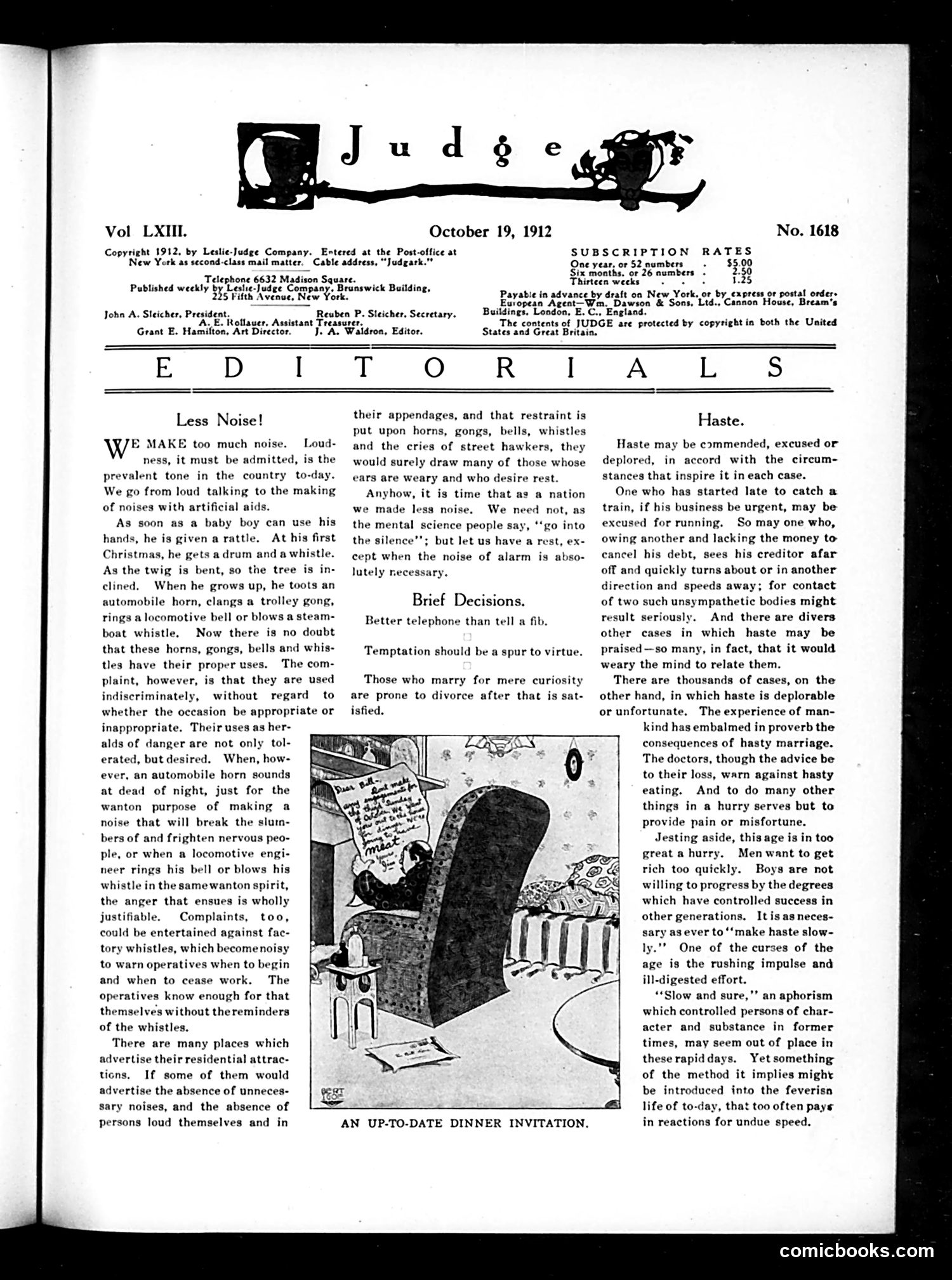
This cartoon satirizes the modern rush and busyness of early 20th-century life. The image shows a woman receiving a dinner invitation via telephone while simultaneously managing multiple domestic tasks—cooking, cleaning, and attending to household duties. The humor lies in the contrast between the formal, leisurely tradition of dinner invitations and the frenetic pace of contemporary society. The accompanying editorial "Less Noise!" and "Haste" complement this theme, criticizing the era's obsession with speed and noise pollution. The editors argue that while progress is valuable, the modern world's constant din and hurried pace create unnecessary stress. The "up-to-date" invitation ironically suggests that even social courtesies cannot escape the modern compulsion toward efficiency and multitasking, reflecting anxieties about industrialization's impact on civilized life.
📄 Transcribed text from this page (OCR, searchable)
Machine-transcribed from the original scan — historical spelling and the odd misread are preserved.
Vol LXIII. Telephone 6632 Madison Square. pany, Brunswick Building, 5 Fifth Avenue, New York. Published weekly by Leslie-Judge Com John A. Sleicher, President. Grant E. Hamilton, Art Director. J. Reuben P. Sleicher, Secretary. A_E. Rotlaver, Assistant Treasurer. A. Waldron, Editor. Judge October 19, 1912 No. 1618 SUBSCRIPTION RATES One year, or 52 numbers ix months, or 26 numbers « Thirteen weeks. ss Payable in advance by draft on New York. or by express or postal order> ‘Wm. Dawson & Sons, Ltd., Cannon House, Bream’s European Agent Buildings. Looden, E. E D T O R Less Noise! WE MAKE too much noise. Loud- ness, it must be admitted, is the prevalent tone in the country to-day. We go from loud talking to the making of noises with artificial aids. As soon as a baby boy can use his hands, he is given a rattle. At his first Christmas, he gets adrum and a whistle. As the twig is bent, so the tree is in- clined. When he grows up, he toots an automobile horn, clangs a trolley gong, rings a locomotive bell or blows a steam- boat whistle. Now there is no doubt that these horns, gongs, bells and whis- tles have their proper uses. The com- plaint, however, is that they are used indiscriminately, without regard to whether the occasion be appropriate or inappropriate. Their uses as her- alds of danger are not only tol- erated, butdesired. When, how- ever, an automobile horn sounds at dead of night, just for the wanton purpose of making a noise that will break the slutn- bers of and frighten nervous peo- ple, or when a locomotive engi- neer rings his bell or blows his whistle in the same wanton spirit, the anger that ensues is wholly justifiable. Complaints, too, could be entertained against fac- tory whistles, which become noisy to warn operatives when to begin and when to cease work. The operatives know enough for that themselves without the reminders of the whistles, There are many places which advertise their residential attrac- ticns. If some of them would advertise the absence of unneces- their appendages, and that restraint is put upon horns, gongs, bells, whistles and the cries of street hawkers, they would surely draw many of those whose ears are weary and who desire rest. Anyhow, it is time that as a nation we made less noise. We need not, as the mental science people say, ‘‘go into the silence’’; but let us have a rest, ex- cept when the noise of alarm is abso- lutely necessary. Brief Decisions. Better telephone than tell a fib. Temptation should be a spur to virtue. Those who marry for mere curiosity are prone to divorce after that is sat- isfied. sary noises, and the absence of persons loud themselves and in AN UP-TO-DATE DINNER INVITATION. States and Great Britain. $5.00 2:50 1.25 England. The contents of JUDGE are protected by copyright in both the United L A S Haste. Haste may be commended, excused or deplored, in accord with the circum- stances that inspire it in each case. One who has started late to catch a train, if his business be urgent, may be excused for running. So may one who, owing another and lacking the money to cancel his debt, sees his creditor afar off and quickly turns about or in another direction and speeds away; for contact of two such unsympathetic bodies might result seriously. And there are divers other cases in which haste may be praised—so many, in fact, that it would weary the mind to relate them. There are thousands of cases, on the other hand, in which haste is deplorable or unfortunate. The experience of man- kind has embalmed in proverb the consequences of hasty marriage. The doctors, though the advice be to their loss, warn against hasty eating. And to do many other things in a hurry serves but to provide pain or misfortune. Jesting aside, this age is in too greata hurry. Men want to get rich too quickly. Boys are not willing to progress by the degrees which have controlled success in other generations. Itisasneces- sary as ever to ‘make haste slow- ly."" One of the curses of the age is the rushing impulse and ill-digested effort. “Slow and sure,’’ an aphorism which controlled persons of char- acter and substance in former times, may seem out of place in these rapiddays. Yet something of the method it implies might be introduced into the feverisn life of to-day, that too often pays in reactions for undue speed. comicbooks.com