
Judge, 1912-10-19 · page 2 of 24
Judge — October 19, 1912 — page 2: what you’re looking at
What you’re looking at
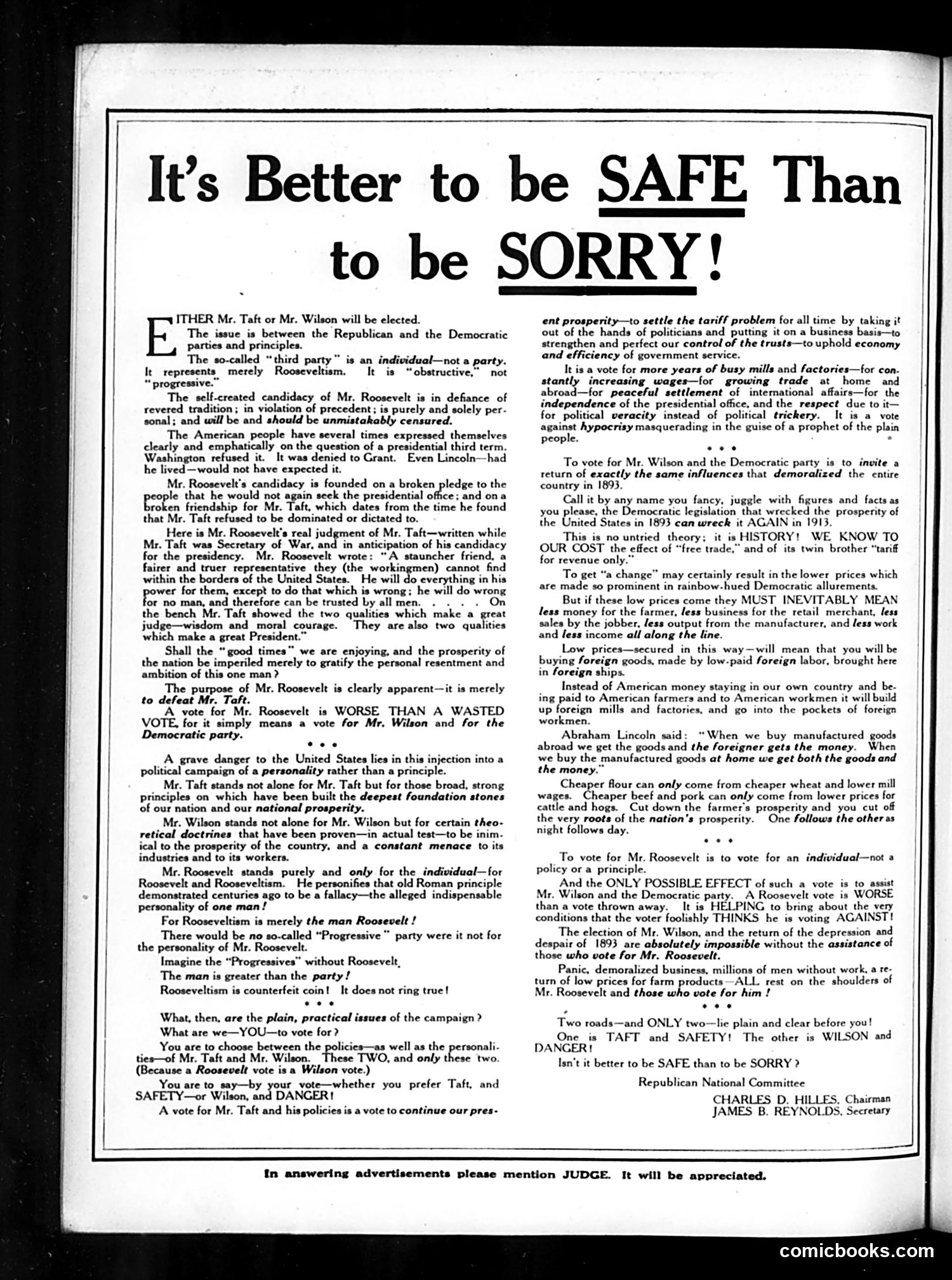
This page is primarily a **Republican National Committee advertisement** (signed by Charles D. Hilles, Chairman), not a satirical cartoon. It's a 1912 campaign piece arguing against Theodore Roosevelt's "Progressive Party" candidacy and promoting William Howard Taft for president. The text attacks Roosevelt as "merely Rooseveltianism" and claims his third-party run splits the Republican vote, benefiting Democrat Woodrow Wilson. It frames the choice as "Taft and Safety" versus "Roosevelt and Wilson and Danger." The advertisement uses economic arguments—tariffs, factory jobs, lower prices—to convince readers that Taft represents stability while Roosevelt represents recklessness. The "Judge" magazine platform gave Republicans space for this direct political messaging rather than satire.
📄 Transcribed text from this page (OCR, searchable)
Machine-transcribed from the original scan — historical spelling and the odd misread are preserved.
It’s Better to be SAFE Than to be SORRY! ITHER Mr. Taft or Mr. Wilson will be elected. The issue is between the Republican and the Democratic parties and principles. The so-called “third party” is an individual—not a party. It represents merely Rooseveltism. —_It “obstructive,” not * progressive. The self-created candidacy of Mr. Roosevelt is in defiance of revered tradition ; in violation of precedent; is purely and solely per- sonal; and will be and should be unmistakably censured. The American people have several times expressed themselves clearly and emphatically on the question of a presidential third term. Washington refused it. It was denied to Grant. Even Lincoln—had he lived—would not have expected it. Mr. Roosevelt's candidacy is founded on a broken pledge to the le that he would not again seek the presidential ofhce; and ona Broken friendship for Mr. Taft, which dates from the time he found that Mr. Taft refused to be dominated or dictated to. Here is Mr. Roosevelt's real judgment of Mr. Taft—written while Mr. Taft was Secretary of W. in anticipation of his candidacy for the presidency. Roosevelt wrote: “A stauncher friend, a fairer and truer vepresentative they (the workin; kingmen) cannot fod everything in his ¢ will do wrong On within the borders of the United States. He will wer for them, except to do that which is wron; Fe no man, and therefore can be trusted by all men. the bench Mr. Taft showed the two qualities which make a “great judge—wisdom and moral courage. They are also two qualities which make a great President Shall the “good times” we are enjoying, and the prosperity of the nation be imperiled merely to gratify the personal resentment and ambition of this one man? The purpose of Mr. Roosevelt is clearly apparent—it is merely to defeat Mr. Taft. A vote for Mr. Roosevelt is WORSE THAN A WASTED VOTE, for it simply means a vote for Mr. Wilson and for the Democratic party. A grave danger to the United States lies in this injection into a political campaign of a personality rather than a principle. Mr. Taft stands not alone for Mr. Taft but for those broad, strong principles on which have been built the deepest foundation stones of our nation and our national prosperity. Mr. Wilson stands not alone for Mr. Wilson but for certain theo- retical doctrines that have been proven—in actual test—to be inim- ical to the prosperity of the country, and a constant menace to its industries and to its workers. Mr. Roosevelt stands purely and only for the fodisiduel for Roosevelt and Rooseveltism. He personifies that old Roman princi, demonstrated centuries ago to be a fallacy—the alleged aeeeetis personality of one man! For Rooseveltism is merely the man Roosevelt ! There would be no so-called “Progressive” party were it not for the personality of Mr. Roosevelt. Imagine the “Progressives” without Roosevelt, The man is greater than the party! Rooseveltism is counterfeit coin! It does not ring true! eee What, then, are the plain, practical issues of the campaign > What are we—YOU—to vote for? You are to choose between the policies—as well as the ronal ties—of Mr, Taft and Mr. Wilson. ese TWO, and only these two. (Because a Roosevelt vote is a Wilson vote.) You are to say—by your vote—whether you prefer Taft, and SAFETY—or Wilson, and DANGER! A vote for Mr. Taft and his policies is a vote to continue our pres- ent prosperity—to settle the tariff problem for all time by taking it out of the hands of politicians and putting it on a business basis—to strengthen and perfect our control of the trusts—to uphold economy and efficiency of government service. It is a vote for more years of busy mills and factories—for con. stantly increasing wages—for growing trade at home and abroad—for peaceful settlement of international affairs—for the independence of the presidential office, and the respect due to it— for political veracity instead of political trickery. It is a vote against hypocrisy masquerading in the guise of a prophet of the plain people. eee To vote for Mr. Wilson and the Democratic party is to invite a return of exactly the same influences that demoralized the entire country in 1893. Call it by any name you fancy, juggle with figures and facts as you please, the Democratic legislation that wrecked the prosperity of the United States in 1893 can wreck it AGAIN in 1913. This is no untried theory; it is HISTORY! WE KNOW TO OUR COST the effect of “free trade,” and of its twin brother “tariff for revenue only.” To get “a change” may certainly result in the lower prices which are made so prominent in rainbow-hued Democratic allurements. But if these low prices come they MUST INEVITABLY MEAN fess money for the farmer, less business for the retail merchant, less sales by the jobber, /ess output from the manufacturer, and less work and fess income all along the line. Low prices—secured in this way—will mean that you will be buying foreign goods, made by low-paid foreign labor, brought here in foreign ships. Instead of American money staying in our own country and be- ing paid to American farmers and to American workmen it will build up foreign mills and factories, and go into the pockets of foreign workmen. Abraham Lincoln said: “When we buy manufactured goods abroad we get the goods and the foreigner gets the money. When we buy the manufactured goods at home we get both the goods and the money. Choepet flour can only come from cheaper wheat and lower mill wages. Cheaper beef and pork can only come from lower prices for cattle and hogs. Cut down the farmer's prosperity and you cut o! the very roots of the nation’s prosperity. One follows the otheras night follows day. eee To vote for Mr. Roosevelt is to vote for an individual—not a policy or a principle. And the ONLY POSSIBLE EFFECT of such a vote is to assist Mr. Wilson and the Democratic party. A Roosevelt vote is WORSE than a vote thrown away. It is HELPING to bring about the very conditions that the voter foolishly THINKS he is voting AGAINST! The election of Mr. Wilson, and the return of the depression and despair of 1893 are absolutely impossible without the assistance of those who vote for Mr. Roosevelt. Panic, demoralized business, millions of men without work, a re- turn of low prices for farm products ALL rest on the shoulders of Mr. Roosevelt and those who vote for him ! eee Two roads—and ONLY two—lie plain and clear before you! One_is TAFT and SAFETY! The other is WILSON and DANGER! Isn’t it better to be SAFE than to be SORRY ? Republican National Committee CHARLES D, HILLES, Chairman JAMES B. REYNOLDS, Secretary In answering advertisements please mention JUDGE. It will be appreciated. comicbooks.com