
A complete issue · 24 pages · 1912
Judge — August 24, 1912
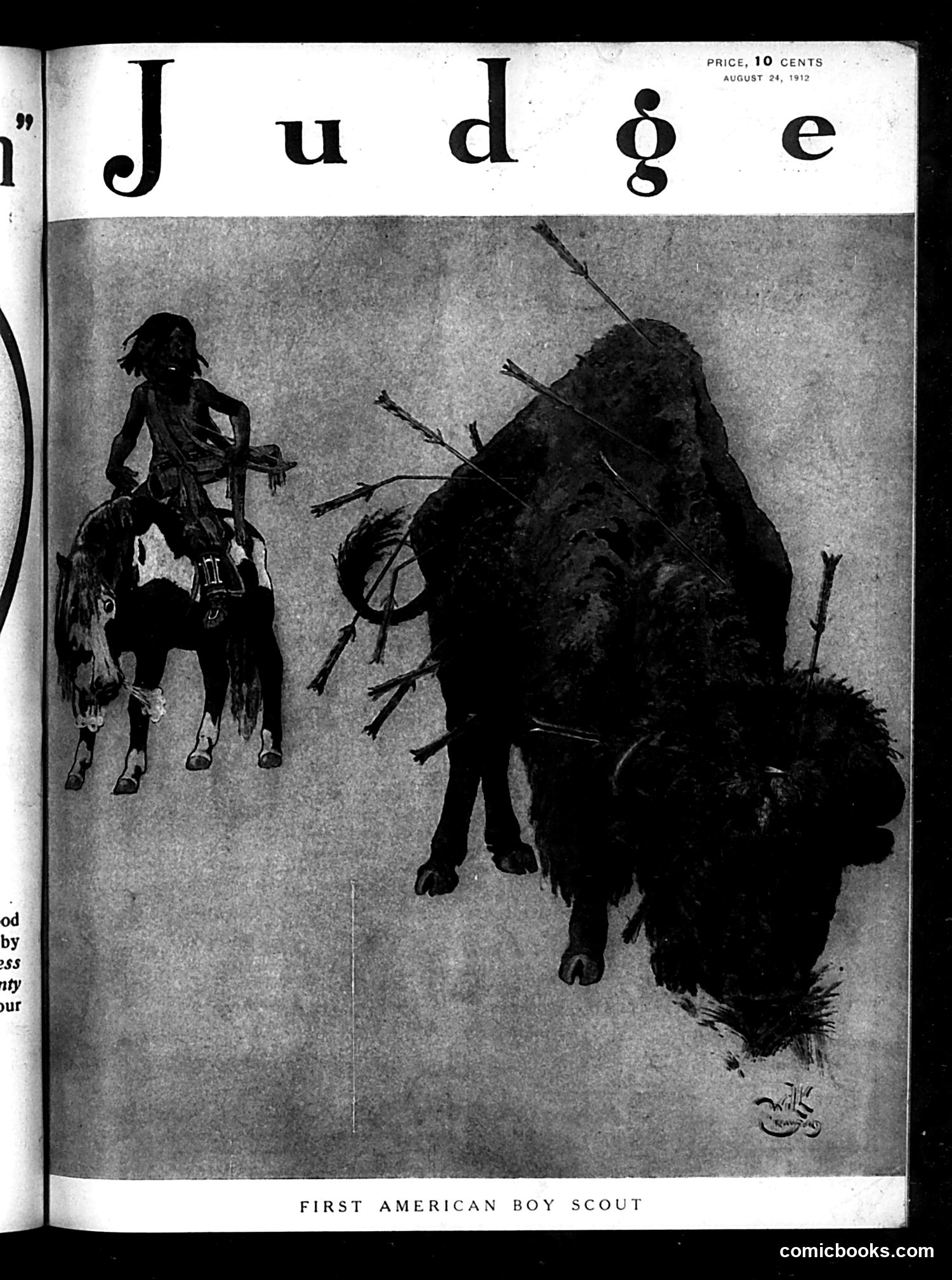
This illustration titled "First American Boy Scout" satirizes the newly established Boy Scout movement in America. The image depicts a Native American scout on horseback alongside a young white Boy Scout, establishing a visual comparison between authentic frontier scouts and the new organization's members. The satire likely critiques the Boy Scouts' romanticized portrayal of American frontier life and scout tradition. By juxtaposing an actual Native American with a costumed boy scout, the cartoon suggests the artificiality or inauthenticity of the movement's attempt to recapture "frontier spirit" through uniforms and organized programs. The 1912 date places this during the Boy Scouts of America's founding years, making it commentary on this rapidly growing youth organization's cultural pretensions.
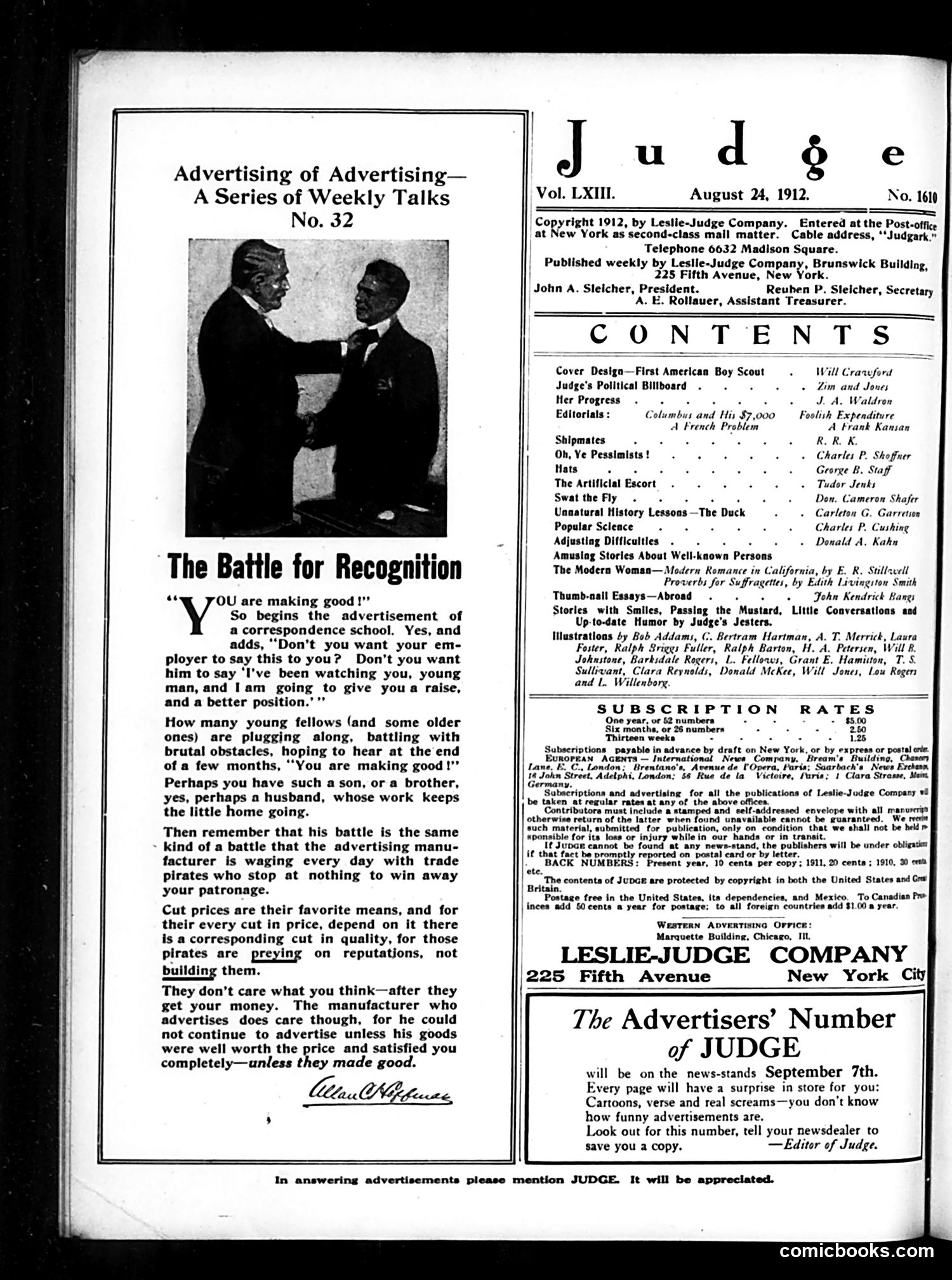
This page is primarily an **advertisement** for a correspondence school, disguised as editorial content. The image shows two men in business attire, with the larger figure appearing to mentor or supervise the smaller one. The ad's argument uses commercial warfare as metaphor: just as manufacturers must continuously advertise to maintain market share and reputation, individuals must continually self-promote to achieve career advancement. The phrase "You are making good!" frames workplace success as dependent on visible, consistent self-promotion rather than merit alone. This reflects early-20th-century anxieties about **corporate competition and personal advancement** during American industrialization. The advertisement essentially sells the idea that self-marketing and visibility are essential survival skills in modern business culture.
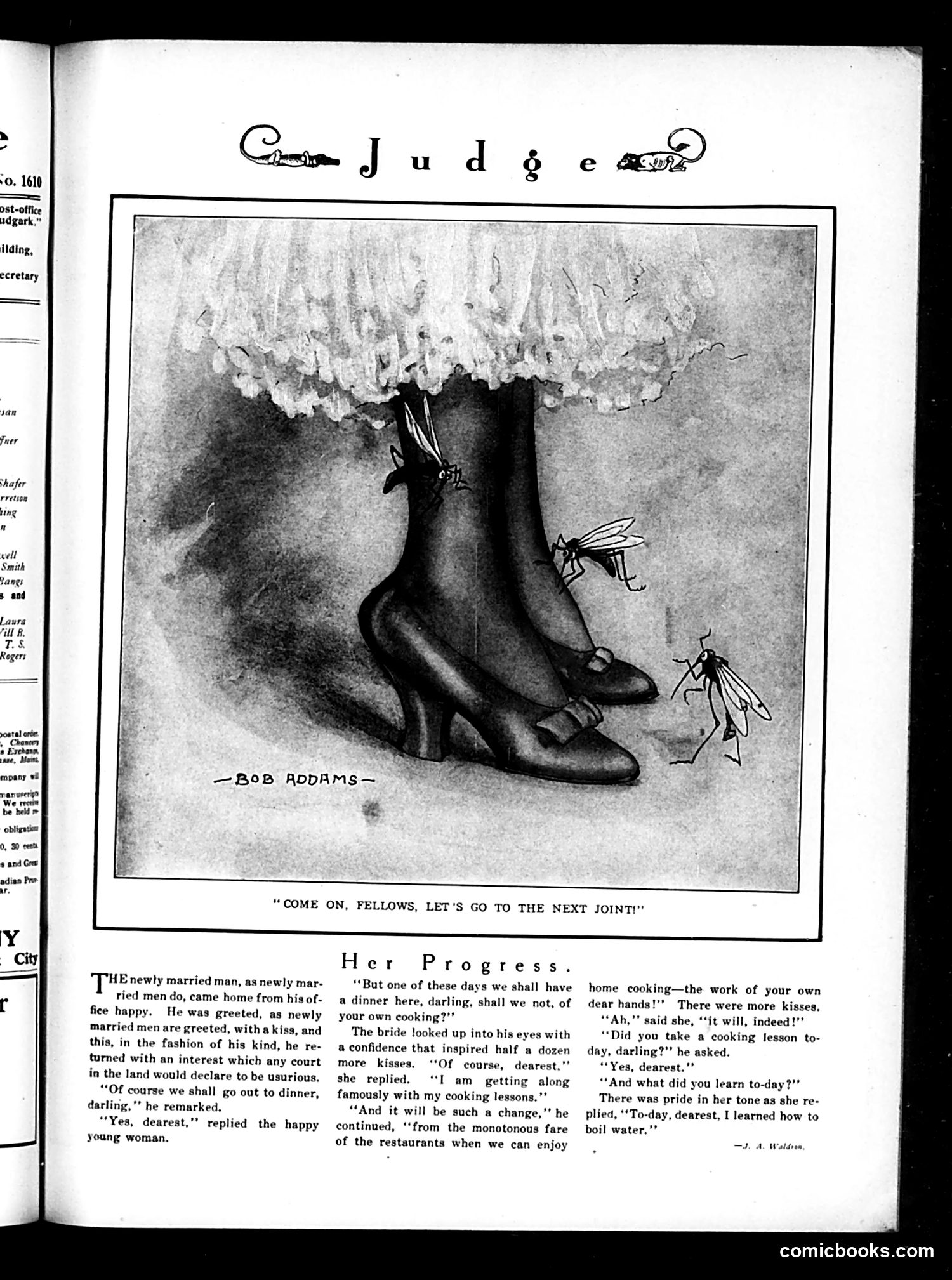
This cartoon satirizes early 20th-century gender roles and marriage expectations. It depicts a newly married woman's supposed "progress" from housewife aspirations to domestic reality. The visual joke shows insects (flies, grasshoppers) approaching women's feet—likely representing unwanted pests in the home—while the woman stands amid lace and fancy boots, suggesting domestic ideals. The accompanying story reveals the satire's target: a groom expects his new bride to progress from restaurant dining to home cooking. The wife initially promises to learn cooking but ends with the droll admission "Today, dearest, I learned how to boil water"—undermining her husband's optimistic assumptions about her domestic transformation. The cartoon mocks both newlyweds' naive expectations about marriage and domestic labor.
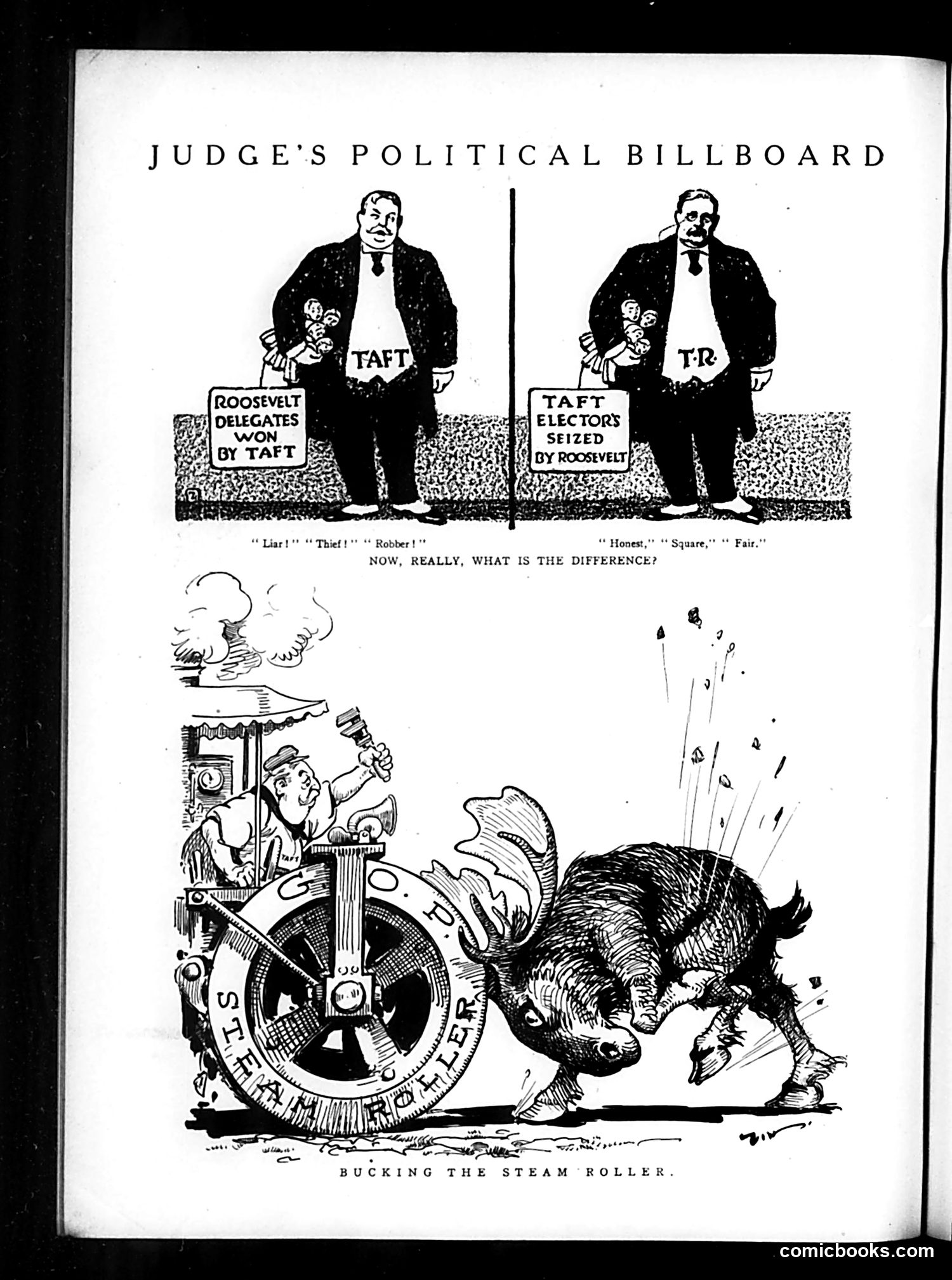
This 1912 cartoon critiques the 1912 U.S. presidential split. The top panel compares Taft and Roosevelt as interchangeable figures—both accused of electoral misconduct ("Roosevelt delegates won by Taft" vs. "Taft electors seized by Roosevelt"). The caption "Now, really, what is the difference?" sarcastically suggests both candidates are equally corrupt, undermining their moral authority. The bottom cartoon, "Bucking the Steam Roller," depicts an elephant (Republican Party symbol) bucking wildly, struggling against the party machinery. This references Roosevelt's failed Progressive "Bull Moose" Party challenge to incumbent Taft, showing the Republican Party fracturing violently. The satire suggests both the establishment and reformers are caught in destructive internal conflict, with neither side claiming legitimacy.
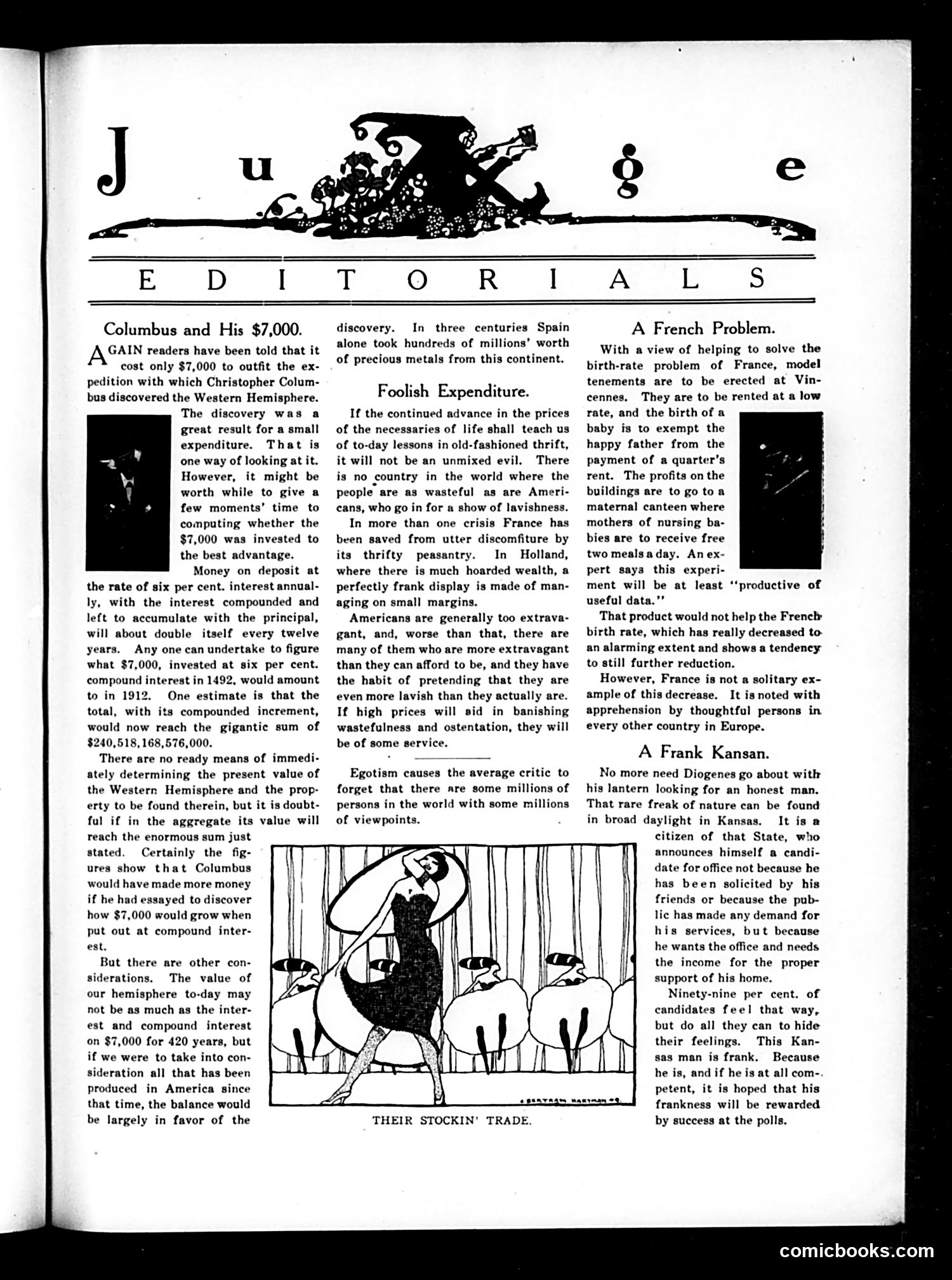
This cartoon satirizes stock market speculation and financial manipulation. The image depicts a figure (likely representing a stock promoter or speculator) hanging from a noose-like structure while manipulating puppet-like figures below labeled as investors or the public. The visual metaphor suggests that stock trading is a dangerous, risky enterprise where ordinary people are manipulated by those controlling the market. The title "Their Stockin' Trade" is a pun on "stock-in-trade" (one's habitual business), playing on the word "stocking" to reference both stockings and the stock market. This reflects Progressive Era concerns about financial fraud, market manipulation, and the vulnerability of average Americans to schemes promoted by wealthy speculators during the Gilded Age.
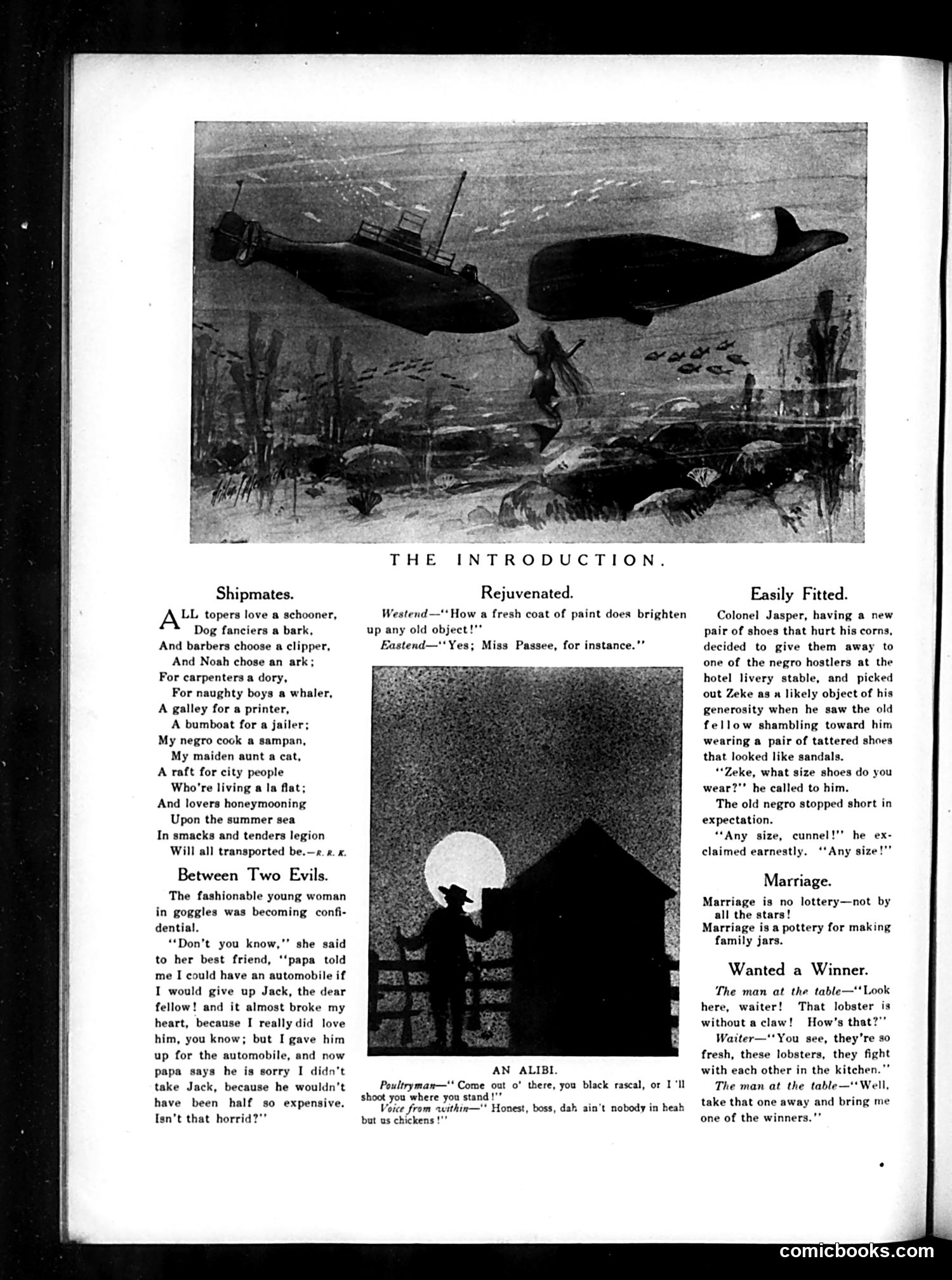
This page from *Judge* contains several satirical vignettes typical of the era's humor: **"The Introduction"** (top illustration): Shows an underwater scene with a submarine and whale, satirizing transportation methods through wordplay—a visual pun on different vessel types mentioned in the accompanying verse. **"Between Two Evils"**: Mocks wealthy women's materialism, depicting a fashionable young woman who abandoned her romantic love for an automobile—framing modern consumerism as morally corrupting. **"Easily Fitted"** and **"An Alibi"**: Feature dialect-heavy racial caricatures of Black men ("negro" servants), reflecting the era's casual racist humor. Colonel Jasper gives away worn shoes; a poultry farmer chases a Black worker from a henhouse. **"Marriage"** and **"Wanted a Winner"**: Contain domestic humor and restaurant jokes. The page reflects *Judge's* satirical targets: modern technology's social disruption, class pretension, and reliance on racist stereotypes considered acceptable period humor. Context crucial for modern readers: the casual racial mockery represents historical attitudes, not editorial endorsement by today's standards.
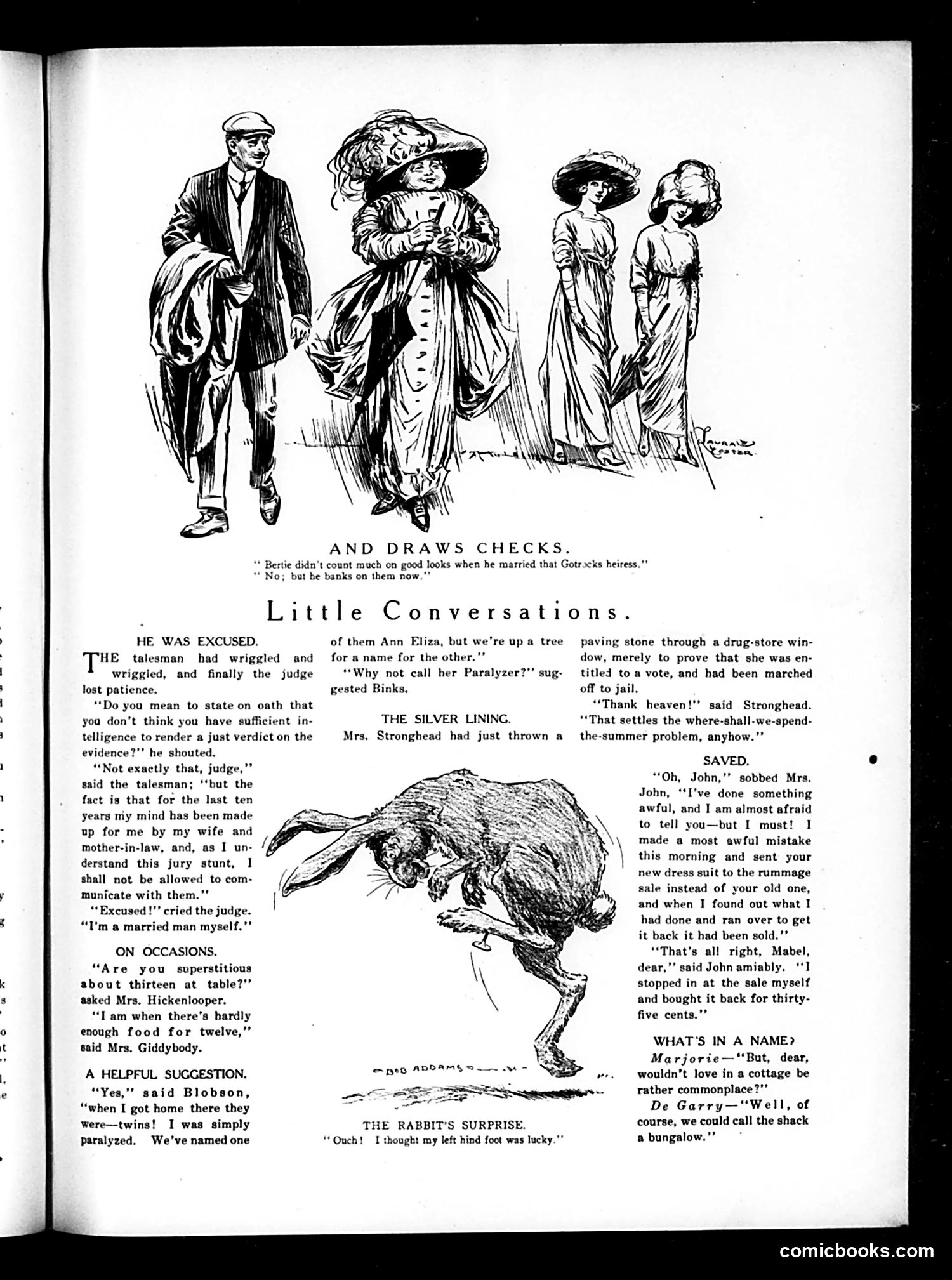
This page contains several short humorous anecdotes satirizing early 20th-century domestic life and social issues. **Key satirical points:** - **"And Draws Checks"**: Mocks marriages between American heiresses and European aristocrats (likely referencing the "Gotrocks" wealthy family type), suggesting such men marry for money rather than looks. - **Jury Excusal**: The joke ridicules married men's lack of independent thought—a juror claims he cannot decide anything without consulting his wife and mother-in-law, leading the judge (himself married) to sympathize and excuse him. - **Women's Suffrage Reference**: "The Silver Lining" appears to reference militant suffragette tactics (throwing stones through windows to protest voting rights), with the husband viewing his wife's jail sentence as solving his summer vacation dilemma. - **General Theme**: These vignettes mock domestic dynamics where wives control husbands financially and intellectually, and critique women's activist methods. The humor relies on anti-feminist assumptions typical of the era. The rabbit illustration appears decorative rather than narrative-driven.
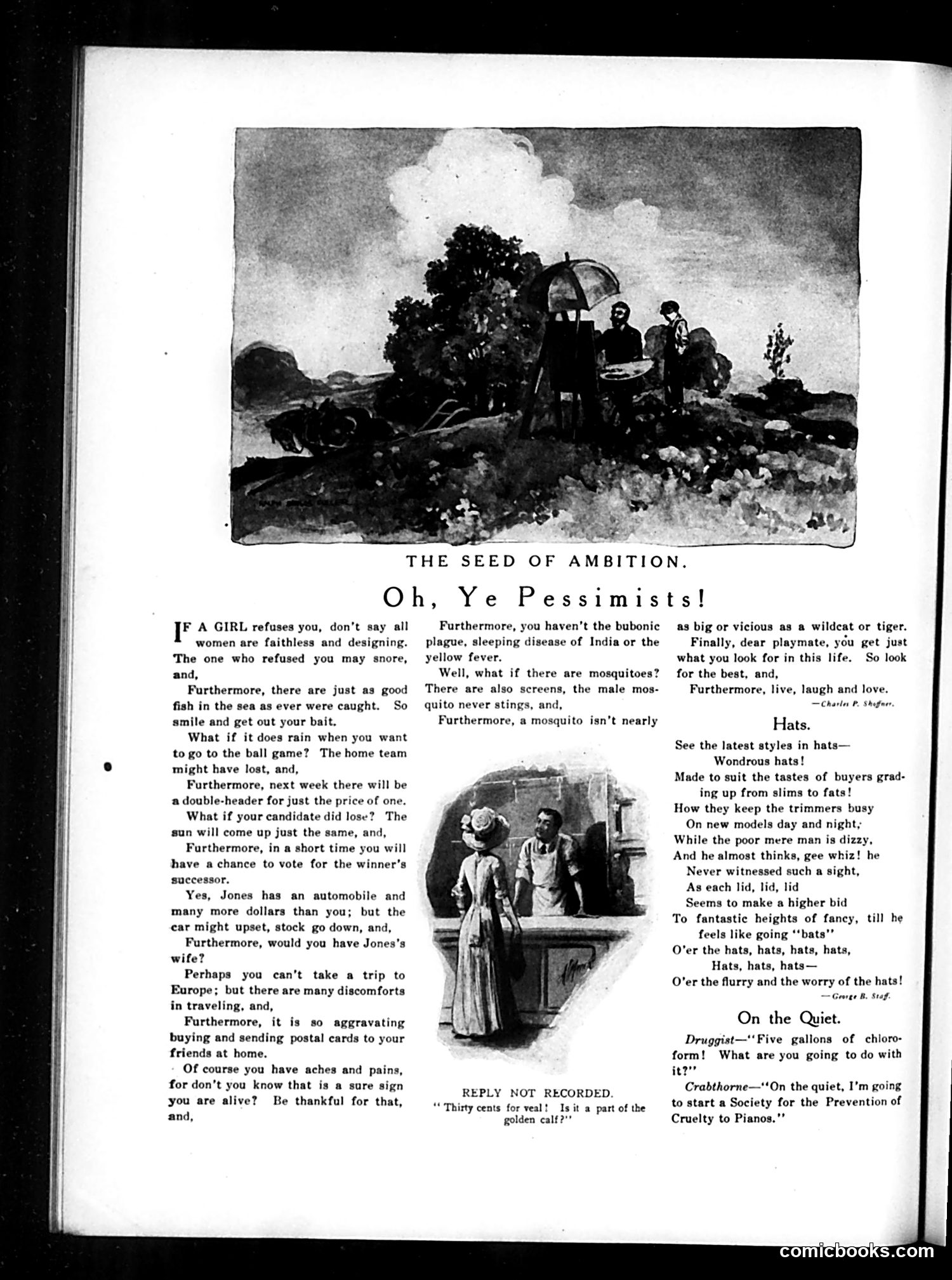
This Judge magazine page contains satirical advice and humor targeting turn-of-the-century American attitudes. **"Oh, Ye Pessimists!"** is a mock-earnest essay that sardonically responds to life's disappointments by insisting readers find silver linings. It employs exaggerated logic—if a girl rejects you, at least there are other fish; if it rains, the team might have lost anyway. The cumulative effect ridicules both pessimism *and* forced optimism, suggesting the author views this relentless positivity as naive or delusional. **The other items** are period advertising and jokes: a "Hats" advertisement emphasizing extravagant millinery trends; and a brief comic exchange ("On the Quiet") where someone purchases chloroform "on the quiet" to start a "Society for the Prevention of Cruelty to Pianos"—likely mocking both amateur musicians and earnest reformist societies. The "Reply Not Recorded" vignette appears to mock food price inflation, with a customer incredulous at veal costs. Overall, the page satirizes American materialism, romantic naiveté, fashion excess, and social reform movements through gentle mockery.
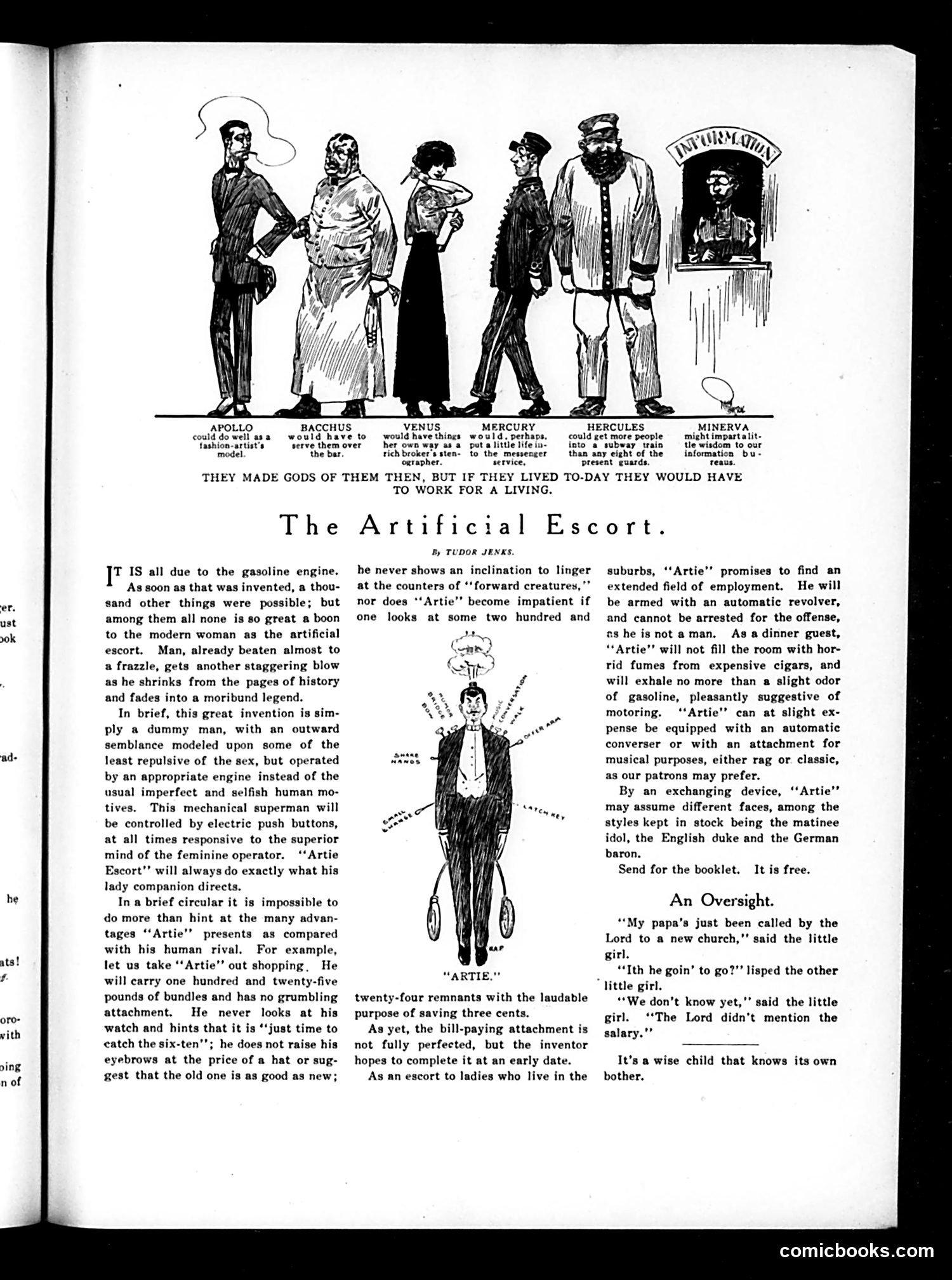
This page satirizes early 20th-century anxieties about women's independence and changing gender roles. The top cartoon reimagines classical gods as modern workers—Apollo as a bartender, Venus as a shop owner, Minerva advising information bureaus—suggesting that even divine beings would need to "work for a living" in the modern age. The main article mocks the "artificial escort," a mechanical man powered by a gasoline engine, controlled by electric buttons operated by women. The satire targets several fears: that women are rejecting real men, that mechanization threatens male authority, and that women prioritize convenience over genuine relationships. The humor assumes readers share anxiety about women gaining economic and social power. The brief joke at bottom ("The Lord didn't mention the salary") extends the satire to clergy, suggesting widespread anxiety about economic instability and changing institutional values in this era of rapid industrialization.
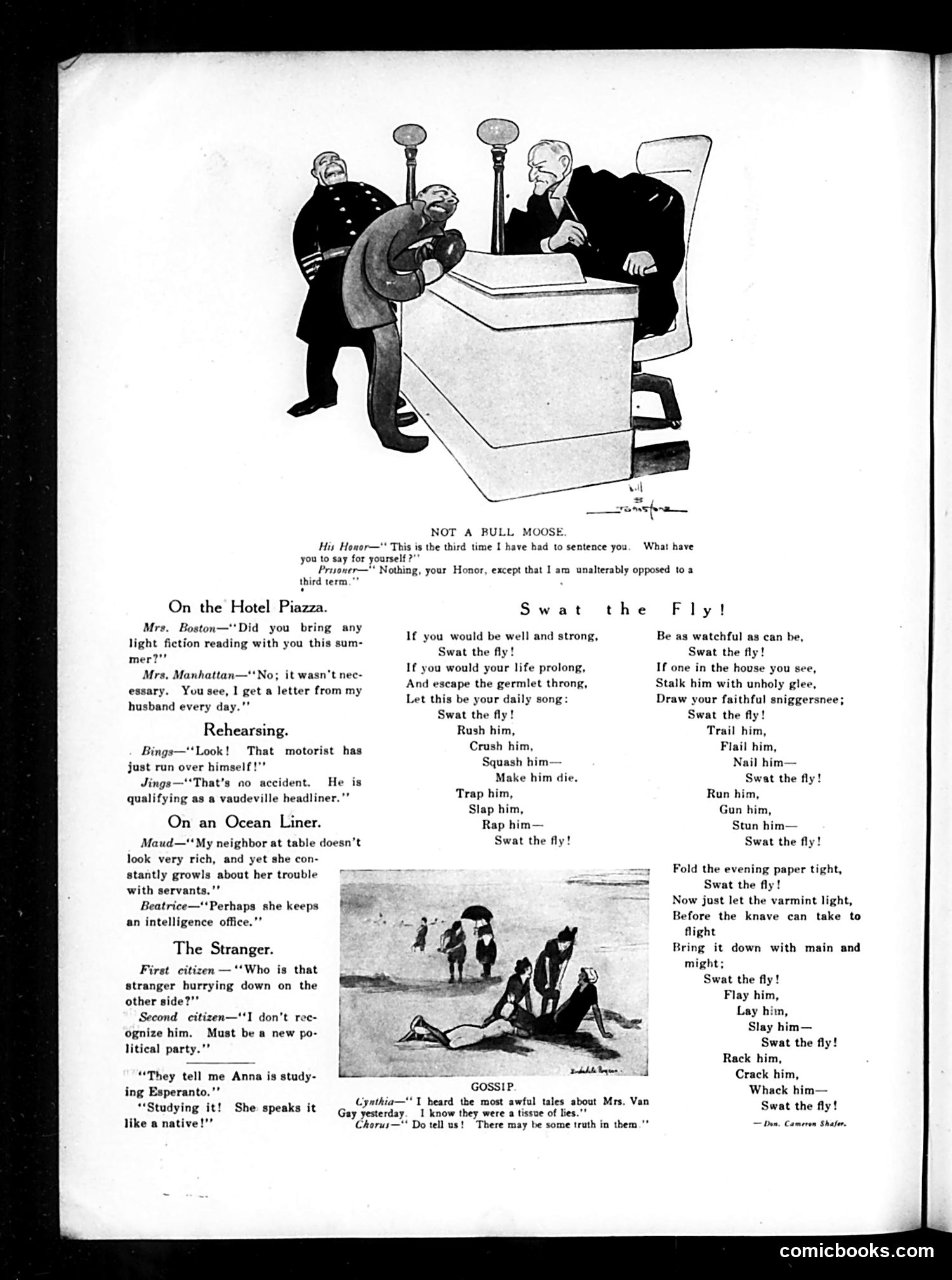
The top cartoon satirizes a repeat offender claiming opposition to a "third term"—likely referencing Theodore Roosevelt's 1912 Bull Moose Party campaign for a third presidential term. The prisoner's invocation of anti-third-term sentiment as his defense is absurd; the judge has sentenced him three times for crimes, not politics. The remaining content consists of brief humorous anecdotes about social life (wealthy women complaining about servants, gossipy neighbor conversations) and a lengthy poem titled "Swat the Fly!" emphasizing public health through fly-killing—reflecting early 20th-century disease-prevention campaigns linking flies to illness transmission. The single photograph shows people on a beach, though its relevance to the page's text is unclear. Overall, this appears to be a typical Judge magazine mix of political humor, social commentary, and public-health advocacy, typical of the magazine's satirical approach to contemporary American life.
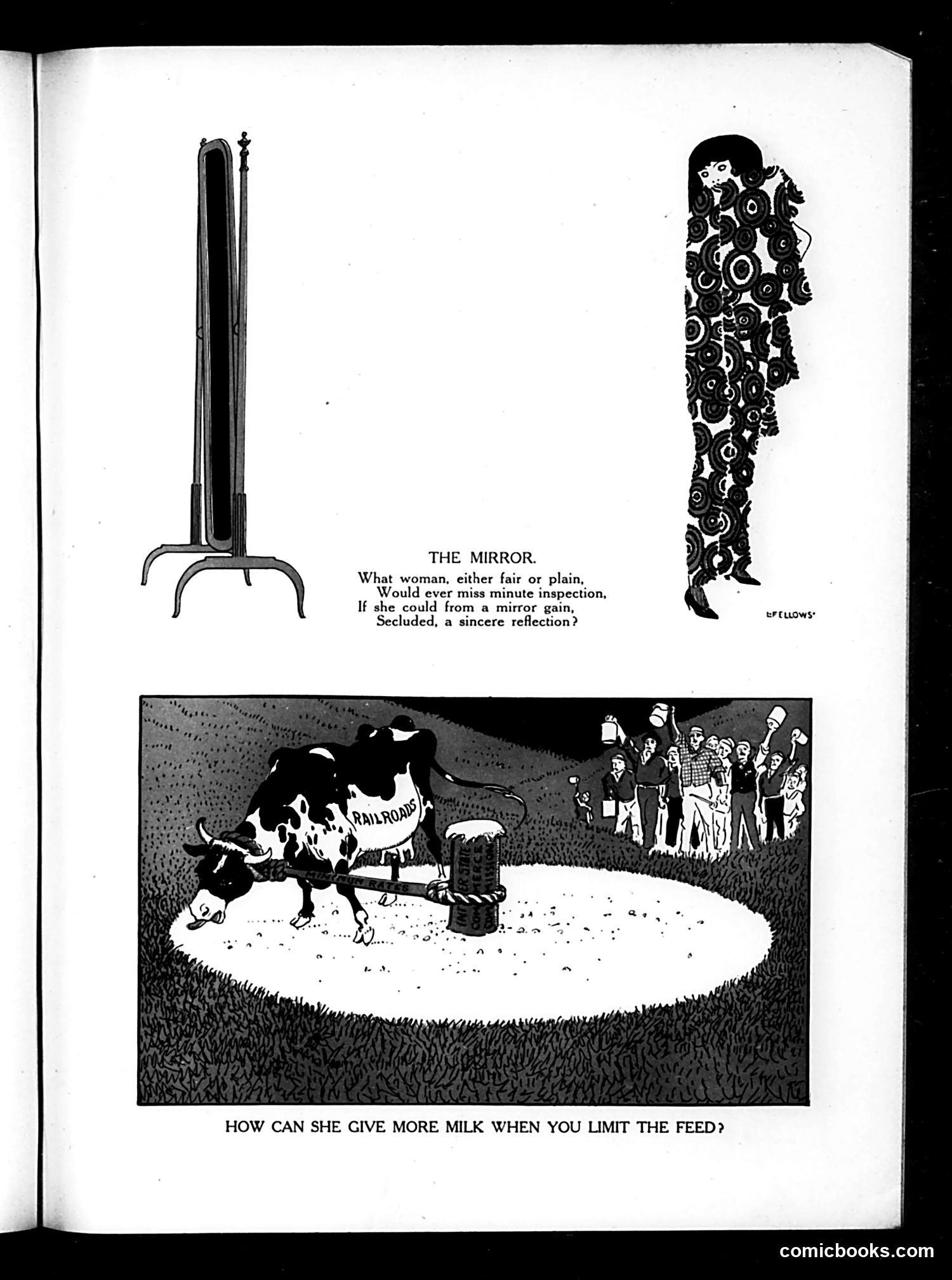
This page contains two distinct satirical pieces from *Judge* magazine. **"The Mirror"** (top) is a vanity-themed poem paired with illustrations of a standing mirror and a fashionably dressed woman, humorously suggesting women's obsession with self-inspection. **"How Can She Give More Milk When You Limit the Feed?"** (bottom) is a political cartoon depicting a cow labeled "RAILROAD" being milked by observers while appearing malnourished. The caption's rhetorical question appears to critique unrealistic expectations—likely satirizing either railroad companies pressured to increase profits while underfunded, or regulatory bodies demanding increased productivity without providing adequate resources. The crowd of onlookers represents stakeholders or the public demanding returns from a struggling enterprise. The cartoon's point: you cannot extract more output from a system starved of necessary resources.
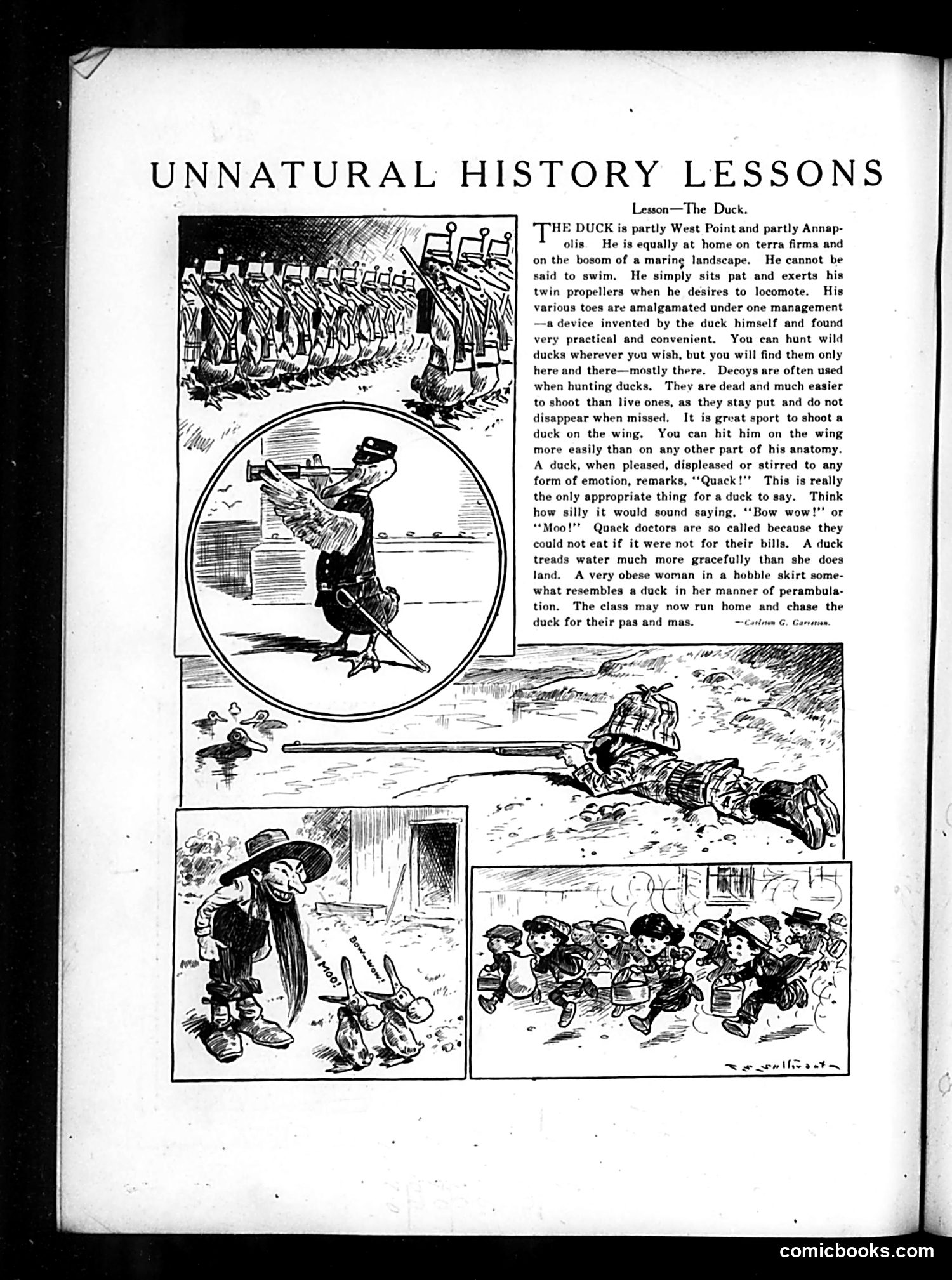
This is a humorous mock-educational piece satirizing pseudo-scientific explanations of animal behavior. The text delivers absurdist "facts" about ducks—claiming they're hybrids of West Point and Annapolis (military academies), that they "sit pat" rather than swim, and that their toes are "amalgamated" under one management. The satire's main target appears to be the fashion of the era: the text compares an "obese woman in a hobble skirt" to a duck's awkward waddling locomotion. Hobble skirts (restrictive skirts that forced women to take tiny steps) were a contemporary fashion trend, and the joke mocks both the garment's impracticality and women who wore them. The illustrations show hunters shooting ducks and children chasing them—visual gags accompanying the deadpan, faux-scientific commentary. The overall effect ridicules both pseudo-intellectual animal descriptions and women's fashionable but absurd clothing choices.
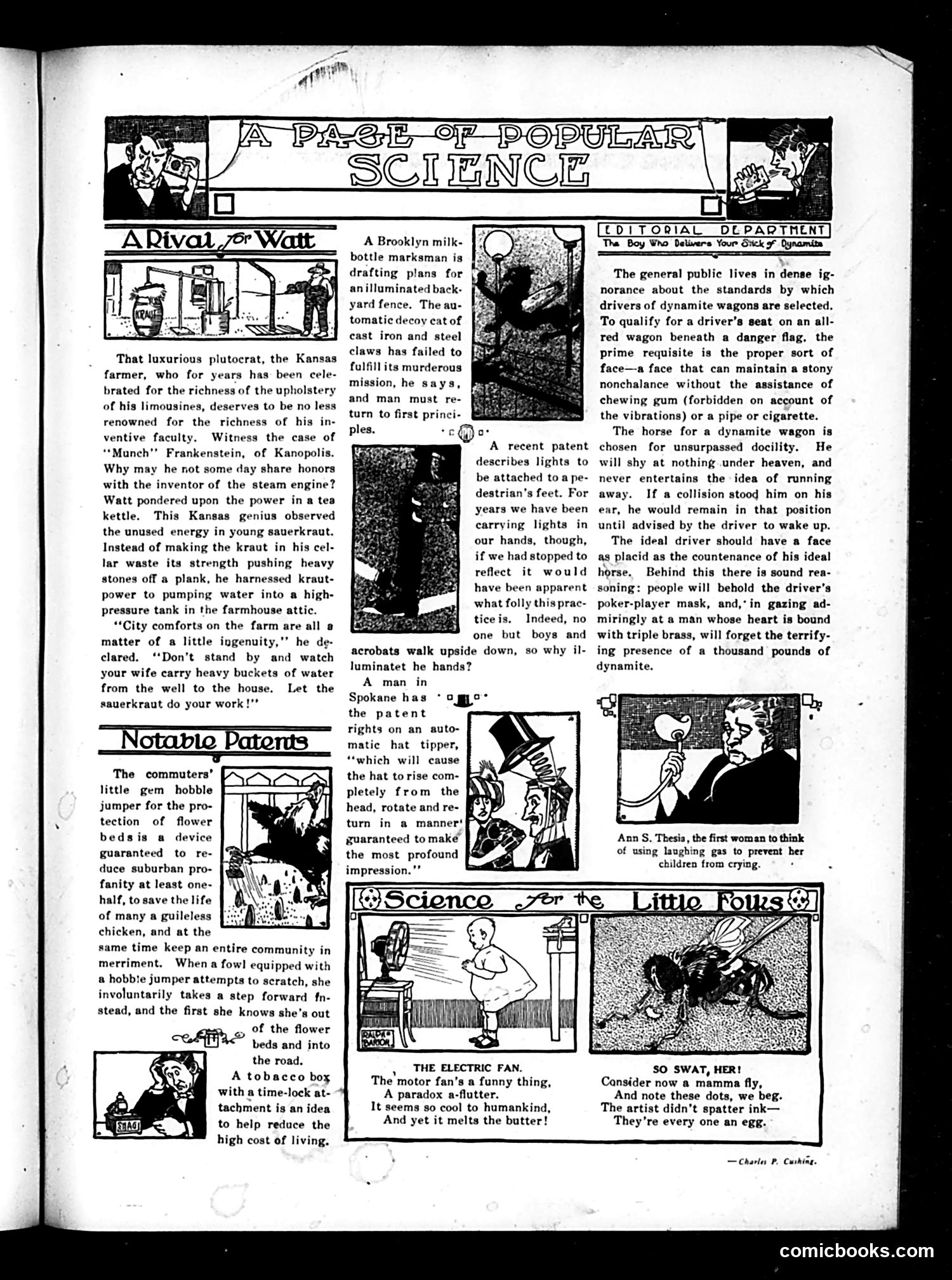
This page satirizes absurd patent inventions and impractical innovations through mock-serious commentary. The humor targets wealthy, ingenious amateurs inventing nonsensical devices: **Key satires include:** - A Kansas farmer powering farm equipment with fermented sauerkraut energy (mocking pseudo-scientific thinking) - A "hobble jumper" device for chickens to prevent them scratching flower beds - An automatic hat-tipper for making "profound impressions" - Lights attached to pedestrians' feet instead of hands - A time-locked tobacco box to reduce spending The "Dynamite Wagon Driver" section shifts tone, seriously praising the emotional composure required for dangerous work—likely contrasting sensible necessities with the frivolous inventions above. **The Electric Fan joke** plays on paradox: fans cool people but melt butter through vibration. Overall, Judge mocks the Gilded Age obsession with mechanical "progress" and labor-saving inventions, suggesting inventors were disconnected from practical reality and wasting ingenuity on absurdities.
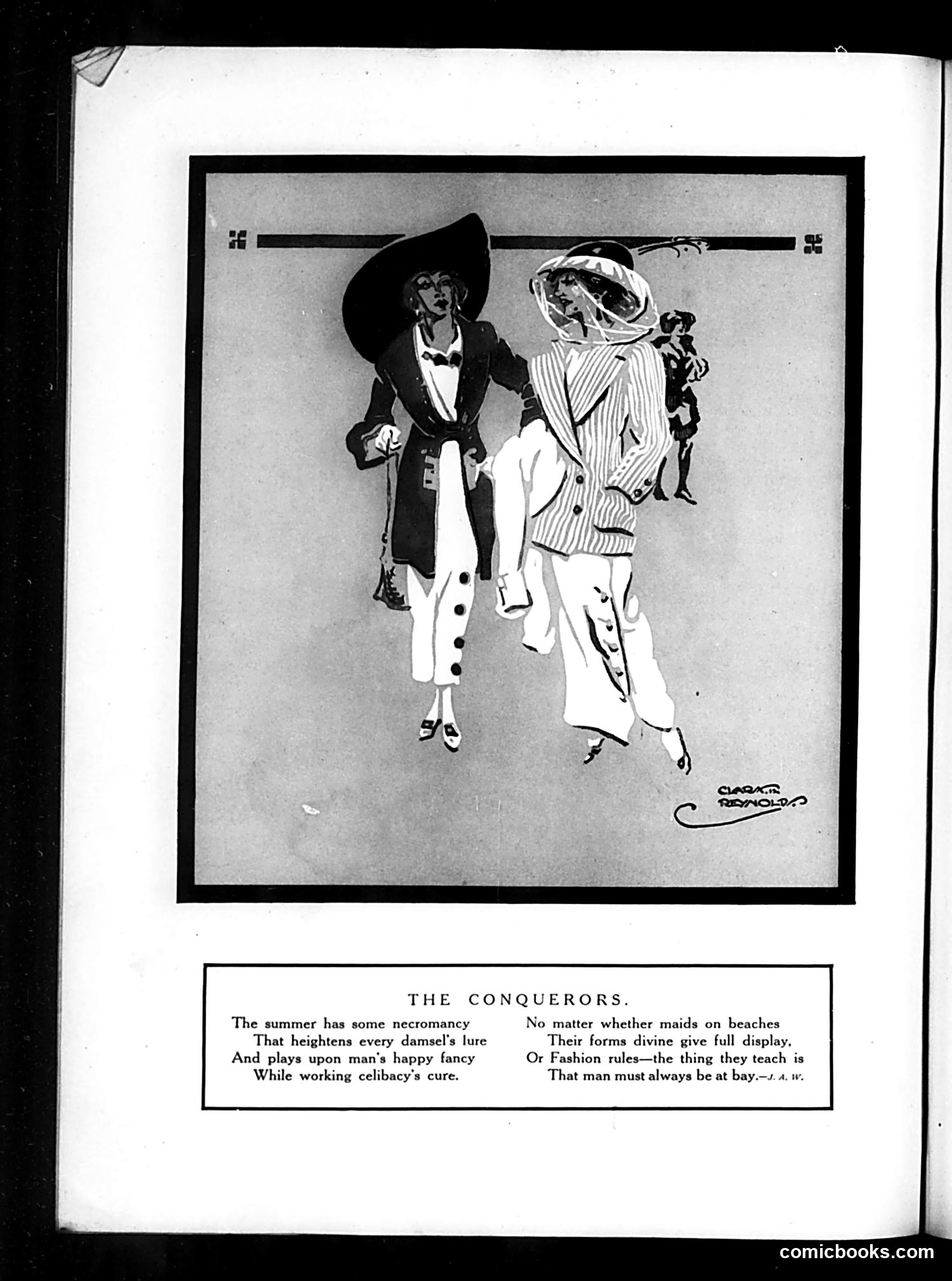
This satirical cartoon depicts two fashionably dressed women in 1910s-era beach attire, styled as confident "conquerors." The accompanying verse, credited to Y.A.W., offers social commentary on gender dynamics and summer romance. The satire targets the tension between male desire and female power. The poem suggests that summer heightens women's sexual appeal ("heightens every damsel's lure"), yet women—through fashion rules and strategic behavior—maintain control, keeping men at a distance ("man must always be at bay"). The illustration emphasizes women's deliberate display of their bodies while maintaining emotional distance, suggesting that female attractiveness itself becomes a tool of power and conquest. The cartoon satirizes both male vulnerability to female charm and women's calculated use of fashion and appearance as instruments of social dominance. This reflects early 20th-century anxieties about shifting gender relations and women's growing independence.
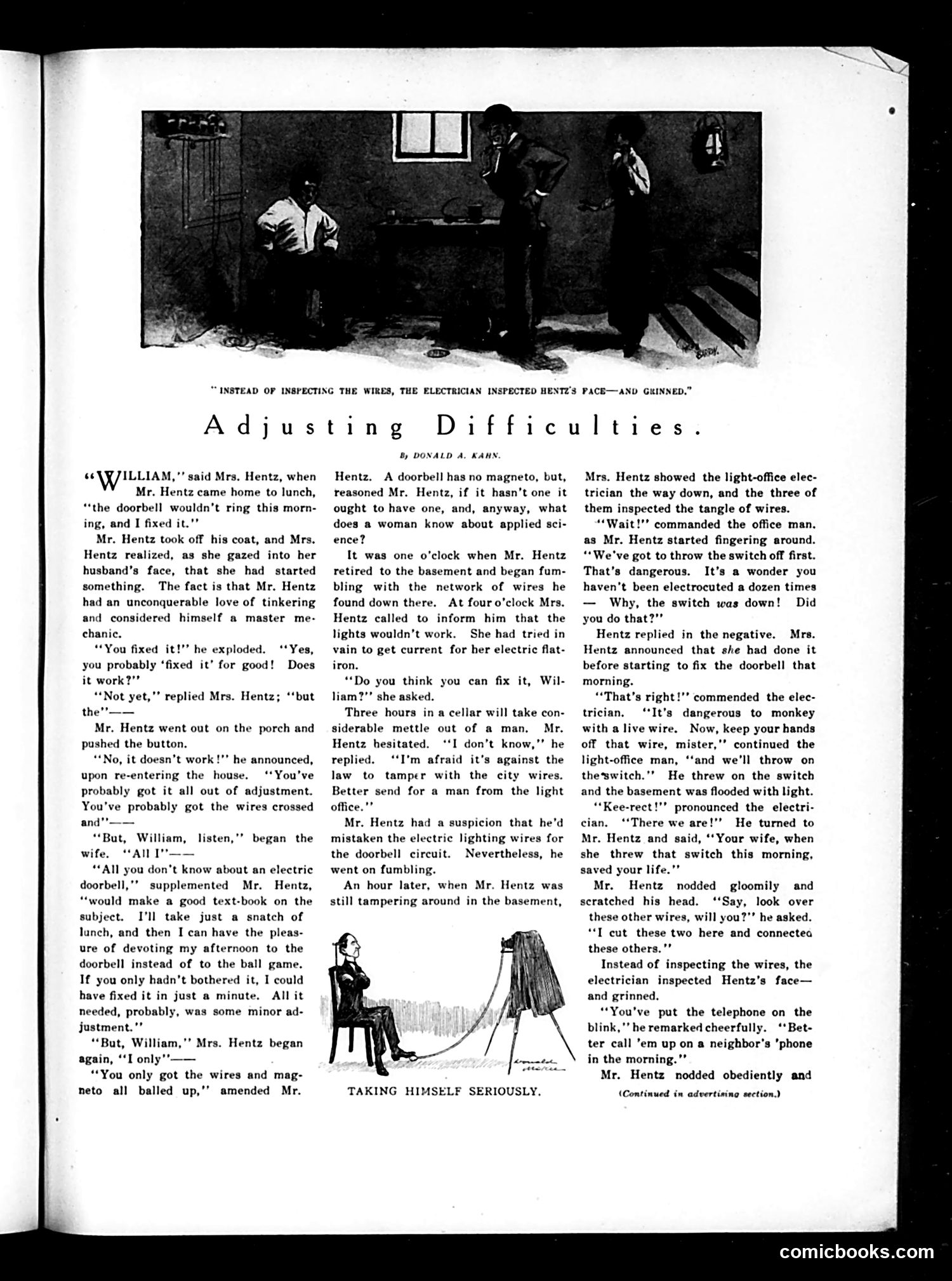
This humorous story satirizes the overconfident amateur tinkerer—a common figure in early 20th-century American life. Mr. Hentz, convinced of his mechanical mastery, decides to repair a broken doorbell despite having no actual expertise. His fumbling extends to the house's electrical wiring, where he dangerously disconnects live wires. The satire's punch comes at the end: while Hentz takes himself seriously as a capable handyman, his wife—whom he dismisses as ignorant about "applied science"—actually saves his life by prudently switching off the current. The electrician's grin upon inspecting Hentz's face (rather than the wires) suggests he recognizes the irony: the woman Hentz patronized is the competent one, while his masculine pride nearly got him killed. The joke mocks male arrogance and the dangers of unqualified DIY attempts.
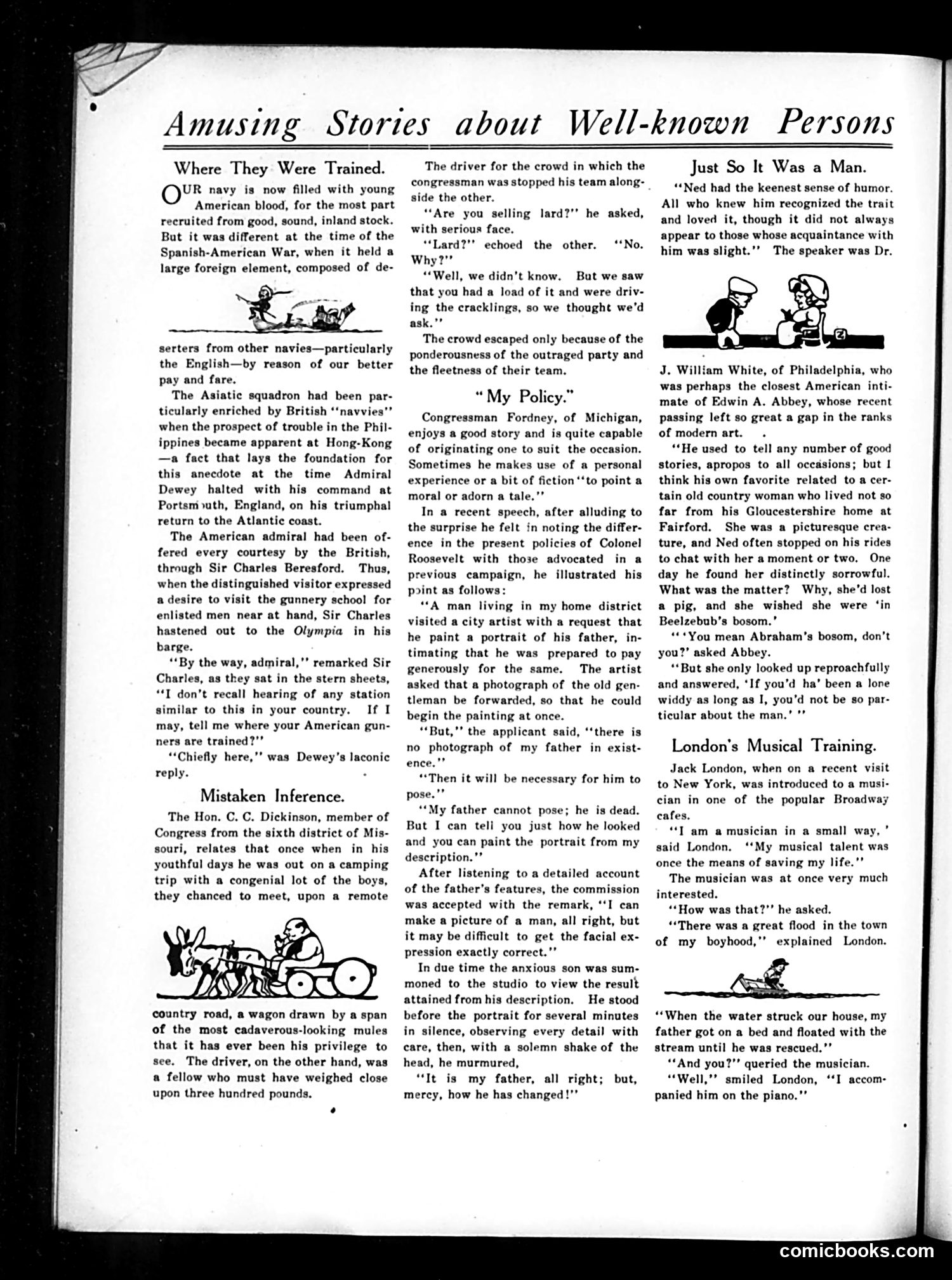
This page from Judge contains three humorous anecdotes about American public figures, likely from the early 1900s. The **first cartoon** depicts Admiral Dewey (hero of the Spanish-American War) being asked by British naval officer Sir Charles Beresford where American gunners train. Dewey's reply—"Chiefly here"—is a witty insult, implying British deserters made up the U.S. Navy's gunners. The **second anecdote** jokes that a fat man driving skeletal mules appears to be "selling lard" while "driving the cracklings"—a crude fat-based insult the congressman's group makes. The **third story**, attributed to Congressman Fordney, uses an analogy about painting a dead man's portrait from memory (impossible to capture true expression) to satirize Theodore Roosevelt's inconsistency between his previous and current policies—suggesting he's changed his "expression" or positions. All three exploit physical appearance or contradiction for satirical effect typical of Judge's style.
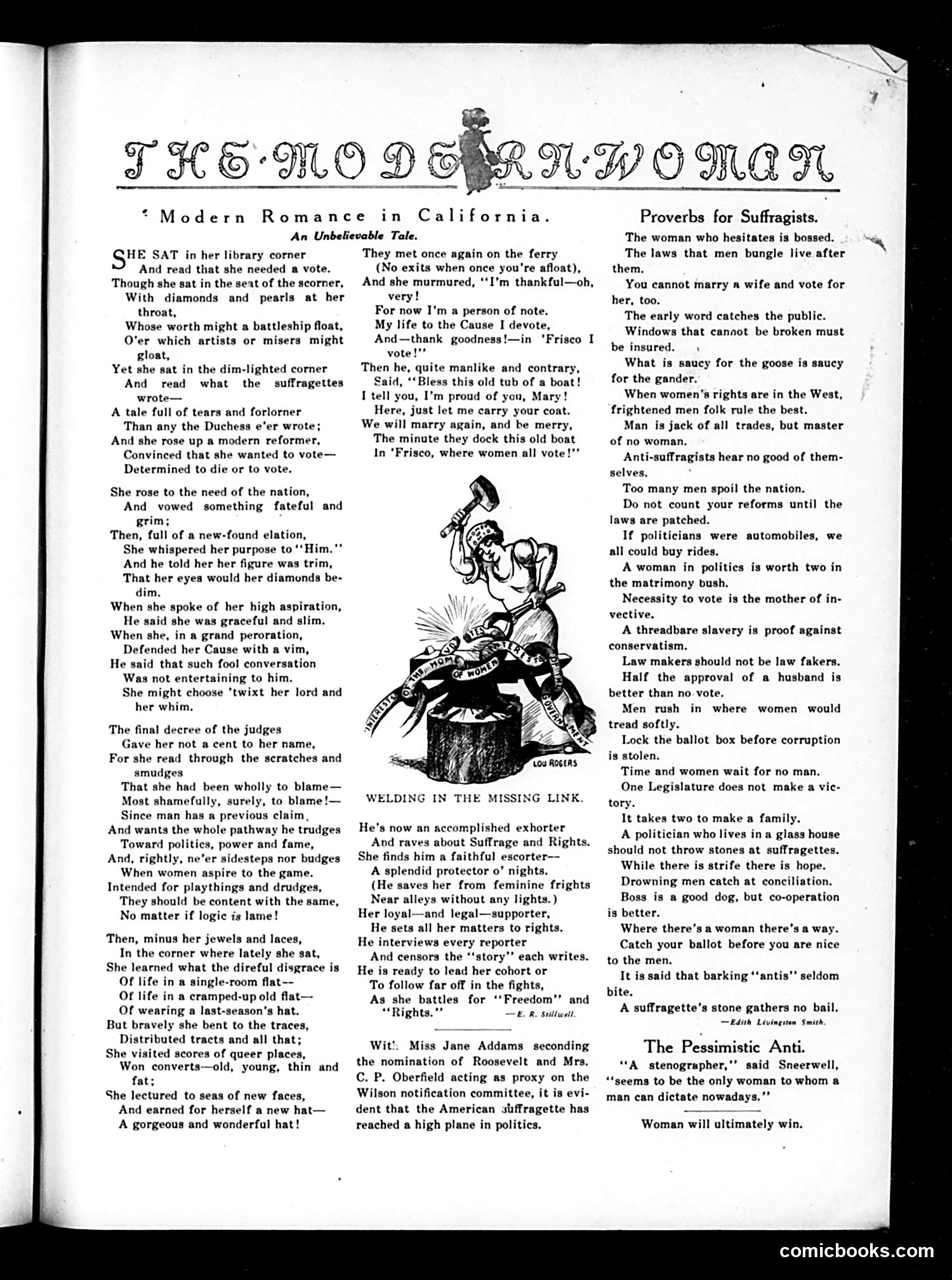
This page satirizes women's suffrage through contrasting narratives. The main poem mocks a wealthy woman who embraces the suffrage cause after reading about it, loses her husband's support (and her fortune in divorce), yet ultimately finds purpose and independence through activism. The cartoon "Welding in the Missing Link" shows a man initially dismissive of his wife's suffrage advocacy who later becomes her devoted champion—suggesting men will eventually support women's rights once they see the benefits. The caption implies the "missing link" between genders is being bridged. The "Proverbs for Suffragists" section offers barbed aphorisms criticizing both suffragettes and anti-suffragists. Judge presents suffrage as simultaneously admirable (the woman gains dignity and influence) yet ridiculous (requiring sacrifice of wealth and marriage). The satire cuts both ways—mocking both the cause and male resistance to it—typical of Judge's cynical 1910s stance on progressive reform.
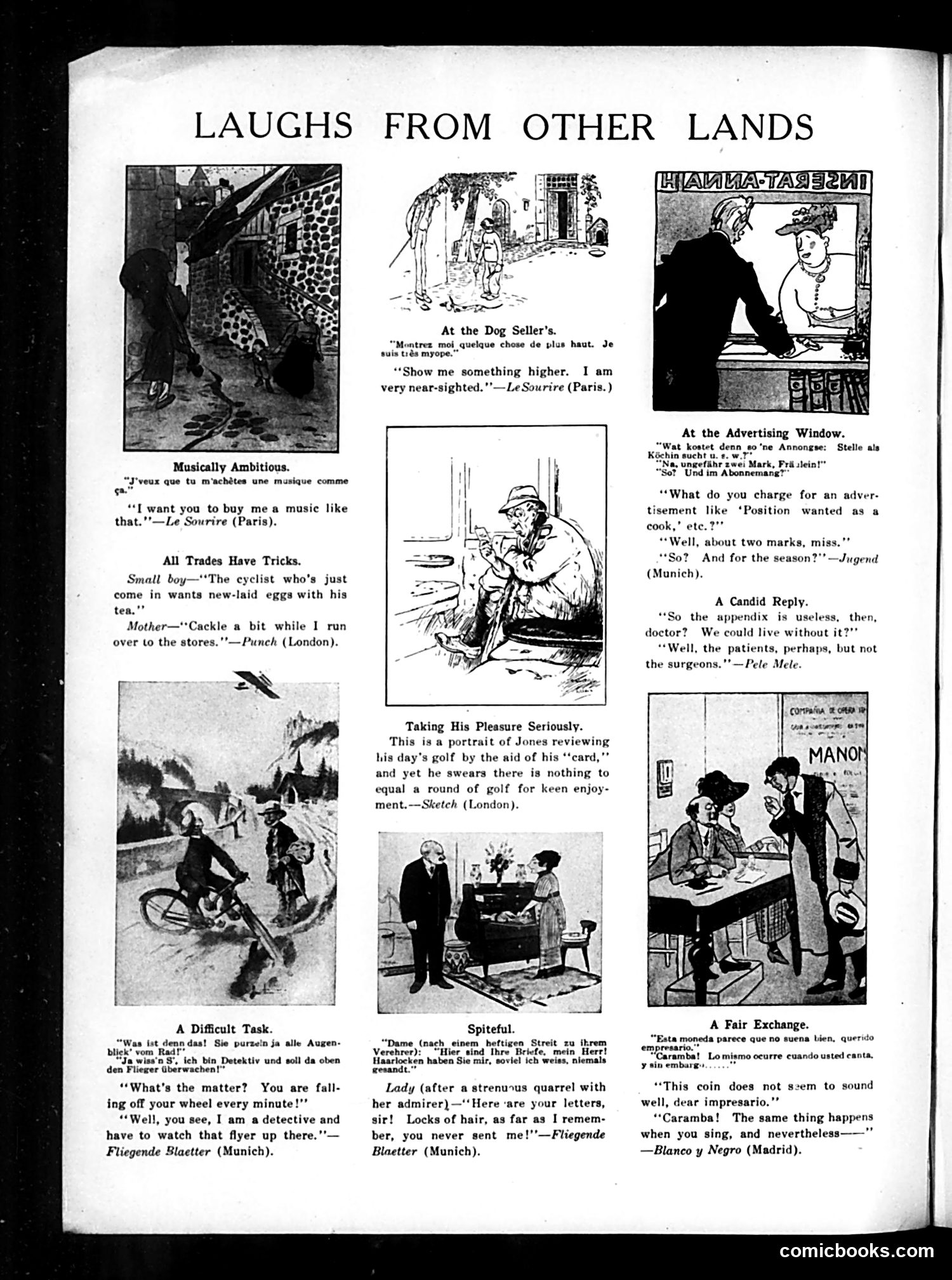
This page reprints humorous cartoons and jokes from European publications (French *Le Sourire*, German *Fliegende Blätter* and *Jugend*, British *Punch* and *Sketch*, Spanish *Blanco y Negro*). The content reflects early-20th-century middle-class social satire: **Common themes include:** - **Class and profession**: A cyclist moonlighting as a detective; advertising rates for job-seekers; a doctor's financial interest in patients' appendixes - **Everyday absurdities**: A near-sighted man buying oversized dogs; a woman factoring "hair locks" into breakup negotiations; golf obsessiveness - **Language and cultural humor**: A child's innocent misunderstanding about eggs; a spiteful ex-lover's accounting of returned love letters The page demonstrates how *Judge* positioned itself as cosmopolitan by showcasing humor from multiple nations, suggesting shared bourgeois anxieties and comic sensibilities across the Atlantic.
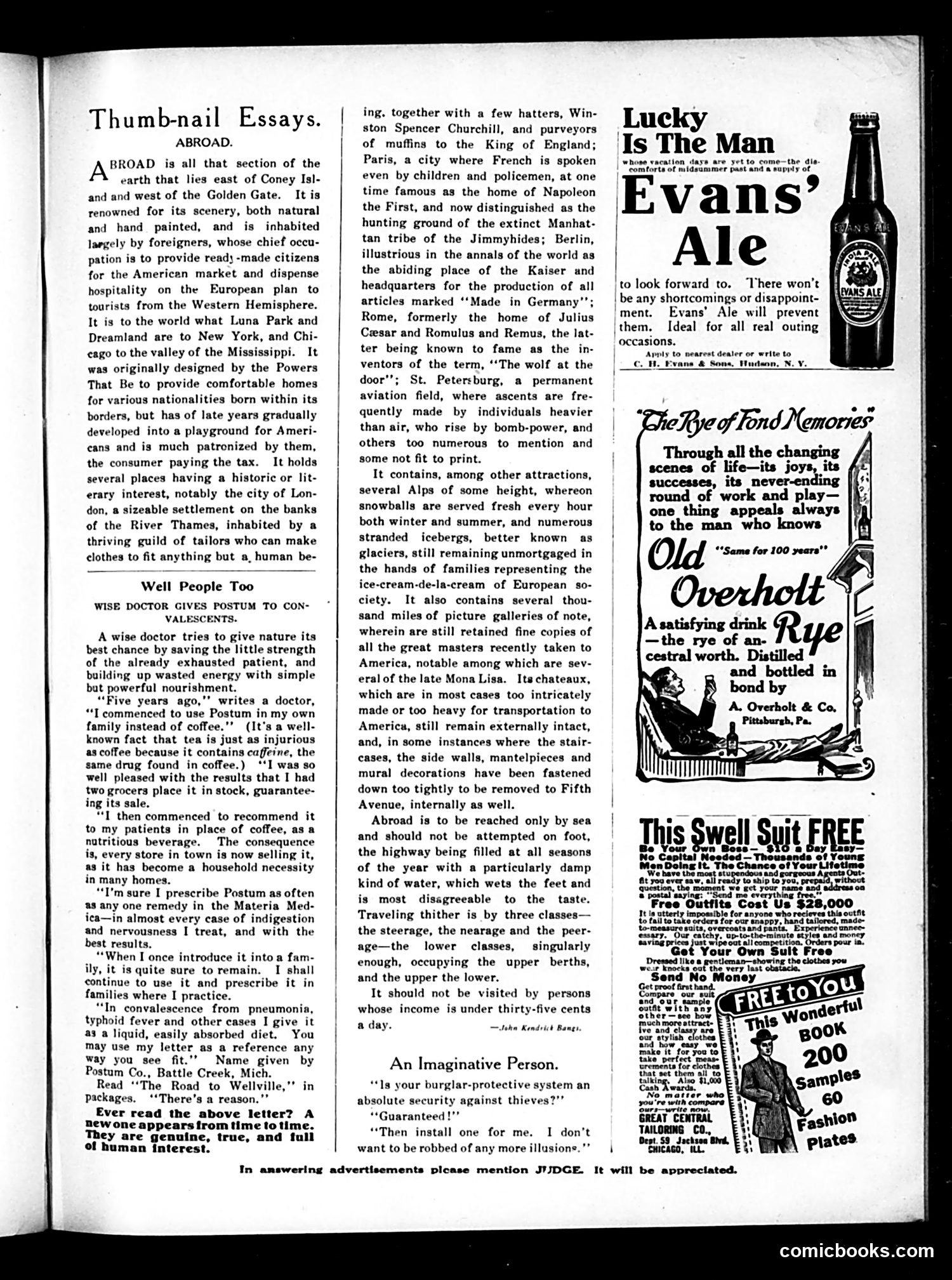
This page from *Judge* consists primarily of satirical essays and advertisements rather than editorial cartoons. The main content is "Thumb-nail Essays: Abroad," which satirizes American tourists' superficial view of Europe. The essay mockingly reduces famous European cities to crude stereotypes: London is just tailors, Paris is where "French is spoken even by children," Berlin is known for "Made in Germany" products, and Rome is associated with the phrase "the wolf at the door." The mention of "the Kaiser" and references to "bomb-power" and aviation suggest this was written during or around World War I, when Germany was America's enemy. The satire's point: Americans treating Europe as a theme park ("Luna Park and Dreamland") filled with quaint attractions for tourists, rather than understanding its genuine historical and cultural significance. The right side contains period advertisements for Evans' Ale, Old Overholt Rye whiskey, and a mail-order suit company—typical early 20th-century magazine advertising.
This page is primarily **advertising**, not political satire. It features vintage print ads from the early 20th century, including whiskey ("Pure Food Whiskey"), a Boston hotel, chewing gum (Chiclets), and fraternal organization materials. The only narrative content is a short story excerpt titled "Adjusting Difficulties" (continued from previous page), depicting a domestic comedy: Mr. Hentz breaks the doorbell, his wife Mrs. Hentz fixes it by adding sal ammoniac, an electrician is called, and humor derives from Mr. Hentz's incompetence being gently mocked by both his wife and the tradesman. The story's resolution shows marital affection restored through Mrs. Hentz's competence and Mr. Hentz's self-deprecating admission of error—fairly typical light domestic humor for the era.
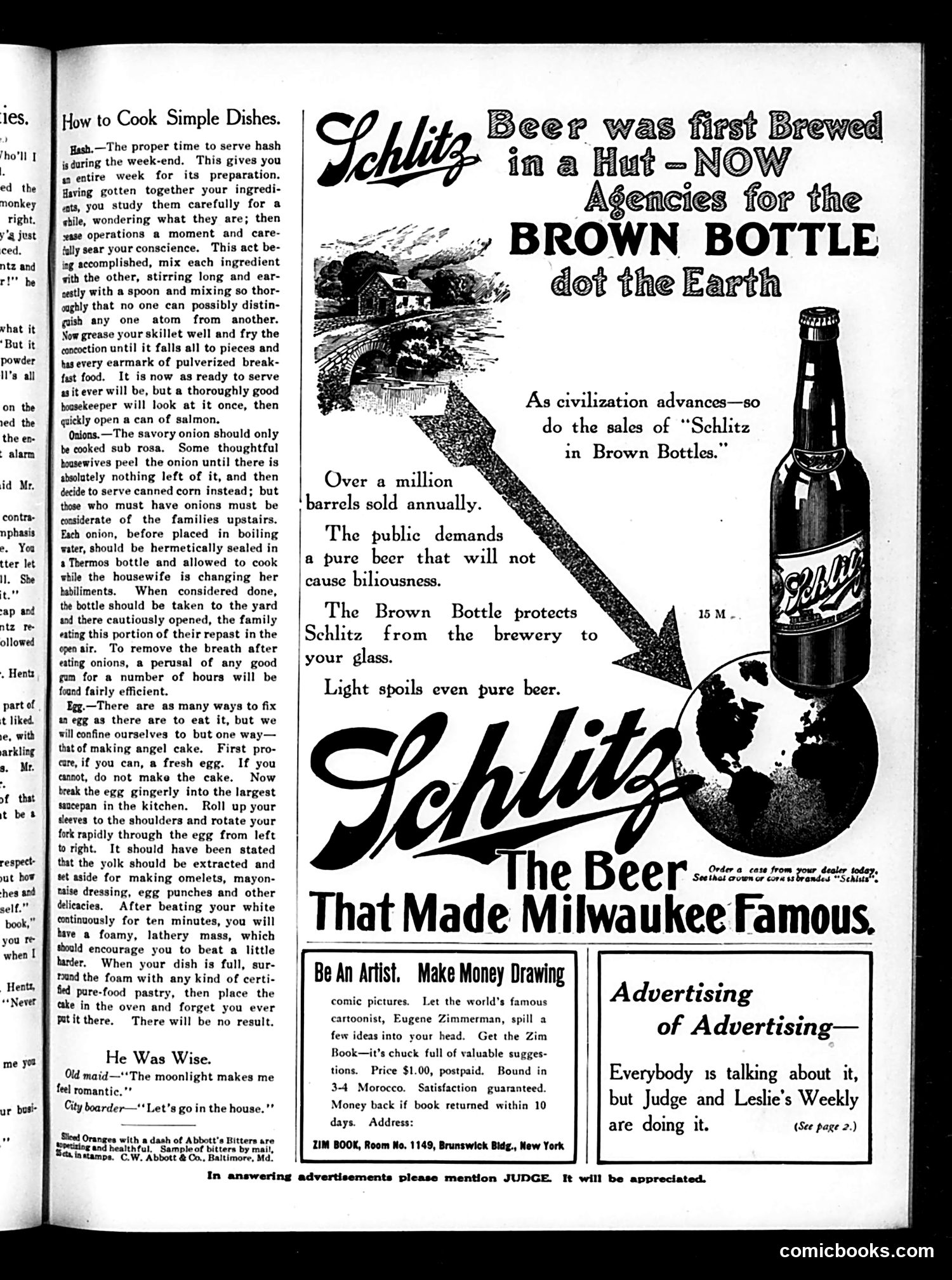
This page is primarily **advertising and instructional content** rather than political satire. The main feature is a **Schlitz beer advertisement** promoting their brown bottle, claiming it protects beer from light spoilage and that "over a million barrels sold annually." The ad uses the slogan "The Beer That Made Milwaukee Famous." The left column contains humorous **cooking advice** presented as satire—instructions for preparing hash, onions, and eggs that deliberately overcomplicate simple tasks or suggest absurd alternatives (like using a Thermos bottle for onions to contain their smell, or abandoning egg cake to open canned corn instead). This is light domestic humor typical of the era. There's also a small **romantic joke** ("He Was Wise") about a city boarder deflecting a woman's romantic mood by suggesting they go inside. The page includes advertisements for **drawing instruction** (Eugene Zimmerman's art book) and **Abbott's Bitters**. The content reflects early-20th-century commercial advertising conventions and gentle domestic comedy rather than sharp political commentary.
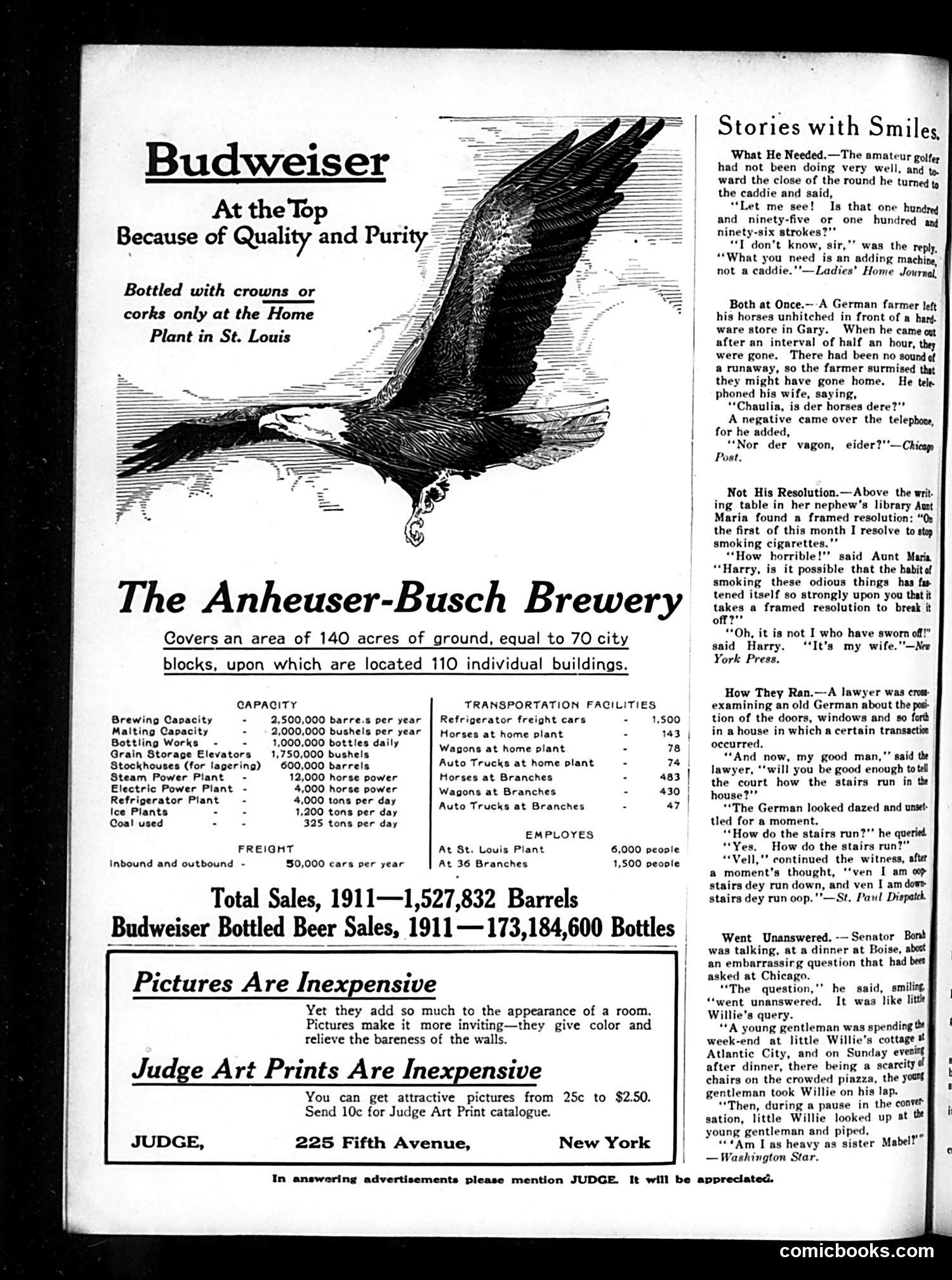
This page is primarily **advertising** for Anheuser-Busch Brewery, with decorative eagle imagery and detailed factory statistics. The bulk of the content showcases the brewery's 1911 sales figures (1.5 million barrels) and operational scale. The right column contains **"Stories with Smiles"**—brief humorous anecdotes typical of Judge's satirical style. These include: - A caddie insulting a golfer's poor performance - A German farmer's broken English when inquiring about missing horses - A nephew's framed anti-smoking resolution (implying he's failed) - A German witness struggling to describe how "stairs run" in English These jokes rely on **ethnic stereotyping** (German immigrants depicted with exaggerated accents) and gentle domestic humor—standard humor conventions for early 1900s American magazines. The German character appears repeatedly, reflecting the period's treatment of immigrant groups as comedic subjects. The page serves dual purposes: legitimate brewery advertising and light entertainment through period-typical ethnic humor.
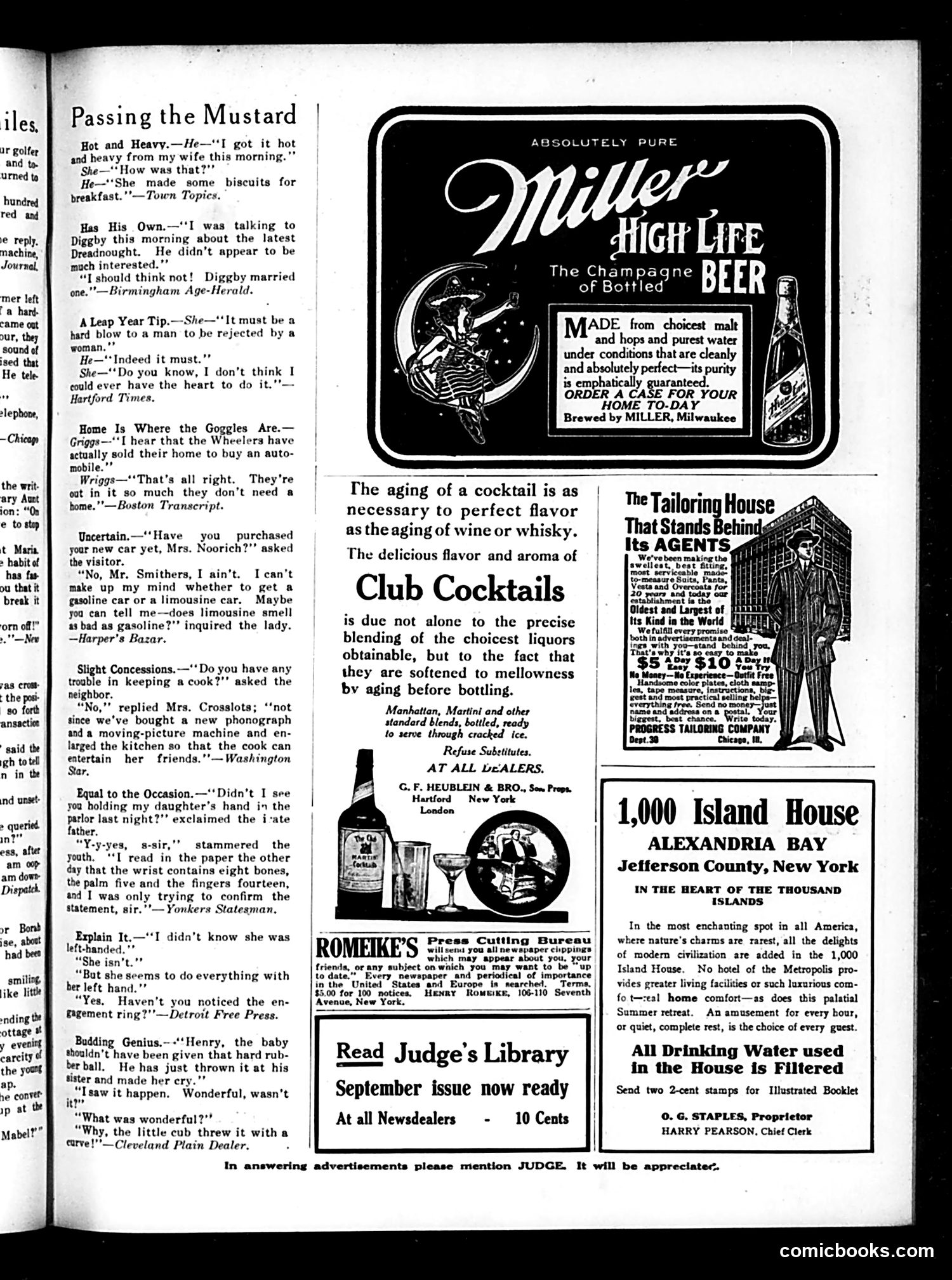
This page is primarily **advertising and humor vignettes**—not political cartoons. The left column contains short joke snippets from *Judge* magazine covering everyday domestic and social topics (automobiles, servants, cooking, engagement rings, etc.). These are light satirical observations on early 1900s American life, poking fun at middle-class anxieties: new technologies (cars), marriage dynamics, and servants. The advertisements occupy the right side: Miller High Life beer, Romeike's press-clipping bureau (a media-monitoring service), Judge's Library magazine, a tailoring company, and a resort ("1,000 Island House"). No specific political figures or events appear here. The satire is social rather than political—gentle ribbing of contemporary manners and modern conveniences, aimed at a presumed educated, leisured readership. The overall effect captures Edwardian-era preoccupations with automobiles, gender roles, and emerging consumer services.
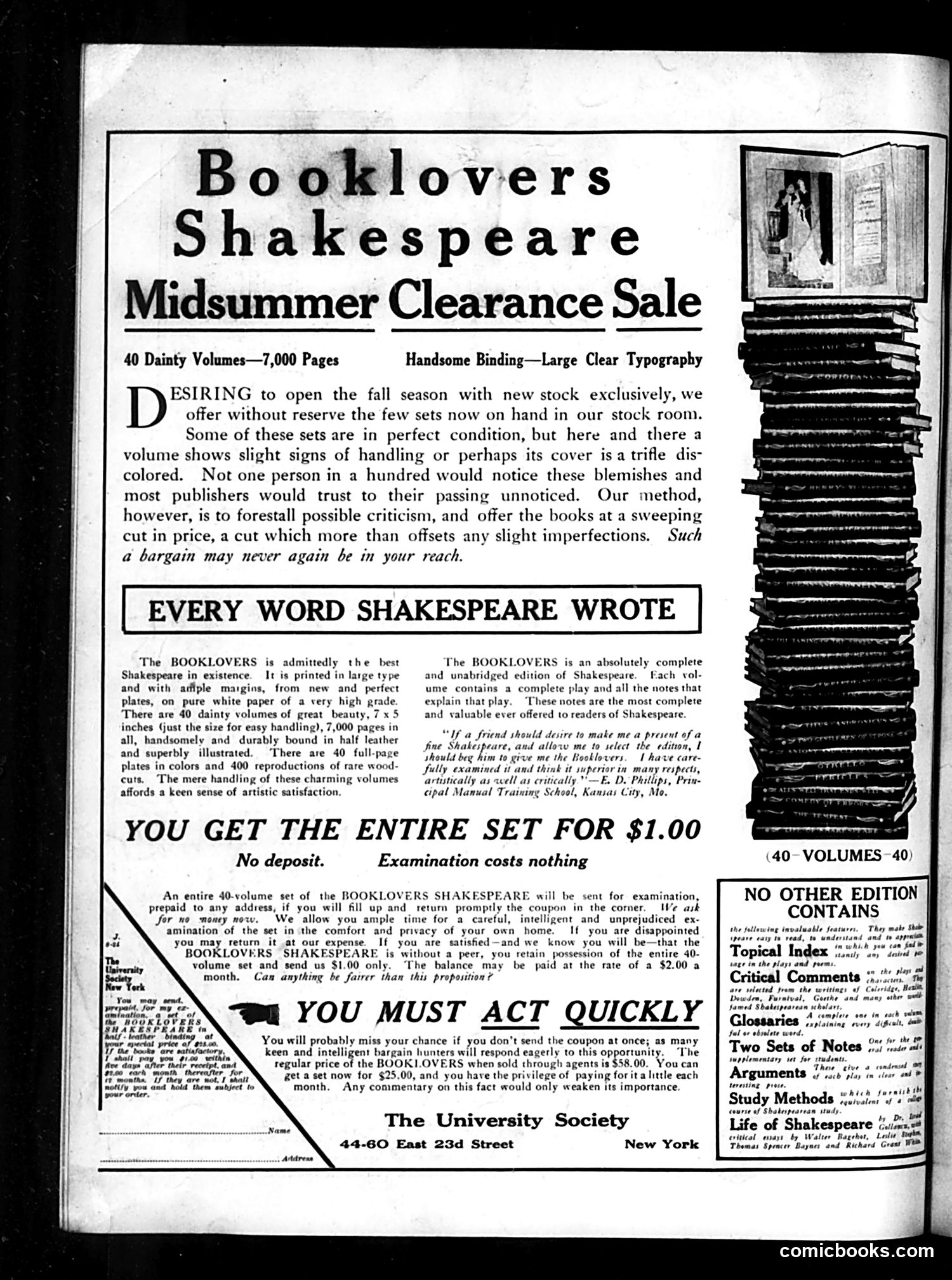
This is primarily a **full-page advertisement**, not a satirical cartoon. It advertises the "Booklovers Shakespeare"—a 40-volume complete works edition. The sales pitch emphasizes that while some volumes show minor wear, this is honest disclosure that actually builds trust. The advertisement uses testimonials and urgency tactics common to early 20th-century mail-order marketing: "YOU MUST ACT QUICKLY," the low initial price ($1.00), and payment plans ($2/month thereafter). The key appeal is accessibility—making Shakespeare affordable and portable (7x5 inches, easy handling) for middle-class households. The detailed features listed (annotations, topical index, study methods) suggest this edition marketed itself as educational, not just literary. The page reflects Progressive Era consumer culture: transparency as a selling point, installment buying, home examination privileges, and democratizing "high culture" Shakespeare for ordinary readers rather than wealthy collectors.