
Judge, 1912-08-24 · page 16 of 24
Judge — August 24, 1912 — page 16: what you’re looking at
What you’re looking at
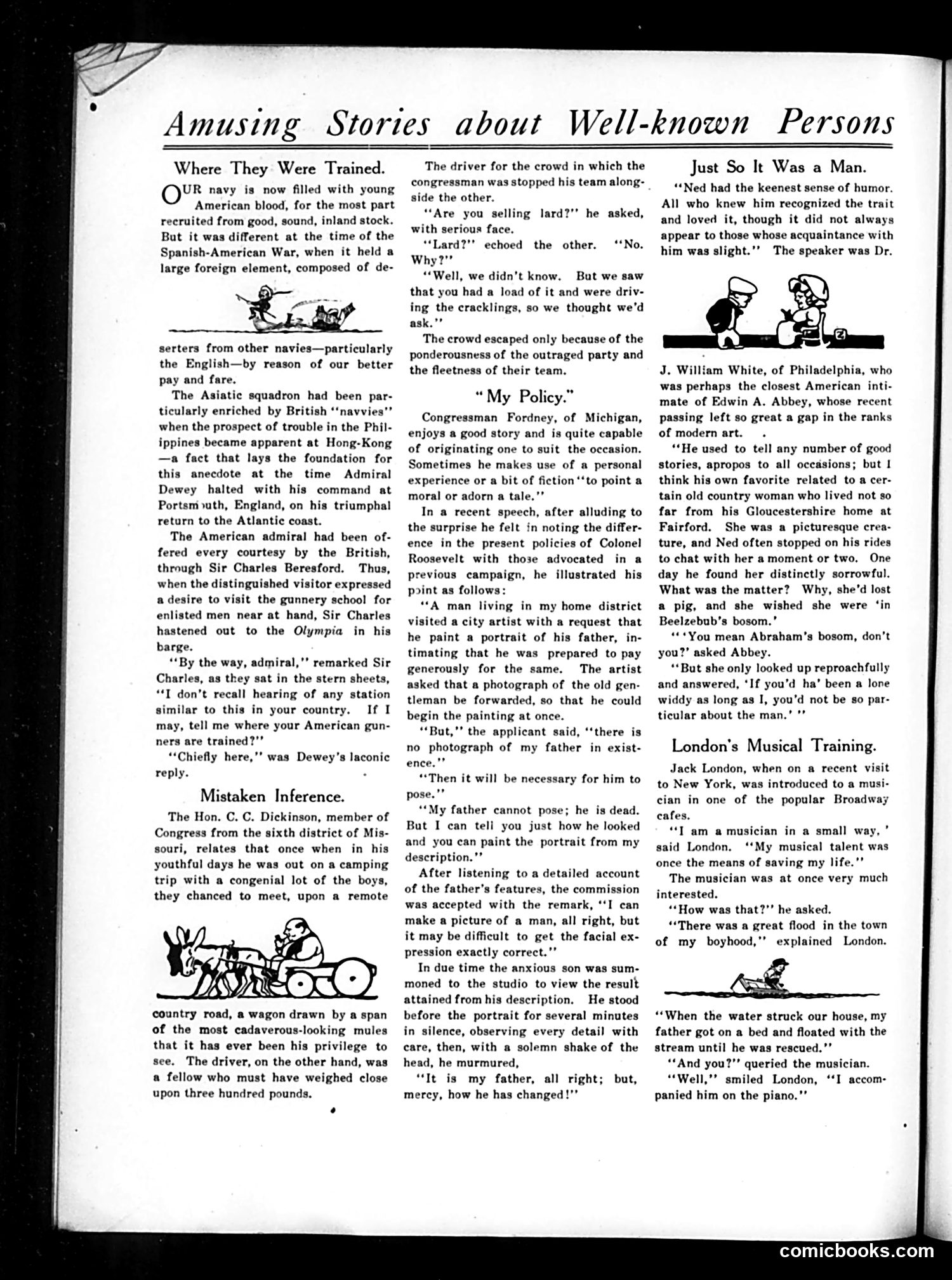
This page from Judge contains three humorous anecdotes about American public figures, likely from the early 1900s. The **first cartoon** depicts Admiral Dewey (hero of the Spanish-American War) being asked by British naval officer Sir Charles Beresford where American gunners train. Dewey's reply—"Chiefly here"—is a witty insult, implying British deserters made up the U.S. Navy's gunners. The **second anecdote** jokes that a fat man driving skeletal mules appears to be "selling lard" while "driving the cracklings"—a crude fat-based insult the congressman's group makes. The **third story**, attributed to Congressman Fordney, uses an analogy about painting a dead man's portrait from memory (impossible to capture true expression) to satirize Theodore Roosevelt's inconsistency between his previous and current policies—suggesting he's changed his "expression" or positions. All three exploit physical appearance or contradiction for satirical effect typical of Judge's style.
📄 Transcribed text from this page (OCR, searchable)
Machine-transcribed from the original scan — historical spelling and the odd misread are preserved.
Amusing Stories about Well-known Persons Where They Were Trained. Ov navy is now filled with young American blood, for the most part recruited from good, sound, inland stock. But it was different at the time of the Spanish-American War, when it held a large foreign element, composed of de- serters from other navies—particularly the English—by reason of our better pay and fare. The Asiatic squadron had been par- ticularly enriched by British ‘‘navvies”’ when the prospect of trouble in the Phil- ippines became apparent at Hong-Kong —a fact that lays the foundation for this anecdote at the time Admiral Dewey halted with his command at Portsmouth, England, on his triumphal return to the Atlantic coast. The American admiral had been of- fered every courtesy by the British, through Sir Charles Beresford. Thus, when the distinguished visitor expressed a desire to visit the gunnery school for enlisted men near at hand, Sir Charles hastened out to the Olympia in his barge. “*By the way, admiral,’’ remarked Sir Charles, as they sat in the stern sheets, “I don’t recall hearing of any station similar to this in your country. If I may, tell me where your American gun- ners are trained?’ “Chiefly here,’’ was Dewey's laconic reply. Mistaken Inference. The Hon. C. C. Dickinson, member of Congress from the sixth district of Mis- souri, relates that once when in his youthful days he was out on a camping trip with a congenial lot of the boys, they chanced to meet, upon a remote country road, a wagon drawn by a span of the most cadaverous-looking mules that it has ever been his privilege to see. The driver, on the other hand, was a fellow who must have weighed close upon three hundred pounds. The driver for the crowd in which the congressman was stopped his team along- side the other. “Are you selling lard?’’ he asked, with serious face. “Lard?’’ echoed the other. ‘No. Why?” “Well, we didn’t know. But we saw that you had a load of it and were driv- ing the cracklings, so we thought we'd ask. The crowd escaped only because of the ponderousness of the outraged party and the fleetness of their team. “My Policy.” Congressman Fordney, of Michigan, enjoys a good story and is quite capable of originating one to suit the occasion. Sometimes he makes use of a personal experience or a bit of fiction ‘‘to point a moral or adorn a tale.’’ In a recent speech, after alluding to the surprise he felt in noting the differ- ence in the present policies of Colonel Roosevelt with those advocated in a previous campaign, he illustrated his point as follows: “A man living in my home district visited a city artist with a request that he paint a portrait of his father, in- timating that he was prepared to pay generously for the same. The artist asked that a photograph of the old gen- tleman be forwarded, so that he could begin the painting at once. “‘But,’’ the applicant said, ‘‘there is no photograph of my father in exist- ence." “Then it will be necessary for him to pose." “My father cannot pose; he is dead. But I can tell you just how he looked and you can paint the portrait from my description."’ After listening to a detailed account of the father's features, the commission was accepted with the remark, ‘‘I can make a picture of a man, all right, but it may be difficult to get the facial ex- pression exactly correct.” In due time the anxious son was sum- moned to the studio to view the result attained from his description. He stood before the portrait for several minutes in silence, observing every detail with care, then, with a solemn shake of the head, he murmured, “It is my father, all right; mercy, how he has changed!"" but, Just So It Was a Man. “Ned had the keenest sense of humor. All who knew him recognized the trait and loved it, though it did not always appear to those whose acquaintance with him was slight.’’ The speaker was Dr. J. William White, of Philadelp! who was perhaps the closest American inti- mate of Edwin A. Abbey, whose recent passing left so great a gap in the ranks of modern art. . “He used to tell any number of good stories, apropos to all occasions; but | think his own favorite related to a cer- tain old country woman who lived not so far from his Gloucestershire home at Fairford. She was a picturesque crea- ture, and Ned often stopped on his rides to chat with her a moment or two, One day he found her distinctly sorrowful. What was the matter? Why, she'd lost a pig, and she wished she were ‘in Beelzebub’s bosom.’ ‘**You mean Abraham’s bosom, don’t you?’ asked Abbey. “But she only looked up reproachfully and answered, ‘If you’d ha’ been a lone widdy as long as I, you'd not be so par- ticular about the man.’ ’’ London's Musical Training. Jack London, when on a recent visit to New York, was introduced to a musi- cian in one of the popular Broadway cafes. “T am a musician in a small way,’ said London, ‘‘My musical talent was once the means of saving my life."’ The musician was at once very much interested. “How was that?’’ he asked. “There was a great flood in the town of my boyhood,”’ explained London. ~<a “When the water struck our house, my father got on a bed and floated with the stream until he was rescued.”’ “And you?” queried the musician. ‘‘Well,’’ smiled London, ‘I accom- panied him on the piano.”’ comicbooks.com