
A complete issue · 24 pages · 1912
Judge — May 25, 1912
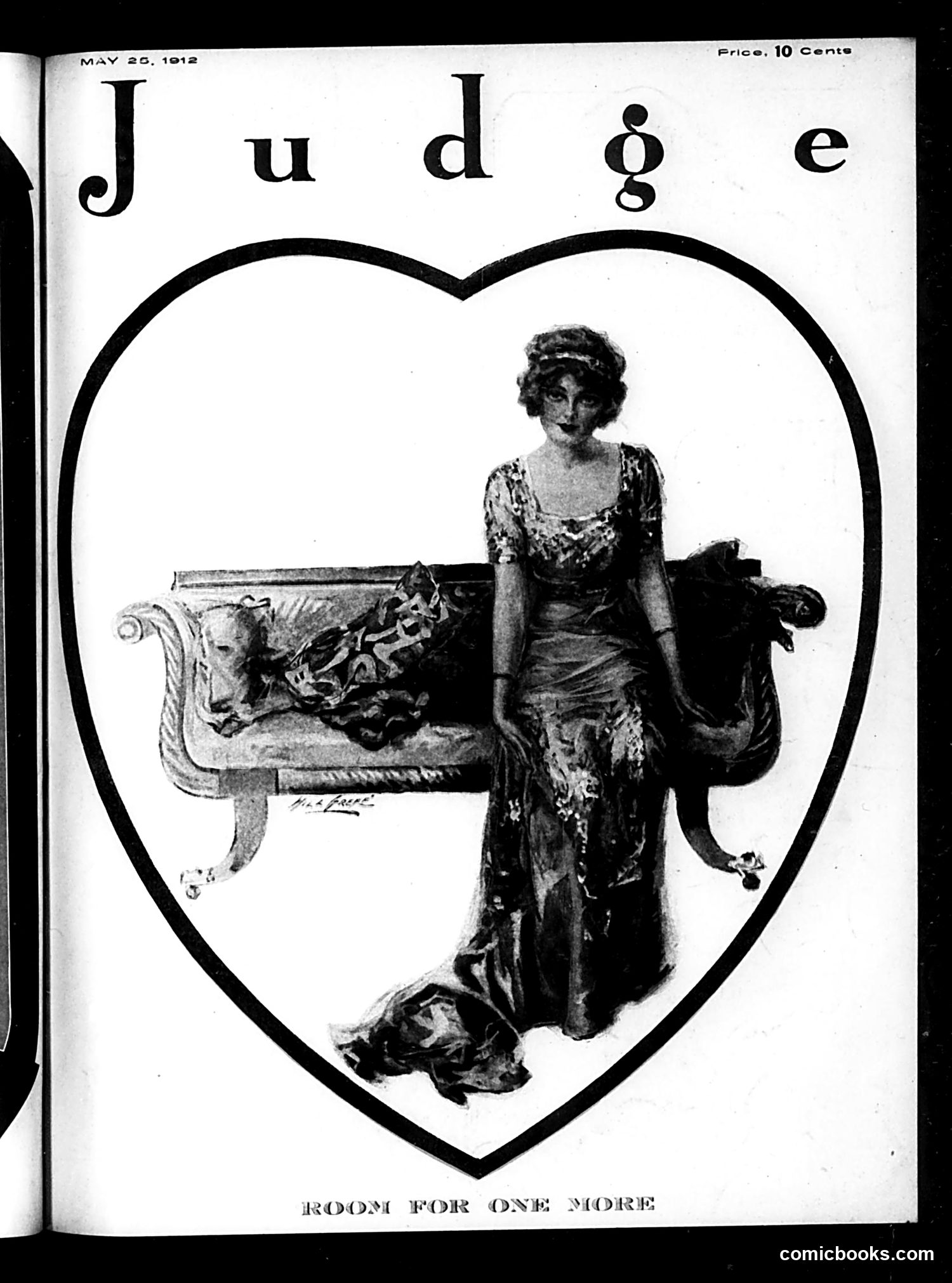
This is a cover illustration titled "Room for One More," featuring a woman in an elegant Edwardian gown standing beside an ornate sofa. The sofa appears to be overflowing with fabric and garments, while she holds additional clothing items. The satire likely comments on **women's fashion and excess consumption** during the Gilded Age/Progressive Era. The caption "Room for One More" is ironic—the sofa is clearly stuffed with clothing, yet the woman suggests space remains for additional garments. This mocks either the extravagance of wealthy women's wardrobes or broader concerns about consumerism and materialism among the upper classes during this period. The elaborate dress and refined setting emphasize the target audience: affluent women whose closets were never full enough.
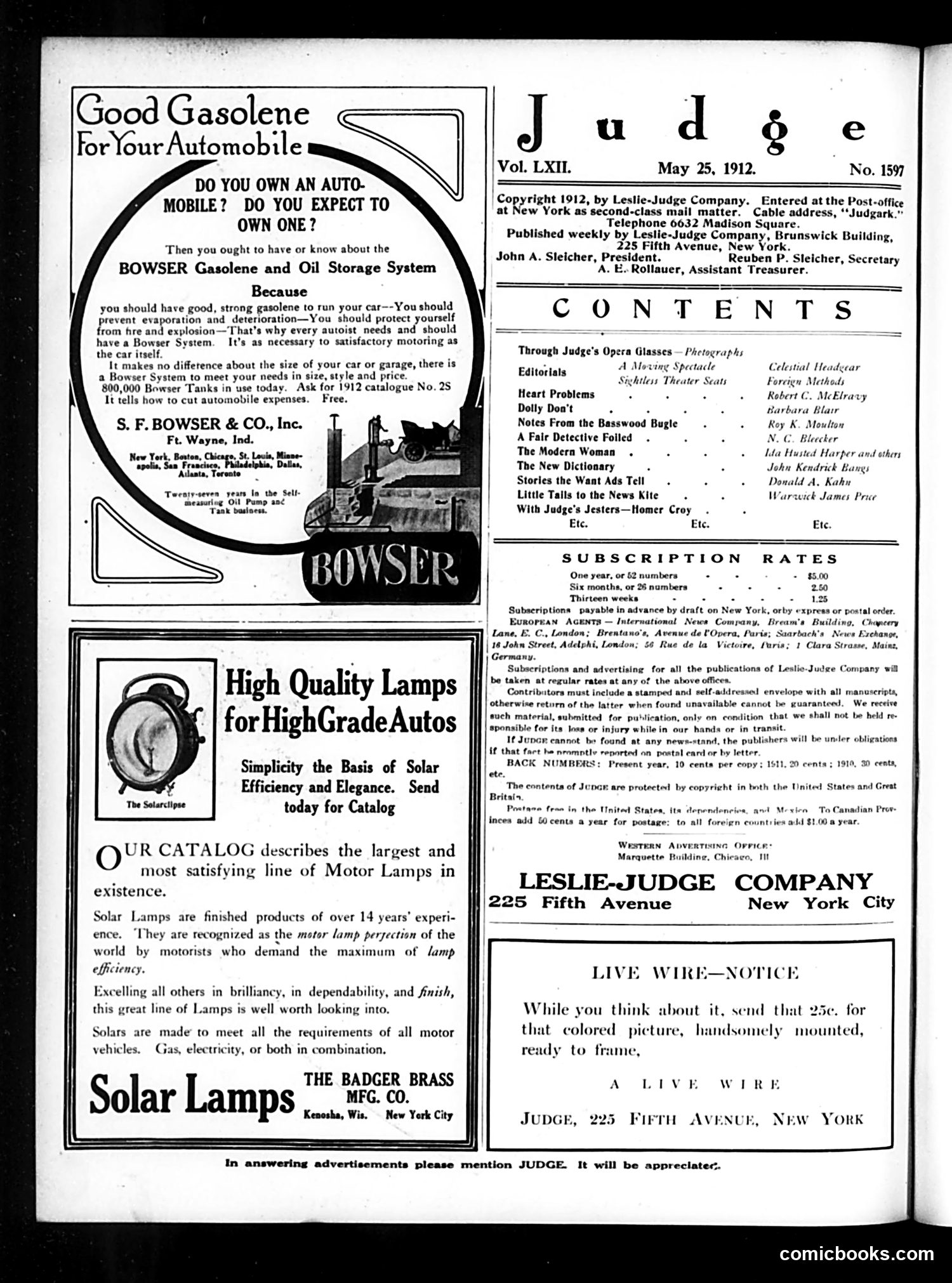
This page is **primarily advertising** with no significant political cartoons or satirical content visible. The main advertisements are: 1. **Bowser Gasolene and Oil Storage System** – promoting automobile fuel storage for car owners 2. **Solar Lamps by Badger Brass Mfg. Co.** – motor lamps for automobiles The table of contents lists articles including editorials and stories, but no titles suggest political satire. A small notice promotes sending 25¢ for a colored picture ("Live Wire") to Judge's office. The page reflects 1912 commercial interests: early automobile ownership was expanding, requiring new products and services. The advertisements target affluent readers who could afford automobiles—a luxury item at this time.
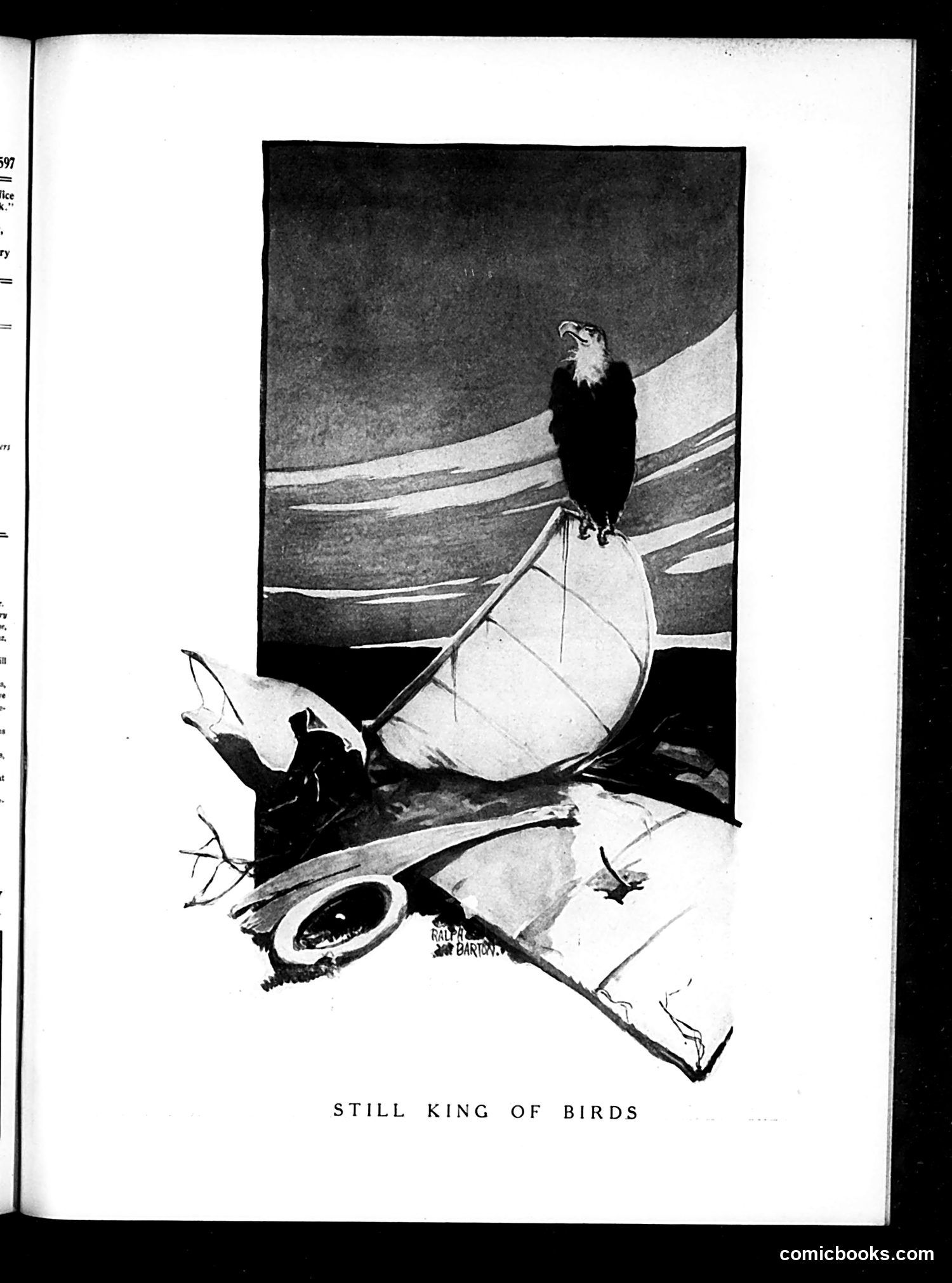
This political cartoon depicts an eagle perched atop what appears to be wreckage or debris—possibly aircraft or mechanical remnants. The composition suggests American dominance or superiority despite surrounding destruction or conflict. The title "Still King of Birds" is ironic: while the eagle maintains its symbolic position as America's emblem, the wreckage below suggests diminished circumstances or costly victory. The cartoon likely comments on American military or political status during a period of conflict or challenge—possibly referencing World War II era concerns about American supremacy being tested, though the exact historical moment is unclear without additional context. The overall message appears to be about maintaining national pride or power despite adversity.
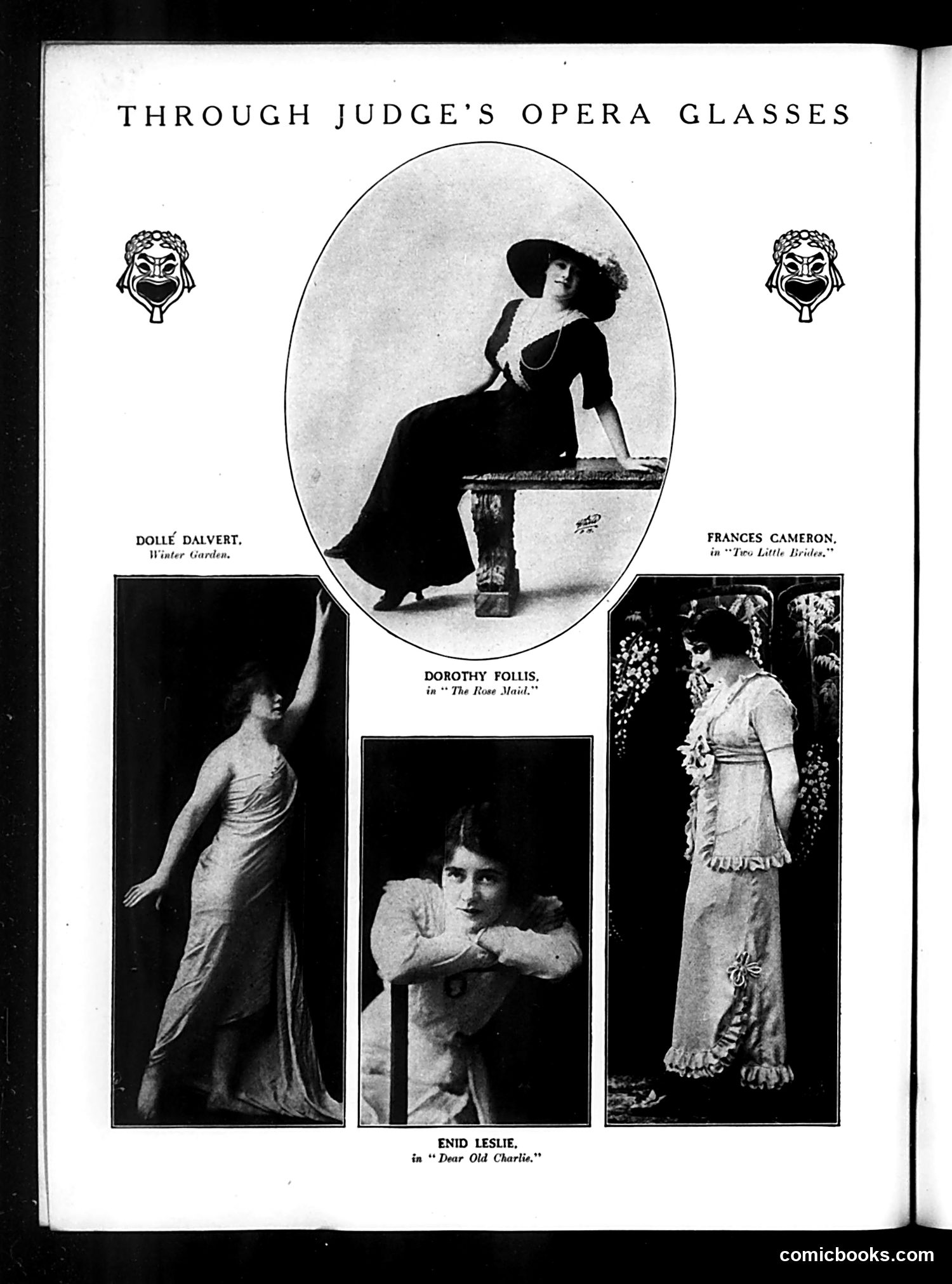
This page features theatrical actresses of the early 20th century photographed in performance or costume. The title "Through Judge's Opera Glasses" is a visual pun—opera glasses were used to view distant stage performers, and Judge magazine is using them metaphorically to examine theatrical stars. The page identifies four actresses: Dollé Dalvert, Dorothy Follis, Enid Leslie, and Frances Cameron, each credited with specific theatrical productions ("Winter Garden," "The Rose Maid," "Dear Old Charlie," "Two Little Brides"). The decorative theatrical masks at top reinforce the theatrical theme. This appears to be a celebrity/entertainment feature rather than political satire—Judge magazine regularly showcased popular stage performers for readers interested in theater gossip and fashionable actresses of the era.
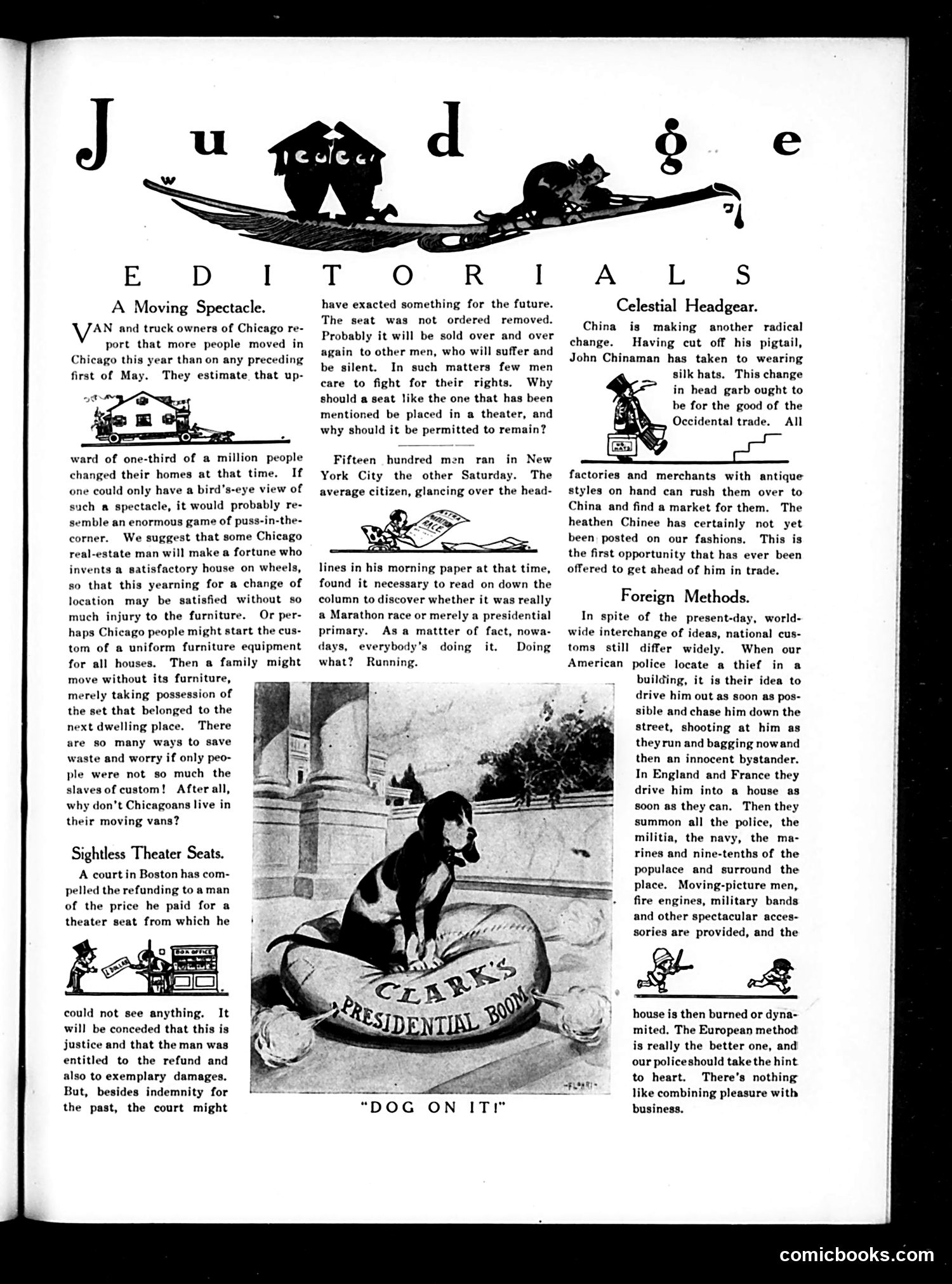
This page contains three distinct editorial items satirizing contemporary American life. **"A Moving Spectacle"** mocks the massive migration into Chicago during early May, suggesting the city experienced an unprecedented housing shortage. The piece humorously proposes a "satisfactory house on wheels" as a solution, satirizing both Chicago's overcrowding and the absurdity of mobile furniture. **"Sightless Theater Seats"** reports on a Boston court case where a man received refunds for theater seats with obstructed views. The satire questions whether this justice is fair, since the man still benefited from attending despite not seeing the performance. **"Dog on It!"** is a cartoon caption accompanying an image of a dog sitting in what appears to be a "Presidential Booth"—likely satirizing a political figure or presidential candidate through animal association, though the specific reference is unclear from context alone.
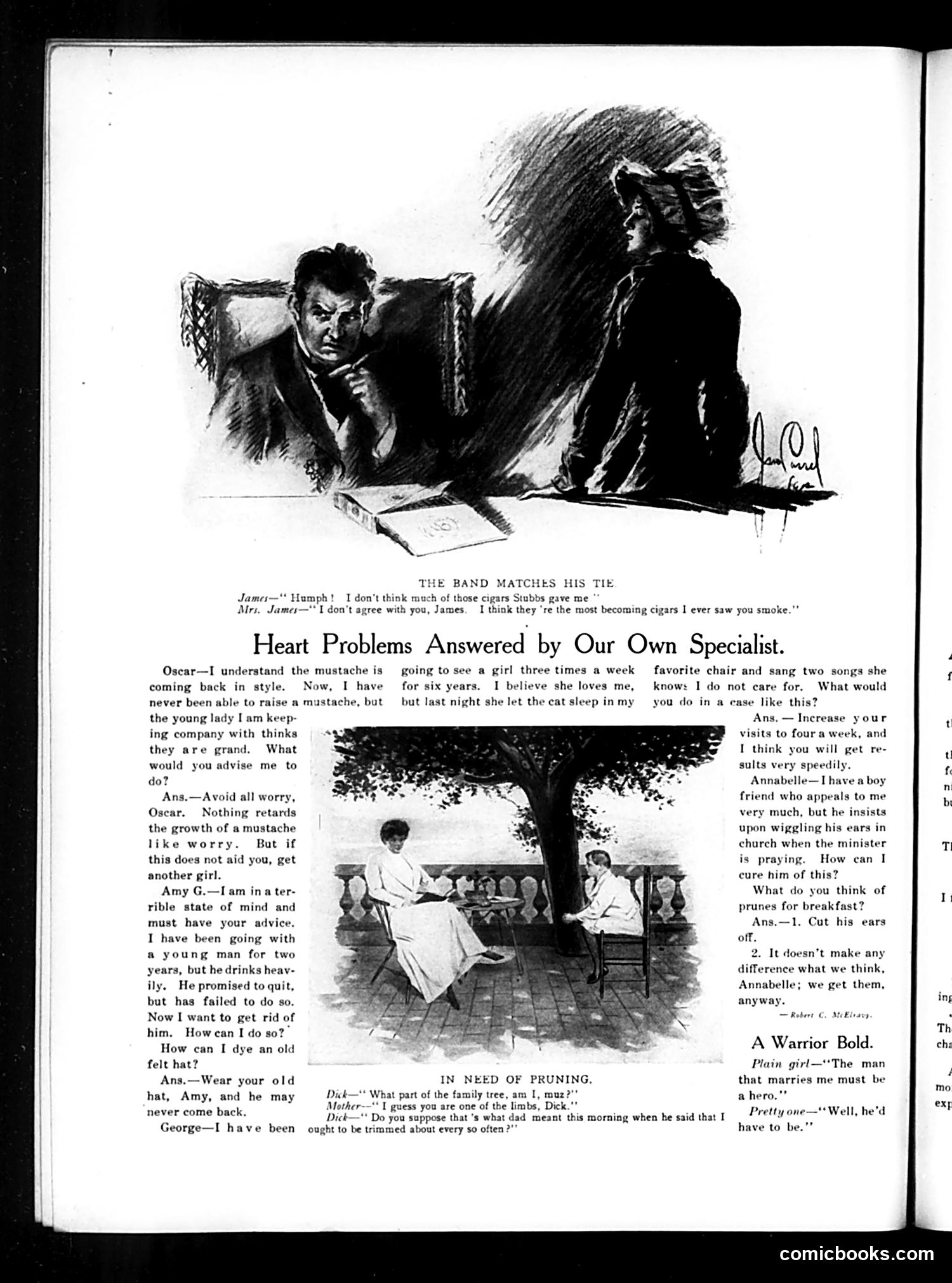
This page from *Judge* magazine features humorous advice columns and comic vignettes typical of early 20th-century American satire. **"The Band Matches His Tie"** (top): A married couple discusses cigars a guest gave them. The joke plays on social pretense—Mrs. James diplomatically compliments unattractive cigars as "becoming," suggesting people often lie politely about unpleasant gifts. **"Heart Problems Answered by Our Own Specialist"** (main section): A mock advice column offering absurd solutions to romantic problems. The humor relies on deliberately unhelpful, ridiculous answers—telling a lovelorn man to "get another girl" or advising someone to "cut his ears off" to stop a fidgeting boyfriend. This satirizes both earnest advice columns and human relationship folly. **"In Need of Pruning"** (middle illustration): A child misunderstands his father's comment about trimming family "branches," confusing metaphorical criticism with literal tree pruning. **"A Warrior Bold"** (bottom): A brief joke contrasting two women's standards for husbands—one demands heroism; the other jokes that any hero husband "would have to be," implying even heroes couldn't tolerate her. The page satirizes courtship, marriage, and social advice culture prevalent in that era.
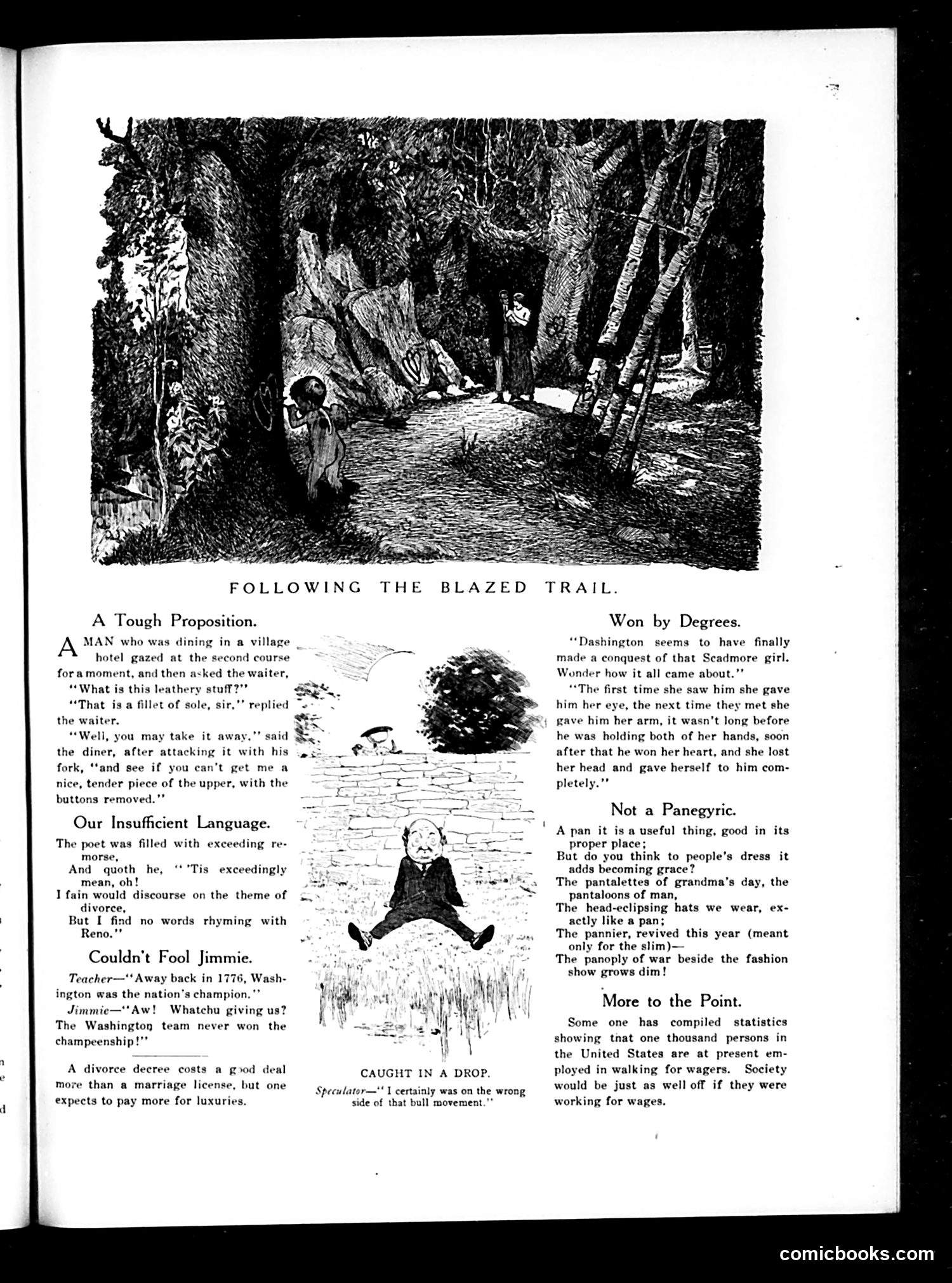
This page contains several brief satirical pieces typical of Judge's humor: **"A Tough Proposition"** mocks a diner's complaint about tough fish, with the waiter's crude suggestion that he request "upper" pieces with "buttons removed"—implying cannibalism as a joke. **"Couldn't Fool Jimmie"** satirizes a child's literal-mindedness: when a teacher claims George Washington was "the nation's champion" in 1776, the boy interprets it as sports championship, catching the teacher's imprecise language. **"Won by Degrees"** uses romantic progression as a pun—each stage ("eye," "arm," "heart") represents a step in courtship. **"Our Insufficient Language"** laments that no words rhyme with "Reno" for a divorce-themed poem—Reno, Nevada was famous as a divorce destination where residency requirements were lenient. **"Not a Panegyric"** criticizes fashionable items (pans, pantalettes, pannier skirts) by playing on their "pan-" prefix, suggesting fashion trends are absurd. The cartoons employ wordplay, puns, and social observation rather than targeting specific politicians or events.
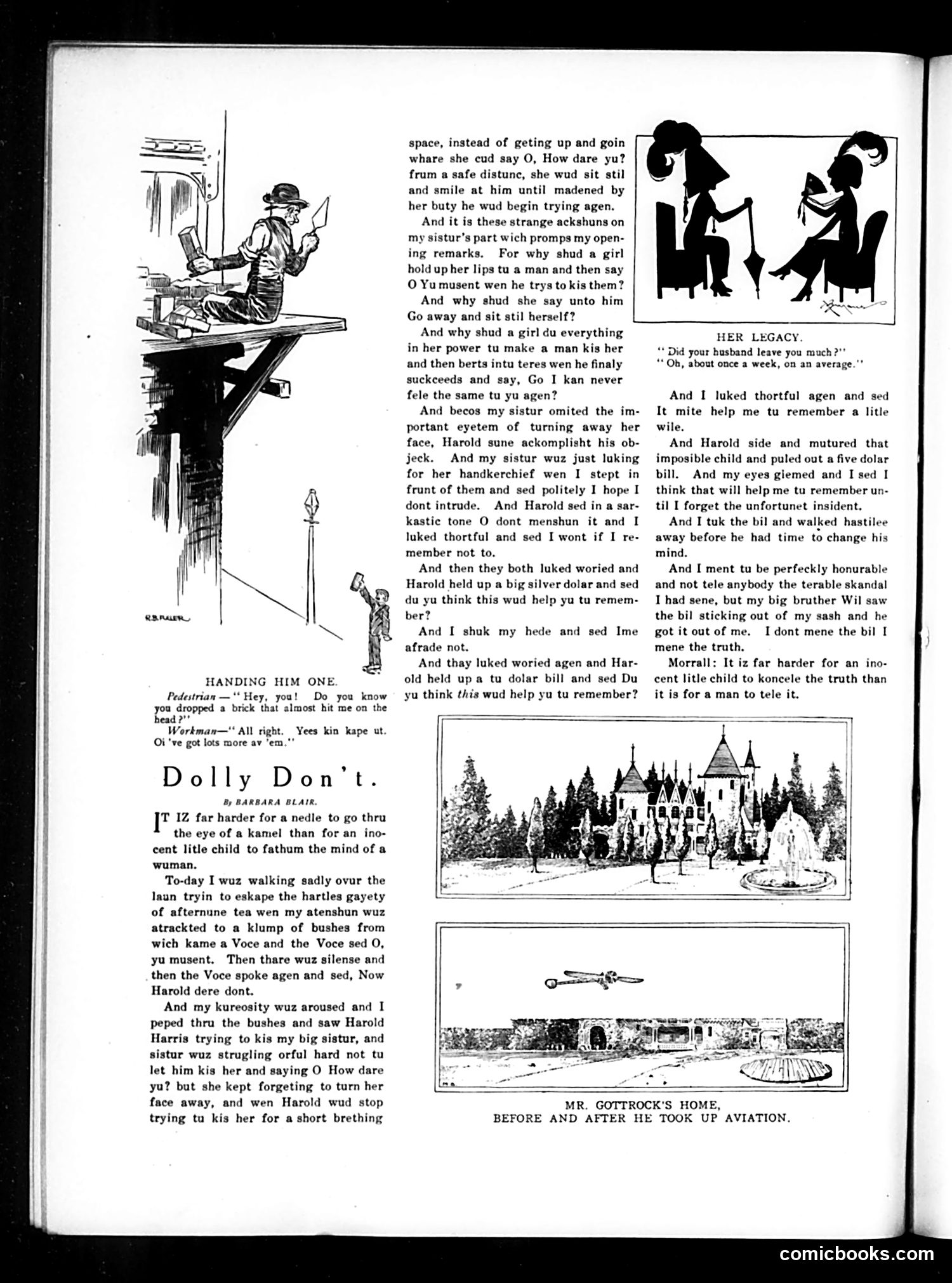
This page contains two satirical pieces: **"Handing Him One"** (top left cartoon): A simple workplace joke. A pedestrian confronts a workman about dropping a brick on his head. The workman's dismissive response—"All right. I've got lots more of 'em"—mocks working-class indifference to safety hazards, a common target of Judge's humor about labor and class. **"Dolly Don't"** (main story): A phonetically-written narrative (mimicking immigrant or rural dialect for comedic effect) describes a child witnessing her sister flirting with a boy named Harold. The satire targets female behavior: the sister simultaneously resists and encourages his advances, then acts offended when successful. The child blackmails Harold with silence for increasing amounts of money. The moral condemns women's perceived dishonesty while ironically praising men's. **"Mr. Gottrock's Home"** (bottom): Before-and-after images showing an estate transformed from a grand castle to rubble, captioned as the result of taking up aviation—humor about early aviation's dangers and the wealthy's reckless hobbies. The magazine's tone reflects early 20th-century gender stereotypes and class attitudes.
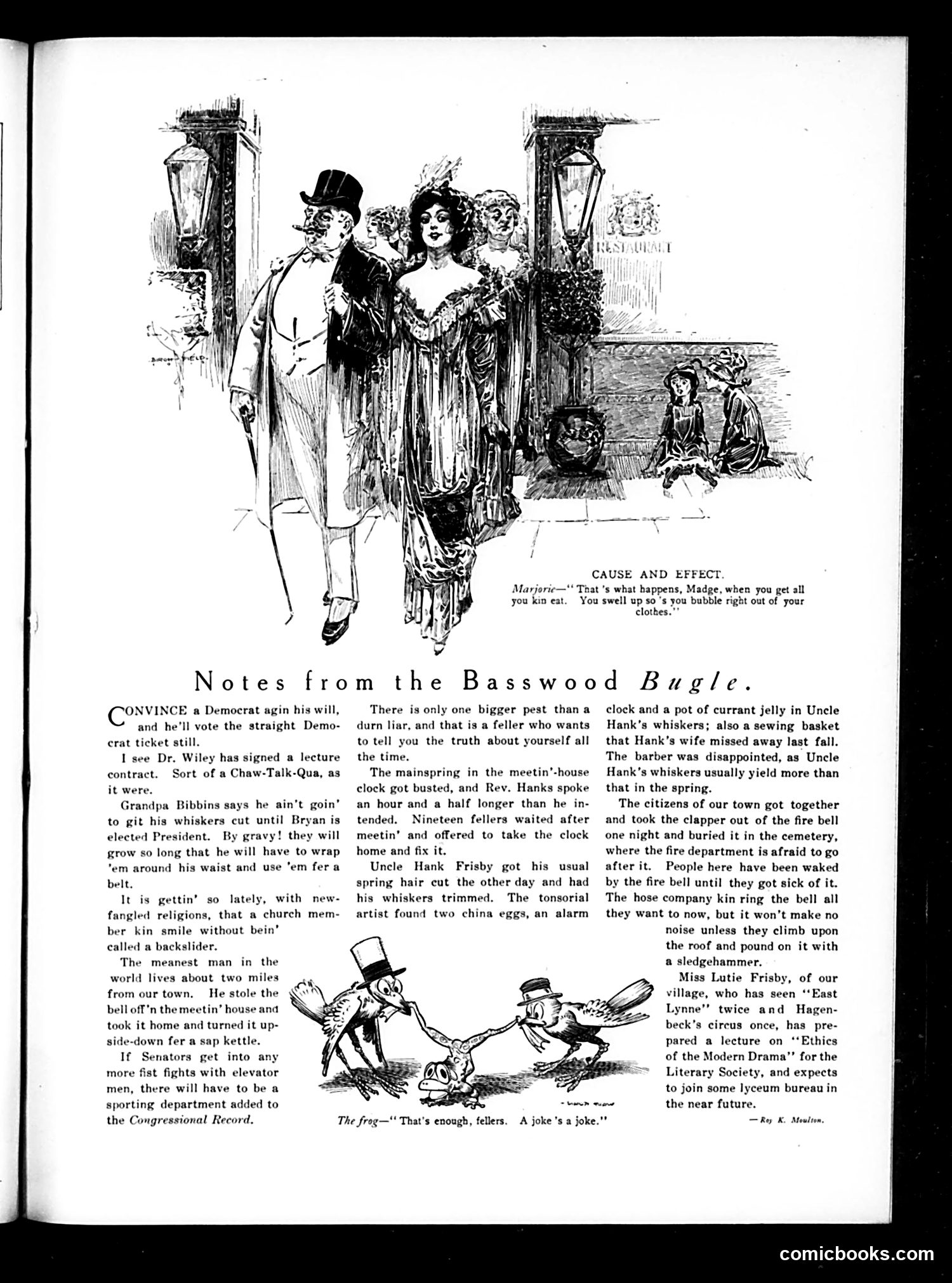
This is a humor column from a small-town newspaper, presented as satirical social commentary. The content mocks rural American life through interconnected jokes: **Political reference**: "Grandpa Bibbins" won't cut his whiskers until William Jennings Bryan is elected President—likely referencing Bryan's 1896 or 1900 presidential campaigns. The joke plays on rural stubbornness and political obsession. **Religious satire**: A church member steals the meetin' house bell to use as a sap kettle; nineteen men volunteer to "fix" the church clock only after the minister's sermon runs long (implying they sabotaged it to escape). **Social commentary**: The "Cause and Effect" cartoon shows overeating leading to bursting out of clothes—mocking gluttony among the newly wealthy. **General theme**: These rural vignettes poke fun at small-town gossip, superstition, provincial attitudes, and simple folk. The barber finding random items in Uncle Hank's whiskers satirizes poor hygiene and slovenliness. The overall tone is affectionate mockery of rural America's perceived backwardness.
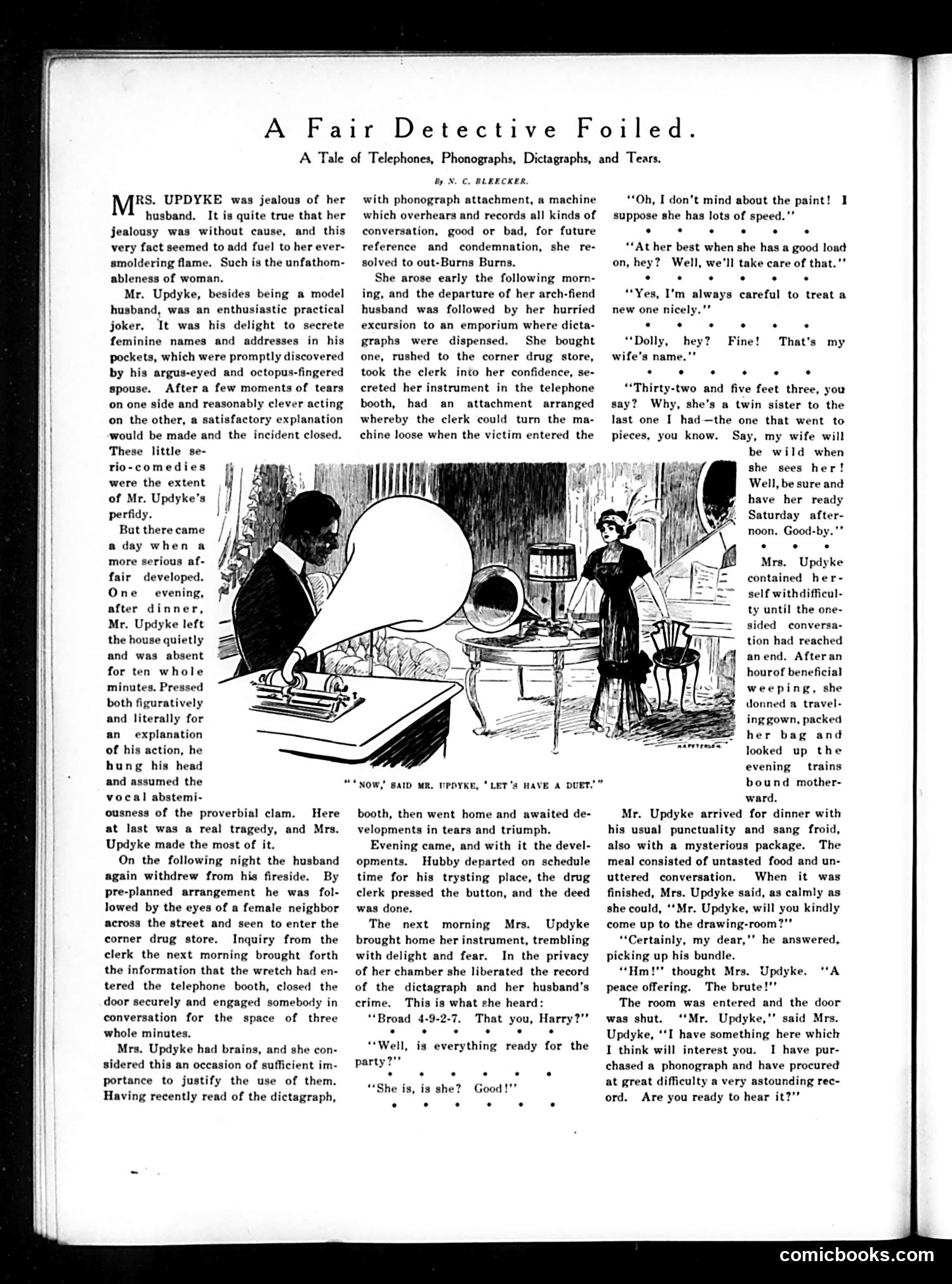
This comic story satirizes the emerging technology of the dictagraph—an early eavesdropping device—and marital jealousy. Mrs. Updyke, suspicious of her husband's secret ten-minute absence, purchases a dictagraph to spy on his phone calls at a drug store booth. She secretly records what she believes will be evidence of infidelity. However, the "damning" recording reveals Mr. Updyke discussing a party with a car dealer, discussing a new automobile ("Dolly") with female characteristics (thirty-two horsepower, five feet three inches long). The misheard conversation—references to treating "a new one nicely" and "she has a good load"—appears scandalous but is entirely innocent. The joke mocks both invasive surveillance technology and a jealous wife's unfounded suspicions. It reflects contemporary anxieties about new communication technologies enabling domestic mistrust.
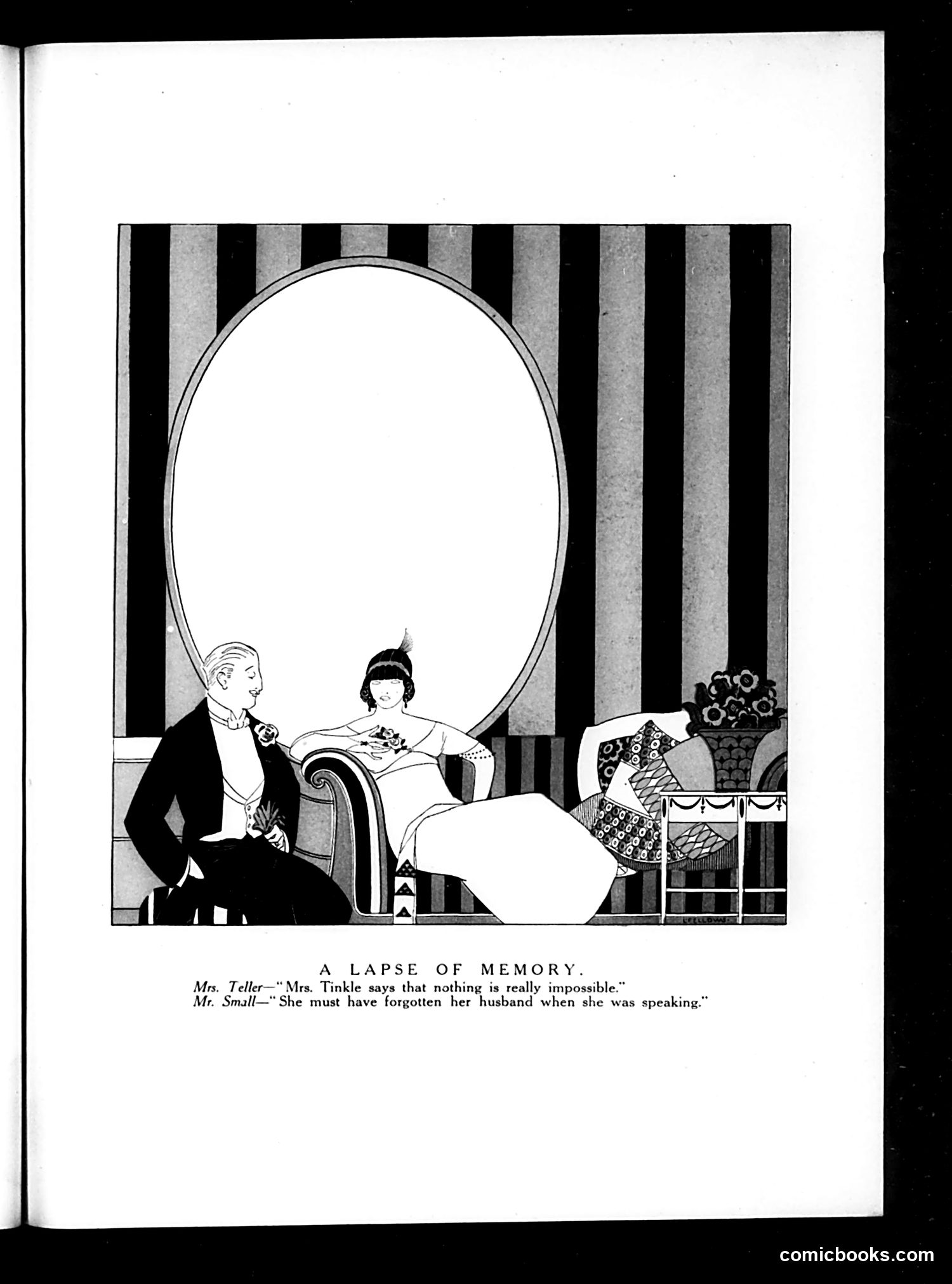
This is a single-panel cartoon joke from *Judge* magazine. Two men converse in an elegant interior: Mr. Teller reports that Mrs. Tinkle claims "nothing is really impossible," to which Mr. Small replies that she must have forgotten about her husband when making this statement. The humor relies on a period-appropriate insult: the joke assumes Mrs. Tinkle's husband (Mr. Tinkle) is so ineffectual, useless, or disappointing that his mere existence disproves the idea that anything is possible. The cartoon mocks both the woman for her naive optimism and—more pointedly—ridicules the husband as a figure of masculine failure or inadequacy. The striped backdrop and furnishings establish a wealthy domestic setting, suggesting this critique applies to idle society figures.
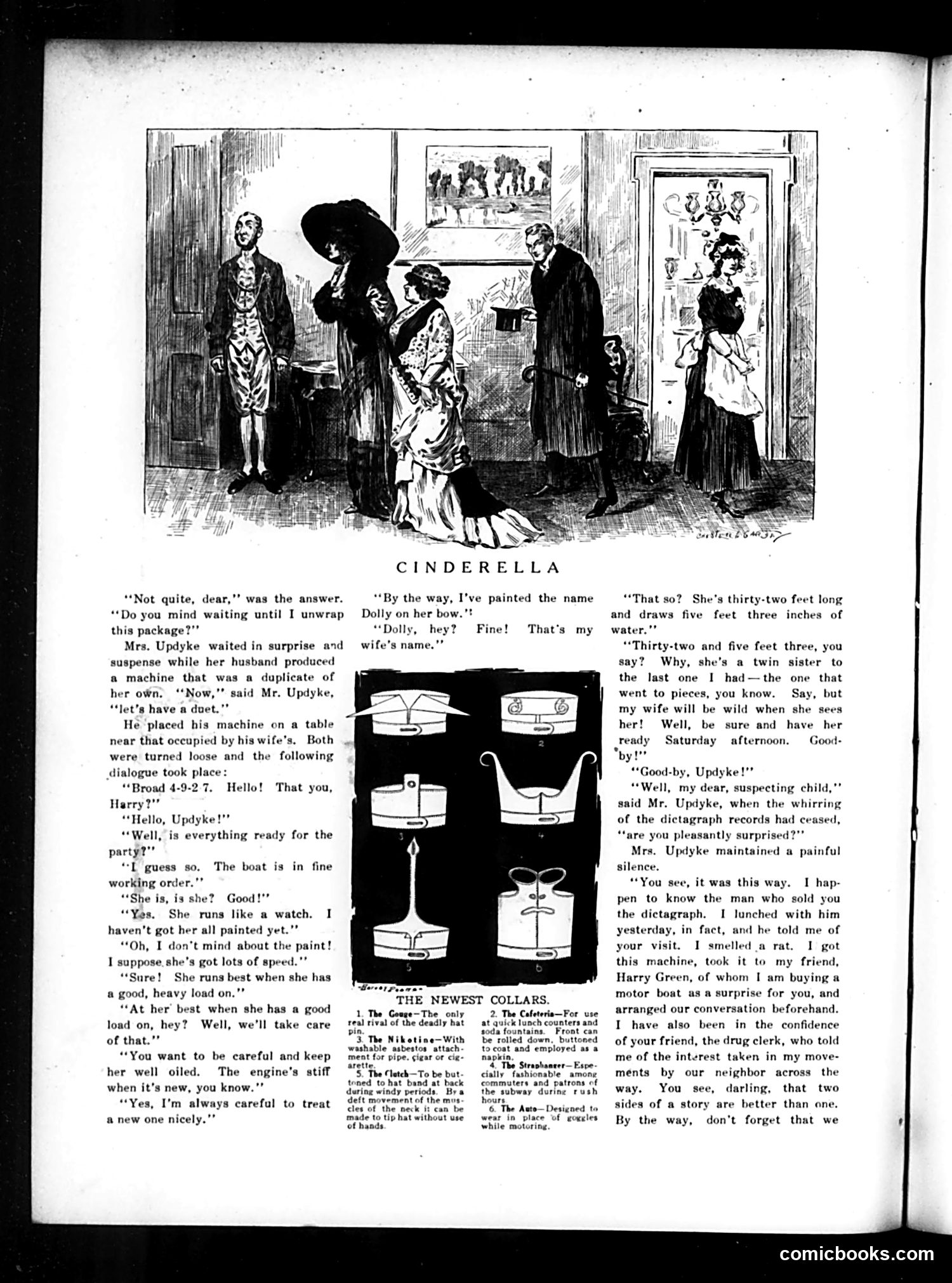
This page satirizes early 20th-century marital deception through a modern technological lens. Mr. Updyke has secretly obtained a **dictaphone** (voice recording machine) identical to his wife's and rigged a fake conversation between two machines to trick her. The joke: Mrs. Updyke had secretly recorded a phone conversation with a drug clerk gossiping about her neighbor's romantic interests. Suspecting infidelity, she purchased the dictaphone to spy on her husband. Updyke discovered this through the clerk, then turned the tables by manufacturing false evidence of his own affair—complete with a fabricated boat purchase as a "surprise gift." The satire targets several things: the absurdity of mechanical eavesdropping technology, marital suspicion and distrust, and the irony that technology meant to catch lies only enables more elaborate deceptions. "Cinderella" likely references the rags-to-riches transformation of deception itself. The sidebar showing absurd collar designs provides comedic relief, lampooning fashion excess.
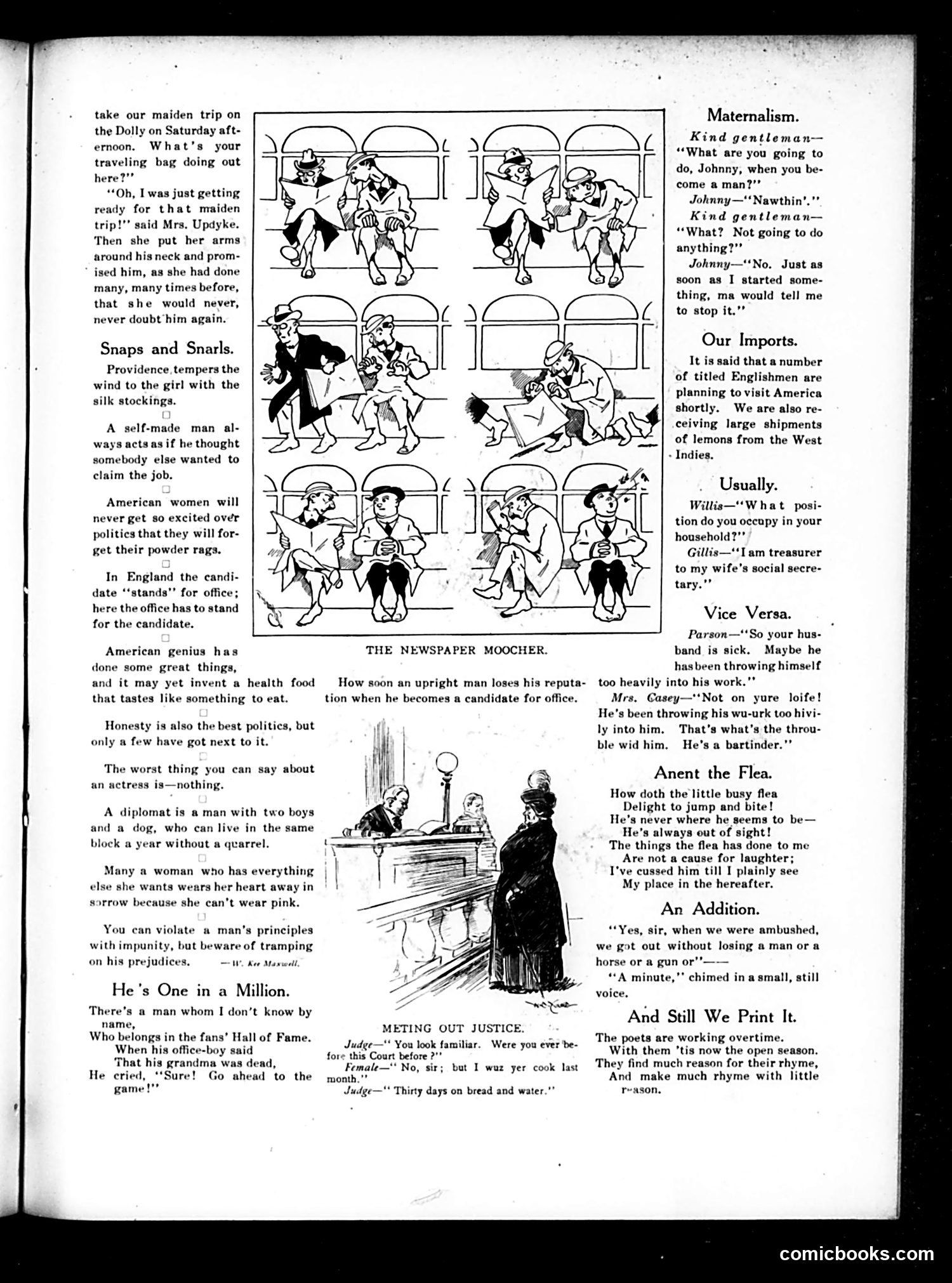
This page from Judge magazine contains multiple short humor pieces typical of early 20th-century American satirical journalism. **"The Newspaper Moocher"** (center comic strip) satirizes political candidates who lose respectability by seeking office—showing a man's changing behavior across multiple train car scenes, illustrating how ambition corrupts character. **Side commentaries** ("Snaps and Snarls") offer brief social critiques: mocking self-made men's pretension, suggesting American women prioritize appearance over politics, and poking fun at diplomatic hypocrisy. **"Meting Out Justice"** shows class commentary—a judge fails to recognize his former cook, now in court, highlighting legal system blind spots. **Other pieces** include domestic humor ("Maternalism," "Vice Versa") about marriage dynamics and working-class life, and "And Still We Print It" mocking poets for forced rhyming during prolific seasons. The overall tone reflects Progressive Era skepticism toward authority, politicians, and social pretense, using gentle ridicule aimed at middle-class readers.
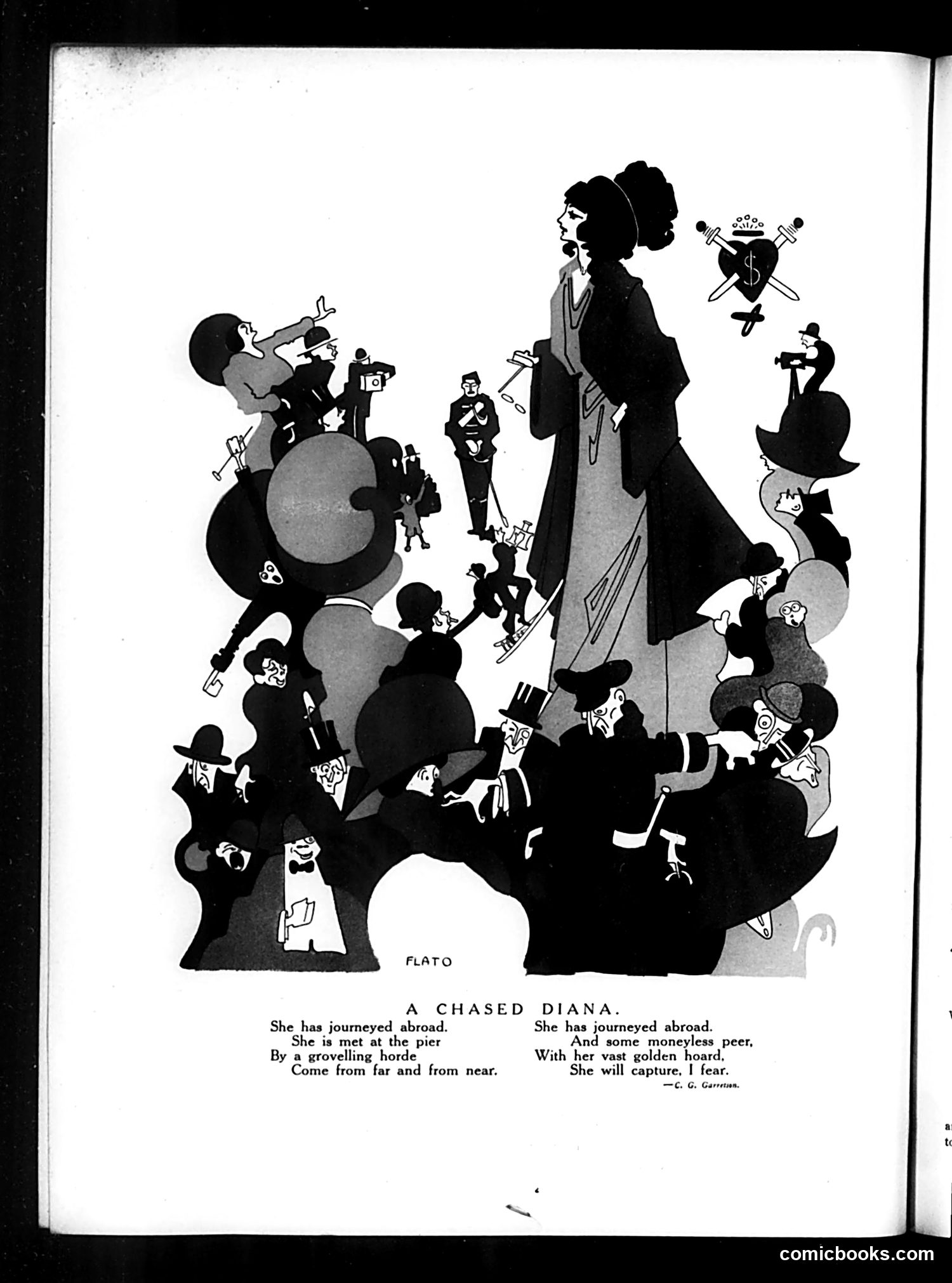
This satire, credited to C.G. Garretson, depicts a wealthy American woman (representing "Diana," likely referencing the goddess or an archetypal wealthy female figure) returning from abroad. The central tall figure is surrounded by a "grovelling horde" of fortune-hunters—identified by the "moneyless peer" reference as impoverished European aristocrats seeking to marry her "vast golden hoard." The cartoon mocks the Gilded Age phenomenon of wealthy American heiresses marrying titled but financially desperate European noblemen. The swarm of small figures with top hats and formal dress clutching money symbols illustrates how such women attracted desperate suitors. The satire suggests American wealth was being "captured" by foreign nobility through strategic marriages—a commentary on both American nouveau riche materialism and European aristocratic decline.
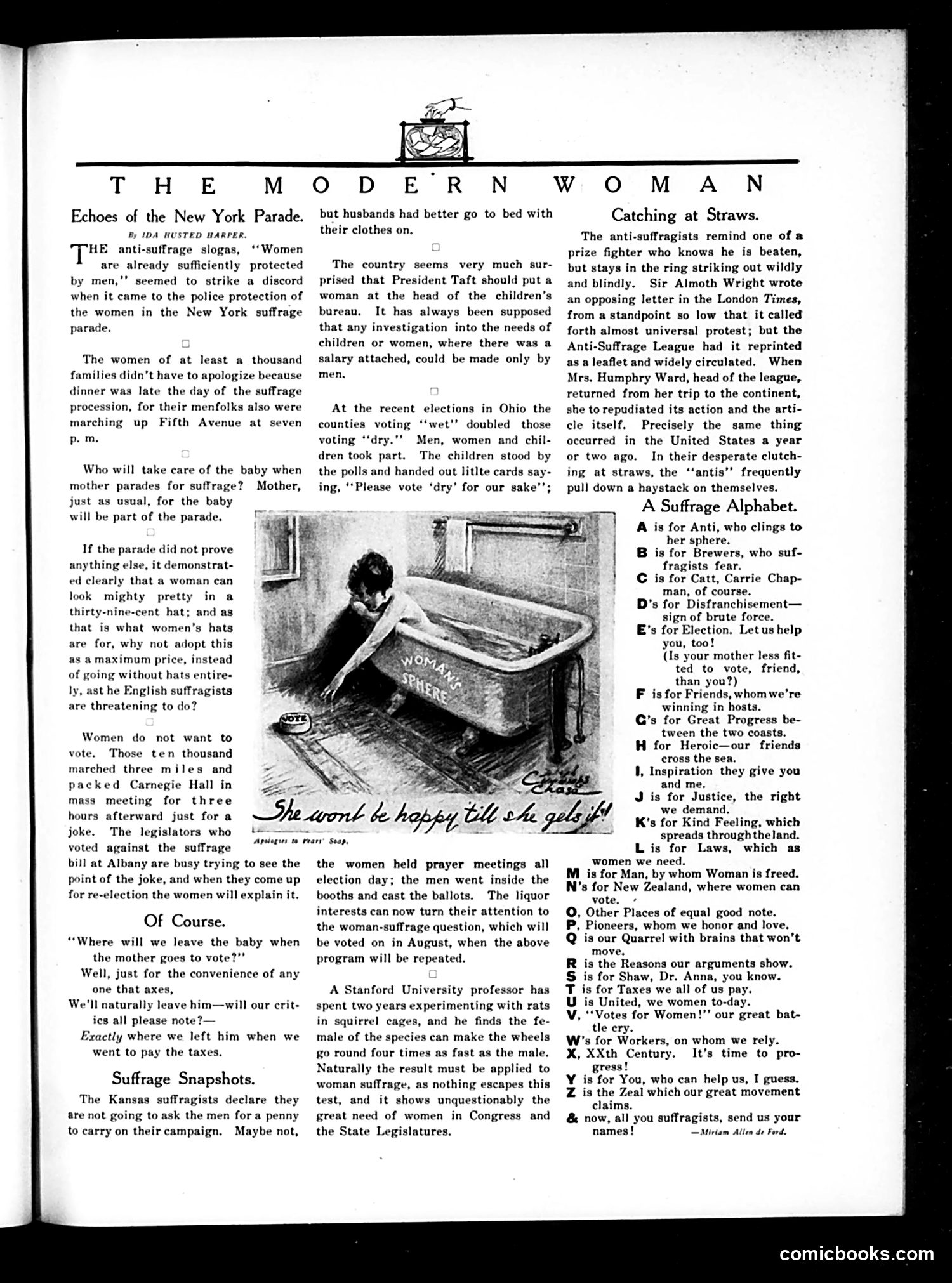
This satirical Judge magazine page attacks anti-suffrage arguments through Ida Husted Harper's column. The central cartoon shows a woman washing clothes in a tub labeled "WOMEN'S SPHERE," with the caption "She won't be happy till she gets it!"—mocking the notion that women are content confined to domestic work. Harper systematically dismantles anti-suffragists' claims: their argument that "men protect women" rings hollow when police failed to protect suffragists at the New York parade. She ridicules the question "Who will care for the baby?"—pointing out mothers already manage childcare while men work. The "Suffrage Alphabet" is a propaganda tool listing reasons supporting women's voting rights. The "Suffrage Snapshots" section uses absurdist humor: a Stanford rat experiment showing female rats outperform males becomes "evidence" women belong in Congress. The piece portrays anti-suffragists as desperate, "striking out wildly and blindly" like a beaten boxer, even circulating discredited arguments their own leaders repudiated.
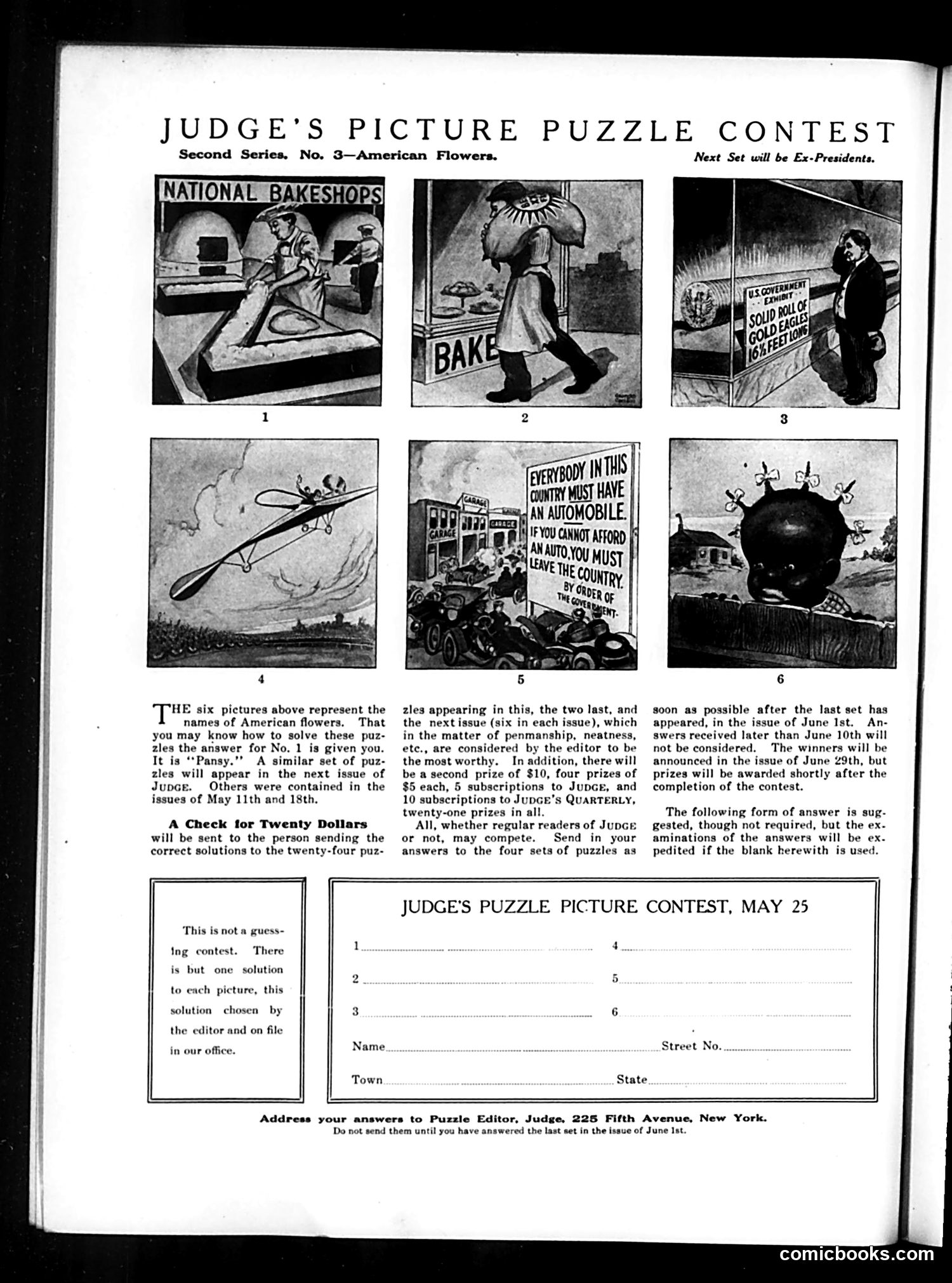
This page presents a visual word-puzzle competition from Judge magazine. Contestants must identify American flowers from cryptic illustrations—for example, picture 1 depicts a "Pansy" (a man in a pan, looking sad/pensive). The remaining five puzzles use visual puns: image 2 appears to show a baker (likely "Sunflower" or similar), image 3 involves a government building (unclear without solution), image 4 shows a plant or vine, image 5 depicts automobiles with text about national policy (possibly referencing Depression-era concerns about automobile ownership), and image 6 shows a large spherical object. This was a legitimate competition offering $20 for correct solutions across multiple issues, with additional prizes for neatness and penmanship. The next contest would feature "Ex-Presidents"—suggesting visual puns on presidential names. Such puzzles were popular magazine entertainment during this era, combining wordplay, art, and monetary incentive.
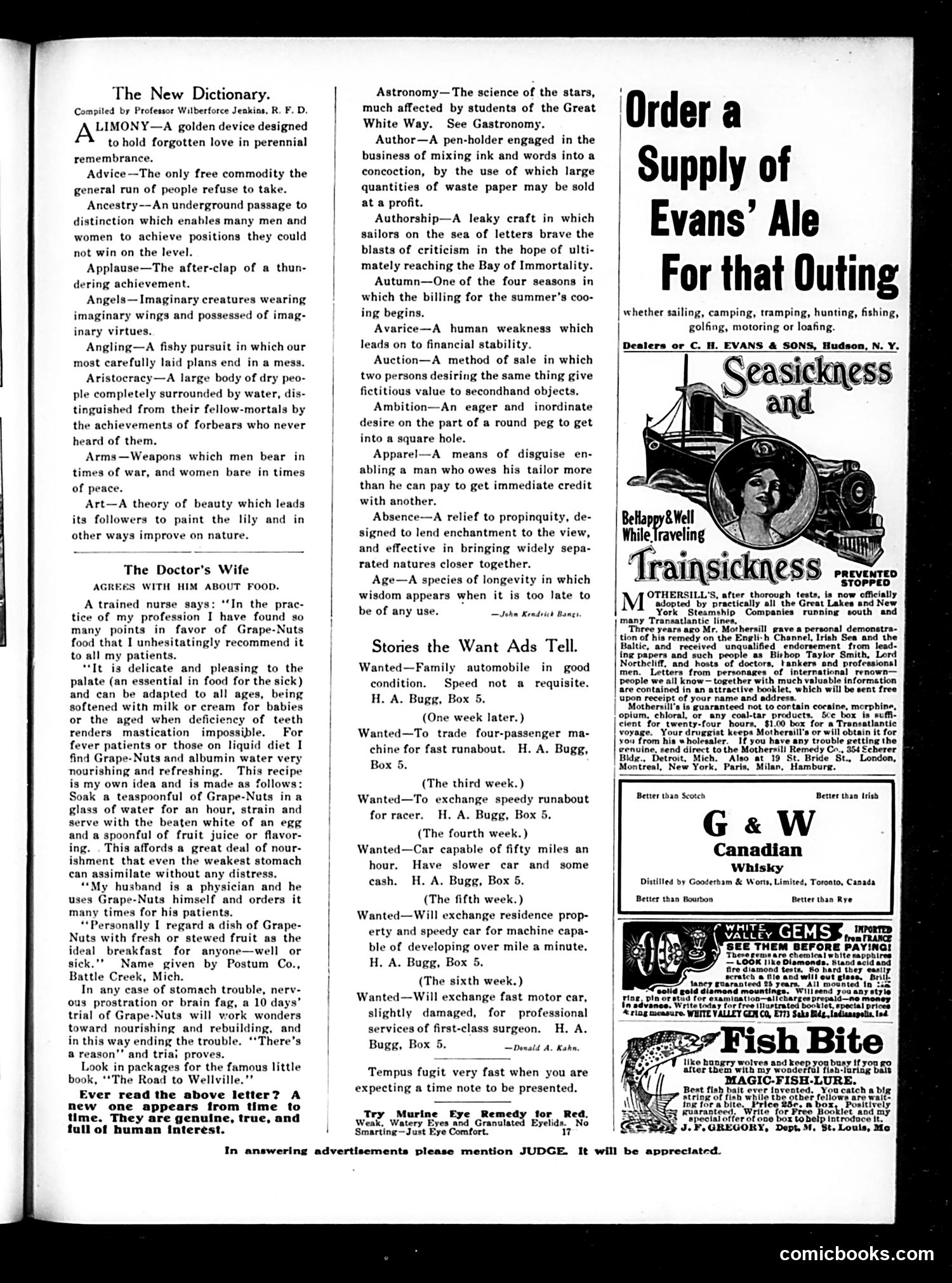
This page is primarily **advertising and satirical definitions**, not political cartoons. The main content is "The New Dictionary" by Professor Wilberforce Jenkins—a humorous lexicon offering cynical redefinitions of common words. Examples: "Ancestry" as an "underground passage to distinction" (mocking inherited privilege), "Authorship" as a "leaky craft" facing criticism, and "Avarice" leading to "financial stability" (ironic social commentary). Below this runs "The Doctor's Wife," a **Grape-Nuts cereal advertisement** featuring testimonial from a trained nurse praising the product's health benefits. The page also contains **classified ads** for various products (Evans' Ale, Mothersill's seasickness remedy, fish lures, whisky) and "Stories the Want Ads Tell"—humorous descriptions of items for sale. The satire targets **American social pretension, financial dishonesty, and materialism** through clever wordplay rather than visual caricature. There are no identifiable political figures—it's social satire aimed at middle-class readers.
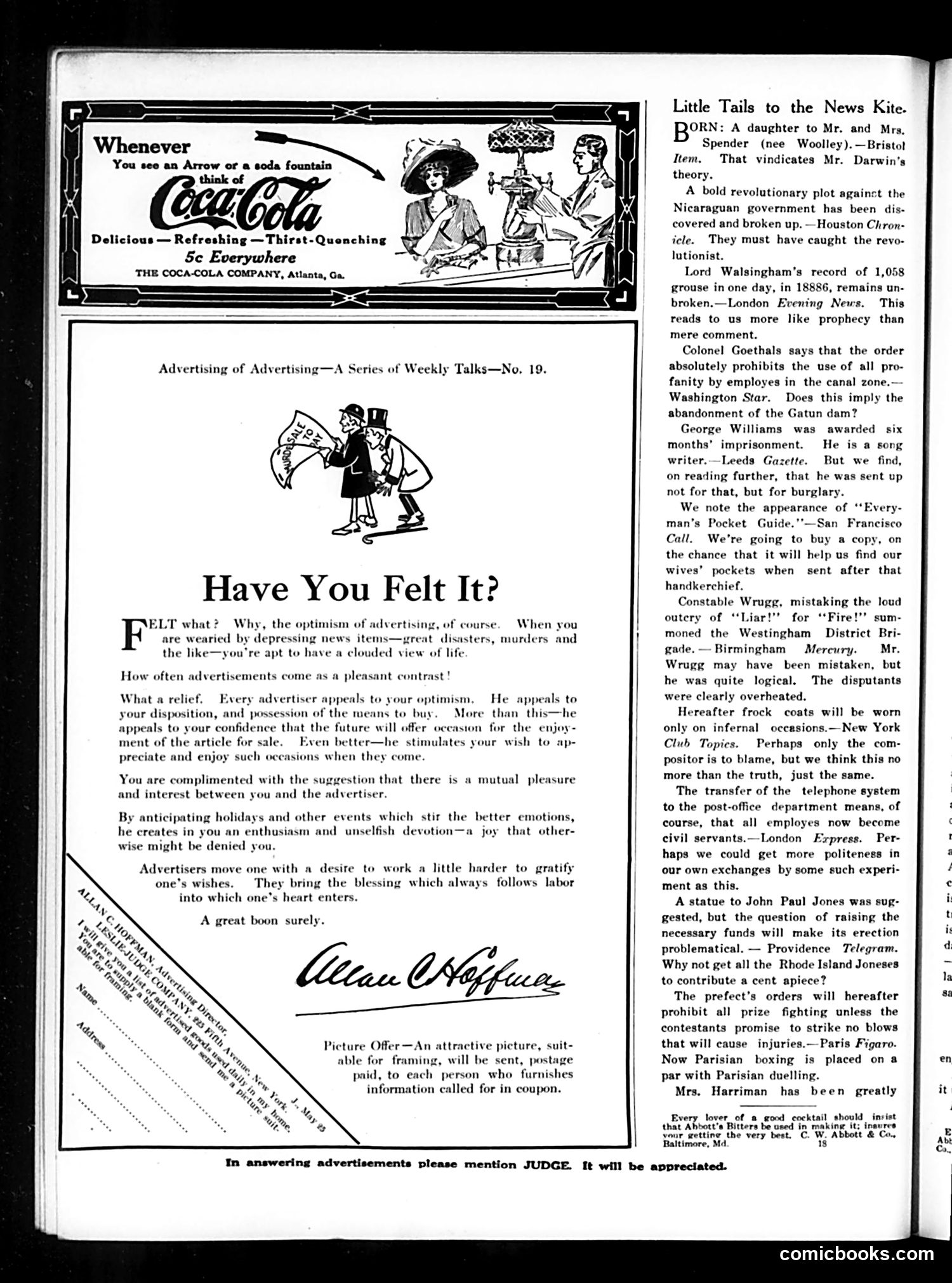
This page contains two distinct elements: a Coca-Cola advertisement and an article titled "Have You Felt It?" by Allan Oaffman (signed). **The Main Article's Satire:** Oaffman satirizes advertising's psychological manipulation. He mocks how advertisers cynically appeal to consumers' optimism during depressing times, creating artificial emotional connections and manufactured desire. The piece presents advertising's manipulative tactics with mock-earnest language—praising how ads inspire "unselfish devotion" and make people "work harder" to buy things. The heavy irony suggests advertising exploits human psychology rather than serving genuine needs. **The Irony:** The article appears *surrounded by advertisements* (Coca-Cola prominently featured), making the critique self-reflexive—Judge itself profits from the very advertising manipulation being satirized. **"Little Tails to the News Kite":** This section collects brief satirical quips mocking recent news items with deadpan wit, typical of Judge's style.
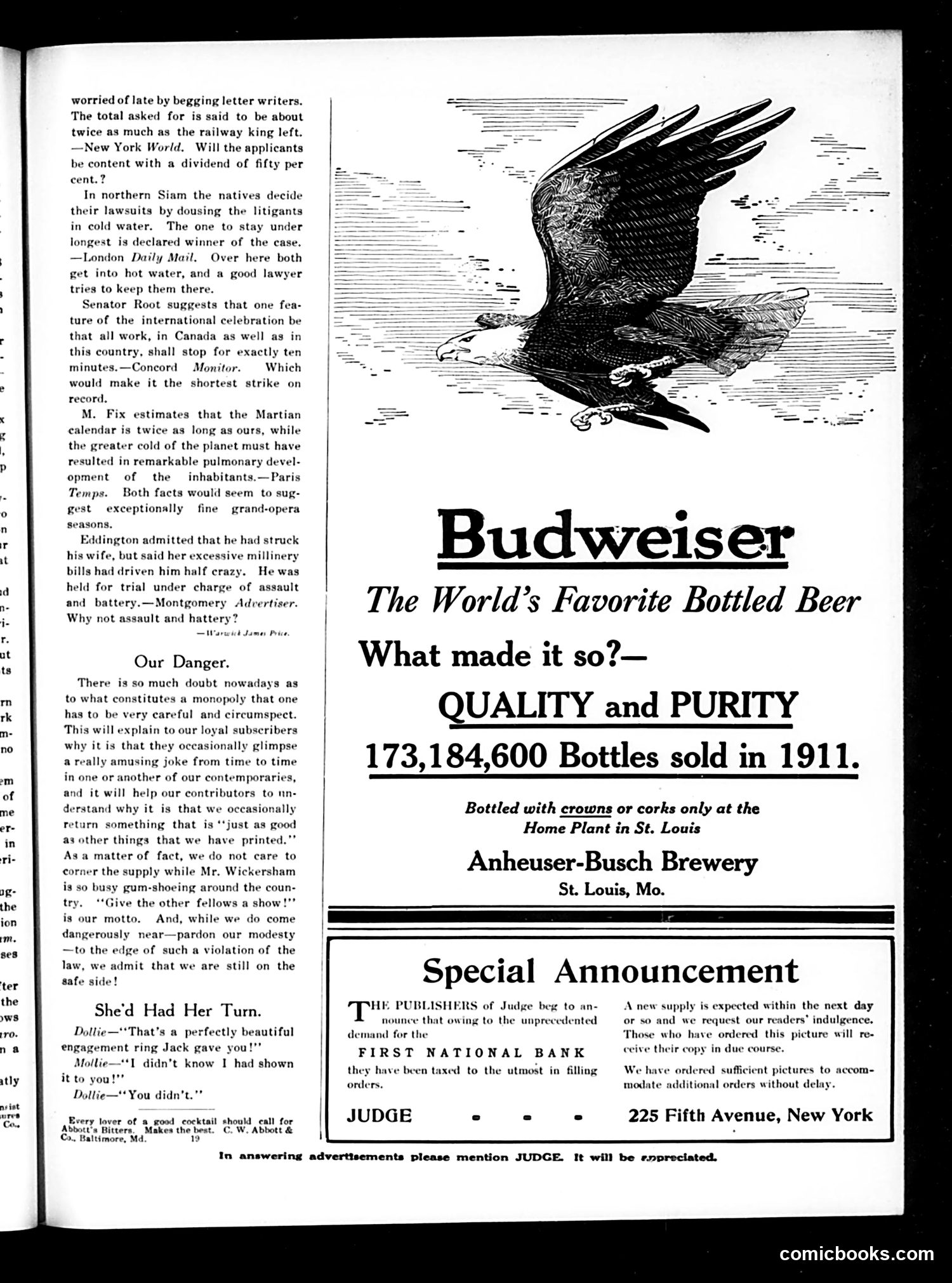
This page combines satirical commentary with advertising, typical of Judge magazine's format. **The Cartoon:** A bald eagle in flight illustrates the page—likely symbolizing American identity or authority, though its specific reference isn't clearly explained in the visible text. **The Satire:** Multiple brief jokes target contemporary issues. One mocks litigation ("both get into hot water, and a good lawyer tries to keep them there"). Another jabs at women's spending habits through a domestic assault case, with the punchline suggesting "assault and hattery" (wordplay on millinery bills). A third jokes about a proposed international work stoppage being "the shortest strike on record"—political commentary on labor disputes. **The Advertisements:** The page heavily features a Budweiser ad claiming 173 million bottles sold in 1911, emphasizing "Quality and Purity." Below, Judge itself advertises a popular "First National Bank" illustration in high demand. **Overall Context:** This reflects early 20th-century American concerns: labor disputes, domestic economics, consumerism, and beer as a respectable commercial product.
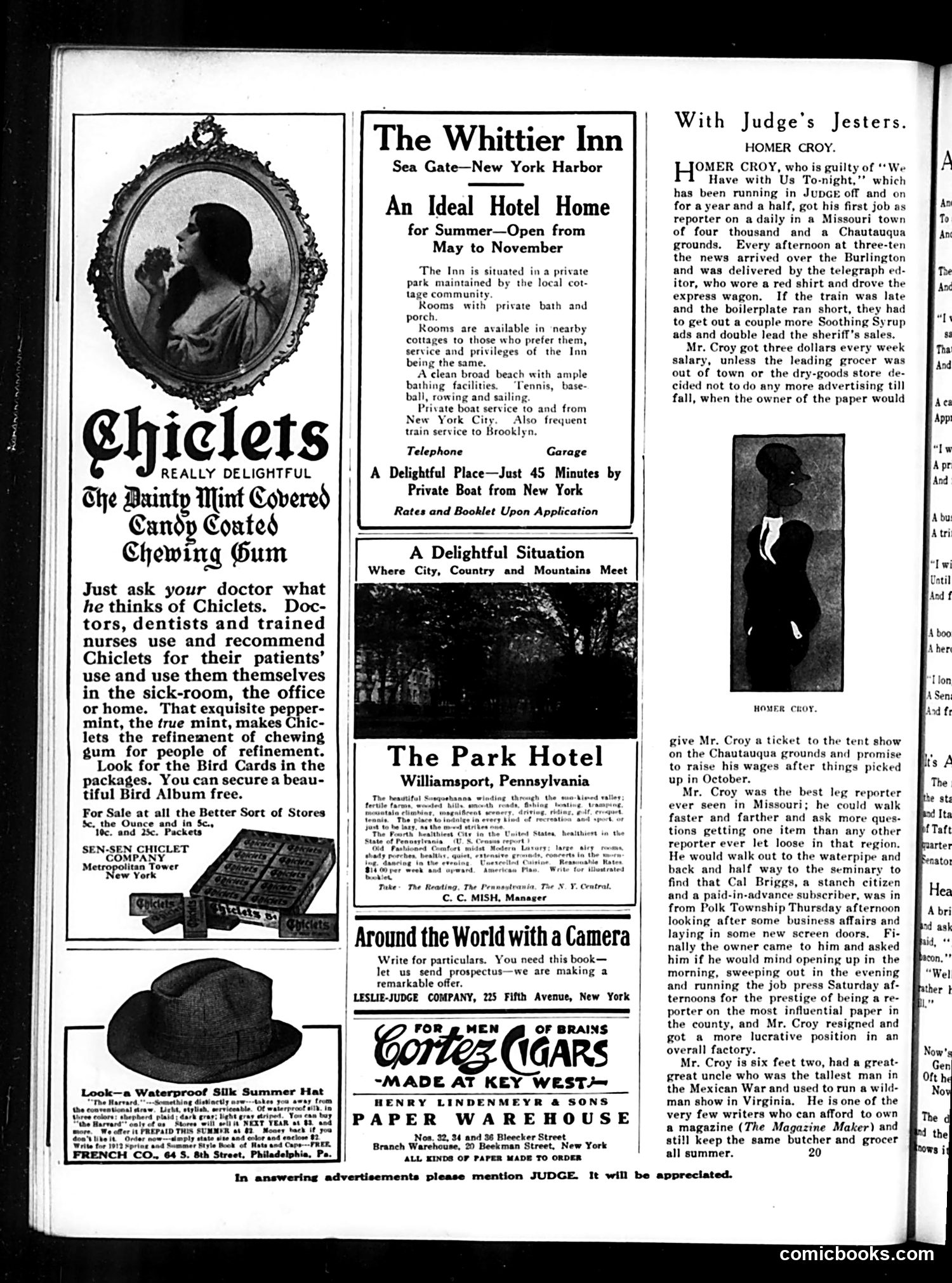
This page is primarily **advertising** with one substantial humorous article. The main content is "With Judge's Jesters," a satirical piece by Homer Croy mocking small-town newspaper life. **The satire:** Croy describes a Missouri newspaper reporter's miserable job—earning three dollars weekly, tasked with covering minor local events (like a citizen buying screen doors), with payment sometimes replaced by circus tickets. The humor targets the pretensions of provincial journalism: the editor promises eventual raises while exploiting the eager young reporter's enthusiasm. The piece ridicules both the economic desperation of small-town journalism and the inflated self-importance papers assigned themselves ("prestige of being a reporter on the most influential paper in the county"). **Context for modern readers:** This reflects early 20th-century newspaper economics, when rural papers operated on minimal budgets and treated reporters as near-volunteer contributors. The satire suggests American journalism's struggles even then—underpaid workers, reliance on local advertising, and modest community news treated with exaggerated significance. The remaining content comprises hotel and product advertisements typical of Judge's era.
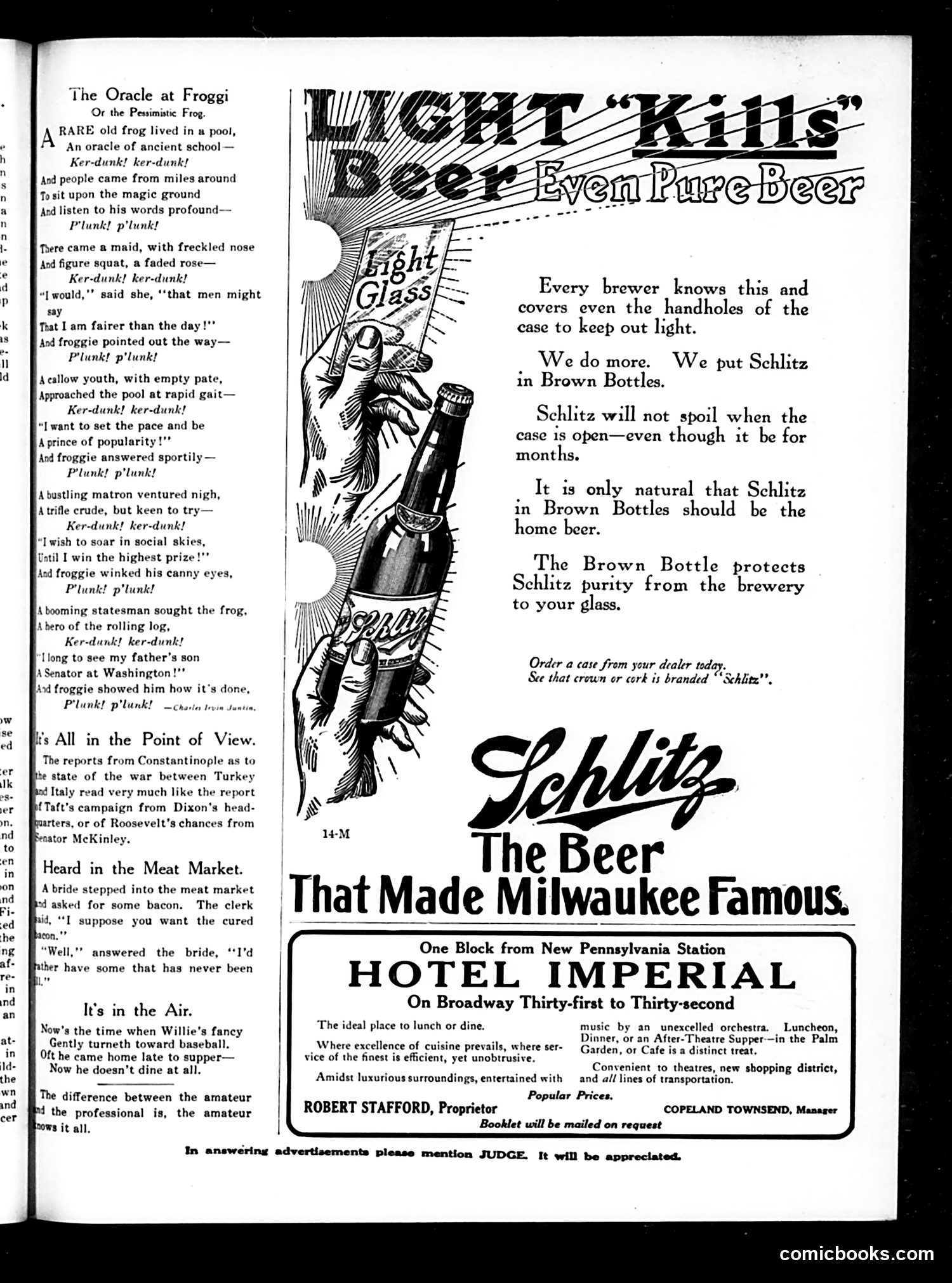
This page contains **primarily literary and advertising content** rather than political satire. **"The Oracle at Froggi"** is a humorous poem about a pessimistic fortune-telling frog who grants wishes to various visitors—a plain-faced woman wanting beauty, a youth seeking popularity, an ambitious matron, and a statesman. The joke appears to be the frog's cynical, understated responses (shown through onomatopoeia like "Ker-dunk!" and "P'lunk!"), suggesting the frog mocks human ambitions. The remaining items are **brief jokes and anecdotes** with light social commentary: one mocks political reporting during the Taft/Roosevelt era by comparing it to war coverage; another plays on a bride's preference for uncured bacon; a third jokes about a boy neglecting dinner for baseball season. The **dominant content is advertising**: a full-page Schlitz beer advertisement emphasizing brown bottles protecting beer purity, and a Hotel Imperial advertisement highlighting dining and theatre convenience. These reflect early-20th-century commercial messaging rather than satire.
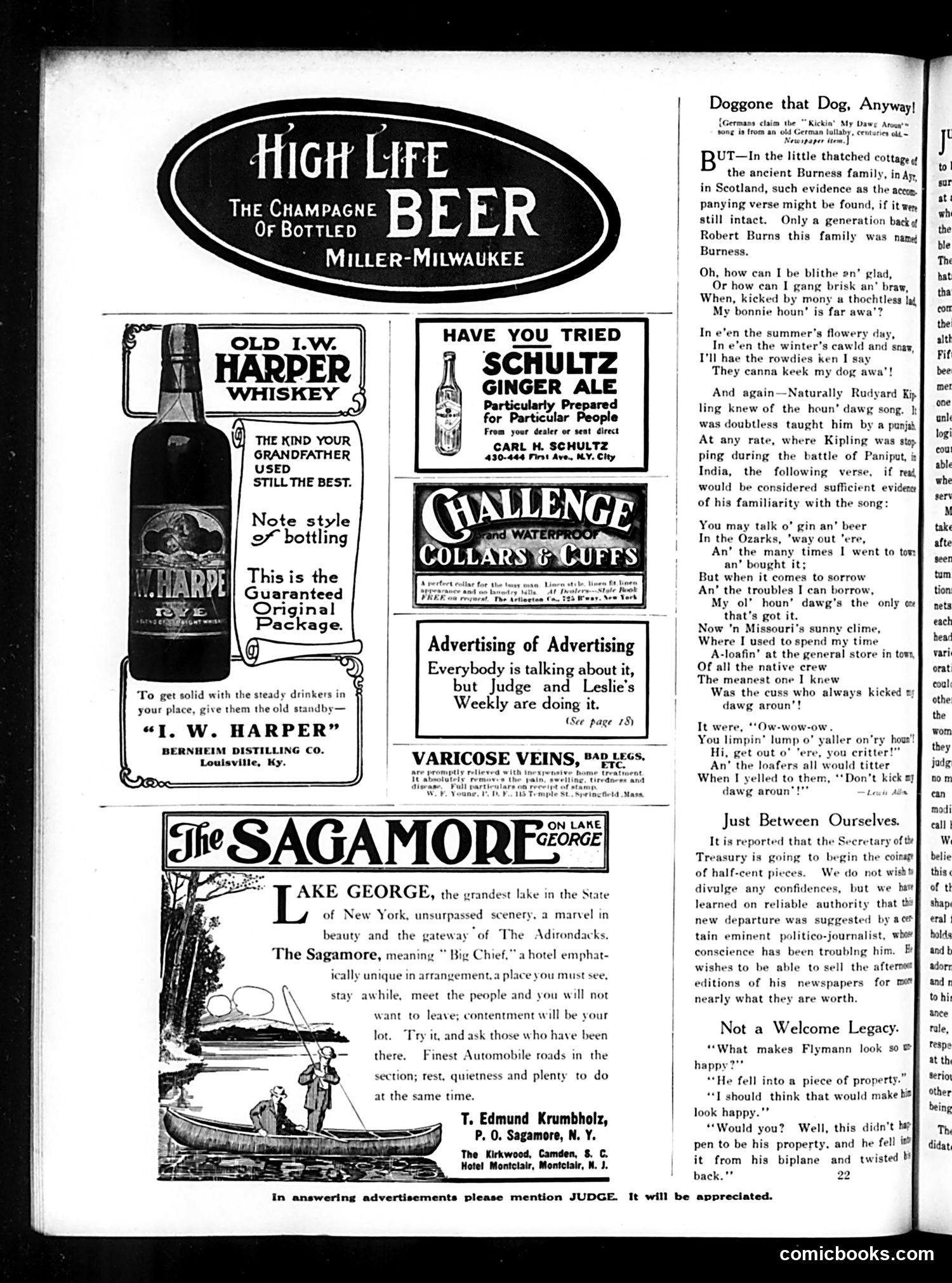
This page is primarily **advertisements** interspersed with two humor pieces. **Advertisements** occupy most space: liquor (I.W. Harper whiskey, High Life beer, Schultz ginger ale), a self-promotional ad for Judge and Leslie's Weekly magazines, and The Sagamore hotel on Lake George. **"Doggone that Dog, Anyway!"** appears to satirize a contemporary dispute about song origins. Germans claimed the "Kicking My Dog Away" song came from old German lullabies; the piece counters by suggesting Scottish poet Robert Burns' family knew it generations ago, and that Rudyard Kipling encountered it in India. It's a playful nationalist/literary quarrel, presented through vernacular poetry. **"Not a Welcome Legacy"** is a brief joke: a man named Flymann fell from his biplane onto property—but since it wasn't his property, he wasn't happy about it. Dark humor about an aviation accident. The page reflects early 20th-century Judge content: advertisements subsidizing satirical commentary on contemporary cultural disputes.
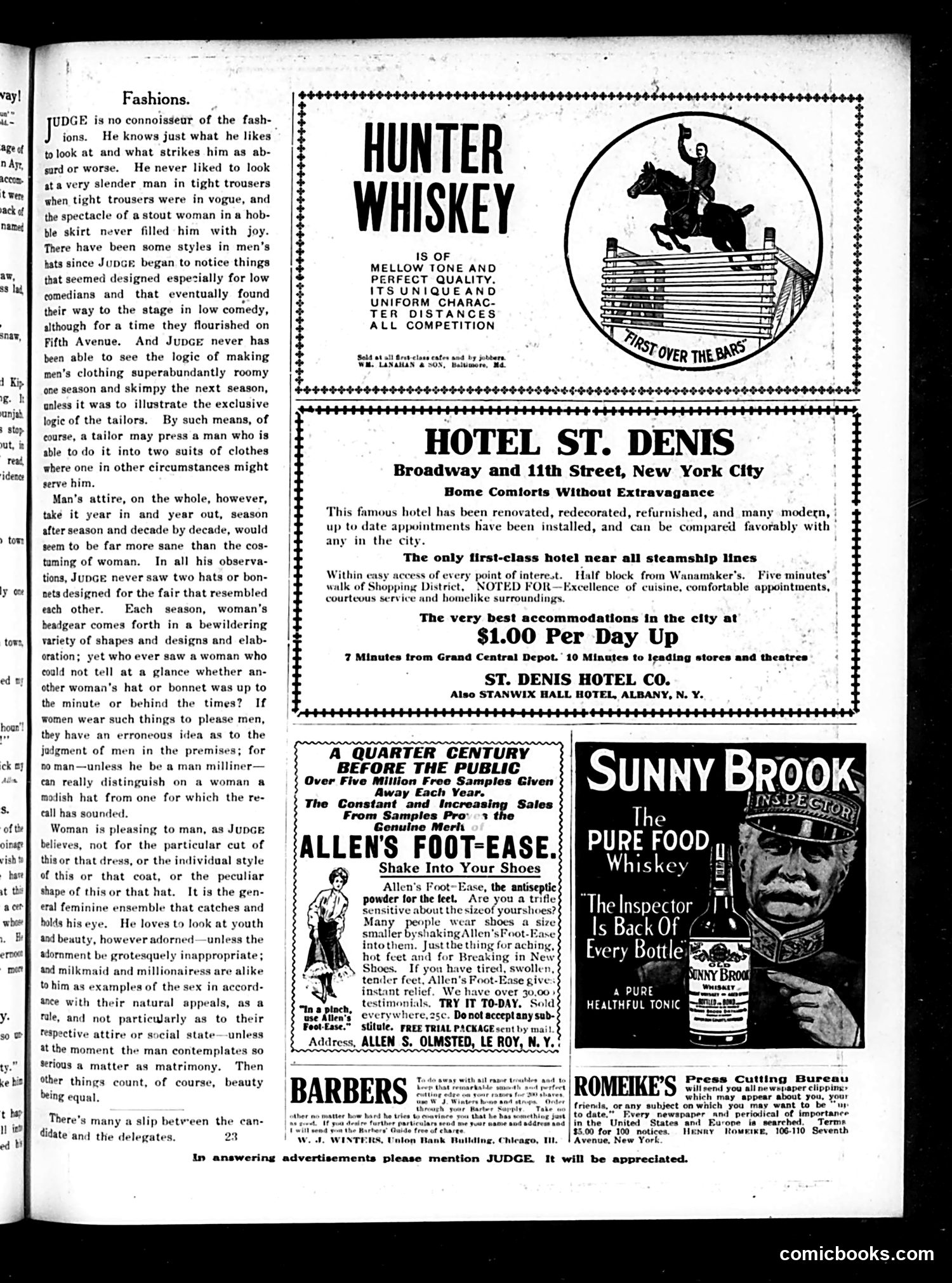
This page is primarily **advertising**, not political satire. The dominant content consists of commercial advertisements for products and establishments popular in the early 20th century. The main editorial piece, "Fashions," is a commentary on clothing trends rather than political satire. The author critiques the illogical nature of fashion—particularly how men's clothing alternates between roomy and tight fits, and how women's hats vary wildly year to year despite supposedly being designed to please men. The point is that women understand fashion minutiae far better than men do, so the premise that women dress for male approval is flawed. The advertisements include Hunter Whiskey, Hotel St. Denis (a New York hotel), Allen's Foot-Ease (a foot powder), Sunny Brook Whiskey, and Romeike's Press Clipping Bureau. These reflect commercial interests of the era but contain no satirical content.
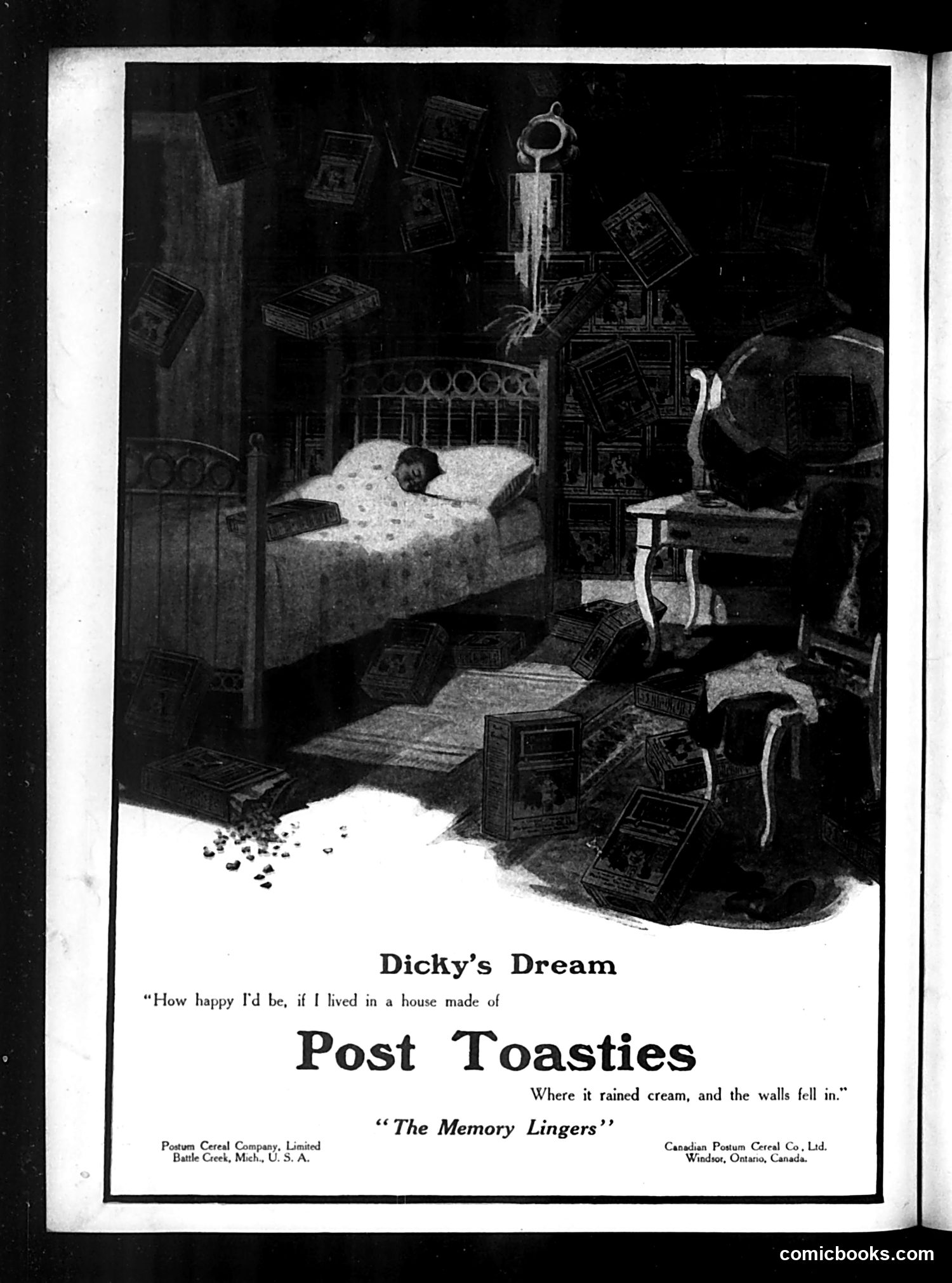
This is a **Post Toasties cereal advertisement** disguised as whimsical fantasy art, not political satire. The image depicts a child named "Dicky" in bed, surrounded by floating cereal boxes, imagining a surreal world made of Post Toasties cereal where it "rains cream, and the walls fell in"—a playful exaggeration of the product's appeal to children. The tagline "The Memory Lingers" emphasizes the product's memorable taste. This represents early 20th-century advertising's strategy of creating fantastical, child-centered dreams to market breakfast cereals. The dream imagery was designed to make the cereal seem magical and irresistible to young consumers and their parents.