
Judge, 1912-05-25 · page 10 of 24
Judge — May 25, 1912 — page 10: what you’re looking at
What you’re looking at
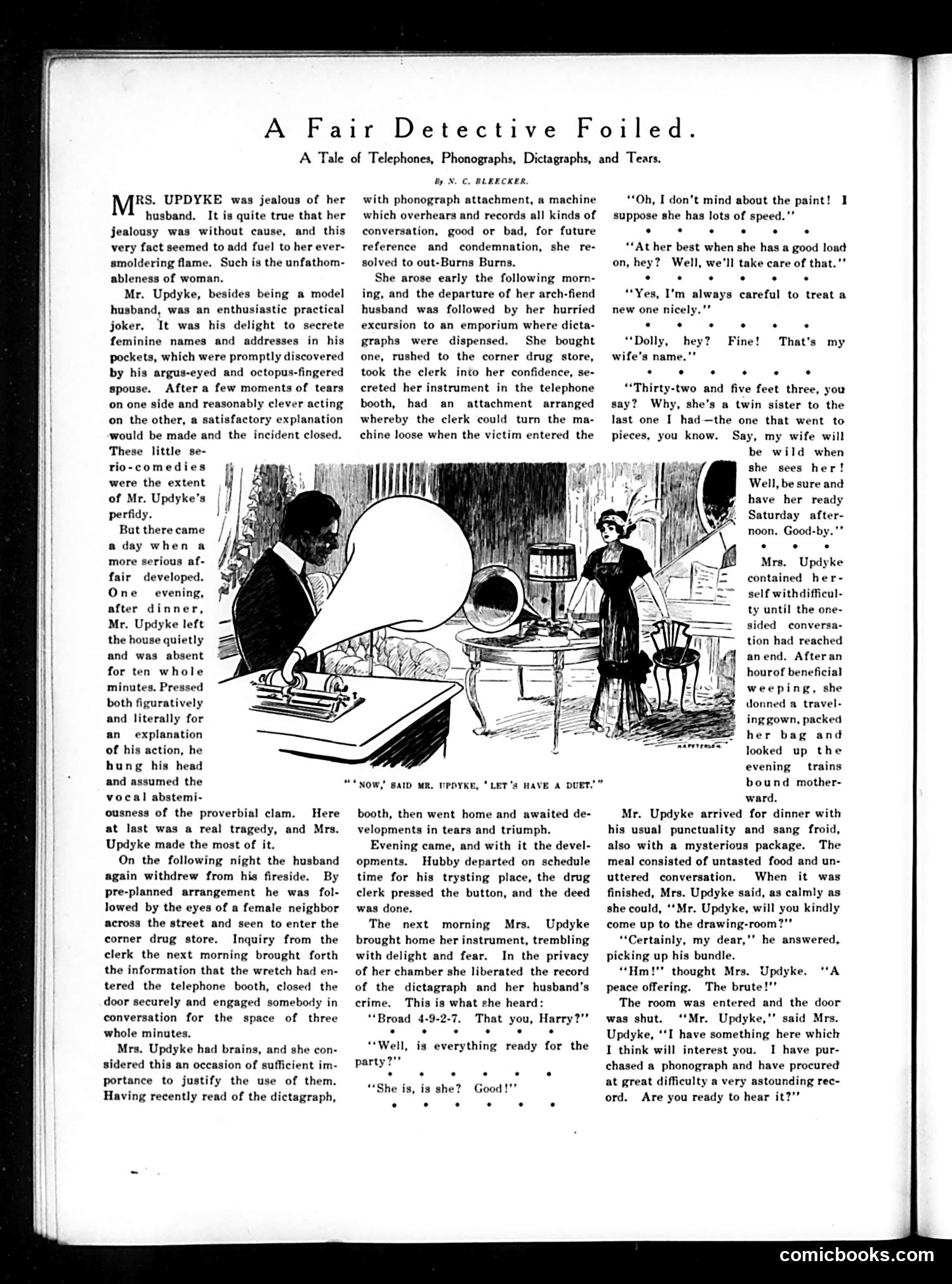
This comic story satirizes the emerging technology of the dictagraph—an early eavesdropping device—and marital jealousy. Mrs. Updyke, suspicious of her husband's secret ten-minute absence, purchases a dictagraph to spy on his phone calls at a drug store booth. She secretly records what she believes will be evidence of infidelity. However, the "damning" recording reveals Mr. Updyke discussing a party with a car dealer, discussing a new automobile ("Dolly") with female characteristics (thirty-two horsepower, five feet three inches long). The misheard conversation—references to treating "a new one nicely" and "she has a good load"—appears scandalous but is entirely innocent. The joke mocks both invasive surveillance technology and a jealous wife's unfounded suspicions. It reflects contemporary anxieties about new communication technologies enabling domestic mistrust.
📄 Transcribed text from this page (OCR, searchable)
Machine-transcribed from the original scan — historical spelling and the odd misread are preserved.
A Fair Detective Foiled. A Tale of Telephones, Phonographs, Dictagraphs, and Tears. RS. UPDYKE was jealous of her husband. It is quite true that her jealousy was without cause, and this very fact seemed to add fuel to her ever- smoldering flame. Such is the unfathom- ableness of woman. Mr. Updyke, besides being a model husband, was an enthusiastic practical joker. It was his delight to secrete feminine names and addresses in his pockets, which were promptly discovered by his argus-eyed and octopus-fingered spouse. After a few moments of tears ‘on one side and reasonably clever acting on the other, a satisfactory explanation would be made and the incident closed. These little se- rio-comedies were the extent of Mr. Updyke’s perfidy. But there came a day when a more serious af- fair developed. One evening, after dinner, Mr. Updyke left the house quietly and was absent for ten whole minutes. Pressed both figuratively and literally for an explanation of his action, he hung his head and assumed the vocal abstemi- ousness of the proverbial clam. Here at last was a real tragedy, and Mrs. Updyke made the most of it. On the following night the husband again withdrew from his fireside. By pre-planned arrangement he was fol- lowed by the eyes of a female neighbor across the street and seen to enter the corner drug store. Inquiry from the clerk the next morning brought forth the information that the wretch had en- tered the telephone booth, closed the door securely and engaged somebody in conversation for the space of three whole minutes. Mrs. Updyke had brains, and she con- sidered this an occasion of sufficient im- portance to justify the use of them. Having recently read of the dictagraph, By N.C. BLEECKER. with phonograph attachment, a machine which overhears and records all kinds of conversation, good or bad, for future reference and condemnation, she re- solved to out-Burns Burns. She arose early the following morn- ing, and the departure of her arch-fiend husband was followed by her hurried excursion to an emporium where dicta- graphs were dispensed. She bought one, rushed to the corner drug store, took the clerk into her confidence, se- creted her instrument in the telephone booth, had an attachment arranged whereby the clerk could turn the ma- chine loose when the victim entered the NOW,’ SAID MR. NIPDYKE, ‘LET'S HAVE A DUET.’” booth, then went home and awaited de- velopments in tears and triumph. Evening came, and with it the devel- opments. Hubby departed on schedule time for his trysting place, the drug clerk pressed the button, and the deed was done. The next morning Mrs. Updyke brought home her instrument, trembling with delight and fear. In the privacy of her chamber she liberated the record of the dictagraph and her husband's crime. This is what she heard: “Broad 4-9-2-7. That you, Harry?” . oe oe . ‘Well, is everything ready for the party?"" . Good !"" “She is, is she? “Oh, I don’t mind about the paint! I suppose she has lots of speed."’ . . . . . . “At her best when she has a good load on, hey? Well, we'll take care of that."’ . oe . “Yes, I’m always careful to treat a new one nicely."” “Dolly, hey? wife’s name."" . Fine! That’s my . . “Thirty-two and five feet three, you say? Why, she’s a twin sister to the last one I had—the one that went to Say, my wife will be wild when she sees her! Well, be sure and have her ready Saturday after- noon. Good-by.”” . Mrs. Updyke contained her- self withdifficul- ty until the one- ed conversa- tion had reached anend. Afteran hourof beneficial weeping, she donned a travel- ing gown, packed her bag and looked up the evening trains bound mother- ward. Mr. Updyke arrived for dinner with his usual punctuality and sang froid, also with a mysterious package. The meal consisted of untasted food and un- uttered conversation. When it was finished, Mrs. Updyke said, as calmly as she could, ‘‘Mr. Updyke, will you kindly come up to the drawing-room?"’ “Certainly, my dear,’’ he answered, picking up his bundle. “Hm!” thought Mrs. Updyke. peace offering. The brute!’’ The room was entered and the door was shut. ‘‘Mr. Updyke,’’ said Mrs. Updyke, ‘‘I have something here which I think will interest you. I have pur- chased a phonograph and have procured at great difficulty a very astounding rec- ord. Are you ready to hear it?’’ . . . pieces, you know. “A comicbooks.com