
A complete issue · 28 pages · 1912
Judge — April 6, 1912
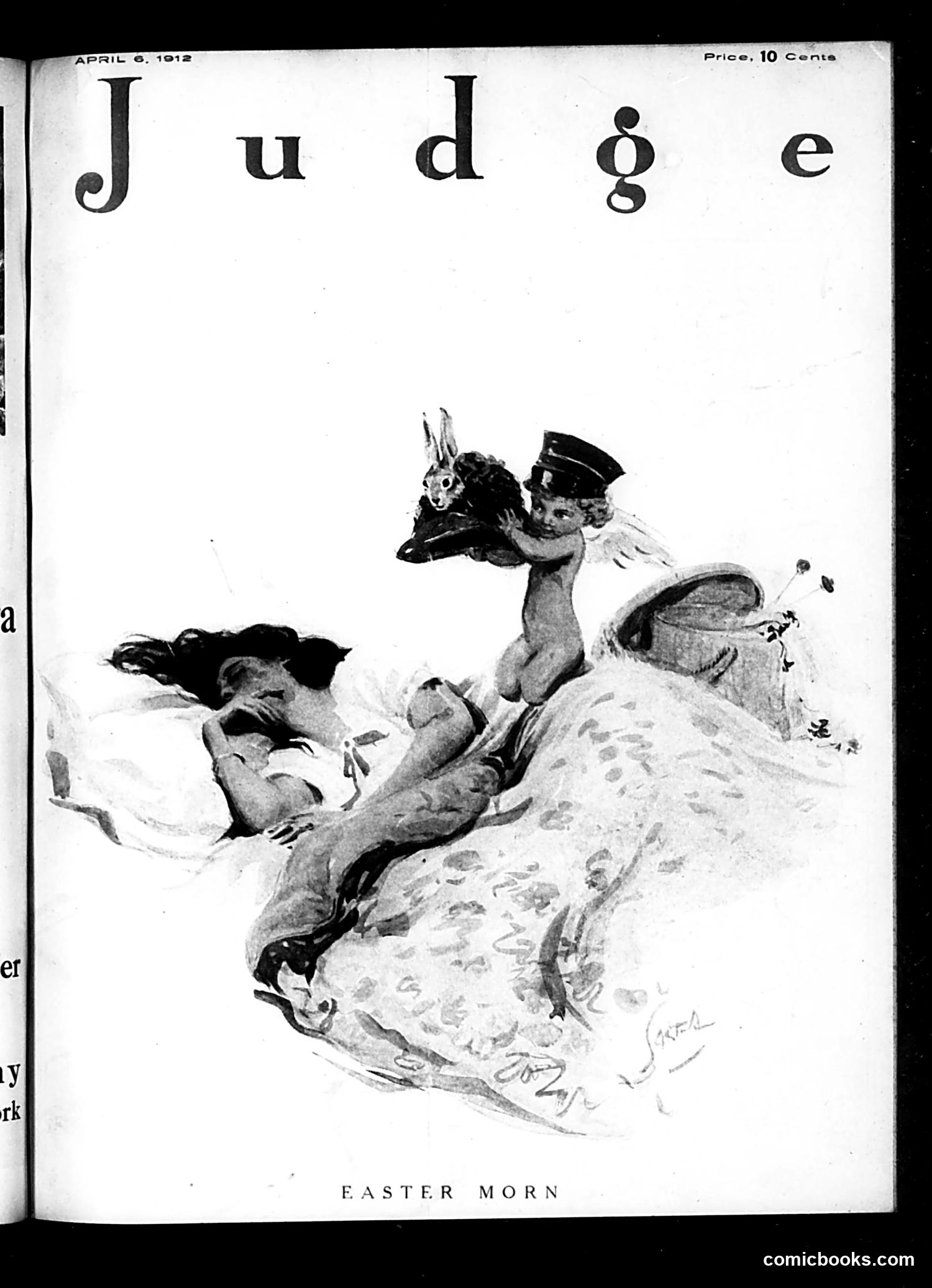
This cover illustration depicts anthropomorphic animals (appearing to be rabbits or hares) in human clothing engaged in Easter celebration activities. The figures are dressed in period attire including hats and jackets, positioned playfully in snow or white covering. The cartoon plays on traditional Easter imagery—particularly the Easter Bunny tradition—by rendering the holiday's central figures in a humorous, slightly grotesque anthropomorphic style typical of Judge's satirical approach. The "Easter Morn" caption suggests this is commentary on Easter customs and celebrations of the era. Without additional context about specific 1912 events or figures, the precise satirical target remains unclear, though the exaggerated characterization appears designed for light holiday humor rather than serious political commentary.
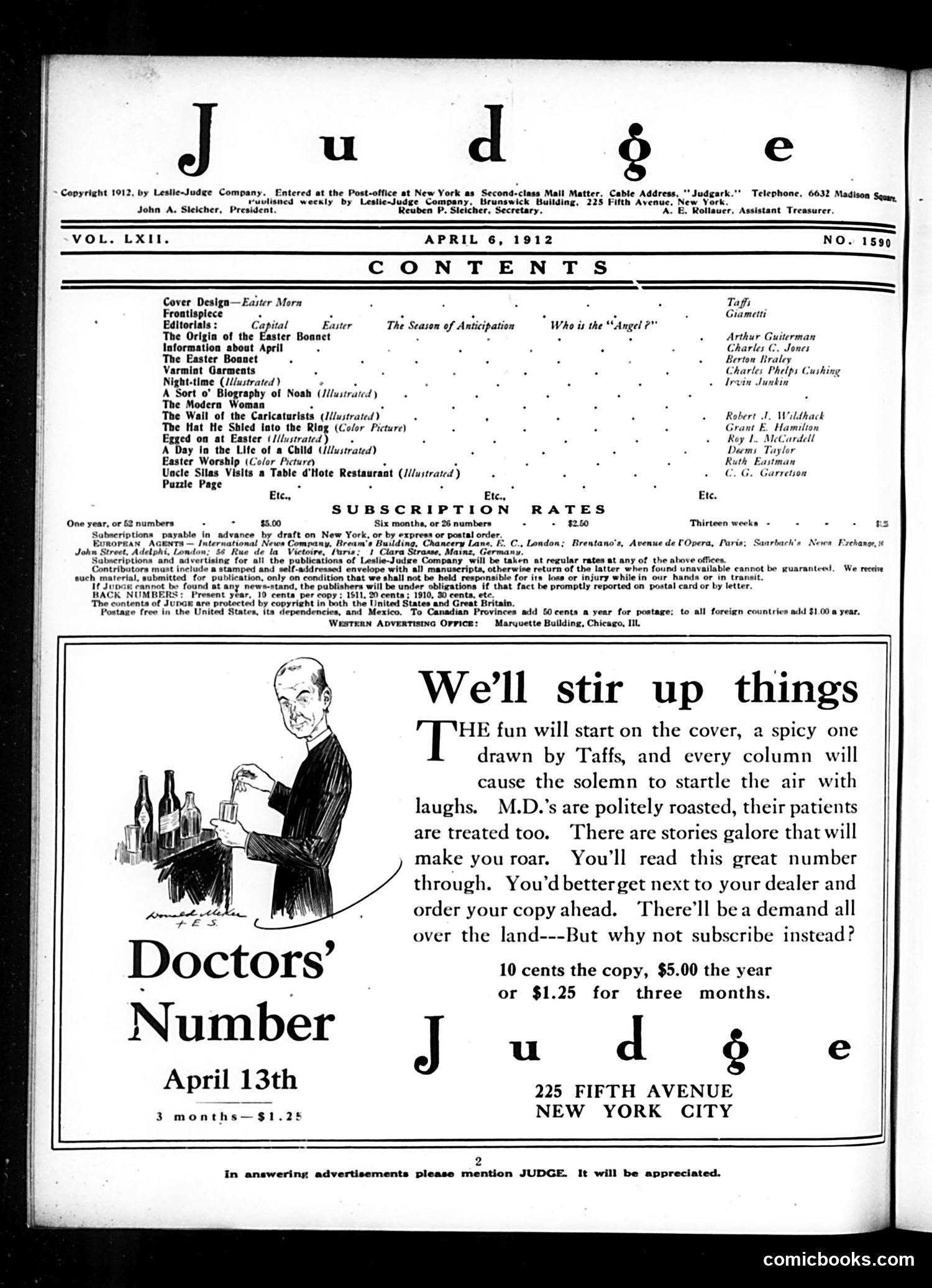
This page primarily features an advertisement for an upcoming "Doctors' Number" issue (April 13th). The cartoon shows a well-dressed man pouring drinks, likely satirizing doctors' social habits or their prescribing of alcohol as medicine—a common practice and satirical target in early 1900s humor. The ad copy promises the issue will contain humorous roasting of physicians and their patients, suggesting Judge's typical approach of mocking professional classes. The $5 annual subscription price and 10-cent per-copy cost indicate this was aimed at middle and upper-class readers who could afford both the magazine and medical care. The overall tone suggests satirizing doctors' pretensions and social standing during the Progressive Era.
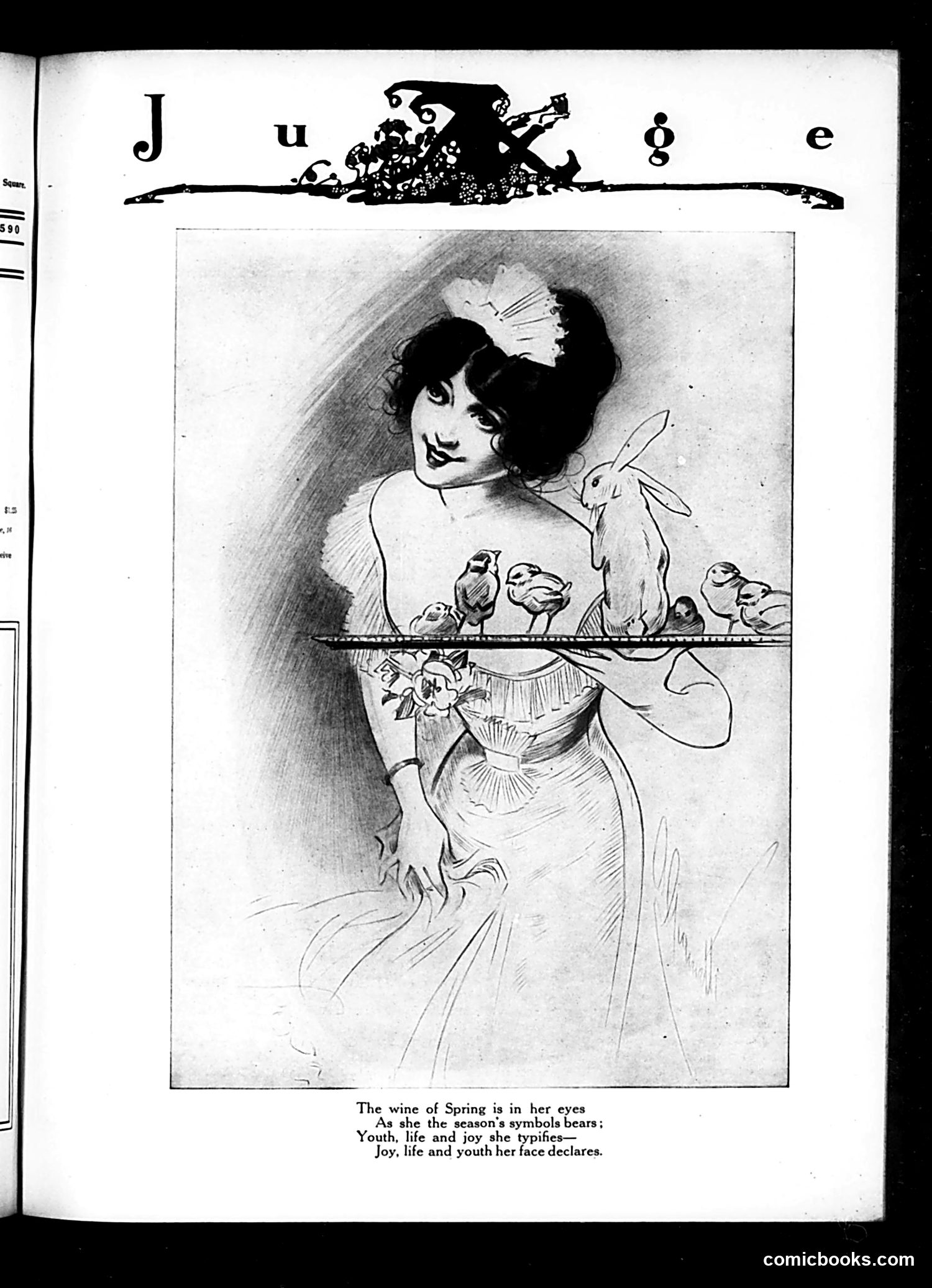
This page features an illustration titled "The wine of Spring is in her eyes," depicting a stylized young woman embodying spring's virtues. The accompanying verse explains the allegorical meaning: she represents "Youth, life and joy" and symbolizes the season itself. The illustration is purely decorative and thematic rather than political satire. It's a classic example of Judge magazine's art-focused content—romanticized imagery celebrating seasonal themes and feminine ideals popular in early 20th-century American periodicals. The page demonstrates how Judge balanced satirical commentary with aesthetic, non-political artwork. This particular piece lacks the sharp social or political commentary typical of the magazine's editorial cartoons, instead serving as visual decoration with poetic accompaniment.
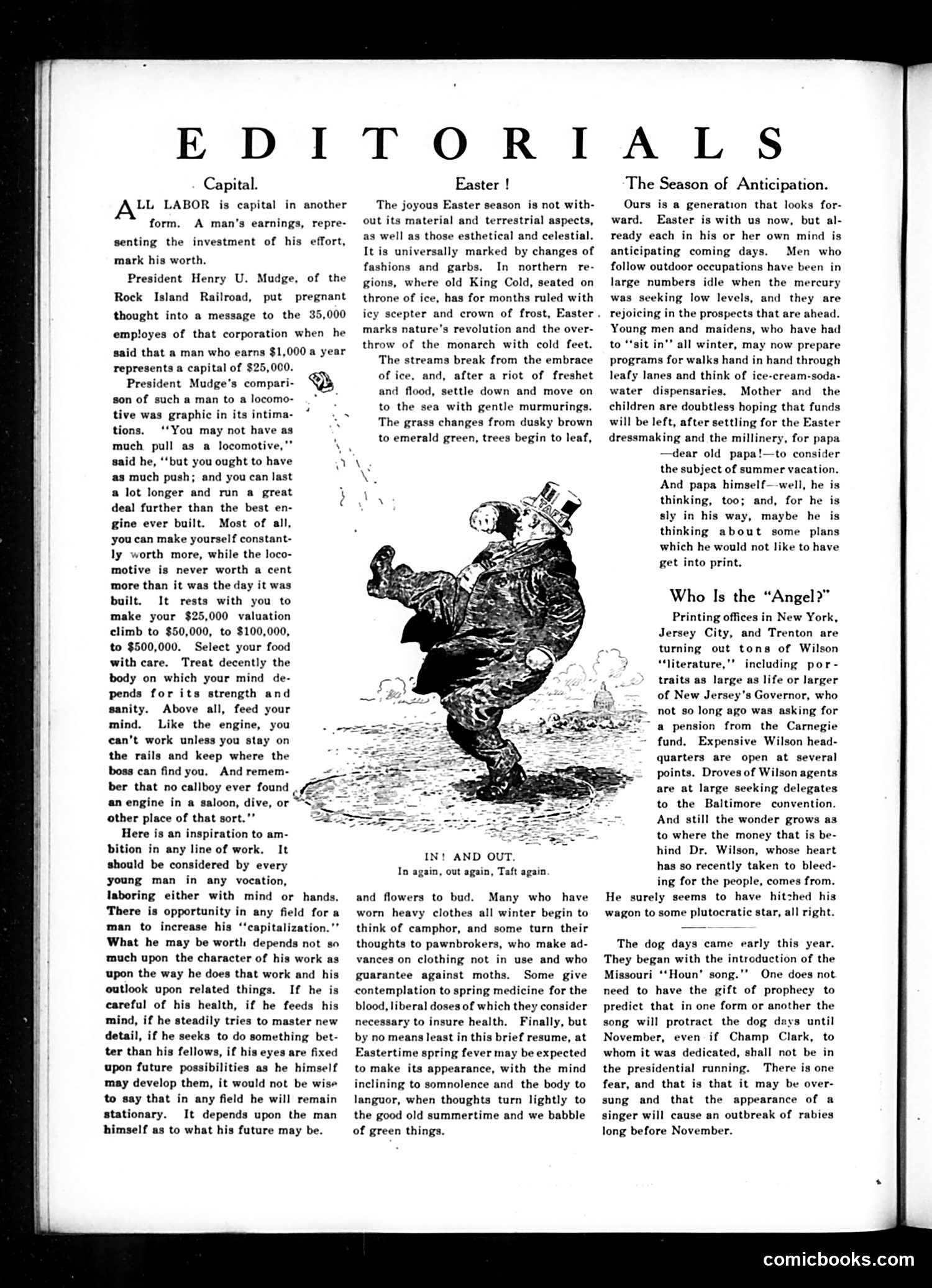
The page contains three separate editorials with no accompanying political cartoon. **"Capital"** discusses labor and wages, citing President Henry U. Mudge of the Rock Island Railroad's comment that a $1,000/year worker represents $25,000 in capital value. The piece argues workers should develop themselves to increase their "capitalization." **"Easter!"** describes spring's arrival and seasonal anticipation in poetic terms, with no apparent satire. **"Who is the 'Angel'?"** discusses printing offices in New York, Jersey City, and Trenton turning out Wilson "literature"—large portraits comparable to New Jersey's Governor. It questions funding sources, noting Wilson headquarters seek delegates for Baltimore convention, wondering where Dr. Wilson's money originates. This references the 1912 presidential campaign supporting Woodrow Wilson.
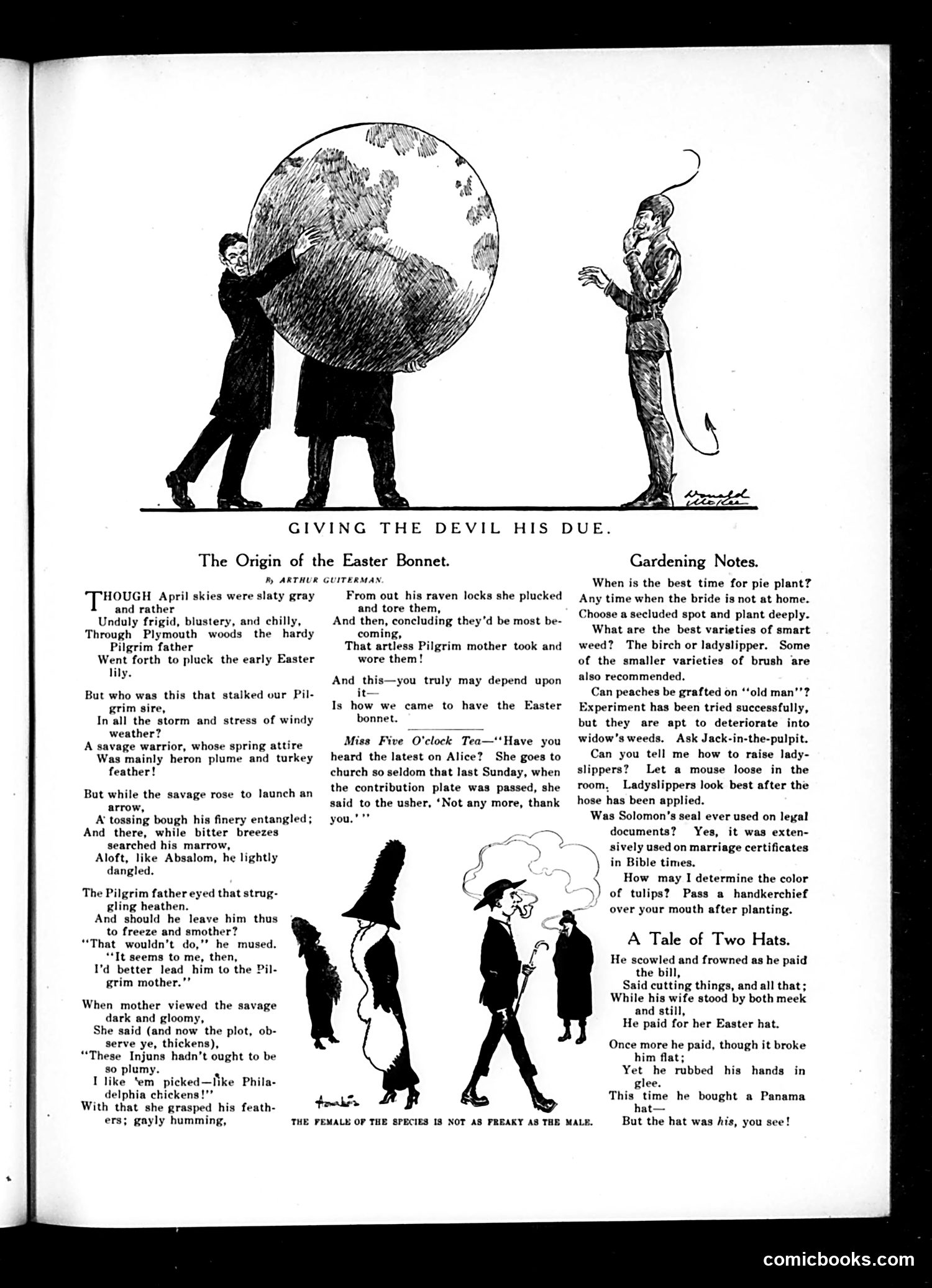
**Top Cartoon: "Giving the Devil His Due"** Two figures manipulate a large globe. The figure on the left appears to be pushing/controlling it while the right figure (depicted with devil's horns and tail) gestures. The title suggests one party is giving concessions to an adversary—likely political commentary on compromise or negotiation with an opposing faction, though the specific historical context isn't clear from the image alone. **Written Content:** The page contains three distinct pieces: "The Origin of the Easter Bonnet" (a humorous poem by Arthur Guiterman about fashion), "Gardening Notes" (practical advice), and "A Tale of Two Hats" (a short comic narrative about a man's hat purchases and marital tensions). The content reflects typical Judge magazine fare: political satire mixed with lighter humor and practical advice.
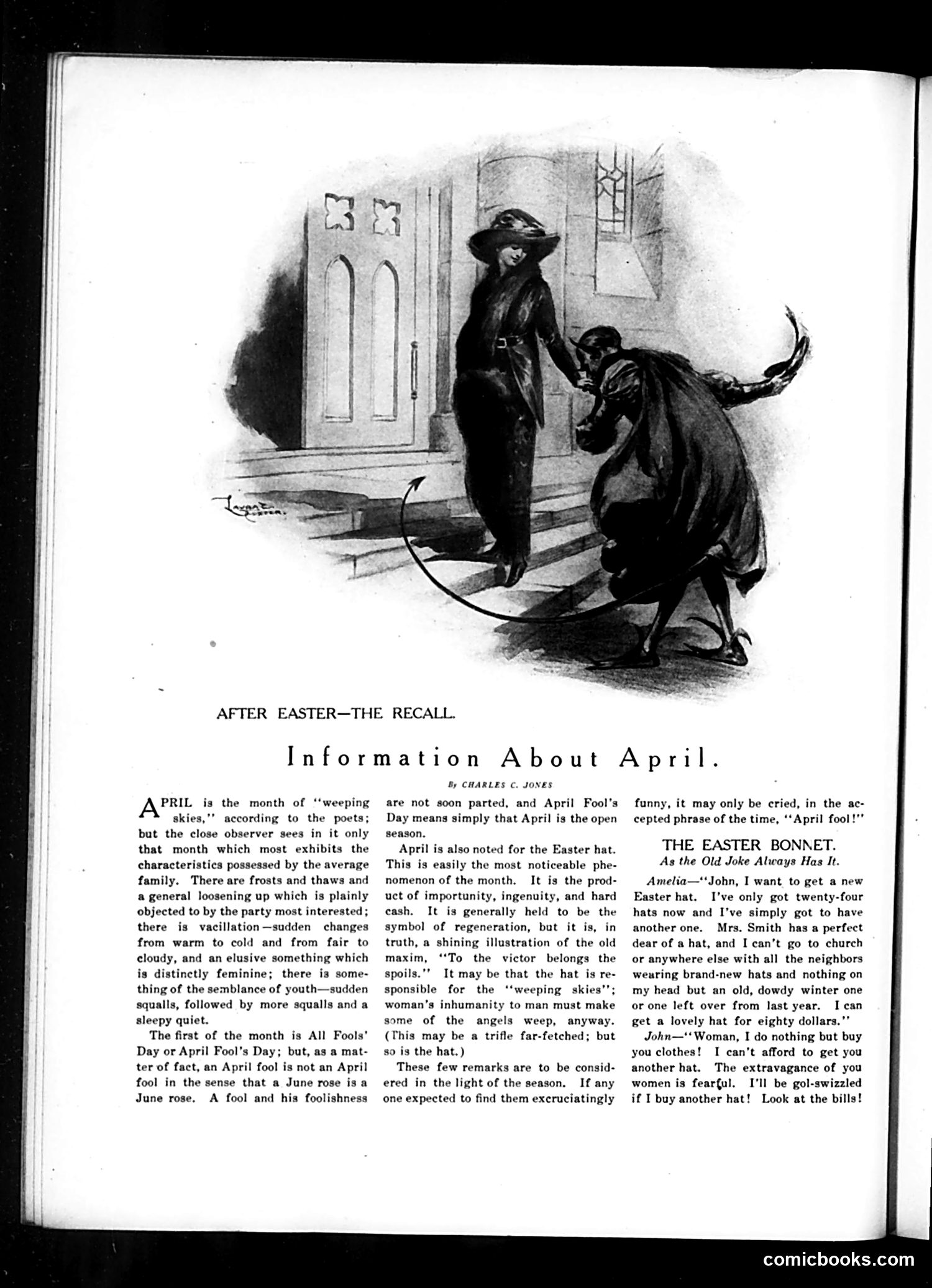
This page satirizes two April traditions: April Fools' Day and the Easter bonnet craze. **The Cartoon**: The sketch depicts a woman returning an elaborate Easter hat to a shop, implying buyer's remorse or the "recall" of the title—a play on the post-Easter period. **The Text**: Charles C. Jones's essay humorously portrays April as embodying feminine traits: emotional volatility, indecision, and sudden changes. The Easter hat is mocked as wasteful vanity masked as religious regeneration—actually "the victor belongs the spoils," meaning women assert dominance through extravagant fashion. **The Satire**: The accompanying dialogue between "Amelia" and "John" dramatizes the stereotype of wives pressuring husbands for expensive clothing. John's exasperation at her twenty-four existing hats and demand for an eighty-dollar replacement captures the satirical critique of early 20th-century women's consumer spending and marital financial conflict—a common Judge theme mocking both female extravagance and male financial anxiety.
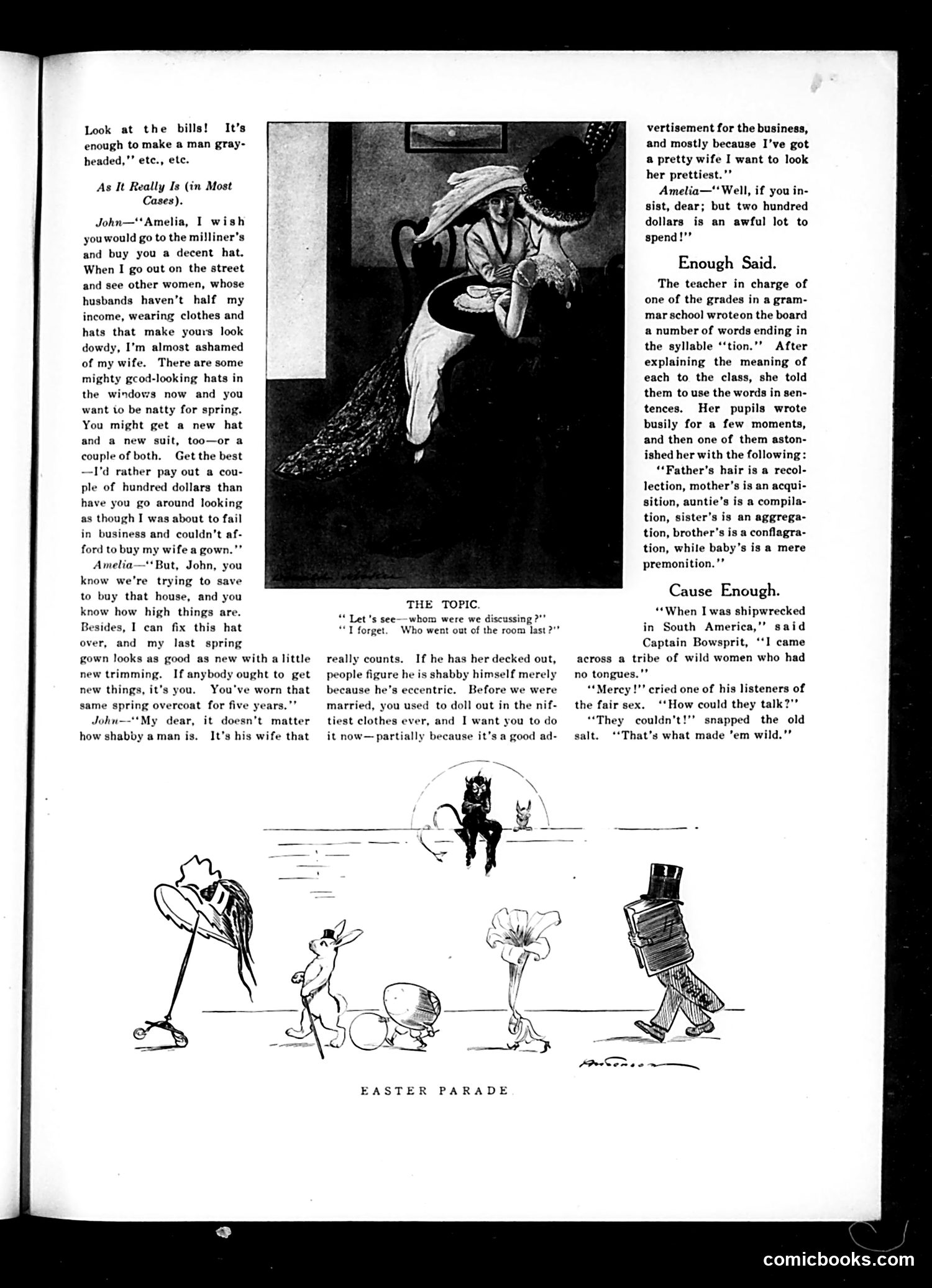
This page contains three distinct satirical pieces reflecting early 20th-century domestic and social attitudes: **"As It Really Is (in Most Cases)"** depicts a marriage debate where the husband pressures his wife to buy expensive new clothes as a status symbol and business advertisement, while she tries to economize for home ownership. The satire critiques male vanity and consumerism masked as concern for appearance. **"Enough Said"** mocks a schoolchild's innocent misuse of "-tion" words, creating unintended humor by describing family members' hair loss through malapropism (e.g., "father's hair is a recollection"). **"Cause Enough"** is a misogynistic joke where a sea captain claims women from South America had "no tongues," and when asked how they communicated, he says they couldn't—implying silent women are "wild" or desirable. The humor relies on period attitudes denigrating women's speech. The "Easter Parade" illustration shows anthropomorphized objects and animals in a spring procession, typical whimsical Judge magazine filler art.
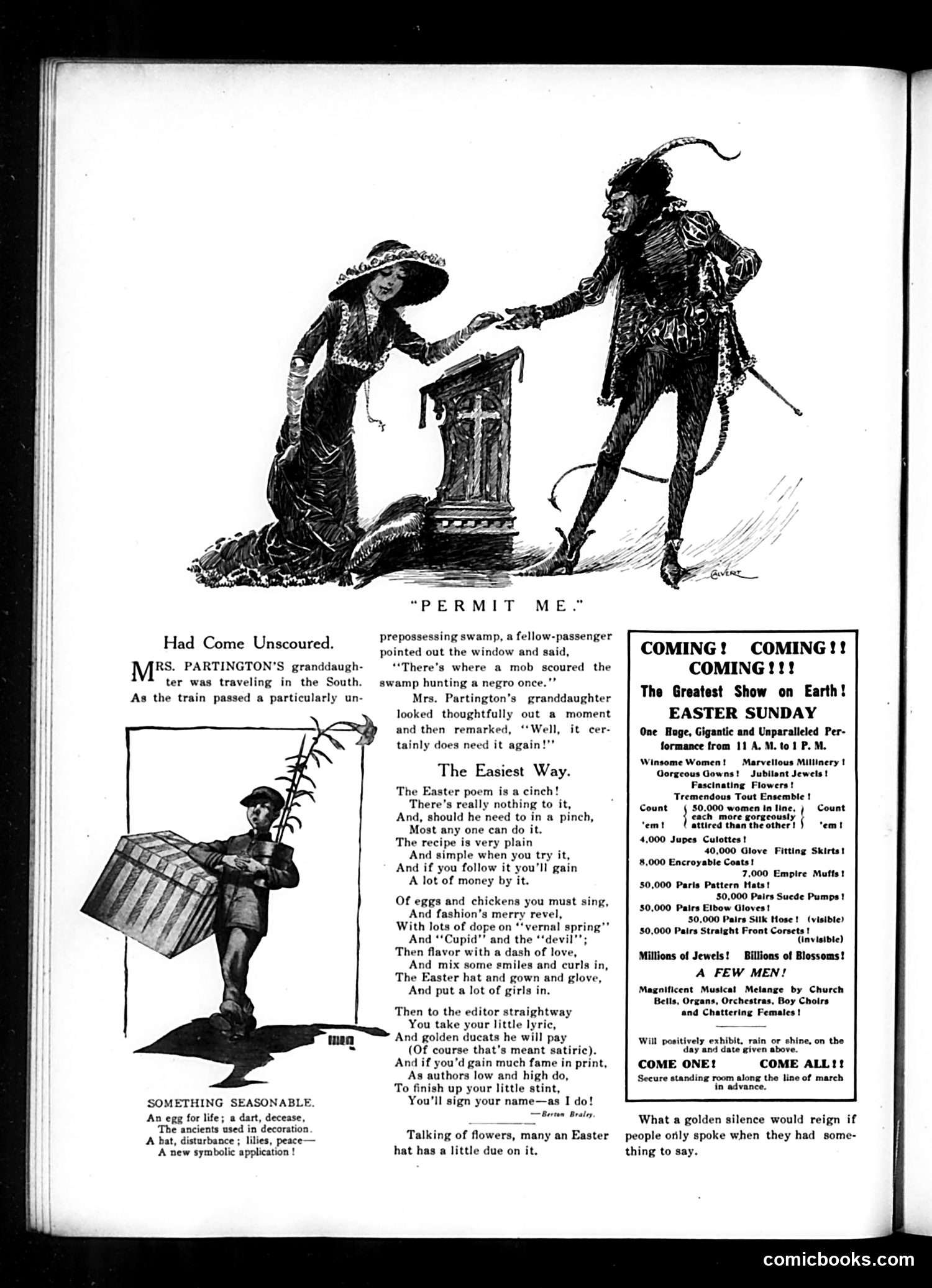
## "Permit Me" (Top Cartoon) A demon-like figure propositions a well-dressed woman near a pedestal. The accompanying anecdote mocks Southern racism: Mrs. Partington's granddaughter observes a swamp where "a mob scoured the swamp hunting a negro once," then remarks it "certainly does need it again!"—implying the swamp needs another lynching. This is satirizing either genuine Southern violence or satirizing those who advocate for it; the cartoon's exact stance is unclear from the image alone. ## Supporting Content The page includes lighter material: Berton Braley's humorous poem about writing formulaic Easter verses for profit, and a mock advertisement for Easter as a grand spectacle of women's fashion ("Millions of Jewels! Billions of Blossoms!") with only "A FEW MEN" mentioned—satirizing Easter's commercial feminization and consumerism. The overall page reflects Judge's mix of sharp social criticism and fashion-focused satire.
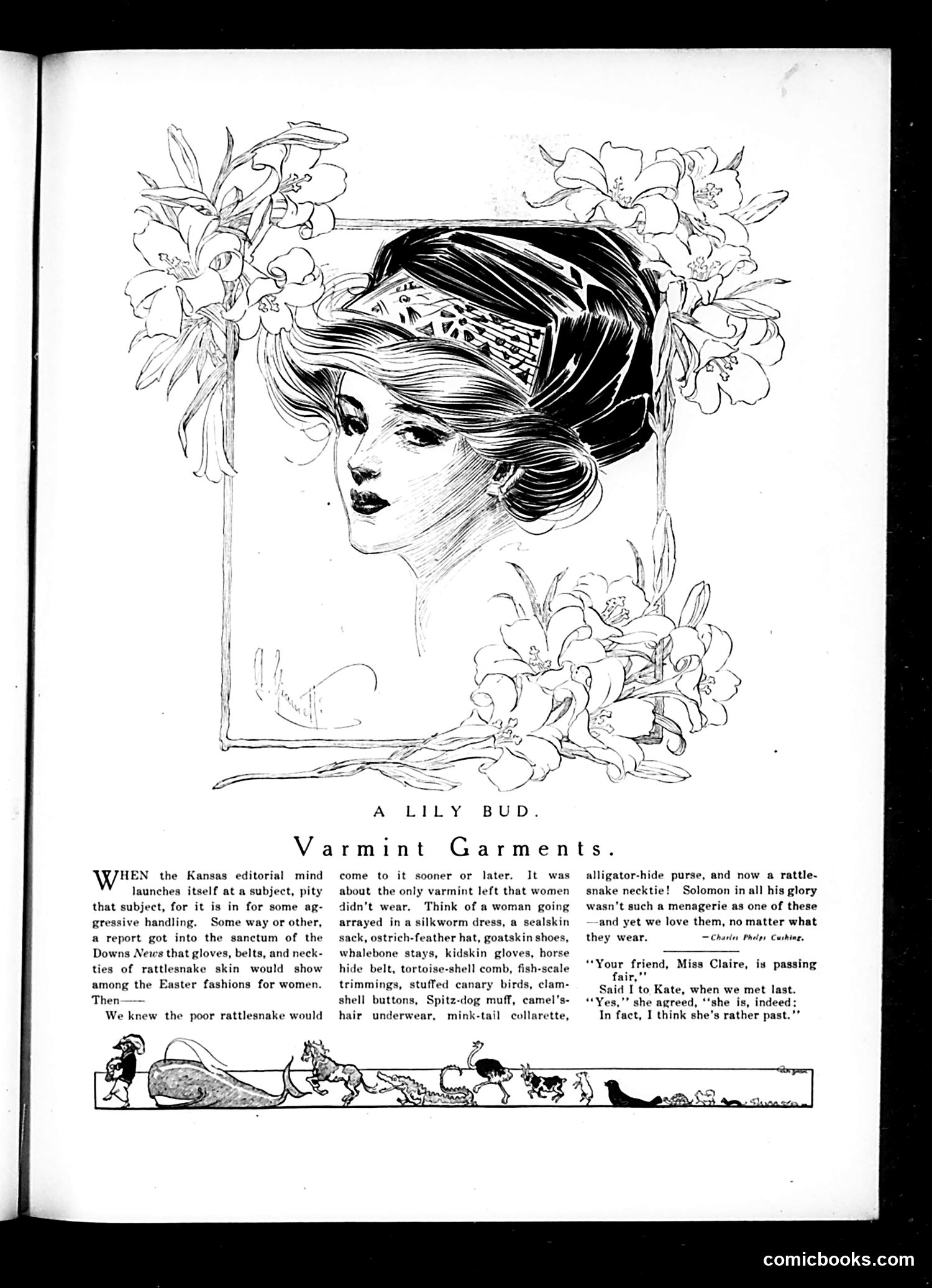
This is a humorous editorial complaint about women's Easter fashion trends, illustrated by a stylized portrait of an elegant woman framed by lilies. The satire mocks the practice of using animal materials in women's clothing. The Kansas newspaper **Downs News** reported that rattlesnake skin would appear in upcoming fashions. Judge's writer sarcastically catalogs the absurd menagerie of animal-derived garments women already wear: silkworm fabric, sealskin, ostrich feathers, goatskin, whalebone, kidskin, horsehide, tortoiseshell, fish-scale, canary birds, clamshell buttons, dog fur, and camel hair. The point: women are walking "menageries" who wear virtually every creature imaginable, and adding rattlesnake merely completes the absurdity. The closing poem jokes that Miss Claire, while fair-looking, is really "past" her prime—a dated quip suggesting her elaborate animal-laden outfit can't hide her age.
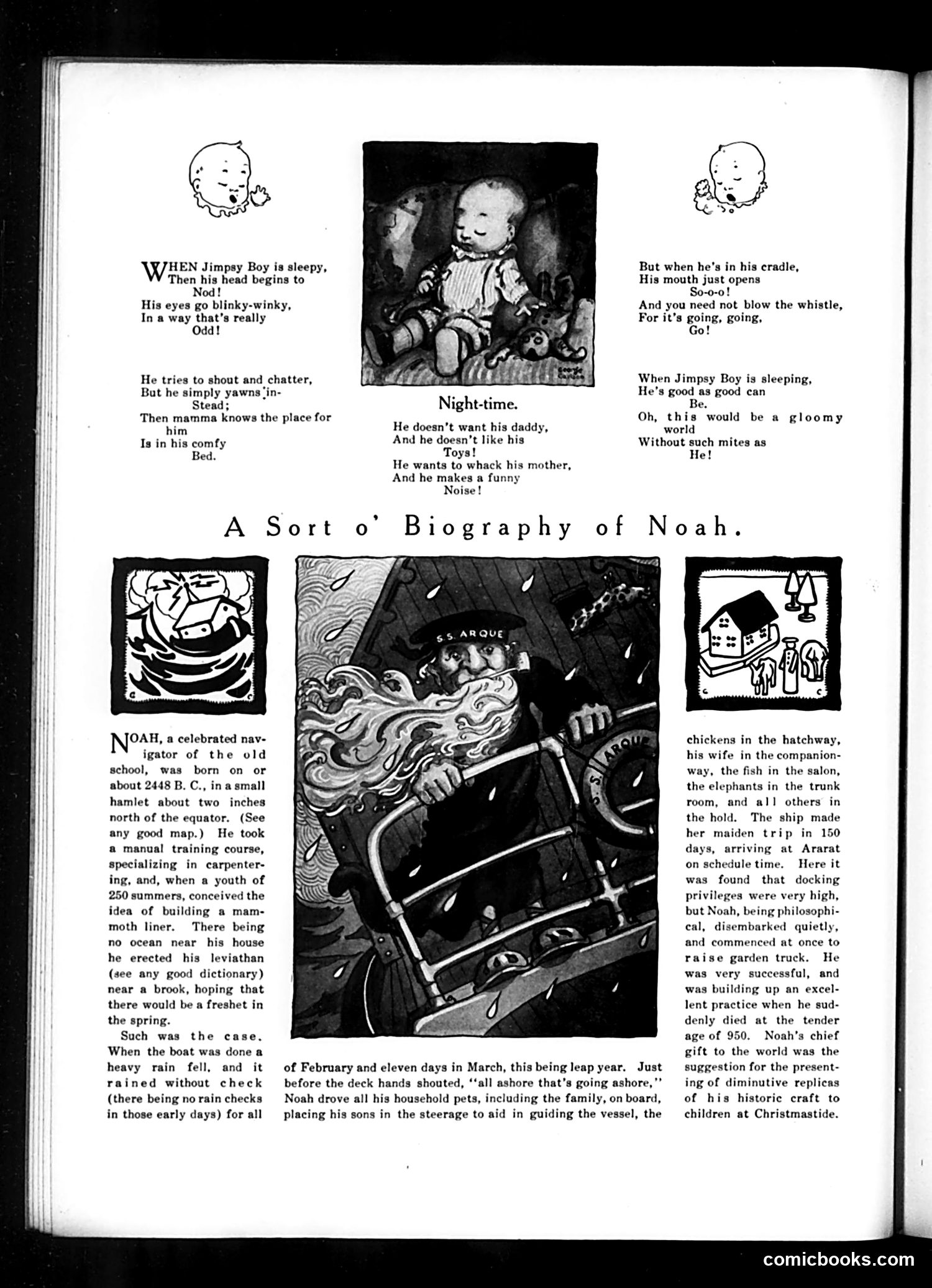
This page contains two unrelated humor pieces from Judge magazine: **"Jimpsy Boy"** (top): A lighthearted children's poem about a drowsy baby, celebrating how sleep transforms a fussy, demanding infant into a peaceful, well-behaved child. The humor appeals to parents exhausted by babies' constant demands. **"A Sort o' Biography of Noah"** (bottom): A satirical retelling of the Biblical flood narrative that applies modern bureaucratic/commercial absurdity to ancient times. The joke mocks Noah's impractical solution—building a massive ship near a brook hoping for spring flooding—and treats the ark like a modern passenger vessel with steerage, docking fees, and "schedule times." The text's deadpan tone and anachronistic details (calling it a "maiden trip," mentioning "leap year," Noah's 950-year lifespan) create humor through the incongruity of treating mythology with contemporary practicality. The final note suggests selling toy ark replicas to children as Christmas gifts. Both pieces use gentle, family-friendly humor typical of Judge magazine's content.
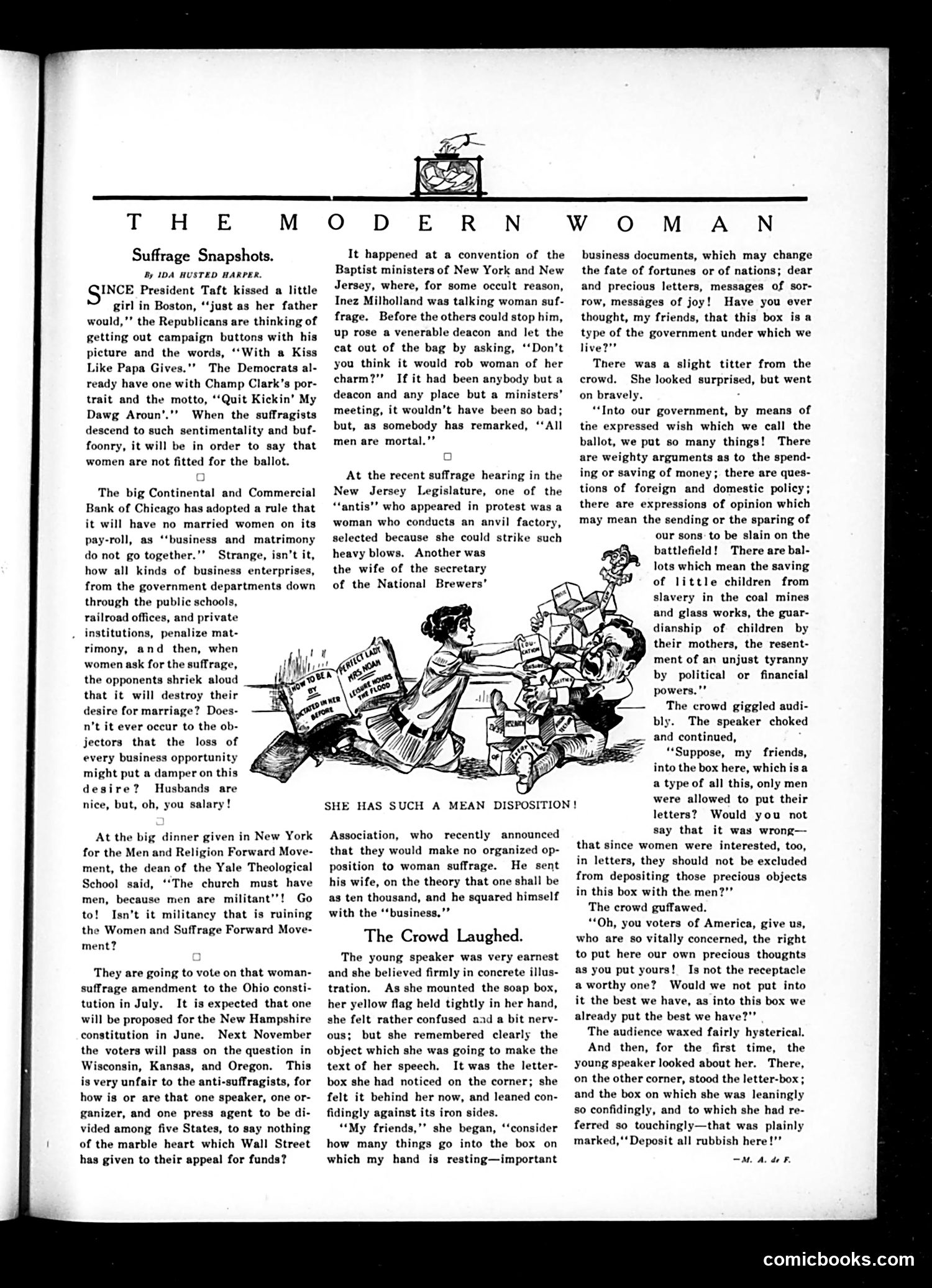
This page contains satirical commentary by Ida Husted Harper attacking anti-suffrage arguments. The main cartoon depicts a woman speaker at a "soap box" rally leaning against a mailbox while holding a yellow suffrage flag, illustrating her argument about everyday democratic participation. The text mocks opponents' contradictions: banks fire married women for "incompatibility with business," yet anti-suffragists claim voting would destroy women's desire to marry. Harper ridicules religious leaders (Yale dean) claiming churches need "militant" men while attacking suffragists' militancy, and notes the hypocrisy of female anti-suffragists—including a brewery secretary's wife and female factory owner—testifying against women's voting rights. The satire targets the illogical reasoning used to deny women political participation, emphasizing how those arguments contradict women's existing economic and social roles.
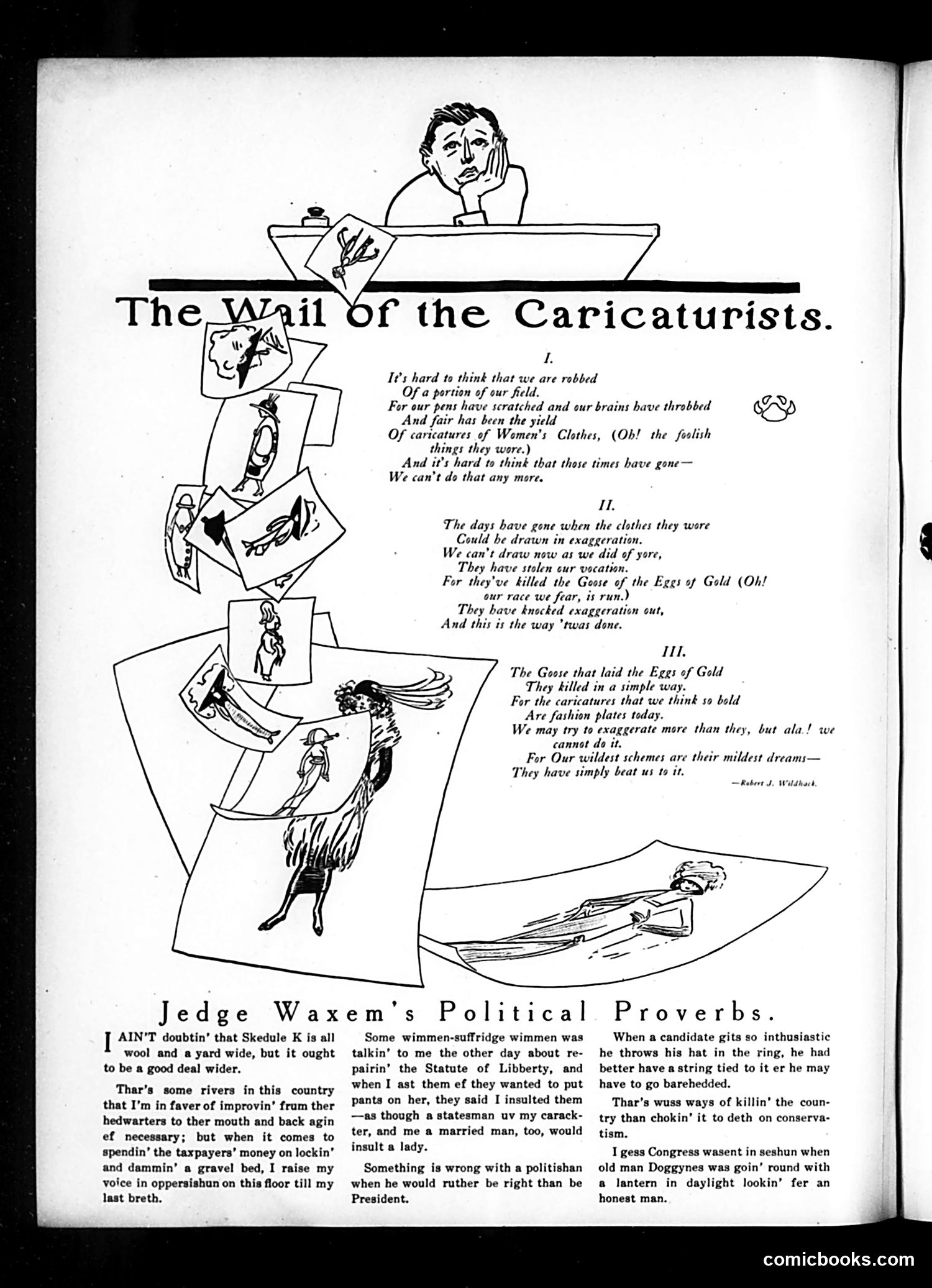
This page contains satirical commentary on two topics: **The Caricaturists' Lament (main feature):** Fashion designers have inadvertently destroyed caricaturists' subject matter. Women's clothing was once so extravagantly exaggerated that cartoonists could mock it through caricature. Now that modern fashion itself has become so extreme and avant-garde, cartoonists can no longer exaggerate beyond reality—fashion designers have "beaten them to it." The poem mourns losing the "Goose of the Golden Eggs." **Judge Waxem's Political Proverbs (bottom):** Folk-wisdom commentary on contemporary politics, including jabs at women's suffrage activists and critiques of politicians prioritizing being "right" over winning elections. The final proverb references Diogenes searching for an honest man, suggesting Congress lacks integrity. The page reflects early 20th-century anxieties: changing fashion norms threatening traditional humor, and skepticism toward progressive political movements like women's suffrage.
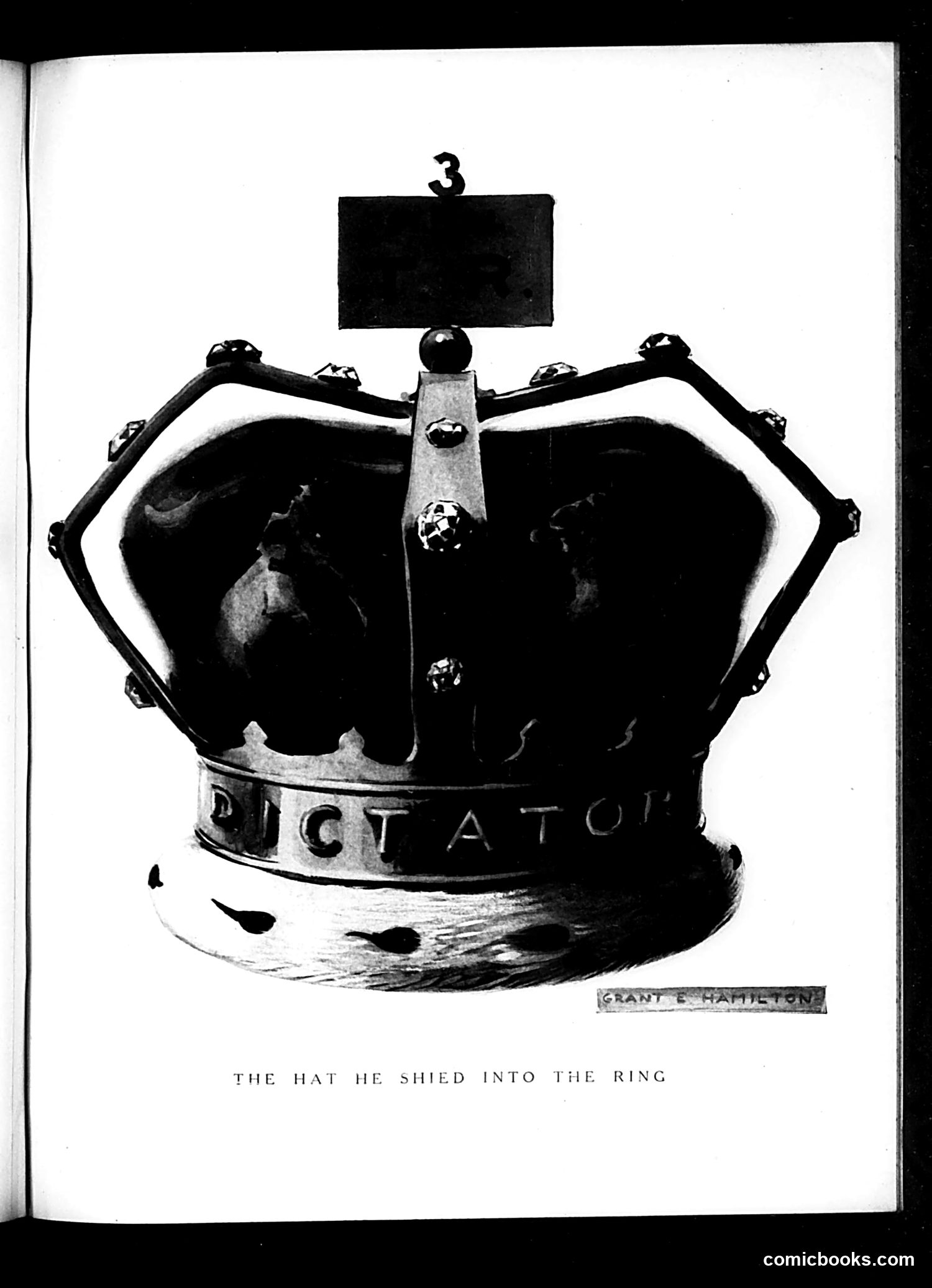
This appears to be a political cartoon from *Judge* magazine featuring a crown with the text "THE HAT HE SHIED INTO THE RING" beneath it. The crown bears what looks like partial text reading "DICTATOR." The phrase "threw his hat in the ring" was an idiom meaning to enter a political contest or declare candidacy. Here, the cartoon satirizes someone—likely a political figure of that era—who symbolically entered politics (threw their hat into the ring), but the hat has become transformed into a crown labeled "dictator." The satire suggests the cartoonist's fear that this political figure harbored autocratic ambitions: entering as a democratic candidate but revealing authoritarian intentions. Without a clear date or additional context, the specific figure remains unclear, though the message critiques the danger of would-be despots in democratic systems.
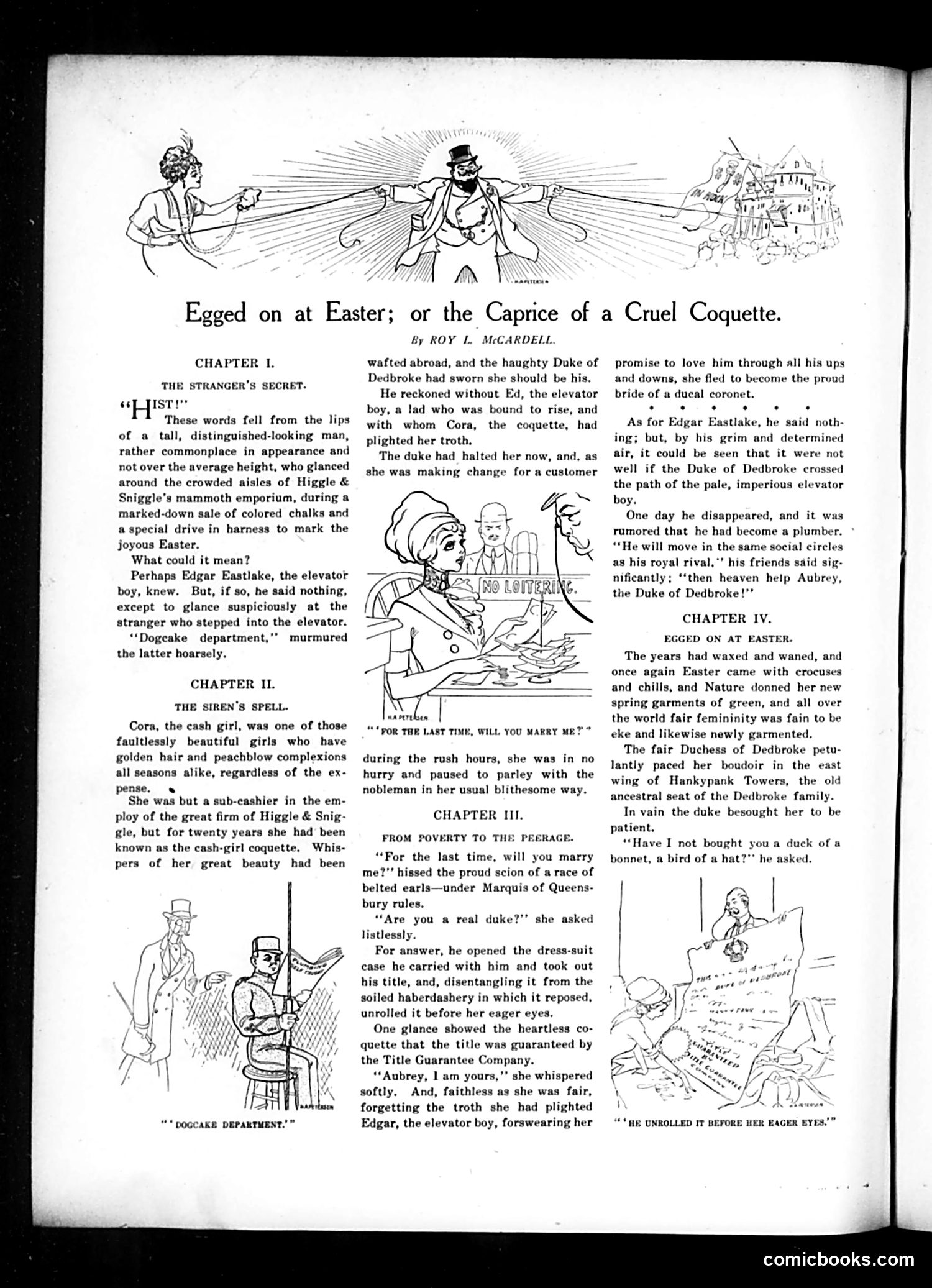
This is a **serial melodrama parody** mocking Victorian romance fiction and class anxiety. The story satirizes: **The Setup:** A beautiful cash girl (Cora) at a department store during an Easter sale is courted by both an elevator boy (Edgar, "bound to rise") and a Duke of Dedbroke. She abandons Edgar for the Duke's title—literally a rolled-up document guaranteed by the "Title Guarantee Company." **The Satire:** The humor targets: - **Social climbing:** Cora abandons true love for nobility, but it's presented absurdly (the title is just paperwork) - **American skepticism of European aristocracy:** The fake duke carrying his title in a suitcase alongside dirty laundry mocks Old World pretension - **Commercialization:** Even romance occurs amid "marked-down sales" at department stores - **Class mobility:** Edgar becomes a plumber—maintaining social relevance through trade rather than inheritance **The Point:** Judge ridicules both the earnestness of sentimental romance novels AND the American obsession with European titles. Real worth comes from ambition and work, not bloodlines.
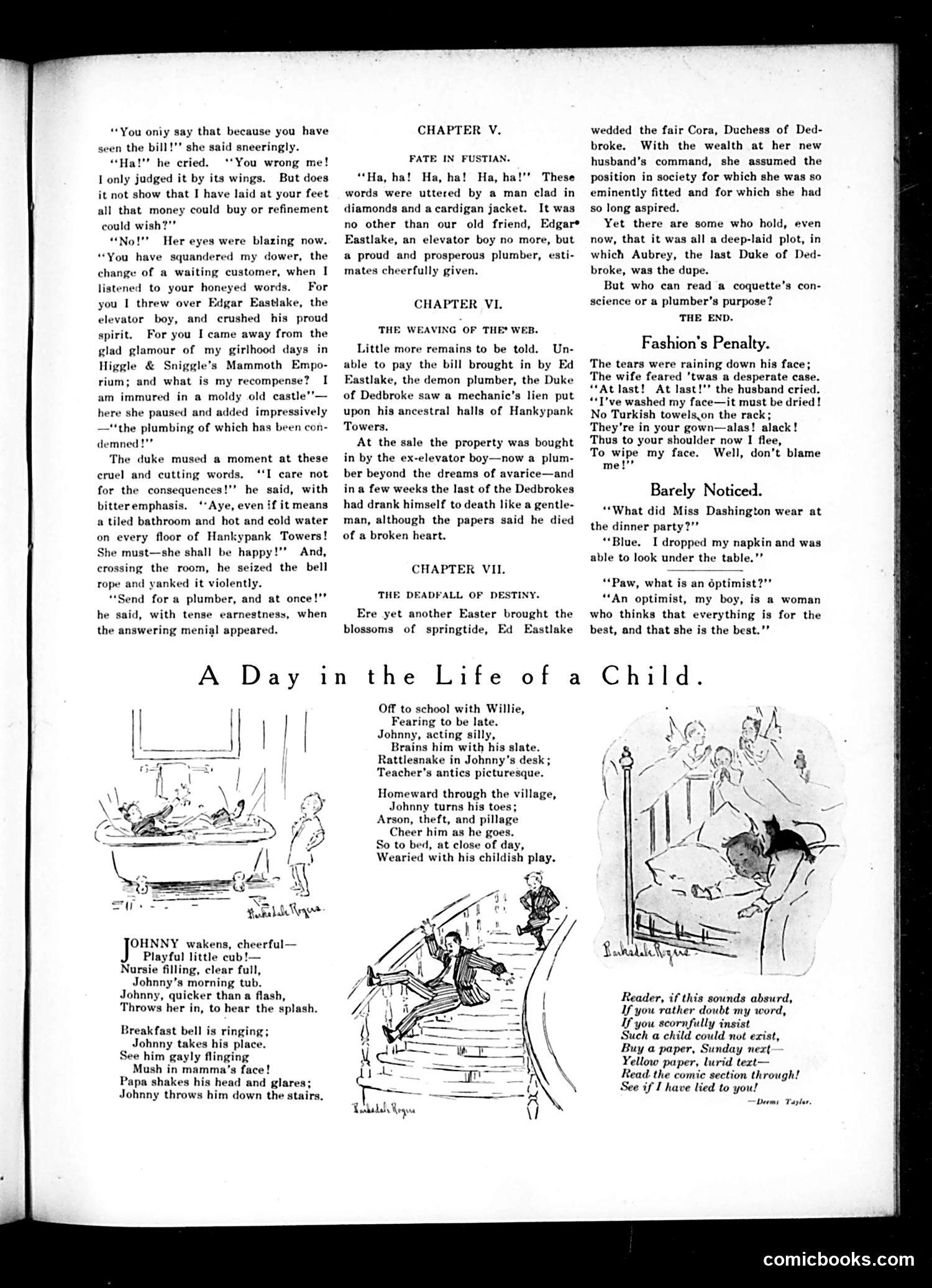
This page contains a serialized satirical melodrama mocking sentimental Victorian fiction, plus a humorous children's verse with accompanying illustrations. The main story parodies overwrought romantic plots: a duchess sacrifices her dower and a true love (elevator boy Edgar Eastlake) to marry a duke. She complains about the castle's condemned plumbing—her ultimate complaint. The duke heroically summons a plumber. The ironic twist: Edgar Eastlake becomes a successful plumber, acquires wealth, purchases the duke's mortgaged estate, marries the duchess himself, and the duke dies. The narrator facetiously asks: "who can read a coquette's conscience or a plumber's purpose?"—suggesting hidden machinations. The children's verse depicts a destructively misbehaving child (Johnny) who throws his nurse in the tub, hits his teacher with a slate, and commits arson and theft—all treated as normal childish pranks. The accompanying illustrations show these "cute" misdeeds. The satirical appeal to readers questions whether such behavior should genuinely be tolerated. Both pieces mock contemporary literary and social conventions through exaggeration.
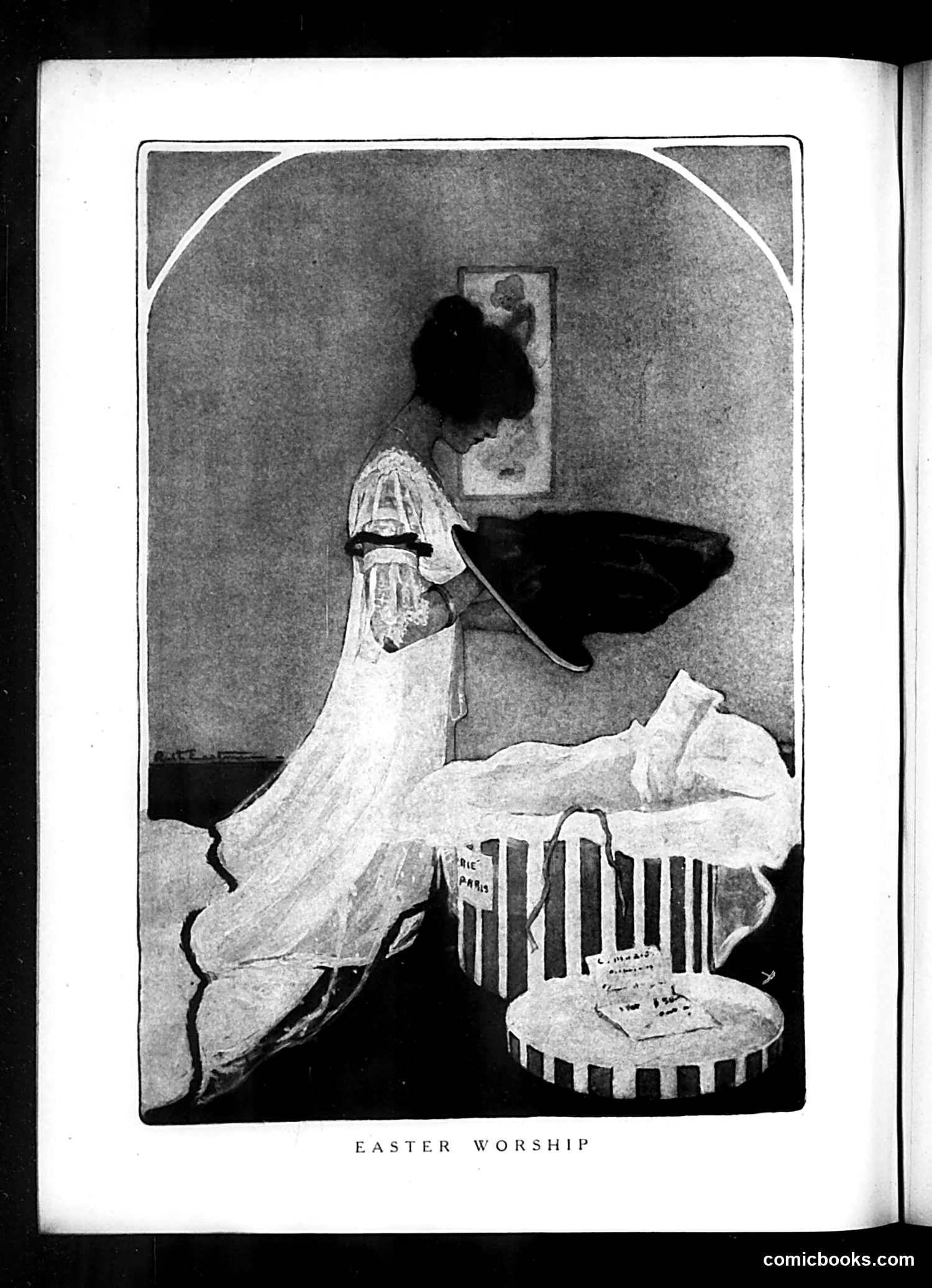
This illustration depicts a woman in an elegant white Easter dress and elaborate hat, kneeling in prayer before what appears to be a small domestic shrine or altar. The image satirizes the commercialization and superficiality of Easter observance among the wealthy or fashionable classes. The caption "Easter Worship" suggests irony—the woman's devotion seems directed toward fashion and material display rather than genuine religious reverence. Her ornate clothing and the carefully arranged domestic setting mock the notion that Easter worship had become primarily a social and sartorial event for certain Americans, focusing on new clothes and appearance rather than spiritual meaning. This reflects *Judge* magazine's recurring social critique of American consumerism and religious hypocrisy in the early-to-mid twentieth century.
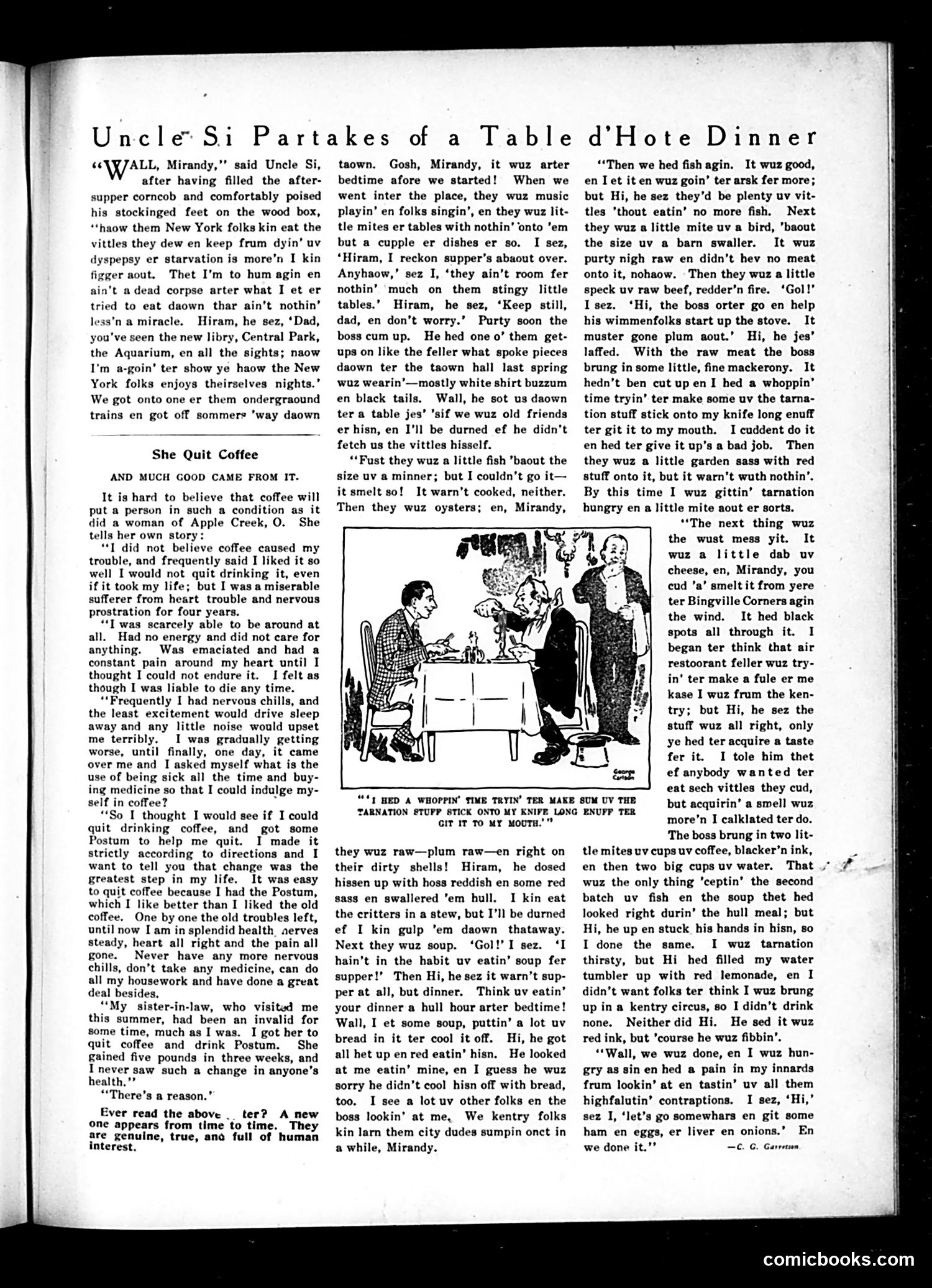
This page features "Uncle Si Partakes of a Table d'Hote Dinner," a rural-versus-urban satire common to Judge magazine. The cartoon mocks the cultural clash between unsophisticated rural Americans and cosmopolitan New York dining. **The humor depends on:** - **Uncle Si**: A rustic character representing traditional American farm values, dialect-heavy speech ("thaow," "daown," "vittles") - **New York sophistication**: Fine dining with small portions, raw oysters, and French service styles - **The joke**: Uncle Si's bewilderment at NYC's refined food culture—dishes that smell bad, won't stay on his knife, tiny portions, and elaborate presentation—versus hearty, substantial country meals The accompanying Postum advertisement (a coffee substitute) uses similar Americana imagery to sell to rural readers by positioning their values as health-conscious and practical. **Context**: This reflects early 1900s American anxieties about urban modernization and the perceived pretentiousness of East Coast elites versus "authentic" rural life.
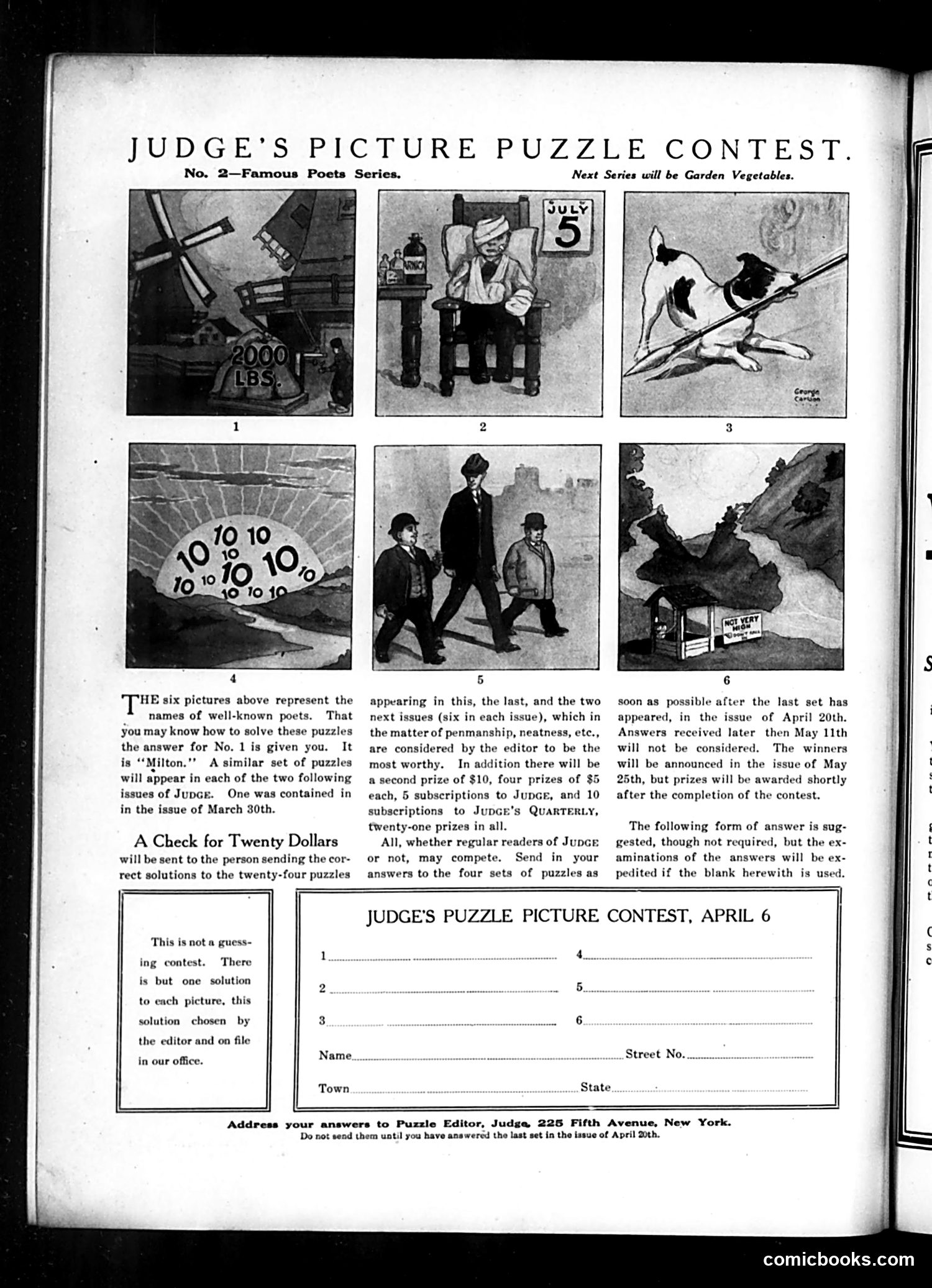
This page presents a visual puzzle contest from Judge magazine's "Famous Poets Series." Readers must identify six well-known poets from pictorial clues. The example given—picture 1 showing a windmill and "2000 LBS"—represents "Milton" (a pun: "mill-ton"). The other images likely use similar wordplay or visual puns: picture 2 shows a figure with a calendar dated July 5 (unclear which poet), picture 3 depicts birds on a branch, picture 4 shows repeated "10"s, picture 5 shows three men in period dress, and picture 6 shows a dramatic landscape scene. This was a legitimate contest offering $20 to winners, judged on penmanship and neatness. It ran across four issues of Judge, with answers due by May 11th. The next series would feature garden vegetables as subjects.
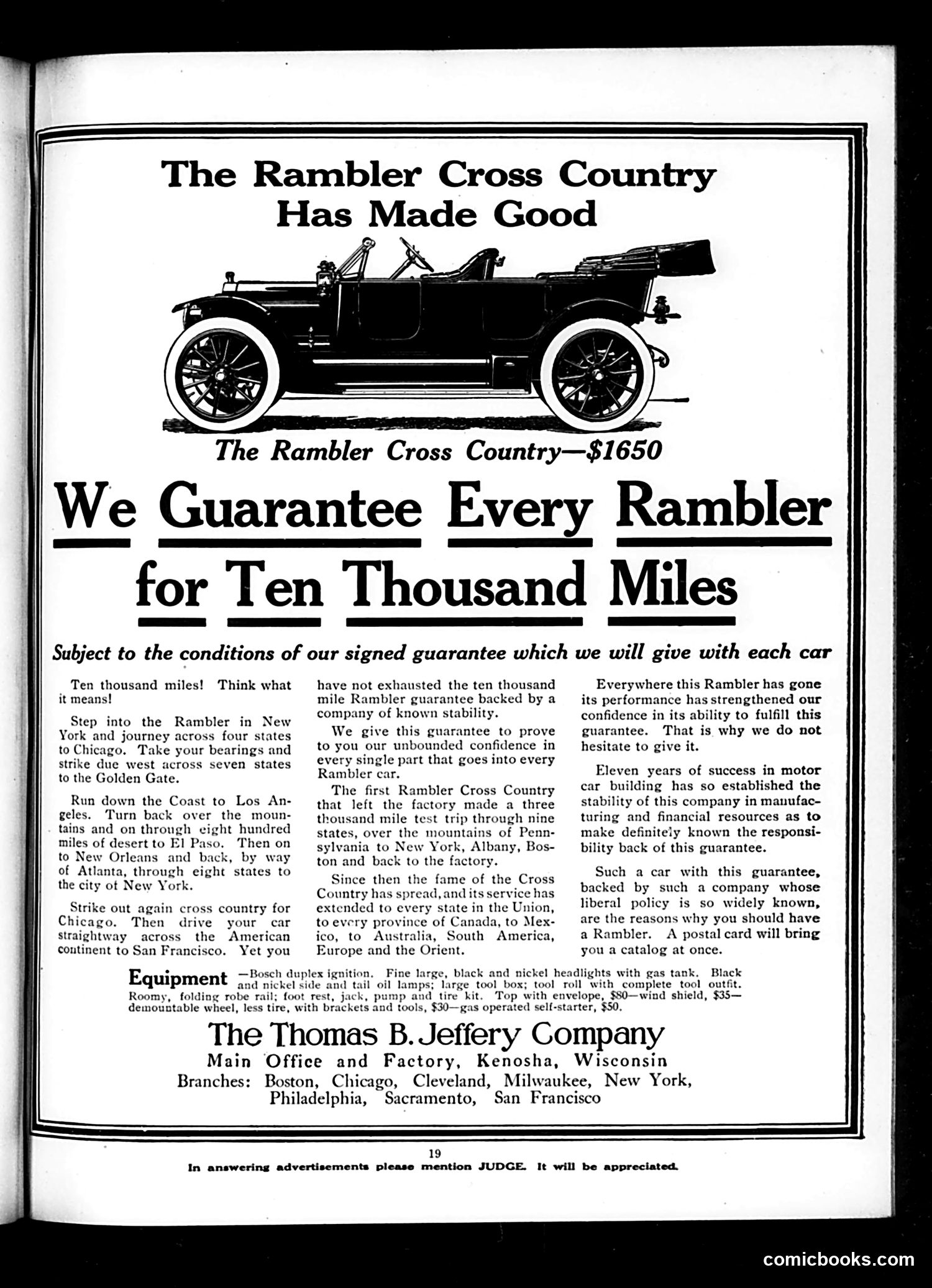
This is **not a cartoon or satire**—it's a straightforward automobile advertisement placed in *Judge* magazine. The Rambler Cross Country, priced at $1,650, is being marketed by the Thomas B. Jeffery Company with an unprecedented 10,000-mile guarantee. For early 1900s readers, this was a remarkable selling point: automobiles were still novel and unreliable, so a manufacturer's confidence in durability was noteworthy. The ad uses vivid cross-country journey descriptions (New York to Chicago to San Francisco, etc.) to demonstrate the car's capability and the guarantee's meaningfulness. The text emphasizes the company's "eleven years of success" and "manufacturing and financial resources" to assure buyers of the guarantee's legitimacy—crucial since many early automakers went bankrupt. The equipment details (Bosch ignition, self-starter, demountable wheels) highlight modern features that justified the premium price. This represents how early automotive advertising worked: emphasizing reliability and company stability rather than performance or style.
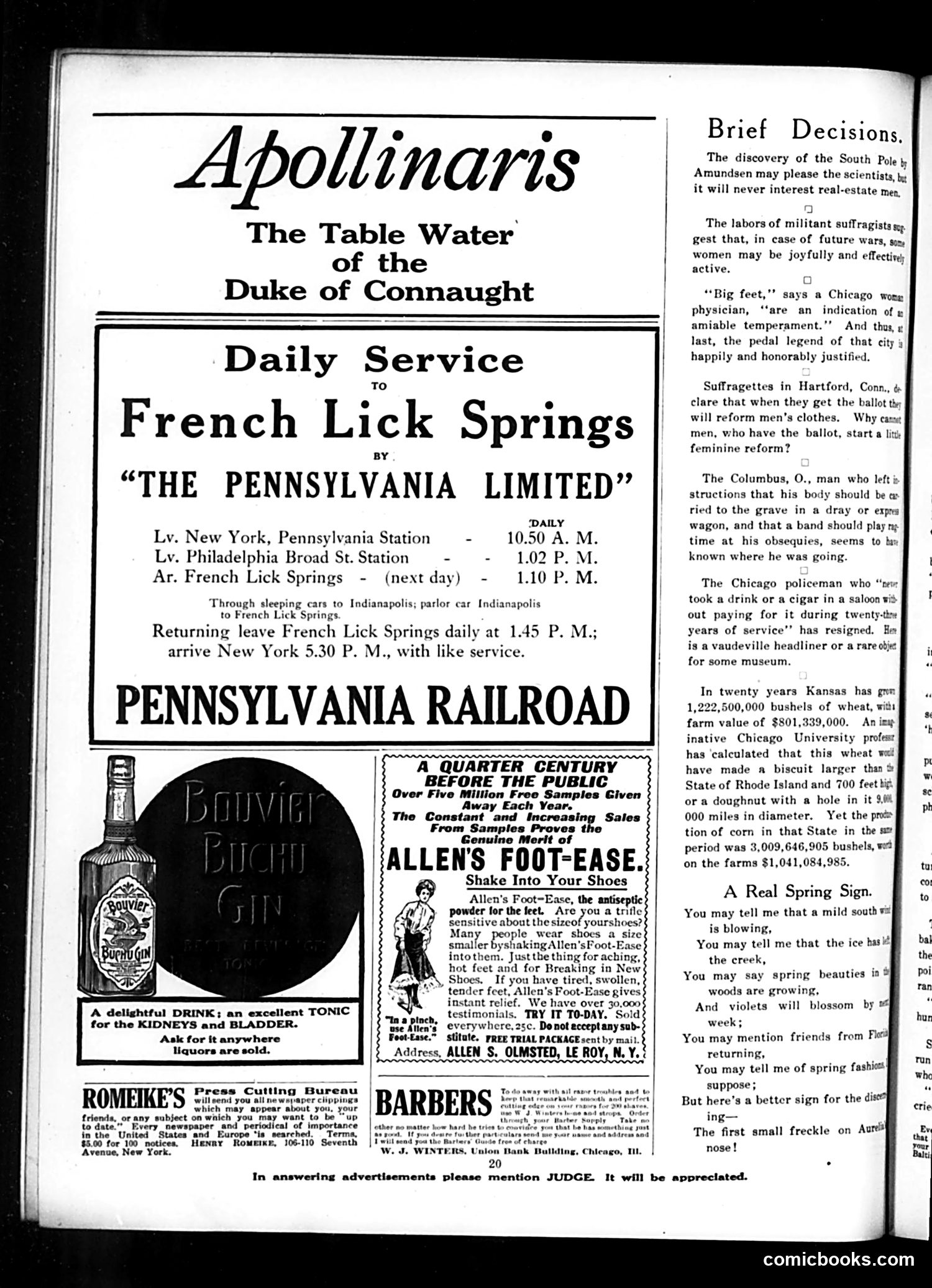
This page is primarily **advertisements and a "Brief Decisions" humor column**—not political cartoons. The main content consists of: 1. **Advertisements** for railroad service to French Lick Springs, Apollinaris water, Allen's Foot-Ease powder, and other products typical of early 20th-century periodicals. 2. **"Brief Decisions"** (right column)—short satirical quips mocking contemporary topics: - The discovery of the South Pole as uninteresting to real-estate investors - Suffragettes' efforts to reform men's clothing - References to Chicago's reputation for large feet - Kansas wheat production statistics - Spring weather signs The humor relies on **gentle social satire** rather than sharp political commentary. The suffragette jokes reflect the era's anti-women's-suffrage sentiment (common in Judge), while other items simply mock absurdities and local quirks. This reflects Judge's role as a humor and satire magazine focused on entertaining affluent readers with witty observations about contemporary life.
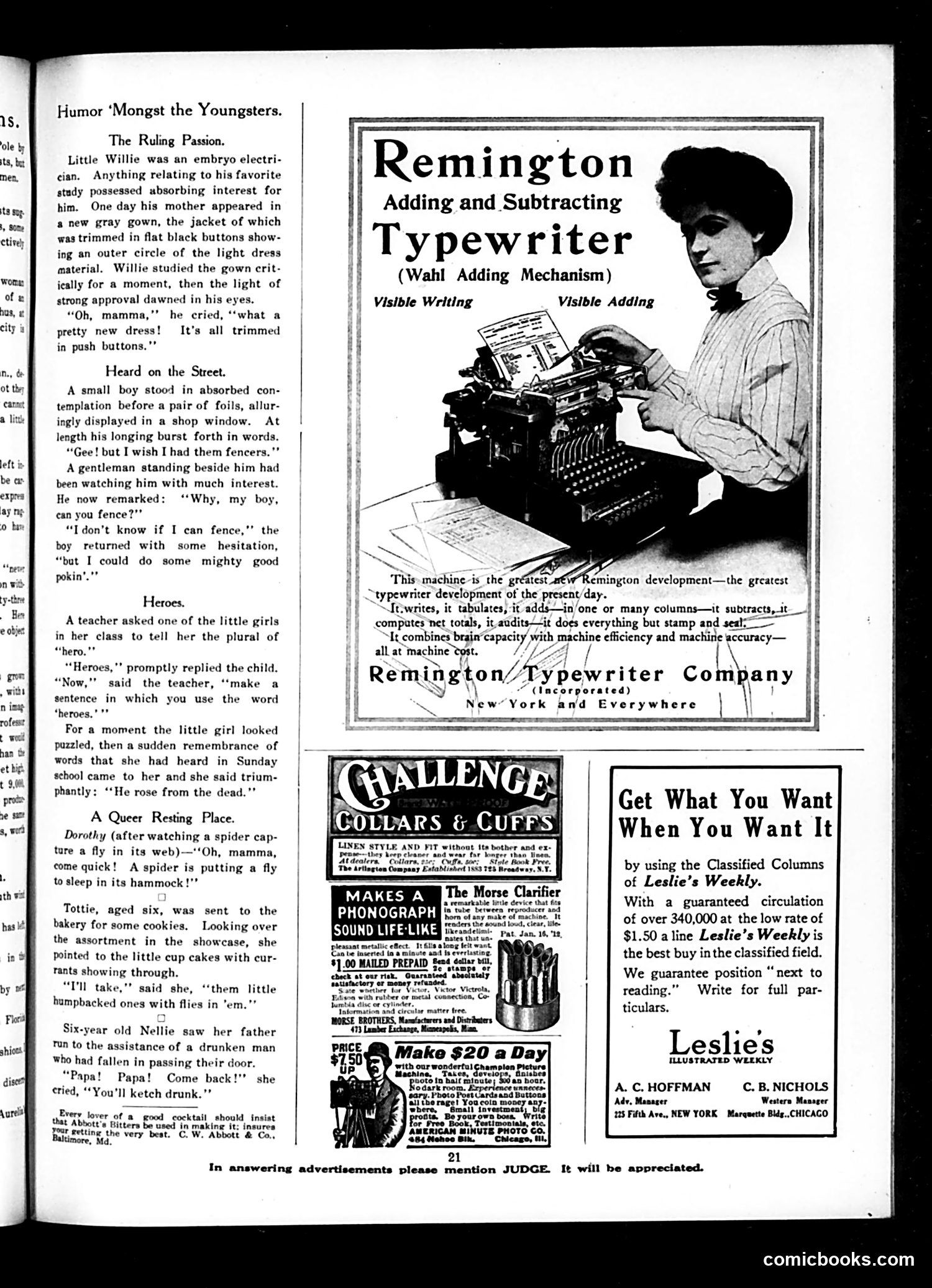
This page is primarily **advertising with humorous filler content**. The main feature is a large Remington Typewriter advertisement showcasing their "Adding and Subtracting Typewriter" with the Wahl Adding Mechanism—highlighting that it performs calculations, auditing, and tabulation functions. This represents a significant technological advancement for the era. The left column contains brief, light humor pieces aimed at children ("Humor 'Mongst the Youngsters"), featuring jokes about a boy misidentifying buttons as "push buttons," another boy confusing "foils" (fencing swords) with "fencers" (people who fence), and a teacher's student offering the biblical phrase "He rose from the dead" as a plural use of "hero." These represent gentle wordplay exploiting children's literal interpretations. The remaining advertisements include Leslie's Weekly classified columns, Challenge Collars & Cuffs, and various other period products. The page reflects typical early 20th-century magazine layout mixing editorial content with advertising.
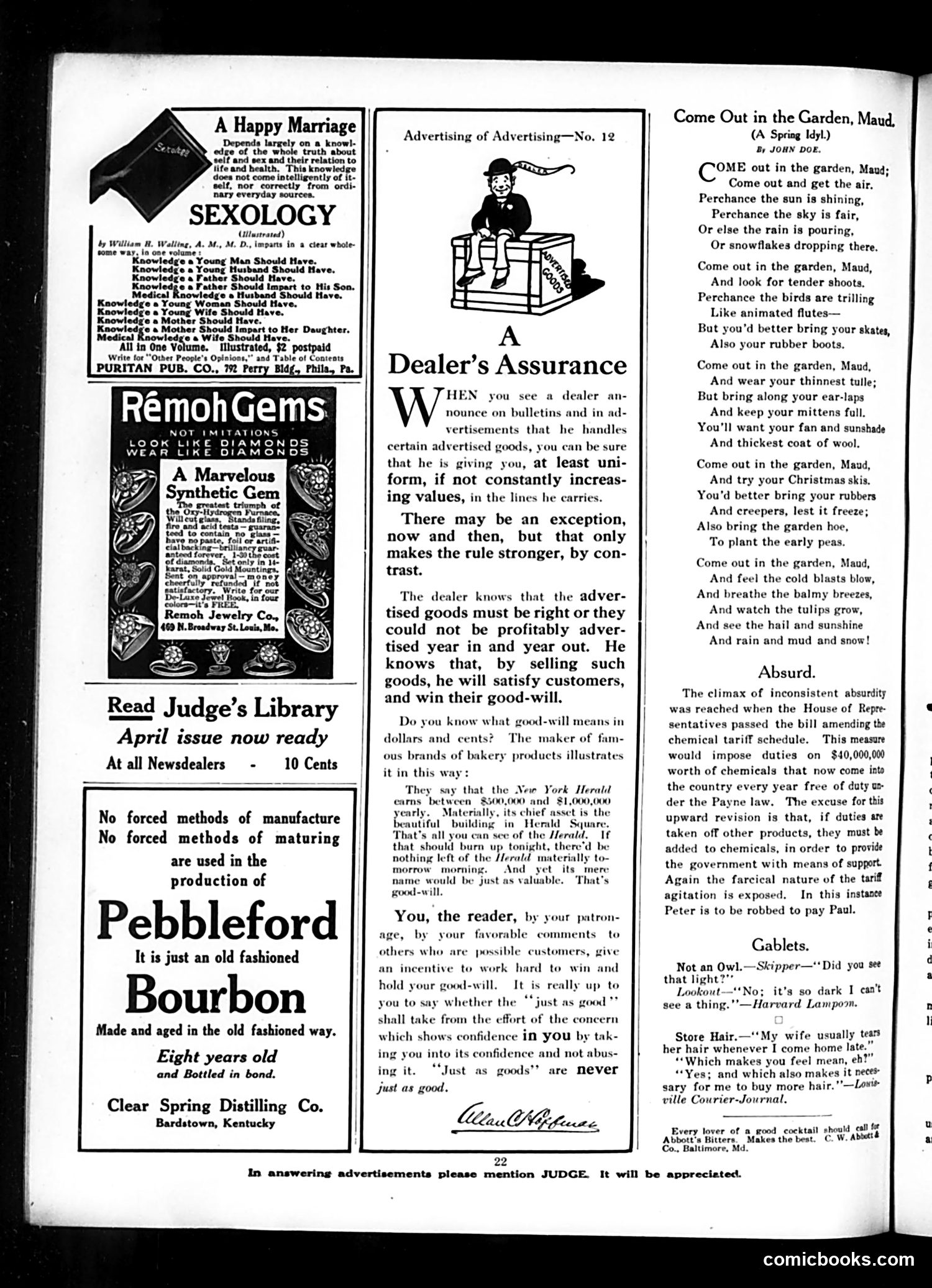
This page is primarily **advertisements and light verse** rather than political satire. The main content is a humorous poem titled "Come Out in the Garden, Maud" by John Doe—a spring idyll that mockingly contradicts itself. The speaker invites "Maud" outdoors with romantic language ("Come out and get the air"), but then comically lists incompatible items she should bring: fans AND ear-laps, thin tulle AND heavy coats, Christmas skis alongside garden tools. The joke: spring weather is unpredictable and absurd, making pastoral romance impossible. The article "A Dealer's Assurance" discusses advertising credibility—if dealers advertise goods, customers can trust quality. It references the *New York Herald's* reputation as an asset. The page also contains an editorial snippet criticizing a congressional chemical tariff bill as economically absurd—imposing duties on $40 million in chemicals while other products remain duty-free. The criticism suggests inconsistent, hypocritical policy-making. The remaining content consists of period advertisements (Sexology books, Pebbleford Bourbon, Judge's Library).
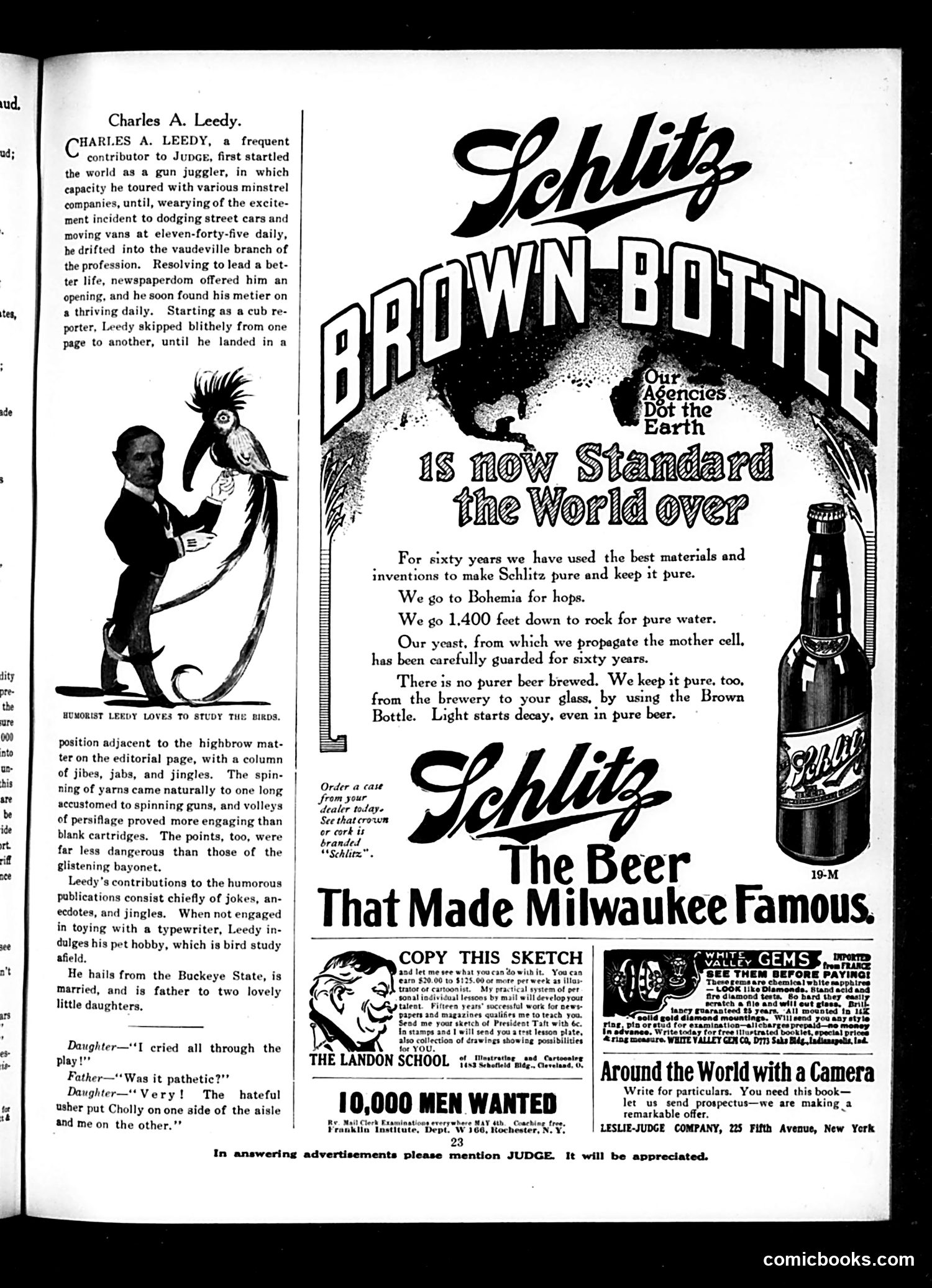
This page is primarily a **biographical profile** of Charles A. Leedy, a humorist and contributor to *Judge* magazine. The text describes his career trajectory from gun juggler in minstrel companies to vaudeville performer to newspaperman, eventually landing in humor writing. His hobby is bird study. The single joke included—about a daughter crying at a play because an usher separated her from her date "Cholly"—exemplifies Leedy's style: light domestic humor playing on social awkwardness rather than sharp satire. The remaining content is **advertising**: a large Schlitz beer advertisement emphasizing purity and the brown bottle's protection from light decay, plus smaller ads for The Landon School (art instruction), Valley Gems (synthetic diamonds), and Leslie-Judge Company's camera book. No political commentary or caricature appears on this page—it's largely a personality piece introducing a contributor alongside commercial content typical of early 20th-century magazines.
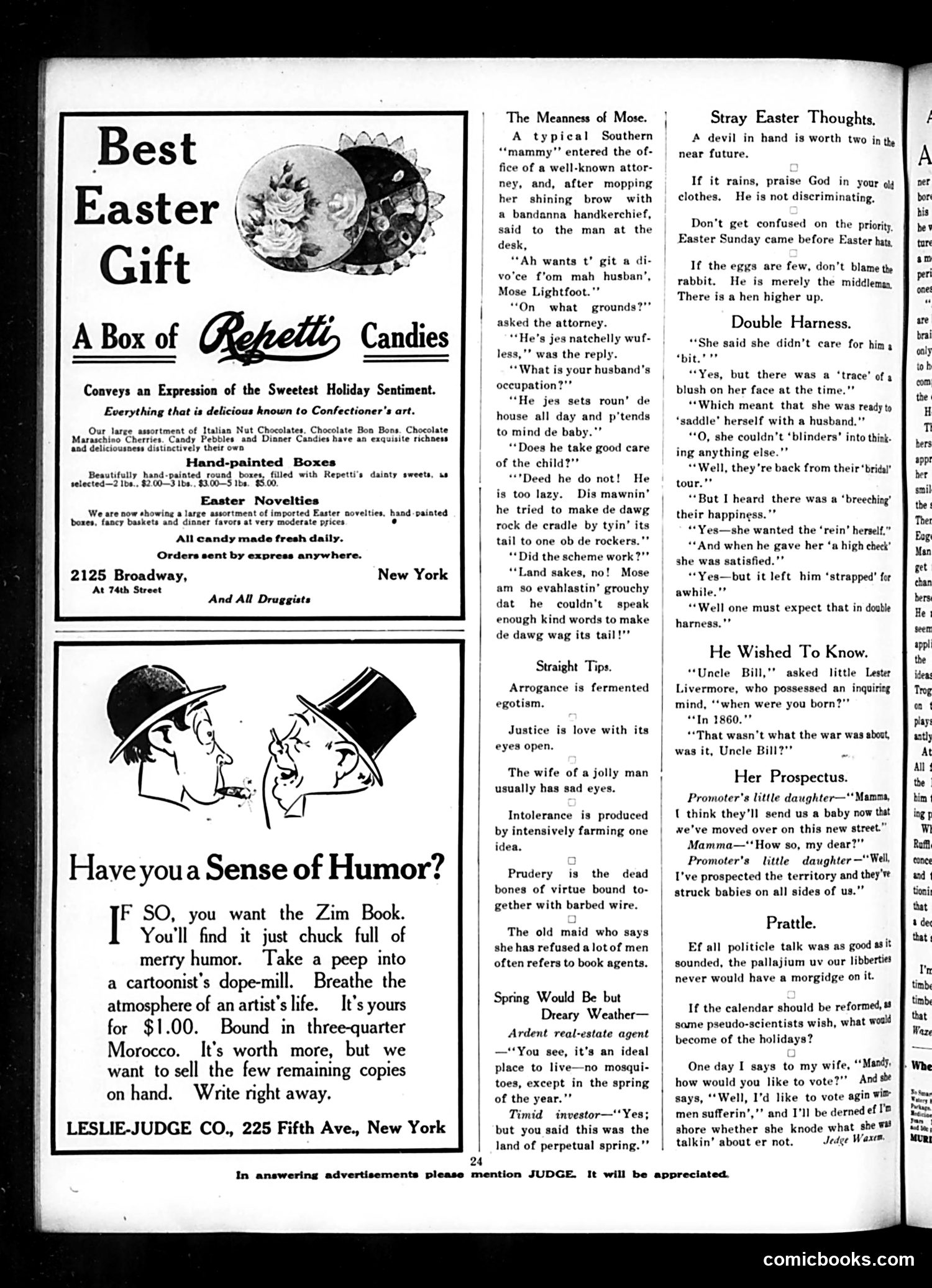
This page is primarily **advertisements and humorous short pieces** rather than political cartoons. The main advertisement promotes Repetti candies as Easter gifts. The two cartoons shown are generic humor unrelated to politics: one features two caricatured faces (unclear who they represent), and the other advertises "The Zim Book," a cartoonist's collection. The rest of the page contains brief jokes and quips. Most notably, "The Meanness of Mose" depicts a Southern Black woman using heavy dialect ("jes," "husban'," "vo'ce") seeking divorce from her lazy husband. This reflects early 20th-century stereotypical comedy about African Americans common in Judge magazine. Other short pieces use puns about marriage ("Double Harness") and contain mild social commentary about human nature ("Straight Tips") with no specific political targets. The page is essentially a collection of light humor and commercial announcements typical of the magazine format.
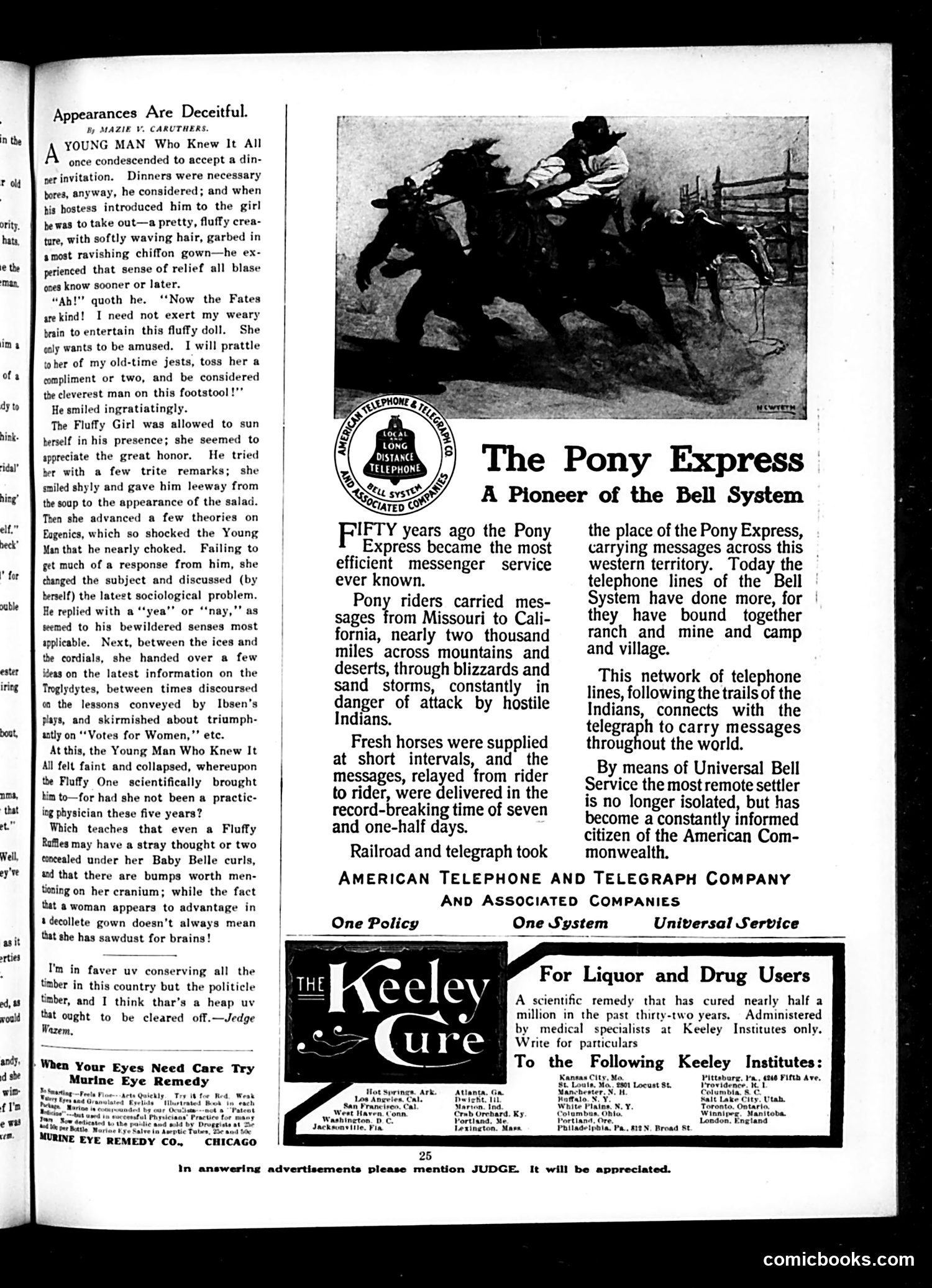
This page contains a short story satirizing gender stereotypes of the era. A conceited young man accepts a dinner invitation, expecting to entertain a conventionally pretty "fluffy girl" in a fashionable chiffon gown with minimal effort. He assumes her appearance signals intellectual emptiness. The joke reverses his expectations: the woman proves to be an educated intellectual discussing eugenics, sociology, Ibsen's plays, and women's suffrage—topics that shock and confound him. She's even a practicing physician. The final punchline mocks his assumption that "a woman appears to advantage in a decollete gown" must mean "she has sawdust for brains." This reflects early 20th-century anxieties about women's education and changing social roles, particularly women entering professions like medicine and advocating for voting rights. The satire targets male smugness and shallow judgments based on appearance. The page also contains unrelated advertisements for the Pony Express (celebrating Bell System telephone service) and the Keeley Cure (for addiction treatment).
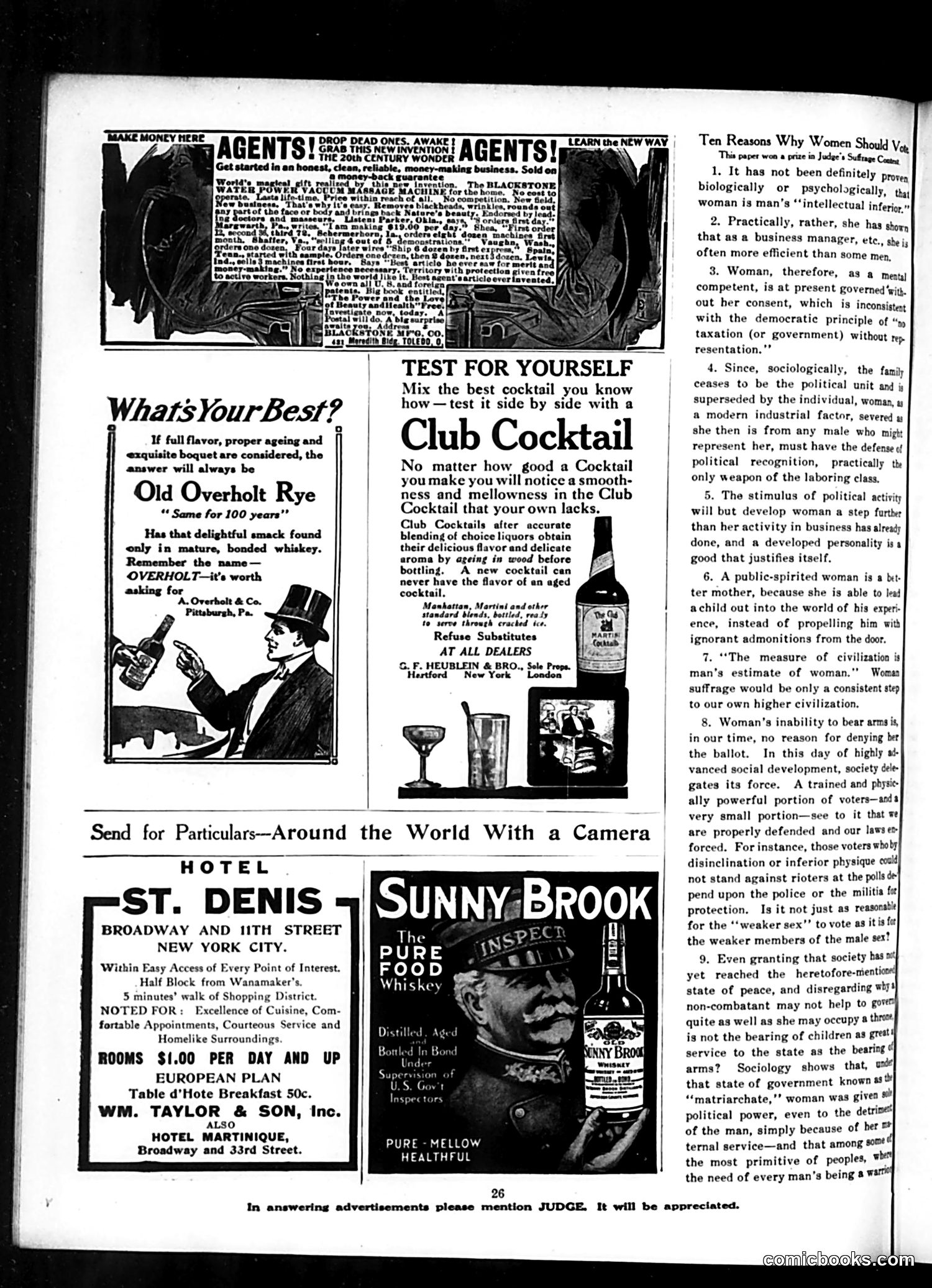
This page is primarily **advertisements** interspersed with an article titled "Ten Reasons Why Women Should Vote." **The Article's Context:** The right column presents arguments for women's suffrage, likely written during the early 20th-century suffrage movement. The arguments are pragmatic rather than purely ideological: women are competent managers (point 2), deserve political representation under democratic principles (point 3), would benefit from civic engagement (point 5), and deserve voting rights regardless of physical strength (point 8). Point 7 explicitly frames women's suffrage as a marker of civilizational progress. **The Advertisements:** The page features typical period ads: whiskey (Old Overholt Rye, Club Cocktail, Sunny Brook), hotel accommodations, and a "money-making business" opportunity. These ads reflect the magazine's audience and commercial interests rather than the editorial content's feminist messaging. **The Disconnect:** The juxtaposition of serious suffrage arguments with liquor and hospitality advertisements creates an ironic contrast—the magazine simultaneously advocates for women's political empowerment while advertising products and services in a male-dominated consumer landscape.
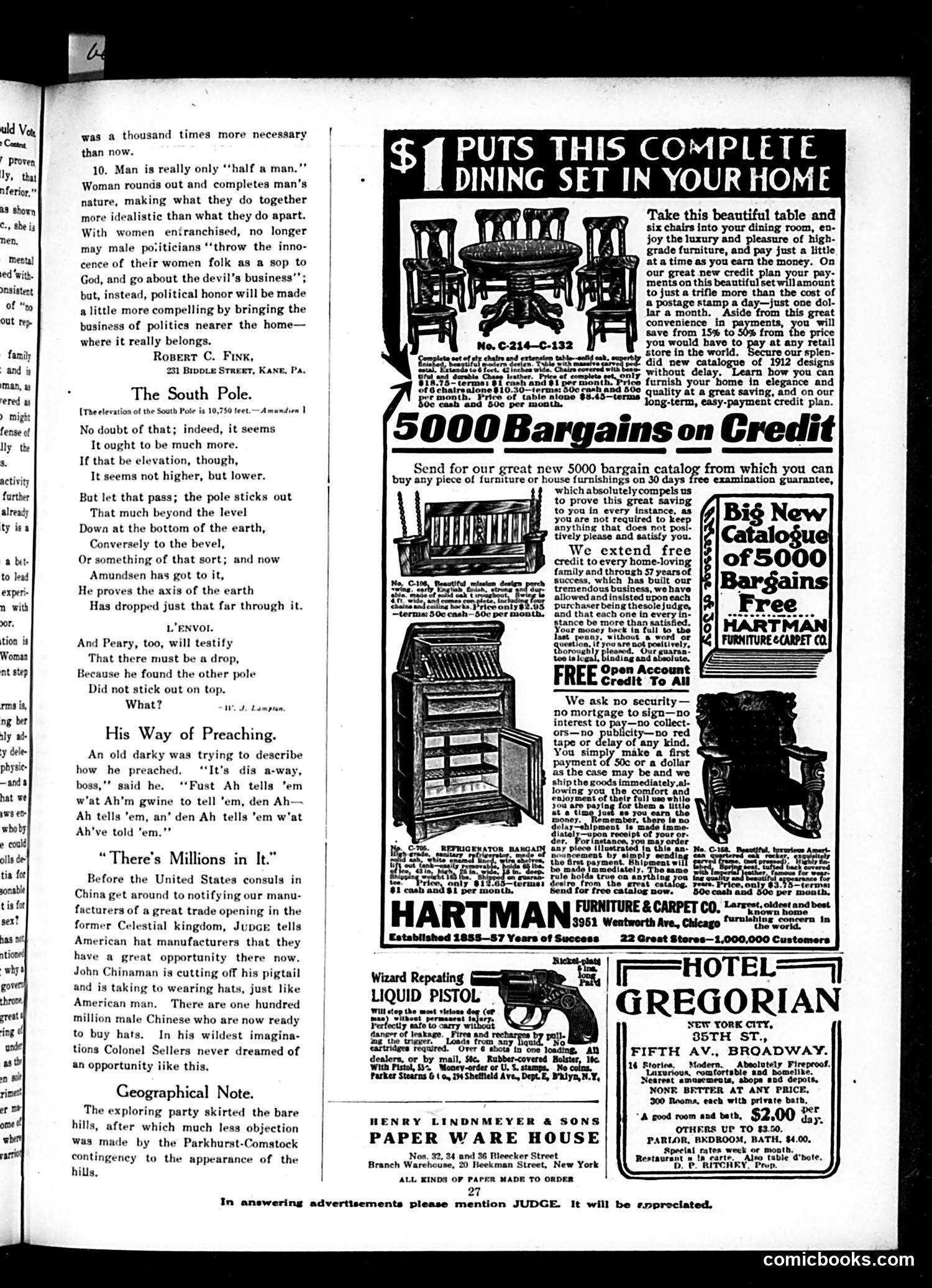
This page is primarily **advertising**, not political satire. The dominant content features a large Hartman Furniture & Carpet Co. advertisement promoting a complete dining set for $1 "on credit." The page's left column contains brief humorous pieces unrelated to the ads: 1. **"The South Pole"** — A light joke about explorers Amundsen and Peary, playing on the idea that if they "found" the South Pole, the Earth's axis must have physically shifted downward. 2. **"His Way of Preaching"** — A dialect joke about an elderly Black preacher's repetitive sermon style ("First I tell 'em what I'm gonna tell 'em, then I tell 'em, then I tell 'em what I told 'em"). 3. **Brief editorial snippets** on women's suffrage and political reform. The advertisements emphasize easy credit terms and "no security" required—reflecting early 20th-century consumer financing. The page represents Judge's mix of light humor and commercial content typical of the era.
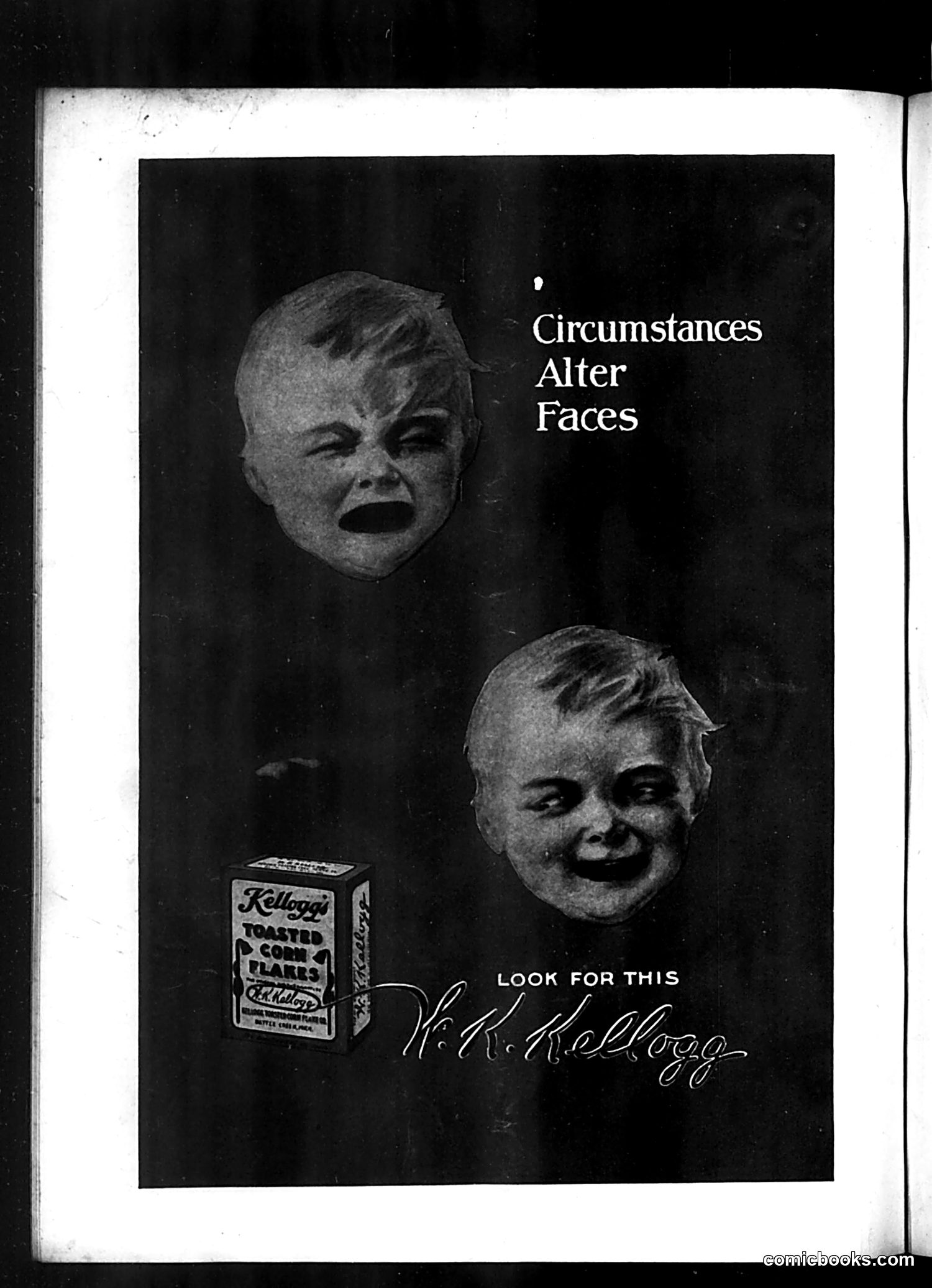
This is a **Kellogg's Toasted Corn Flakes advertisement**, not political satire. The page shows two contrasting infant faces—one appearing distressed (top) and one appearing happy (bottom)—illustrating the headline "Circumstances Alter Faces." The ad's message suggests that proper nutrition from Kellogg's cereal improves infant health and disposition. The unhappy face represents a baby without adequate nutrition; the smiling face represents one fed Kellogg's products. The signature "W.K. Kellogg" (company founder) adds authenticity. This reflects early 20th-century advertising that used dramatic before-and-after imagery to promote commercial products as solutions to child health concerns—a common marketing approach of the era that modern viewers would recognize as manipulative.