
Judge, 1912-04-06 · page 11 of 28
Judge — April 6, 1912 — page 11: what you’re looking at
What you’re looking at
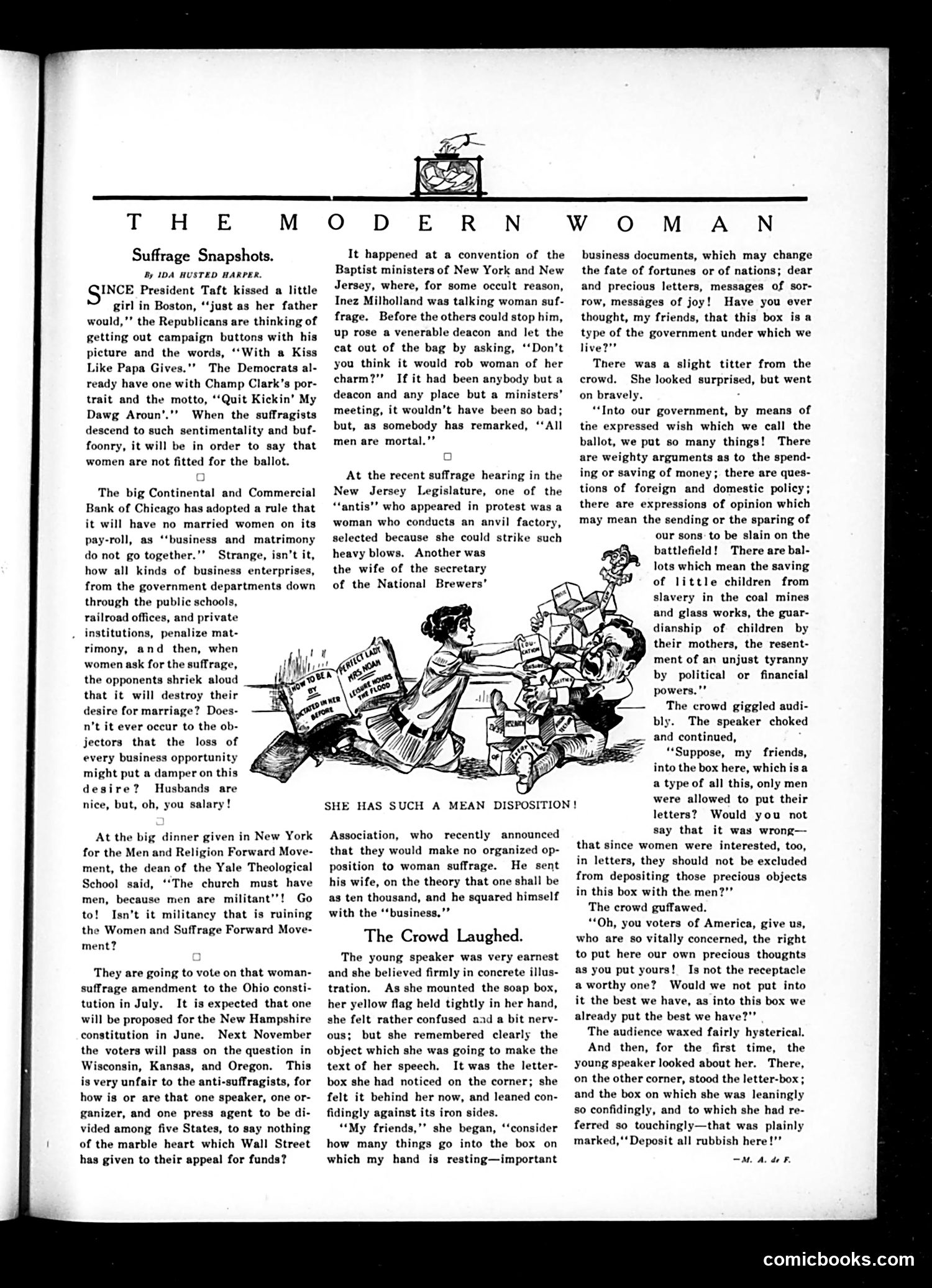
This page contains satirical commentary by Ida Husted Harper attacking anti-suffrage arguments. The main cartoon depicts a woman speaker at a "soap box" rally leaning against a mailbox while holding a yellow suffrage flag, illustrating her argument about everyday democratic participation. The text mocks opponents' contradictions: banks fire married women for "incompatibility with business," yet anti-suffragists claim voting would destroy women's desire to marry. Harper ridicules religious leaders (Yale dean) claiming churches need "militant" men while attacking suffragists' militancy, and notes the hypocrisy of female anti-suffragists—including a brewery secretary's wife and female factory owner—testifying against women's voting rights. The satire targets the illogical reasoning used to deny women political participation, emphasizing how those arguments contradict women's existing economic and social roles.
📄 Transcribed text from this page (OCR, searchable)
Machine-transcribed from the original scan — historical spelling and the odd misread are preserved.
T H E Suffrage Snapshots. By IDA HUSTED HARPER. INCE President Taft kissed a little girl in Boston, ‘‘just as her father would,’’ the Republicans are thinking of getting out campaign buttons with his picture and the words, ‘‘With a Kiss Like Papa Gives.'"’ The Democrats al- ready have one with Champ Clark’s por- trait and the motto, ‘Quit Kickin’ My Dawg Aroun’.’’ When the suffragists e8. descend to such sentimentality and buf- foonry, it will be in order to say that women are not fitted for the ballot. The big Continental and Commercial Bank of Chicago has adopted a rule that it will have no married women on its pay-roll, as ‘‘business and matrimony do not go together.’” Strange, isn’t it, how all kinds of business enterprises, from the government departments down through the public schools, railroad offices, and private institutions, penalize mat- rimony, and then, when women ask for the suffrage, the opponents shriek aloud that it will destroy their desire for marriage? Does- n’t it ever occur to the ob- jectors that the loss of every business opportunity might put a damper on this desire? Husbands are nice, but, oh, you salary! At the big dinner given in New York for the Men and Religion Forward Move- ment, the dean of the Yale Theological School , ‘The church must have men, because men are militant’! Go to! Isn’t it militancy that is ruining the Women and Suffrage Forward Move- ment? They are going to vote on that woman- suffrage amendment to the Ohio consti- tution in July. It is expected that one will be proposed for the New Hampshire constitution in June. Next November the voters will pass on the question in Wisconsin, Kansas, and Oregon. This is very unfair to the anti-suffragists, for how is or are that one speaker, one or- ganizer, and one press agent to be di- vided among five States, to say nothing of the marble heart which Wall Street has given to their appeal for funds? M O D E RN It happened at a convention of the Baptist ministers of New York and New Jersey, where, for some occult reason, Inez Milholland was talking woman suf- frage. Before the others could stop him, up rose a venerable deacon and let the cat out of the bag by asking, ‘Don’t you think it would rob woman of her charm?”’ If it had been anybody but a deacon and any place but a ministers’ meeting, it wouldn’t have been so bad; but, as somebody has remarked, ‘‘All men are mortal.’’ At the recent suffrage hearing in the New Jersey Legislature, one of the “‘antis’’ who appeared in protest was a woman who conducts an anvil factory, selected because she could strike such heavy blows. Another was the wife of the secretary of the National Brewers’ SHE HAS SUCH A MEAN DISPOSITIO: Association, who recently announced that they would make no organized op- position to woman suffrage. He sent his wife, on the theory that one shall be as ten thousand, and he squared himself with the ‘‘business,”” The Crowd Laughed. The young speaker was very earnest and she believed firmly in concrete illus- tration. As she mounted the soap box, her yellow flag held tightly in her hand, she felt rather confused aad a bit nerv- ous; but she remembered clearly the object which she was going to make the text of her speech. It was the letter- box she had noticed on the corner; she felt it behind her now, and leaned con- fidingly against its iron sides. “*‘My friends,’’ she began, ‘‘consider how many things go into the box on which my hand is resting—important WwW OM A N business documents, which may change the fate of fortunes or of nations; dear and precious letters, messages of sor- row, messages of joy! Have you ever thought, my friends, that this box is a type of the government under which we live?” There was a slight titter from the crowd. She looked surprised, but went on bravely. : ‘Into our government, by means of tne expressed wish which we call the ballot, we put so many things! There are weighty arguments as to the spend- ing or saving of money; there are ques- tions of foreign and domestic policy; there are expressions of opinion which may mean the sending or the sparing of our sons: to be slain on the battlefield! There are bal- lots which mean the saving of little children from slavery in the coal mines and glass works, the guar- dianship of children by their mothers, the resent- ment of an unjust tyranny by political or financial powers,’"” The crowd giggled audi- bly. The speaker choked and continued, “Suppose, my friends, into the box here, which isa a type of all this, only men were allowed to put their letters? Would you not say that it was wrong— that since women were interested, too, in letters, they should not be excluded from depositing those precious objects in this box with the men?” The crowd guffawed. “Oh, you voters of America, give us, who are so vitally concerned, the right to put here our own precious thougnts as you put yours! Is not the receptacle a worthy one? Would we not put into it the best we have, as into this box we already put the best we have?” The audience waxed fairly hysterical. And then, for the first time, the young speaker looked about her. There, on the other corner, stood the letter-bo: and the box on which she was leaningly so confidingly, and to which she had re- ferred so touchingly—that was plainly marked,‘‘ Deposit all rubbish here !’’ NI <M. A. de F comicbooks.com