
Judge, 1912-04-06 · page 15 of 28
Judge — April 6, 1912 — page 15: what you’re looking at
What you’re looking at
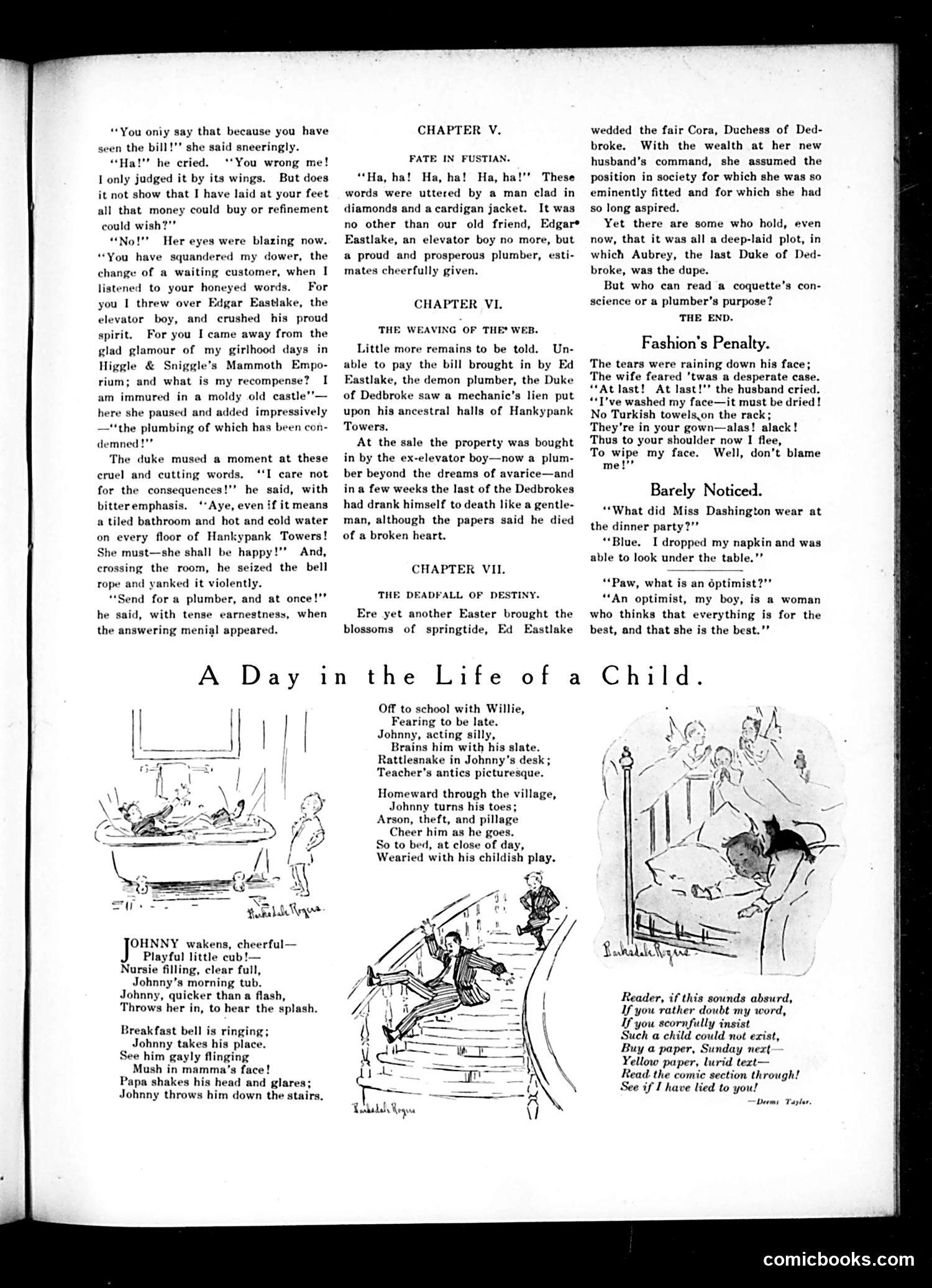
This page contains a serialized satirical melodrama mocking sentimental Victorian fiction, plus a humorous children's verse with accompanying illustrations. The main story parodies overwrought romantic plots: a duchess sacrifices her dower and a true love (elevator boy Edgar Eastlake) to marry a duke. She complains about the castle's condemned plumbing—her ultimate complaint. The duke heroically summons a plumber. The ironic twist: Edgar Eastlake becomes a successful plumber, acquires wealth, purchases the duke's mortgaged estate, marries the duchess himself, and the duke dies. The narrator facetiously asks: "who can read a coquette's conscience or a plumber's purpose?"—suggesting hidden machinations. The children's verse depicts a destructively misbehaving child (Johnny) who throws his nurse in the tub, hits his teacher with a slate, and commits arson and theft—all treated as normal childish pranks. The accompanying illustrations show these "cute" misdeeds. The satirical appeal to readers questions whether such behavior should genuinely be tolerated. Both pieces mock contemporary literary and social conventions through exaggeration.
📄 Transcribed text from this page (OCR, searchable)
Machine-transcribed from the original scan — historical spelling and the odd misread are preserved.
“You oniy say that because you have seen the bill!’’ she said sneeringly. “Hal'’ he cried. ‘‘You wrong me! I only judged it by its wings. But does it not show that I have laid at your feet all that money could buy or refinement could wish?" “No!’? Her eyes were blazing now. “You have squandered my dower, the change of a waiting customer, when I listened to your honeyed words. For you I threw over Edgar Eastlake, the elevator boy, and crushed his proud spirit. For you I came away from the glad glamour of my girlhood days in Higgle & Sniggle’s Mammoth Empo- rium; and what is my recompense? I am immured in a moldy old castle’’— here she paused and added impressively —the plumbing of which has been con- demned !"" The duke mused a moment at these cruel and cutting words. ‘‘I care not for the consequences!’ he said, with bitteremphasis. ‘*Aye, even if it means a tiled bathroom and hot and cold water on every floor of Hankypank Towers! She must—she shall be happy!’’ And, crossing the room, he seized the bell rope and yanked it violently. “Send for a plumber, and at once!’’ he said, with tense earnestness, when the answering menial appeared. in OHNNY wakens, cheerful— Playful little cub!— Nursie filling, clear full, Johnny's morning tub. Johnny, quicker than a flash, Throws her in, to hear the splash. Breakfast bell is ringing; Johnny takes his place. See him gayly flinging Mush in mamma's face! Papa shakes his head and glares; Johnny throws him down the stairs. CHAPTER V. FATE IN FUSTIAN. “Ha, ha! Ha, ha! Ha, ha!’’ These words were uttered by a man clad in diamonds and a cardigan jacket. It was no other than our old friend, Edgar® Eastlake, an elevator boy no more, but a proud and prosperous plumber, esti- mates cheerfully given. CHAPTER VI. THE WEAVING OF THE® WEB. Little more remains to be told. Un- able to pay the bill brought in by Ed Eastlake, the demon plumber, the Duke of Dedbroke saw a mechanic’s lien put upon his ancestral halls of Hankypank Towers. At the sale the property was bought in by the ex-elevator boy—now a plum- ber beyond the dreams of avarice—and ina few weeks the last of the Dedbrokes had drank himself to death like a gentle- man, although the papers said he died of a broken heart. CHAPTER VII. THE DEADFALL OF DESTINY. Ere yet another Easter brought the blossoms of springtide, Ed Eastlake Off to school with Willie, Fearing to be late. Johnny, acting silly, Brains him with his slate. Rattlesnake in Johnny’s desk; Teacher's antics picturesque. Homeward through the village, Johnny turns his toes; Arson, theft, and pillage Cheer him as he goes. So to bed, at close of day, Wearied with his childish play. wedded the fair Cora, Duchess of Ded- broke. With the wealth at her new husband’s command, she assumed the position in society for which she was so eminently fitted and for which she had so long aspired. Yet there are some who hold, even now, that it was all a deep-laid plot, in which Aubrey, the last Duke of Ded- broke, was the dupe. But who can read a coquette’s con- science or a plumber's purpose? THE END. Fashion's Penalty. The tears were raining down his face; The wife feared 'twas a desperate case. “At last! At last!"? the husband cried. “I've washed my face—it must be dried! No Turkish towels.on the rack; They’re in your gown—alas! alack! Thus to your shoulder now I flee, To wipe my face. Well, don’t blame me!” Barely Noticed. “‘What did Miss Dashington wear at the dinner party?”’ “Blue. I dropped my napkin and was able to look under the table.’” “Paw, what is an éptimist?’’ “An optimist, my boy, is a woman who thinks that everything is for the best, and that she is the best.’’ the Life of a Child. Reader, if this sounds absurd, If you rather doubt my word, If you scornfully insist Such a child could not exist, Buy a paper, Sunday next Yellow paper, lurid text— Read the comic section through! See if I have lied to you! —Deems Taylor. comicbooks.com