
Judge, 1912-04-06 · page 6 of 28
Judge — April 6, 1912 — page 6: what you’re looking at
What you’re looking at
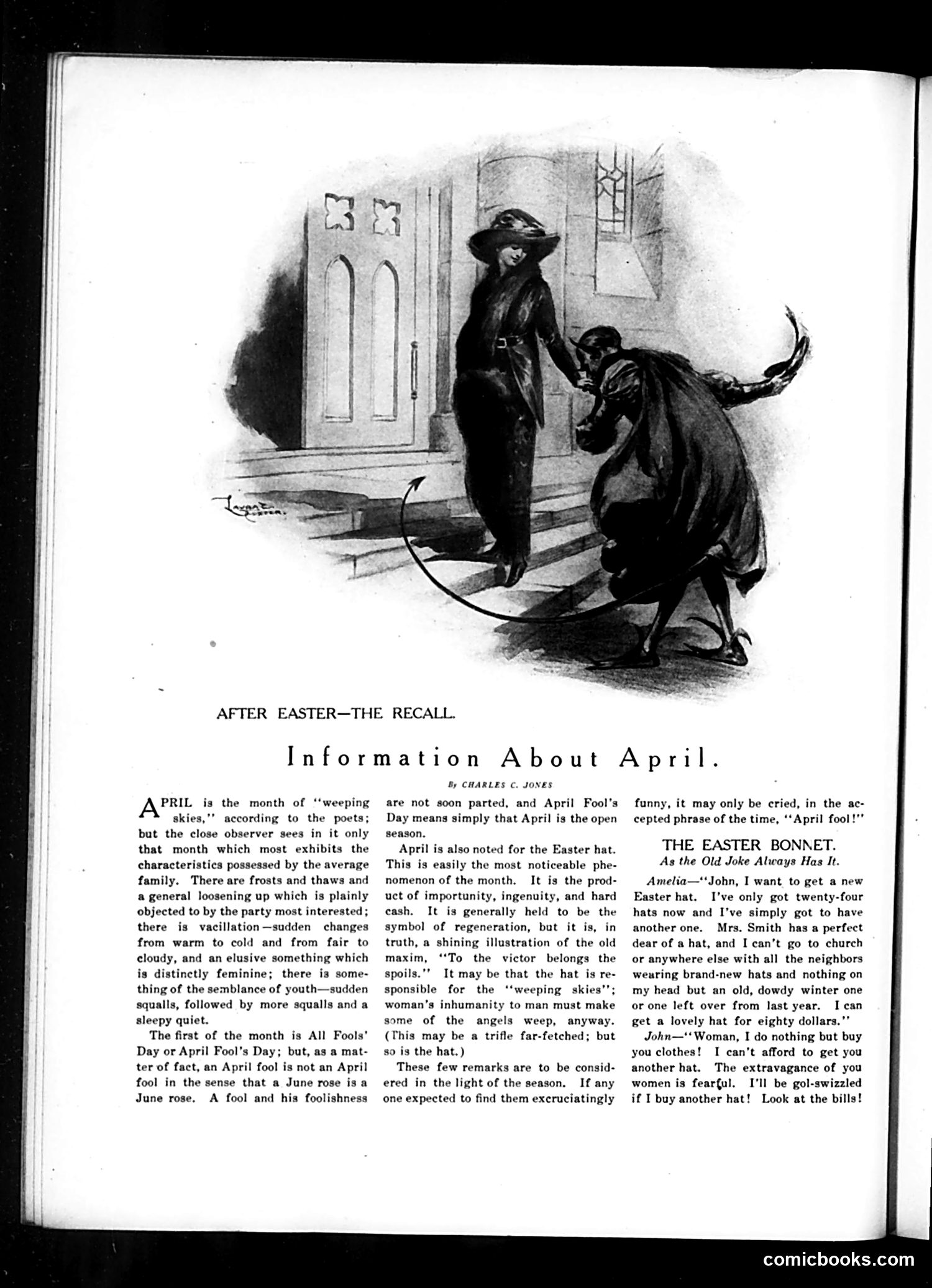
This page satirizes two April traditions: April Fools' Day and the Easter bonnet craze. **The Cartoon**: The sketch depicts a woman returning an elaborate Easter hat to a shop, implying buyer's remorse or the "recall" of the title—a play on the post-Easter period. **The Text**: Charles C. Jones's essay humorously portrays April as embodying feminine traits: emotional volatility, indecision, and sudden changes. The Easter hat is mocked as wasteful vanity masked as religious regeneration—actually "the victor belongs the spoils," meaning women assert dominance through extravagant fashion. **The Satire**: The accompanying dialogue between "Amelia" and "John" dramatizes the stereotype of wives pressuring husbands for expensive clothing. John's exasperation at her twenty-four existing hats and demand for an eighty-dollar replacement captures the satirical critique of early 20th-century women's consumer spending and marital financial conflict—a common Judge theme mocking both female extravagance and male financial anxiety.
📄 Transcribed text from this page (OCR, searchable)
Machine-transcribed from the original scan — historical spelling and the odd misread are preserved.
AFTER EASTER—THE RECALL. Information About April. By CHARLES C. JONES PRIL is the month of ‘weeping skies,"’ according to the poets; but the close observer sees in it only that month which most exhibits the characteristics possessed by the average family. There are frosts and thaws and a general loosening up which is plainly objected to by the party most interested; there is vacillation—sudden changes from warm to cold and from fair to cloudy, and an elusive something which is distinctly feminine; there is some- thing of the semblance of youth—sudden squalls, followed by more squalls and a sleepy quiet. The first of the month is All Fools’ Day or April Fool’s Day; but, as a mat- ter of fact, an April fool is not an April fool in the sense that a June rose is a June rose. A fool and his foolishness are not soon parted, and April Fool's Day means simply that April is the open season. April is also noted for the Easter hat. This is easily the most noticeable phe- nomenon of the month. It is the prod- uct of importunity, ingenuity, and hard cash. It is generally held to be the symbol of regeneration, but it is, in truth, a shining illustration of the old maxim, ‘To the victor belongs the spoils.’" It may be that the hat is re- sponsible for the skies"; woman's inhumanity to man must make some of the angels weep, anyway. (This may be a trifle far-fetched; but so is the hat.) These few remarks are to be consid- ered in the light of the season. If any one expected to find them excruciatingly “weeping funny, it may only be cried, in the ac- cepted phrase of the time, ‘‘April fool!"’ THE EASTER BONNET. As the Old Joke Always Has It. Amelia—‘‘John, I want to get a new Easter hat. I've only got twenty-four hats now and I’ve simply got to have another one. Mrs. Smith has a perfect dear of a hat, and Ican’t go to church or anywhere else with all the neighbors weuring brand-new hats and nothing on my head but an old, dowdy winter one or one left over from last year. I can get a lovely hat for eighty dollars.’’ John—*Woman, I do nothing but buy you clothes! I can’t afford to get you another hat. The extravagance of you women is fearful. I'll be gol-swizzled if I buy another hat! Look at the bills! comicbooks.com