
A complete issue · 24 pages · 1912
Judge — January 6, 1912
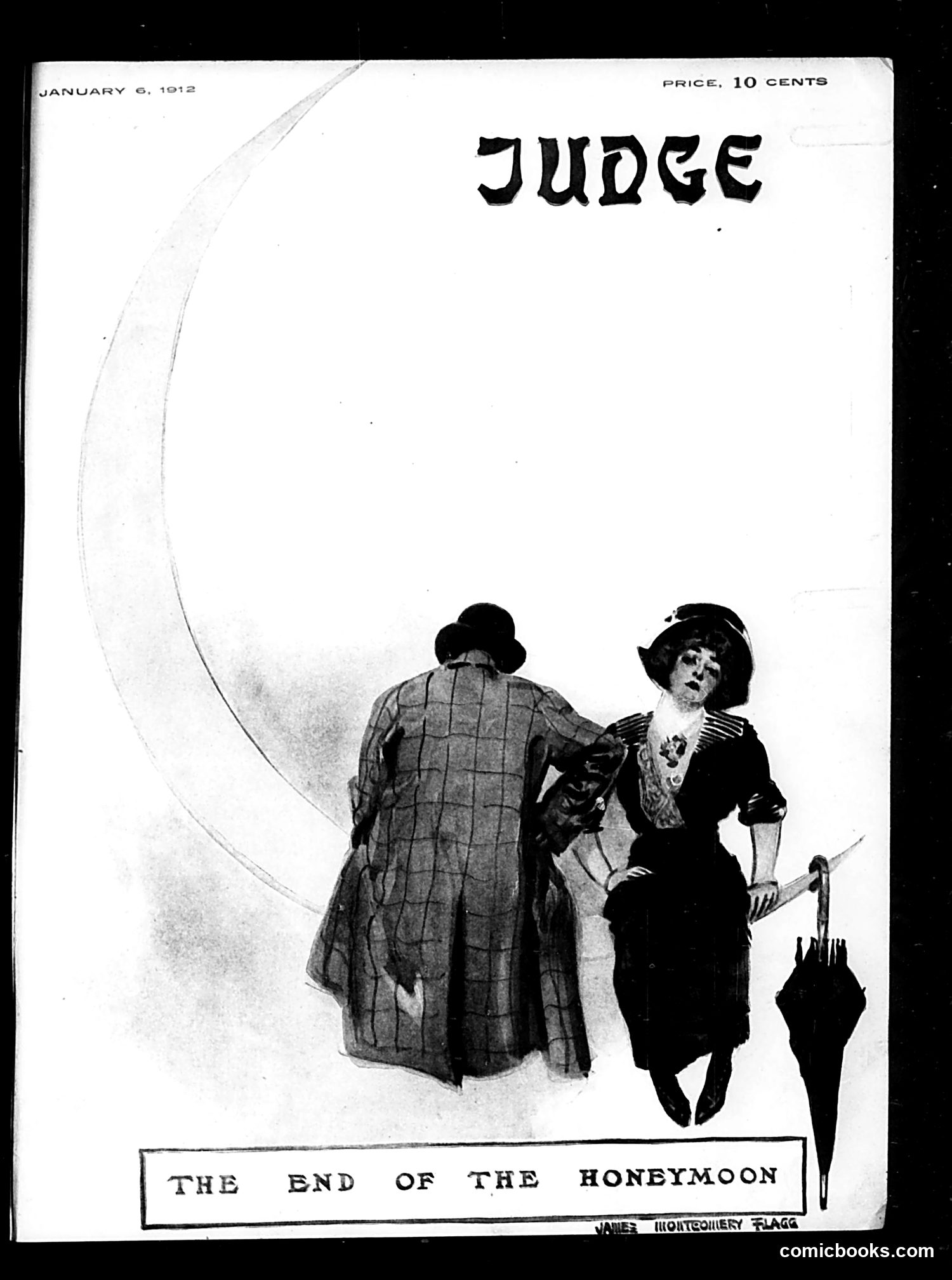
This 1912 Judge magazine cover illustrates a common satirical theme of the era: the romantic disillusionment following marriage. The cartoon depicts a couple where the woman appears displeased or annoyed, while the man (shown from behind) holds what appears to be a newspaper or document. An umbrella sits nearby—likely symbolizing protection or the practical realities of married life replacing romantic illusions. The title "The End of the Honeymoon" was a popular cultural phrase referencing the post-wedding period when couples' initial passion supposedly fades into domestic routine and mundane responsibilities. This reflects early-20th-century satirical commentary on marriage as a transition from romance to reality, a frequent subject in Judge's humor directed at middle-class readers.
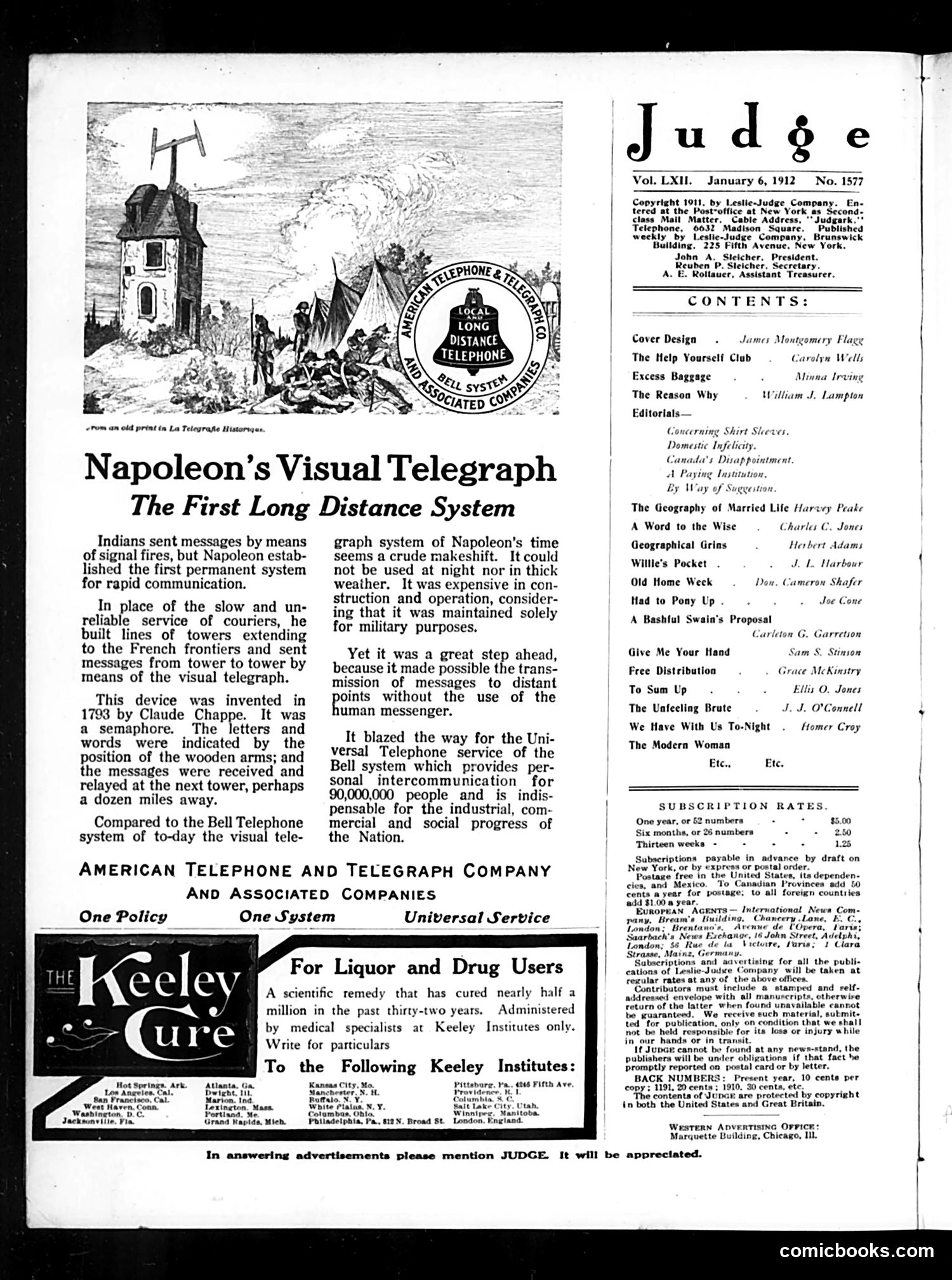
This page from Judge magazine (January 6, 1912) features a substantial article on "Napoleon's Visual Telegraph," explaining the semaphore communication system Napoleon used—the first long-distance rapid messaging system preceding modern telecommunications. The article describes how Napoleon built towers across French frontiers using arm-position signaling, contrasting this primitive method with the contemporary Bell Telephone system that could reach 90,000,000 people. The implicit satire appears to be celebrating modern American technological progress: the juxtaposition suggests how far communication technology has advanced from Napoleon's era to the present. This serves as implicit advertising for the American Telephone and Telegraph Company ("One Policy, One System, Universal Service") shown at the bottom of the page. The content is primarily informational rather than caricature-based satire.
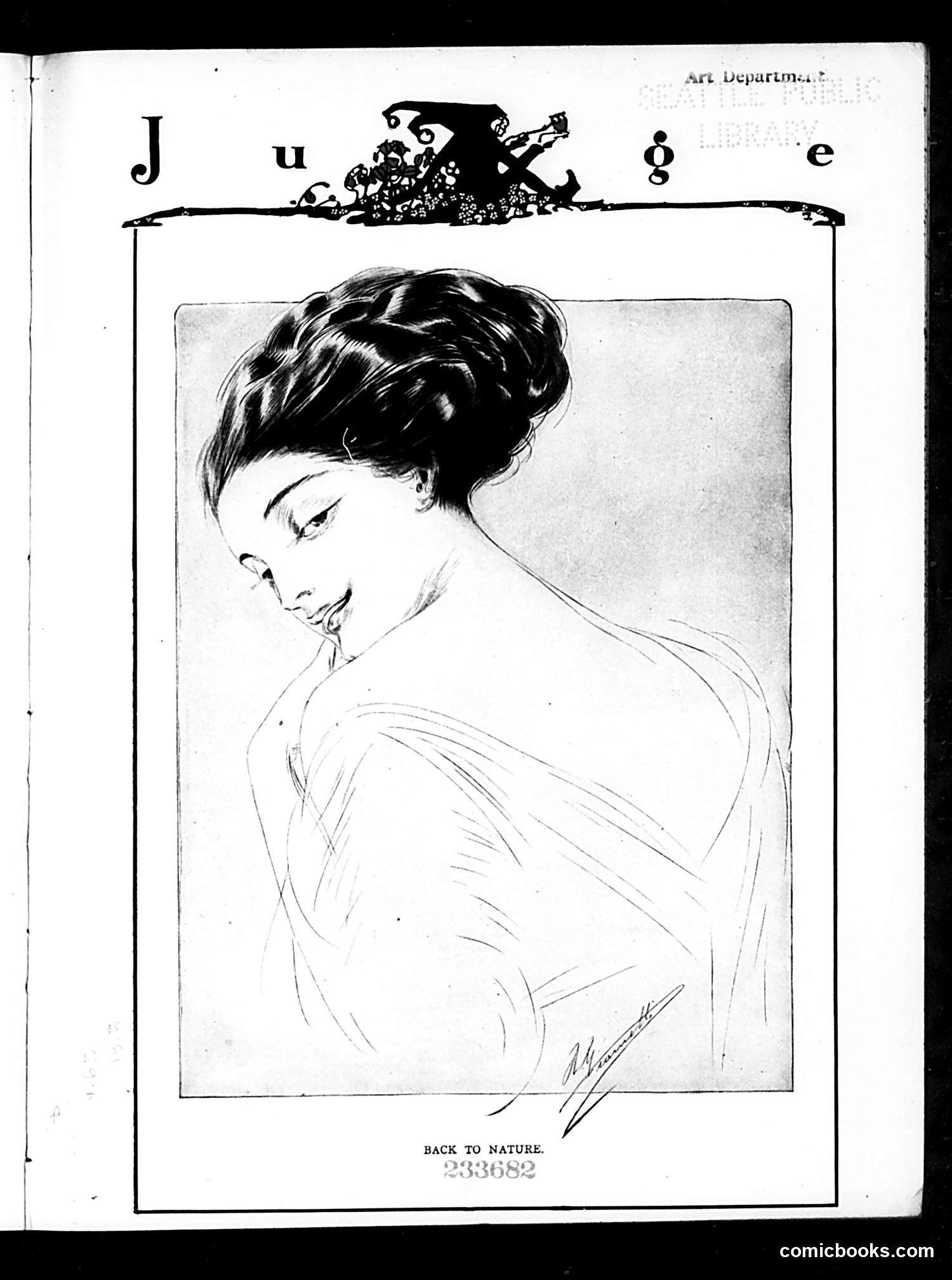
This page from *Judge* magazine features a portrait titled "Back to Nature" depicting a woman in profile, shown from behind, with her hair styled up and wearing a draped garment. The sketch emphasizes her bare shoulders and natural pose. The title "Back to Nature" likely references late 19th/early 20th-century artistic and social movements promoting natural beauty and rejecting Victorian artificiality. The delicate line-work style suggests this is satirizing contemporary attitudes toward women's fashion, beauty standards, or the "natural woman" aesthetic that was gaining popularity during this era. Without additional context or clearer OCR text identifying the specific figure or event, the precise satirical target remains unclear, though it appears to critique or comment on contemporary beauty ideals.
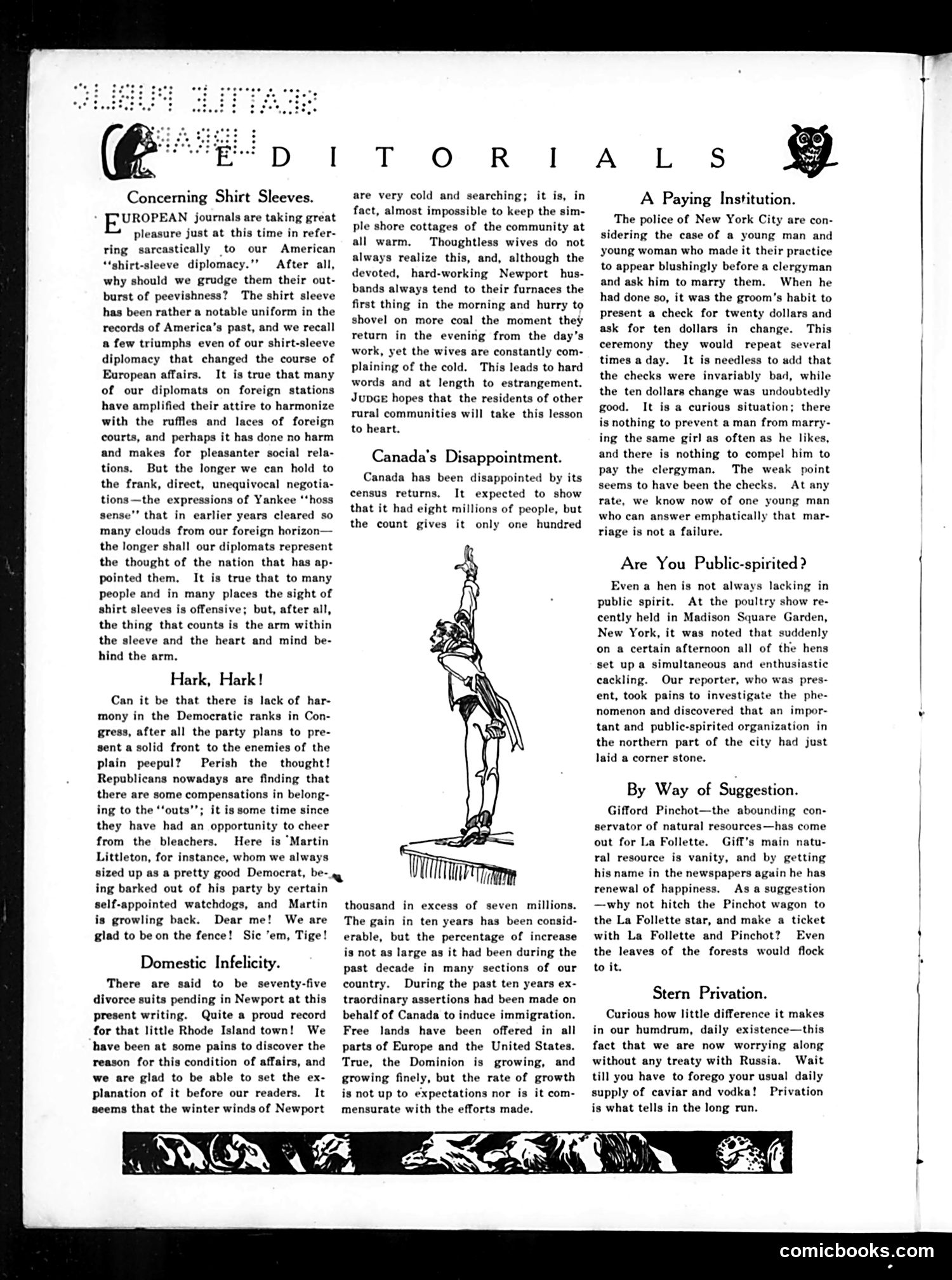
This page contains several short satirical editorials rather than a political cartoon. The main pieces critique: 1. **"Concerning Shirt Sleeves"** - Mocks American diplomats for adopting casual dress (rolled-up sleeves) as a supposed diplomatic innovation, contrasting this with European formality. 2. **"Hark, Hark!"** - Appears to criticize Democratic Party disunity, suggesting Republicans are benefiting from Democratic infighting. References "Martin Littleton" as an example. 3. **"Canada's Disappointment"** - Comments on Canada's census showing lower population than expected, discussing immigration efforts. 4. **"Domestic Infidelity"** - Notes seventy-five divorces pending in Newport, using this as social commentary. The central illustration shows a classical female figure on a pedestal—likely representing a civic institution or virtue. The page's overall tone is typical Judge satire: witty, cynical commentary on contemporary social and political issues.
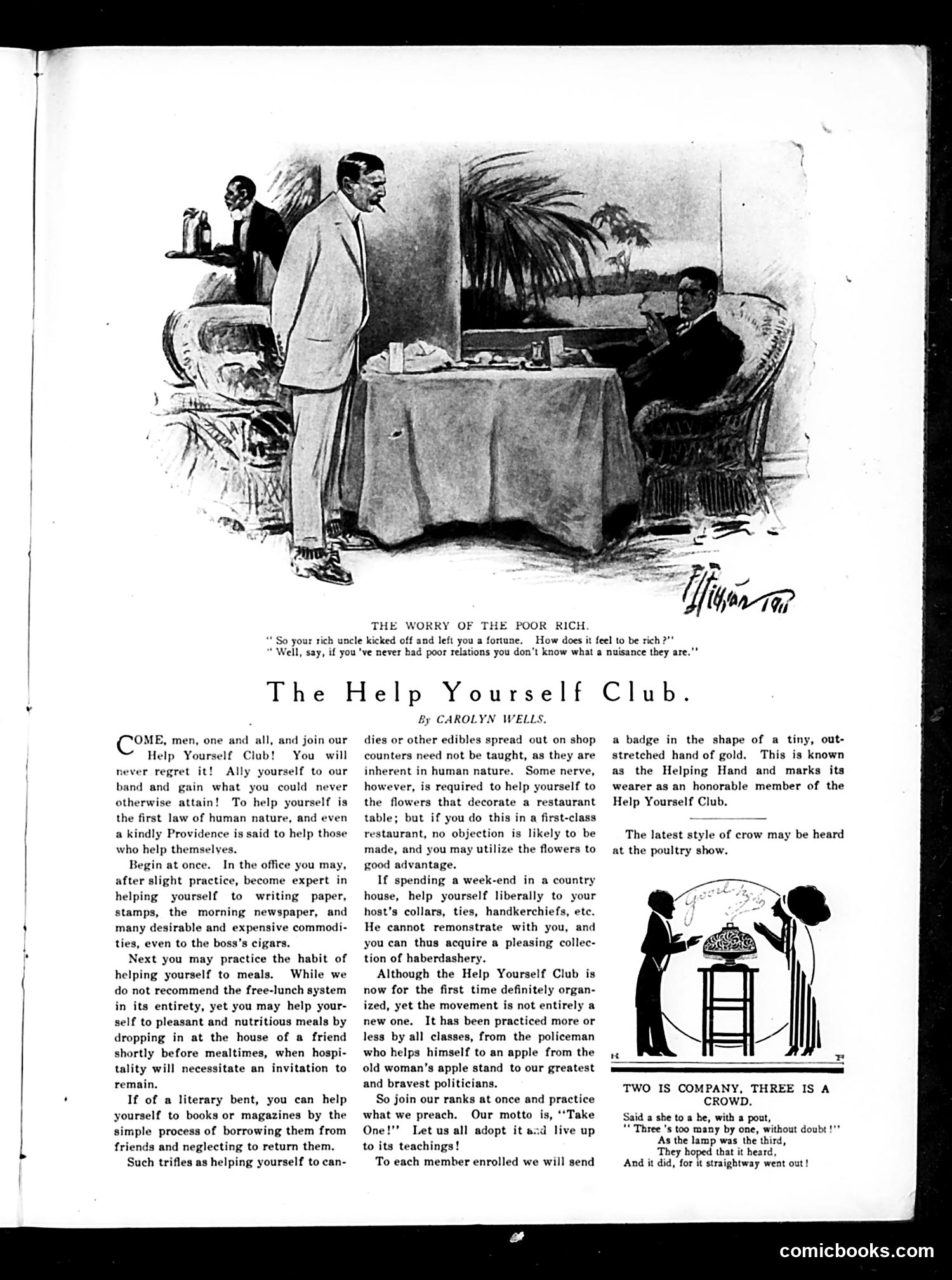
This satirical piece by Carolyn Wells mocks the "Self-Help" movement popular in early 20th-century America. The top cartoon shows a wealthy man dining while servants attend him, illustrating the irony: the "poor rich" complain about poverty despite never experiencing genuine hardship or "poor rations." The article satirizes self-help philosophy by suggesting absurd applications—helping yourself to restaurant flowers, borrowing magazines without returning them, stealing a friend's supplies. The humor lies in the contradiction: the movement preaches self-reliance and moral improvement, yet Wells demonstrates how the privileged class interprets "helping yourself" literally as theft or entitlement. The secondary cartoon jokes about uninvited guests, maintaining the theme of selfish self-interest masquerading as virtue.
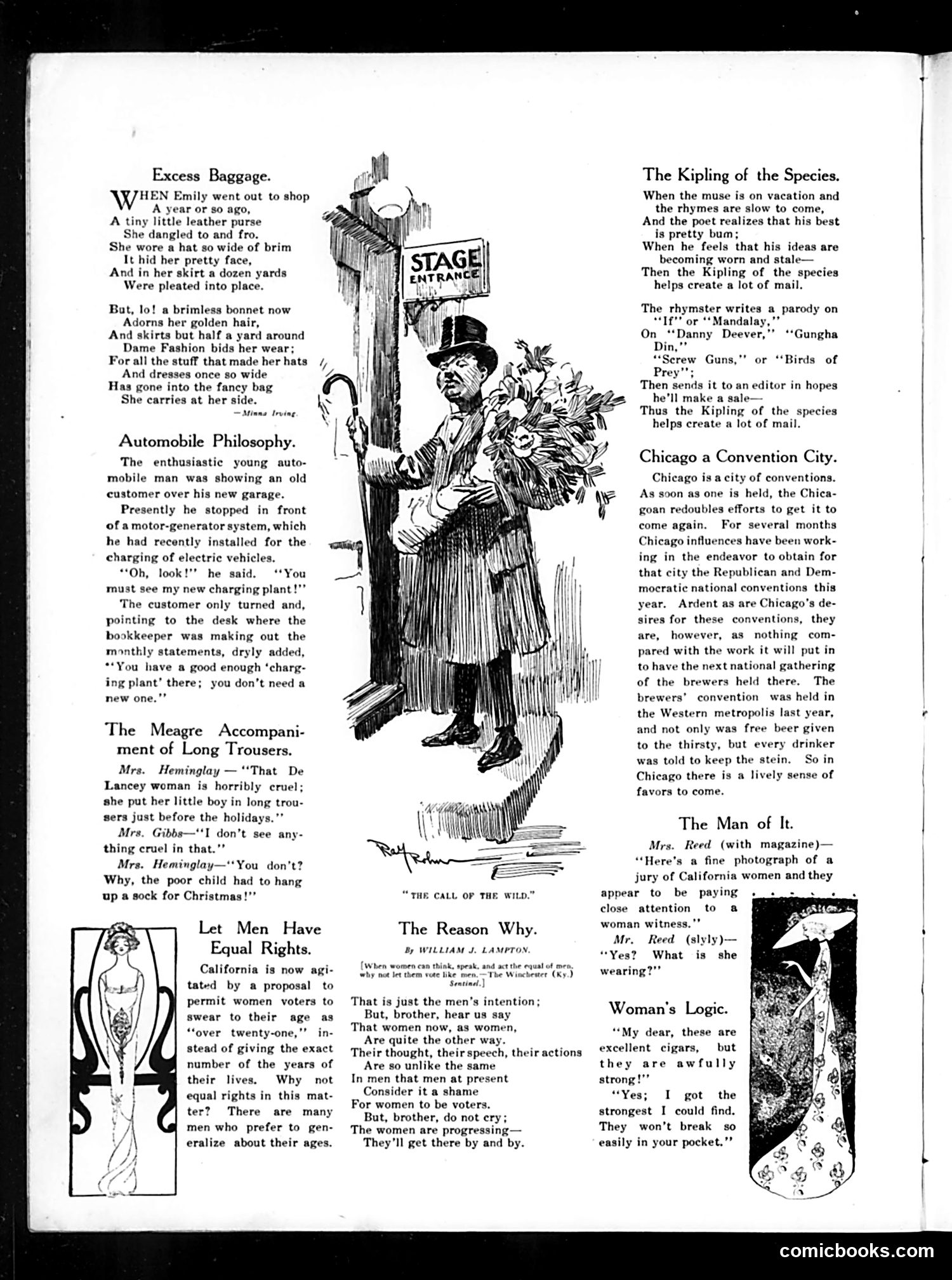
This page satirizes early 20th-century American social and political issues: **"Excess Baggage"** mocks women's shifting fashion trends—as skirts shrank from yards of fabric to half-yards, women transferred the excess material into ever-larger handbags, replacing one form of bulk with another. **"Automobile Philosophy"** jokes that a business's accounting department (where debts accumulate) is already a sufficient "charging plant"—no need for fancy equipment. **"Let Men Have Equal Rights"** argues against women's suffrage by claiming men won't grant it because women think and act differently than men do. The piece sarcastically suggests women will eventually obtain voting rights anyway. **"The Kipling of the Species"** mocks poets who imitate Rudyard Kipling's style when their own inspiration fails, flooding editors' desks with derivative work. **"Chicago a Convention City"** notes Chicago aggressively courts major conventions, particularly praising brewers' conventions for their generous hospitality (free beer and souvenirs). **"The Man of It"** jokes that a man finds it amusing a jury of California women pays attention during courtroom testimony.
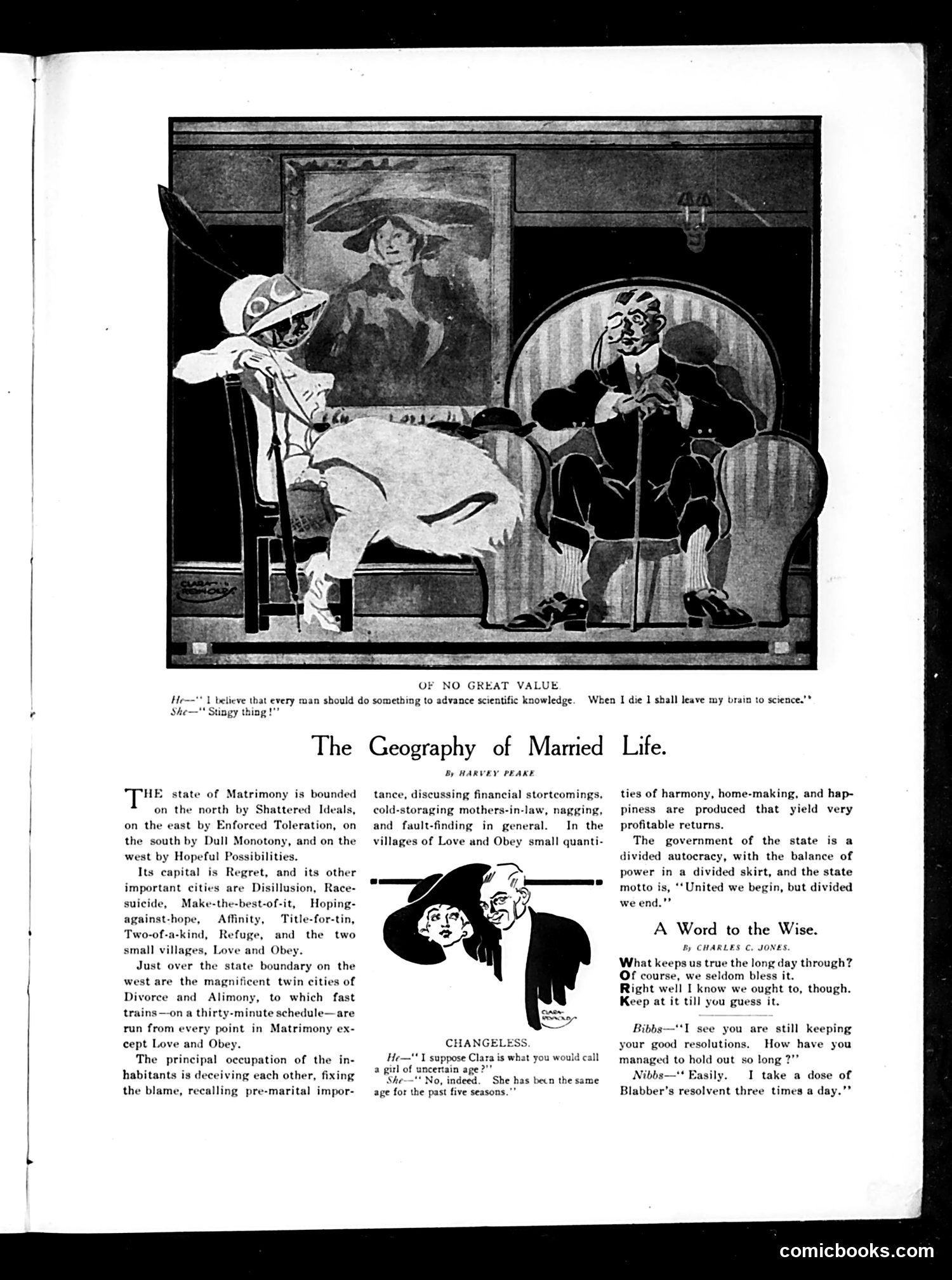
This satirical article uses a mock-geographic map to critique marriage as an inherently unhappy institution. The "state of Matrimony" is bordered by "Shattered Ideals" and "Dull Monotony," with a capital city named "Regret." Towns like "Disillusion," "Race-suicide," and "Make-the-best-of-it" populate the landscape, while "Love and Obey"—the only positive villages—produce merely "profitable returns" (suggesting marriage is commercially exploited). The accompanying cartoons reinforce cynicism about matrimony. The top panel shows a husband offering his brain to science when he dies; his wife dismisses this as "stingy." A lower panel mocks female vanity, suggesting a woman pretends youth by claiming the "same age for the past five seasons." The piece reflects early-20th-century satirical attitudes toward marriage as a trap of mutual deception, financial hardship, and eroded romance—while humorously implying both spouses perpetually disappoint each other.
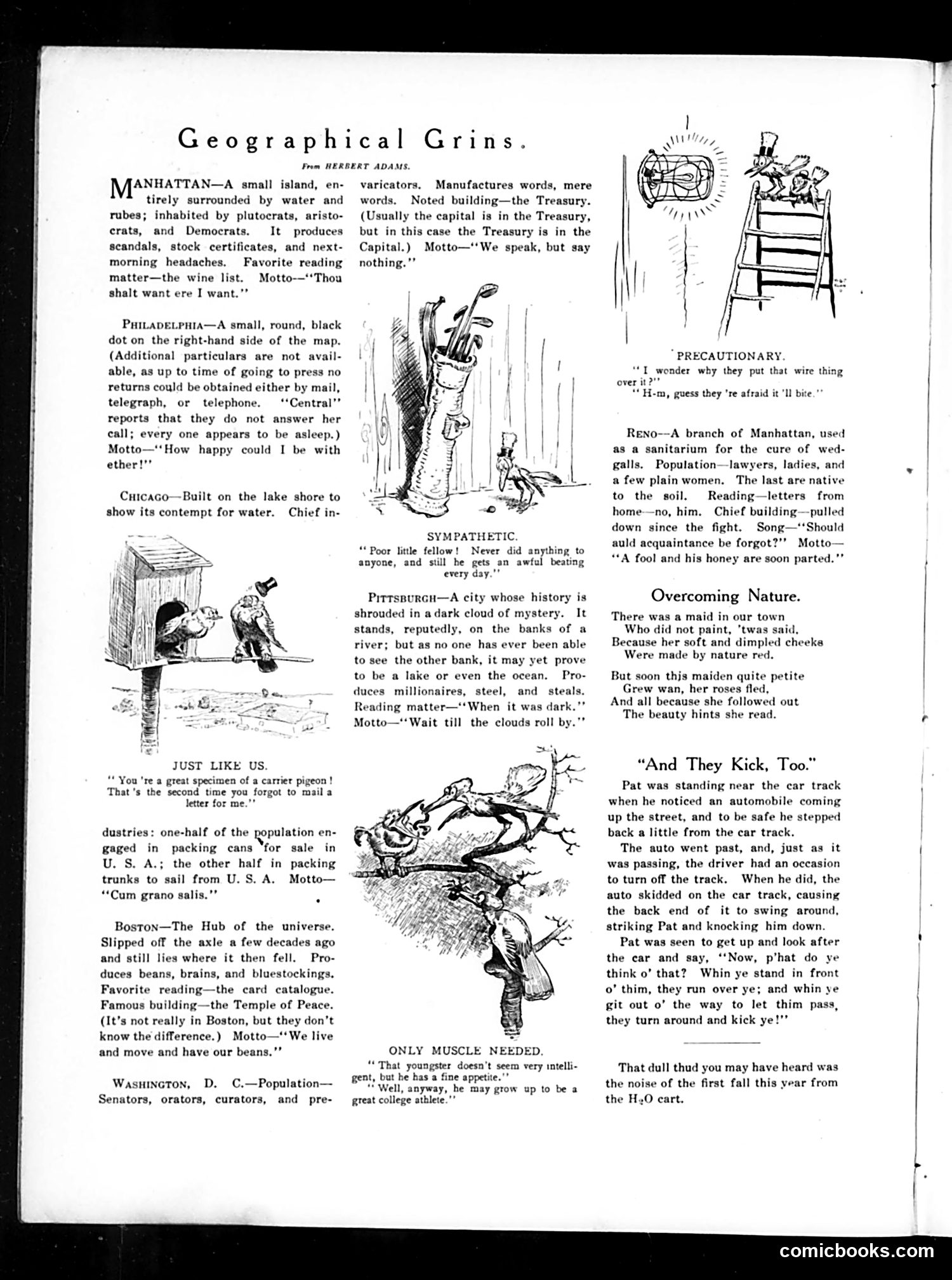
This page from Judge presents satirical "definitions" of major American cities by Herbert Adams, mocking their characteristics and inhabitants. **Manhattan** is portrayed as a water-surrounded island of plutocrats and aristocrats obsessed with wealth and wine. **Philadelphia** is humorously described as unreachable—so asleep/unresponsive that telegraph and telephone operators can't get answers, suggesting the city's decline or torpor. **Chicago** is depicted as contemptuous of water despite being lake-built, with industries focused on canning and packing goods. **Boston** is called the "Hub of the Universe" but jokingly "slipped off the axle" decades ago, still lying where it fell—a backhanded insult to its faded importance. **Washington, D.C.** manufactures "words, mere words"—satirizing politicians' empty rhetoric. **Pittsburgh** is shrouded in mystery about whether its river exists, producing "millionaires, steel, and steals" (theft). **Reno** is characterized as a divorce destination for wealthy people seeking legal separations. The scattered humorous anecdotes mock American social pretensions and urban follies.
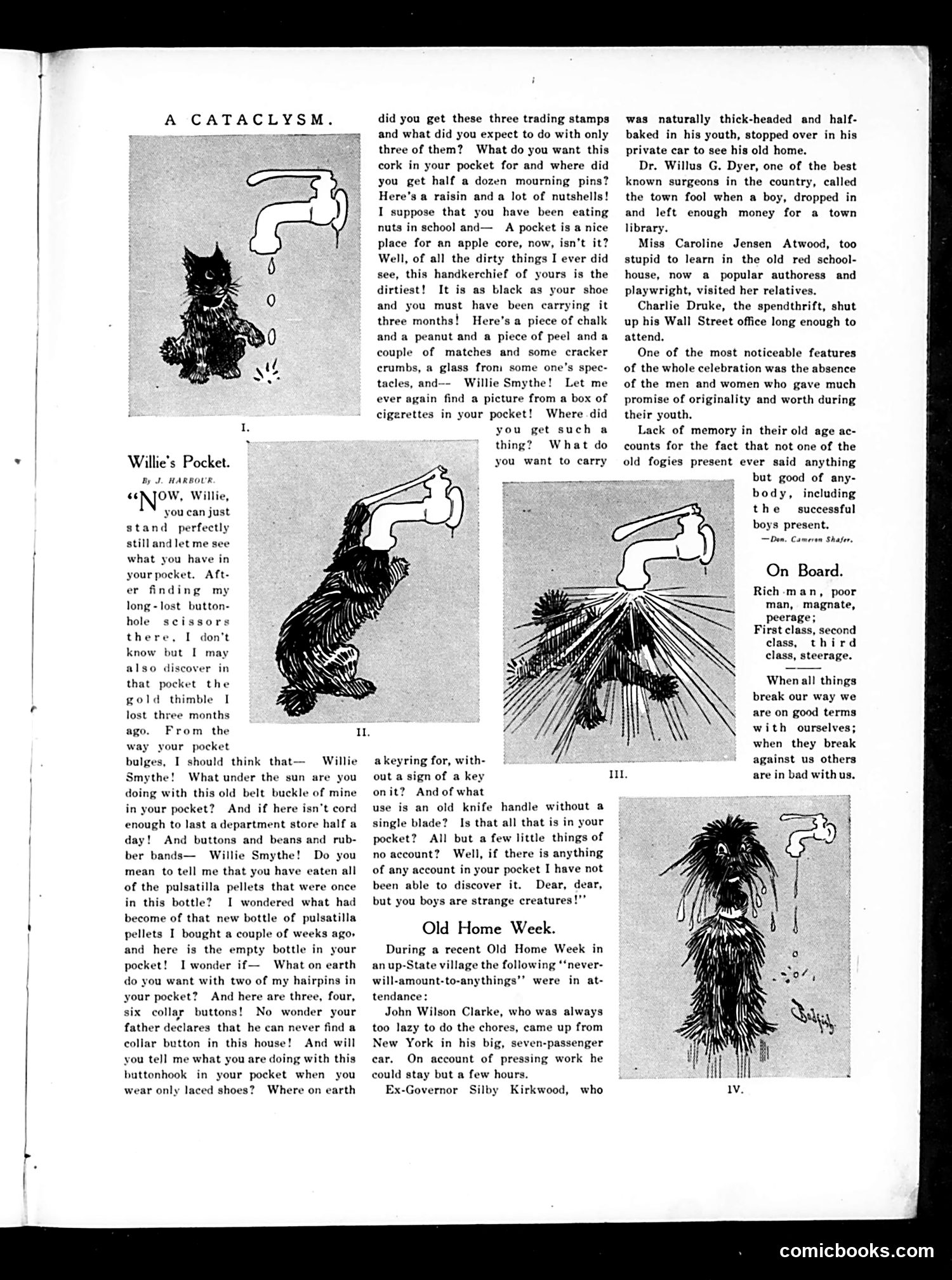
**"Willie's Pocket"** is a humorous domestic sketch depicting a mother discovering an absurdly cluttered boy's pocket. The joke relies on exaggerated contrast: she finds mundane junk (buttons, beans, used hairpins, a dirty handkerchief, apple cores, nutshells) alongside items she's been searching for (her scissors, thimble, pulsatilla pellets—a medicinal powder). The satire gently mocks both boys' chaos and mothers' exasperation. The accompanying illustrations show Willie's distress as his pocket is methodically emptied. **"Old Home Week"** presents social irony: the townspeople dismissed as failures in youth—"never-will-amount-to-anythings"—have become successful (doctor, governor, businesswoman). The joke critiques provincial small-town judgment and nostalgia. Those actually promising as youth are now absent from the reunion. The moral observation, credited to "Den. Cameron Shafer," notes that successful returnees generate only praise from old neighbors, while failures had been overlooked. Both pieces satirize American class mobility and small-town social dynamics typical of early 20th-century Judge magazine humor.
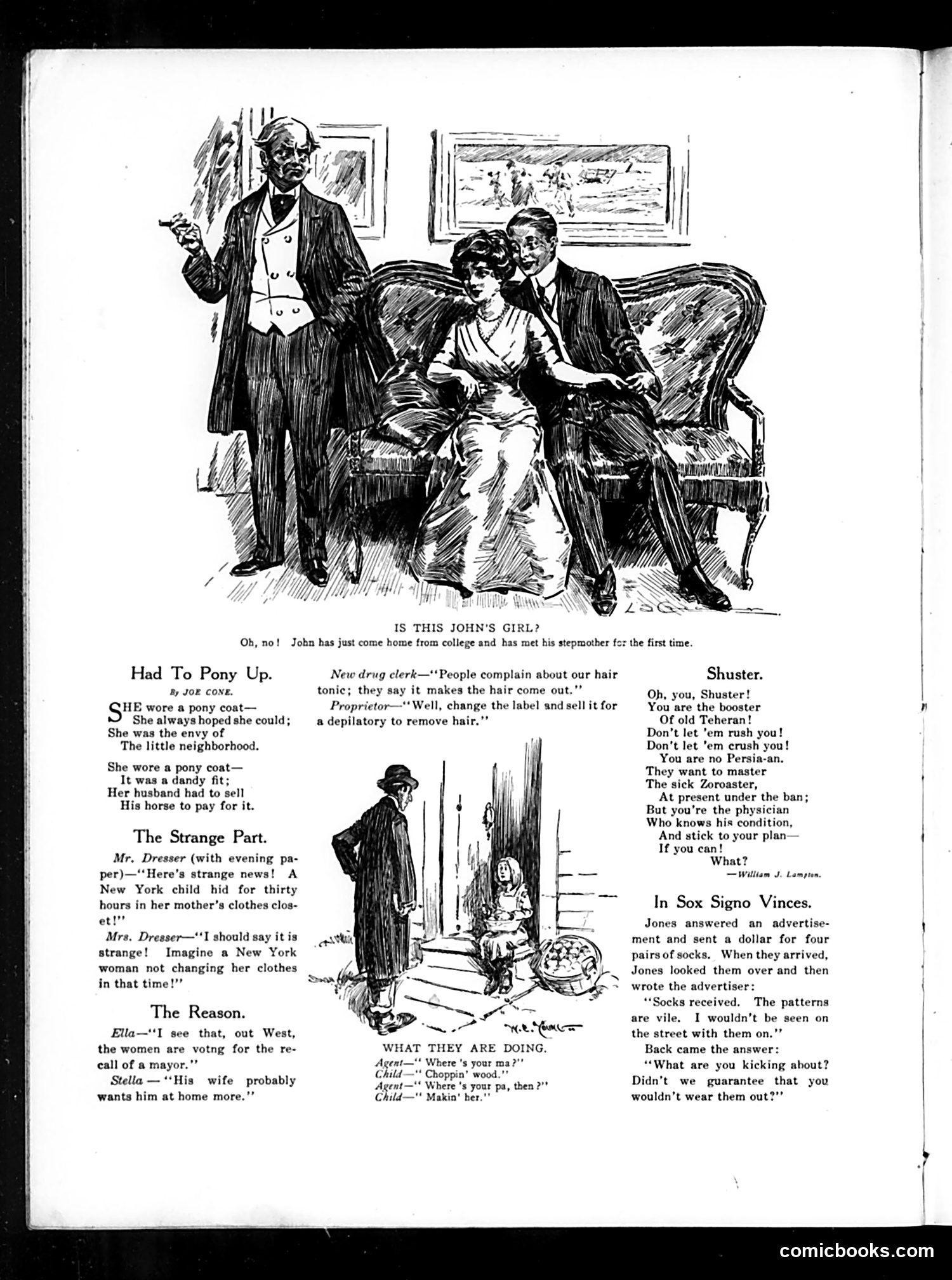
This page contains several short humorous pieces satirizing early 20th-century American life: **Top cartoon**: "Is This John's Girl?" jokes about a young man meeting his stepmother for the first time after college—playing on awkward family dynamics. **"Had To Pony Up"**: Satirizes consumerism and status-seeking among wives. A woman's desire for a fashionable "pony coat" forces her husband to sell his horse to afford it—the irony being she gets the coat named after the animal he must sacrifice. **Other brief jokes** mock: - Dishonest pharmacy practices (relabeling hair-removal tonic as hair tonic) - Women's fashion obsession (changing clothes constantly) - Women's newfound political activism (the western women's "recall" vote) - Mail-order fraud (deliberately sending worthless socks with a guarantee they won't wear out) The page reflects period anxieties about consumer culture, women's changing social roles, and emerging consumer protection issues—all presented through snappy, cynical humor typical of Judge's satirical style.
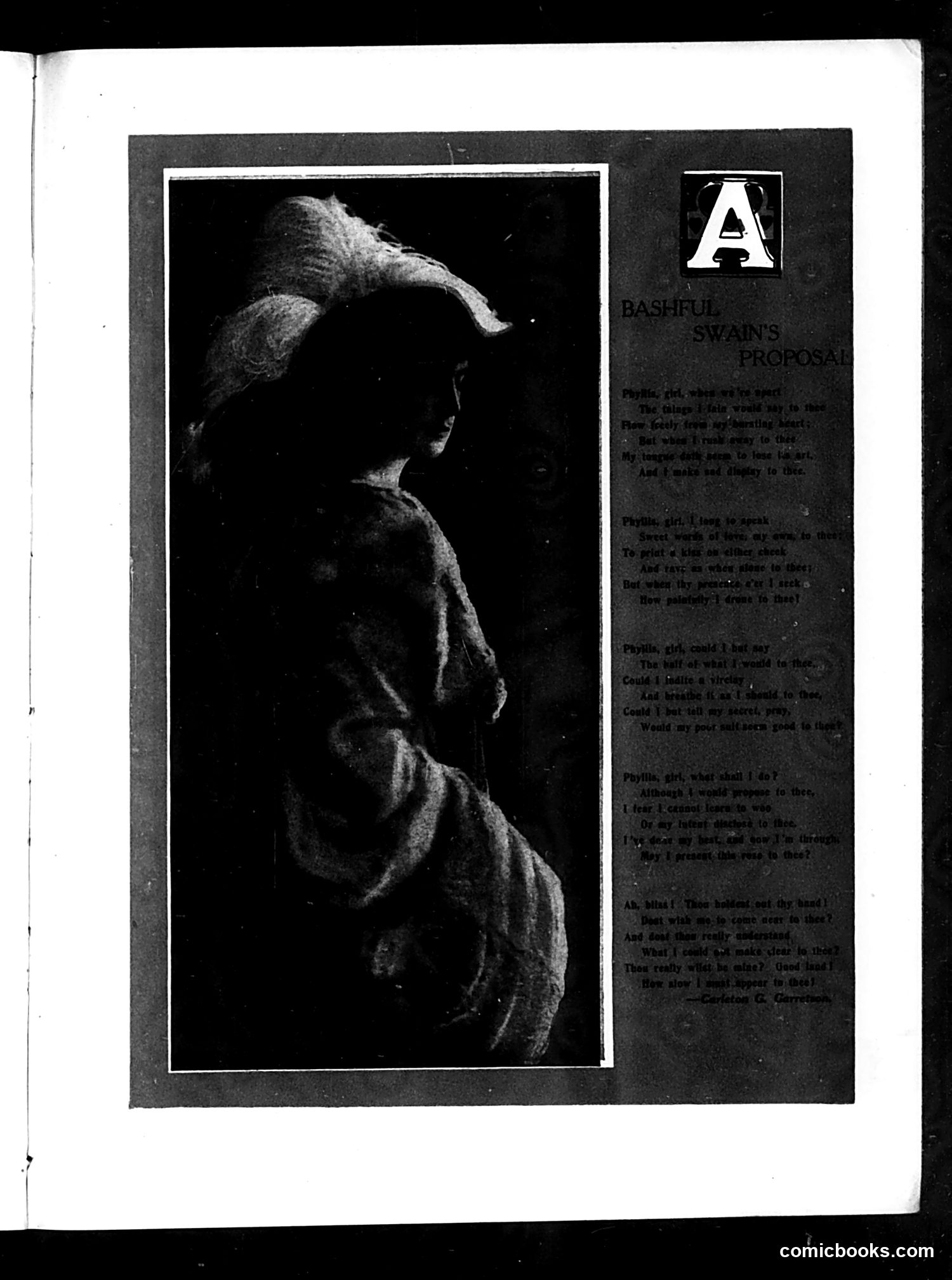
This appears to be a romantic/comedic sketch from Judge magazine featuring a young man attempting to propose marriage. The dramatic photograph shows a figure in profile, appearing nervous or hesitant. The accompanying text presents a dialogue where "Phyllis, girl" is being asked to marry by an anxious suitor. The humor derives from the man's stammering, indirect approach—he cannot directly propose but instead asks roundabout questions like "Could I build a villa?" and "Could I bet off my secret, pray?" before finally asking "What shall I do?" The satire targets the social awkwardness of courtship rituals of the era, mocking both masculine anxiety around marriage proposals and the elaborate, indirect communication expected in Victorian-era romance. The "bashful swain" (young lover) represents a familiar comedic type struggling with direct emotional expression.
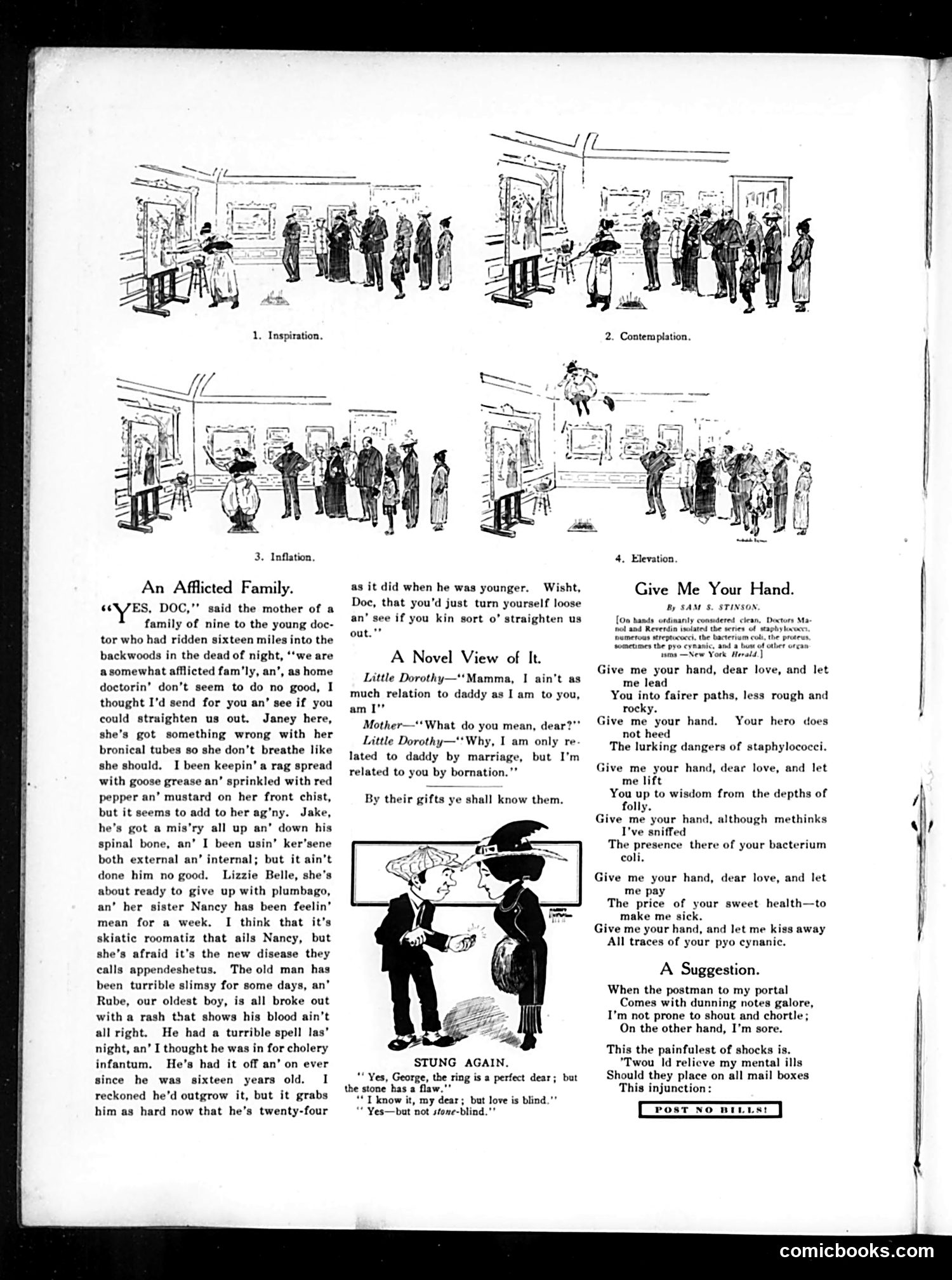
**The Cartoon Sequence (top):** Four panels labeled "Inspiration," "Contemplation," "Inflation," and "Elevation" depict an art gallery scene. They appear to satirize the pretentiousness of artistic appreciation—showing how viewers' reactions to art become progressively more exaggerated and artificial as they move through the gallery, suggesting people perform appreciation rather than genuinely experience it. **"An Afflicted Family":** A rural mother describes her family's various ailments to a doctor using folk remedies (goose grease, kerosene). The satire targets rural ignorance and ineffective home treatments, portraying backwoods medicine as comically misguided. **"Stung Again":** A husband gives his wife a flawed diamond ring. When she complains, he claims "love is blind"—she retorts that love shouldn't be "stone-blind," mocking his excuse. **"Give Me Your Hand":** A humorous poem romanticizing love while repeatedly referencing bacteria and disease (staphylococci, bacterium coli, pyo cynanic), likely satirizing the new germ theory's cultural penetration into everyday discourse.
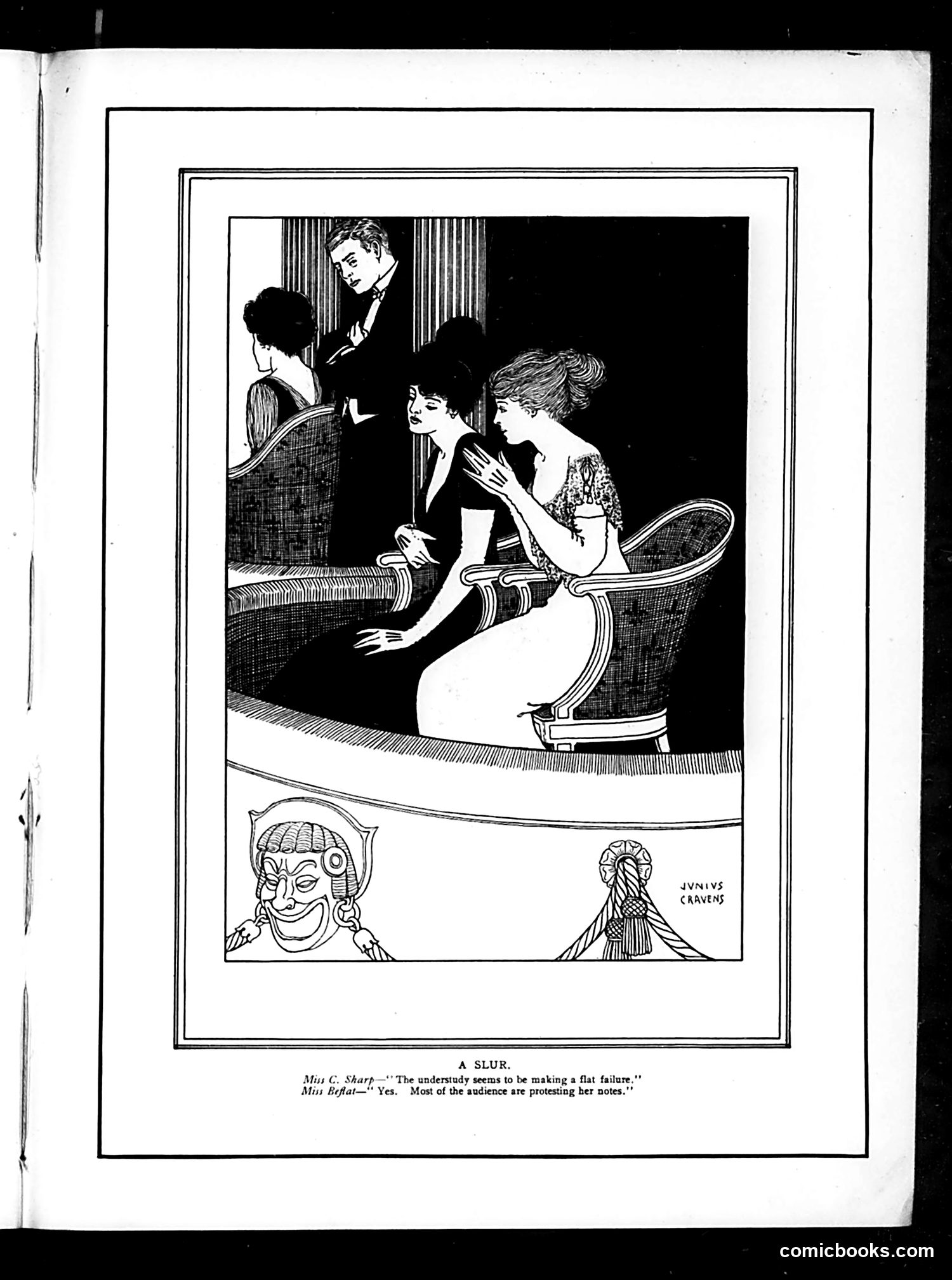
This theatrical satire depicts two women discussing an understudy's poor performance. The cartoon plays on musical terminology: "Miss C. Sharp" and "Miss Beflat" are puns on musical notes (C-sharp and B-flat), while the understudy is making a "flat failure" — she's singing poorly, hitting flat notes. The joke hinges on the double meaning of "protesting her notes" — the audience objects both to her musical performance and (implicitly) to her conduct or presence. The carved mask heads at bottom appear to be theatrical props, reinforcing the stage setting. This is light entertainment satire typical of Judge magazine's humor: wordplay about a contemporary theatrical world, with no deeper political meaning.
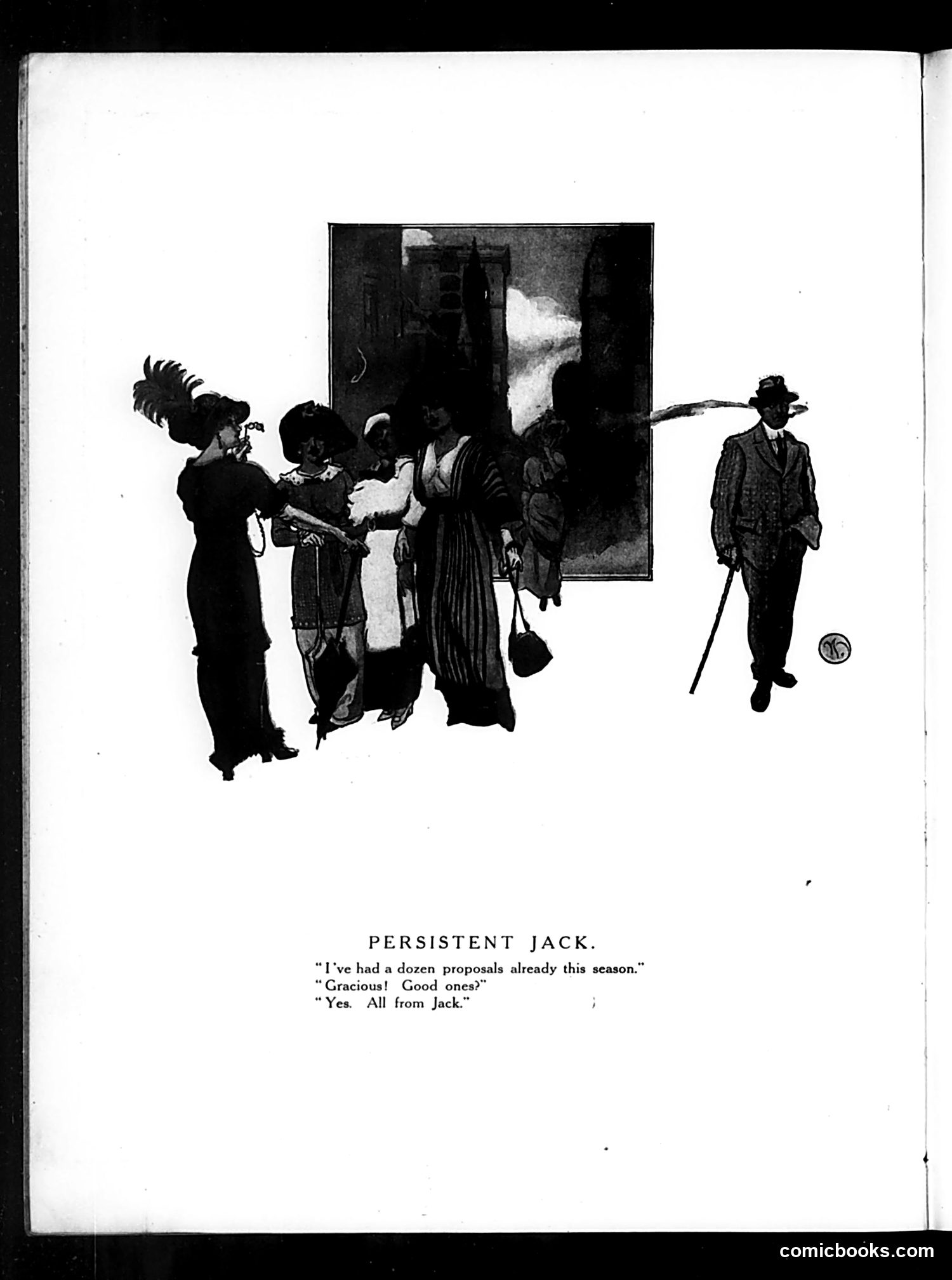
This cartoon satirizes a persistently unwanted suitor. A well-dressed man labeled "Jack" (right, with cane) repeatedly proposes to a woman, who is shown at an art gallery or similar social venue with fashionable companions. The joke's humor relies on the double meaning: when asked if her "proposals" are "good ones," the woman reveals they're all from the *same persistent man*, Jack—implying his proposals are not particularly desirable, merely numerous. The cartoon mocks both Jack's lack of social awareness (continuing to propose despite rejection) and potentially critiques courtship conventions where a gentleman's persistence was sometimes socially tolerated. The setting suggests upper-class social circles where such romantic pursuits occurred publicly.
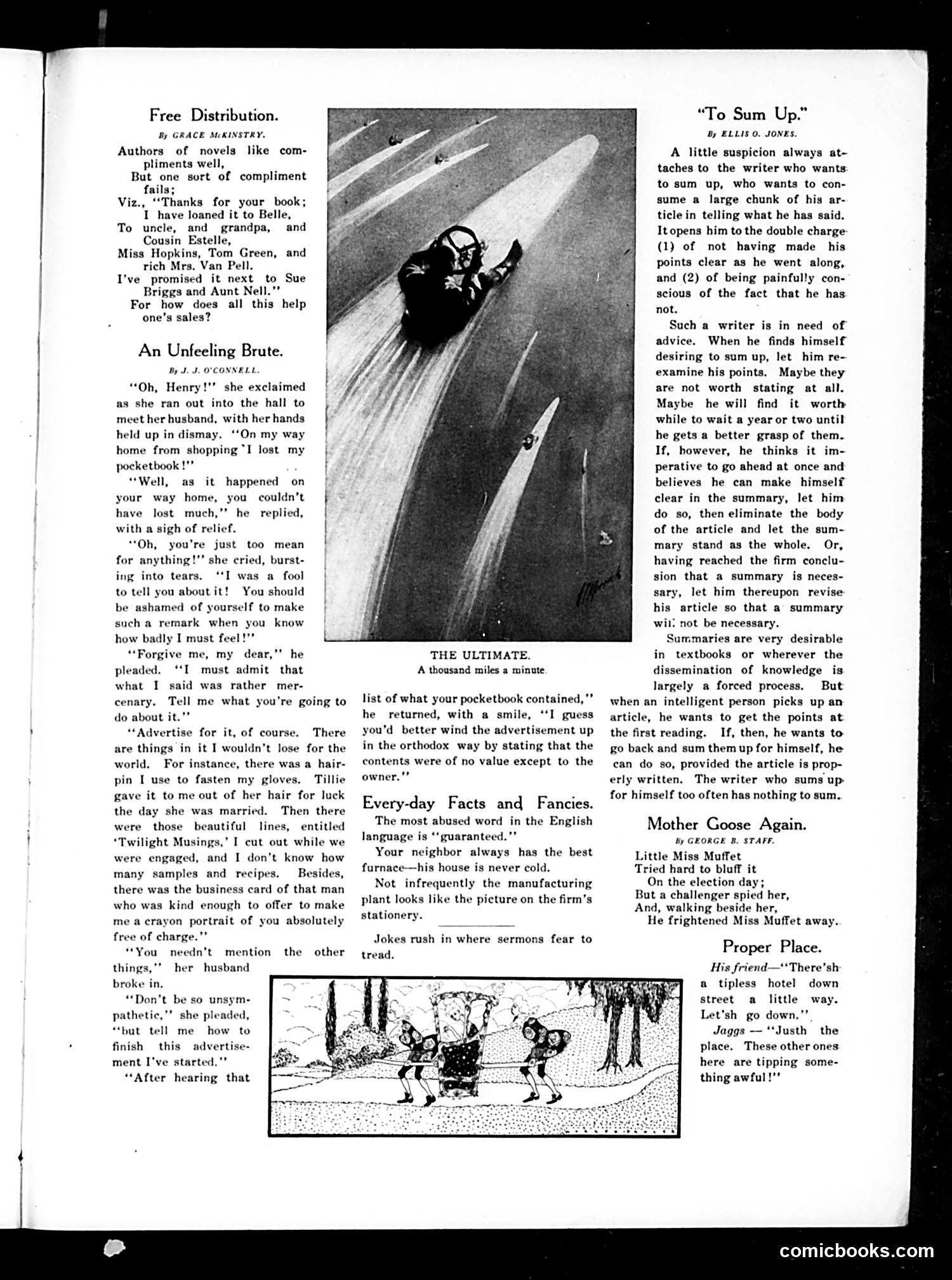
This page contains three satirical pieces typical of early-20th-century humor magazines: **"Free Distribution"** mocks authors' frustration when recipients of complimentary books claim they've lent copies to numerous people—implying the book helps everyone *but* sales. **"An Unfeeling Brute"** satirizes a husband's callous response to his wife losing her pocketbook. She lists sentimental items (a lucky hairpin from a friend's wedding, poetry clippings), and he sarcastically suggests she advertise it as worthless to the owner—a joke about her inflated emotional attachment to junk. **"Every-day Facts and Fancies"** offers brief observational humor, including that "guaranteed" is the most abused English word and that neighbors always brag their furnaces work best. The page also includes **"To Sum Up"** (editorial advice against unnecessary article summaries) and brief comic poetry titled **"Mother Goose Again."** The images show a person sledding and children playing—likely illustrating one of the humorous pieces, though the connection is unclear without fuller context.
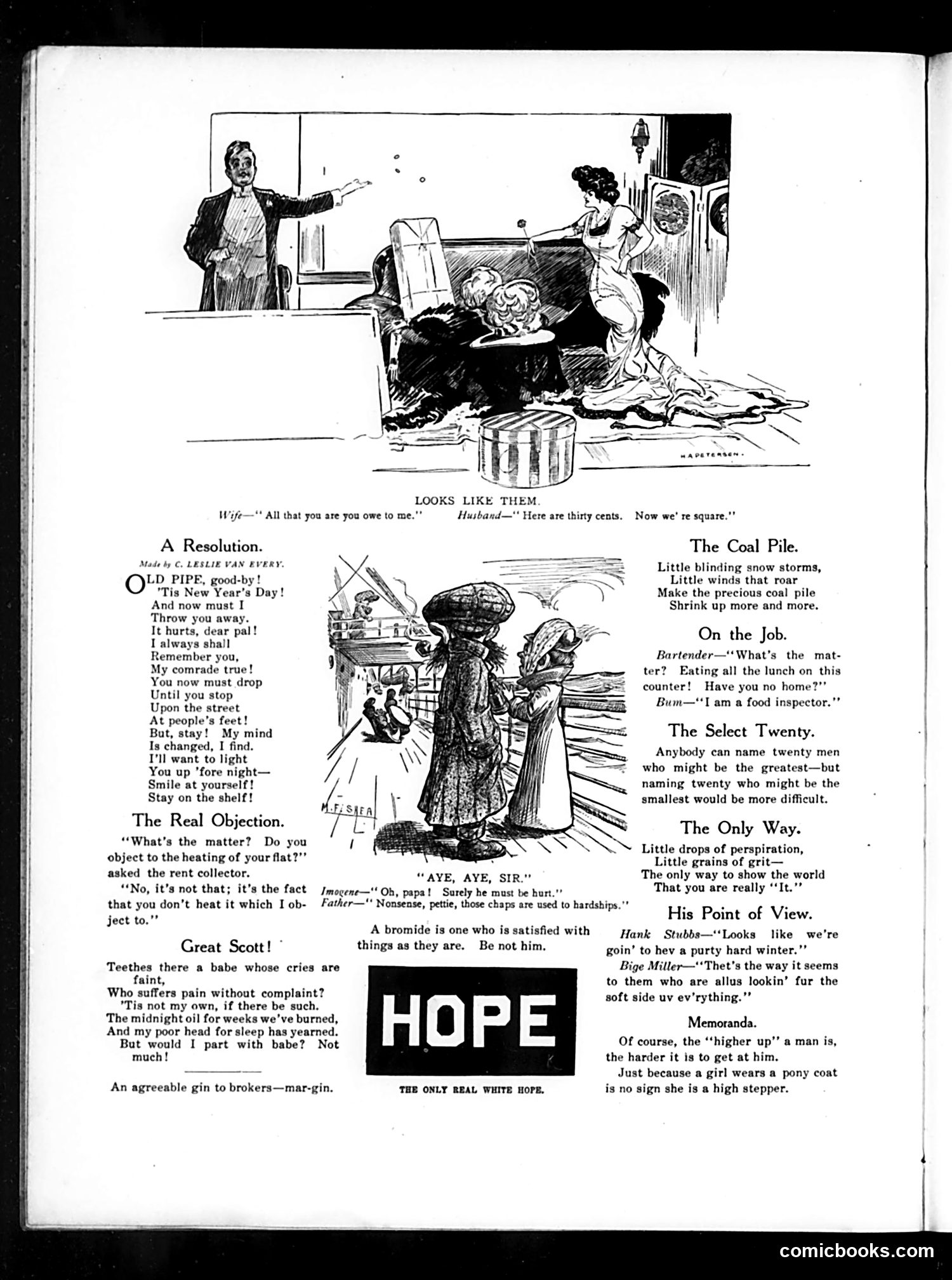
This is a **humor and satire page** from Judge magazine, featuring multiple short jokes and comic sketches typical of early 20th-century American satire. **Main cartoon (top):** A domestic dispute over marital finances. The wife demands payment ("all that you are you owe to me"), while the husband dismisses her with "thirty cents. Now we're square"—mocking both her financial dependence and his stinginess. **Key satirical content:** - **"A Resolution"**: Mocks New Year's resolutions as easily abandoned (a man vows to quit smoking but immediately changes his mind) - **"The Real Objection"**: Jokes about slumlords who charge rent but don't provide heat - **"Great Scott!"**: Celebrates fatherhood despite sleep deprivation - **"The Coal Pile"**: References winter fuel shortages (likely WWI-era rationing) - **"A bromide"**: Defines a "bromide" as someone satisfied with the status quo—a period term for a clichéd person The page satirizes working-class struggles (heating, food, coal) alongside domestic complaints and social commentary typical of Judge's readership.
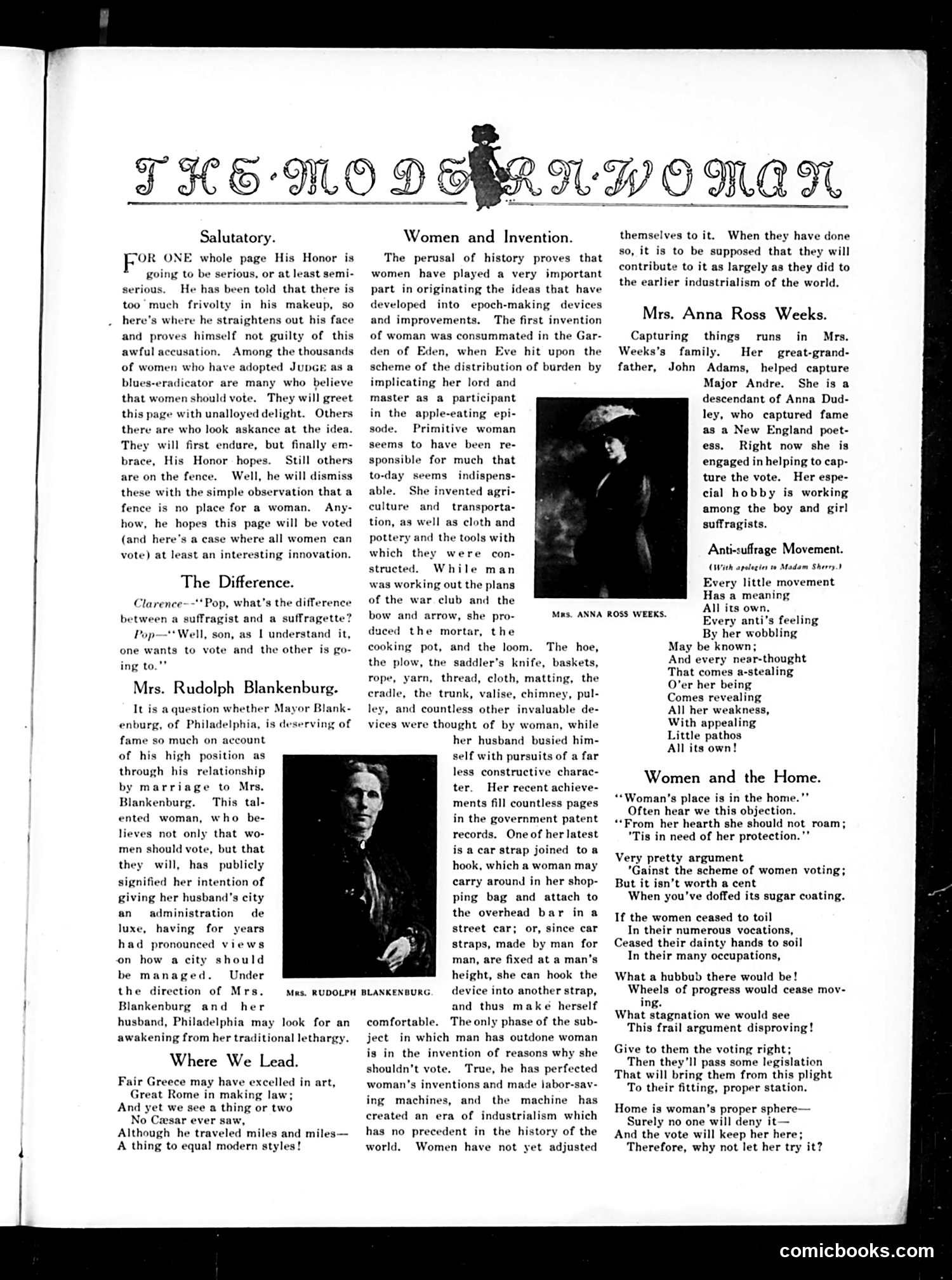
This page from Judge presents **pro-suffrage arguments** disguised as satire, likely from the early 1900s women's suffrage debate. **Key content:** The "Salutatory" mocks opponents by suggesting women shouldn't vote because "a fence is no place for a woman"—clearly absurd logic. The joke works backwards, supporting women's voting rights. **Mrs. Rudolph Blankenburg** (photograph shown) represents a real Philadelphia woman whose husband was mayor. The piece praises her administrative influence, suggesting women *already* govern effectively through their husbands—so why deny them direct voting power? **"Women and Invention"** argues women invented agriculture, cooking tools, and textiles while men pursued warfare. A final jab: men's only superior invention is "reasons why she shouldn't vote"—explicitly mocking anti-suffrage arguments. The page uses humor to normalize women's suffrage by presenting opposition as obviously ridiculous, while celebrating women's actual historical contributions and contemporary capability.
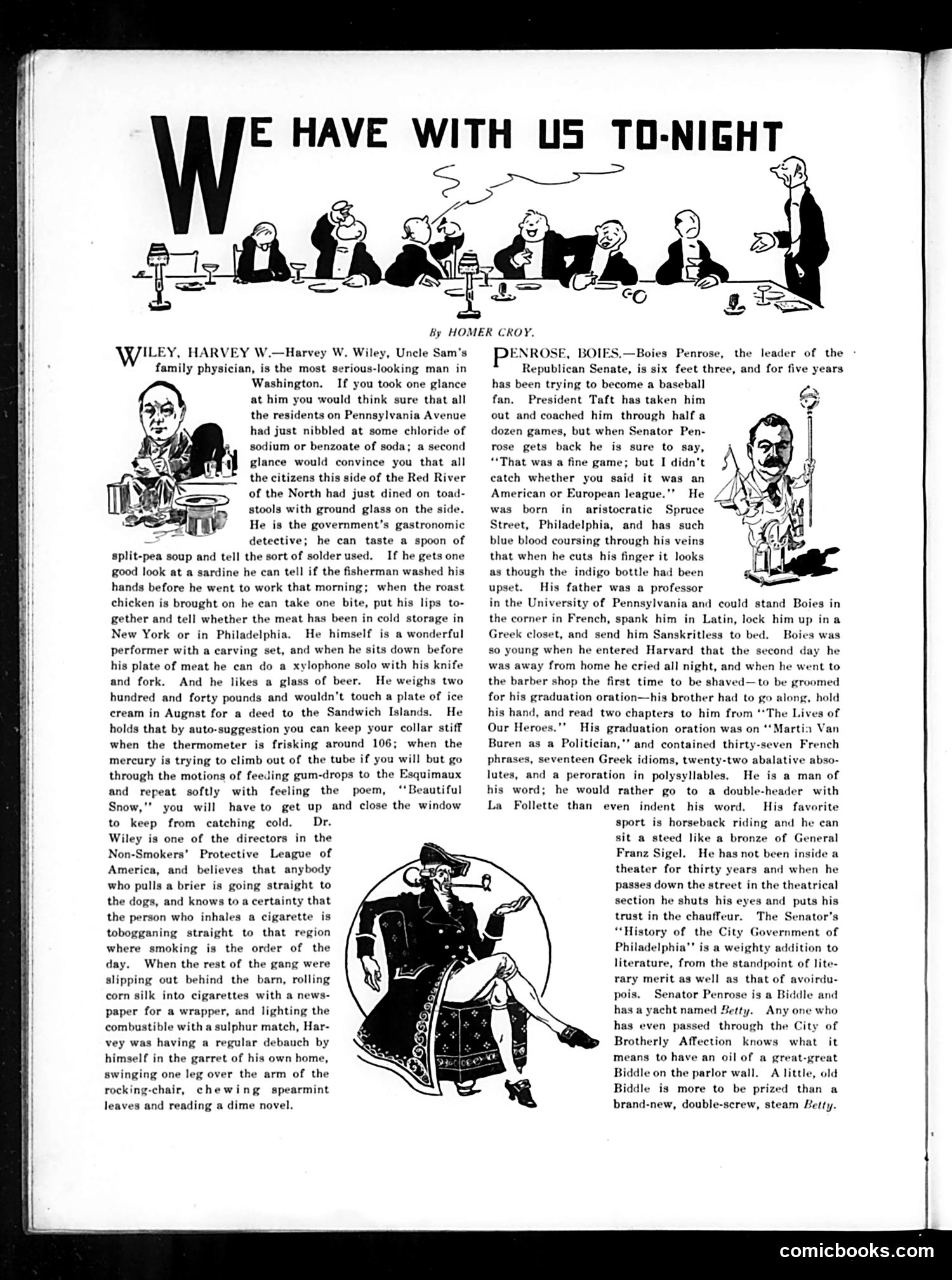
This Judge magazine page satirizes two prominent political figures through mock biographical sketches: **Harvey W. Wiley** (left caricature): Uncle Sam's "family physician" and head of food safety. The satire mocks his obsessive focus on food purity—he can allegedly detect solder in soup or determine a chicken's storage location by taste. He's portrayed as a humorless health crusader who advocates auto-suggestion for heat relief and leads the Non-Smokers' Protective League, yet hypocritically indulged in solitary vices (chewing gum, reading dime novels) as a youth. **Boies Penrose** (right caricature): Republican Senate leader described as intellectually pretentious but culturally obtuse. Despite his aristocratic Philadelphia pedigree and Harvard education, he cannot grasp basic baseball rules after President Taft's coaching. His graduation oration supposedly overloaded with French and Greek phrases exemplifies empty verbosity. Both sketches ridicule progressive-era reformers and Republican politicians as either sanctimonious busybodies or pompous incompetents.
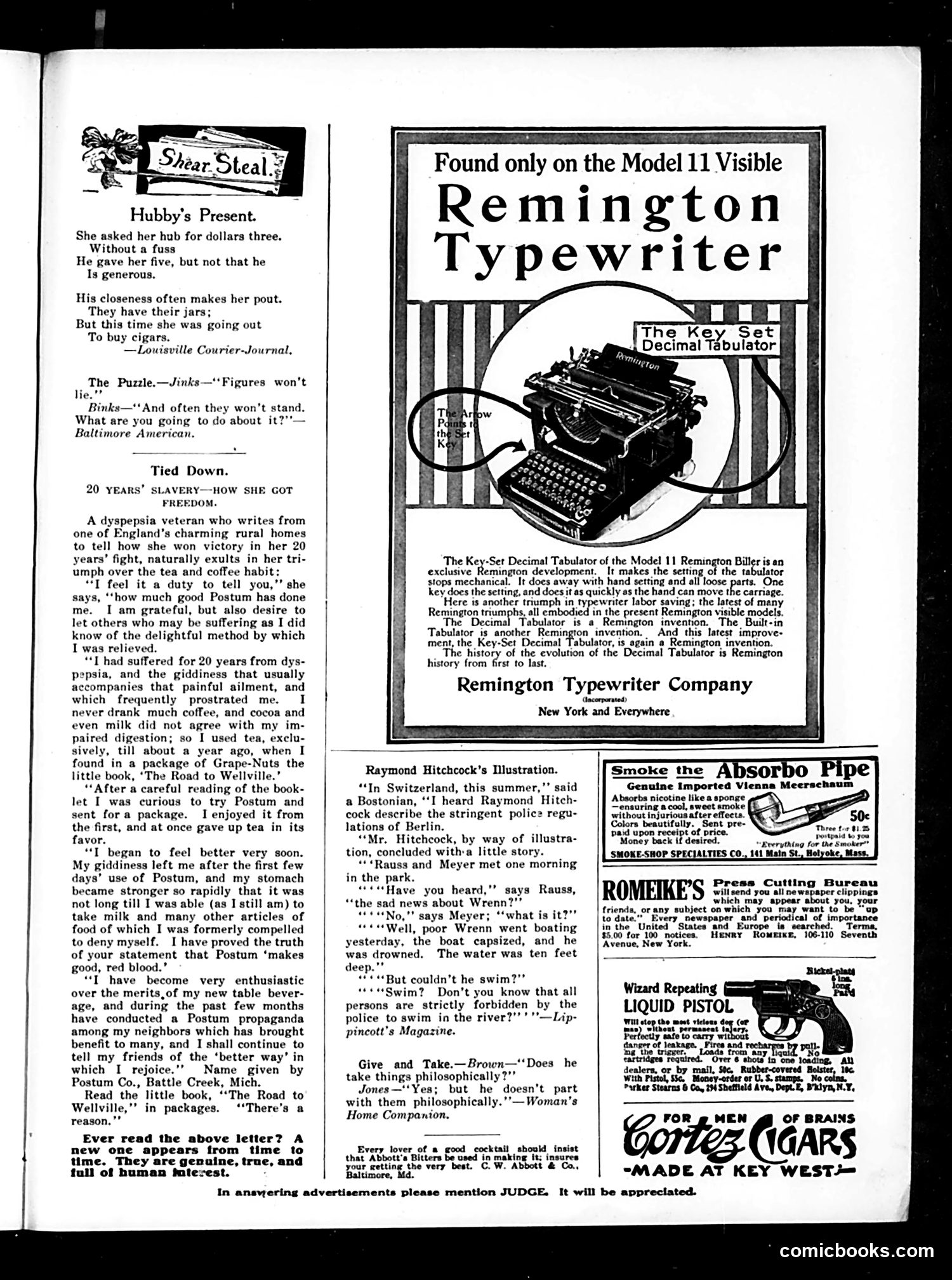
This page mixes short humorous items with advertisements. The three jokes address domestic and social topics typical of early 20th-century satire: **"Hubby's Present"** satirizes marital stinginess—a husband gives his wife five dollars instead of the three she requested, yet this miserly act is presented as generosity because he usually refuses her money. **"The Puzzle"** is a brief wordplay joke about statistics being unreliable. **"Tied Down"** is primarily a Postum (cereal coffee substitute) advertisement disguised as testimonial. An English woman claims 20 years of dyspepsia and digestive suffering ended after switching from tea and coffee to Postum. This represents health-claim marketing common to the era, targeting women's wellness concerns. The remaining content includes Remington Typewriter advertising and other product promotions. The page is primarily commercial, using humor and celebrity endorsements (Raymond Hitchcock illustration) to drive sales rather than offering political satire.
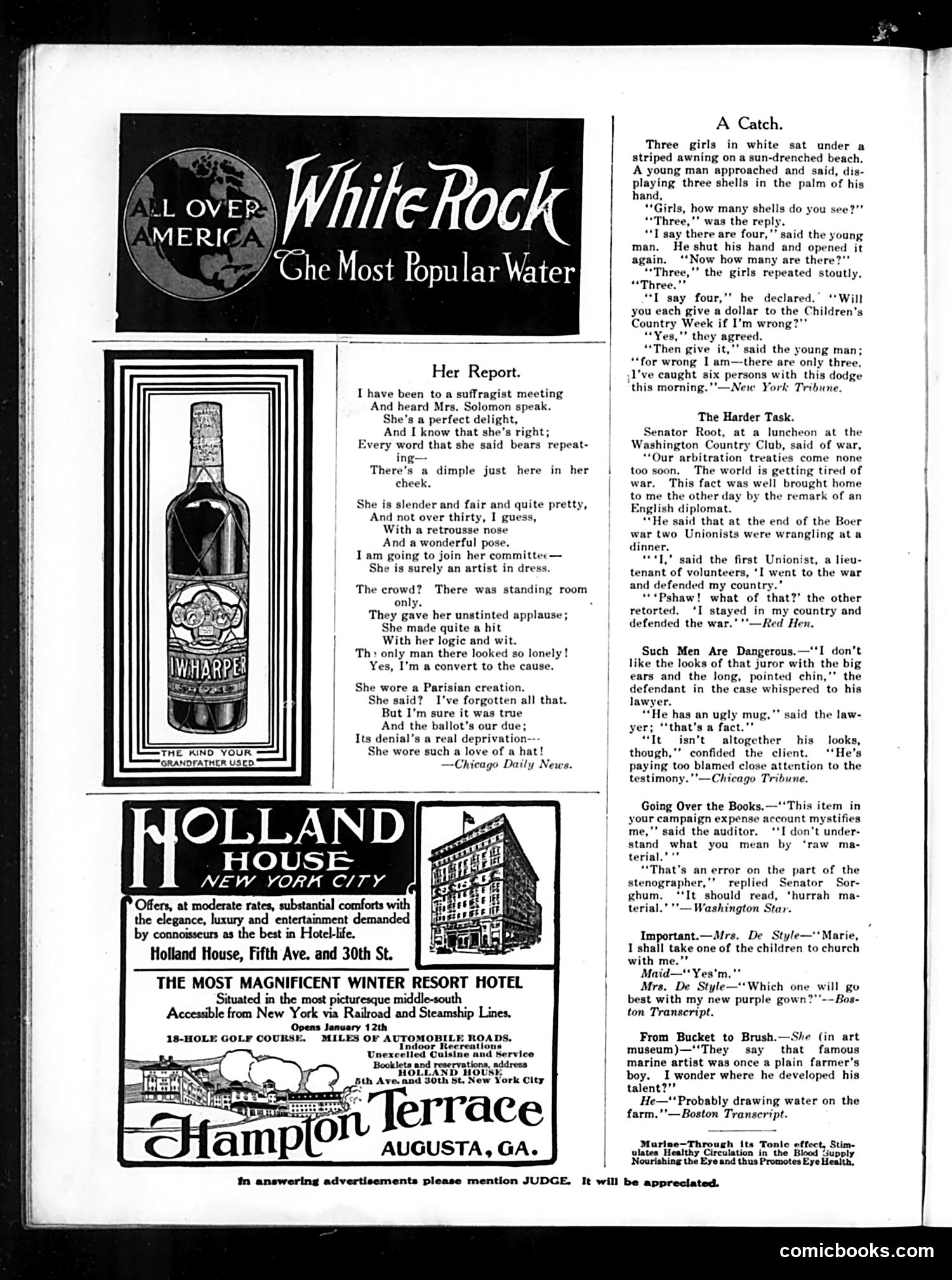
This page from *Judge* contains several satirical pieces targeting early 20th-century social attitudes: **"Her Report"** mocks suffragists and male supporters. A man attends a suffrage meeting but admits he's converted not by the speaker's arguments about voting rights, but by her physical appearance—her dimple, dress, and "Parisian creation." The satire suggests male suffrage supporters were motivated by attraction rather than principle, undermining the movement's credibility. **"A Catch"** presents a con artist exploiting women's gullibility. The young man uses a shell-counting trick to win money from three naive girls, successfully repeating the scam on six other victims. The humor targets women as easily duped. Both pieces reflect common *Judge* editorial positions: skepticism toward women's political engagement and reinforcement of stereotypes portraying women as intellectually inferior, vain, and foolish—common anti-suffrage propaganda of the era. The advertisements for luxury hotels and resorts occupy the remaining space.
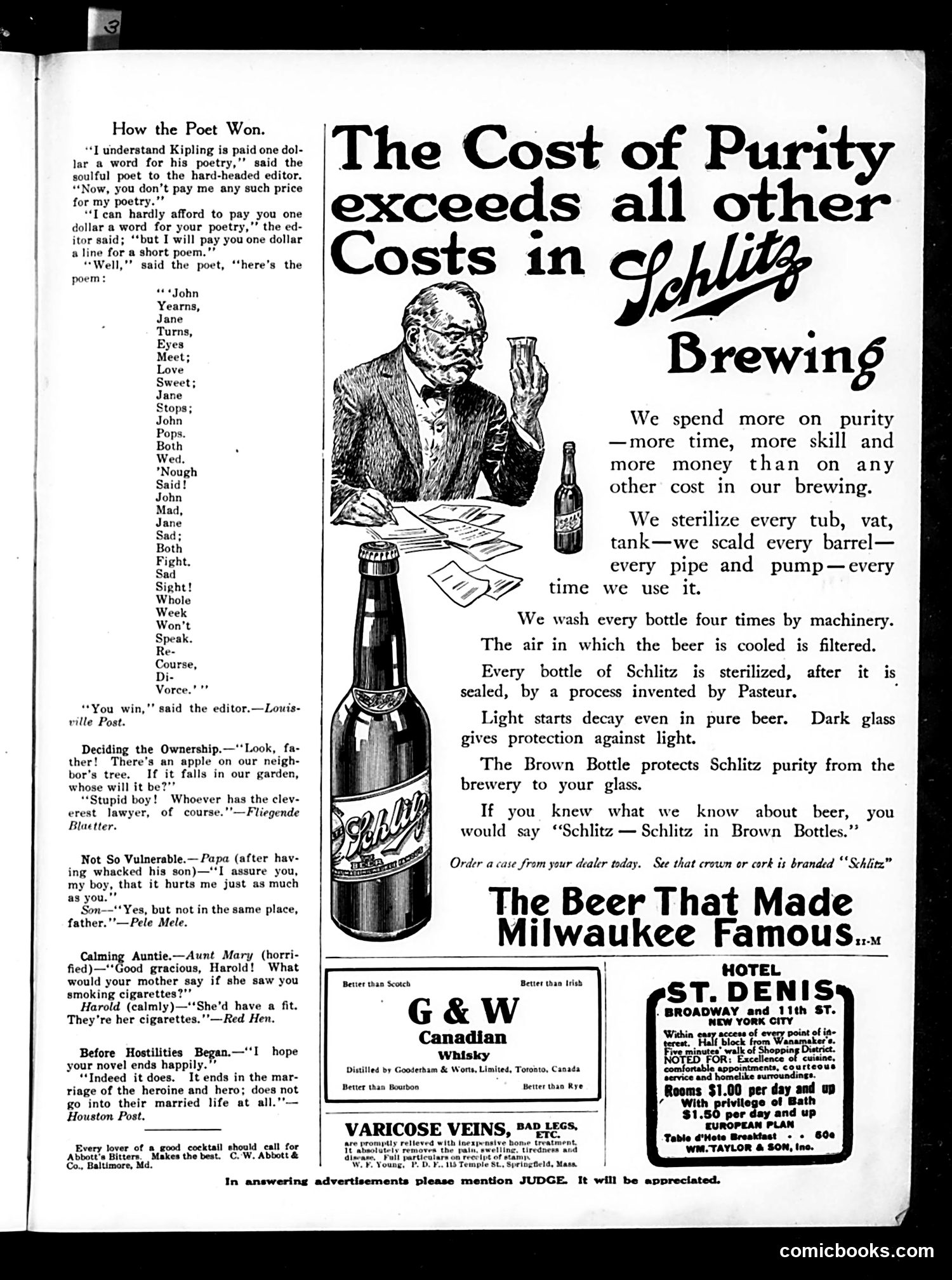
This page contains several humor pieces and advertisements typical of early 20th-century American satirical magazines. **The Humor Sections:** The left column features brief jokes poking fun at literary pretension, property disputes, parental discipline, and marriage. The "How the Poet Won" piece satirizes Rudyard Kipling's high pay rates by having a struggling poet submit absurdly minimalist verse (single words per line) to earn his dollar-per-line rate from an editor—the joke being the poet's work is so bad it's nearly worthless even at reduced rates. **Advertisements:** The page is dominated by period advertisements for Schlitz beer (emphasizing purity and sterilization), G&W Canadian Whisky, the Hotel St. Denis in New York, and a varicose vein treatment. The Schlitz ad is notably lengthy, using pseudo-scientific claims about pasteurization and brown bottles to market the product—typical early advertising rhetoric before modern consumer protection laws. The page reflects early 1900s attitudes: literary snobbery, legal cynicism, and aggressive patent-medicine marketing alongside mainstream beer and spirits advertising.
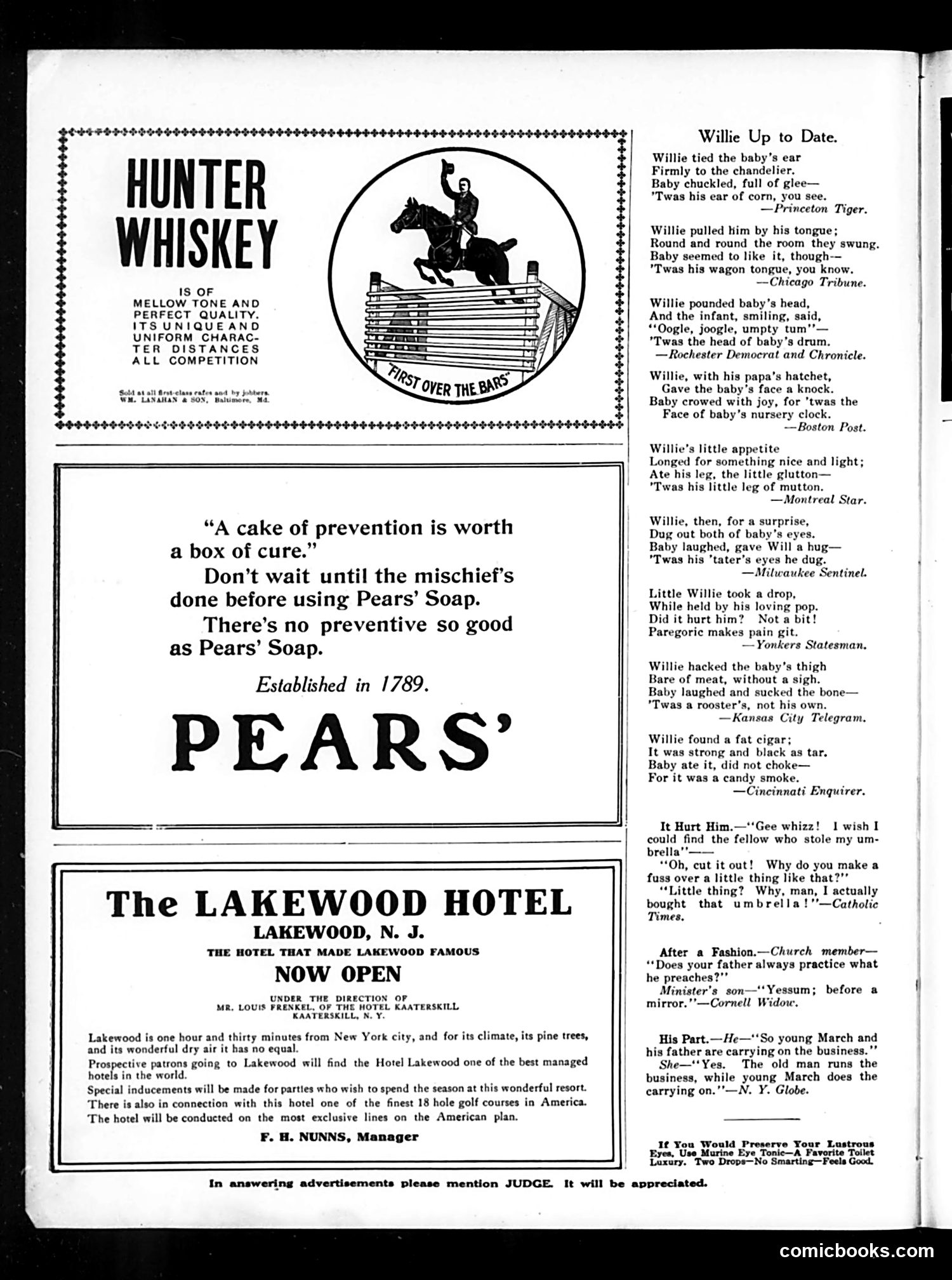
This page is primarily **advertising with a humorous sidebar feature**. The main content is ads for Hunter Whiskey, Pears' Soap, and the Lakewood Hotel. The notable editorial content is **"Willie Up to Date,"** a comic series from various newspapers featuring dark humor about a mischievous child named Willie who performs dangerous acts on a baby—tying its ear to a chandelier, pulling its tongue, pounding its head, etc. The joke's structure: each apparent act of violence is revealed as harmless because the "victim" is actually an inanimate object (a corn ear, wagon tongue, drum, clock face, mutton leg, etc.). This reflects **turn-of-the-century American humor** that found comedy in describing child endangerment—a sensibility completely alien to modern audiences. The humor relies on the reader's relief that no actual harm occurred, though the repeated scenarios of a child abusing an infant are darkly comic by contemporary standards. The feature republishes submissions from competing newspapers, suggesting this type of joke was widely syndicated.
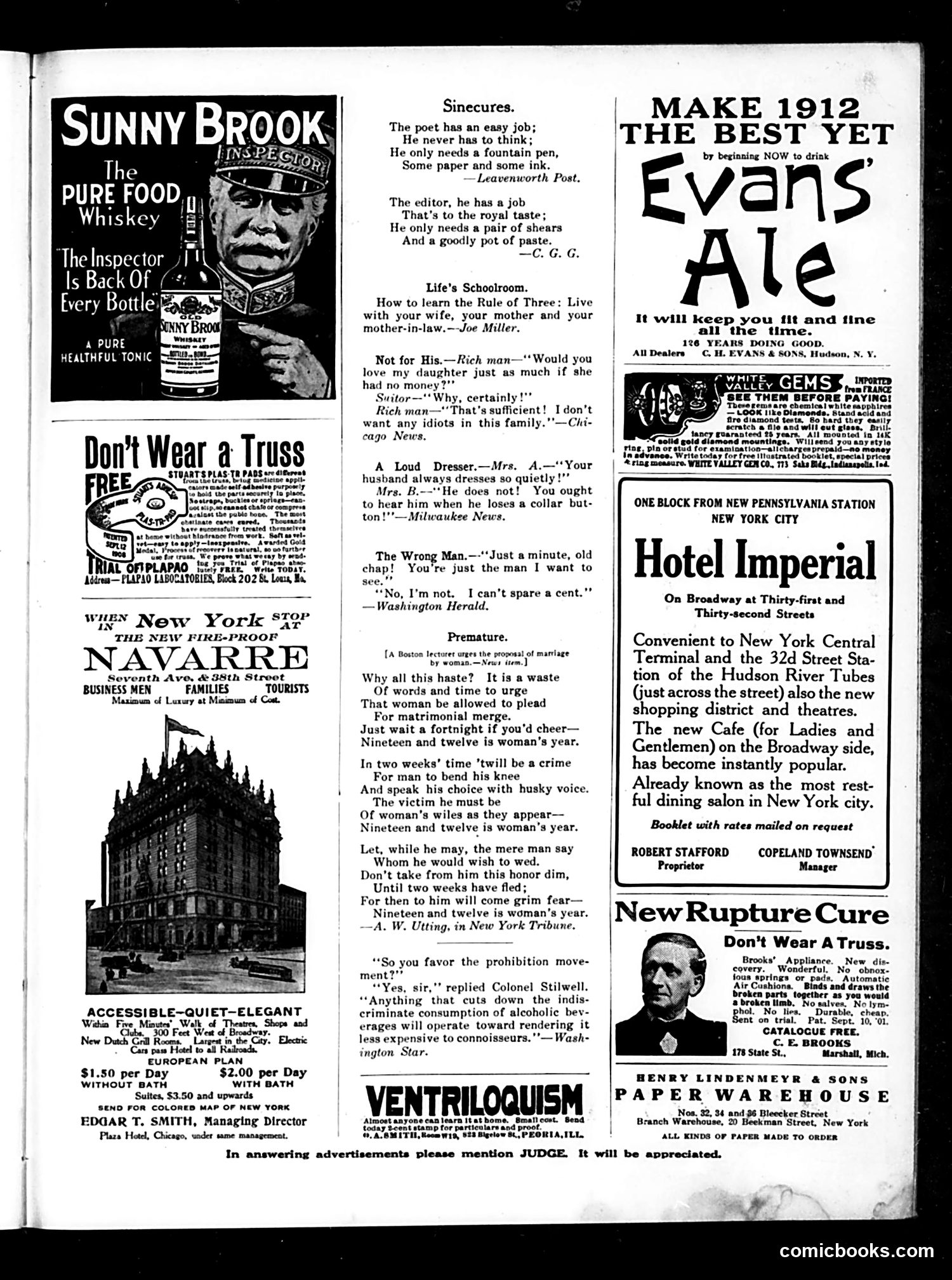
This page is **primarily advertisements and humorous filler content**, not political cartoons. The notable humor piece is "Premature," a poem satirizing the emerging women's suffrage movement. The 1912 date is significant—this predates women gaining the right to vote nationally by 8 years. The poem sardonically warns that "1912 is woman's year," suggesting that within two weeks, women will seize the power to propose marriage to men, inverting traditional gender roles. The joke mocks both the idea of female empowerment and middle-class anxieties about changing social roles. The other jokes are standard domestic humor: mismatched marriages, marital discord over clothing, and courtship dynamics. These reflect early 20th-century attitudes about gender relations. The advertisements promote whiskey, hotels, and various remedies (notably "truss" devices and "rupture cure" products), reflecting 1912 commercial culture and patent medicine prevalence.
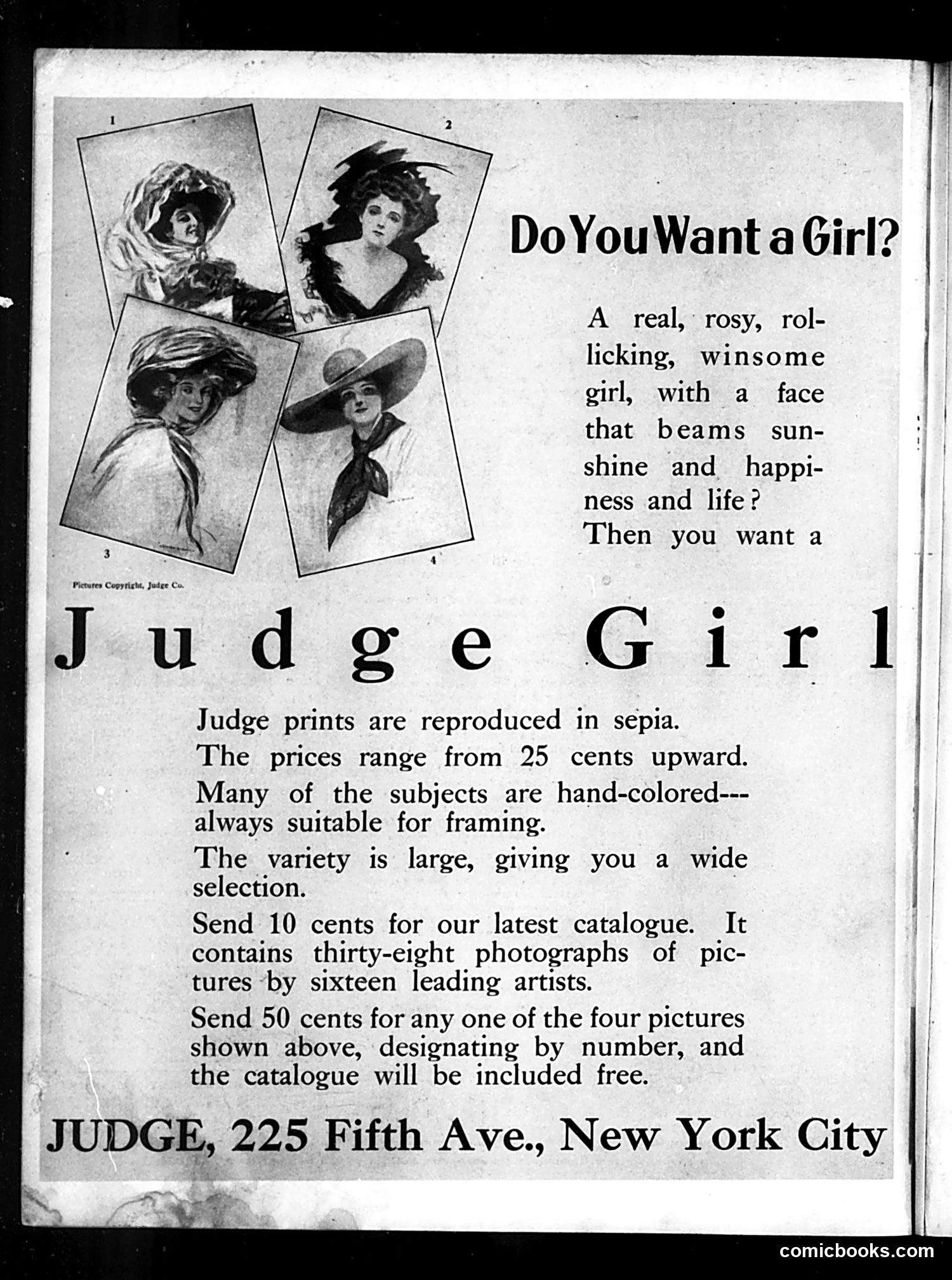
This is primarily an **advertisement**, not satire. Judge magazine is selling illustrated prints of attractive young women—marketed as "Judge Girls"—through mail order. The four numbered photographs show stylized female portraits in various fashionable hats and poses, representing the "types" available. The accompanying text uses romantic language ("rosy, rollicking, winsome") to appeal to male customers, suggesting these prints were decorative items for homes or offices. The ad offers catalogs and individual prints (25 cents to 50 cents), with some hand-colored options. This reflects early-1900s popular culture where illustrated "pin-up" style portraits of attractive women were common commercial products sold through magazines. The framing suggestion indicates these were meant as wall decoration. The appeal is straightforward commercial marketing rather than satirical commentary.