
Judge, 1912-01-06 · page 17 of 24
Judge — January 6, 1912 — page 17: what you’re looking at
What you’re looking at
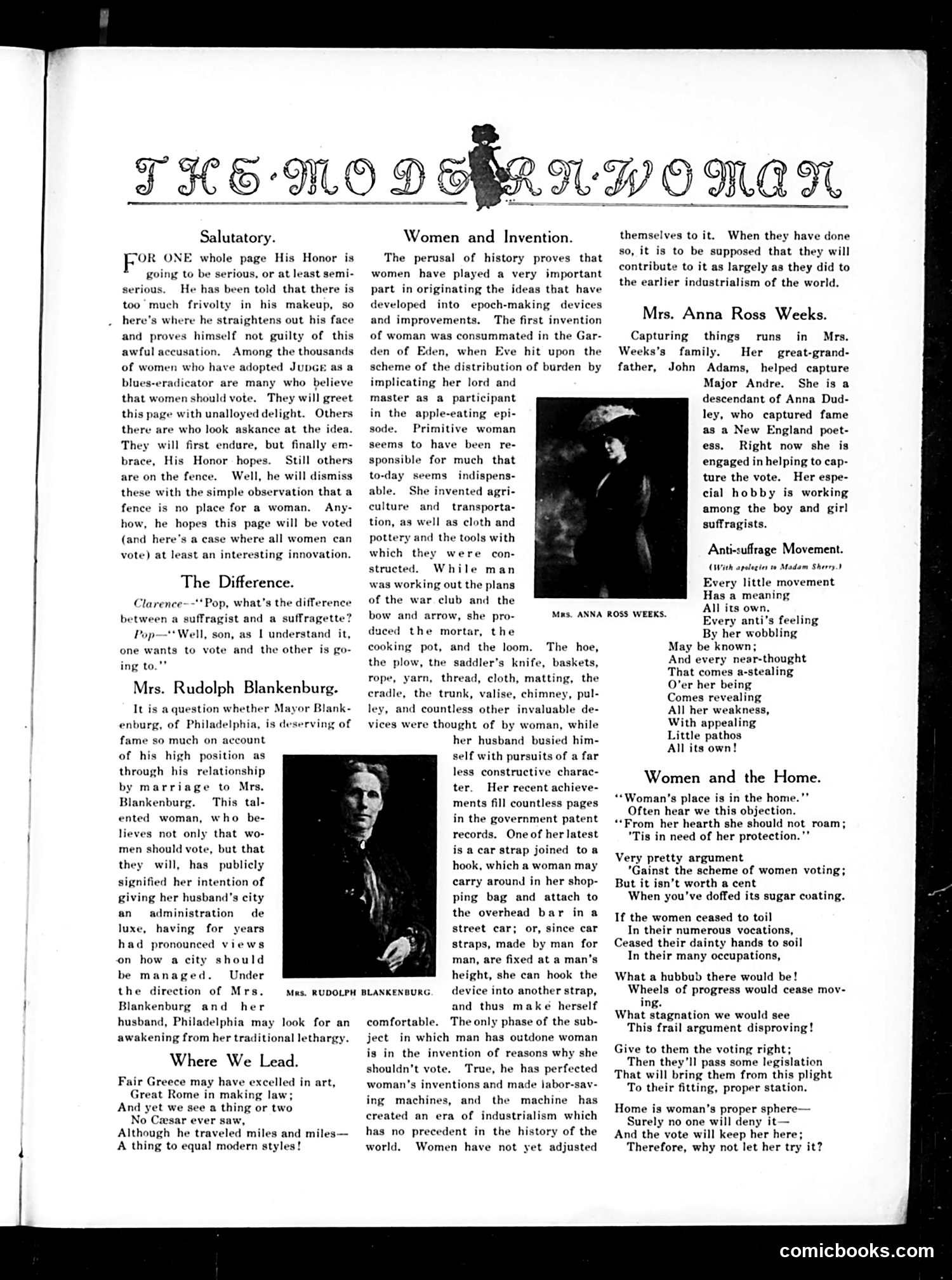
This page from Judge presents **pro-suffrage arguments** disguised as satire, likely from the early 1900s women's suffrage debate. **Key content:** The "Salutatory" mocks opponents by suggesting women shouldn't vote because "a fence is no place for a woman"—clearly absurd logic. The joke works backwards, supporting women's voting rights. **Mrs. Rudolph Blankenburg** (photograph shown) represents a real Philadelphia woman whose husband was mayor. The piece praises her administrative influence, suggesting women *already* govern effectively through their husbands—so why deny them direct voting power? **"Women and Invention"** argues women invented agriculture, cooking tools, and textiles while men pursued warfare. A final jab: men's only superior invention is "reasons why she shouldn't vote"—explicitly mocking anti-suffrage arguments. The page uses humor to normalize women's suffrage by presenting opposition as obviously ridiculous, while celebrating women's actual historical contributions and contemporary capability.
📄 Transcribed text from this page (OCR, searchable)
Machine-transcribed from the original scan — historical spelling and the odd misread are preserved.
Salutatory. ‘OR ONE whole page His Honor is going to be serious, or at least semi- serious. He has been told that there is too much frivolty in his makeup, so here’s where he straightens out his face and proves himself not guilty of this Among the thousands a awful accusation. of women who have adopted JupcE blues-eradicator are many who be that women should vote. They will greet this page with unalloyed delight. Others there are who look askance at the idea. They will first endure, but finally em- brace, His Honor hopes. Still others are on the fence. Well, he will dismiss these with the simple observation that a Any- eve fence is no place for a woman. how, he hopes this page will be voted (and here's ac where all women can vote) at least an interesting innovation. The Difference. Clarence--'* Pop, what's the difference between a suffragist and a suffragette? ’op—* Well, son, as | understand it, one wants to vote and the other is go- ing to." Mrs. Rudolph Blankenburg. It is a question whether Mayor Blank- enburg, of Philadelphia, is deserving of fame so much on account of his high position as through his relationship by marriage to Mrs. Blankenburg. This _tal- ented woman, who be- lieves not only that wo- men should vote, but that they has publicly will, signified her intention of. giving her husband's city an administration de luxe, having for years had pronounced views on how a city should be managed. Under the direction of Mrs. Blankenburg and her husband, Philadelphia may look for an awakening from her traditional lethargy. Where We Lead. Fair Greece may have excelled in art, Great Rome in making law; And yet we see a thing or two No Ceesar ever saw, Although he traveled miles and miles— A thing to equal modern styles! Mrs, RUDOLPH BLANKENBURG Women and Invention. The perusal of history proves that women have played a very important part in originating the ideas that have developed into epoch-making devices and improvements. The first invention of woman was consummated in the Gar- den of Eden, when Eve hit upon the scheme of the distribution of burden by implicating her lord and master as a participant in the apple-eating epi- sode. Primitive woman seems to have been re- sponsible for much that to-day seems indispens- able. She invented agri- culture and transporta- tion, as well as cloth and pottery and the tools with which they were con- structed. While man was working out the plans of the war club and the bow and arrow, she pro- duced the mortar, the cooking pot, and the loom. The hoe, the plow, the saddler’s knife, baskets, rope, yarn, thread, cloth, matting, the ile, the trunk, valise, chimney, pul- ley, and countless other invaluable de- vices were thought of by woman, while her husband busied him- self with pursuits of a far less constructive charac- ter. Her recent achieve- ments fill countless pages in the government patent records. One of her latest is a car strap joined toa hook, which a woman may carry around in her shop- ping bag and attach to the overhead bar in a street car; or, since car straps, made by man for man, are fixed at a man’s height, she can hook the device into another strap, and thus make herself comfortable. The only phase of the sub- ject in which man has outdone woman is in the invention of reasons why she True, he has perfected woman's inventions and made labor-sav- ing machines, and the machine has created an era of industrialism which has no precedent in the history of the Women have not yet adjusted shouldn't vote. world. Mrs. ANNA ROSS WEEKS. HA OMAN themselves to it. When they have done so, it is to be supposed that they will contribute to it as largely as they did to the earlier industrialism of the world. Mrs. Anna Ross Weeks. Capturing things runs in Mrs. Weeks’s family. Her great-grand- father, John Adams, helped capture Major Andre. She is a descendant of Anna Dud- ley, who captured fame as a New England poet- ess. Right now she is engaged in helping to cap- ture the vote. Her espe- cial hobby is working among the boy and girl suffragists. Anti-suffrage Movement. (With apelegion te Madam Sherry) Every little movement Has a meaning All its own, Every anti’s feeling By her wobbling May be known; And every near-thought That comes a-stealing O’er her being Comes revealing All her weakness, With appealing Little pathos All its own! Women and the Home. **Woman’s place is in the home. Often hear we this objection. “From her hearth she should not roam; 'Tis in need of her protection. Very pretty argument 'Gainst the scheme of women voting; But it isn’t worth a cent When you've doffed its sugar coating. If the women ceased to toil In their numerous vocations, Ceased their dainty hands to soil In their many occupations, What a hubbub there would be! Wheels of progress would cease mov- ing. What stagnation we would see This frail argument disproving! Give to them the voting right; Then they'll pass some legislation That will bring them from this plight To their fitting, proper station, Home is woman’s proper sphere— Surely no one will deny it— And the vote will keep her here; Therefore, why not let her try it? comicbooks.com