
Judge, 1912-01-06 · page 9 of 24
Judge — January 6, 1912 — page 9: what you’re looking at
What you’re looking at
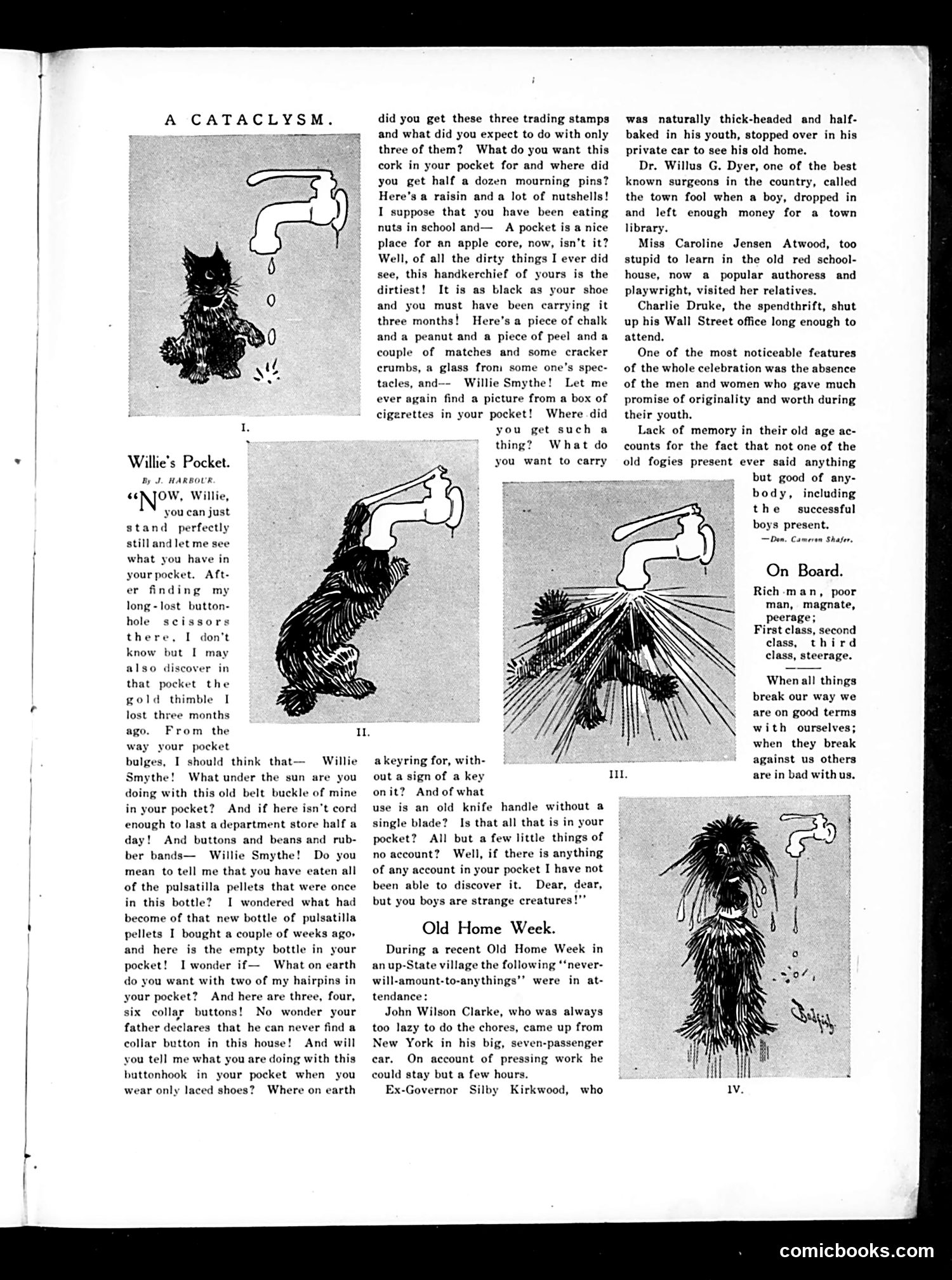
**"Willie's Pocket"** is a humorous domestic sketch depicting a mother discovering an absurdly cluttered boy's pocket. The joke relies on exaggerated contrast: she finds mundane junk (buttons, beans, used hairpins, a dirty handkerchief, apple cores, nutshells) alongside items she's been searching for (her scissors, thimble, pulsatilla pellets—a medicinal powder). The satire gently mocks both boys' chaos and mothers' exasperation. The accompanying illustrations show Willie's distress as his pocket is methodically emptied. **"Old Home Week"** presents social irony: the townspeople dismissed as failures in youth—"never-will-amount-to-anythings"—have become successful (doctor, governor, businesswoman). The joke critiques provincial small-town judgment and nostalgia. Those actually promising as youth are now absent from the reunion. The moral observation, credited to "Den. Cameron Shafer," notes that successful returnees generate only praise from old neighbors, while failures had been overlooked. Both pieces satirize American class mobility and small-town social dynamics typical of early 20th-century Judge magazine humor.
📄 Transcribed text from this page (OCR, searchable)
Machine-transcribed from the original scan — historical spelling and the odd misread are preserved.
— A CATACLYSM. Willie’s Pocket. By J. HARBOUR s6AJTOW, Willie, you can just stand perfectly stilland let me s what you have in yourpocket. Aft- er finding my long-lost button- hole scissors there, I don’t know but I may e also discover in that pocket the gold thimble I lost three months ago. From the Il. your pocket I should think that— ! What under the sun are doing with this old belt buckle of mine in your pocket? And if here isn’t cord enough to last a department store half a day! And buttons and beans and rub- ber bands— Willie Smythe! Do you mean to tell me that you have eaten all of the pulsatilla pellets that were once in this bottle? I wondered what had become of that new bottle of pulsatilla pellets I bought a couple of weeks ago, and here is the empty bottle in your pocket! I wonder if— What on earth do you want with two of my hairpins in your pocket? And here are three, four, six collar buttons! No wonder your father declares that he can never find a collar button in this house! And will you tell me what you are doing with this buttonhook in your pocket when you wear only laced shoes? Where on earth Willie ou did you get these three trading stamps and what did you expect to do with only three of them? What do you want this cork in your pocket for and where did you get half a dozen mourning pins? Here's a raisin and a lot of nutshells! I suppose that you have been eating nuts in school and— A pocket is a nice place for an apple core, now, isn’t it? Well, of all the dirty things I ever did see, this handkerchief of yours is the dirtiest! It is as black as your shoe and you must have been carrying it three months! Here’s a piece of chalk and a peanut and a piece of peel and a couple of matches and some cracker crumbs, a glass from some one’s spec- tacles, and—- Willie Smythe! Let me ever again find a picture from a box of cigerettes in your pocket! Where did you get such a thing? What do you want to carry akeyring for, with- out a sign of a key onit? And of what use is an old knife handle without a single blade? Is that all that is in your pocket? All but a few little things of no account? Well, if there is anything of any account in your pocket I have not been able to discover it. Dear, dear, but you boys are strange creatures !"" Old Home Week. During a recent Old Home Week in an up-State village the following ‘‘never- will-amount-to-anythings’’ were in at- tendance: John Wilson Clarke, who was always too lazy to do the chores, came up from New York in his big, seven-passenger ear. On account of pressing work he could stay but a few hours. Ex-Governor Silby Kirkwood, who was naturally thick-headed and half- baked in his youth, stopped over in his private car to see his old home. Dr. Willus G. Dyer, one of the best known surgeons in the country, called the town fool when a boy, dropped in and left enough money for a town library. Miss Caroline Jensen Atwood, too stupid to learn in the old red school- house, now a popular authoress and playwright, visited her relatives. Charlie Druke, the spendthrift, shut up his Wall Street office long enough to attend, One of the most noticeable features of the whole celebration was the absence of the men and women who gave much promise of originality and worth during their youth, Lack of memory in their old age ac- counts for the fact that not one of the old fogies present ever said anything but good of any- body, including the successful boys present. Den. Camron Shafer. T On Board. Rich-man, poor man, magnate, peerage; First class, second class, third class, steerage. When all things break our way we are on good terms with ourselves; when they break against us others are in bad withus. : comicbooks.com