
Judge, 1912-01-06 · page 15 of 24
Judge — January 6, 1912 — page 15: what you’re looking at
What you’re looking at
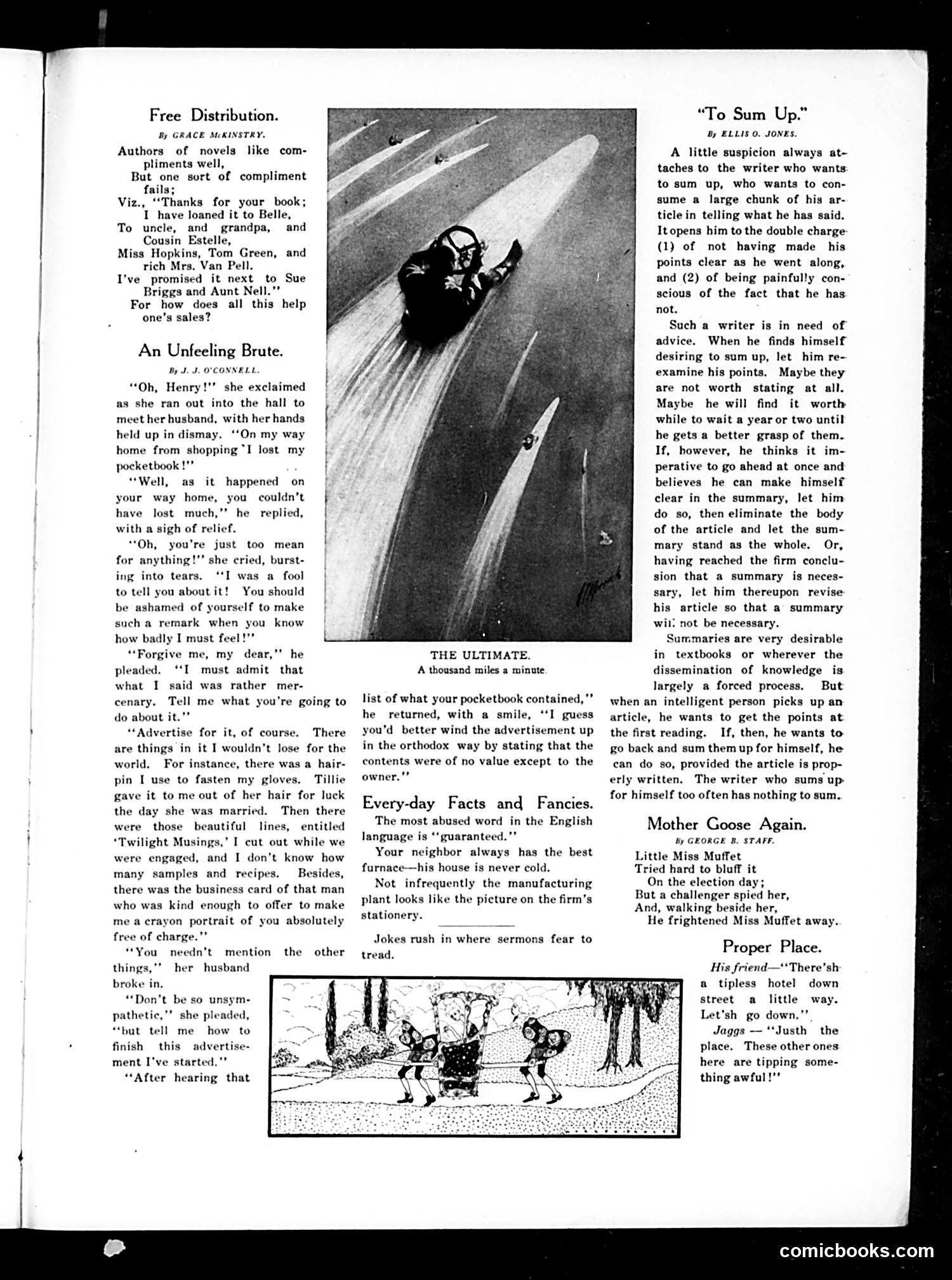
This page contains three satirical pieces typical of early-20th-century humor magazines: **"Free Distribution"** mocks authors' frustration when recipients of complimentary books claim they've lent copies to numerous people—implying the book helps everyone *but* sales. **"An Unfeeling Brute"** satirizes a husband's callous response to his wife losing her pocketbook. She lists sentimental items (a lucky hairpin from a friend's wedding, poetry clippings), and he sarcastically suggests she advertise it as worthless to the owner—a joke about her inflated emotional attachment to junk. **"Every-day Facts and Fancies"** offers brief observational humor, including that "guaranteed" is the most abused English word and that neighbors always brag their furnaces work best. The page also includes **"To Sum Up"** (editorial advice against unnecessary article summaries) and brief comic poetry titled **"Mother Goose Again."** The images show a person sledding and children playing—likely illustrating one of the humorous pieces, though the connection is unclear without fuller context.
📄 Transcribed text from this page (OCR, searchable)
Machine-transcribed from the original scan — historical spelling and the odd misread are preserved.
Free Distribution. By GRACE McKINSTRY. Authors of novels like com- pliments well, But one sort of compliment fails; Viz., ‘‘Thanks for your book; I have loaned it to Belle, To uncle, and grandpa, and Cou: Estelle, Miss Hop! Tom Green, and rich Mrs, Van Pell. I've promised it next to Sue Briggs and Aunt Nell.’" For how does all this help one’s sales? An Unfeeling Brute. By J. J. O'CONNELL “Oh, Henry!’’ she exclaimed as she ran out into the hall to meet her husband, with her hands held up in dismay. ‘On my way home from shopping “I lost my pocketbook !”” “Well, as it happened on your way home, you couldn't have lost much,’’ he replied, with a sigh of relief. “Oh, you're just too mean for anything!" she cried, burst- ing into tears. ‘Il was a fool to tell you about it! You should be ashamed of yourself to make such a remark when you know how badly I must feel !’" “Forgive me, my dear,’? he pleaded. ‘‘I must admit that what I said was rather mer- cenary. Tell me what you're going to do about it."’ “Advertise for it, of course. There are things in it I wouldn't lose for the world. For instance, there was a hair- pin I use to fasten my gloves. Tillie gave it to me out of her hair for luck the day she was married. Then there were those beautiful lines, entitled ‘Twilight Musings,’ I cut out while we were engaged, and I don’t know how many samples and recipes. Besides, there was the business card of that man who was kind enough to offer to make me acrayon portrait of you absolutely free of charge.”" “You needn't mention the other things," her husband broke in, Don't be so unsym- pathetic,’ she pleaded, “‘but tell me how to finish this advertise ment I've started."” “After hearing that THE ULTIMATE. A thousand miles a minute. list of what your pocketbook contained,” he returned, with a smile, ‘‘I guess you'd better wind the advertisement up in the orthodox way by stating that the contents were of no value except to the owner."” Every-day Facts and Fancies. The most abused word in the English language is “guaranteed.” Your neighbor always has the best furnace—his house is never cold. Not infrequently the manufacturing plant looks like the picture on the firm’s stationery. Jokes rush in where sermons fear to tread. “To Sum Up.” By ELLIS 0. JONES. A little suspicion always at- taches to the writer who wants to sum up, who wants to con- sume a large chunk of his ar- ticle in telling what he has s: It opens him to the double charge. (1) of not having made his points clear as he went along, and (2) of being painfully con- scious of the fact that he has not. Such a writer is in need of advice. When he finds himself desiring to sum up, let him re- examine his points. Maybe they are not worth stating at all. Maybe he will find it worth while to wait a year or two until he gets a better grasp of them. If, however, he thinks it im- perative to go ahead at once and believes he can make himself clear in the summary, let him do so, then eliminate the body of the article and let the sum- mary stand as the whole. Or, having reached the firm conclu- sion that a summary is neces- sary, let him thereupon revise his article so that a summary wil. not be necessary. Summaries are very desirable in textbooks or wherever the dissemination of knowledge is. largely a forced process, But when an intelligent person picks up an article, he wants to get the points at the first reading. If, then, he wants to go back and sum them up for himself, he can do so, provided the article is prop- erly written. The writer who sums up for himself too often has nothing to sum. Mother Goose Again. by GEORGE B. STAFF. Little Miss Muffet Tried hard to bluff it On the election day; But a challenger spied her, And, walking beside her, He frightened Miss Muffet away. Proper Place. His friend—"There’sh a tipless hotel down street a little way. Let'’sh go down.’’ Jaggs —‘‘Justh the place. These other ones here are tipping some- thing awful!’’ comicbooks.com