
A complete issue · 24 pages · 1911
Judge — December 16, 1911
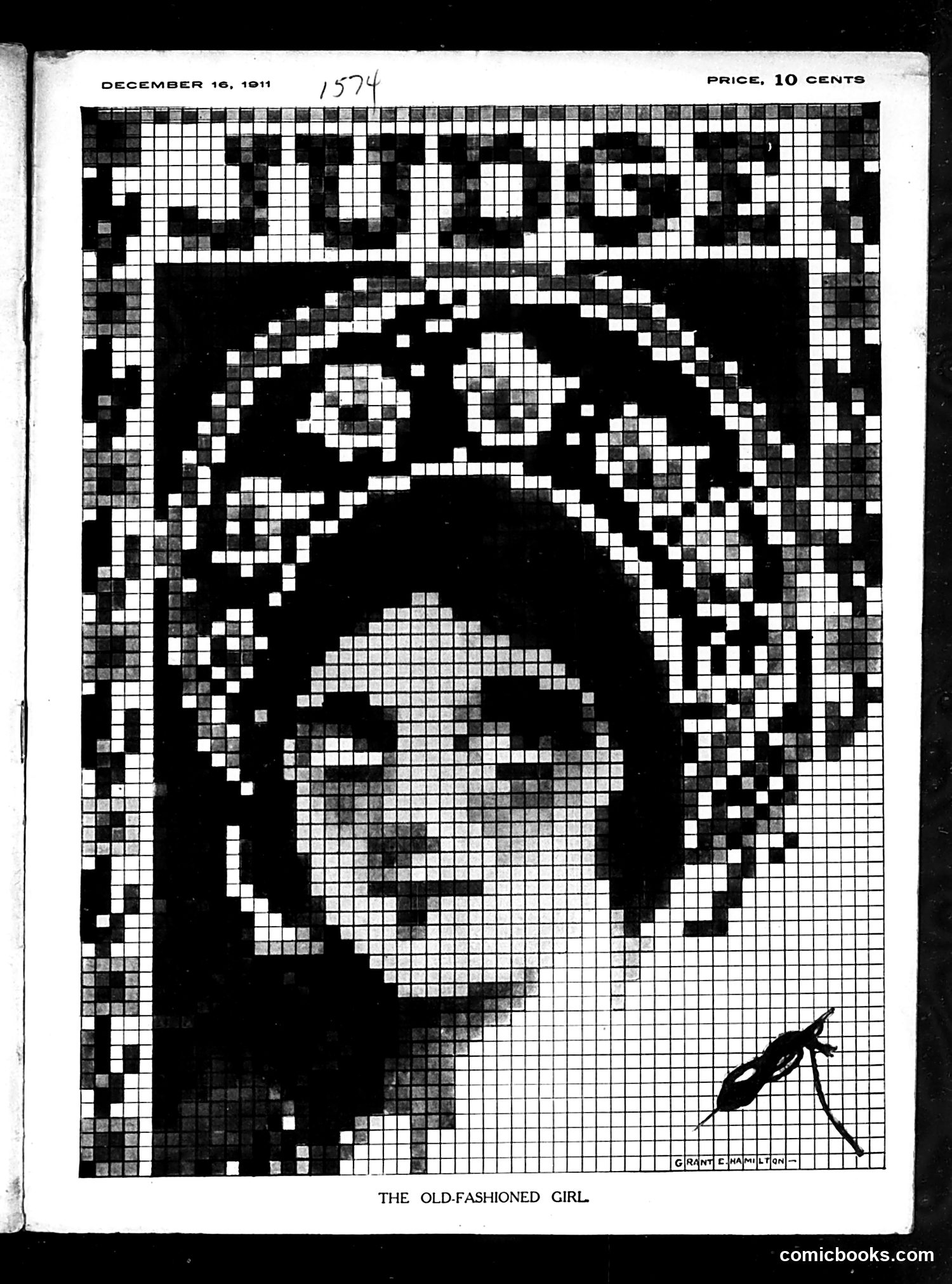
This pixelated portrait from Judge magazine (December 16, 1911) depicts a young woman's face rendered in a grid pattern—an early example of halftone or mosaic reproduction technology. The title "The Old-Fashioned Girl" suggests satirical commentary on changing gender roles and female appearance standards during the Progressive Era. The image likely critiques either outdated feminine ideals or contrasts them with modern "New Woman" sensibilities of the 1910s. The mechanical, depersonalized grid presentation may ironically emphasize how women's appearance was increasingly subjected to mass reproduction and commodification in advertising and media. Without additional context, the specific target of satire remains unclear, though the date and title suggest commentary on generational shifts in female identity and social expectations.
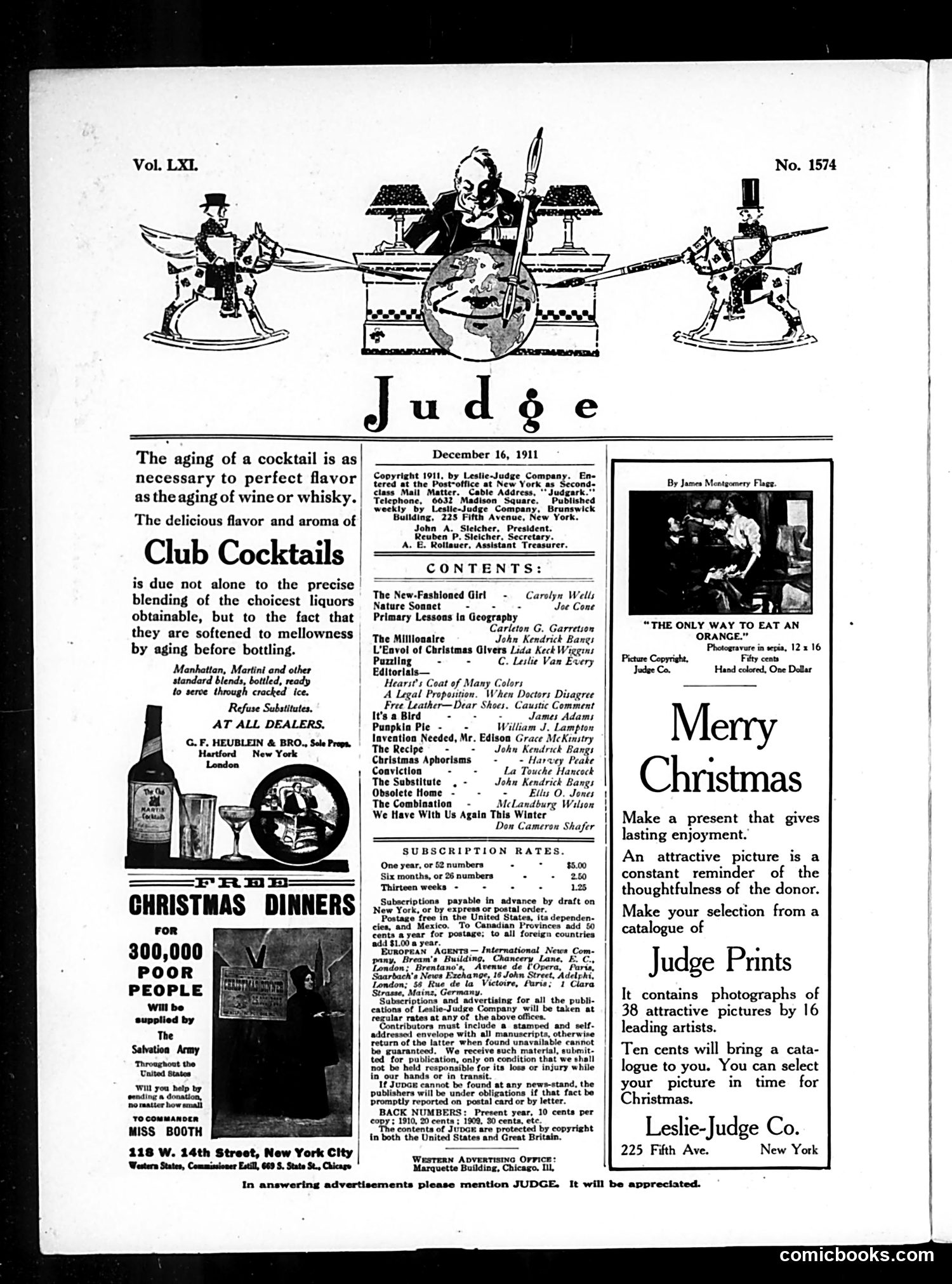
This page is primarily **advertising and editorial content** rather than satirical cartoons. The main visual elements include: 1. **Club Cocktails advertisement** (left): Features a bottle and glass, emphasizing that cocktails require proper aging and blending—a humorous comparison to wine maturation. 2. **Christmas Dinners advertisement** (center-left): Promotes Salvation Army dinners for 300,000 poor people, with a donation appeal. 3. **Judge Prints advertisement** (right): Promotes the Leslie-Judge Co.'s catalogue of 38 photographs by 16 artists as Christmas gift options. The page reflects early 20th-century consumer culture, charitable appeals, and the magazine's commercial nature alongside its satirical function.
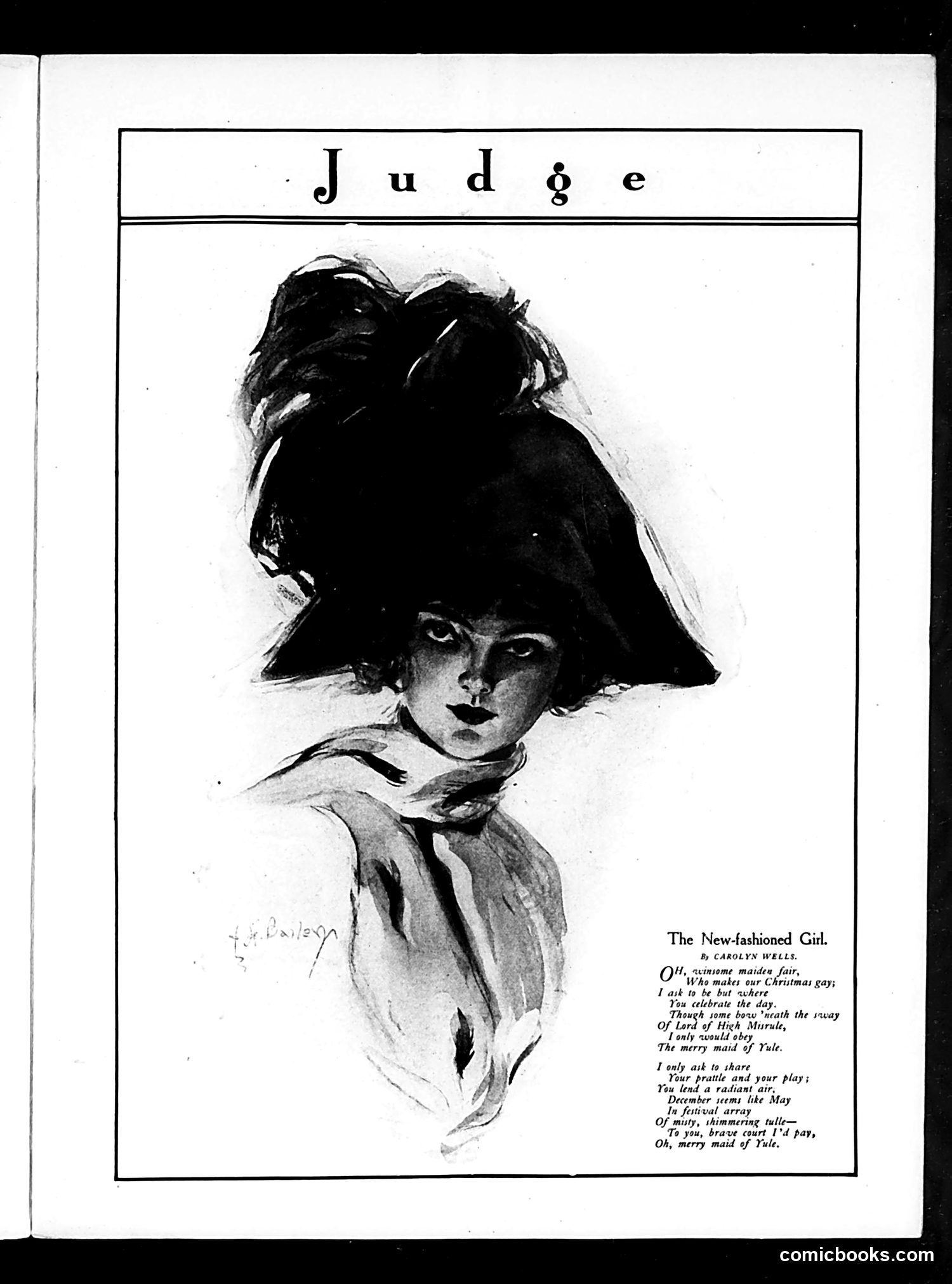
This page from *Judge* features an illustration titled "The New-Fashioned Girl" by Carolyn Wells, accompanied by verse. The sketch depicts a young woman wearing a large, wide-brimmed hat characteristic of early 20th-century fashion, shown in profile with a somewhat stern or determined expression. The poem satirizes modern women of the era, commenting on changing gender roles and behavior. References to "Christmas gays," "Lord of High Misrule," and "merry maid of Yule" suggest the piece contrasts traditional femininity with contemporary women's evolving independence. The phrase "brave court I'd pay" hints at women's assertiveness—a point of social commentary during a period of shifting women's rights and changing social expectations in America.
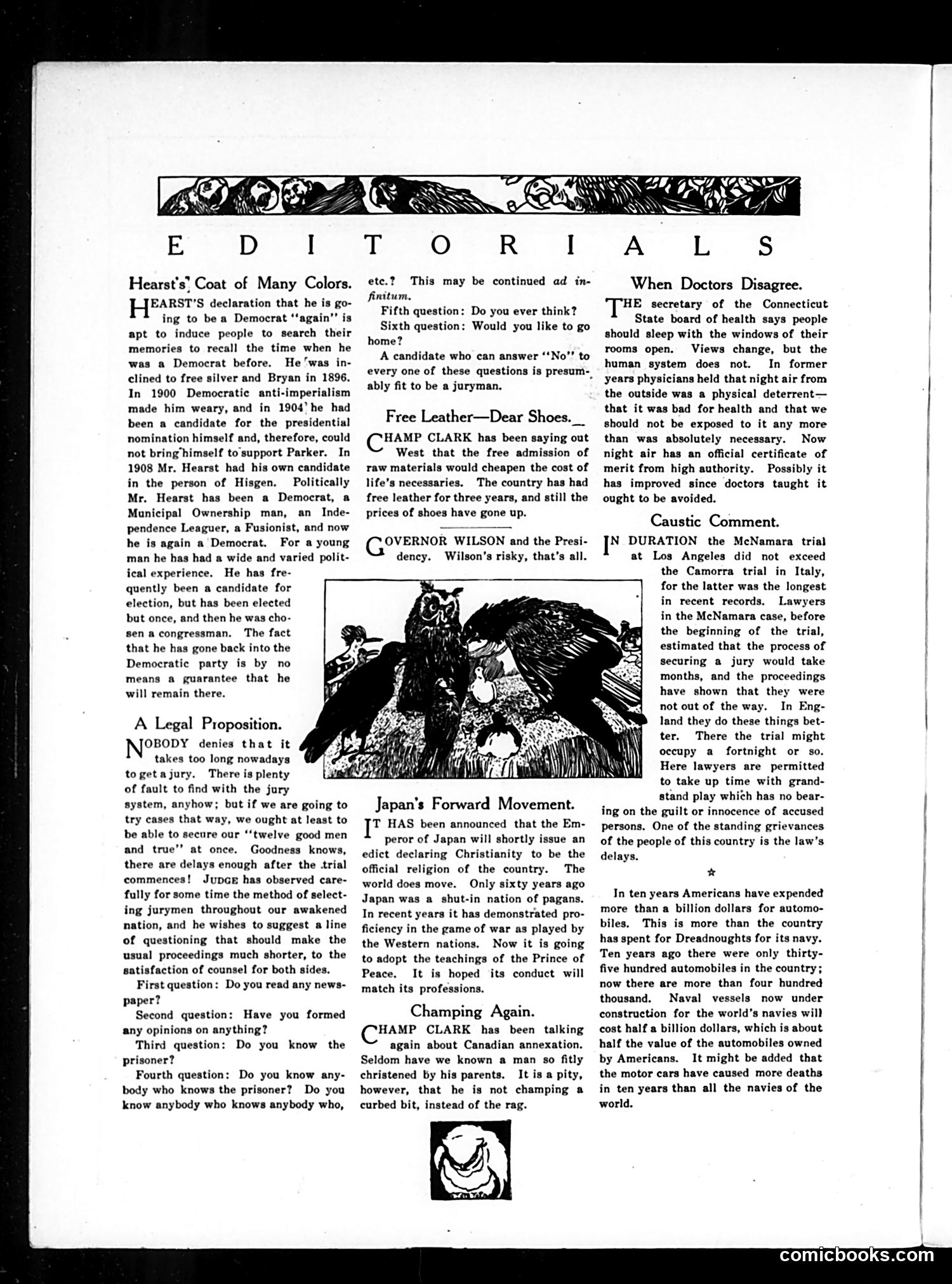
This editorials page contains several political commentaries typical of early 20th-century American satire: **"Hearst's Coat of Many Colors"** criticizes William Randolph Hearst's shifting political loyalties, noting he previously ran as a Democrat but now opposes Democrats—suggesting opportunistic political positioning rather than principle. **"A Legal Proposition"** advocates jury reform, proposing questions to screen jurors' impartiality and reliability. The **central cartoon** (depicting an eagle) accompanies "Japan's Forward Movement," discussing Japan's announced adoption of Christianity as state religion—presenting this as calculated Western emulation rather than genuine conversion. **"Champing Again"** mocks Champ Clark for continually discussing Canadian annexation, satirizing his persistence on the issue as obsessive rather than serious policy debate. The page reflects Progressive Era concerns about political sincerity, jury integrity, and international relations.
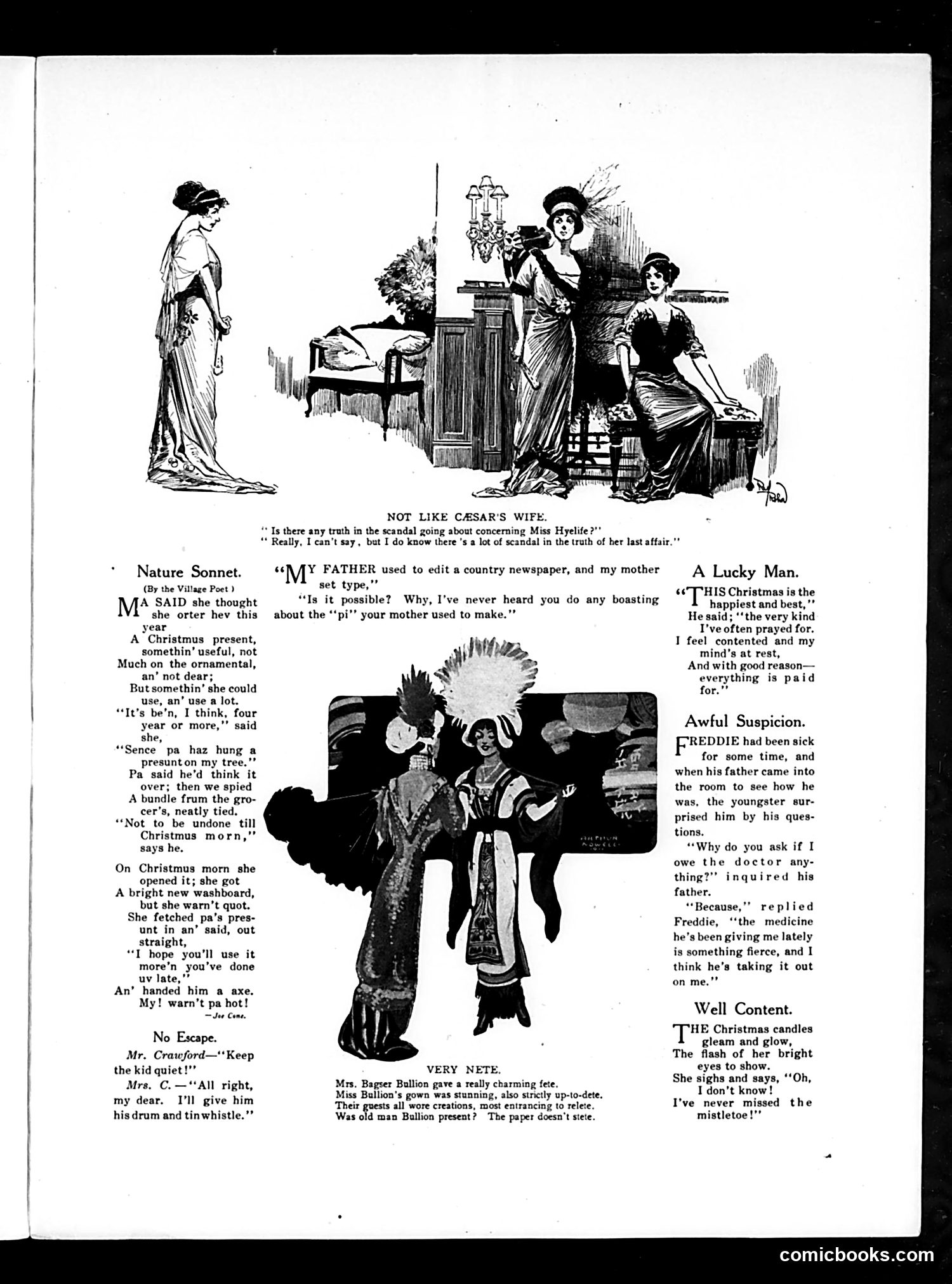
This page contains several short humorous stories and one satirical cartoon rather than explicit political commentary. The top cartoon, "Not Like Caesar's Wife," depicts a social scandal involving "Miss Hyldie" and gossip about her "last affair." It satirizes high-society women's reputations and the scandal-mongering of elite social circles. The remaining content—"Nature Sonnet," "No Escape," "A Lucky Man," "Awful Suspicion," and "Well Content"—are domestic humor pieces about Christmas, parental relationships, and family life. They mock middle-class anxieties: children's gifts, doctor bills, and sentimental holiday traditions. The "Very Note" section jokes about Mrs. Barger Ballion's fashionable dress at a party. Overall, this page targets genteel society and domestic life rather than politics, using gentle satire about social pretension and family dynamics typical of Judge's humor circa early 1900s.
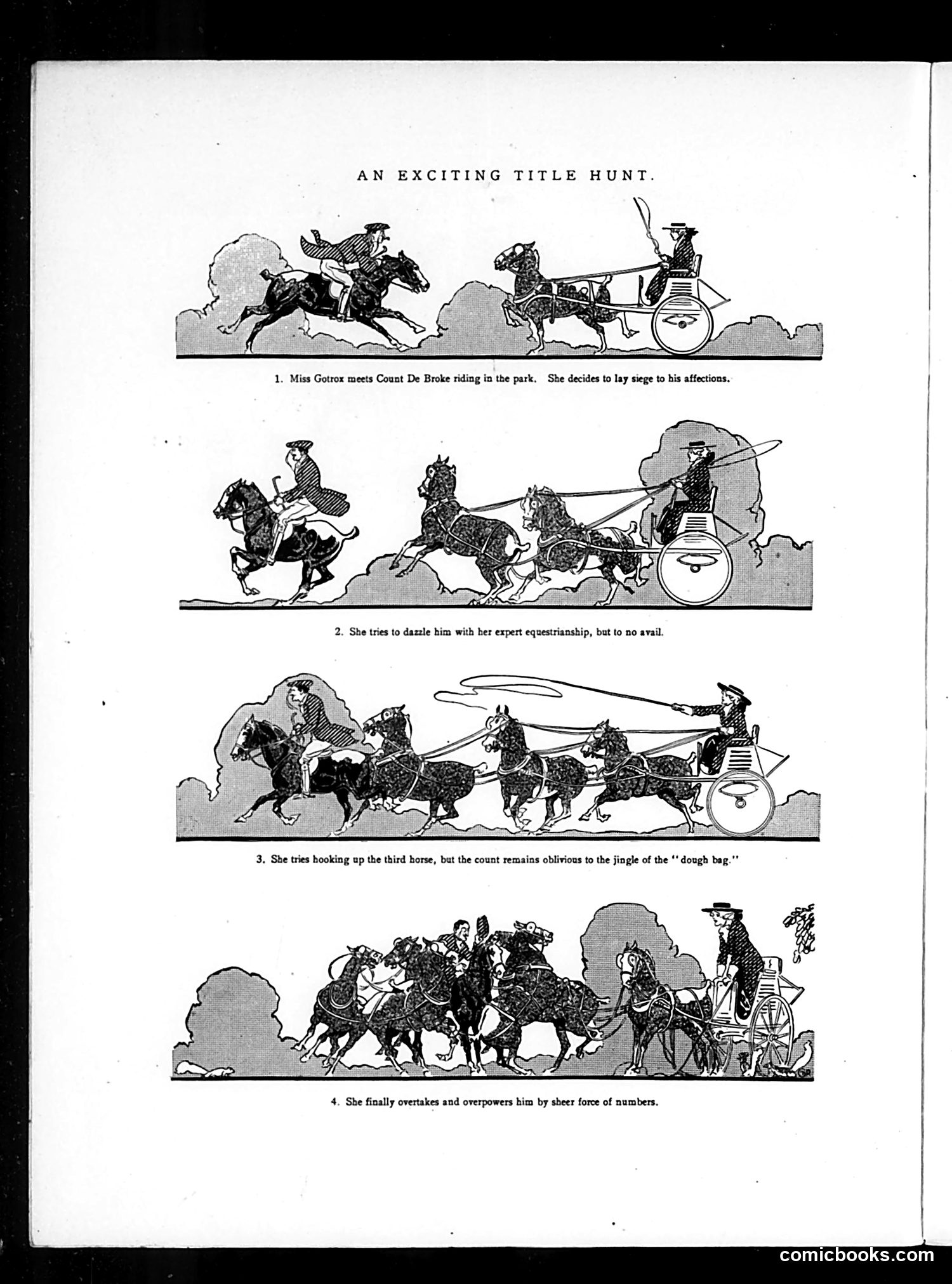
This humorous four-panel comic depicts a romantic pursuit styled as a chase scene. Panel 1 shows Miss Gotrox meeting Count De Broke in the park; she decides to "lay siege to his affections." Panels 2-3 show her attempting to win him over through equestrian skills and other tactics, but he remains indifferent—described as oblivious to her "jingle of the dough bag" (her wealth). Panel 4 concludes with her overwhelming him "by sheer force of numbers," suggesting she enlists multiple companions or suitors to pursue him collectively. The satire appears to mock romantic persistence and the complications of courtship, likely playing on contemporary anxieties about marriage, wealth, and gender dynamics. The "Count" title reference in the heading suggests social pretense and fortune-hunting may be satirized as well.
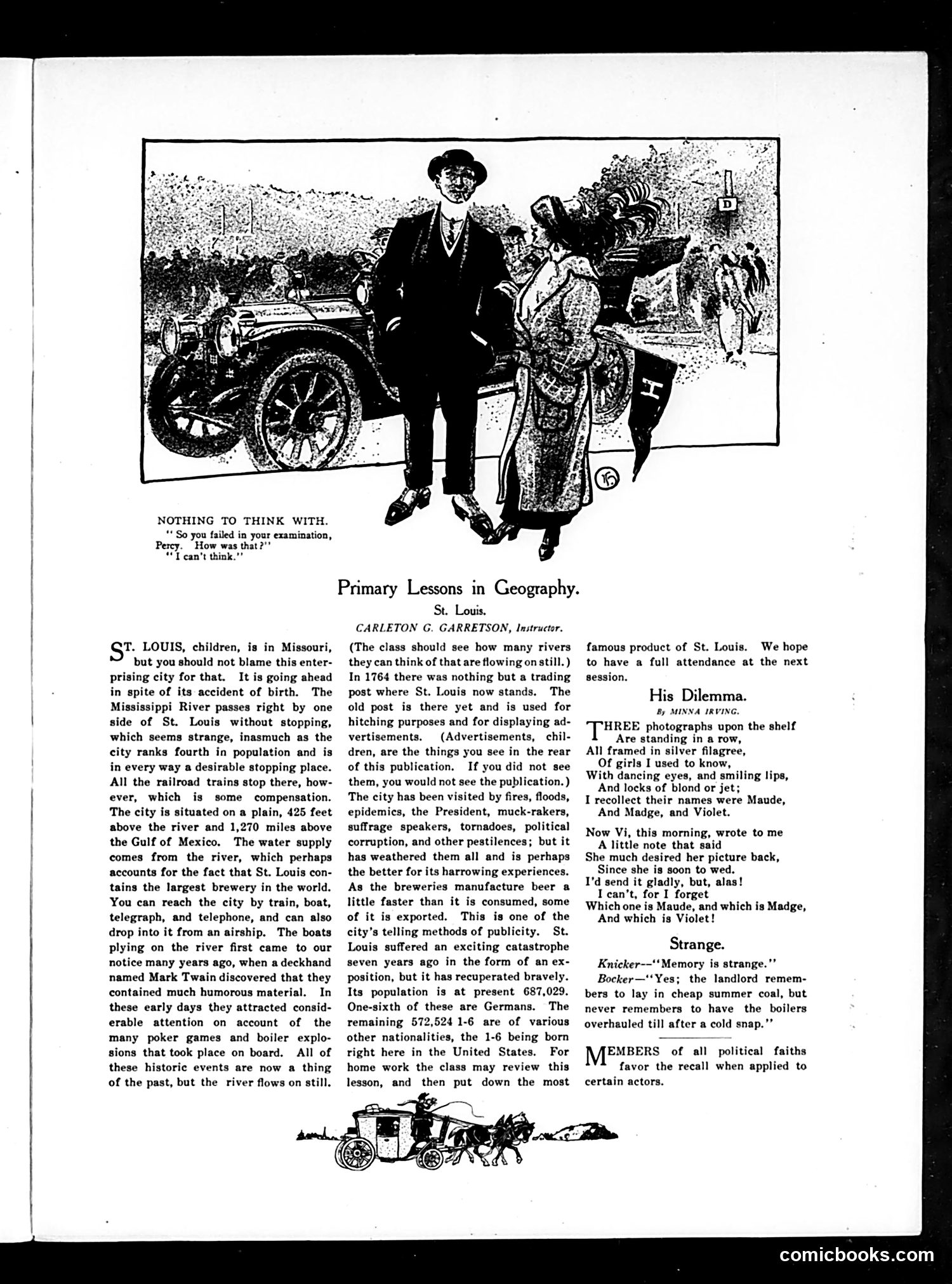
This page from Judge contains educational satire and light humor rather than political cartooning. The top cartoon "Nothing to Think With" is a simple visual joke: a schoolboy failed his exam because he literally cannot think—depicted as an empty-headed figure who cannot process information. The main content is a mock geography lesson about St. Louis by instructor Carleton G. Garretson. It's satirical pedagogy, mixing genuine facts (St. Louis's location, population of 687,029, large brewery) with absurdist commentary—noting the Mississippi River passes by "without stopping," that the city has been visited by "pestilences" including "the President," and sarcastically crediting breweries as the city's "famous product." The page also includes two poems: "His Dilemma" (a man cannot distinguish between three photographs of ex-girlfriends) and "Strange" (a joke about a landlord's selective memory regarding coal and boiler maintenance). Finally, there's a brief quip about theatrical "recall" being favored by people of all political beliefs—likely referencing the progressive-era recall election movement, here applied humorously to removing bad actors from stage.
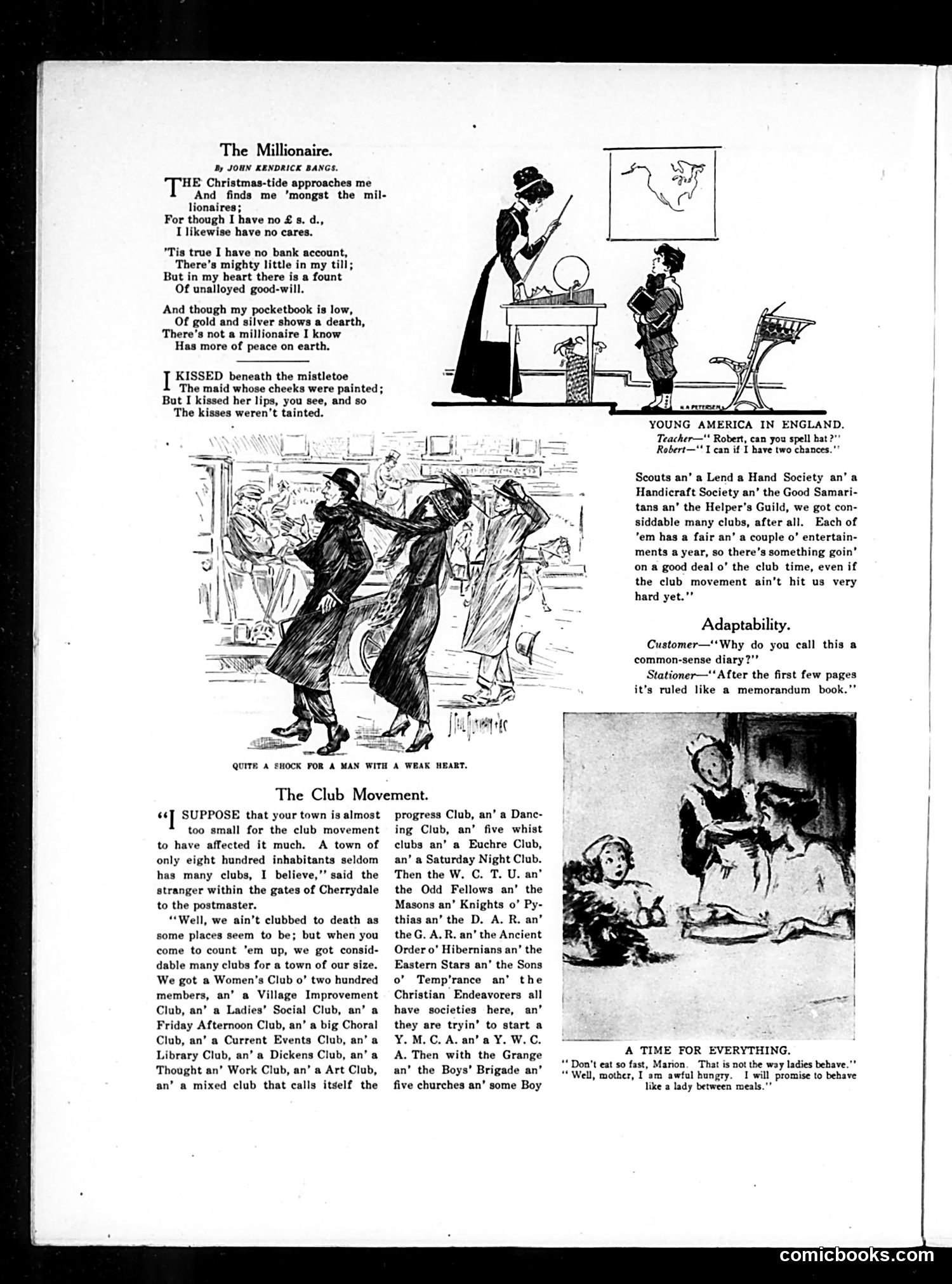
This page from *Judge* contains satirical commentary on American social life circa early 1900s. **"The Millionaire"** (poem): A gentle satire contrasting wealth with contentment. The speaker claims poverty but spiritual richness—peace of mind that millionaires lack. The mistletoe kiss joke suggests moral superiority through genuine feeling versus transactional relationships of the wealthy. **"Young America in England"**: A schoolroom scene mocking American educational standards. A boy cannot spell "hat" without "two chances"—satire on American students' supposed intellectual inferiority to their English counterparts. **"The Club Movement"**: The main satire. A stranger expresses surprise at the proliferation of clubs in a small town (eight hundred inhabitants). The postmaster then catalogs dozens: women's clubs, fraternal orders (Odd Fellows, Masons, D.A.R., G.A.R.), temperance societies, religious groups, youth organizations—suggesting Americans' obsessive club-joining and organizational mania had become ridiculous and pervasive even in tiny communities. The overall theme critiques American social excess and conformity.
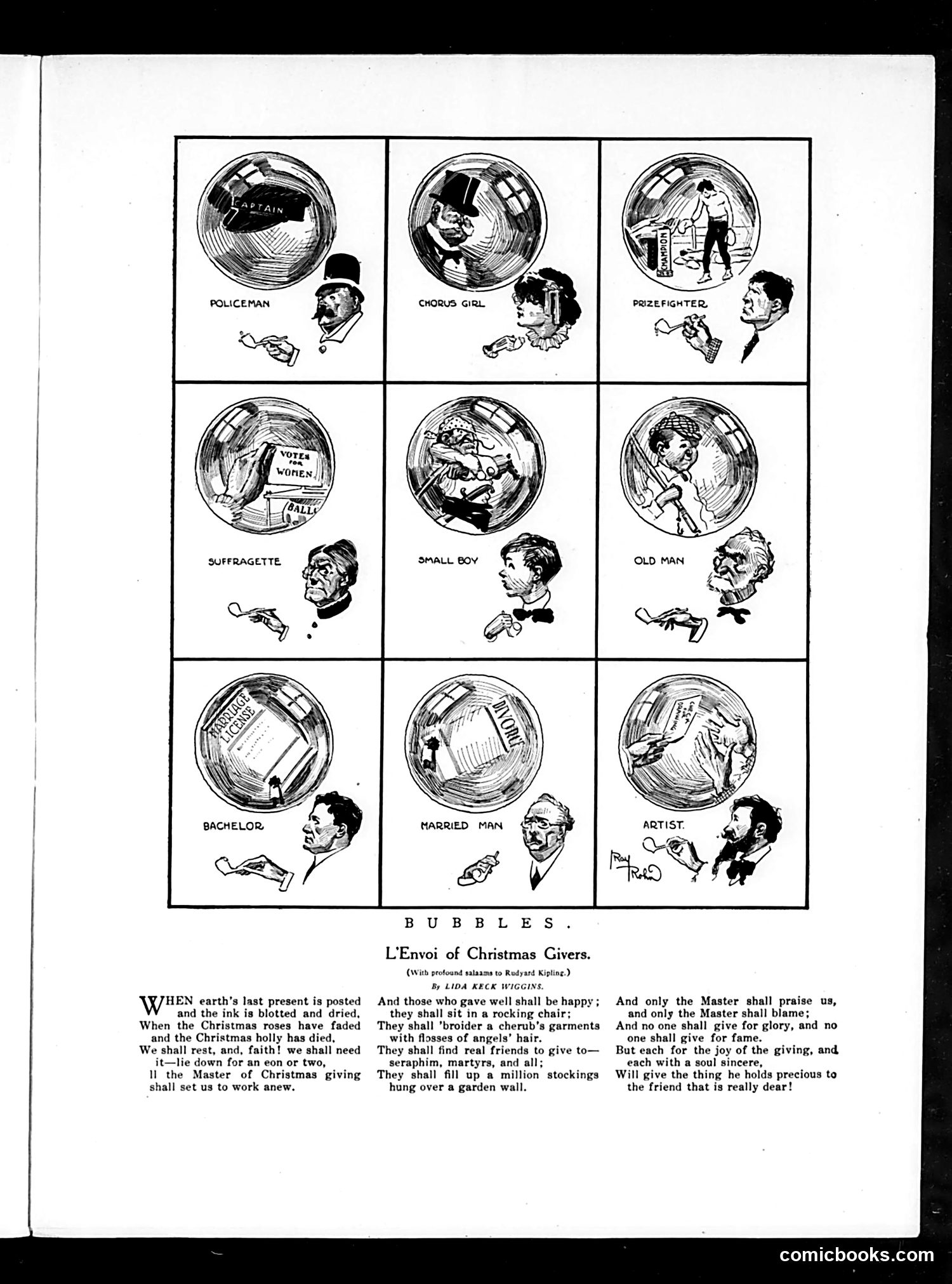
This page from *Judge* presents a satirical grid of "bubbles"—reflecting spheres showing different social types and their Christmas gift-giving fantasies. Each bubble depicts what that person dreams of receiving or becoming. The nine character types—Policeman, Chorus Girl, Prize Fighter, Suffragette, Small Boy, Old Man, Bachelor, Married Man, and Artist—represent cross-sections of American society. The satire lies in the contrast between each figure's mundane reality (shown in caricature below) and their idealized bubble-reflection above. The accompanying poem by Lida Keck Wiggins parodies Rudyard Kipling's "L'Envoi," offering mock-serious moralizing about Christmas giving. The humor derives from deflating sentimental Victorian gift-giving rhetoric while suggesting each type harbors absurdly specific desires—the suffragette dreams of voting rights, the chorus girl of respectability, etc. This is social satire through wish-fulfillment fantasy, gently mocking contemporary American types and their aspirations.
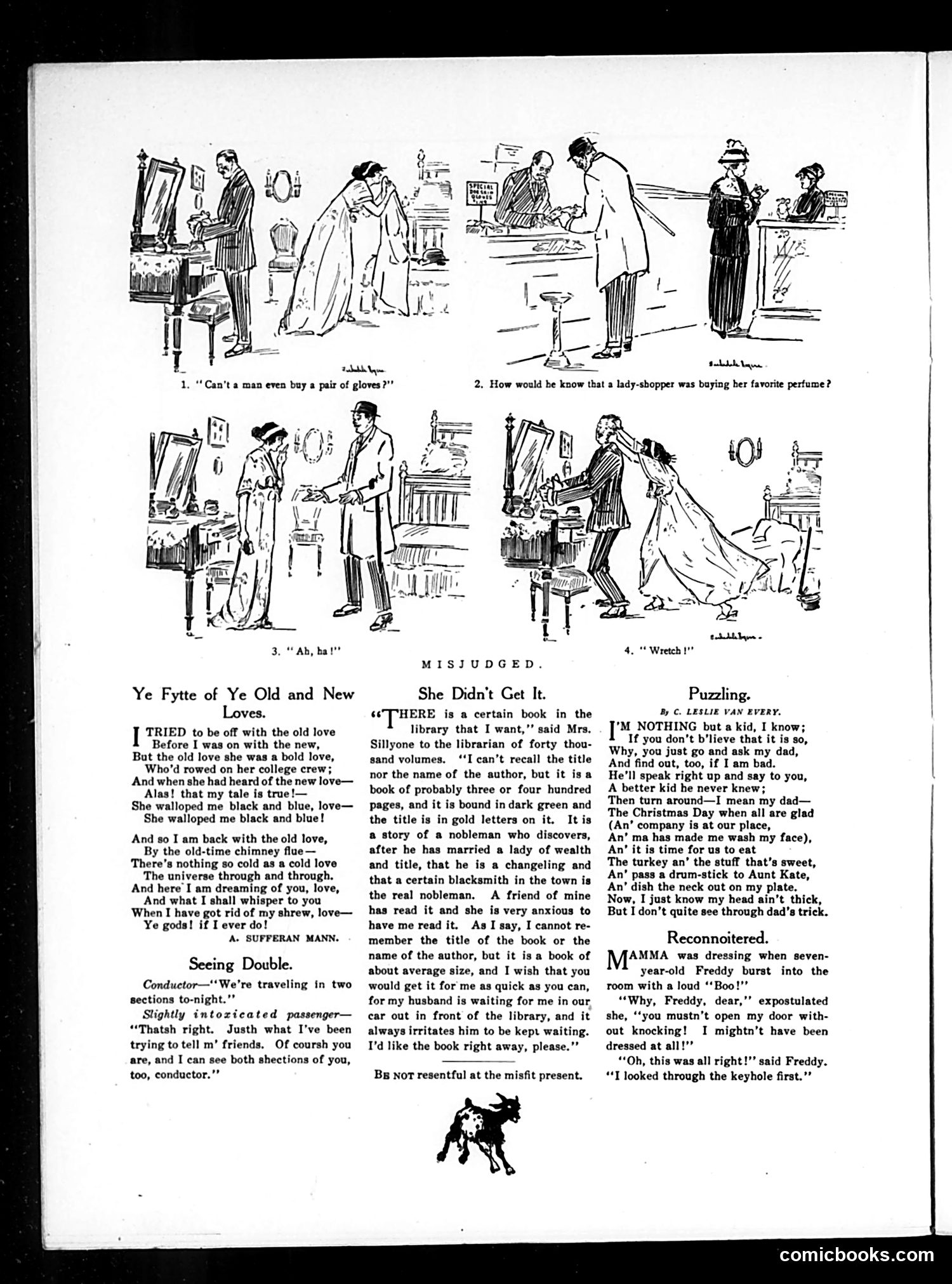
This Judge magazine page contains humorous short pieces satirizing romantic and domestic situations of the early 20th century. **"Ye Fytte of Ye Old and New Loves"** is a poem about a man caught between an old girlfriend (described as athletic—"rowed on her college crew") and a new love. When the old girlfriend learns of his infidelity, she physically beats him, forcing his return to her. The satire mocks male infidelity and the powerlessness of men facing assertive women. **"Seeing Double"** jokes about an intoxicated passenger who literally sees two versions of the conductor, then uses this as an excuse to his friends—ironically proving he was already claiming to see double before drinking. **"She Didn't Get It"** depicts a librarian's frustration with a patron (Mrs. Sillyone—a play on "silly one") who provides vague, rambling details about a book she wants, revealing upper-class women's impracticality. **"Puzzling"** and **"Reconnoitered"** are brief humorous anecdotes about children's innocent but embarrassing observations about adult behavior. The overall tone gently ridicules social pretension and gender dynamics of the era.
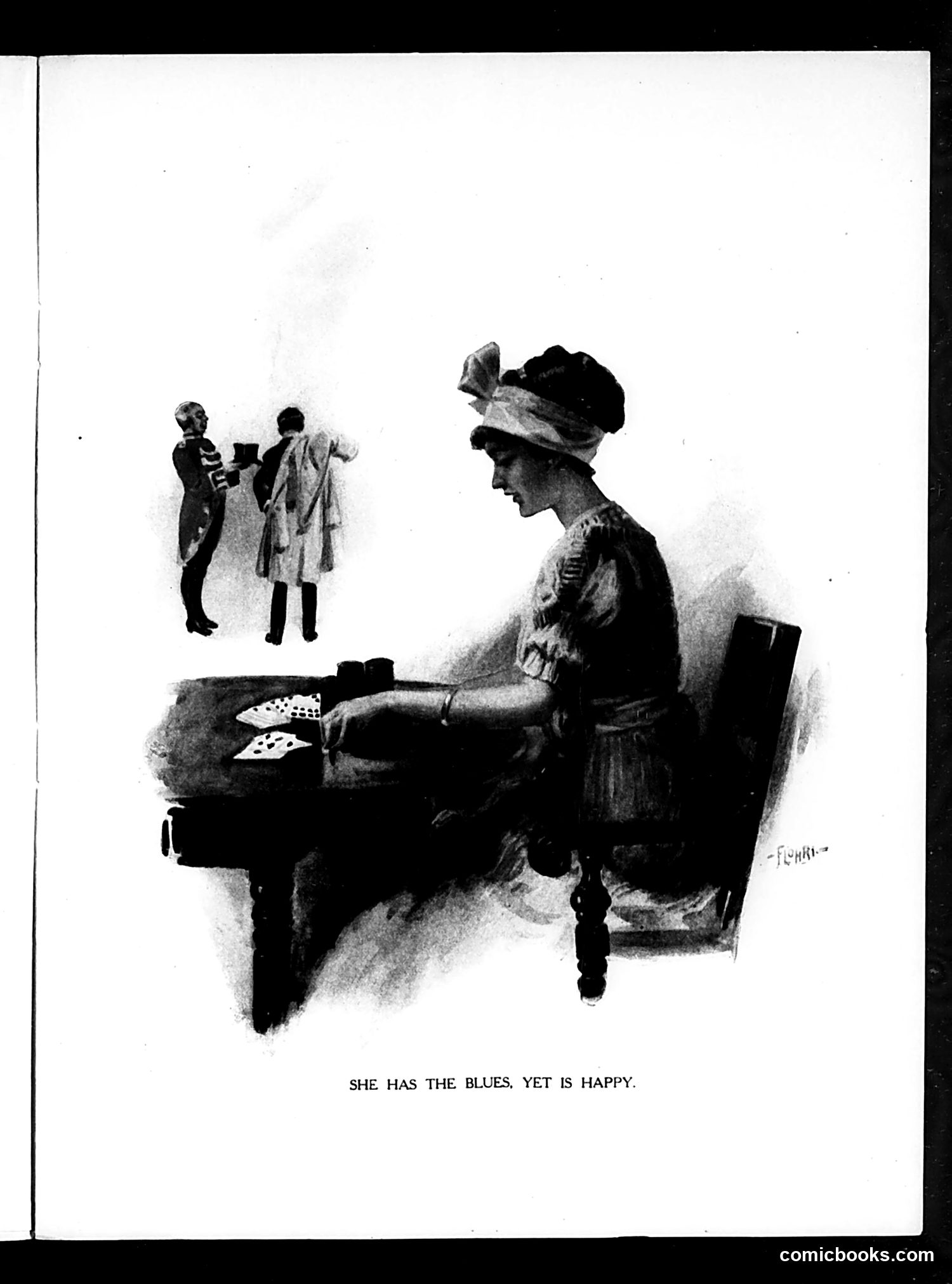
This Judge magazine cartoon depicts a woman seated at a table with playing cards, appearing contemplative or melancholy. Two figures are visible in the background, seemingly engaged in conversation or observation. The caption "She Has the Blues, Yet Is Happy" presents a paradox—suggesting emotional contradiction. In early 20th-century slang, "having the blues" meant feeling sad or depressed. The satire likely comments on a woman finding contentment despite emotional distress, possibly mocking female resilience, stoicism, or resignation to difficult circumstances. The playing cards suggest gambling or idle leisure as a coping mechanism. The cartoon's point appears social commentary on women's emotional states and how they navigate adversity, though without additional context about the specific date and issue, the precise target of satire remains unclear.
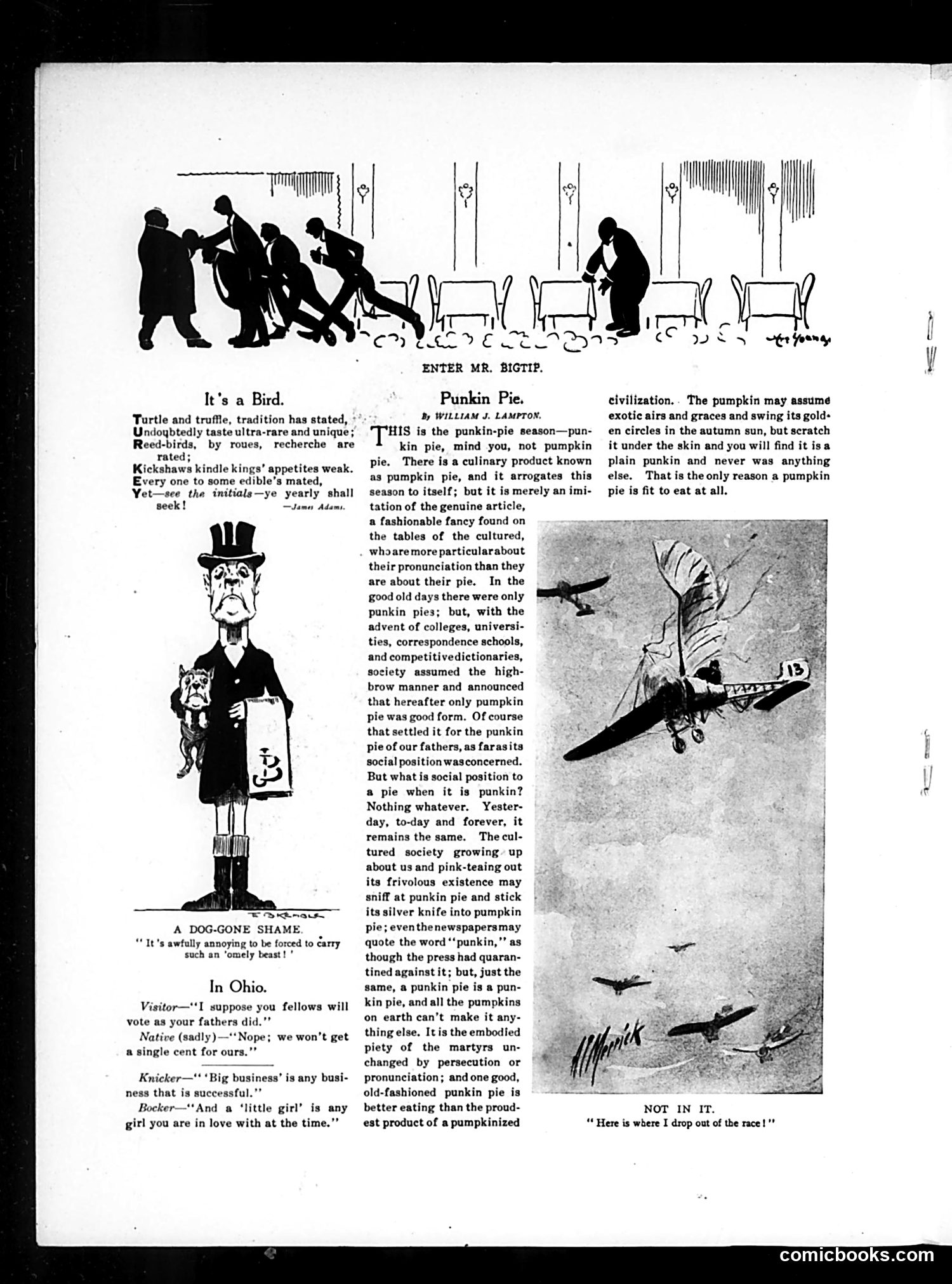
This Judge magazine page contains several satirical pieces mocking American social pretension and changing customs around 1900-1910. **"Enter Mr. Bigtip"** (top cartoon) shows men struggling with a chair—likely satirizing overly formal etiquette among the wealthy. **"Punkin Pie"** is the main feature. William J. Lampton satirizes how educated society abandoned the word "punkin" for the "refined" pronunciation "pumpkin," treating the traditional dessert as beneath cultured taste. His point: regardless of pronunciation snobbery, a punkin pie remains fundamentally unchanged—the substance outlasts social pretension. This mocks how newly educated Americans (via colleges and correspondence schools) adopted artificial high-brow manners while abandoning authentic traditions. **"A Dog-Gone Shame"** ridicules a wealthy man forced to carry an "homely beast"—criticizing vanity. The **"In Ohio"** jokes mock rural/urban differences: farmers won't inherit money like their fathers did, and people redefine terms ("big business," "little girl") based on current success or personal desire rather than actual meaning. Overall, the page satirizes American social climbing and the erosion of genuine values through affectation.
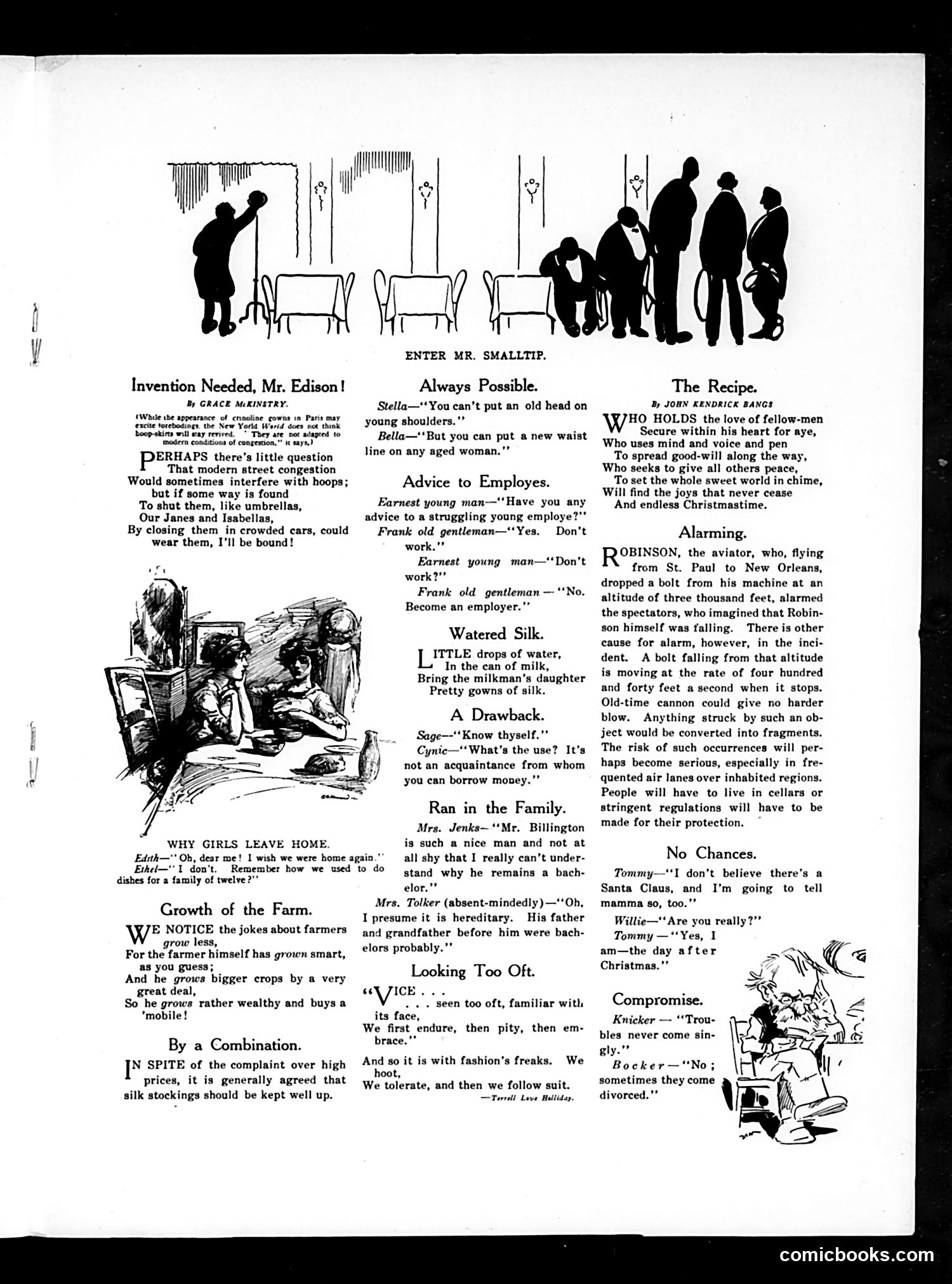
This is a **humor and satire page** from Judge magazine featuring various short jokes and comic pieces typical of early 20th-century American wit. **Key content:** - **"Invention Needed, Mr. Edison!"** satirizes urban congestion by joking that collapsible hoop skirts could solve crowded streetcar problems - **"Why Girls Leave Home"** contrasts modern reluctance to do housework with past domestic duties - **"Growth of the Farm"** celebrates agricultural modernization and farmer prosperity (farmers now buying automobiles) - **Social commentary pieces** on employment, fashion cycles, and aviation safety (Robinson's bolt-dropping incident appears to reference real early aviation concerns) - **"The Recipe"** is sentimental verse about spreading goodwill - **Various short jokes** about romance, marriage reluctance, and Christmas skepticism The satire targets **changing social conditions**: urban crowding, women's liberation from household drudgery, technological advancement, and shifting fashion trends. The tone is lighthearted rather than biting—typical Judge humor mocking modern life's absurdities while celebrating progress.
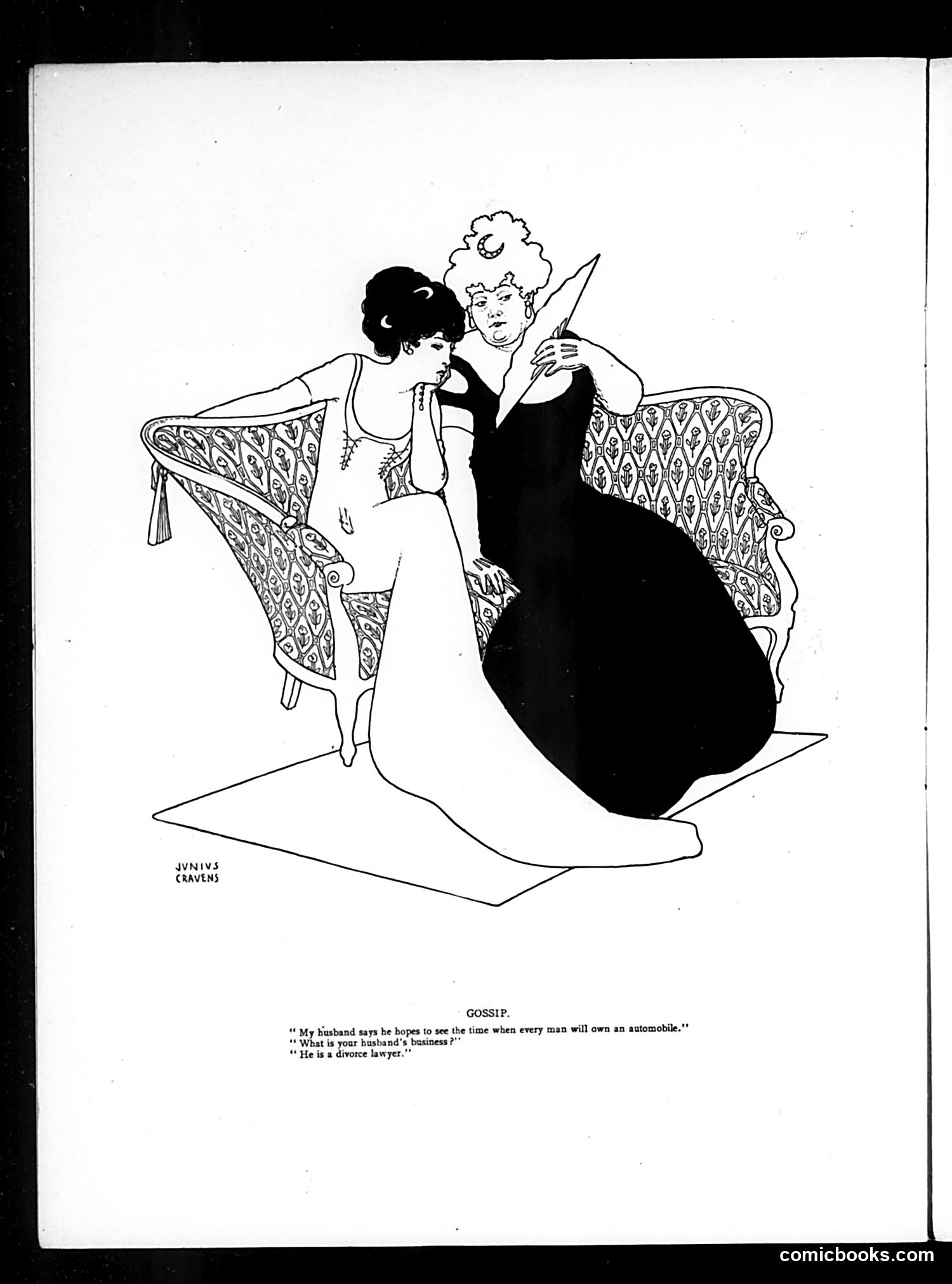
This cartoon satirizes marriage and divorce through overheard gossip between two women on a couch. One woman (in light dress) tells another (in dark dress) about her husband's optimism regarding automobiles becoming universal. When asked his business, she reveals he's a divorce lawyer. The joke works on multiple levels: the husband's prediction about universal automobile ownership is presented as naïve optimism, while his actual profession (divorce lawyer) implies he profits from marital dissolution. The satire suggests that increased mobility from automobiles will lead to more infidelity and divorces—a cynical but contemporary concern about how new technology disrupts traditional family structures. The elaborate Art Nouveau furniture and fashionable dress indicate this targets upper-class readers.
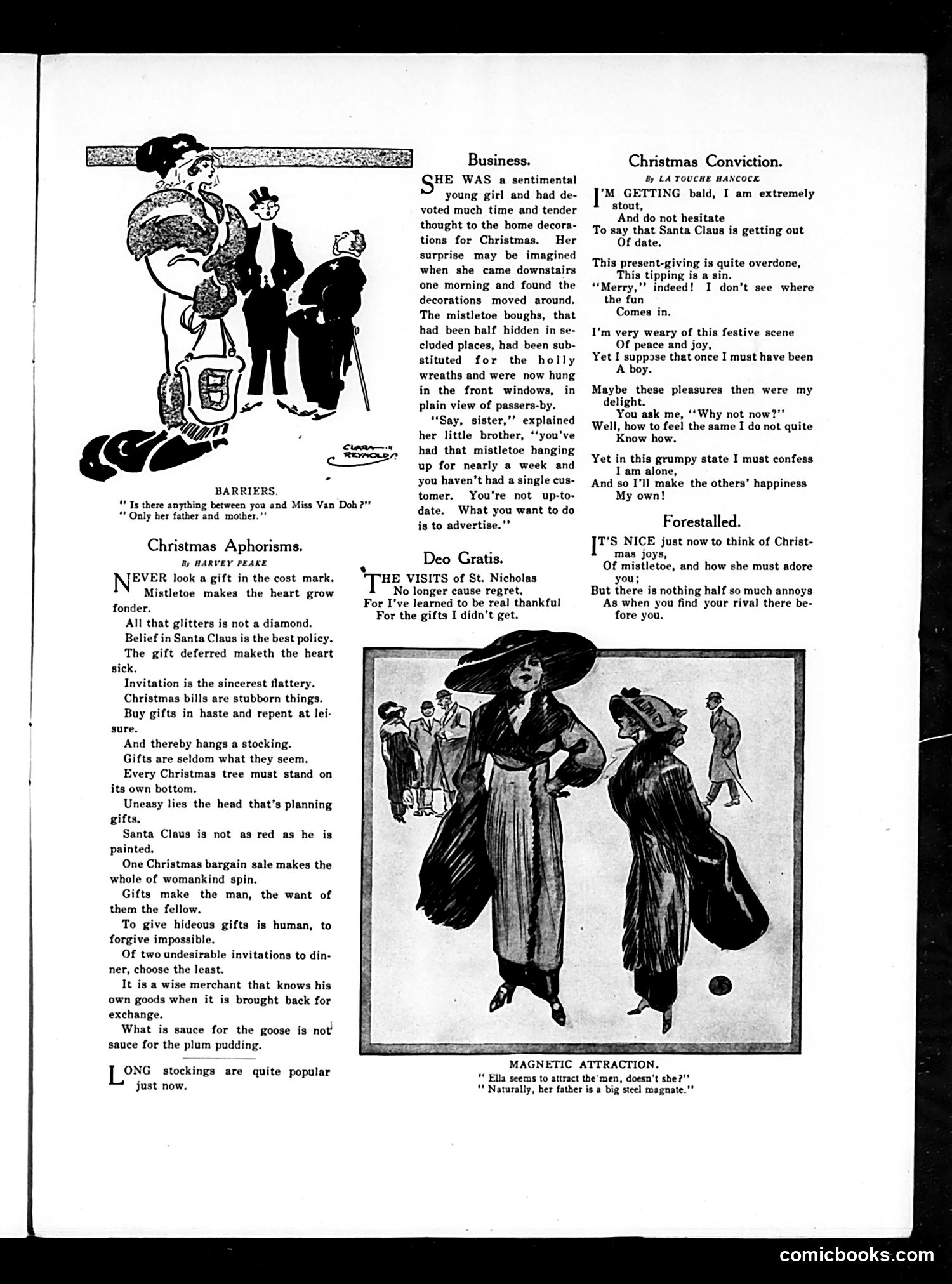
This page contains multiple short humorous pieces typical of early 20th-century satirical magazines: **"Christmas Aphorisms"** parodies famous sayings (playing on "Never look a gift horse in the mouth," "Absence makes the heart grow fonder," etc.), offering cynical takes on Christmas gift-giving and holiday obligations—mocking commercialism and social obligations. **"Business"** joke satirizes a young woman's failed attempt at romance through Christmas decoration placement. Her brother suggests she advertise the mistletoe to attract suitors, treating courtship as a commercial transaction. **"Magnetic Attraction"** makes a crude joke: a woman attracts men not through charm but because her father is wealthy ("steel magnate")—satirizing mercenary marriage motivations. **"Christmas Conviction"** presents a grumpy older man rejecting Christmas joy, lamenting lost youth while admitting he'll pursue others' happiness anyway—gentle satire of aging cynicism. **"Forestalled"** humorously warns that romantic rivals may interfere with holiday romance plans. The accompanying illustrations show period-appropriate clothing and social scenarios. The overall tone mocks commercialism, romance conventions, and holiday excess—typical Judge magazine fare.
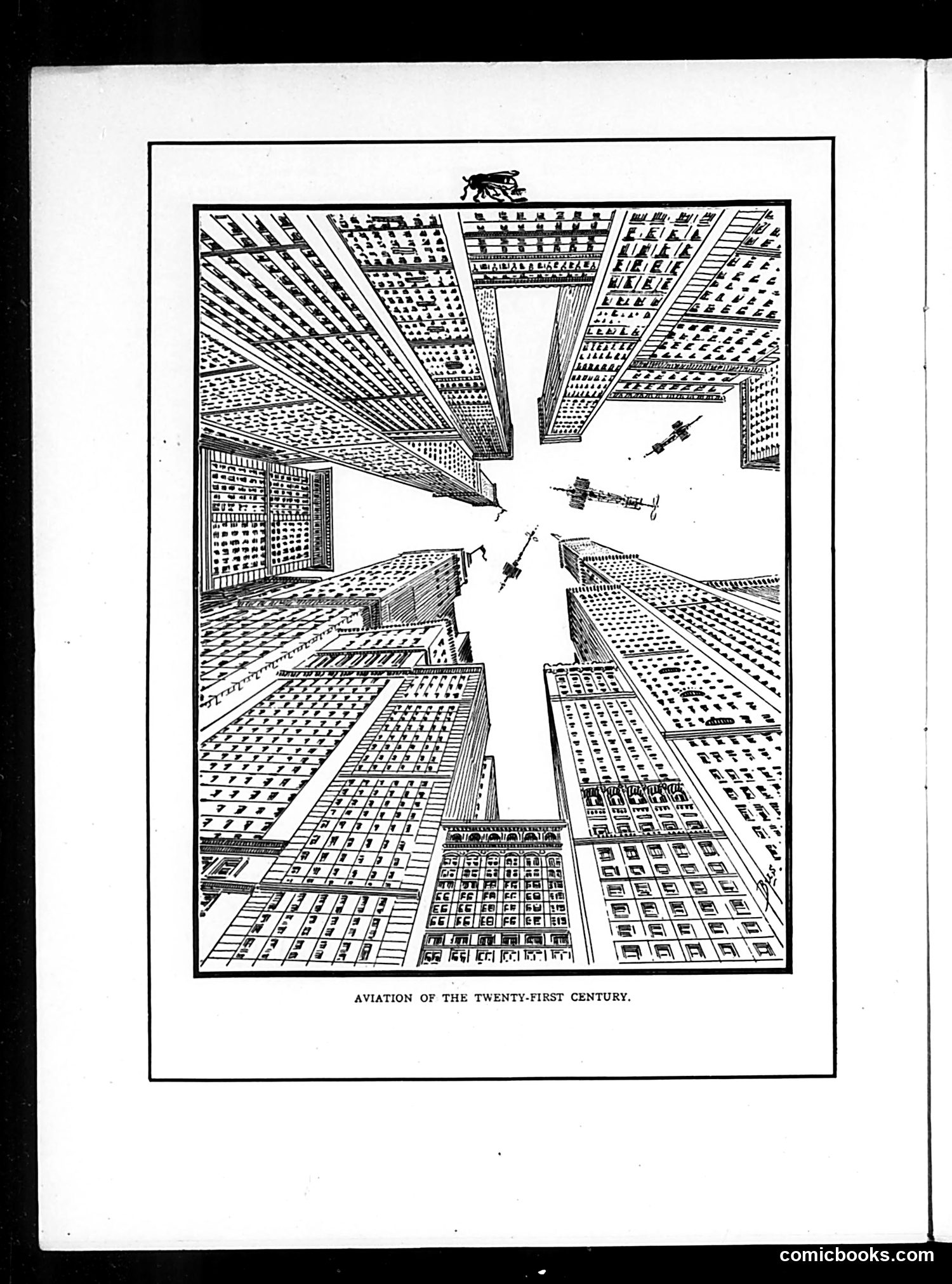
This is a satirical engraving depicting an imagined future of urban aviation. The illustration shows a densely packed cityscape viewed from above, with tall skyscrapers forming canyon-like streets. Multiple aircraft fill the sky between the buildings, suggesting that early 20th-century visionaries anticipated crowded aerial traffic above cities. The satire likely mocks both technological optimism and urban congestion anxieties of the era. Rather than celebrating aviation as liberating, the cartoon presents a chaotic vision where the sky becomes as congested as city streets below—replacing one problem with another. The crude OCR suggests the text identifies building details, but the illustration itself communicates the joke: technology may solve transportation but create new urban problems. This reflects common Judge magazine satire about industrial progress's unintended consequences.
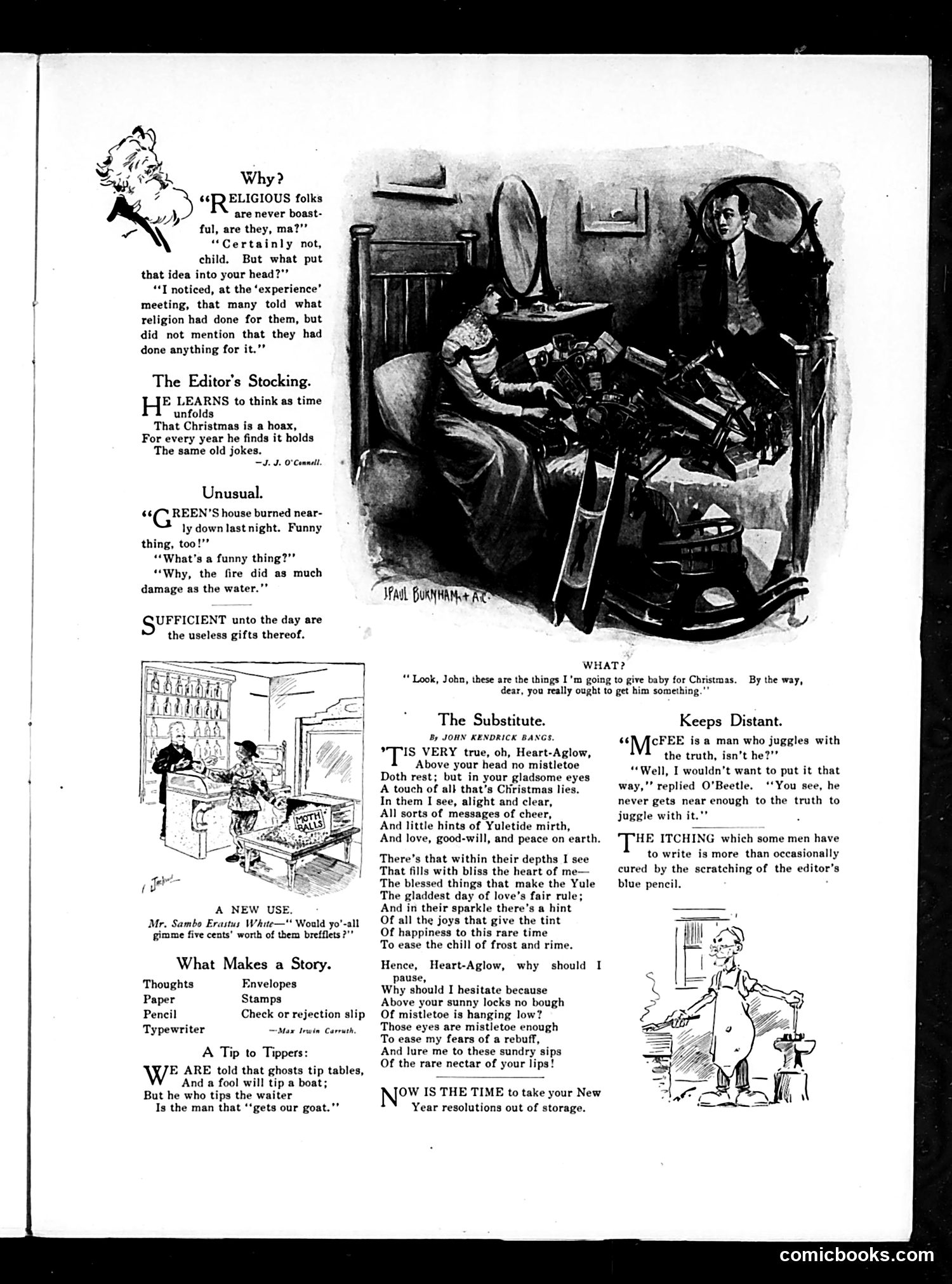
This page contains several short humorous pieces typical of Judge's satirical format: **"Why?"** mocks religious hypocrisy—a speaker claims religious folks are never boastful, yet they brag about charity work while ignoring other good deeds. **"The Editor's Stocking"** jokes that Christmas predictably repeats the same tired jokes annually. **"Unusual"** presents a pun: a house fire caused more damage than the water used to fight it—dark humor about disaster response. **"The Substitute"** is a poem about Christmas gifts and their emotional value versus materialism. **"Keeps Distant"** satirizes someone ("McFee") who claims to champion truth but avoids actually confronting it. The illustrations show domestic scenes. The central large image depicts what appears to be a printing or publishing operation, likely referencing Judge magazine's own production. The overall theme: mid-century American social commentary on commercialism, hypocrisy, and the gap between stated values and actual behavior.
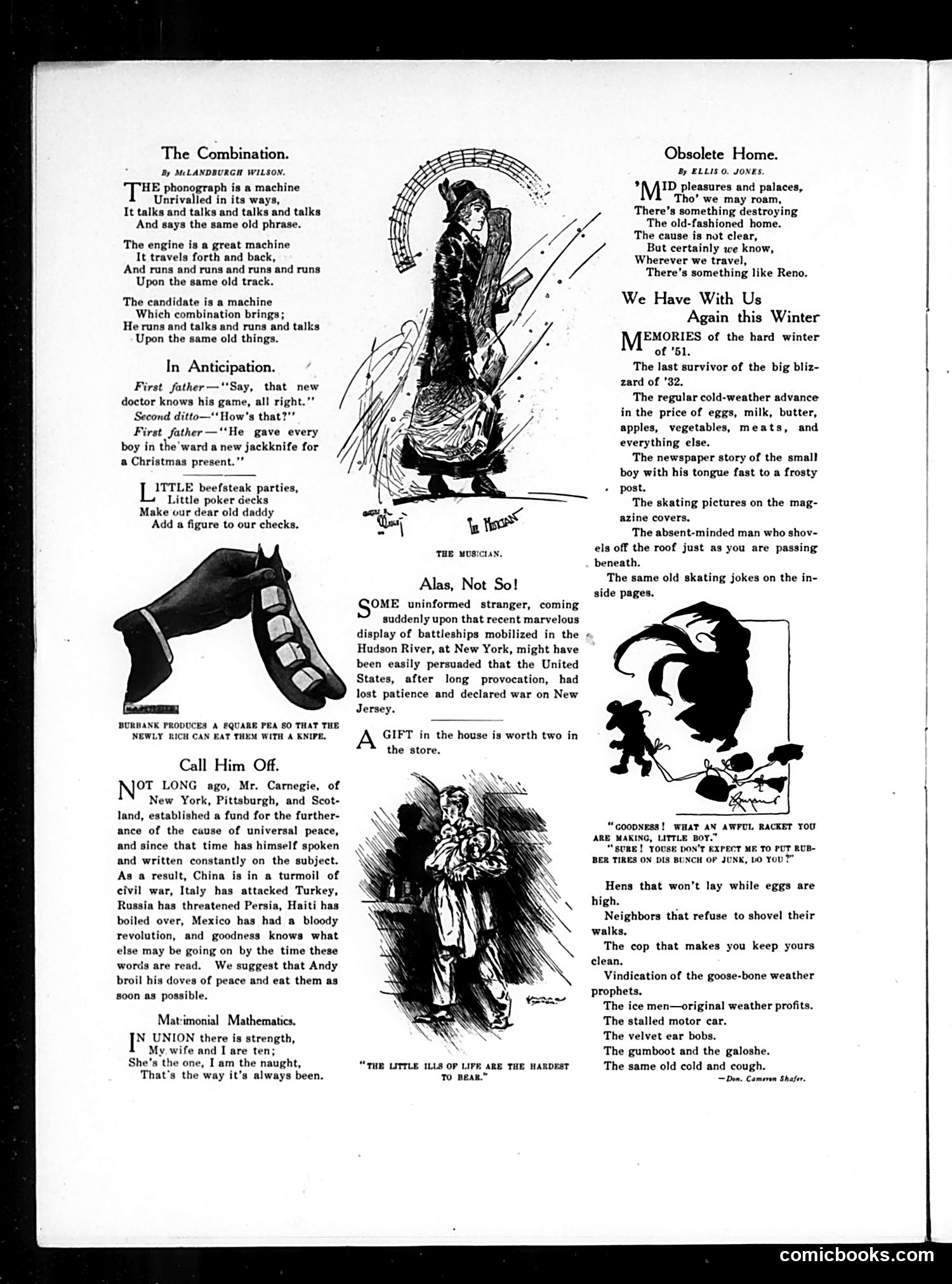
This page contains multiple satirical pieces typical of early 20th-century American humor: **"The Combination"** compares a political candidate to machines (phonograph, engine) that mechanically repeat themselves—satirizing politicians as mere repeaters of hollow rhetoric with no original thought. **"Call Him Off"** mocks Andrew Carnegie's peace advocacy efforts. The joke: despite Carnegie establishing a peace fund and publicly championing peace, international conflicts (China, Italy-Turkey, Russia-Persia, Haiti, Mexico) erupted anyway. The satire suggests his efforts are ineffectual, humorously proposing he eat his "doves of peace" since they're useless. **"Alas, Not So!"** jokes that a naval battleship display in New York's Hudson River was so impressive, an uninformed observer might think America had declared war on New Jersey—absurd exaggeration for comedic effect. **"Obsolete Home"** and the winter memories section are nostalgic/humorous commentary on changing domestic life and recurring seasonal inconveniences. The cartoons use exaggeration and irony typical of Judge's satirical approach to contemporary politics and social observation.
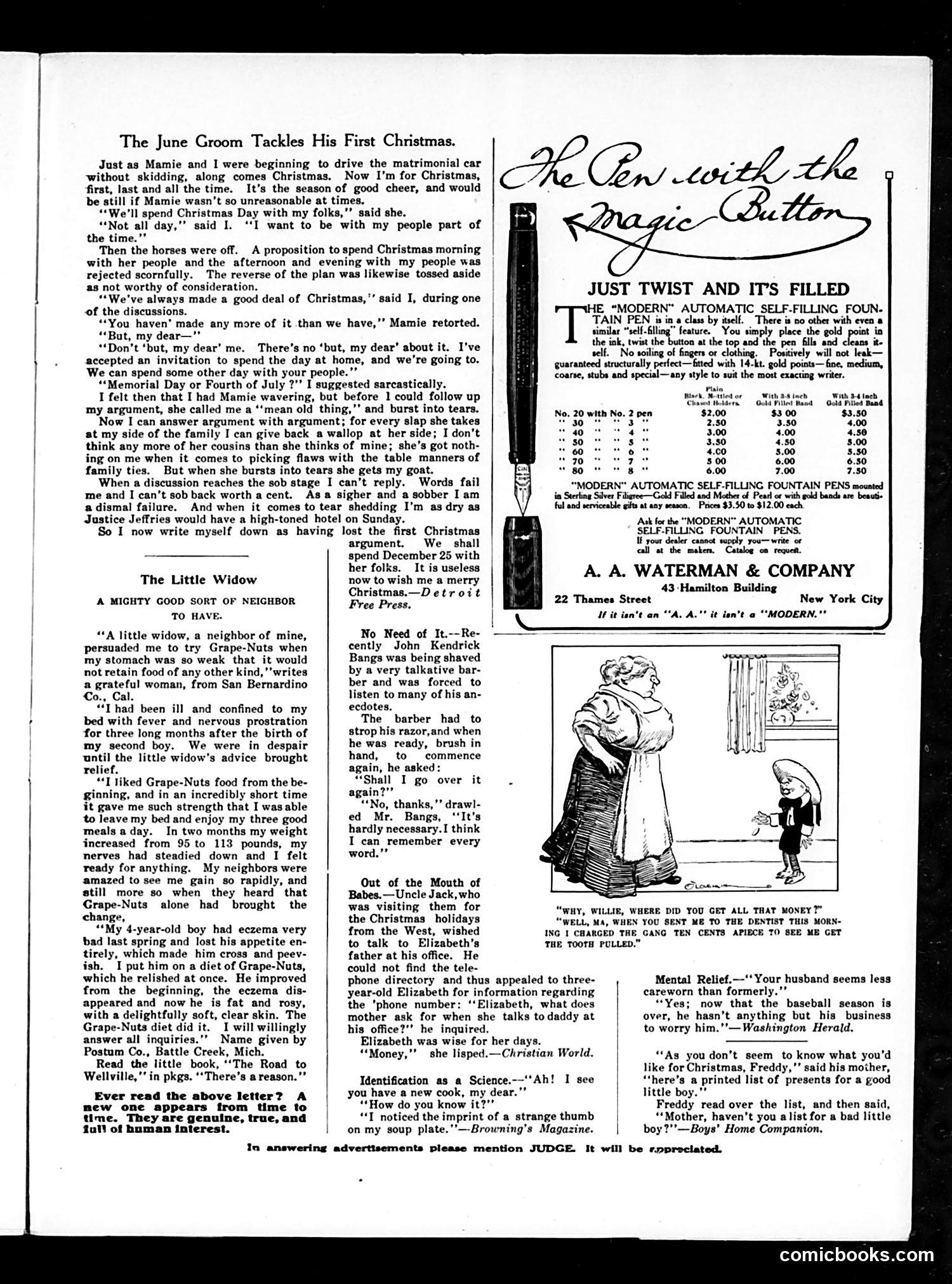
This page contains three distinct pieces typical of early 20th-century Judge magazine: **"The June Groom Tackles His First Christmas"** is a humorous marital dispute story where a newlywed husband and wife argue about spending Christmas Day. He wants to split time between their families; she insists on spending it entirely at her parents' home. The humor derives from the domestic conflict—a common theme—and concludes with the husband surrendering when his wife cries, unable to match her emotional display. The satire gently mocks both marital negotiations and masculine emotional inadequacy. **"The Little Widow"** is a Grape-Nuts cereal advertisement disguised as a testimonial, featuring a woman crediting the breakfast cereal with restoring her health after childbirth and nervous exhaustion. **"No Need of It"** is a brief anecdote about humorist John Kendrick Bangs at a barber shop, joking that the talkative barber's stories are so memorable he doesn't need his head shaved twice. The page also advertises A.A. Waterman fountain pens with decorative styling emphasizing their self-filling mechanism.
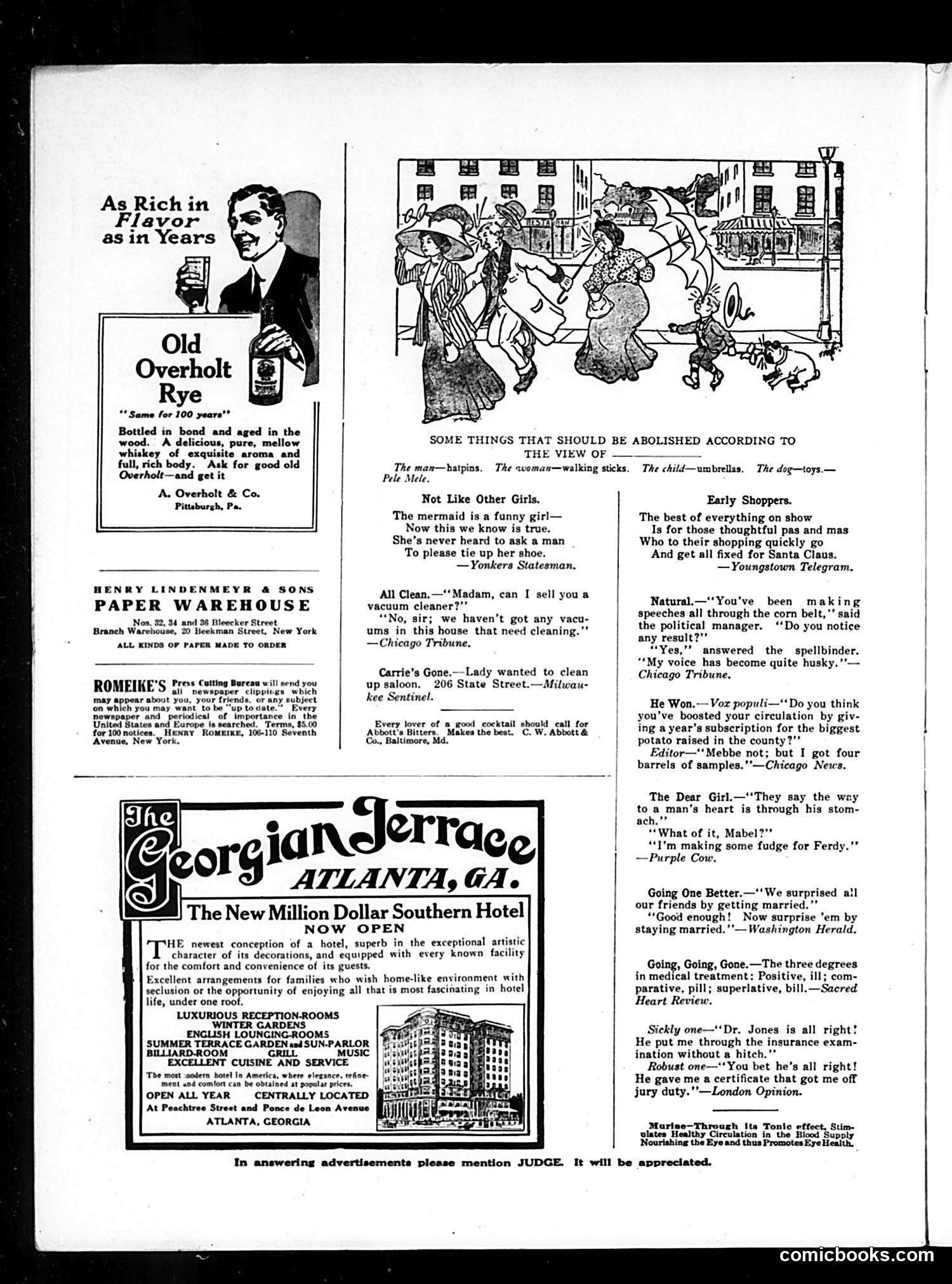
This page is primarily **advertisements and humorous short jokes** rather than political cartoons. The main cartoon at top depicts various figures (a man with batpins, woman with walking stick, child with umbrella, dog with toys) and sarcastically asks what "should be abolished"—a gentle satire on contemporary social complaints. The bulk of the page consists of: - **Liquor and product ads** (Old Overholt Rye whiskey, Abbott's Bitters, Murine eye tonic) - **Hotel advertisement** for Atlanta's Georgian Terrace - **Brief humorous quips** from various newspapers about everyday situations: mermaids, vacuum cleaners, saloon cleaning, political speeches causing hoarseness, medical treatments as grammatical degrees, insurance exams, and marriage The jokes reflect early-20th-century concerns: household management, political campaigning, courtship rituals, and medical skepticism. They're mild, domestic humor rather than hard-hitting satire—typical filler content for Judge magazine between advertisements.
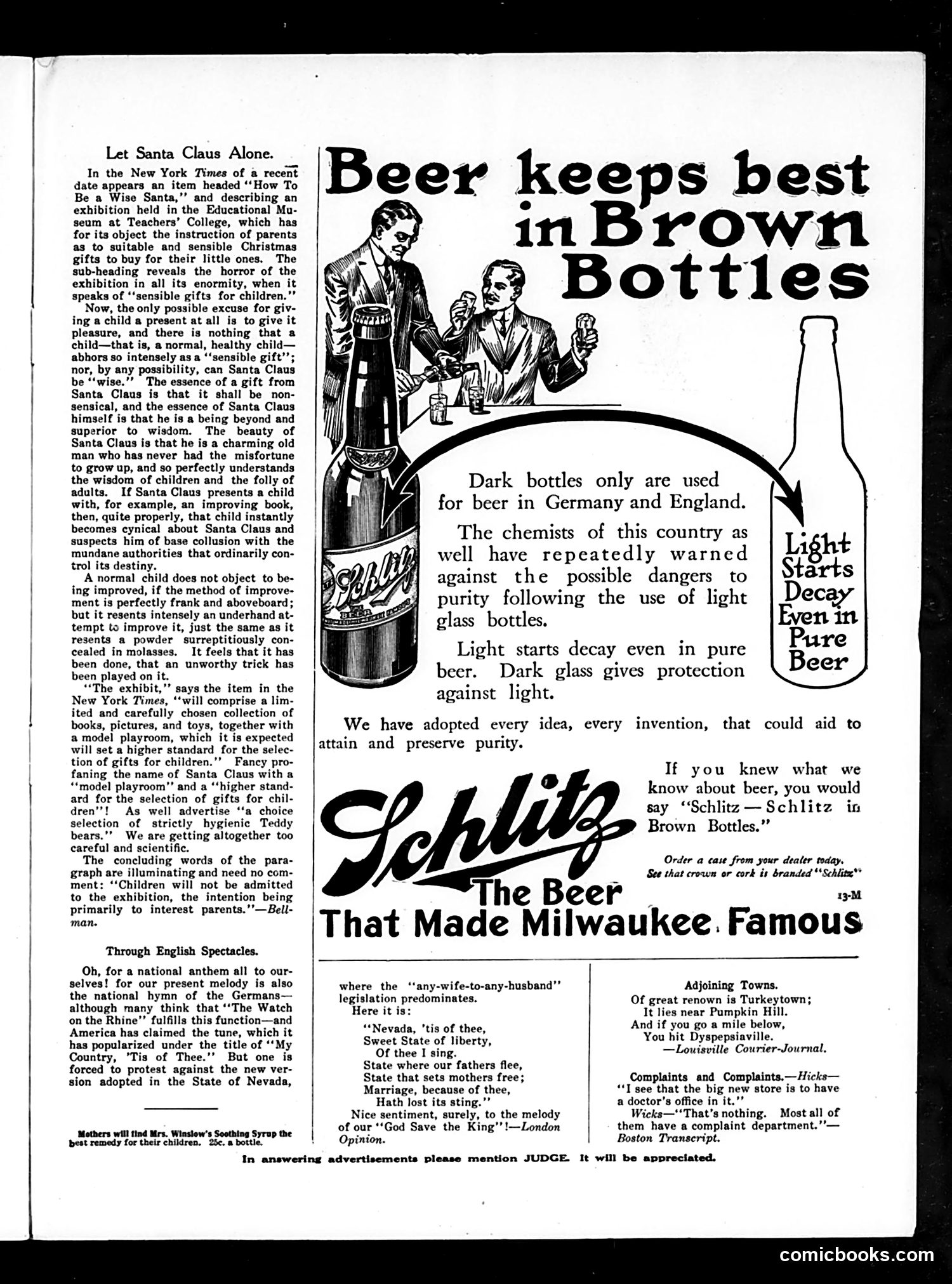
This page contains two distinct elements: **editorial content** and **advertising**. The left side features an editorial essay titled "Let Santa Claus Alone," satirizing a Teachers' College exhibition promoting "sensible" Christmas gifts for children. The author argues that Santa Claus's essential charm lies in giving *non-sensical* gifts—that educational, improving presents betray the spirit of Santa and make children suspicious they're being manipulated by adults. The satire targets earnest progressives who want to rationalize and improve childhood itself, viewing this as missing the point of Santa entirely. It's a defense of whimsy against moralizing. The right side is a **Schlitz beer advertisement** emphasizing that dark brown bottles protect beer from light decay. The ad claims chemists have warned against light-colored bottles, and that Schlitz has adopted "every idea, every invention" for purity—positioning the company as scientifically rigorous. The page also includes minor items: brief verses about Nevada's anthem and humorous "Adjoining Towns" observations.
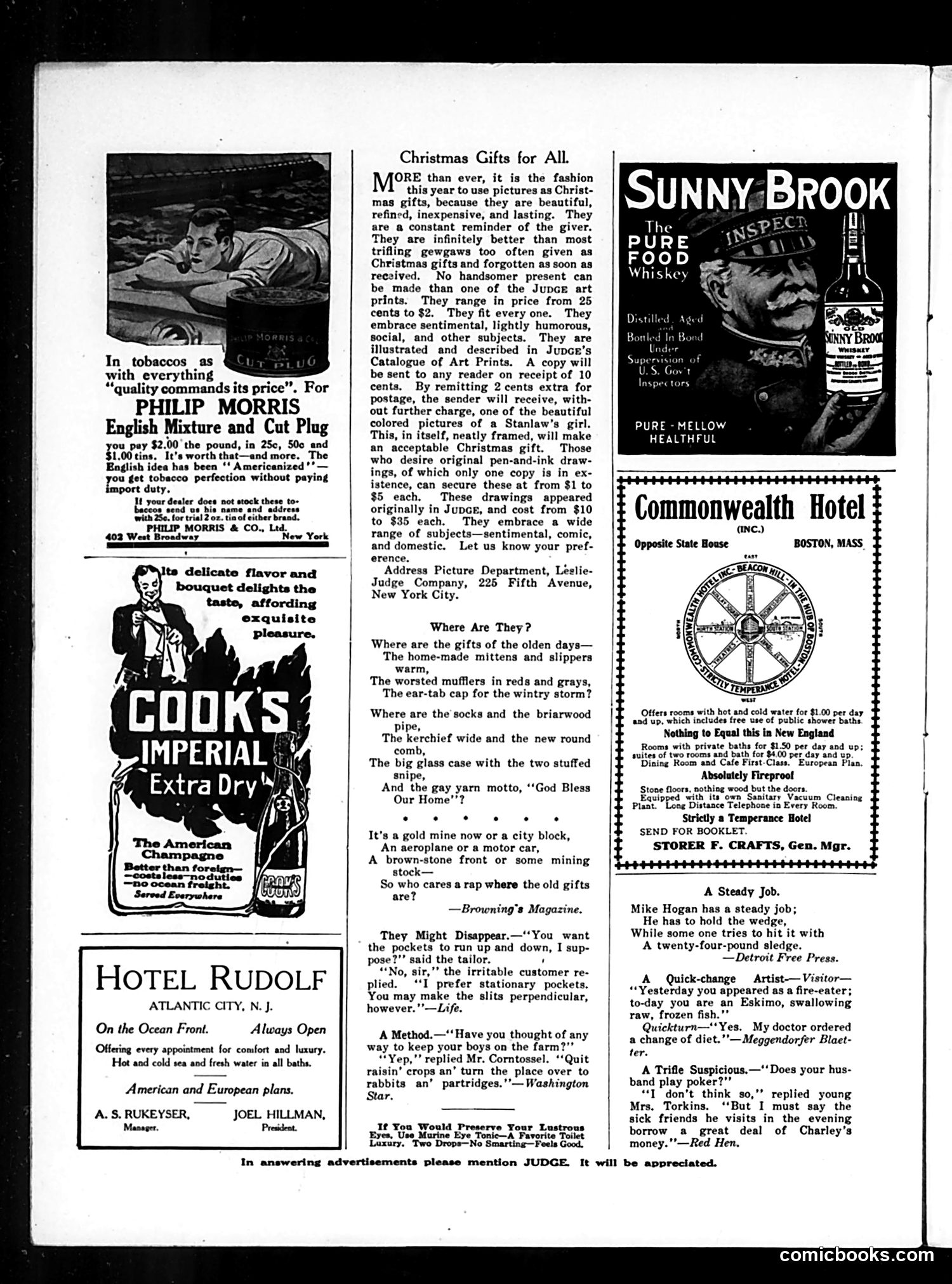
This page is primarily **advertising and filler content**, not political satire. It contains: **Advertisements:** Philip Morris tobacco, Cook's Imperial Extra Dry champagne, Hotel Rudolf (Atlantic City), Commonwealth Hotel (Boston), and Sunny Brook Whiskey dominate the layout. **Editorial Content:** The main feature, "Christmas Gifts for All," promotes Judge magazine's own art prints as holiday gifts—a self-promotional pitch. The accompanying poem "Where Are They?" nostalgically contrasts old-fashioned homemade gifts (mittens, scarves, pipes) with modern materialistic ones (real estate, automobiles, mining stock), gently satirizing contemporary consumer culture and the decline of domestic craft traditions. **Humor Items:** Brief jokes about tailors' pockets and farm management appear as filler. **Context:** This reflects early 20th-century Judge positioning itself as a sophisticated magazine for affluent readers, while advertising luxury goods and promoting its own merchandise to that same audience.
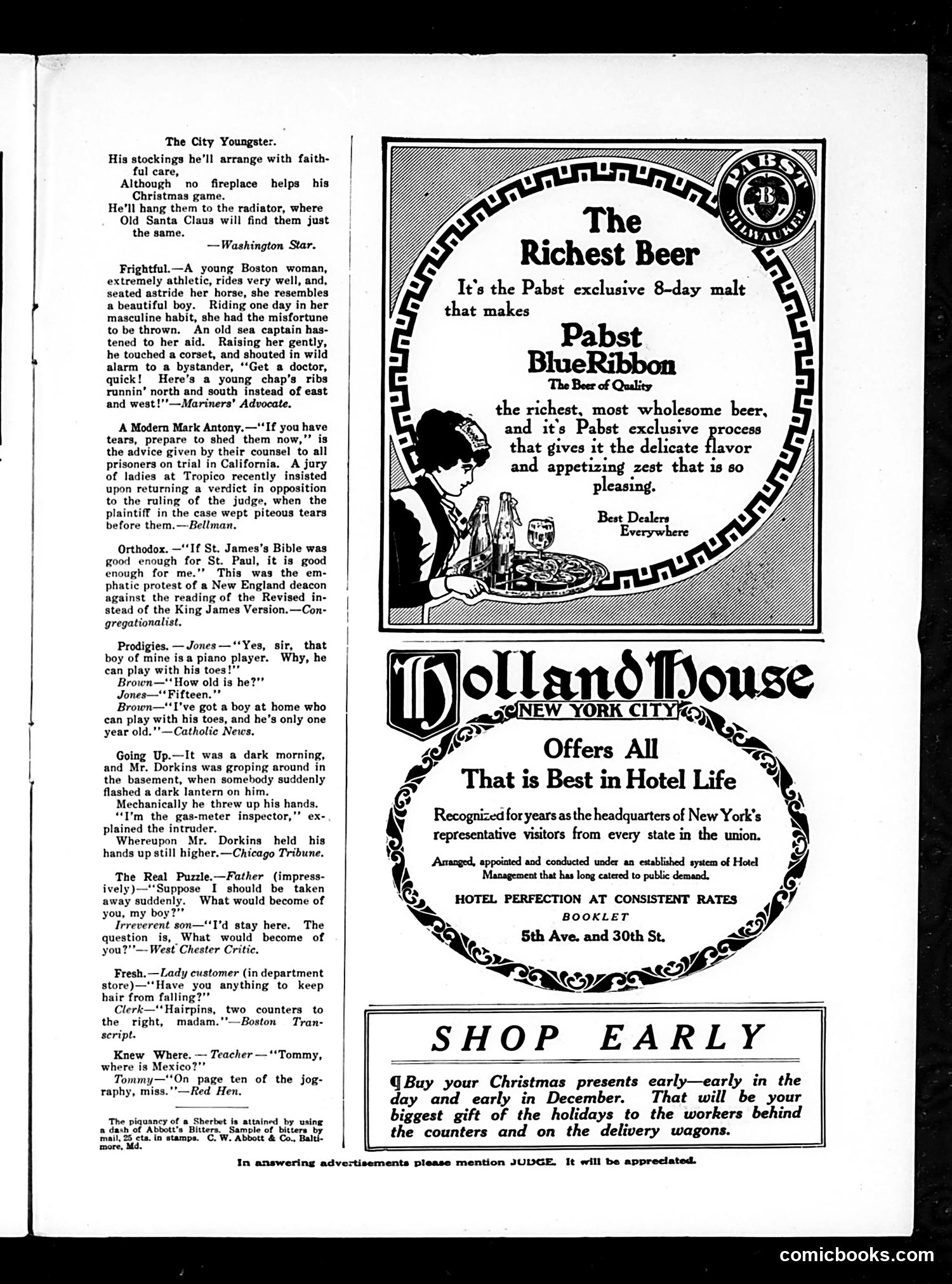
This page contains brief satirical anecdotes typical of Judge's humor, plus period advertisements. **The Cartoons/Jokes:** The page features six short humorous vignettes rather than illustrated cartoons: 1. **"The City Youngster"** mocks urban children lacking fireplaces, hanging stockings on radiators instead—satirizing modern city life versus traditional Christmas. 2. **"Frightful"** jokes about a masculine-dressed woman rider thrown from a horse; a sea captain mistakes her corset for broken ribs in masculine clothing. 3. **"A Modern Mark Antony"** satirizes California juries of women who cry easily and ignore judges' rulings—reflecting contemporary anxieties about women's suffrage/jury duty. 4. The remaining anecdotes mock: Bible literalism, child prodigies, working-class anxiety (gas-meter inspector), family dynamics, and student ignorance. **Context:** These reflect early 1900s American concerns—urbanization, women's changing roles, education, and class dynamics. The humor relies on wordplay and social observation typical of Judge's satirical style. The page is primarily **advertising-heavy** (Pabst Beer, Holland House Hotel).
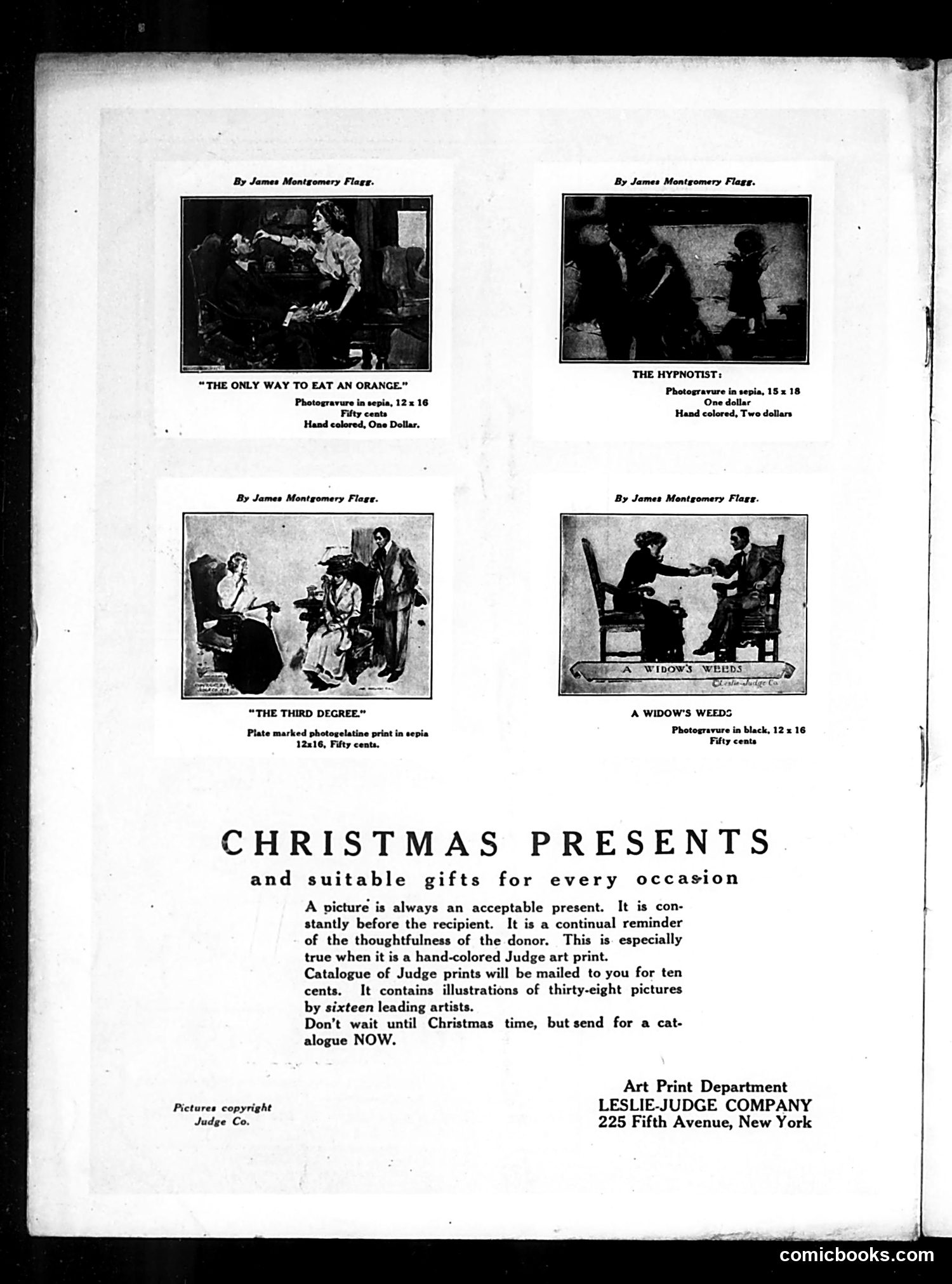
This is primarily an **advertisement page** rather than satirical content. It showcases four James Montgomery Flagg illustrations available for purchase as art prints through Leslie-Judge Company. The four cartoons advertised are: - "The Only Way to Eat an Orange" - "The Hypnotist" - "The Third Degree" - "A Widow's Weeds" The images appear to depict domestic and social scenarios typical of early 20th-century Judge humor—though the reproduction quality makes specific details difficult to discern. "The Third Degree" likely references police interrogation tactics, a common satirical subject. The main text is a **sales pitch** arguing that Judge art prints make ideal Christmas gifts because they're constant reminders of the donor's thoughtfulness. The company encourages readers to request their catalog immediately rather than wait until the holiday season. This reflects Judge's dual function as both satirical magazine and commercial art publisher.