
Judge, 1911-12-16 · page 21 of 24
Judge — December 16, 1911 — page 21: what you’re looking at
What you’re looking at
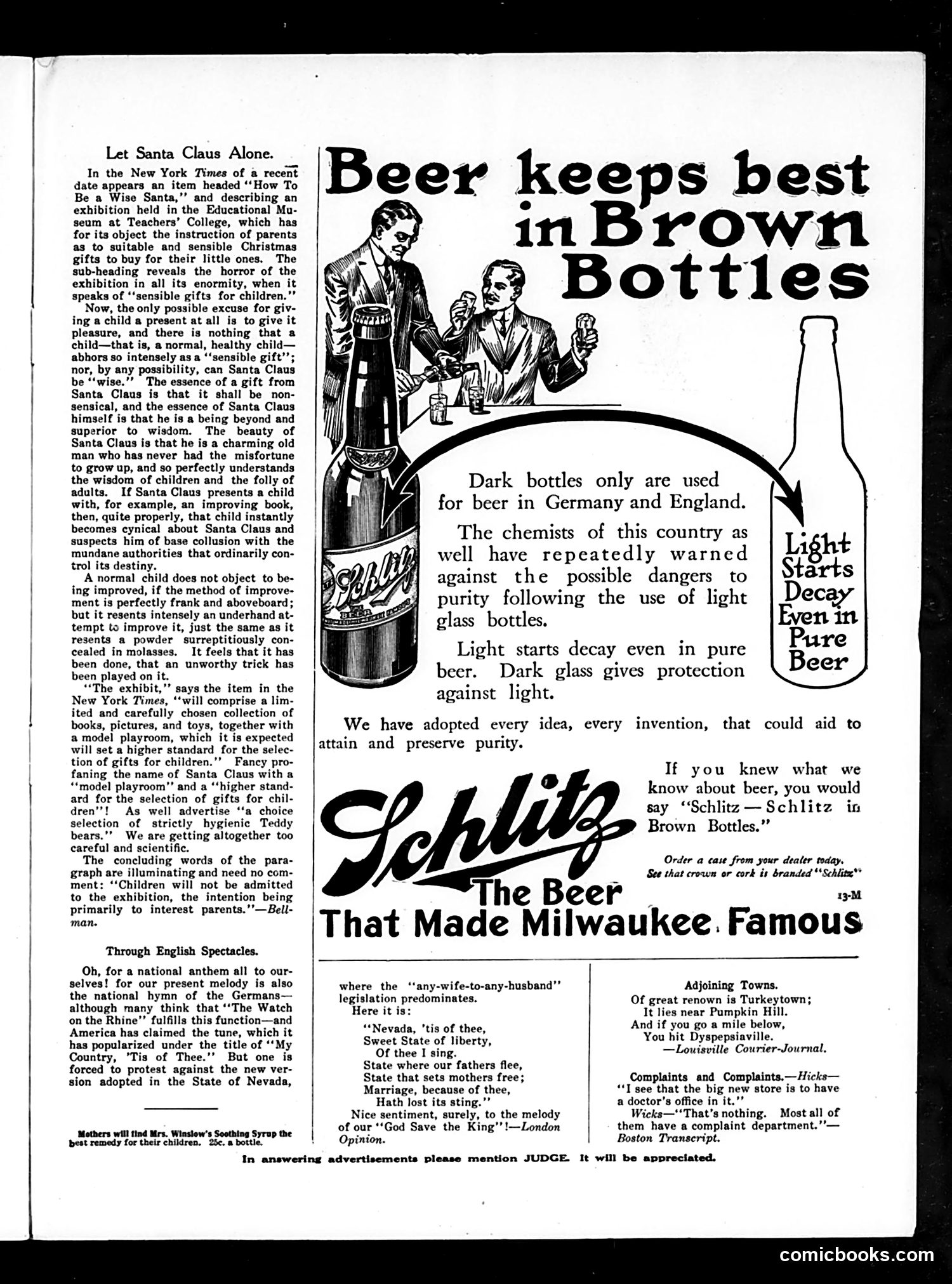
This page contains two distinct elements: **editorial content** and **advertising**. The left side features an editorial essay titled "Let Santa Claus Alone," satirizing a Teachers' College exhibition promoting "sensible" Christmas gifts for children. The author argues that Santa Claus's essential charm lies in giving *non-sensical* gifts—that educational, improving presents betray the spirit of Santa and make children suspicious they're being manipulated by adults. The satire targets earnest progressives who want to rationalize and improve childhood itself, viewing this as missing the point of Santa entirely. It's a defense of whimsy against moralizing. The right side is a **Schlitz beer advertisement** emphasizing that dark brown bottles protect beer from light decay. The ad claims chemists have warned against light-colored bottles, and that Schlitz has adopted "every idea, every invention" for purity—positioning the company as scientifically rigorous. The page also includes minor items: brief verses about Nevada's anthem and humorous "Adjoining Towns" observations.
📄 Transcribed text from this page (OCR, searchable)
Machine-transcribed from the original scan — historical spelling and the odd misread are preserved.
Let Santa Claus Alone. In the New York Times of a recent date appears an item headed ‘‘How To Be a Wise Santa,’’ and describing an exhibition held in the Educational Mu- seum at Teachers’ College, which has for its object the instruction of parents as to suitable and sensible Christmas gifts to buy for their little ones. The ib speaks of ‘‘sensible gifts for children.” Now, the only possible excuse for giv- ing a child a present at all is to give it pleasure, and there is nothing that a child—that is, a normal, healthy child— abhors so intensely as a ‘‘sensible gift’; nor, by any possibility, can Santa Claus be ‘‘wise.’’ The essence of a gift from Santa Claus is that it shall be non- sensical, and the essence of Santa Claus himself is that he is a being beyond and superior to wisdom. The beauty of Santa Claus is that he is a charming old man who has never had the misfortune to grow up, and so perfectly understands the wisdom of children and the folly of adults. If Santa Claus presents a child with, for example, an improving book, then, quite properly, that child instantly becomes cynical about Santa Claus and suspects him of base collusion with the mundane authorities that ordinarily con- trol its destiny. A normal child does not object to be- ing improved, if the method of improve- ment is perfectly frank and aboveboard; but it resents intensely an underhand at- tempt to improve it, just the same as it resents a powder surreptitiously con- cealed in molasses. It feels that it has been done, that an unworthy trick has been played on it. “The exhibit,’’ says the item in the New York Times, ‘‘will comprise a lim- ited and carefully chosen collection of books, pictures, and toys, together with a model playroom, which it is expected will set a higher standard for the selec- tion of gifts for children.’ Fancy pro- faning the name of Santa Claus with a “model playroom” and a ‘“‘higher stand- ard for the selection of gifts for chil- dren’! As well advertise ‘‘a choice selection of strictly hygienic Teddy bears.’’ We are getting altogether too careful and scientific. The concluding words of the para- graph are illuminating and need no com- ment: ‘‘Children will not be admitted to the exhibition, the intention being primarily to interest parents.’’—Bell- man. Through English Spectacles. Oh, for a national anthem all to our- selves! for our present melody is also the national hymn of the Germans— although many think that ‘‘The Watch on the Rhine’’ fulfills this function—and America has claimed the tune, which it has popularized under the title of “My Country, 'Tis of Thee.’’ But one is forced to protest against the new ver- sion adopted in the State of Nevada, Mothers will find Mrs. Winslow's Soothing Syrup the peat remedy for their chives” 25e. a bottle, In answering advertisements please mention JUDGE. eer keeps best in Brown Botties Dark bottles only are used for beer in Germany and England. The chemists of this country as well have repeatedly warned against the possible dangers to purity following the use of light glass bottles. Light starts decay even in pure beer. Dark glass gives protection against light. We have adopted every idea, every invention, that could aid to attain and preserve purity. If you knew what we know about beer, you would say ‘Schlitz —Schlitz is Brown Bottles.” Order a case from your dealer today. \ See that crown or cork it branded “Schlita”* The Beer That Made Milwaukee. Famous where the ‘“any-wife-to-any-husband”’ Adjoining Towns. legislation predominates. Of great renown is Turkeytown; Here it is: It lies near Pumpkin Hill. “Nevada, ‘tis of thee, And if you go a mile below, Sweet State of liberty, You hit Dyspepsiaville. Of thee I sing. —Louisville Courier-Journal, State where our fathers flee, State that sets mothers free; Complaints and Complaints.—Hicks— Marriage, because of thee, “I see that the big new store is to have Hath lost its sting.’’ a doctor's office in it.’’ sentiment, surely, to the melody Wicks—That’s nothing. Most all of “God Save the King’’!—London them have a complaint department.”— Boston Transcript. It will be appreciated. comicbooks.com