
A complete issue · 24 pages · 1911
Judge — September 9, 1911
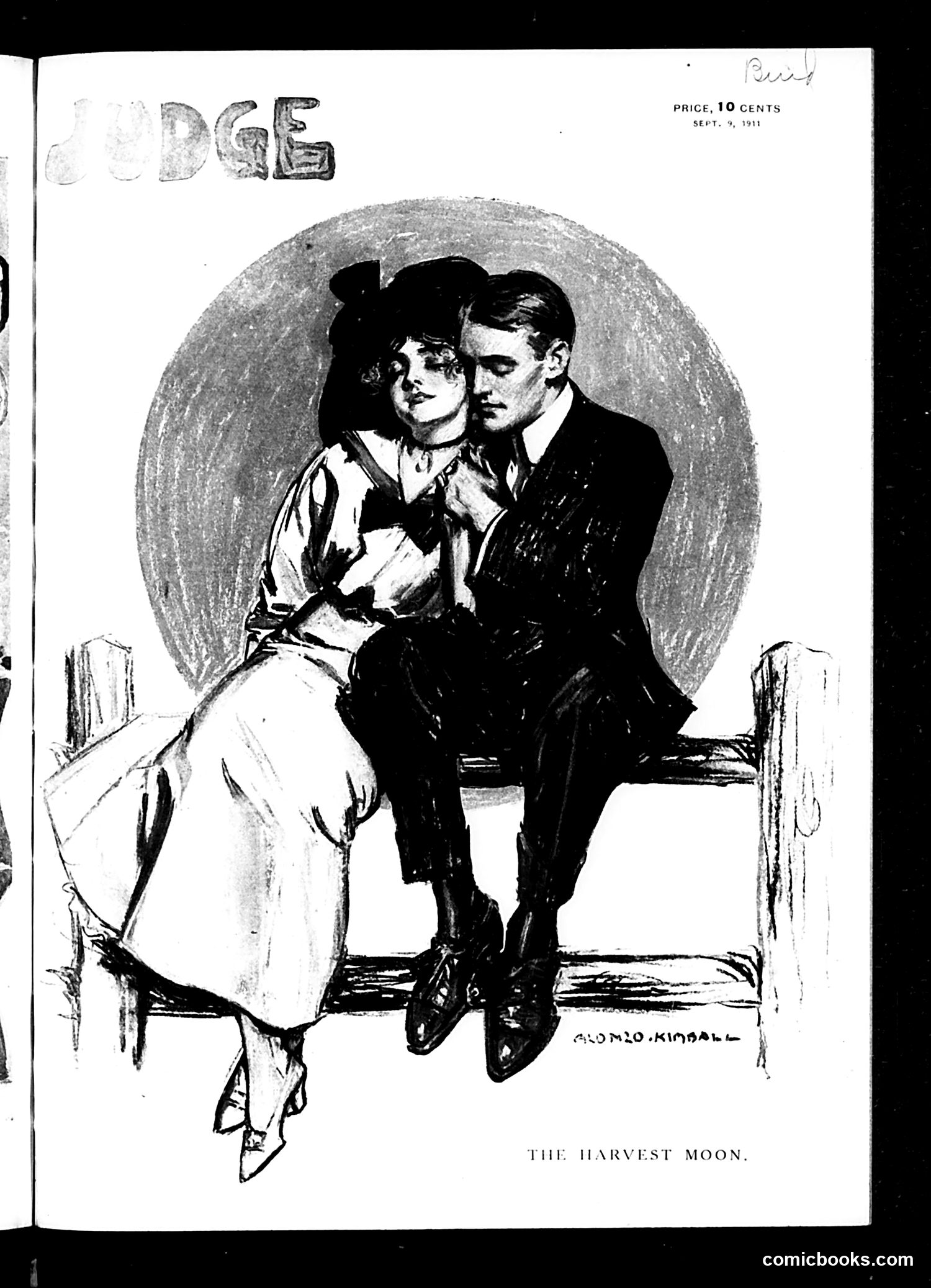
This illustration by Alonzo Kimball depicts a romantic couple seated together under a large moon. The title "The Harvest Moon" references the full moon occurring near the autumn equinox, traditionally associated with romance and courtship. The cartoon appears to be a straightforward romantic illustration rather than political satire—common content in Judge during this era. The intimate pose of the well-dressed couple gazing at the moon together plays on the period's sentimental association between moonlight and romance. There's no apparent political commentary or social criticism visible; instead, it reflects early 20th-century popular culture's romanticization of courtship and moonlit encounters. The 10-cent price point indicates this was accessible popular entertainment for the magazine's general readership.
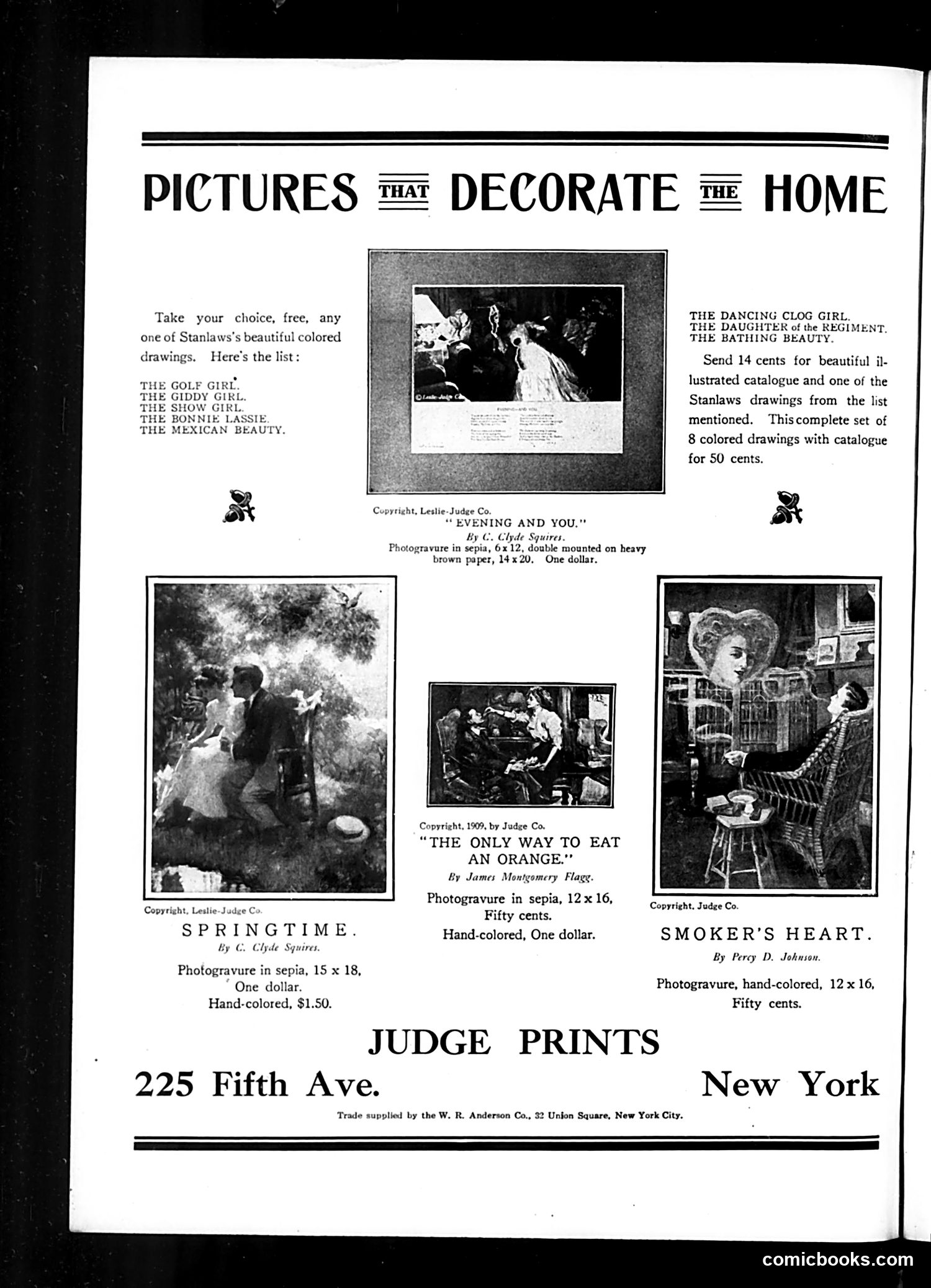
This page is primarily **advertising for Judge Prints**, a decorative art company selling reproductions. It's not a political cartoon or satire. The page advertises framed artworks by various artists, including "Evening and You" by C. Clyde Squires (top center), "Springtime" by the same artist (bottom left), "The Only Way to Eat an Orange" by James Montgomery Flagg (center), and "Smoker's Heart" by Percy D. Johnson (right). At the top, there's a promotional offer for Stanlaw's colored drawings—images of "The Golf Girl," "The Giddy Girl," and other similar subjects—available free or inexpensively to readers. The content reflects early 20th-century aesthetic taste: romantic genre scenes and character studies suited for home decoration. There is no evident political commentary or satire on this page.
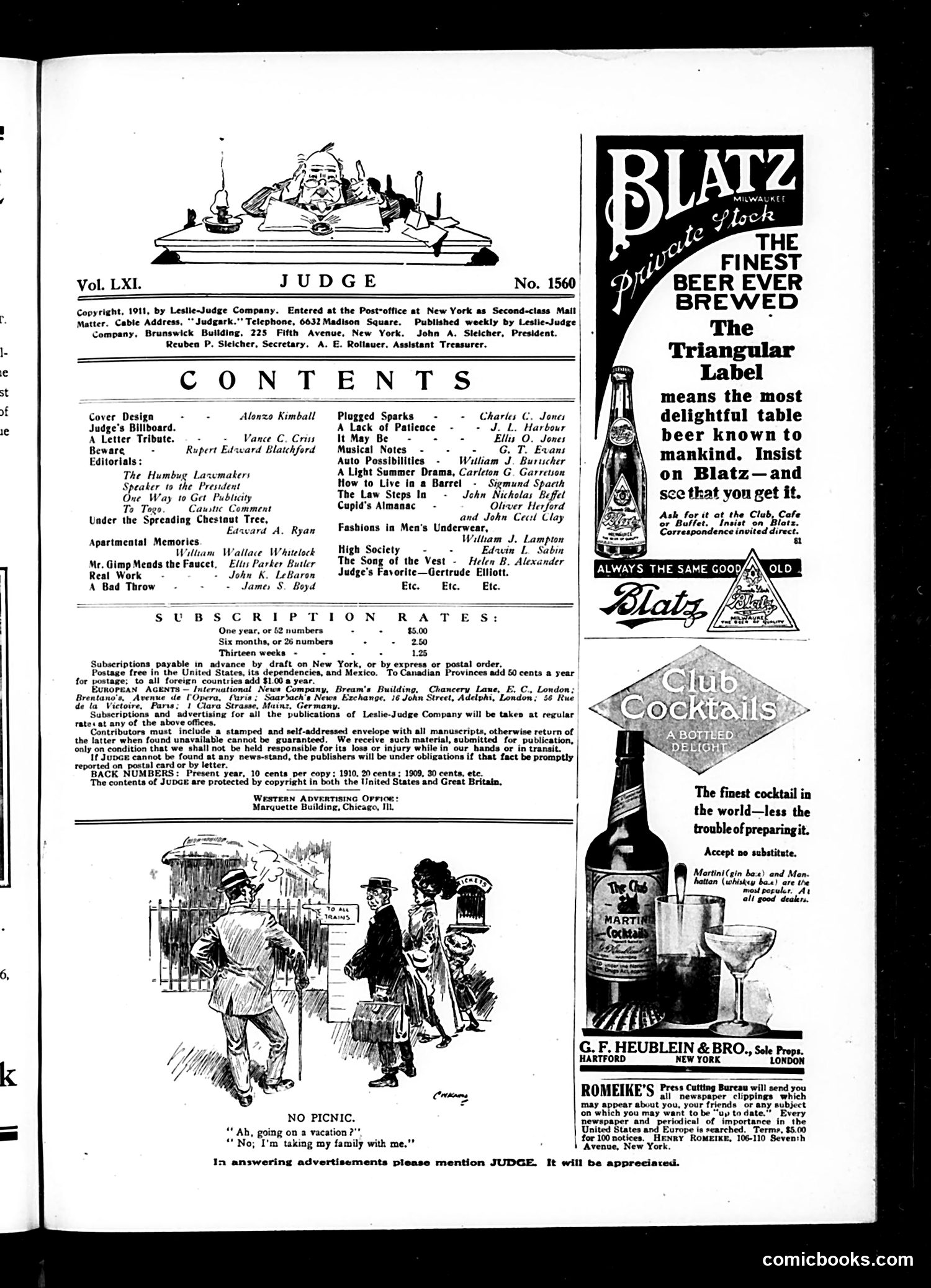
This page is primarily **advertising and table of contents** rather than political satire. The main cartoon shows two figures at what appears to be a gate or fence, with dialogue: "Ah, going on a vacation?" / "No, I'm taking my family with me." This is a **domestic humor joke**, likely playing on the common marital stereotype that wives are unwanted burdens on vacations—a relatively mild jab at marriage dynamics popular in early 20th-century magazines. The right side features **product advertisements** for Blatz beer and Club Cocktails, typical of Judge's commercial content during Prohibition or its immediate aftermath (given the alcohol marketing). The cartoonist is credited as "Cesare" (likely Cesare Biseo). Overall, this represents Judge's blend of light domestic humor and paid advertising rather than serious political commentary.
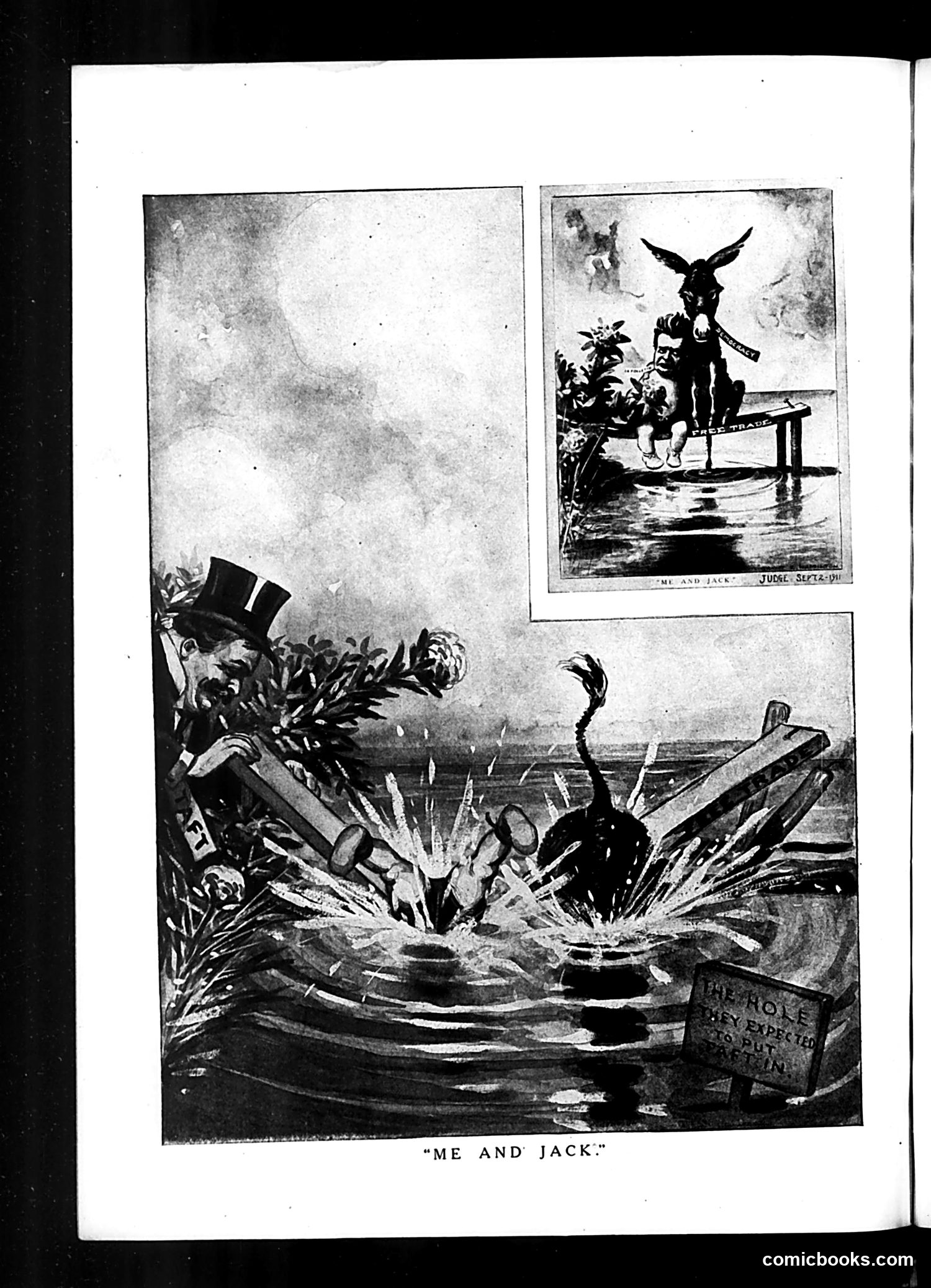
This page from *Judge* contains two satirical illustrations titled "Me and Jack." The larger bottom panel depicts an anthropomorphic donkey (wearing a top hat, likely representing the Democratic Party's traditional symbol) standing amid explosive warfare and destruction—cannons, ammunition, and debris surround it. A man in formal dress observes the chaos. The smaller top panel shows a similar donkey-headed figure on a dock or pier with a child. The satire appears to critique either Democratic Party politics or a specific political figure nicknamed "Jack" during a period of conflict or political turmoil. The contrast between the peaceful domestic scene (top) and violent destruction (bottom) suggests commentary on contradictory political positions or consequences of Democratic policies. Without the magazine's date, the specific historical reference remains unclear.
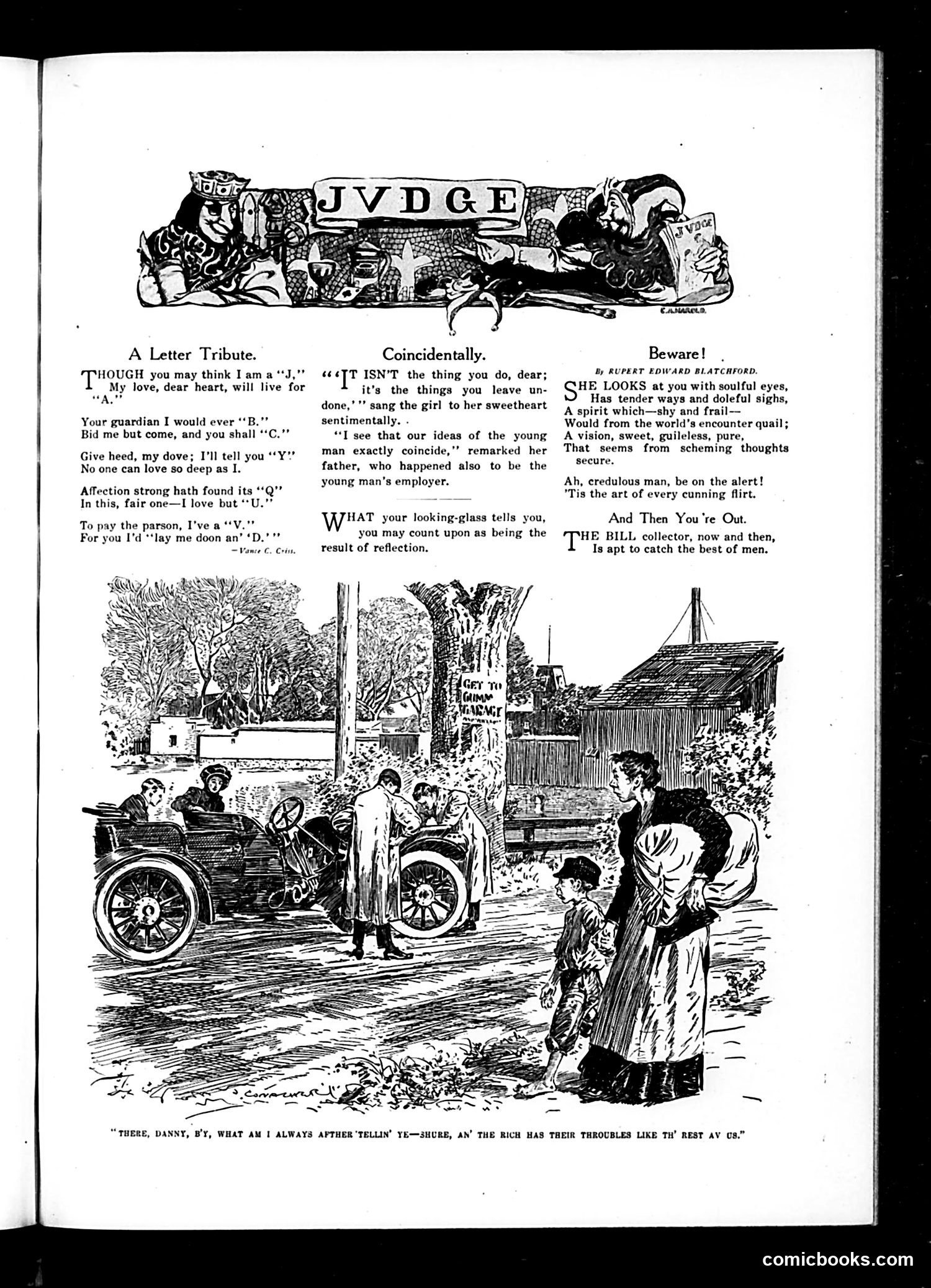
This page contains **satirical poetry and social commentary** rather than political cartoons. The poems mock various targets: 1. **"A Letter Tribute"** uses alphabet letters as double entendres to satirize romantic relationships and courtship conventions. 2. **"Coincidentally"** critiques a young woman's hypocrisy—she claims not to care about her appearance yet carefully uses mirrors and "scheming thoughts" to attract men. 3. **"Beware!"** warns against "cunning flirts" and seductive women. 4. **"And Then You're Out"** makes a cynical joke about bill collectors targeting men, presumably after they've been financially drained by romantic pursuits. The **illustration** depicts a social scene with an early automobile, showing class commentary on wealth and modernity. The overall theme satirizes gender relations, materialism, and romantic deception in early 20th-century American society.
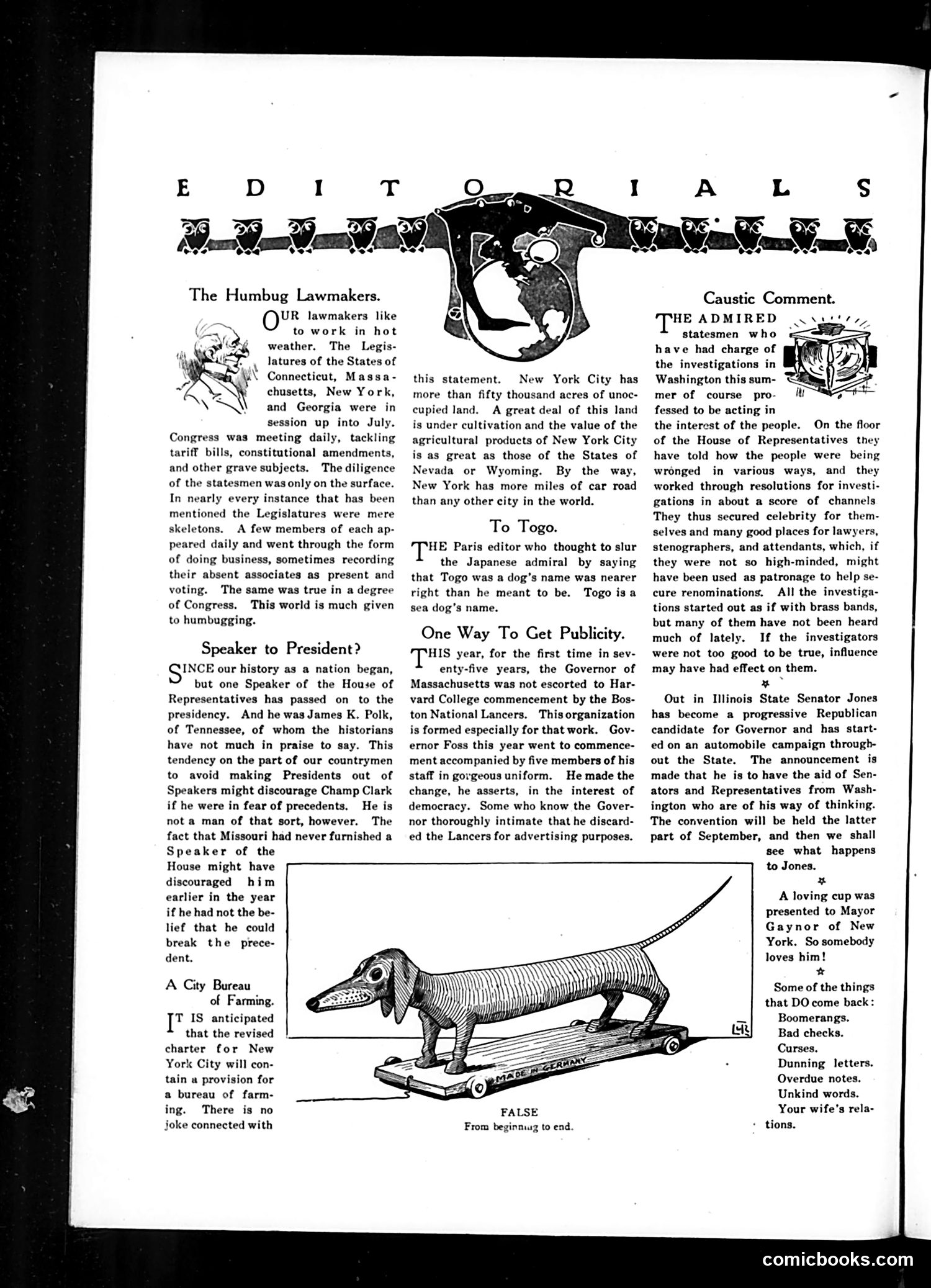
This page collects political satire and commentary on early 1910s American governance. **"The Humbug Lawmakers"** criticizes state legislatures and Congress for theatrical work—members appear present and vote while absent, merely performing legislative duty without substance. The central dachshund cartoon (labeled "FALSE / From beginning to end") likely satirizes some contemporary political claim. **Other commentary** includes: - Skepticism that House Speaker Champ Clark might become president (noting only one Speaker, James K. Polk, ever reached the presidency) - Mockery of Massachusetts Governor Foss discarding ceremonial Boston National Lancers escorts, claiming democratic principle while likely seeking publicity - Cynicism about Congressional investigations supposedly serving the public interest, suggesting they actually provide patronage and advancement The overall tone is acerbic about politicians' performative sincerity and hidden self-interest. The magazine targets the gap between stated noble intentions and actual motives in governance.
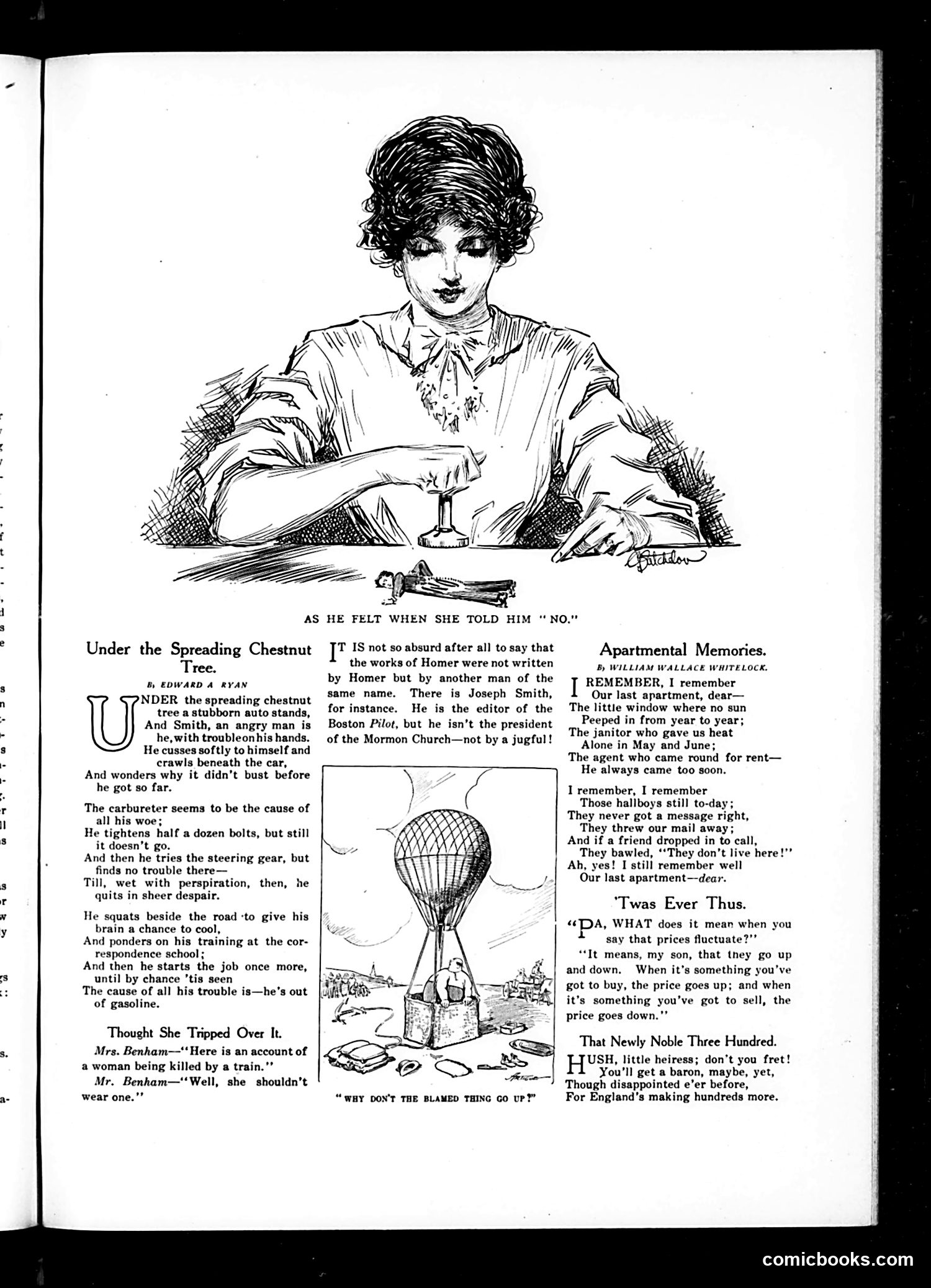
This page contains several humorous pieces satirizing early 20th-century American life: **"Under the Spreading Chestnut Tree"** parodies Longfellow's famous poem, substituting an automobile breakdown for pastoral nostalgia. The joke: a man spends hours troubleshooting his car only to discover he's simply run out of gas—mocking both mechanical incompetence and correspondence-school education. **"Apartmental Memories"** nostalgically catalogs apartment-living frustrations: unheated units, unreliable message service, intrusive landlords—presenting urban rental life as comically miserable. **The Joseph Smith reference** jokes about name ambiguity, distinguishing the Boston *Pilot* editor from the Mormon Church founder (both named Joseph Smith). **"That Newly Noble Three Hundred"** satirizes wealthy American heiresses marrying titled European men. The "newly noble" references England supposedly creating hundreds of new peerages, suggesting England is mass-producing baronetcies for rich American brides—mocking both transatlantic social climbing and British willingness to commercialize aristocracy.
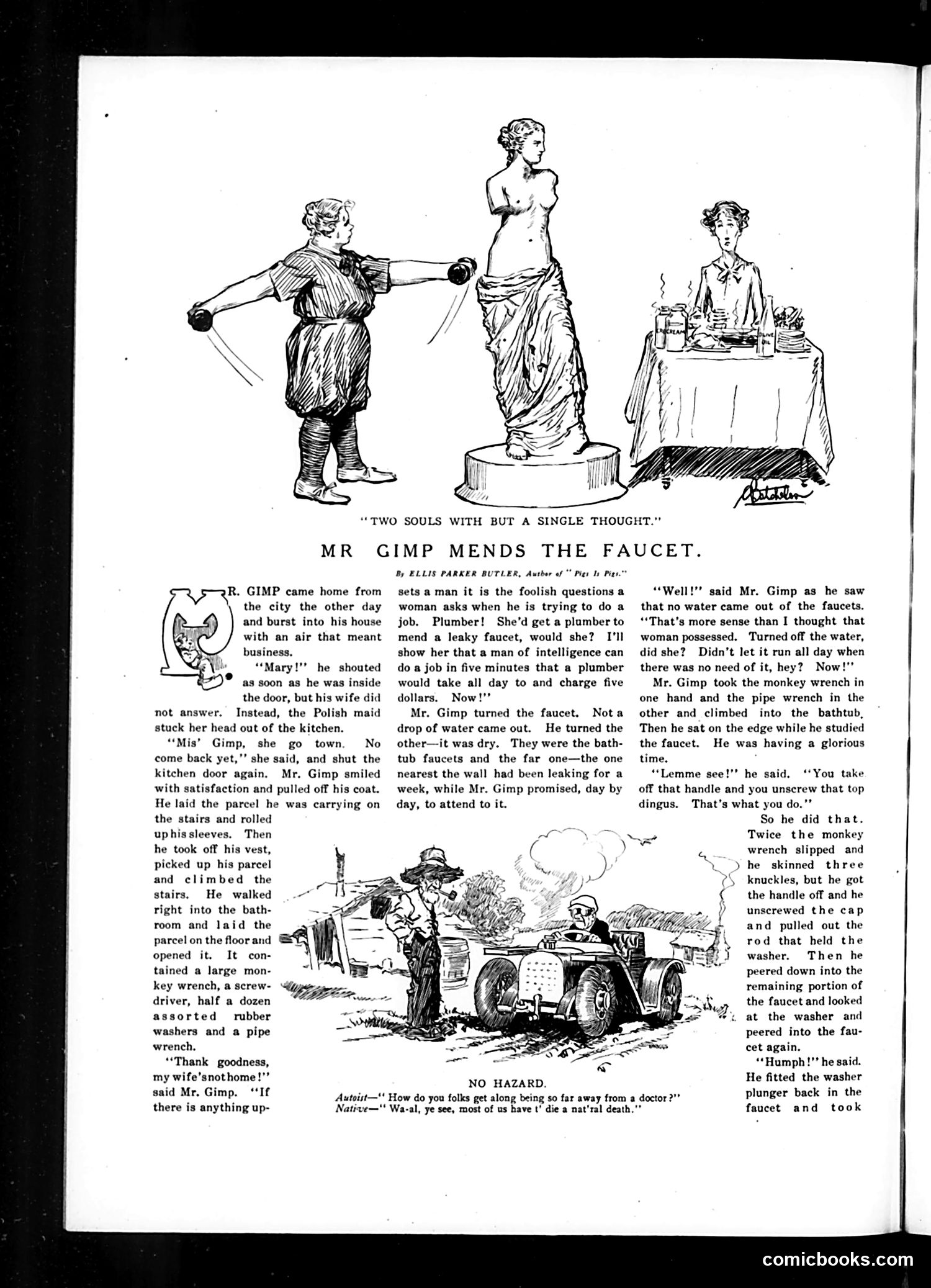
This humorous story by Ellis Parker Butler satirizes male ego and domestic incompetence. Mr. Gimp, a man of average means, is determined to repair a leaky bathroom faucet himself to prove his intelligence superior to hiring a professional plumber. The joke centers on his smugness—he's thrilled his wife is away so she won't ask "foolish questions" while he works. The cartoon illustrations show his confident posturing contrasted with the actual messiness of the job (the lower sketch depicts chaos). The title "Two Souls with But a Single Thought" ironically suggests marital harmony while depicting their opposing views: his pride versus her practicality about calling a plumber. The piece pokes fun at early 20th-century masculine pride and the common male fantasy of handiwork competence—a recognizable archetype even today.
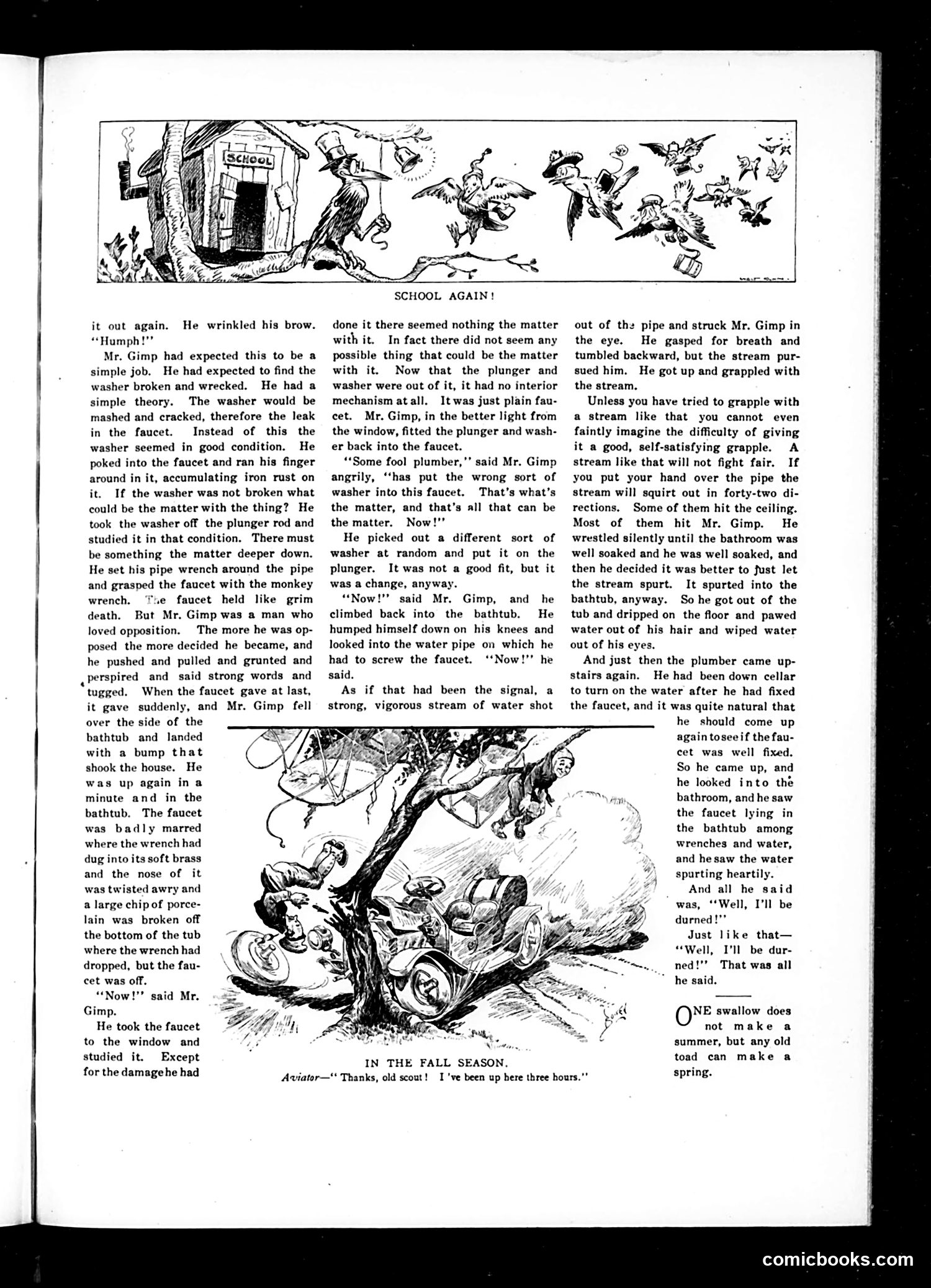
This page presents a humorous domestic narrative about Mr. Gimp, an amateur handyman attempting to repair a leaky faucet. The story satirizes the overconfidence and persistence of do-it-yourselfers who lack actual plumbing knowledge. The joke: Gimp assumes the problem is simple (a worn washer) but, finding the washer in good condition, proceeds with destructive guesswork. He damages the faucet and bathroom attempting to disassemble it, then arbitrarily swaps the washer without diagnosing the real issue. When he finally reconnects the water, a powerful stream shoots directly at him, and he futilely attempts to "grapple" with flowing water in comedic fashion. The cartoon strip at top ("SCHOOL AGAIN!") shows children fleeing back to school, likely referencing post-summer chaos. The satire targets the American male's stubborn determination to "fix it himself" despite incompetence—a common Judge theme mocking masculine pride and ignorance masquerading as competence.
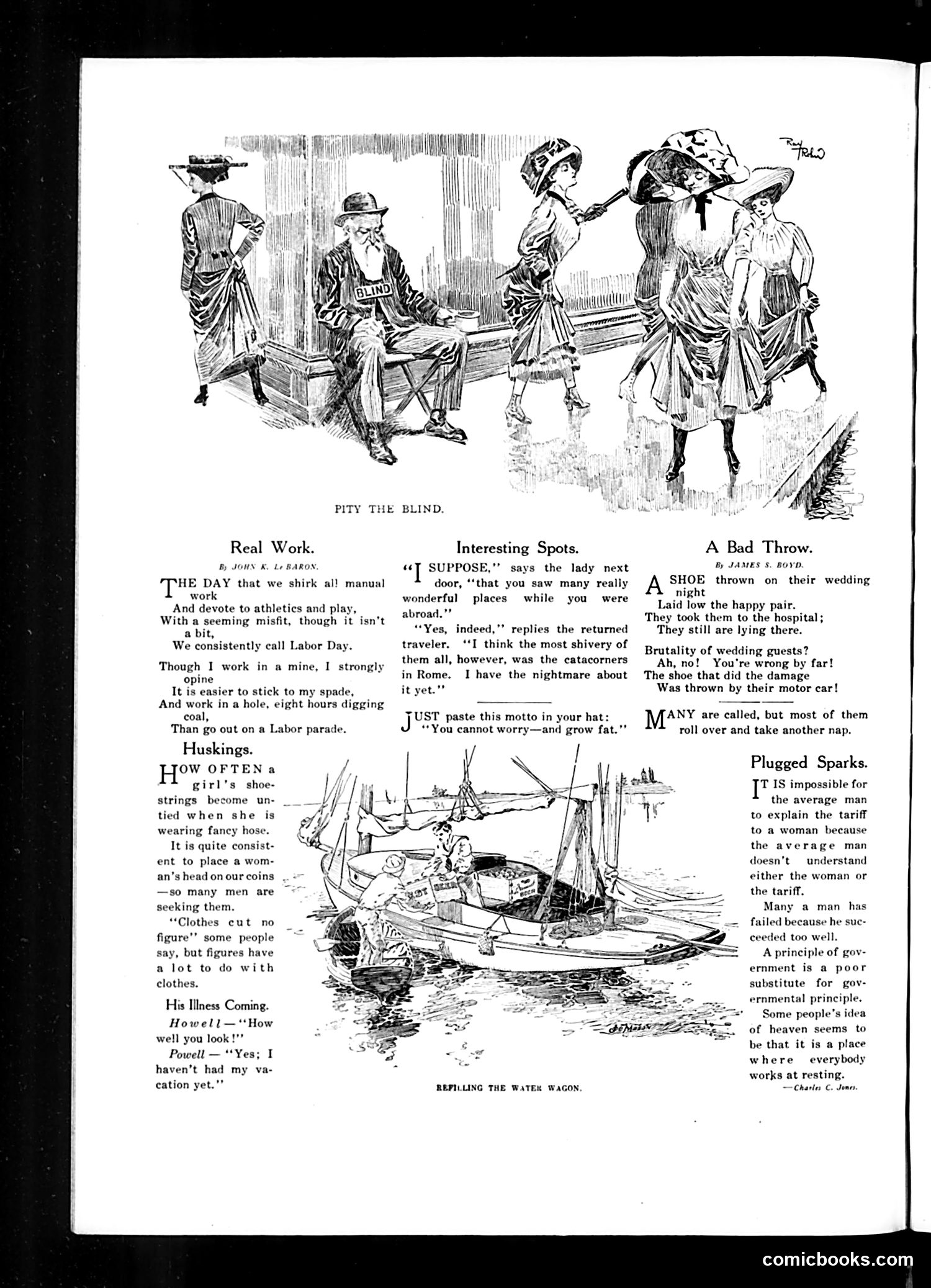
This page from Judge contains several satirical pieces mocking early 20th-century American life and attitudes. **"Real Work"** critiques the hypocrisy of Labor Day celebrations—workers abandon actual labor to parade around, celebrating idleness while claiming to honor work itself. **"Interesting Spots"** satirizes superficial travel culture: a returned tourist found Rome's catacombs frightening rather than meaningful, reducing grand historical sites to mere curiosities. **"A Bad Throw"** is a dark joke: wedding guests threw shoes (a traditional practice) that damaged a car, which then injured the newlyweds—mocking both wedding customs and the new automobile age's dangers. **"Huskings"** and other sections offer brief social commentary on women's fashion, the tariff debate (a major political issue), and general human weakness. **"Refilling the Water Wagon"** illustration (bottom) depicts street labor—likely critiquing working-class conditions. Overall, Judge uses gentle satire to comment on American pretension, labor exploitation, and modernization's disruptions.
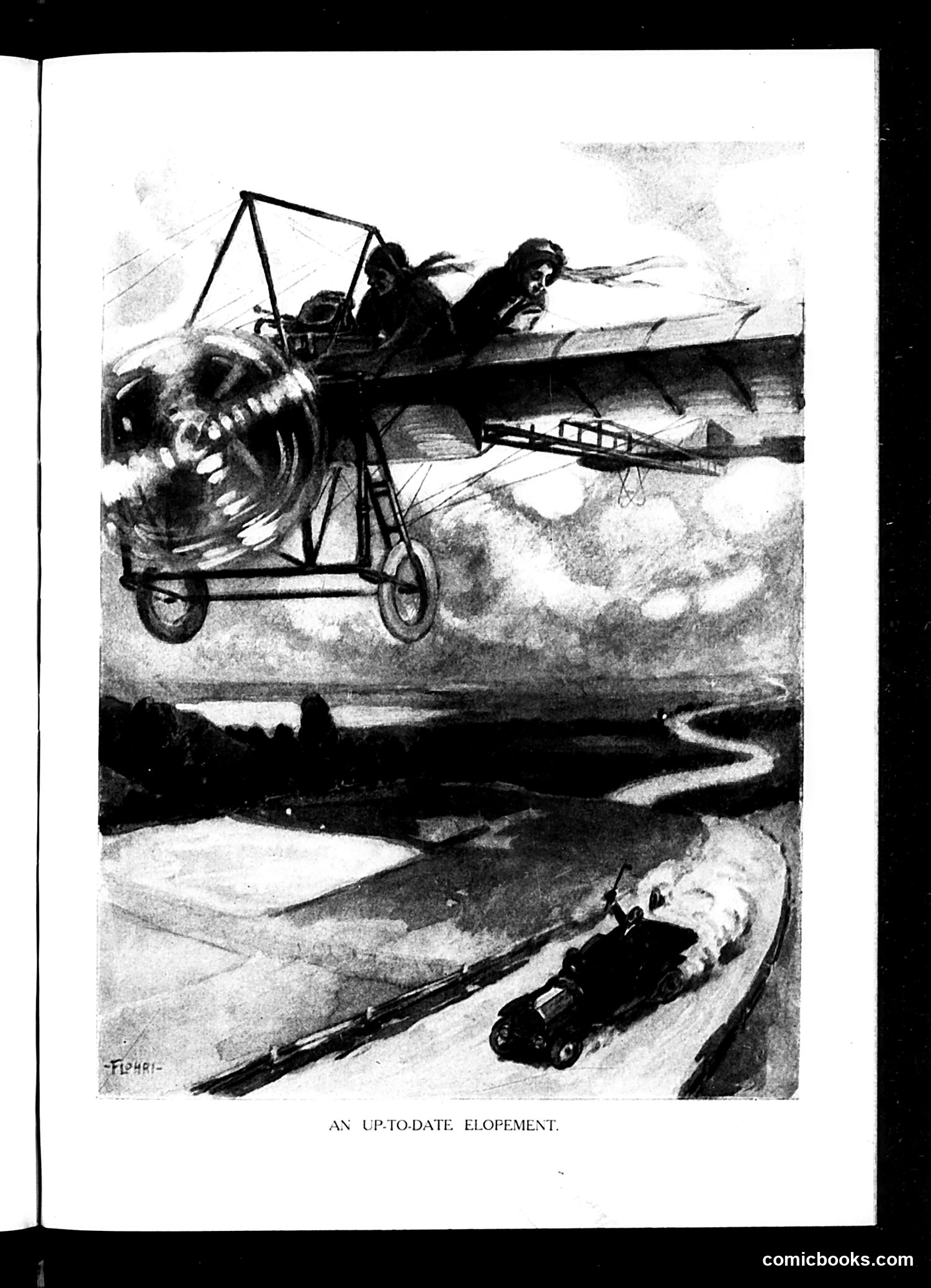
This cartoon satirizes modern elopement methods by contrasting contemporary technology with traditional romance. Two figures flee in an early airplane (circa 1910s-1920s), representing the latest in aviation technology—a dramatic departure from the horse-and-buggy escapes of previous generations. Below, a toy racing car on tracks appears to represent the outdated method of elopement, now comically obsolete. The satire mocks how rapidly technology was transforming even intimate human experiences like romantic getaways. By showing lovers literally ascending above older modes of transport, the cartoon comments on the "up-to-date" nature of the modern era, where young couples adopt the newest inventions to conduct age-old romantic adventures.
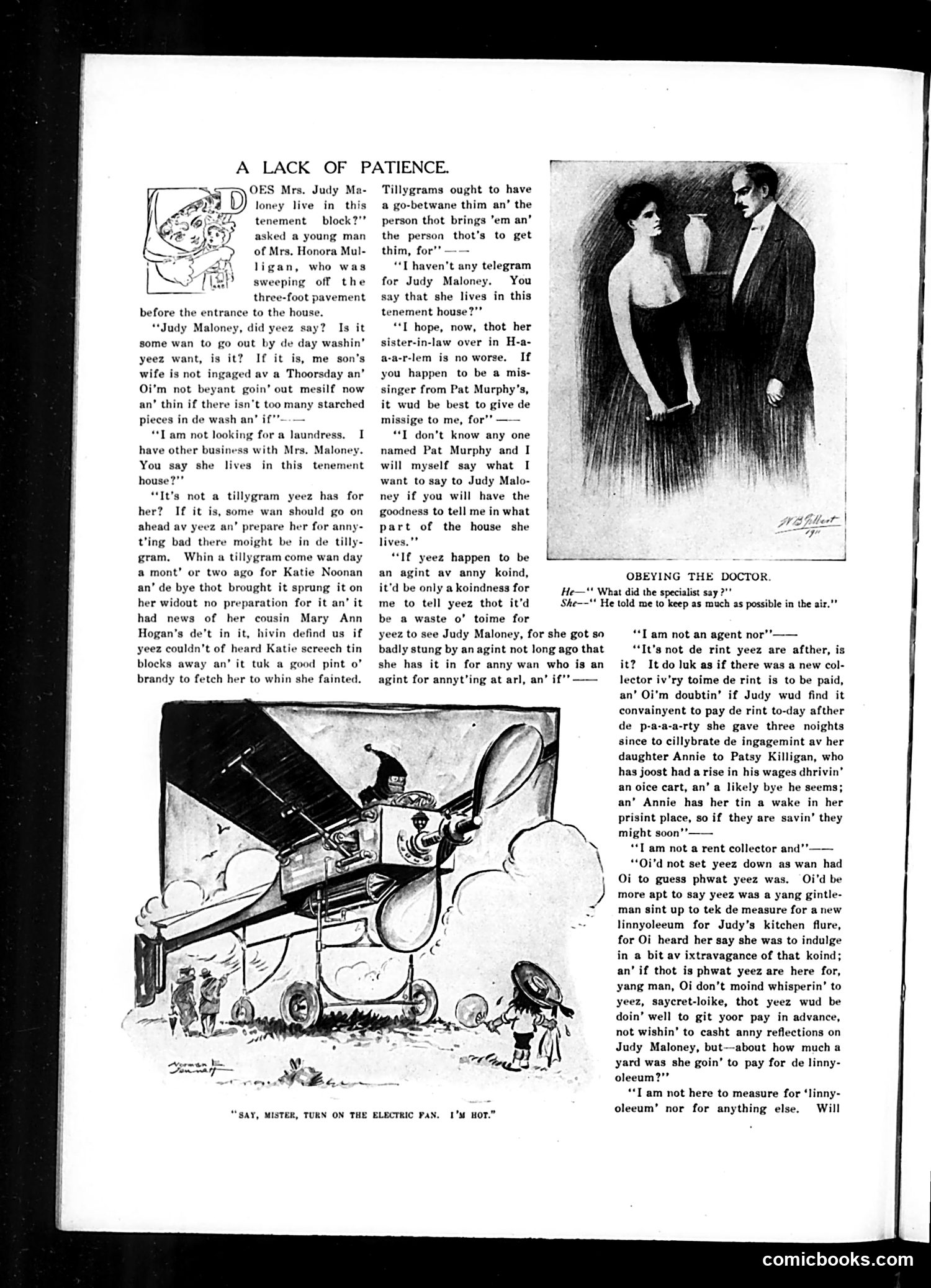
This page satirizes Irish immigrant tenement life and cultural stereotypes common in early 20th-century American humor. The main story depicts Mrs. Honora Mulligan, a garrulous Irish landlady character (identifiable by thick dialect and working-class setting), endlessly interrupting a young man trying to locate Judy Maloney with elaborate, irrelevant gossip about neighbors, telegrams, rent collectors, and her daughter's engagement. The satire targets two things: (1) Irish immigrant verbosity and tendency toward dramatic storytelling, and (2) the chaotic, gossipy nature of crowded tenement living where privacy is impossible. The young man's mounting frustration—he repeatedly tries to state his purpose—drives the humor. The secondary cartoon "Obeying the Doctor" jokes about literal interpretation: a doctor's advice to "keep as much as possible in the air" results in someone using an electric fan.
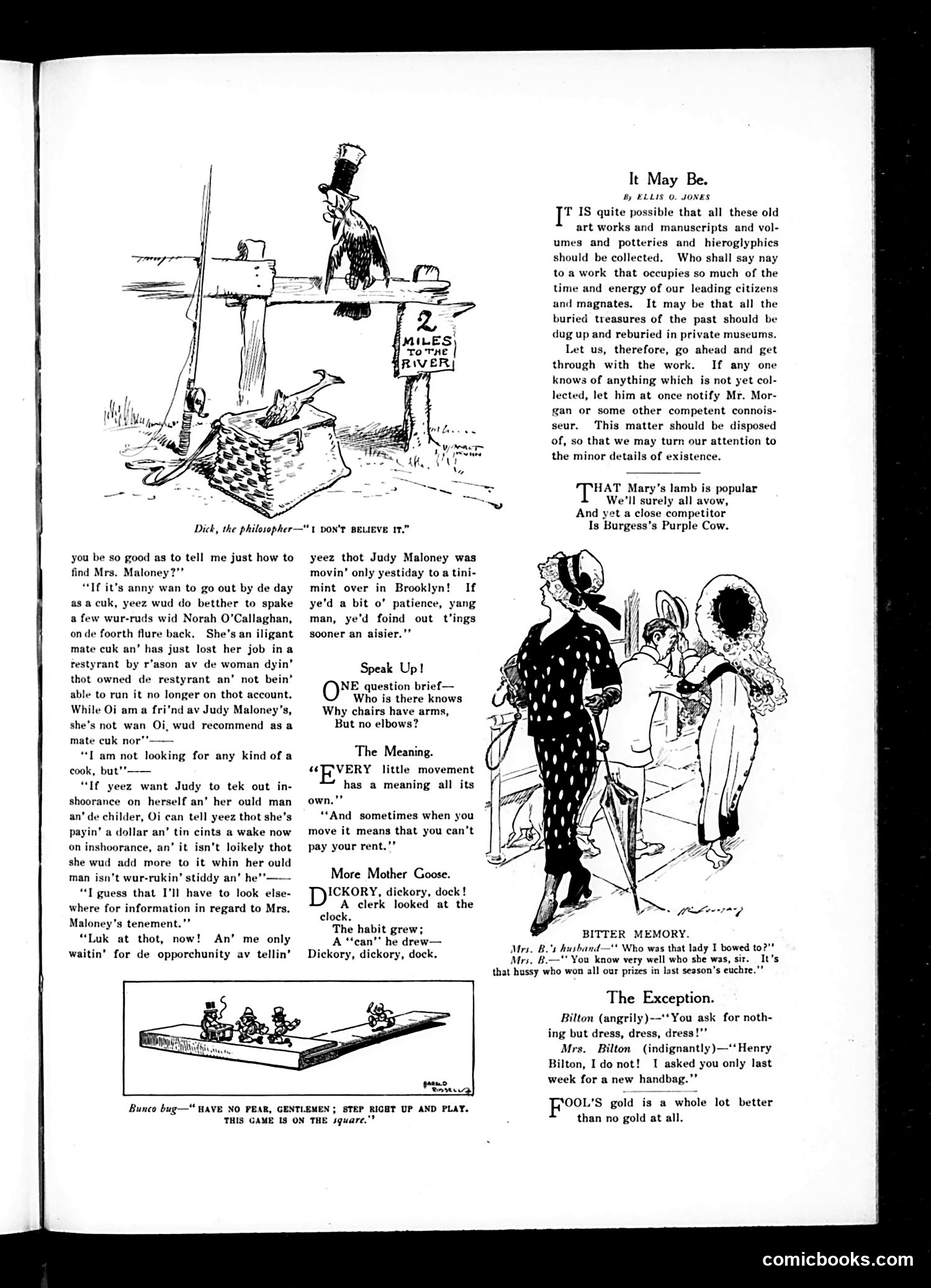
This Judge magazine page contains multiple satirical pieces targeting early 20th-century American society: **Main cartoon ("Dick, the Philosopher")**: A comic monologue in Irish-American dialect where a tenement dweller rambles endlessly about Mrs. Maloney's circumstances—her friend's job loss, insurance payments, recent move to Brooklyn. The satire mocks working-class gossip culture and the stereotype of Irish immigrants as verbose, chatty neighbors who provide unsolicited information. **"It May Be" essay**: Satirizes wealthy magnates like J.P. Morgan who obsessively collect art and antiquities. The piece mockingly suggests collecting old treasures occupies the "leading citizens" while suggesting they should finish this hobby so society can attend to "minor details of existence"—a barbed critique of elite collecting mania. **Other bits**: Include puns ("Mother Goose" parody about office workers), observations on furniture design, and domestic humor about marriage expenses. The overall tone reflects Judge's satirical stance against both immigrant working-class culture and wealthy American collector elites.
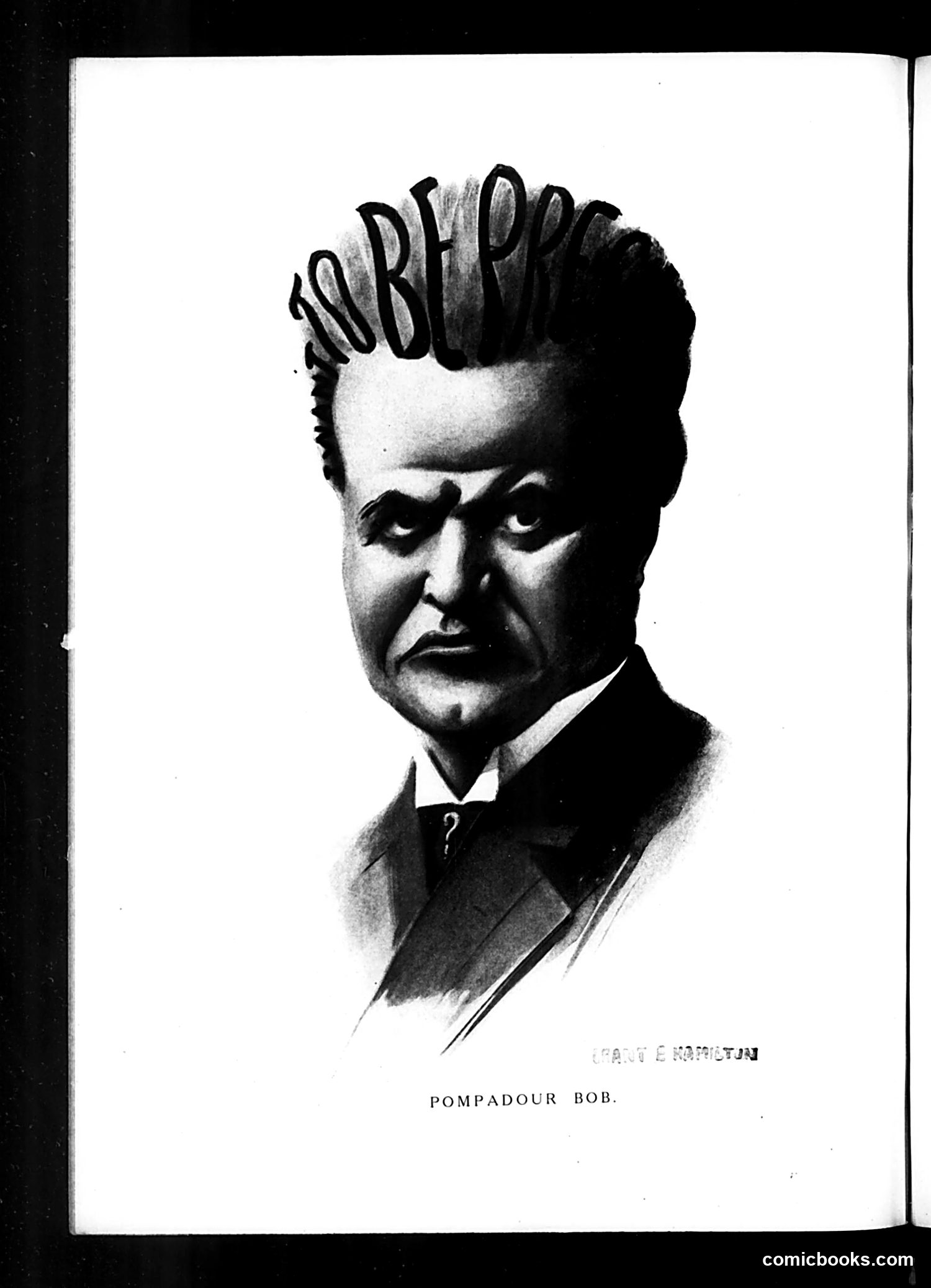
This appears to be a portrait illustration titled "Pompadour Bob," likely from Judge magazine's satirical section. The image shows a man in formal attire (suit and bow tie) with a distinctive tall, swept-back hairstyle—a pompadour. The exaggerated hair styling is clearly the subject of the satire. "Pompadour Bob" likely refers to a contemporary public figure known for this particular hairdo, though the specific identity is unclear from the image alone. The satire mocks either the man's vanity in maintaining such an elaborate hairstyle or ridicules the fashion trend itself. The formal presentation contrasts humorously with the somewhat absurd grooming choice, making the hairstyle the butt of the joke.
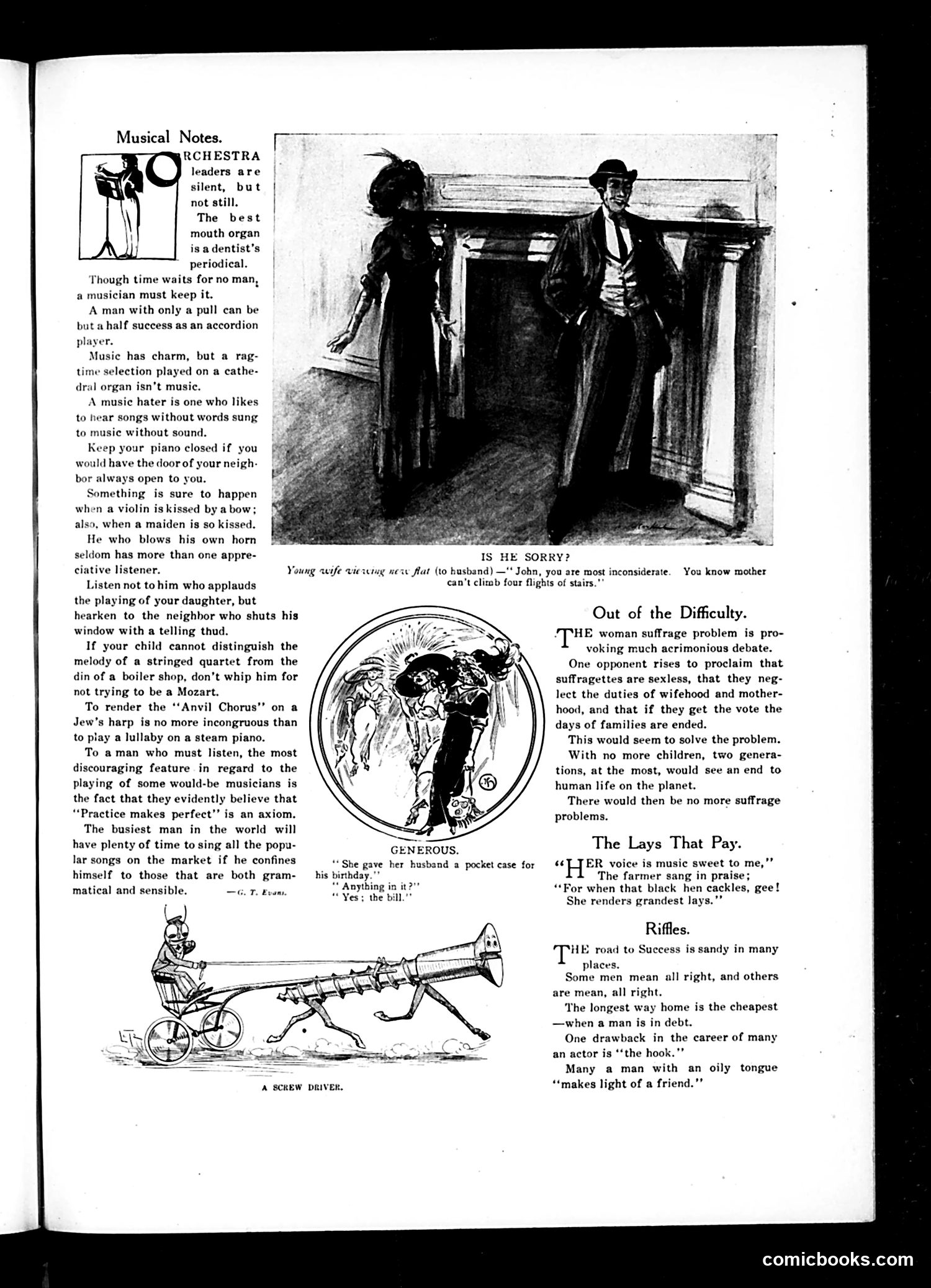
This page contains several distinct satirical pieces: **"Musical Notes"** is a column of witty aphorisms mocking both musicians and listeners. The jokes target self-promoting musicians ("He who blows his own horn seldom has more than one appreciative listener"), amateur players who ignore practice realities, and the suffering of neighbors forced to endure poor performances. **The cartoon "Is He Sorry?"** depicts a young wife criticizing her husband for his inconsiderateness—specifically, that her mother cannot climb four flights of stairs to their flat. The satire targets newlywed couples' self-centeredness. **"Out of the Difficulty"** uses dark humor to mock suffragettes by suggesting that if women gain voting rights and abandon motherhood, humanity would end in two generations—thereby "solving" the suffrage problem. This represents anti-suffrage propaganda dressed as logical argument. **"The Lays That Pay"** is a pun: a farmer praises his black hen's "lays" (eggs), not her musical "airs." **"Riffles"** offers aphoristic humor about success, debt, and human nature. The illustrations are simple line drawings typical of early 20th-century satirical magazines.
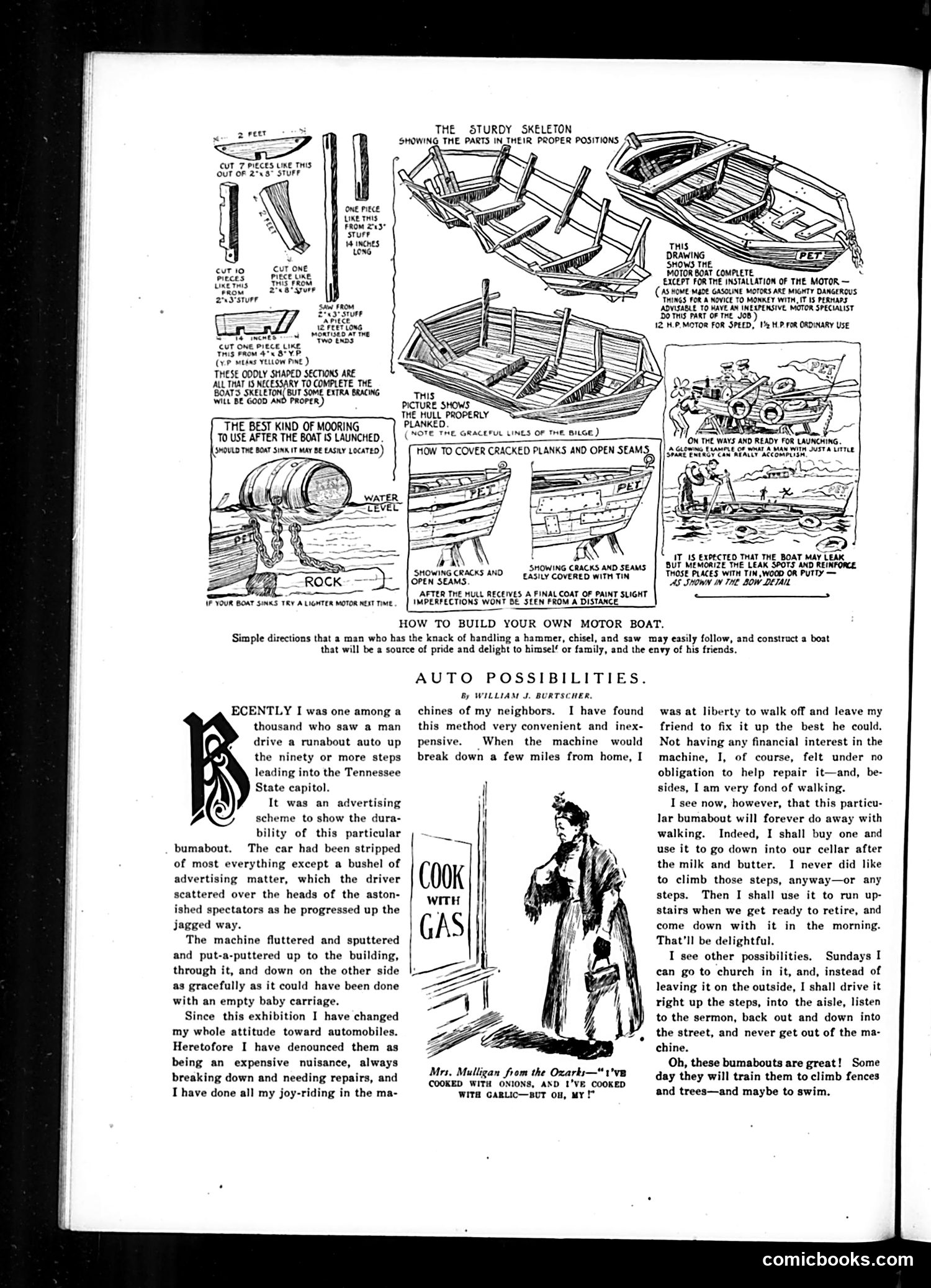
This page contains two distinct sections: **Upper half:** Practical DIY instructions for building a motorboat, with detailed diagrams showing boat skeleton construction, hull planking, and launching preparation. This is straightforward instructional content, not satire. **Lower half:** A satirical essay titled "Auto Possibilities" by William J. Burtscher. The satire mocks early automobile enthusiasm by describing absurd uses for a "runabout" car—including driving it down cellar stairs to fetch milk, up bedroom stairs for bedtime convenience, and into a church aisle during sermons. The humor derives from the automobile industry's aggressive marketing (referenced by the stunt of driving a stripped car up the Tennessee Capitol steps), which the author sardonically suggests has converted him into an auto enthusiast. The accompanying illustration shows a woman praising her gas stove in similar hyperbolic fashion, paralleling consumer advertising excess. The satire targets the era's promotional hype and consumerism around new technologies.
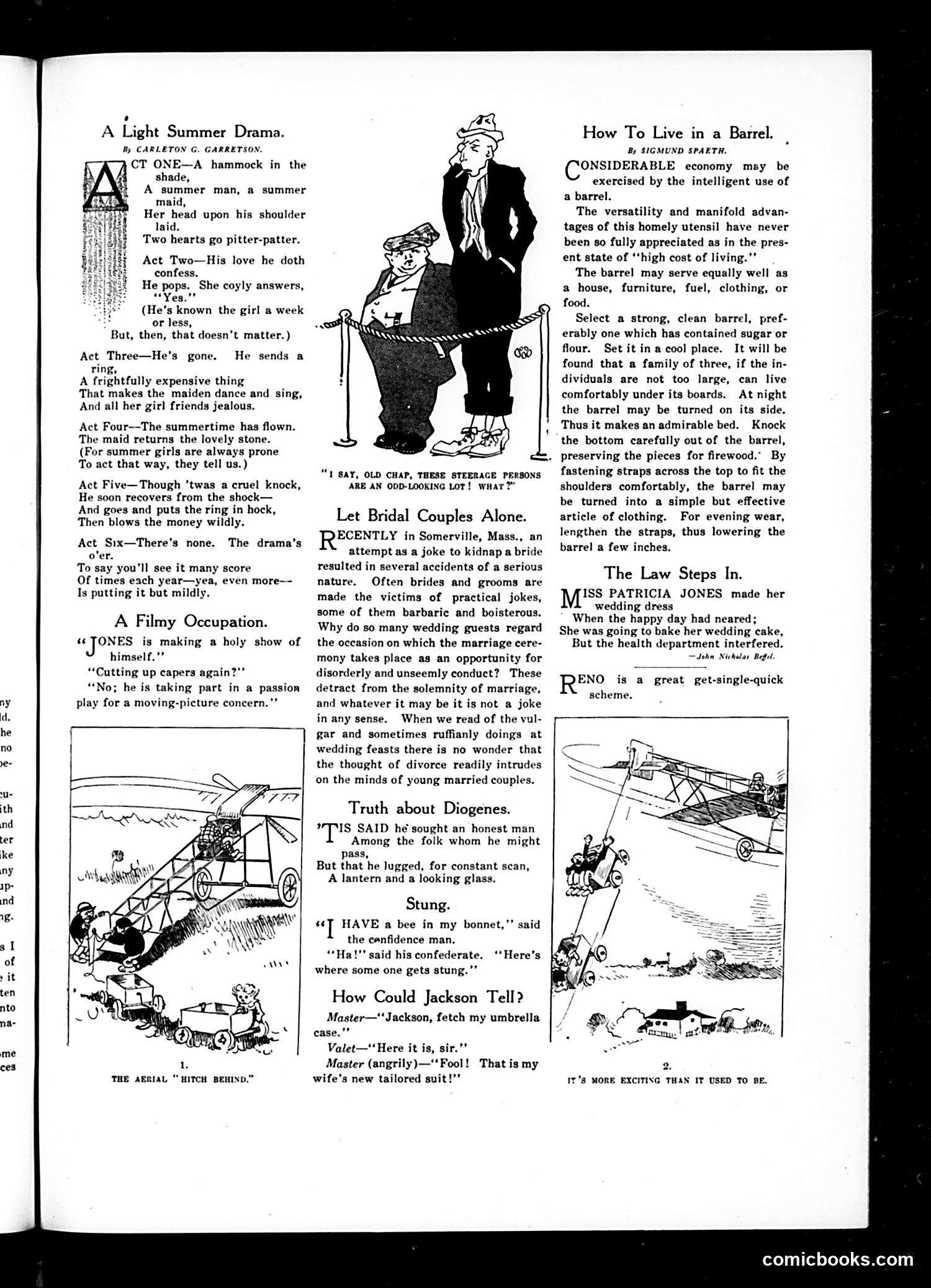
This page contains multiple brief satirical pieces mocking early 20th-century American life: **"A Light Summer Drama"** skewers summer romance as shallow and transactional—a couple meets, gets engaged within a week, the woman returns the expensive ring when summer ends, and the man pawns it. The satire is that this cycle repeats constantly, treating serious commitment as frivolous seasonal entertainment. **"Let Bridal Couples Alone"** criticizes the vulgar tradition of wedding pranks and practical jokes, arguing they undermine marriage's solemnity and make young couples contemplate divorce. **Other pieces** mock: an actor's pretentious film work ("A Filmy Occupation"), the absurdity of a servant confusing his master's wife's tailored suit for an umbrella case, and—in "How to Live in a Barrel"—the "high cost of living" by satirically suggesting barrels as housing during economic hardship. The overall theme reflects pre-WWI anxiety about modernity, commercialism, and social decline, using humor to critique frivolous attitudes toward love, marriage, and economic instability.
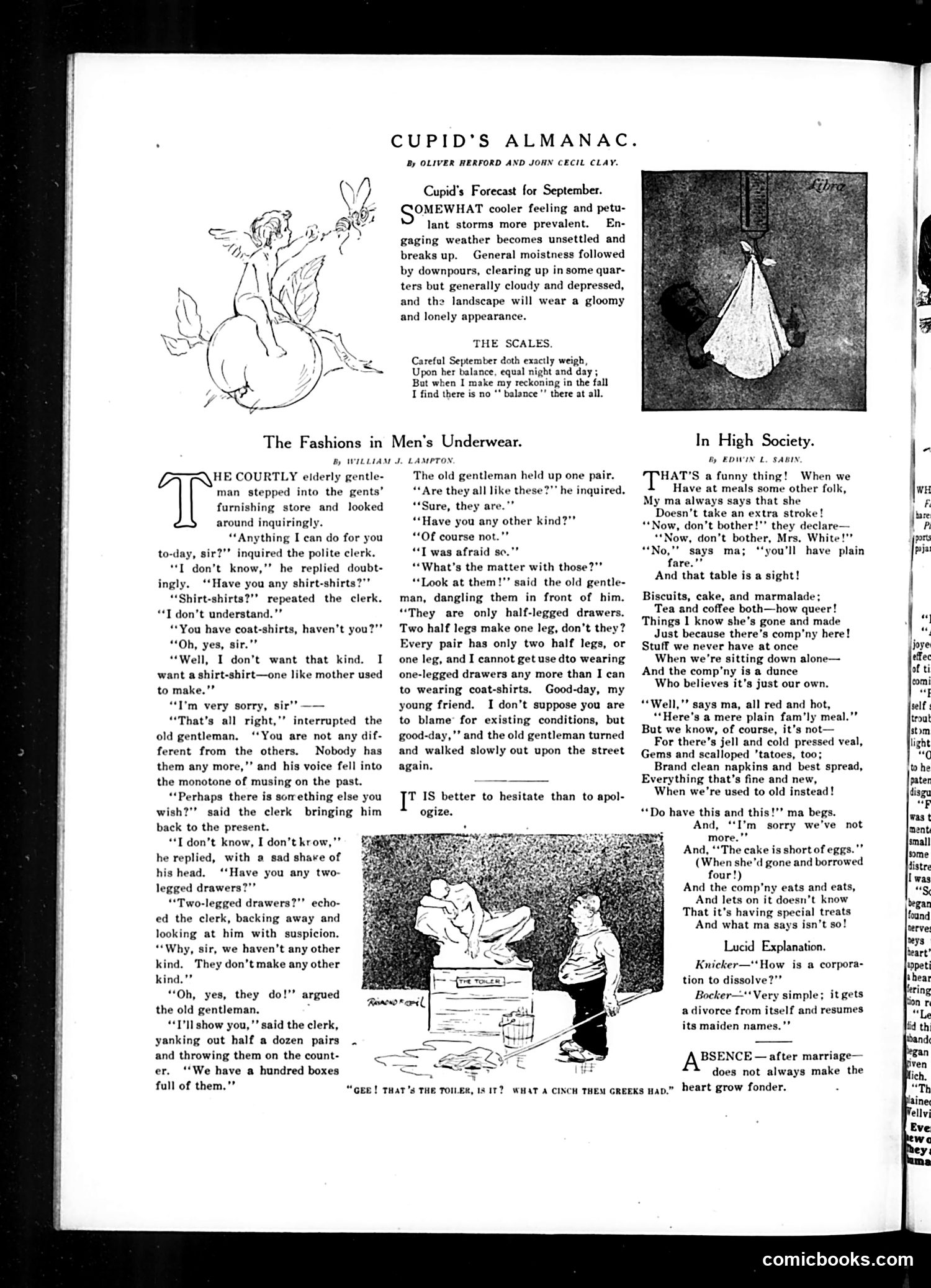
This page from *Judge* magazine contains three satirical pieces mocking social conventions of the era: **"Cupid's Almanac"** playfully describes September as a melancholic romantic month—"gloomy and lonely"—using weather metaphors for emotional states. **"The Fashions in Men's Underwear"** satirizes an elderly man's nostalgia through absurdist logic. He complains modern underwear is inferior to what "mother used to make," then argues that two-legged drawers are actually "one-legged" (since two half-legs equal one leg), rendering them useless. The joke mocks both obsolete thinking and the frustration of generational disconnect. **"In High Society"** ridicules middle-class pretension: a child observes that her mother dramatically over-prepares lavish meals for guests while serving plain food normally, then insists it's "just a simple family meal." The satire targets the anxiety of appearing properly genteel while hiding one's actual circumstances. All three pieces use humor to critique social hypocrisy, outdated attitudes, and class-consciousness among their contemporary audience.
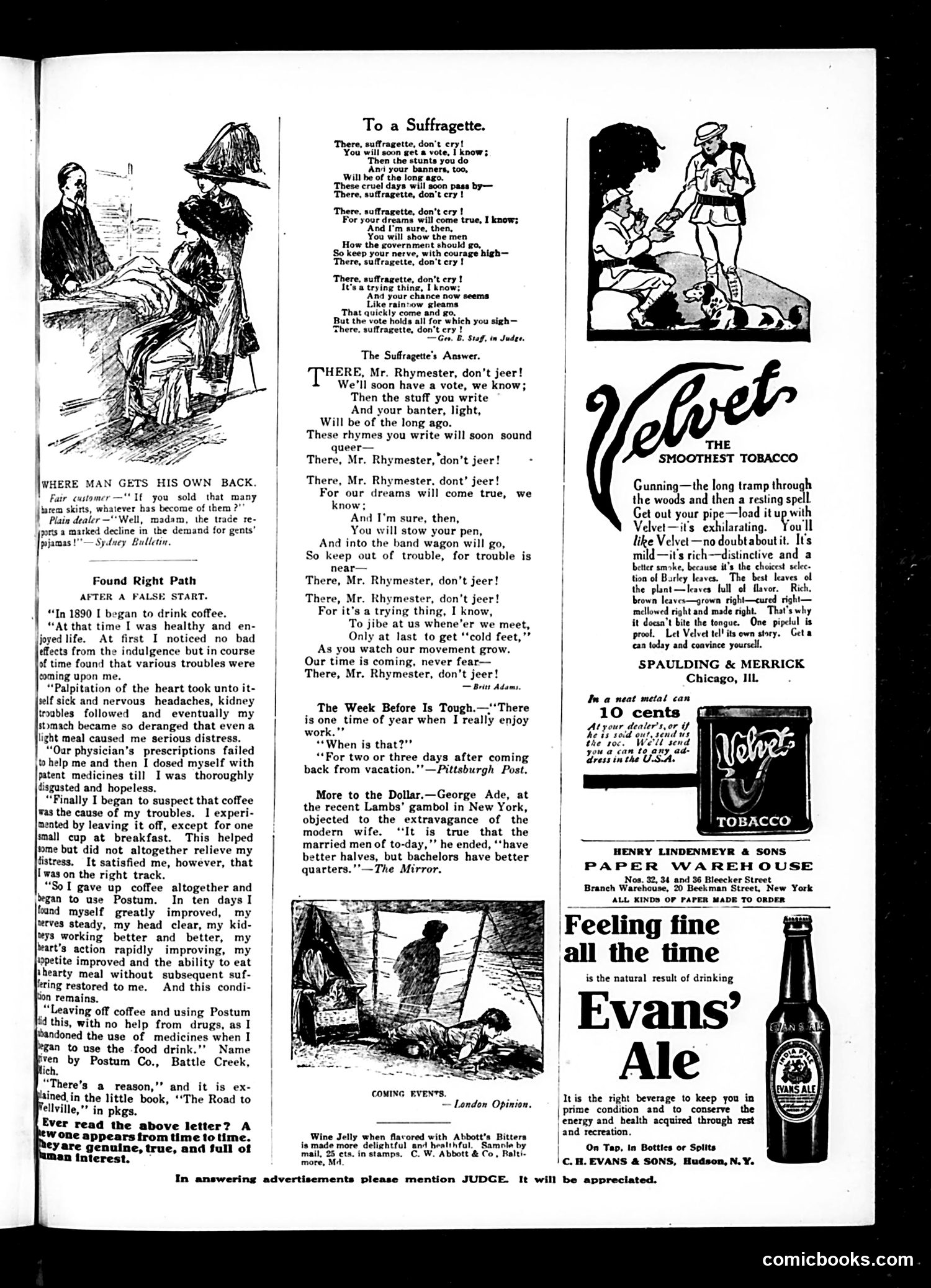
This page features a witty poetic debate about women's suffrage. A male poet ("Mr. Rhymester") condescends to a suffragette, patronizingly assuring her that women will soon get the vote, so she should stop her disruptive activism ("stunts," "banners"). The suffragette's response cleverly reverses his argument: she predicts that *he* will eventually support women's voting and abandon his mocking verse—turning his own patronization back on him. She threatens that their movement's inevitable success will make his current jibes seem foolish. The cartoon exemplifies Judge magazine's satirical approach to the suffrage debate, likely from the early 1910s when women's voting rights were hotly contested. The exchange captures the era's tension between suffragists demanding immediate change and opponents who dismissed them as temporary irritants. The suffragette's confident prediction of inevitability—and her threat to hold the rhymester accountable—represents the movement's growing political power.
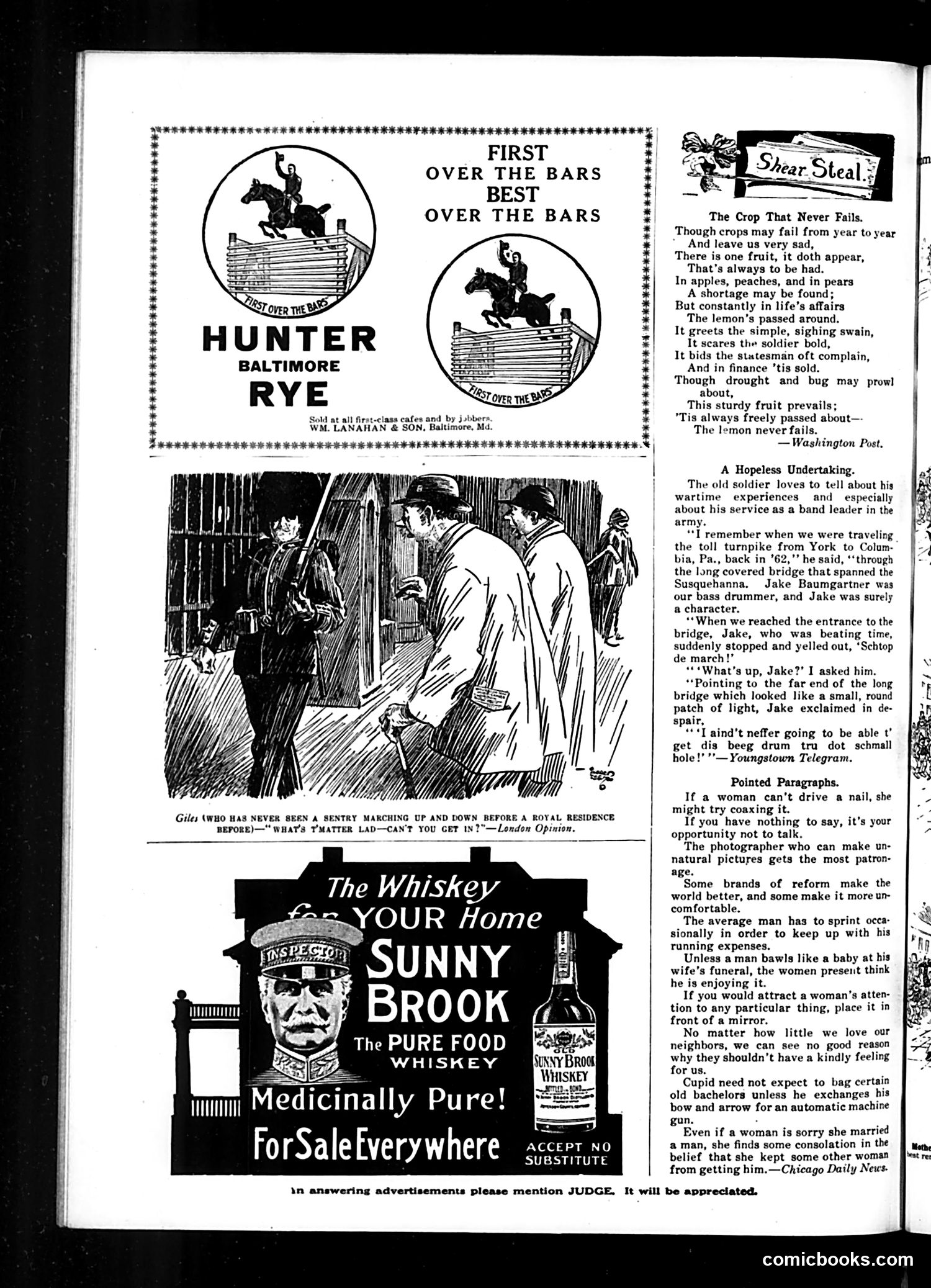
This page contains three distinct elements: whiskey and rye advertisements, a humorous anecdote, and satirical "Pointed Paragraphs." **Main Cartoon/Story ("A Hopeless Undertaking"):** The illustration shows soldiers with a bass drummer at a covered bridge entrance. The accompanying anecdote recounts a Civil War-era band's journey where drummer "Jake Baumgartner" panics upon seeing the bridge's far end (a small circular opening in perspective), convinced his large drum cannot fit through the "hole." The humor relies on Jake's literal misreading of visual perspective—mistaking the vanishing point for an actual physical obstruction. **Advertisements:** Hunter Baltimore Rye whiskey and Sunny Brook whiskey ads, typical of the era's alcohol marketing. **"Pointed Paragraphs":** Brief satirical observations on gender relations and human nature—women's incompetence with tools, men's funeral behavior, vanity, and marriage regrets. These reflect period attitudes toward women and marital discord common in early 20th-century humor magazines. The page exemplifies Judge's blend of visual comedy, advertising, and social commentary typical of American satirical publications of this era.
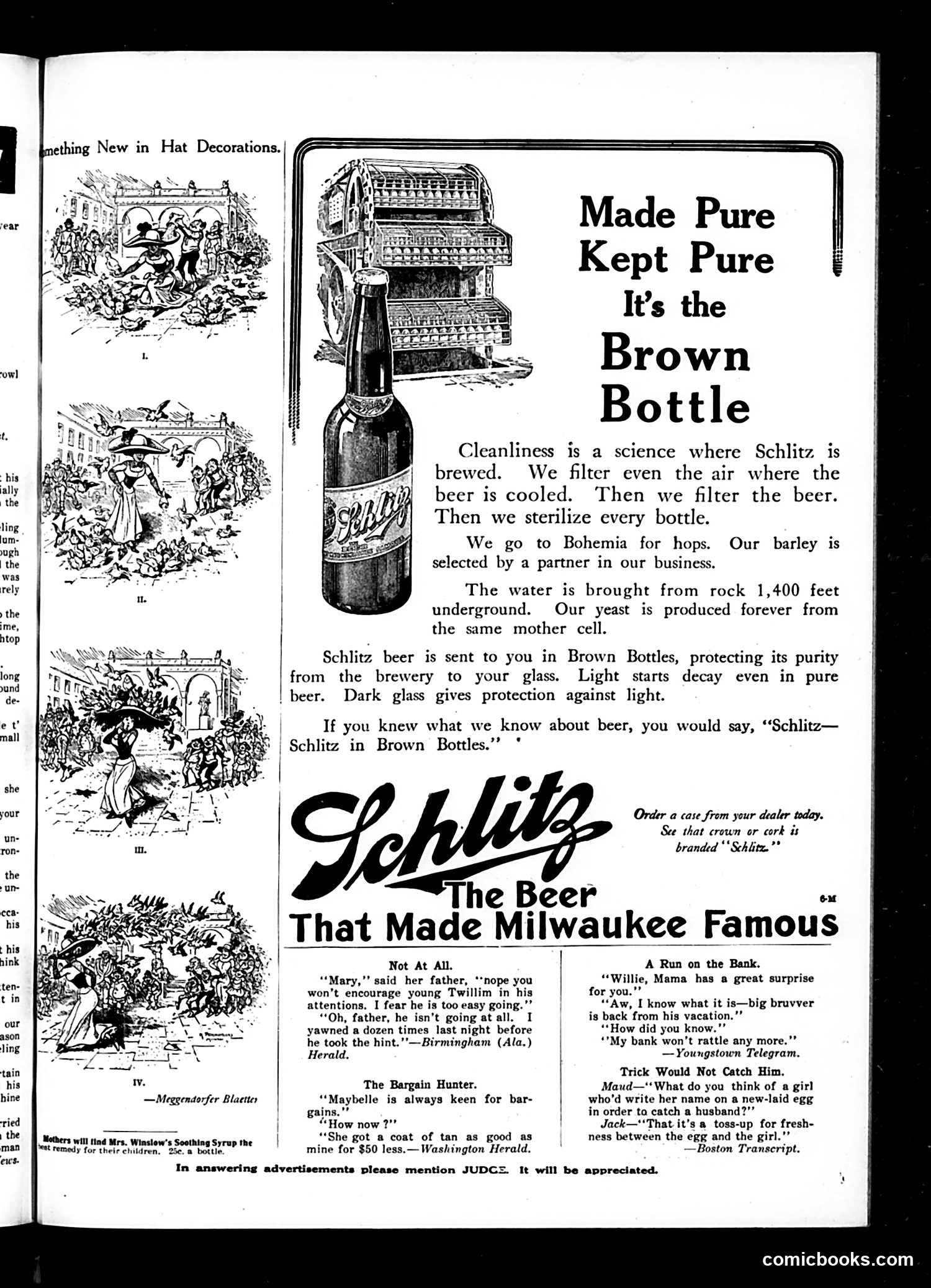
This page mixes advertising with humor content. The dominant feature is a **Schlitz beer advertisement** promoting their brown bottles as purity protection—a major selling point for early 20th-century breweries competing on sanitation claims. The ad emphasizes scientific processes: filtered air, sterilized bottles, imported Bohemian hops, and underground water sources. The cartoons below are short **domestic humor jokes**: 1. "Not At All"—A father warns against a suitor, but the young man is so lazy he won't even pursue courtship, proving harmless through inaction. 2. "A Run on the Bank"—A child assumes his older brother's return home means the family's finances improved (the bank "won't rattle anymore" without withdrawals). 3. "Trick Would Not Catch Him"—A woman's scheme to attract a husband by writing her name on an egg is dismissed as equally foolish as the egg itself. These are light, family-appropriate jokes typical of *Judge*'s humor section, contrasting sharply with the page's commercial messaging.
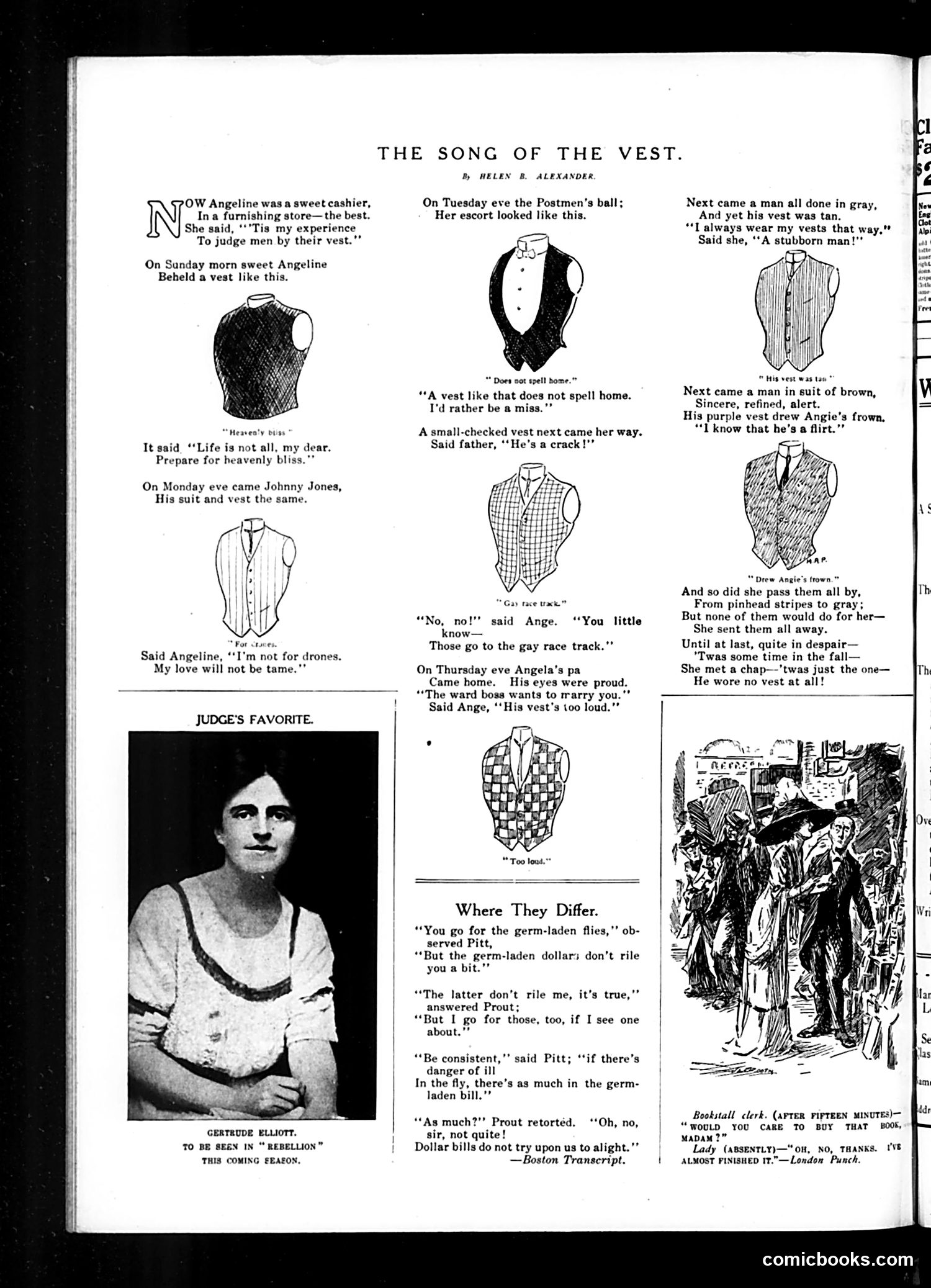
This humorous poem mocks the idea that a man's vest reveals his character and intentions. The protagonist, Angeline, a cashier, judges potential suitors entirely by their vests' appearance and messages—rejecting a religious man (heaven-focused), a racetrack gambler, a political operative ("ward boss"), and men whose vests suggest flirtation or stubbornness. The satire targets both shallow courtship conventions and the era's belief in reading personality through fashion details. The joke culminates when she finally accepts a man wearing *no vest at all*—suggesting that judgment based on surface appearances is fundamentally absurd. The page also includes a brief exchange ("Where They Differ") about germ-laden flies versus money, and unrelated magazine content. The satirical point: earnest character assessment requires looking beyond superficial markers.
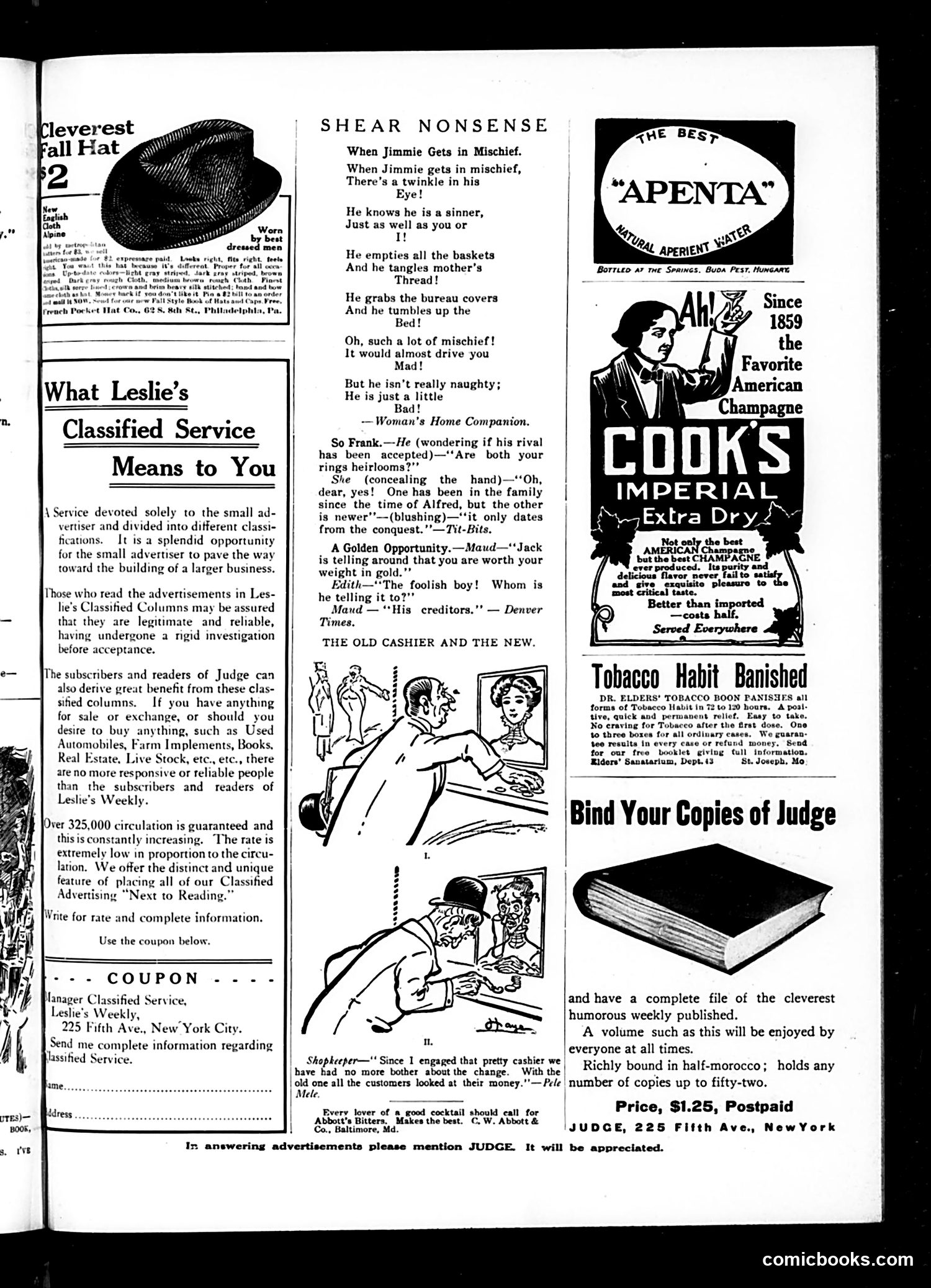
This page is primarily **advertising and filler content** rather than political cartoons. It contains: **"Shear Nonsense"** — a light humor section with jokes and verses about domestic life (a mischievous child named Jimmie, romantic misunderstandings, workplace humor). These reflect early 1900s middle-class concerns: courtship etiquette, marital dynamics, and office life. **Two cartoon vignettes** labeled "The Old Cashier and the New" depict a shopkeeper noting that customers behave differently with an attractive female cashier versus the previous male one—a mild commentary on gender and workplace dynamics of the era. **The remaining content** consists of classified advertising service promotions, product advertisements (champagne, tobacco cessation, book binding), and a coupon for Leslie's Weekly classified ads. **Context for modern readers:** This reflects a publication focused on genteel, domestic humor for middle-class readers rather than sharp political satire. The gender dynamics and product endorsements reveal early 1900s consumer culture and social attitudes.
This is a **full-page advertisement for Wrigley's Spearmint Pepsin Gum**, not editorial content or political satire. The ad showcases the product's packaging and emphasizes its protective features: waxed paper wrapping to preserve freshness and pink paper to keep dust out. The ad makes health claims typical of early 20th-century advertising—that the mint juice "purifies the breath and cleanses the teeth, and soothes the nerves." The spear logo serves as a brand identifier ("Look for the spear"). The page illustrates how Judge magazine, while known for satirical cartoons, also carried commercial advertisements to fund publication. There is no political satire or caricature present—this is straightforward product marketing that appears in the magazine.