
Judge, 1911-09-09 · page 15 of 24
Judge — September 9, 1911 — page 15: what you’re looking at
What you’re looking at
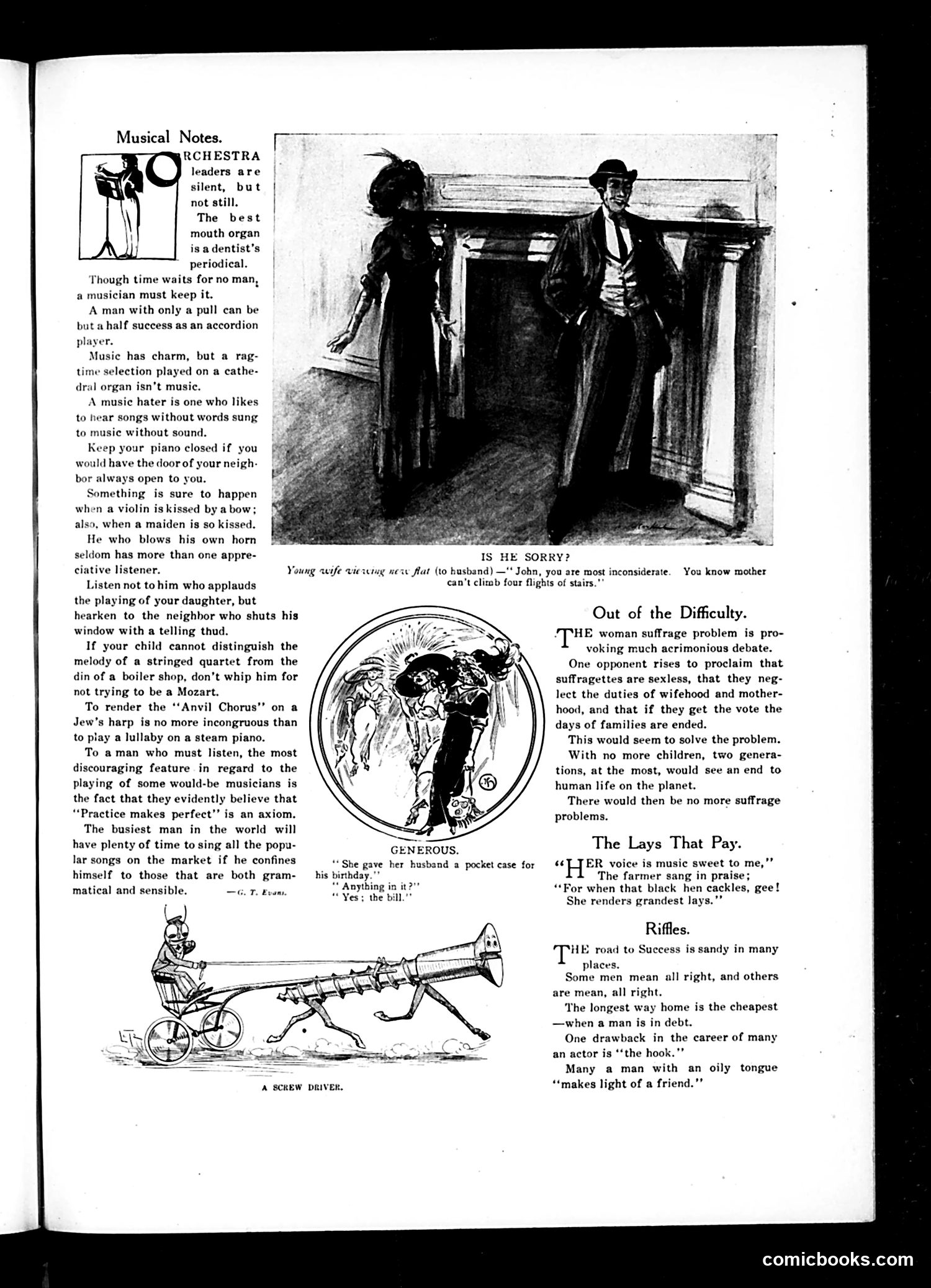
This page contains several distinct satirical pieces: **"Musical Notes"** is a column of witty aphorisms mocking both musicians and listeners. The jokes target self-promoting musicians ("He who blows his own horn seldom has more than one appreciative listener"), amateur players who ignore practice realities, and the suffering of neighbors forced to endure poor performances. **The cartoon "Is He Sorry?"** depicts a young wife criticizing her husband for his inconsiderateness—specifically, that her mother cannot climb four flights of stairs to their flat. The satire targets newlywed couples' self-centeredness. **"Out of the Difficulty"** uses dark humor to mock suffragettes by suggesting that if women gain voting rights and abandon motherhood, humanity would end in two generations—thereby "solving" the suffrage problem. This represents anti-suffrage propaganda dressed as logical argument. **"The Lays That Pay"** is a pun: a farmer praises his black hen's "lays" (eggs), not her musical "airs." **"Riffles"** offers aphoristic humor about success, debt, and human nature. The illustrations are simple line drawings typical of early 20th-century satirical magazines.
📄 Transcribed text from this page (OCR, searchable)
Machine-transcribed from the original scan — historical spelling and the odd misread are preserved.
Musical Notes. RCHESTRA leaders are silent, but not still. The best mouth organ is adentist’s periodical. Though time waits for no man, a musician must keep it. A man with only a pull can be but a half success as an accordion player. Music has charm, but a rag- time selection played on a cathe- dral organ isn’t music. A music hater is one who likes to hear songs without words sung to music without sound. ‘eep your piano closed if you would have the door of your neigh- bor always open to you. Something is sure to happen when a violin is kissed by a bow; also, when a maiden is so kissed. He who blows his own horn seldom has more than one appre- ciative listener. Listen not to him who applauds the playing of your daughter, but hearken to the neighbor who shuts his window with a telling thud. If your child cannot distinguish the melody of a stringed quartet from the din of a boiler shop, don’t whip him for not trying to be a Mozart. To render the ‘‘Anvil Chorus’? on a Jew’s harp is no more incongruous than to play a lullaby on a steam piano. To aman who must listen, the most discouraging feature in regard to the playing of some would-be musicians is the fact that they evidently believe that “Practice makes perfect’ is an axiom. The busiest man in the world will have plenty of time to sing all the popu- lar songs on the market if he confines himself to those that are both gram- matical and sensible. —G. 7. Evans. IS HE SORRY? Young wife viewtug ner flat (to husband) —"' John, you are most inconsiderate You know mother can't climb four flights of stairs."* GENEROUS. “She gave her husband a pocket case for his birthday.”” Anything in it?”” “Yes; the bill.”” A SCREW DRIVER. Out of the Difficulty. HE woman suffrage problem is pro- voking much acrimonious debate. One opponent rises to proclaim that suffragettes are sexless, that they neg- lect the duties of wifehood and mother- hood, and that if they get the vote the days of families are ended. This would seem to solve the problem. With no more children, two genera- tions, at the most, would see an end to human life on the planet. There would then be no more suffrage problems. The Lays That Pay. “ ER voice is music sweet to me,’’ ‘The farmer sang in praise; ‘*For when that black hen cackles, gee! She renders grandest lays.”” Riffles. HE road to Success is sandy in many places. Some men mean all right, and others are mean, all right. ‘The longest way home is the cheapest —when a man is in debt. One drawback in the career of many an actor is ‘the hook."” Many a man with an oily tongue “makes light of a friend.”” comicbooks.com