
Judge, 1911-09-09 · page 18 of 24
Judge — September 9, 1911 — page 18: what you’re looking at
What you’re looking at
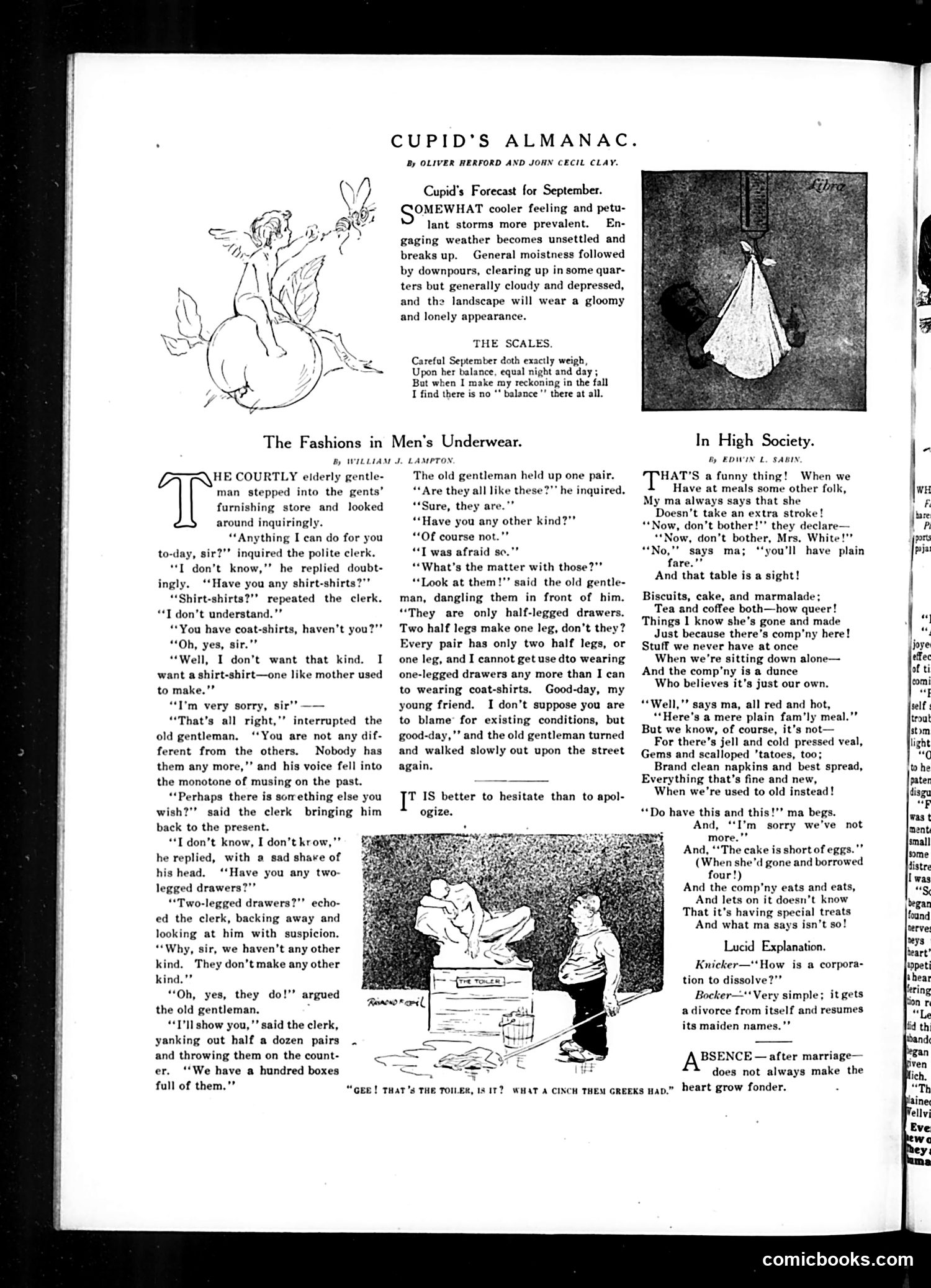
This page from *Judge* magazine contains three satirical pieces mocking social conventions of the era: **"Cupid's Almanac"** playfully describes September as a melancholic romantic month—"gloomy and lonely"—using weather metaphors for emotional states. **"The Fashions in Men's Underwear"** satirizes an elderly man's nostalgia through absurdist logic. He complains modern underwear is inferior to what "mother used to make," then argues that two-legged drawers are actually "one-legged" (since two half-legs equal one leg), rendering them useless. The joke mocks both obsolete thinking and the frustration of generational disconnect. **"In High Society"** ridicules middle-class pretension: a child observes that her mother dramatically over-prepares lavish meals for guests while serving plain food normally, then insists it's "just a simple family meal." The satire targets the anxiety of appearing properly genteel while hiding one's actual circumstances. All three pieces use humor to critique social hypocrisy, outdated attitudes, and class-consciousness among their contemporary audience.
📄 Transcribed text from this page (OCR, searchable)
Machine-transcribed from the original scan — historical spelling and the odd misread are preserved.
CUPID’S ALMANAC. By OLIVER HERFORD AND JOHN CECIL CLAY. Cupid's Forecast for September. OMEWHAT cooler feeling and petu- lant storms more prevalent. En- gaging weather becomes unsettled and breaks up. General moistness followed by downpours, clearing up in some quar- ters but generally cloudy and depressed, and the landscape will wear a gloomy and lonely appearance. THE SCALES. Careful September doth exactly weigh, Upon her balance, equal night and day ; But when I make my reckoning in the fall I find there is no ‘* balance "’ there at all. The Fashions in Men's Underwear. By WILLIAM J. LAMPTON HE COURTLY elderly gentle- man stepped into the gents’ furnishing store and looked around inquiringly. “Anything I can do for you to-day, sir?’’ inquired the polite clerk. “IT don’t know,’ he replied doubt- ingly. ‘‘Have you any shirt-shirts?”’ “Shirt-shirts?”” repeated the clerk. “IT don’t understand.’’ “You have coat-shirts, haven't you?’’ “Oh, yes, sir.”” “Well, I don’t want that kind. I want a shirt-shirt—one like mother used to make.’” “I'm very sorry, sir’? —— “That's all right, interrupted the old gentleman. ‘You are not any dif- ferent from the others. Nobody has them any more,”’ and his voice fell into the monotone of musing on the past. “Perhaps there is sorrething else you wish?” said the clerk bringing him back to the present. “T don’t know, I don’t krow,”’ he replied, with a sad shave of his head. ‘Have you any two- legged drawers?” “Two-legged drawers?’’ echo- ed the clerk, backing away and looking at him with suspicion. “Why, sir, we haven’t any other kind. They don’t make any other kind."” “Oh, yes, they do!’? argued the old gentleman. : “I'll show you,’’ said the clerk, yanking out half a dozen pairs and throwing them on the count- er. ‘‘We have a hundred boxes full of them."” The old gentleman held up one pair. “Are they all like these?” he inquired. “Sure, they are.” “Have you any other kind?”’ “Of course not.’" “T was afraid so. “‘What’s the matter with those?"’ “Look at them!"’ said the old gentle- man, dangling them in front of him. “They are only half-legged drawers. Two half legs make one leg, don’t they? Every pair has only two half legs, or one leg, and I cannot get use dto wearing one-legged drawers any more than I can to wearing coat-shirts. Good-day, my young friend. I don’t suppose you are to blame’ for existing conditions, but good-day,’’ and the old gentleman turned and walked slowly out upon the street again. T IS better to hesitate than to apol- ogize. “Gee! THAT'S THE TOILER, 18 17? WHAT A CINCH THEM GREEKS Hap.” heart grow fonder. In High Society. By EDWIN L. SABIN “THars a funny thing! When we Have at meals some other folk, My ma always says that she Doesn't take an extra stroke! w, don’t bother!"’ they declare— Now, don’t bother, Mrs, White!"’ “No,” ou'll have plain fare And that table is a sight! Biscuits, cake, and marmalade; Tea and coffee both—how queer! Things 1 know she’s gone and made Just because there’s comp’ny here! Stuff we never have at once When we're sitting down alone— And the comp'ny is a dunce Who believes it’s just our own. “‘Well,’’ says ma, all red and hot, “‘Here’s a mere plain fam'ly meal.”” But we know, of course, it's not-— For there’s jell and cold pressed veal, Gems and scalloped 'tatoes, too; Brand clean napkins and best spread, Everything that’s fine and new, When we're used to old instead! ‘Do have this and this!’’ ma begs. And, “I’m sorry we've not more.”” And, ‘‘The cake is short of eggs."” (When she’d gone and borrowed four!) And the comp’ny eats and eats, And lets on it doesn’t know That it’s having special treats And what ma says isn’t so! Lucid Explanation. Knicker—*‘How is a corpora- tion to dissolve?”’ Bocker—Very simple; it gets a divorce from itself and resumes its maiden names.”’ BSENCE — after marriage— does not always make the comicbooks.com P port lag |