
A complete issue · 24 pages · 1911
Judge — August 19, 1911
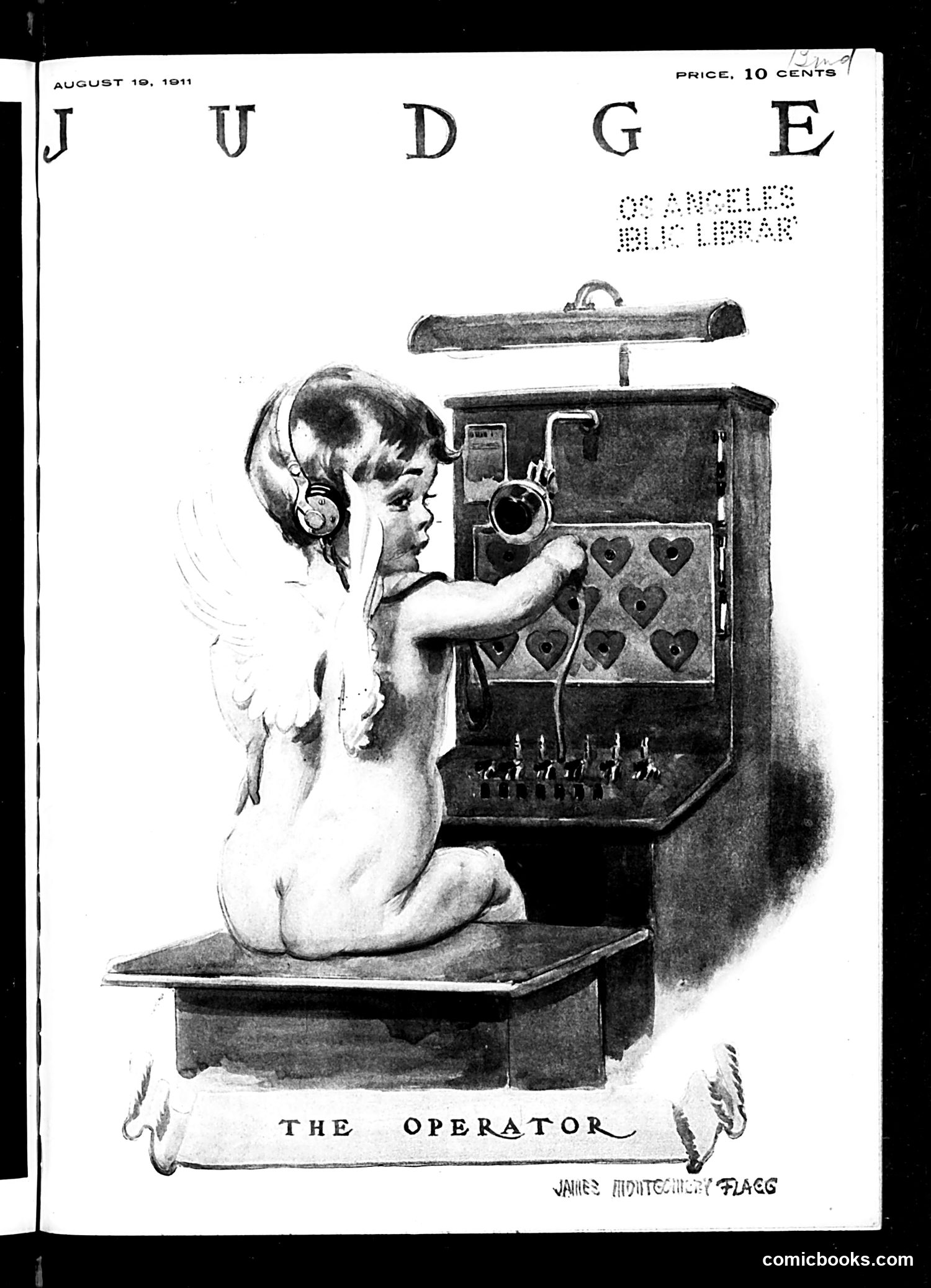
This cartoon satirizes early telephone switchboard operators, depicted as a cherub or cupid figure wearing headphones. The humor operates on multiple levels: the operator is feminized (as most switchboard operators were women), positioned in a childlike or innocent pose while managing complex machinery decorated with hearts. The title "The Operator" and heart imagery suggest the cartoon jokes about romantic calls—perhaps mocking the operators' role in facilitating (or overhearing) intimate conversations between callers. The cherub/cupid symbolism reinforces this romantic angle, implying operators as facilitators of love connections. This reflects early 20th-century attitudes toward the emerging telephone industry and the young female workers who staffed switching stations—viewing them as somewhat naive participants in others' romantic affairs.
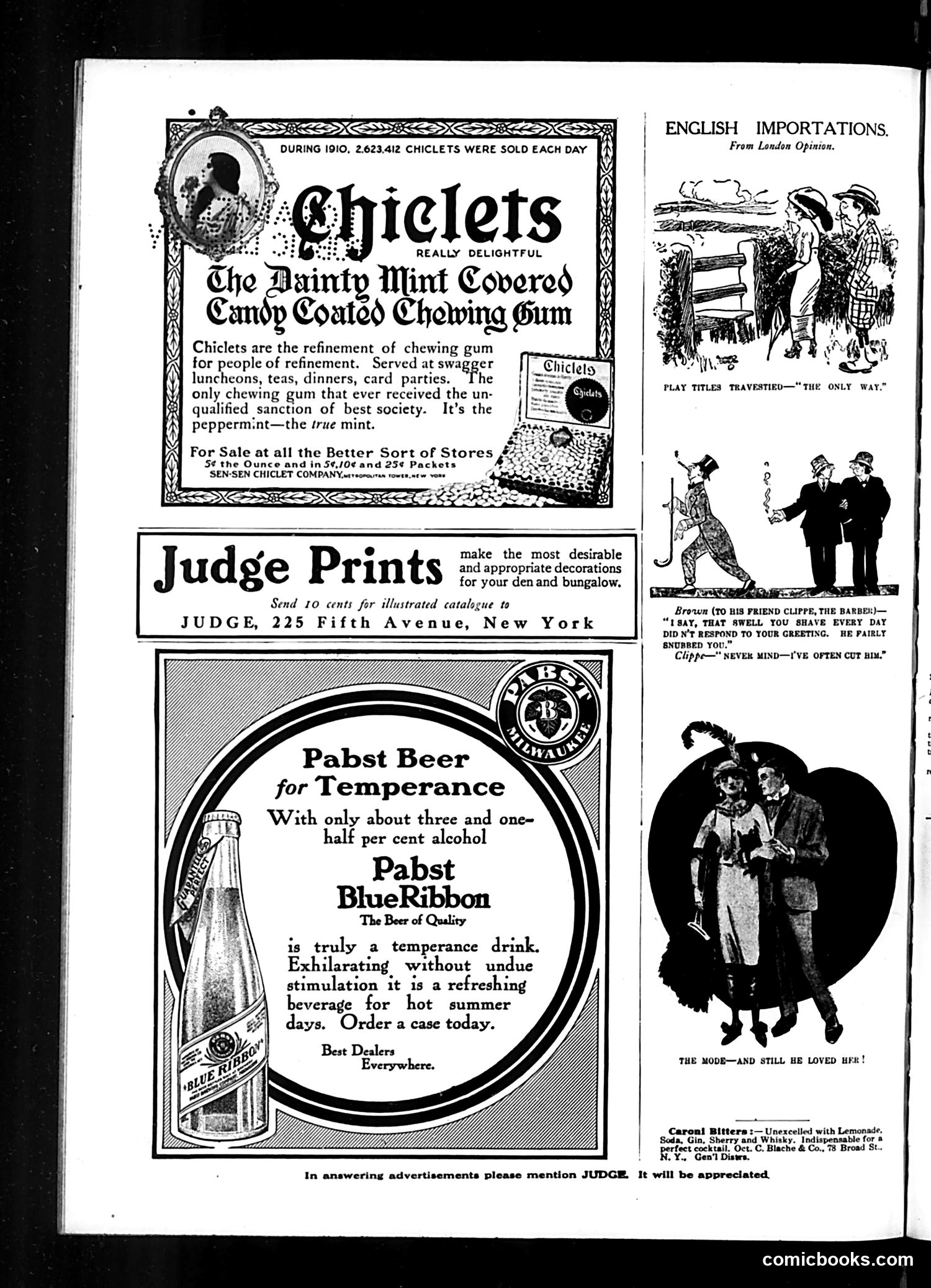
This page is primarily **advertising**, not political satire. It contains three major ads: 1. **Chiclets gum**: Promotes the product as refined confection for "people of refinement," served at fancy venues. Notes 2,623,412 were sold daily in 1910. 2. **Judge Prints**: Interior decoration service advertisement. 3. **Pabst Blue Ribbon beer**: Markets itself as a "temperance" beverage with low alcohol content (3.5%), positioning beer as acceptable during the Prohibition-era temperance movement. The right column shows "English Importations" with illustrations and captions—brief comedic sketches about British customs and manners rather than political commentary. This reflects early 1900s advertising targeting middle and upper-class consumers while navigating contemporary social movements like temperance.
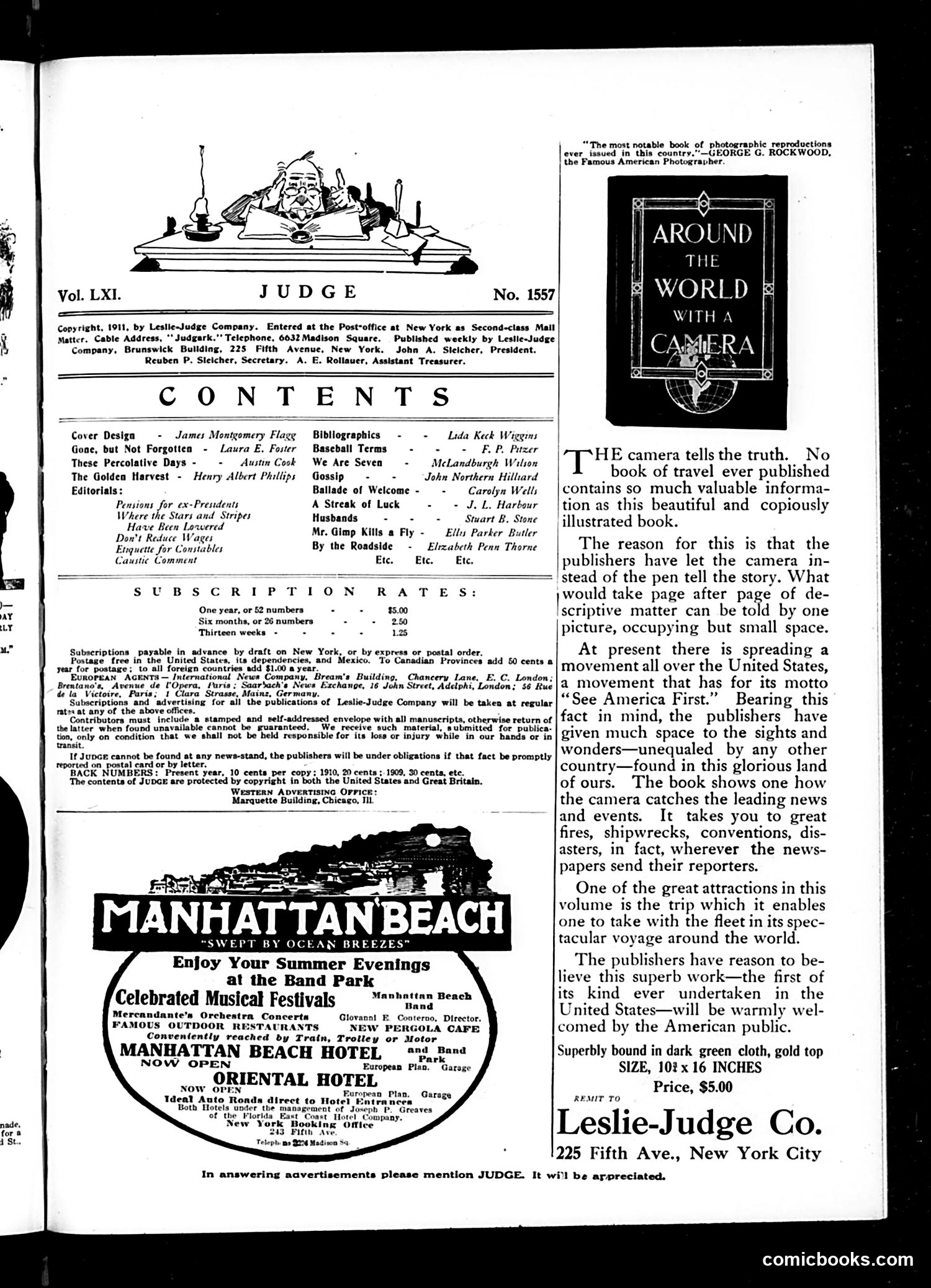
This page is primarily **advertising and editorial content** rather than political satire. The masthead shows Vol. LXII, No. 1557 from Judge magazine (1911). The main visual element is a **cartoon of a portly judge or authority figure** at the top of the page, though without accompanying text it's unclear what specific political situation it references. The page's substantial real estate features advertisements for **Manhattan Beach** (promoting summer entertainment and the Oriental Hotel) and a book advertisement for **"Around the World with a Camera"** by Leslie-Judge Company, emphasizing photography's documentary value. The contents listing suggests typical magazine fare: humor pieces, gossip columns, and sports content. Without the article text itself, the specific satirical targets remain unclear.
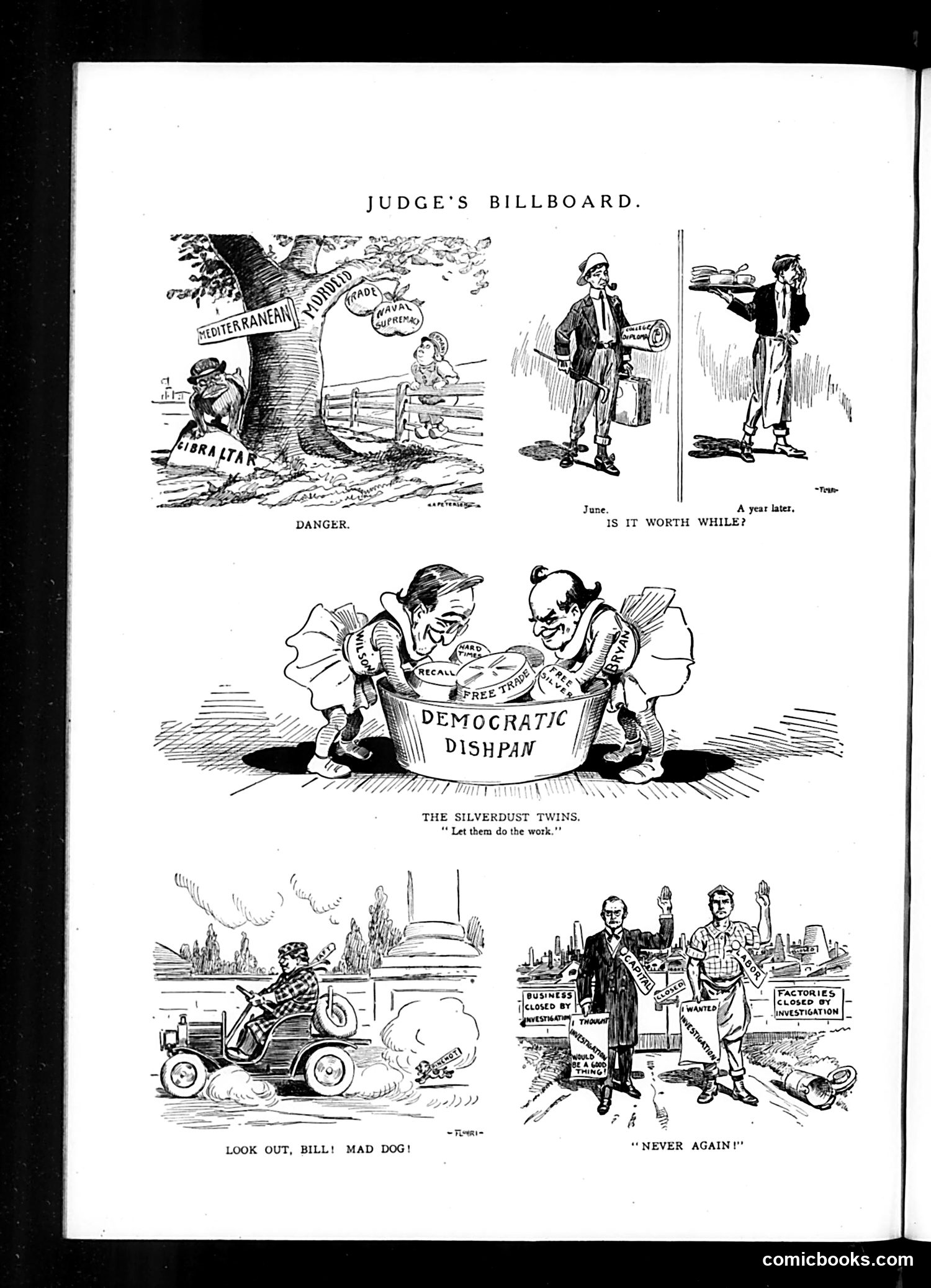
This page presents four cartoons criticizing Democratic politics, likely from the 1920s-1930s era based on style and references. **"Danger"** depicts a tree labeled with financial crises ("Silverdust Randeau," "Doral Biopure") threatening a figure—warning of economic threats. **"Is It Worth While?"** shows a man asking a year later if pursuing something was worthwhile, suggesting failed Democratic promises. **"The Silverdust Twins"** caricatures two Democratic figures collaborating over a "Democratic Dishpan," with the caption "Let them do the work"—mocking Democratic leadership and competence. **"Never Again!"** depicts businessmen amid closed factories and investigation signs, blaming Democratic policies for economic hardship and business failures. The page's overall message: Democratic governance has failed economically and should not be trusted.
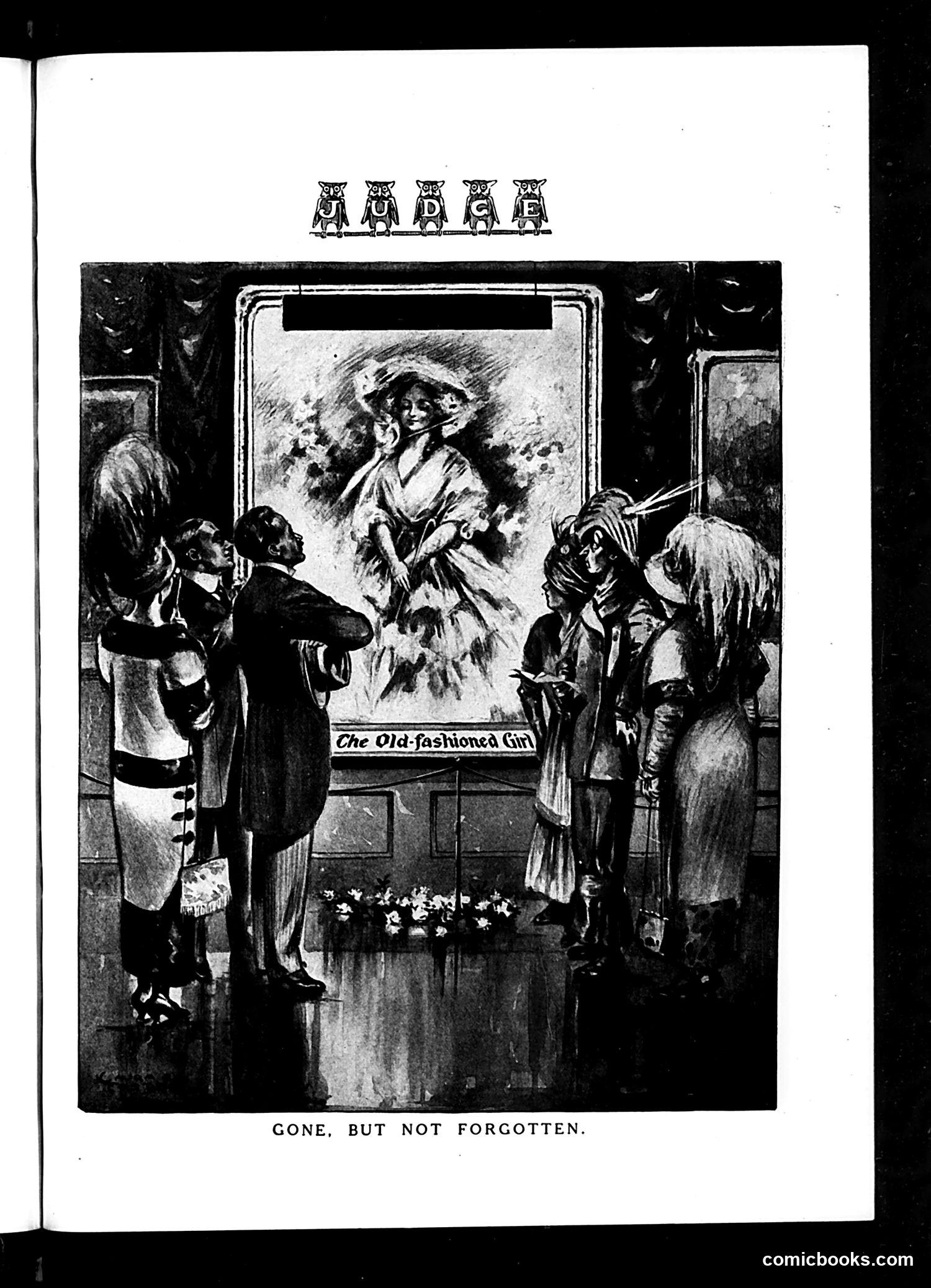
This satirical cartoon depicts a window display for "The Old-Fashioned Gin," with the caption "GONE, BUT NOT FORGOTTEN." The image shows well-dressed figures gazing at a portrait of a woman in the shop window, as if viewing a memorial or remembrance. This appears to reference **Prohibition-era satire**—mocking the loss of alcohol consumption in America (Prohibition began 1920). The "gone, but not forgotten" caption suggests nostalgia for pre-Prohibition drinking culture. The woman's portrait in the window functions as a kind of memorial to alcohol itself, treated as a departed figure worthy of remembrance. The cartoon satirizes how Americans continued to sentimentalize legal alcohol after Prohibition's implementation, treating its absence as a genuine loss to mourn.
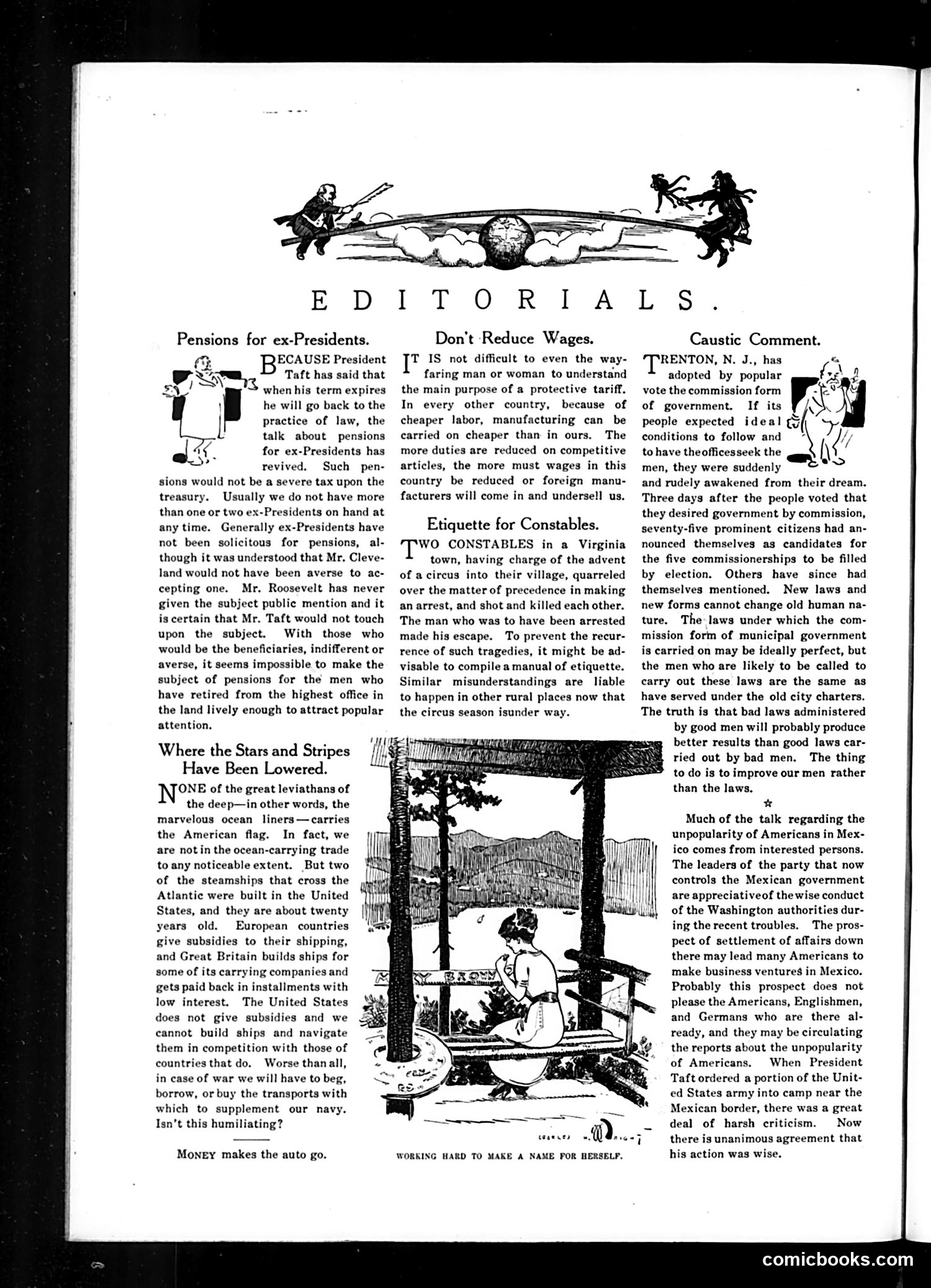
This page from Judge satirizes three political/social issues circa 1909: **"Pensions for ex-Presidents"**: Mocks the proposal to pension retiring presidents like Taft. The satire notes that ex-presidents themselves don't want pensions, making the debate absurd—there's no constituency supporting it, yet it persists as idle chatter. **"Where the Stars and Stripes Have Been Lowered"**: Criticizes American naval weakness. No major American ocean liners fly the U.S. flag because European countries subsidize their shipping while America doesn't. This leaves America vulnerable in wartime, forced to beg or borrow transport ships. **"Don't Reduce Wages"**: Argues protective tariffs are necessary. Lower import duties would force American workers' wages down to compete with cheaper foreign labor, undermining domestic workers. **"Etiquette for Constables"**: Reports a darkly humorous Virginia incident where two constables, quarreling over arrest precedence, shot each other dead—allowing the actual suspect to escape. Suggests rural lawmen need manners training. The page reflects Progressive-era debates over trade policy, naval power, and good governance.
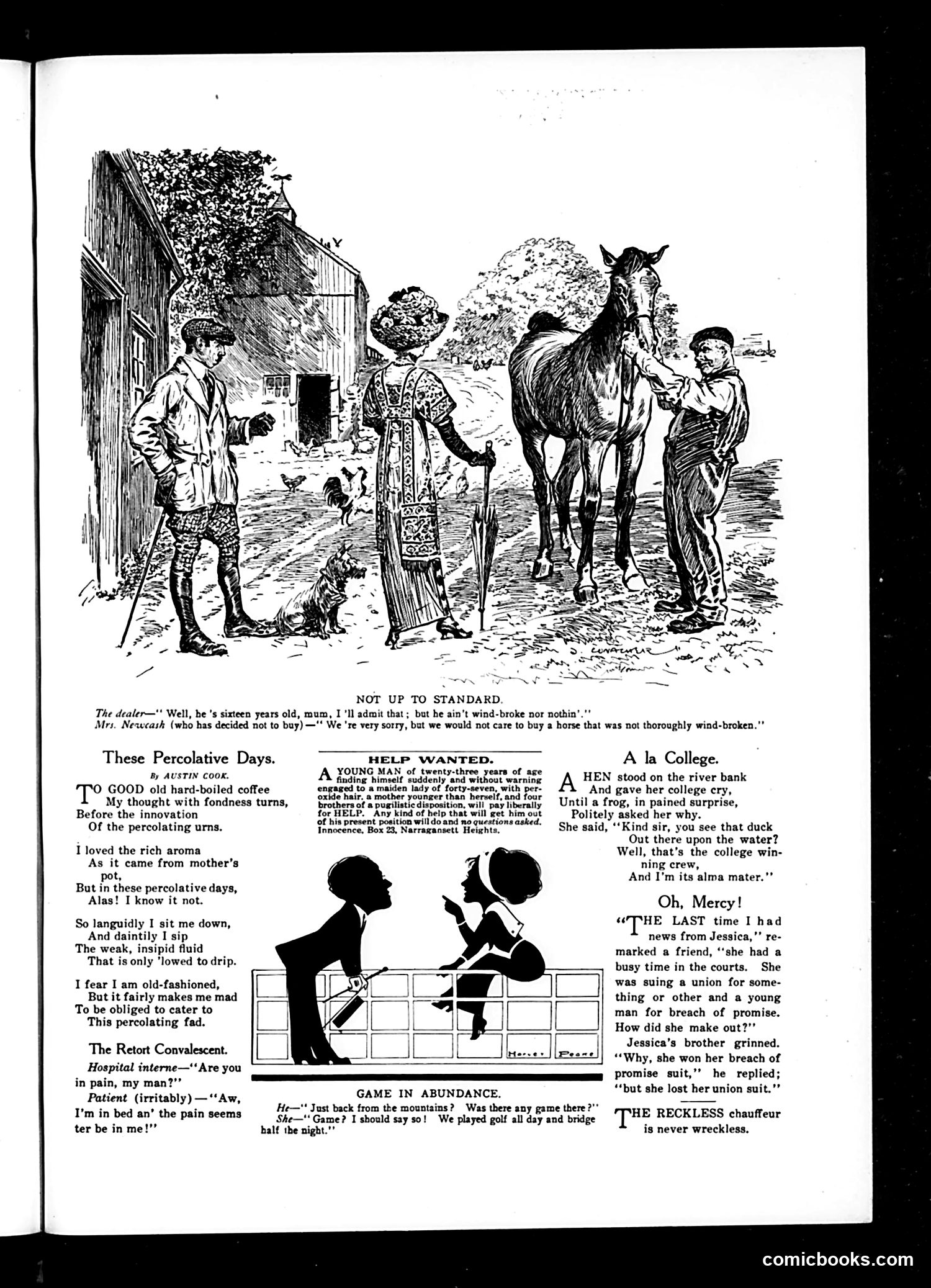
This page contains several satirical pieces typical of early 20th-century American humor: **"These Percolative Days"** mocks modern convenience technology—specifically electric percolating coffee urns—through an old-fashioned narrator nostalgic for strong, traditionally-brewed coffee. The satire targets resistance to technological "progress" and changing household customs. **The horse-trading cartoon** at top satirizes nouveaux riches (represented by "Mrs. Newcash") who adopt fashionable standards without understanding them—she insists on buying only "wind-broken" horses, inverting normal logic about animal quality. **"Help Wanted"** and **"Oh, Mercy!"** are brief comedic vignettes about romantic entanglements and legal mishaps respectively. **"Game in Abundance"** plays on double meanings—conflating hunting "game" with parlor games (golf, bridge), suggesting the wealthy occupy themselves frivolously. Throughout, the humor targets modern affectations, social climbing, and the absurdities of contemporary manners among the affluent and fashionable classes—typical Judge magazine fare satirizing American society's anxieties about progress and propriety.
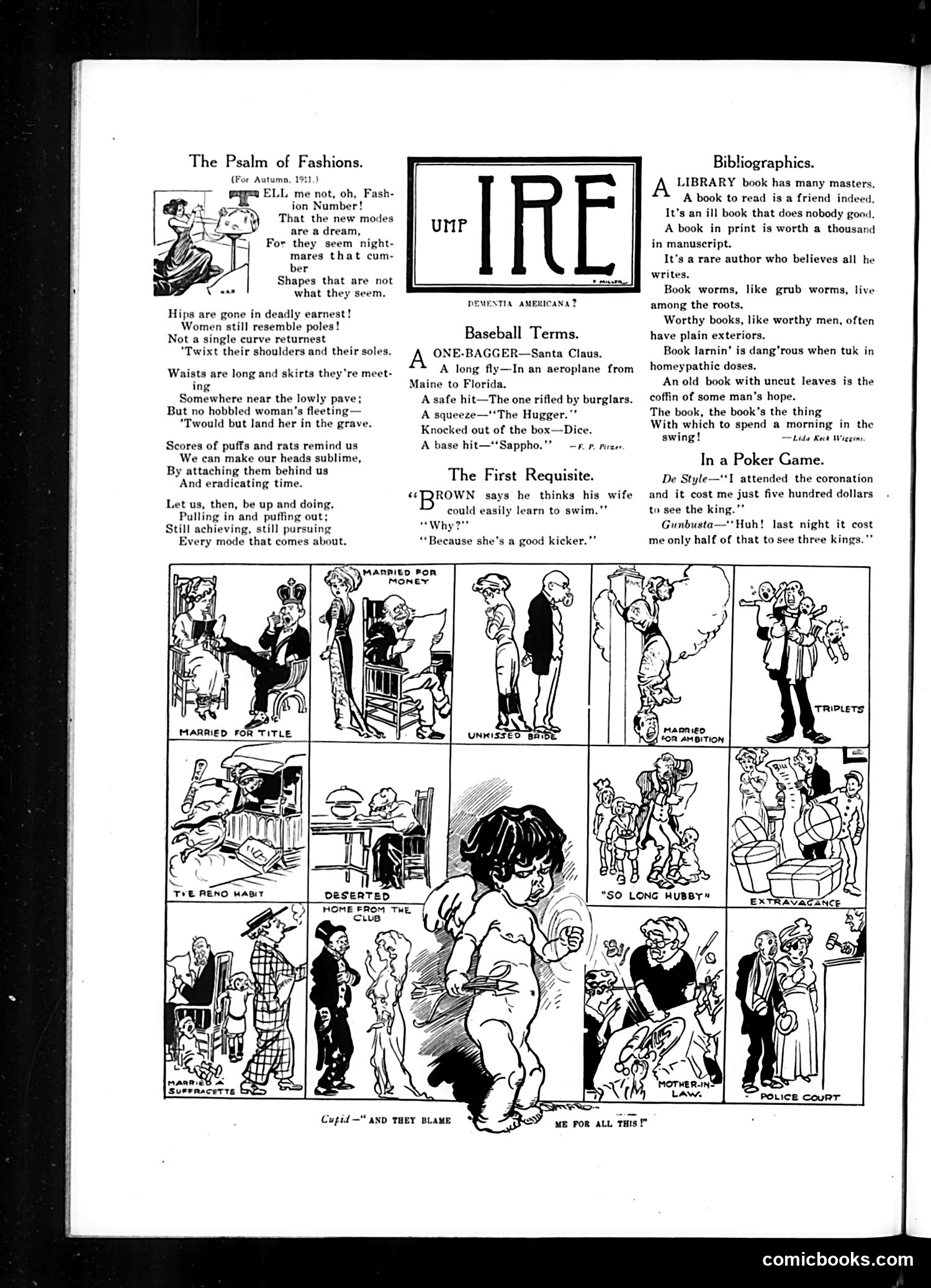
This page from *Judge* magazine (1911) contains several satirical pieces mocking contemporary American life: **"The Psalm of Fashions"** ridicules women's fashion trends of 1911—specifically the elimination of curves, elongated waists, and hobble skirts that restricted movement. The satire criticizes how absurdly impractical and unflattering these designs were. **"Baseball Terms"** is wordplay connecting baseball slang to contemporary topics: "one-bagger" refers to Santa Claus (possibly mocking commercialism), "safe hit" jokes about burglars, and "base hit—'Sappho'" likely contains a reference unclear without additional context. **"The First Requisite"** is a brief joke about wives learning to swim because "she's a good kicker"—implying women's leg strength. **The large comic strip** titled "And They Blame Me for All This!" depicts various marital and domestic scenarios (marriages for money/title, desertion, infidelity, etc.), suggesting society blames women for relationship failures while ignoring men's responsibility. **"Bibliographics"** offers homespun observations about books and reading. The overall tone is characteristic of *Judge*'s satirical approach to gender relations and social hypocrisy.
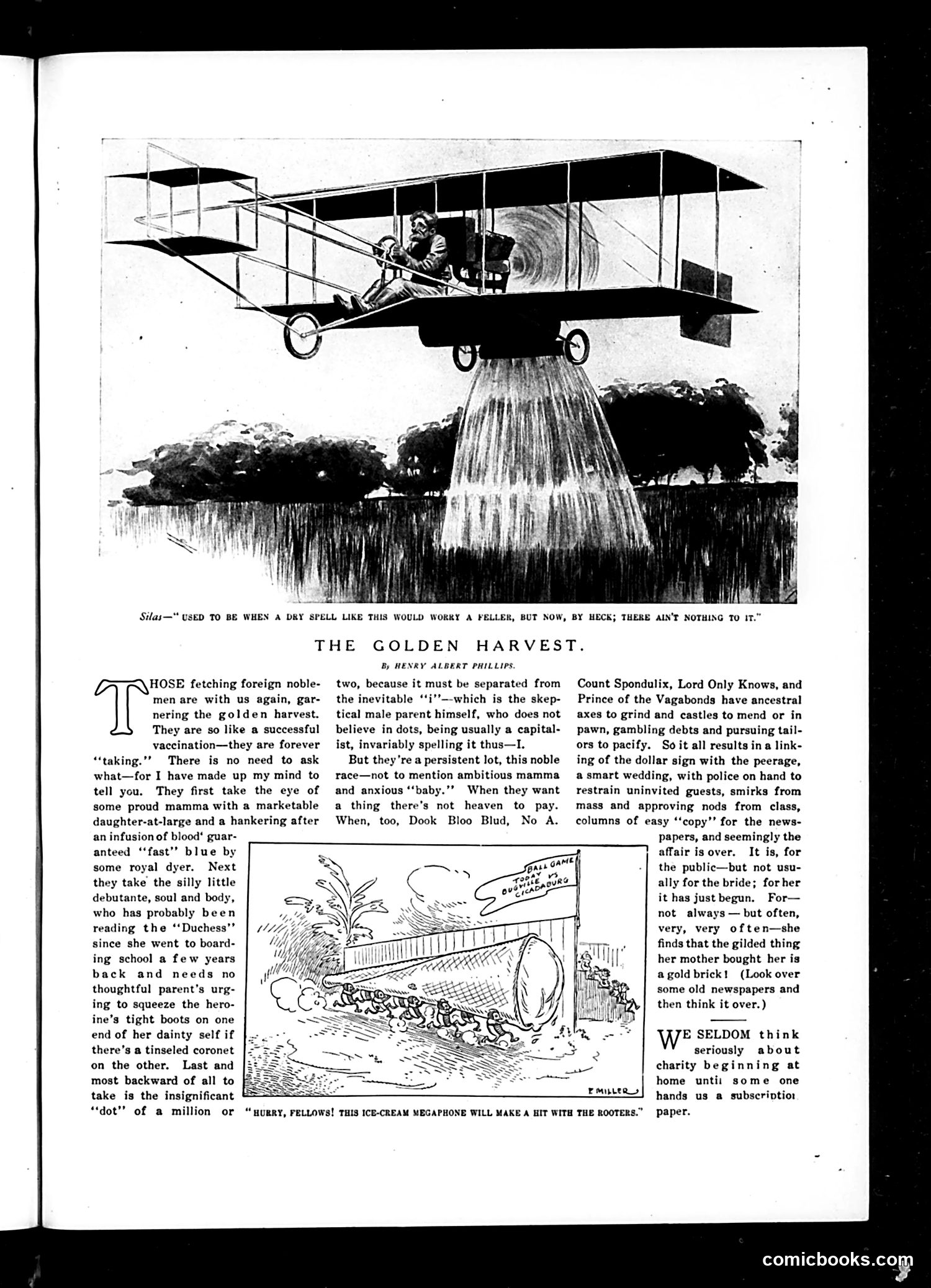
This satirical piece by Henry Albert Phillips mocks the practice of wealthy American families marrying off their daughters to impoverished European nobility. The cartoon shows an airplane (likely representing modern speed/progress) spraying water on crops—visually representing how foreign nobles "harvest" American wealth. The text details the scheme: foreign noblemen with titles but empty pockets seduce American debutantes whose mothers eagerly pursue such matches for social prestige. The satirist lists the targets: the daughter, her mother, and finally—reluctantly—the capitalist father who finances the whole affair. The satire's sting: these daughters discover too late they've married literal gold bricks—titles mask financial ruin, gambling debts, and mistresses. The joke is that American money temporarily props up European aristocratic pretense, benefiting no one but the nobility. The smaller cartoon about an ice-cream megaphone appears unrelated—likely filler or a separate item.
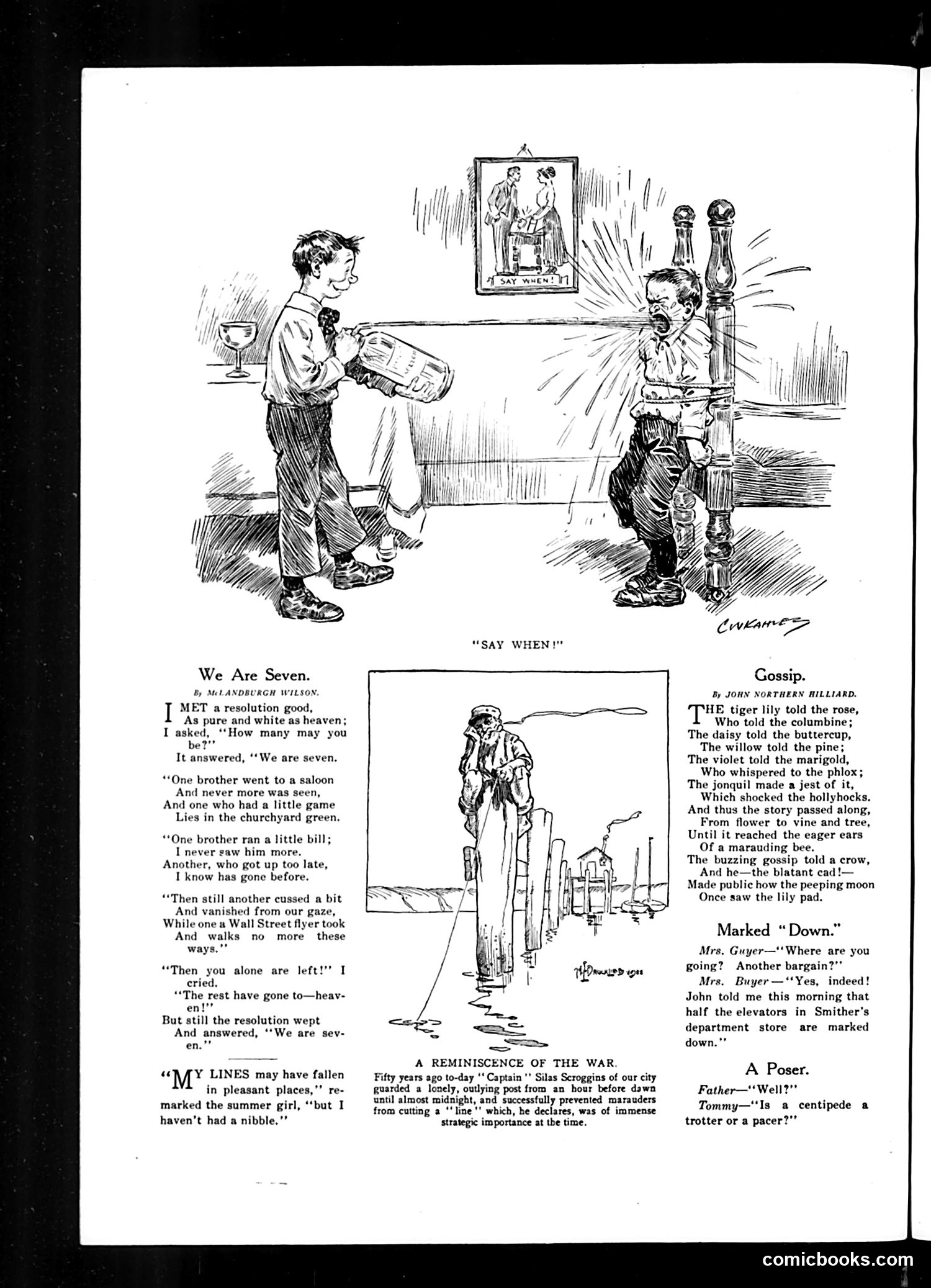
This page contains several humorous pieces satirizing American society circa early 1900s: **"We Are Seven"** (top left): A parody of Wordsworth's poem where a "resolution" (likely a New Year's resolution to be virtuous) explains why it has failed. Its seven components have each disappeared through moral failings: one visited a saloon, another gambled, another defaulted on bills, one "cussed," another made risky Wall Street investments. The joke mocks how easily good intentions collapse under temptation—a commentary on human weakness and vice. **"Say When!" cartoon** (top): Two boys with what appears to be beer bottles—one spraying the other. The title suggests excess or loss of control, satirizing drinking culture. **Other pieces** include light humor about summer romance, a war reminiscence, and domestic comedy about bargain-hunting wives misunderstanding their husbands' words. The overall tone reflects Judge's satirical approach to contemporary American failings: moral weakness, financial speculation, drinking, and consumer culture.
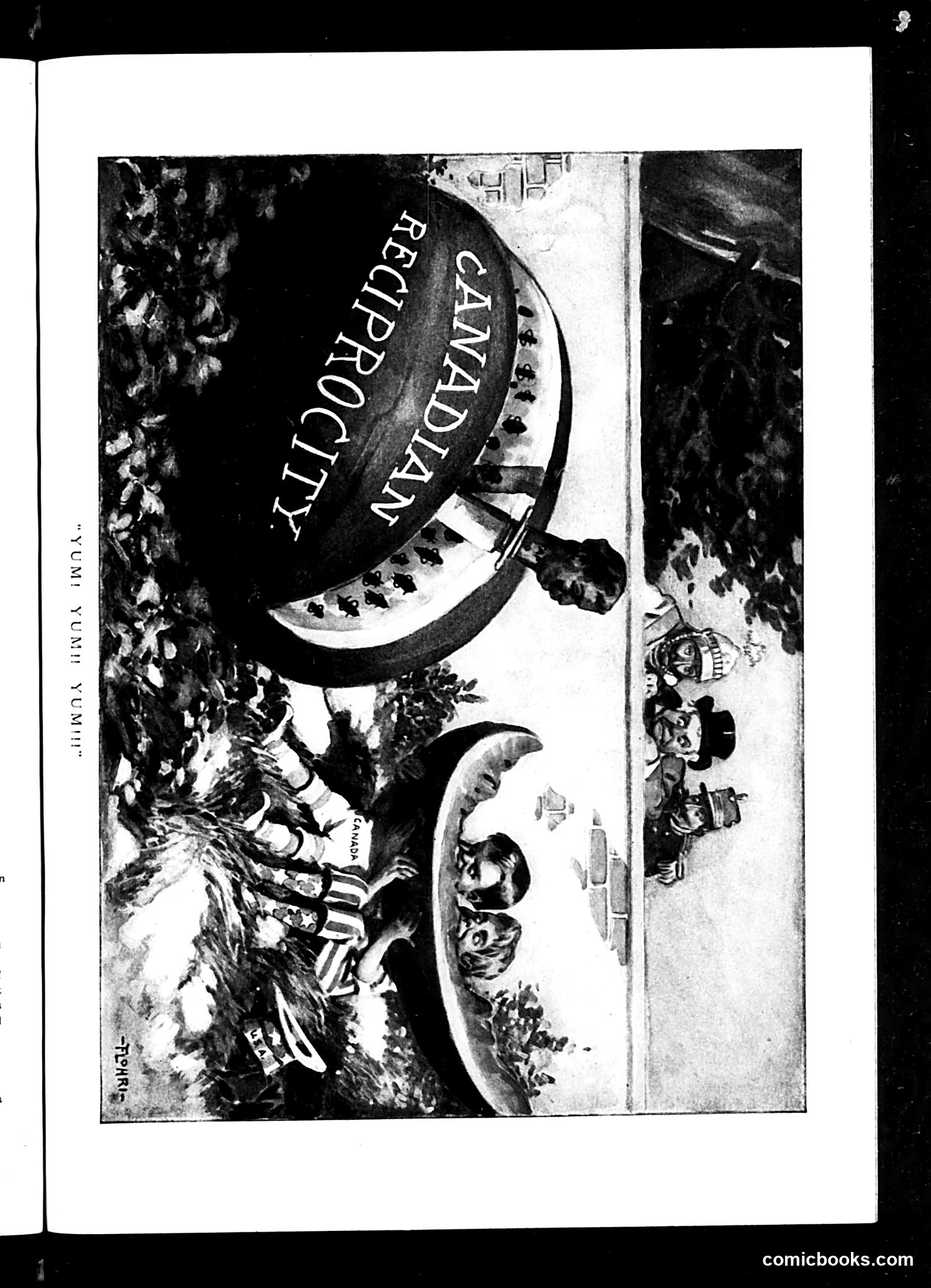
This page from *Judge* magazine appears to show a political cartoon, though the OCR text provided is largely corrupted and illegible, consisting mainly of scattered characters and symbols. The visible image shows what appears to be a circular emblem or seal with text reading "CANADIAN RECIPROCITY" (visible when the image is rotated). The cartoon likely satirizes trade relations between the United States and Canada, a politically contentious issue in early 20th-century American politics. Without legible text or clearer identification of the caricatured figures, the specific targets and precise satirical point remain unclear. The cartoon's point would have involved contemporary debates over tariffs and trade agreements with Canada.
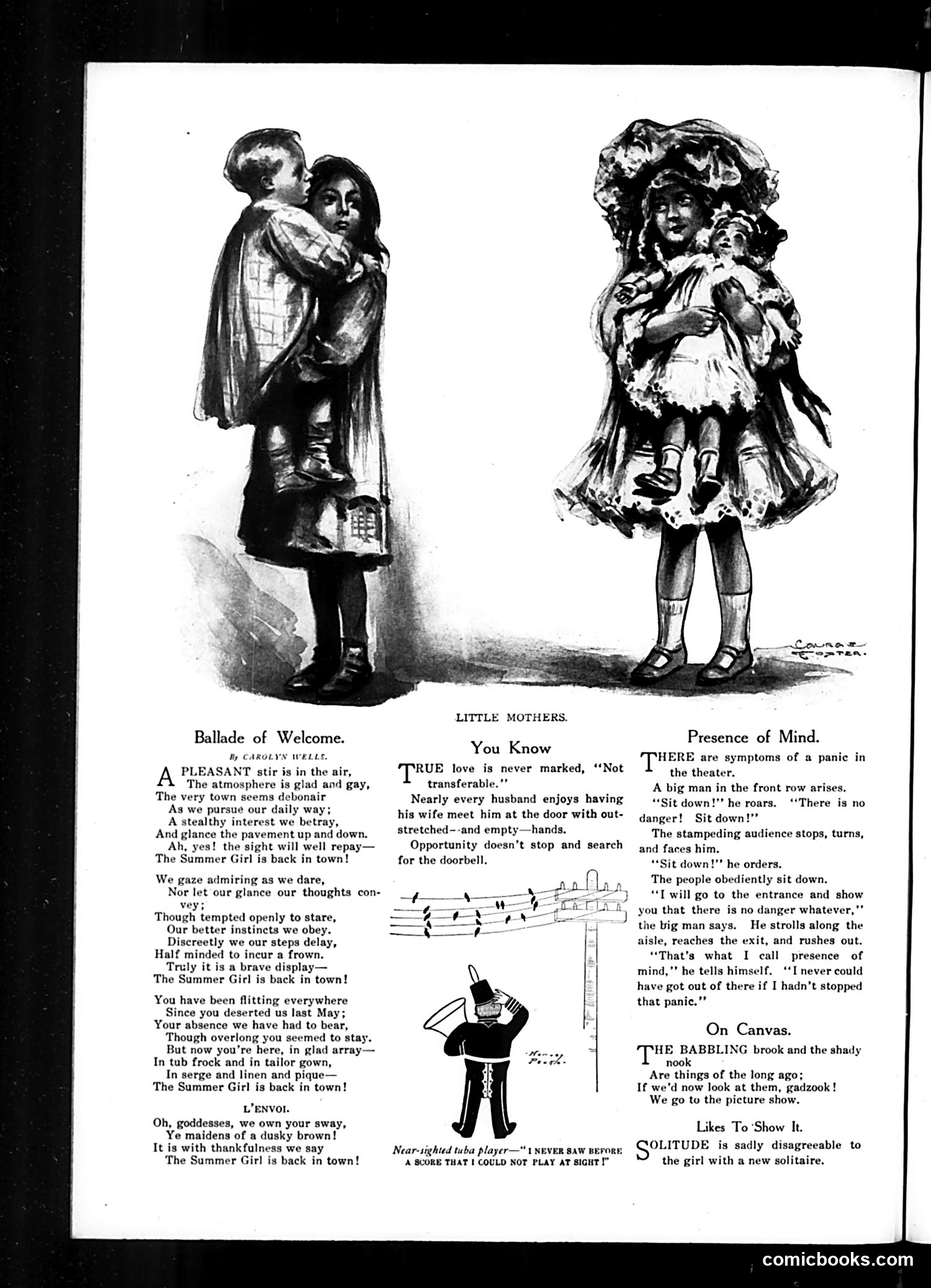
This page from the satirical magazine *Judge* contains several humorous short pieces mocking social customs of the era: **"Ballade of Welcome"** celebrates the return of fashionable young women ("Summer Girls") to town each season—satirizing both male attention to their appearance and their conspicuous consumption of new clothing (tub frocks, tailor gowns, serge, linen). **"Little Mothers"** offers cynical observations on marriage: husbands prefer wives with empty hands (implying they've spent no money), and opportunity isn't predictable. **"Presence of Mind"** jokes about a man who stops a theater panic by commanding calm, then immediately flees—taking credit for preventing chaos he himself caused. **"On Canvas"** laments that modern people prefer picture shows to nature. **"Likes To Show It"** mocks vain women who ostentatiously display new engagement rings. The two illustrations show elegantly-dressed women with children, typical *Judge* fashion commentary. The overall tone satirizes urban upper-class vanity, consumerism, and social pretense typical of early 20th-century American satire.
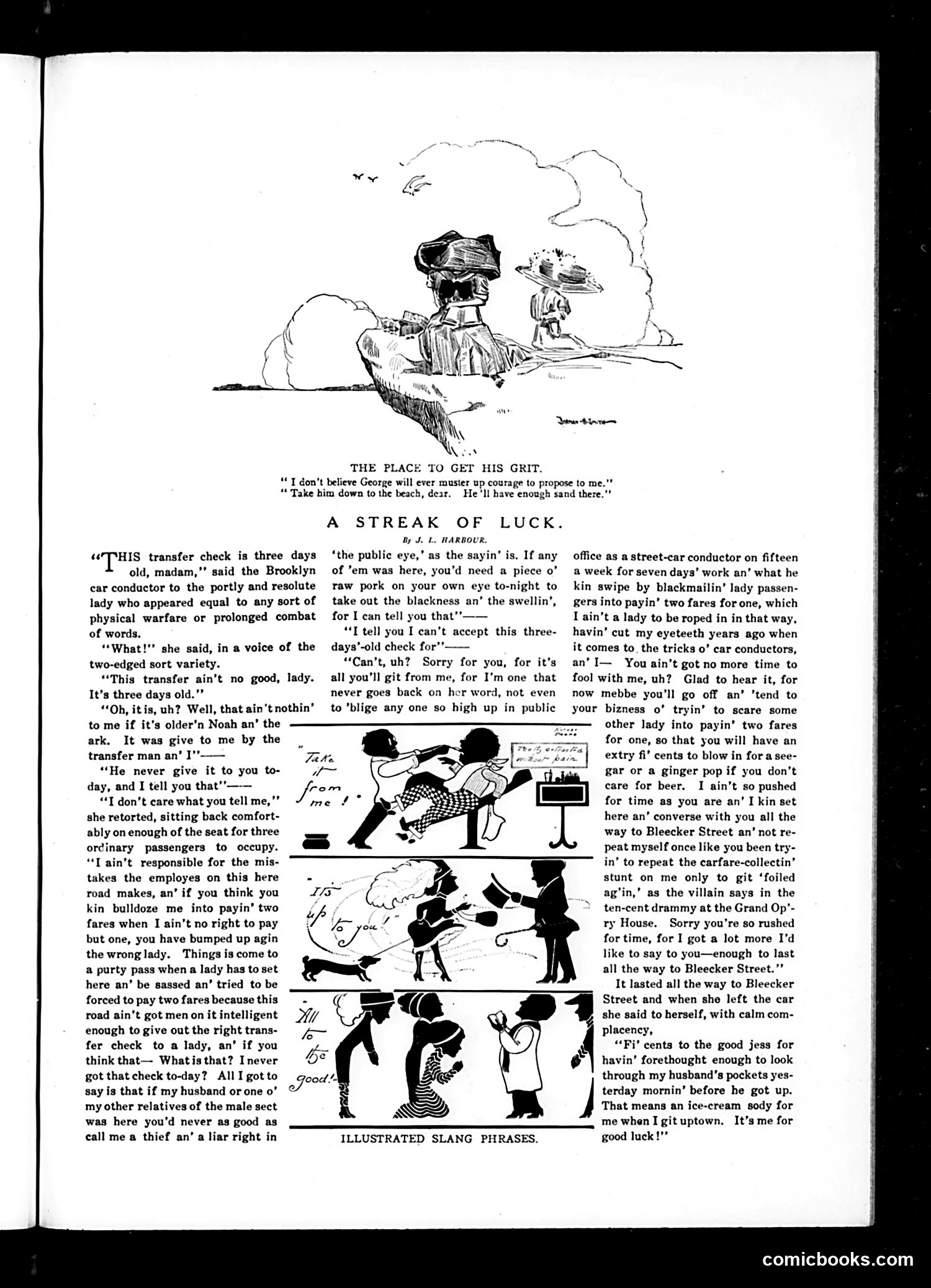
This is a humorous narrative piece satirizing a confrontation between a working-class Brooklyn woman and a streetcar conductor over an expired transfer pass. The woman, portrayed as loud, combative, and verbally unstoppable, refuses to pay an additional fare. She threatens violence ("raw pork on your own eye"), invokes her male relatives menacingly, and overwhelms the conductor with relentless talk until he gives up. The satire targets both figures: the conductor's petty authoritarianism and the woman's aggressive belligerence and manipulation. The ironic "streak of luck" ending reveals her real motivation—she stole five cents from her husband's pockets, planning to spend it on ice cream. The accompanying comic panels labeled "Illustrated Slang Phrases" humorously depict exaggerated body language and street vernacular common to working-class New York dialogue of the era.
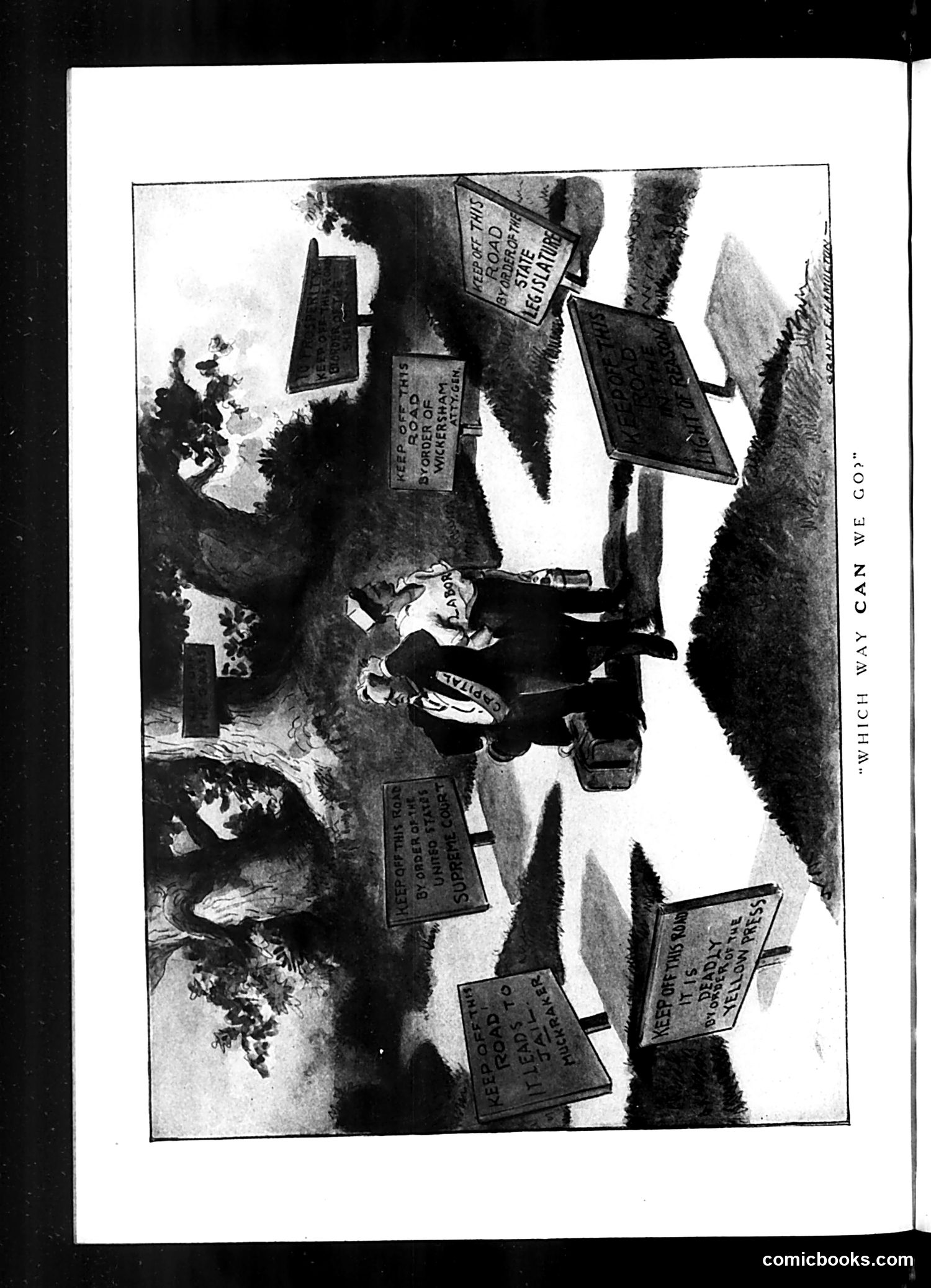
This appears to be a black and white photograph rather than a traditional cartoon, oriented sideways on the page. It shows a man in formal attire standing among numerous grave markers or memorial plaques in what appears to be a cemetery. The caption reads "WHICH WAY CAN WE GO?" The image likely constitutes political satire, with the graves representing fallen soldiers, victims, or consequences of a particular policy or decision. The man's confused posture amid the markers suggests he's trapped or questioning which direction to proceed given the surrounding "death" or destruction. Without clearer text or date identification, the specific political context remains unclear—this could reference wartime decisions, economic policies, or other crises of the era. The satire critiques someone's inability or unwillingness to change course despite evident negative consequences.
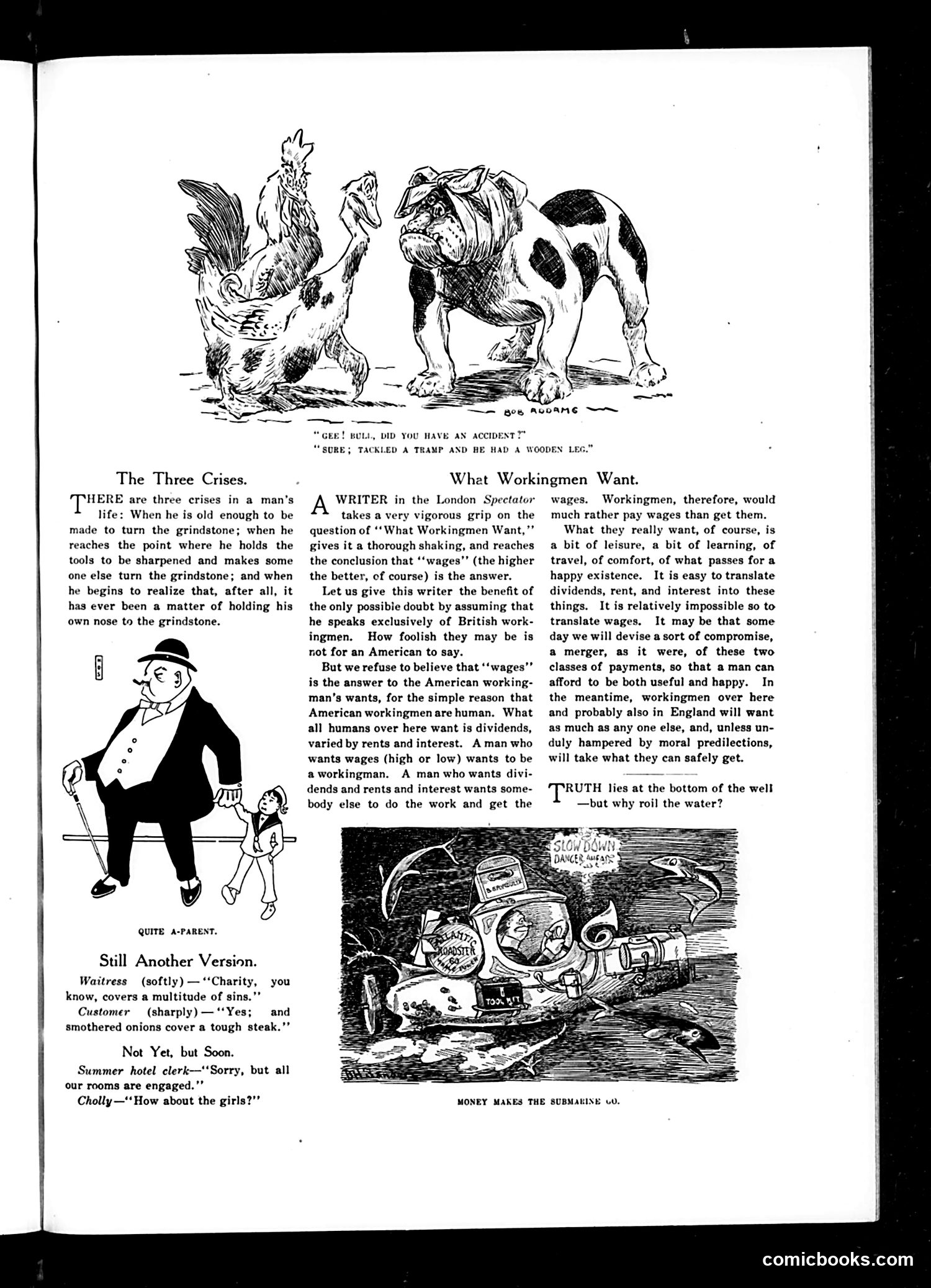
This page contains satirical commentary on labor and class issues circa early 1900s America. **"The Three Crises"** presents a cynical view of working life: men progress from grinding stones (manual labor) to controlling others' labor to finally realizing they've been grinding their own noses down—suggesting all work exhausts the worker regardless of position. **"What Workingmen Want"** mocks a British writer's claim that workers simply want higher wages. The American author argues this is foolish because American workingmen actually desire what the wealthy have: dividends, rents, and interest income—passive wealth. The satire suggests workers aspire to *not* work, contradicting the notion that wages satisfy them. The small vignettes ("Quite Apparent," "Still Another Version," "Not Yet") are unrelated joke fillers typical of Judge's format. **"Money Makes the Submarine Go"** (bottom illustration) appears to mock submarine technology or military spending, though context is limited. The overall thrust critiques both labor activists' wage demands and middle-class hypocrisy about American aspiration.
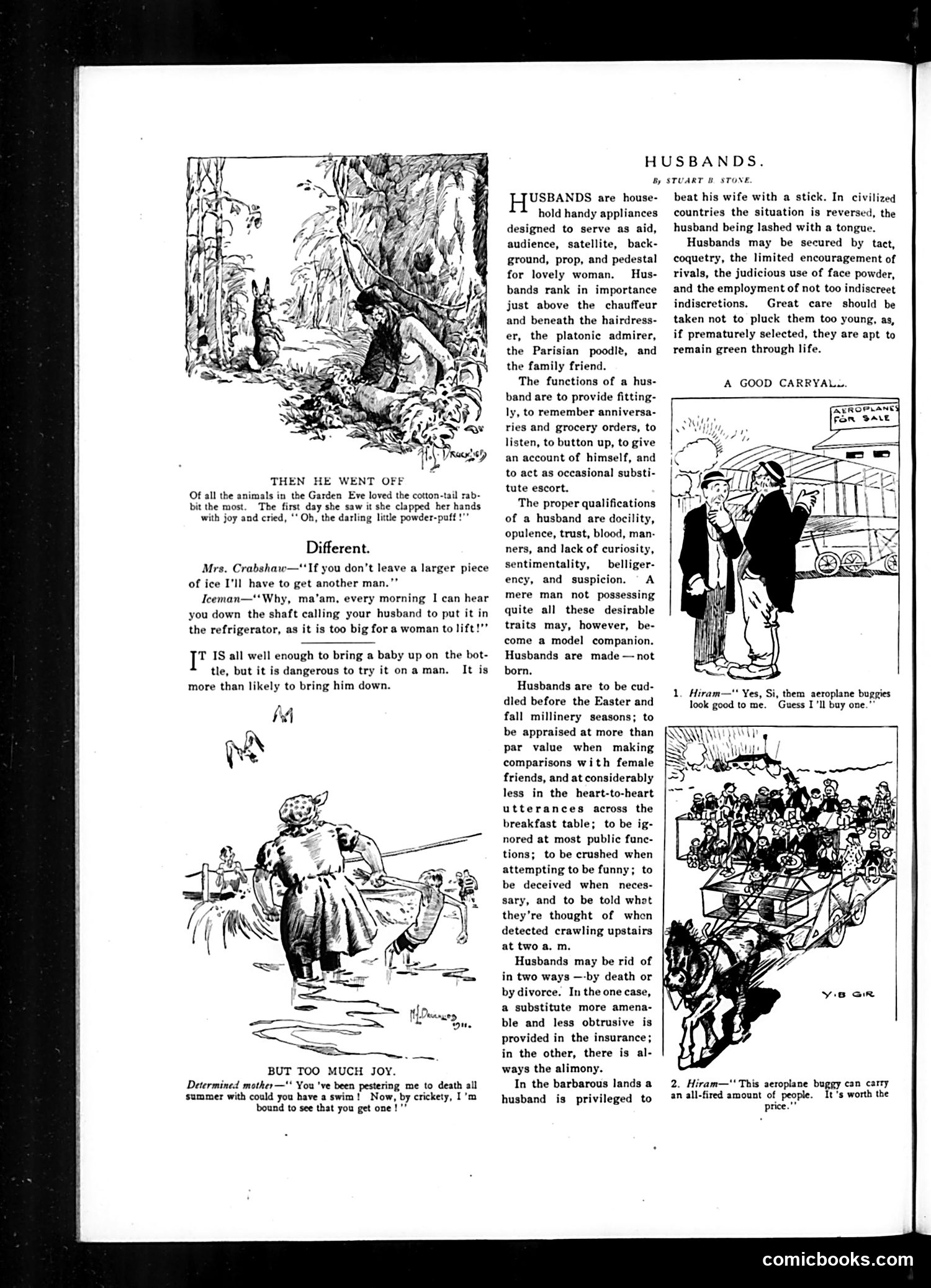
This *Judge* magazine page satirizes the institution of marriage from a misogynistic early-20th-century perspective. The main article by Stuart B. Stone treats husbands as household "appliances" wives control and manipulate—ranking them below chauffeurs and hairdressers in importance. The satire suggests wives strategically manage husbands through deception, withholding affection before shopping seasons, and verbal abuse as the "civilized" equivalent of physical beating in other cultures. The accompanying cartoons mock domestic friction: a wife complains about ice deliveries while her husband supposedly shirks; a mother forces her reluctant child into swimming as punishment. A final joke pairs rural figures admiring "aeroplane buggies" (early automobiles). The satire's target is ambiguous—it may mock either domineering wives or the marital power dynamics of the era. The tone reflects contemporary anxiety about shifting gender roles and women's increasing independence.
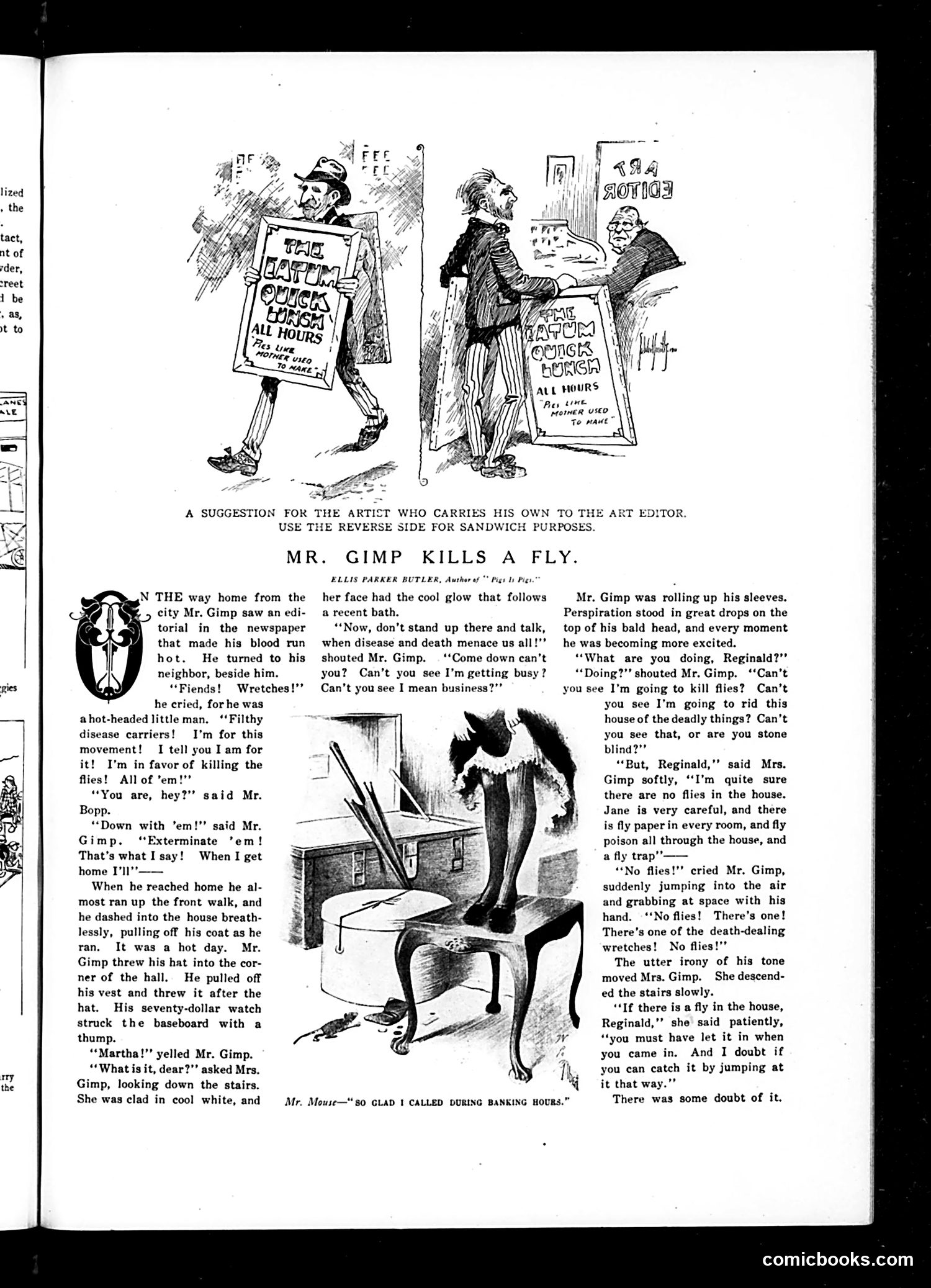
This is a humorous story by Ellis Parker Butler satirizing public health campaigns of the early 20th century. Mr. Gimp becomes inflamed by a newspaper editorial advocating fly extermination—a genuine public health movement of that era, as flies were recognized disease vectors. The satire mocks his hot-headed, performative enthusiasm: he rushes home in a frenzy, strips off his clothes, and begins wildly swatting at invisible flies despite his wife's calm assurance that their house is already fly-free through proper precautions (fly paper, poison, traps). The joke targets not flies themselves but the type of person who becomes passionately, irrationally swept up in reform movements without thinking them through—all noise and action where none is needed. His earnest zeal disconnected from reality becomes the actual target of ridicule.
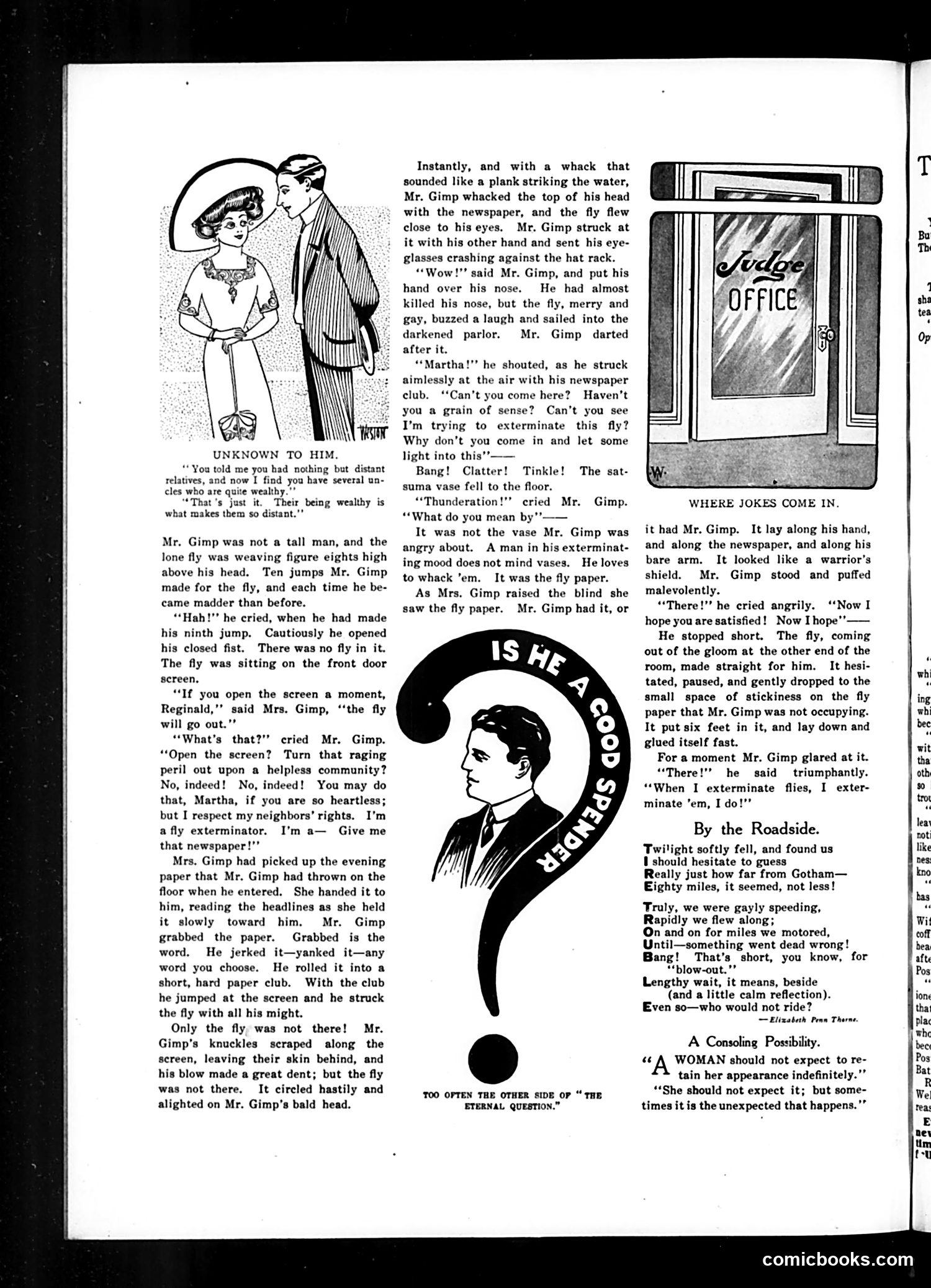
This page contains a humorous short story about Mr. Gimp, a man obsessed with exterminating a fly in his home. The satire works on multiple levels: **The Main Story**: Mr. Gimp's increasingly frantic and destructive attempts to kill a single fly—smashing his head, breaking his eyeglasses, denting the door screen, destroying a Satsuma vase, and coating himself in flypaper—illustrate the absurdity of overreacting to minor annoyances. His insistence on being a "fly exterminator" and his self-righteous refusal to simply open a window mock people who take trivial matters with exaggerated seriousness. **Social Commentary**: The opening joke about wealthy uncles being "distant" satirizes how money affects family relationships, a common Judge theme. **The Illustration**: Shows a well-dressed couple, typical of Judge's middle-class audience, representing domestic life's mundane conflicts. The story's humor derives from escalating chaos and Mr. Gimp's stubborn determination destroying more property than the actual pest—a classic comedic inversion where the solution becomes worse than the problem.
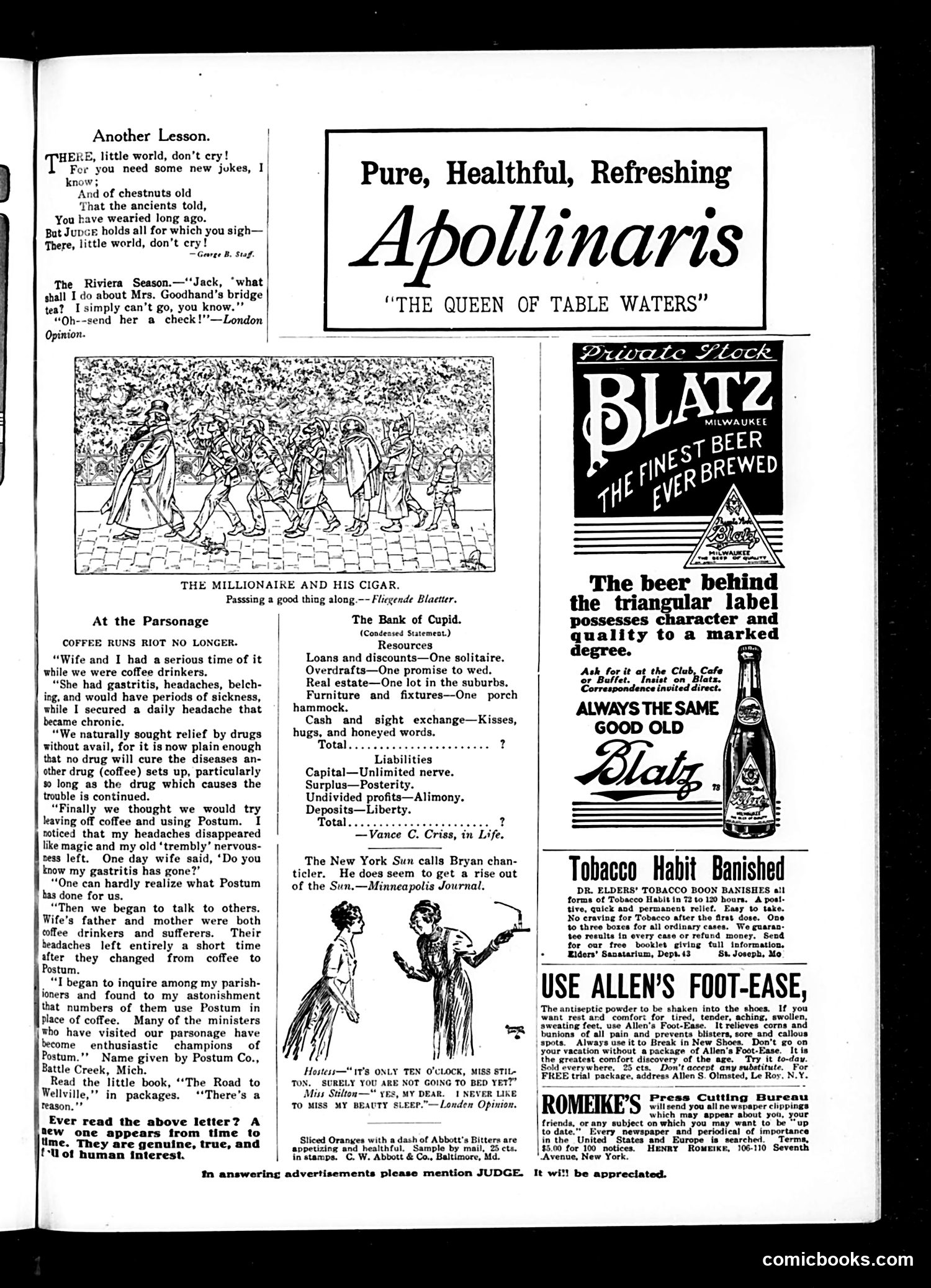
This page is primarily **advertising with light satirical content**, typical of early 1900s Judge magazine. The main cartoon depicts **"The Millionaire and His Cigar,"** showing a wealthy man passing along a fine cigar—a gentle joke about sharing good fortune, suggesting the rich man's generosity or that he's passing off his experience. Other satirical pieces include: - **"The Bank of Cupid"**: A humorous financial statement treating romance as a business, listing "assets" (kisses, promises) and "liabilities" (alimony, posterity)—satirizing the transactional nature of courtship and marriage in society. - A quip about **William Jennings Bryan**, the political figure, calling him a "chanticleer" (rooster) because he "gets a rise out of the Sun"—wordplay on the *New York Sun* newspaper. The rest consists of period advertisements for Apollinaris water, Blatz beer, Postum coffee substitute, and various patent medicines—reflecting turn-of-the-century consumer culture and the ubiquity of dubious health product advertising.
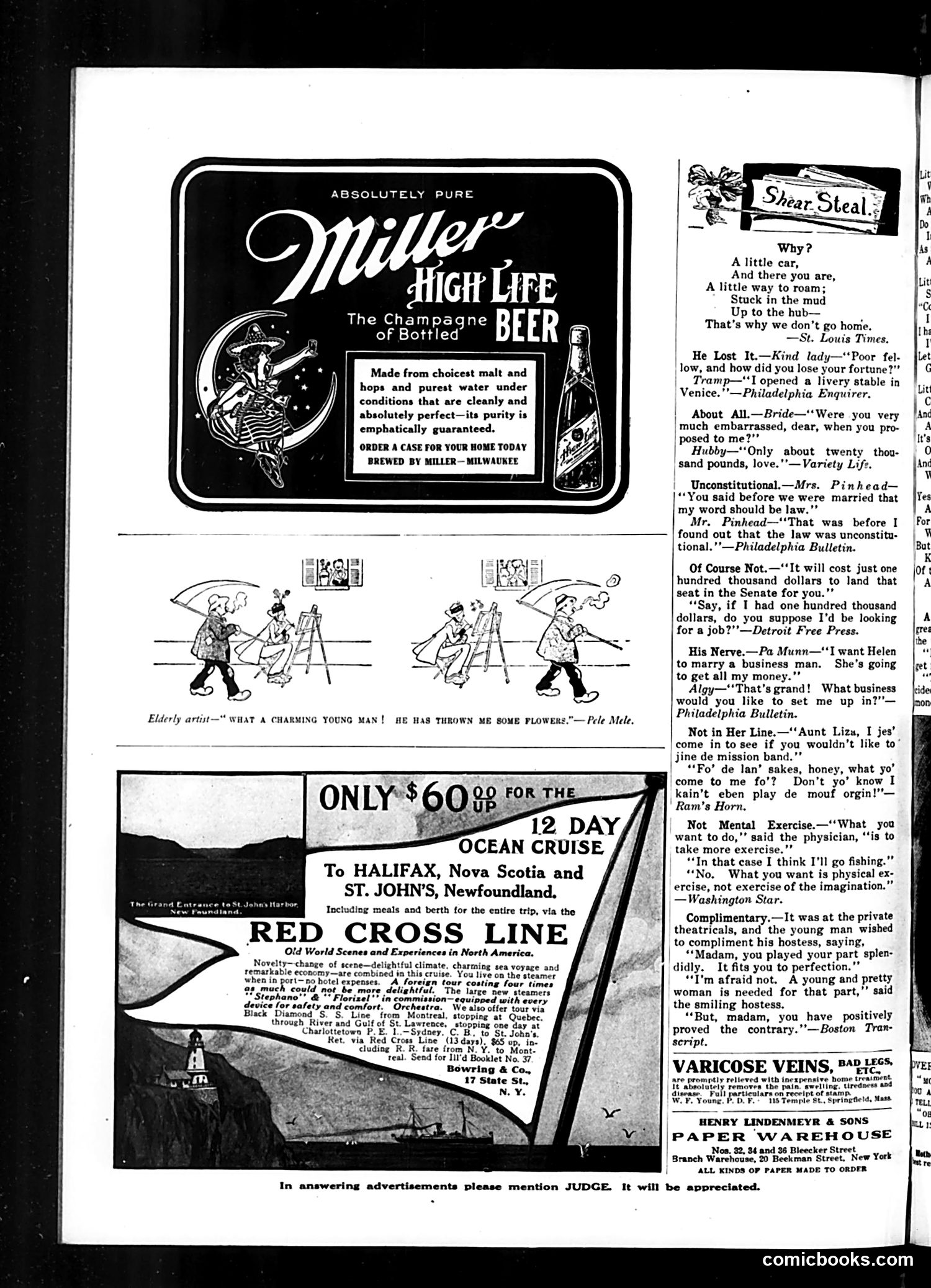
This page from Judge magazine (a satirical publication) contains primarily **advertisements and humor columns**, rather than political cartoons. The main content includes: **Advertisements:** - Miller High Life beer ("The Champagne of Bottled Beer") - Red Cross Line cruise to Halifax and Newfoundland for $60 - Henry Lindenmeyer & Sons paper warehouse - Medical treatment for varicose veins **Humorous content:** A small cartoon showing an elderly artist and a young man, captioned about compliments and flowers—typical sentimental humor. Below this are numerous brief joke columns titled "Shear Steal" featuring domestic humor: couples bickering about marriage law, a farmer losing money on a livery stable in Venice, complaints about car troubles, and other everyday social observations. These represent common satirical targets of the era—marriage dynamics, financial foolishness, and modern inconveniences. **Overall:** This appears to be a typical Judge magazine page from the early 20th century, mixing consumer advertising with mild, conventional humor rather than sharp political satire.
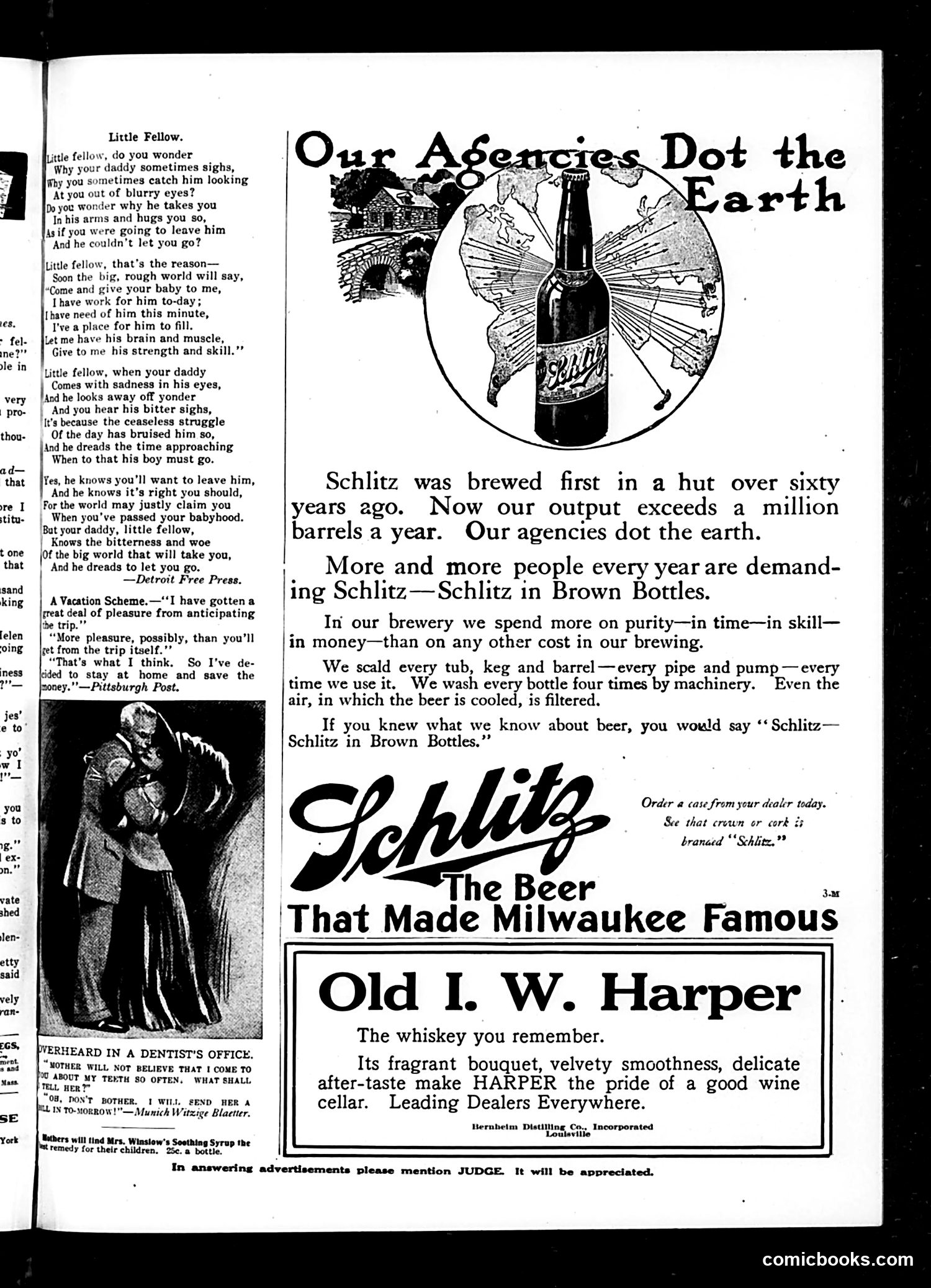
This page combines sentimental editorial content with period advertising. **The Main Content:** "Little Fellow" is a sentimental poem about a father's anxiety over his son's inevitable entry into the harsh working world. The piece reflects early 20th-century anxieties about child labor and industrial society—the father dreads the day "the big, rough world" will demand his boy's "brain and muscle" for work. It's melodramatic but speaks to genuine contemporary concerns about children entering factories and mines. **The Advertisements:** The page features three ads typical of the era: - **Schlitz Beer**: Emphasizes purity and sanitation ("We wash every bottle four times by machinery") - **Old I.W. Harper Whiskey**: Markets itself as a luxury product for refined consumers - **A cartoon joke** about a man visiting a dentist as a pretext to escape his mother The advertisements reveal what Judge's affluent readership valued: industrial efficiency, consumer goods, and humor about family obligation.
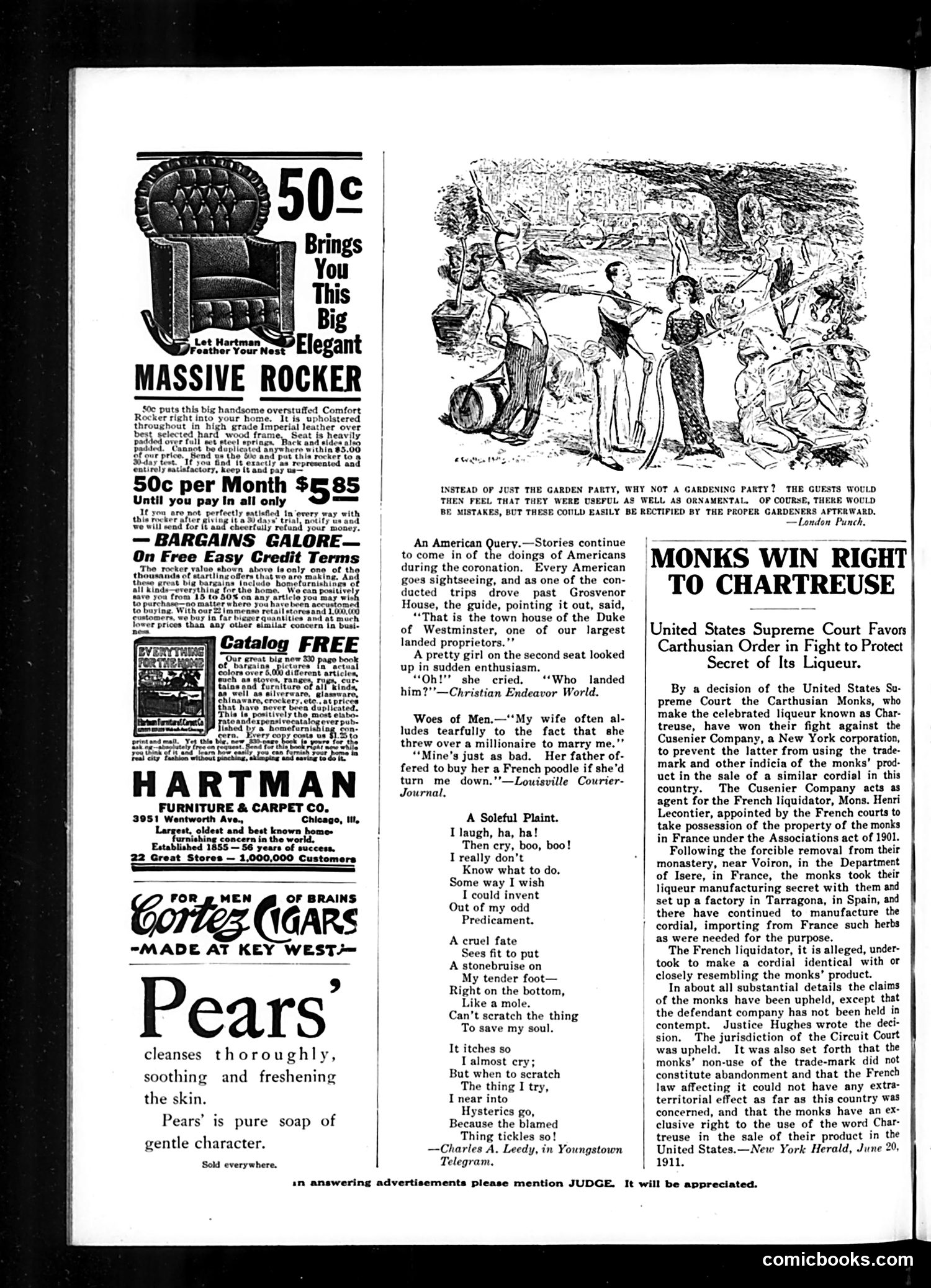
This Judge magazine page is primarily **advertising and humor content** rather than political satire. The illustrated cartoon at top-right depicts a garden party scene with the caption suggesting guests participate in actual gardening work rather than just socializing—a gentle satire on the leisure activities of the wealthy. The page contains **multiple advertisements**: a Hartman Furniture rocker (50 cents monthly), Cortez cigars, and Pears' soap, using typical early 20th-century marketing language emphasizing value and quality. The humor section includes light anecdotes: an American tourist asking "Who landed him?" about the Duke of Westminster (playing on "landing" a wealthy husband), and a poem about the frustration of an itchy foot that cannot be scratched without tickling. The serious article concerns a **1911 Supreme Court decision** protecting Carthusian monks' exclusive rights to produce Chartreuse liqueur against a competing American company. This reflects contemporary intellectual property debates and the conflict between European monastic traditions and American commercial interests.
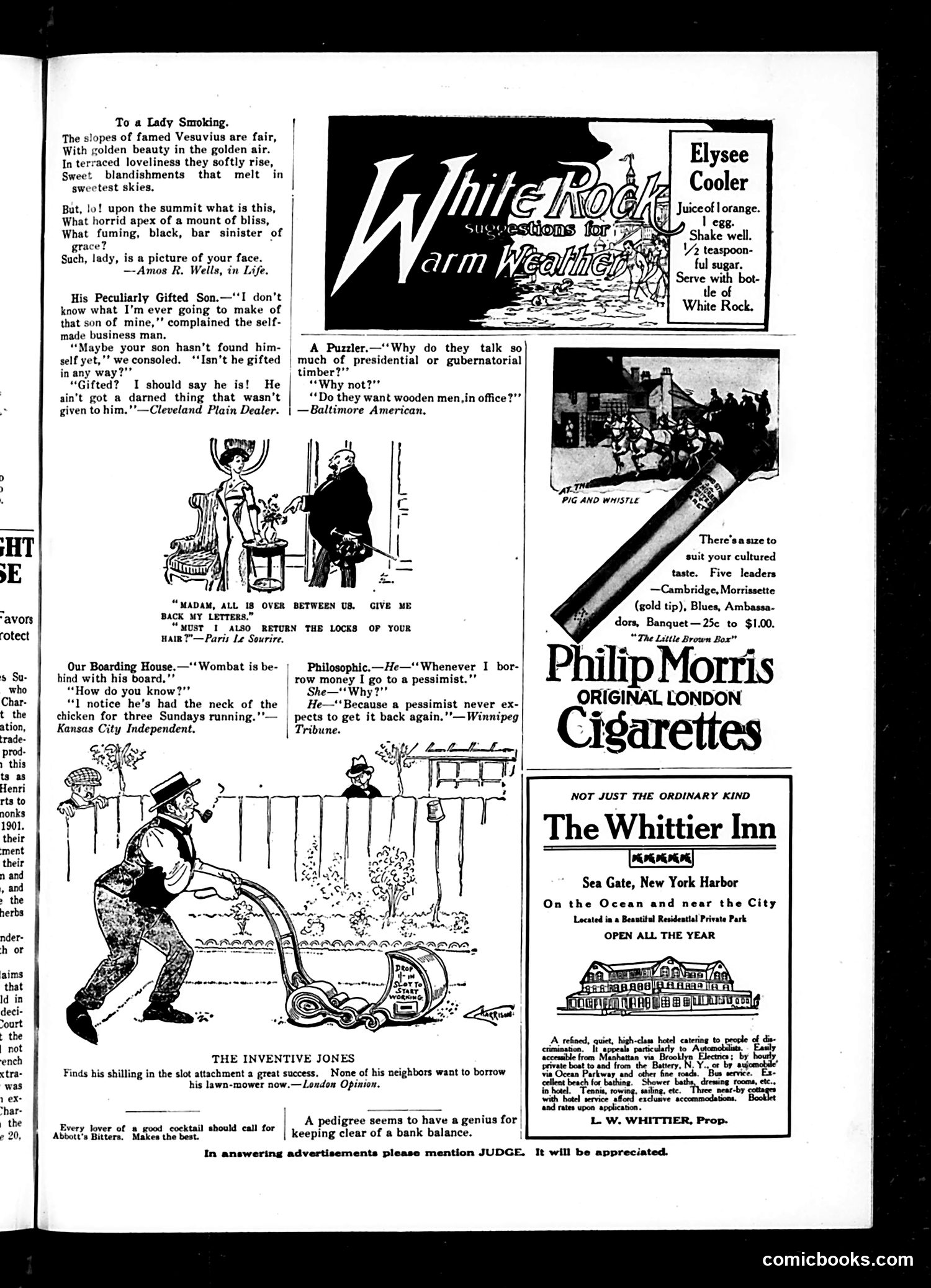
This page contains humor pieces and advertisements typical of early 20th-century American satirical magazines. **Notable Content:** The **"To a Lady Smoking"** poem mocks women smokers by comparing a woman's smoking face to Mount Vesuvius—suggesting cigarette smoke makes her appearance grotesque and destructive. This reflects contemporary attitudes condemning female smoking as unfeminine and socially improper. **"His Peculiarly Gifted Son"** jokes that a self-made businessman's son is "gifted" only at receiving handouts—satirizing wealthy heirs who inherit rather than earn their position. **"The Inventive Jones"** depicts a man who installed a coin-operated latch on his lawnmower to prevent neighbors from borrowing it—poking fun at penny-pinching and suburban competitiveness. The page is dominated by period **advertisements** for cigarettes, bitters, hotels, and beverages, reflecting Judge's commercial focus alongside satire.
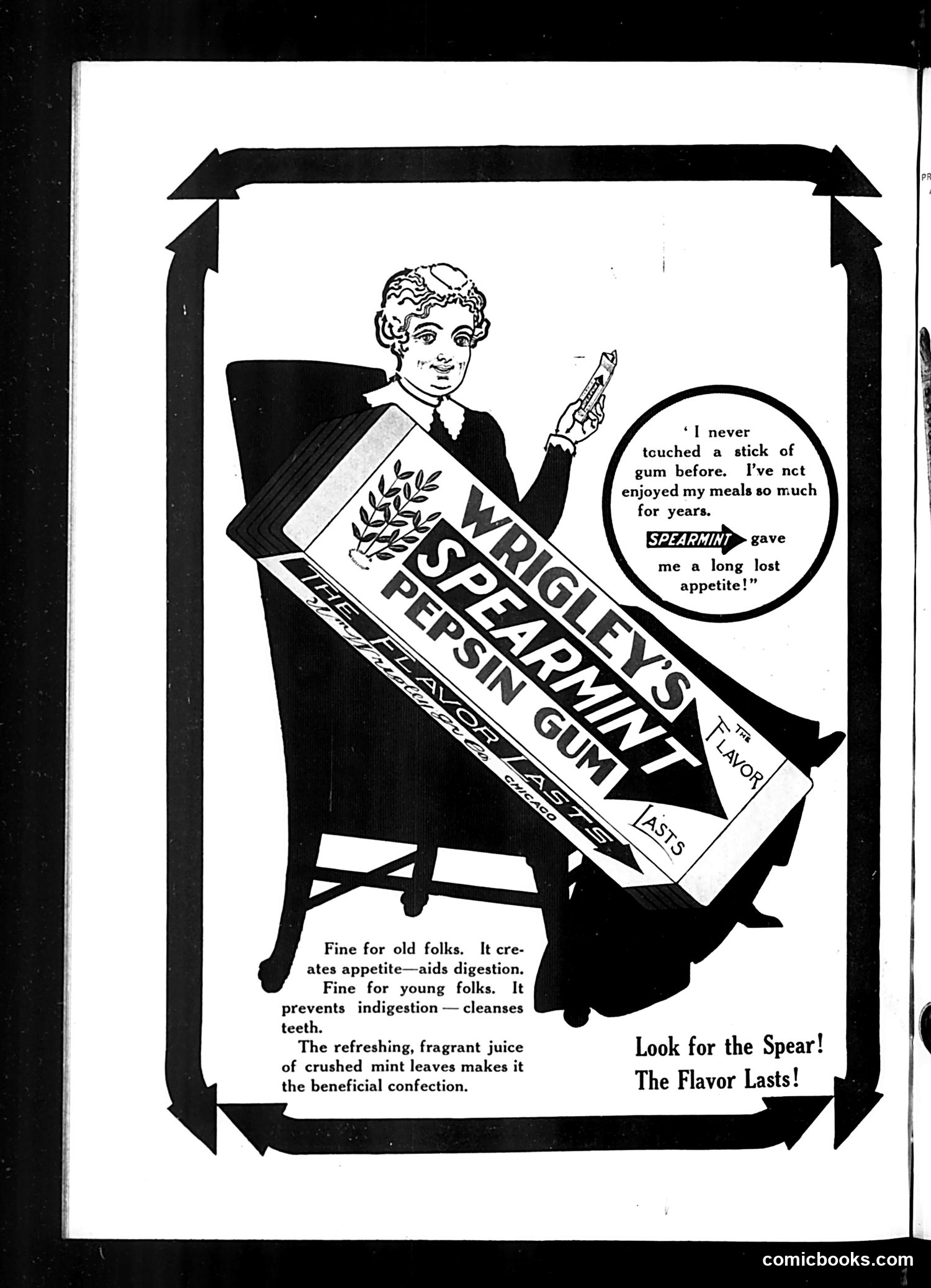
This is a **product advertisement**, not political satire. It promotes Wrigley's Spearmint chewing gum, identifiable by the distinctive spear logo on the gum package. The ad features a well-dressed woman in a chair endorsing the product through a testimonial: she claims the gum restored her lost appetite and enhanced her meal enjoyment. The marketing copy emphasizes health benefits—claiming it aids digestion, prevents indigestion, and cleanses teeth for both elderly and young consumers. The "Spear" referenced is Wrigley's brand trademark. This appears to be vintage advertising (likely early-to-mid 20th century) from Judge magazine, using a respectable-looking female figure as a credible endorser—a common advertising strategy of that era to build consumer trust in commercial products.