
Judge, 1911-08-19 · page 6 of 24
Judge — August 19, 1911 — page 6: what you’re looking at
What you’re looking at
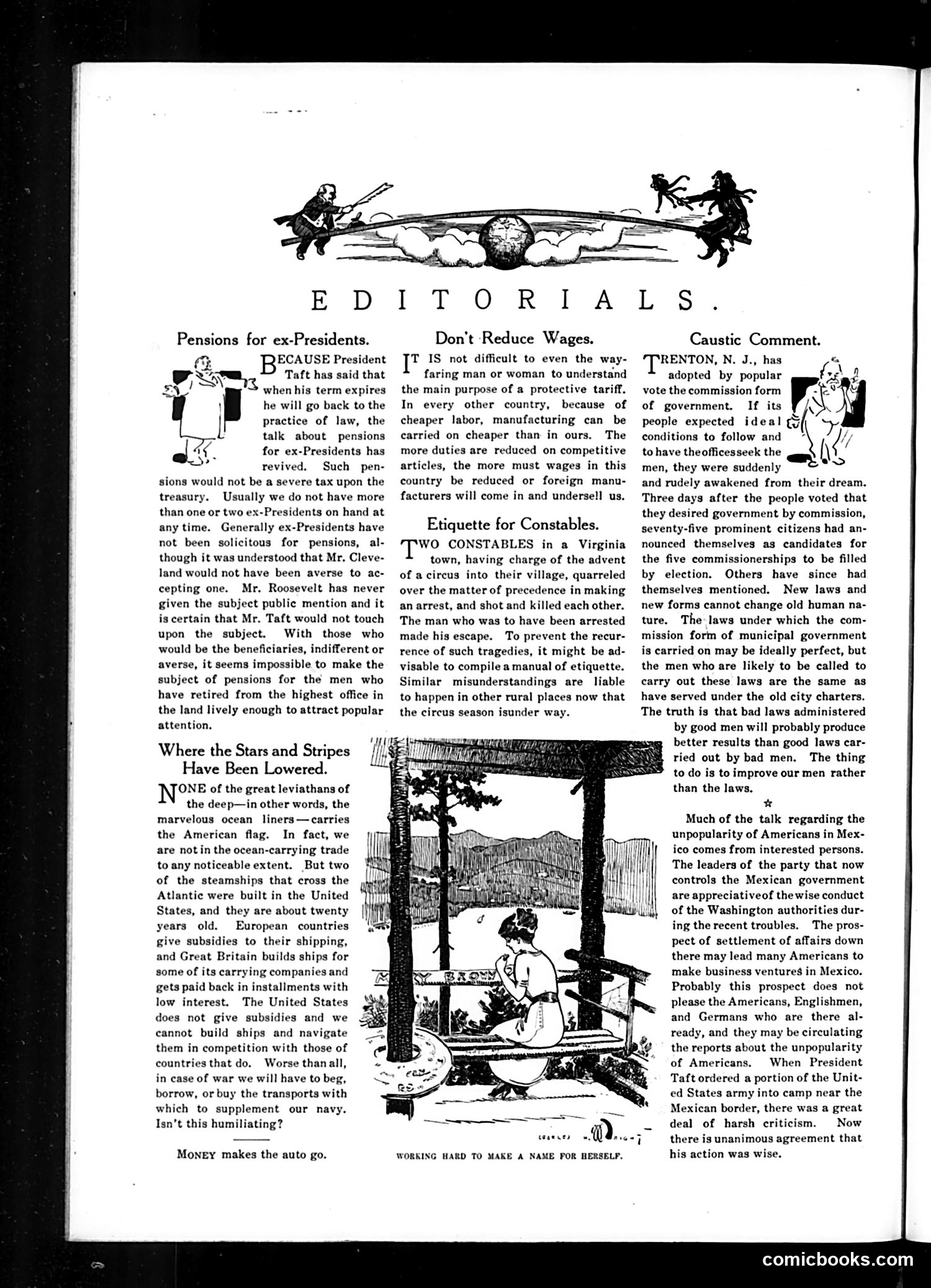
This page from Judge satirizes three political/social issues circa 1909: **"Pensions for ex-Presidents"**: Mocks the proposal to pension retiring presidents like Taft. The satire notes that ex-presidents themselves don't want pensions, making the debate absurd—there's no constituency supporting it, yet it persists as idle chatter. **"Where the Stars and Stripes Have Been Lowered"**: Criticizes American naval weakness. No major American ocean liners fly the U.S. flag because European countries subsidize their shipping while America doesn't. This leaves America vulnerable in wartime, forced to beg or borrow transport ships. **"Don't Reduce Wages"**: Argues protective tariffs are necessary. Lower import duties would force American workers' wages down to compete with cheaper foreign labor, undermining domestic workers. **"Etiquette for Constables"**: Reports a darkly humorous Virginia incident where two constables, quarreling over arrest precedence, shot each other dead—allowing the actual suspect to escape. Suggests rural lawmen need manners training. The page reflects Progressive-era debates over trade policy, naval power, and good governance.
📄 Transcribed text from this page (OCR, searchable)
Machine-transcribed from the original scan — historical spelling and the odd misread are preserved.
Pensions for ex-Presidents. ECAUSE President Taft has said that when his term expires he will go back to the practice of law, the talk about pensions P| a for ex-Presidents has coniid revived. Such pen- sions would not be a severe tax upon the treasury. Usually we do not have more than one or two ex-Presidents on hand at any time. Generally ex-Presidents have not been solicitous for pensions, al- though it was understood that Mr. Cleve- land would not have been averse to ac- cepting one. Mr. Roosevelt has never given the subject public mention and it is certain that Mr. Taft would not touch upon the subject. With those who would be the beneficiaries, indifferent or averse, it seems impossible to make the subject of pensions for the men who have retired from the highest office in the land lively enough to attract popular attention. Where the Stars and Stripes Have Been Lowered. NONE of the great leviathans of the deep—in other words, the marvelous ocean liners —carries the American flag. In fact, we are notin the ocean-carrying trade to any noticeable extent. But two of the steamships that cross the Atlantic were built in the United States, and they are about twenty years old. European countries give subsidies to their shipping, and Great Britain builds ships for some of its carrying companies and gets paid back in installments with low interest. The United States does not give subsidies and we cannot build ships and navigate them in competition with those of countries that do. Worse thanall, in case of war we will have to beg, borrow, or buy the transports with which to supplement our navy. Isn't this humiliating? Money makes the auto go. Don't ‘Reduce Wages. i IS not difficult to even the way- faring man or woman to understand the main purpose of a protective tariff. In every other country, because of cheaper labor, manufacturing can be carried on cheaper than in ours. The more duties are reduced on competitive articles, the more must wages in this country be reduced or foreign manu- facturers will come in and undersell us. Etiquette for Constables. Tre CONSTABLES in a Virginia town, having charge of the advent of acircus into their village, quarreled over the matter of precedence in making an arrest, and shot and killed each other. The man who was to have been arrested made his escape. To prevent the recur- rence of such tragedies, it might be ad- visable to compile a manual of etiquette. Similar misunderstandings are liable to happen in other rural places now that the circus season isunder way. a a WORKING HARD TO MAKE A NAME POR HERSELP. Caustic Comment. RENTON, N. J., has adopted by popular vote the commission form of government. If its people expected ideal (Gj conditions to follow and 4 to have theofficesseek the wm (\! men, they were suddenly Se and rudely awakened from their dream. Three days after the people voted that they desired government by commission, seventy-five prominent citizens had an- nounced themselves as candidates for the five commissionerships to be filled by election. Others have since had themselves mentioned. New laws and new forms cannot change old human na- ture. The laws under which the com- mission form of municipal government is carried on may be ideally perfect, but the men who are likely to be called to carry out these laws are the same as have served under the old city charters. The truth is that bad laws administered by good men will probably produce better results than good laws car- ried out by bad men. The thing to do is to improve our men rather than the laws. * Much of the talk regarding the unpopularity of Americans in Mex- ico comes from interested persons. The leaders of the party that now controls the Mexican government are appreciativeof the wise conduct of the Washington authorities dur- ing the recent troubles. The pros- pect of settlement of affairs down there may lead many Americans to make business ventures in Mexico. Probably this prospect does not please the Americans, Englishmen, and Germans who are there al- ready, and they may be circulating the reports about the unpopularity of Americans. When President Taft ordered a portion of the Unit- ed States army into camp near the Mexican border, there was a great deal of harsh criticism. Now there is unanimous agreement that his action was wise. comicbooks.com