
A complete issue · 24 pages · 1911
Judge — February 18, 1911
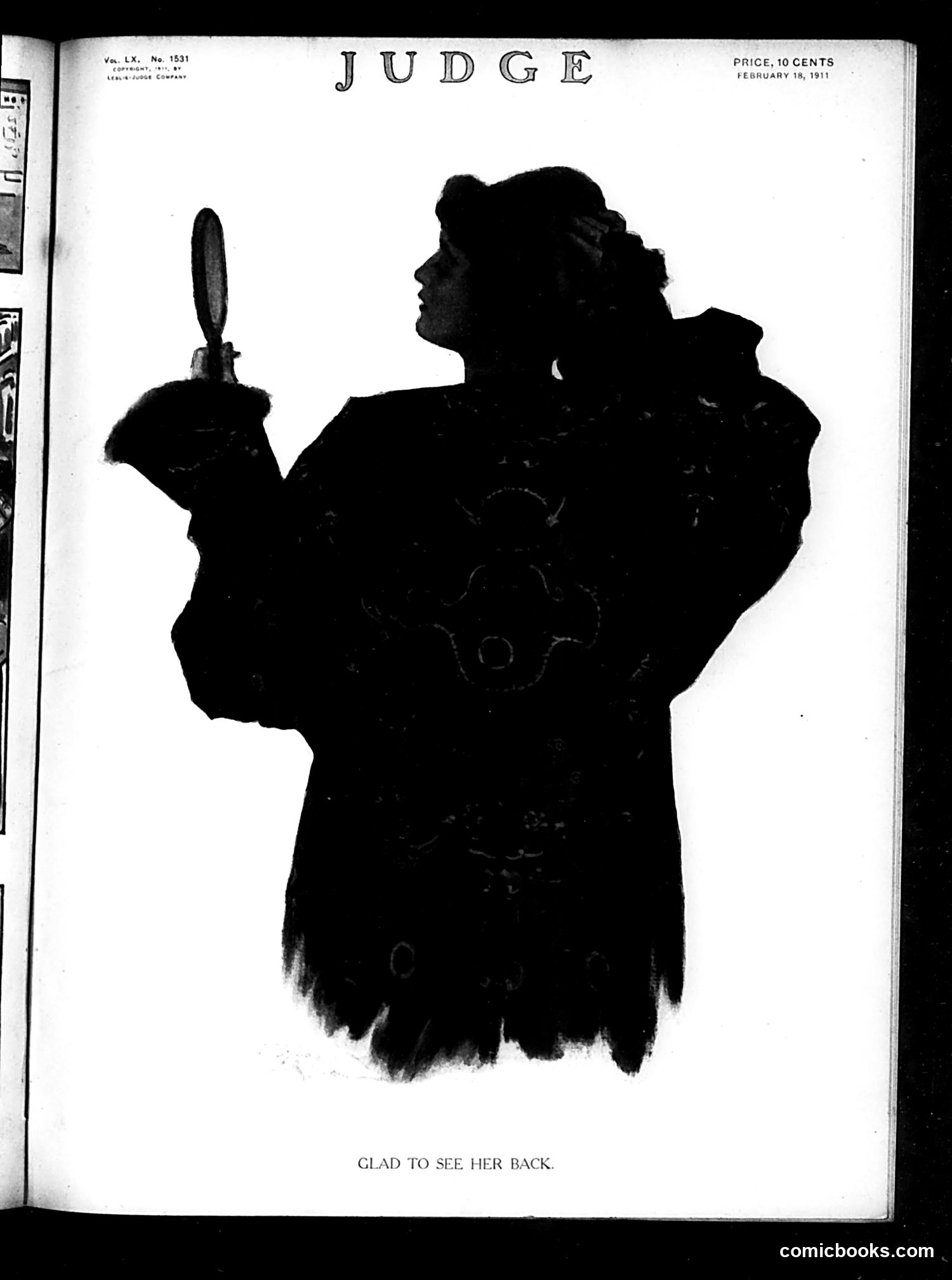
This silhouette illustration shows a woman in early 1900s clothing holding a hand mirror, gazing at her reflection. The caption reads "GLAD TO SEE HER BACK." The joke appears to be a visual pun: the woman is literally looking at her own back in the mirror's reflection, making the caption's double meaning work—she's pleased to see herself again (after an absence), but the image literally depicts her viewing her posterior. This plays on the era's genteel humor about propriety and women's fashion, while the silhouette style was popular in Judge's satirical illustrations. Without additional context, the specific social or political reference remains unclear, though it likely relates to a contemporary public figure or social commentary on women's fashion or behavior.
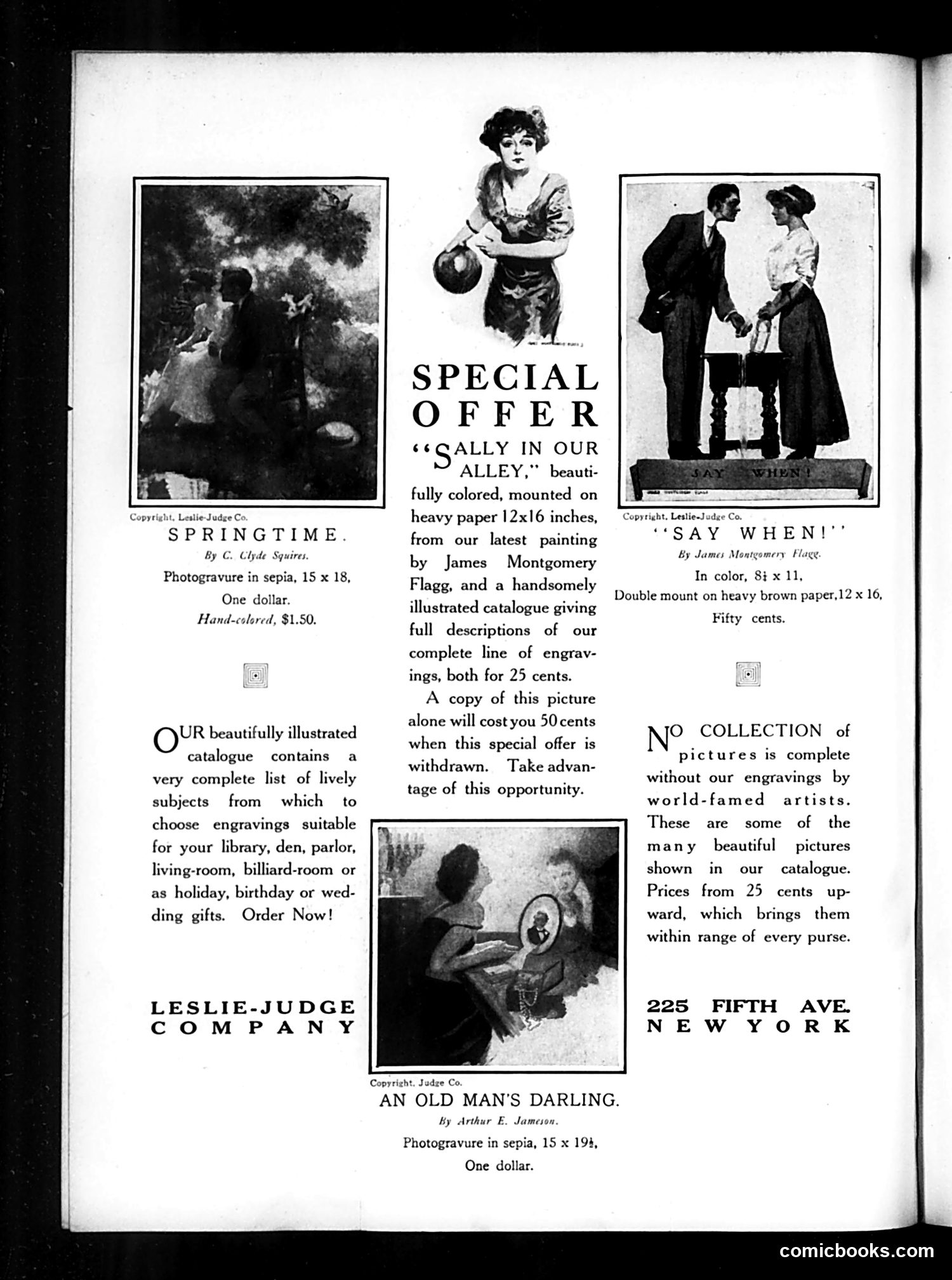
This page is primarily **advertising content** from the Leslie-Judge Company, a publisher of engravings and artwork, rather than satirical editorial material. The page features three artwork offerings: 1. **"Springtime"** by Uncle Sargent — a photogravure priced at $1 (hand-colored $1.50) 2. **"Say When!"** by James Montgomery Flagg — a color print depicting a man and woman in formal dress, priced at 50 cents 3. **"An Old Man's Darling"** by Arthur E. Jameson — a photogravure at $1 The central section advertises a special offer on "Sally in Our Alley" by Flagg. The company emphasizes their catalog's broad subject matter suitable for home decoration and gifts, with prices ranging from 25 cents upward. The address given is 225 Fifth Avenue, New York. This represents commercial illustration advertising rather than political satire.
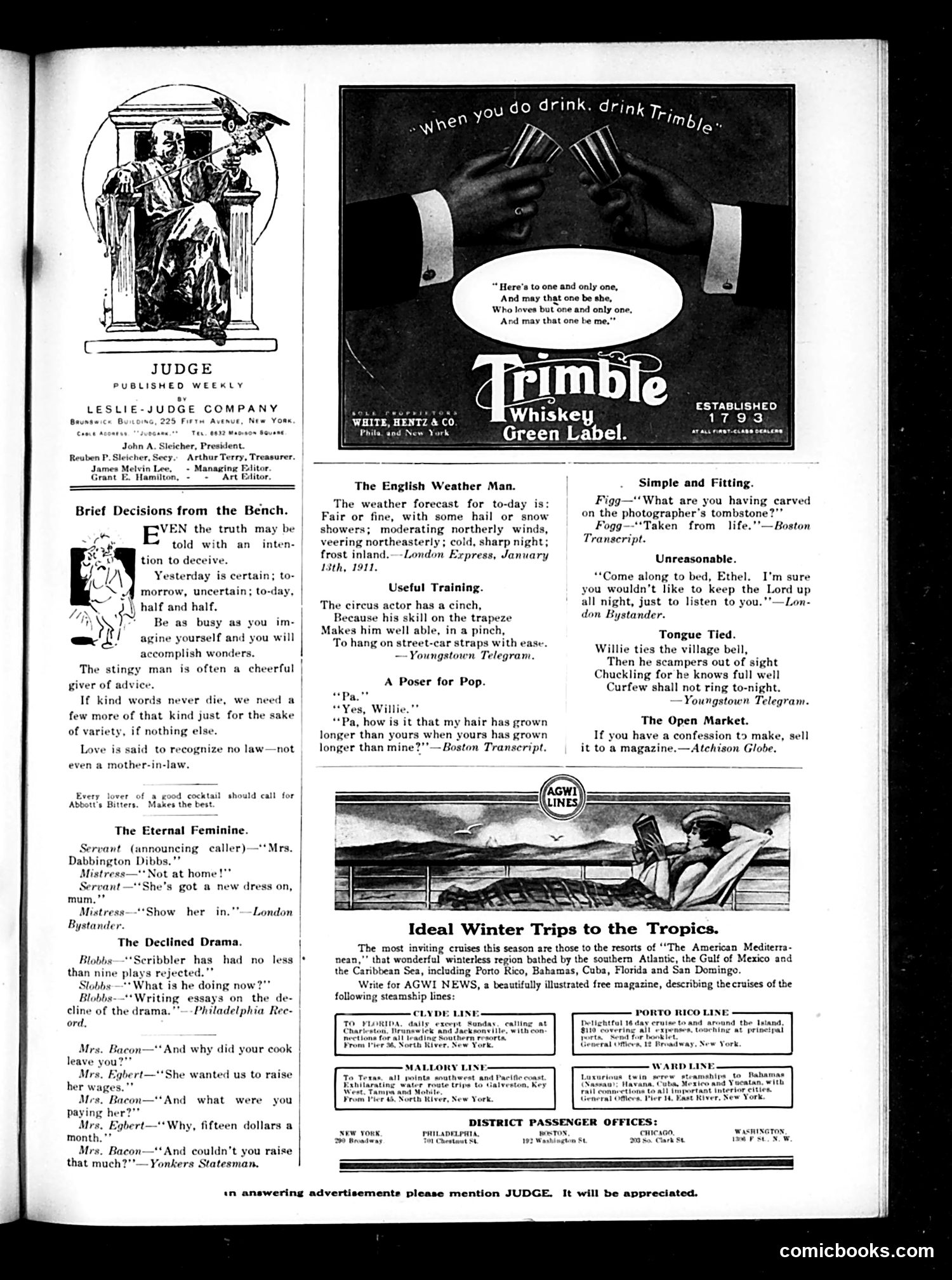
This page is primarily **advertising and humor snippets** rather than political commentary. The main content includes: **Visual Elements:** - Left: A classical "Judge" masthead illustration - Right: A Trimble Whiskey advertisement featuring two men toasting, with the tagline "When you do drink, drink Trimble" **Text Content:** The page consists of brief humorous anecdotes under headers like "Brief Decisions from the Bench," "The Eternal Feminine," and "The Declined Drama"—typical Judge magazine filler featuring domestic comedy and wordplay without political significance. **Lower Section:** Travel advertisements for cruise lines (Clyde Line, Mallory Line, Ward Line) to tropical destinations—standard commercial content. The page represents Judge's mix of light social satire, advertising revenue, and travel promotions typical of early 20th-century American magazines.
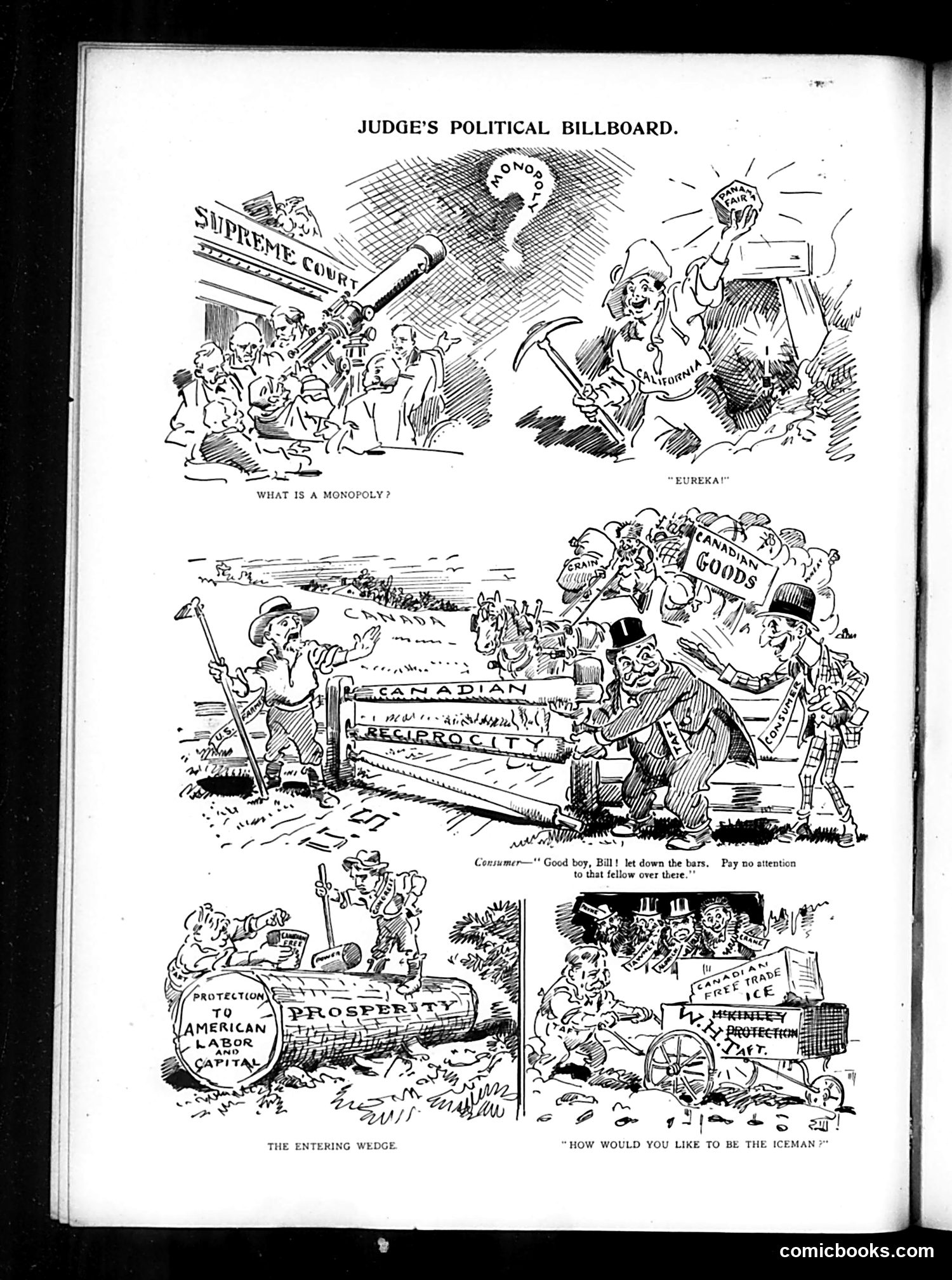
This page satirizes American political and economic debates of the early 20th century. The top panel titled "What is a Monopoly?" shows Supreme Court justices apparently confused about monopolies, while "Eureka!" depicts someone discovering "Fair Trade." The central cartoon labeled "Canadian Reciprocity" shows a figure attempting to control trade relations, with text: "Good boy, Bill! let down the bars. Pay no attention to that fellow over there." "The Entering Wedge" depicts protection for American labor and capital being threatened. "How Would You Like to Be the Iceman?" references McKinley tariff policies affecting ice trade. These cartoons critique judicial confusion over monopoly law, trade agreements with Canada, tariff policies, and their economic consequences for American workers and commerce.
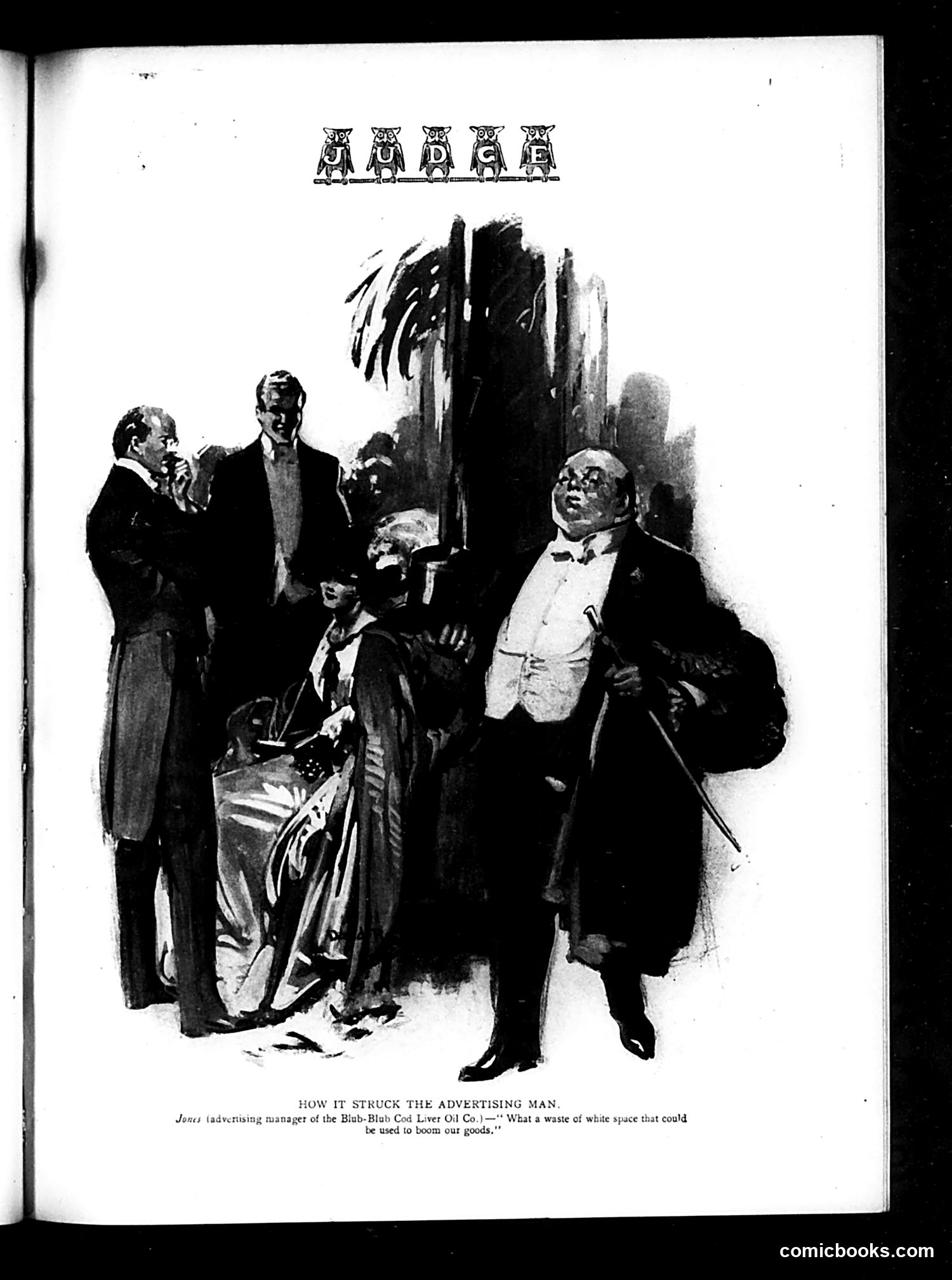
This is a satirical cartoon titled "How It Struck the Advertising Man" from *Judge* magazine. The caption shows Jones, an advertising manager for the "Blah-Blah Cod Liver Oil Co.," reacting with dismay to what appears to be a large tree or monument. His quoted complaint—"What a waste of white space that could be used to boom our goods"—is the joke's punchline. The satire mocks advertising executives' obsession with filling every available space with commercial messages. To Jones, even a natural or monumental object represents lost advertising real estate rather than something to appreciate for its own value. This reflects early-20th-century anxieties about commercialism's invasiveness and advertising's growing cultural dominance.
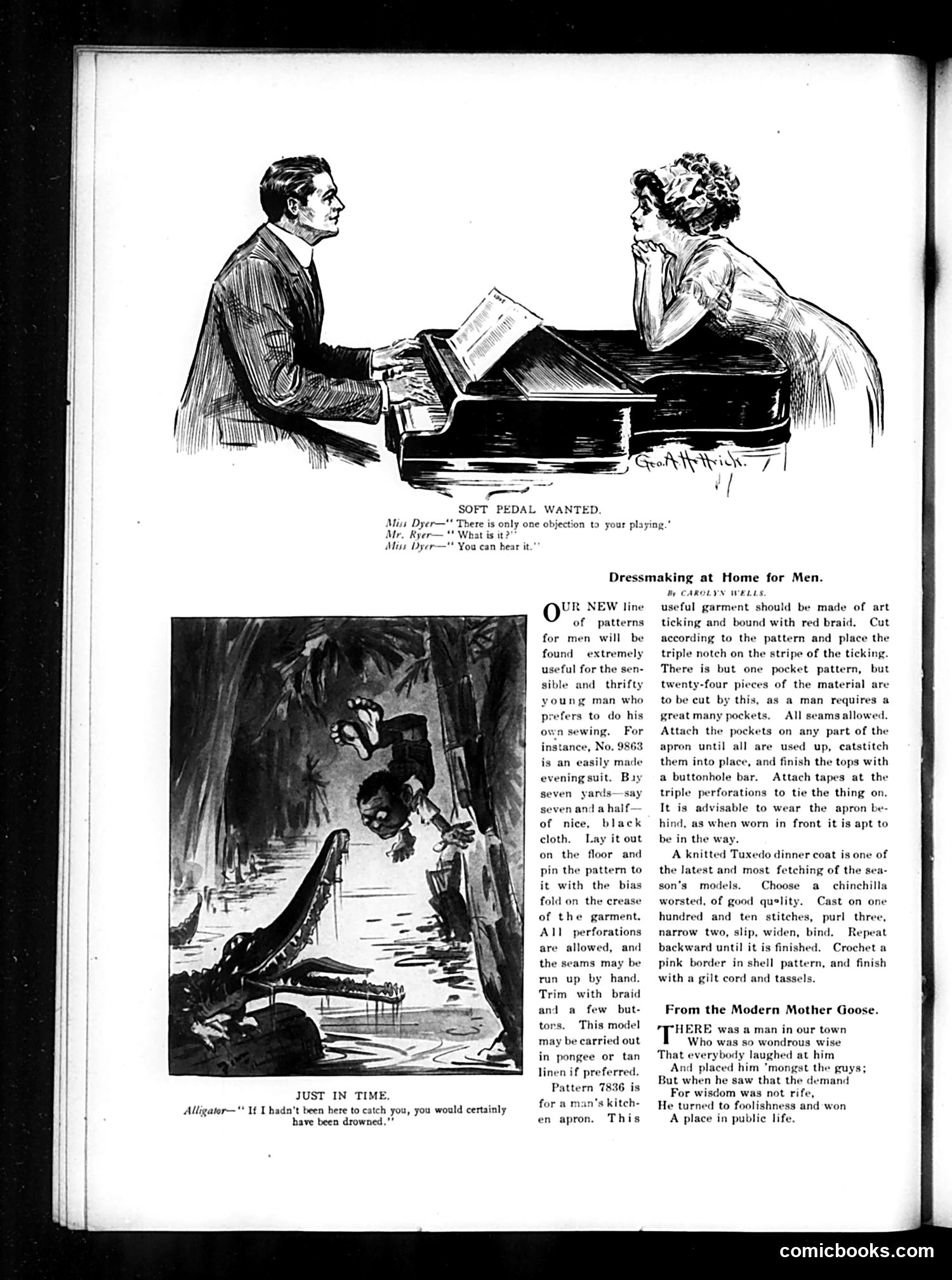
**Top Cartoon ("Soft Pedal Wanted"):** A man plays piano while a woman listens critically. The joke is a pun on "soft pedal"—literally the piano pedal that softens sound, but also the expression meaning to downplay or minimize something. Miss Dyer's complaint is that Mr. Ryer's playing is so bad she can actually *hear* it, implying he should use the soft pedal to muffle the noise. It's gentle domestic humor mocking poor musical ability. **"Just in Time" Cartoon:** An alligator rescues a drowning man. The caption's irony suggests the man might have been better off drowning, or that rescue from one danger (drowning) may lead to another (being eaten by the alligator). Dark humor typical of the era. **Remaining Content:** The page includes practical instructional articles on men's home dressmaking and a "Modern Mother Goose" poem satirizing a man who abandoned wisdom for foolishness to gain public success—likely political commentary on contemporary figures prioritizing popularity over principle.
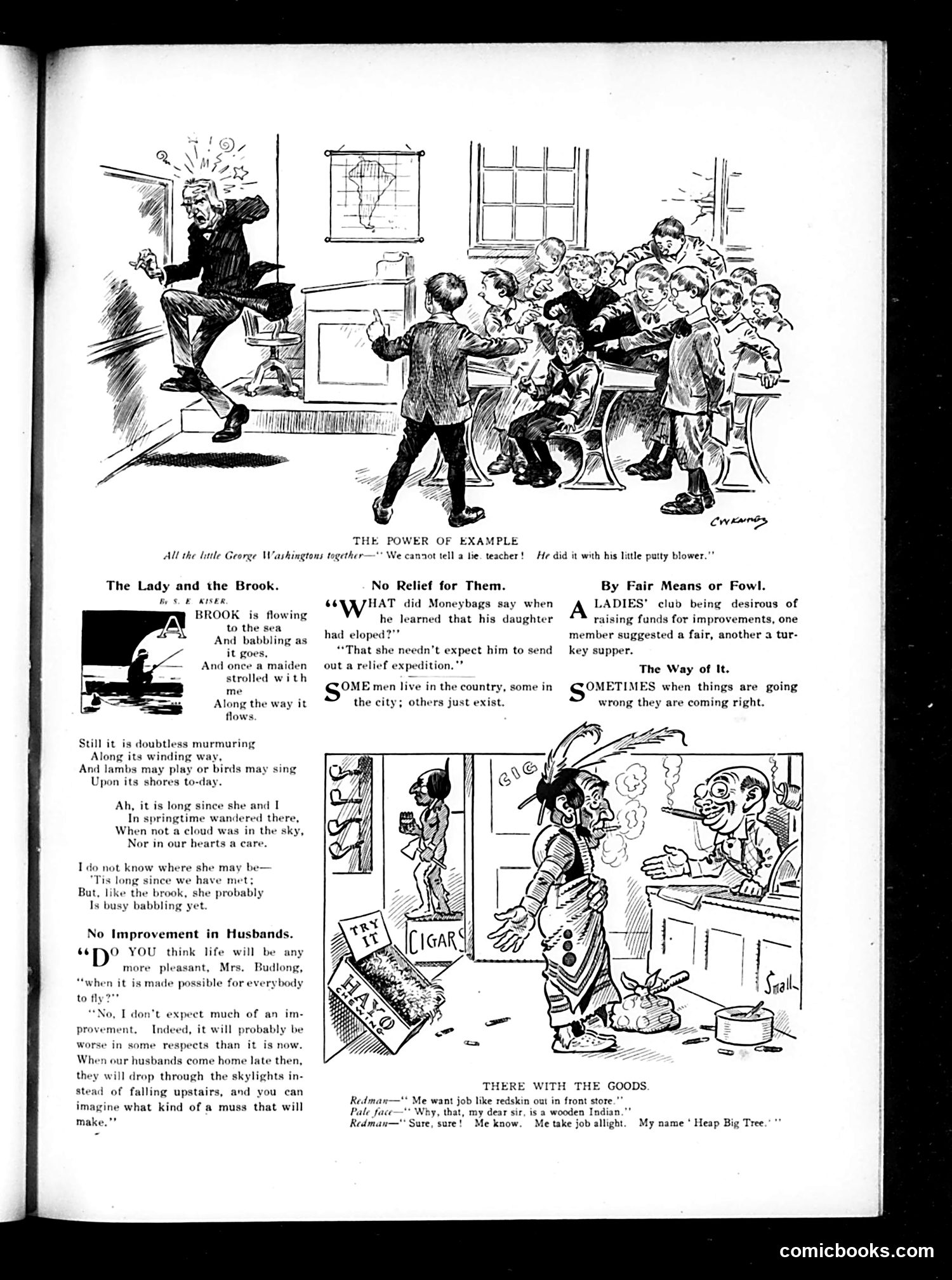
This page contains multiple satirical vignettes typical of early 20th-century American humor: **"The Power of Example"** (top): A teacher striking a dramatic pose while children watch, illustrating how children imitate authority figures—the caption references the George Washington cherry tree myth. **"The Lady and the Brook"** and **"No Improvement in Husbands"**: Sentimental and domestic humor. The latter mocks women's anxieties about future aviation technology, joking that flying husbands will crash through skylights instead of stumbling up stairs. **"No Relief for Them"** and **"By Fair Means or Fowl"**: Brief jokes about wealthy misers and women's fundraising efforts. **"There with the Goods"** (bottom cartoon): Features crude Native American stereotypes ("Redman," "Pale face," "Heap Big Tree")—offensive racial caricature common to the era—depicting a confused Native American job applicant mistaking a wooden Indian store display for a real person. The page reflects period attitudes: sentimental nostalgia, domestic comedy centered on female concerns, and casual racial mockery presented as humor.
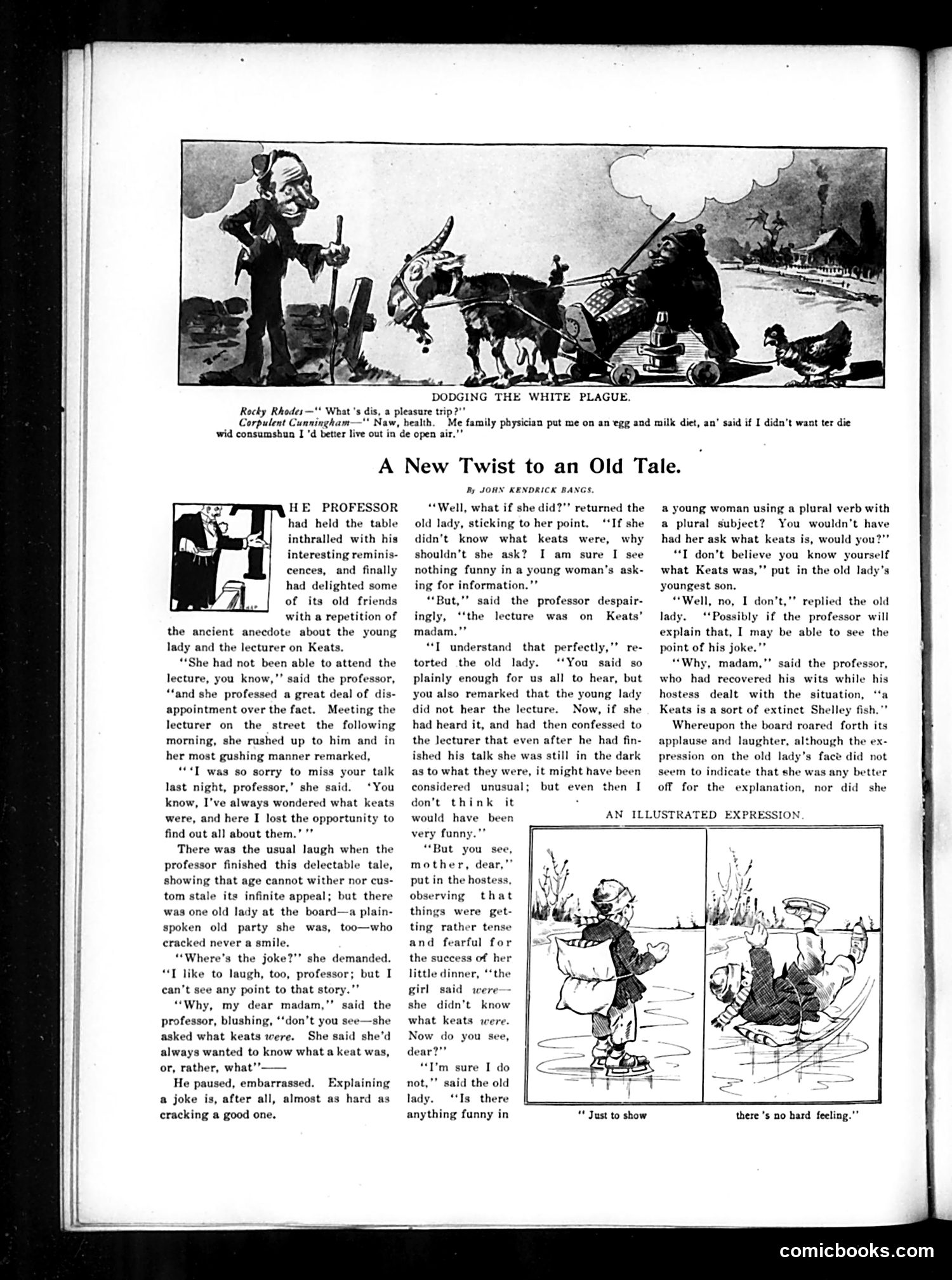
This page contains two distinct pieces of humor: **Top cartoon ("Dodging the White Plague"):** References tuberculosis, then called "consumption" or "the White Plague." A character named Corpulent Cunningham explains he's traveling for health reasons, hoping fresh air will prevent TB—a common (and often ineffective) treatment recommendation of the era. **Main story ("A New Twist to an Old Tale"):** A professor tells a familiar anecdote about a woman who asks what "keats" are, not knowing the lecture was about the poet John Keats. The humor depends on her grammatical ignorance. However, a blunt old lady in the audience refuses to find it funny, logically pointing out: if someone didn't attend the lecture, why shouldn't they ask questions? Her literalist objections deflate the professor's joke entirely. He eventually recovers by making a pun ("Keats is a sort of extinct Shelley fish"—Shelley being another Romantic poet). The satire targets professorial pretension and the fragility of jokes that rely on assumed shared knowledge or subtle wordplay.
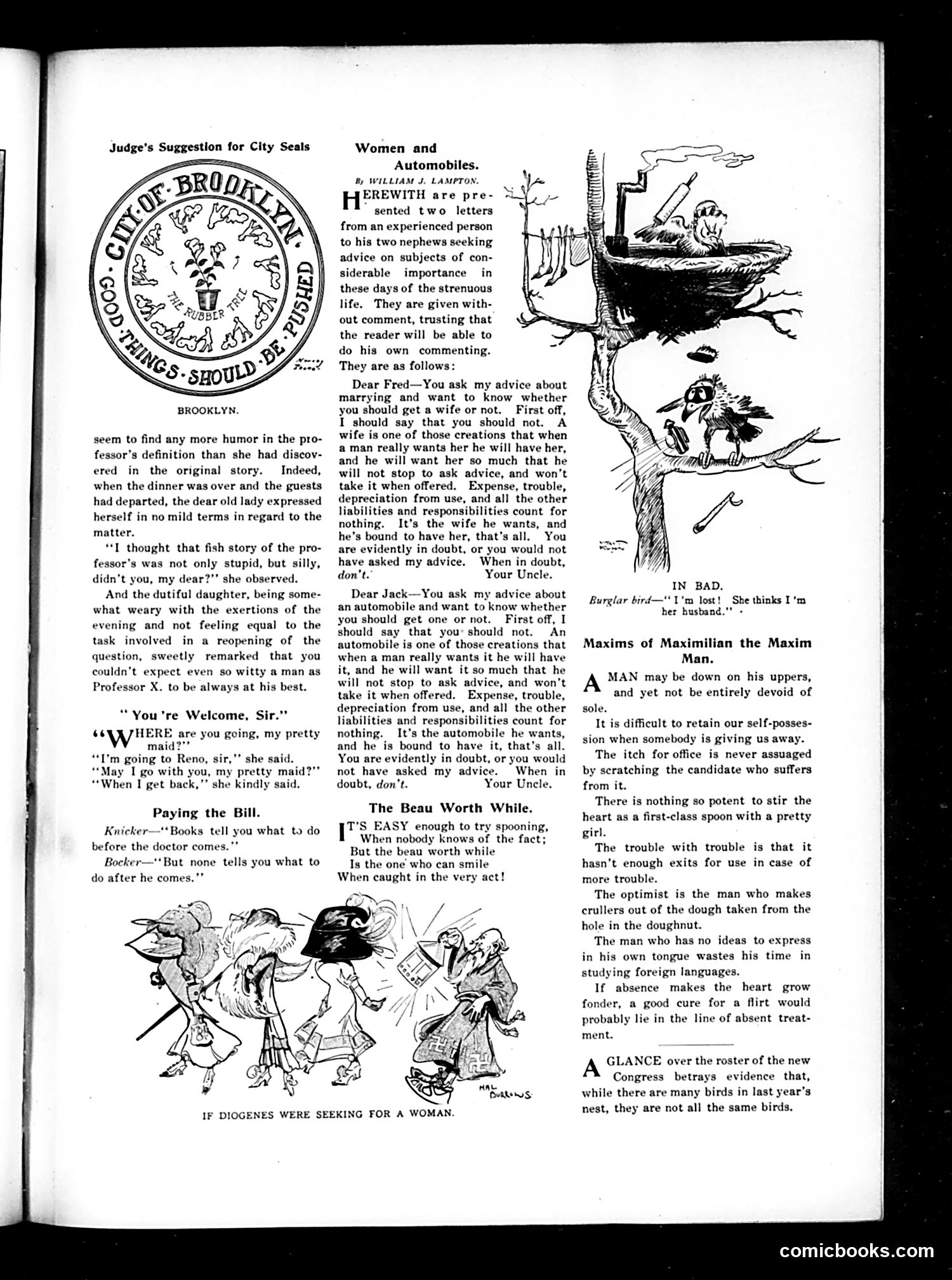
This page contains several satirical pieces typical of early-20th-century American humor: **"Women and Automobiles"** presents two nearly identical mock-advice letters comparing wives and automobiles—both presented as expensive luxuries men irrationally desire despite warnings. The satire mocks both marital hesitation and the automobile craze consuming America, suggesting both are equally foolish acquisitions once desired. **"Paying the Bill"** is a brief joke about medical costs, implying doctors' advice on treatment is useless compared to preventing the need to call them. The **cartoons** illustrate various social situations: one shows figures seeking "a woman" (unclear specific reference); another depicts a burglar bird claiming to be "lost," suggesting his wife mistakes him for her husband—a marital infidelity joke. **"Maxims of Maximilian"** offers cynical one-liners about poverty, office-seeking, romance, and optimism—typical of Judge's satirical aphorism style. The overall page reflects early-1900s anxieties about marriage, new technology (automobiles), and economic hardship, presented through humor intended for educated, urban readers.
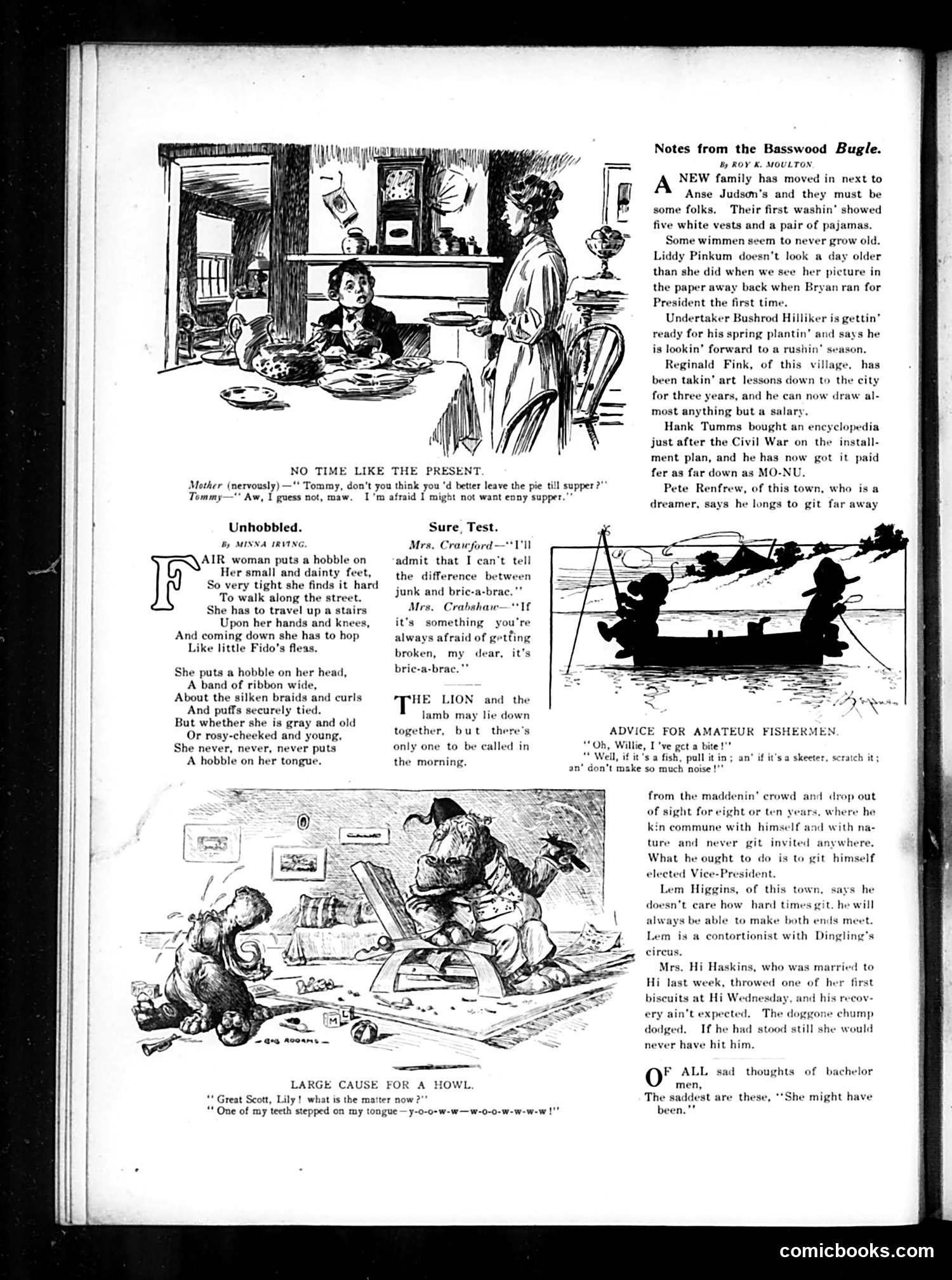
This page from Judge magazine presents rural American humor circa early 1900s through several formats: **"Notes from the Basswood Bugle"** is small-town gossip presented as local news items—gentle mockery of rural life and character types (the art student who can't draw salary, the man still paying for a Civil War encyclopedia). **The cartoons satirize contemporary social trends**: "No Time Like the Present" jokes about children's gluttony; "Unhobbled" mocks women's restrictive fashion (the "hobble skirt" was a real 1910s trend that severely restricted movement) while praising women's uncontrolled speech; "Sure Test" and "Advice for Amateur Fishermen" are domestic humor sketches. **"Large Cause for a Howl"** depicts a dog with something in its mouth causing distress—simple slapstick. The overall tone is affectionate mockery of rural/small-town America: unsophisticated but resourceful people navigating modern fashions, technology, and social change. The satire punches gently downward at provincial life rather than critiquing power structures.
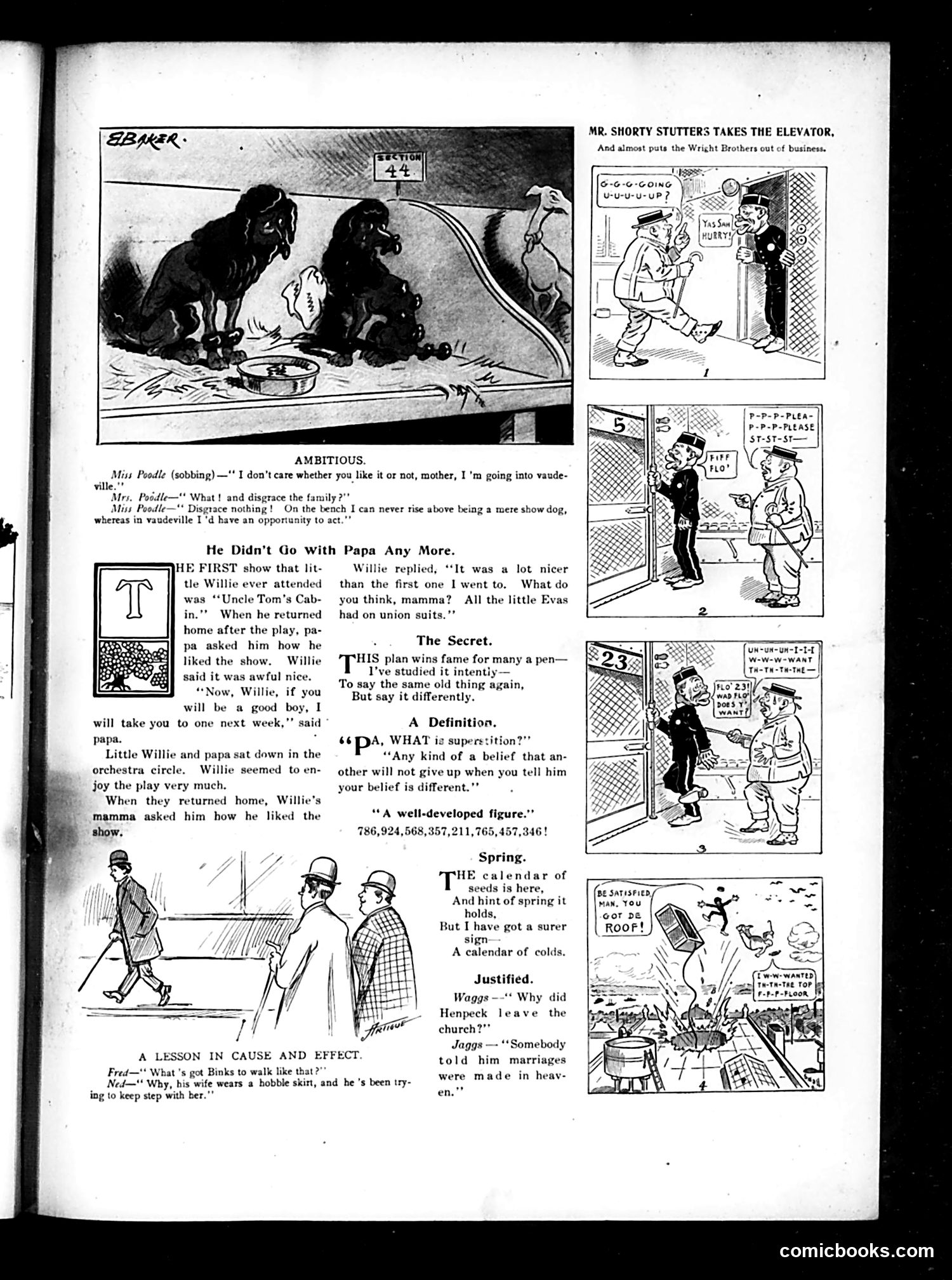
This page contains several unrelated satirical pieces typical of early 20th-century Judge magazine humor: **"Ambitious"** mocks a poodle wanting to leave show-dog life for vaudeville, satirizing class ambitions and theatrical pretension. **"He Didn't Go with Papa Any More"** jokes about a child's innocent misinterpretation: after seeing "Uncle Tom's Cabin," the boy comments the "little Evas" wore "union suits" (underwear), implying the actresses' scanty costumes—embarrassing Papa. **"The Secret"** is meta-commentary on hack writing: recycling old ideas with different wording. **"A Lesson in Cause and Effect"** puns on a man walking oddly because his wife wears a hobble skirt (a restrictive 1910s fashion), forcing him to match her stride. **"Mr. Shorty Stutters Takes the Elevator"** features a stammering man in an elevator whose repeated "G-G-GOING U-U-UP!" utterances allegedly disturb the Wright Brothers' aviation business—absurdist wordplay humor. The humor relies on period-specific references (hobble skirts, vaudeville, "Uncle Tom's Cabin") and simple punchlines.

This appears to be a satirical illustration from *Judge* magazine showing an early airplane flying above a riverside landscape with a European city (featuring a church spire and buildings). The text "THE UP-TO-DATE FL[Y]" (likely "The Up-to-Date Flyer") is partially visible. The cartoon satirizes aviation as a modern marvel or fad. The juxtaposition of the primitive aircraft with the traditional cityscape suggests commentary on technological progress versus established civilization. Without the complete caption, the specific satirical point is unclear—it may mock the impracticality of early aviation, wealthy enthusiasm for newfangled machines, or the contrast between industrial modernity and traditional society. The image likely dates to aviation's early era (1900s-1910s), when flying was still novelty and spectacle.
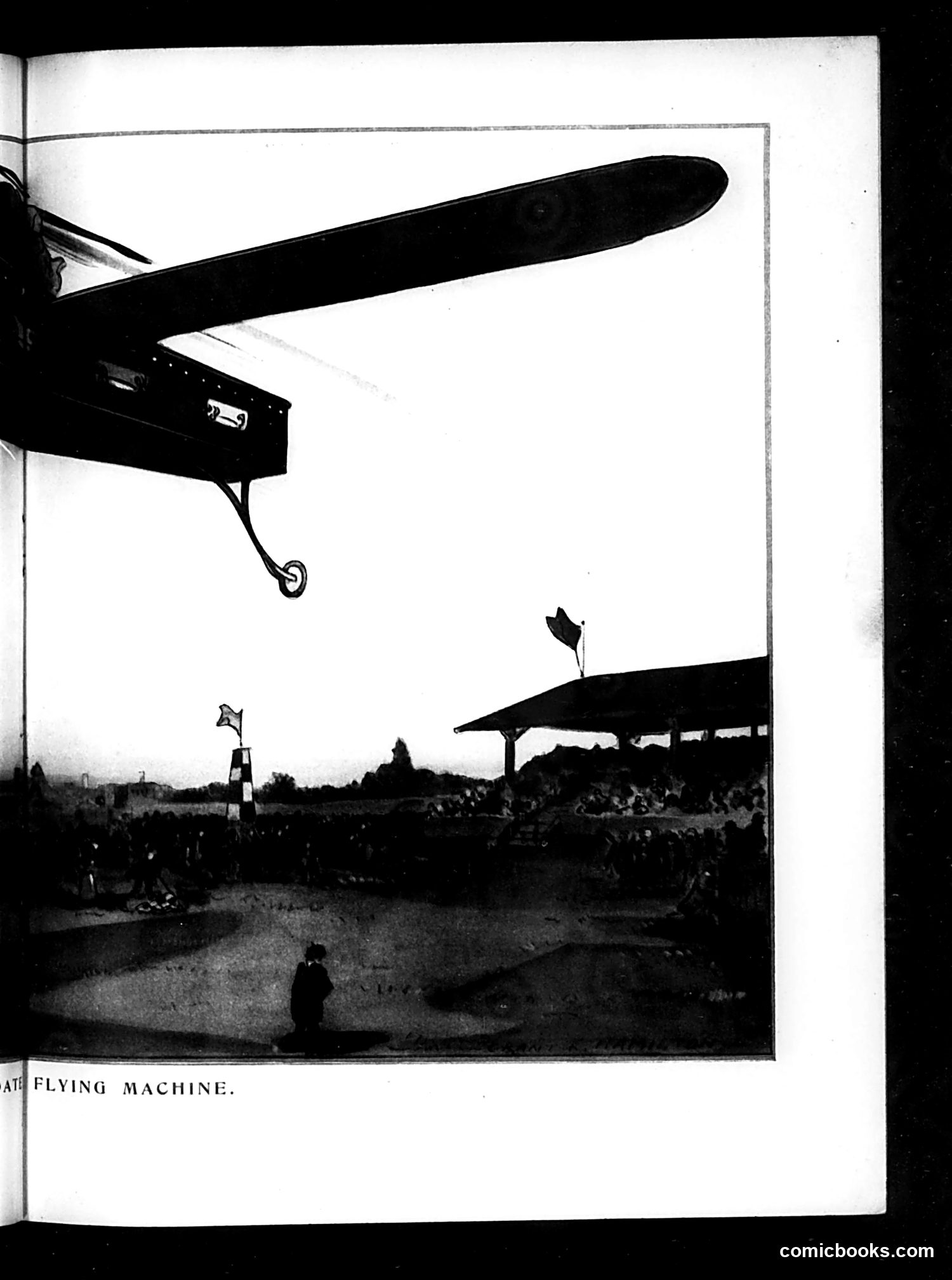
This appears to be a satirical illustration titled "A Flying Machine" from Judge magazine. The image shows an early aircraft with an elongated fuselage hovering above what looks like an airfield or fairground, with flags, a grandstand structure, and spectators visible below. The satire likely mocks the early aviation craze and public fascination with experimental flying machines (circa early 1900s). The dramatic composition—with the aircraft looming large over the gathered crowd—suggests commentary on the period's obsession with aviation spectacles and demonstrations. Judge often ridiculed contemporary fads and technological enthusiasm, so this probably satirizes public gullibility about flying machine exhibitions or the inflated promises of aviation pioneers. The context requires familiarity with early-20th-century aviation history and Judge's skeptical editorial stance.
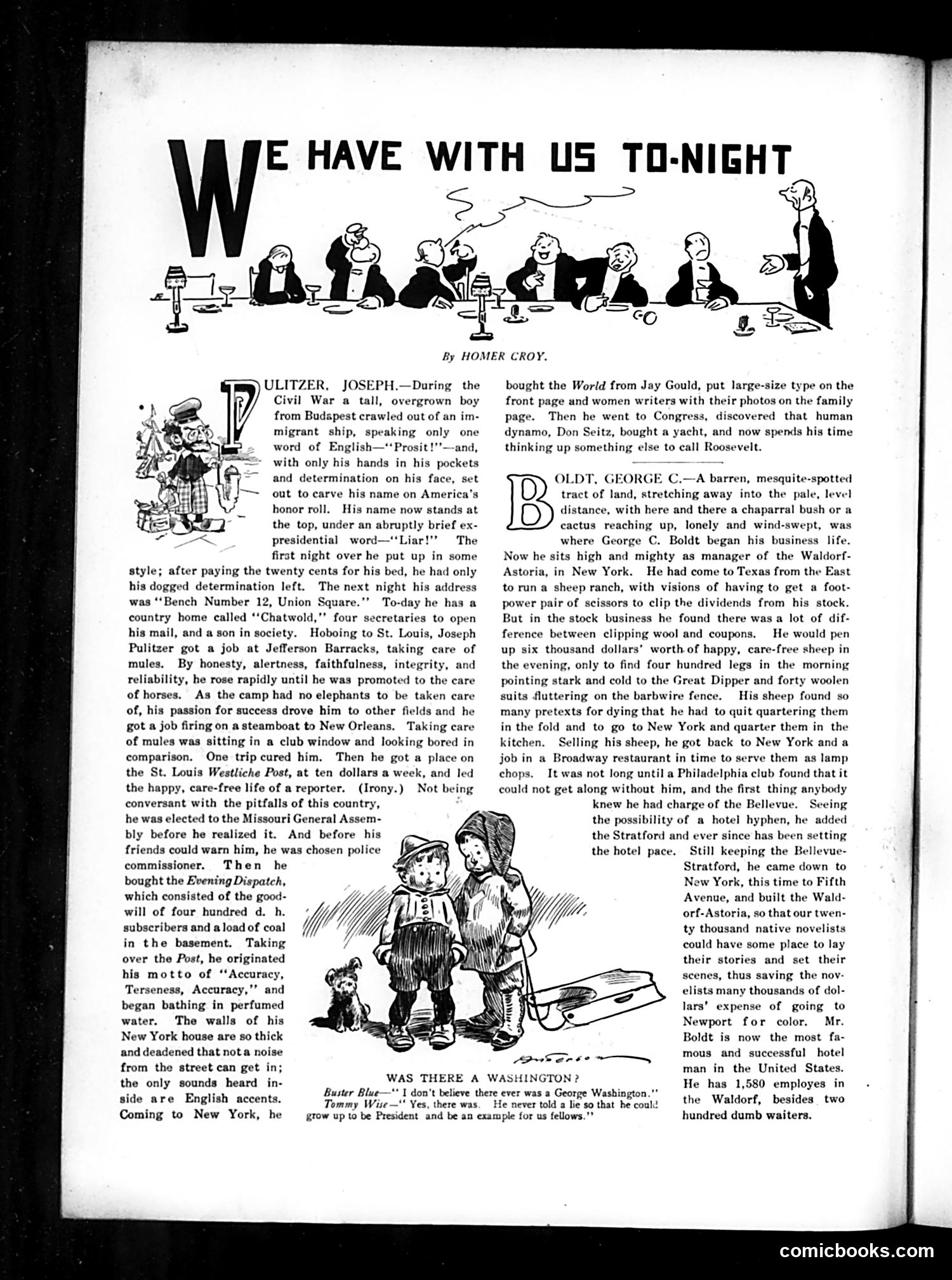
This Judge magazine page profiles successful immigrants through satirical biographical sketches. The header cartoon shows men dining together, introducing the theme. **Joseph Pulitzer** receives harsh treatment: though praised for rising from poverty to newspaper prominence, the sketch mocks his pretensions—his mansion's soundproofing, perfumed baths, and English accents. The buried insult is the reference to an "abruptly brief ex-presidential word—'Liar!'"—apparently attacking Theodore Roosevelt's credibility, whom Pulitzer's *World* frequently criticized. **George C. Boldt's** section humorously recounts his failed Texas sheep ranching (sheep mysteriously dying overnight) before he succeeded managing the Waldorf-Astoria hotel in New York. A sidebar joke depicts children discussing whether George Washington existed, satirizing skepticism toward American mythology. The satire works on two levels: celebrating immigrant success while mocking their social climbing, pretension, and the sensationalism of Pulitzer's yellow journalism.
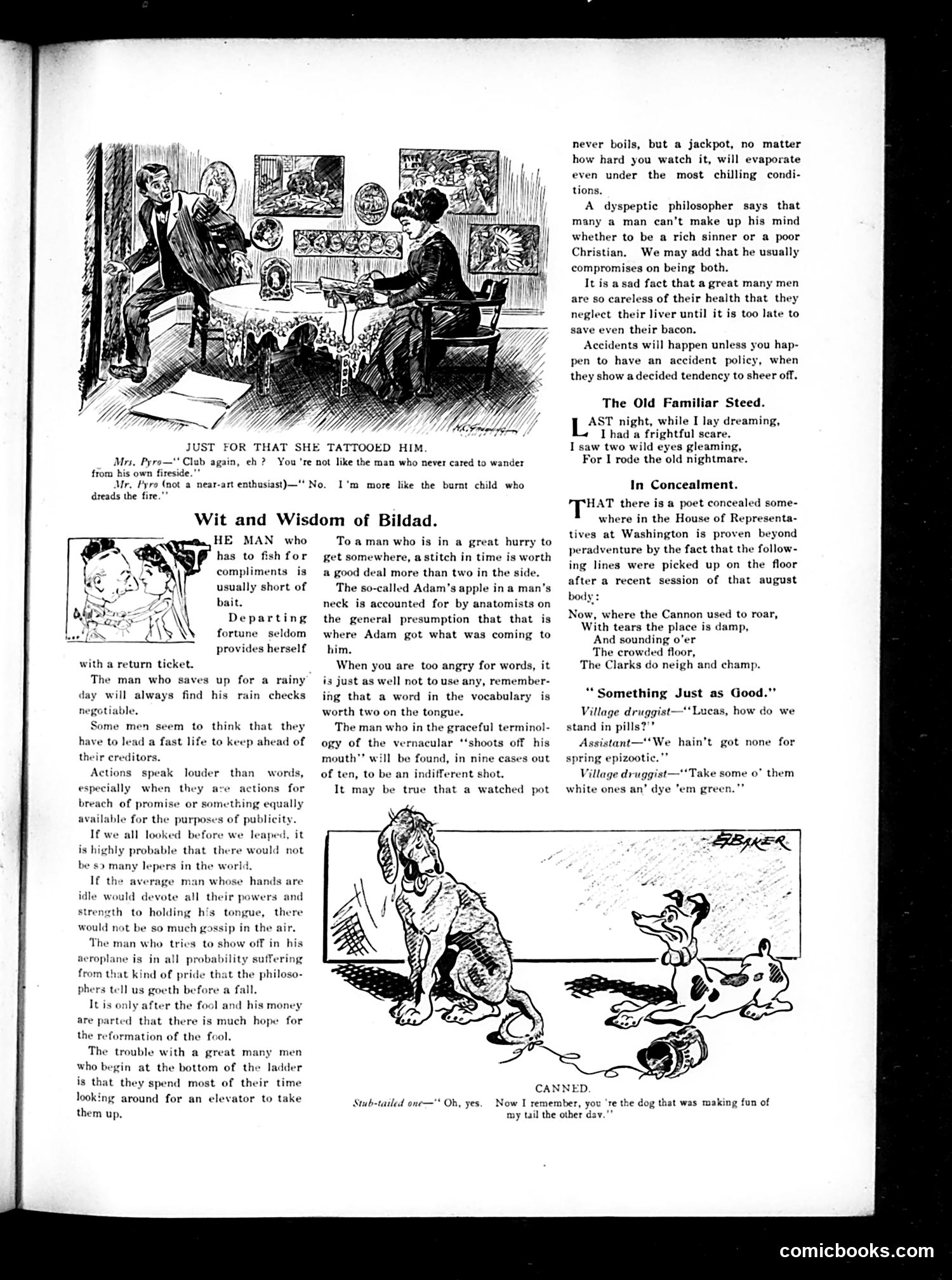
**Top Cartoon ("Just for That She Tattooed Him"):** A domestic dispute between Mr. and Mrs. Pyro. She complains he frequents the club instead of staying home; he retorts he's like "the burnt child" who fears fire—implying her aggressive behavior (symbolized by tattooing him) drives him away. The satire mocks both nagging wives and husbands who use their spouses' behavior to justify avoiding home. **"Wit and Wisdom of Bildad":** A satirical advice column with illustrations offering cynical observations about human nature: men who fish for compliments lack charm, fortune doesn't guarantee return visits, average men avoid work, ambitious fools show off dangerously, and the poor often remain poor. The tone is misanthropic social commentary typical of Judge's sardonic humor. **Bottom Cartoon ("Canned"):** Two dogs interact, with one remembering the other mocked its tail previously. The joke is mild dog humor with unclear deeper meaning—possibly just observational comedy about animal behavior and grudges. The page showcases Judge's characteristic blend of domestic satire, cynical philosophy, and light animal humor popular in early-to-mid 20th century American magazines.
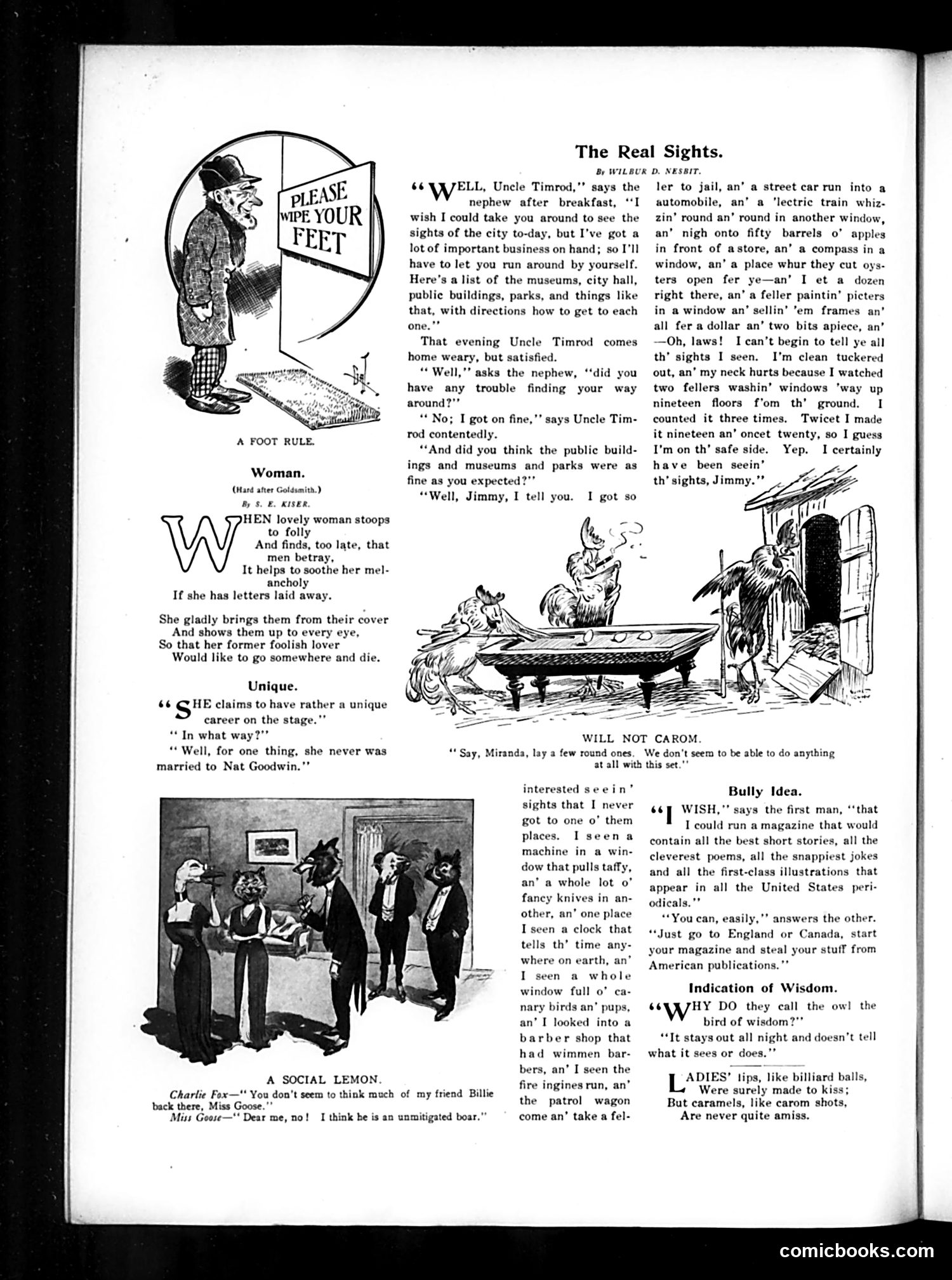
This page from *Judge* contains several short humorous pieces. The main story, "The Real Sights" by Wilbur D. Nesbit, satirizes tourism and perception. An Uncle Timrod visits the city but becomes distracted by everyday urban spectacles—street cars, window displays, barber shops with female barbers, fire engines—rather than the "proper" tourist attractions (museums, city hall, parks) his nephew listed. The joke is that common street life proves more entertaining than official sightseeing, deflating pretensions about what constitutes culture worth viewing. The page also includes brief comic verses mocking women's behavior ("Woman"), theatrical careers ("Unique"—a joke about an actress never marrying actor Nat Goodwin), and social awkwardness ("A Social Lemon"). The cartoons and accompanying text emphasize light, domestic humor typical of early 20th-century American satirical magazines.
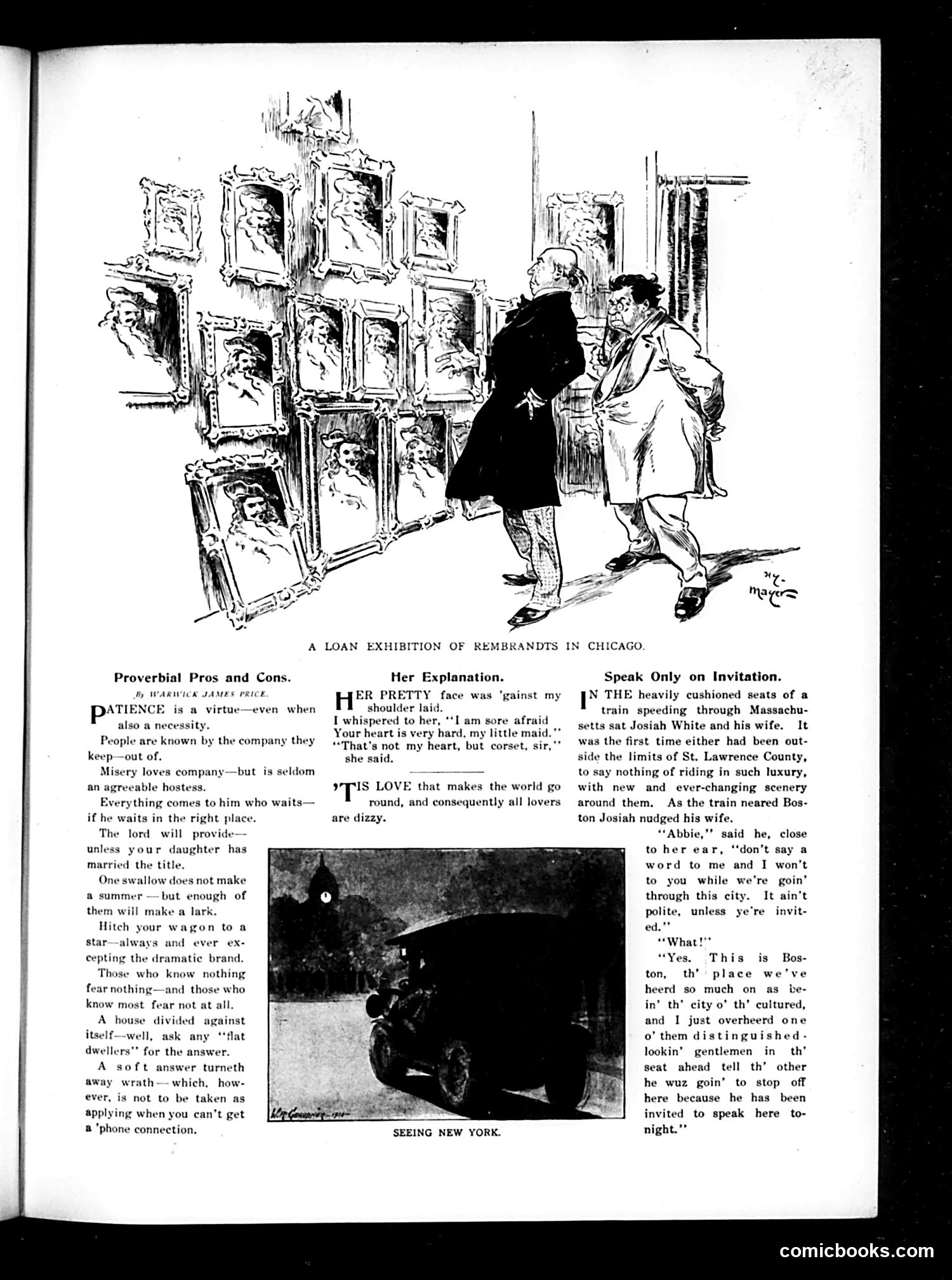
The page contains three separate humorous pieces typical of Judge magazine's satirical style: **Top cartoon**: "A Loan Exhibition of Rembrandts in Chicago" depicts two well-dressed men examining framed paintings on a wall. This satirizes Chicago's cultural aspirations—the city was eager to display Old Master paintings to establish itself as a sophisticated arts center, a pretension Judge mocks by showing viewers treating the exhibition as a social rather than artistic occasion. **Left column**: "Proverbial Pros and Cons" presents inverted or subverted proverbs with cynical twists (e.g., "The lord will provide—unless your daughter has married the title"), mocking both folk wisdom and social hypocrisy. **Right column**: "Speak Only on Invitation" humorously portrays unsophisticated rural visitors (Josiah and Abbie White from upstate) who adopt artificial social rules in Boston, misunderstanding that a distinguished gentleman's remark about being "invited to speak" means a formal engagement—not that casual conversation requires invitation. The joke targets both rural naiveté and urban pretentiousness.
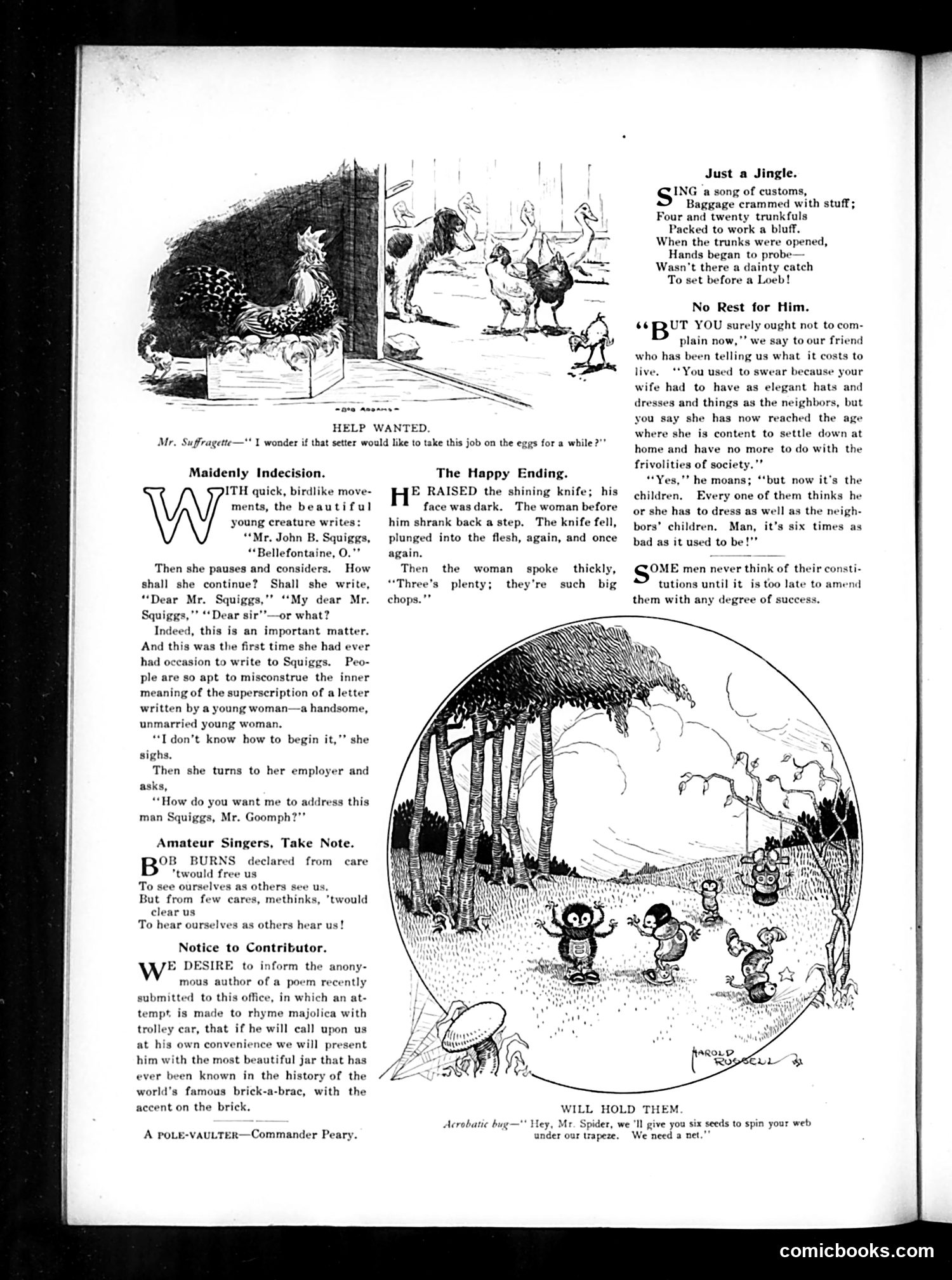
This page contains several satirical pieces typical of early 20th-century American humor: **"Help Wanted"** shows a suffragette with a dog, mocking women's suffrage advocates by suggesting they're unfit for traditional domestic roles. **"Maidenly Indecision"** satirizes young women's anxieties about propriety—a woman agonizes over the correct salutation when writing to a man, reflecting period social conventions about gender interaction and letter etiquette. **"The Happy Ending"** appears to be a melodramatic sketch about a woman threatened with a knife, though the punchline references "chops" (meat), suggesting domestic cooking rather than violence. **"No Rest for Him"** jokes that a man's economic troubles persist—his wife no longer demands fancy clothes, but now his children do, making life equally expensive. Minor items include verse about customs inspections and editor commentary rejecting poorly-written poetry submissions. The humor throughout reflects anxieties about women's changing social roles, consumer culture, and domestic economics during this era.
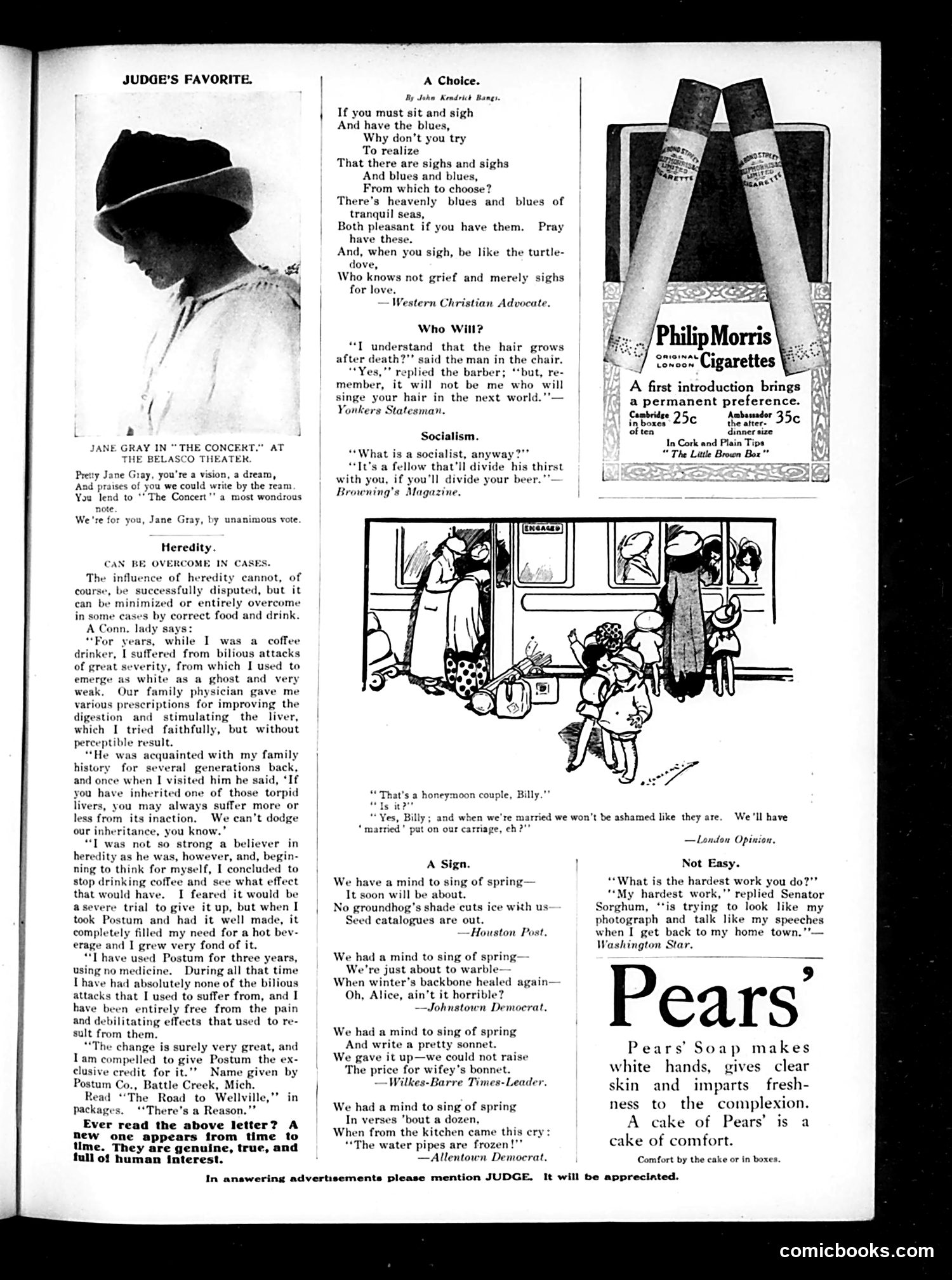
This page contains several short humorous pieces typical of early 20th-century American satirical magazines: **"Judge's Favorite"** praises actress Jane Gray from the play "The Concert" at the Belasco Theatre—a straightforward theatrical endorsement. **"Heredity"** and **"Postum" advertisement** are paired: a testimonial letter claims coffee caused bilious attacks, but switching to Postum (a caffeine-free grain beverage) cured the problem. This reflects contemporary health anxieties about coffee's effects. **Short jokes** mock contemporary subjects: a barber's quip about hair growth after death; a definition of "socialism" as sharing thirst/beer (playing on socialist redistribution ideology); and Senator Sorghum's complaint that his hardest work is "looking like my photograph"—satirizing politicians' vanity and disconnection from actual labor. **"A Sign"** collects rural newspaper verses about spring, with recurring joke: poets want to celebrate spring but face winter's persistence or financial hardship (can't afford wife's bonnet). The page is primarily advertising and light humor aimed at middle-class readers concerned with health, theater, and gentle political mockery.
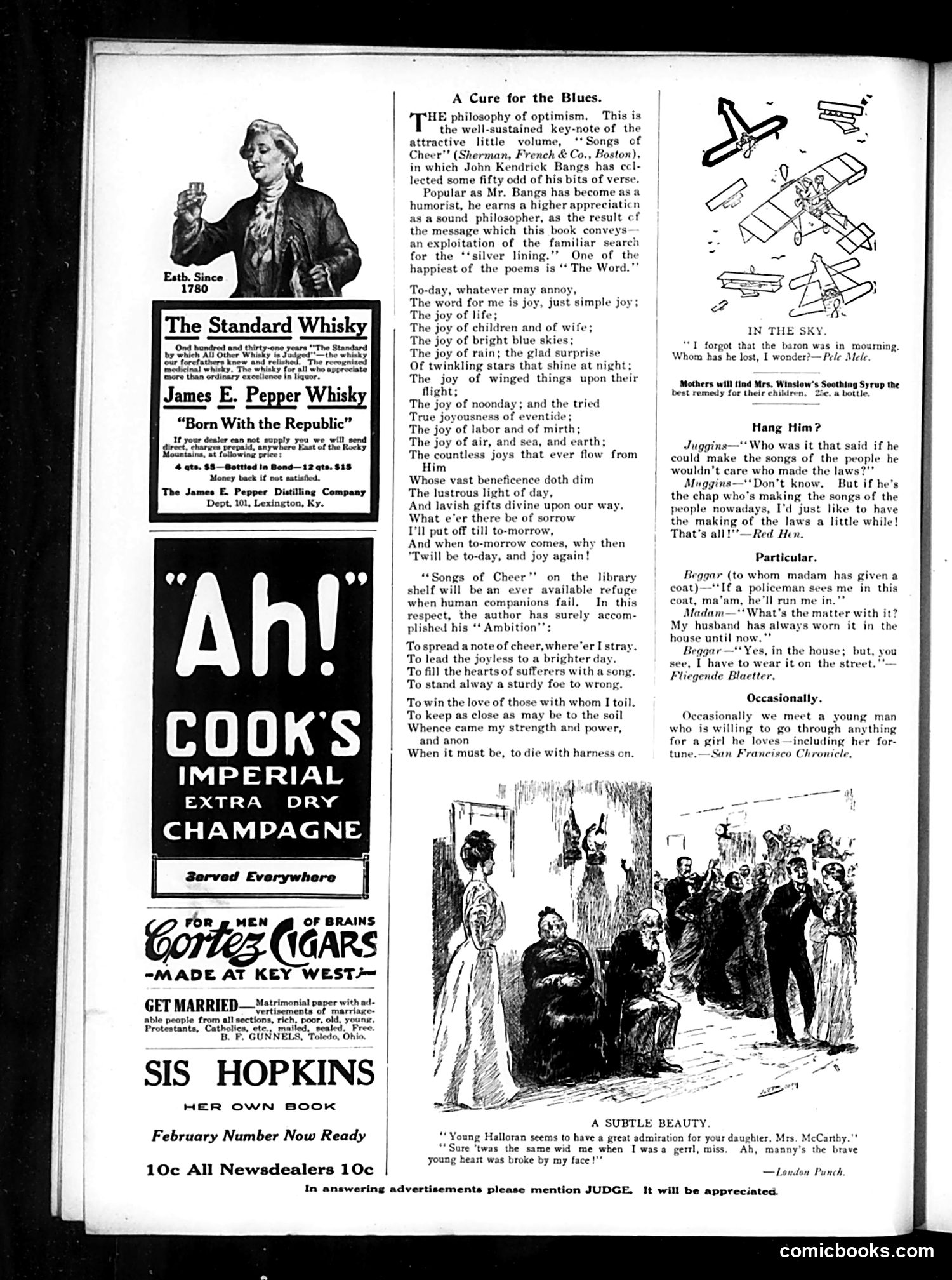
This page is primarily **advertisements and literary content** rather than political cartoons. The main elements are: **Advertisements:** Whisky, champagne, cigars, marriage bureaus, and patent medicines dominate the layout—typical period advertising. **Literary Feature:** "A Cure for the Blues" reviews John Kendrick Bangs's poetry collection *Songs of Cheer*, emphasizing optimistic philosophy popular in early 20th-century self-help culture. The poem excerpt celebrates finding joy despite hardship—a common Victorian/Edwardian sentiment. **Small Humor Pieces:** Include brief jokes about law-making, police, and romantic disappointment—lighthearted social commentary rather than sharp satire. **One Cartoon:** "A Subtle Beauty" depicts an Irish working-class woman joking that her youth's beauty was so poor it broke her own heart, making a self-deprecating ethnic humor joke. The page reflects Judge's mixed content model: serious literary reviews alongside frivolous ads and gentle comedy, targeting middle-class readers seeking both culture and entertainment.
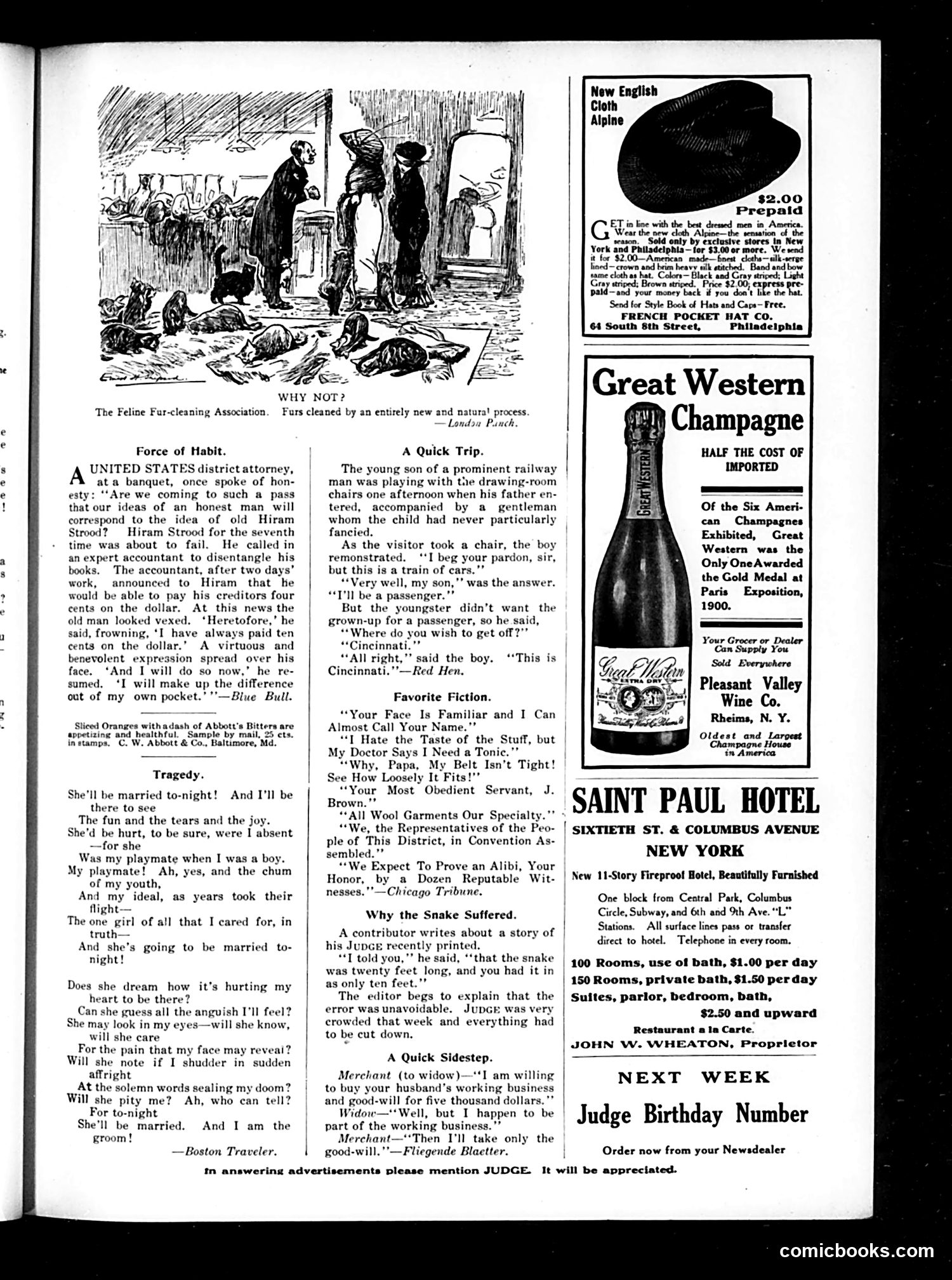
**The Cartoons:** The top illustration is titled "The Feline Fur-Cleaning Association" and shows well-dressed figures standing while observing what appear to be cats or animals on the floor—a visual pun depicting literal "fur-cleaning." **The Satirical Content:** The humor pieces target common American deceptions and social absurdities: 1. **"Force of Habit"** mocks a failed businessman (Hiram Strood) who maintains a façade of respectability by dishonestly claiming he'll now pay creditors 10 cents on the dollar instead of 4 cents—virtue performed for appearance. 2. **"Favorite Fiction"** catalogs lies people routinely tell (denying they dislike medicine, claiming recognition they don't feel), exposing hypocrisy in everyday social interaction. 3. **"Why the Snake Suffered"** is a self-referential joke about editorial compression—Judge admits cutting a 20-foot snake to 10 feet due to space constraints, a humorous acknowledgment of print limitations. The page satirizes American dishonesty, social pretense, and the gap between public behavior and private truth—recurring Judge themes.
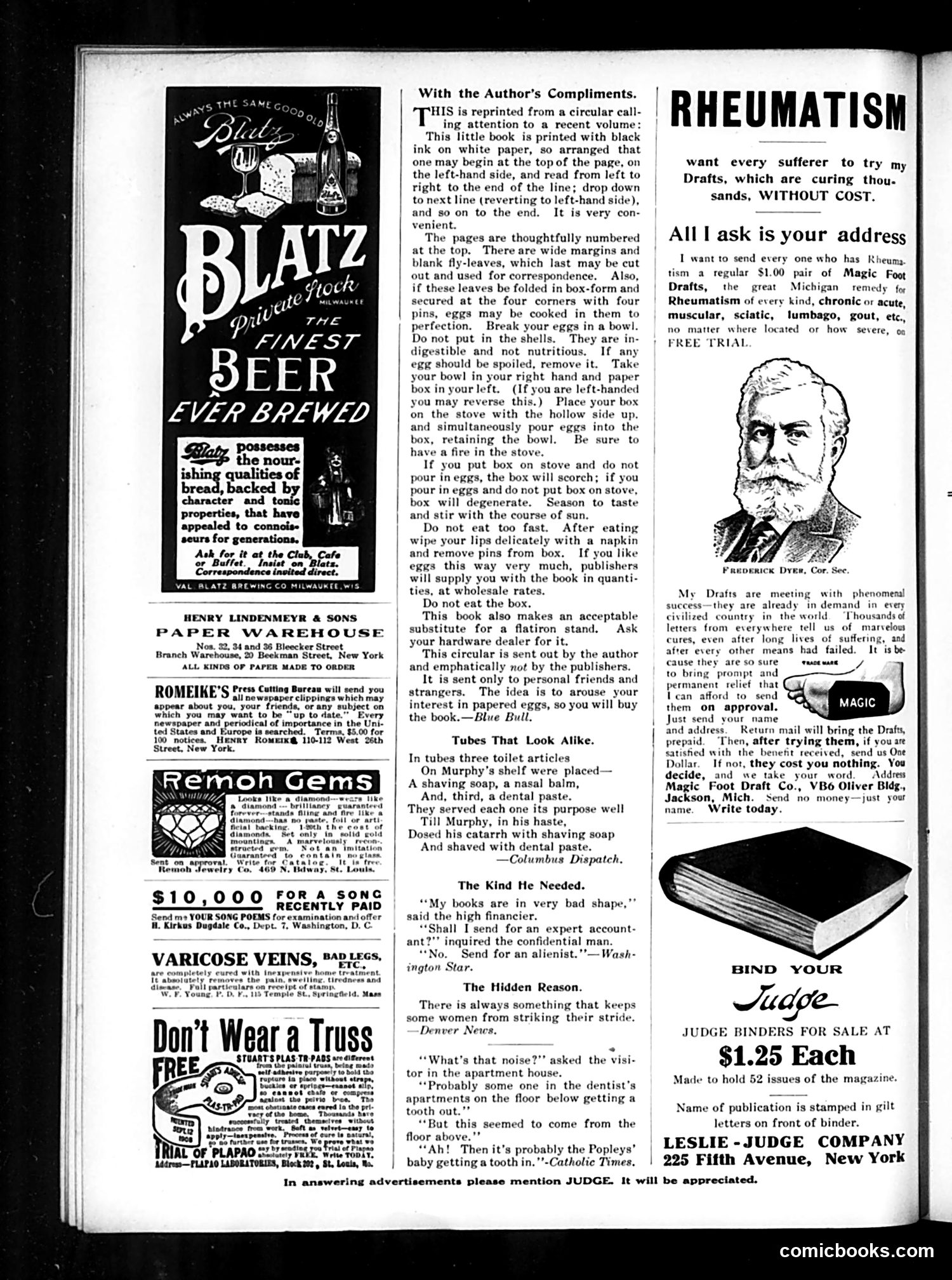
This page is primarily **advertisements and comic fillers** rather than political satire. The layout includes: **Main Content:** A humorous circular describing a book printed with unconventional instructions—notably, its blank pages can allegedly be folded into a box to cook eggs on a stove. The joke satirizes absurdly over-engineered product instructions and impractical book design. **Short Comic Pieces:** Brief jokes about: - A man confusing toiletries (shaving soap as nasal balm, dental paste for shaving) - A financier needing an "alienist" (psychiatrist) rather than accountant for his "bad books" - Apartment noise from dental work **Advertisements:** Beer (Blatz), paper warehouse, press-clipping services, a truss company, jewelry, and a magazine binder dominate the page. The humor reflects early 20th-century sensibilities—wordplay, physical comedy, and light social observation rather than sharp political commentary. No identifiable political figures or events appear.
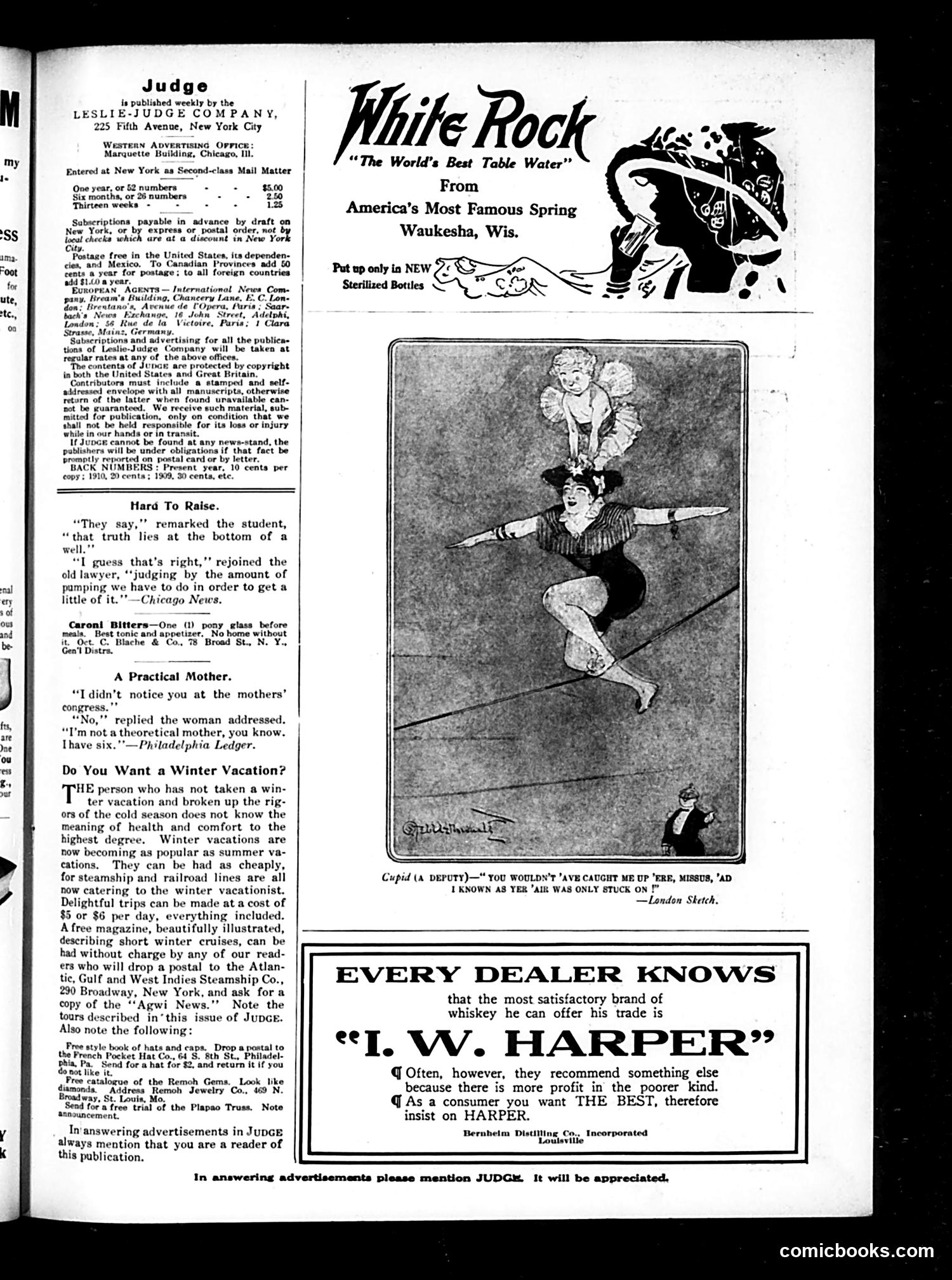
This page from Judge magazine contains mostly **advertisements and filler content** rather than political cartoons with clear satirical intent. The main cartoon shows **Cupid (depicted as a cherub) dressed as a police deputy**, catching a woman with an artificial hat. The caption references the woman's fake hair being "stuck on," suggesting the joke mocks women's use of false hairpieces—a common beauty practice of the era. The humor is simply observational about women's cosmetic deceptions rather than politically charged. The page includes several brief humorous anecdotes (about truth in wells, a practical mother with six children) and advertisements for White Rock water, I.W. Harper whiskey, and various patent medicines and products typical of early 20th-century publications. **No significant political or social satire is present** on this particular page. It primarily serves as a showcase for Judge's advertising revenue and light domestic humor.
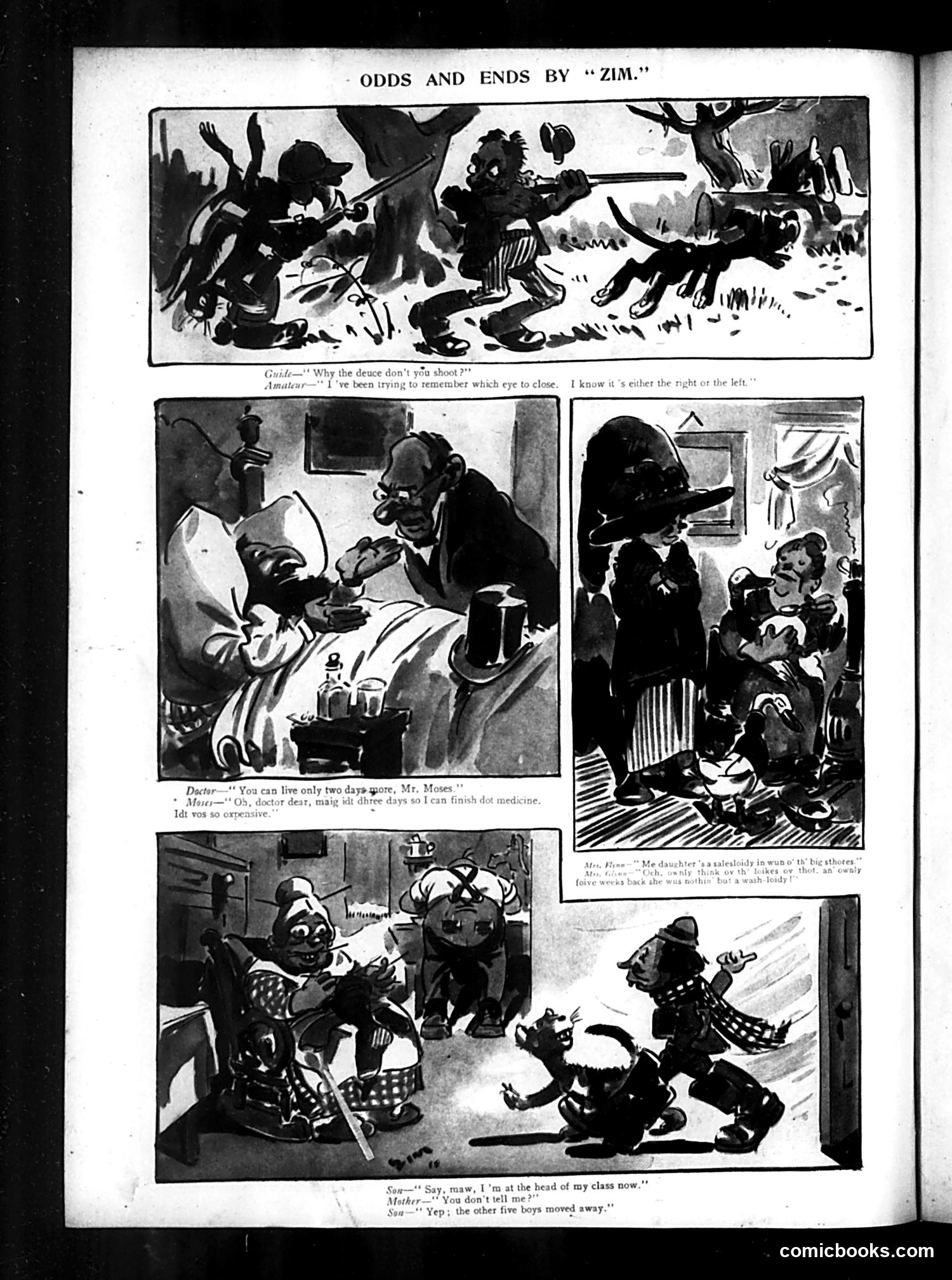
This page contains four separate humorous vignettes by cartoonist Zim, apparently satirizing domestic life and social situations rather than overt politics. The top panel shows a hunting scene with a joke about which eye to close when shooting. The middle panels depict a doctor-patient interaction and what appears to be a social/family scenario, likely poking fun at everyday pretensions or misunderstandings. The bottom panel shows children playing, with a joke about classroom hierarchy. Overall, these appear to be general-interest humor pieces targeting middle-class social conventions and family dynamics rather than specific political figures or events. Without dates or clearer context, the exact contemporary references remain unclear, though the style and tone suggest early-to-mid 20th century satirical commentary on American domestic life.