
Judge, 1911-02-18 · page 8 of 24
Judge — February 18, 1911 — page 8: what you’re looking at
What you’re looking at
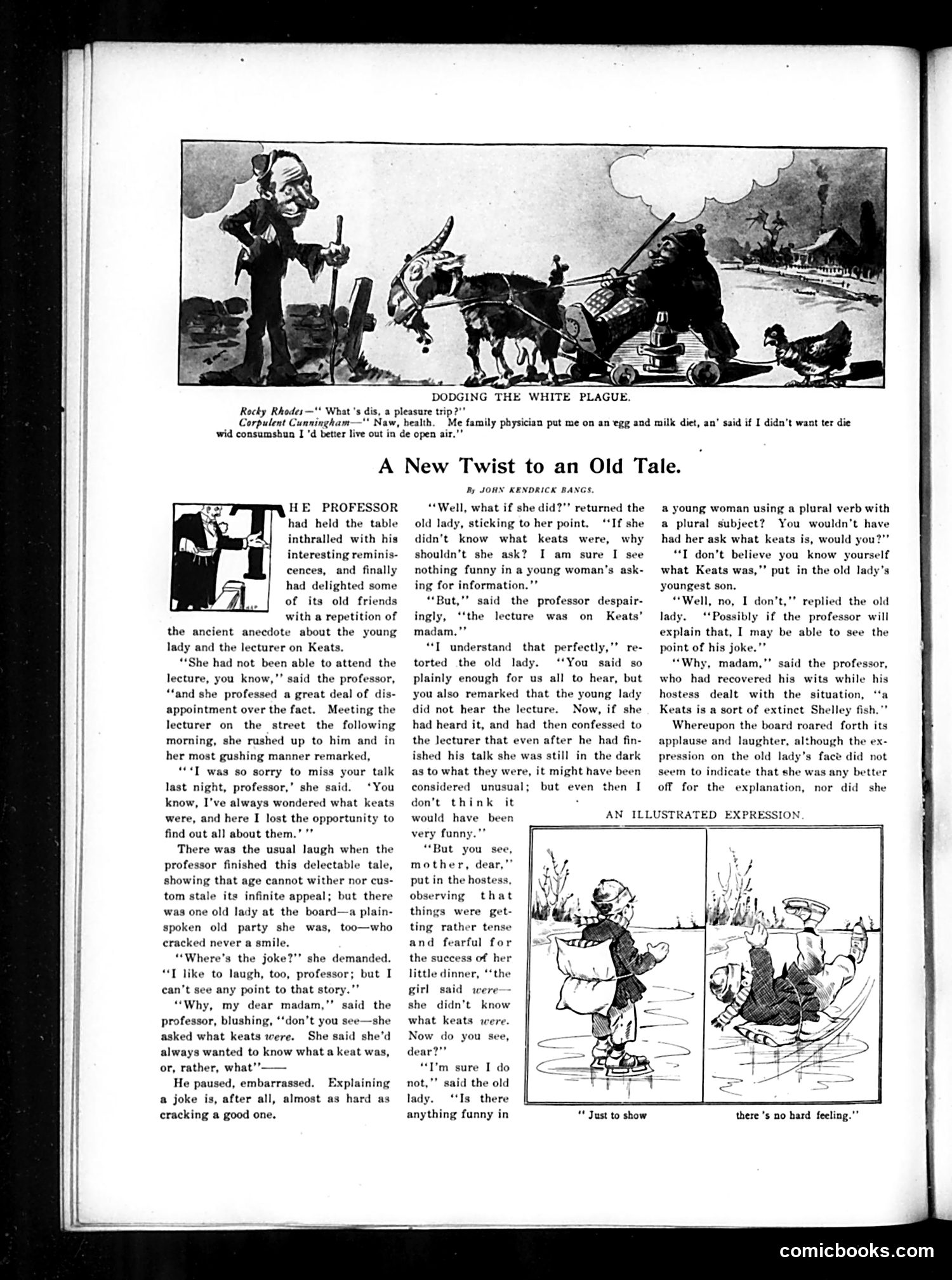
This page contains two distinct pieces of humor: **Top cartoon ("Dodging the White Plague"):** References tuberculosis, then called "consumption" or "the White Plague." A character named Corpulent Cunningham explains he's traveling for health reasons, hoping fresh air will prevent TB—a common (and often ineffective) treatment recommendation of the era. **Main story ("A New Twist to an Old Tale"):** A professor tells a familiar anecdote about a woman who asks what "keats" are, not knowing the lecture was about the poet John Keats. The humor depends on her grammatical ignorance. However, a blunt old lady in the audience refuses to find it funny, logically pointing out: if someone didn't attend the lecture, why shouldn't they ask questions? Her literalist objections deflate the professor's joke entirely. He eventually recovers by making a pun ("Keats is a sort of extinct Shelley fish"—Shelley being another Romantic poet). The satire targets professorial pretension and the fragility of jokes that rely on assumed shared knowledge or subtle wordplay.
📄 Transcribed text from this page (OCR, searchable)
Machine-transcribed from the original scan — historical spelling and the odd misread are preserved.
DODGING THE WHITE PLAGUE. Rocky Rhodes —"* What's dis, a pleasure trip ?"" Corpulent Cunningham “* Naw, bealth. wid consumshun I 'd better live out in de open air.'’ A New Twist to an Old Tale. HE PROFESSOR had held the table inthralled with his interesting reminis- cences, and finally had delighted some of its old friends with a repetition of the ancient anecdote about the young lady and the lecturer on Keats. “‘She had not been able to attend the lecture, you know,"’ said the professor, “and she professed a great deal of dis- appointment over the fact. Meeting the lecturer on the street the following morning, she rushed up to him and in her most gushing manner remarked, “““T was so sorry to miss your talk last night, professor,’ she said. ‘You know, I’ve always wondered what keats were, and here I lost the opportunity to find out all about them.’ '" There was the usual laugh when the professor finished this delectable tale, showing that age cannot wither nor cus- tom stale its infinite appeal; but there was one old lady at the board—a plain- spoken old party she was, too—who cracked never a smile. “Where's the joke?’’ she demanded. “T like to laugh, too, professor; but I can’t see any point to that story.”” “Why, my dear madam," said the professor, blushing, ‘‘don’t you see—she asked what keats were. She said she'd always wanted to know what a keat was, or, rather, what’’—— He paused, embarrassed. Explaining a joke is, after all, almost as hard as cracking a good one. By JOHN KENDRICK BANGS. “Well, what if she did?” returned the old lady, sticking to her point. ‘‘If she didn't know what keats were, why shouldn’t she ask? I am sure I see nothing funny in a young woman’s ask- ing for information.’” “But”? said the professor despair- ingly, ‘‘the lecture on Keats’ madam."’ “I understand that perfectly,"? re- torted the old lady. ‘You said so plainly enough for us all to hear, but you also remarked that the young lady did not hear the lecture. Now, if she had heard it, and had then confessed to the lecturer that even after he had fin- ished his talk she was still in the dark as to what they were, it might have been but even then I was considered unusual; think it been don't would have Me family physician put me on an egg and milk diet, an’ said if I didn't want ter die a young woman using a plural verb with a plural subject? You wouldn't have had her ask what keats is, would you?” “I don’t believe you know yourself what Keats was,”’ put in the old lady's youngest son. “Well, no, I don’t," replied the old lady. ‘Possibly if the professor will explain that, I may be able to see the point of his joke. “Why, madam,"’ said the professor, who had recovered his wits while his hostess dealt with the situation, ‘ta Keats is a sort of extinct Shelley fish.”’ Whereupon the board roared forth its applause and laughter, although the ex- pression on the old lady’s fac? did not seem to indicate that she was any better off for the explanation, nor did she AN ILLUSTRATED EXPRESSION . ——— very funny. “But you see, mother, dear,” put in the hostess, observing that things were get- ting rather tense and fearful for the success of her little dinner, ‘‘the girl said were she didn’t know what keats Now do you see, dear?” “I'm sure I do not,"’ said the old lady. ‘‘Is. there anything funny in ** Just to show there's no bard feeling.”” comicbooks.com