
Judge, 1911-02-18 · page 14 of 24
Judge — February 18, 1911 — page 14: what you’re looking at
What you’re looking at
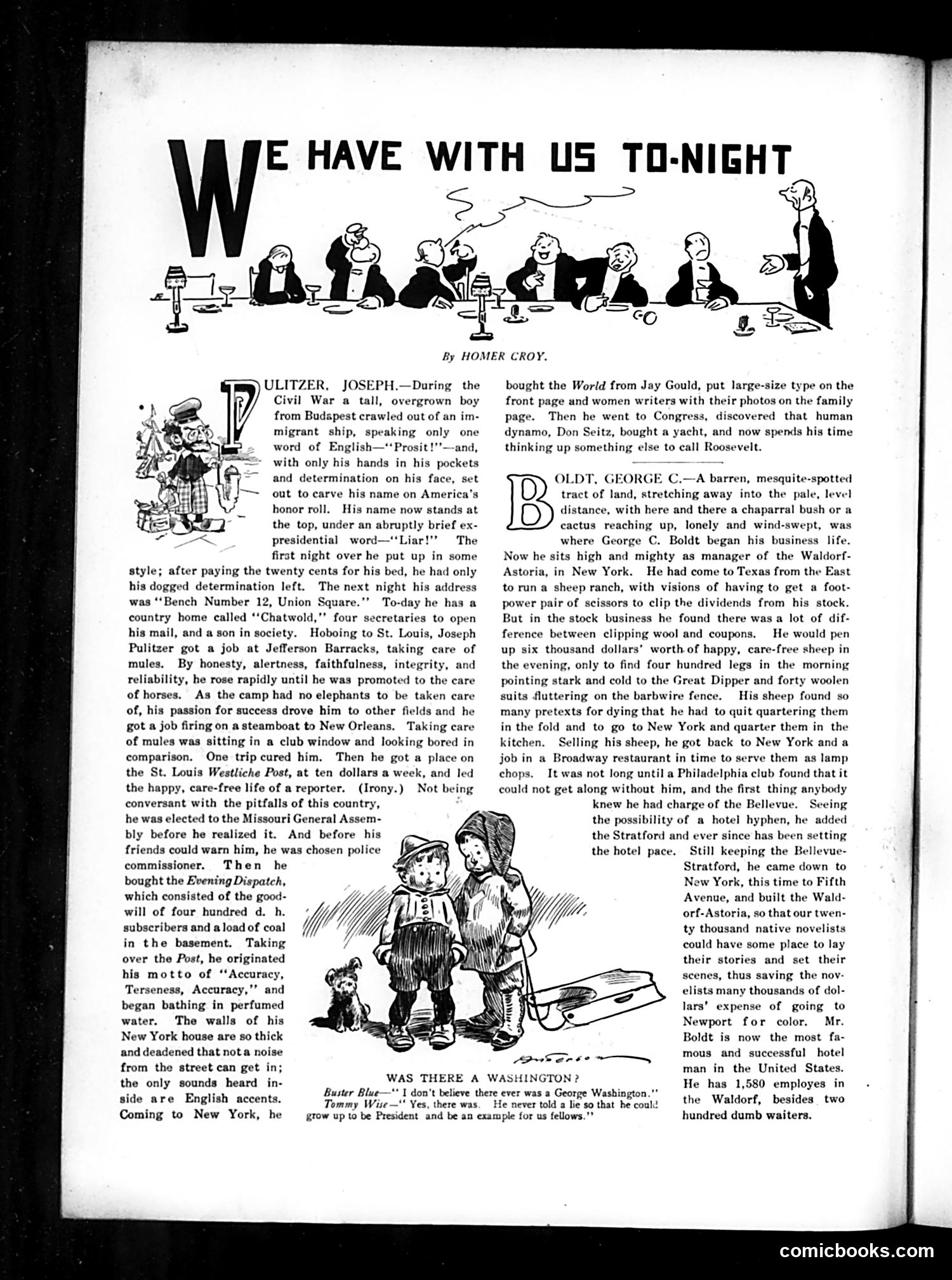
This Judge magazine page profiles successful immigrants through satirical biographical sketches. The header cartoon shows men dining together, introducing the theme. **Joseph Pulitzer** receives harsh treatment: though praised for rising from poverty to newspaper prominence, the sketch mocks his pretensions—his mansion's soundproofing, perfumed baths, and English accents. The buried insult is the reference to an "abruptly brief ex-presidential word—'Liar!'"—apparently attacking Theodore Roosevelt's credibility, whom Pulitzer's *World* frequently criticized. **George C. Boldt's** section humorously recounts his failed Texas sheep ranching (sheep mysteriously dying overnight) before he succeeded managing the Waldorf-Astoria hotel in New York. A sidebar joke depicts children discussing whether George Washington existed, satirizing skepticism toward American mythology. The satire works on two levels: celebrating immigrant success while mocking their social climbing, pretension, and the sensationalism of Pulitzer's yellow journalism.
📄 Transcribed text from this page (OCR, searchable)
Machine-transcribed from the original scan — historical spelling and the odd misread are preserved.
By HOMER CROY. ULITZER, JOSEPH.—During the Civil War a tall, overgrown boy from Budapest crawled out of an im- migrant ship, speaking only one word of English—‘*Prosit!’’—and, with only his hands in his pockets and determination on his face, set out to carve his name on America’s honor roll. His name now stands at the top, under an abruptly brief ex- presidential word—‘‘Liar!"” ‘The first night over he put up in some style; after paying the twenty cents for his bed, he had only his dogged determination left. The next night his address was ‘‘Bench Number 12, Union Square." To-day he has a country home called ‘‘Chatwold,”’ four secretaries to open his mail, and a son in society. Hoboing to St. Louis, Joseph Pulitzer got a job at Jefferson Barracks, taking care of mules, By honesty, alertness, faithfulness, integrity, and reliability, he rose rapidly until he was promoted to the care of horses. As the camp had no elephants to be taken care of, his passion for success drove him to other fields and he got a job firing on a steamboat to New Orleans. Taking care of mules was sitting in a club window and looking bored in comparison. One trip cured him. Then he got a place on the St. Louis Westliche Post, at ten dollars a week, and led the happy, care-free life of a reporter. (Irony.) Not being conversant with the pitfalls of this country, he was elected to the Missouri General Assem- bly before he realized it. And before his friends could warn him, he was chosen police commissioner. Then he bought the Evening Dispatch, which consisted of the good- will of four hundred d. h. subscribers and aload of coal in the basement. Taking over the Post, he originated his motto of ‘Accuracy, Terseness, Accuracy,’’ and began bathing in perfumed water. The walls of his New York house are so thick and deadened that nota noise from the street can get in; the only sounds heard in- side are English accents. Coming to New York, he Tommy Wise —'' Yes, there was. WAS THERE A WASHINGTON? Buster Blue—"' 1 don't believe there ever was a George Washington."* grow up to be President and be an example for us fellows."? bought the World from Jay Gould, put large-size type on the front page and women writers with their photos on the family page. Then he went to Congress, discovered that human dynamo, Don Seitz, bought a yacht, and now spends his time thinking up something else to call Roosevelt. OLDT, GEORGE C.—A barren, mesquite-spotted tract of land, stretching away into the pale, level distance, with here and there a chaparral bush or a cactus reaching up, lonely and wind-swept, was where George C. Boldt began his business life. Now he sits high and mighty as manager of the Waldorf- Astoria, in New York. He had come to Texas from the East to run a sheep ranch, with visions of having to get a foot- power pair of scissors to clip the dividends from his stock. But in the stock business he found there was a lot of dif- ference between clipping wool and coupons. He would pen up six thousand dollars’ worth of happy, care-free sheep in the evening, only to find four hundred legs in the morning pointing stark and cold to the Great Dipper and forty woolen suits fluttering on the barbwire fence. His sheep found so many pretexts for dying that he had to quit quartering them in the fold and to go to New York and quarter them in the kitchen. Selling his sheep, he got back to New York and a job in a Broadway restaurant in time to serve them as lamp chops. It was not long until a Philadelphia club found that it could not get along without him, and the first thing anybody knew he had charge of the Bellevue. Seeing the possibility of a hotel hyphen, he added the Stratford and ever since has been setting the hotel pace. Still keeping the Bellevue- Stratford, he came down to New York, this time to Fifth Avenue, and built the Wald- orf-Astoria, so that our twen- ty thousand native novelists could have some place to lay their stories and set their scenes, thus saving the nov- elists many thousands of dol- lars’ expense of going to Newport for color. Mr. Boldt is now the most fa- mous and successful hotel man in the United States. He has 1,580 employes in the Waldorf, besides two He never told a lie so that he could 5 hundred dumb waiters. comicbooks.com