
A complete issue · 24 pages · 1910
Judge — November 26, 1910
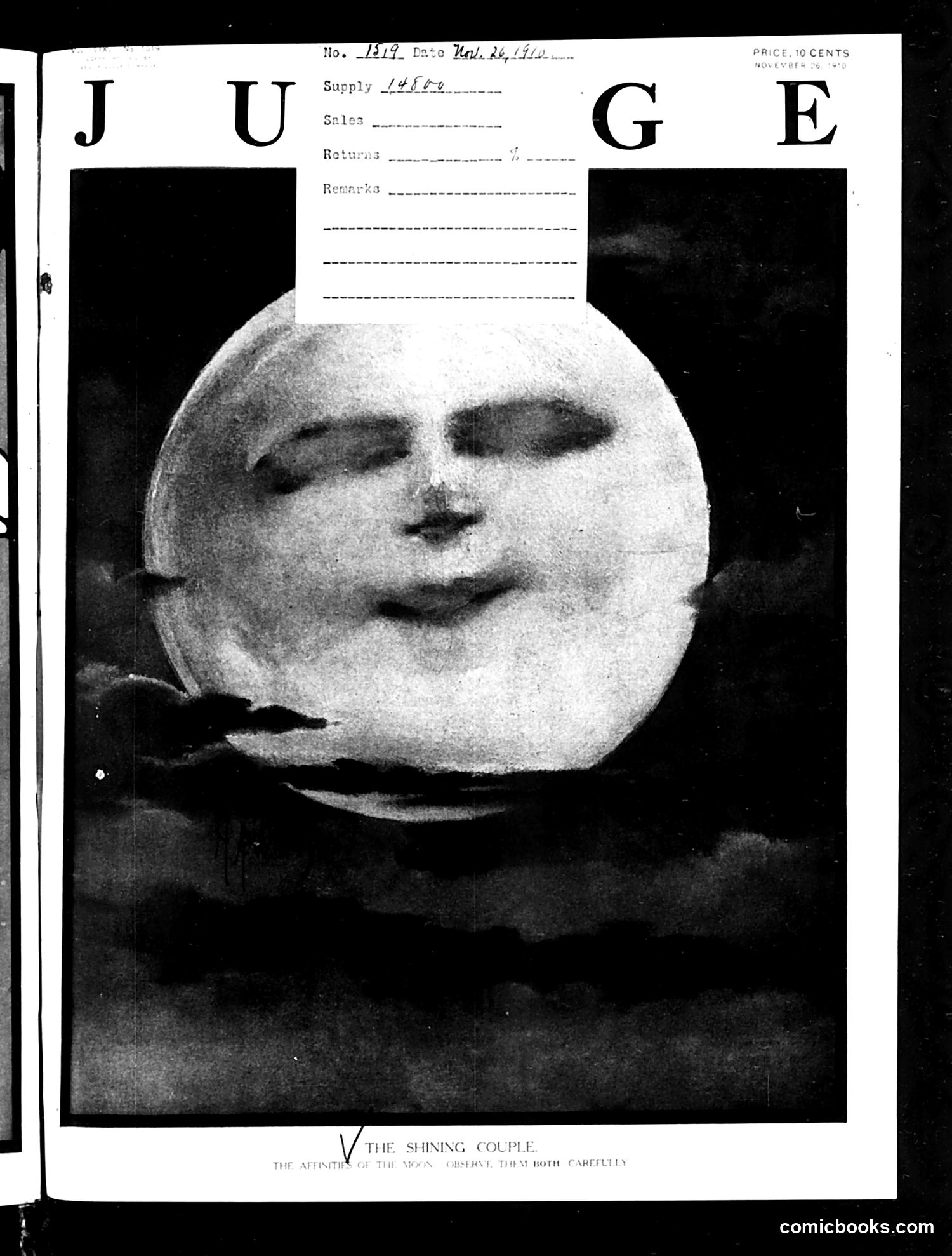
This page from *Judge* magazine features a satirical illustration titled "The Shining Couple," subtitled "The Affinity of the Moon: Observe Their Careful[?]" The cartoon depicts two round, moon-like faces in close proximity, suggesting a romantic pairing. The style of caricature and the moon imagery appear to mock some contemporary public figures or social phenomenon—likely a well-known couple of the era whose relationship was being satirized. The specific identities remain unclear without additional context, but the satire likely targets either celebrity romance, political figures' personal lives, or perhaps a commentary on superficial public personas ("shining" surfaces concealing something beneath). The archival nature and poor OCR quality make precise interpretation difficult without knowing the magazine's publication date.
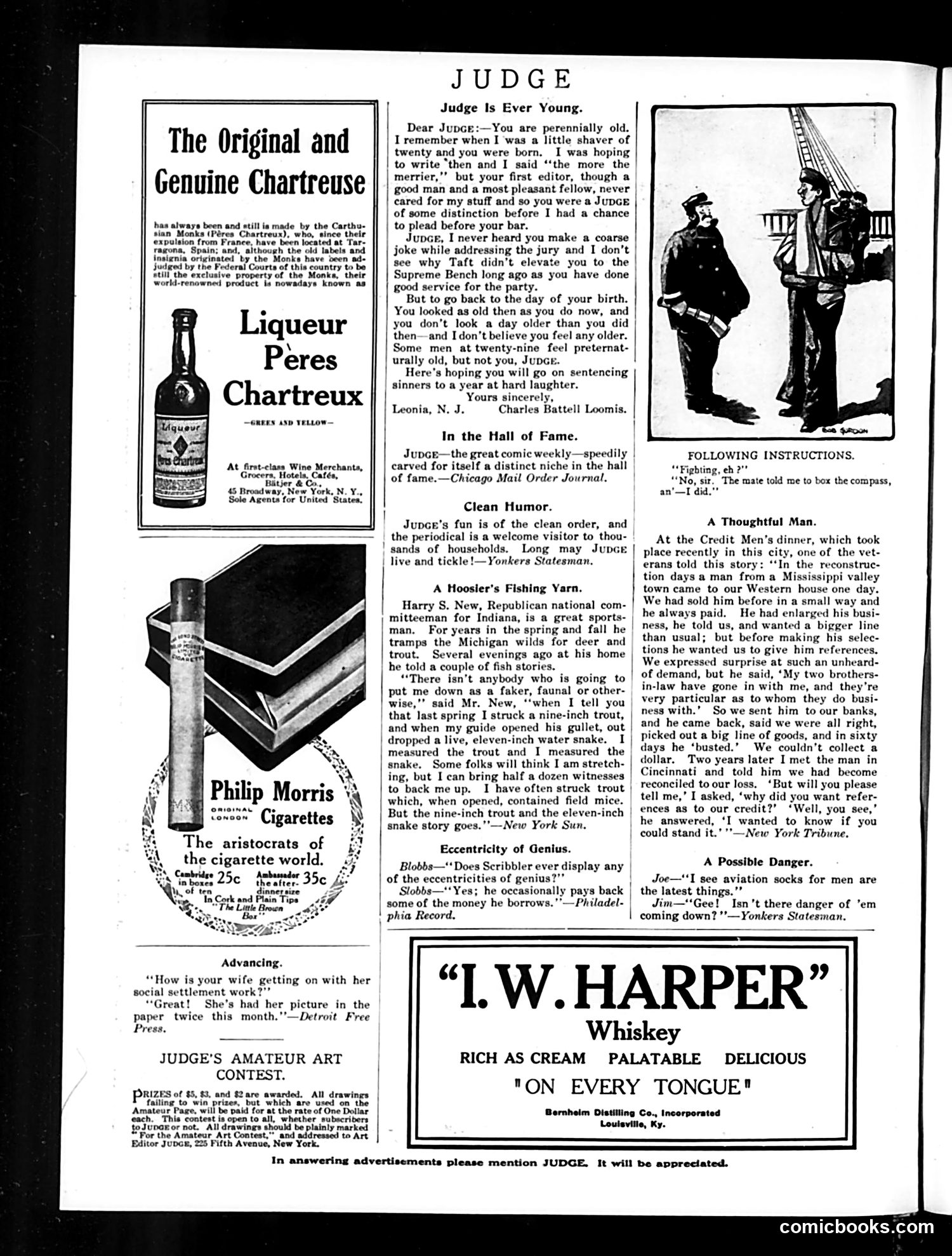
This page is primarily **advertising and humor columns** rather than political satire. The main content includes: **Advertisements:** Liqueur Pères Chartreaux, Philip Morris cigarettes, and I.W. Harper whiskey dominate the layout. **Cartoons/Humor:** The illustrated anecdotes appear to be genteel social humor—one shows a sailor receiving navigation instructions, another depicts a man telling fishing stories at a club dinner. **Columns:** "Judge is Ever Young," "In the Hall of Fame," "Clean Humor," "A Hoosier's Fishing Yarn," and others present light comic stories about everyday situations—a man's references for employment, aviation socks, etc. The tone is **apolitical and recreational**, targeting middle-class readers with affluent leisure interests (fishing, clubs, dining). This reflects Judge's evolution toward lifestyle humor rather than sharp political commentary.
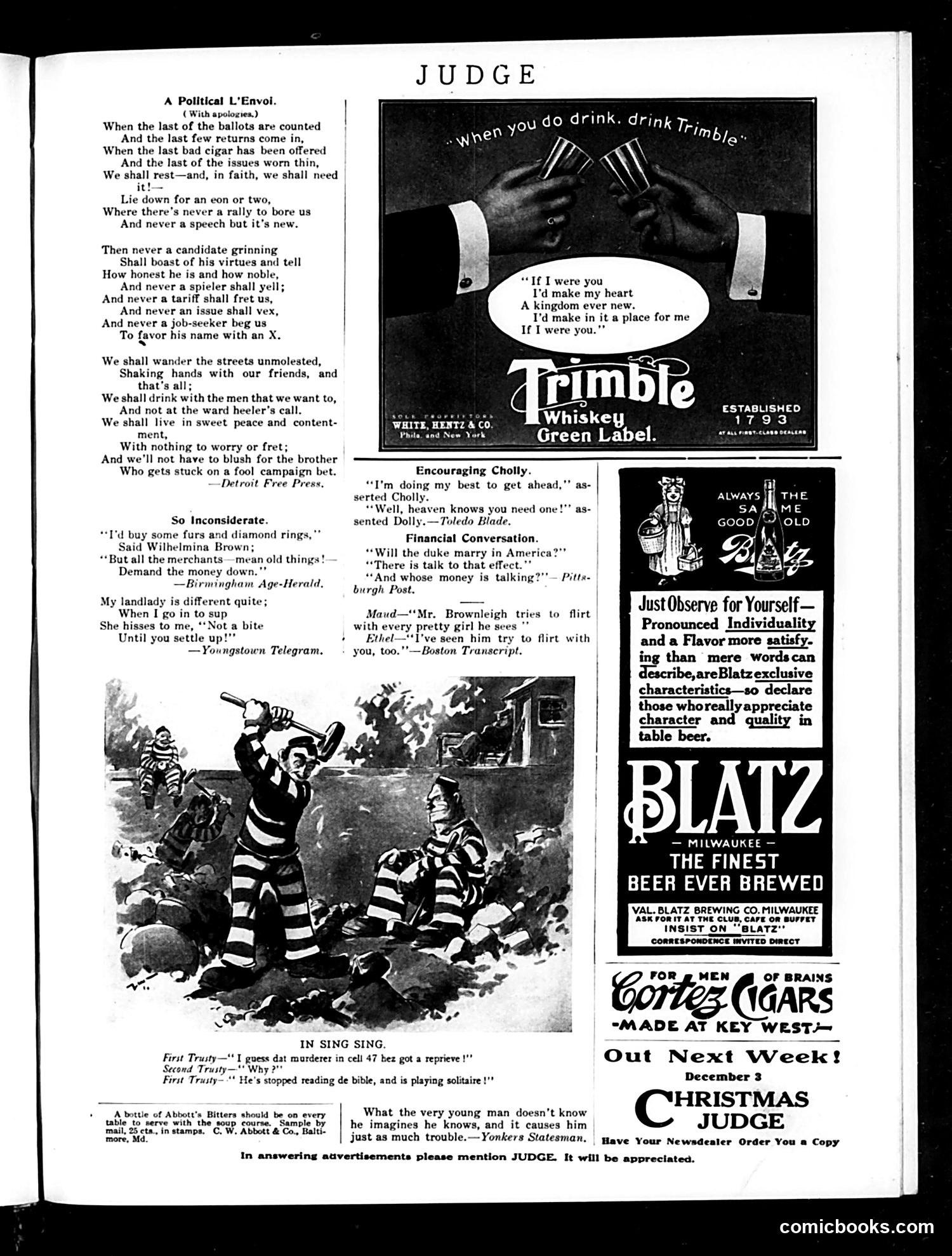
This page is primarily **advertising**, featuring liquor and beer ads (Trimble Whiskey, Blatz Beer, Cortez Cigars) alongside humorous poems and short satirical pieces. The main cartoon titled "In Sing Sing" depicts prisoners in striped uniforms. The caption references a "First Trusty" joking about murderers and reprieves, suggesting dark humor about prison life and capital punishment—topical issues in early 20th-century America. The poems ("A Political L'Envoi," "So Inconsiderate") offer light social satire about politics, relationships, and etiquette rather than hard-hitting political commentary. The overall tone is genteel humor aimed at affluent readers, mixing advertisements with gentle mockery of contemporary social behaviors.
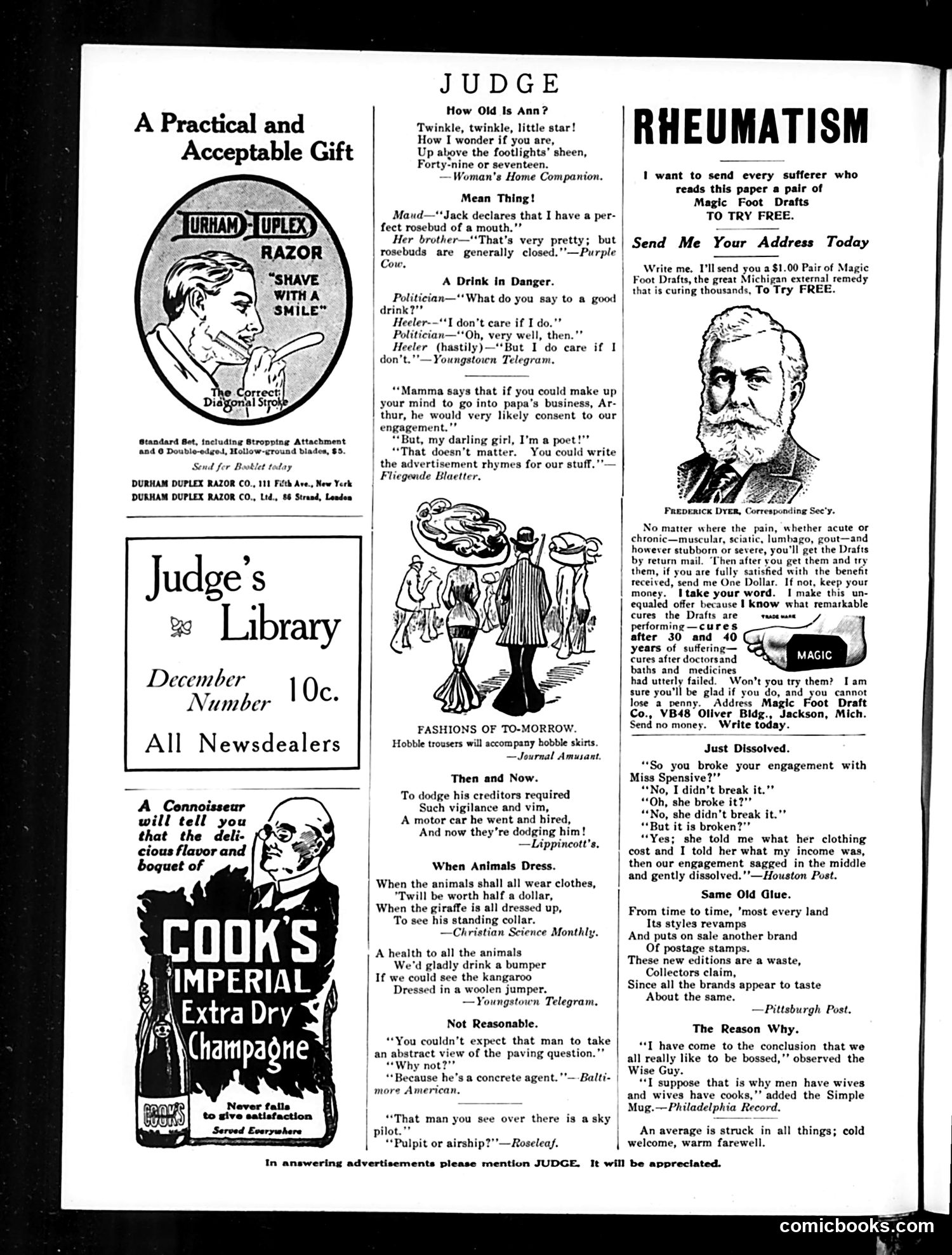
This page is primarily **advertisements and light humor** rather than political commentary. The main content includes: **Advertisements:** - Durham Duplex Razor ("Shave with a Smile") - Judge's Library (December issue, 10¢) - Cook's Imperial Extra Dry Champagne **Humor Section ("Judge"):** Contains brief comedic exchanges and observations on everyday topics—courtship dissolution, fashion predictions, animal dress, and social observations. The jokes target common subjects: poets as unsuitable fiancés, changing fashions, and marital dynamics. **Right Column:** A prominent advertisement for "Magic Foot Drafts," a patent medicine claiming to cure rheumatism and various ailments, promising results "after 30 and 40 years of suffering." The page reflects early 20th-century concerns: medical quackery, social etiquette, and consumer culture—with minimal political content.
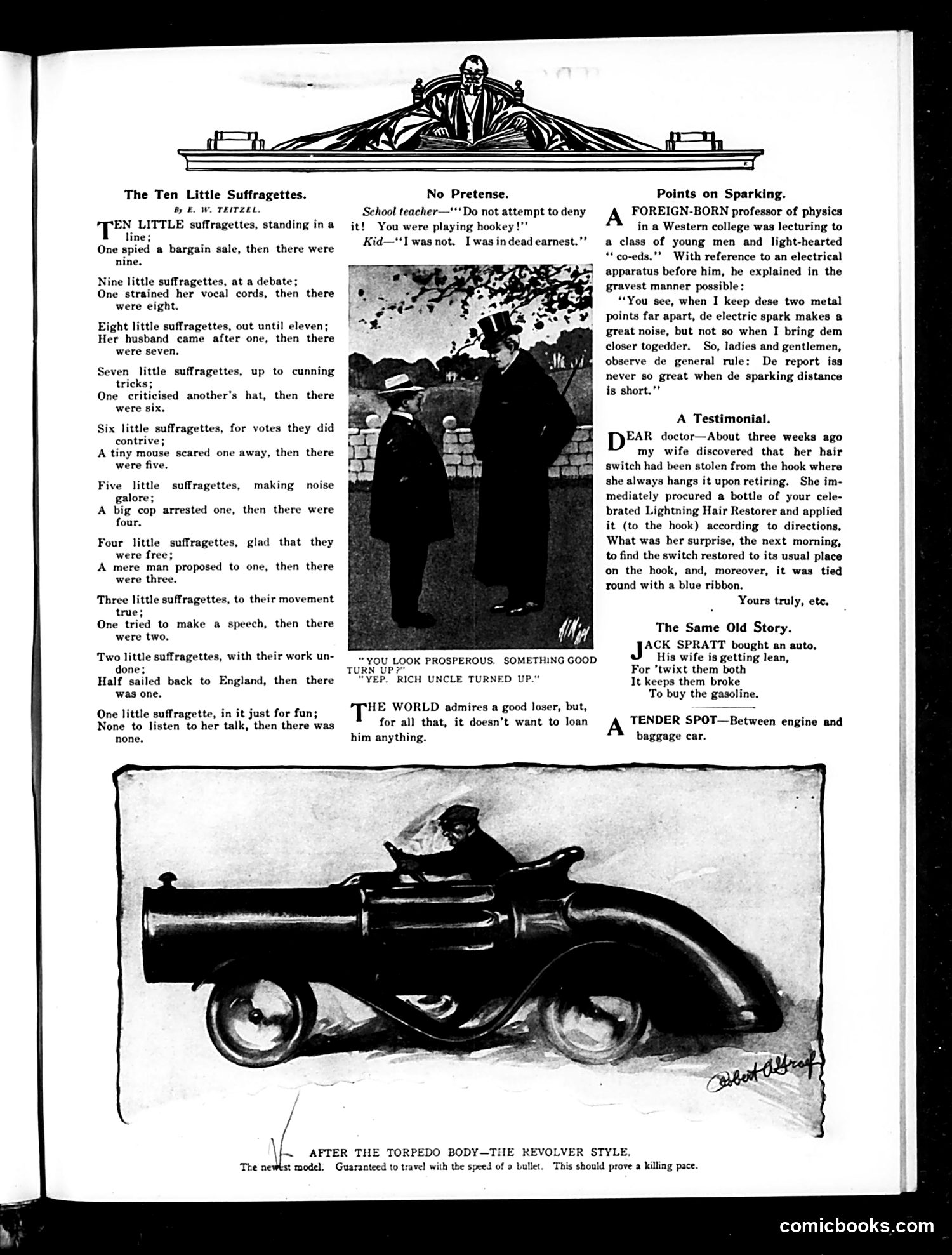
This page contains light satirical content rather than political cartoons. **"The Ten Little Suffragettes"** is a poem parodying the nursery rhyme "Ten Little [N-word]," tracking suffragettes' numbers declining through various mishaps—losing votes, facing arrests, and eventually dwindling to none. It mocks the women's suffrage movement by treating activists as foolish rather than principled. **"Points on Sparking"** quotes a Western college physics professor explaining electrical principles, apparently comparing romantic "sparking" to electrical phenomena—a mild flirtation joke. The automobile cartoon shows a car styled like a revolver, captioned as "guaranteed to travel with the speed of a bullet," satirizing dangerous driving speeds. The content reflects Judge's conservative stance against women's suffrage while embracing genteel humor about courtship and automobiles.
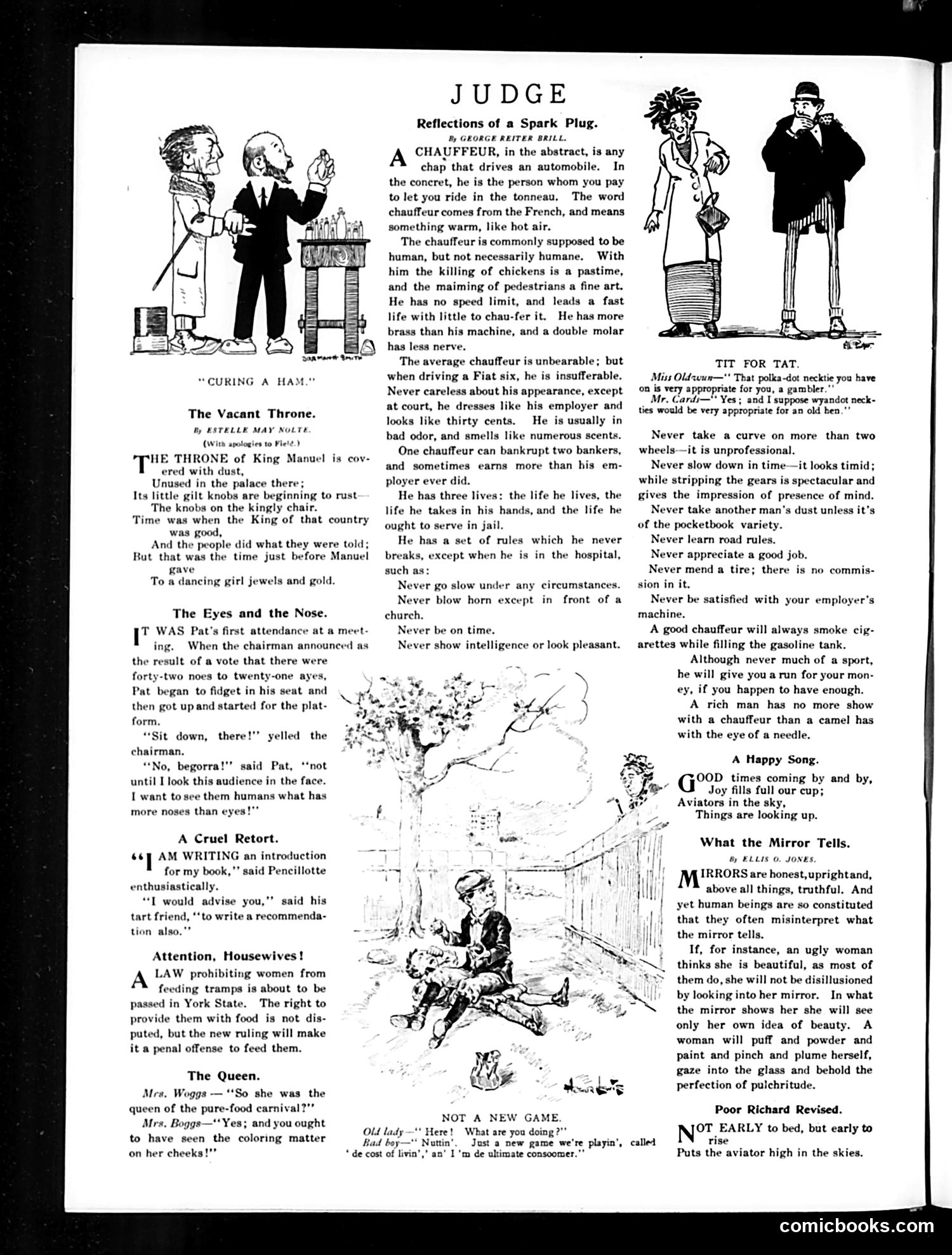
This page from Judge (likely early 1900s) contains multiple satirical pieces targeting contemporary social figures and behaviors: **"The Vacant Throne"** appears to reference King Manuel II of Portugal, whose reign (1908-1910) was marked by scandal involving relationships with dancers and courtesans—hence the "dancing girl jewels and gold" reference. The satire criticizes royal excess and moral failure. **"Reflections of a Spark Plug"** is a humorous essay mocking automobile chauffeurs—a newly emergent professional class. The satire portrays them as reckless, pretentious, and morally questionable drivers who endanger pedestrians and bankrupt their employers. This reflects early-1900s anxieties about dangerous automobiles and working-class upstarts. The remaining pieces are lighter social humor: "The Eyes and the Nose" jokes about Irish immigrant Pat's confusion at a voting meeting; "A Cruel Retort" mocks pretentious writers; "Attention, Housewives!" references actual legislation; and "The Queen" satirizes food-coloring scandals. The overall tone reflects Judge's characteristic class-conscious, mildly xenophobic humor targeting immigrants, social climbers, and modern annoyances.
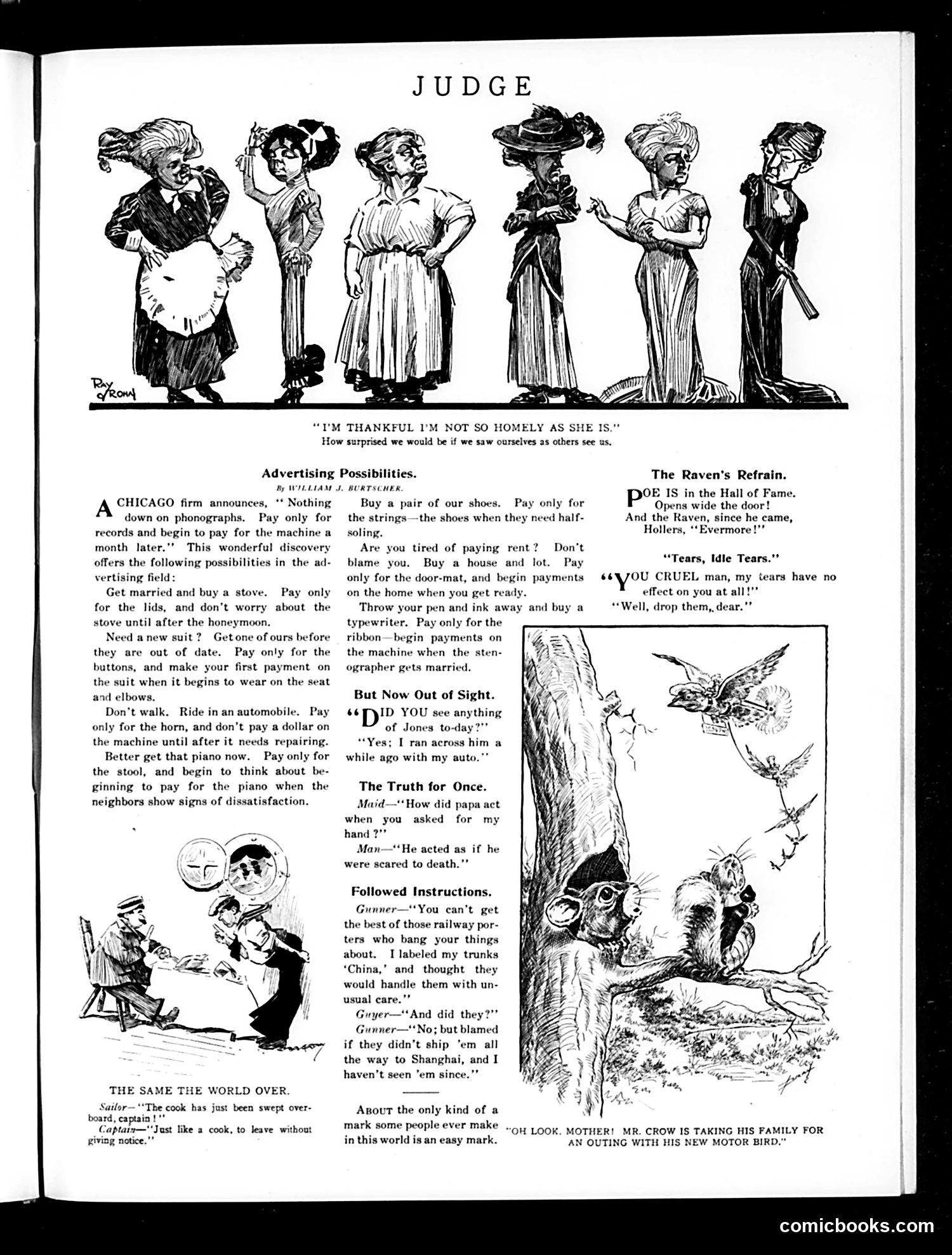
This page from Judge satirizes early-1900s consumer culture and installment buying. The top cartoon mocks women's self-perception—a homely woman criticizes another's appearance, the joke being we don't see ourselves as others do. The main article parodies a Chicago phonograph company's "nothing down" payment scheme by proposing absurd extensions: buy a stove but pay only for lids, a suit but only buttons first, a piano but only the stool initially. The satire targets both aggressive marketing tactics and consumer gullibility during an era of expanding credit. Secondary jokes include workplace absurdities (a cook leaving without notice) and customer exploitation (porters deliberately mislabeling luggage to Shanghai). The bottom cartoon mocks emerging automobile culture by showing a crow family using a "motor bird"—visual humor about the novelty of motorized transportation. Overall, Judge critiques modern commercialism, easy-credit culture, and the transformation of daily life by new technologies and marketing schemes.
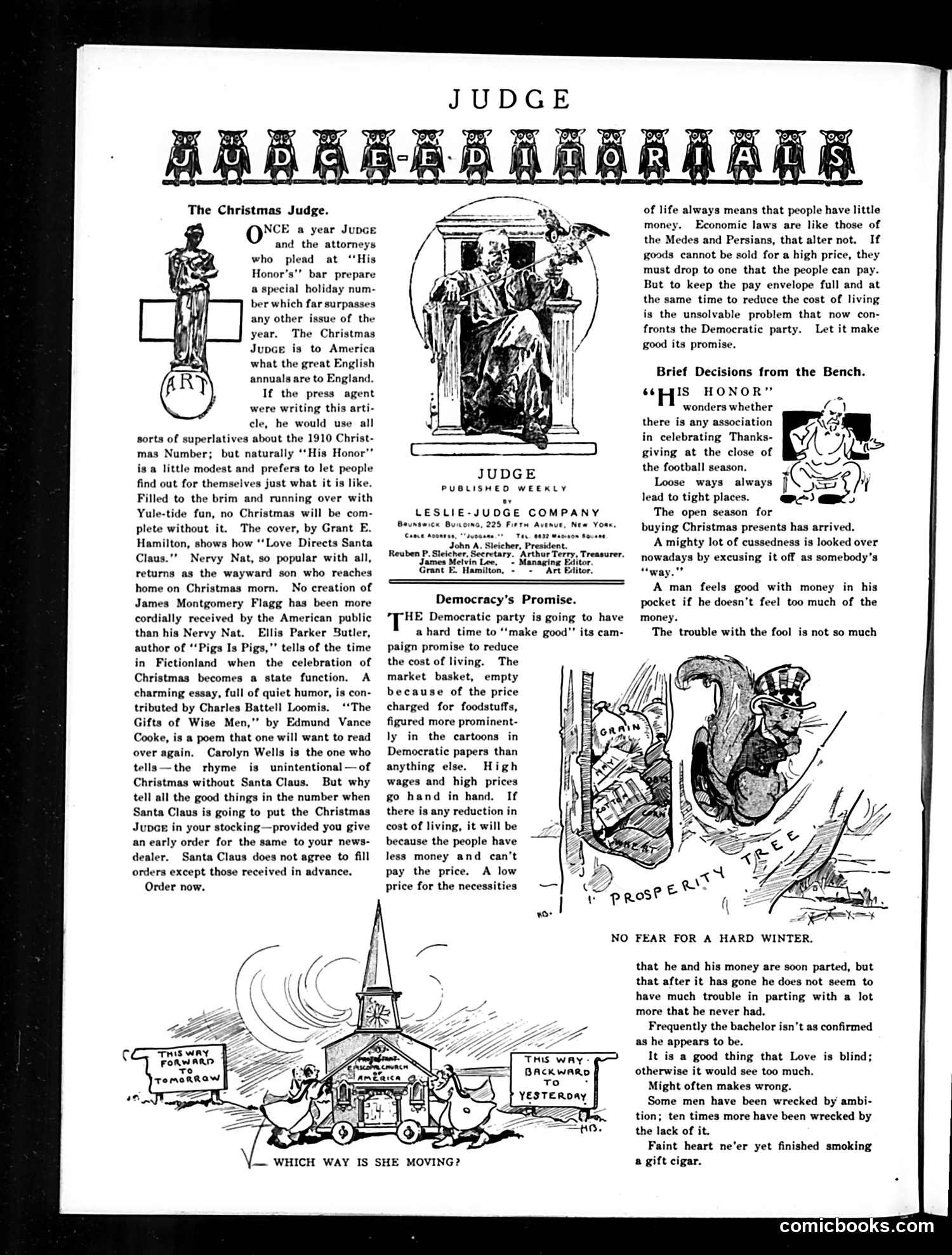
This is primarily **promotional and editorial content** for Judge's 1910 Christmas issue, not political satire. The page features: **Main content:** Self-promotion for the upcoming holiday edition, listing contributing writers (Ellis Parker Butler, Edmund Vance Cooke, Carolyn Wells) and highlighting cover art by Grant E. Hamilton showing "Love Directs Santa Claus." **Political commentary:** A section titled "Democracy's Promise" critiques the Democratic party's campaign pledge to reduce living costs. The satirist argues this is impossible—that high wages and high prices are linked, and lowering prices would simply mean people have less money. The accompanying illustration shows a figure labeled "Prosperity Tree" looking confused about which direction to move. **Brief humor items:** Short aphorisms about money, bachelors, and foolishness fill the remainder. The satire targets Democratic economic promises as naive or contradictory, suggesting their "good" intentions cannot overcome basic economic laws.
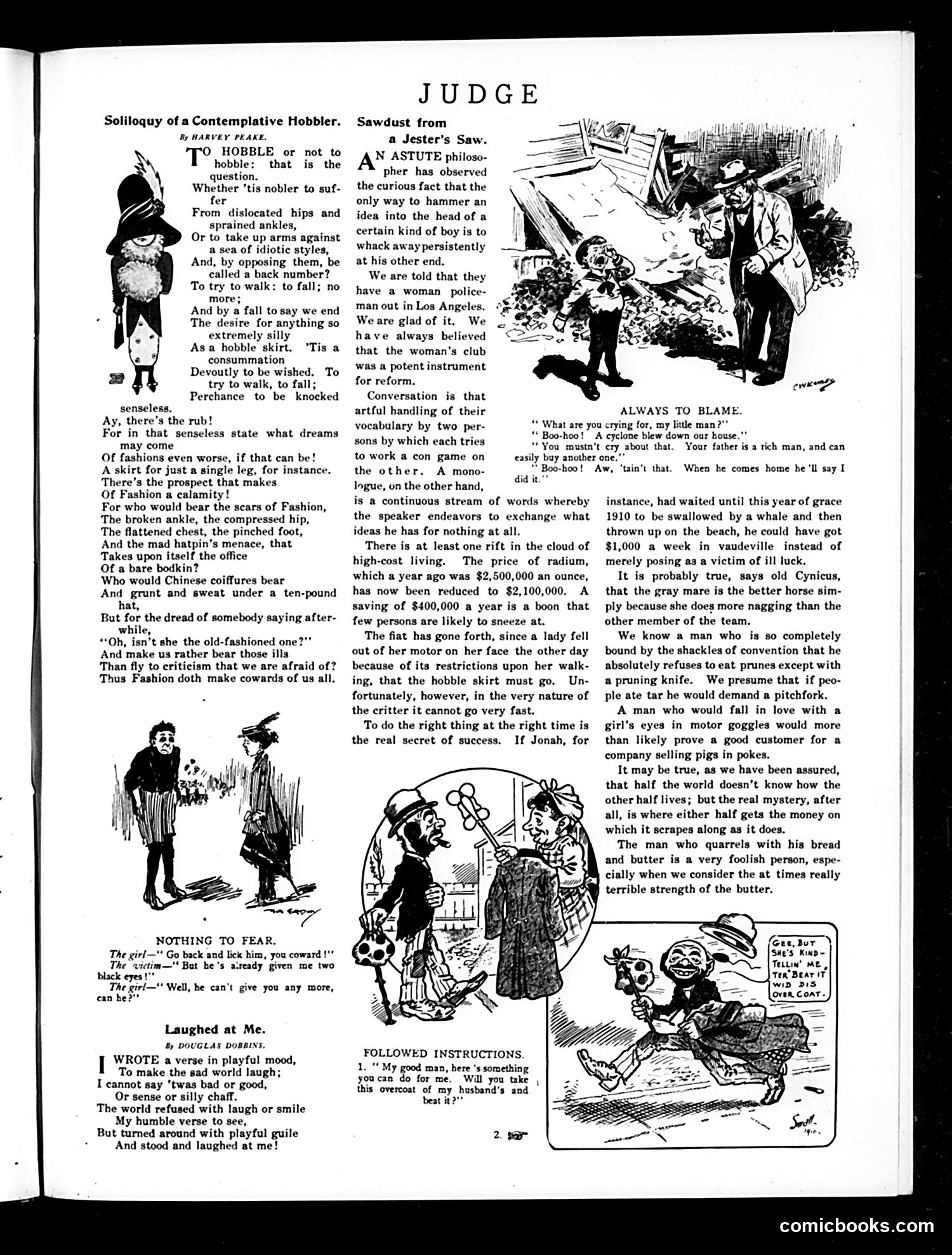
This page from Judge (an American satirical weekly) contains several distinct pieces satirizing early 1910s social issues: **"Soliloquy of a Contemplative Hobbler"** parodies Shakespeare's Hamlet, mocking women's fashion, specifically the "hobble skirt"—a restrictive garment that severely limited stride length. The satire suggests fashion enslaves women through social pressure ("the dread of somebody saying afterwards, 'Oh, isn't she the old-fashioned one?'"). **"Always to Blame"** depicts a child blamed by his father for a cyclone destroying their house—satirizing how fathers reflexively blame their sons regardless of circumstances. **The miscellaneous jokes** target various targets: a female Los Angeles police officer ("woman's club was a potent instrument for reform"), the high cost of living, and radium's price reduction. The cartoons illustrate these pieces with period-appropriate illustrations. The overall tone criticizes fashion conformity, gender dynamics, and domestic absurdity typical of Edwardian-era Judge humor.
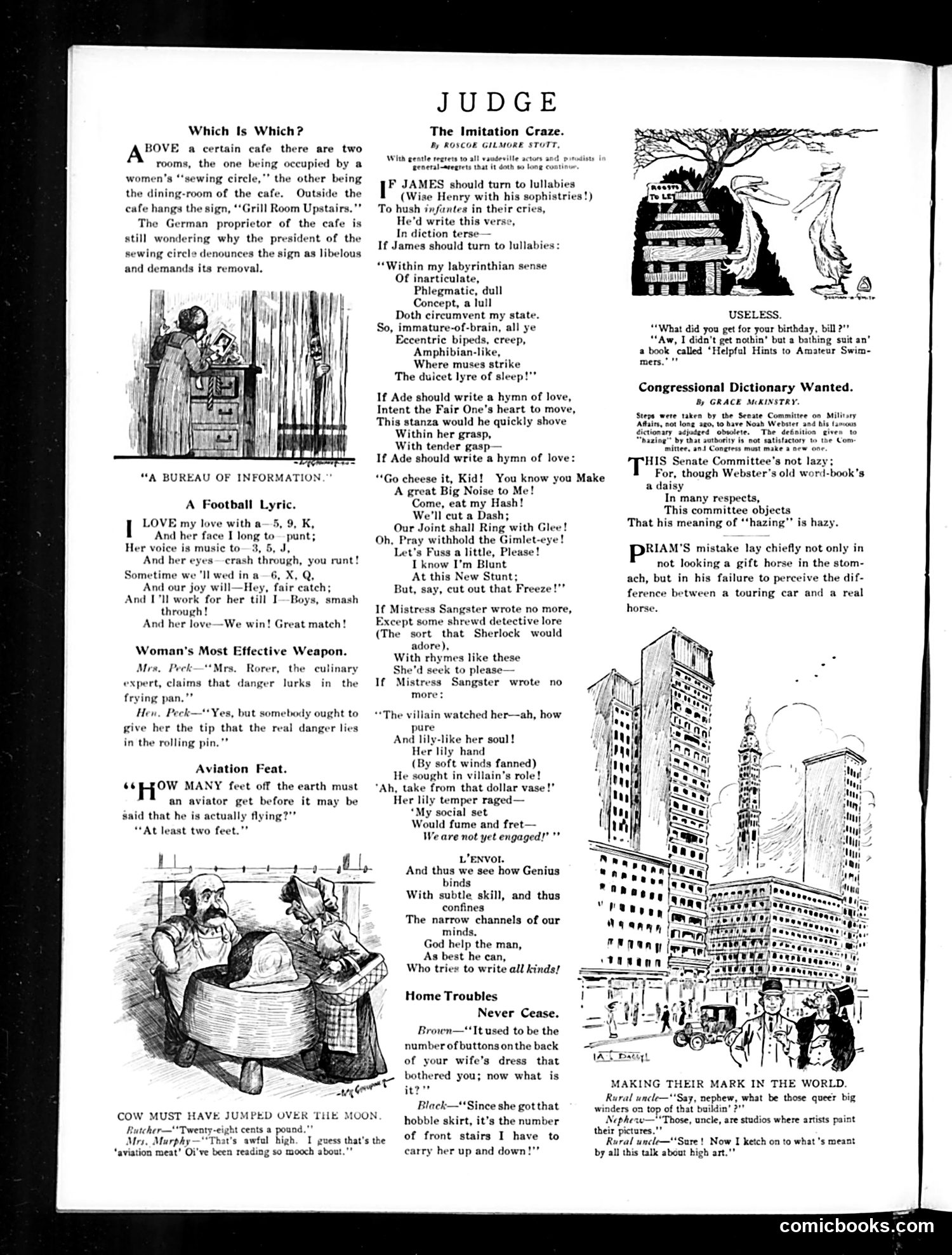
This page from the satirical magazine **Judge** contains multiple short humorous pieces mocking contemporary figures and trends: **"The Imitation Craze"** parodies literary figures of the era—likely including William James (philosopher), George Ade (humorist), and Margaret Sangster (writer)—by imitating how each would write a lullaby or love poem in their distinctive styles. The satire targets pretentious, affected writing and the fashion for imitating famous authors' mannerisms. **"Which Is Which?"** jokes about a café sign reading "Grill Room Upstairs" causing offense to a women's sewing circle president, who considers it libelous—suggesting the sign implies impropriety. The remaining pieces are light domestic humor: wives' dangerous rolling pins, aviators' definitions of flight, and marital complaints about dress buttons versus car troubles. **Overall context:** Judge was primarily political-satirical, but this page emphasizes cultural/literary satire and domestic comedy rather than partisan politics—typical filler content common to the era's magazines.
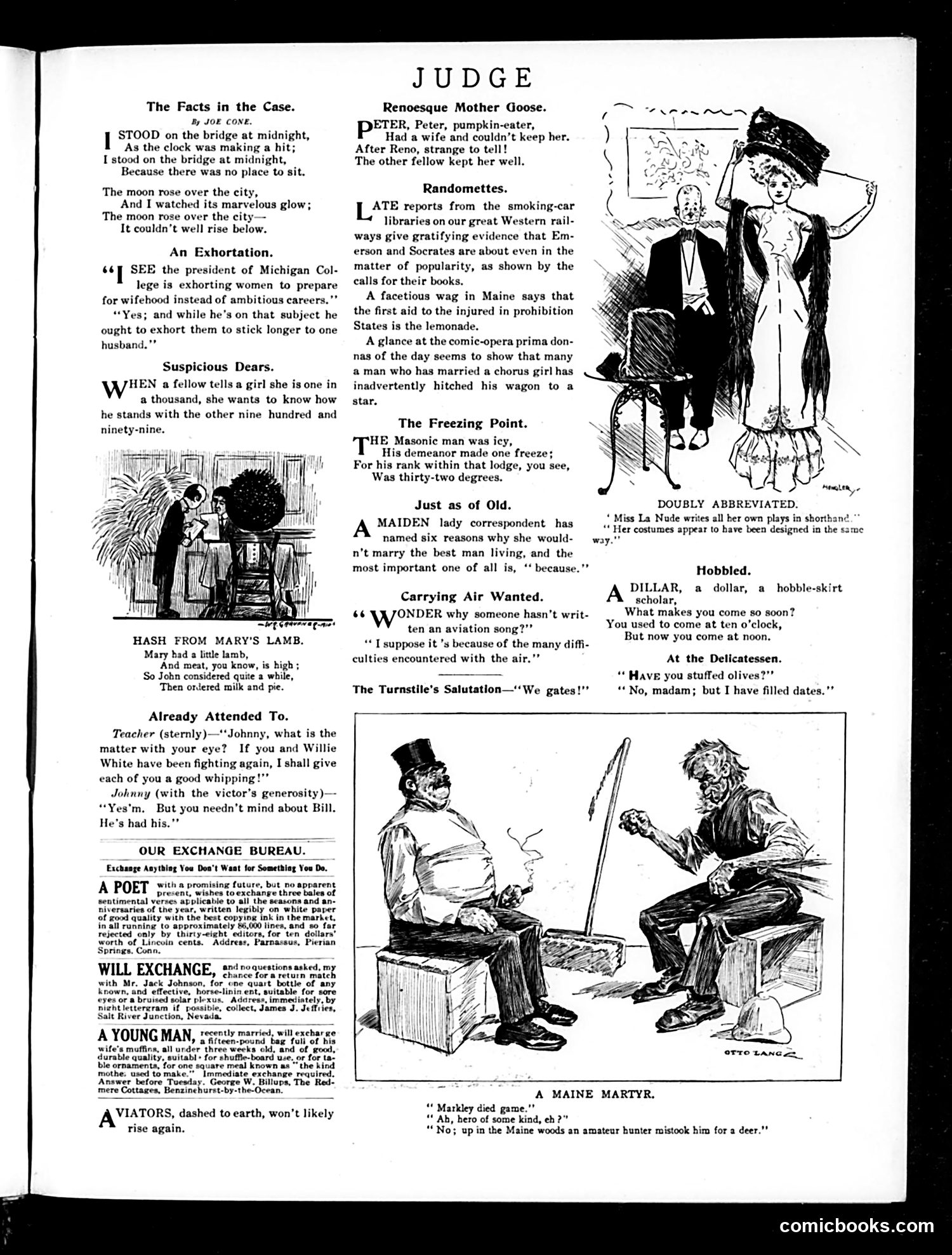
This page from *Judge* magazine contains brief satirical pieces and jokes reflecting early 20th-century American concerns: **Key Satire:** - **"Michigan College" piece**: Mocks a college president urging women toward domesticity rather than careers—the punchline implies women divorce frequently, so the advice is hypocritical. - **"Reno" reference**: References Nevada's Reno, famous for easy divorces. The "Mother Goose" parody jokes that divorce is now commonplace. - **Jeffries exchange**: References boxer James J. Jeffries, apparently beaten by Jack Johnson (likely the 1910 fight), requesting liniment for injuries—mocking his defeat. - **Prohibition jokes**: References "prohibition States" where alcohol was banned, joking that lemonade became the primary aid. - **Aviator joke**: Contemporary mockery of early aviation as inherently dangerous. The humor targets contemporary social anxieties: changing gender roles, easy divorce, boxing scandals, and new technologies. The "Exchange Bureau" adopts a classified-ad format for absurdist humor about modern problems.
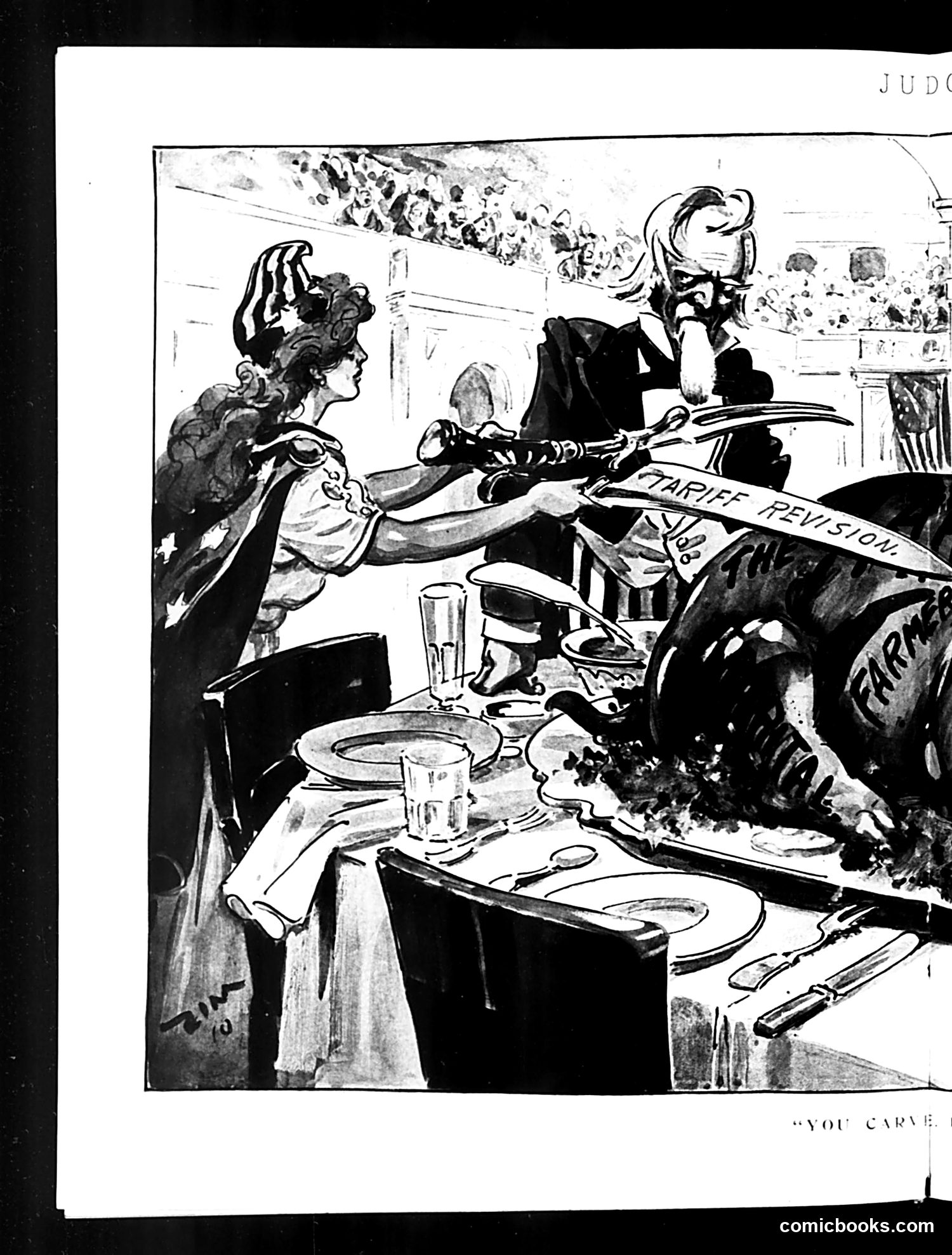
This Judge magazine cartoon depicts a formal dining scene with satirical commentary on tariff policy. A woman on the left (likely representing a political figure or personified concept) presents a carved bird labeled "TARIFF REVISION" to a man on the right. The phrase "YOU CARVE" suggests she's deferring the difficult decision-making to him. The cartoon appears to mock political procrastination or buck-passing regarding tariff revision—a major early 20th-century policy debate. The formal dinner setting with an attentive audience in the background emphasizes the public nature of the issue. The humor lies in the implication that someone is avoiding responsibility for making unpopular tariff decisions, instead leaving it to another party to "carve" up the controversial legislation.
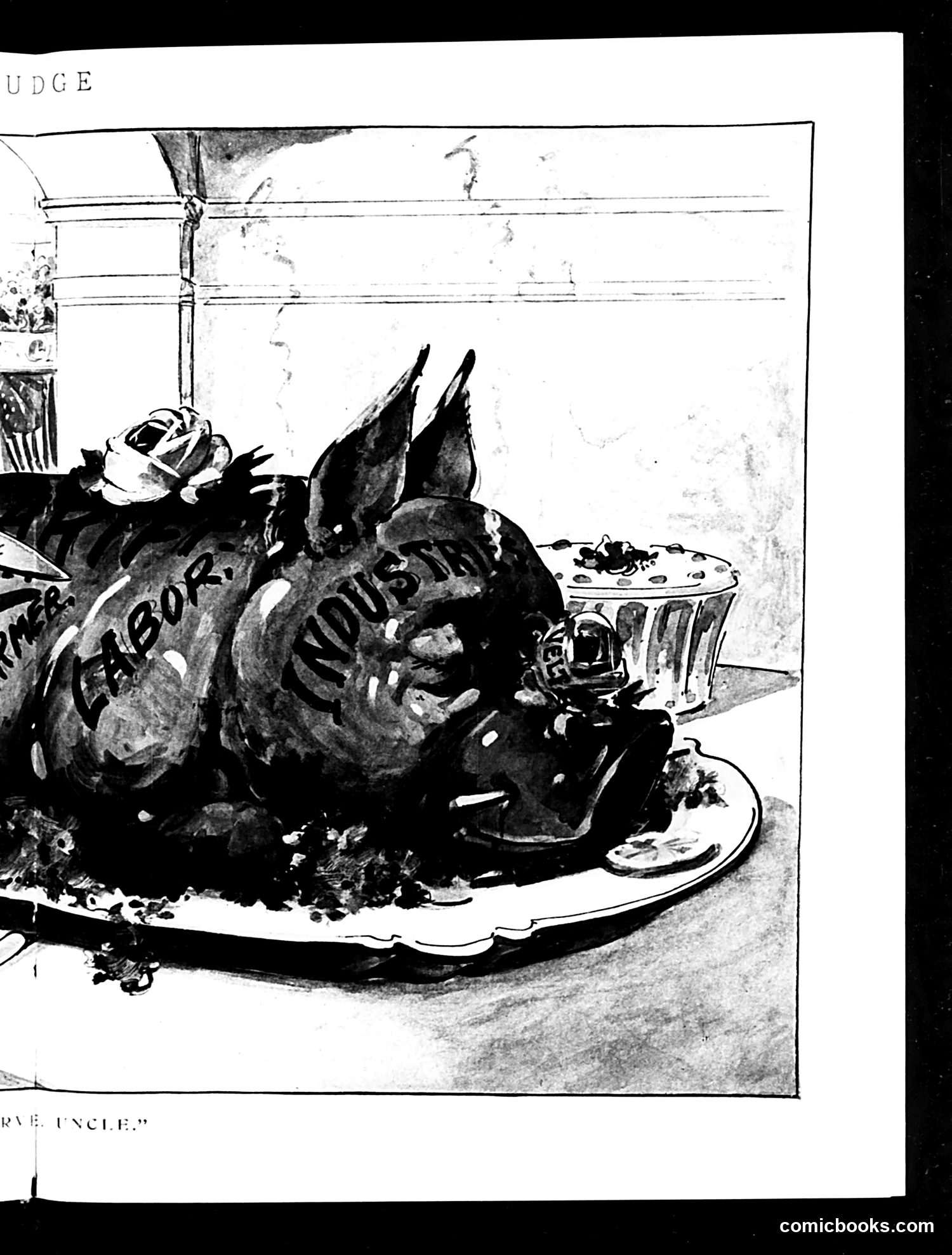
This appears to be a satirical food illustration from Judge magazine featuring a roasted bird (likely a turkey or game bird) as the centerpiece of a formal dinner plate. The bird is labeled "LABOR" and displays prominent wings, while "CAPITAL" appears written on its body. The cartoon likely satirizes labor-capital relations, a recurring theme in Gilded Age and Progressive Era satire. The bird represents labor being consumed or exploited by capital interests—a visual metaphor for economic inequality. The formal plating and dining context suggests this wealthy indulgence comes at labor's expense. Without a visible date or clearer text, the specific historical moment remains unclear, though the style and subject matter suggest late 19th or early 20th century American politics.
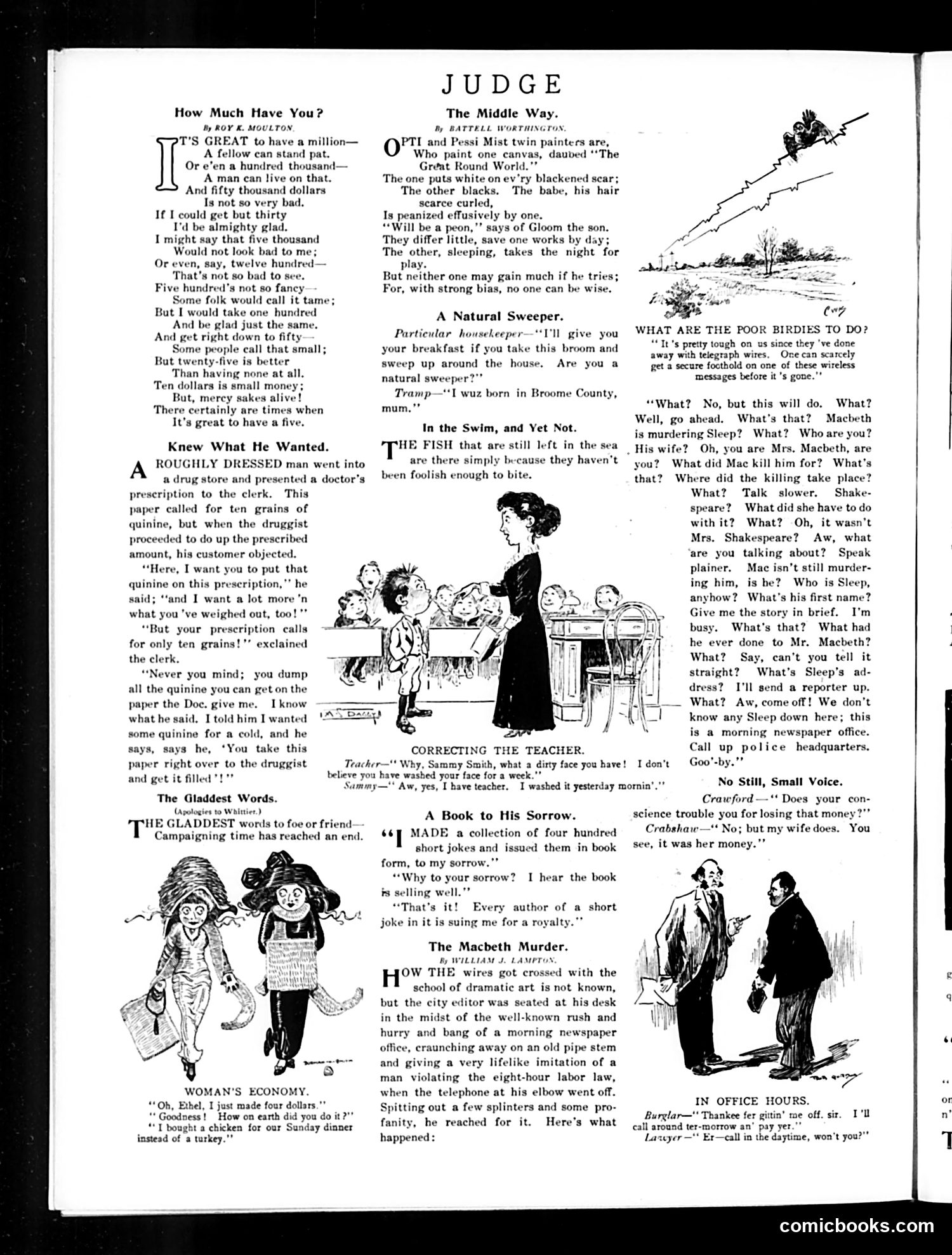
This page contains several satirical pieces typical of early 20th-century American humor: **"How Much Have You?"** mocks materialism by having a narrator progressively lower his financial aspirations—from a million dollars down to just five dollars—each time claiming satisfaction. The joke satirizes both greed and the rationalization of poverty. **"Knew What He Wanted"** ridicules a working-class customer who ignores a doctor's prescription dosage, demanding the druggist dump as much quinine as possible on the paper. It's class-based humor mocking the uneducated. **"Woman's Economy"** presents a housewife proudly claiming she "saved" money by buying chicken instead of turkey—missing that both cost money. The satire targets feminine financial ignorance. **"The Macbeth Murder"** appears to be a longer story about newspaper office chaos involving Shakespeare references, suggesting confusion between dramatic art and actual crime reporting. The cartoons use simple ink drawings accompanying light verse and comedic prose—typical Judge format mixing social observation with gentle ridicule of contemporary American life and character types.
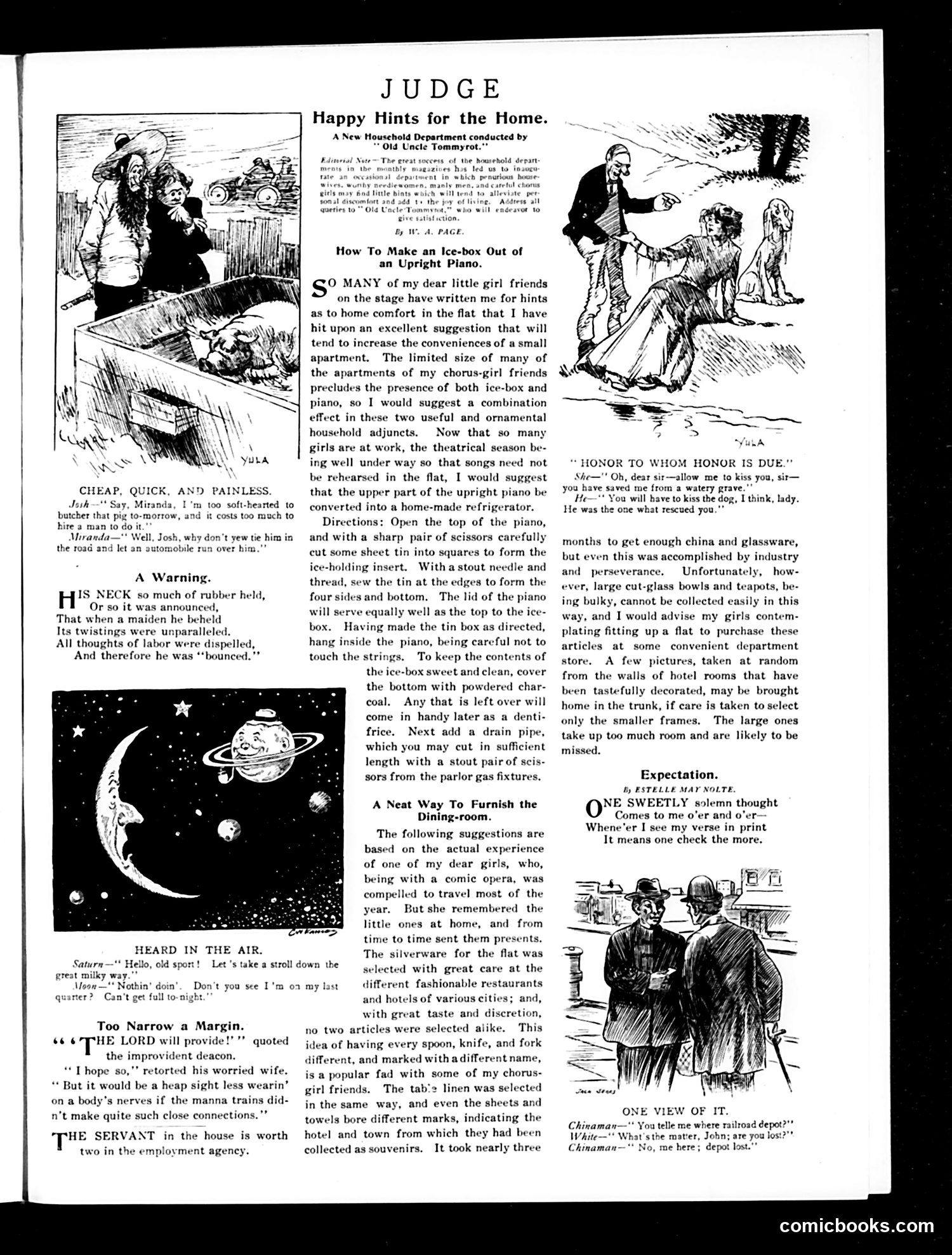
This page from the satirical magazine *Judge* contains several unrelated humor pieces targeting domestic life and social pretensions of the era. **"Cheap, Quick, and Painless"** mocks rural folk through a dialogue about disposing of a pig—Miranda's suggestion that Josh use an automobile instead of butchering reveals rural unfamiliarity with modern technology, treated as comic naïveté. **"A Warning"** satirizes workplace behavior, where a man's rubber neck (literal flexibility or metaphorical gullibility) causes distraction and job loss—possibly commentary on easily distracted workers. **"Too Narrow a Margin"** jokes about relying on divine providence while complaining about inconvenient train schedules—mocking religious faith's impracticality. **"Happy Hints"** parodies home advice columns by proposing absurd solutions: converting a piano into an ice-box, and furnishing a dining room with stolen silverware from various hotels. The "chorus-girl" references suggest satirizing theatrical workers' modest means and questionable ethics. The overall tone ridicules working-class and lower-middle-class domestic struggles through exaggeration and absurdist suggestions.
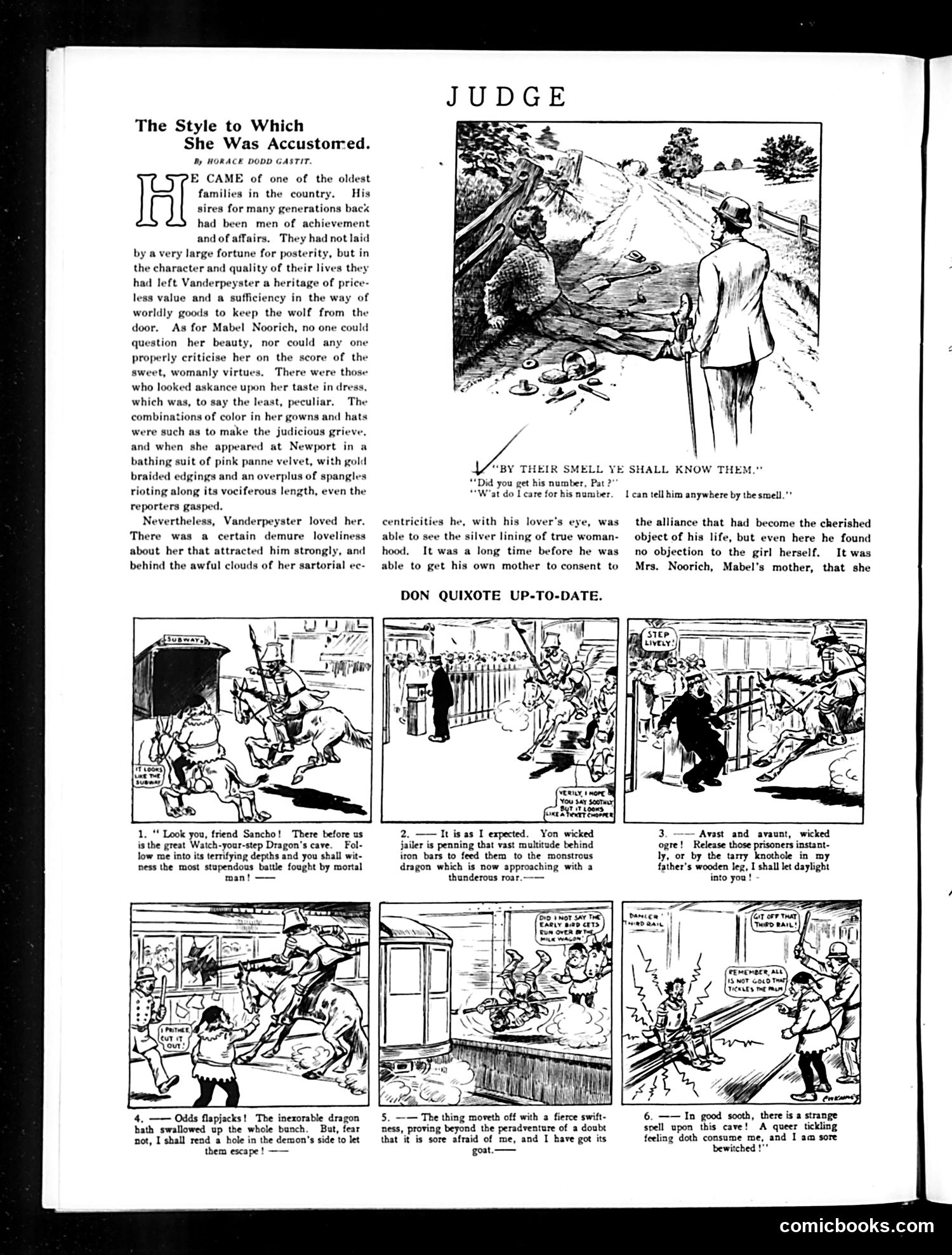
This Judge page contains two distinct satirical pieces: **"The Style to Which She Was Accustomed"** (top) satirizes wealthy American society's class anxieties. It contrasts an old-money family (Vanderpeyster—suggesting Dutch aristocracy) with a nouveau-riche woman (Mabel Noorich—name obviously mocking "new rich"). The joke targets the gaudy fashion choices of newly wealthy Americans: her pink velvet bathing suit with gold braid and spangles at Newport scandalized even jaded reporters. The satire mocks both the pretensions of the newly rich and the snobbery of established families who view such ostentation as vulgar. **"Don Quixote Up-to-Date"** (bottom comics) is a comedic parody updating Cervantes' classic tale to modern urban settings—replacing windmills and giants with actual city problems: dragons become subway stations, and Sancho and Don Quixote encounter crowded transit, petty criminals, and literal cave-like spaces. The humor lies in applying quixotic idealism to mundane modern urban life.
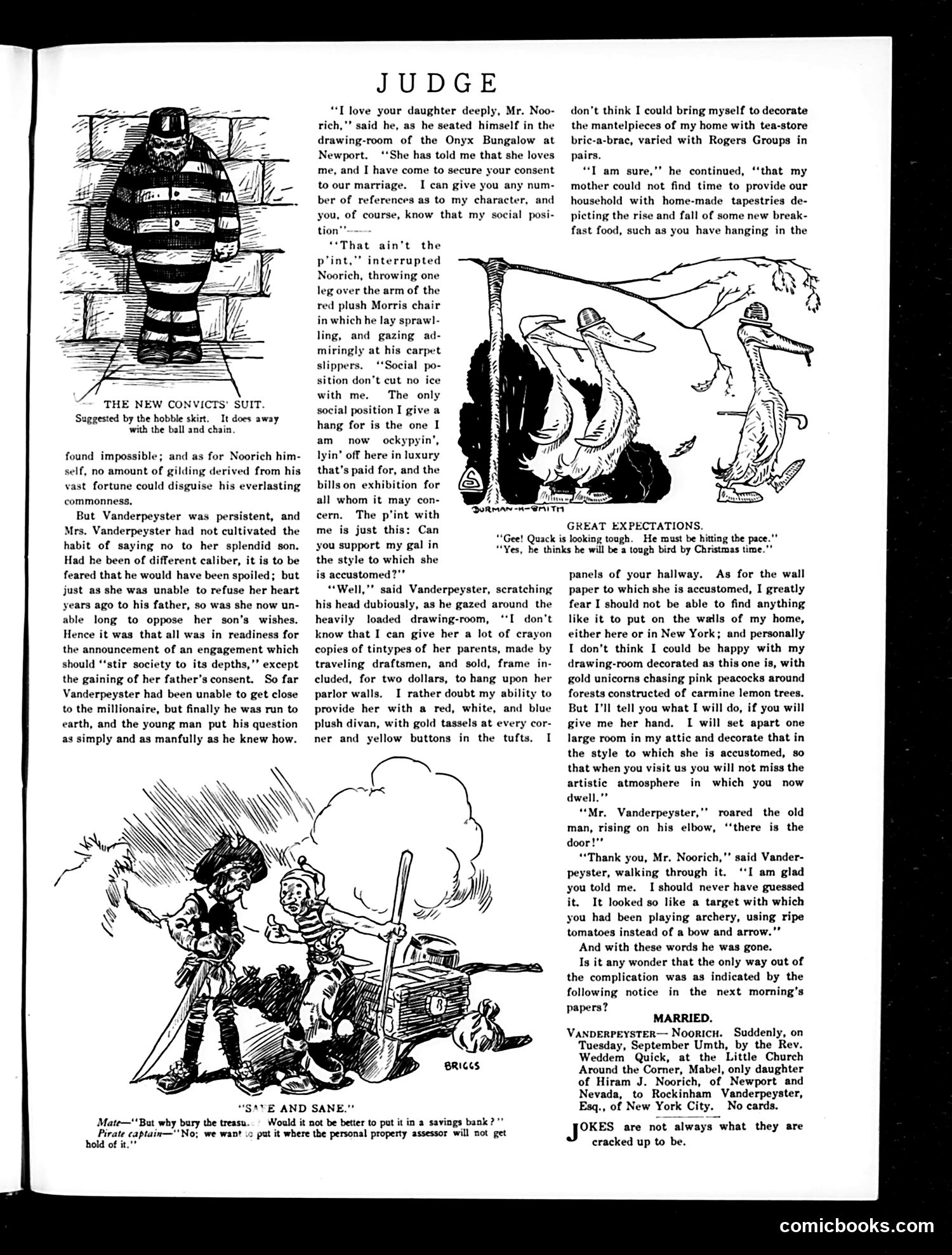
This page satirizes the clash between old-money aristocracy and new-money vulgarity in Gilded Age America. **The Main Story:** Young Rockingham Vanderpeyster seeks to marry Mabel Noorich, daughter of a wealthy but culturally crude millionaire. When Vanderpeyster asks for her hand, Noorich—lounging in undignified comfort—dismisses social position as irrelevant. Instead, he boasts about his tacky possessions: crayon portraits, garish plush furniture with gold tassels, homemade tapestries advertising breakfast foods, and pink peacocks on wallpaper. **The Satire:** Vanderpeyster's polite response reveals the absurdity of Noorich's "taste." The joke is that nouveau riche industrialists like Noorich displayed wealth through *quantity and garishness* rather than refinement. Vanderpeyster's offer to decorate one attic room in Noorich's style—implying it's fit only for storage—is cutting social commentary. **Top Cartoon:** "The New Convicts' Suit" mocks the hobble skirt's restrictive design by comparing it to prison garb.
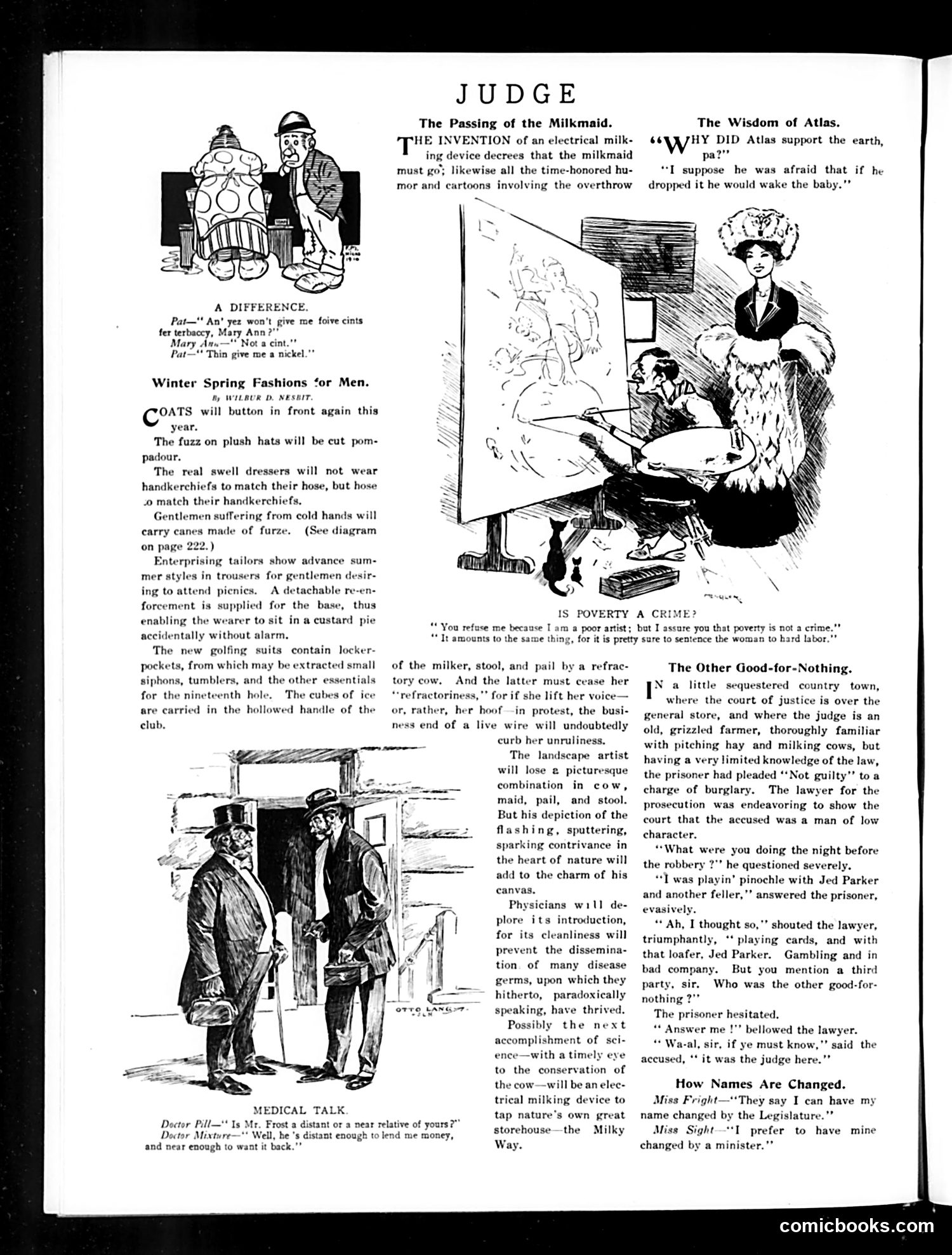
This page contains several satirical pieces typical of Judge magazine's humor: **"A Difference"** (top left): A joke about an Irish immigrant (Pat) and a woman (Mary Ann) haggling over tobacco money—the humor relies on ethnic stereotype wordplay about five cents versus a nickel. **"Winter Spring Fashions for Men"** (left column): Absurdist fashion commentary by Wilbur D. Nesbit mocking men's upcoming styles—exaggerated claims like "detachable re-enforcement for custard pie sitting" and golf clubs with hidden liquor compartments. **"The Passing of the Milkmaid"** (center): Commentary on electrical milking machines replacing traditional milkmaids, lamenting the loss of picturesque rural imagery and humor while acknowledging hygiene improvements. **"The Other Good-for-Nothing"** (right): A courtroom joke where a country judge, when asked about a third party present during a crime, is revealed to be the "good-for-nothing" in question—satirizing rural justice's informality. **"The Wisdom of Atlas"** and other brief jokes round out the page with typical period humor.
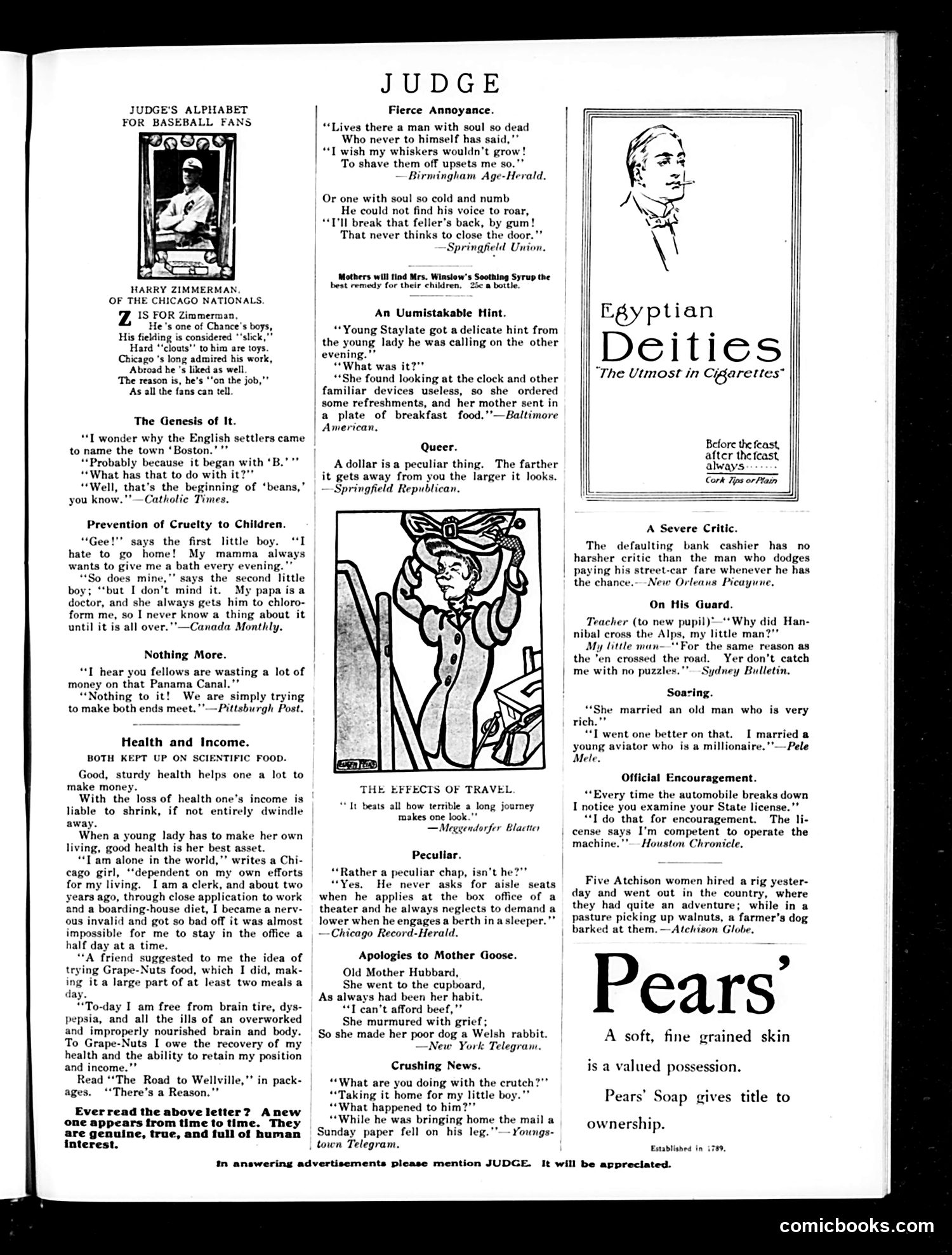
This page from *Judge* magazine contains mostly short humorous anecdotes and advertisements rather than political cartoons. The content includes: **Baseball reference**: Harry Zimmerman of the Chicago Nationals is featured in an "alphabet for baseball fans," praising his fielding and work ethic. **Social humor**: Multiple brief jokes target everyday annoyances—men frustrated about shaving and whiskers, young women hinting to overstaying suitors by serving breakfast food, and children avoiding baths. **Advertising**: Prominent ads for Mrs. Winslow's Soothing Syrup (a children's remedy), Egyptian Deities cigarettes, and Pears' Soap dominate the right column. **Grape-Nuts testimonial**: A lengthy advertorial features a Chicago clerk crediting the cereal with restoring her health and job performance. The page reflects early-20th-century middle-class concerns: health through diet, courtship conventions, and domestic life. The humor is gentle and domestic rather than political satire.
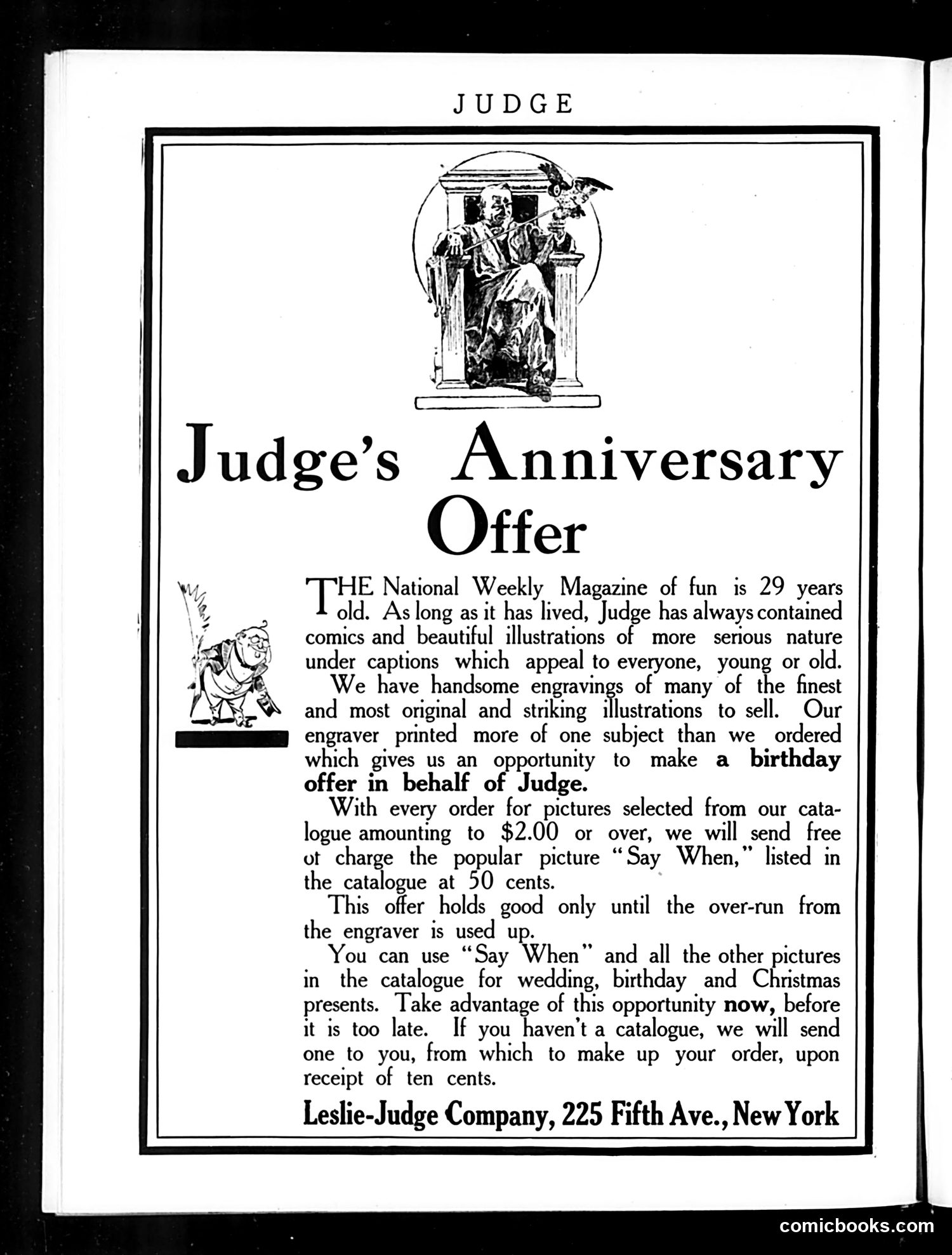
This is primarily **advertising content**, not satirical cartoons. It announces Judge magazine's 29th anniversary promotion (the magazine was founded around 1881). The page offers customers a free engraving titled "Say When" with purchases of $2.00 or more from their catalogue. The offer exists because the engraver produced surplus copies beyond what was ordered—a common business situation that Judge is leveraging as a marketing opportunity. The decorative header shows **Lady Justice** (blindfolded, holding scales and sword), a classical symbol reinforcing the magazine's name and gravitas. A smaller cartoon figure appears on the left margin but is partially cut off. The promotion emphasizes these engravings work for "wedding, birthday and Christmas presents," positioning Judge as a source for illustrated gift material. A catalogue costs ten cents. This reflects late-19th/early-20th-century print advertising and the era's thriving illustrated magazine industry.
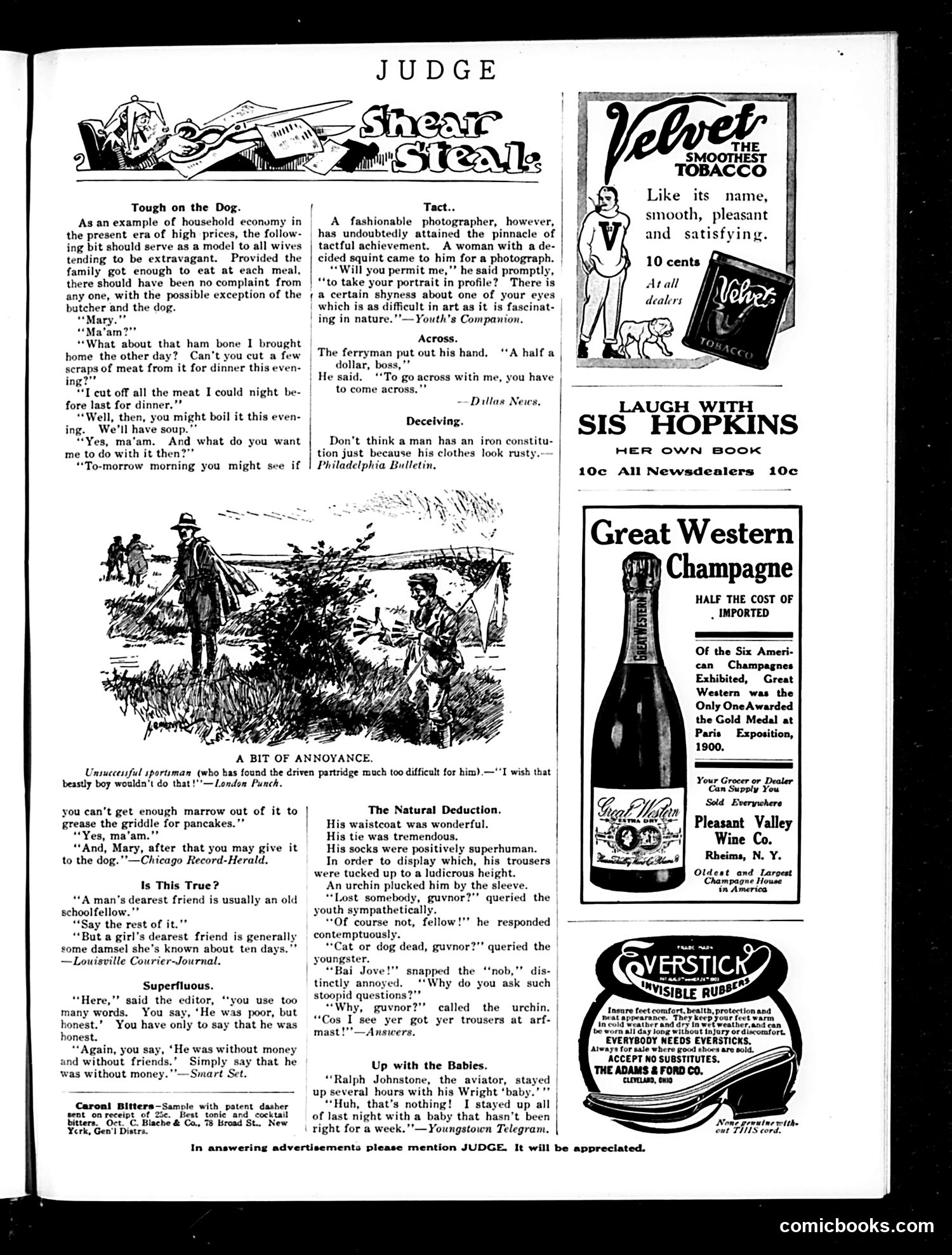
This page from Judge magazine contains multiple brief satirical pieces typical of early 20th-century American humor, plus period advertisements. **"Tough on the Dog"** satirizes household economy during high inflation—a wife's relentless reuse of a ham bone (boiled for soup, scraped for marrow to grease griddles) before finally giving the stripped bone to the dog. The joke mocks both wasteful "extravagant" wives and the irony that even the dog gets little. **"A Bit of Annoyance"** features a failed hunter blaming a boy for startling his prey—a mild complaint about incompetent hunting companions. **Other brief jokes** mock pretension ("The Natural Deduction"—a poorly-dressed man with absurdly fancy accessories) and wordplay about modern conveniences (comparing aircraft endurance to baby-sitting). The page is primarily **filler content**: short humor pieces and advertisements for Velvet tobacco, champagne, and patent medicines. No specific political figures or major events are referenced—this represents Judge's typical satirical commentary on everyday life, fashion, and social manners rather than political cartooning.
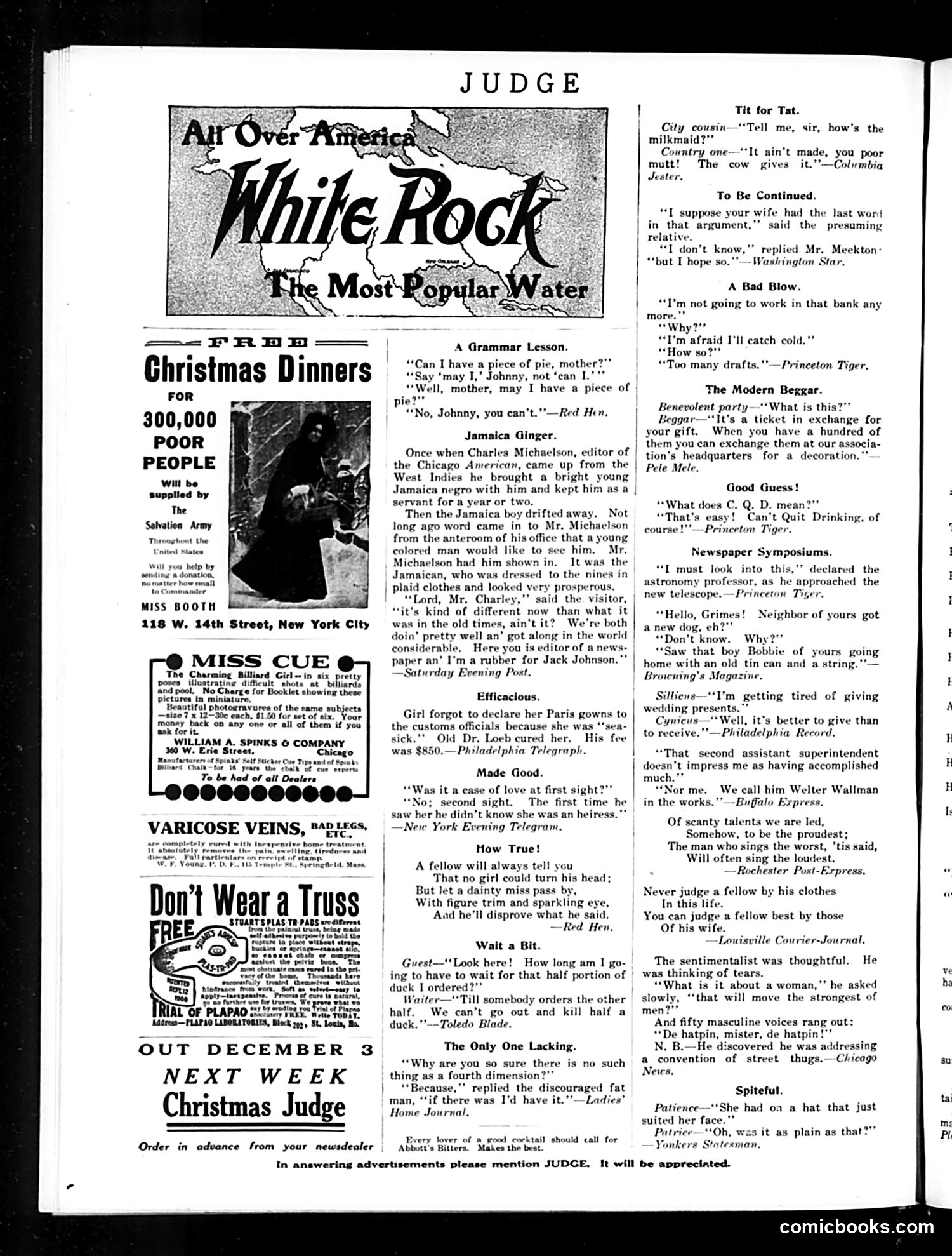
This page from **Judge** (a satirical American weekly) is primarily **advertisements and joke columns** rather than political cartoons. The main visual content is advertising: White Rock water (top), Christmas dinners for poor people by Miss Booth, a "Miss Cue" billiard girl photo offer, and medical/product ads (varicose veins treatment, truss). The text consists of short humorous anecdotes and one-liners typical of early 20th-century American humor magazines. Notable items include: - A story about Charles Michaelson (Chicago American editor) and a Jamaican servant who became Jack Johnson's "rubber" (masseur)—referencing the famous boxer - Various light jokes about relationships, customs, and social situations - Wordplay and puns common to the era **The satire is gentle and domestic** rather than political—poking fun at miscommunication, romance, and everyday absurdities. The Jack Johnson reference suggests this is from the 1910s era when Johnson was heavyweight champion and a controversial figure.
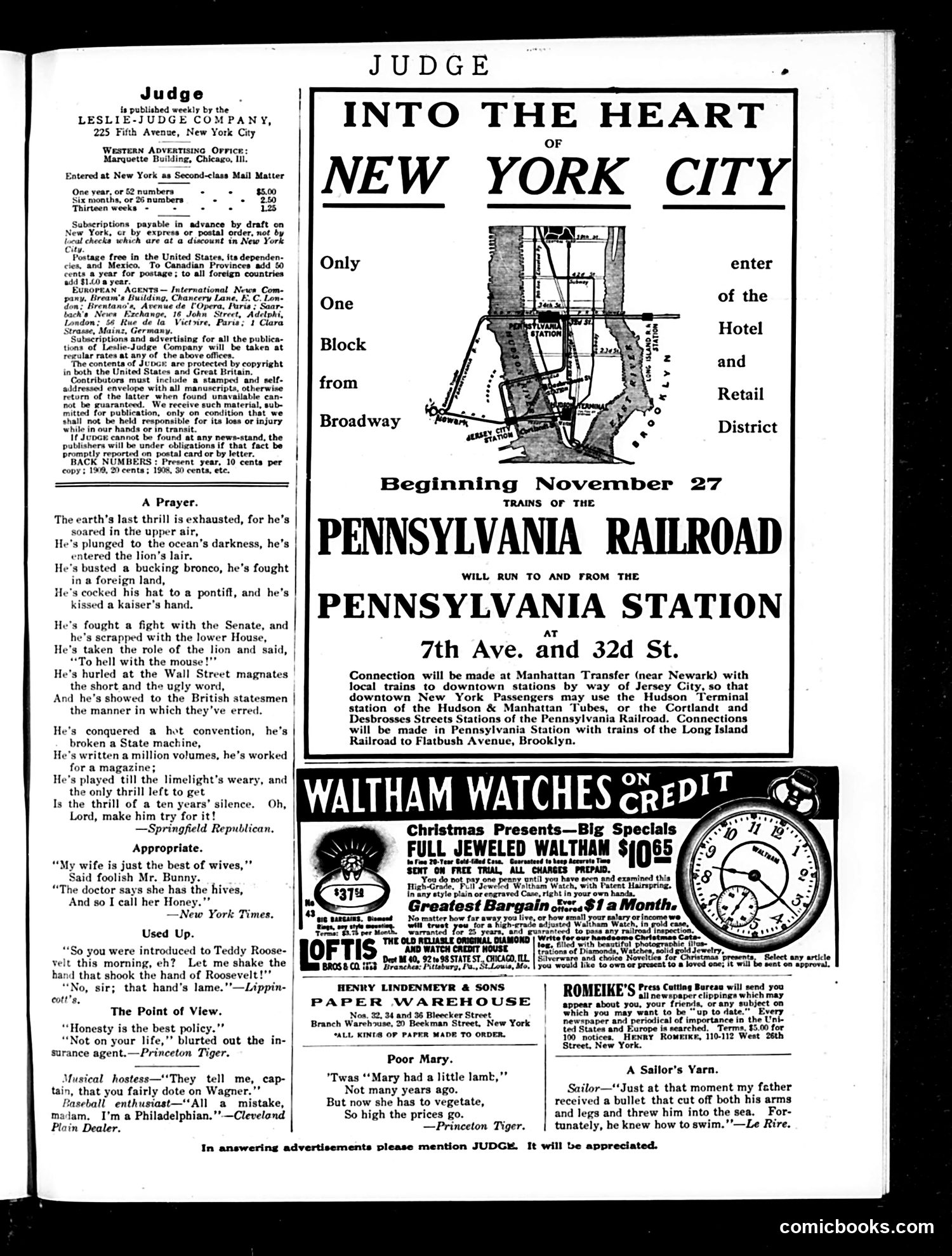
This page is primarily **advertising and masthead content** rather than editorial cartoons. The dominant feature is a large advertisement for the **Pennsylvania Railroad's new Pennsylvania Station** opening November 27 at 7th Avenue and 32nd Street in Manhattan—a major transportation infrastructure announcement for the era. The page includes several brief **humorous items and jokes** typical of Judge's satirical content: references to Theodore Roosevelt (a frequent target), commentary on Wall Street and political institutions, and lighthearted wordplay about marriage and hobbies. These are generic topical humor rather than specific political cartoons. Additional advertisements promote Waltham watches and other retail goods. The overall layout reflects Judge's business model: satirical commentary interspersed with commercial notices to support publication costs.
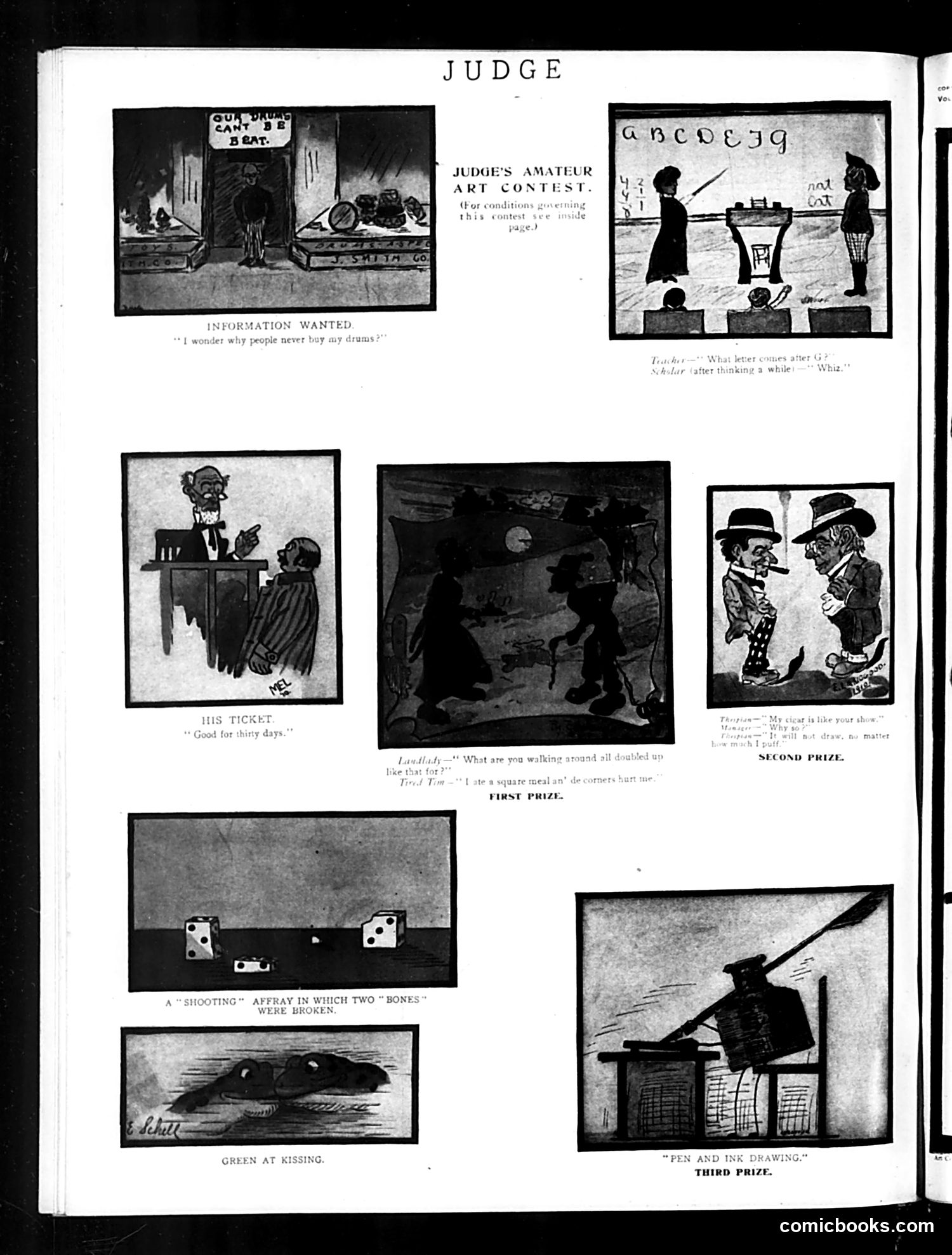
This page showcases winning entries from Judge magazine's amateur art competition. The contest invited readers to submit cartoons and drawings, with the results displayed here as "First Prize," "Second Prize," and "Third Prize" winners. The cartoons employ typical early-20th-century humor: visual gags about drinking ("I wonder why people never buy my drums"), judges and authority figures, and domestic comedy. One features two men in hats discussing appearance; another shows someone with a drawing pen and ink. The contest format was common in satirical magazines, allowing publications to crowdsource content while engaging readers. These amateur submissions demonstrate the accessible, participatory nature of Judge's humor—emphasizing comic situations and visual wordplay over topical satire.