
Judge, 1910-11-26 · page 9 of 24
Judge — November 26, 1910 — page 9: what you’re looking at
What you’re looking at
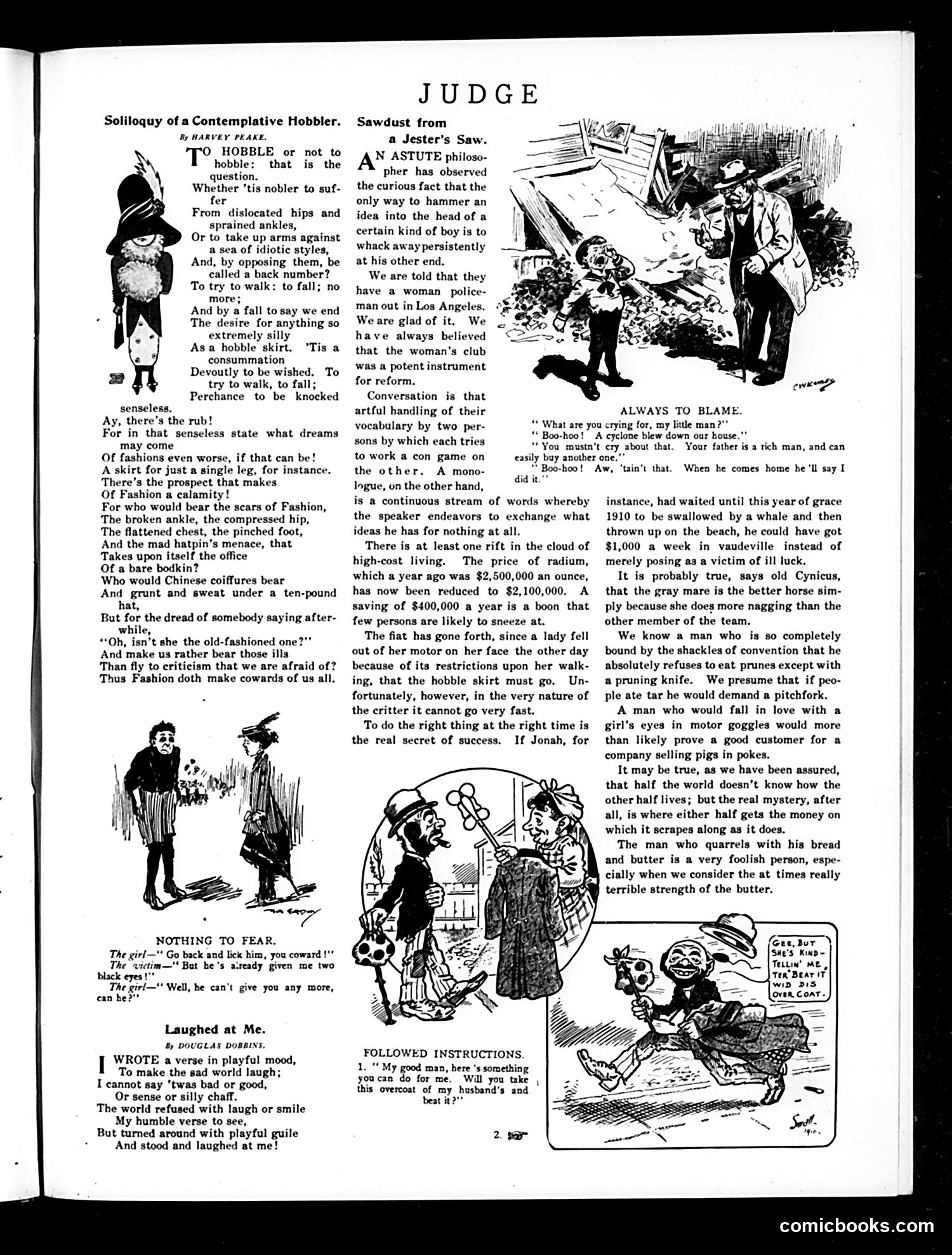
This page from Judge (an American satirical weekly) contains several distinct pieces satirizing early 1910s social issues: **"Soliloquy of a Contemplative Hobbler"** parodies Shakespeare's Hamlet, mocking women's fashion, specifically the "hobble skirt"—a restrictive garment that severely limited stride length. The satire suggests fashion enslaves women through social pressure ("the dread of somebody saying afterwards, 'Oh, isn't she the old-fashioned one?'"). **"Always to Blame"** depicts a child blamed by his father for a cyclone destroying their house—satirizing how fathers reflexively blame their sons regardless of circumstances. **The miscellaneous jokes** target various targets: a female Los Angeles police officer ("woman's club was a potent instrument for reform"), the high cost of living, and radium's price reduction. The cartoons illustrate these pieces with period-appropriate illustrations. The overall tone criticizes fashion conformity, gender dynamics, and domestic absurdity typical of Edwardian-era Judge humor.
📄 Transcribed text from this page (OCR, searchable)
Machine-transcribed from the original scan — historical spelling and the odd misread are preserved.
Soliloquy of a Contemplative Hobbler. By HARVEY PEAKE. ‘O HOBBLE or not to hobble: that is the question. Whether 'tis nobler to suf- fer From dislocated hips and sprained ankles, Or to take up arms against a sea of idiotic styles, And, by opposing them, be called a back number? To try to walk: to fall; no more; And by a fall to say we end The desire for anything so extremely silly Asa hobble skirt. consummation Devoutly to be wished. To try to walk, to fall; Perchance to be knocked ‘Tis a senseless. Ay, there’s the rub! For in that senseless state what dreams may come Of fashions even worse, if that can be! A skirt for just a single leg, for instance. There’s the prospect that makes Of Fashion a calamity! For who would bear the scars of Fashion, The broken ankle, the compressed hip, The flattened chest, the pinched foot, And the mad hatpin’s menace, that Takes upon itself the office Of a bare bodkin? Who would Chinese coiffures bear And grunt and sweat under a ten-pound hat, But for the dread of somebody saying after- while, “Oh, isn’t she the old-fashioned one?”’ And make us rather bear those ills Than fly to criticism that we are afraid of? Thus Fashion doth make cowards of us all. NOTHING TO FEAR. The girl—“' Go back and lick him, you coward !"* The victim—"* Bat he's aiready given me two black eyes !"* The girl—"' Well, he can't give you any more, can be?” Laughed at Me. by DOUGLAS DoBBINS. | WROTE a verse in playful mood, To make the sad world laugh; I cannot say ‘twas bad or good, Or sense or silly chaff. The world refused with laugh or smile My humble verse to see, But turned around with playful guile And stood and laughed at me! JUDGE Sawdust from a Jester's Saw. AN ASTUTE philoso- pher has observed the curious fact that the only way to hammer an idea into the head of a certain kind of boy is to whack away persistently at his other end. We are told that they have a woman police- man out in Los Angeles. We are glad of it. We have always believed that the woman's club was a potent instrument for reform. Conversation is that artful handling of their vocabulary by two per- sons by which each tries to work a con game on the other. A mono- logue, on the other hand, is a continuous stream of words whereby the speaker endeavors to exchange what ideas he has for nothing at all. There is at least one rift in the cloud of high-cost living. The price of radium, which a year ago was $2,500,000 an ounce, has now been reduced to $2,100,000. A saving of $400,000 a year is a boon that few persons are likely to sneeze at. The fiat has gone forth, since a lady fell out of her motor on her face the other day because of its restrictions upon her walk- ing, that the hobble skirt must go. Un- fortunately, however, in the very nature of the critter it cannot go very fast. To do the right thing at the right time is the real secret of success. If Jonah, for Boo-hoo! -hoo | did it.”’ FOLLOWED INSTRUCTIONS. 1, “My good man, here 's something youcan do for me. Will you take , this overcoat of my husband's and beat it?”” 2. ar “You mustn't cry about that. easily buy another one." ** Boo. ‘Aw, ‘tain’t that. ALWAYS TO BLAME. “* What are you crying for, my little man?” ‘A cyclone blew down our house."* Your father is a rich man, and can When he comes home he'll say I instance, had waited until this year of grace 1910 to be swallowed by a whale and then thrown up on the beach, he could have got $1,000 a week in vaudeville instead of merely posing as a victim of ill luck, It is probably true, says old Cynicus, that the gray mare is the better horse sim- ply because she does more nagging than the other member of the team. We know a man who is so completely bound by the shackles of convention that he absolutely refuses to eat prunes except with a pruning knife. We presume that if peo- ple ate tar he would demand a pitchfork. A man who would fall in love with a girl’s eyes in motor goggles would more than likely prove a good customer for a company selling pigs in pokes. It may be true, as we have been assured, that half the world doesn’t know how the other half lives; but the real mystery, after all, is where either half gets the money on which it scrapes along as it does. The man who quarrels with his bread and butter is a very foolish person, espe- cially when we consider the at times really terrible strength of the butter. Telun’ Me, Tex’ Bear iT wid DiS comicbooks.com