
Judge, 1910-11-26 · page 14 of 24
Judge — November 26, 1910 — page 14: what you’re looking at
What you’re looking at
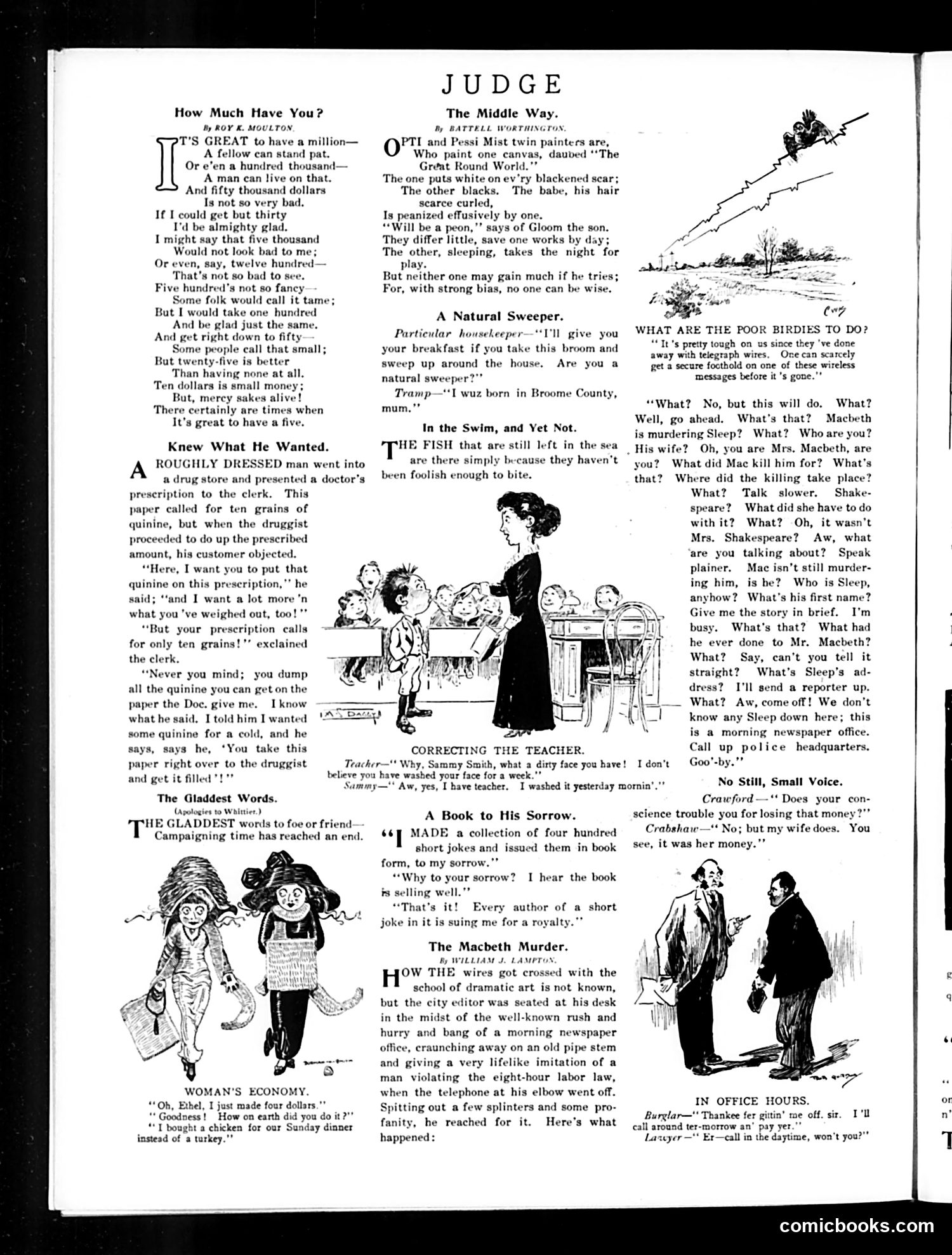
This page contains several satirical pieces typical of early 20th-century American humor: **"How Much Have You?"** mocks materialism by having a narrator progressively lower his financial aspirations—from a million dollars down to just five dollars—each time claiming satisfaction. The joke satirizes both greed and the rationalization of poverty. **"Knew What He Wanted"** ridicules a working-class customer who ignores a doctor's prescription dosage, demanding the druggist dump as much quinine as possible on the paper. It's class-based humor mocking the uneducated. **"Woman's Economy"** presents a housewife proudly claiming she "saved" money by buying chicken instead of turkey—missing that both cost money. The satire targets feminine financial ignorance. **"The Macbeth Murder"** appears to be a longer story about newspaper office chaos involving Shakespeare references, suggesting confusion between dramatic art and actual crime reporting. The cartoons use simple ink drawings accompanying light verse and comedic prose—typical Judge format mixing social observation with gentle ridicule of contemporary American life and character types.
📄 Transcribed text from this page (OCR, searchable)
Machine-transcribed from the original scan — historical spelling and the odd misread are preserved.
How Much Have You? by ROY K. MOULTON T’S GREAT to have a million— A fellow can stand pat. Or e’en a hundred thousand— A man can live on that. And fifty thousand dollars Is not so very bad. If I could get but thirty I'd be almighty glad. I might say that five thousand Would not look bad to me; Or even, say, twelve hundred— ‘That's not so bad to see. not so fancy ome folk would call it tame; But I would take one hundred And be glad just the same. And get right down to fifty: Some people call that small; But twenty-five is better Than having none at all. Ten dollars is small money But, mercy sakes alive ‘There certainly are times when It's great to have a f Knew What He Wanted. ROUGHLY DRESSED man went into a drug store and presented a doctor’s prescription to the clerk. This paper called for ten grains of quinine, but when the druggist proceeded to do up the prescribed amount, his customer objected. “Here, I want you to put that quinine on this prescription,’’ he said; ‘and I want a lot more 'n what you ‘ve weighed out, too!” “But your prescription calls for only ten grains! "” exclained the clerk. Never you mind; you dump all the quinine you can get on the paper the Doc. give me. [know what he said. I told him I wanted some quinine for a cold, and he says, says he, ‘You take this paper er to the druggist and get it fill The Gladdest Words. (Apologies to Whittier.) HE GLADDEST words to foe or friend Campaigning time has reached an end. WOMAN'S ECONOMY. “Oh, Ethel, I just made four dollars."” ** Goodness! How on earth did you do it ““T bought a chicken for our Sunday dinner instead of a turkey.”” Teacher—"* Why, Sammy Smith, what a eye believe you have washed your face for a week: Sammy—" Aw, yes, I have teacher. JUDGE The Middle Way. By BATTELL WORTHINGTON PTI and Pessi Mist twin painters are, Who paint one canvas, daubed ‘The Great Round World."’ The one puts white on ev'ry blackened sear; The other blacks. The babe, his hair scarce curled, Is peanized effusi “Will be a peon,’’ says of Gloom the son. They differ little, save one works by day; The other, sleeping, takes the night for play. But neither one may gain much if he tries; For, with strong bias, no one can be wise. ly by one. A Natural Sweeper. Particular housekeeper—“UN give you your breakfast if you take this broom and sweep up around the house. Are you a natural sweeper?” Tramp—'l wuz born in Broome County, mum.” In the Swim, and Yet Not. HE FISH that are still left in the s are there simply because they haven't been foolish enough to bite. CORRECTING THE TEACHER. A Book to His Sorrow. 66] MADE a collection of four hundred short jokes and issued them in book form, to my sorrow.” “Why to your sorrow? I hear the book is selling well." “That's it! Every author of a short joke in it is suing me for a ro. The Macbeth Murder. By WILLIAM J. LAMPTON OW THE wires got crossed with the school of dramatic art is not known, but the city editor was seated at his desk in the midst of the well-known rush and hurry and bang of a morning newspaper office, craunching away on an old pipe stem and giving a very lifelike imitation of a man violating the eight-hour labor law, when the telephone at his elbow went off. Spitting out a few splinters and some pro- fanity, he reached for it. Here’s what happened: dirty face you have! I don’t I washed it yesterday morni Eiggee ane Fs hd WHAT ARE THE POOR BIRDIES TO DO? “«Tt's pretty tough on us since they ‘ve done away with telegraph wires. One can scarcely get a secure focthold on one of these wireless messages before it ’s gone."" “What? No, but this will do, What? Well, go ahead, What's that? Macbeth is murdering Sleep? What? Who are you? . His wife? Oh, you are Mrs. Macbeth, are you? What did Mac kill him for? What's that? Where did the killing take place What?) Talk slower. Shake- speare? What did she have to do with it?) What? Oh, it wasn’t Mrs. Shakespeare? Aw, what ‘are you talking about? Speak plainer. Mac isn’t still murder- ing him, is he? Who is Sleep, anyhow? What's his first name? G me the story in brief. I'm bus What's that? What had he ever done to Mr. Macbeth? What?) Say, can’t you tell it straight? What's Sleep’s ad- dress? I'll send a reporter up. What? Aw, come off! We don’t know any Sleep down here; this is a morning newspaper office. Call up police headquarters. Goo'-by.”” ” No Still, Small Voice. Crawford — Does your con- science trouble you for losing that money?”” Crabshaw— No; but my wife does. You see, it was her money."’ 23 IN OFFICE HOURS. Burglar—" Thankee fer gittin’ me off. sir. I'l call around ter-morrow an’ pay yer.”” . Lawyer —"* Ex—call in the daytime, won't you?’ comicbooks.com