
A complete issue · 16 pages · 1910
Judge — October 1, 1910
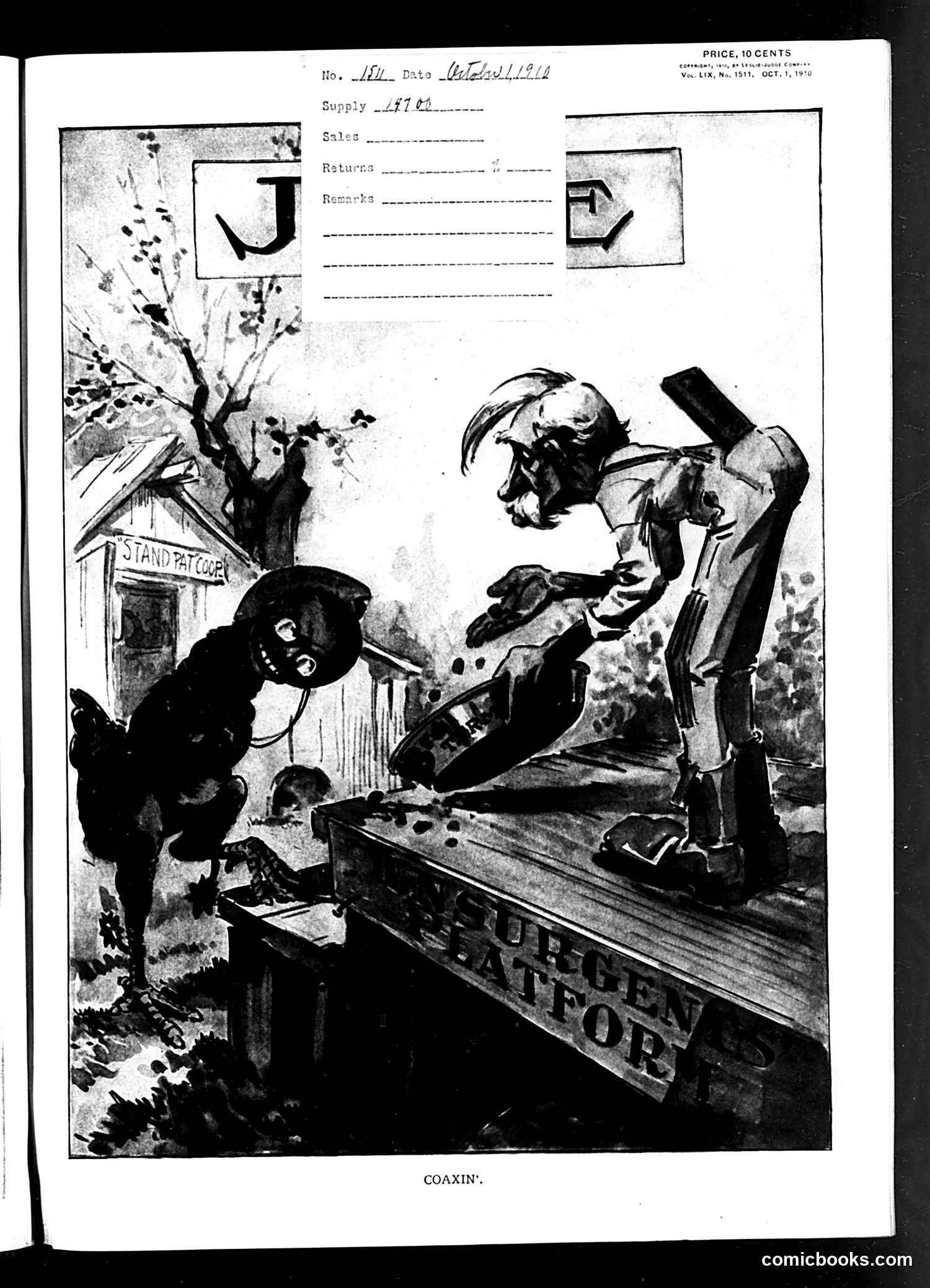
This cartoon depicts a man attempting to coax a reluctant Black child toward a coffin labeled "SOUTHERN COMFORT" while a small shack marked "STAND PAT CORPS" appears in the background. The image appears to be political satire from the early 1900s, likely critiquing either: 1. Southern racial violence or exploitation disguised as benign inducement 2. A political movement's deceptive recruitment tactics targeting vulnerable populations The "Stand Pat" reference suggests Republican Party politics (the conservative "stand pat" faction). The coffin represents danger masked as comfort, while the child's resistance emphasizes the threat to innocence. The satire warns readers that Southern institutions promise safety while delivering harm.
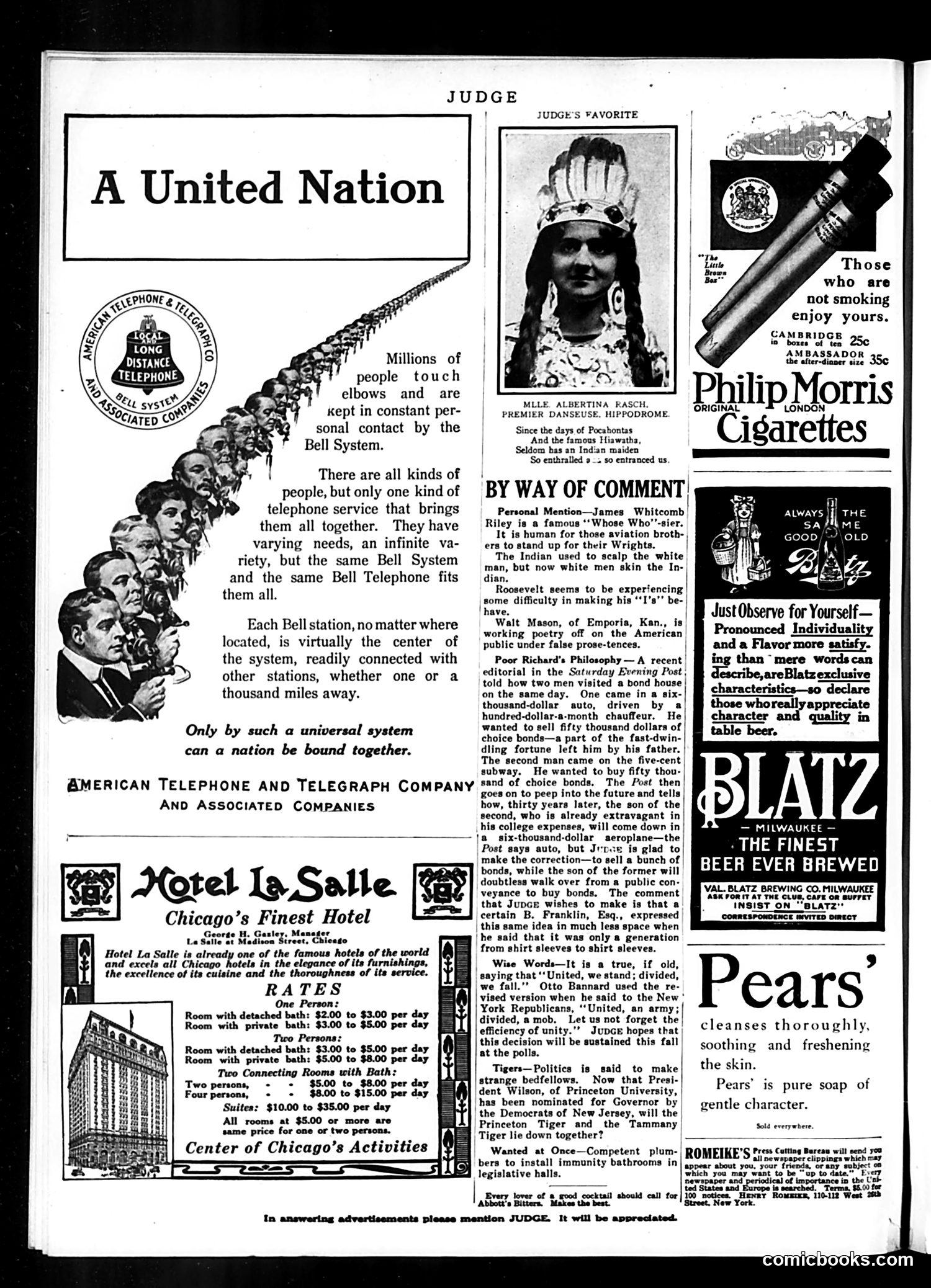
This Judge magazine page is primarily **advertising-heavy** rather than satirical content. The main elements include: **Central cartoon**: "A United Nation" depicts a human chain of diverse people connected via Bell Telephone System, promoting the idea that universal telephone infrastructure unites the nation. This is straightforward corporate messaging, not satire. **"By Way of Comment" section**: A gossipy column touching on various public figures—James Whitcomb Riley (writer), Roosevelt, Walt Mason (poet), and Poor Richard—discussing scandals and oddities. The tone is light social commentary rather than sharp political satire. **Advertisements** dominate: Hotel La Salle, Philip Morris cigarettes, Blatz beer, Pears' soap, and Romeike's clipping service. The page reflects early-1900s magazine format where advertising and genteel social gossip coexist, with minimal hard-hitting satire visible.
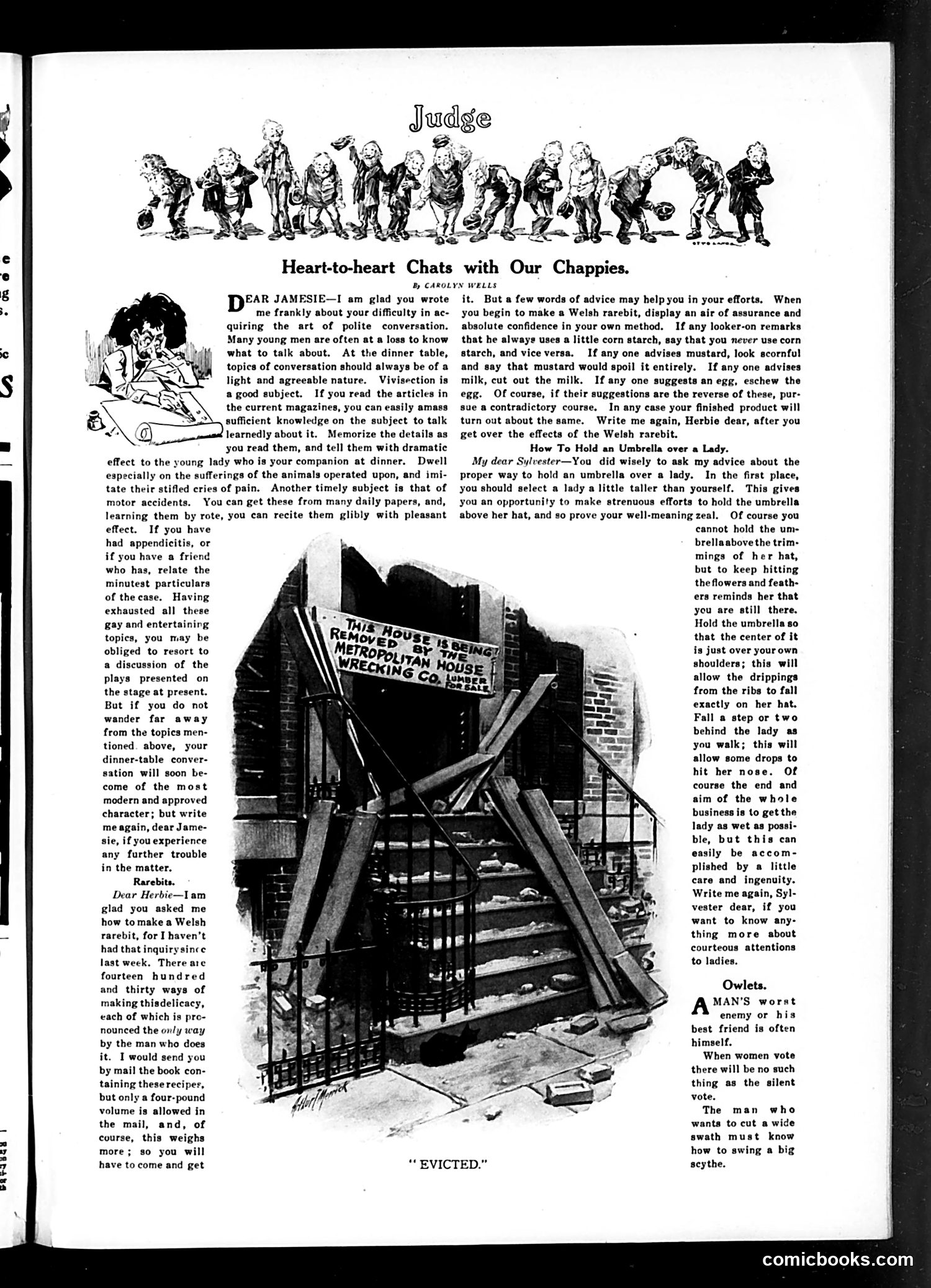
This page from Judge magazine contains advice columns ("Heart-to-heart Chats with Our Chappies") rather than political satire. The large central illustration labeled "EVICTED" depicts a house being demolished, showing eviction—a common social problem of the era. The advice columns address practical etiquette questions: how to hold an umbrella properly over a lady, how to make a Welsh rarebit dish, and brief observations on modern character ("Owlets"). The content reflects Judge's mixed format of humor, social commentary, and helpful guidance for readers. The eviction image likely serves as mild social satire about housing instability, but without accompanying editorial text, its specific satirical intent remains unclear. The page is primarily instructional rather than sharply political.
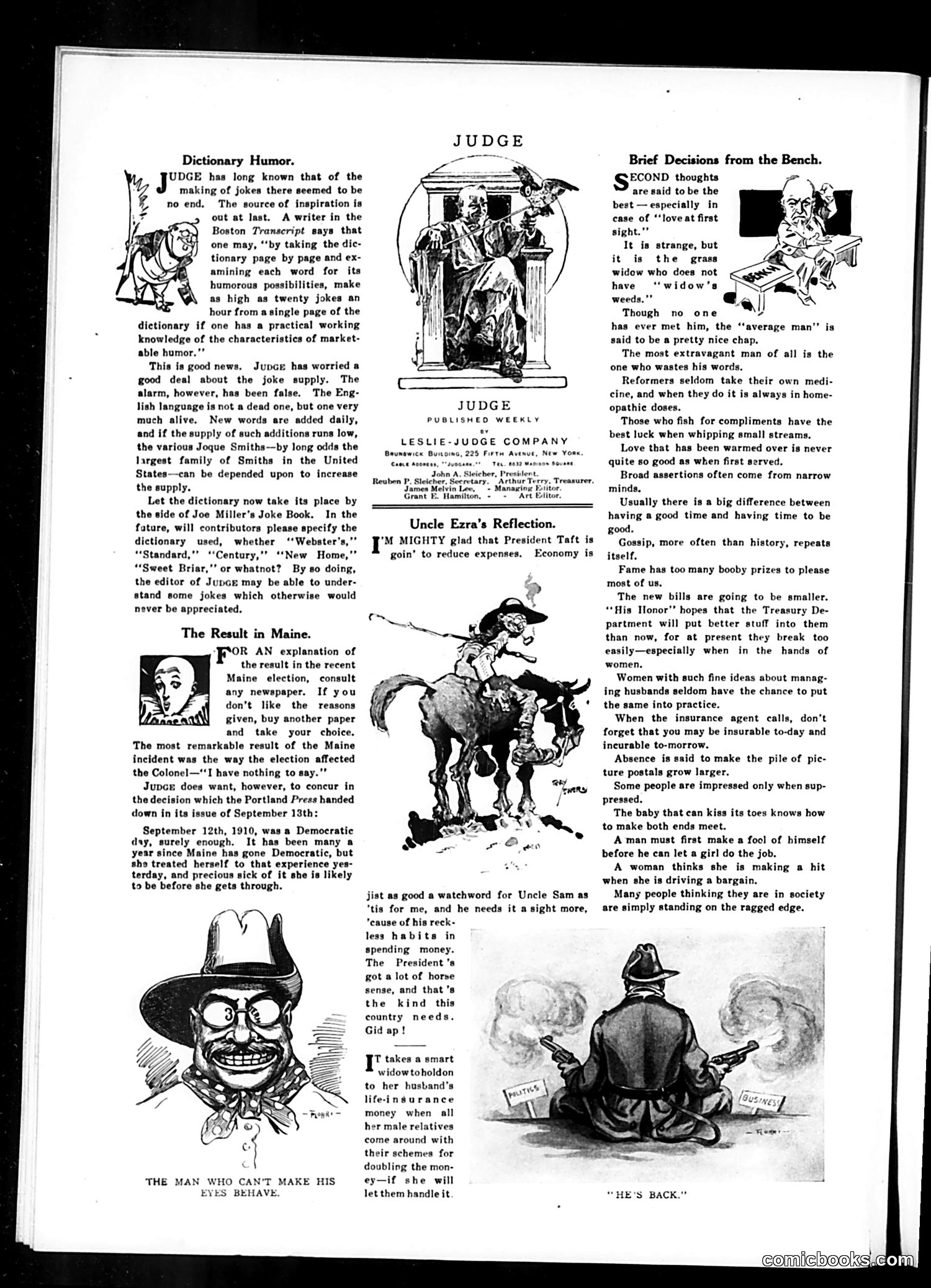
This page contains satirical commentary typical of Judge magazine's style. "Dictionary Humor" discusses how the publication mines comedic material from linguistic observations about human behavior and market characteristics. "The Result in Maine" references a recent Maine election, with an editorial note from September 10th, 1910. The cartoon shows caricatured figures, likely political candidates or election-related personalities, though specific identities aren't clearly labeled. "Uncle Ezra's Reflections" presents brief satirical observations on contemporary life—economics, women's roles, marriage, and social behavior. The crude illustrations accompany quips about President Taft's cost-cutting efforts and general social commentary. The final cartoon "He's Back" appears political but lacks sufficient context in the visible text to identify the specific figure or event with certainty. The page exemplifies Judge's blend of visual satire and short-form social commentary targeting turn-of-century American life.
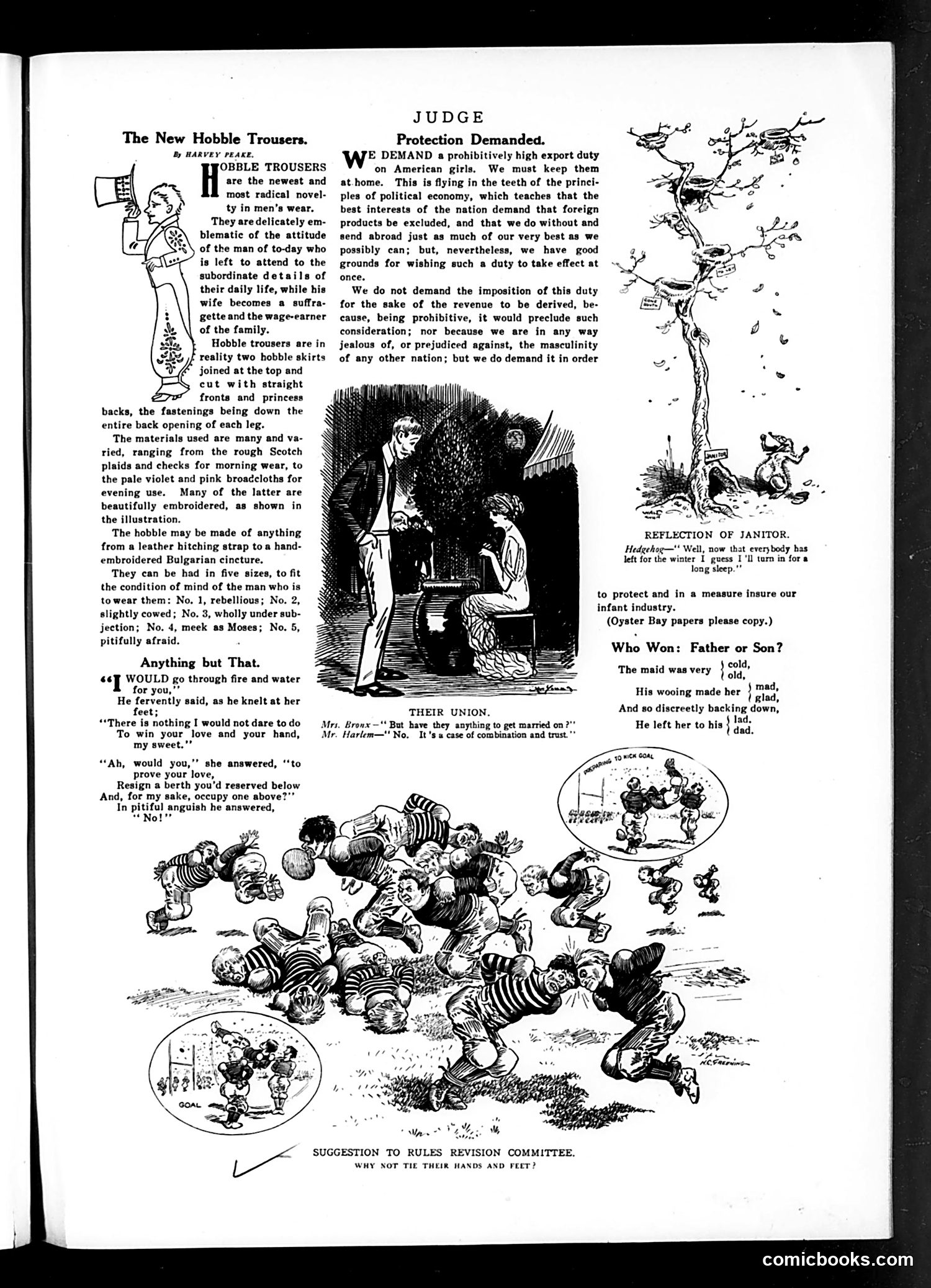
This page contains several distinct pieces: **"The New Hobble Trousers"** satirizes women's fashion, specifically the hobble skirt trend. The article mocks how these restrictive garments limit women's movement and freedom, describing materials from "rough Scotch plaids" to "pale violet and pink brocloths." The satire critiques how fashion constrains women's lives. **"Judge: Protection Demanded"** argues for protective tariffs on American goods, specifically girls' products, using nationalist economic rhetoric common to early 20th-century trade debates. **The remaining cartoons** appear to depict domestic scenes and children's games, though their specific satirical targets are unclear from this reproduction. The page reflects Judge's focus on social commentary through fashion critique and political economy.
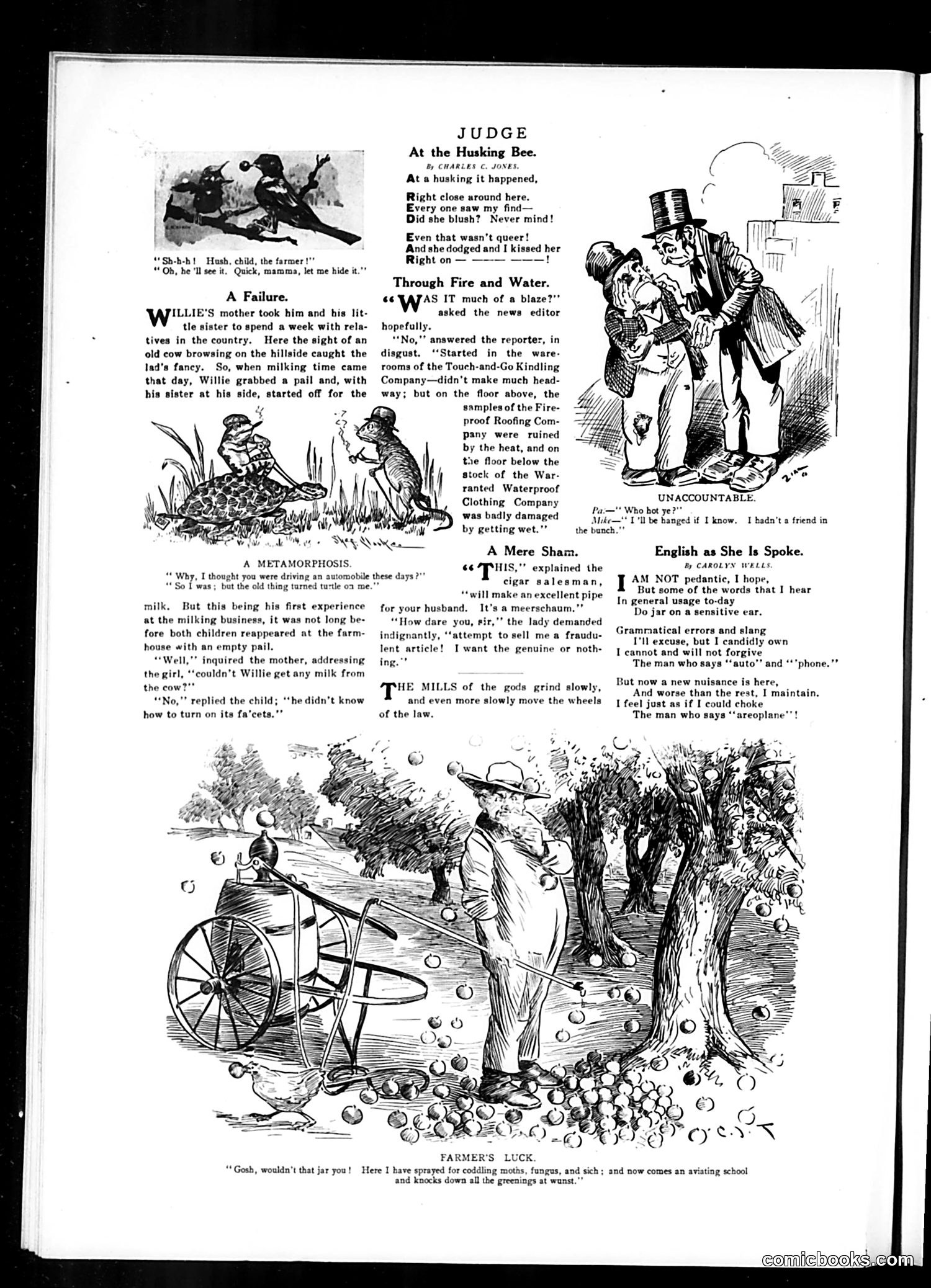
This page collects brief humorous stories and verses typical of Judge's satirical style: **"A Failure"** mocks children's naïveté—Willie doesn't understand cows have no faucets to turn on for milk, treating the animal like plumbing. **"A Metamorphosis"** jokes about the automobile craze: a driver who crashed his car (it "turned turtle") now drives an old automobile instead—no real progress. **"Through Fire and Water"** satirizes ironic corporate misfortune: a fire at a kindling company spreads minimally, but destroys samples of "fireproof roofing" above and "waterproof clothing" below—the specialized products fail their intended purposes. **"English as She Is Spoke"** critiques contemporary slang, particularly mocking the abbreviated terms "auto" and "phone" (from automobile and telephone) and "aeroplane," treating them as vulgar corruptions of proper language. **"Farmer's Luck"** depicts a farmer's spray damaging his own fruit crop instead of pests—situational irony presented humorously. These represent Judge's typical mix of observational humor about modern life and social pretension.
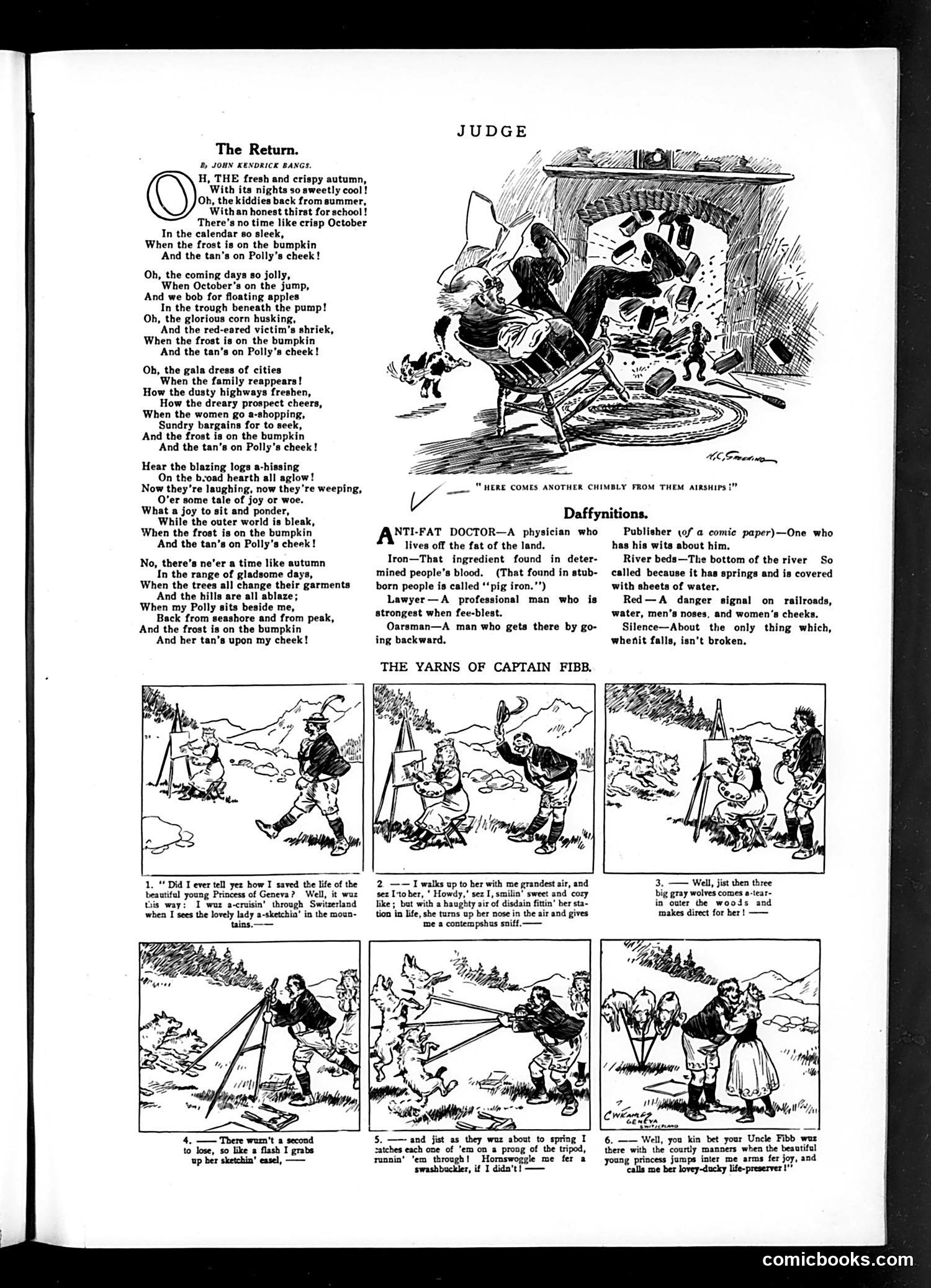
This page contains three distinct satirical elements typical of early 20th-century Judge magazine: **"The Return" Poem:** A sentimental verse celebrating autumn's return, emphasizing crisp weather, children back from summer, and family gatherings—likely mocking the era's romanticized nostalgia for rural/domestic life. **"Daffynitions":** Humorous mock-definitions satirizing contemporary figures and professions. The "Fat Doctor" and "Lawyer" entries mock doctors who profit excessively and lawyers' fee-dependency. "Red" satirizes danger signals and, pointedly, "women's cheeks"—mocking women's cosmetics use. "Silence" contains dark humor about noise pollution, possibly referencing airships (referenced in the cartoon caption above). **"Captain Fibb's Yarns":** A tall-tale comic strip mocking adventure fiction clichés—a braggart sailor rescuing a princess through implausibly convenient heroics, then winning her affection. The exaggerated narrative parodies both adventure literature and male vanity. The page exemplifies Judge's blend of sentimental satire, social commentary on gender/class, and absurdist humor.
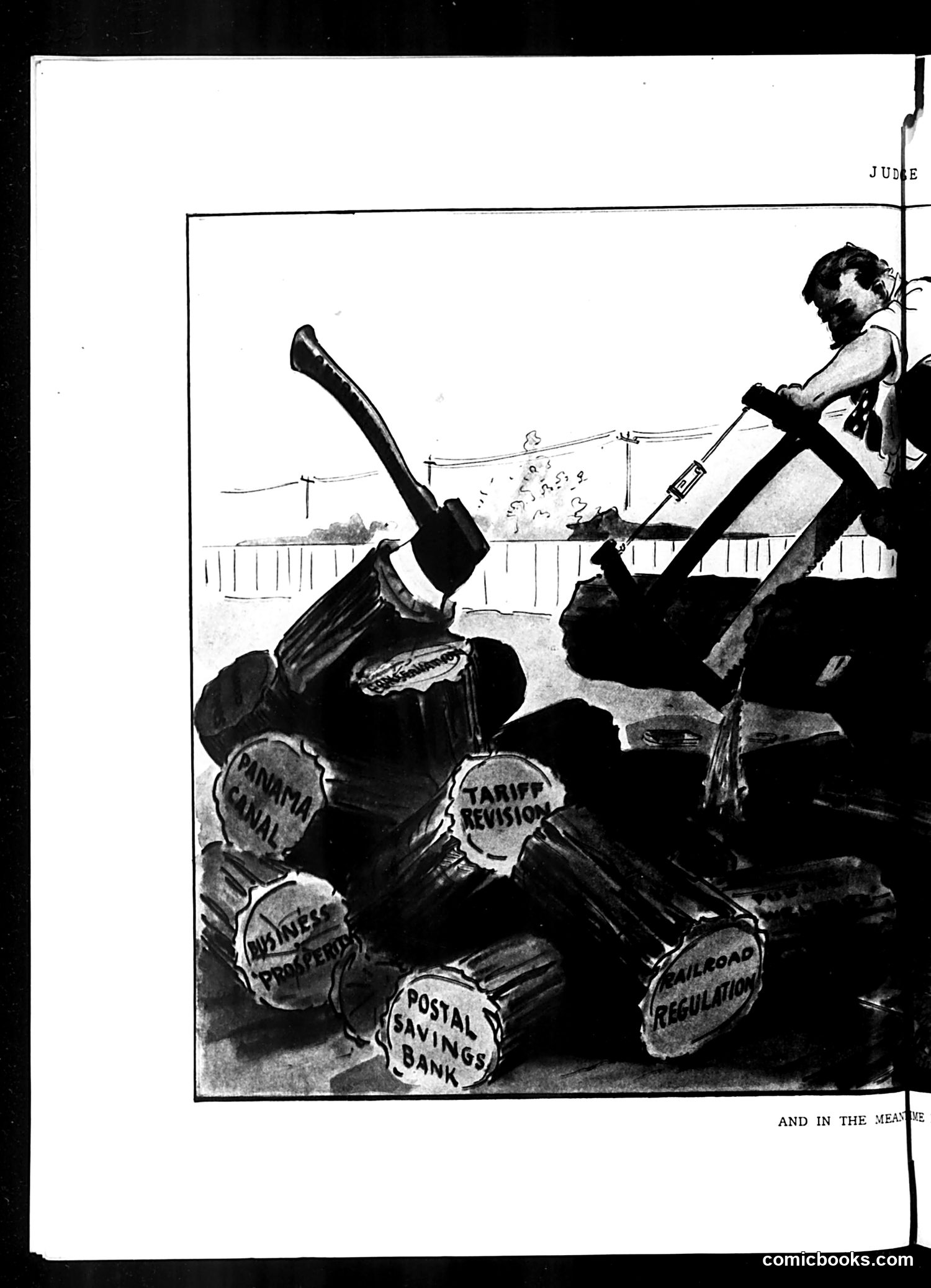
This Judge magazine cartoon depicts a figure wielding an axe labeled "JUDGE" against several barrels representing various government programs and regulations: "Tariff Revision," "Railroad Regulation," "Inland Waterways," and "Postal Savings Bank." The person appears to be a judicial or government authority dismantling progressive-era reforms. The satire criticizes the destruction of regulatory measures and social programs, likely from the early 1900s when these were contested political issues. The "Judge" publication was using its namesake as the weapon—a clever visual pun suggesting judicial authority was being used to eliminate protections and reforms. The cartoon represents opposition to the rollback of Progressive Era initiatives.
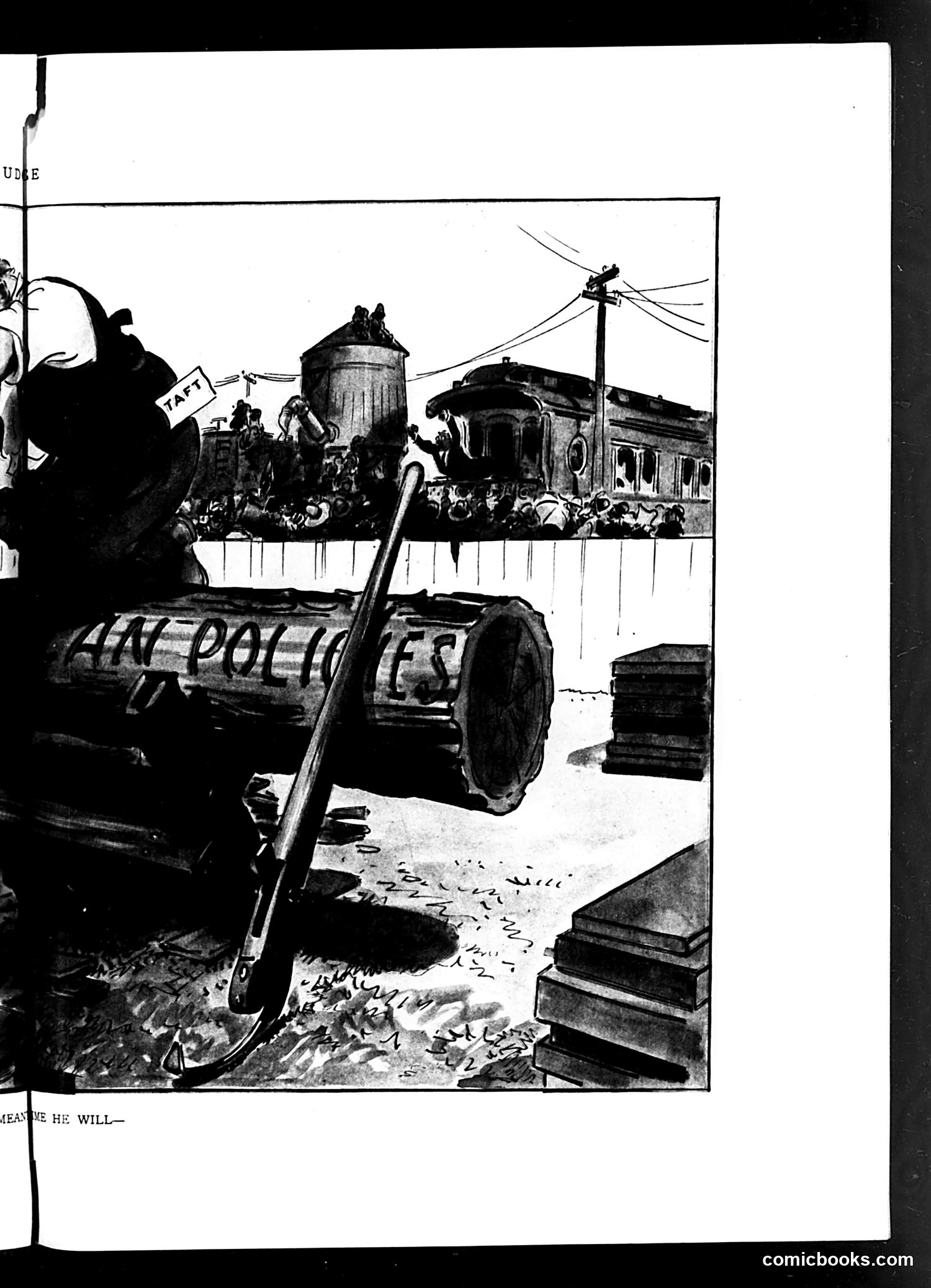
This Judge magazine cartoon depicts a large barrel labeled "AN POLICIES" (likely "TAFT POLICIES") being aimed like a cannon at a crowd of people behind a fence. A shovel leans against the barrel in the foreground. The satire appears to target President William Howard Taft's policies as weapons being deployed against the public or political opponents. The cannon barrel suggests aggressive implementation or bombardment with controversial measures. The crowd's reaction behind the barrier suggests either victims or observers of these policies. The partially visible caption "EAMBME HE WILL—" (likely "REMEMBER HE WILL—") implies consequences or a warning about these policies' effects. Without the complete text and publication date, the specific policy being criticized remains unclear, though it likely refers to a notable Taft administration controversy.
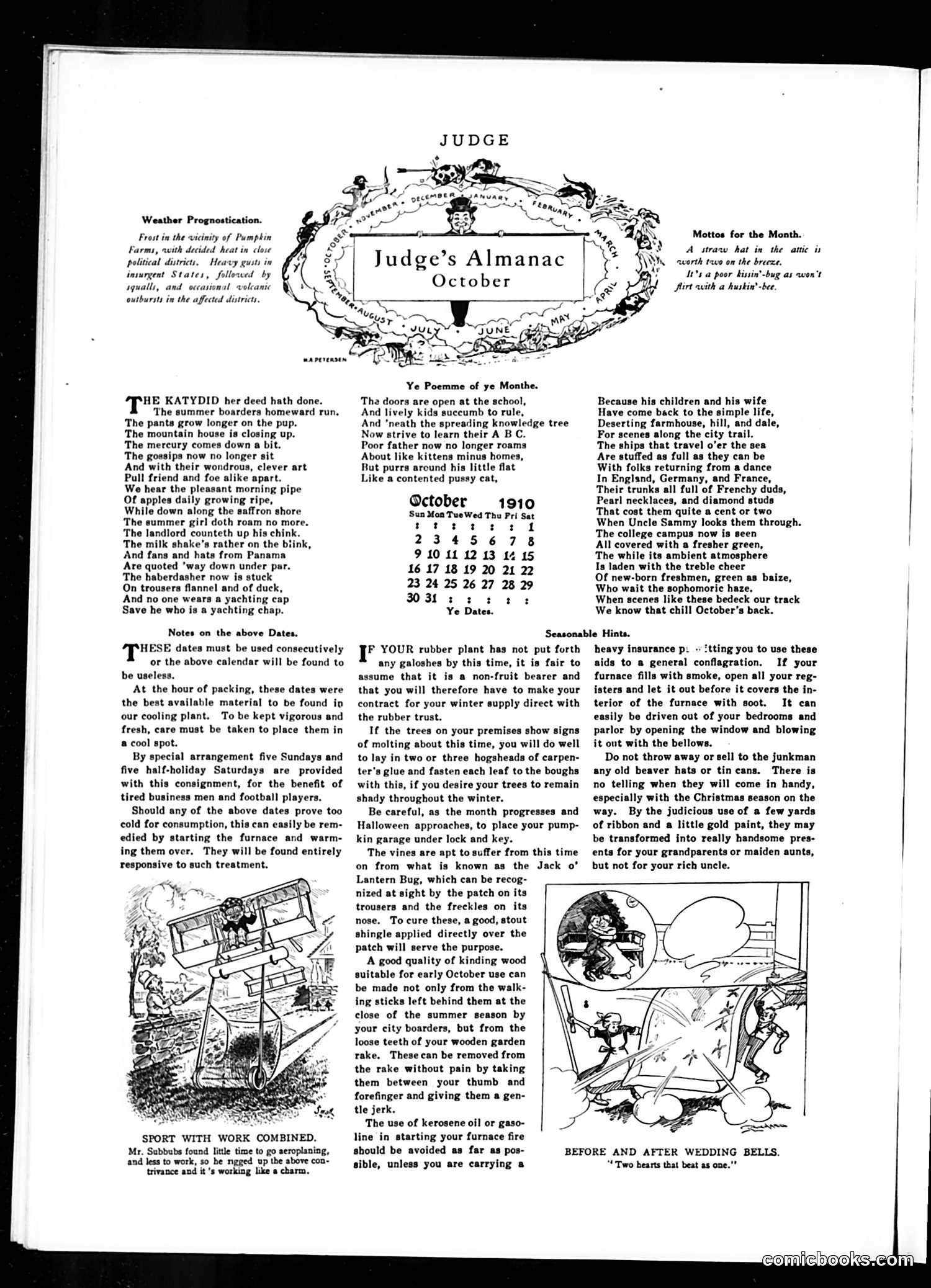
This page from Judge's October 1910 issue contains seasonal humor rather than sharp political satire. The content includes: **"Ye Poemme of ye Monthe"**: A whimsical poem celebrating autumn's arrival—summer boarders departing, fall fashions emerging, schoolchildren returning, and fathers contentedly "purring" at home like cats after their wives return from summer travels. **"Seasonable Hints"**: Tongue-in-cheek practical advice mocking current fads and concerns—rubber plants, Halloween pumpkins, the "Jack o' Lantern Bug," and furnace maintenance. **"Mottos for the Month"**: Lighthearted observations about returning vacationers and college life. **The cartoon "Sport with Work Combined"**: Shows a man who has rigged a contraption combining work and recreation—satirizing the era's obsession with efficiency and leisure combined. The "Weather Prognostication" header satirizes political divisions as natural phenomena ("volcanic outbursts in affected districts"), typical of Judge's political commentary tradition, though this particular page emphasizes gentle seasonal humor over sharp political critique.
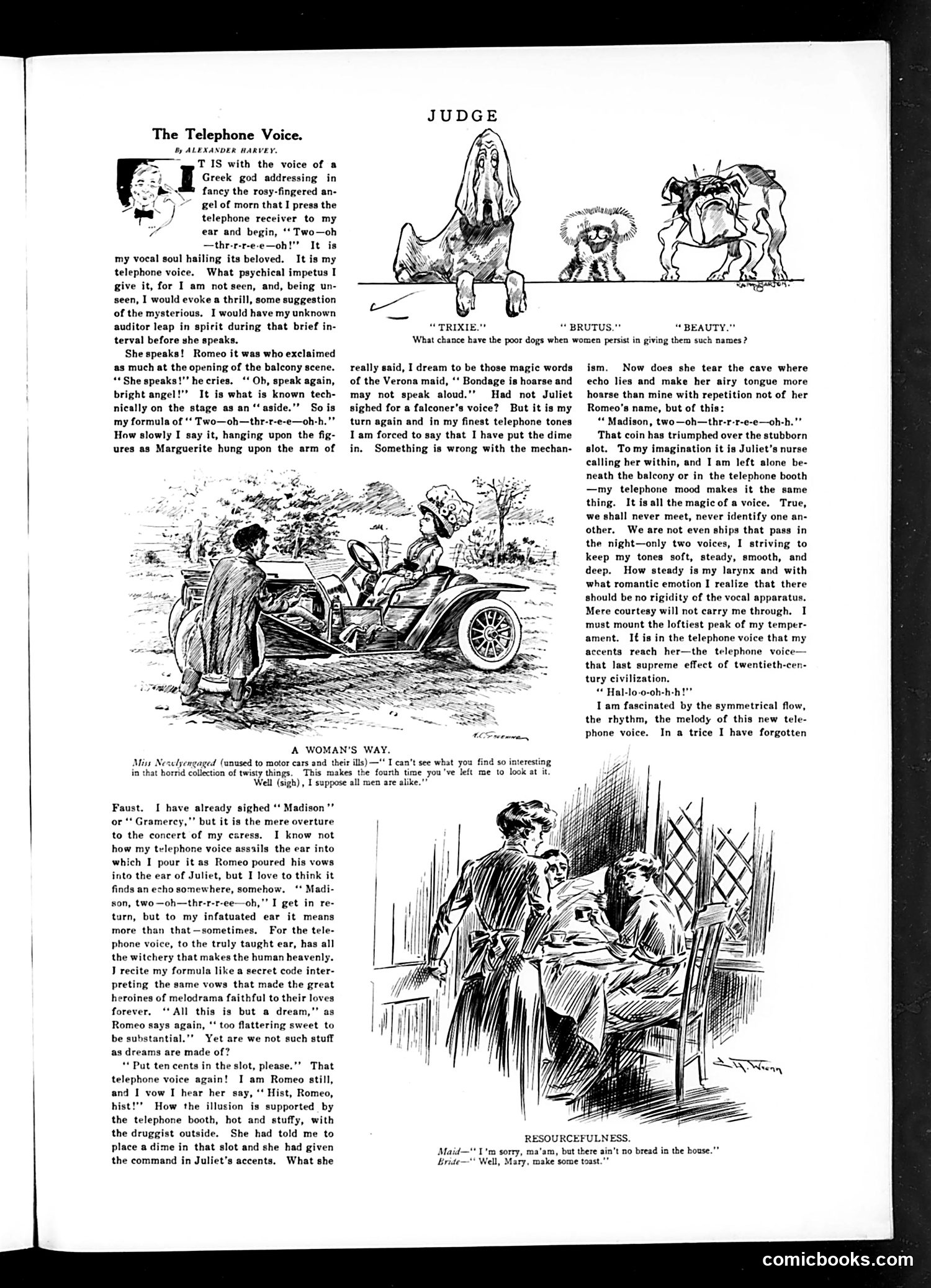
This piece satirizes romantic pretension in the telephone era. The author describes making a mundane phone call (inserting coins, dialing "Madison 2") while imagining himself as Romeo wooing Juliet, speaking in grandiose theatrical tones. The satire targets men who inflate ordinary moments into melodramatic romance — he treats a simple operator-assisted call to an unnamed woman as high passion, comparing his "telephone voice" to Shakespeare's greatest lovers. The accompanying cartoons mock related absurdities: "A Woman's Way" shows a woman bored by her boyfriend's obsession with automobiles; "Judge" section features three dogs with absurdly romantic names ("Trixie," "Brutus," "Beauty"), questioning women's sentimentality; "Resourcefulness" depicts practical domestic problem-solving. Together, they critique both male romantic affectation and female sentimentality in early 20th-century courtship.
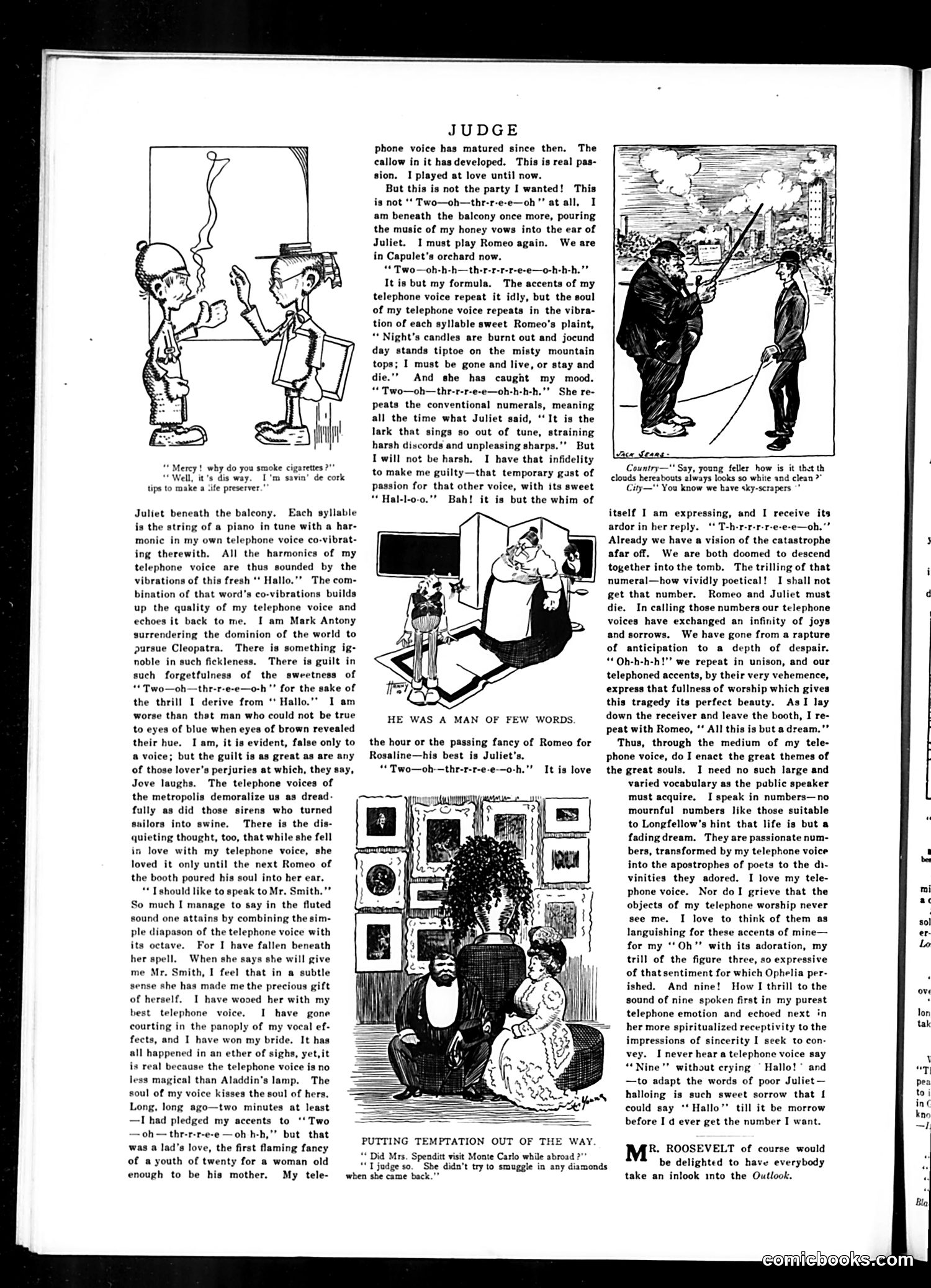
This page satirizes the romantic possibilities of early telephone technology. The main article presents an extended metaphor: a man falling in love with a woman purely through her telephone voice, comparing himself to Romeo wooing Juliet. He romanticizes the phone operator's voice as "magical," describing their brief interactions as genuine courtship conducted entirely through vocal performance. The satire targets several things: the emotional intensity people project onto disembodied voices, the anonymity enabling fantasy, and the operator's professional detachment contrasted with his imagined intimacy. The repeated "Two-oh-thr-r-e-e-oh" represents dialed numbers transformed into poetry in his mind. Side cartoons mock related absurdities: one shows a man saving cigarette cork tips as a life preserver; another depicts rural-urban differences regarding city smoke (ironically from skyscrapers, not actual pollution). The piece mocks both modern technology's seductive appeal and human susceptibility to romance constructed entirely from thin air.
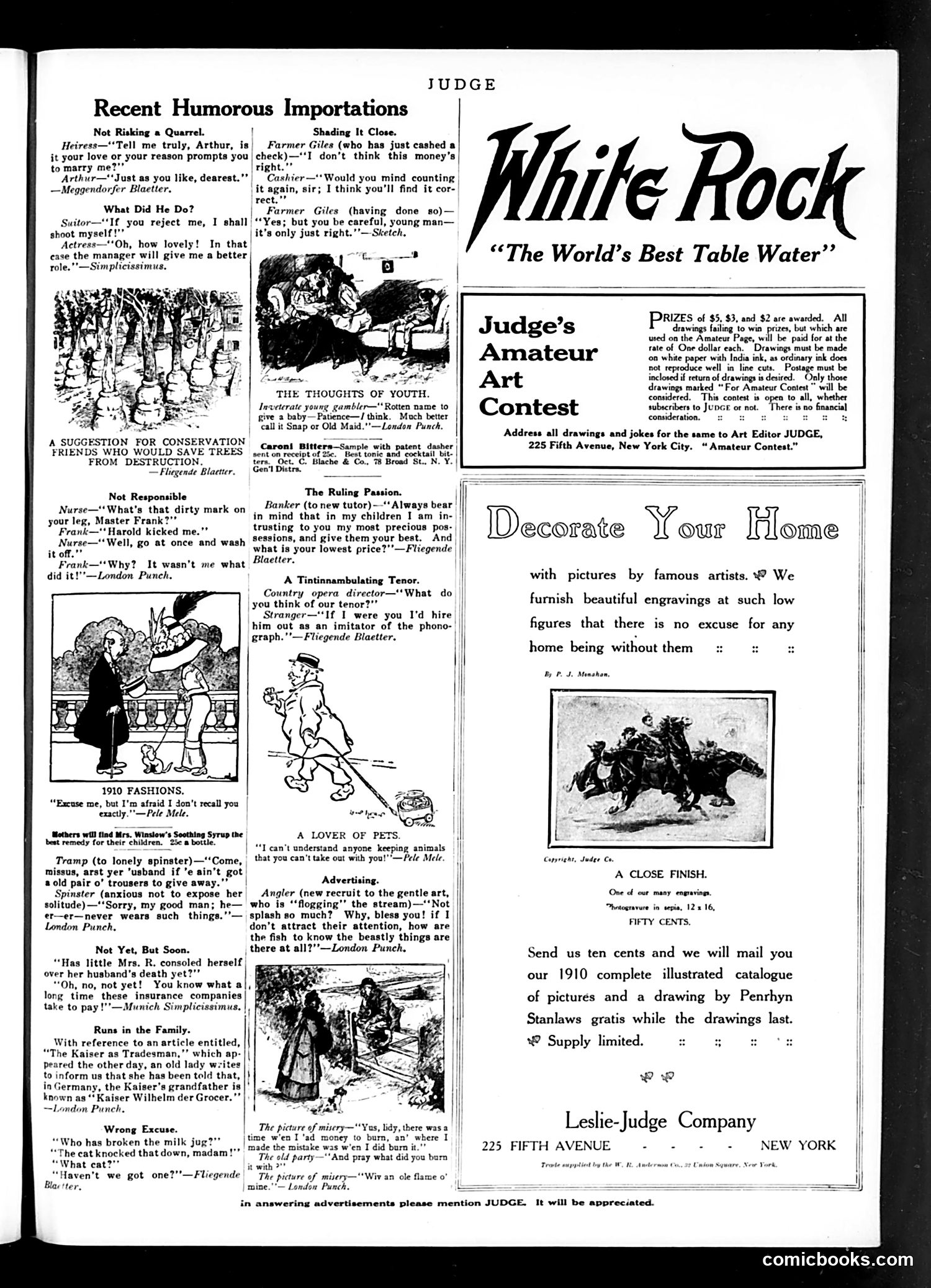
This page compiles humorous short jokes and cartoons imported from European satirical magazines (Punch, Simplicissimus, Fliegende Blatter, etc.). The jokes satirize contemporary social conventions and human nature through brief comedic scenarios. **Key satirical targets include:** - **Class and marriage**: An heiress tests whether a suitor loves her or her money; he dodges the question, mocking superficial aristocratic courtship. - **Banking and greed**: A banker prioritizes fees over his children's education, satirizing capitalist values. - **Gender roles**: A spinster pretends to have a husband to avoid appearing unmarried—mocking women's social vulnerability. - **Insurance company delays**: A widow hasn't grieved because she's waiting for insurance payouts, exposing financial desperation. - **Parenting contradictions**: Parents deny responsibility for children's misbehavior. The page also advertises White Rock table water, Judge's art contest, and Leslie-Judge Company's picture catalog. These are primarily European imports reflecting early 20th-century middle-class anxieties about money, marriage, and propriety.
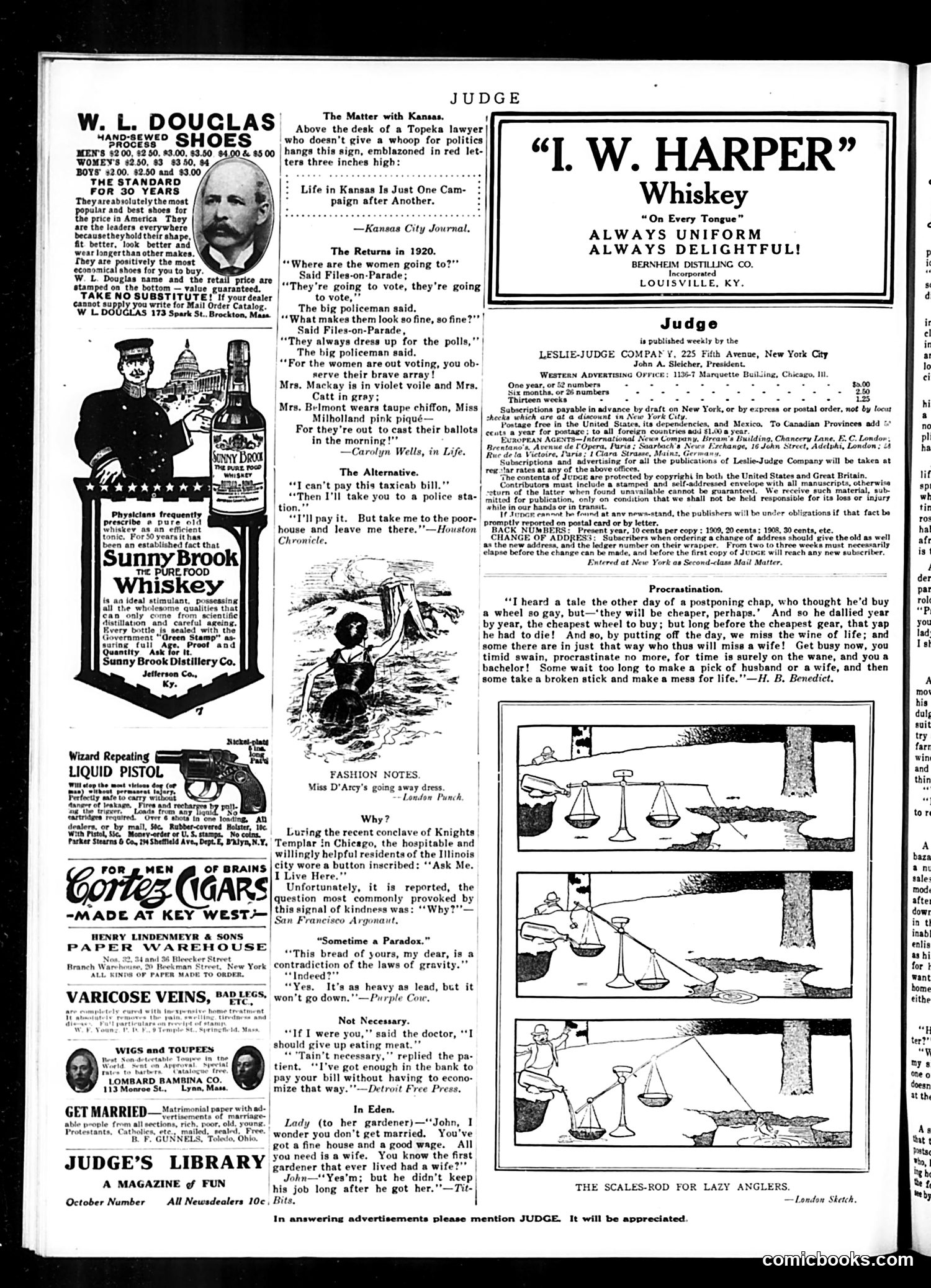
This page from Judge (a satirical weekly) contains mostly **advertisements and brief humor items** rather than a coherent political cartoon. The notable content includes: **"The Matter with Kansas"** section features a lawyer's sign reading "Life in Kansas Is Just One Campaign after Another," satirizing Kansas's reputation for constant political activity and contentious elections. **"The Returns in 1920"** is a poem about women voting, written shortly after women gained the right to vote nationally (19th Amendment, 1920). It sarcastically describes women "dressing up for the polls," implying they treat voting like a social event rather than serious civic duty. The poem names real suffragists like Carrie Chapman Catt and Alice Paul, mocking their fashion choices while voting. The remaining content—shoe ads, whiskey advertisements, brief jokes about taxicabs and marriage—comprises typical magazine filler with no clear political message beyond general social satire.
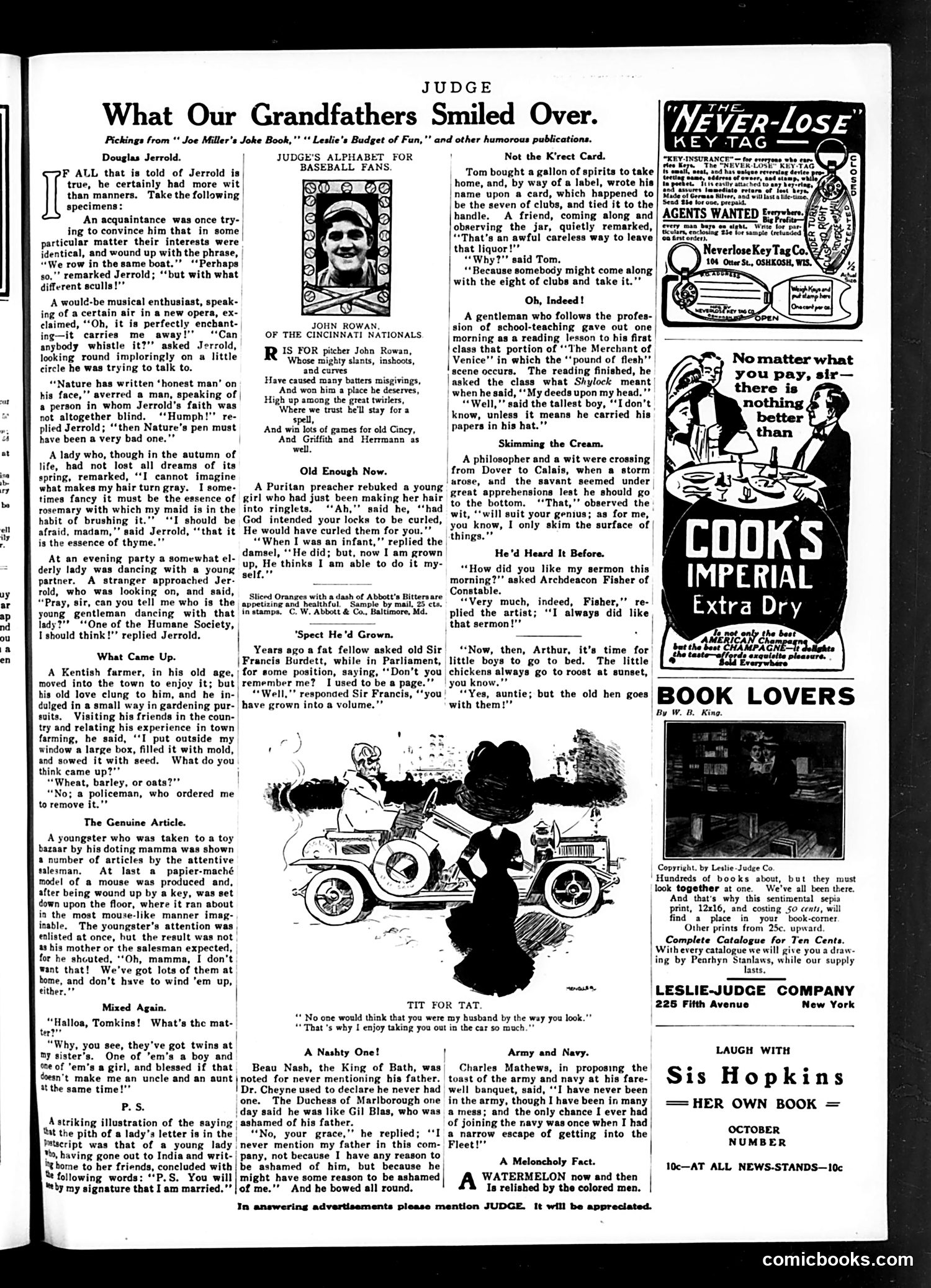
This page from *Judge* magazine reprints humorous anecdotes attributed to 19th-century figures. The main content features witty exchanges supposedly from **Douglas Jerrold**, a British writer known for sharp, sometimes insulting remarks. The jokes showcase his caustic style—mocking a man's appearance, criticizing a lady's vanity, and ridiculing someone's kindness as mere sentimentality. The page also includes other period humor: a baseball alphabet featuring player **John Rowan**, jokes about a Puritan preacher and curled hair, and schoolboy misunderstandings of Shakespeare. These represent typical *Judge* magazine content—genteel, often class-conscious humor aimed at educated readers familiar with literary references and social pretension. The advertisements (Cook's Imperial, Book Lovers, Sis Hopkins) indicate the magazine's middle-class readership.
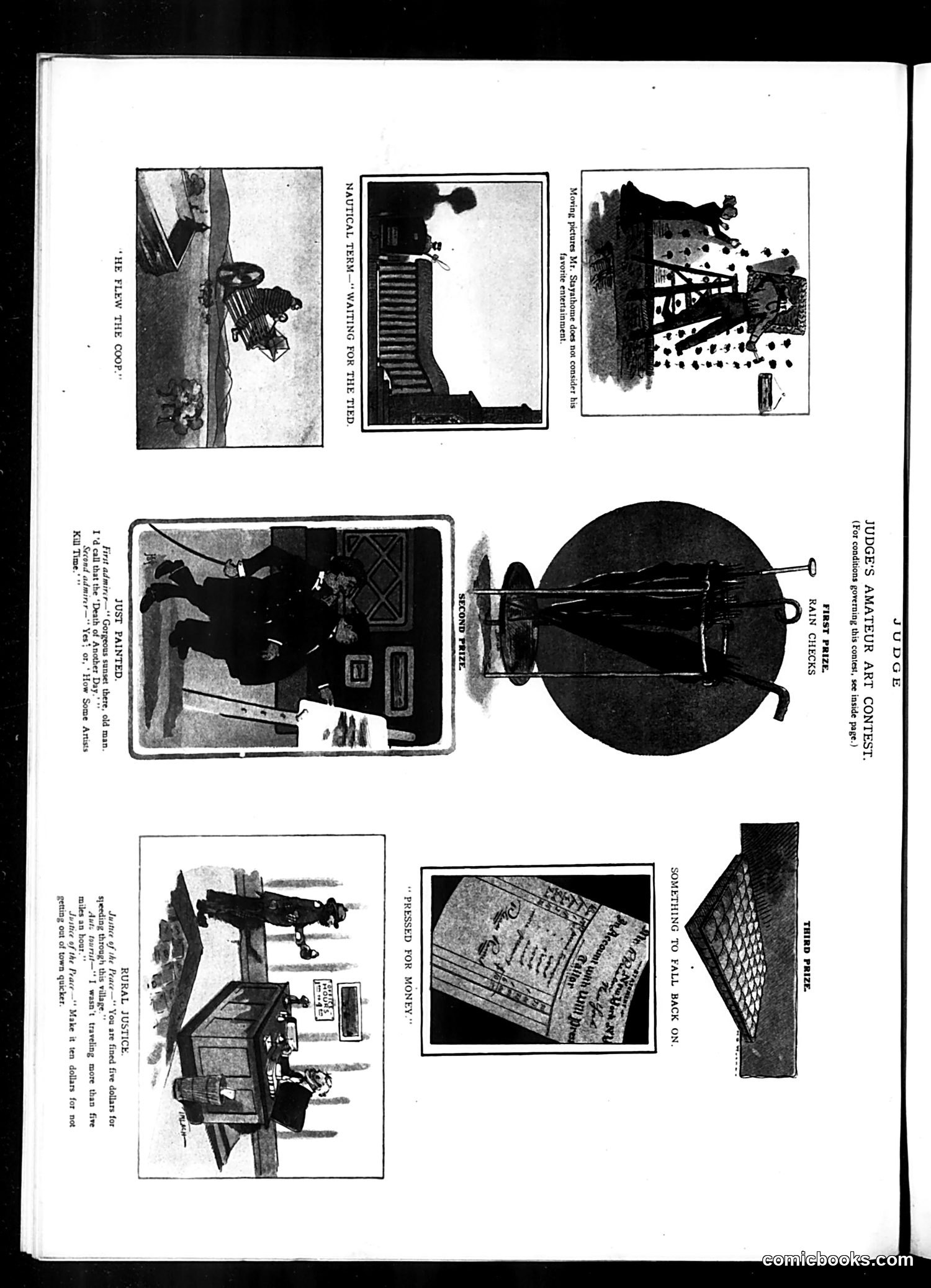
This page showcases Judge magazine's amateur art competition featuring six cartoon submissions. The entries include: **"Rain Checks"** (First Prize): Depicts a man frustrated by weather preventing outdoor entertainment, preferring indoor activities. **"Moving Pictures"**: Shows Mr. Stayathome avoiding cinema, suggesting he prefers home entertainment over theaters—likely satirizing early 20th-century moviegoing culture. **"Nautical Term—Waiting for the Tide"**: Appears to show someone literally waiting by water, playing on nautical terminology for humorous effect. **"He Flew the Coop"**: References someone escaping, likely a domestic situation. The remaining entries include "Shooting at All Make One" and "The Hare" (bottom right). These amateur submissions represent typical Judge humor: domestic situations, wordplay puns, and everyday frustrations transformed into visual gags—the magazine's standard satirical approach for middle-class American readers.