
Judge, 1910-10-01 · page 4 of 16
Judge — October 1, 1910 — page 4: what you’re looking at
What you’re looking at
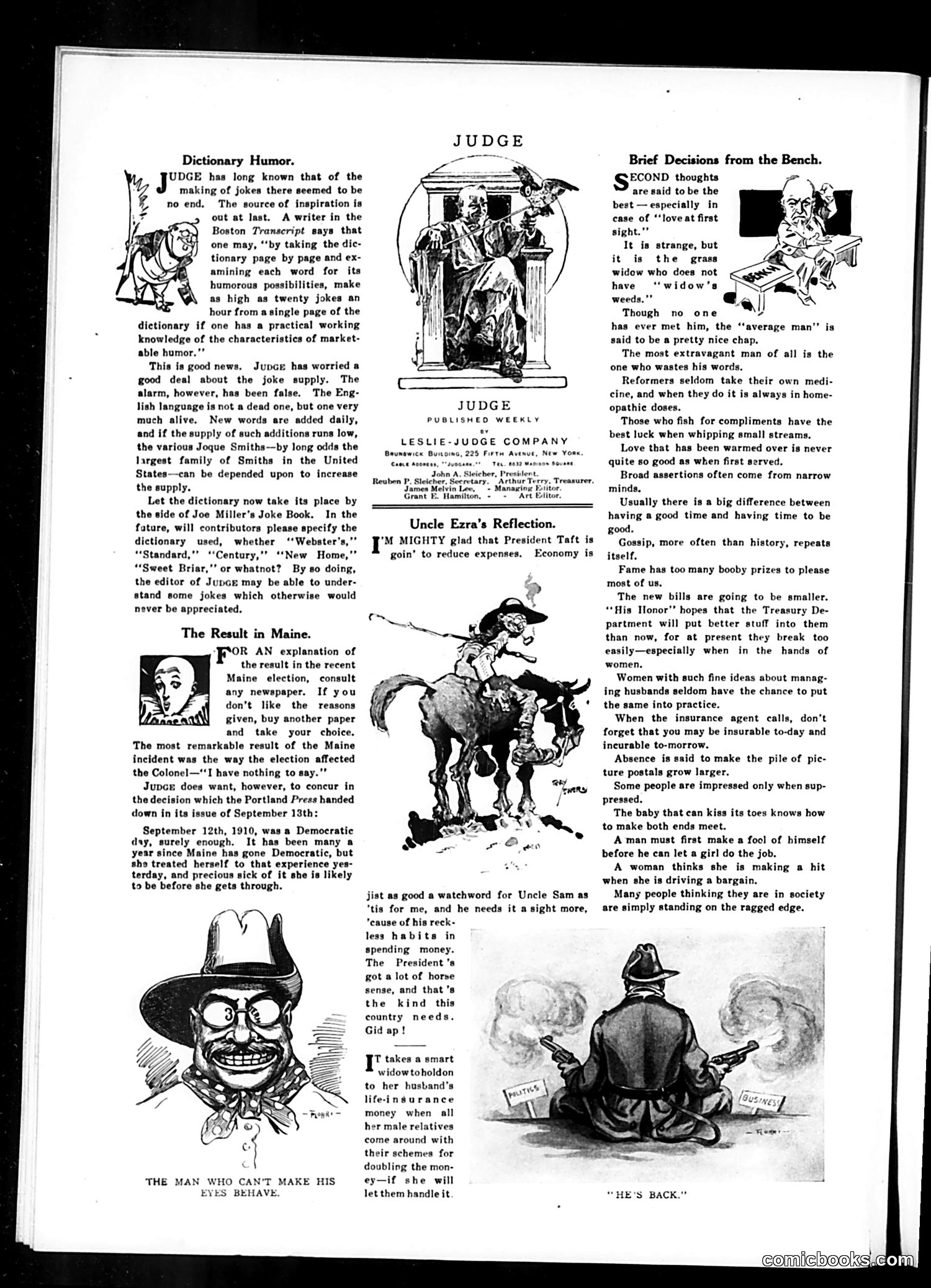
This page contains satirical commentary typical of Judge magazine's style. "Dictionary Humor" discusses how the publication mines comedic material from linguistic observations about human behavior and market characteristics. "The Result in Maine" references a recent Maine election, with an editorial note from September 10th, 1910. The cartoon shows caricatured figures, likely political candidates or election-related personalities, though specific identities aren't clearly labeled. "Uncle Ezra's Reflections" presents brief satirical observations on contemporary life—economics, women's roles, marriage, and social behavior. The crude illustrations accompany quips about President Taft's cost-cutting efforts and general social commentary. The final cartoon "He's Back" appears political but lacks sufficient context in the visible text to identify the specific figure or event with certainty. The page exemplifies Judge's blend of visual satire and short-form social commentary targeting turn-of-century American life.
📄 Transcribed text from this page (OCR, searchable)
Machine-transcribed from the original scan — historical spelling and the odd misread are preserved.
Dictionary Humor. UDGE has long known that of the making of jokes there seemed to be The source of inspiration is out at last. A writer in the Boston Transcript says that one may, “by taking the dic- tionary page by page and ex- amining each word for its humorous possibilities, make as high as twenty jokes an hour from a single page of the dictionary if one has a practical working knowledge of the characteristics of market- able humor."’ This is good news. Jupce has worried a good deal about the joke supply. The rm, however, has been false. The Eng- lish language is not a dead one, but one very much alive. New words are added daily, and if the supply of such additions runs low, the various Joque Smiths—by long odds the largest family of Smiths in the United States—can be depended upon to increase the supply. Let the dictionary now take its place by the side of Joe Miller’s Joke Book. In the fatare, will contributors please specify the dictionary used, whether ‘‘Webster's,’’ “Standard,’’ ‘‘Century,’’ ‘‘New Home, “Sweet Briar,'’ or whatnot? By so doing, the editor of Jupce may be able to under- stand some jokes which otherwise would never be appreciated, The Result in Maine. Fo AN explanation of the result in the recent Maine election, consult any newspaper. If you don’t like the reasons given, buy another paper and take your choice. The most remarkable result of the Maine incident was the way the election affected the Colonel—'‘I have nothing to sa: Jupce does want, however, to concur in the decision which the Portland Press handed down in its issue of September 13th: September 12th, 1910, was a Democratic surely enough. It has been many a year since Maine has gone Democratic, but she treated herself to that experience yes- terday, and precious sick of it she is likely to be before she gets through. no end. WHO CAN'T MAKE HIS EYES BEHAVE, ‘THE MAN JUDGE PUBLISHED WEEKLY LESLIE-JUODGE COMPANY 225 Firm Avenue, Ni Uncle Ezra’s Reflection. y™ MIGHTY glad that President Taft is goin’ to reduce expenses, Economy is jist as good a watchword for Uncle Sam as ‘tis for me, and he needs it a sight more, ‘cause of his reck- less habits in spending money. The President 's got a lot of horse sense, and that ’s the kind this country needs. Gid ap! T takes a smart widow toholdon to her husband's life-insurance money when all her male relatives come around with their schemes for doubling the mon- ey—if she will let them handle it Brief Decisions from the Bench. ECOND thoughts are said to be the best — especially in case of ‘‘loveat first sight.” It is strange, but it is the grass widow who does not have ‘“‘widow’s weeds."" Though no one has ever met him, the ‘‘average man’ is said to be a pretty nice chap. The most extravagant man of all is the one who wastes his words. Reformers seldom take their own medi- cine, and when they do it is always in home- opathic doses. Those who fish for compliments have the best luck when whipping small streams, Love that has been warmed over is never quite so good as when first served. Broad assertions often come from narrow minds, Usually there is a big difference between having @ good time and having time to be good. Gossip, more often than history, repeats itself. Fame has too many booby prizes to please most of us. The new bills are going to be smaller. “His Honor’? hopes that the Treasury De- partment will put better stuff into them than now, for at present they break too easily—especially when in the hands of women. Women with such fine ideas about manag- ing husbands seldom have the chance to put the same into practice. When the insurance agent calls, don’t forget that you may be insurable to-day and incurable to-morrow. Absence is said to make the pile of pic- ture postals grow larger. Some people are impressed only when sup- pressed. The baby that can kiss its toes knows how to make both ends meet. Aman must first make a fool of himself before he can let a girl do the job. A woman thinks she is making a hit when she is driving a bargain. Mans people thinking they are in society are simply standing on the ragged edge. “HE'S BACK."