
A complete issue · 16 pages · 1910
Judge — September 24, 1910
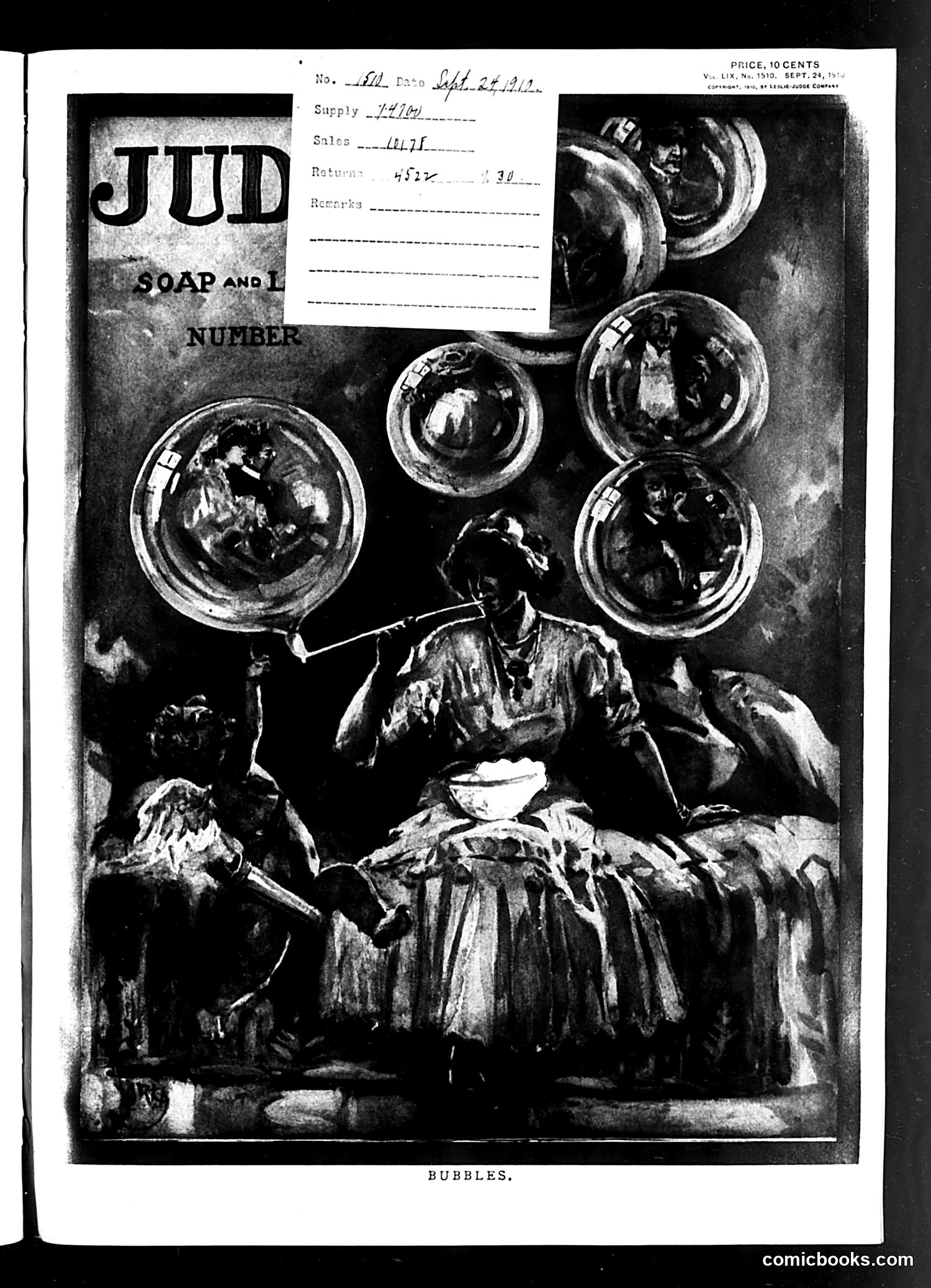
This page from **Judge** magazine (dated September 24, 1921, priced at 10 cents) depicts a satirical scene titled "Bubbles." The illustration shows a woman juggling large soap bubbles while seated, with children or cherubs observing around her. The cartoon likely satirizes the **ephemeral nature of post-WWI promises or political commitments** — a common Judge theme. The woman's act of juggling fragile bubbles suggests she's managing unstable or illusory situations. The children's attention implies the public (or younger generation) is mesmerized by empty spectacles. Without clearer identification of the woman, the exact political target remains unclear, though the bubble metaphor typically critiques failed policies, broken promises, or economic instability during the 1920s economic adjustment period.
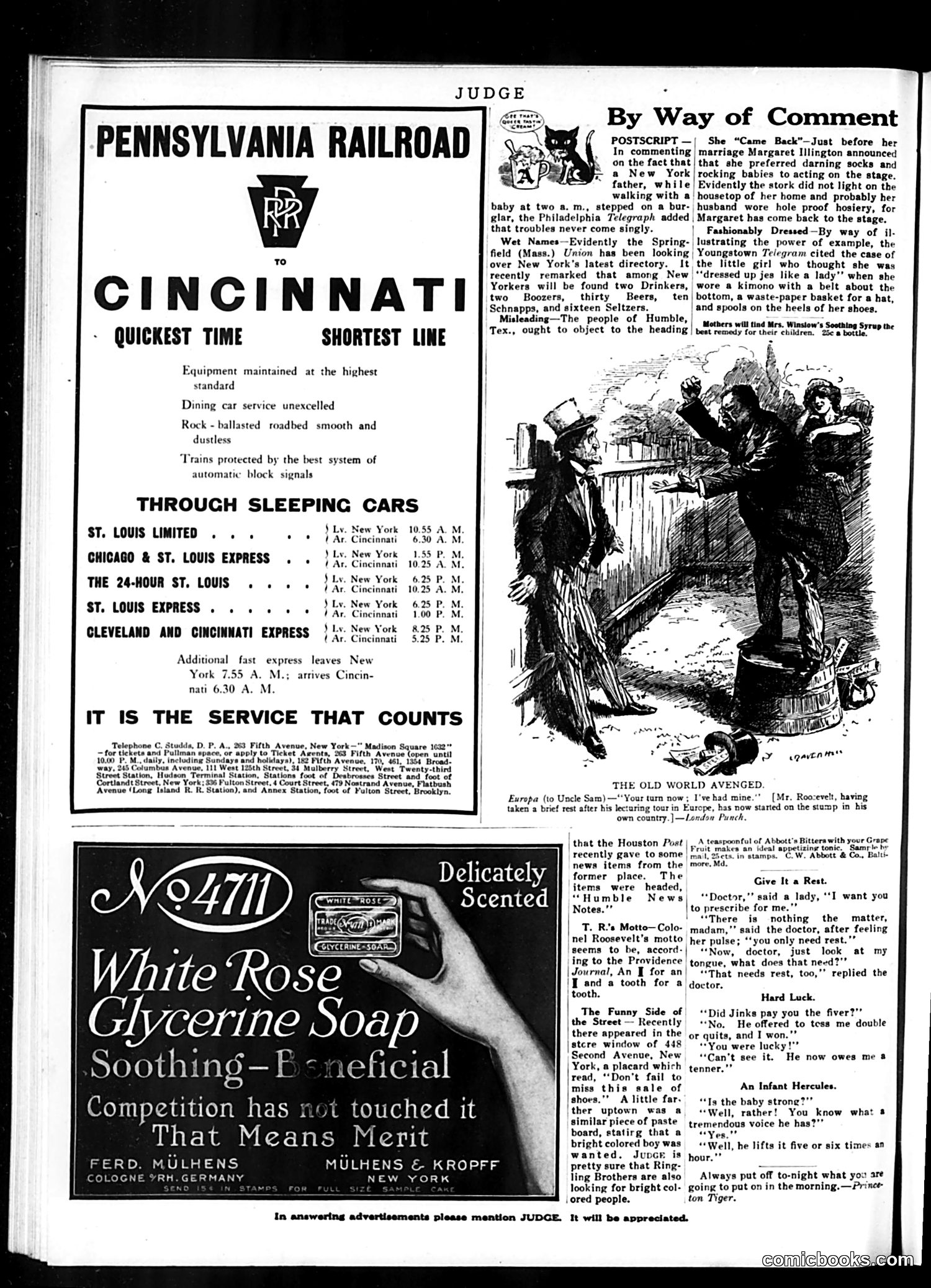
This cartoon depicts two figures in Old World European dress confronting what appears to be an American character at a wooden fence or gate. The caption indicates this is "Uncle Sam" encountering European representatives. The joke plays on immigration and national character. The text references "Your turn now; I've had mine" and someone having "started on the stump in his own country," suggesting criticism of European emigration patterns to America. The satire likely mocks European nations sending their populations abroad while experiencing domestic troubles themselves—a common American complaint about immigration in this era. The "Old World" characters appear somewhat disheveled or disreputable, reinforcing period stereotypes about European immigrants. The cartoon reflects early-20th-century American anxieties about foreign immigration and national identity.
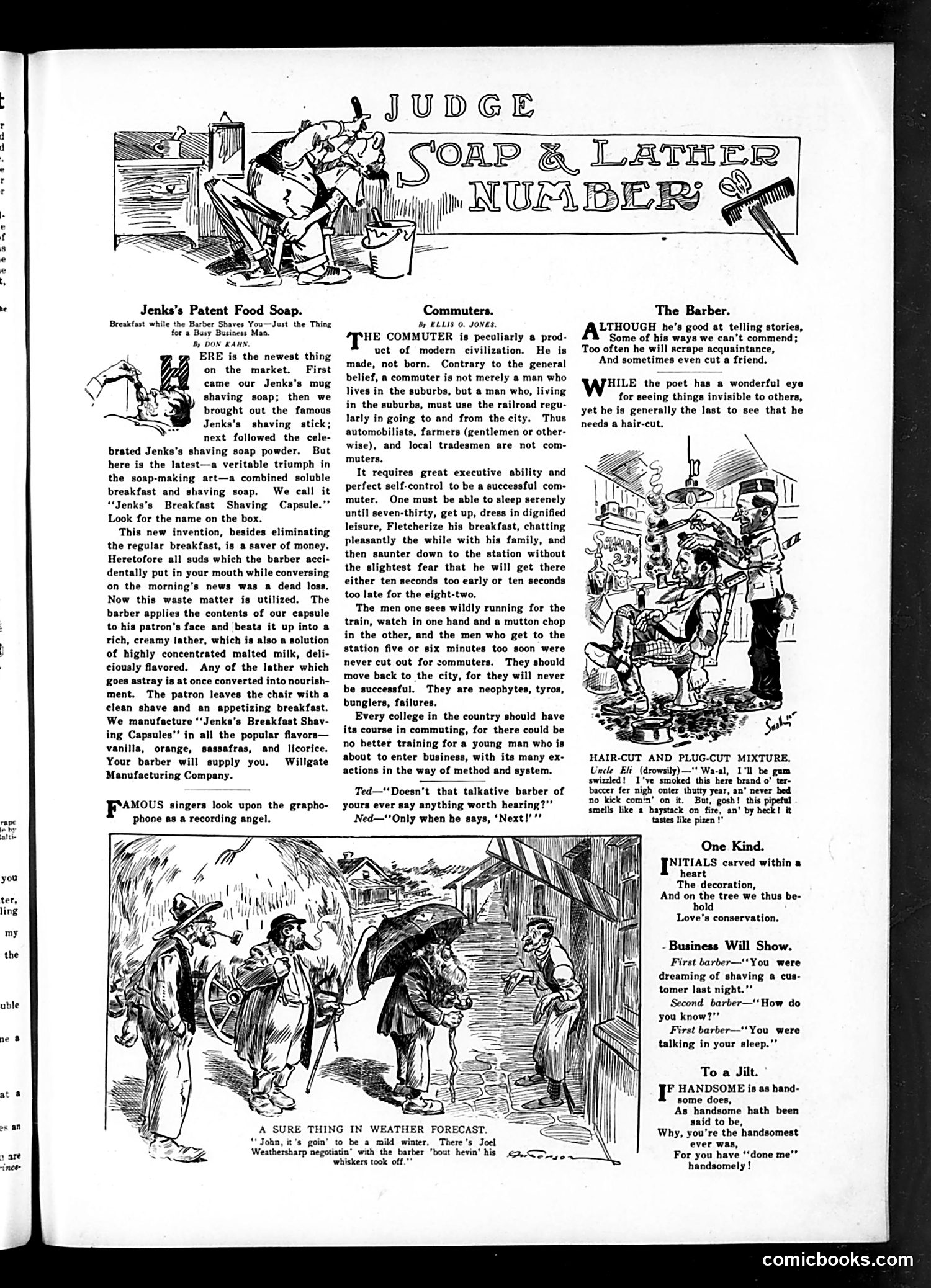
This page is primarily **advertising and humor content** rather than political satire. It features: 1. **"Jenks's Patent Food Soap"** - a fake product advertisement claiming to combine breakfast, shaving soap, and shaving powder in one. The humor mocks overly-complex "patent" products popular in the era. 2. **"Commuters"** - a satirical piece about railroad commuters, likely referencing the growing suburban commute culture of early 20th-century America. It jokes about men rushing to catch trains and their general incompetence. 3. **"The Barber"** - humorous anecdotes about barber shop conversations, a common social gathering point. 4. **"A Sure Thing in Weather Forecast"** - a cartoon about a barber predicting mild winter weather, likely satirizing pseudo-scientific forecasting. The page represents **Judge's** typical mix of consumer-culture satire and genteel humor aimed at middle-class readers.
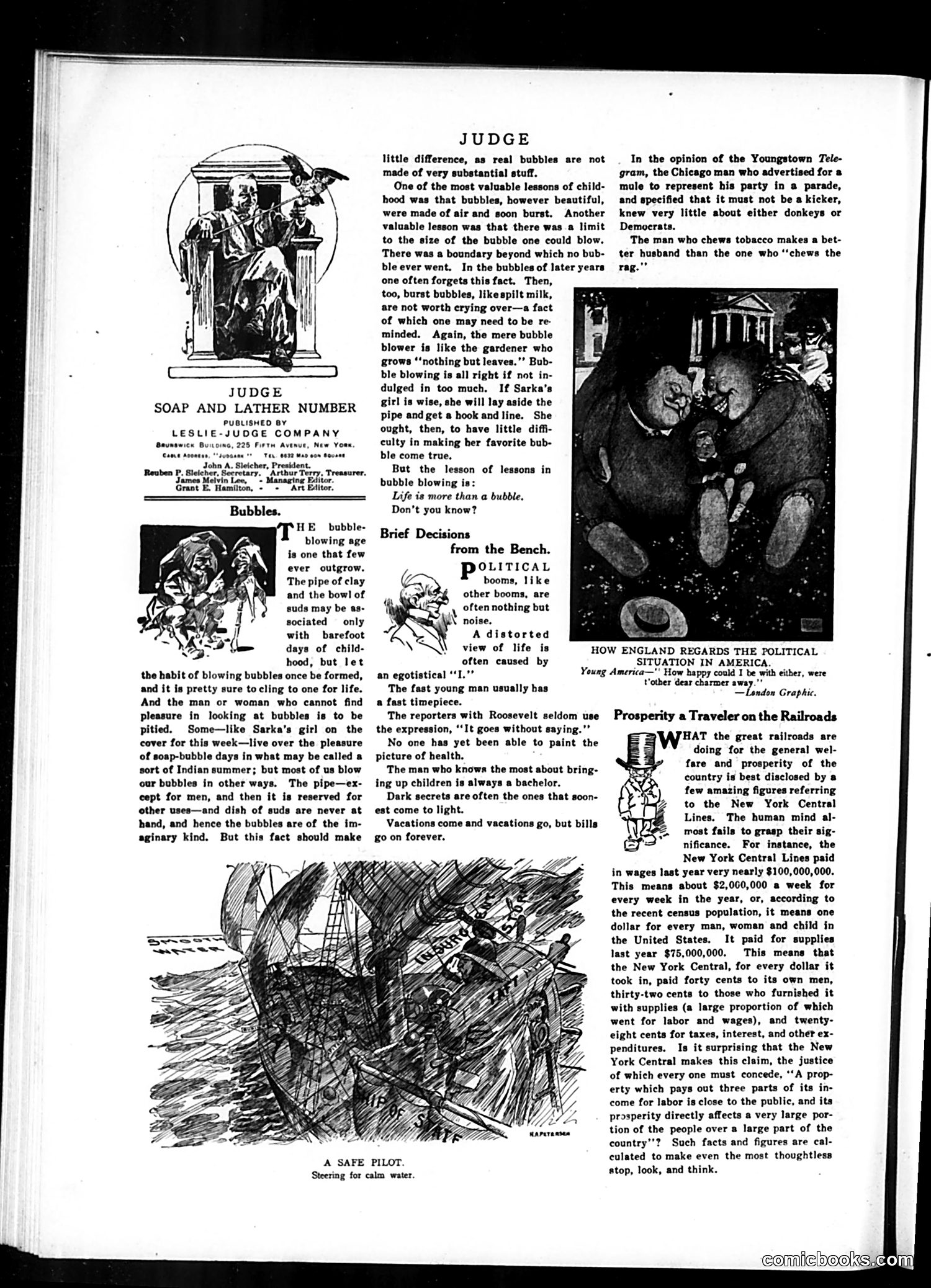
This page contains three distinct sections: 1. **"Judge: Soap and Lather Number"** - A cover illustration showing Lady Justice, likely promoting an issue themed around cleanliness/reform ("soap and lather" being metaphors for purification). 2. **"Bubbles"** - An essay about bubble-blowing as a childhood lesson, offering philosophical observations about life's limits and boundaries. 3. **"Prosperity a Traveler on the Railroads"** - An article with statistics about the New York Central Lines' massive wages ($100,000,000 annually) and economic impact. The accompanying sketch shows a safe pilot "steering for calm water," suggesting railroad prosperity reflects broader national economic health. The page functions as both satirical commentary and informational journalism typical of Judge magazine's format, mixing humor with social observation and economic analysis.
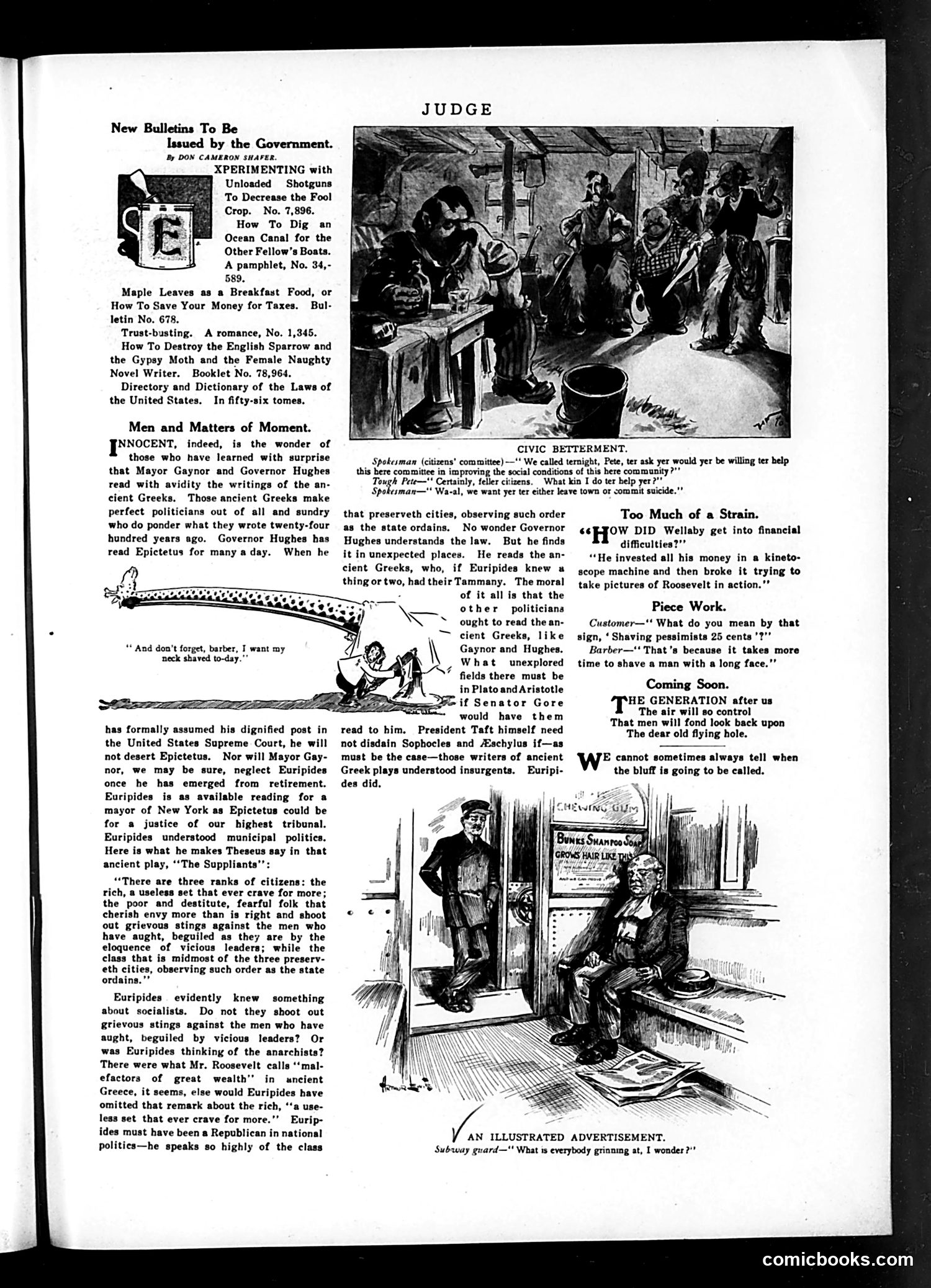
This page contains political commentary referencing Governor Hughes (likely Charles Evans Hughes of New York) and his understanding of classical Greek philosophy and governance. The article "Men and Matters of Moment" argues that Hughes, like ancient Greek leaders Solon and Pericles, should read the classics to understand proper civic order and law. The cartoons appear satirical: one shows a barber scene with political commentary, another depicts what's labeled "Civic Betterment" with citizens' committee discussing social improvement. A third cartoon, "An Illustrated Advertisement," shows a subway guard with unclear satirical intent. The page critiques how politicians should be educated in classical wisdom to govern effectively, contrasting their actual conduct with idealized ancient democratic principles. The specific historical context and all figure identifications cannot be definitively established from the image alone.
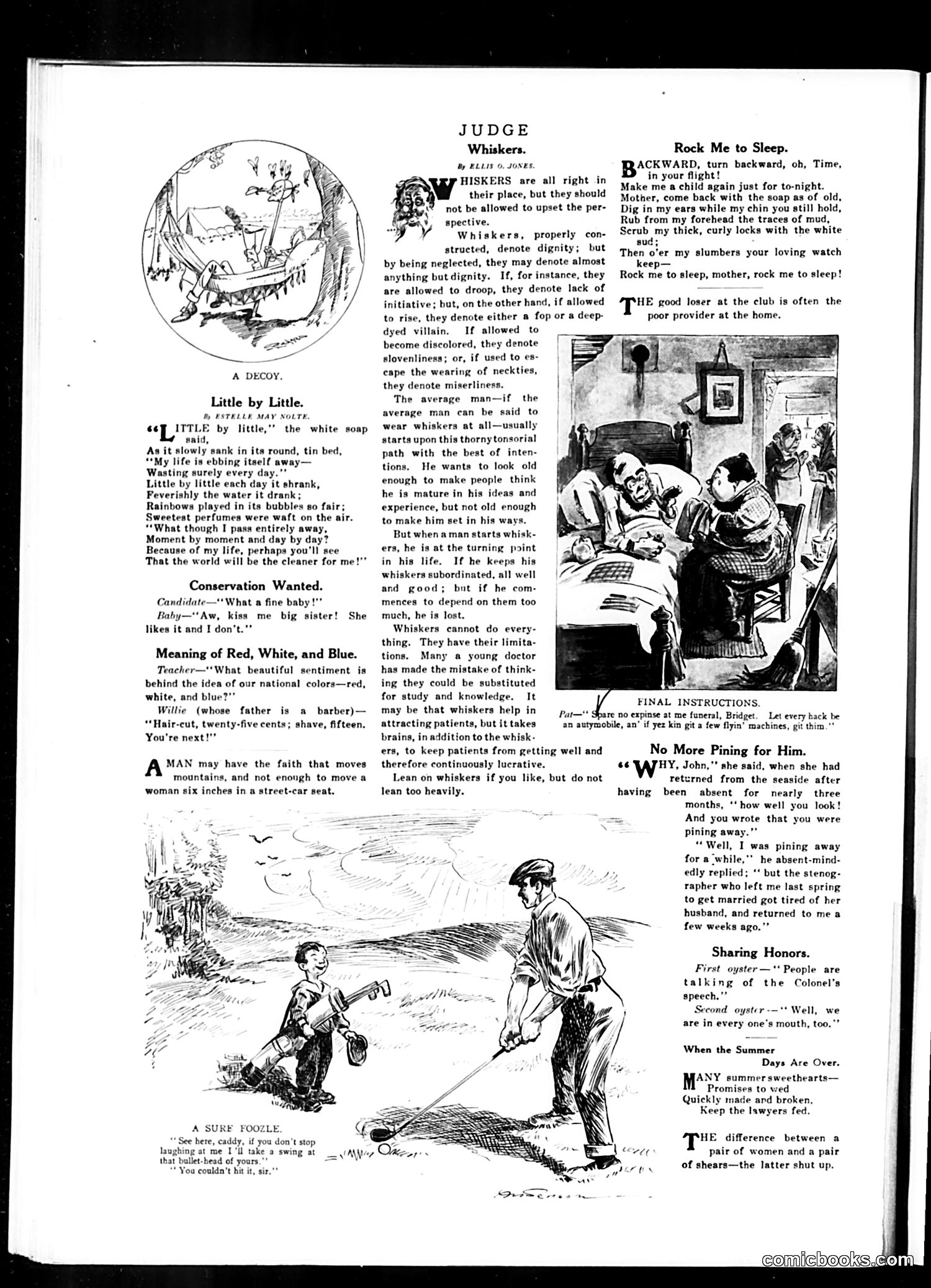
This page from Judge contains multiple satirical pieces typical of early 20th-century American humor: **"Whiskers"** (center): A lengthy essay mocking men's obsession with facial hair as a shortcut to appearing mature and authoritative. The satire warns that whiskers cannot substitute for actual competence—particularly targeting young doctors who rely on beards rather than medical knowledge to attract patients. **Surrounding Jokes**: Include gentle domestic humor ("No More Pining for Him"—a man admits his stenographer's return makes him happier than his wife), workplace satire ("A Sure Foozle"—golf caddy disrespect), and observations on gender relations and social class. **"Rock Me to Sleep"** references the sentimental 1860s poem, contrasting nostalgic childhood with adult responsibilities. The overall tone is conservative social commentary—poking fun at vanity, incompetence, and marital discord without challenging social structures. Typical of Judge's middle-class, male-oriented readership.
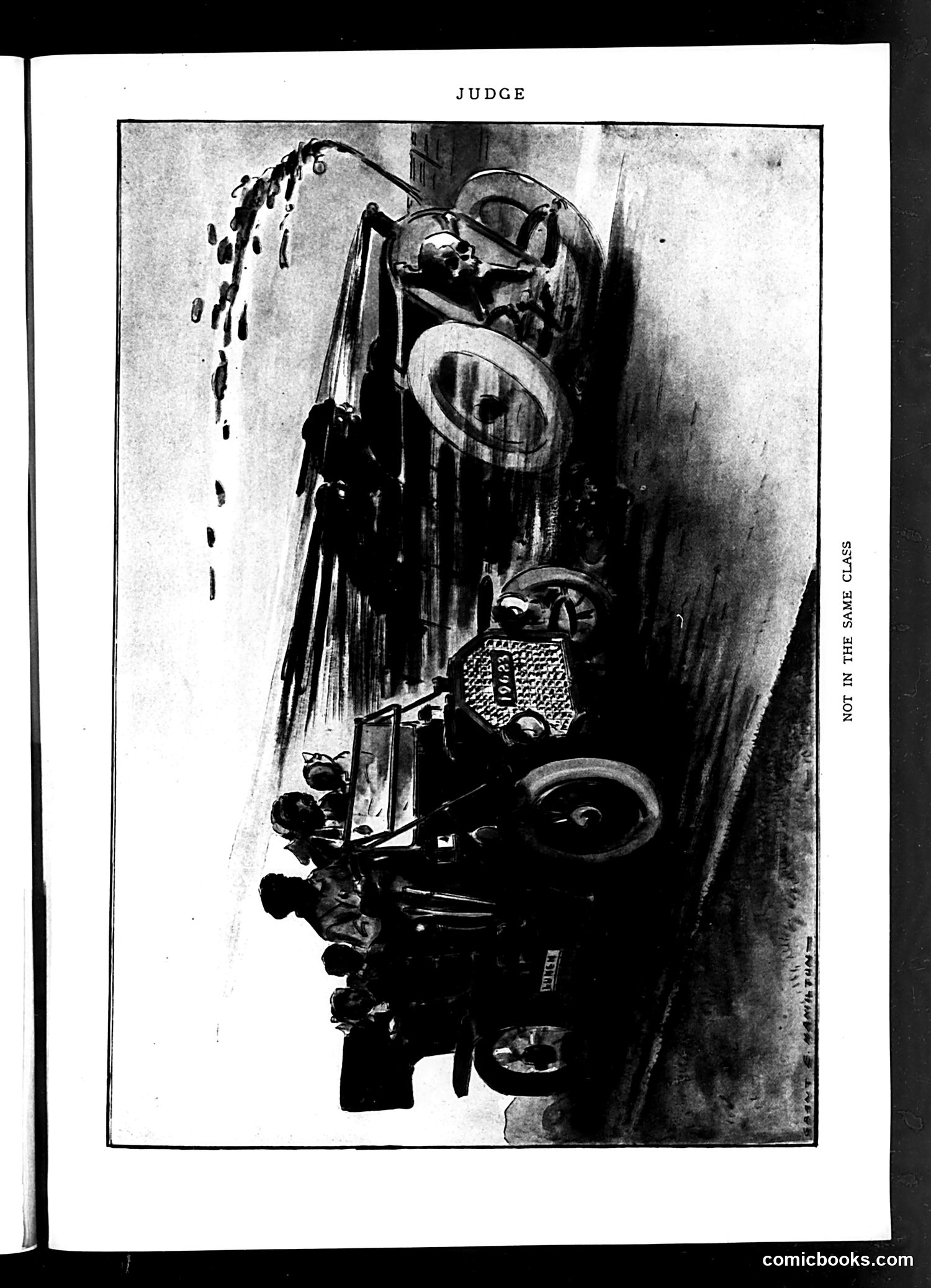
This page is difficult to interpret with certainty. The OCR text appears corrupted and unreadable, and while the image shows what seems to be a vintage automobile photographed from above, the specific satirical message is unclear without legible accompanying text or captions. The image itself—a car shot from an unusual angle—suggests this may be automotive satire, possibly commenting on early 20th-century automobile design, safety, or driving culture. The phrase "NOT IN THE SAME CLASS" appears on the right margin, hinting at social commentary. However, without clear OCR text or visible captions identifying the subject, figures, or political/social reference, I cannot reliably explain the intended satire to a modern reader. More context or a clearer scan would be needed for accurate interpretation.
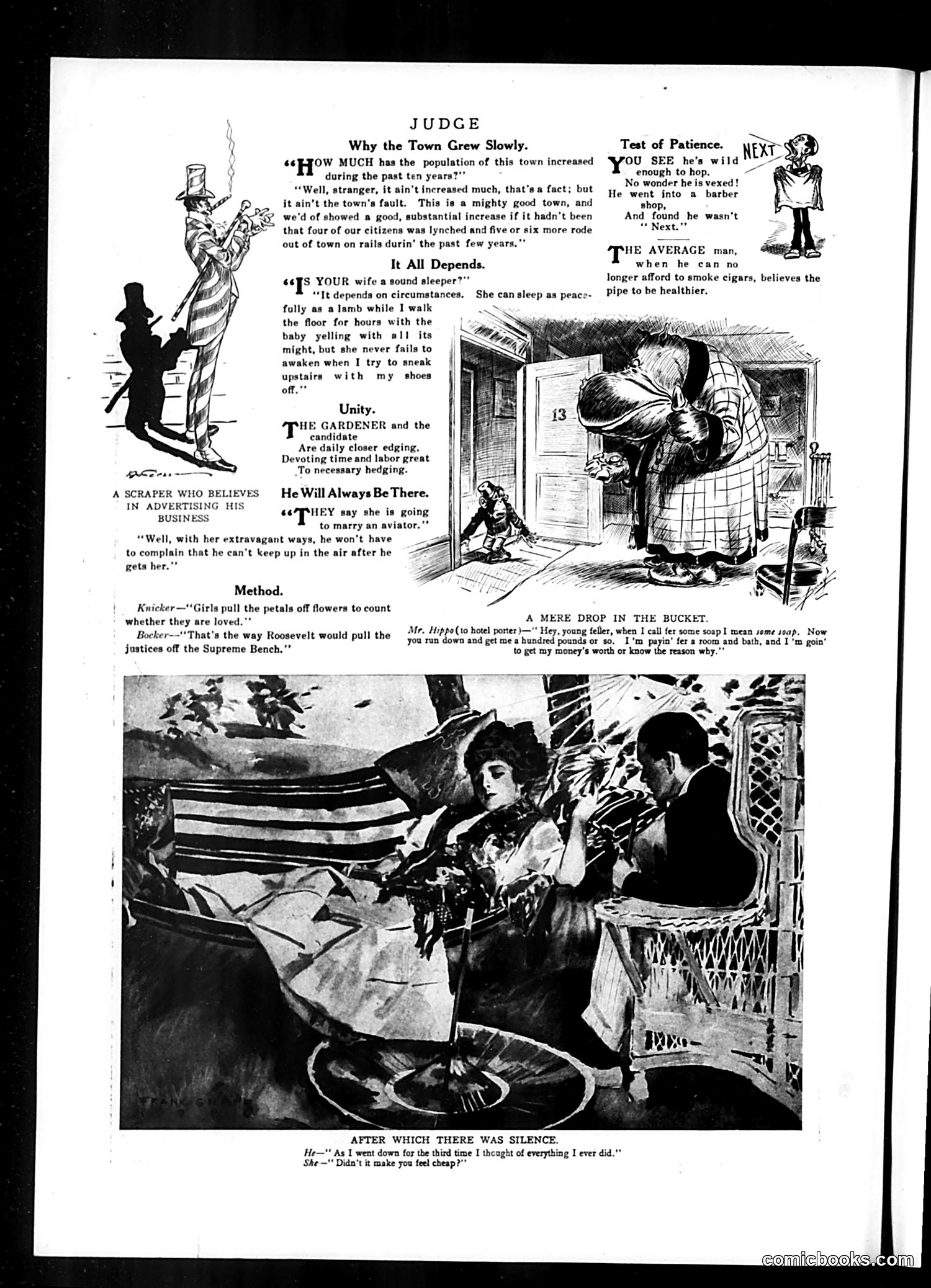
This page contains multiple satirical cartoons and jokes typical of early 20th-century American humor: **"Why the Town Grew Slowly"** jokes about lynching and violence driving away residents—dark social commentary on lawlessness in certain regions. **"It All Depends"** and **"Test of Patience"** are domestic humor about marriage and everyday annoyances (wives, waiting at barbershops, aviators). **"Method"** references Roosevelt's judicial activism, comparing his removal of Supreme Court justices to plucking petals from flowers—mocking his aggressive politics. **"He Will Always Be There"** uses an aviator marrying an extravagant woman as a setup for a joke about keeping up with expenses. **"A Mere Drop in the Bucket"** shows a hippo at a hotel demanding excessive soap—likely poking fun at wealthy or demanding guests. The bottom photograph **"After Which There Was Silence"** appears to be a dramatic scene with romantic/marital implications, with dialogue about regret and humiliation. The page is primarily humor and social satire rather than sustained political commentary.
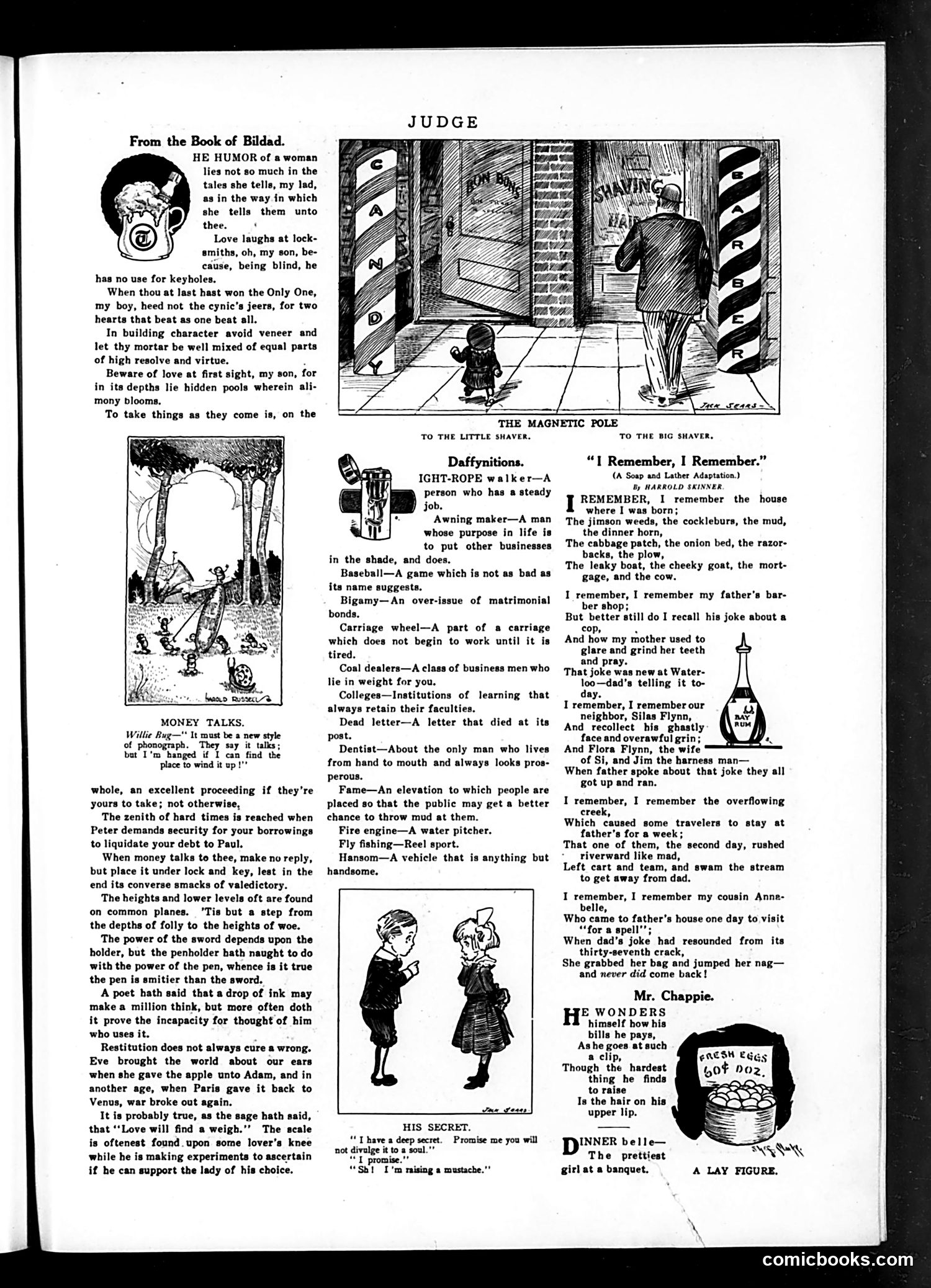
This page from *Judge* magazine contains several pieces of satirical humor typical of early 20th-century American satire: **"From the Book of Bildad"** offers mock-biblical wisdom mocking romantic sentimentality—warning against "love at first sight" because "in its depths lie hidden pools wherein alimony blooms," a jab at divorce costs. **"Money Talks"** features a cartoon of a beetle examining a phonograph, joking that money "talks" but you can't find where to "wind it up"—satirizing the difficulty of getting money to produce results. **"Daffynitions"** provides humorous fake definitions: a dentist is "the only man who lives from hand to mouth and always looks prosperous"; a hansom cab is "a vehicle that is anything but handsome"—wordplay-based satire. The poetry section and other content mock Victorian sentimentality and domestic life. Overall, the page exemplifies *Judge's* blend of puns, social commentary, and illustrated humor targeting American middle-class pretensions and foibles.
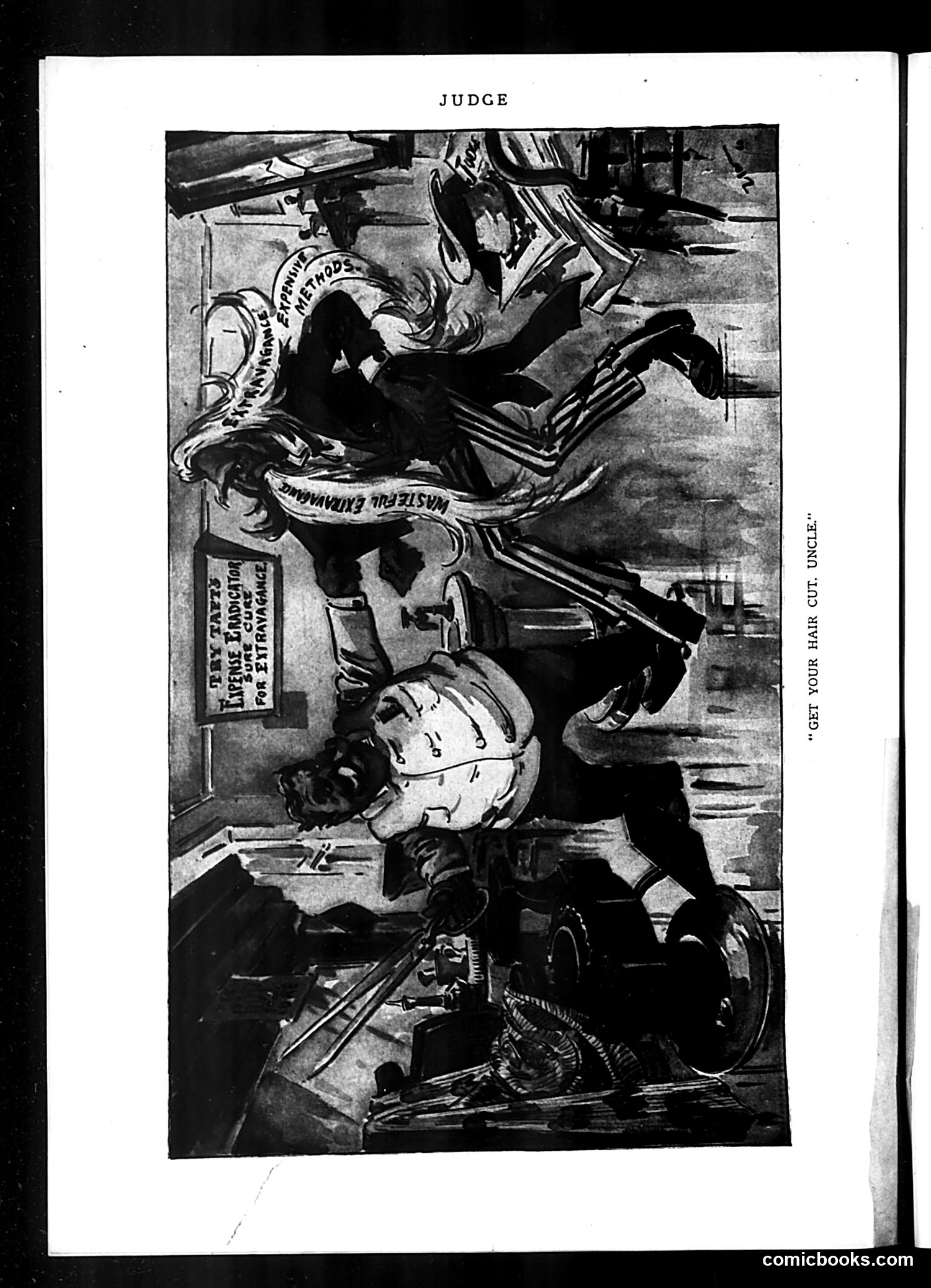
The OCR text is too degraded to read clearly. However, the image shows a satirical cartoon (rotated 90 degrees) depicting figures in what appears to be a barber shop scene. The visible text fragment reads "GET YOUR HAIR CUT UNCLE" and references something about "ADVERTISING" and what may be a business establishment. The cartoon appears to be satirizing commercial practices or personal grooming culture, likely from the early-to-mid 20th century based on the style and Judge's publication period. Without legible text identifying specific political figures or clearer historical references, I cannot determine the precise satirical target or social commentary intended. The crude reproduction quality limits confident interpretation of the specific joke or contemporary reference.
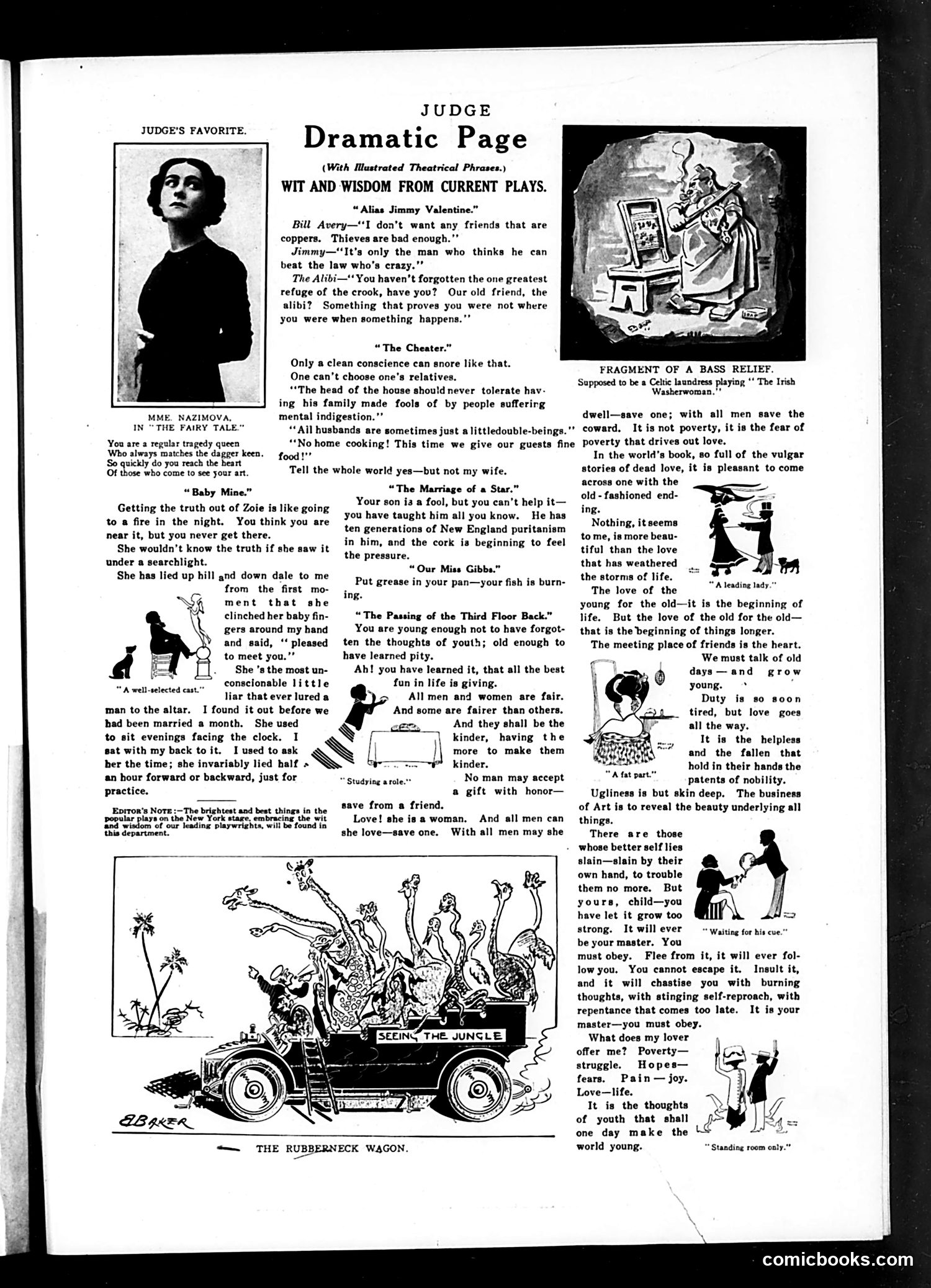
This page excerpts witty dialogue from popular Broadway plays of the era (appearing to be early 1910s), presenting theatrical wisdom for readers. The plays referenced—"Alias Jimmy Valentine," "The Cheater," "Baby Mine," "The Marriage of a Star," and "The Passing of the Third Floor Back"—were contemporary hits. The satire operates on two levels: the quoted lines humorously capture universal human truths (marriage follies, criminal psychology, conscience), while accompanying illustrations provide visual jokes. For instance, one cartoon shows a woman waiting anxiously—likely referencing romantic entanglement themes common in period comedies. The page's appeal lay in offering audiences clever zingers from successful plays they might attend, functioning as both entertainment preview and philosophical commentary. Lines like "All you have learned it, that all the best fun in life is giving" reflect the sentimental yet witty tone characteristic of early-twentieth-century American theater. The accompanying illustrations by various artists reinforce comedic points through visual caricature, a Judge magazine trademark.
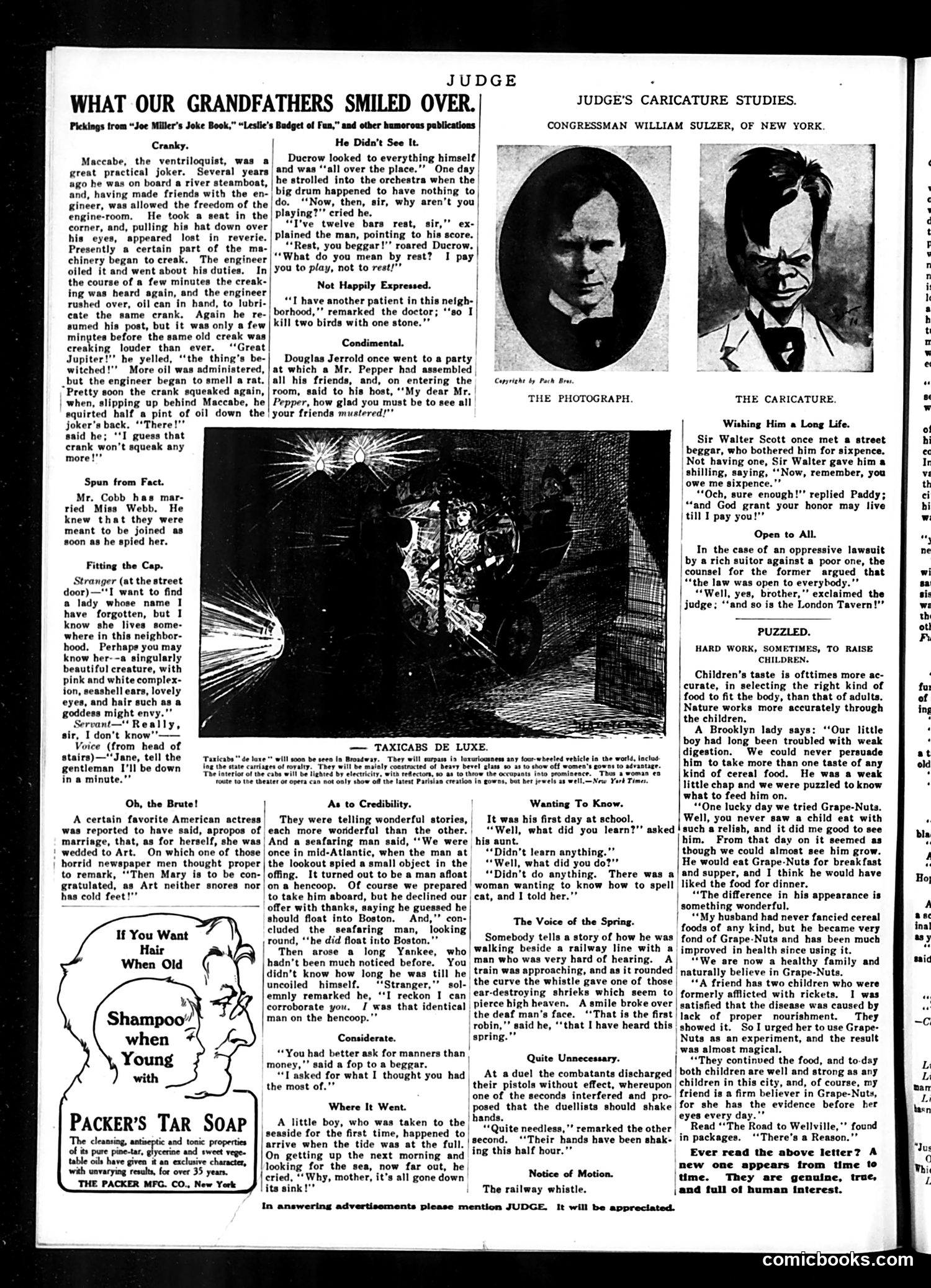
This page from *Judge* presents reprinted jokes from 19th-century humor collections ("Joe Miller's Joke Book," "Leslie's Budget of Fun"), demonstrating what earlier generations found amusing. The jokes are largely **slapstick and pun-based**: a ventriloquist pranks a steamboat engineer by imitating creaking machinery; wordplay exploits surnames (Mr. Pepper hosting friends who are "mustered"); a man mistakes an actress's devotion to "Art" (her career) as marriage to a person. On the right side appears a **caricature study of Congressman William Sulzer of New York**, labeled "Judge's Caricature Studies." The accompanying anecdotes—"Wishing Him a Long Life," "Open to All," "Puzzled"—appear to be brief satirical takes on his character or political positions, though specific references are unclear without more context. The page also includes a **Packer's Tar Soap advertisement**, common for period magazines. Overall, this reflects early 20th-century popular humor: heavily dependent on puns, practical jokes, and exaggerated social situations that modern readers would find relatively mild.
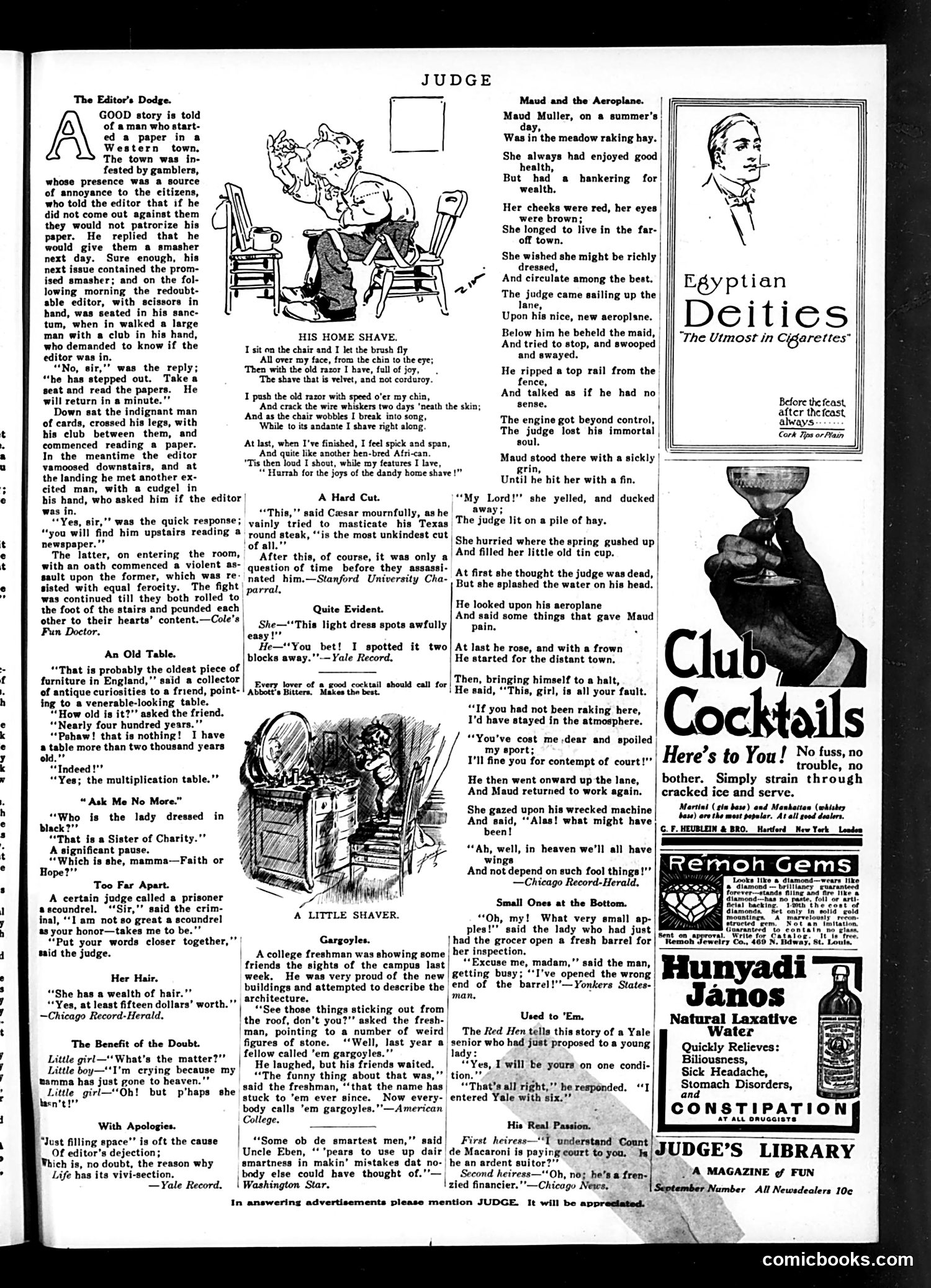
This page contains primarily **humorous anecdotes and light satirical pieces** rather than political cartoons. The main content includes: **"The Editor's Dodge"**: A tall tale about a Western newspaper editor who publishes inflammatory content about local gamblers, then hides while angry gamblers attack each other instead of him—satirizing sensationalist journalism and cowardly editors. **"His Home Shave"**: A lighthearted poem celebrating the comfort of shaving at home, with racial humor ("hen-bred African") typical of the era's casual racism. **Other brief jokes** mock: multiplication tables as "old," a Sister of Charity's modest means, judicial authority, and—in "A Hard Cut"—the difficulty of eating tough Texas steak (with a Caesar assassination pun). The illustrations are generic domestic scenes. **This is primarily a humor/joke page with vintage advertisements** rather than commentary on specific political events. The satire targets universal subjects: editors, gamblers, vanity, and matrimony—not identifiable public figures.
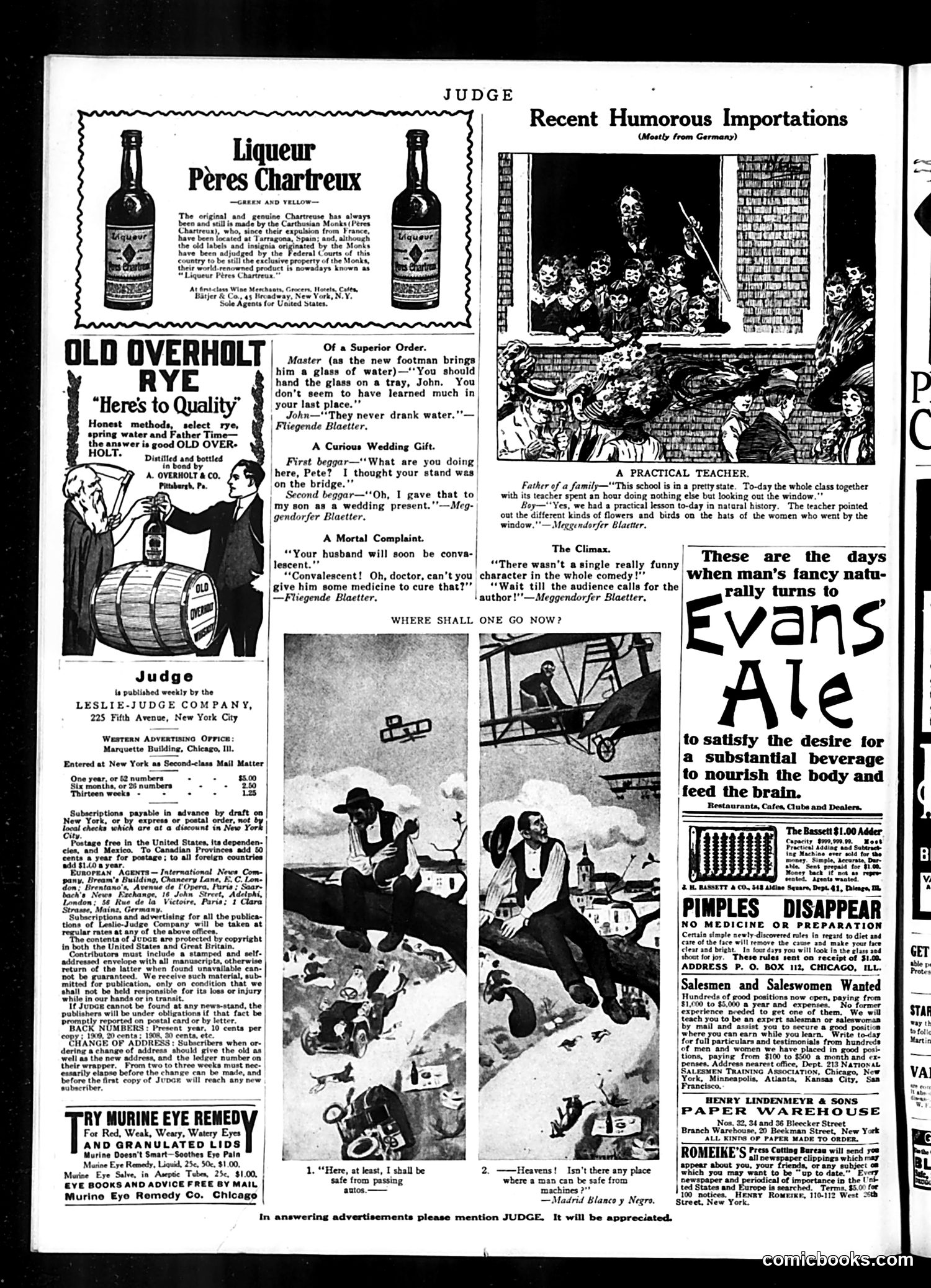
This page is primarily **advertising with humorous filler content**. The advertisements dominate (liqueur, rye whiskey, eye remedy, ale, adding machines). The "Recent Humorous Importations" section presents **translated German jokes**, mostly social satire: - A schoolmaster complains students stared out windows; the teacher claims it was a "practical lesson" in botany/ornithology by observing birds and flowers on women's hats passing by—**mocking progressive education claims**. - A beggar gives his street corner to his son as a wedding gift—**dark comedy about poverty**. - A doctor tells a man his husband will soon "convalesce," but the wife asks for medicine to cure him entirely—**domestic satire about unwanted spouses**. - Two final panels show someone avoiding automobiles by hiding—**early auto-age anxiety humor**. These German imports reflect Judge's interest in European satire. The jokes target pretension, domestic friction, and modern urban anxieties common to 1910s audiences across both continents.
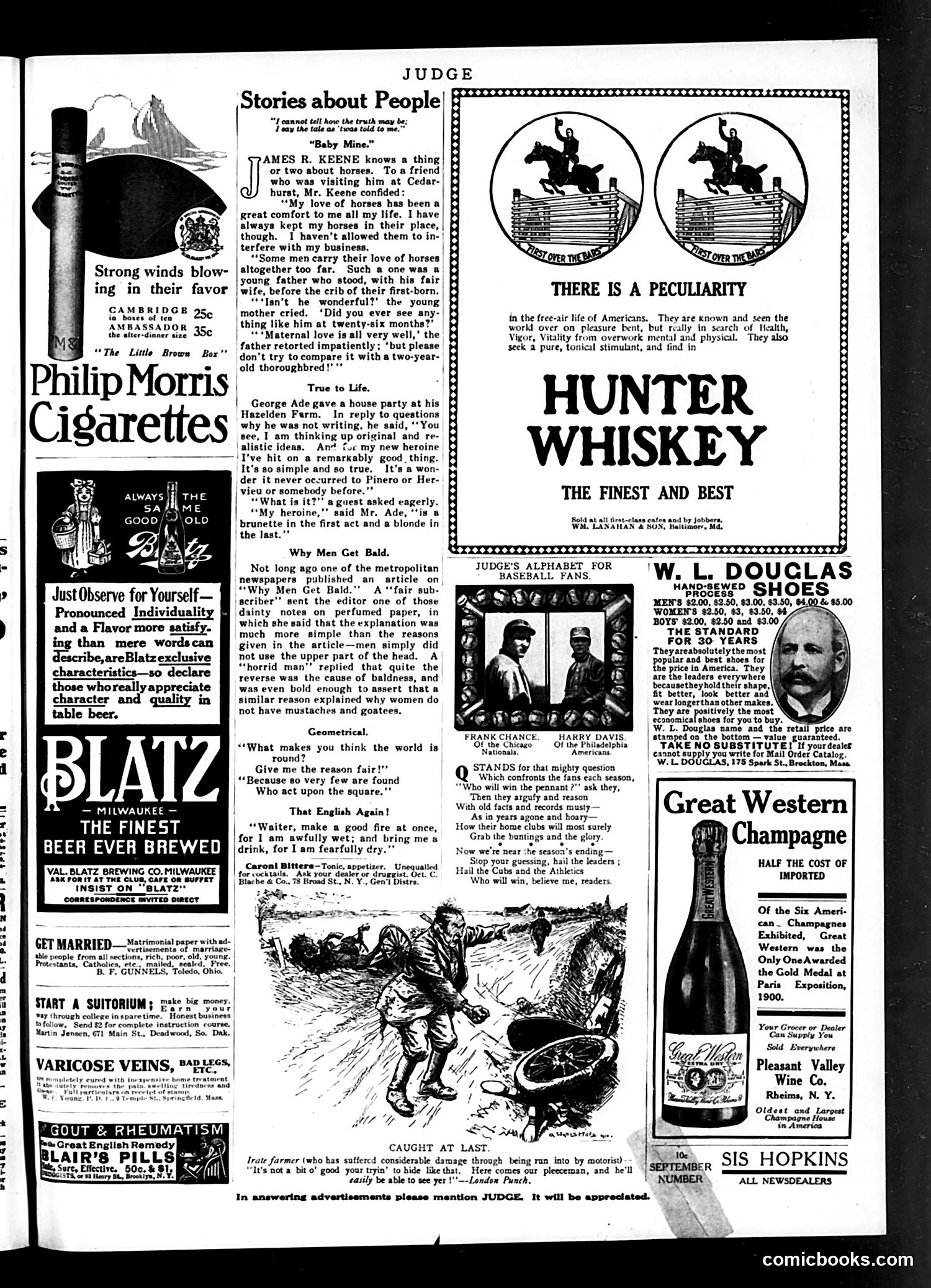
This is primarily an **advertising page** with scattered short humor pieces, typical of Judge magazine's format. The main content includes: **Anecdotes**: Three brief humorous stories about notable figures (James R. Keene on horses, George Ade on writing) illustrating human quirks—a father comparing his newborn unfavorably to a racehorse; a writer struggling for original ideas. **Jokes about baldness and geometry**: Period humor playing on gender stereotypes (why men go bald vs. why women lack beards; why the world is "round" because few "act upon the square"). **Advertisements** dominate: Philip Morris cigarettes, Blatz beer, Hunter whiskey, W.L. Douglas shoes, Great Western Champagne, and patent medicine remedies (for varicose veins, gout). These ads reflect early 20th-century commercial products and marketing approaches. **"Judge's Alphabet for Baseball Fans"** appears mentioned but isn't fully visible. The page lacks coherent political satire—it's essentially a product catalog dressed in light entertainment, representing Judge's commercial model of that era.
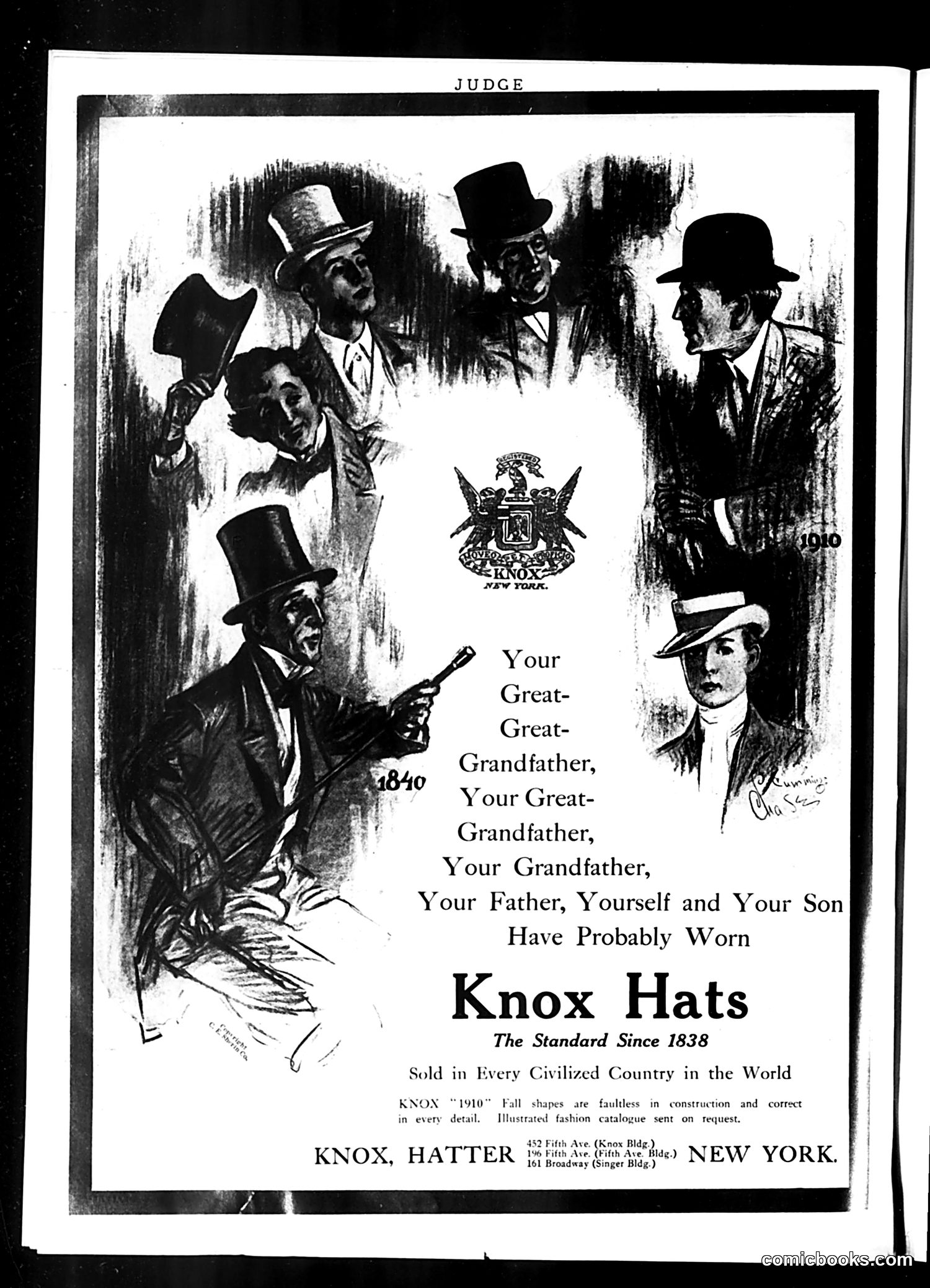
This is a **product advertisement**, not political satire. It promotes Knox Hats, a real New York hatmaker established in 1838. The illustration shows six men in formal dress spanning different generations—labeled from 1840 onward—each wearing a top hat. The copy claims Knox hats have been "the standard" for over 70 years, suggesting their longevity and respectability across generations. The humor is gentle: the exaggerated caricatured faces and the genealogical conceit suggest that wearing Knox hats is so traditional it's practically hereditary. For a 1910 audience, top hats signified respectability and social standing, so the ad positions Knox as the choice of established gentlemen. This represents early 20th-century advertising's appeal to tradition and status—implying that proper men, across generations, chose Knox.