
Judge, 1910-09-24 · page 11 of 16
Judge — September 24, 1910 — page 11: what you’re looking at
What you’re looking at
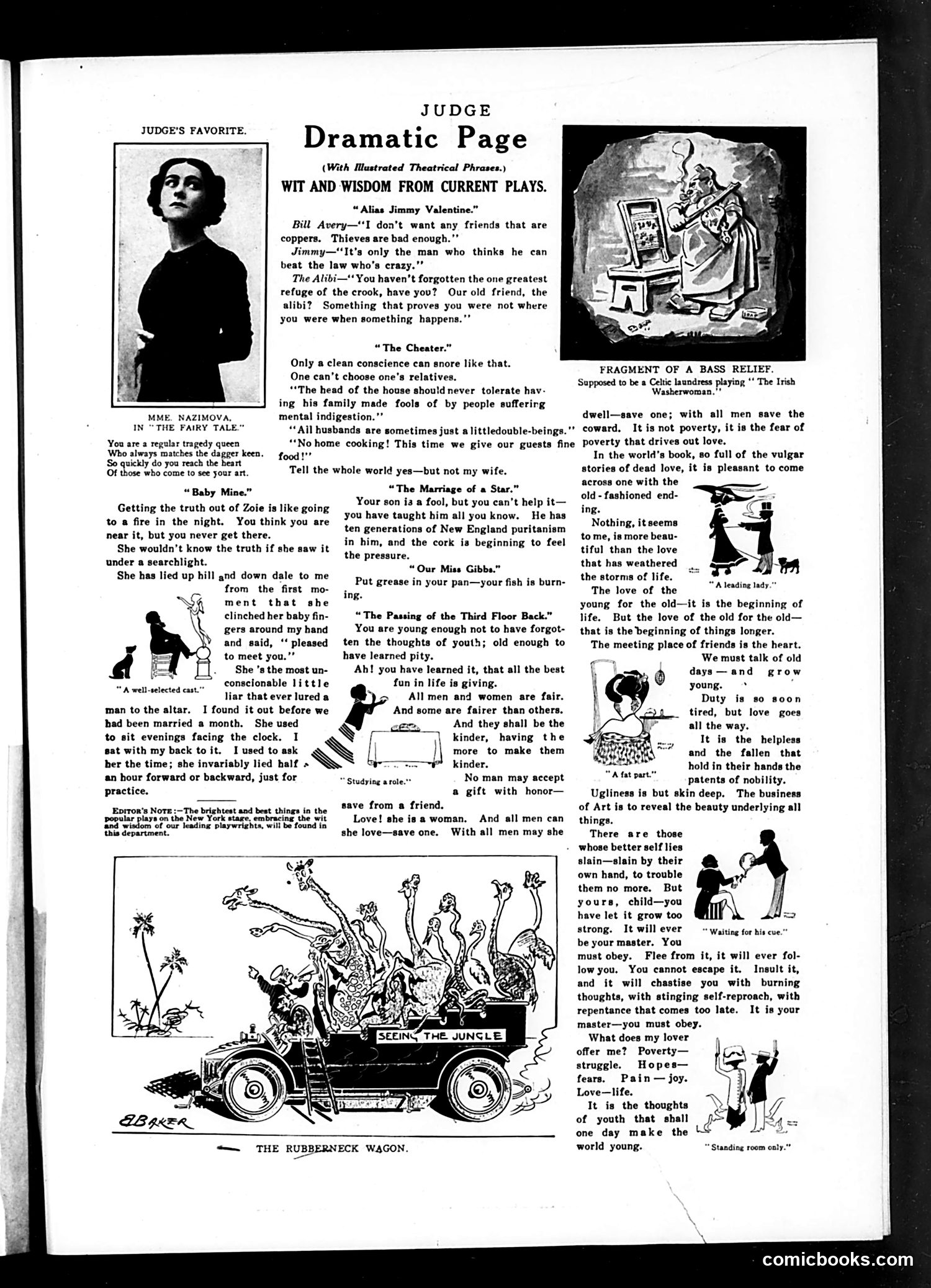
This page excerpts witty dialogue from popular Broadway plays of the era (appearing to be early 1910s), presenting theatrical wisdom for readers. The plays referenced—"Alias Jimmy Valentine," "The Cheater," "Baby Mine," "The Marriage of a Star," and "The Passing of the Third Floor Back"—were contemporary hits. The satire operates on two levels: the quoted lines humorously capture universal human truths (marriage follies, criminal psychology, conscience), while accompanying illustrations provide visual jokes. For instance, one cartoon shows a woman waiting anxiously—likely referencing romantic entanglement themes common in period comedies. The page's appeal lay in offering audiences clever zingers from successful plays they might attend, functioning as both entertainment preview and philosophical commentary. Lines like "All you have learned it, that all the best fun in life is giving" reflect the sentimental yet witty tone characteristic of early-twentieth-century American theater. The accompanying illustrations by various artists reinforce comedic points through visual caricature, a Judge magazine trademark.
📄 Transcribed text from this page (OCR, searchable)
Machine-transcribed from the original scan — historical spelling and the odd misread are preserved.
JUDGE Dramatic Page (With Mlustrated Theatrical Phrases.) WIT AND WISDOM FROM CURRENT PLAYS. “Alias Jimmy Valentine.” Bill. Avery—I don't want any friends that are coppers. Thieves are bad enough.” Jimmy—“‘It’s only the man who thinks he can beat the law who's crazy.’’ The Alibi—‘* You haven't forgotten the one greatest refuge of the crook, have you? Our old friend, the alibi?) Something that proves you were not where you were when something happens.”* JUDGE'S FAVORITE. “The Cheater.” Only a clean conscience can snore like that. FRAGMENT OF A BASS RELIEF. One can’t choose one's relatives. Sopposed to be a Celtic laundress playing ‘The Trish “The head of the house should never tolerate hav- Washerwoman."* ing his family made fools of by people sufferirg MME. NAZIMOVA, mental indigestion.” IN “THE FAIRY TALE.” “Ail husbands are sometimes just alittledouble-beings.”” coward. It is not poverty, it is the fear of You are a regular tragedy queen ‘No home cooking! This time we give our guests fine Poverty that drives out love. wee always matches the dagger keen. food!" In the world’s book, 80 full of the vulgar Ot Uncmeaehs come 06 ans gout ar Tell the whole world yes—but not my wife. stories of dead love, it is pleasant to come , ‘i . across one with the “Baby Mine.” The! Marriage ot a. Star: old-fashioned end- Your son ia a fool, but you can’t help it— you have taught him all you know. He has ten generations of New England puritanism dwell—save one; with all men save the ing. Nothing, it seems to me, is more beau- tiful than the love that has weathered Getting the truth out of Zoie is like going to a fire in the night. You think you are near it, but you never get there. : ra She woulde't know the truth if she saw it 2 him, and the cork ia beginning to feel ; the pressure. under a searchlight. «Our Miss Gitihe” She has lied up hill qnd down dale to me put grease in your pan—your fish is burn- the storms of life. from the first mo- ing, The love of the Sh ment that she young for the old—it is the beginning of clinchedher baby fin- “The Passing of the Third Floor Back.” life. But the love of the old for the old— gers around my hand You are young enough not to have forgot- that is the beginning of things longer. and , ‘pleased ten the thoughts of youth; old enough to The meeting place of friends is the heart. to meet you.”” have learned pity. mn We must talk of old She 'sthe mostun- Ab! you have learned it, that all the best = {. days—and grow conscionable little fun in life is giving. { young. * ‘ liar that ever lured a ‘ye All'men and women are fair. Duty is so soon man to the altar. I found it out before we And some are fairer than others. = tired, but love goes had been married a month. She used : And they shall be the } f all the way. to sit evenings facing the clock. I kinder, having the : a It is the helpless eat with my back to it. I used to ask more to make them mide “* and the fallen that her the time; she invariably lied half » kinder. 4 hold in their hands the an hour forward or backward, just for * Studying a tole.” No man may accept patents of nobility. practice. a gift with honor— i is but skin deep. The business Eprron’s Nore:—The brightest and best things in the | 88V€ from a friend. of Art is to reveal the beauty underlying all popular plays on the New York stare, embracing the wit Love! she ia a woman. And all men can things. this department. she love—save one. With all men may she There are those . whose better self lies slain—slain by their @& own hand, to trouble them no more. But yours, child—you have let it grow too strong. It will ever = Waiting for his cve.” be your master. You must obey. Flee from it, it will ever fol- low you, You cannot escape it. Insult it, and it will chastise you with burning thoughts, with stinging self-reproach, with repentance that comes too late. It is your master—you must obey. What does my lover offer me? Poverty— struggle. Hopes: fears. Pain — joy. Love—life. It is the thoughts of youth that shall f) one day make the \& “— THE RUBBERNECK WAGON. world young. “ Standing room only.”* — "A leading lady.”* A well-selected cast.” comicbooks.com