
Judge, 1910-09-24 · page 5 of 16
Judge — September 24, 1910 — page 5: what you’re looking at
What you’re looking at
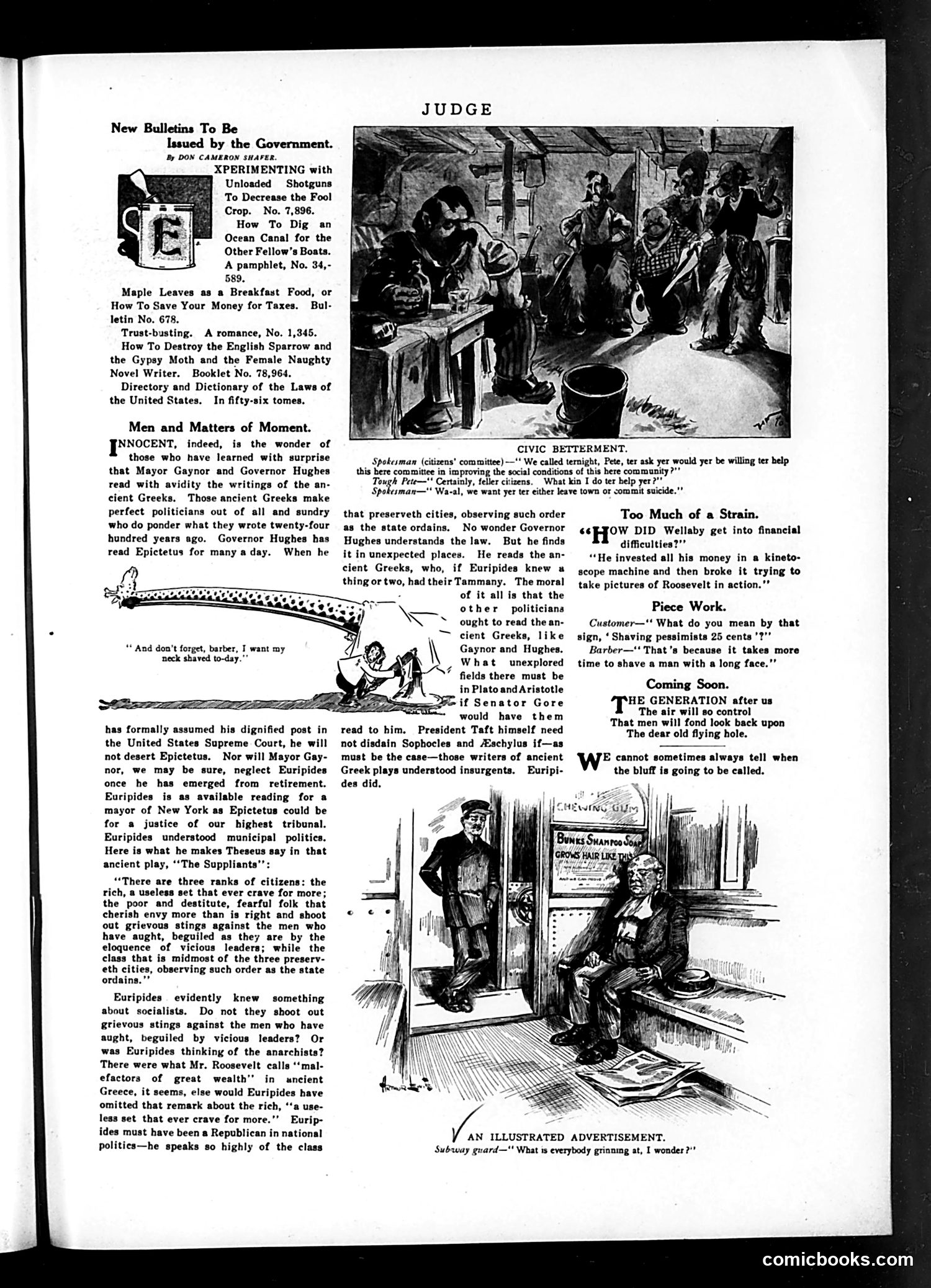
This page contains political commentary referencing Governor Hughes (likely Charles Evans Hughes of New York) and his understanding of classical Greek philosophy and governance. The article "Men and Matters of Moment" argues that Hughes, like ancient Greek leaders Solon and Pericles, should read the classics to understand proper civic order and law. The cartoons appear satirical: one shows a barber scene with political commentary, another depicts what's labeled "Civic Betterment" with citizens' committee discussing social improvement. A third cartoon, "An Illustrated Advertisement," shows a subway guard with unclear satirical intent. The page critiques how politicians should be educated in classical wisdom to govern effectively, contrasting their actual conduct with idealized ancient democratic principles. The specific historical context and all figure identifications cannot be definitively established from the image alone.
📄 Transcribed text from this page (OCR, searchable)
Machine-transcribed from the original scan — historical spelling and the odd misread are preserved.
New Bulletins To Be Issued by the Government. By DON CAMERON SHAFER. XPERIMENTING with Unloaded Shotguns To Decrease the Foo! Crop. No. 7,896. How To Dig an Ocean Canal for the Other Fellow’s Boats. ‘A pamphlet, No. 34,- 589, Maple Leaves as a Breakfast Food, or How To Save Your Money for Taxes. Bul- letin No. 678. ‘Trust-busting. A romance, No. 1,345. How To Destroy the English Sparrow and the Gypsy Moth and the Female Naughty Novel Writer. Booklet No. 78,964. Directory and Dictionary of the Laws of the United States. In fifty-six tomes. Men and Matters of Moment. NNOCENT, indeed, is the wonder of those who have learned with surprise that Mayor Gaynor and Governor Hughes read with avidity the writings of the an- cient Greeks. Those ancient Greeks make perfect politicians out of all and sundry who do ponder what they wrote twenty-four hundred years ago. Governor Hughes has read Epictetus for many aday. When he has formally assumed his dignified post in the United States Supreme Court, he will not desert Epictetus. Nor will Mayor Gay- nor, we may be sure, neglect Euripides once he has emerged from retirement. Euripides is as available reading for a mayor of New York as Epictetus could be for a justice of our highest tribunal. Euripides understood municipal politics. Here is what he makes Theseus say in that ancient play, ‘The Suppliants’”’: “There are three ranks of citizens: the rich, a useless set that ever crave for more; the poor and destitute, fearful folk that cherish envy more than is right and shoot out grievous stings against the men who have aught, beguiled as they are by the eloquence of vicious leaders; while the class that is midmost of the three preserv- eth cities, observing such order as the state ordains."” Euripides evidently knew something about socialists. Do not they shoot out grievous stings against the men who have aught, beguiled by vicious leaders? Or was Euripides thinking of the anarchists? There were what Mr. Roosevelt calls ‘‘mal- efactors of great wealth’? in ancient Greece, it seems, else would Euripides have omitted that remark about the rich, ‘‘a use- less set that ever crave for more."” Eurip- ides must have been a Repu! in in national polities—he speaks so highly of the class CIVIC BETTERMENT. Spokesman (citizens' committee) —"* We called ternight, Pete, ter ask yer would yer be willing ter belp this here committee in improving the social conditions of this here community ?"" Tough Pete—'' Certainly, feller citizens. ‘What kin I do ter help yer ?"" Spokesman—" Wa-al, we want yer ter either leave town or commit suicide." that preserveth cities, observing such order as the state ordains. No wonder Governor Bughes understands the law. But he finds it in unexpected places. He reads the an- cient Greeks, who, if Euripides knew a thing or two, had their Tammany. The moral : of it all is that the other politicians ought to read the an- cient Greeks, like Gaynor and Hughes. What unexplored fields there must be in Plato and Aristotle if Senator Gore would have them read to him. President Taft himself need not disdain Sophocles and AEschylus if—as must be the case—those writers of ancient Greek plays understood insurgents. Euripi- des did. Too Much of a Strain. 66 FJOW DID Wellaby get into financial difficulties?”’ “He invested all his money in a kineto- scope machine and then broke it trying to take pictures of Roosevelt in action.”” Piece Work. Customer—‘‘ What do you mean by that sign, ‘ Shaving pessimists 25 cents '?"" Barber—‘‘ That's because it takes more time to shave a man with a long face.”” Coming Soon. HE GENERATION after us The air will 80 control That men will fond look back upon The dear old flying hole. WE cannot sometimes always tell when the bluff is going to be called. I ILLUSTRATED ADVERTISEMENT. Subway guard—'' What is everybody grinning at, I wonder ?"’ comicbooks.com