
Judge, 1910-09-24 · page 4 of 16
Judge — September 24, 1910 — page 4: what you’re looking at
What you’re looking at
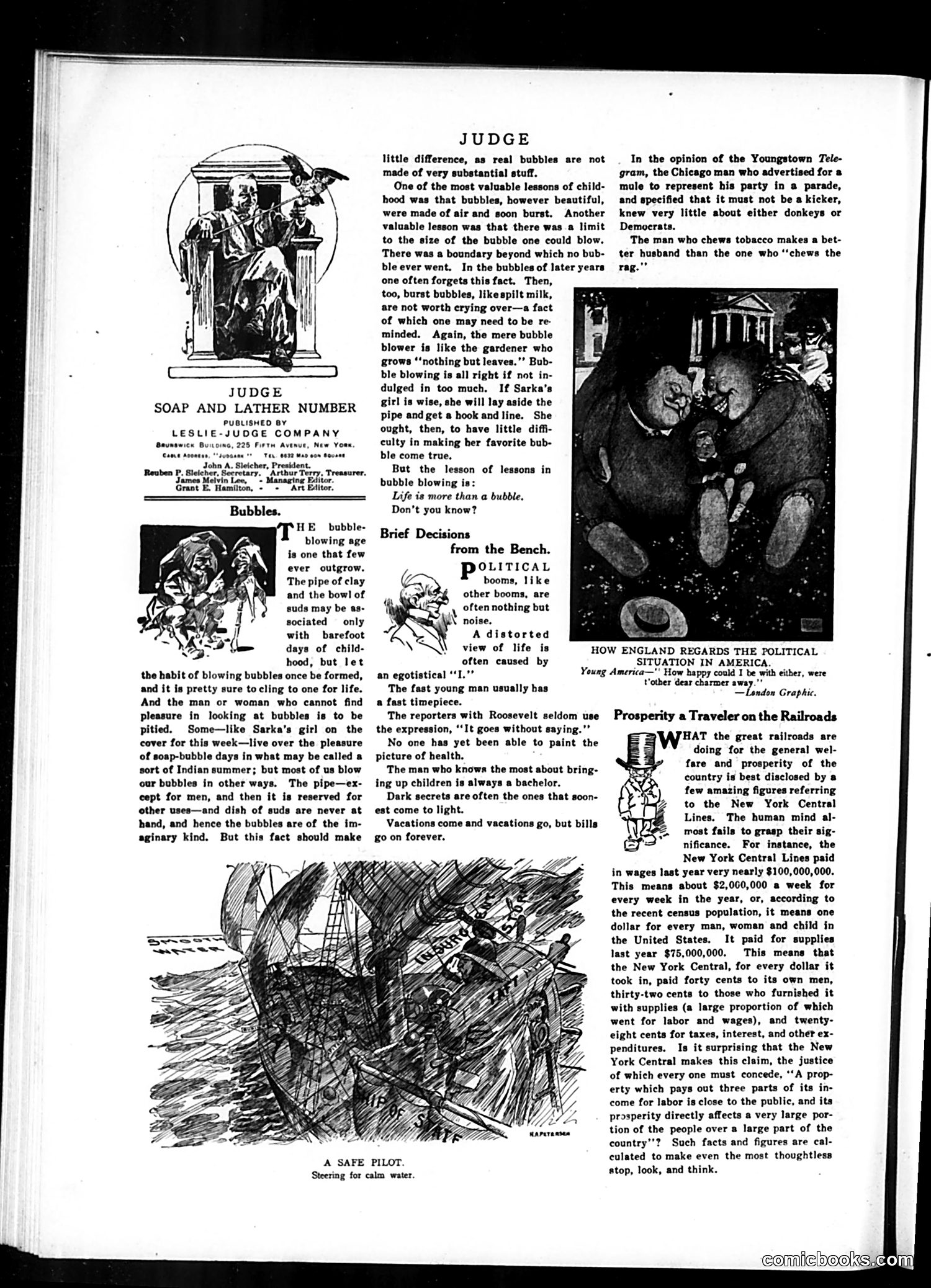
This page contains three distinct sections: 1. **"Judge: Soap and Lather Number"** - A cover illustration showing Lady Justice, likely promoting an issue themed around cleanliness/reform ("soap and lather" being metaphors for purification). 2. **"Bubbles"** - An essay about bubble-blowing as a childhood lesson, offering philosophical observations about life's limits and boundaries. 3. **"Prosperity a Traveler on the Railroads"** - An article with statistics about the New York Central Lines' massive wages ($100,000,000 annually) and economic impact. The accompanying sketch shows a safe pilot "steering for calm water," suggesting railroad prosperity reflects broader national economic health. The page functions as both satirical commentary and informational journalism typical of Judge magazine's format, mixing humor with social observation and economic analysis.
📄 Transcribed text from this page (OCR, searchable)
Machine-transcribed from the original scan — historical spelling and the odd misread are preserved.
JUDGE SOAP AND LATHER NUMBER PUBLISHED BY LESLIE-JUDGE COMPANY rer. HE_ bubble- blowing age is one that few ever outgrow. The pipe of clay and the bowl of suds may be as- sociated only with barefoot days of child- hood, but let the habit of blowing bubbles once be formed, and it is pretty sure to cling to one for life. And the man or woman who cannot find pleasure in looking at bubbles is to be pitied. Some—like Sarka’s girl on the cover for this week—live over the pleasure of soap-bubble days in what may be called sort of Indian summer; but most of us blow our bubbles in other ways. The pipe—ex- cept for men, and then it is reserved for other uses—and dish of suds are never at hand, and hence the bubbles are of the im- aginary kind, But this fact should make SS JUDGE little difference, as real bubbles are not made of very substantial stuff. One of the most valuable lessons of child- hood was that bubbles, however beautiful, were made of air and soon burst. Another valuable lesson was that there was a limit to the size of the bubble one could blow. There was a boundary beyond which no bub- ble ever went. In the bubbles of later years one often forgets this fact. Then, too, burst bubbles, like spilt milk, are not worth erying over—a fact of which one may need to be re- minded. Again, the mere bubble blower is like the gardener who grows “‘nothing but leaves.’” Bub- ble blowing is all right if not in- dulged in too much. If Sarka’s girl is wise, she will lay aside the pipe and get a hook and line. She ought, then, to have little diffi- culty in making her favorite bub- ble come true. But the lesson of lessons in bubble blowing is: Life is more than a bubble. Don’t you know? Brief Decisions from the Bench. OLITICAL booms, like other booms, are ’ often nothing but \ noise. A distorted view of life is often caused by an egotistical ‘‘I.”” The fast young man usually has a fast timepiece. The reporters with Roosevelt seldom use the expression, ‘It goes without saying. No one has yet been able to paint the picture of health. The man who knows the most about bring- ing up children is always a bachelor. Dark secrets are often the ones that soon- est come to light. Vacations come and vacations go, but bills go on forever. A SAFE PILOT. Steering for calm water. In the opinion of the Youngstown Tele- gram, the Chicago man who advertised for a mule to represent his party in a parade, and specified that it must not be a kicker, knew very little about either donkeys or Democrats. The man who chews tobacco makes a bet- ter husband than the one who ‘‘chews the HOW ENGLAND REGARDS THE POLITICAL SITUATION IN AMERICA. Young America—"' How happy could I be with either, were other dear charmer away.”” "London Graphic. Prosperity a Traveler on the Railroads HAT the great railroads are doing for the general wel- fare and prosperity of the country is best disclosed by a few amazing figures referring to the New York Central Lines. The human mind most fails to grasp their 8 nificance. For instance, the New York Central Lines paid in wages last year very nearly $100,000,000. This means about $2,060,000 a week for every week in the year, or, according to the recent census population, it means one dollar for every man, woman and child in the United States. It paid for supplies last year $75,000,000. This means that the New York Central, for every dollar it took in, paid forty cents to its own men, thirty-two cents to those who furnished it with supplies (a large proportion of which went for labor and wages), and twenty- eight cents for taxes, interest, and other ex- penditures. Is it surprising that the New York Central makes this claim, the justice of which every one must concede, *‘A prop- erty which pays out three parts of its in- come for labor is close to the public, and its prosperity directly affects a very large por- tion of the people over a large part of the Such facts and figures are cal- country’"? culated to make even the most thoughtless stop, look, and think. comichooks,