
A complete issue · 24 pages · 1910
Judge — April 23, 1910
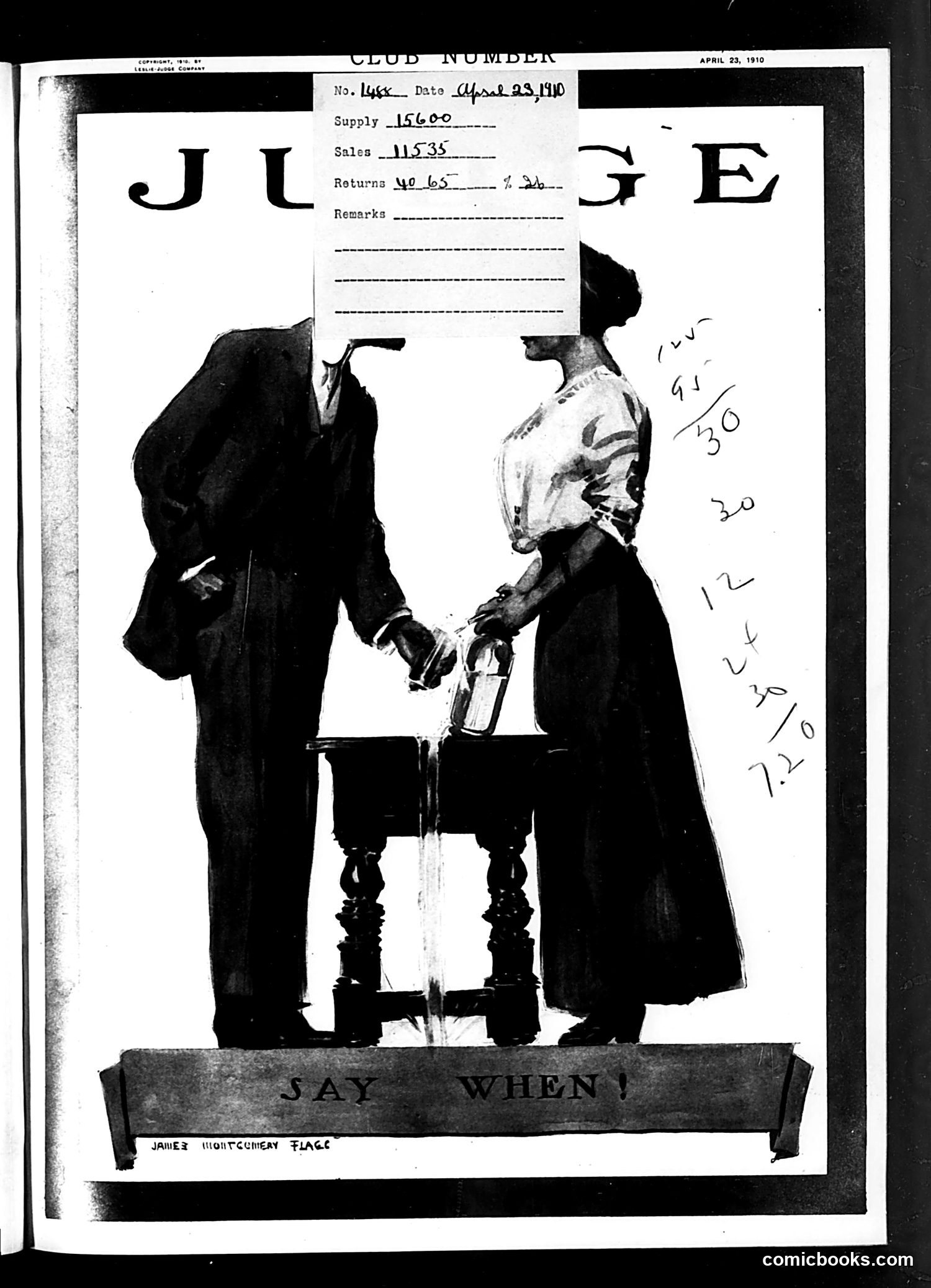
This is a "Say When!" cartoon showing two figures in formal attire shaking hands over what appears to be a small table or platform. The phrase "Say When!" suggests a transaction or agreement where one party controls the timing or terms. The publication data indicates this is from April 23, 1910. Without clearer identification of the specific figures or captions beyond what's visible, I cannot definitively identify who these individuals represent or what particular political/social event this satirizes. The cartoon's style is consistent with Judge magazine's satirical approach to contemporary politics and social issues of the Progressive Era. The formal dress and handshake suggest a business or political negotiation being mocked, but the specific context requires additional identifying information not clearly legible in this reproduction.
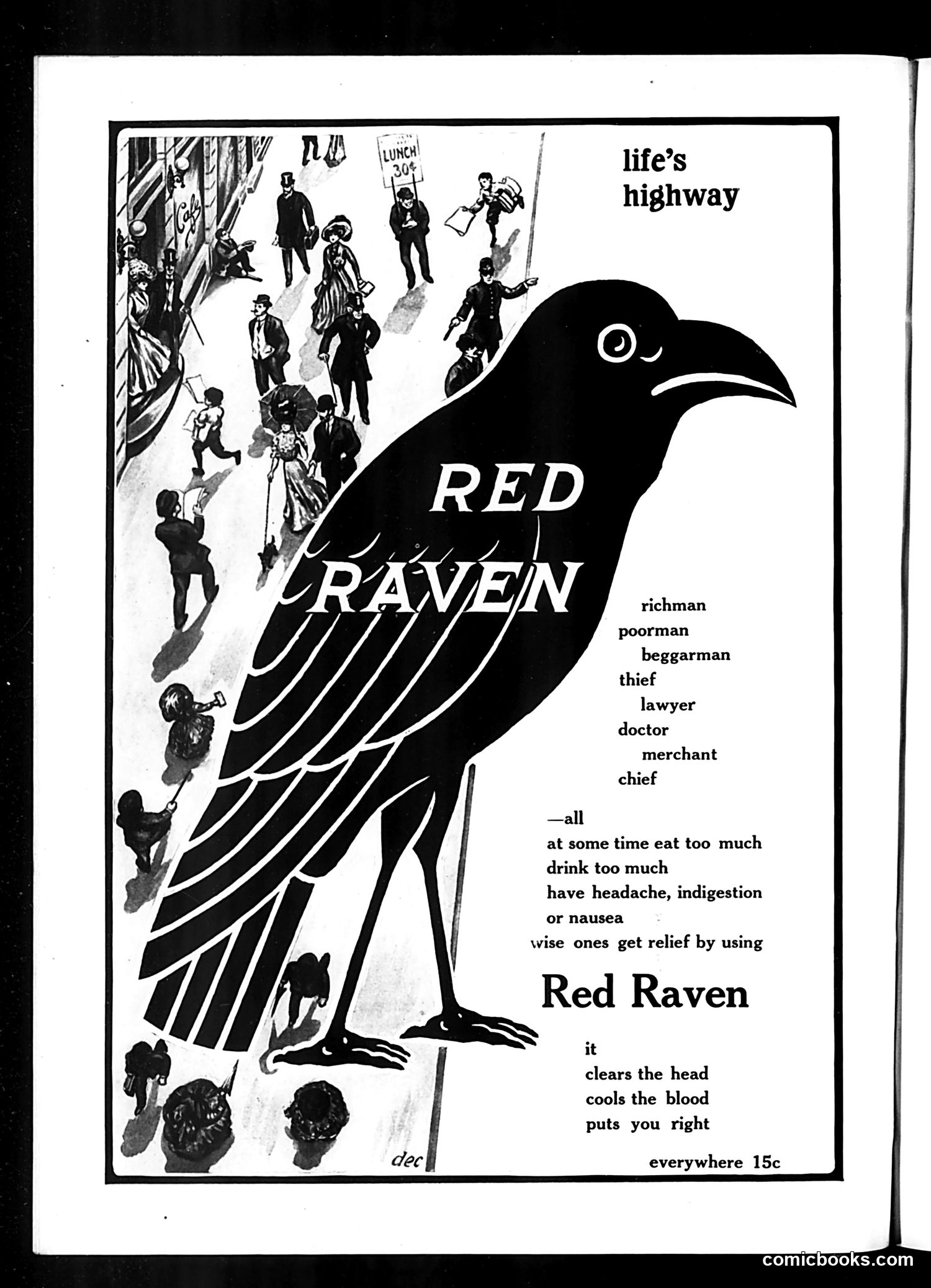
This page is primarily **advertising**, not political satire. It advertises "Red Raven," a patent medicine or digestive aid from the early 20th century (price: 15¢). The "life's highway" illustration on the left shows various social types (richman, poorman, beggarman, thief, lawyer, doctor, merchant, chief) climbing or descending a path—a visual metaphor suggesting that all walks of life face common ailments. The advertisement's claim is straightforward: regardless of social status, everyone occasionally overeats or drinks too much, causing headaches, indigestion, or nausea. Red Raven's purported solution is to "clear the head," "cool the blood," and "put you right." This reflects the era's widespread marketing of patent medicines as cure-alls for various complaints.
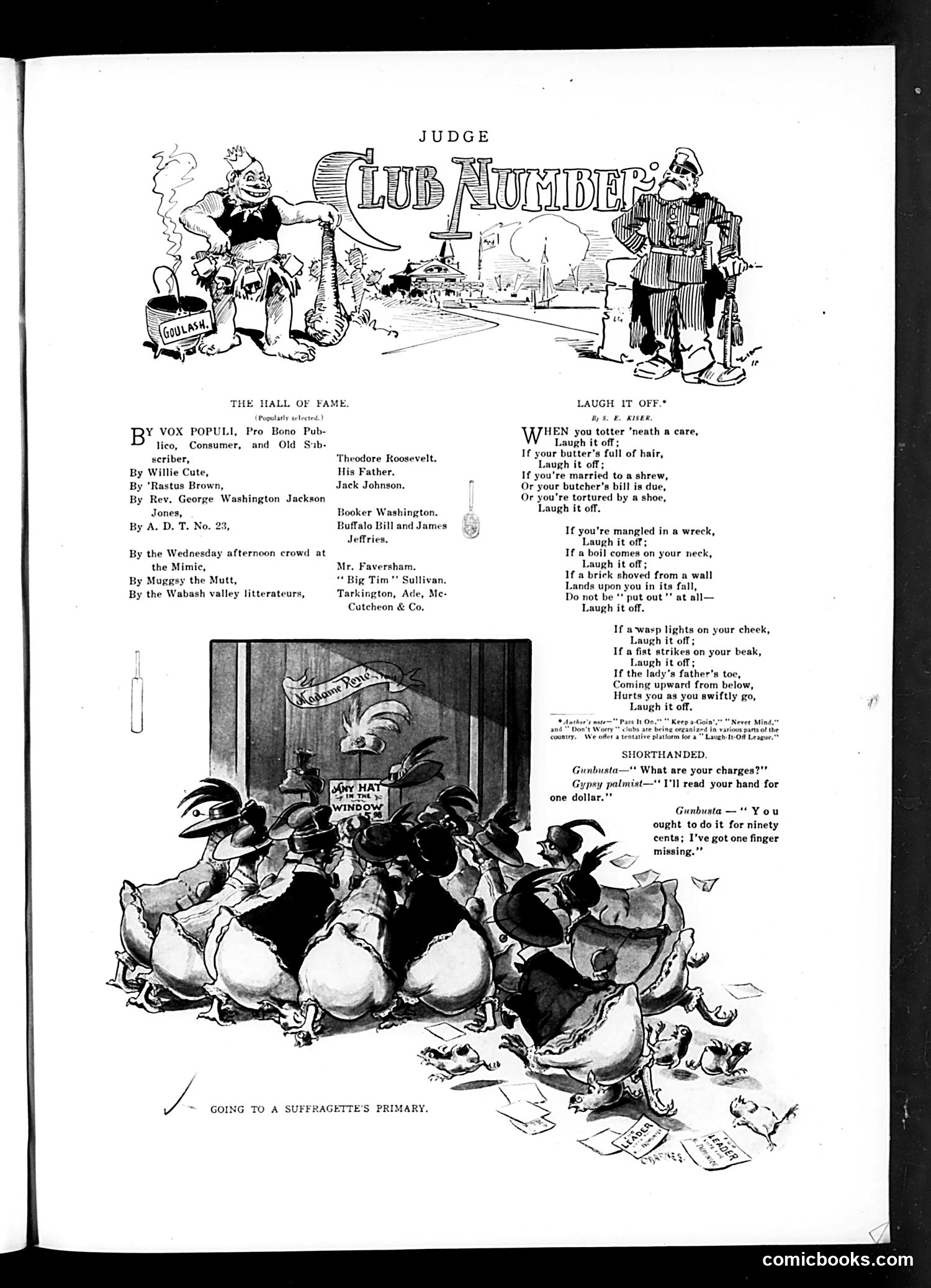
This Judge magazine page satirizes the women's suffrage movement through caricature and humor. The bottom illustration, "Going to a Suffragette's Primary," depicts women with exaggerated physical features in what appears to be a confrontational political gathering—likely mocking women's political participation as unseemly or unladylike. The top section credits "The Hall of Fame" to various male figures (Theodore Roosevelt, Jack Johnson, Booker Washington, Buffalo Bill), while "Laugh It Off" offers humorous advice about accepting life's misfortunes—possibly suggesting women should accept their political exclusion gracefully. The "Shorthanded" joke contrasts a gypsy palmist and someone named Gumbuata, though its connection to suffrage isn't entirely clear from the text alone. Overall, the page uses physical ridicule and dismissive humor to delegitimize women's political ambitions—typical anti-suffrage propaganda of the early 20th century.
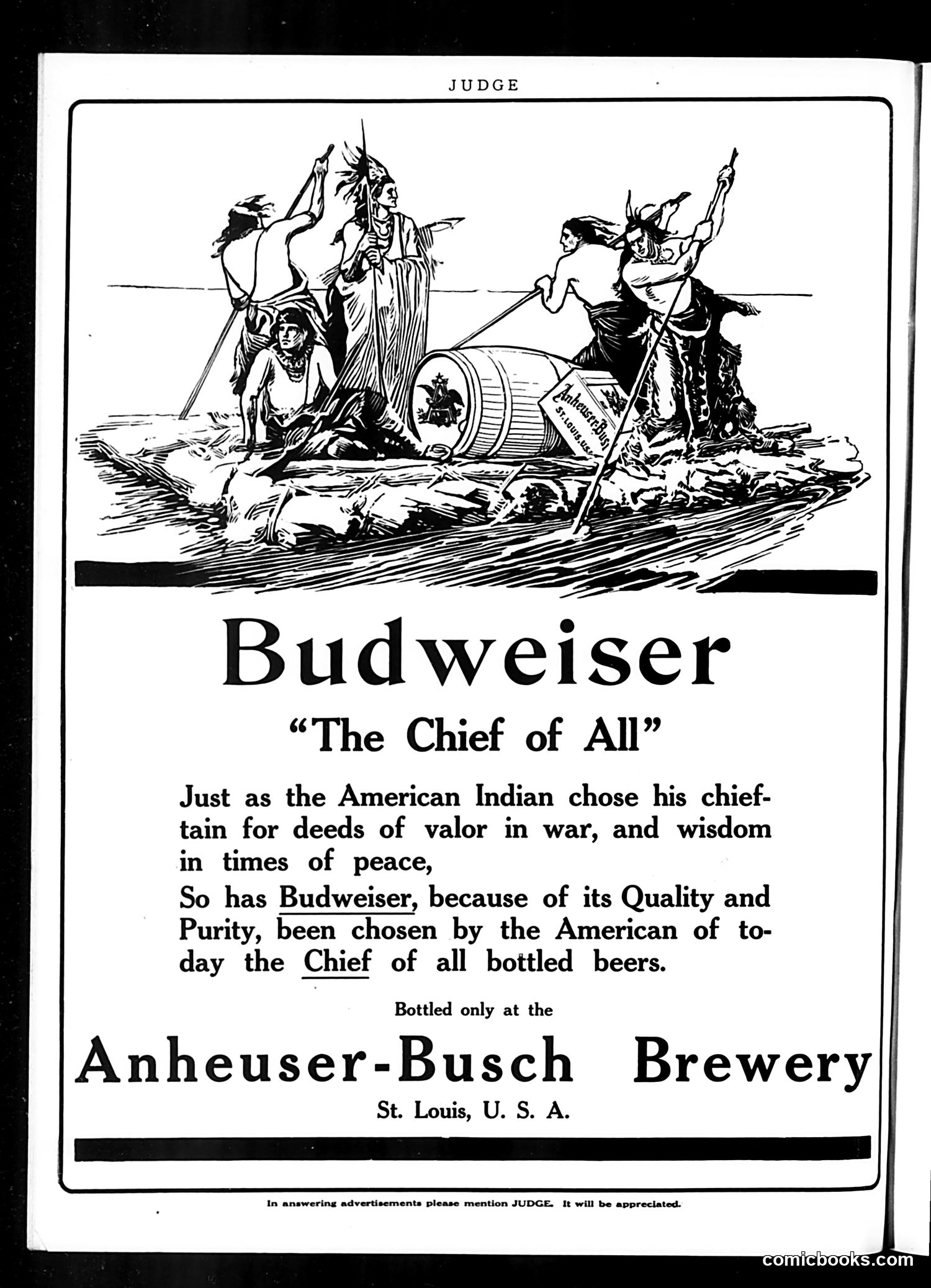
This is a **Budweiser beer advertisement**, not satirical content. It appeared in *Judge* magazine during the early 20th century. The ad uses Native American imagery to market beer, depicting what appears to be a tribal scene with figures in stereotypical dress around a barrel. The text compares Budweiser's selection as "Chief of all bottled beers" to how American Indians chose leaders based on "valor" and "wisdom." This reflects period advertising conventions that exploited Native American imagery and stereotypes to convey ideas of strength, authenticity, and natural superiority—a marketing approach now recognized as deeply offensive and appropriative. The "Anheuser-Busch Brewery" tagline identifies the St. Louis manufacturer.
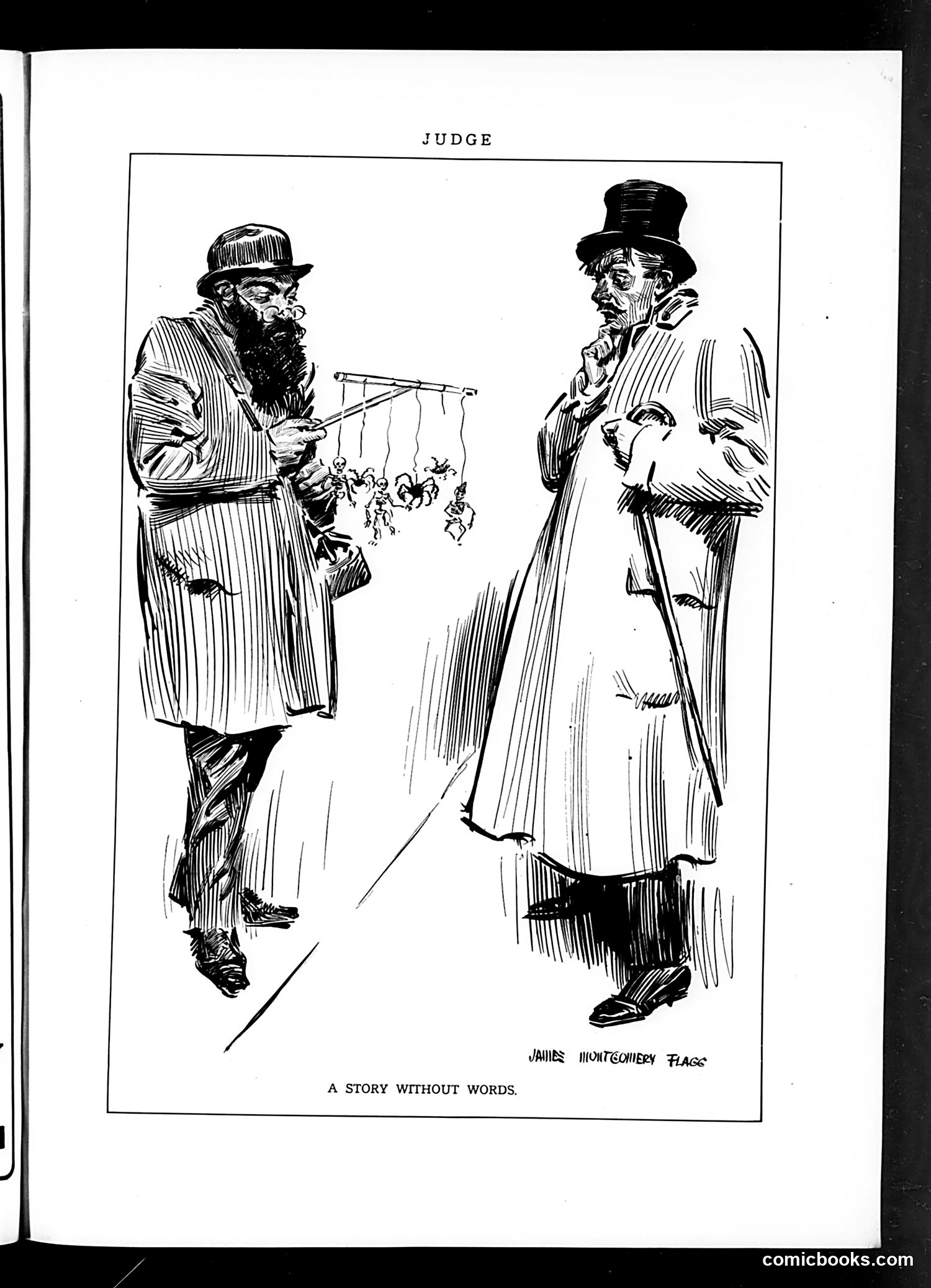
**Title:** "Judge" - "A Story Without Words" **Image:** Two men in Victorian-era clothing and top hats face each other. The man on the left holds a stick with small dangling figures (appearing to be puppets). The man on the right observes him thoughtfully. **Meaning:** This is a political allegory about manipulation and control. The figure on the left represents someone pulling strings—literally controlling others like puppets. The figure on the right appears to be a judge or authority figure observing this manipulation. The "story without words" format relies on visual metaphor: the cartoon satirizes how politicians or powerful individuals manipulate the public through control and strings-pulling, while authorities watch. **Artist credit:** James Montgomery Flagg (visible signature) The satire critiques political corruption through the classic puppet-master metaphor common in Gilded Age commentary.
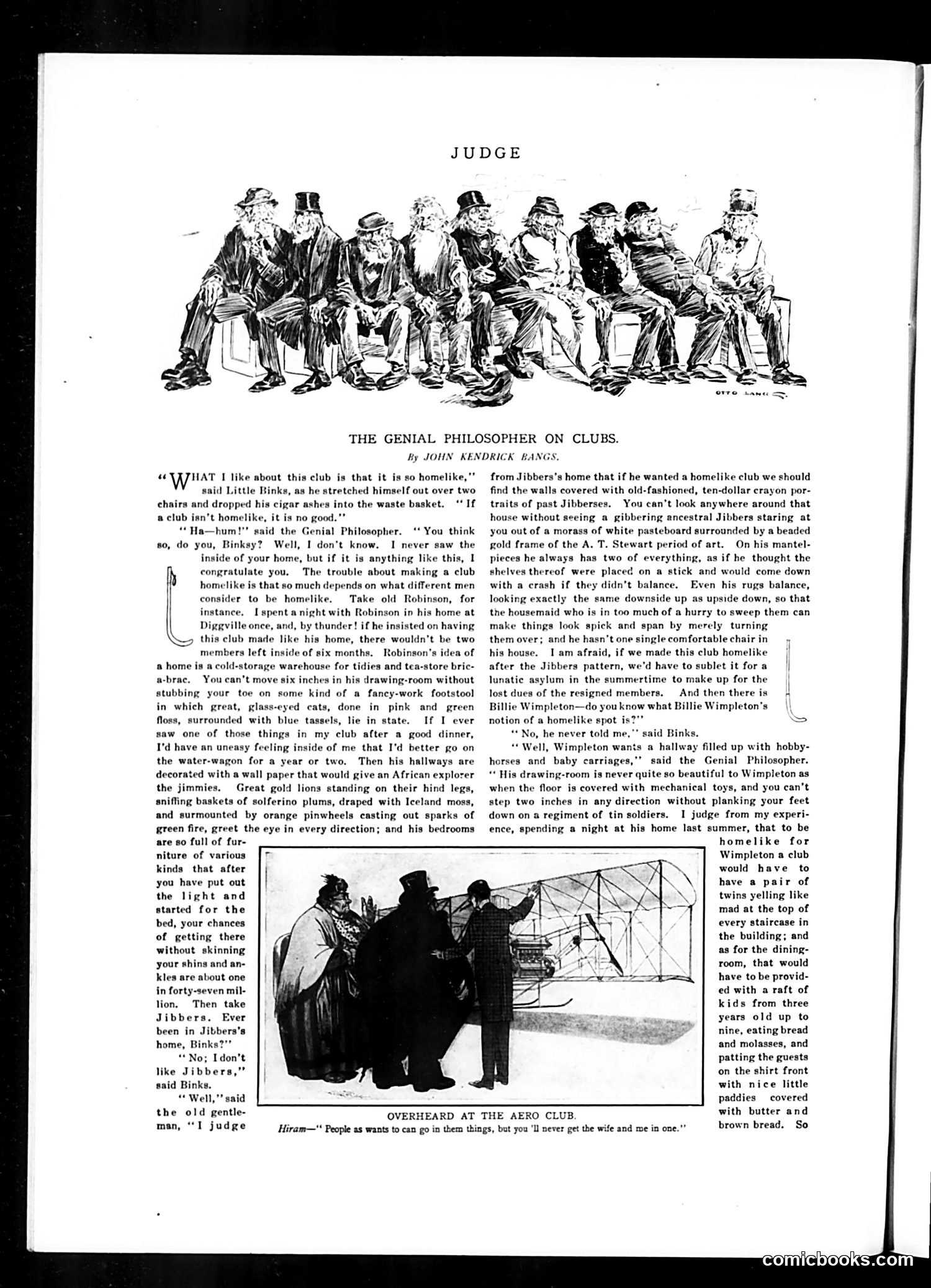
This satirical piece by John Kendrick Bangs mocks the impossibility of creating a truly "homelike" club by cataloging the absurd domestic tastes of various club members. The humor relies on exaggerated character types: Robinson obsesses over doilies and overwrought decorations; Jibbers fills his home with portraits of ancestors in cheap frames and symmetrically balanced objects; Wimpleton clutters his space with hobby-horses, baby carriages, and tin soldiers. The joke targets Gilded Age excess and the aspirational middle-class tendency to confuse cluttered ornamentation with comfort and respectability. By listing these competing domestic visions, Bangs argues that no shared "homelike" standard exists—making any club attempting such homeyness inherently chaotic. The lower cartoon's brief caption about an aeroplane club reinforces class anxieties about new technologies.
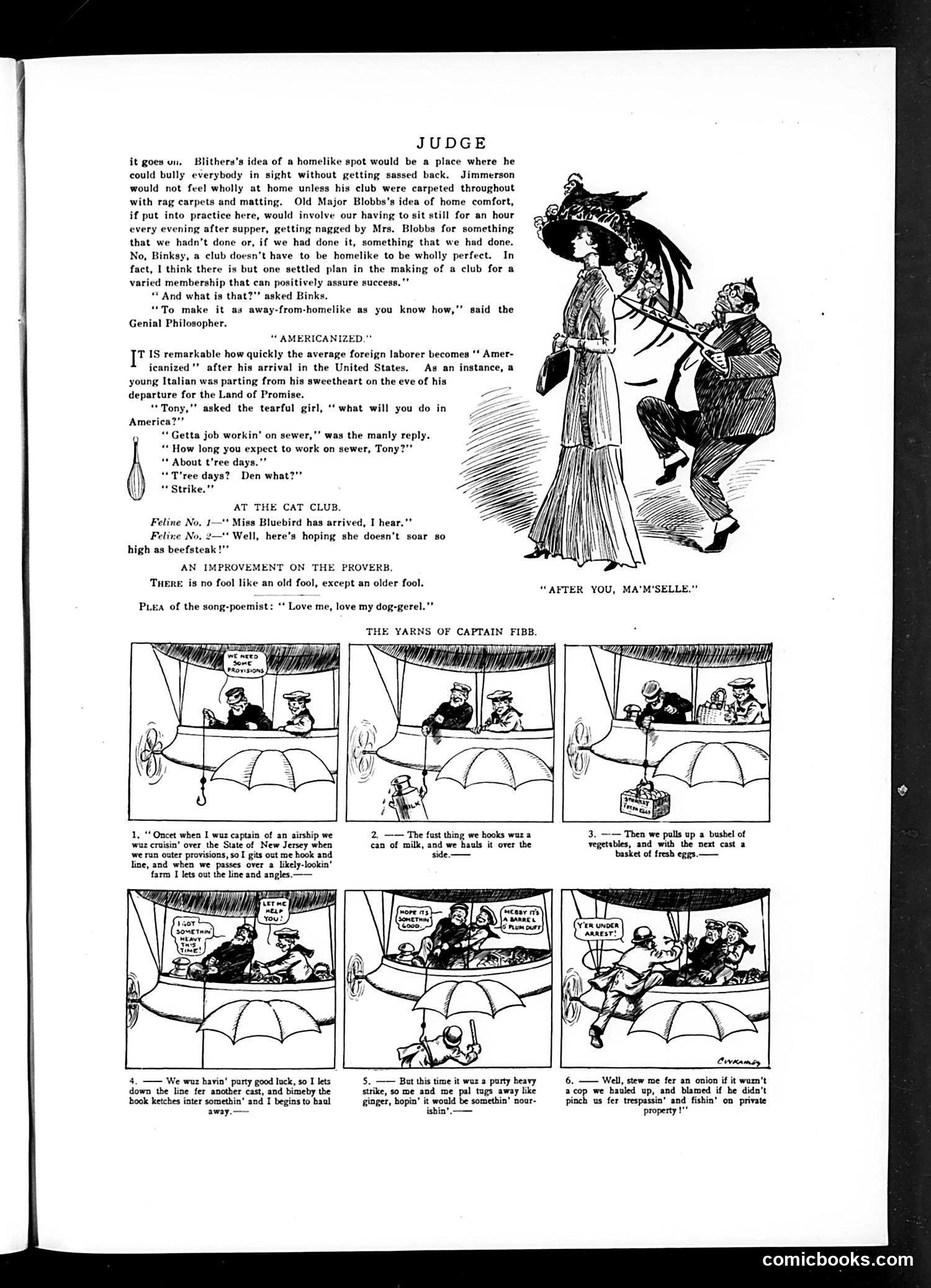
This page contains several satirical pieces typical of early 20th-century American humor: **"The Genial Philosopher"** section mocks different club members' conflicting ideas of "homelike comfort," concluding that a successful club should deliberately *avoid* being homelike—a joke about clubs serving as escapes from domestic life. **"Americanized"** satirizes rapid cultural assimilation through an Italian immigrant's immediate adoption of American labor slang and attitudes. He arrives speaking broken English and quickly adopts strike-threat rhetoric—humor playing on both immigrant stereotypes and American labor activism of the era. **"The Yarns of Captain Fibb"** is a tall-tale comic strip where an airship captain "fishes" from the sky, comically catching milk, vegetables, eggs, and finally a policeman who arrests him for trespassing—absurdist humor with no deeper political meaning. Minor items include puns about cats and wordplay ("dog-gerel"). The overall tone reflects Judge's characteristic blend of social observation, immigrant humor, and whimsical absurdism.
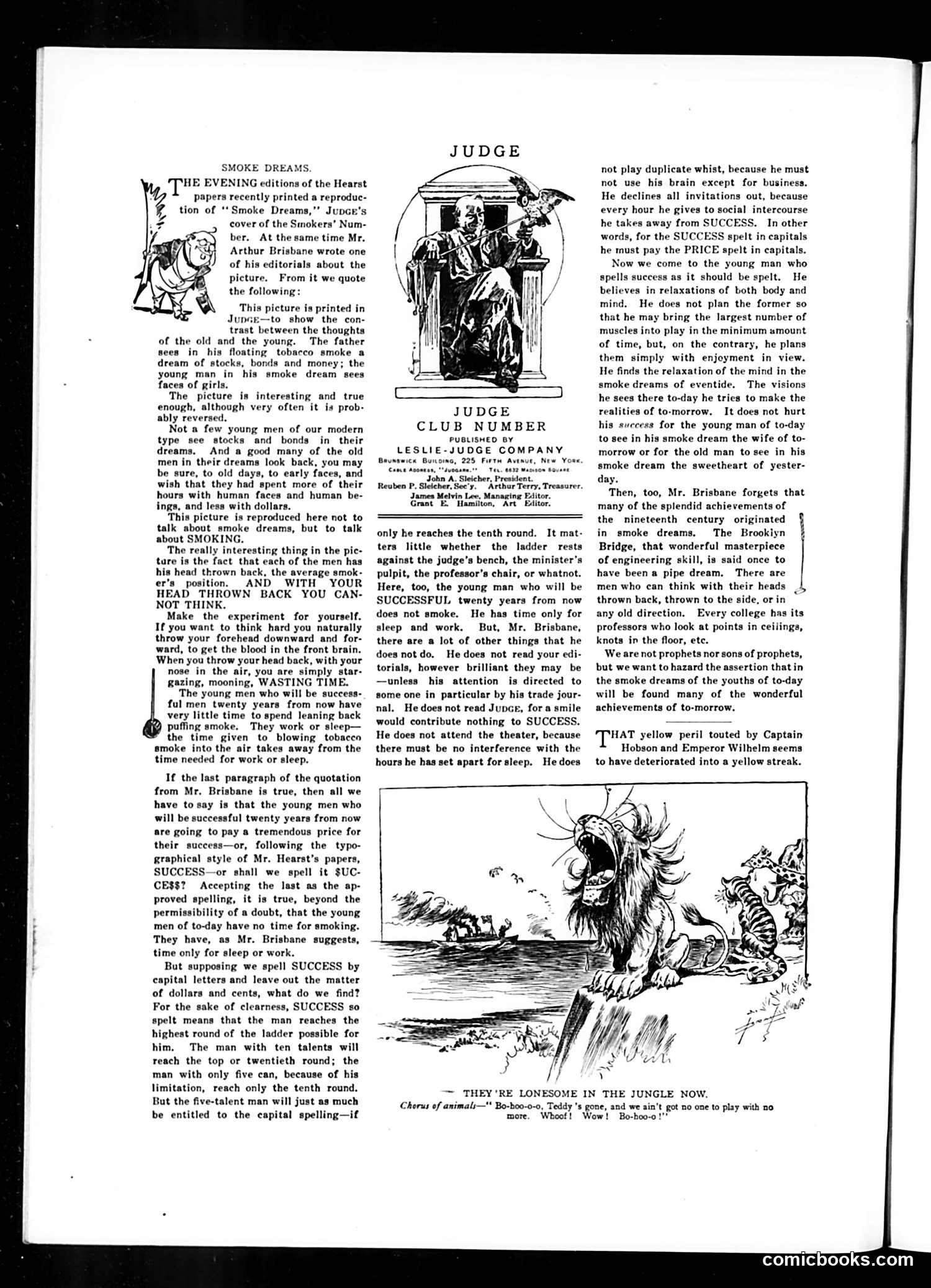
This page satirizes advice from Arthur Brisbane (a famous Hearst newspaper editor) about smoking and success. Brisbane had written that young men who throw their heads back to smoke cannot think properly, and therefore successful men don't smoke—they only work or sleep. **Judge's satire**: The magazine takes Brisbane's logic to its absurd extreme. If smoking wastes time that could go to work, then by that standard, successful people also cannot read newspapers (including Judge itself), attend theaters, or play games—basically have no leisure at all. The satire mocks Brisbane's puritanical work ethic and suggests his "SUCCESS" formula (deliberately misspelled "$UCCE$$" to emphasize greed) reduces life to mere productivity. The accompanying cartoon (bottom) shows animals in a jungle—possibly representing people reduced to their basest state by such relentless ambition. **Context**: This reflects early 20th-century debates about work-life balance and competing visions of the American success narrative.
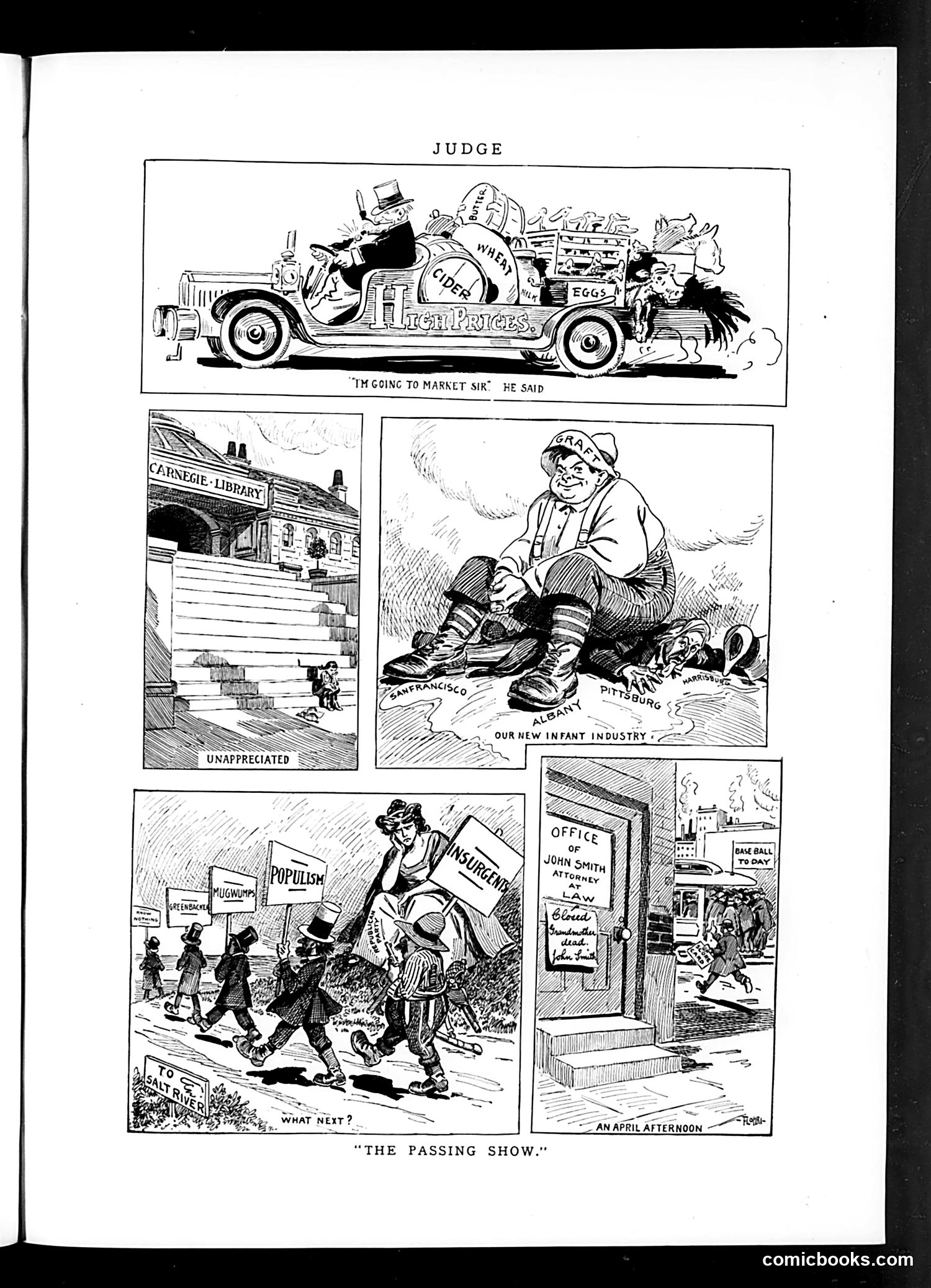
This page presents four interconnected satirical panels titled "The Passing Show," criticizing various American institutions and trends of the era. The top panel mocks inflated commodity prices, showing a merchant hauling goods labeled "HIGH PRICES" and "EGGS" to market. Below, "Unappreciated" depicts the Carnegie Library as neglected—suggesting public indifference to cultural institutions. "Our New Infant Industry" shows a fat businessman straddling cities (San Francisco, Pittsburgh, Albany), representing emerging industrial monopolies. "What Next?" depicts a large figure labeled with "Populism" and "Insurgency" being attacked by smaller figures with protest signs, satirizing political reform movements as chaotic threats. The final panel, "An April Afternoon," shows an attorney's office (appearing to reference political corruption or legal maneuvering), with baseball mentioned—likely alluding to seasonal distraction from serious civic issues. Overall, the page critiques capitalism, monopolies, populist politics, and public apathy circa early 1900s.
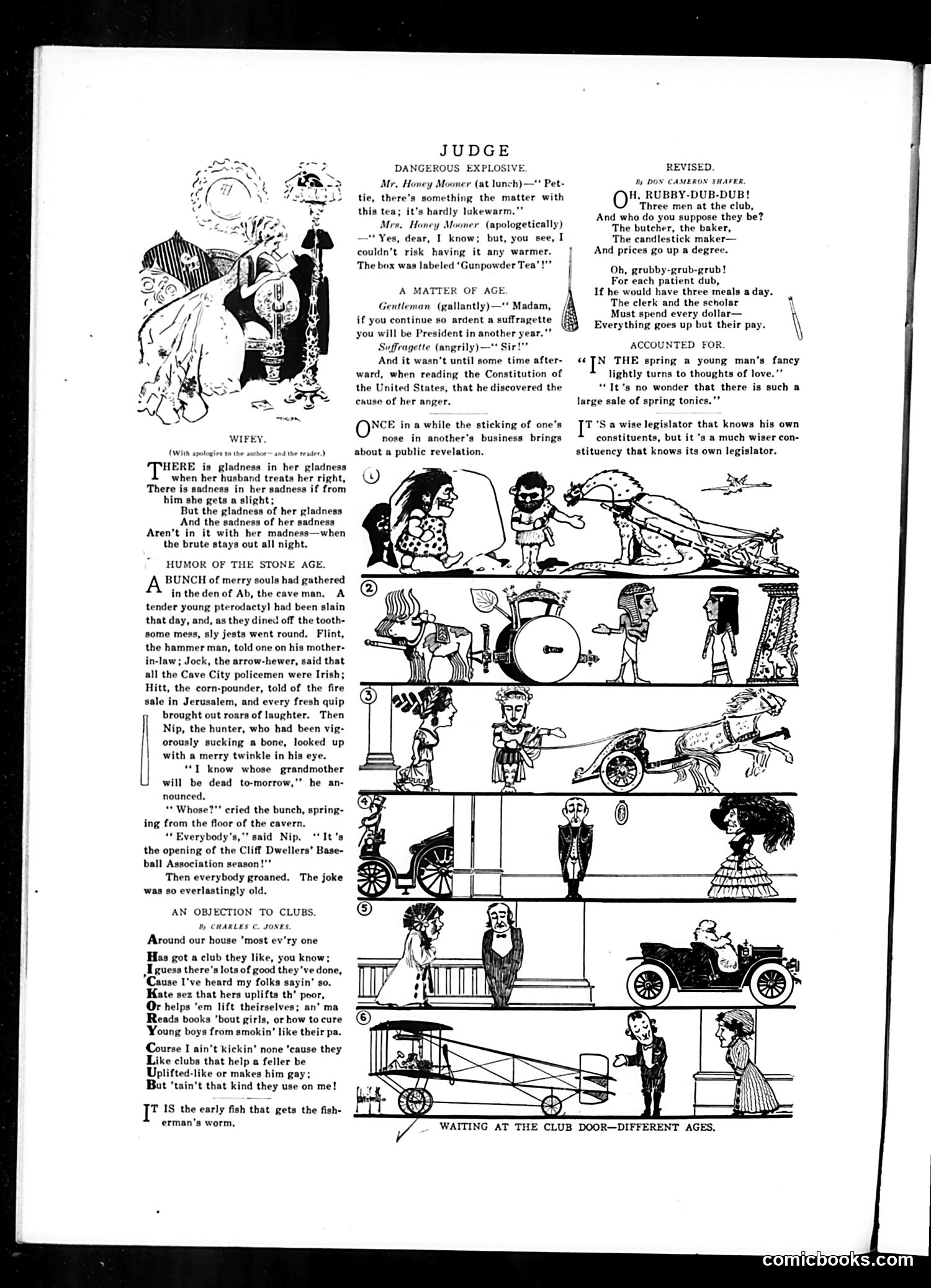
This Judge magazine page contains several satirical pieces mocking early 1900s social conventions: **"Wifey"** jokes about marital discord—specifically a husband staying out late, presented as worse than typical unhappiness. **"Humor of the Stone Age"** satirizes predictable, tired jokes by having cavemen tell ancient gags (mother-in-law jokes, Irish policemen stereotypes, Jerusalem fire sales) that audiences find exhaustingly old. **"An Objection to Clubs"** critiques social clubs—the speaker resents that while his wife and mother belong to "uplifting" organizations helping the poor or women's rights, he experiences clubs differently (implied: as places of violence or exclusion). **Additional short pieces** mock: women suffragettes (for constitutional ignorance), rising inflation affecting working people, and the gap between legislators and constituents. The bottom illustration shows people of different ages waiting outside a club, suggesting varying social participation across life stages.
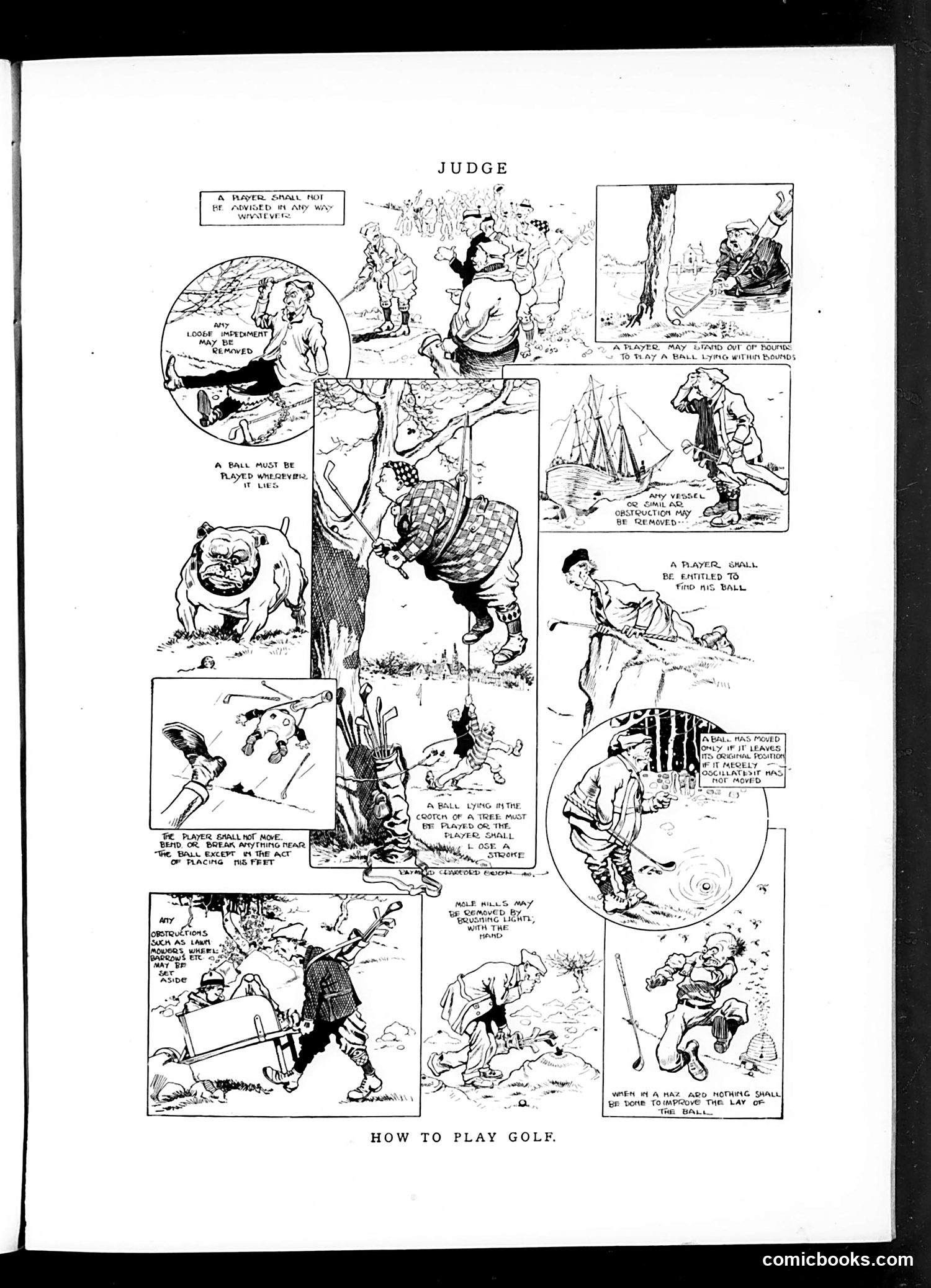
This is a humorous instructional comic mocking golf's overly complicated rulebook through absurdist visual gags. Rather than straightforward golf instruction, each panel depicts ridiculous scenarios: players retrieving balls from trees, water hazards, and impossible situations; a bulldog obstruction; a player stuck in a barrel. The satire targets golf's reputation as an elite, rule-laden sport with byzantine regulations that players constantly debate. By illustrating the rules literally and literally—showing every odd edge case and exception mentioned in the formal rulebook—the cartoonist mocks how golf creates absurd complexity around what should be a simple game. The joke is that these rules exist because golfers encounter such varied terrain and obstacles that comprehensive rule-making becomes ludicrous. The cartoon suggests golf attracts pedantic rule-followers rather than casual athletes—a common satirical critique of the sport among working-class Judge readers.
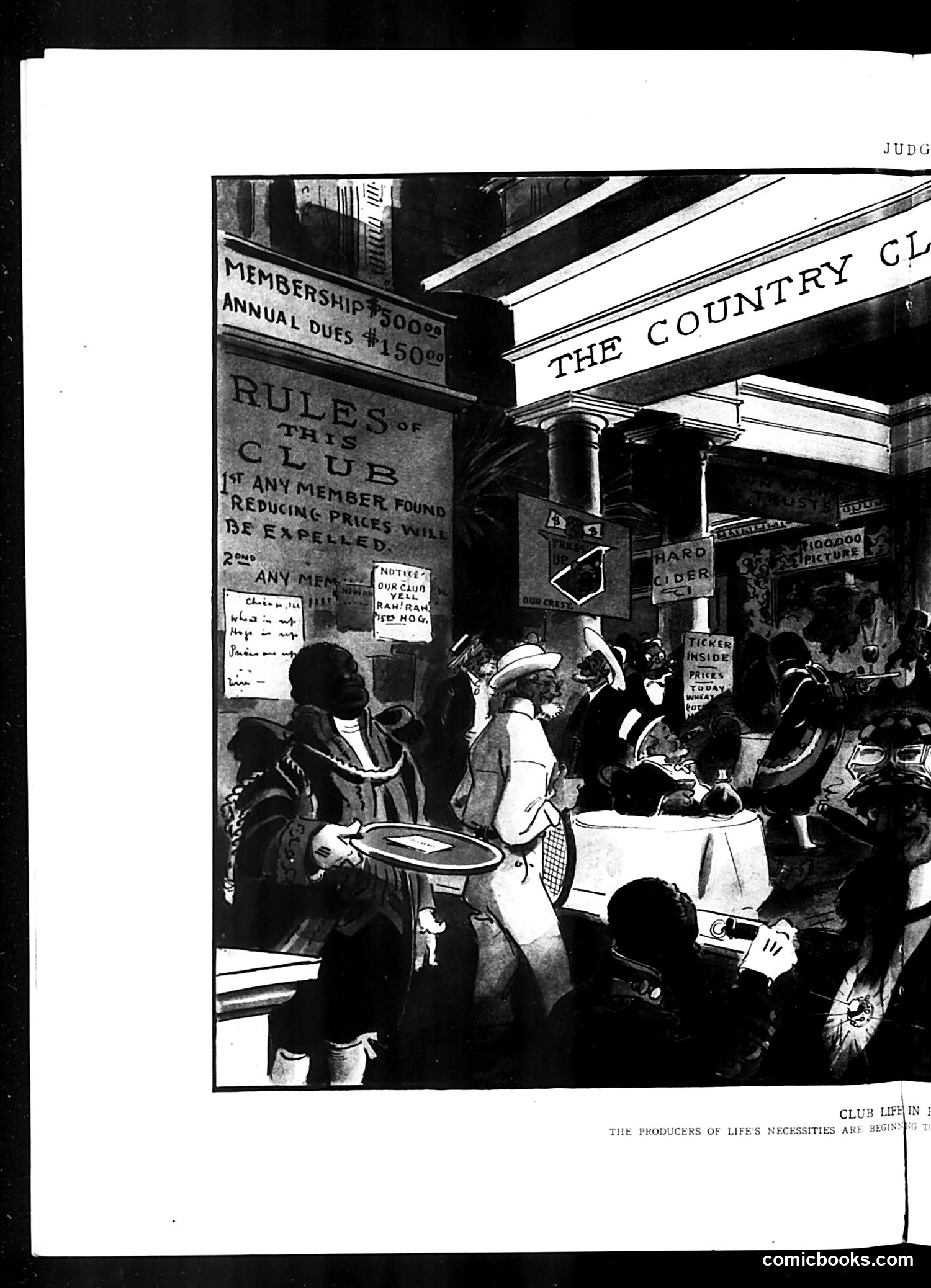
This image shows the entrance to "The Country Club," a satirical depiction of an exclusive social establishment. The visible signage reads: - **"MEMBERSHIP $500"** and **"ANNUAL DUES $150"** — establishing this as an expensive, elite club - **"RULES OF THE CLUB"** warning that members found reducing prices will be expelled The satire targets wealthy club members prioritizing exclusivity and price-fixing over fair commerce. The crowd of working people outside suggests social commentary on class division and economic inequality during an era (likely Gilded Age/Progressive Era) when such clubs represented wealth concentration. The caption references "producers of life's necessities," implying contrast between essential workers and privileged leisure-class members. The piece critiques how the wealthy insulate themselves from economic reality through exclusive institutions.
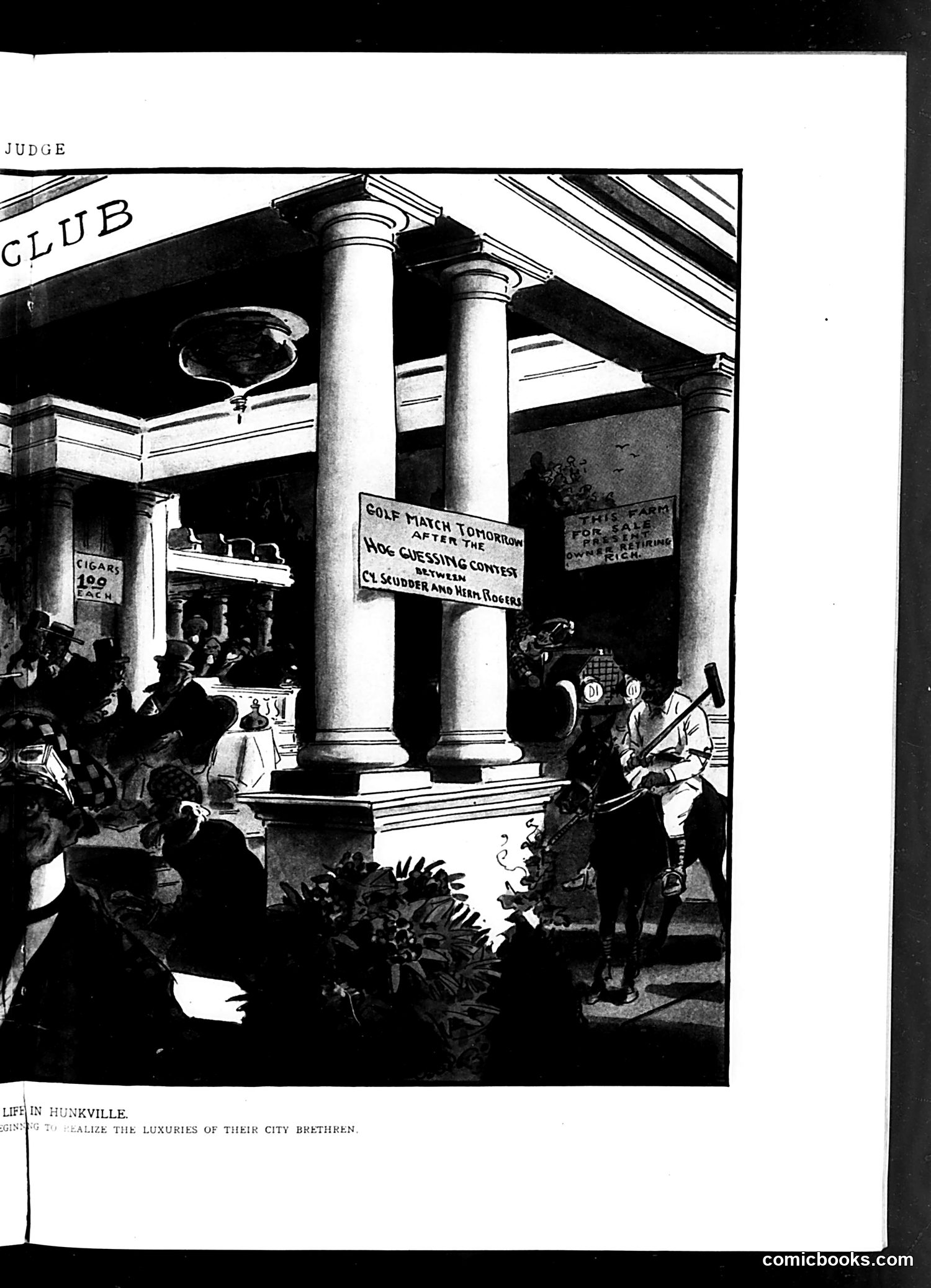
This page shows an illustration titled "Life in Hunkville" depicting what appears to be a social club or gathering space with classical columns. A banner advertises a "Golf Match Tomorrow" and a "Handicapping Contest Between Cy Scudder and Herm Rogers." The scene satirizes small-town social life, showing various club members gathered under the columns. Signs visible include "Cigars 100 Each" and references to local figures. The image appears to mock the pretensions of provincial society—the grand classical architecture suggests attempts to replicate urban sophistication in a small town setting. The caption indicates this is satirizing how small-town residents attempt to emulate the luxuries and social structures of city dwellers, treating their modest club as if it were an important metropolitan institution.
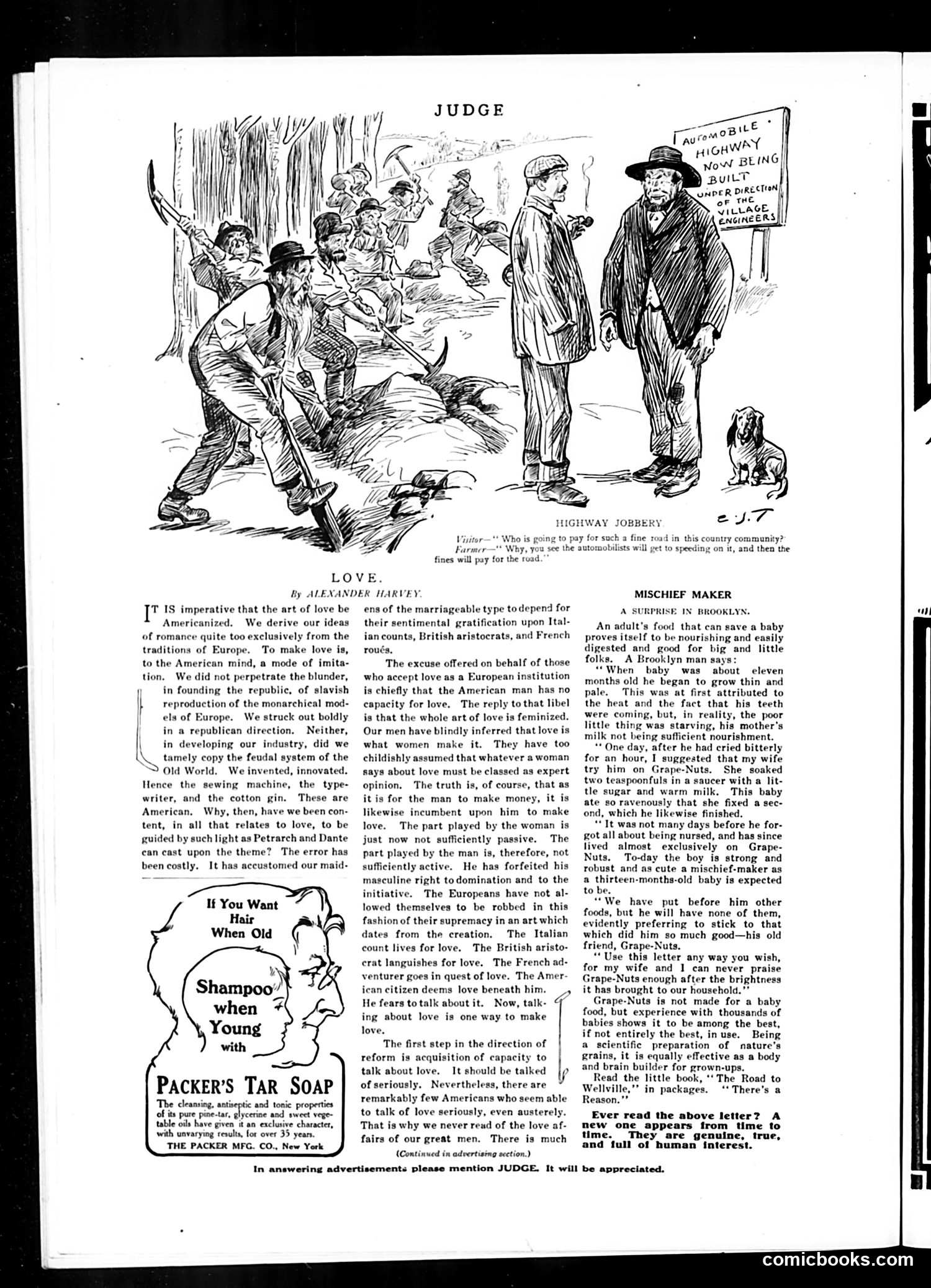
**The Cartoons:** The top cartoon, "Highway Jobbery," satirizes rural infrastructure corruption. It shows farmers being deceived by local officials about a new "automobile highway"—presented as community improvement but actually a scheme to extract money from villagers. The joke's caption reveals the con: officials claim speeders will pay fines to fund the road, but ordinary farmers will actually bear the costs. This reflects Progressive Era anxieties about how modernization (automobiles) and government projects could be exploited by corrupt local politicians at rural communities' expense. **The Articles:** The page contains two unrelated pieces: Alexander Harvey's essay arguing Americans should develop their own approach to romance rather than imitating European traditions, and a Grape-Nuts advertisement testimonial about infant nutrition. These are typical Judge content—satirical social commentary mixed with period advertising.
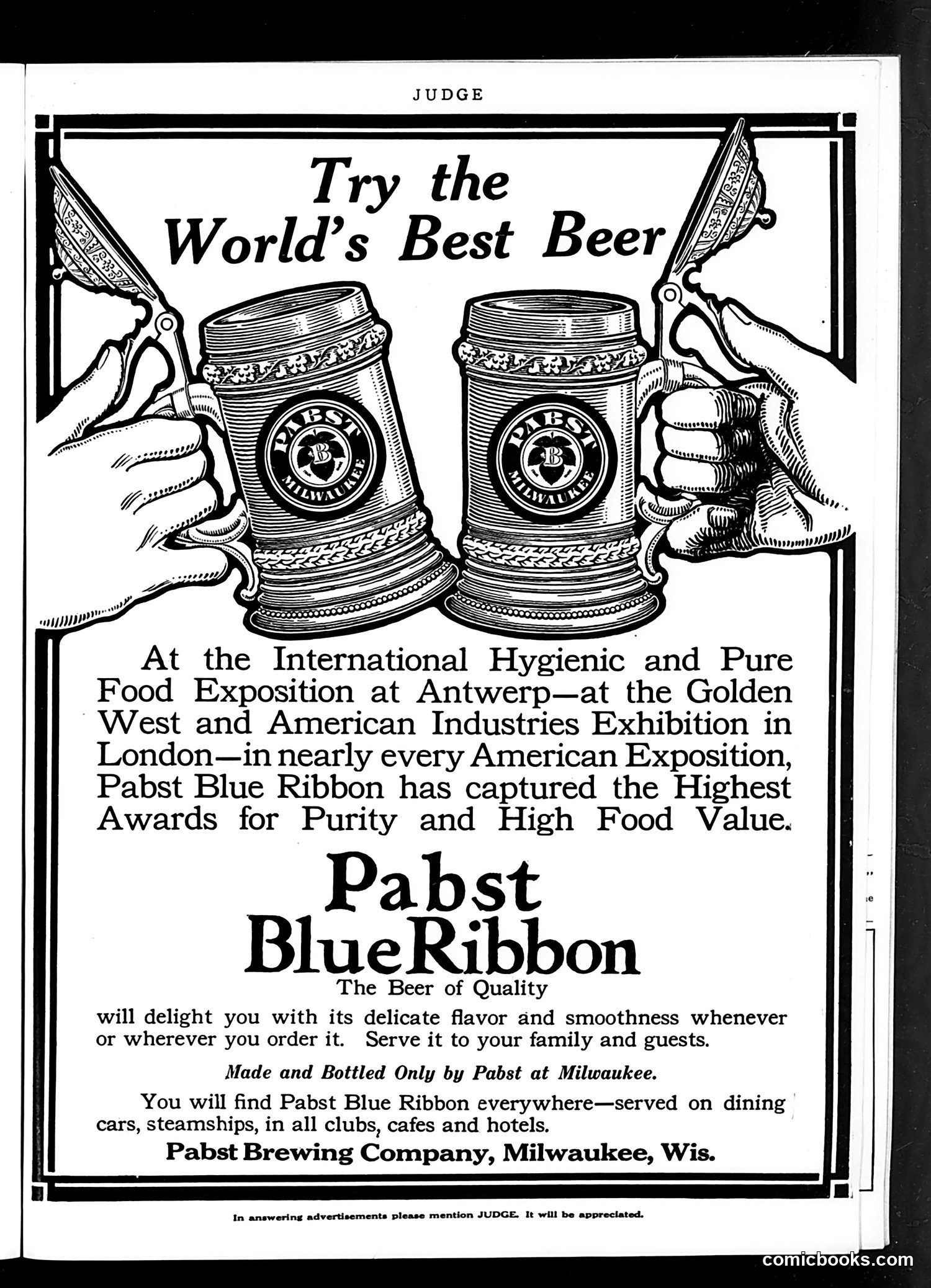
This is a **beer advertisement**, not political satire. It appears in Judge magazine (likely early 1900s, based on style). The image shows two hands toasting with ornate beer steins bearing the Pabst "B" logo. The ad claims Pabst Blue Ribbon won "Highest Awards for Purity and High Food Value" at international expositions in Antwerp and London. This appeals to early-20th-century American consumers' anxieties about food safety and product quality—legitimate concerns in an era before federal food regulation (the FDA was established 1906). The advertisement positions beer as a refined, respectable beverage served in genteel settings (dining cars, steamships, clubs), aiming to distance Pabst from associations with working-class taverns. The tagline "The Beer of Quality" reinforces this aspirational branding.
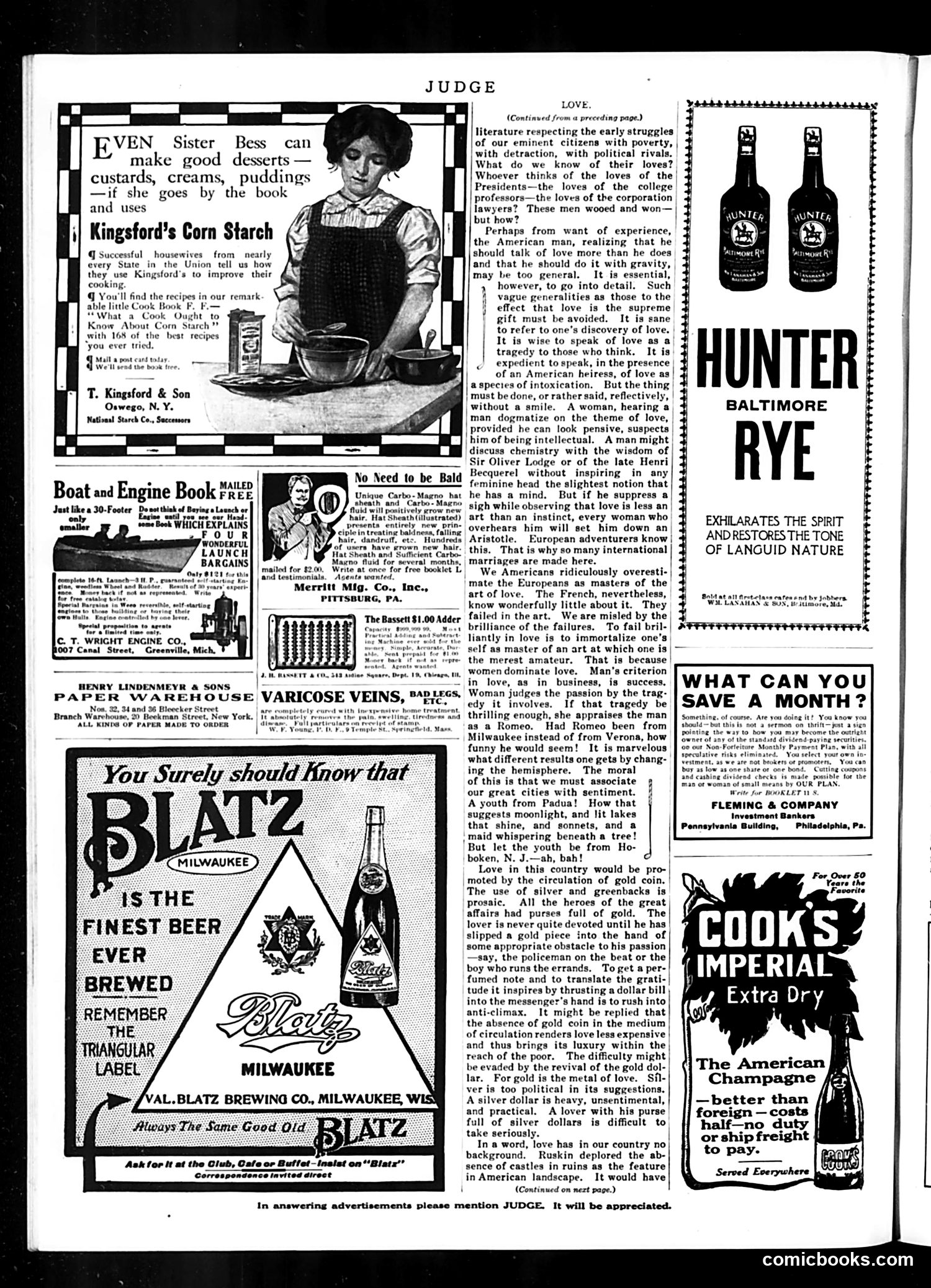
This page is primarily **advertising**, not political satire. It contains product ads for corn starch, beer (Blatz), hair treatment, and other goods typical of early 20th-century magazines. The only substantive editorial content is an essay titled "LOVE" (continued from a previous page). The piece satirizes American attitudes toward romance by contrasting them with European romanticism. The author argues Americans underestimate love's importance and overestimate European sophistication about it. He suggests geography shapes perception—a lovesick youth seems poetic from Padua, Italy, but ridiculous from Hoboken, New Jersey. The satire mocks American pragmatism: we judge love by whether it ends tragically, and we associate sentiment with European locations rather than our own cities. The piece reflects early 20th-century cultural anxiety about American materialism versus European tradition, suggesting readers should romanticize their own homeland rather than fetishize foreign settings.
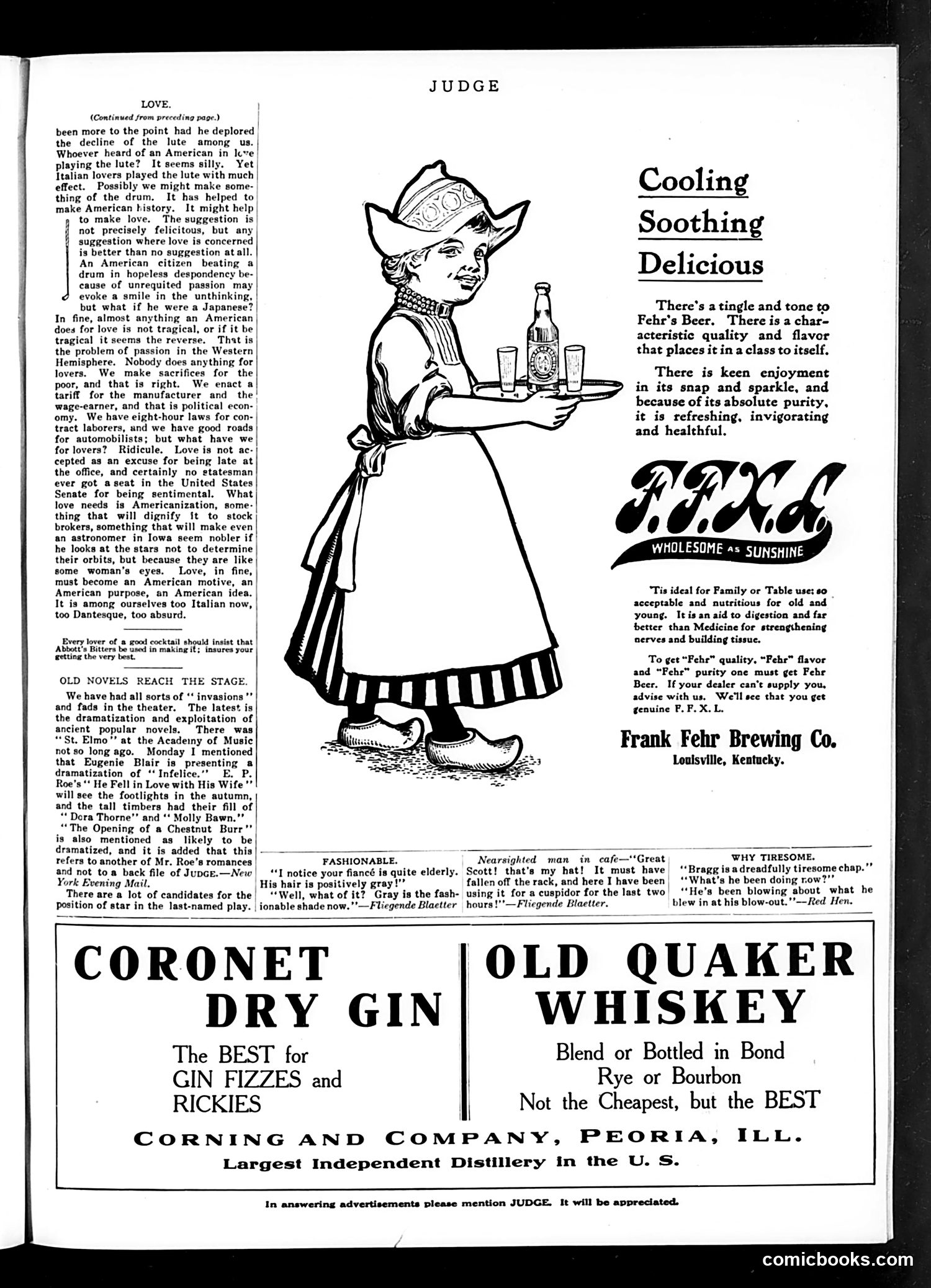
This page from *Judge* (a major American satirical magazine) contains multiple elements: **Main Essay ("Love"):** A satirical commentary arguing that Americans approach romance poorly compared to Europeans. The author suggests love needs "Americanization"—treated with the same seriousness as tariffs, labor laws, or infrastructure—rather than dismissed as silly sentiment unworthy of Senate-seat holders. **Central Illustration:** A Bavarian-style figure (likely representing "Fehr's Beer") serves a beer advertisement, playing on German beer culture associations. **Three Brief Jokes at Bottom:** Social humor about mistaken identity (an elderly fiancée), a hat mix-up at a cafe, and someone being tiresome—typical light satirical fare. **Advertisements:** For Fehr's Beer, Frank Fehr Brewing Co., Coronet Dry Gin, and Old Quaker Whiskey dominate the page—typical of early 20th-century magazine revenue models. The page blends editorial satire (mocking American attitudes toward romance) with drinking advertisements, reflecting the era's casual integration of alcohol marketing into mainstream publications.
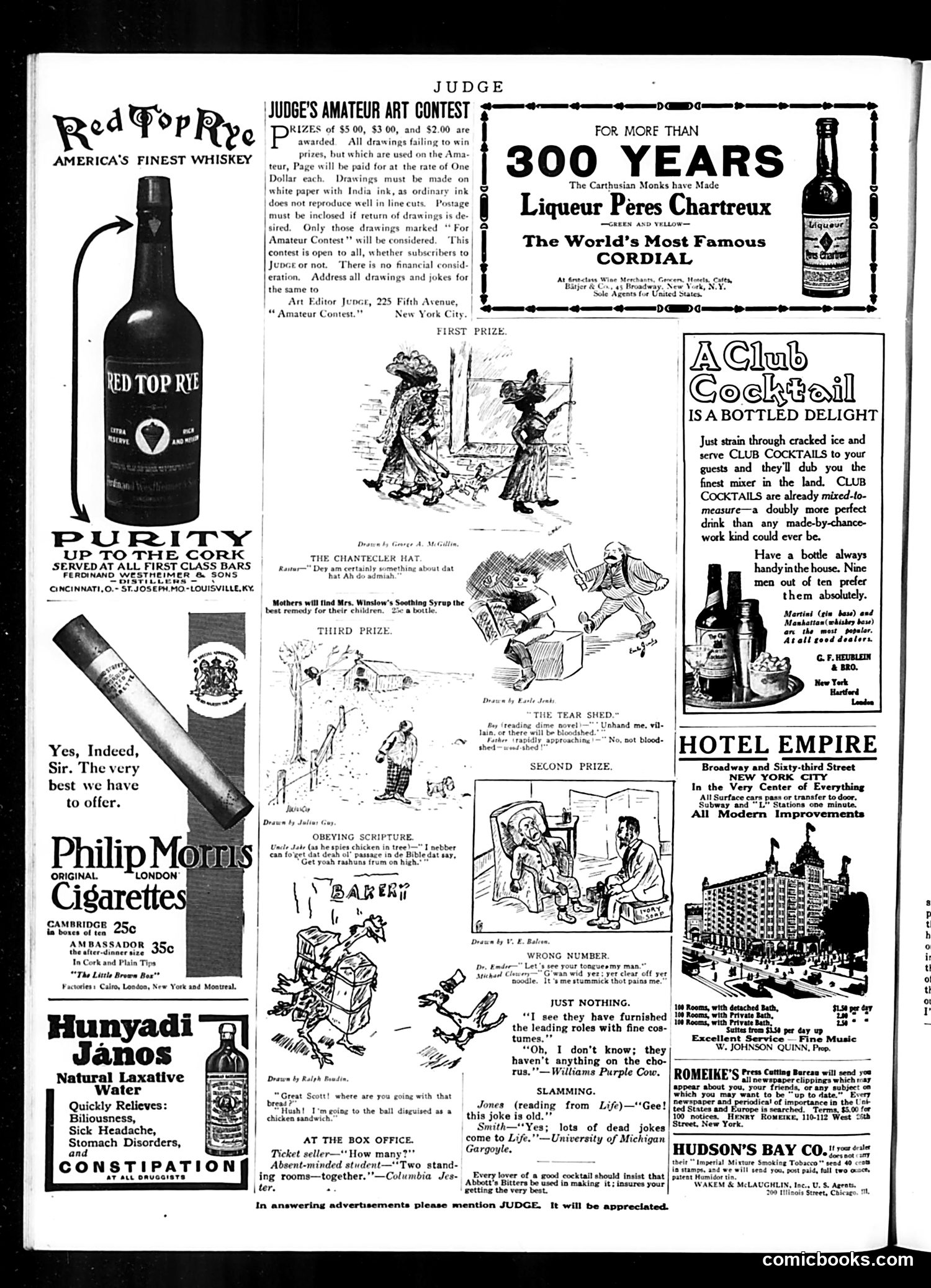
This page is primarily **advertising with some cartoon content**. The main satirical elements are small comic strips scattered throughout, featuring brief joke scenarios: **Key Cartoons:** - Multiple small single-panel comics with captions about everyday absurdities—a doctor misdiagnosing a patient, confusion at a theater box office, a student requesting standing room - These represent typical "Judge" humor: mild domestic and social mishaps played for light laughs **The Advertisements Dominate:** The page showcases luxury products of the era (circa 1910s-1920s): Red Top Rye whiskey, Philip Morris cigarettes, Chartreaux liqueur, Club Cocktails, Hotel Empire, and Hunyadi Janos laxative water. **The "Amateur Art Contest"** announces Judge's invitation for readers to submit drawings, offering small monetary prizes. **Context for Modern Readers:** This reflects a publication model where advertising subsidized content. The humor is gentle, apolitical—focusing on mistaken identities and social confusion rather than satire. The prevalence of alcohol and tobacco ads reflects pre-regulation advertising norms.
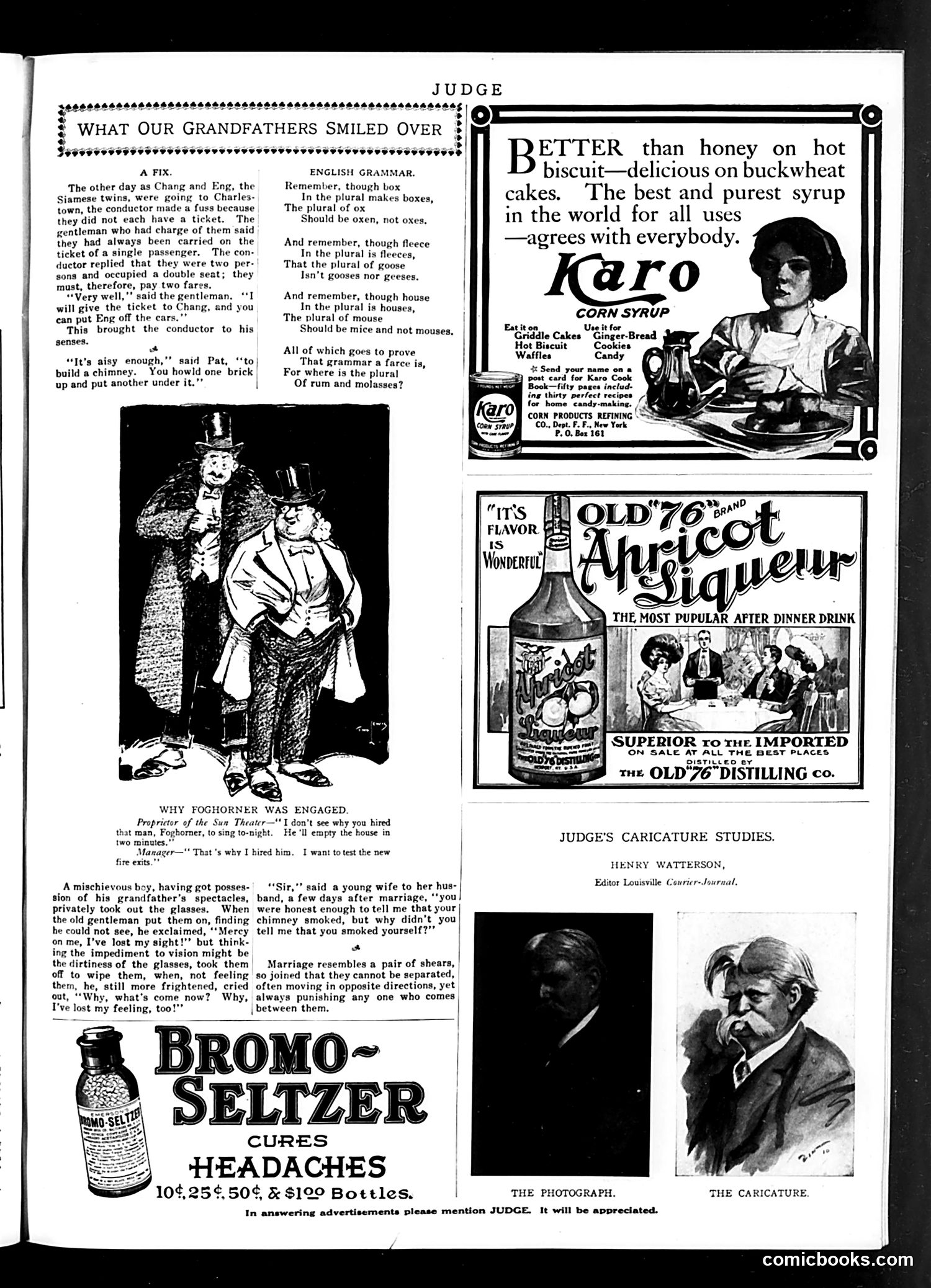
This Judge magazine page mixes humor with advertisements. The main content includes: **"What Our Grandfathers Smiled Over"** presents Victorian-era anecdotes: Siamese twins Chang and Eng needing two tickets (playing on literal interpretation of "two persons"), a man building a chimney by stacking bricks, and a boy removing spectacles' lenses—all playing on misunderstandings or wordplay. **An English Grammar section** humorously addresses plural forms (houses/boxes, oxen vs. oxes, geese vs. gooses), ending with the joke that "rum and molasses" have no plural because they're typically consumed completely. **Additional jokes** include theater manager hiring a bad singer to test fire exits and marital observations about smoking and sacrifice. **The advertisements** (Karo Corn Syrup, Old '76 Apricot Liqueur, Bromo-Seltzer) occupy significant space. **Bottom section**: Shows "Judge's Caricature Studies"—a photograph and accompanying caricature of Henry Watterson, editor of the Louisville Courier-Journal, demonstrating the magazine's artistic approach to depicting public figures. The page reflects early 20th-century American humor: genteel, domestically-focused, with gentle satire.
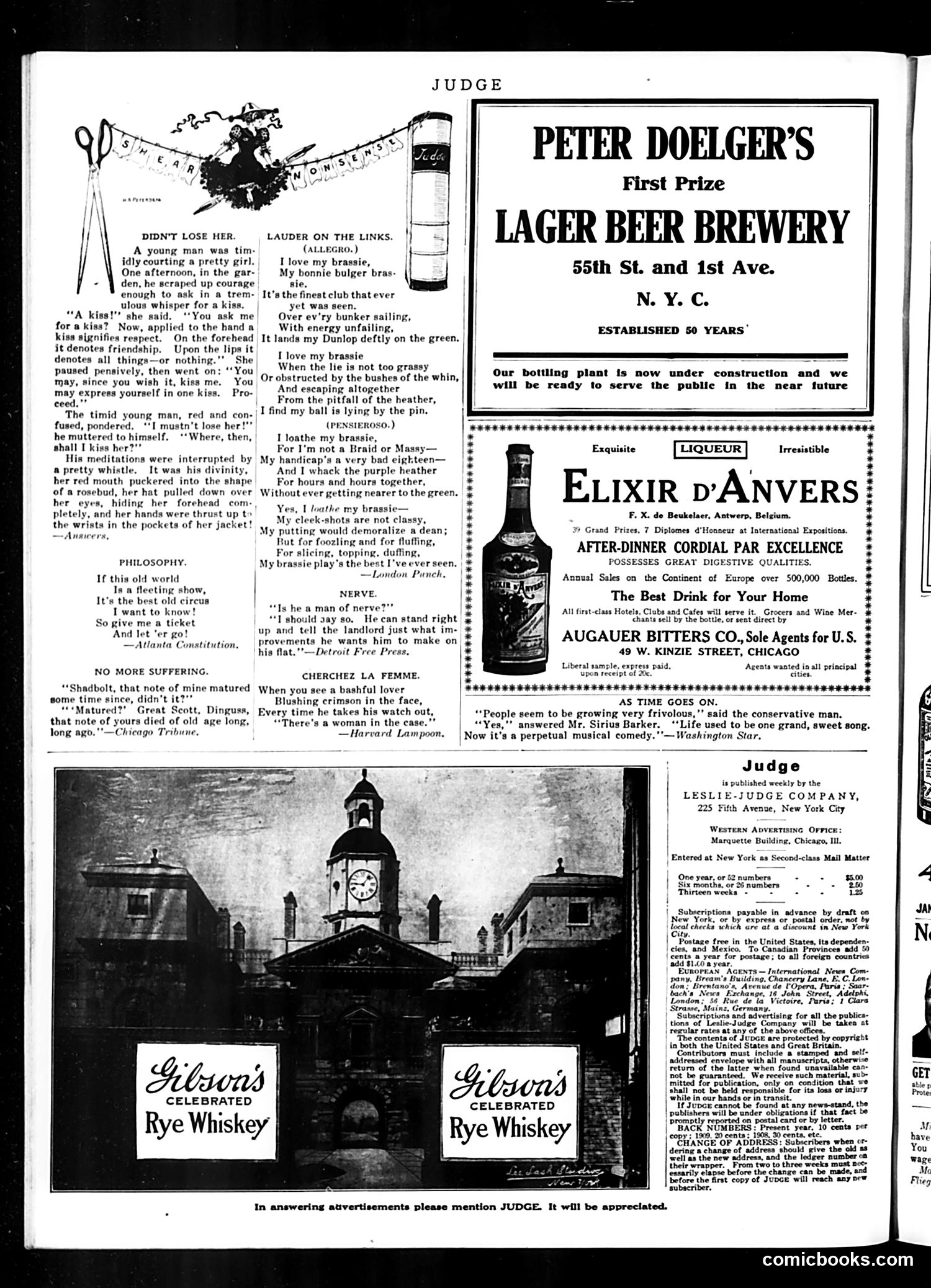
This page from *Judge* magazine is primarily **advertising with light humor pieces**, not political satire. The main content includes short comic anecdotes: - **"Didn't Lose Her"**: A young man seeks a kiss from a girl; she philosophizes about kiss meanings (hand = respect, forehead = friendship, lips = everything or nothing). He ultimately doesn't kiss her because he's paralyzed by overthinking—a gentle joke about male timidity in courtship. - **"Lauder on the Links"**: Golf humor personifying a golf club (brassie), celebrating its performance while admitting the writer's poor skill—appears to reference actual golfers (Braid, Massy). - Other brief jokes about matured debts, nervous landlords, and a "woman in the case." **The advertisements** dominate: Peter Doelger's Lager Beer (55th St., NYC), Elixir d'Anvers liqueur, and Augauer Bitters—typical period alcohol advertising. The page reflects early 1900s print culture combining light journalism with commercial sponsorship.
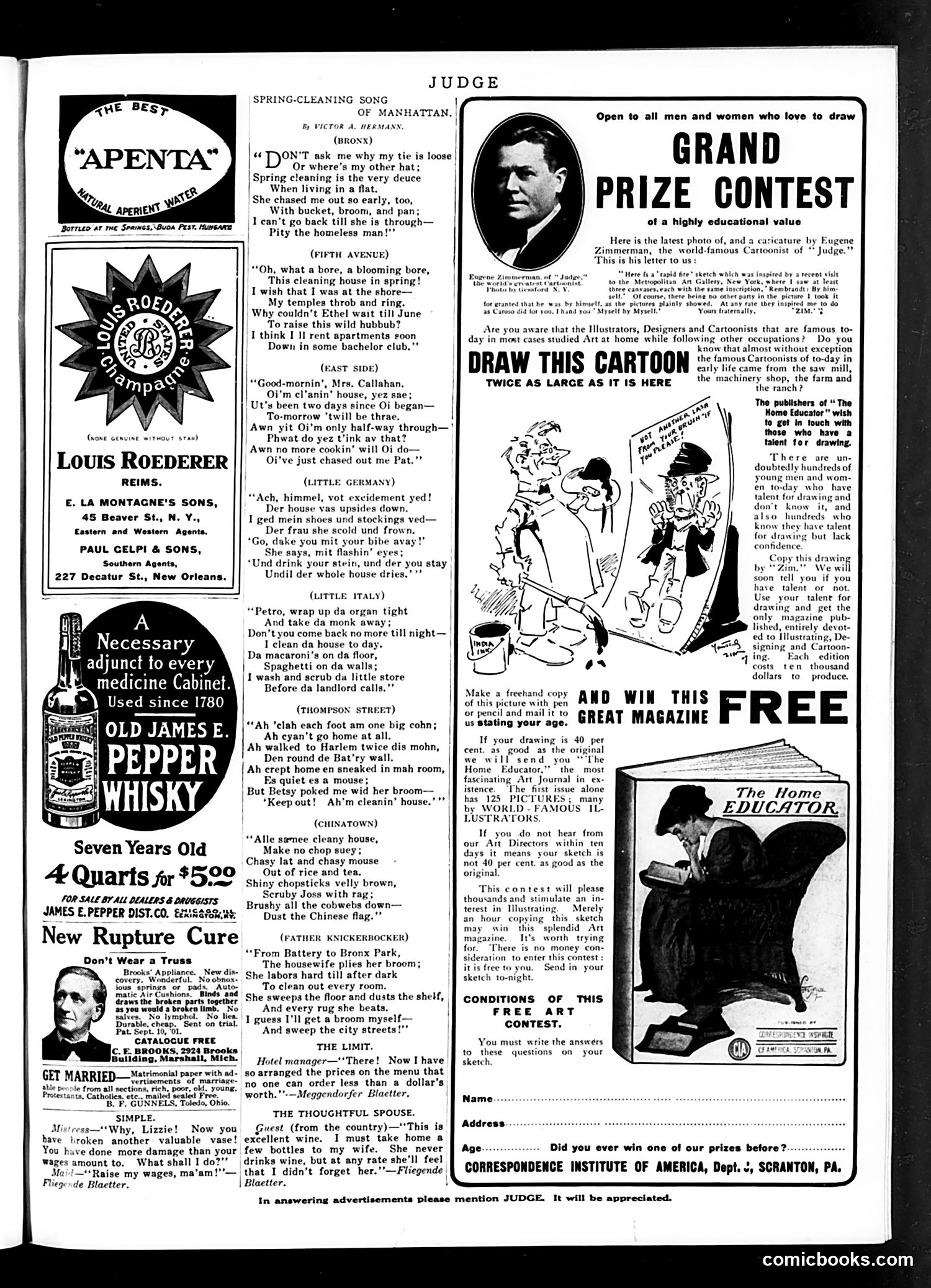
This page presents a humorous poem about spring housecleaning, broken into seven dialect-heavy sections representing different New York neighborhoods and social classes circa early 1900s. Each stanza depicts how spring cleaning disrupts daily life differently: Bronx residents complain about being evicted from their homes; Fifth Avenue wealthy grumble about cancelled leisure plans; East Side working-class families endure cramped-apartment chaos; German and Italian immigrant communities struggle with the disruption in their native dialects; African Americans (Thompson Street) face exclusion from their own homes; Chinese residents (Chinatown) clean amid stereotypical references; and Father Knickerbocker (representing New York itself) observes the citywide phenomenon. The satire mocks spring cleaning's universal disruption while gently stereotyping each ethnic/class group through exaggerated dialect and cultural details—a common Judge magazine approach blending social observation with period-typical ethnic humor.
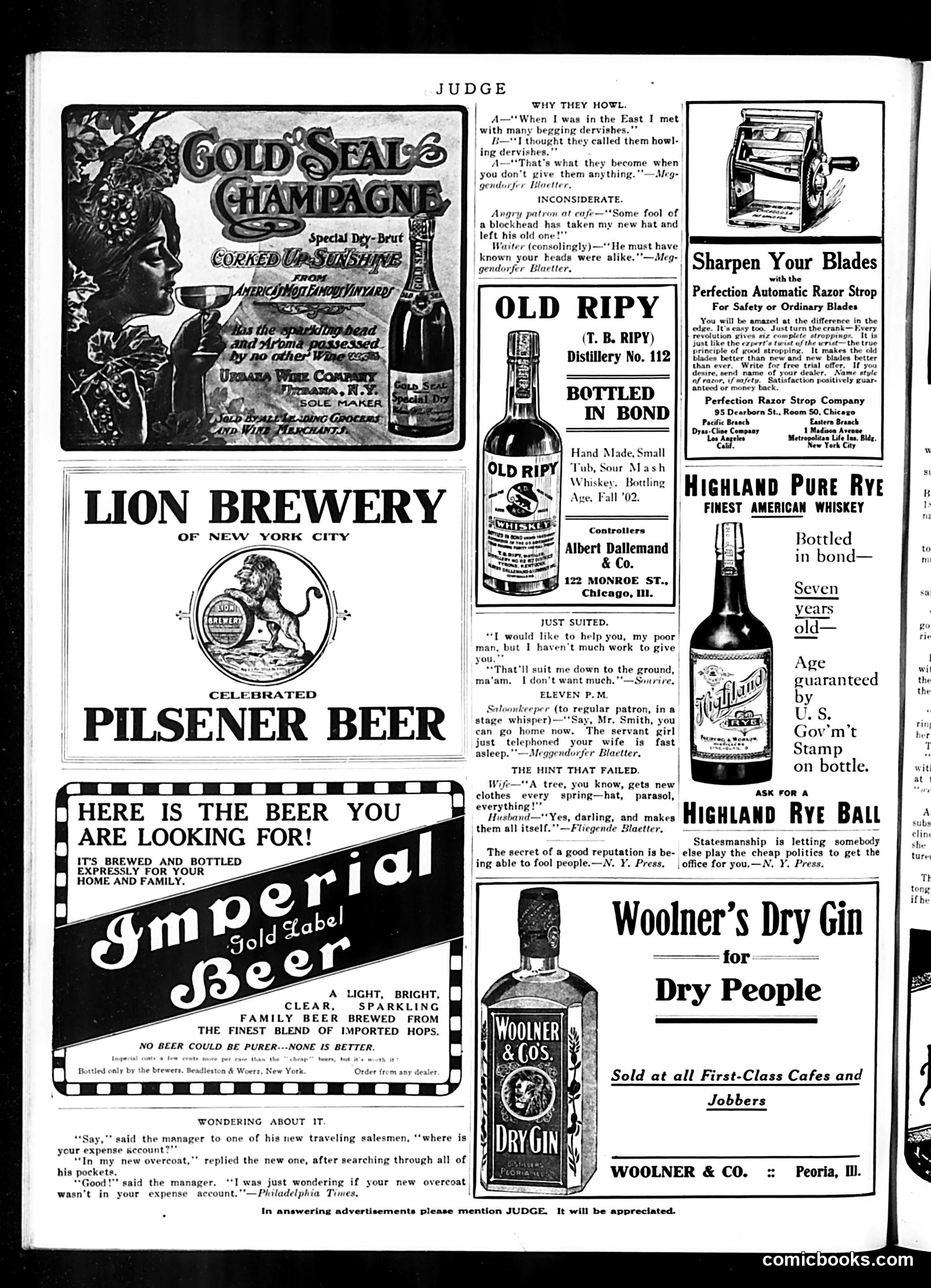
This is primarily an **advertising page** for alcoholic beverages (beer, whiskey, gin) interspersed with short humorous anecdotes—typical of Judge's format during Prohibition-era America. The small cartoons/jokes include: - **"Why They Howl"**: A pun about whirling dervishes who "howl" (become loud) only when denied charity - **"Inconsiderate"**: A joke about swapped hats between men with similar head sizes - **"Just Suited"**: Wordplay where a jobless man accepts work "suited to the ground" (low pay) - **"Saloonkeeper" anecdote**: Dark humor about a bartender helping a man sneak home while his wife sleeps - **"The Hint That Failed"**: A husband ignores his wife's metaphor about trees renewing themselves (implying he should update his appearance) The final joke shows a manager wondering if a new salesman's expensive overcoat came from his expense account—subtle satire on corporate dishonesty. These are light, domestic humor pieces typical of early-20th-century publications, without overt political commentary.
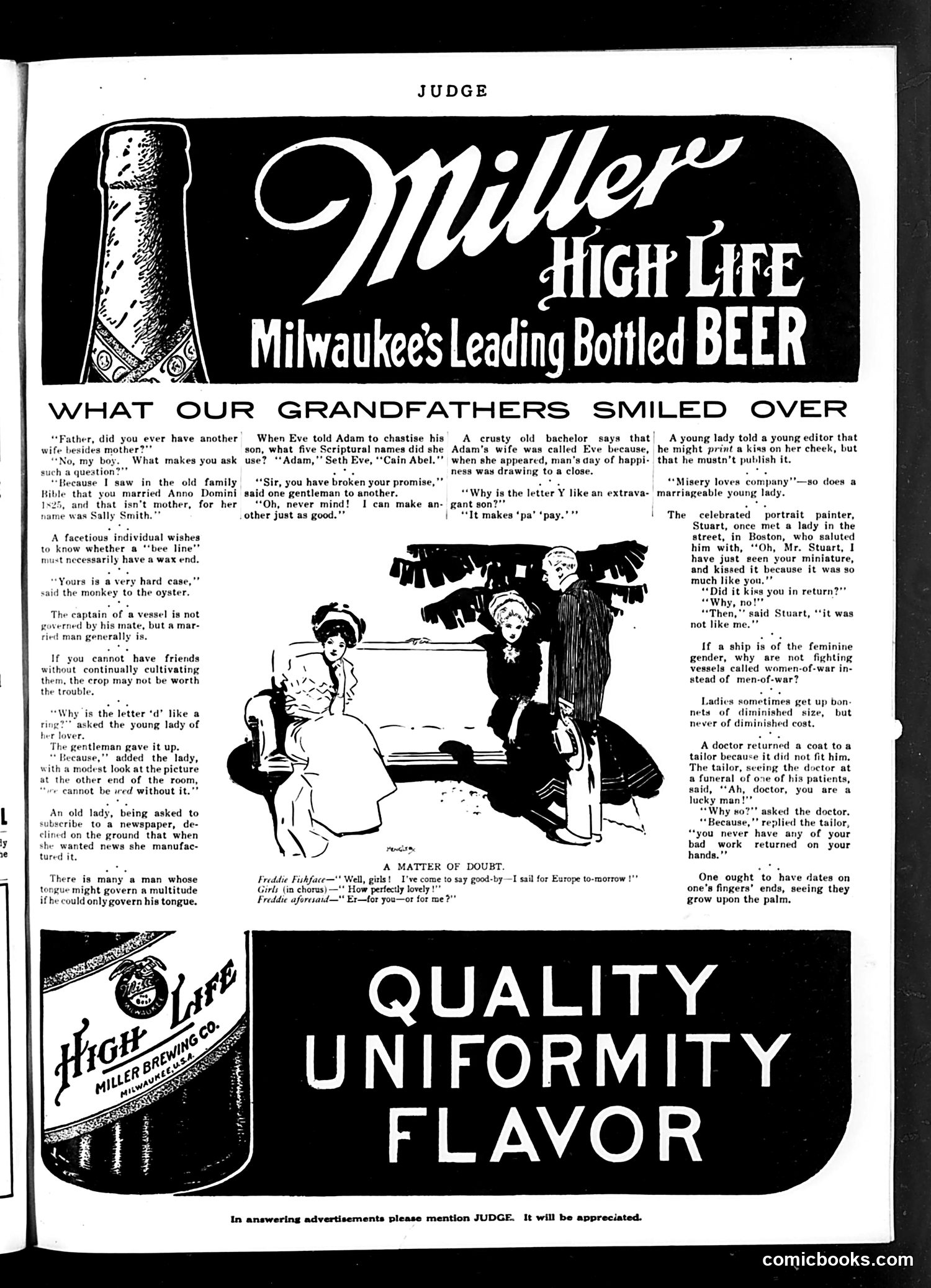
This is primarily a **beer advertisement** for Miller High Life, Milwaukee's bottled beer, rather than political satire. The page uses humor to sell the product. The central cartoon shows a social gathering where a young man (Freddie Fishface) announces he's sailing to Europe. The girls respond enthusiastically—but the joke's ambiguity ("Ex—for you—or for me?") plays on whether they're happy about his departure or upset. Surrounding this are traditional joke columns titled "What Our Grandfathers Smiled Over"—Victorian-era riddles and puns involving wordplay (why is Y like a spendthrift son? "It makes 'pa' 'pay"). These nostalgic jokes emphasize the product's established heritage and respectability. The advertisement strategy positions Miller High Life as a refined, quality beer for educated readers of *Judge*, using genteel humor rather than crude appeals. The bottom banner emphasizes "Quality, Uniformity, Flavor"—manufacturing standards presented as virtues to discriminating consumers of the Prohibition-era or early post-Prohibition period.
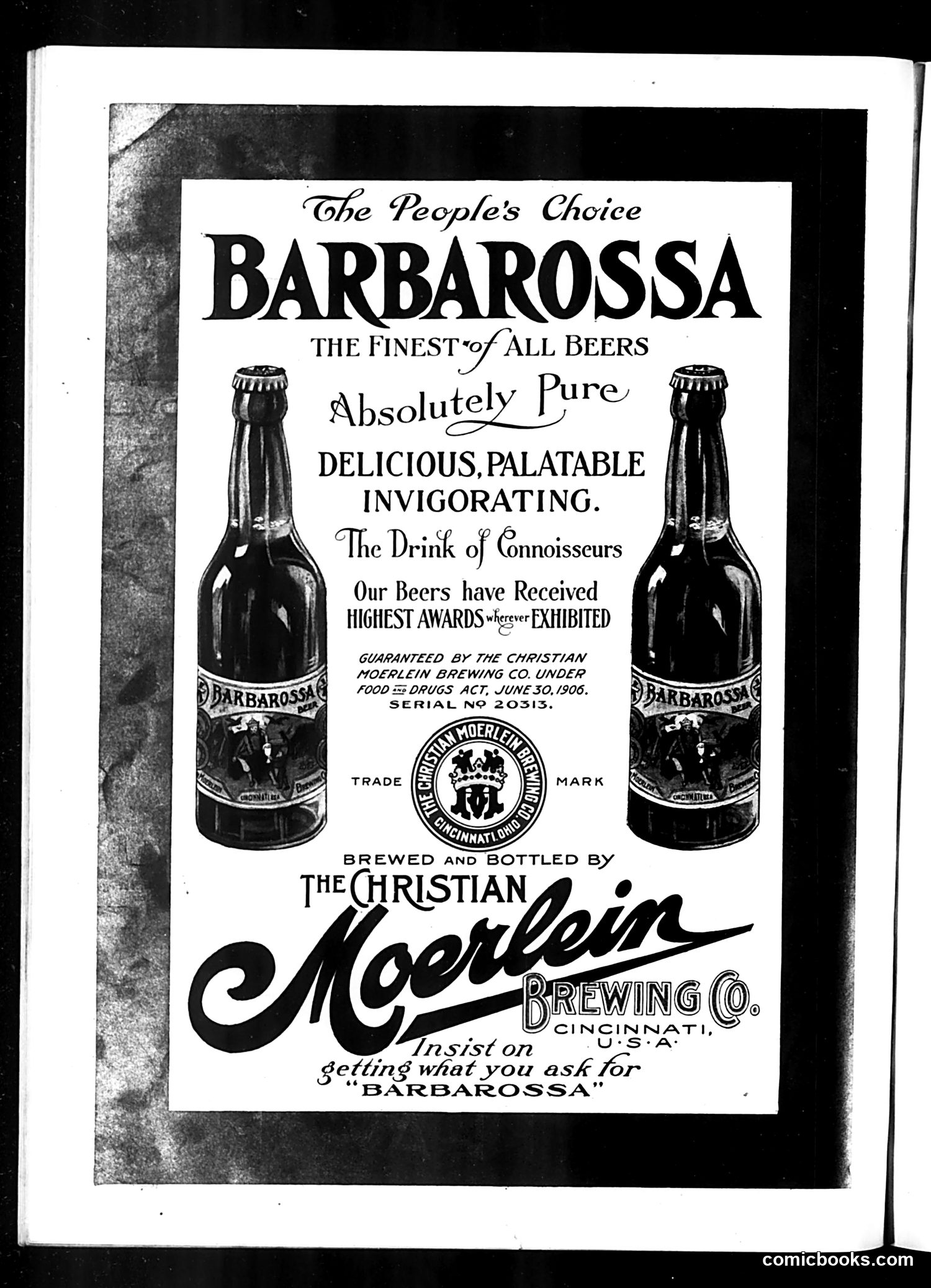
This is primarily a **beer advertisement**, not a cartoon. It advertises Barbarossa beer, brewed by the Christian Moerlein Brewing Company in Cincinnati, Ohio. The ad emphasizes purity and quality—standard beer marketing of the era. The reference to being "GUARANTEED BY THE CHRISTIAN MOERLEIN BREWING CO. UNDER FOOD & DRUGS ACT, JUNE 30, 1906" is significant: this invokes the Pure Food and Drug Act, recent legislation (1906) meant to combat adulterated products. By highlighting this compliance, the brewer reassures consumers their product is safe and pure—a selling point in an era when food safety was a genuine public concern. The "People's Choice" tagline and emphasis on "highest awards" are typical period advertising claims to build consumer confidence and brand prestige.