
A complete issue · 16 pages · 1909
Judge — December 18, 1909
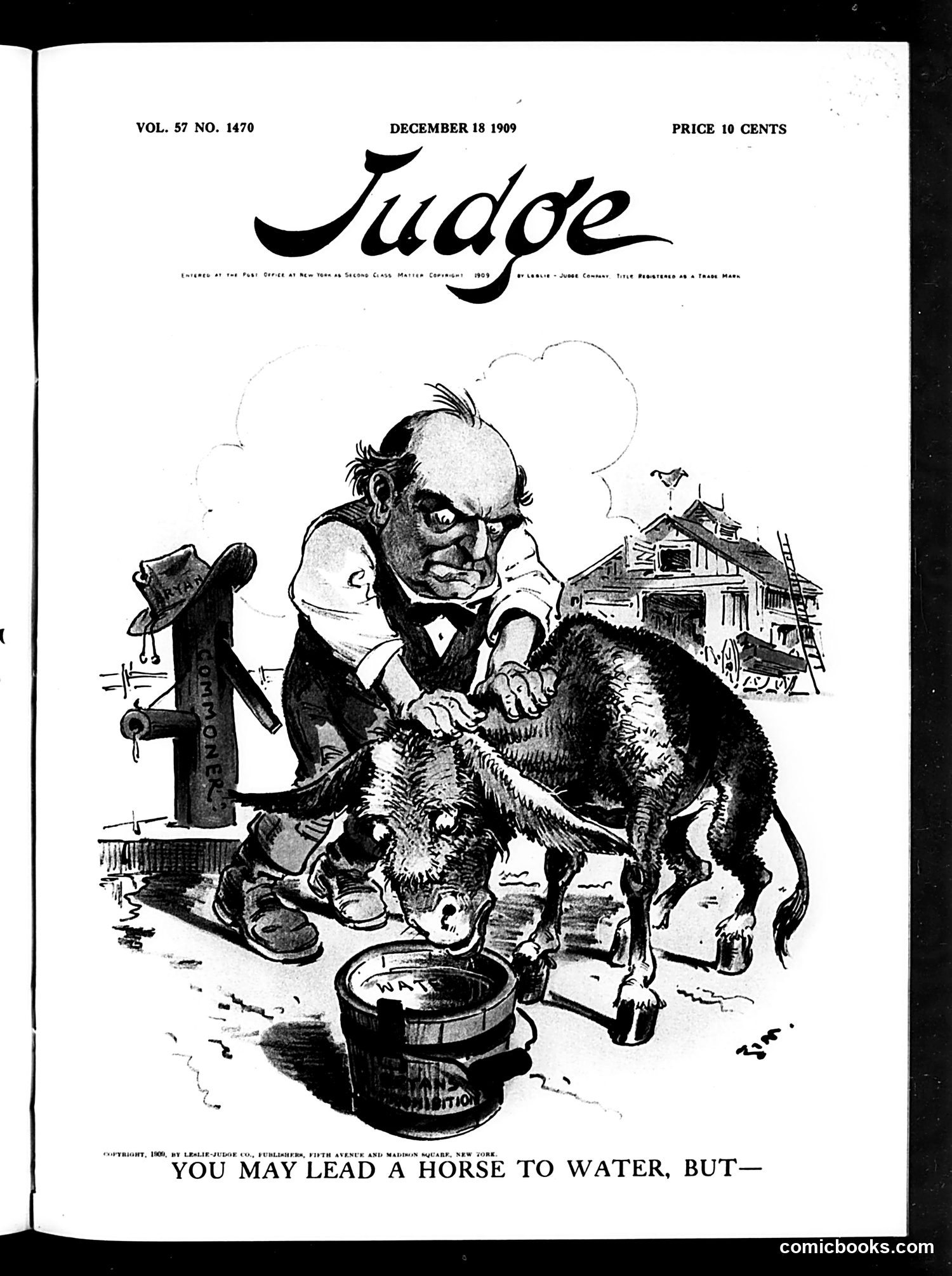
This political cartoon satirizes someone's failed attempt to influence or control another party—likely a political figure or leader. The caricatured man with exaggerated features attempts to force a reluctant horse to drink from a water bucket labeled "WATER," while a farmhouse sits in the background. The title "YOU MAY LEAD A HORSE TO WATER, BUT—" invokes the well-known proverb about inability to force compliance. The cartoon appears to mock a political figure's failed persuasion efforts, suggesting they cannot compel obedience despite their authority or position. Without additional context identifying the specific figure or 1909 political situation referenced, I cannot definitively state which politician or policy dispute this targets, though the imagery suggests executive impotence or legislative frustration.
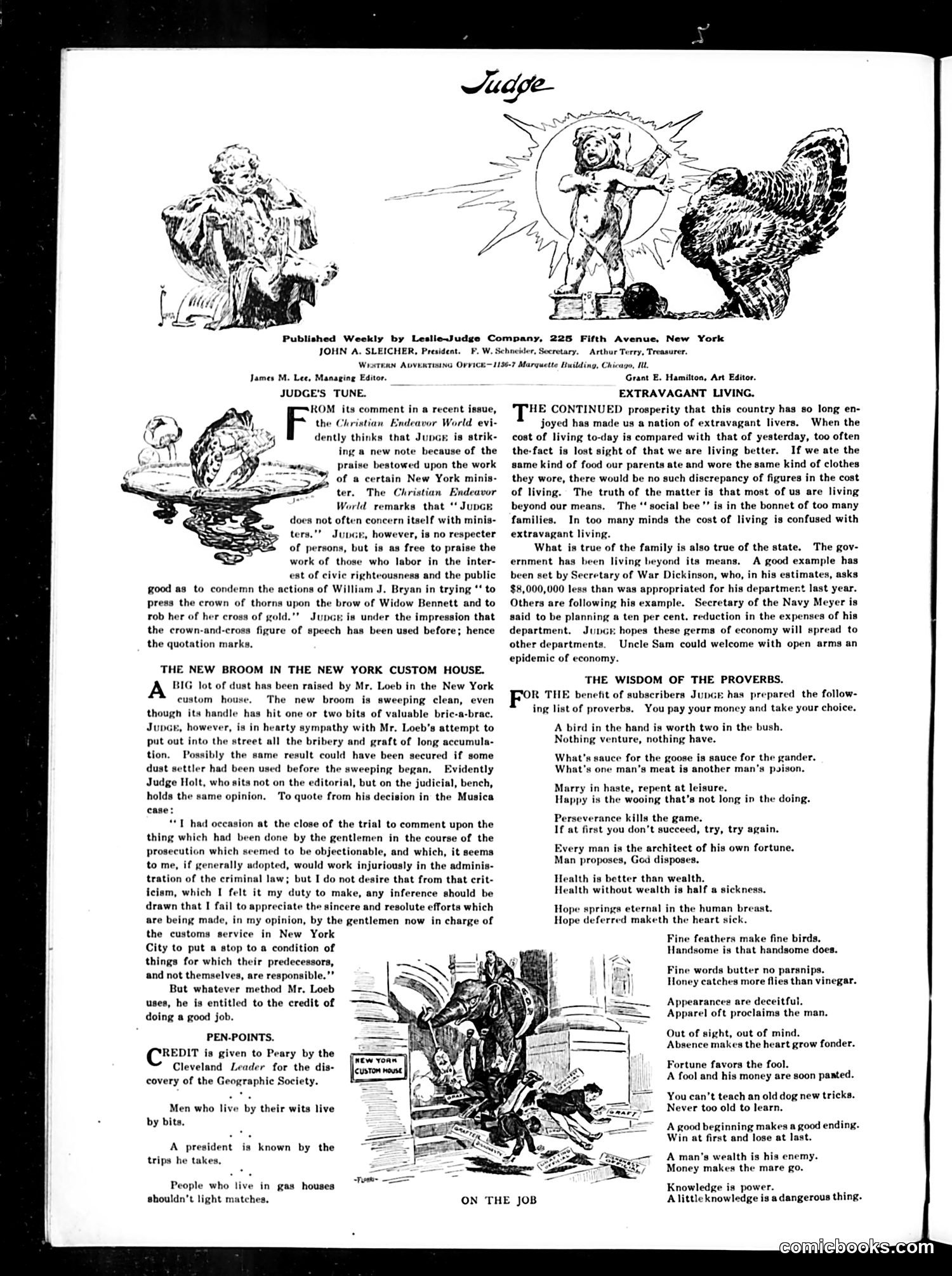
This page contains several editorial pieces satirizing American excess and government inefficiency circa early 20th century. **"Judge's Tune"** criticizes the *Christian Endeavor World* for praising Judge's editorial stance on ministerial restraint—Judge finds this ironic praise suspicious. **"The New Broom in the New York Custom House"** references Mr. Loeb's recent appointment, celebrating his cleaning efforts at a notoriously corrupt institution. The text notes Judge's editorial position on the customs service while cautiously crediting Loeb's apparent reforms. **"Extravagant Living"** condemns widespread American overspending, citing government examples (Secretary of War Dickinson's budget reductions) and noting that even "Uncle Sam" could benefit from economizing. The page also includes a "Wisdom of the Proverbs" column and other brief satirical commentary typical of Judge's format.
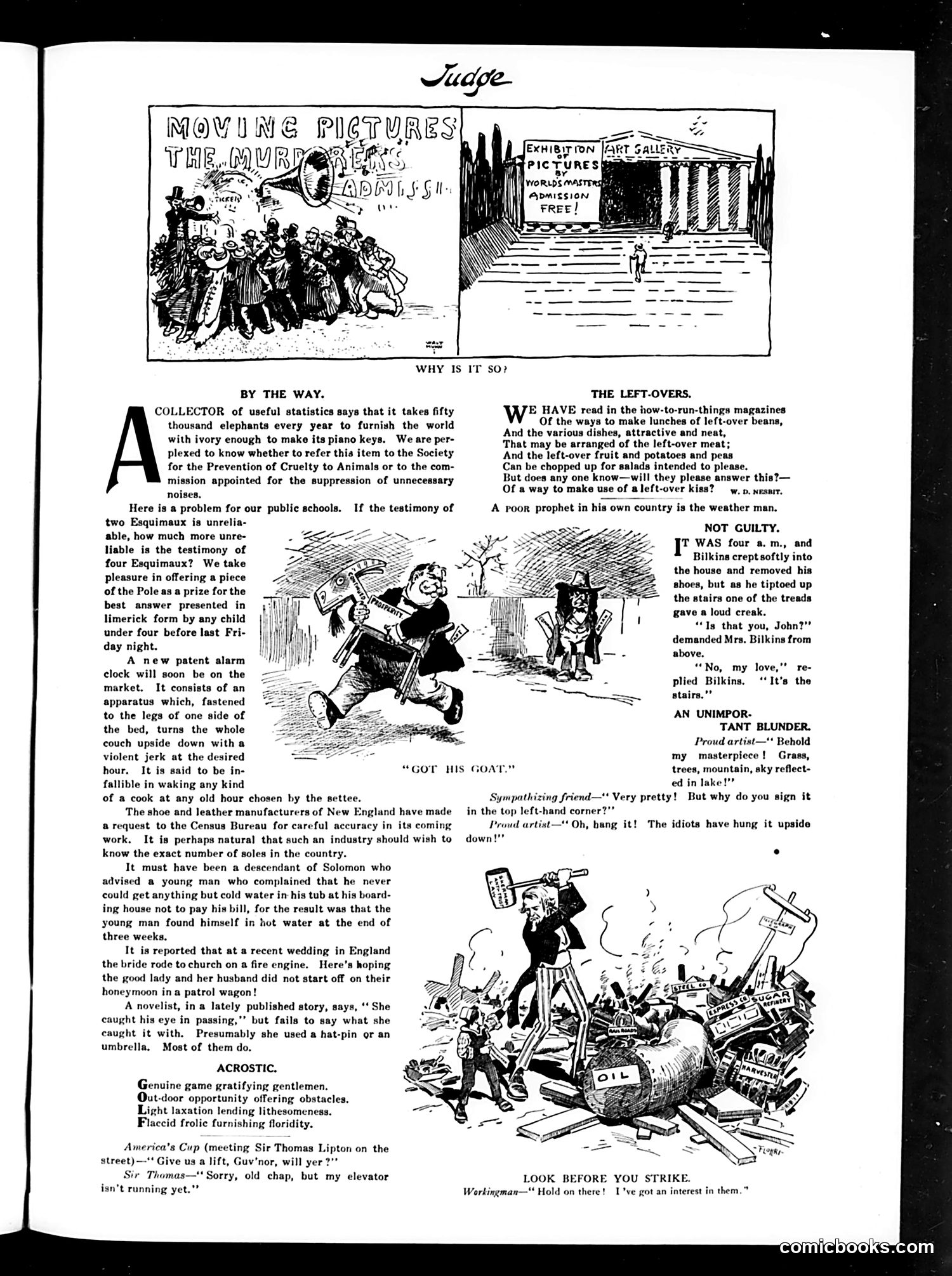
This page contains several satirical pieces mocking contemporary concerns: **"Why Is It So?"** addresses the contrast between expensive art exhibitions (shown in the right panel as free/prestigious) and commercial entertainment like moving pictures featuring "The Murderer" (left panel), suggesting cultural hypocrisy about what institutions promote. **"By the Way"** satirizes practical absurdities: a mechanical alarm clock that violently throws one from bed, and complaints about leftover food waste—early twentieth-century domestic frustrations. **"Got His Goat"** and **"Look Before You Strike"** are brief comic vignettes about everyday mishaps. The magazine employs visual caricature and wordplay typical of Judge's format—mixing social commentary, domestic humor, and mild ridicule of contemporary trends in technology and society.
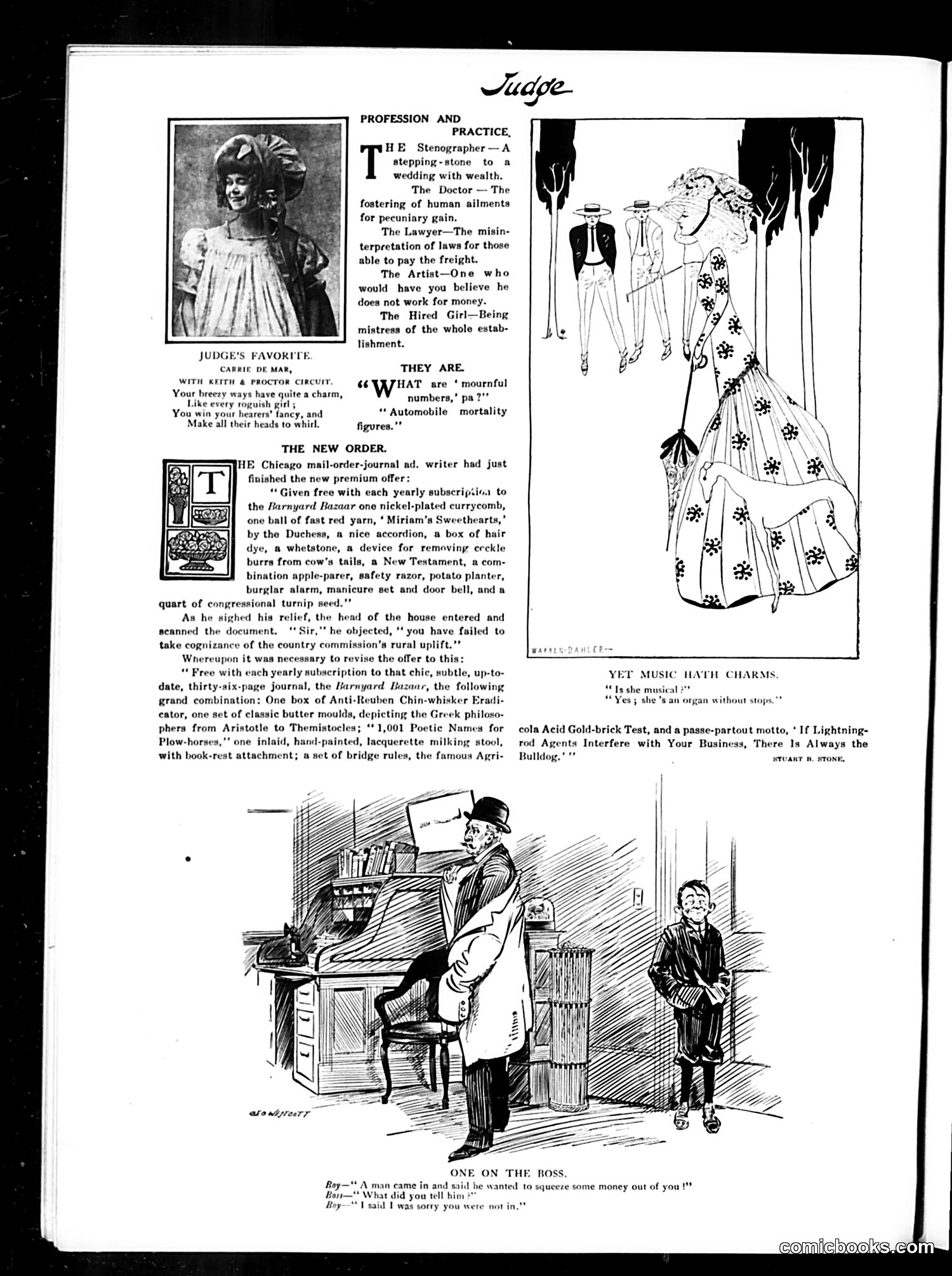
This page contains several distinct pieces of early 20th-century American satire: **Top Section ("Profession and Practice")**: Satirizes various professions—stenographers seeking wealthy husbands, doctors profiting from illness, lawyers misinterpreting laws, and artists claiming not to work for money. The humor targets professional hypocrisy and self-interest. **"The New Order"**: Mocks mail-order magazine subscription schemes offering absurd premiums (chin-whiskers, butter molds, poetic names) alongside functional items. This satirizes aggressive marketing tactics of the era. **Bottom Cartoon ("One on the Boss")**: A visual joke where an employee tells his boss a man came demanding money be squeezed out of him—the employee claims he responded "I said I was sorry you were not in," implying the boss is the one who squeezes money from people. The page critiques commercial excess and workplace exploitation.
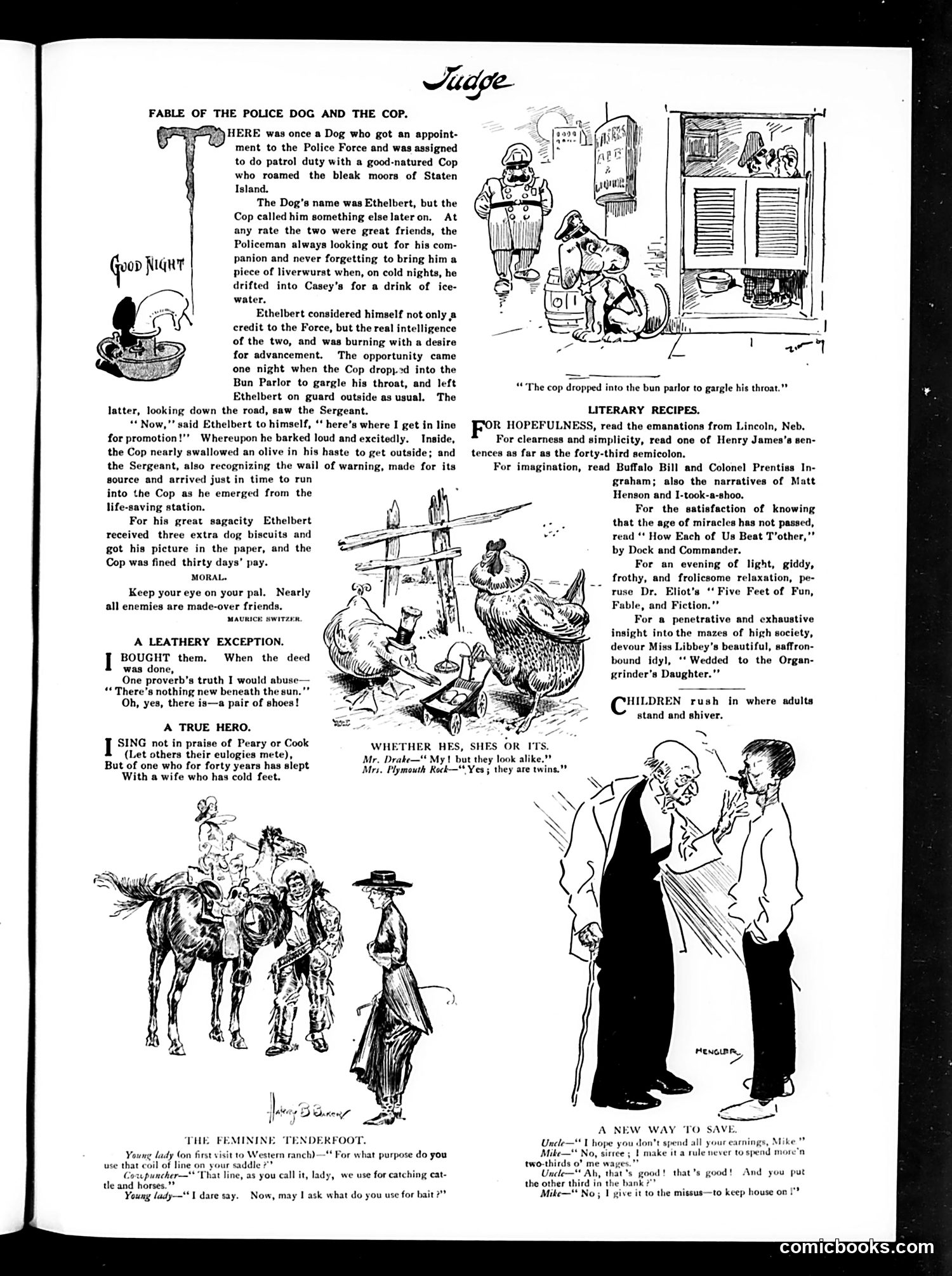
This page contains several distinct pieces rather than a unified political cartoon: **"Fable of the Police Dog and the Cop"** (top): A humorous story about Ethelbert, a police dog partnered with a cop in Staten Island. The narrative celebrates their friendship and Ethelbert's intelligence, culminating in the dog saving the cop's life by alerting him to a threat. This appears to be a feel-good tale rather than political satire. **"Literary Recipes"** and other sections offer miscellaneous humor and advice columns typical of Judge's format. **Bottom illustrations** include "The Feminine Tenderfoot" (about a woman visiting a Western ranch) and "A New Way to Save" (a joke about financial advice). The page is primarily **humorous lifestyle content** rather than political commentary, reflecting Judge's mix of satirical fables, practical jokes, and illustrated stories for general entertainment.
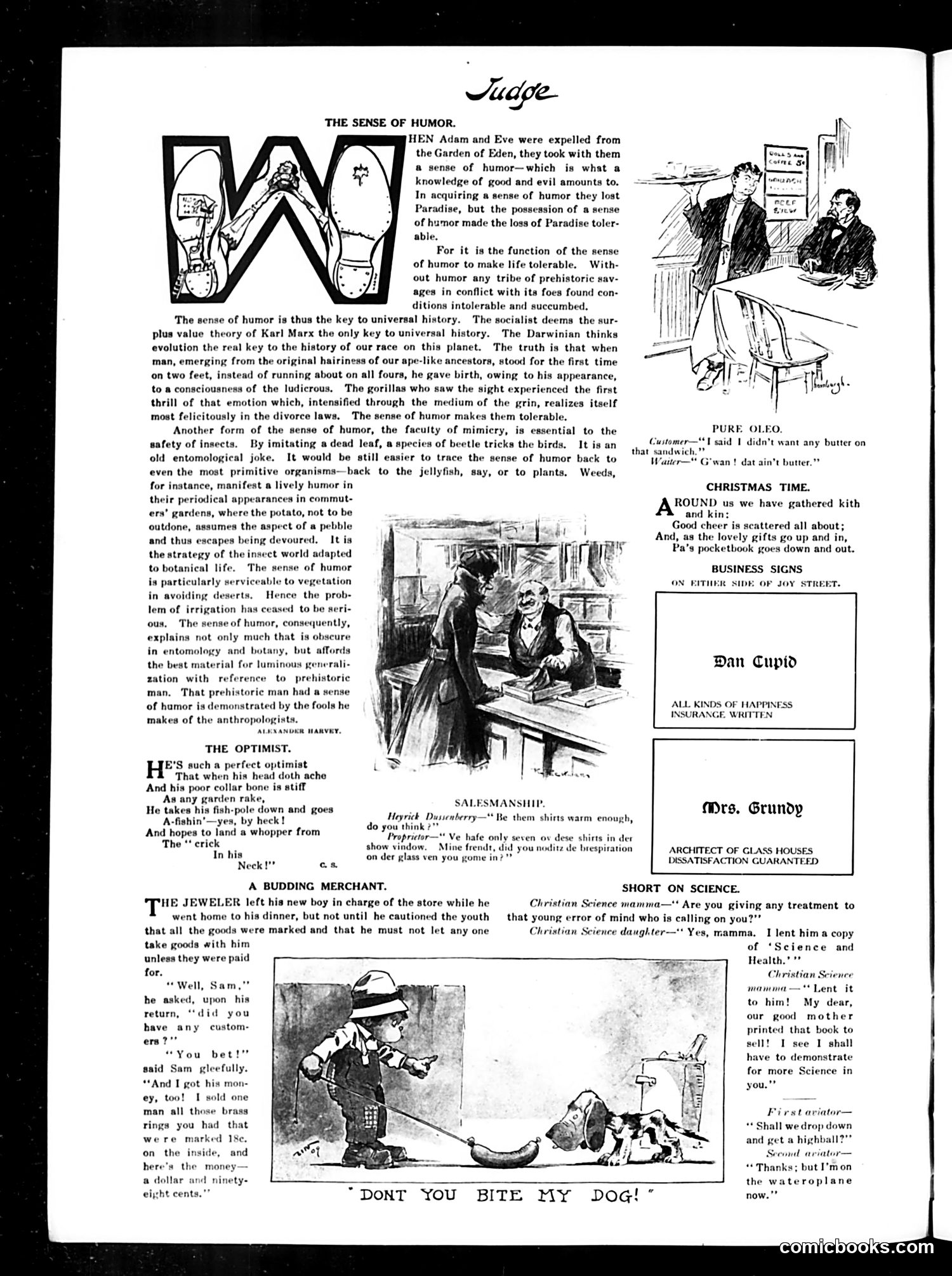
This page from *Judge* satirical magazine contains multiple unrelated pieces typical of the publication's format. The lead article, "The Sense of Humor" by Alexander Harvey, argues humorously that humor—not Marx's economics or Darwin's evolution—is the key to human history and survival. It traces humor back to primitive organisms and cavemen, claiming prehistoric humans discovered comedy upon standing upright and seeing their own ridiculous appearance. The page includes several captioned cartoons and brief comedic sketches: - "The Optimist": A cheerful fisherman despite physical ailments - "A Budding Merchant": A jeweler instructs a boy employee about marked merchandise and payment - "Don't You Bite My Dog!": A child threatening a dog - "Salesmanship," "Pure Oleo," "Christmas Time," and "Short on Science": Various domestic humor vignettes The "Business Signs" section advertises fictional companies with pun-based names ("Dan Cupid" insurance, "Mrs. Grundy" glass houses). The humor relies on wordplay, domestic situations, and gentle social observation rather than specific political references.
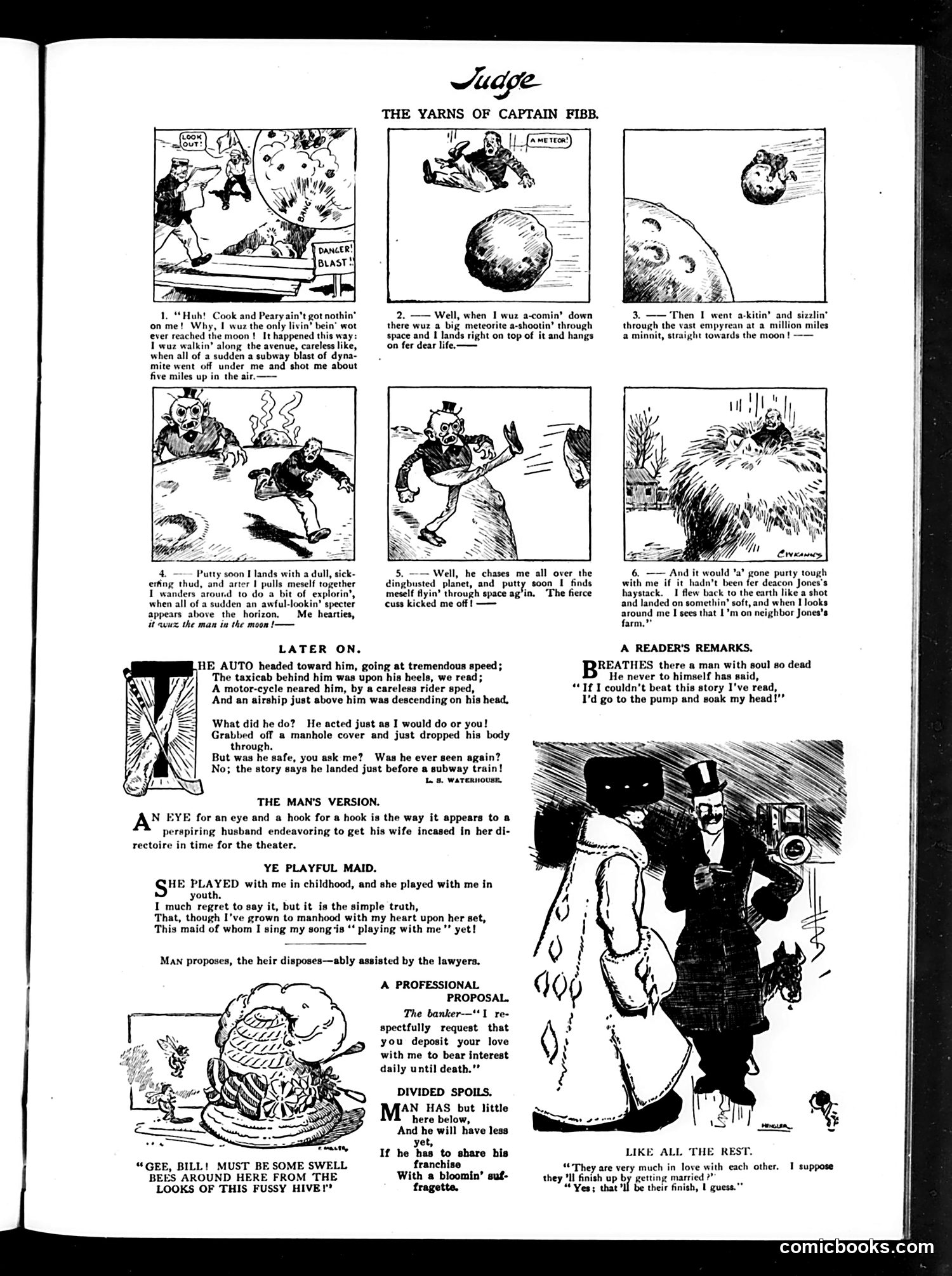
This page contains several satirical pieces typical of early 20th-century Judge magazine humor. **"The Yarns of Captain Fibb"** is a tall-tale comic strip mocking exaggerated adventure narratives. Captain Fibb boasts of reaching the moon—surpassing polar explorers Cook and Peary—through increasingly absurd mishaps (subway dynamite, meteorite collision, planetary chase). The satire targets both fantastical exploration claims and the braggadocio common in contemporary adventure literature. The remaining vignettes offer social commentary: "Later On" depicts a man narrowly escaping traffic only to be struck by a subway train—darkly humorous commentary on modern urban dangers. Other pieces satirize marriage dynamics, romantic "games," and legal/financial arrangements between spouses. The final fragment references "suffragette" politics, suggesting contemporary debates over women's rights. Overall, the page reflects Judge's focus on mocking contemporary social anxieties: transportation dangers, marital discord, and emerging feminist movements.
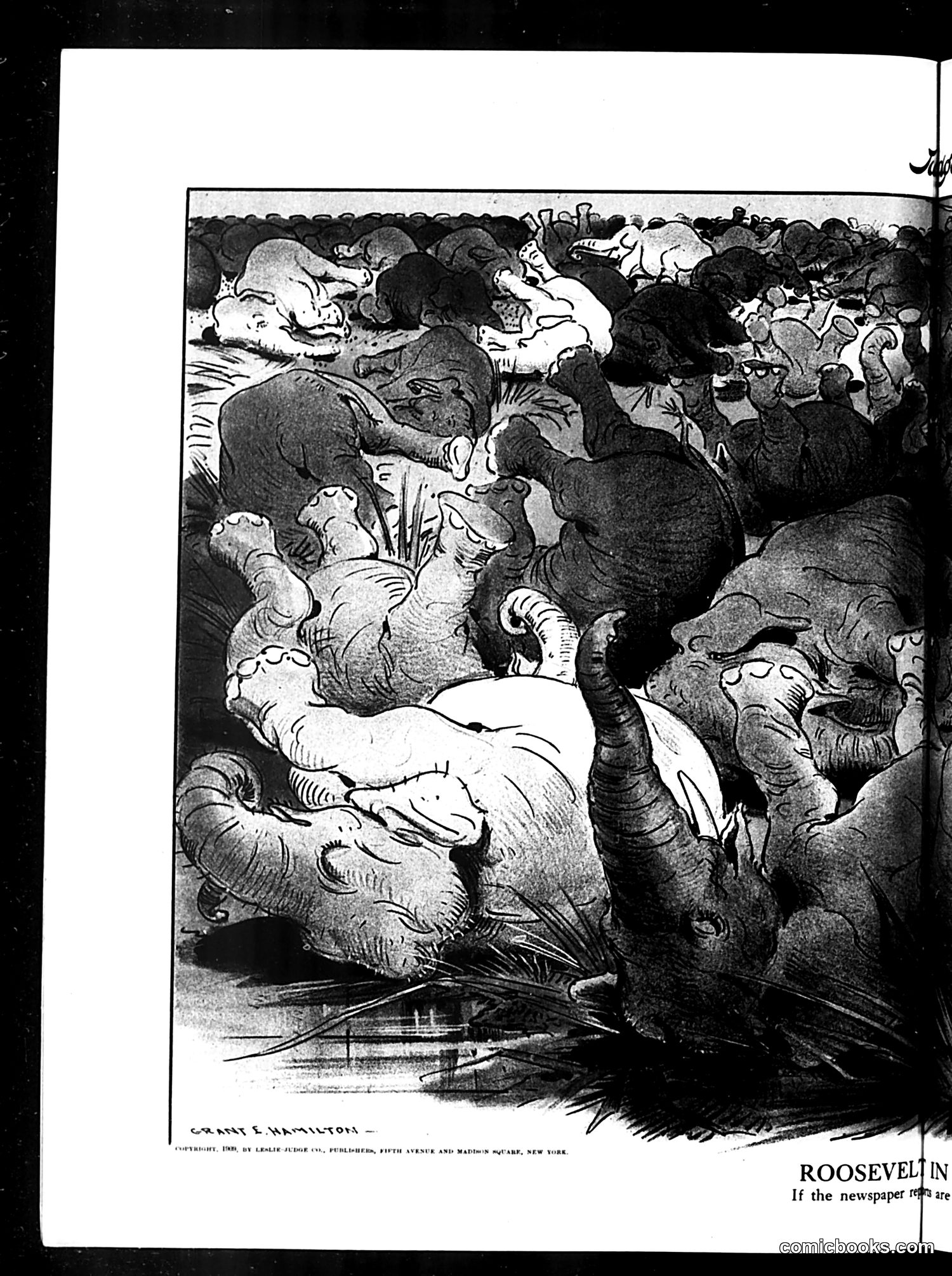
This appears to be a satirical cartoon by Grant Hamilton from Judge magazine critiquing Theodore Roosevelt. The image shows Roosevelt (identifiable by caricature style typical of the era) surrounded by what appear to be political opponents or critics—depicted as various animal-like or grotesque figures in a chaotic, crowded scene. The cartoon's title references "Gibraltar" and "Napoleon," suggesting Roosevelt is being compared to an imposing military/political figure. The caption fragment "If the newspaper *" indicates this comments on press coverage of Roosevelt. The satire likely critiques Roosevelt's political power, aggressive policies, or dominating personality, portraying him as embattled by numerous adversaries or controversies. Without the complete caption, the specific target remains somewhat unclear, but it appears to mock Roosevelt's controversial leadership or contentious political situation.
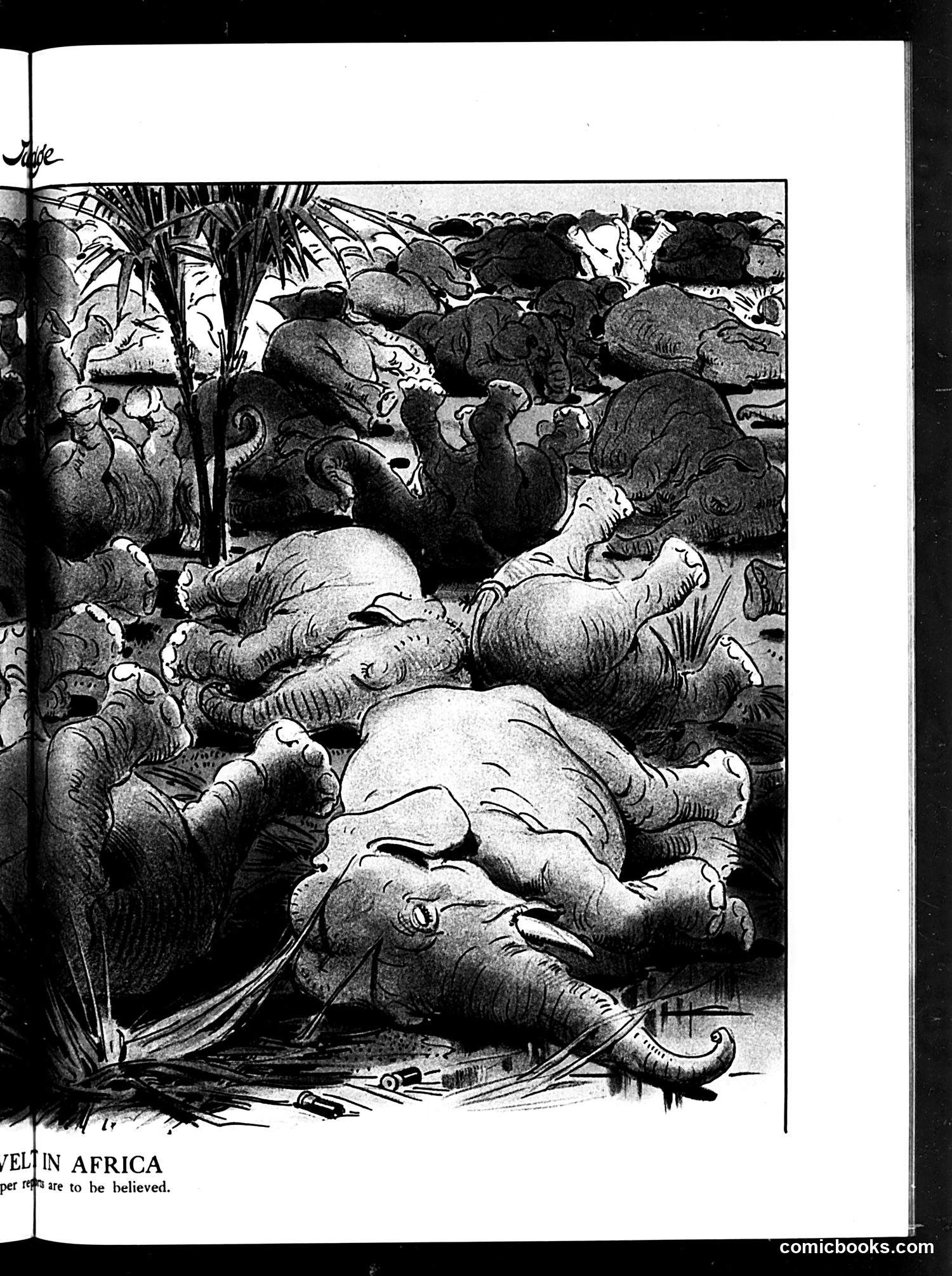
This appears to be a satirical illustration titled "Duel in Africa" depicting a violent scene with multiple figures. The image shows what appears to be dead or dying elephants in the foreground, with human figures (drawn in caricatured style) gathered around them in a tropical setting with palm trees. The partial OCR text "are to be believed" suggests this may be commentary on exaggerated accounts or tall tales about African hunting expeditions—a common satirical subject in late 19th/early 20th century American magazines like Judge. The cartoon likely mocks either hunters' boastful claims about African game or colonial-era narratives about Africa. However, without the complete caption or clearer context, the specific political or social point remains unclear.
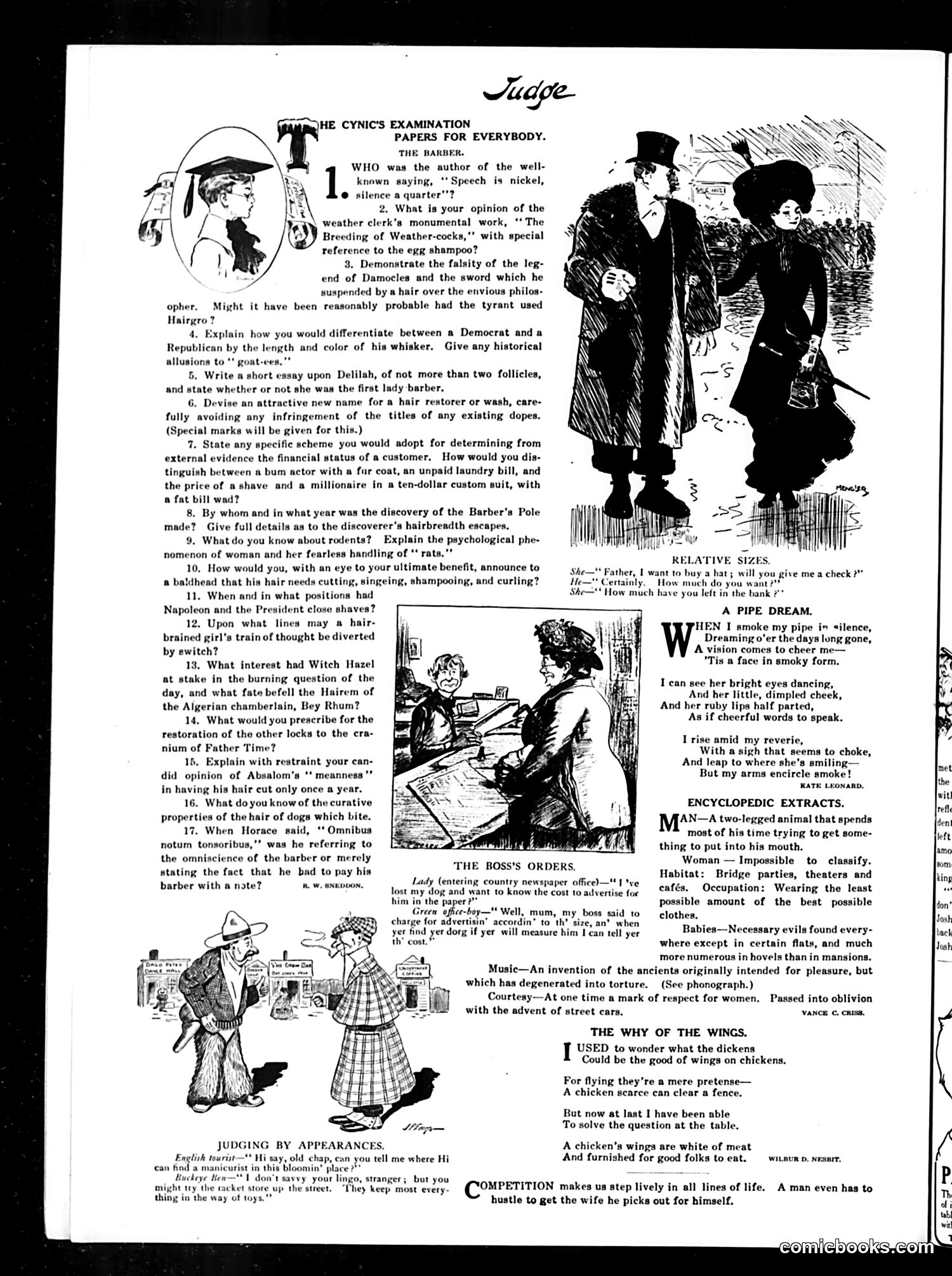
This page from the satirical magazine *Judge* contains examination questions parodying a barber's knowledge. The "Cynic's Examination Papers" mock barbers by asking absurdly erudite questions mixing classical references (Damocles, Delilah, Horace) with barbering trivia—a working-class profession contrasted humorously against intellectual demands. The satire targets barbers' pretensions: questions about distinguishing millionaires from broke actors, decoding customers' finances, and naming hair products reflect social anxieties about class deception in the Gilded Age. References to "rats" (hairpieces), hair restorers ("dopes"), and the Barber's Pole mock the profession's commercialism. The accompanying cartoons and poems (including "A Pipe Dream" about romantic reverie) and encyclopedic jokes fill space with period humor. The overall effect ridicules both barbers' aspirations to sophistication and contemporary concerns about determining who actually has money—a recurring anxiety in Edwardian-era satire.
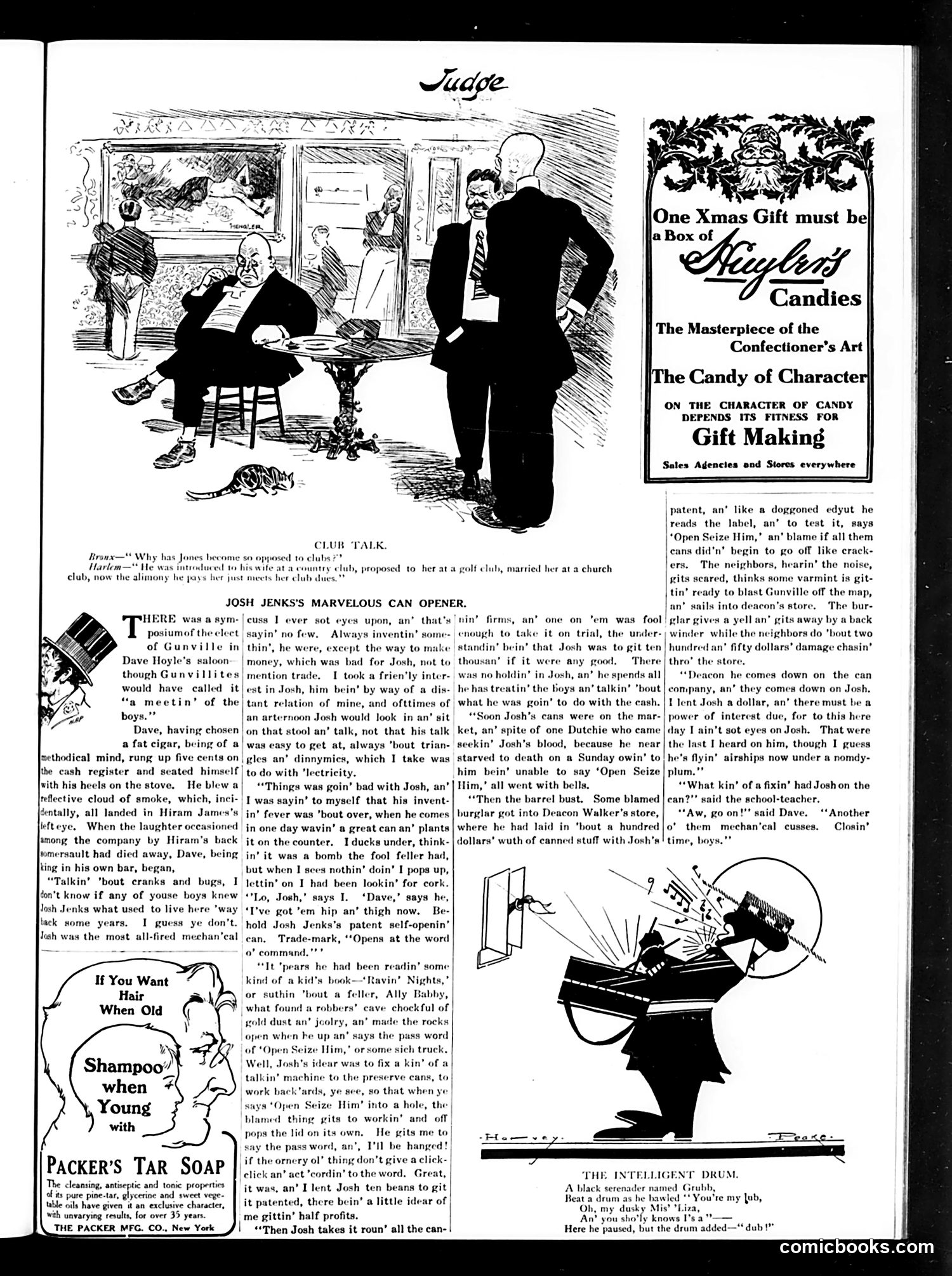
This page contains a humorous story titled "Josh Jenks's Marvelous Can Opener," a common Judge feature satirizing American gullibility and get-rich-quick schemes. **The Setup:** Dave Hoyle recounts how his acquaintance Josh Jenks invented a self-opening can operated by speaking "Open Seize Him" (a pun on "Open Says Me," the magic phrase from *Ali Baba and the Forty Thieves*). Josh spends borrowed money promoting it as revolutionary. **The Satire:** The joke mocks inventor-optimism and naive investors. Despite initial promise, the invention fails spectacularly when it malfunctions in a store, causing chaos. Josh borrows ten dollars for a patent that yields no profits. **Social Context:** This reflects early-1900s American skepticism toward technological "miracles" and the proliferation of dubious patents. The story invokes a fairy-tale reference (Ali Baba) to suggest the scheme is equally fantastical. The page also includes period advertisements for Suydam's Candies and Packer's Tar Soap, typical of Judge's revenue model.
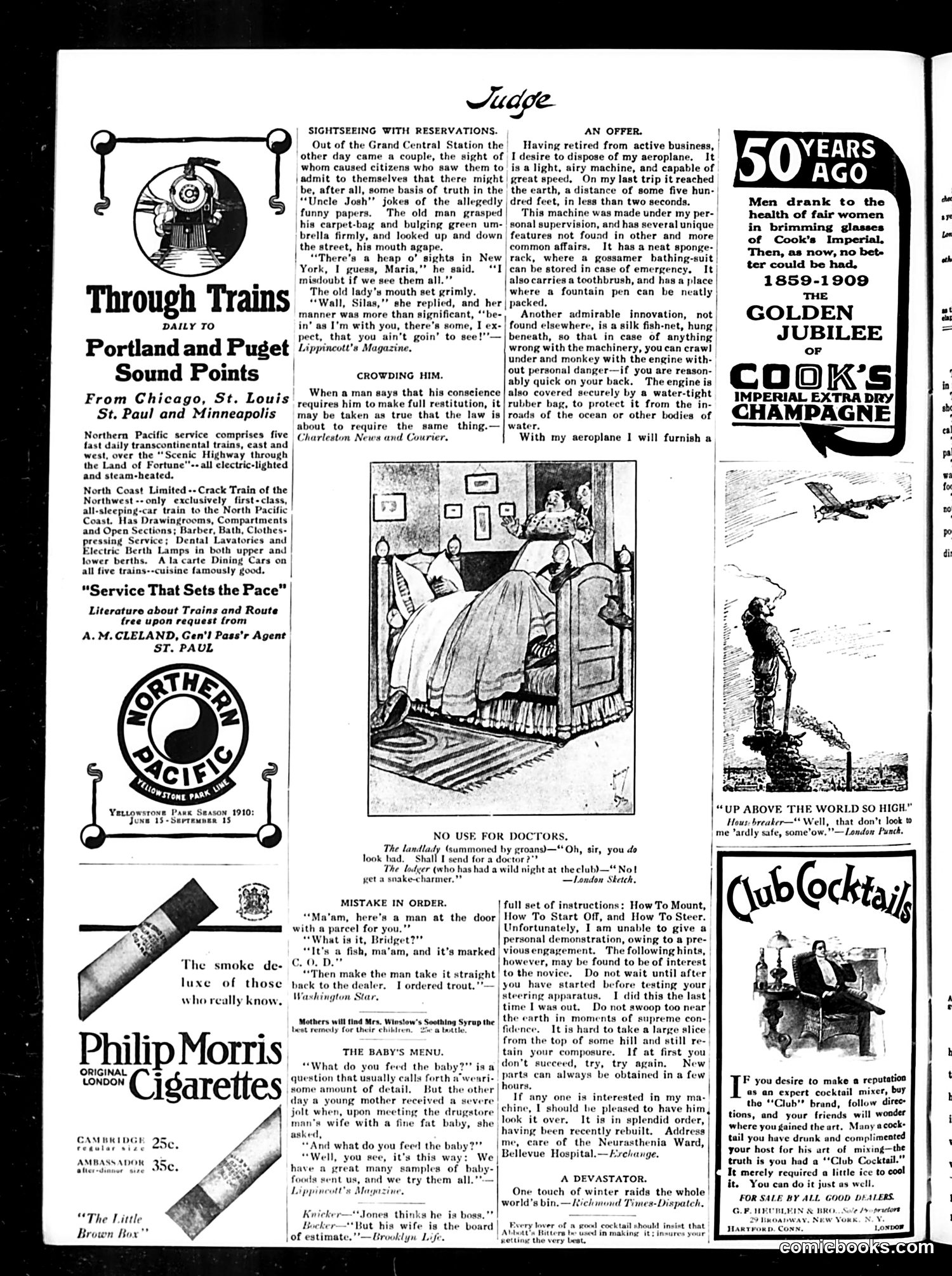
This page is primarily **advertisements and humor pieces** rather than political satire. Key content: **Main Cartoon/Humor**: "Sightseeing with Reservations" depicts rural/unsophisticated travelers (appearing to be from the Midwest) arriving at Grand Central Station in New York. The joke plays on "Uncle Josh" stereotypes—country folk amazed by city life, speaking in dialect. The woman declares she won't see the sights because she's traveling with her husband. The satire mocks rural Americans' perceived lack of worldliness and awkwardness in urban settings. **"An Offer"** is a deadpan humor piece offering a broken airplane for sale, listing absurd "features" like a sponge rack and fish-net—poking fun at early aviation's dangers and poor engineering. Other brief jokes mock doctors, babies' diets, and conscience versus law. The page is dominated by **product advertisements**: Philip Morris cigarettes, Northern Pacific trains, and Cook's champagne—typical of Judge's era.
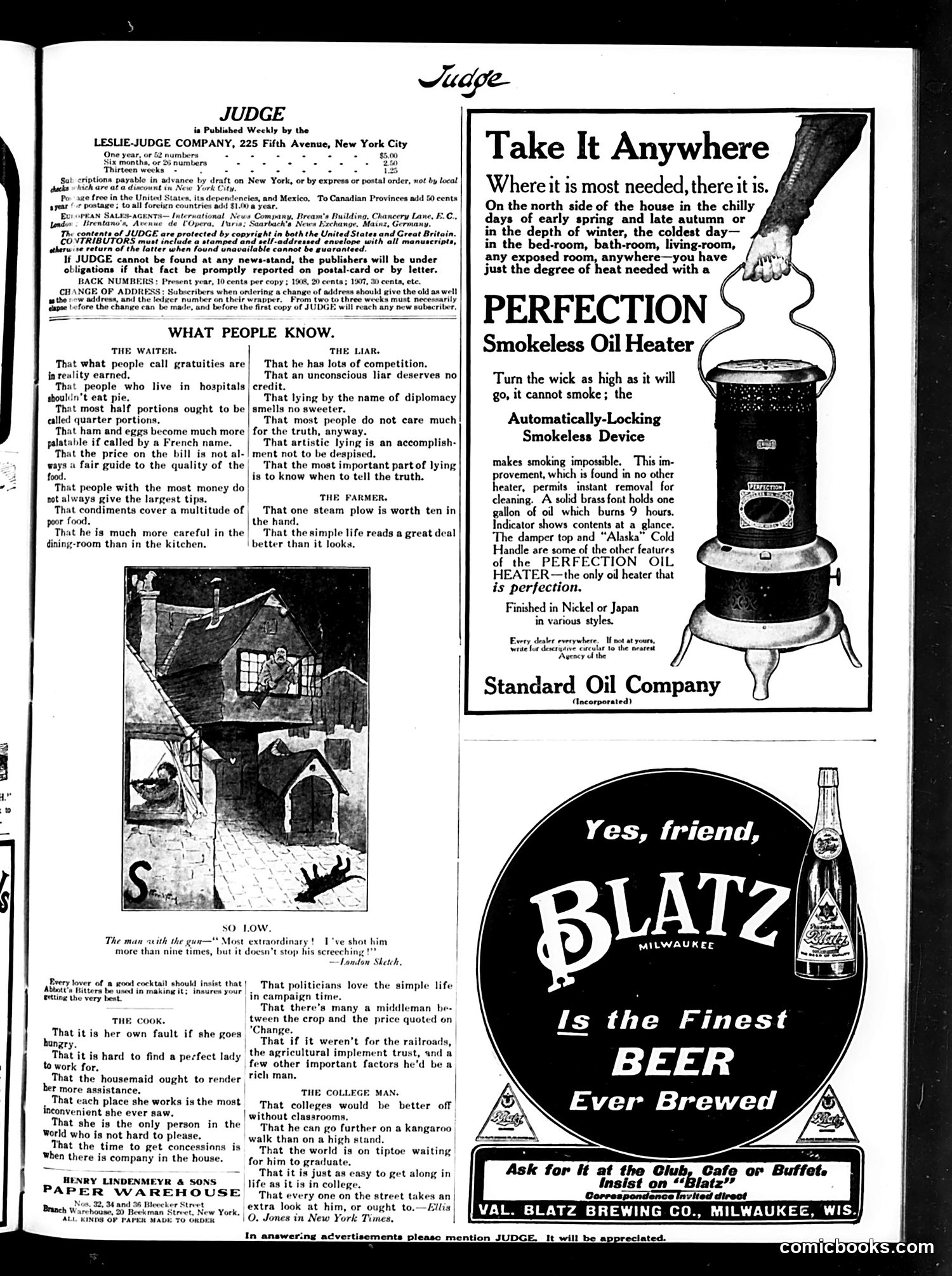
This page contains satirical commentary typical of *Judge* magazine's early 20th-century humor. The main content is a section titled "WHAT PEOPLE KNOW"—a series of witty observations about different social types: waiters, liars, farmers, cooks, and college men. These are gentle satirical jabs at common stereotypes, suggesting, for example, that waiters carefully manage tips, liars deserve no credit for dishonesty, farmers are practical, and college men are self-important. The page also includes period advertisements: a *Perfection* smokeless oil heater and *Blatz* beer from Milwaukee. The single cartoon visible depicts a man with a gun in an apparent crime scene (labeled "SO LOW"), with a humorous caption about shooting someone repeatedly without stopping them. The satire reflects turn-of-the-century American social observation rather than specific political commentary.
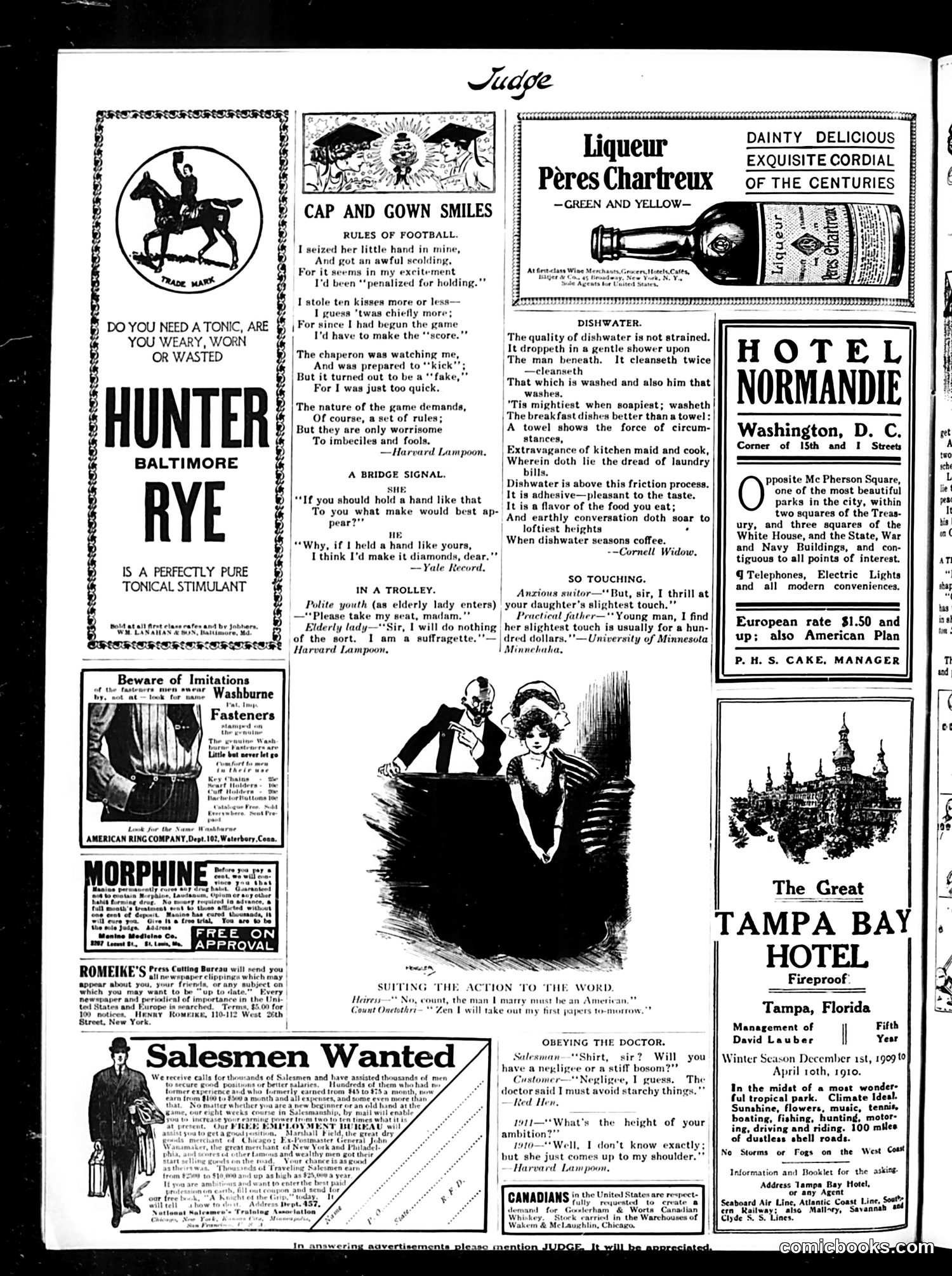
This page from *Judge* is primarily **advertising and humorous vignettes**, not a political cartoon. The content consists of: **Humorous sketches** depicting dating/courtship mishaps: - College couples getting in trouble with chaperones - A man misunderstanding bridge card signals as romantic - A father warning a young suitor away from his daughter The jokes rely on turn-of-the-century social anxieties: strict propriety around unmarried couples, class consciousness (elderly ladies on trolleys), and parental protectiveness. References to Harvard and Yale suggest an educated readership. **The "Dishwater" piece** appears to be mock-Shakespearean satire, humorously elevating mundane kitchen complaints to poetic language. **Advertisements** dominate: Hunter Rye tonic, Hotel Normandie (Washington DC), Tampa Bay Hotel, and various patent medicines (morphine "free on approval"). The overall tone reflects early 1900s American leisure-class humor—genteel, slightly risqué, assumption of reader familiarity with college culture and social conventions.
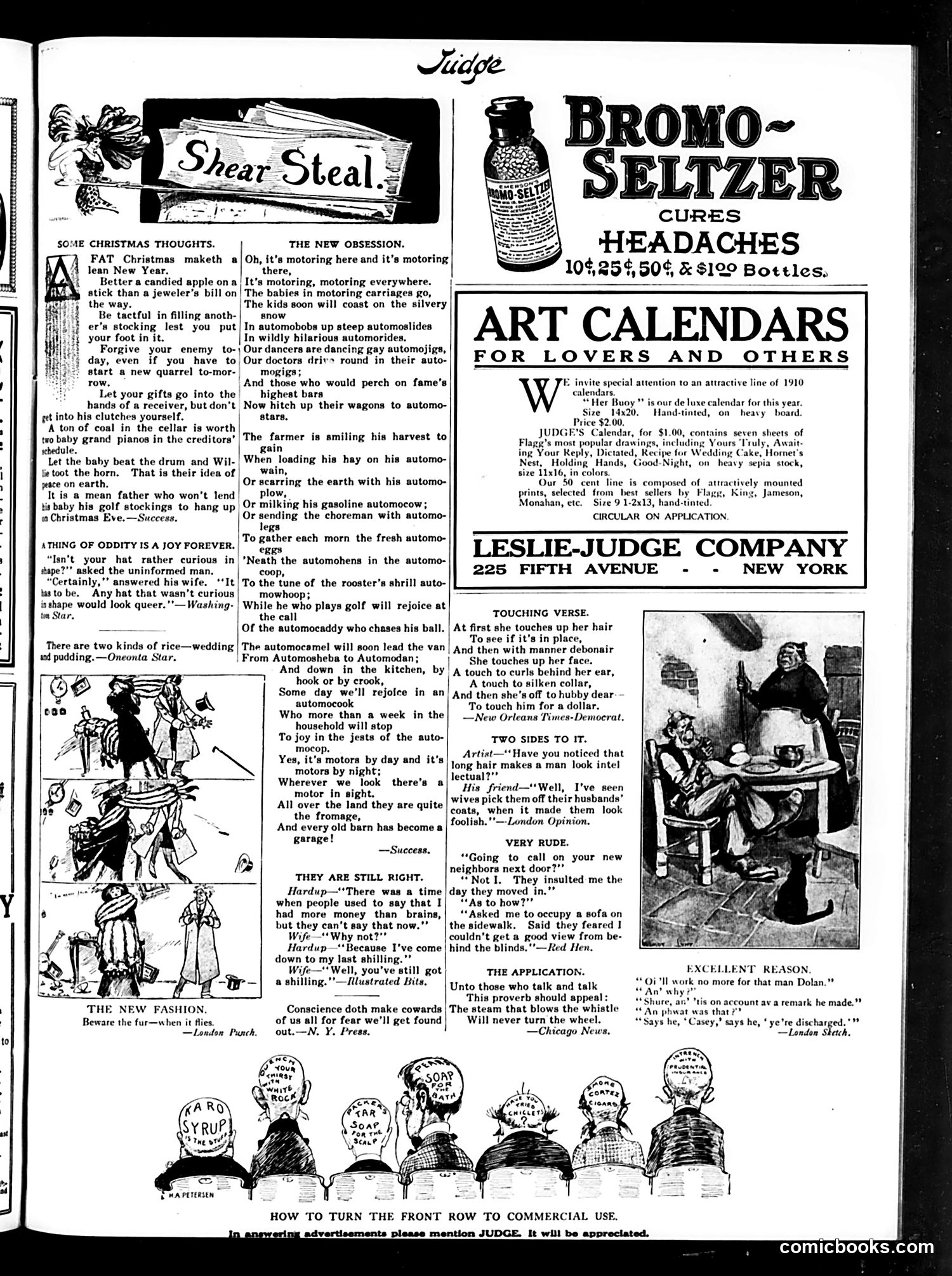
This page satirizes early-1900s America's obsession with automobiles. The main cartoon, "The New Obsession," uses playful neologisms ("automojigs," "automocow," "automocook") to mock how completely motor vehicles have infiltrated daily life—from farming to romance to children's play. The humor works through exaggeration: farmers now use "gasoline automocows" for milking; golf caddies become "automocaddies"; even barnyard hens produce "automo-eggs." The satirist suggests Americans have mindlessly absorbed automobiles into every activity, replacing horse-drawn and manual labor with motorized versions of the same tasks. This reflects real anxiety about rapid technological change transforming society. For modern readers, it's notable as early commentary on how transformative (and potentially absurd) automobile adoption appeared to 1910 observers—capturing genuine cultural disruption, even as the language choices make it seem quaint today.
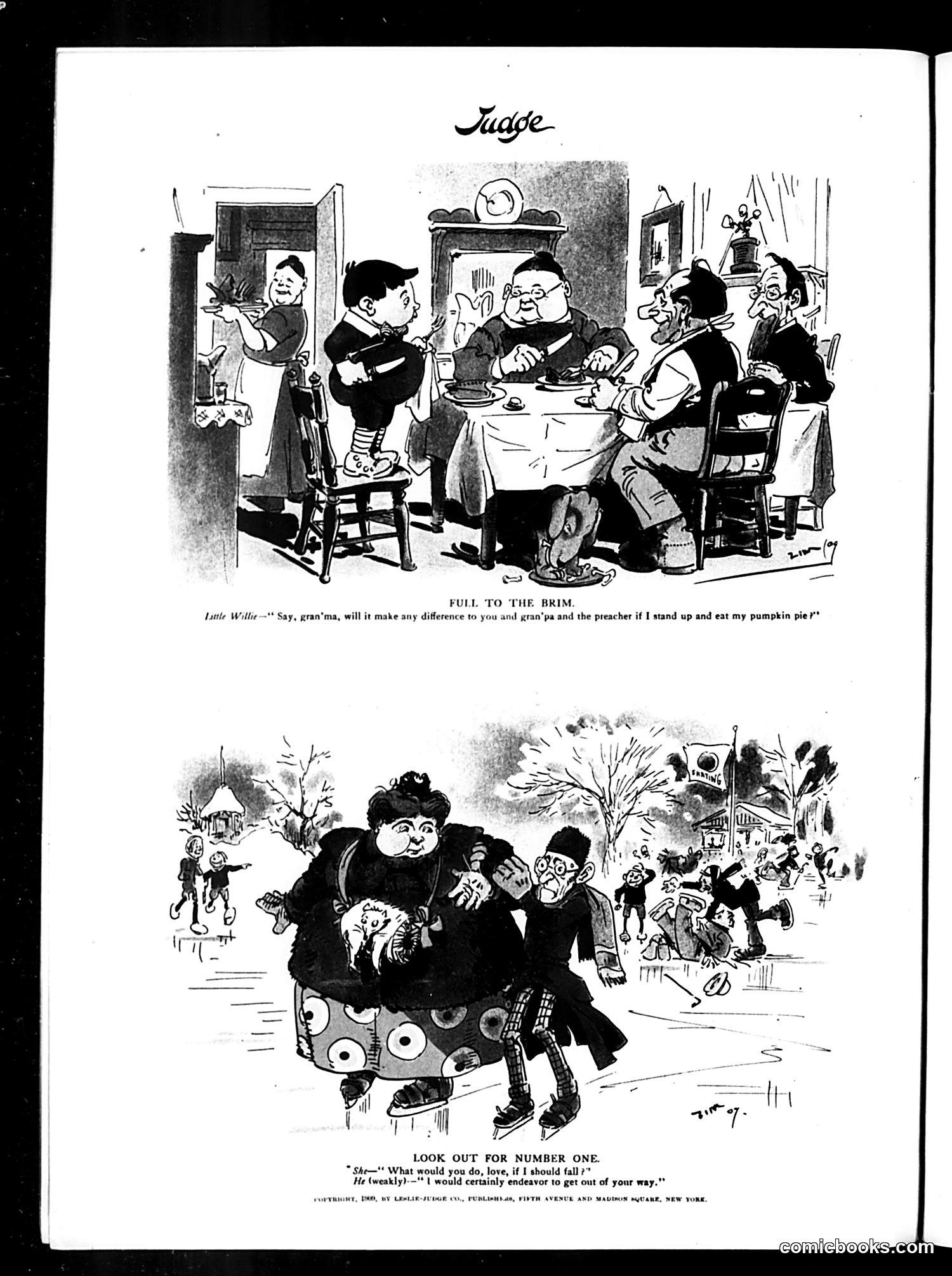
These two cartoons satirize social hypocrisy and self-interest among the upper classes. **"Full to the Brim"** shows a child (Little Willie) asking grandparents and a preacher if his standing and eating during a formal meal matters to them. The humor targets how adults lecture children about propriety while being preoccupied with food and comfort themselves—the adults are clearly "full to the brim" (stuffed) and indifferent to etiquette. **"Look Out for Number One"** depicts a woman assuring her husband she'd help if he fell, but the caption reveals her actual response: she'd simply get out of his way. This satirizes the self-preservation instinct masked by performative concern—the title's pun on "number one" (oneself) underscores how people prioritize their own welfare over others, even spouses. Both cartoons mock Victorian-era pretense about morality and devotion while exposing base self-interest beneath polite society.