
A complete issue · 16 pages · 1909
Judge — July 31, 1909
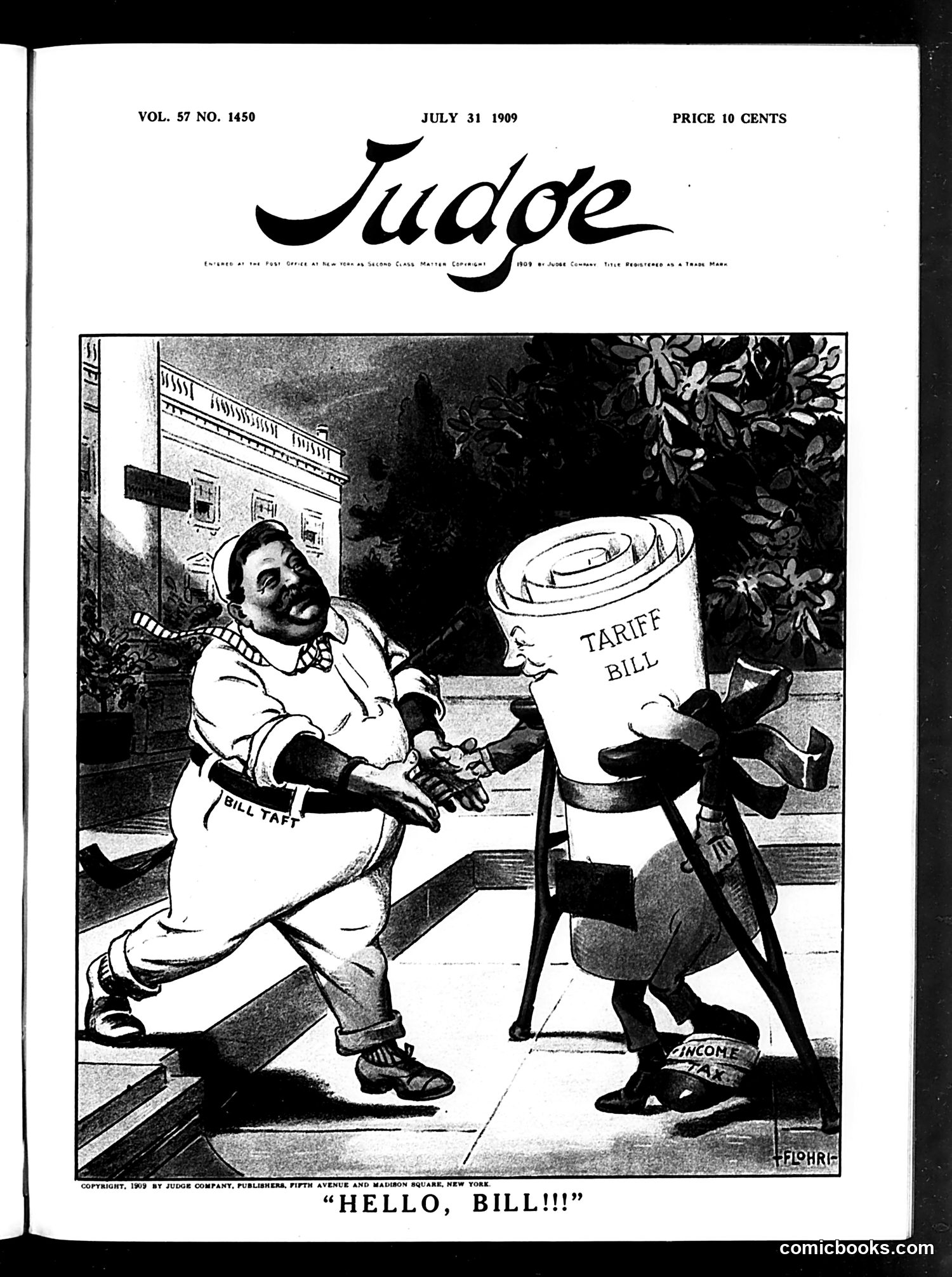
This cartoon satirizes the relationship between two bills in Congress. One figure labeled "BILL TAFT" appears to be greeting or confronting another labeled "TARIFF BILL." The cartoon suggests tension or conflict between President William Howard Taft's legislative agenda and tariff legislation being debated in Congress. The "Hello, Bill" caption implies these two legislative matters are meeting or colliding. In 1909, Taft faced significant political controversy over tariff policy, particularly following the Payne-Aldrich Tariff debate. The cartoon likely critiques how Taft's own bills or policies were entangled with contentious tariff issues, mocking the legislative gridlock or political maneuvering of the period.
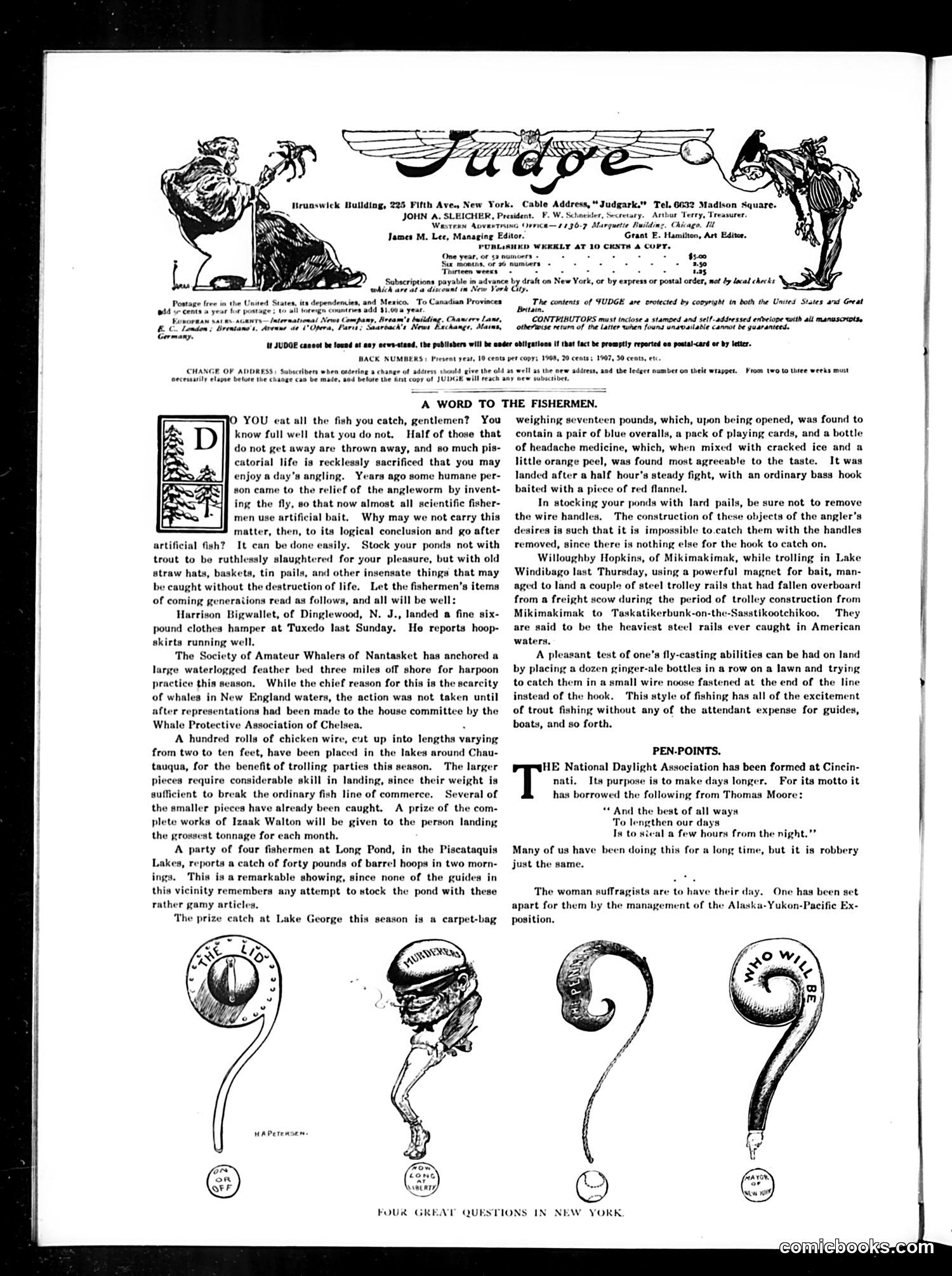
This page combines fishing advice with political satire. "A Word to the Fishermen" offers practical tips about fish care and trolling techniques, seemingly straightforward outdoor content. However, the bottom section, "Four Great Questions in New York," appears political. Four illustrated question marks feature different caricatured heads—though the image quality makes specific identifications difficult. Based on Judge's satirical nature, these likely represent prominent New York political or public figures of the era, though I cannot definitively identify them. The accompanying text about the National Daylight Association and women suffragists suggests the page addresses contemporary social debates, but without clearer visual detail or complete OCR text for those sections, the specific satirical targets and arguments remain unclear.
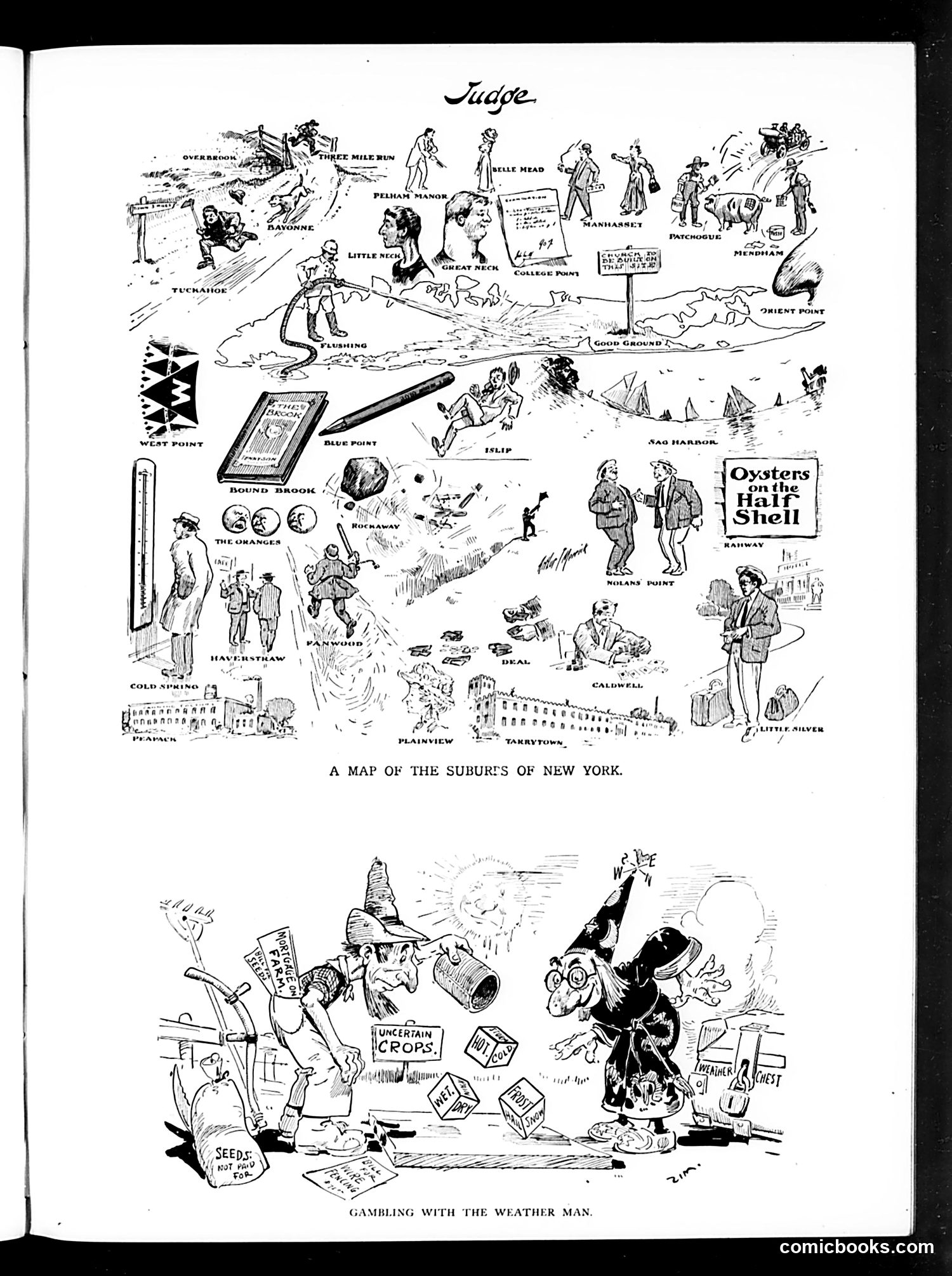
The page contains two satirical cartoons: **Top: "A Map of the Suburbs of New York"** is a humorous map-illustration showing various NYC-area locations (Pelham Manor, Manhasset, Tarrytown, etc.) populated with caricatured figures representing stereotypical suburban residents and activities. The satire appears to mock suburban life, leisure activities, and the types of people attracted to different communities. **Bottom: "Gambling with the Weather Man"** depicts a figure labeled "Uncertain Crops" juggling dice and other gambling implements while interacting with a wizard-like "Weather Man" character. This likely satirizes farmers' dependence on unpredictable weather and their gambling-like relationship with agricultural outcomes—a timely concern for early-20th-century rural America. Both cartoons use exaggerated characterization and visual humor typical of Judge's satirical style.
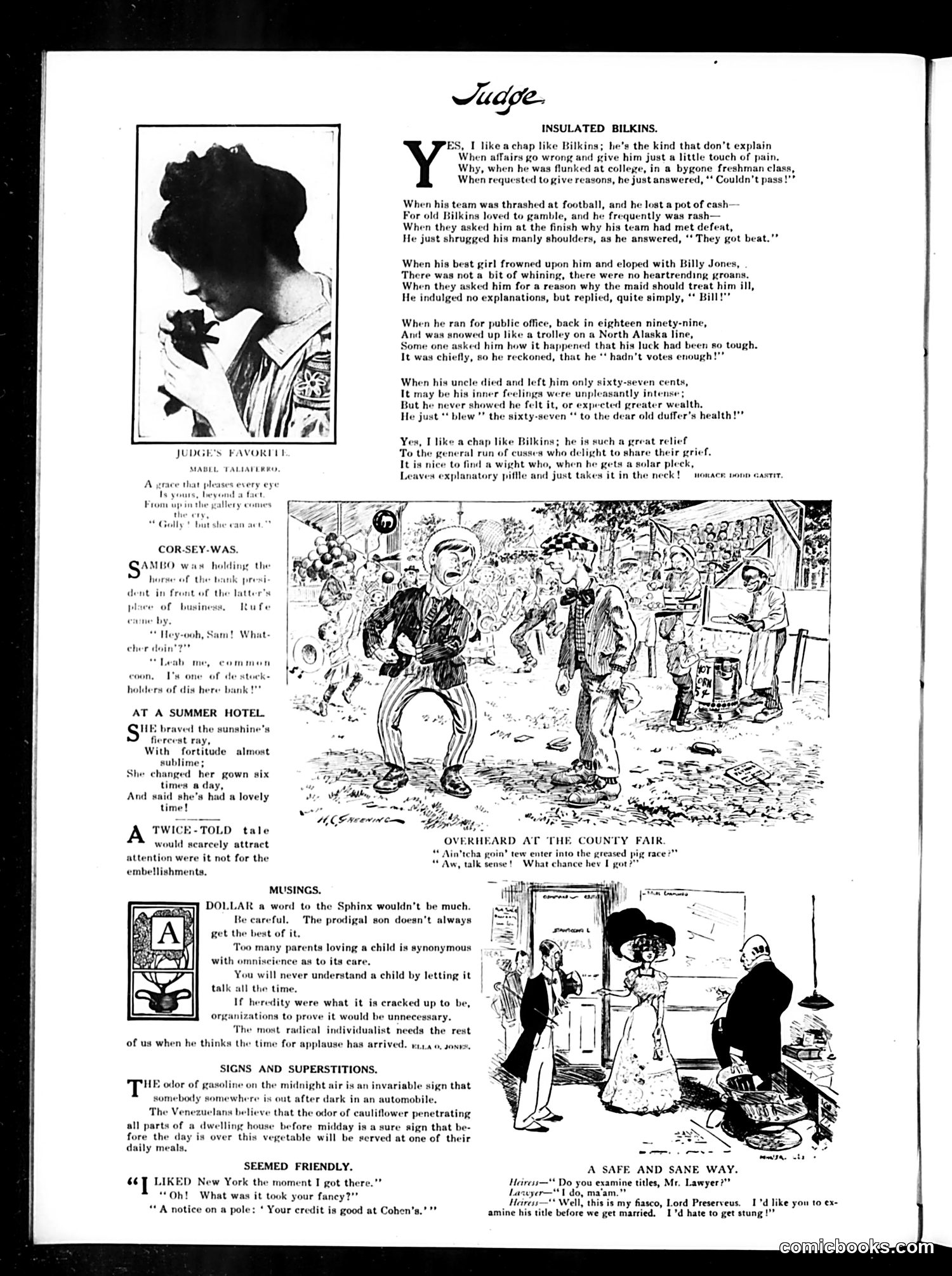
This page contains several separate satirical pieces rather than unified political cartoons: **"Insulated Bilkins"** (top) uses verse to mock a character named Bilkins—a man who responds to life's difficulties with indifference or shrugs. He loses money gambling, his team loses at football, his girlfriend elopes, he loses a political race, and his uncle leaves him little money—yet he remains unmoved. The satire targets emotional detachment or lack of genuine feeling. **"Corsey-Was"** and other vignettes are humorous social observations about everyday situations. **"Musings"** and **"Signs and Superstitions"** sections offer witty commentary on human behavior and folk beliefs. The cartoons illustrate these pieces with sketches of typical middle-class American scenes and characters from the era, emphasizing social manners and peculiarities rather than partisan politics.
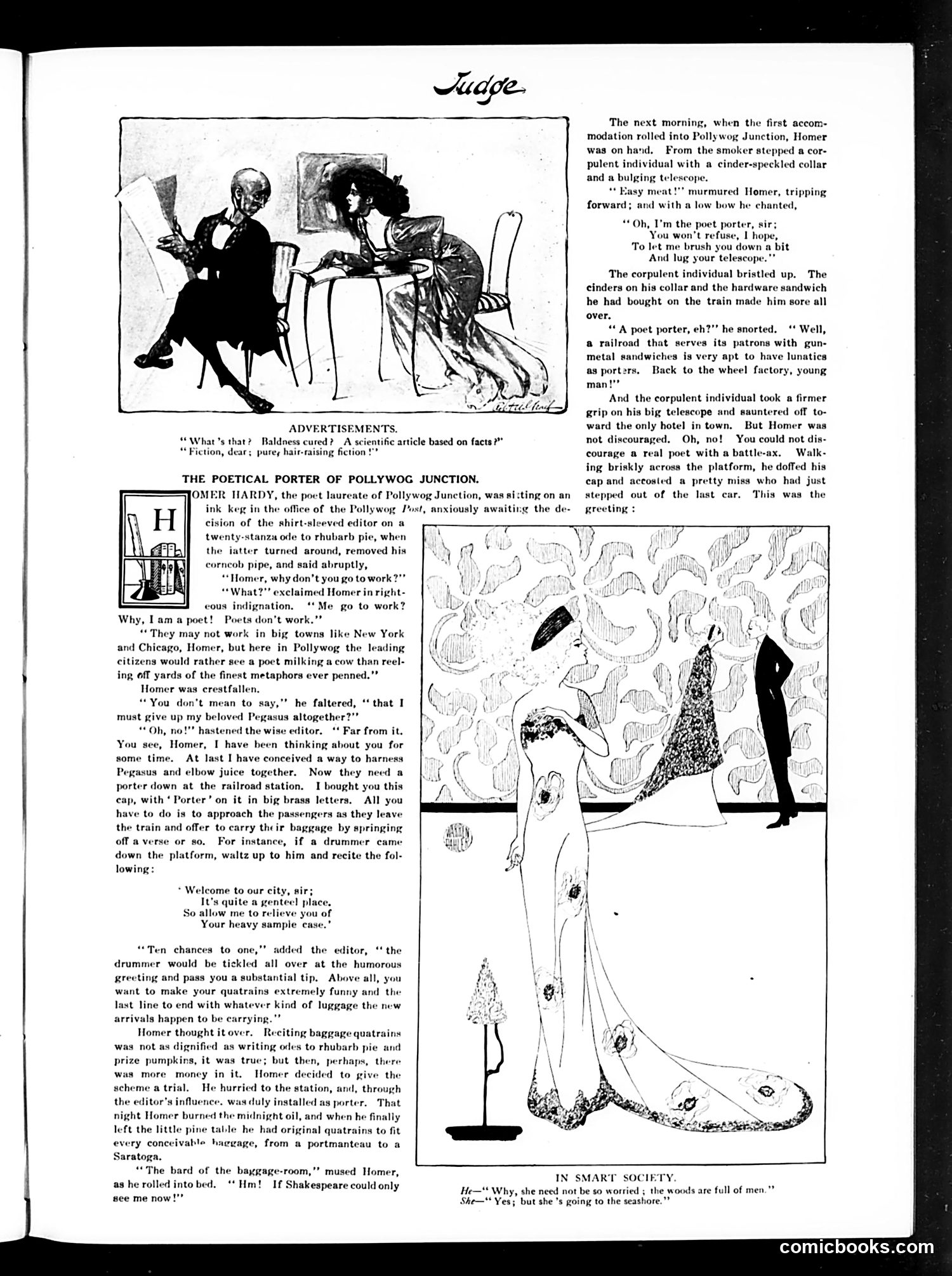
This page contains two main sections: **Top cartoon**: Shows two figures in conversation—apparently a smoker with a telescope and another character. The dialogue references "Baldhead Garey" and discusses whether fiction should be "hair-raising." This appears to be satirizing a contemporaneous figure or public debate, though the specific reference is unclear without additional context. **Main story**: "The Poetical Porter of Pollywog Junction" features Homer Hardy, a railroad porter who fancies himself a poet. The satire mocks his pretensions to literary greatness while working a menial job. The editor's suggestion that Homer recite poetry to arriving passengers—framed as entertainment—ridicules both Homer's delusions and the era's enthusiasm for amateur verse. The accompanying illustration shows Homer accosting a woman with his work, satirizing the aggressive promotion of unsolicited poetry.
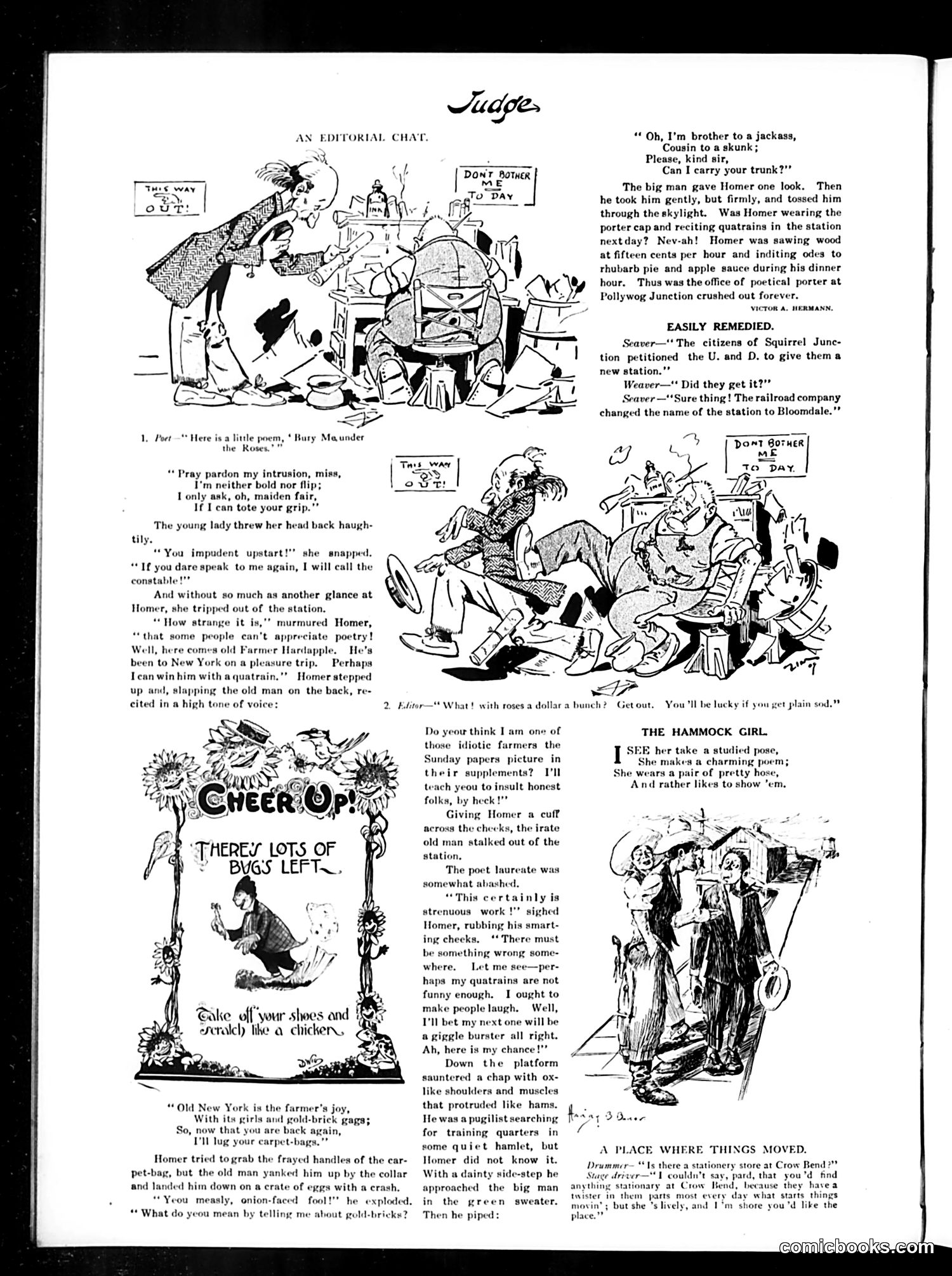
This page satirizes the pretensions and failures of a would-be "poetical porter" named Homer. The main cartoon depicts Homer attempting to impress travelers with bad poetry and courtly manners at a train station, only to be repeatedly rejected and physically abused. The satire targets: **social climbing** (Homer's attempts to adopt genteel behavior toward middle-class travelers), **bad poetry** (his clumsy quatrains about "jackasses" and "skunks"), and **class friction** (wealthy ladies and farmers rejecting his advances). The joke is that his efforts to be cultured backfire spectacularly—he's thrown through a skylight by a pugilist and eventually reduced to manual labor. Supporting pieces mock **railroad companies** (renaming stations rather than building new ones) and include mild visual humor about women's fashion. The satire reflects Gilded Age anxieties about social mobility and the gap between aspirations and reality.
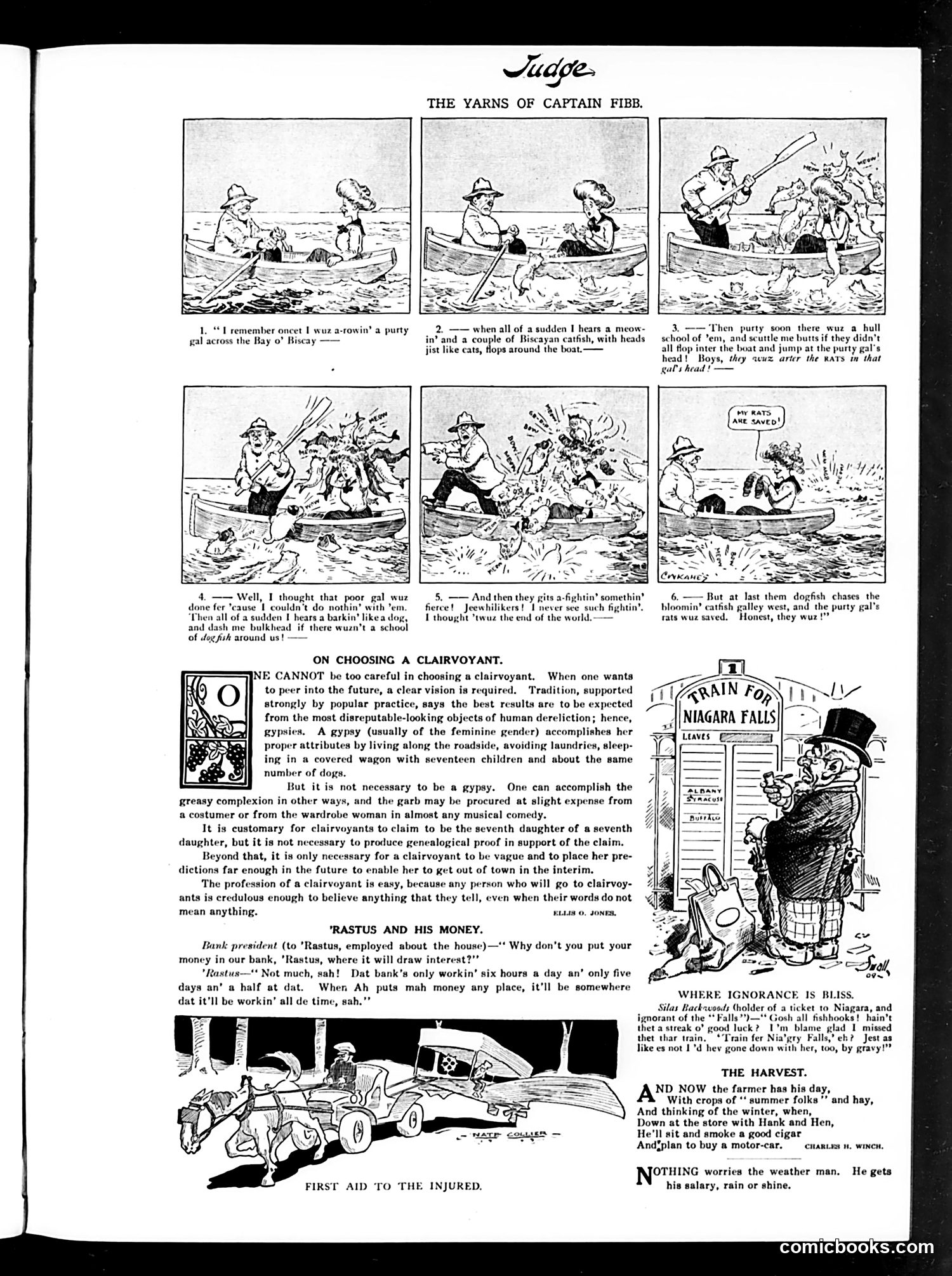
The top comic strip satirizes tall tales and exaggerated storytelling—a classic American folklore tradition. Captain Fibb recounts an absurd fishing adventure involving a woman, aggressive sea creatures (catfish, dogfish), and escalating chaos. The humor derives from the implausibility and the sailor's oblivious delivery of increasingly ridiculous events. Below are separate satirical pieces targeting social types: clairvoyants (fraudulent fortune-tellers exploiting gullibility), racial stereotyping in "Rastus and His Money" (depicting African Americans as financially unsophisticated), and ignorant tourists at Niagara Falls. "The Harvest" jokes about farmers viewing seasonal tourists as profitable crops. Throughout, Judge lampoons American gullibility, fraud, and social pretension through exaggeration and character caricature typical of early 20th-century humor magazines.
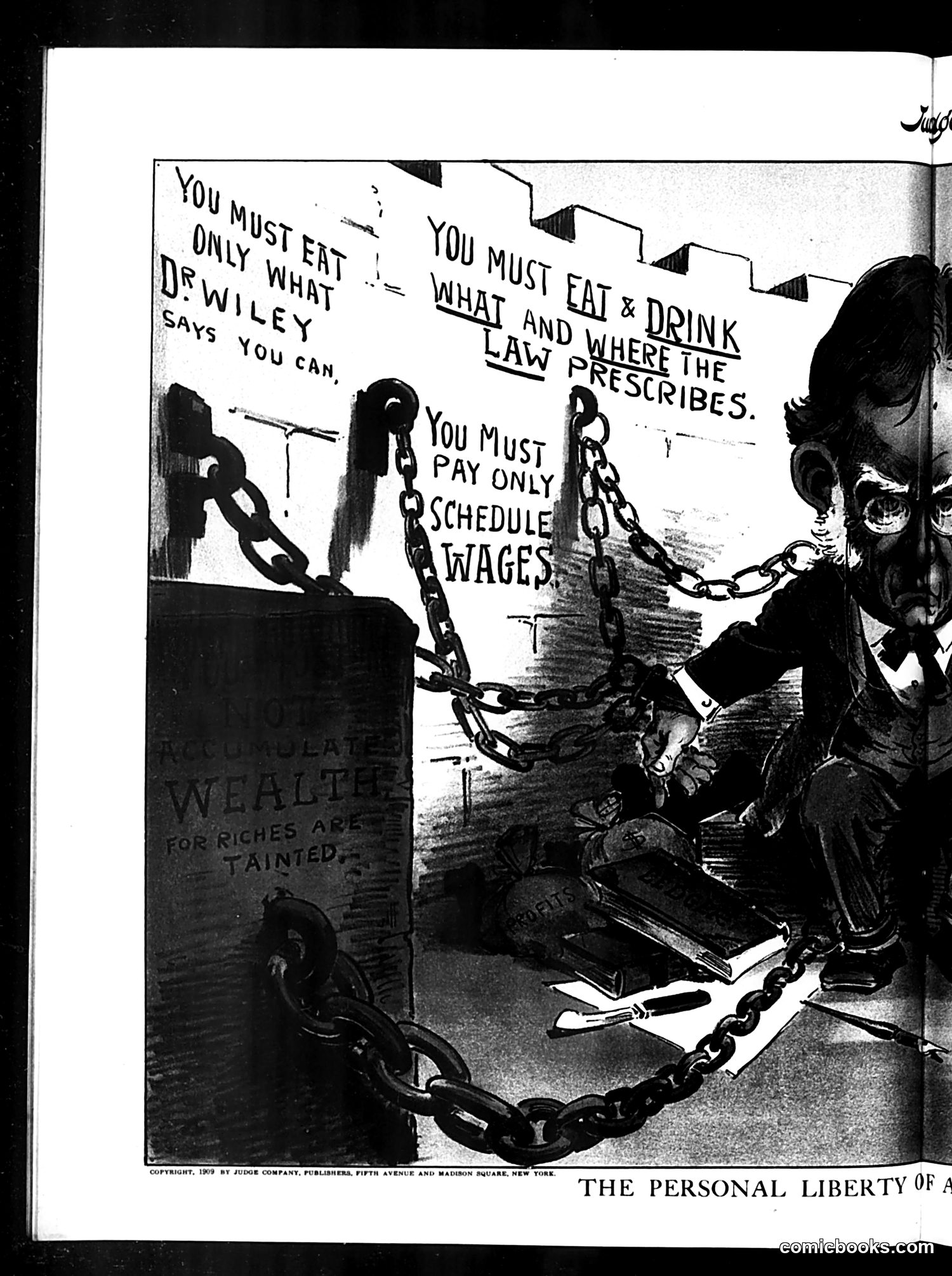
This political cartoon critiques government restrictions on personal liberty during what appears to be the Prohibition era or wartime rationing period. A caricatured authority figure (likely representing the government or "Dr. Wiley," referenced in the text) stands beside chained workers, symbolizing loss of freedom. The chains bear written restrictions: - "You must eat only what Dr. Wiley says you can" - "You must eat & drink what and where the law prescribes" - "You must pay only schedule wages" A sign reads "Wealth for riches are tainted," suggesting criticism of wealth redistribution policies. The satire argues that government regulation of food, drink, wages, and consumption represents tyrannical control over personal liberty. The imagery equates regulatory policies to slavery or imprisonment, appealing to readers' concerns about expanding government authority over private life choices.
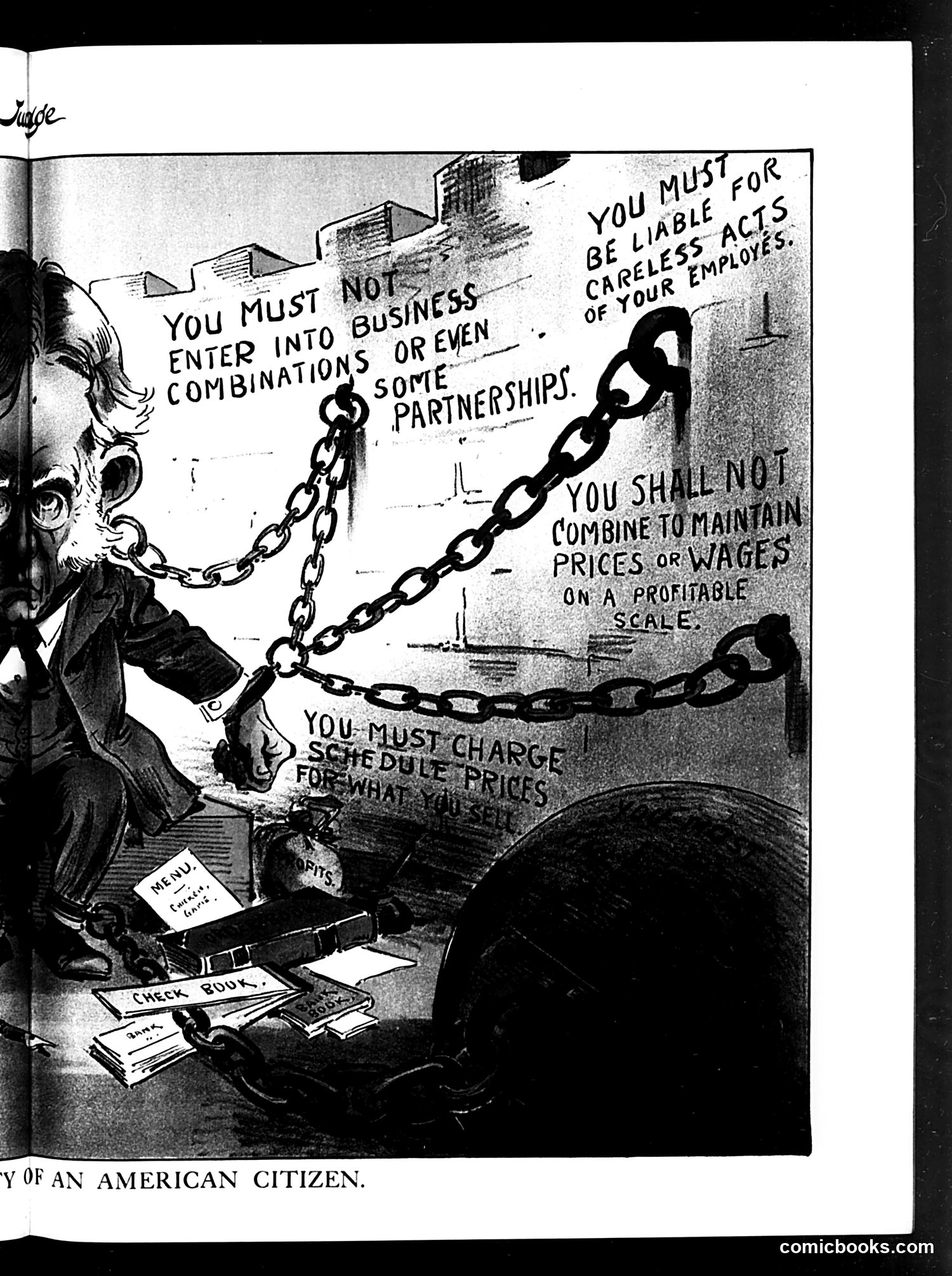
This is a political cartoon satirizing restrictions on American business practices, likely from the Progressive Era (early 1900s). A devil-like figure representing business interests is bound in chains labeled with regulatory requirements: - "You must not enter into business combinations or even partnerships" - "You must be liable for careless acts of your employees" - "You shall not combine to maintain prices or wages on a profitable scale" - "You must charge schedule prices for what you sell" The cartoon mocks what business saw as oppressive government regulations and antitrust laws. The chained devil, scattered documents (menu, check book), and the phrase "duty of an American citizen" suggest the cartoonist is criticizing regulations as unfairly constraining legitimate business operations. This reflects business opposition to Progressive-era antitrust and labor regulations.
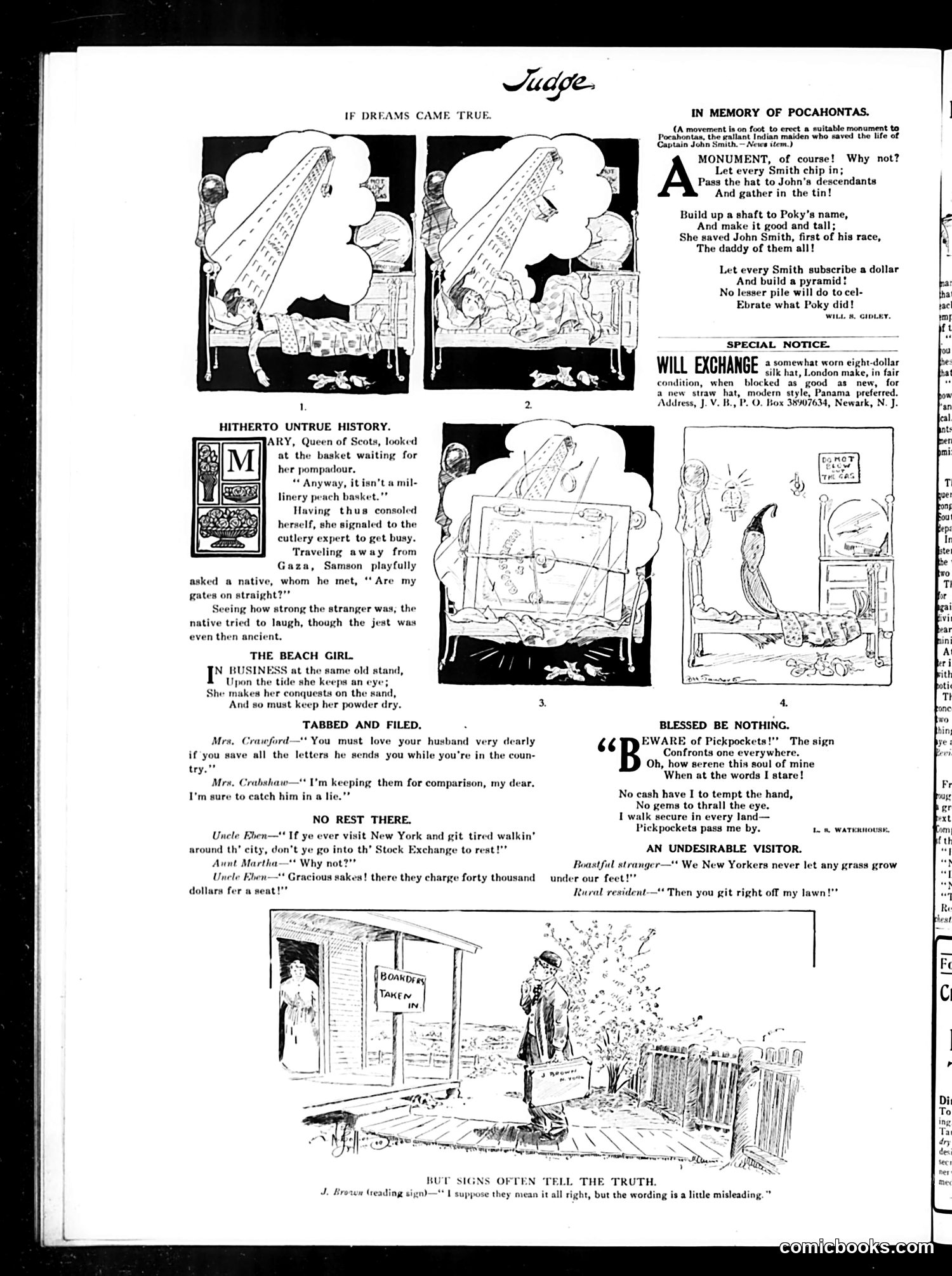
This page contains several satirical pieces typical of early Judge magazine: **"If Dreams Came True"** presents absurdist humor pairing historical/biblical figures with modern situations—Mary Queen of Scots worried about a "millinery peach basket" instead of execution, Samson making jokes about gates. The humor relies on incongruity. **"In Memory of Pocahontas"** satirizes a proposed monument to Pocahontas by mocking the commercialization of her sacrifice. It suggests turning her memory into a fundraising scheme where "every Smith" (referencing Captain John Smith) contributes dollars to build a pyramid—critiquing both sentimentality and financial exploitation. **"No Rest There"** jokes about the Stock Exchange charging $40 admission for exhausted visitors to sit. **Other pieces** include domestic humor ("Tabbed and Filed"), a beach girl reference to "keeping powder dry," and urban/rural culture clash jokes. The satire targets commercialism, sentimentality, and social pretension rather than specific political figures or events. The drawing style and content suggest this is from the early-to-mid 20th century.
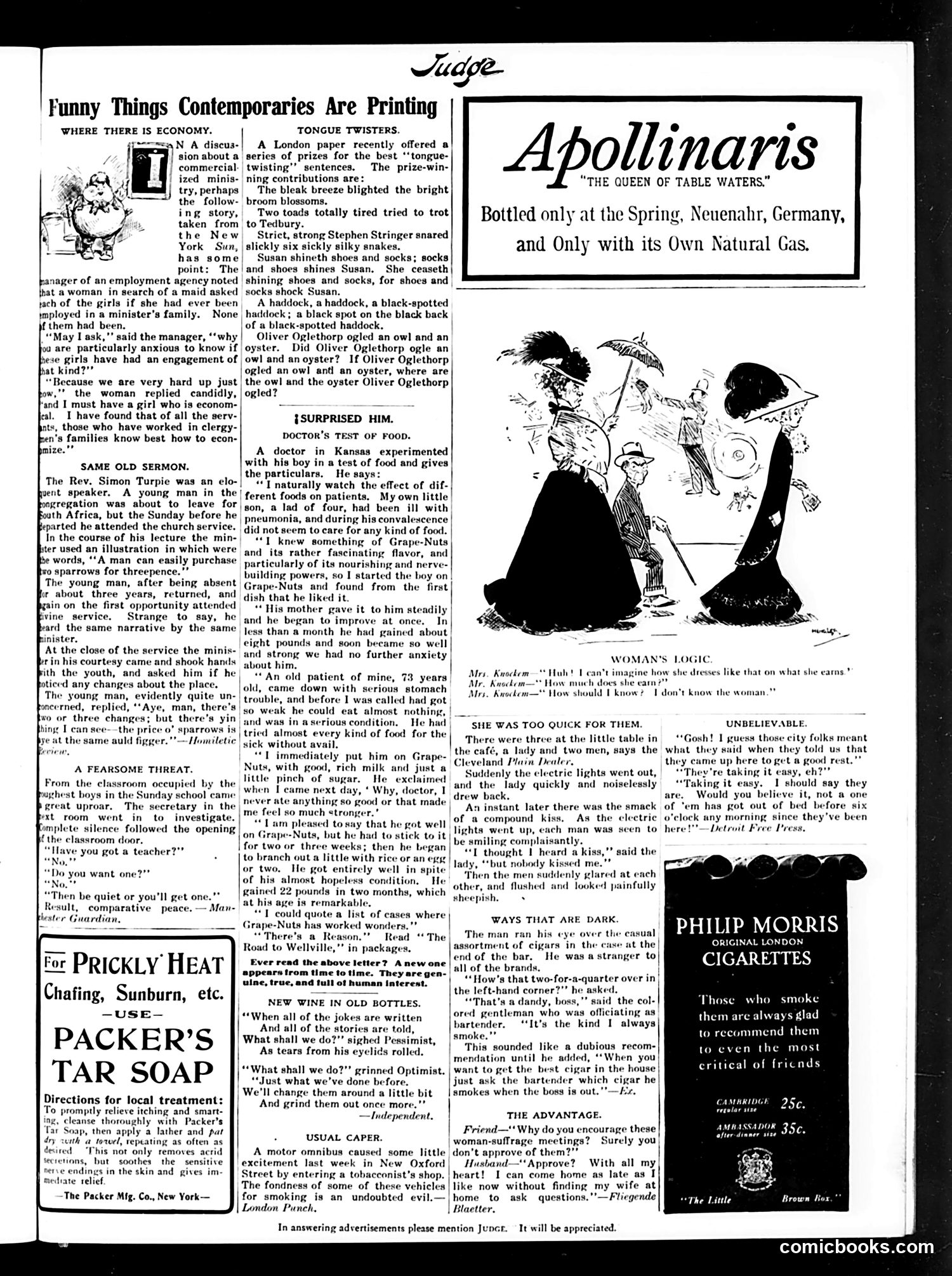
This page from *Judge* (a date-uncertain American satirical magazine) contains several humorous anecdotes and advertisements rather than a single political cartoon. The main satirical content mocks **clergy frugality**. One anecdote jokes that domestic servants who worked for ministers' families learn superior economizing skills—implying clergymen are notoriously stingy employers. Another piece ridicules a minister's repetitive preaching: a young man returns after three years abroad to hear the *identical* sermon with the same outdated illustration about sparrows costing threepence, suggesting ministers recycle stale material without updating. The "Tongue Twisters" section documents a London newspaper contest for alliterative wordplay—contemporary popular entertainment requiring verbal dexterity. The remaining content consists of advertisements (Packer's Tar Soap, Apollinaris water, Philip Morris cigarettes) and a medical anecdote about food testing for child convalescence. The overall tone is gentle domestic humor rather than biting political satire.
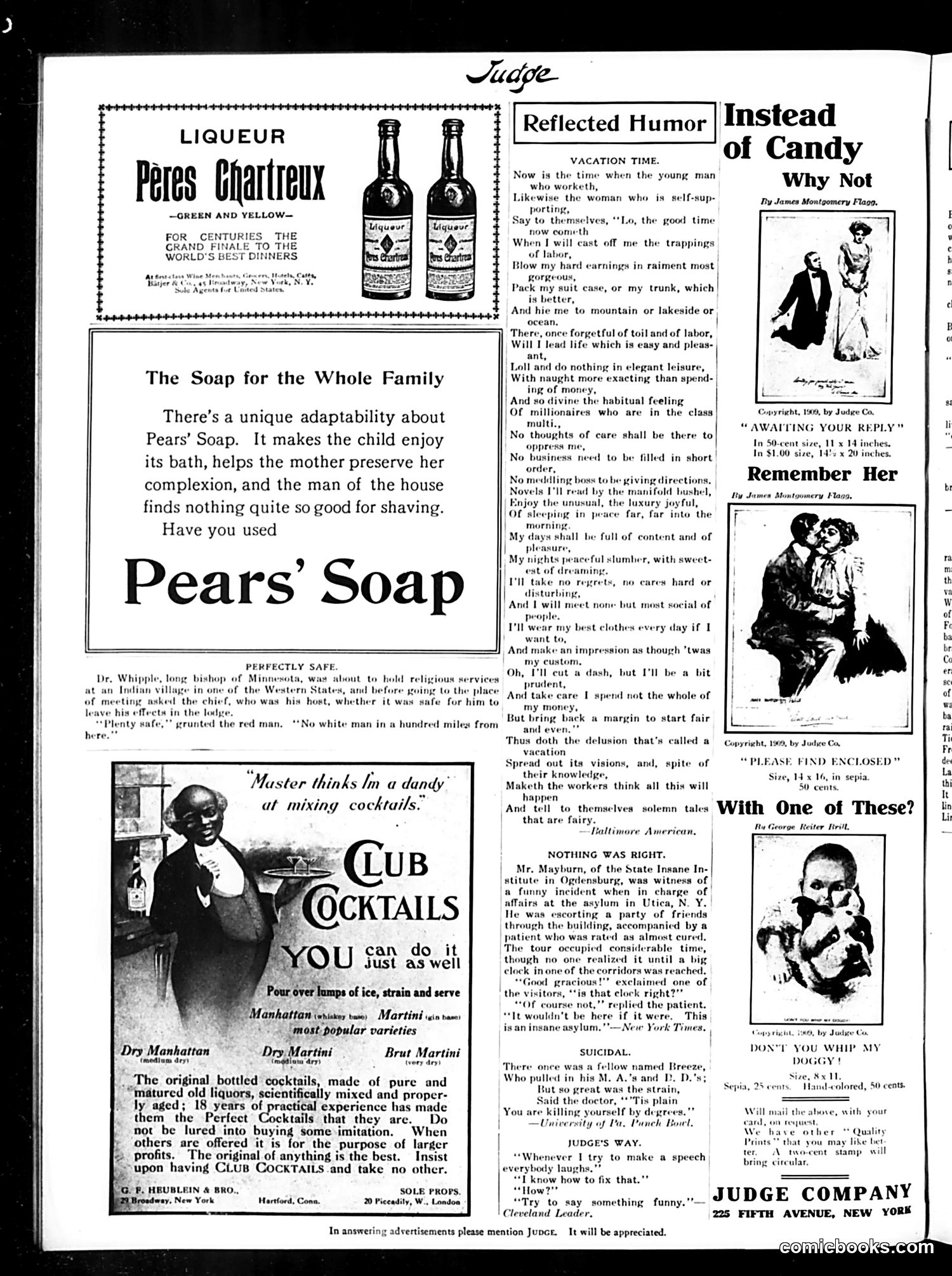
This is primarily an **advertising page** from Judge magazine (circa 1909, based on copyright dates visible). The layout mixes commercial ads with satirical content typical of the publication. **Key Content:** The main satirical pieces are James Montgomery Flagg illustrations accompanying poems about leisure and vacation fantasies—standard Judge humor poking fun at the wealthy's idle daydreams of escape from work and social obligations. **Advertisements include:** - Liqueurs and cocktail products (reflecting the pre-Prohibition era) - Pears' Soap and other household goods - Judge Company's own illustrated postcards and merchandise **Social Context:** The satire reflects early 20th-century class commentary—mocking the aspirations of working and middle-class people imagining carefree wealthy lifestyles. An anecdote about an insane asylum mixes dark humor typical of the period. The page demonstrates Judge's business model: mixing satirical commentary with lifestyle advertising targeting relatively affluent readers, while selling their own illustrated products and postcards.
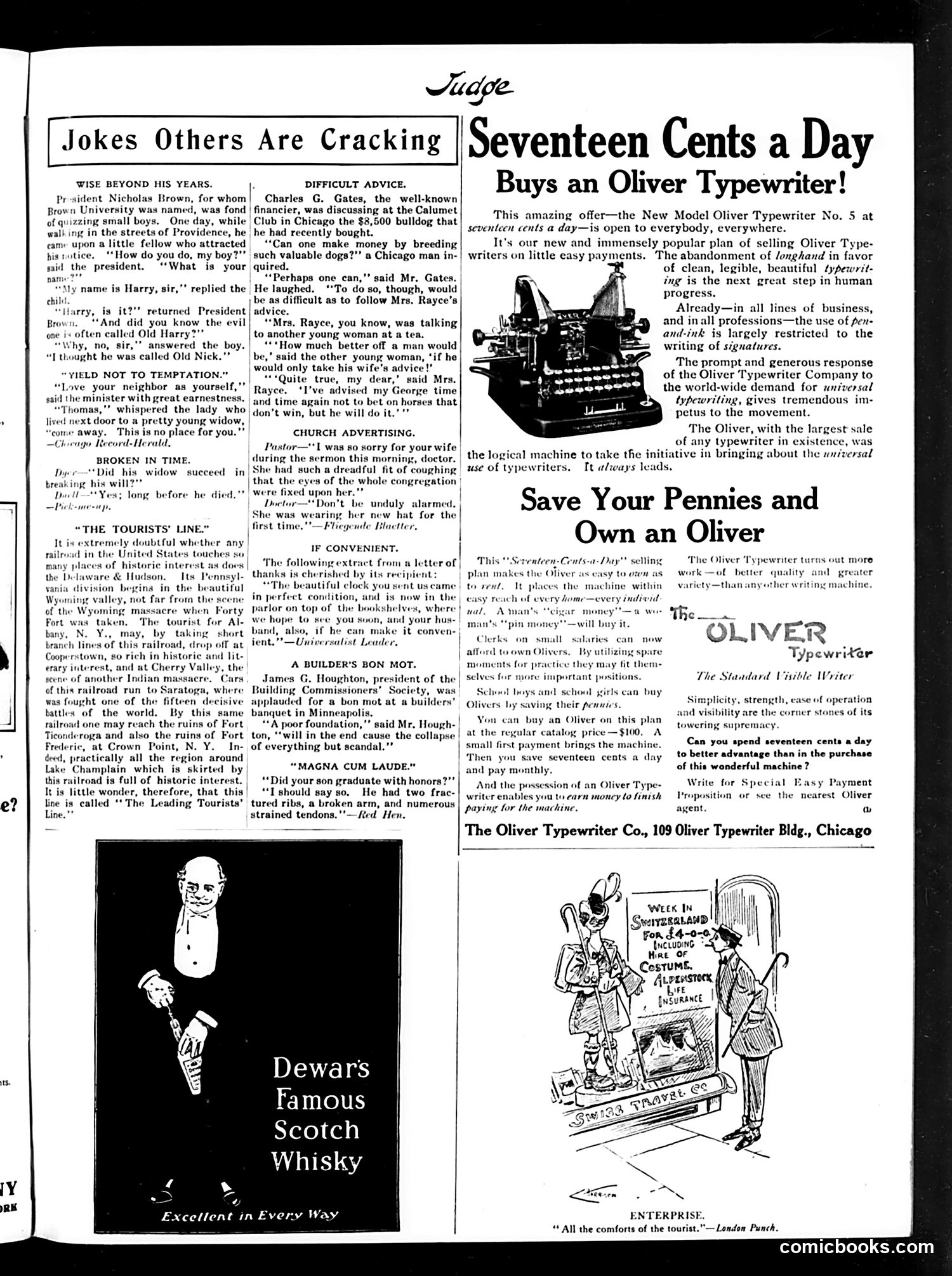
This page mixes humorous anecdotes with advertising. The left column contains brief jokes exploiting wordplay and social situations—a boy's innocent misunderstanding of "Old Harry" (slang for the Devil), a widow breaking her husband's will before his death, and comedic misinterpretations of advice. These reflect early 20th-century humor conventions emphasizing puns and domestic/social mishaps. The right side advertises the Oliver Typewriter No. 5 at "seventeen cents a day"—a payment plan marketing innovation. The text emphasizes typewriters' superiority over handwriting for business and professional work, particularly noting their appeal to women entering the workforce. A Dewar's Scotch Whisky advertisement appears at bottom left. The cartoons are minimal: a Dewar's mascot figure and a cartoon showing tourists with luggage, illustrating the "Leading Tourists' Line" railroad joke about the Hudson Valley's historic sites.
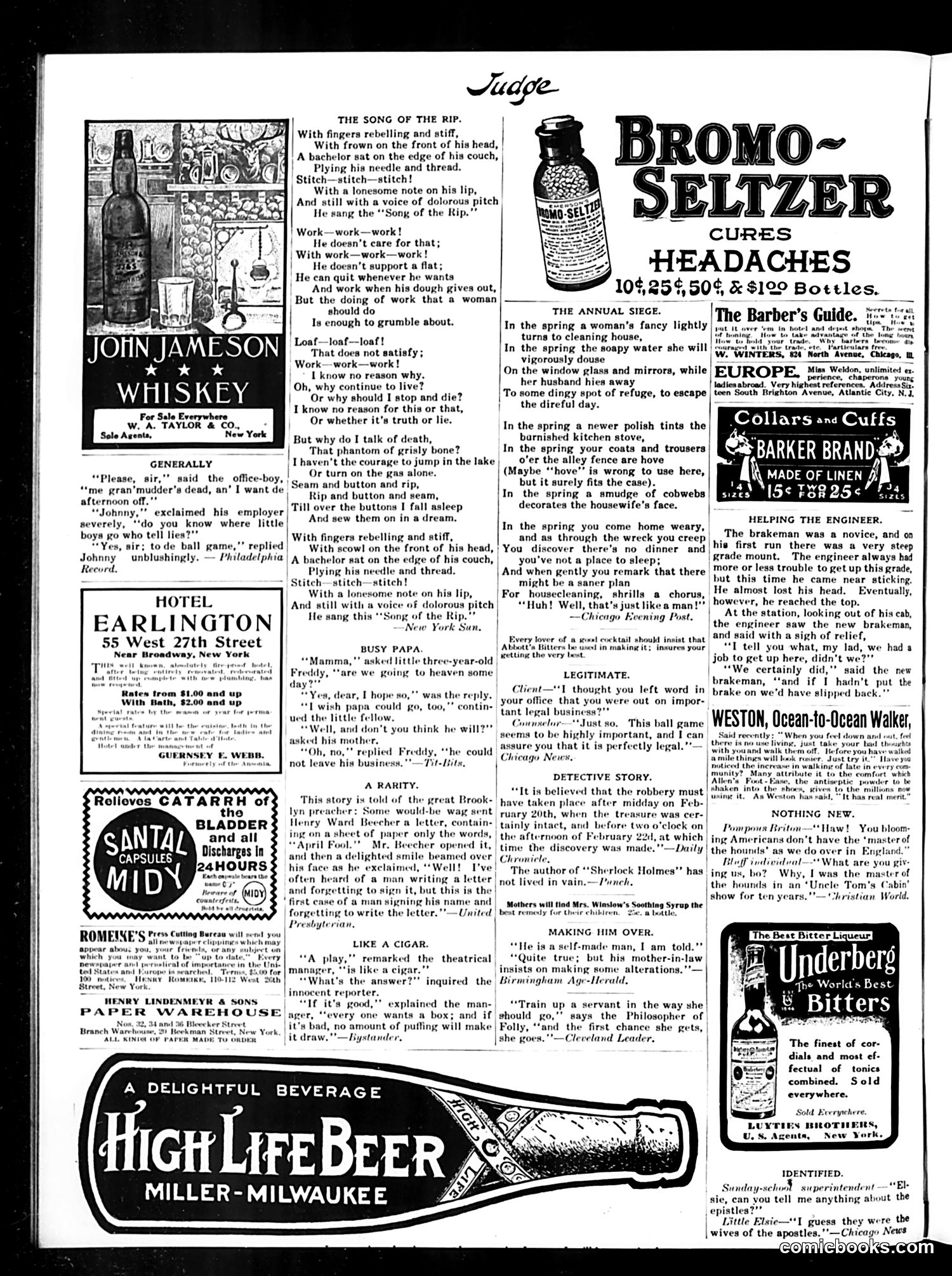
This page is primarily **advertising** mixed with light humor and satirical verse, typical of Judge magazine's format. The main illustrated piece, "The Song of the Rip," satirizes **bachelor life and domestic incompetence**. The cartoon shows a single man awkwardly sewing his own clothes—mending a rip—while singing a melancholic song. The satire targets the social expectation that women handle domestic tasks; a bachelor forced to do "women's work" appears pathetic and unmanned. The repeated "work—work—work" refrain mocks his complaint about having to care for himself. Supporting this theme, "The Annual Siege" describes spring housecleaning as a domestic invasion where wives exhaust themselves and neglect husbands, ending with their defensive cry: "that's just like a man"—implying men don't understand women's household burdens. The remaining content consists of **advertisements** for whiskey, beer, medicine, hotels, and paper goods—standard Judge filler. Brief anecdotes about office boys and clergy provide mild humor typical of the era's genteel satire.
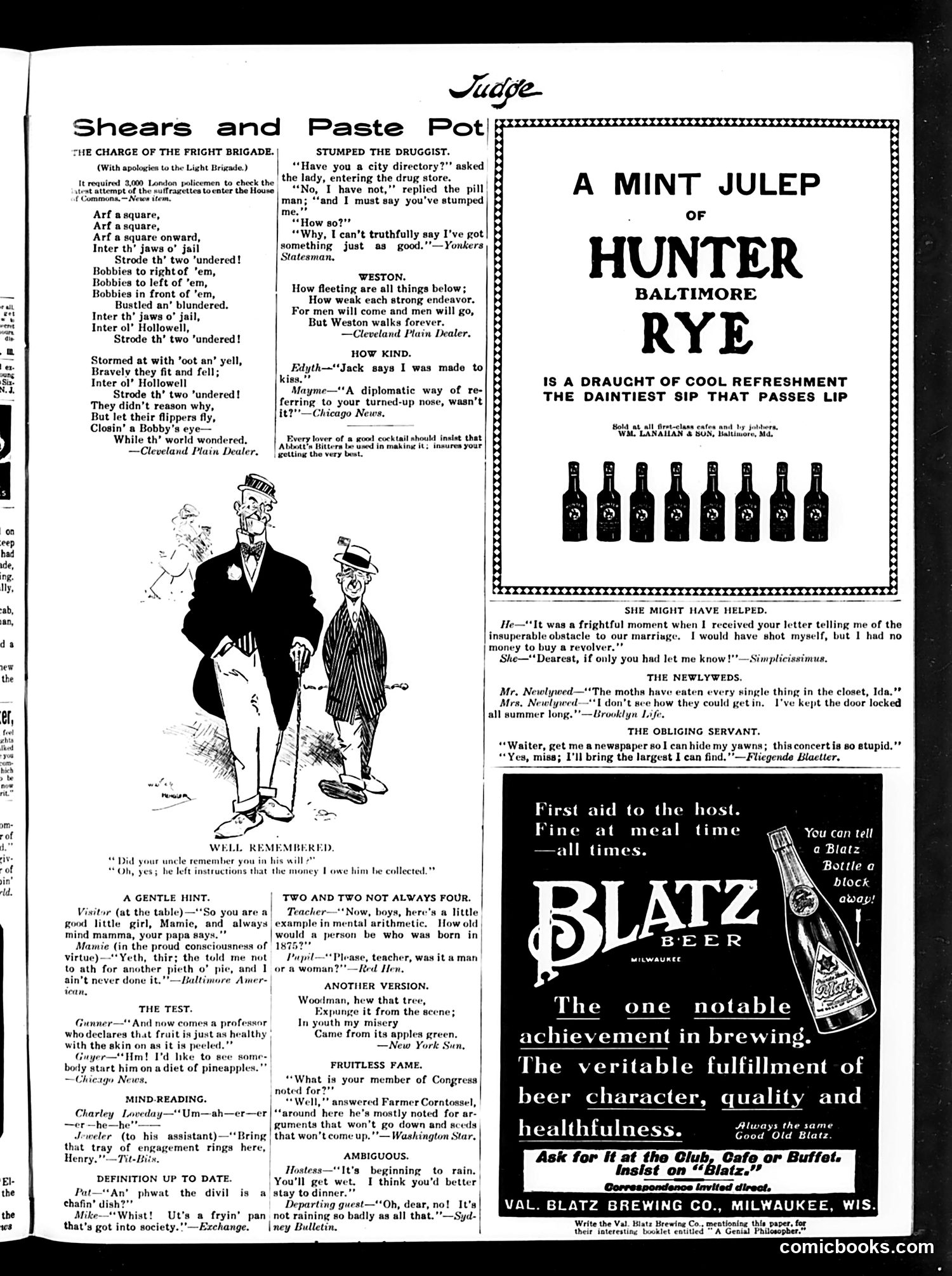
This page is primarily **advertising and humor miscellany** from an early 20th-century American satirical magazine. The main cartoon, "Shears and Paste Pot," parodies Tennyson's "Charge of the Light Brigade," mocking a 1909 incident where 9,000 London police stopped suffragettes attempting to enter Parliament. The poem satirizes their "charge" as futile, with "Bobbies" (police officers) surrounding them, ending in arrest at "Hollowell" (likely Holloway Prison). Other brief humor items mock everyday situations: a druggist who can't recommend anything, children's logic about discipline, weak engagement promises, and marital mishaps. The jokes rely on wordplay and mild social observation typical of the era. The page includes substantial advertising for **Hunter Baltimore Rye whiskey** and **Blatz Beer**, emphasizing quality and availability at establishments. The overall tone is light, domestic humor targeting middle-class readers, with the suffragette parody being the only overtly political content—presented mockingly.
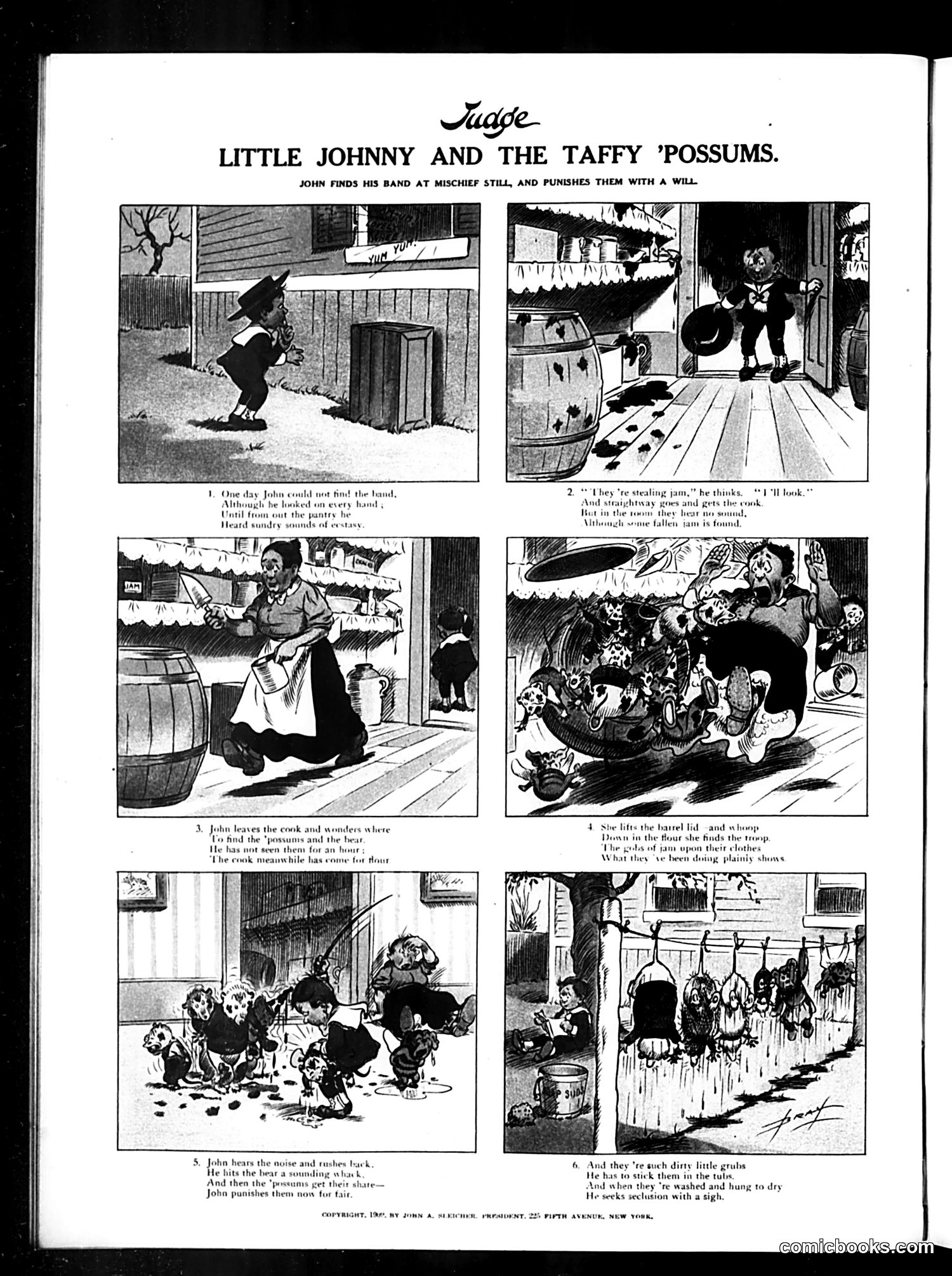
This is a six-panel comic strip from Judge magazine featuring a character named "Little Johnny" who discovers his band of animal companions—apparently possums—have gotten into mischief while stealing jam or taffy from a pantry. The narrative follows Johnny's discovery of the mess, his pursuit of the animals, and his punishment of them by forcing them to clean up after themselves—washing and hanging their soiled clothes to dry. The humor appears to be slapstick comedy targeting children's audiences: mischievous animals creating chaos, followed by comeuppance. The "taffy possums" likely refers to the animals getting sticky from stolen sweets. This represents typical early 20th-century children's entertainment, without apparent political or social satire.