
A complete issue · 16 pages · 1909
Judge — July 3, 1909
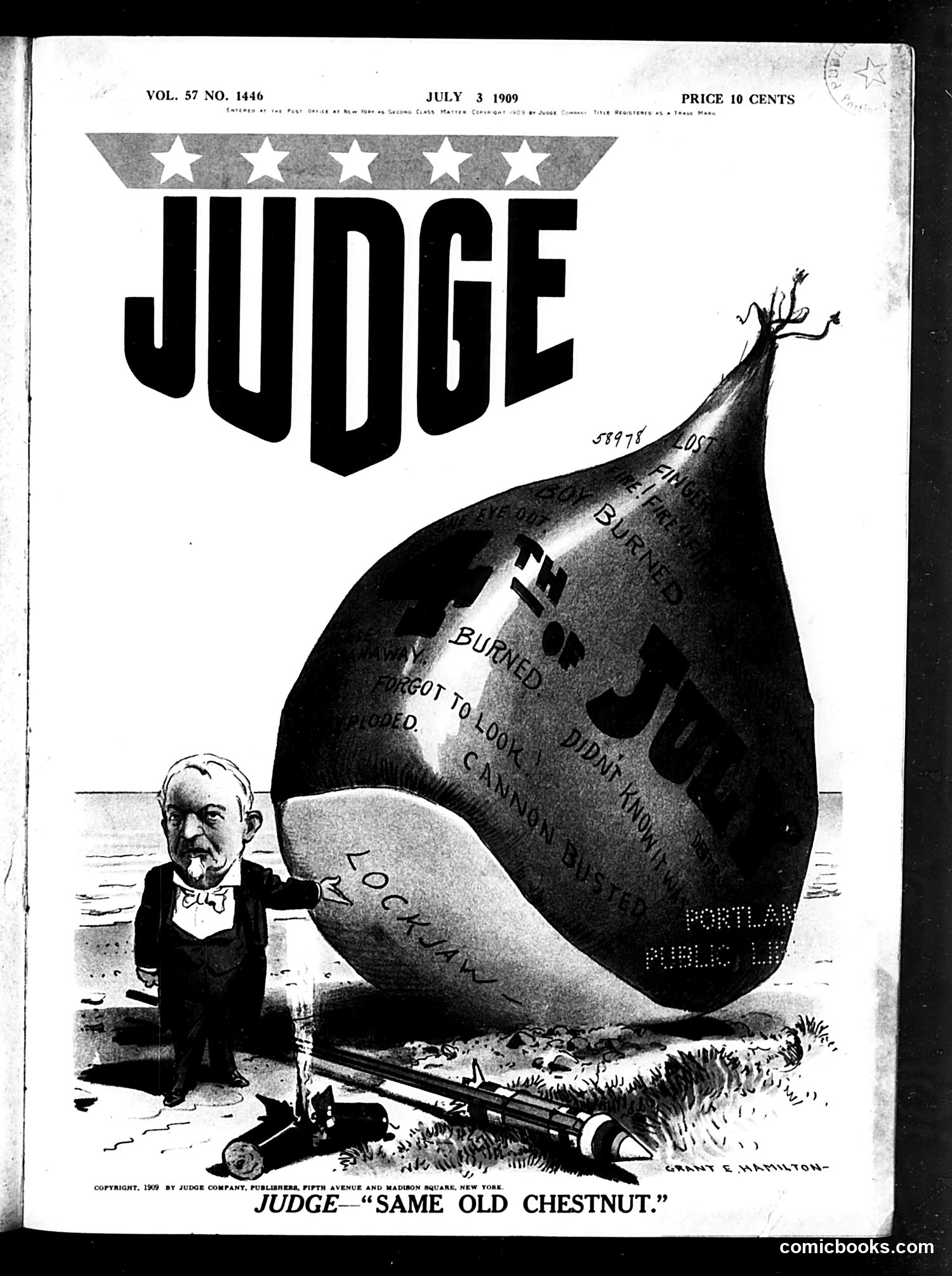
This political cartoon depicts a small man in formal attire standing before an enormous, damaged bomb or explosive device. The bomb's surface bears partially legible text including phrases like "BURNED," "FORGOT TO LOOK," and "CANNON DISABLED." The cartoon's title, "Same Old Chestnut," suggests a recurring, tired joke or worn-out issue. The figure appears to represent a politician repeatedly confronting the same explosive problem or scandal. The bomb's damaged state and scattered debris suggest ongoing controversy that won't disappear despite repeated attempts to address it. Without clearer identification of the specific figure or event referenced, the exact political context remains unclear, though it likely comments on a persistent controversy dominating 1909 headlines that readers of the day would have immediately recognized.
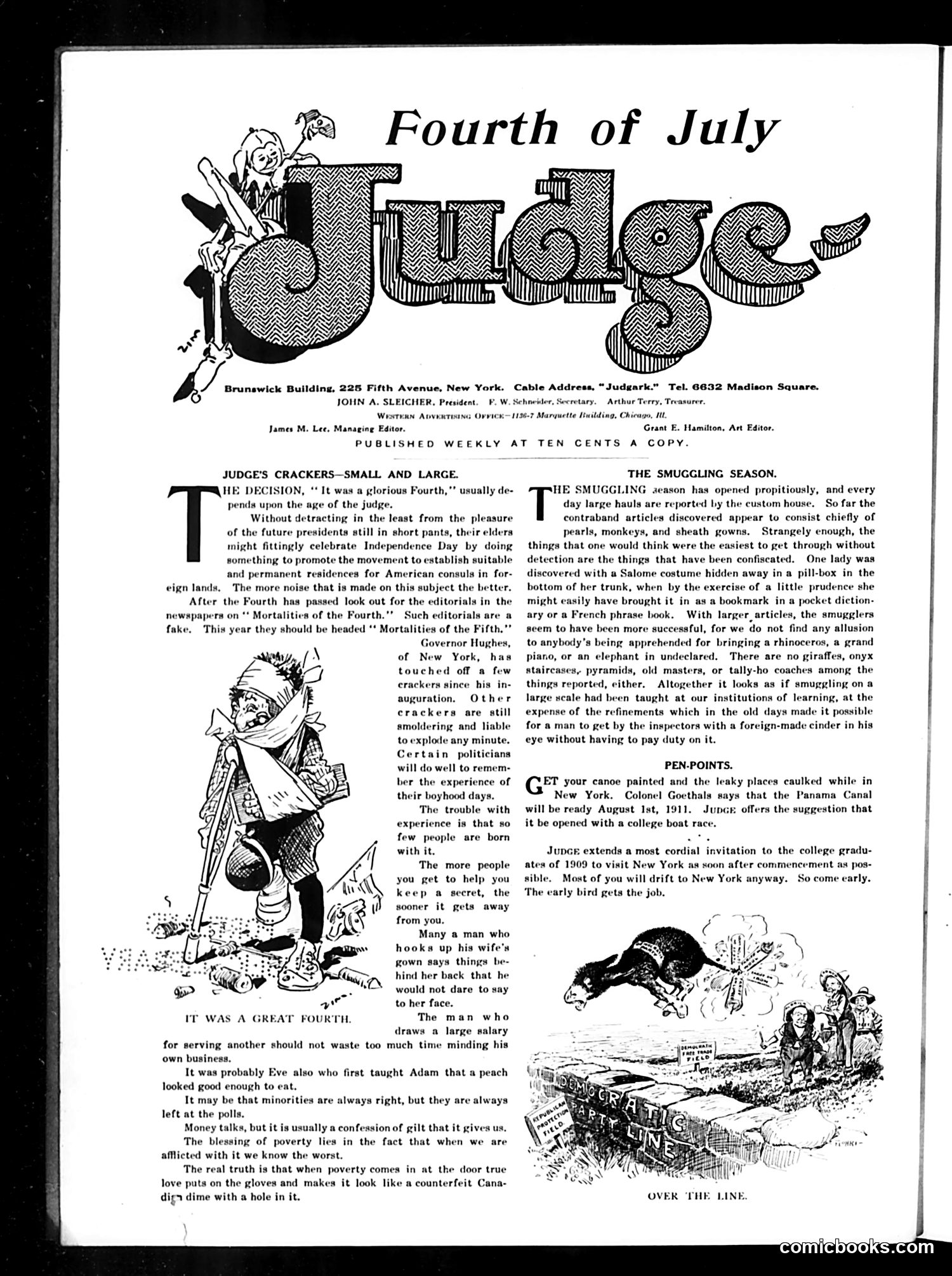
This is a Fourth of July issue of Judge magazine. The page contains three main sections: **"Judge's Crackers—Small and Large"** critiques judges who use Independence Day celebrations to promote political movements, calling such editorials fake patriotism. It satirizes judges' hypocrisy regarding poverty and morality. **"The Smuggling Season"** discusses contraband discovered at ports—pearls, monkeys, and exotic animals—suggesting wealthy people evade customs duties. It mocks the idea that smuggling such items requires expertise, implying ordinary criminals could accomplish it. **"Pen-Points"** references the Panama Canal (opening August 1, 1911) and invites college graduates to visit New York, with implicit criticism of those who would waste such opportunity. The illustrations use caricature and wordplay typical of early 1900s American satirical humor, targeting upper-class hypocrisy and corruption.
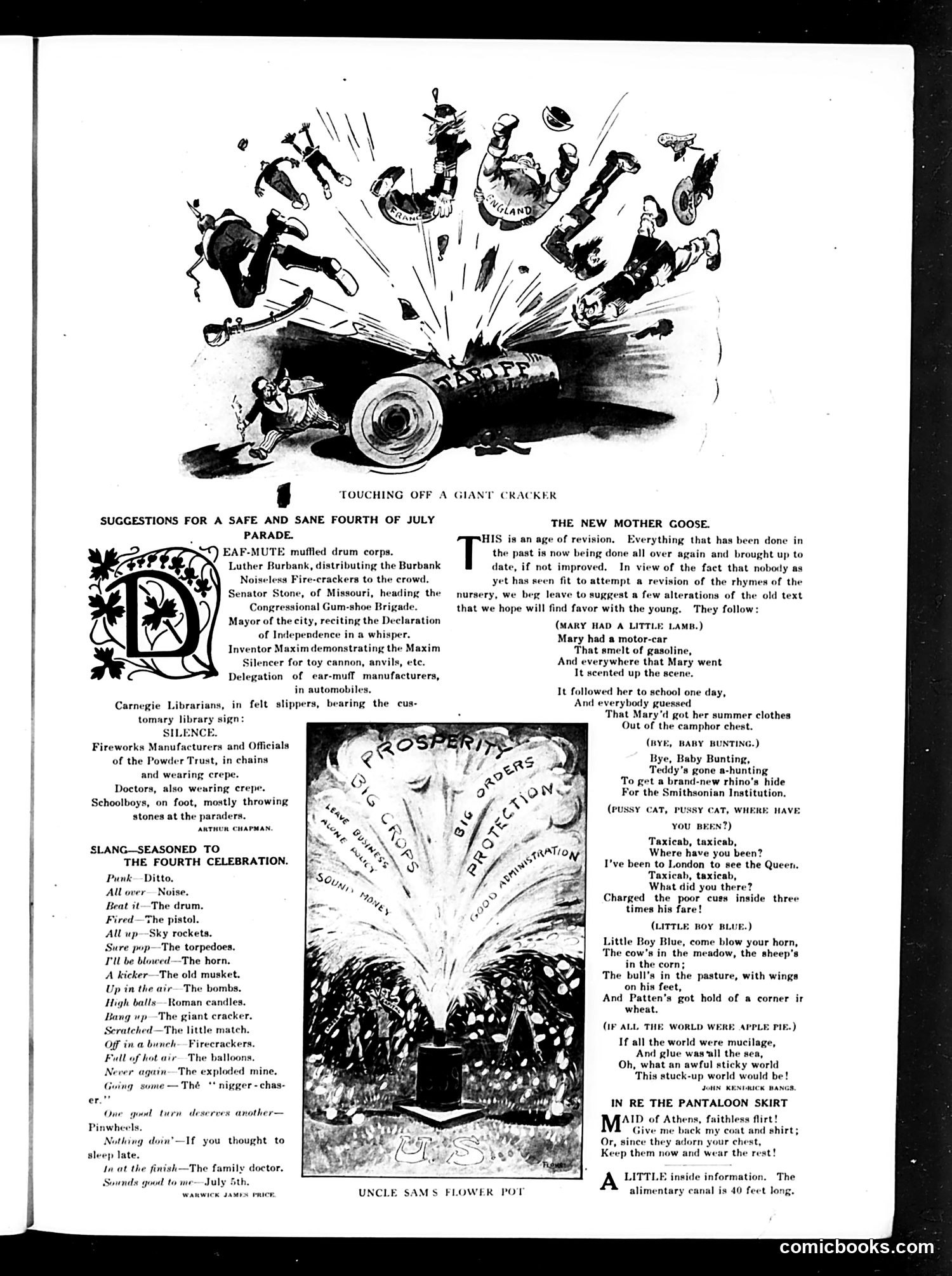
This Judge magazine page satirizes Fourth of July celebrations through two main pieces: **"Touching Off a Giant Cracker"** (top): The explosion cartoon depicts various figures—including what appears to be politicians, officials, and social groups—being launched into the air by a massive firecracker. This likely mocks the chaotic nature of Independence Day festivities and perhaps critiques how different American constituencies (represented by the diverse figures) are thrown together by patriotic celebration. **"Uncle Sam's Flower Pot"** (center illustration): Shows Uncle Sam's head as a decorative vessel sprouting various American activities and types of people, symbolizing America's diverse population and industries growing from the nation's foundation. The accompanying text offers satirical "suggestions for a safe Fourth of July parade," listing humorous (and dangerous) parade elements meant to mock both celebration excess and contemporary social concerns.
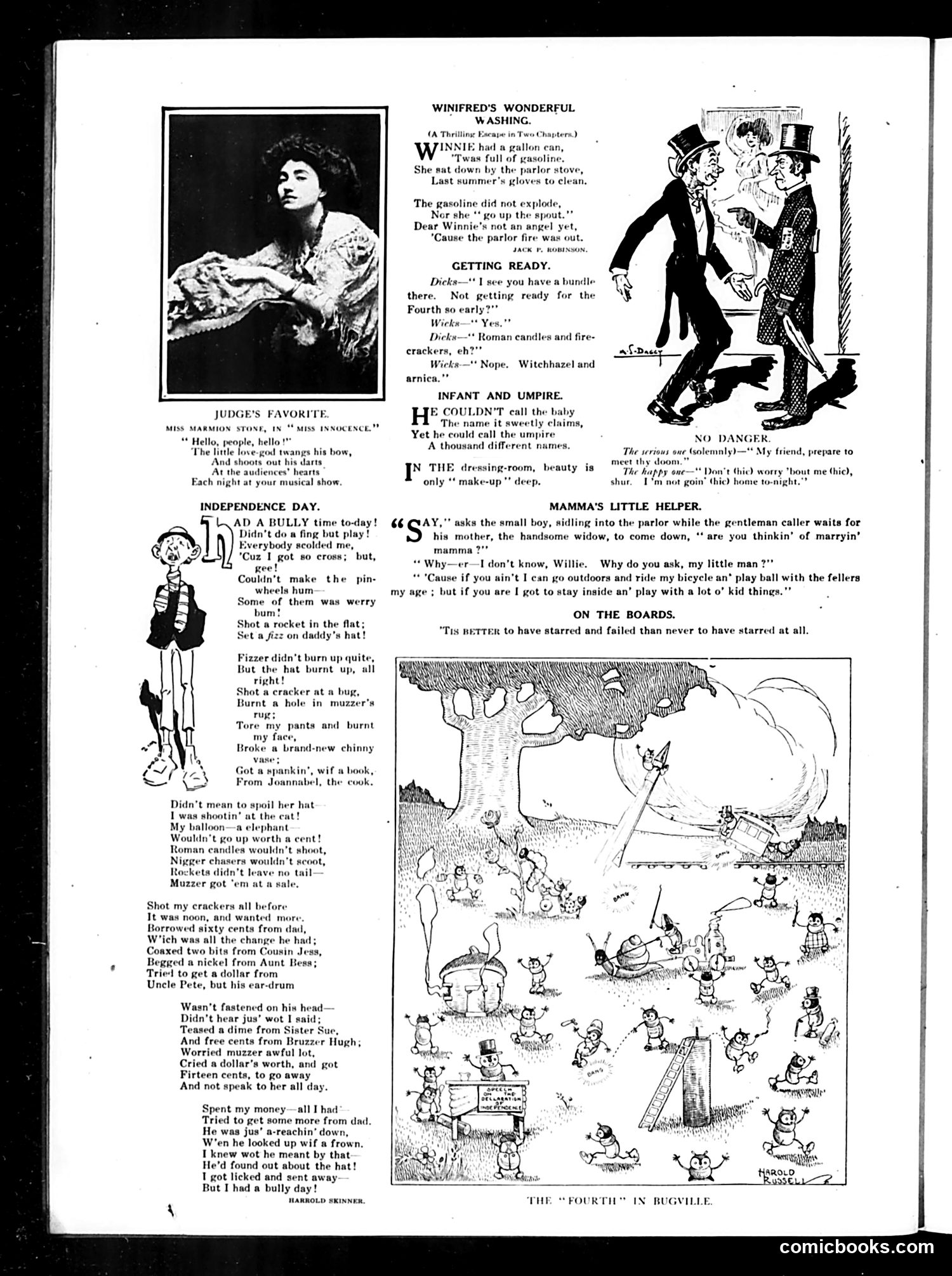
This page contains several humorous pieces about early 20th-century American life rather than political cartoons. **"Winifred's Wonderful Washing"** satirizes a woman's domestic mishap—her gallon can of gasoline nearly explodes while cleaning gloves by a parlor stove, highlighting the dangers of using flammable cleaning products in homes without modern safety standards. **"Independence Day"** is a comedic poem about a boy's chaotic Fourth of July celebration involving firecrackers, rockets, and property damage—poking fun at unregulated holiday celebrations. **"The Fourth" in Bugville** depicts anthropomorphized insects celebrating Independence Day, likely a whimsical children's illustration. The page mixes domestic comedy with holiday humor, reflecting turn-of-the-century American life and family entertainment values rather than political satire.
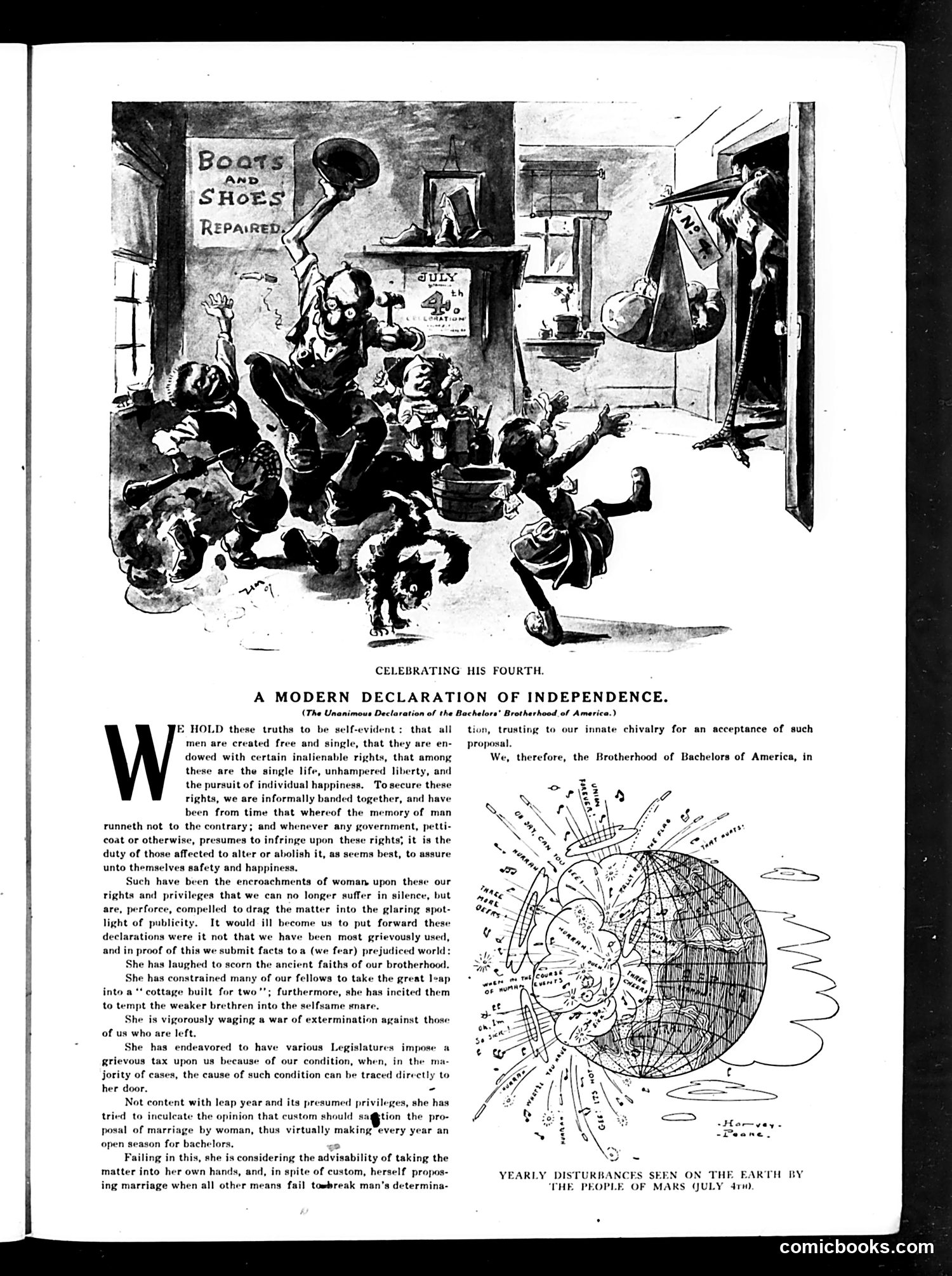
The top cartoon shows a chaotic tenement scene titled "Celebrating His Fourth," depicting Independence Day festivities among poor urban residents, likely immigrants. The "Boots and Shoes Repaired" sign suggests a working-class neighborhood. The main text is "A Modern Declaration of Independence: The Uncommon Declaration of the Bachelors' Brotherhood of America"—a satirical document parodying the Declaration of Independence. It humorously claims bachelors possess "inalienable rights" and protests women's encroachment on male privileges, specifically mentioning women's attempts to control marriage customs and legislative decisions. The Mars diagram below depicts "yearly disturbances seen on the earth by the people of Mars (July 3rd)," a whimsical device suggesting Martians observing Earth's chaotic Independence Day celebrations. The satire mocks both bachelor anxieties about changing women's roles and broader social tensions over gender and marriage in early 20th-century America.
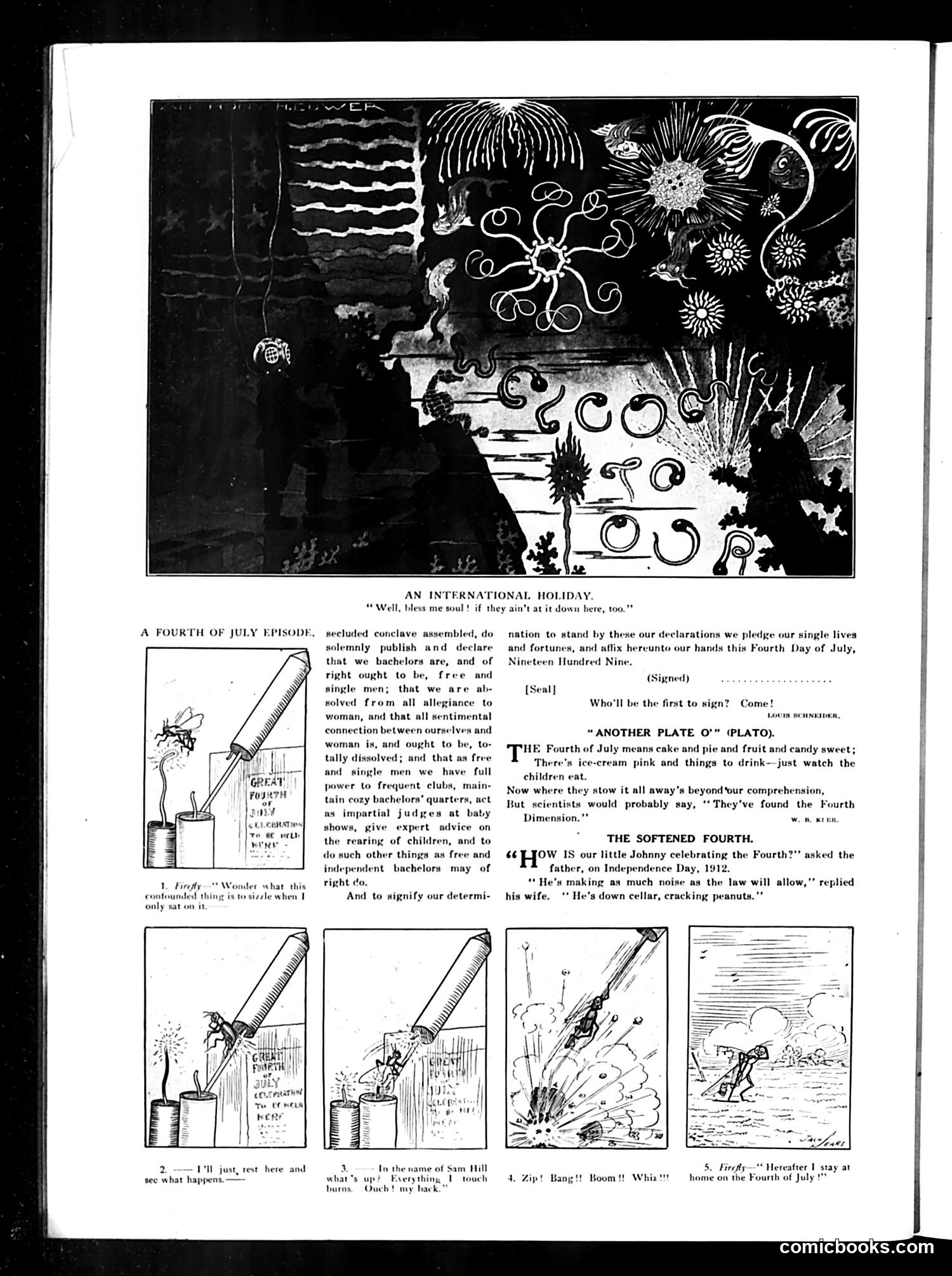
This Judge magazine page from 1909 contains Fourth of July-themed humor. The main comic strip follows a firefly character who attempts to observe Independence Day celebrations, only to be repeatedly caught in explosive fireworks—the joke being that the insect's own bioluminescence makes it a target for the holiday's dangerous pyrotechnics. The accompanying text satirizes bachelor clubs declaring their "independence" from women and domestic life through a mock Declaration of Independence, humorously paralleling the Revolutionary holiday's language. A secondary poem jokes about children's capacity to consume sweets on July 4th, while the final panel (dated 1912) presents a gentler vision: a father notes his son celebrates quietly by cracking peanuts in the basement—suggesting societal shift toward safer, less explosive Fourth of July observances. The overall theme: American independence celebrated through noise, explosions, and youthful chaos.
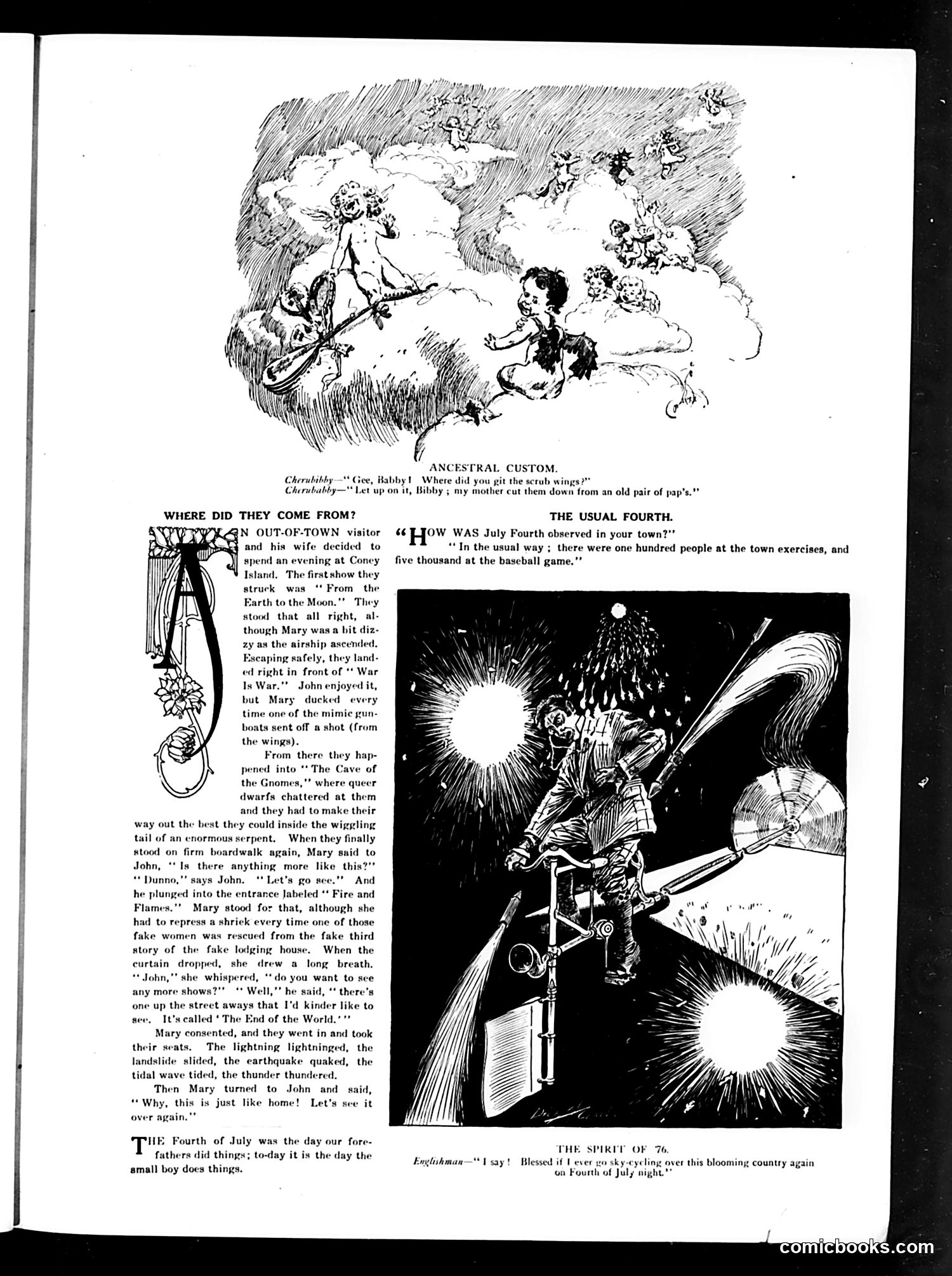
This page satirizes American patriotism and Independence Day customs circa the early 1900s. **"Where Did They Come From?"** mocks newlyweds at Coney Island amusement park. The wife finds theatrical attractions—"War Is War," "Fire and Flames," "The End of the World"—progressively chaotic and destructive. Her comment that the apocalyptic finale is "just like home" sarcastically suggests domestic life mirrors theatrical catastrophe, critiquing marriage or domestic discord. **"The Usual Fourth"** contrasts historical and contemporary Fourth of July observance: founding fathers performed significant deeds; modern Americans merely attend baseball games (five thousand vs. one hundred at civic exercises), suggesting decline in patriotic seriousness. **"The Spirit of '76"** features a visiting Englishman traumatized by fireworks displays, calling them "sky-cycling." This mocks aggressive American patriotic demonstrations—particularly fireworks—as excessive and dangerous, while satirizing British condescension toward American customs. Overall, the page critiques how Americans have trivialized Independence Day into entertainment and spectacle rather than genuine civic commemoration.
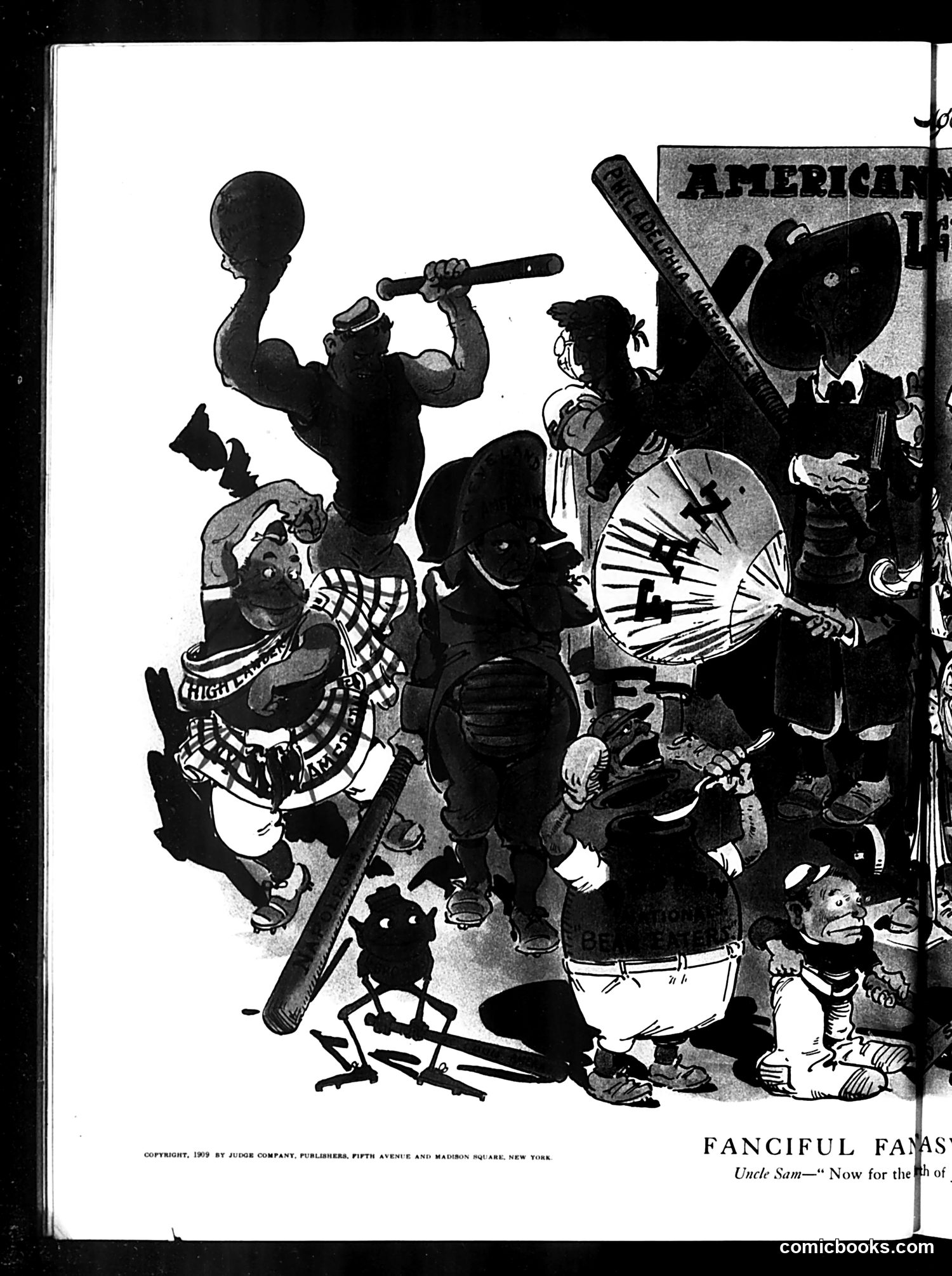
This political cartoon titled "Fanciful Fanas" depicts Uncle Sam (representing the U.S. government) conducting an orchestra of caricatured figures described as "fans." The image appears to satirize American foreign policy or interventionism, showing Uncle Sam directing various stereotyped international characters like an orchestra conductor. The incomplete caption "Now for the # of" suggests the cartoon critiques how America orchestrates or manipulates foreign affairs. The "fans" likely represent different nations or political factions that Uncle Sam controls or directs. This reflects early 20th-century concerns about American imperial ambitions and interventionist policies abroad. The style and Judge magazine's satirical nature indicate this mocks American exceptionalism or overreach in international relations during this era.
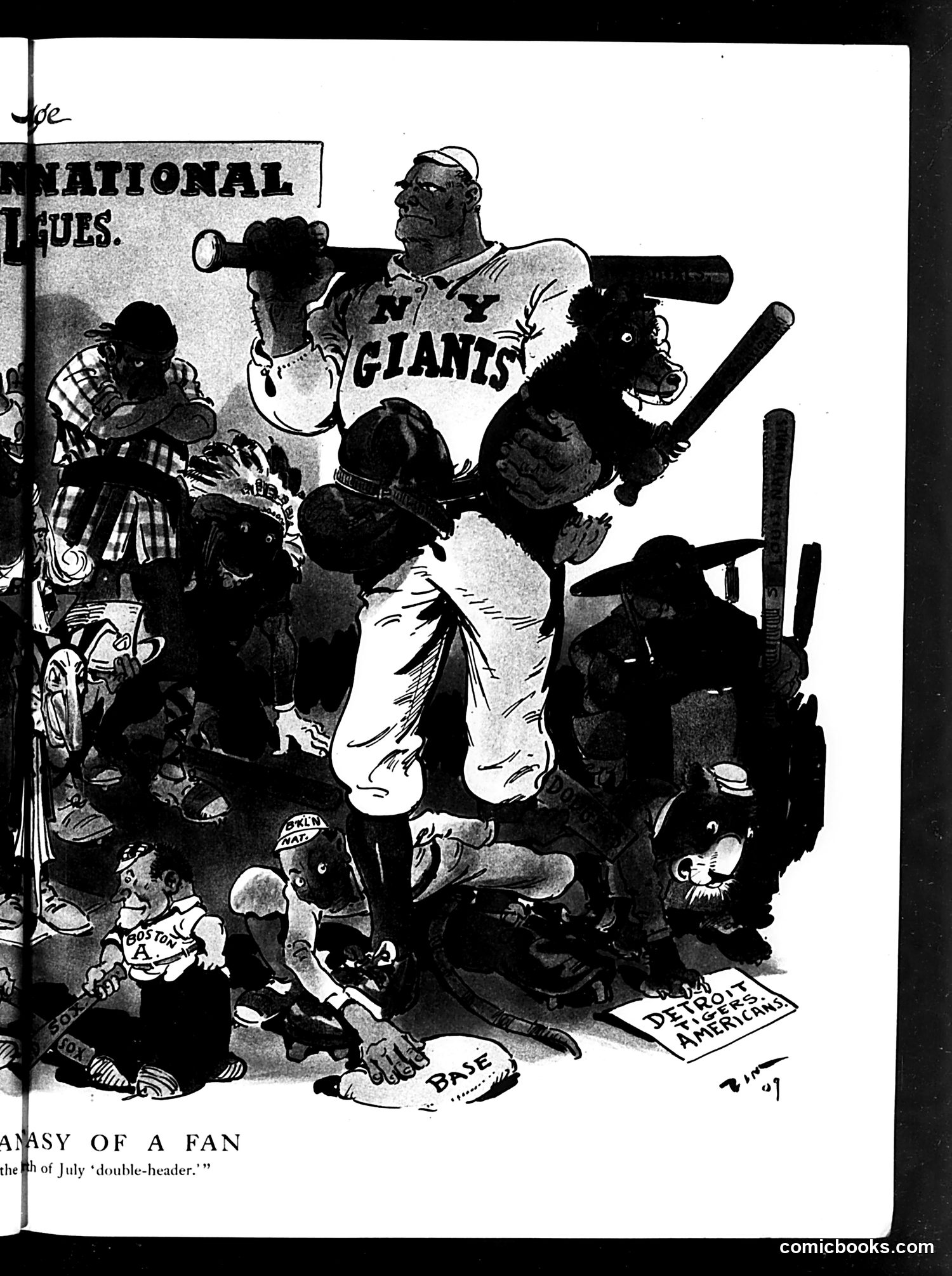
This cartoon satirizes baseball fan enthusiasm, specifically around a Fourth of July doubleheader. The central figure is a Giants player surrounded by excited fans depicted as animals (monkeys, dogs) holding telescopes and bats. The chaotic composition emphasizes the wild, almost uncontrolled behavior of devoted supporters. The visible text references include "Boston" and "Detroit" (likely competing teams), and "National" appears at top left. The date notation and doubleheader reference suggest this is commentary on summer baseball season fervor during the early 20th century. The satire mocks how sports fans, particularly around patriotic holidays when doubleheaders were common, would become animalistic in their enthusiasm and obsession with the game—a common theme in early Judge magazine humor about American popular culture.
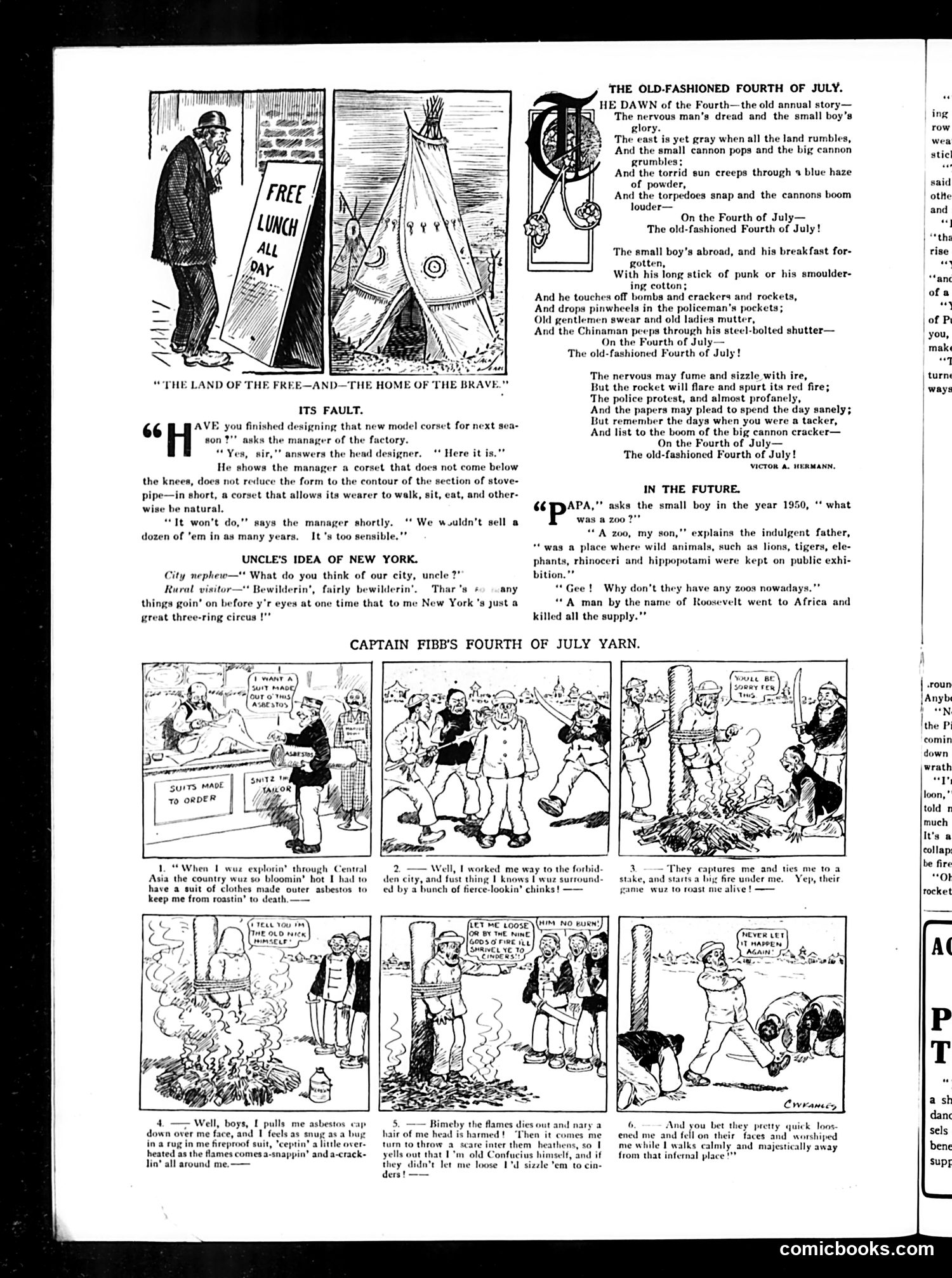
This *Judge* magazine page contains several satirical pieces mocking American society circa 1900-1910: **"The Old-Fashioned Fourth of July"** is nostalgic verse lamenting how Independence Day celebrations—once genuinely anarchic with boys setting off fireworks and causing chaos—are now being regulated by police and reformers wanting a "sane" holiday. The satire targets progressive activists trying to eliminate dangerous but traditional celebrations. **"Its Fault"** mocks corset designers for rejecting a sensible, wearable design because it wouldn't sell—prioritizing impracticality and profit over women's comfort and health. **"Uncle's Idea of New York"** presents a rural visitor astounded by the city's overstimulation, framed as a "three-ring circus." **"Captain Fibb's Fourth of July Yarn"** is a tall tale where the captain, exploring Asia, gets captured by Chinese people who worship him as "old Confucius" after he claims that identity—playing on period attitudes about Asian "superstition" and American exceptionalism. The satire throughout targets progressivism, commercialism, and period racial attitudes.
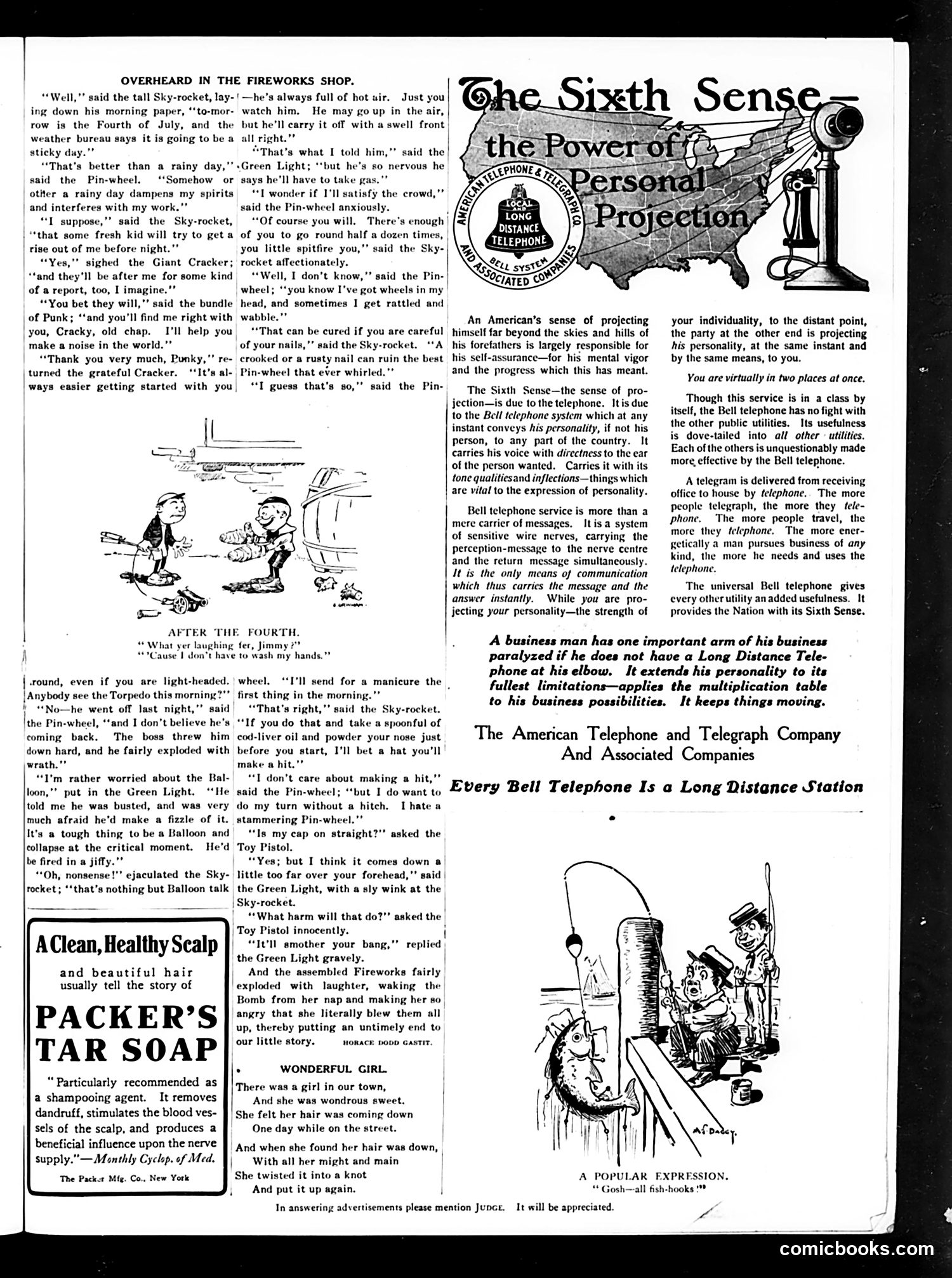
This page contains a humorous dialogue between anthropomorphized fireworks—a Sky-rocket, Pin-wheel, Giant Cracker, and Bundle of Punk—discussing their anxieties about Fourth of July celebrations the next day. They worry about rain dampening spirits, being "used" by children for entertainment, and failing to perform well. The jokes rely on puns: the Torpedo "went off," the Balloon might "collapse," the Pin-wheel gets "rattled." A final cartoon shows a boy explaining he doesn't need to wash his hands because he "don't have to walk my hands"—a non-sequitur joke. The page also includes a substantial Bell Telephone advertisement claiming the telephone represents America's "Sixth Sense"—the ability to project one's personality across distance. The ad contrasts with the fireworks' anxieties about their brief, explosive utility.
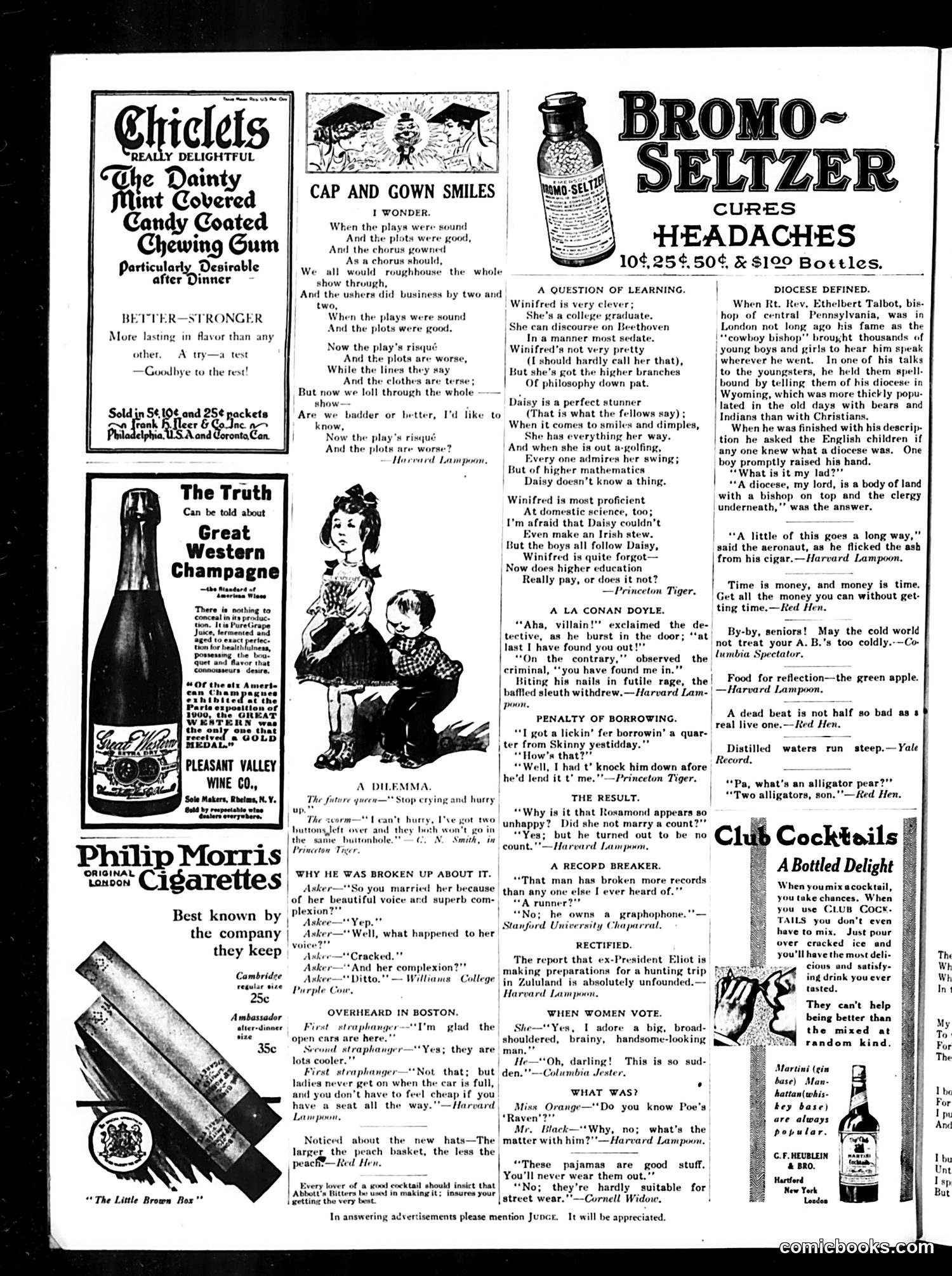
This page is primarily **advertisements and collegiate humor** rather than political satire. The ads (Chiclets gum, Philip Morris cigarettes, Bromo-Seltzer) occupy prominent space. The content consists of joke submissions from college humor magazines (Harvard Lampoon, Princeton Tiger, Columbia Spectator, Yale Record). The humor is lighthearted and reflects early 20th-century campus life: jokes about theatrical performances, borrowed money, courtship, and academic pretension. One notable piece, "A Question of Learning," contrasts an educated but plain woman (Winifred) against a beautiful but ignorant one (Daisy), concluding that boys ignore education for attractiveness—a commentary on gender and education standards of the era. "Diocese Defined" mocks a bishop's story through a child's innocent redefinition. "Why He Was Broken Up About It" is a domestic joke about a wife's aging appearance. The page reflects *Judge's* role as a repository for collegiate wit rather than sharp political commentary.
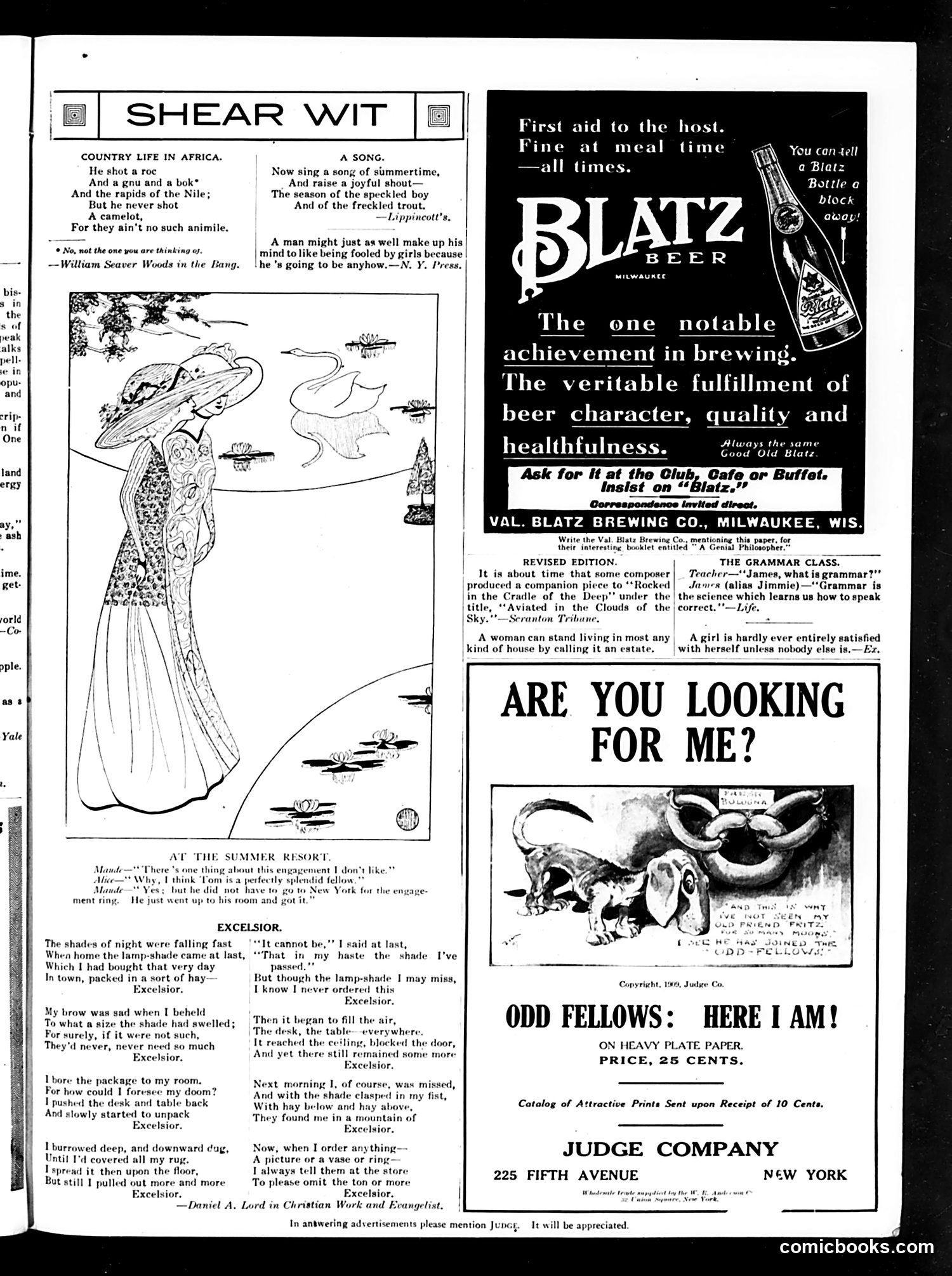
This page is primarily **advertising and humor content** rather than political satire. It contains: **"Shear Wit" section:** Light humor pieces including a poem mocking African safari hunting (referencing the fictional "camelot"), summer resort jokes, and "Excelsior"—a lengthy parody about unpacking a lamp shade with excessive packaging material. **Advertisements:** The page features major ads for Blatz Beer (Milwaukee brewery) and Judge Company prints, including "Odd Fellows: Here I Am!" (depicts cartoon animals). **Short jokes and quips:** Various one-liners about romance, grammar, and domestic life—typical period humor. **Context for modern readers:** This reflects early 1900s consumer culture (excessive product packaging was already a complaint), beer advertising as mainstream magazine content, and genteel humor about courtship and social situations. The "African" hunting reference reflects period attitudes toward colonial adventure narratives. There's no significant political commentary—it's entertainment and ads.
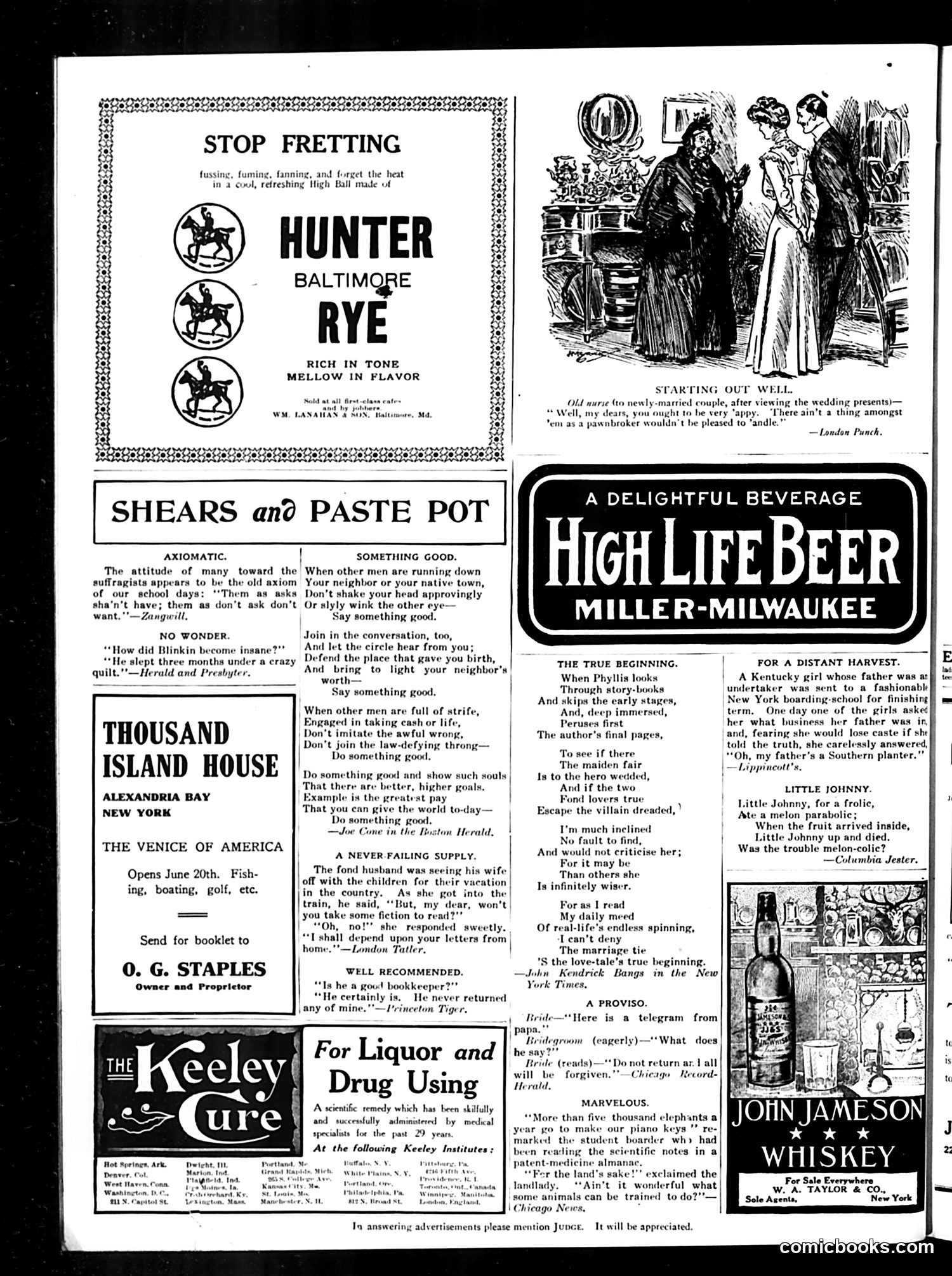
This page from *Judge* magazine is primarily **advertising**, not political commentary. It contains multiple liquor advertisements (Hunter Rye whiskey, High Life Beer, John Jameson whiskey) interspersed with light humor. The notable cartoon (top right) shows an older woman advising a newly-married couple about their wedding gifts—a gentle domestic joke about receiving unremarkable household items ("there ain't a thing amongst 'em as a pawnbroker wouldn't be pleased to 'andle"). This is genteel British humor adapted from *London Punch*. The text columns contain aphorisms and poetry encouraging "doing something good," jokes about absent-minded husbands, and miscellaneous light pieces. A *Keeley Institute* advertisement offers treatment for "Liquor and Drug Using"—reflecting contemporary Progressive-era concerns about substance abuse. The remaining content consists of whimsical poems and brief anecdotes with no political significance. This is a typical commercial page from an era when satirical magazines depended heavily on advertising revenue.
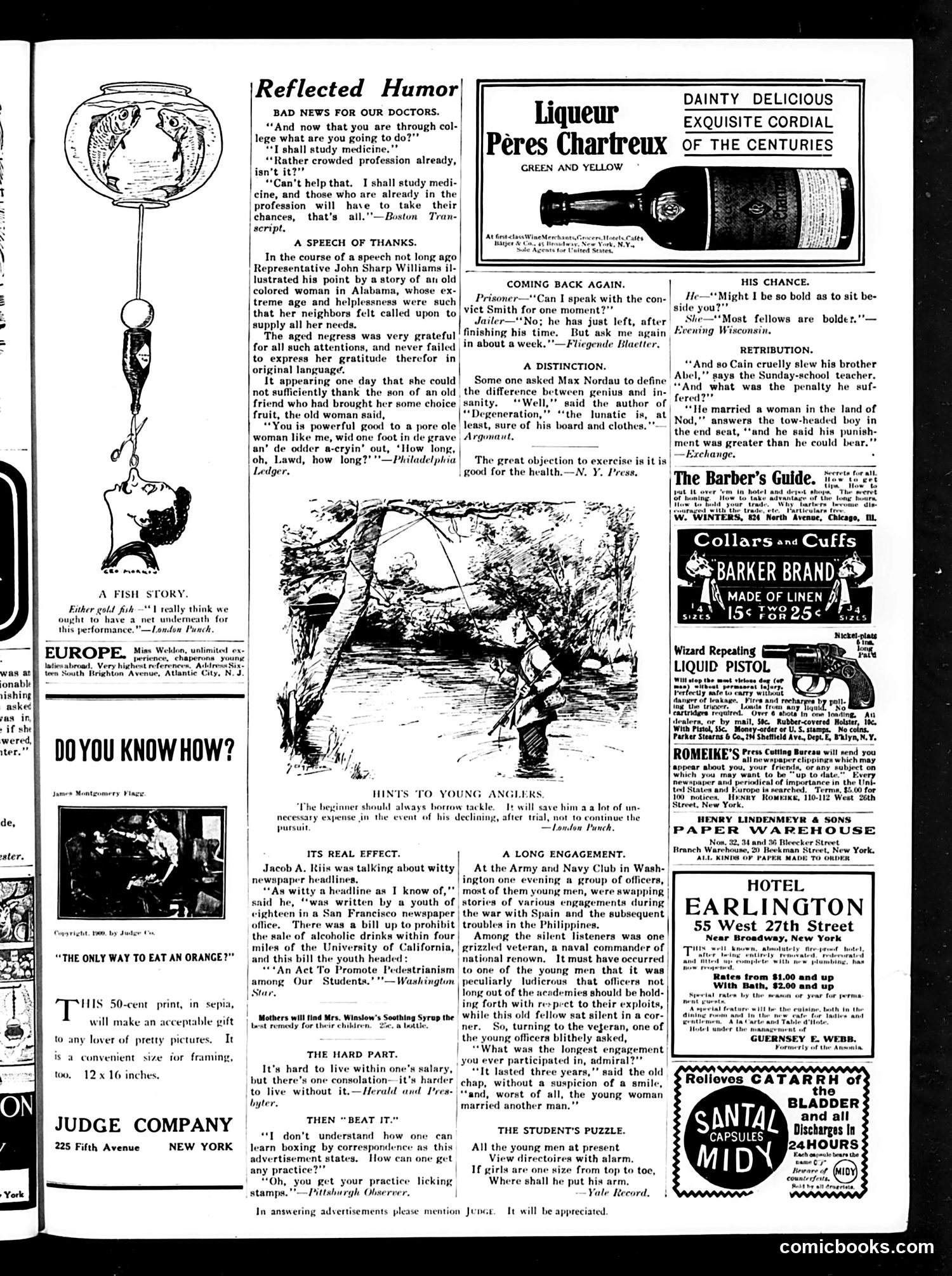
This page from Judge magazine (a satirical publication) consists primarily of **short humorous anecdotes and advertisements** rather than political cartoons. The "Reflected Humor" section contains brief jokes about: - A medical student's confidence that crowding in the profession won't stop him - A Representative's anecdote about an elderly Black woman's gratitude, using dialect for comedic effect (reflecting period racial attitudes) - A newspaper headline pun about a prohibition bill near a university called "An Act To Promote Pedestrianism" - Various one-liners about life's frustrations (living within salary, learning boxing by mail) - A joke distinguishing genius from insanity via Max Nordau The page also features **period advertisements** for liqueur, collars, hotel, and other goods. **No clear political figures or caricatures** are identifiable. This appears to be a humor/advertisement page rather than satirical commentary on specific political events or personalities.
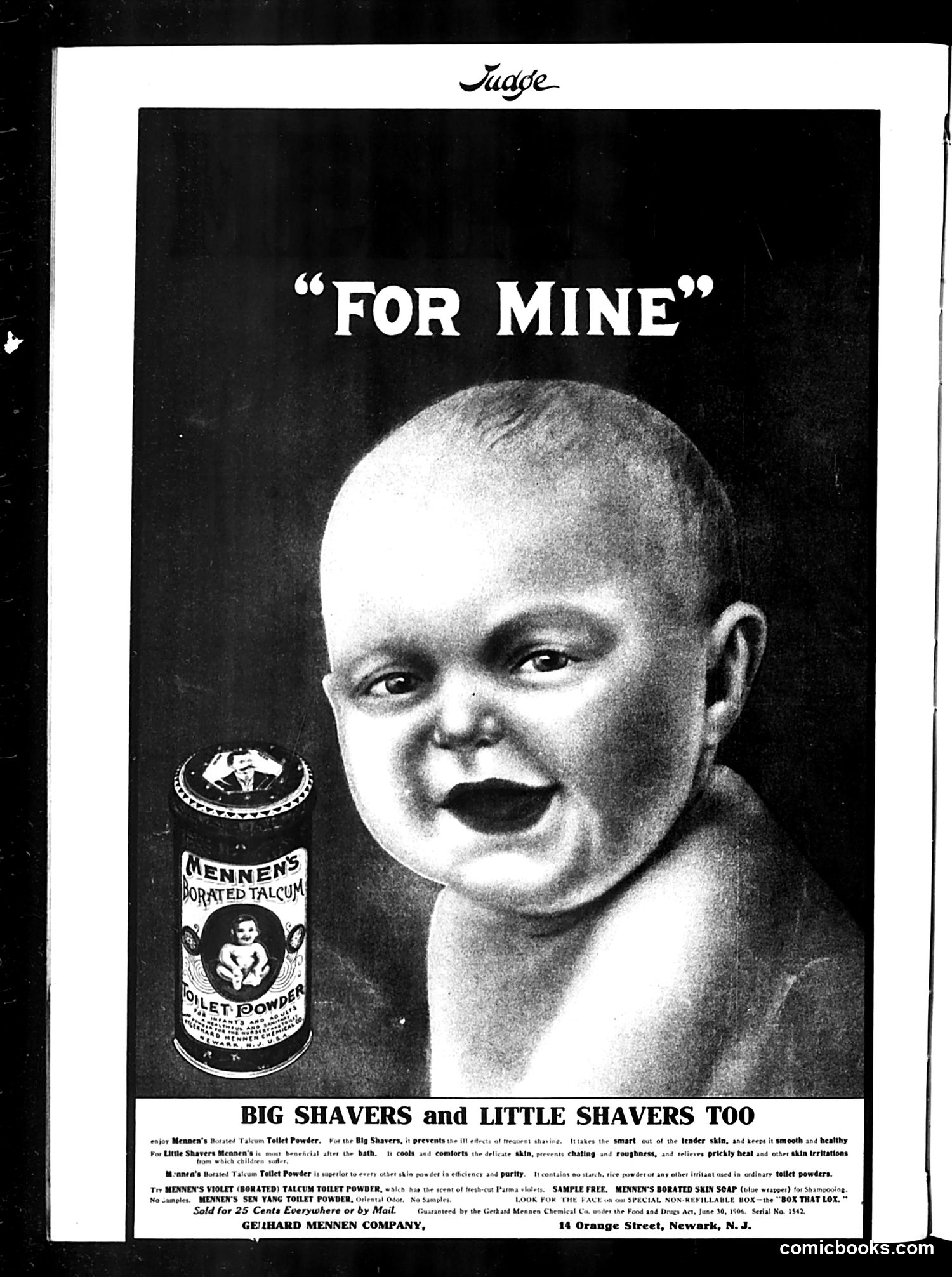
This is primarily a **product advertisement**, not political satire. It promotes Mennen's Borated Talcum Toilet Powder, using the phrase "FOR MINE" as a possessive claim (the product is desirable to own). The image shows a **bald baby's face** in close-up—the "little shaver" referenced in the text. The advertisement plays on parental concern: the powder is marketed for both "big shavers" (men) and infants, claiming it prevents skin irritation, chafing, and "prickly heat." The accompanying jar of Mennen's product sits beside the child's portrait as visual proof of the brand's association with infant care and safety. This reflects early 20th-century marketing strategy: positioning a commercial product as medically beneficial and trustworthy for vulnerable populations (babies). The "Judge" magazine context suggests this was placed among satirical content, though the ad itself contains no satire—just direct product promotion with health claims.