
A complete issue · 16 pages · 1907
Judge — October 12, 1907
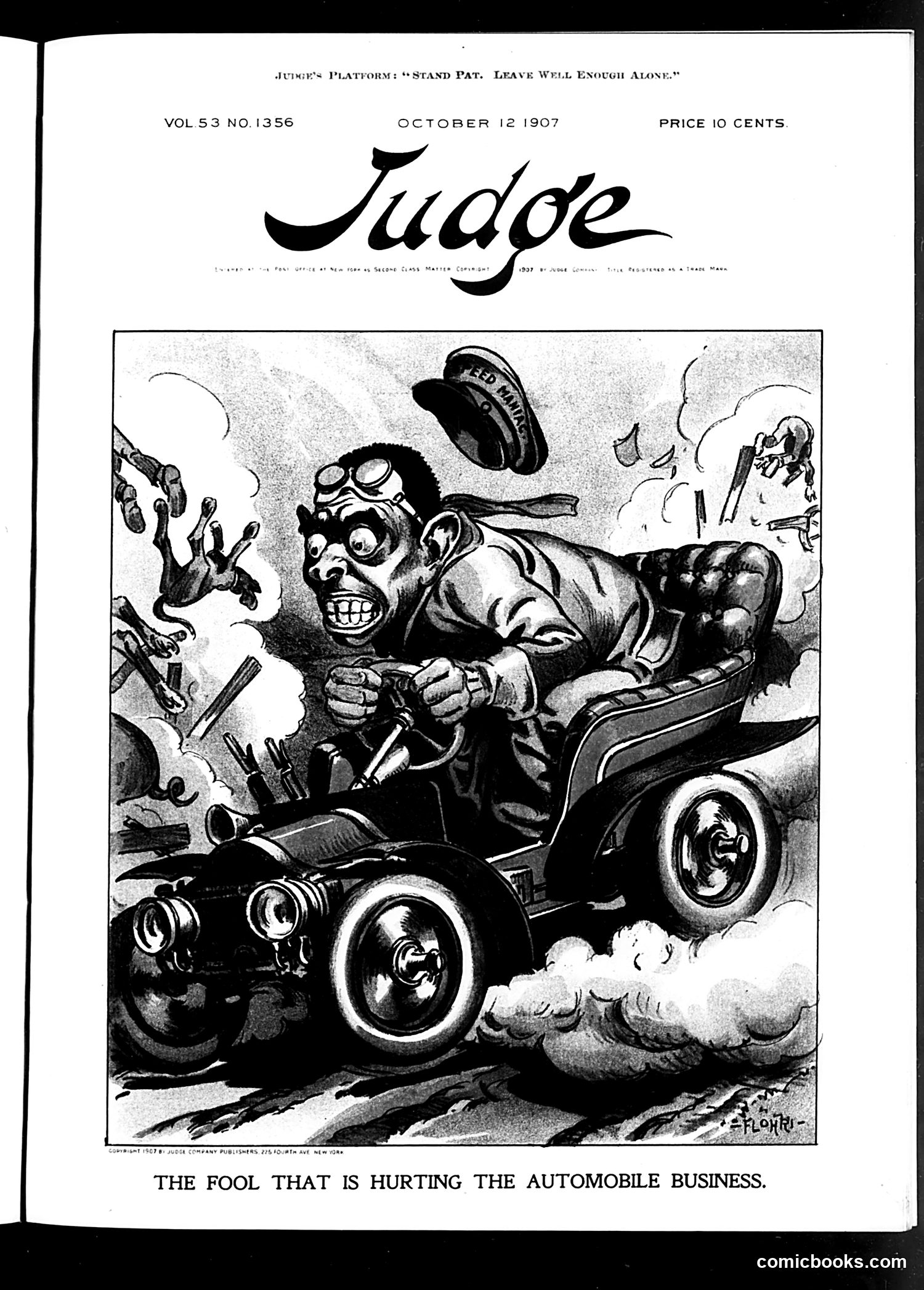
This October 1907 *Judge* cartoon satirizes reckless driving as damaging the nascent automobile industry. The caricatured driver—depicted with exaggerated features suggesting incompetence or foolishness—operates a car wildly out of control, kicking up dust clouds while his hat flies off. Mechanical parts scatter in his wake. The satire critiques unsafe drivers whose accidents and dangerous behavior were undermining public confidence in automobiles during this early era. Rather than blaming the vehicle itself, the cartoon blames the "fool" operator, suggesting that reckless individuals threatened the automobile business's reputation and commercial viability. This reflects contemporary concerns about traffic safety as cars became more common on American roads.
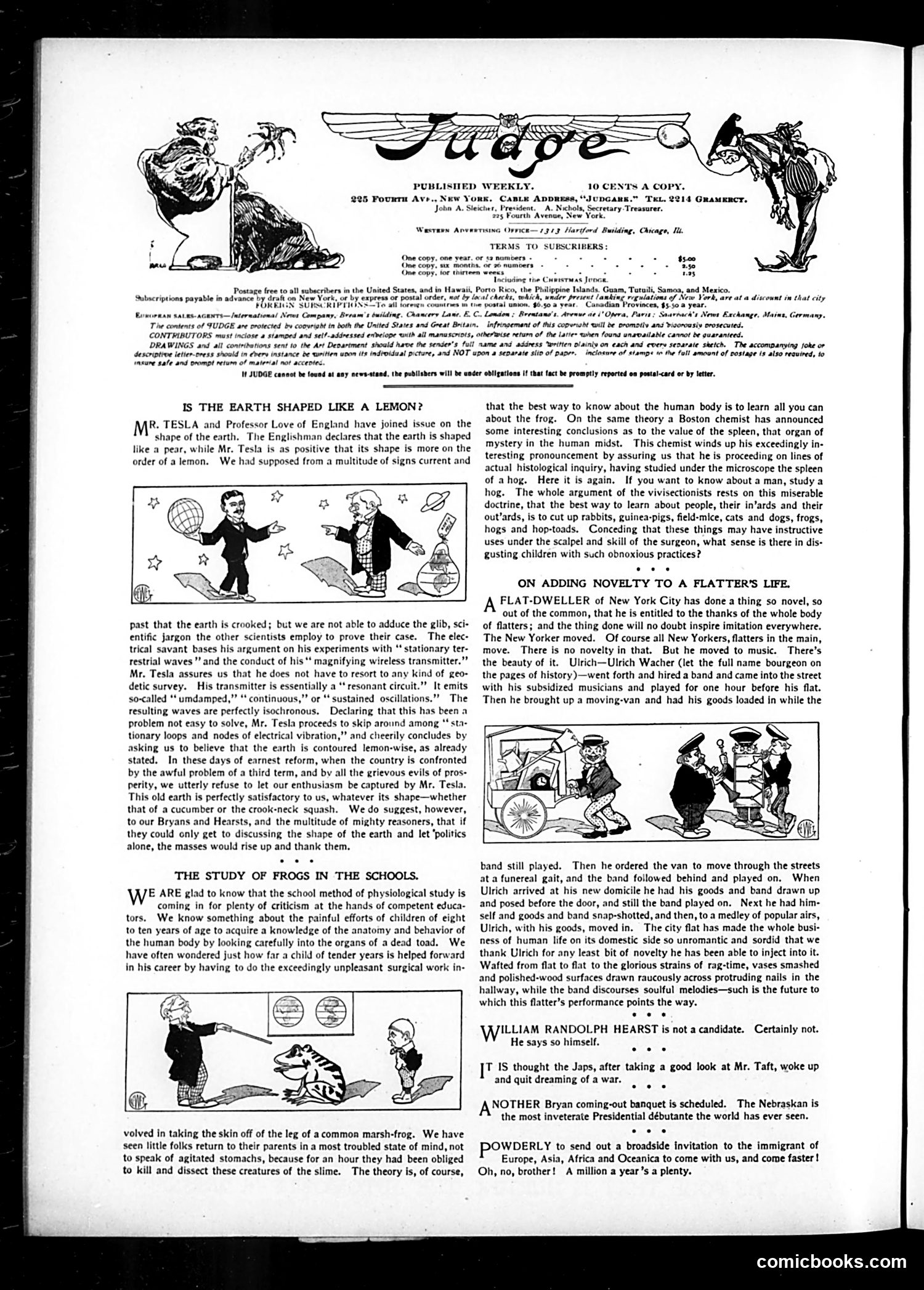
This page contains three distinct satirical pieces: 1. **"Is the Earth Shaped Like a Lemon?"** mocks Nikola Tesla and Professor Love's dispute over Earth's shape. The cartoon shows them debating while holding globes and scientific apparatus—satirizing how serious scientists waste time on trivial arguments while claiming scientific authority. 2. **"On Adding Novelty to a Flatter's Life"** humorously describes a New York City flatter (someone with no money) who hired a street band and moved via moving-van, creating spectacle from poverty. The satire pokes fun at working-class attempts at dignity and showmanship. 3. **"The Study of Frogs in the Schools"** critiques educational methods by questioning whether dissecting frogs traumatizes children and serves educational purpose. The page primarily satirizes pseudoscience, class pretension, and pedagogical excess.
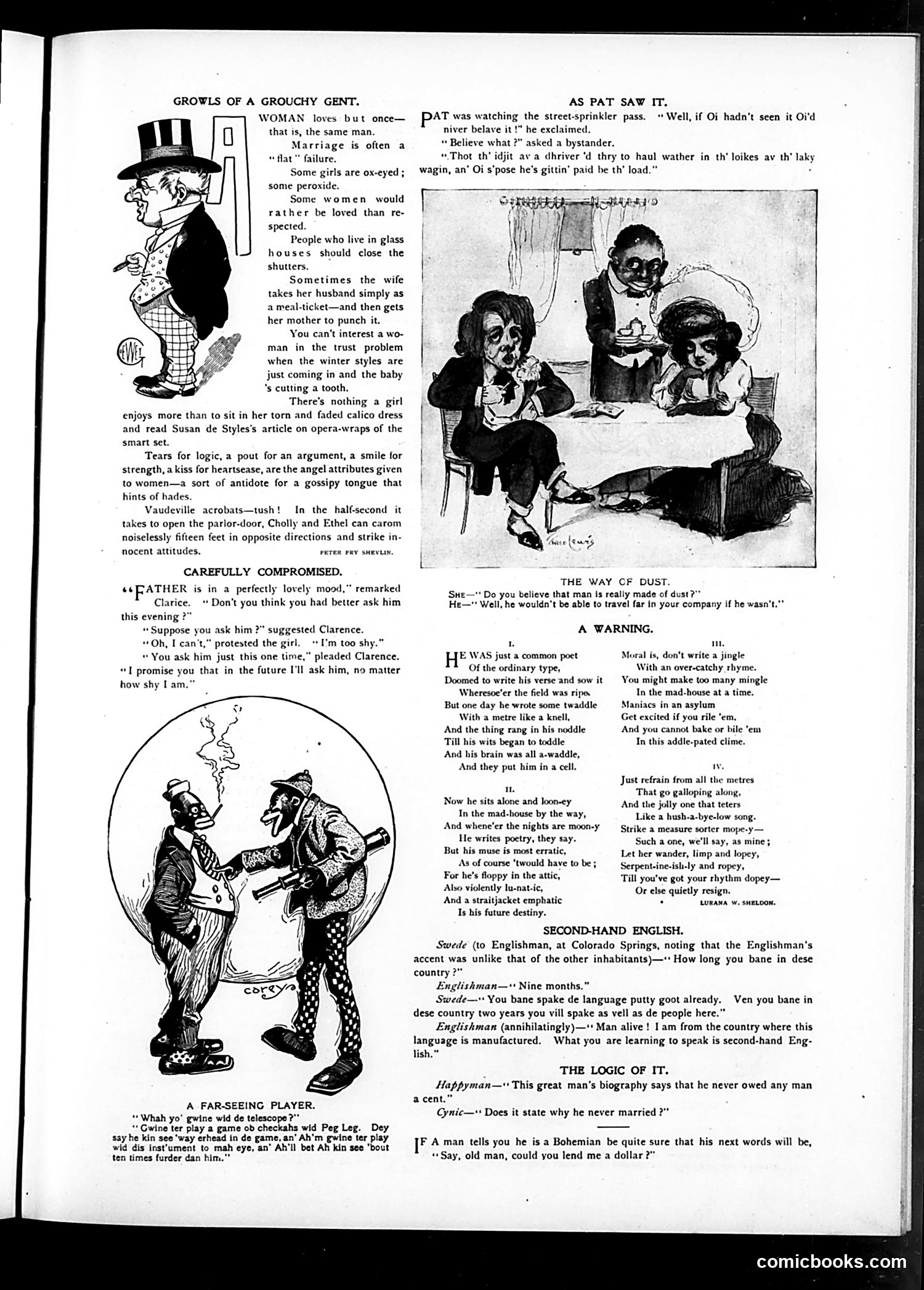
This page contains humor columns and illustrations typical of early-20th-century satirical magazines. The cartoons mock social conventions: **"Growls of a Grouchy Gent"** satirizes marriage and women's behavior through a misogynistic lens—commenting on wives who marry for security rather than love, and women's emotional manipulation. **"A Far-Seeing Player"** depicts what appears to be a theatrical or gambling scenario with exaggerated caricatured figures, likely mocking someone's poor judgment or naïveté. **"A Warning"** presents a cautionary poem about an unsuccessful poet driven to madness, typical moralizing content. The other sections—"The Way of Dust," "Second-Hand English," and "The Logic of It"—are humorous anecdotes and wordplay rather than political commentary. The overall tone reflects period attitudes about gender, class, and respectability through satirical commentary.
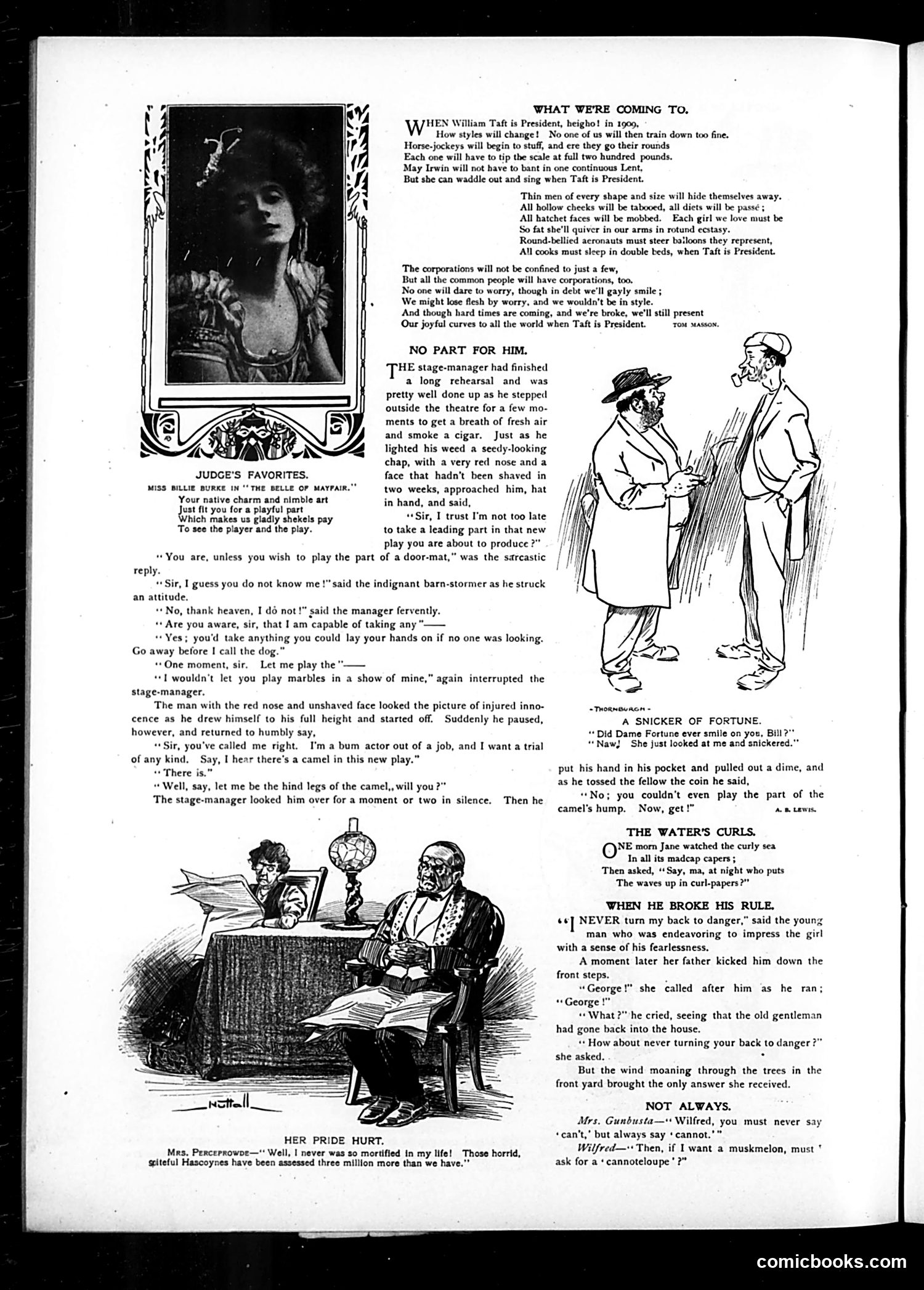
This page contains several unrelated short stories and cartoons rather than a unified political cartoon. **"What Were Coming To"** satirizes anticipated changes under President William Taft (elected 1908). It humorously predicts women will adopt masculine fashion and behavior—wearing jockeys' outfits, smoking, and sleeping in double beds—reversing traditional gender roles. **"No Part for Him"** depicts a stage manager rejecting an unshaven, shabby actor, offering him only a camel's part. It's a joke about theatrical ambition meeting harsh reality. The remaining sections are brief humorous anecdotes ("A Snocker of Fortune," "The Water's Curls," "When He Broke His Rule," "Not Always") featuring wordplay and situational comedy typical of period magazine filler. The page reflects early 1900s attitudes toward gender, class, and social propriety through light satire.
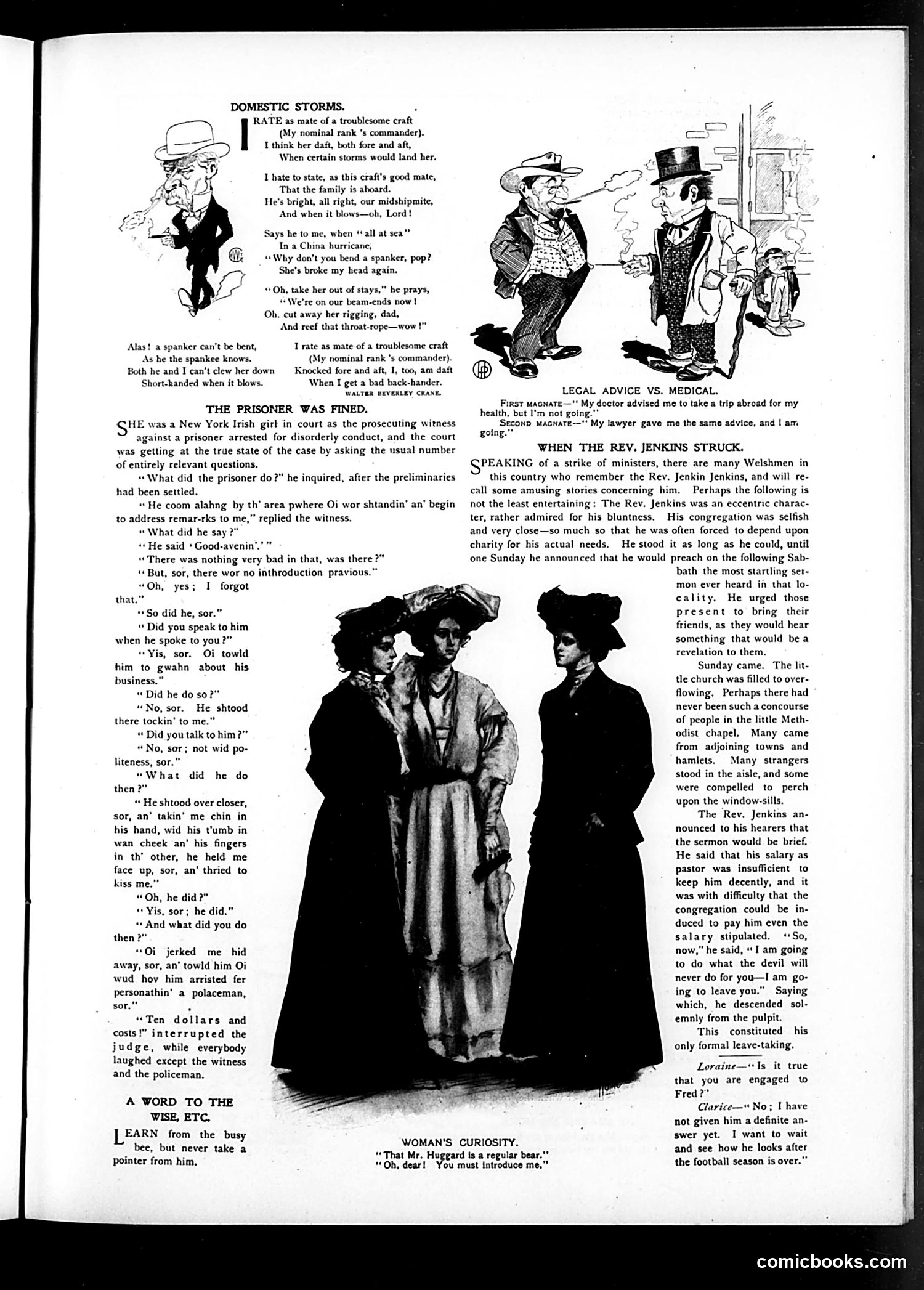
This page contains several satirical pieces typical of Judge's humor: **"Domestic Storms"** (top left): A caricatured Irish man complains about his wife's nagging, using exaggerated dialect ("swor shnding"). The joke plays on ethnic stereotypes common to the era—depicting working-class Irish domestic life as quarrelsome. **"The Prisoner Was Freed"** (center left): A courtroom dialogue where an Irish witness uses broken English and malapropisms, satirizing both immigrant speech patterns and legal proceedings. **"Legal Advice vs. Medical"** (top right): Two wealthy gentlemen compare advice—one from a lawyer, one from a doctor—suggesting class-based differences in professional guidance. **"When the Rev. Jenkins Struck"** (right): A lengthy anecdote about a minister announcing he'd leave his congregation unless paid more, satirizing clergy's financial demands. The page exemplifies Judge's reliance on ethnic caricature and class-based humor typical of early 20th-century American satire.
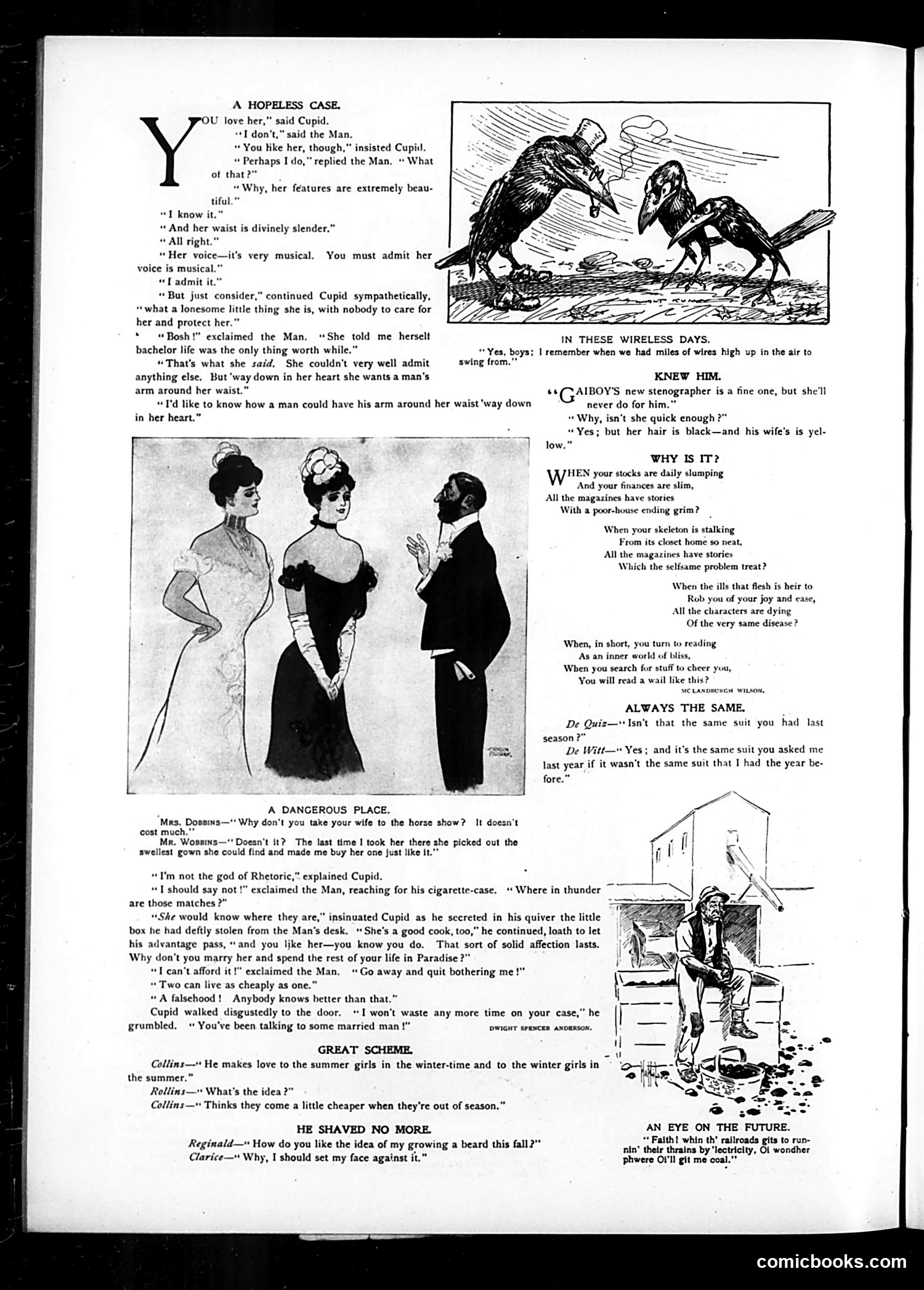
This page contains multiple satirical pieces reflecting early 20th-century social anxieties: **"A Hopeless Case"** presents a dialogue between Cupid and a reluctant man about marriage. The satire mocks masculine resistance to matrimony despite a woman's obvious merits—the man dismisses her beauty, musical voice, and loneliness as irrelevant. The joke: men resist marriage even when logically they should embrace it, revealing male stubbornness as the real obstacle. **"Why Is It?"** by McHenry Wilson sarcastically catalogs magazine content: poverty stories appear when readers face financial ruin; tragedy tales when they seek comfort. The satire criticizes how periodicals fail readers by offering depressing subject matter precisely when escapism is needed most. **"Always the Same"** jokes about fashion stagnation—a man wears identical suits year after year, yet friends continually question whether it's the *same* suit, suggesting both male indifference to fashion and society's obsession with novelty. The page also includes lighter humor about stenographers, horse shows, and railroads. These pieces collectively satirize contemporary social conventions around marriage, consumerism, and gender roles.
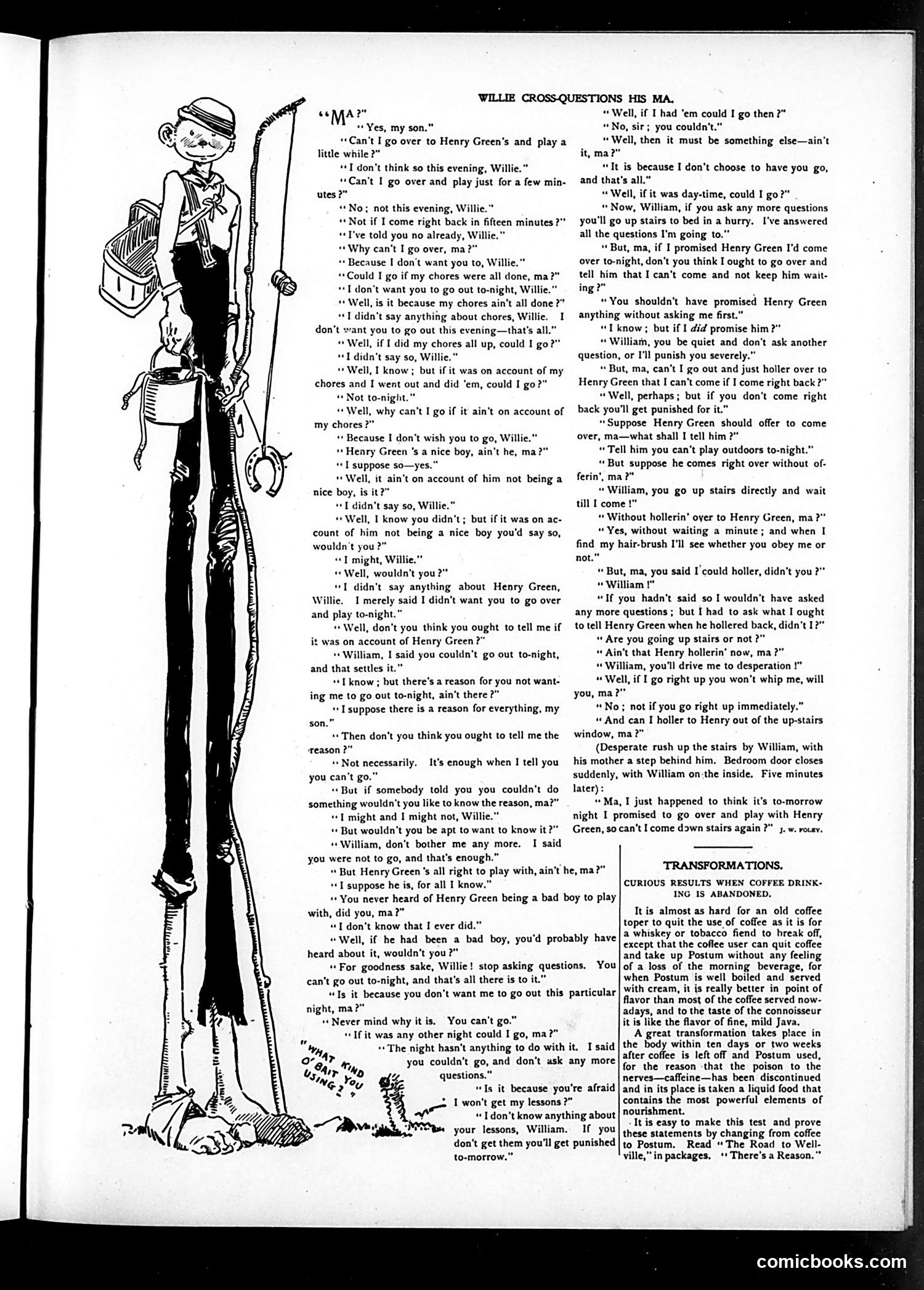
This page contains a humorous domestic dialogue rather than a political cartoon. It depicts a child (Willie) persistently questioning his mother about why he cannot visit his friend Henry Green one evening. The satire targets **parental authority and childhood logic**: Willie uses increasingly sophisticated reasoning to challenge his mother's "no," asking if he could go if chores were done, if it were daytime, if he came right back, or if Henry came to him instead. His mother repeatedly refuses to provide a rational justification, insisting on obedience without explanation. The joke lies in the **universal frustration** of children facing arbitrary parental rules and the parent's exasperation with endless questioning. This reflects period anxieties about childhood discipline and parental authority. The accompanying article about coffee discusses removing caffeine from coffee—a contemporary health concern of the era (likely early 1900s). The cartoon is satirizing not politics but family dynamics and the clash between childish persistence and adult authority.
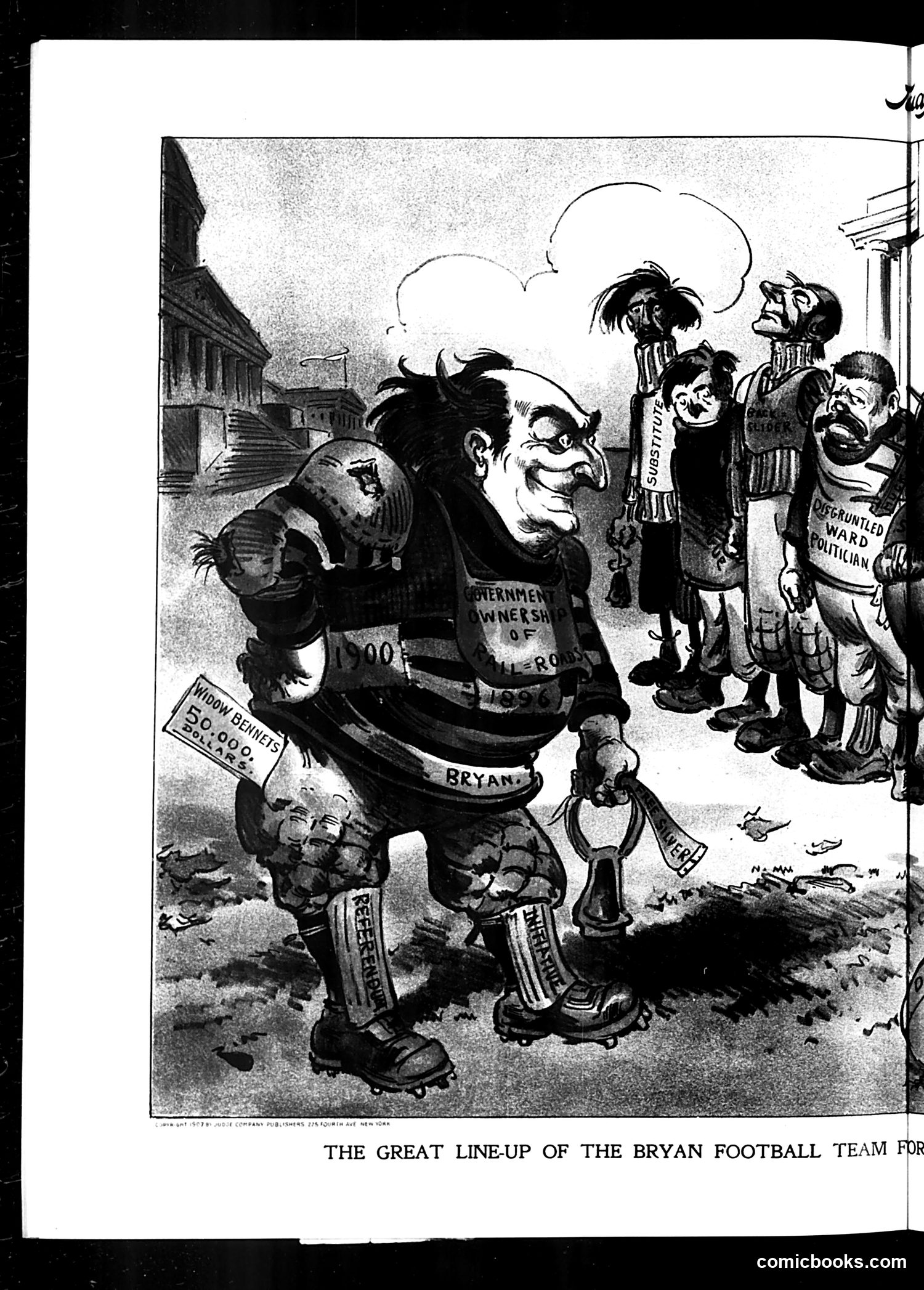
This is a satirical cartoon from *Judge* magazine titled "The Great Line-Up of the Bryan Football Team For..." (text cut off). The central caricatured figure labeled "BRYAN" represents William Jennings Bryan, the three-time Democratic presidential candidate. He's depicted as a grotesque football player carrying what appears to be a baby, wearing a jersey labeled "Government Ownership of Roads." The cartoon satirizes Bryan's political platform and supporters. Visible labels reference "Free Silver" (a key Bryan campaign issue) and other policy positions. The military or official-looking figures in the background likely represent Bryan's political allies or supporters being assembled for his campaign. The joke equates Bryan's political "team" to a football lineup, mocking both his candidacy and his progressive policy proposals through grotesque caricature.
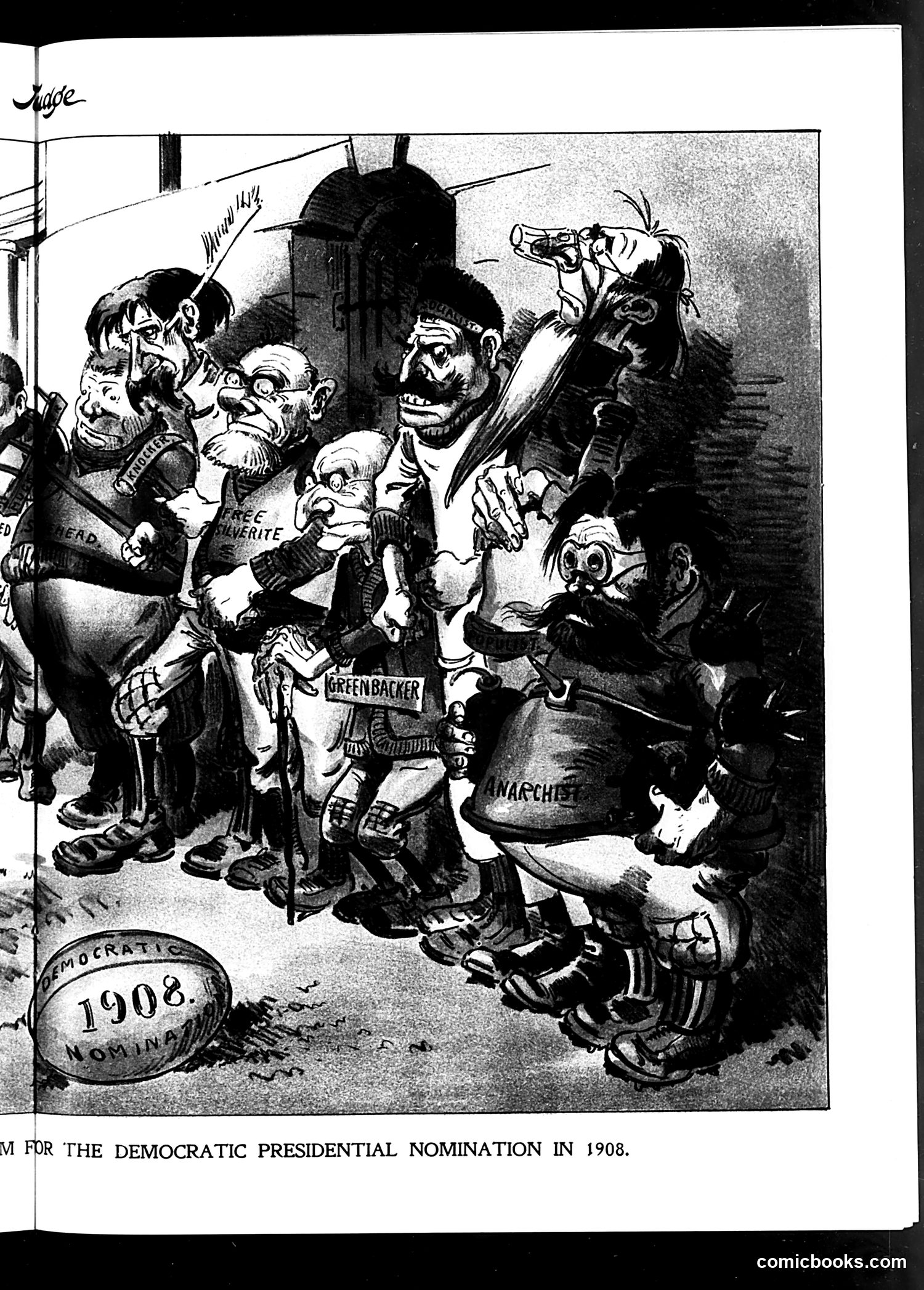
This Clifford Berryman cartoon satirizes the chaotic Democratic race for the 1908 presidential nomination. The central figure appears to be a candidate surrounded by caricatured supporters and rival politicians—identifiable by labels like "Greenbacker" and "Anarchist." The crowded, aggressive scene depicts competing factions literally fighting over the nomination, with exaggerated facial features typical of turn-of-the-century political caricature. The chaotic gathering suggests the Democratic Party was fractured among multiple candidates and ideological groups—populists, labor interests, and conservative Democrats—all vying for control. The 1908 Democratic nomination was genuinely contentious following Theodore Roosevelt's 1904 victory, making this visual metaphor of disorder commentary on the party's internal discord and struggle for unity.
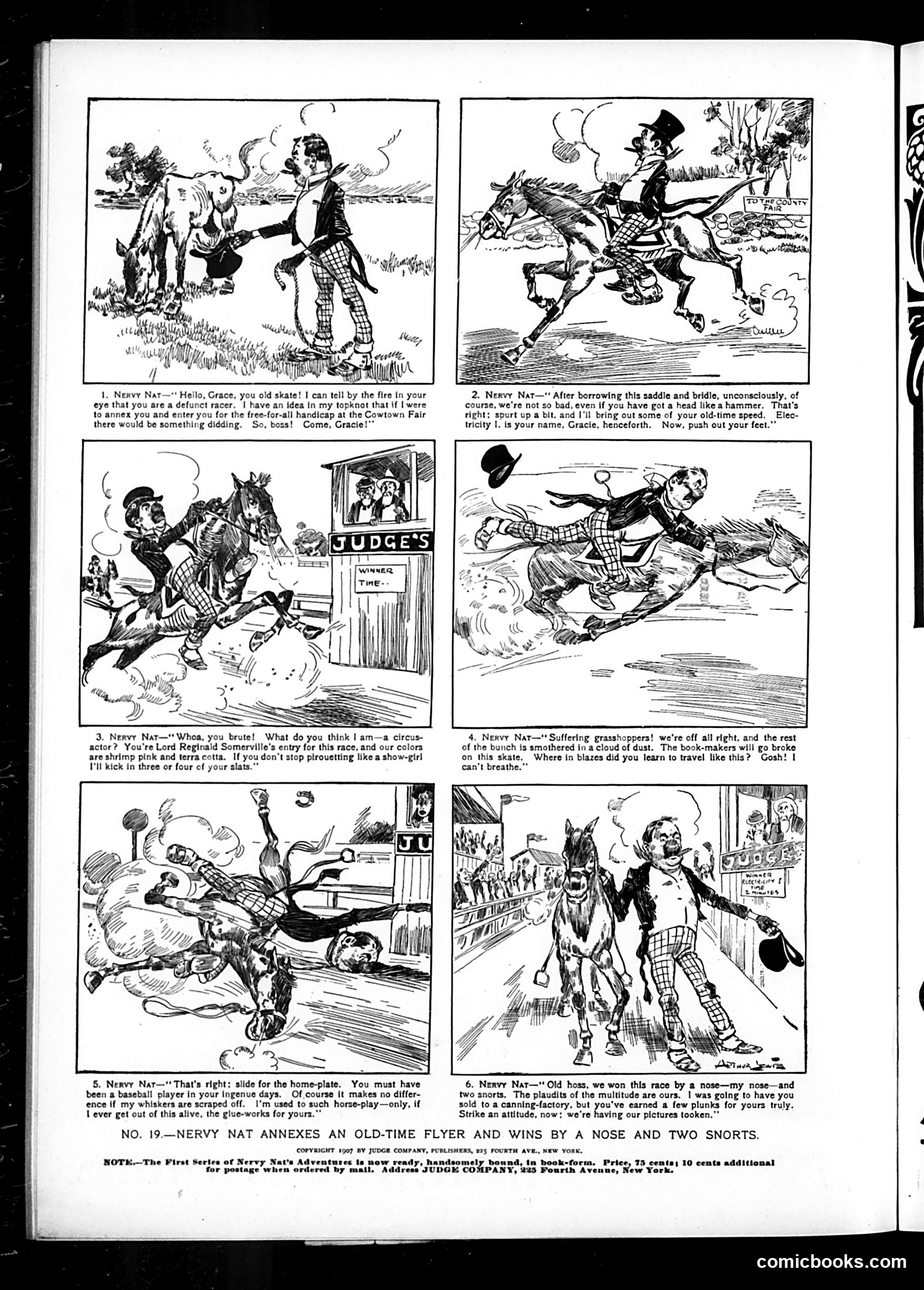
This is a humorous six-panel comic strip following "Nervy Nat," a cocky character who discovers an old, worn-out racehorse named "Gracie" and convinces himself he can enter it in a horse race. Nat borrows tack without permission and coaxes the reluctant animal into competition. The joke unfolds as Nat's brash confidence meets reality: the horse, initially stubborn and difficult, surprisingly runs well. Despite Nat's rough treatment and constant complaints—he's thrown around, can't breathe from dust, worries about his appearance—the horse somehow wins "by a nose and two snorts." The satire mocks overconfident hustlers ("Nervy Nat") who succeed despite incompetence, sheer luck, and disregard for decorum. His casual theft of equipment, crude horsemanship, and vanity ("strike an attitude") contrast amusingly with an improbable victory. The period slang ("old skate," "plunks") and references to baseball and vaudeville ground this in early 1900s Americana.
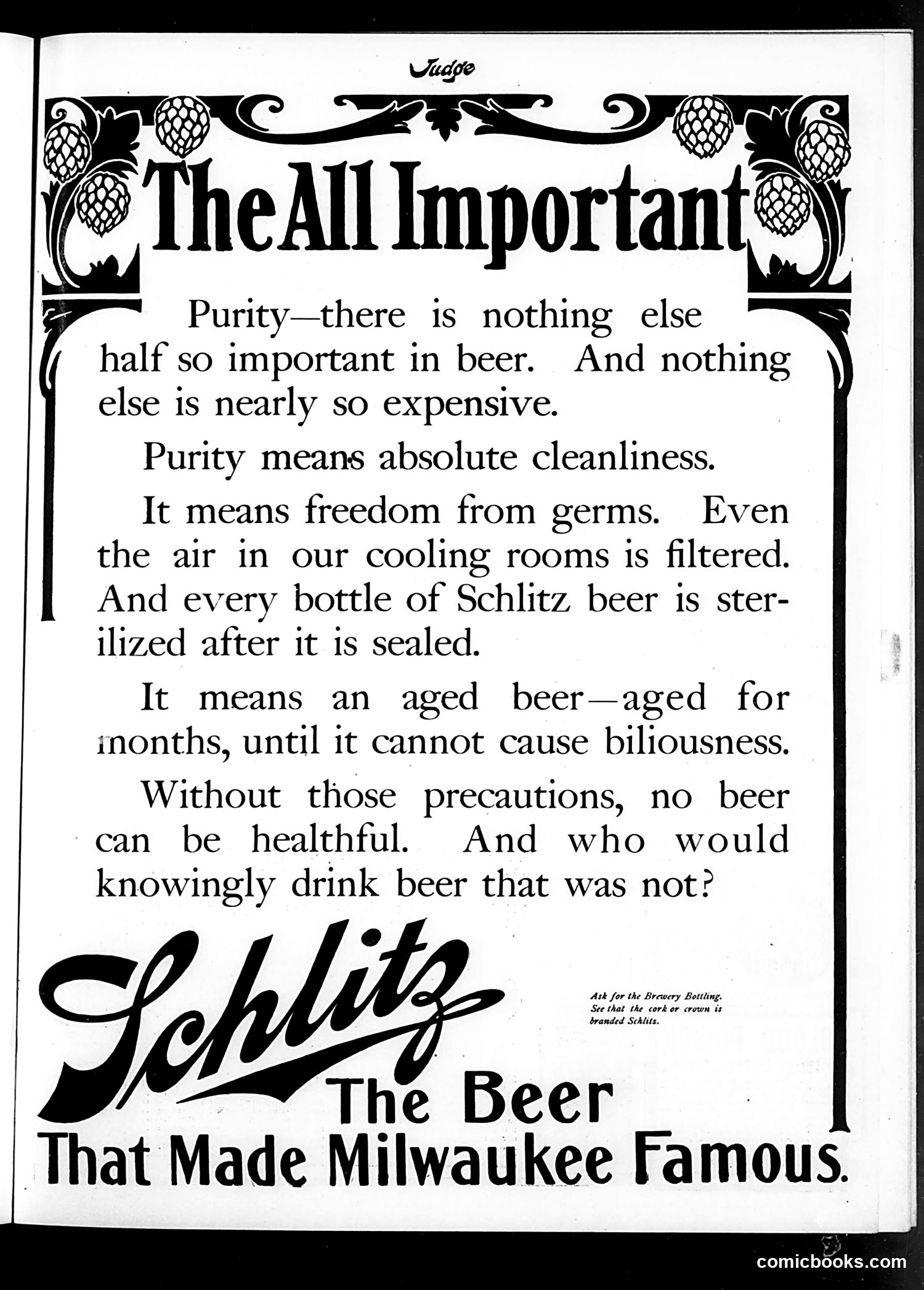
This is **not a cartoon or satire**, but rather a **straightforward advertisement** for Schlitz beer from Judge magazine. The page promotes Schlitz's purity standards—emphasizing filtered air, sterilized bottles, and aging processes—as health safeguards. The claims reflect early 20th-century marketing emphasizing sanitation and germ-free production, which would have appealed to contemporary concerns about contaminated food and beverages. The phrase "The Beer That Made Milwaukee Famous" was Schlitz's actual slogan. The "Ask for the Brewery Bottling" instruction and warning to verify the branded cork were genuine anti-counterfeiting measures of the era. This represents how major breweries used premium publications like Judge to establish their brands as safe and reputable products during an era when beer quality and safety were legitimate consumer concerns.
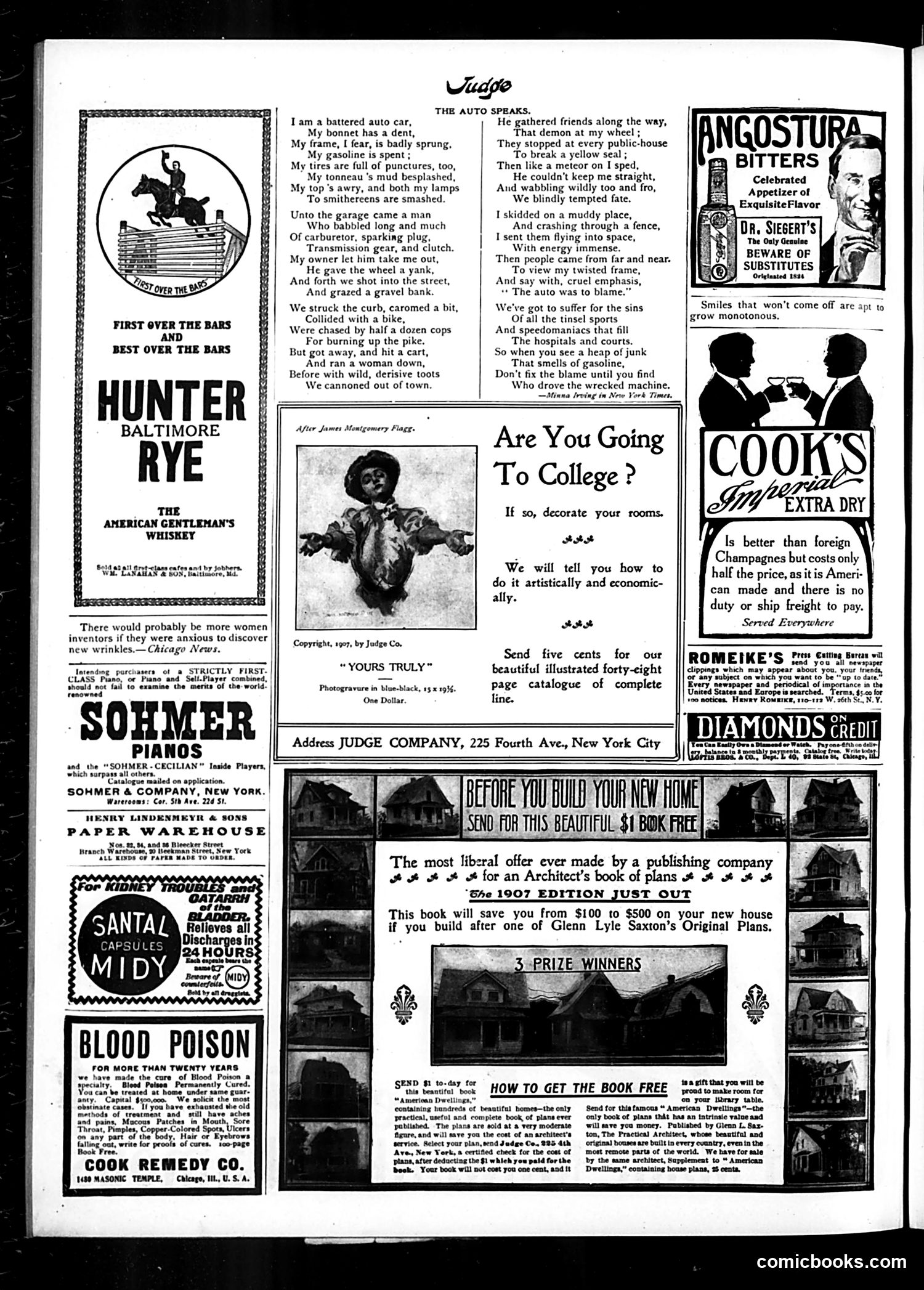
This page is primarily **advertising** with one substantial satirical poem. The main content is "The Auto Speaks," a humorous verse personifying a battered automobile. The car blames its wrecked condition on its reckless driver—a "demon at my wheel" who drives drunk, speeds dangerously, and causes multiple collisions. The satire targets early-1900s automobile culture: reckless "speedomaniacs," intoxicated joy-riders, and public danger. The ironic point is that the car itself, not the irresponsible driver, receives blame for accidents. The poem reflects genuine contemporary anxieties about automobiles as new, chaotic threats to public safety. The surrounding ads—for whiskey (Hunter Baltimore Rye), pianos, blood poison treatments, and home-building books—are typical Judge magazine commercial content. The illustration, credited to James Montgomery Flagg, shows the car personified as a distressed figure.
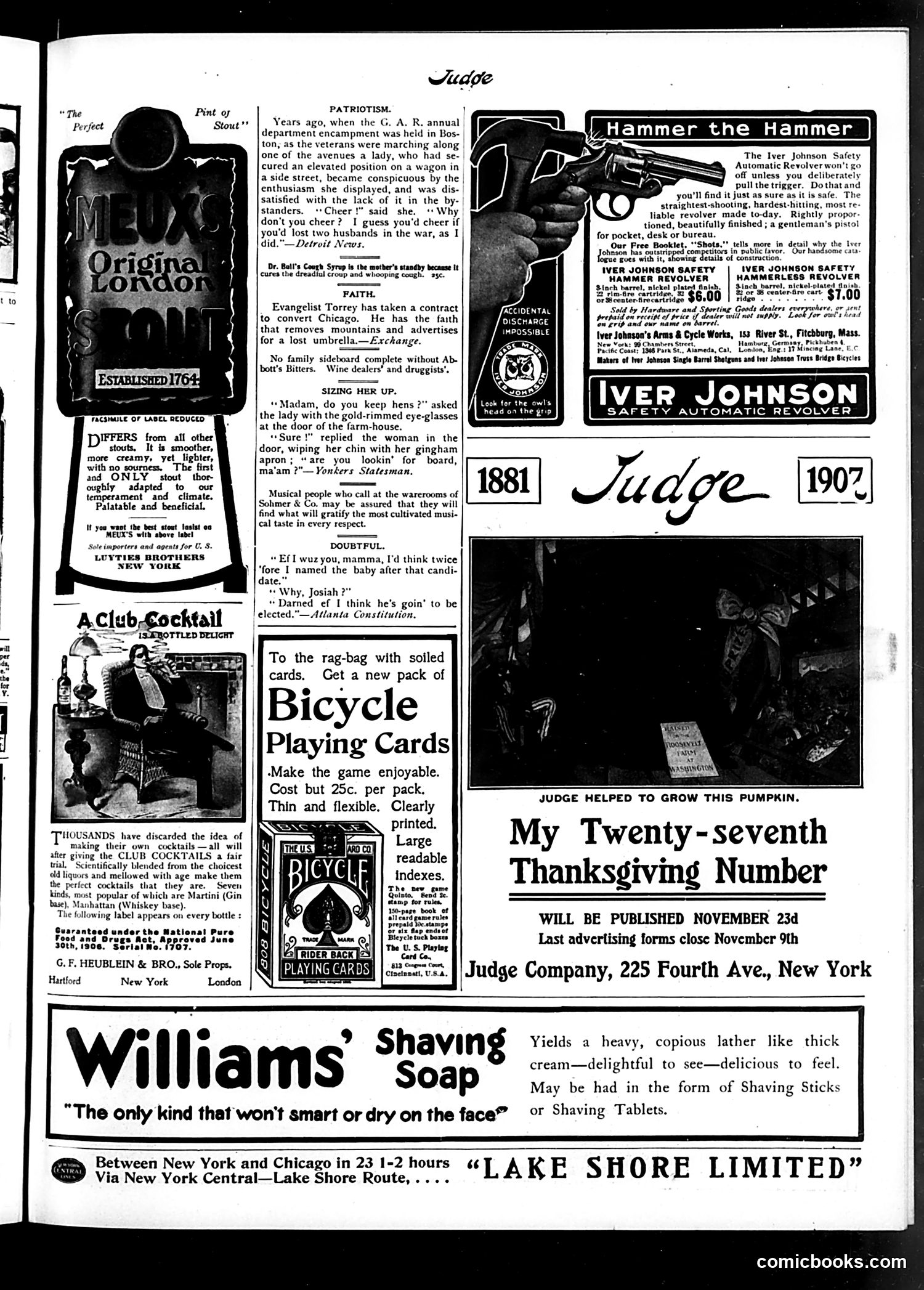
This page is primarily **advertising and filler content** rather than a coherent editorial piece. The notable satirical elements include: **"Patriotism"** (top left): A anecdote mocking performative patriotism. A woman at a Civil War veterans' parade demands others cheer because she lost two husbands in the war—her sacrifice supposedly obligating public enthusiasm. The satire suggests her grief, while valid, doesn't justify demanding patriotic displays from strangers. **"Sizing Her Up"** (center): A brief comic dialogue where a woman asking about keeping hens is mistaken for a boarding-house seeker. It's mild wordplay humor with no deeper satirical intent. **"Doubtful"** (lower center): A parent jokes they won't name their baby after a political candidate because he likely won't be elected—satirizing the candidate's poor prospects. The remainder is advertising for period products: Iver Johnson revolvers, cough syrup, playing cards, shaving soap, and liquor. This reflects Judge's business model of mixing editorial content with substantial advertising revenue.
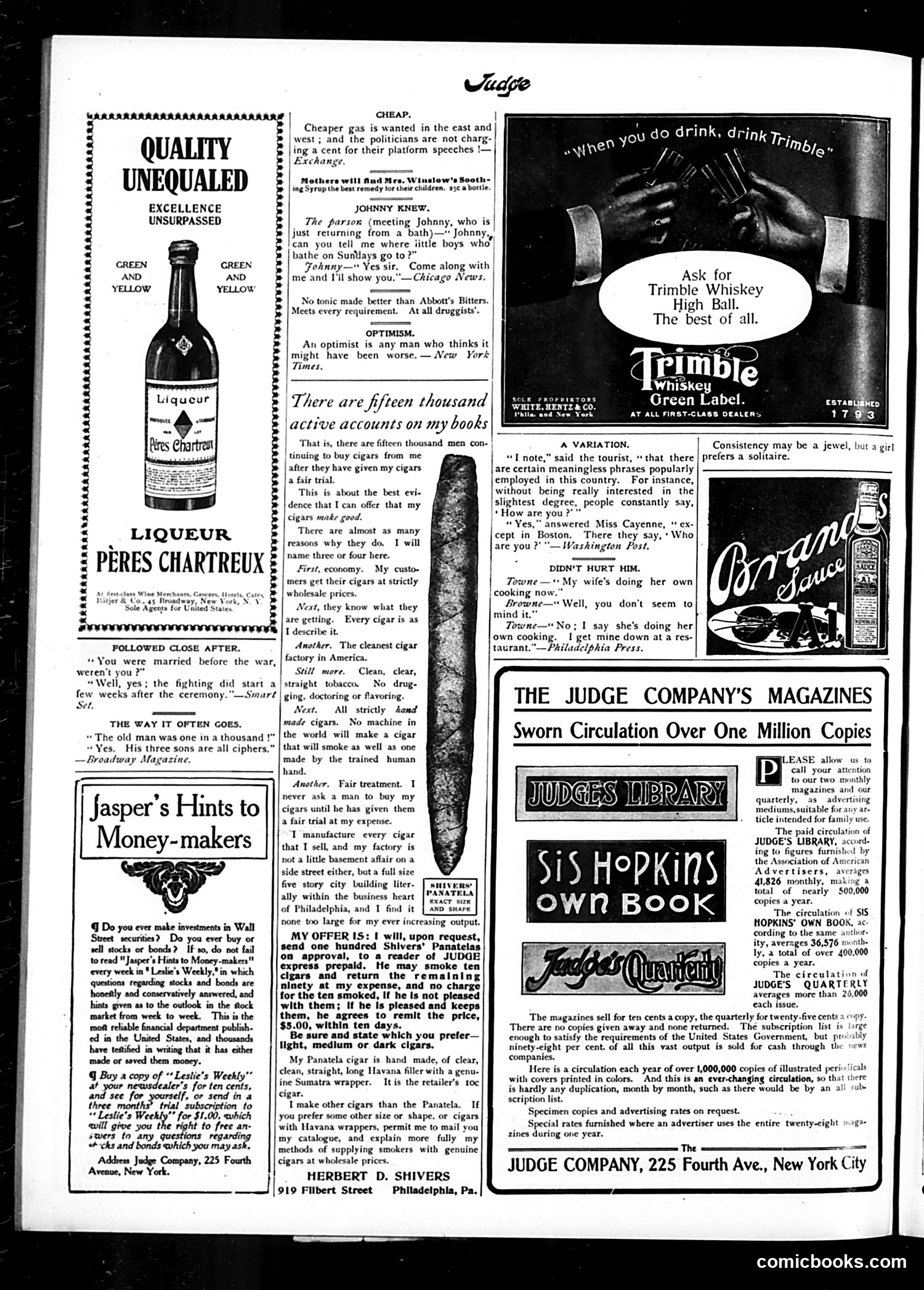
This page is primarily **advertising and filler content**, typical of early 20th-century magazines. The main elements are: **Advertisements:** - Liqueur Pères Chartreux (French spirits) - Trimble Whiskey (prominent right-side ad) - Cocoanut Sauce (bottom right) - Jasper's Hints to Money-makers (investment advice column) - Herbert D. Shivers cigars (extensive pitch about "15,000 active accounts") **Brief Humor Pieces:** Short jokes about marriage ("fighting did start a few weeks after the ceremony"), optimism, and platform speeches by politicians—typical light satire. **Judge Company Self-Promotion:** Large advertisement for Judge's own magazines (Judge's Library, Sis Hopkins' Own Book, Judge's Quarterly) claiming over one million circulation. **No significant political cartoons or caricatures are visible**—this is a back page dominated by commercial content and house ads typical of era magazines.
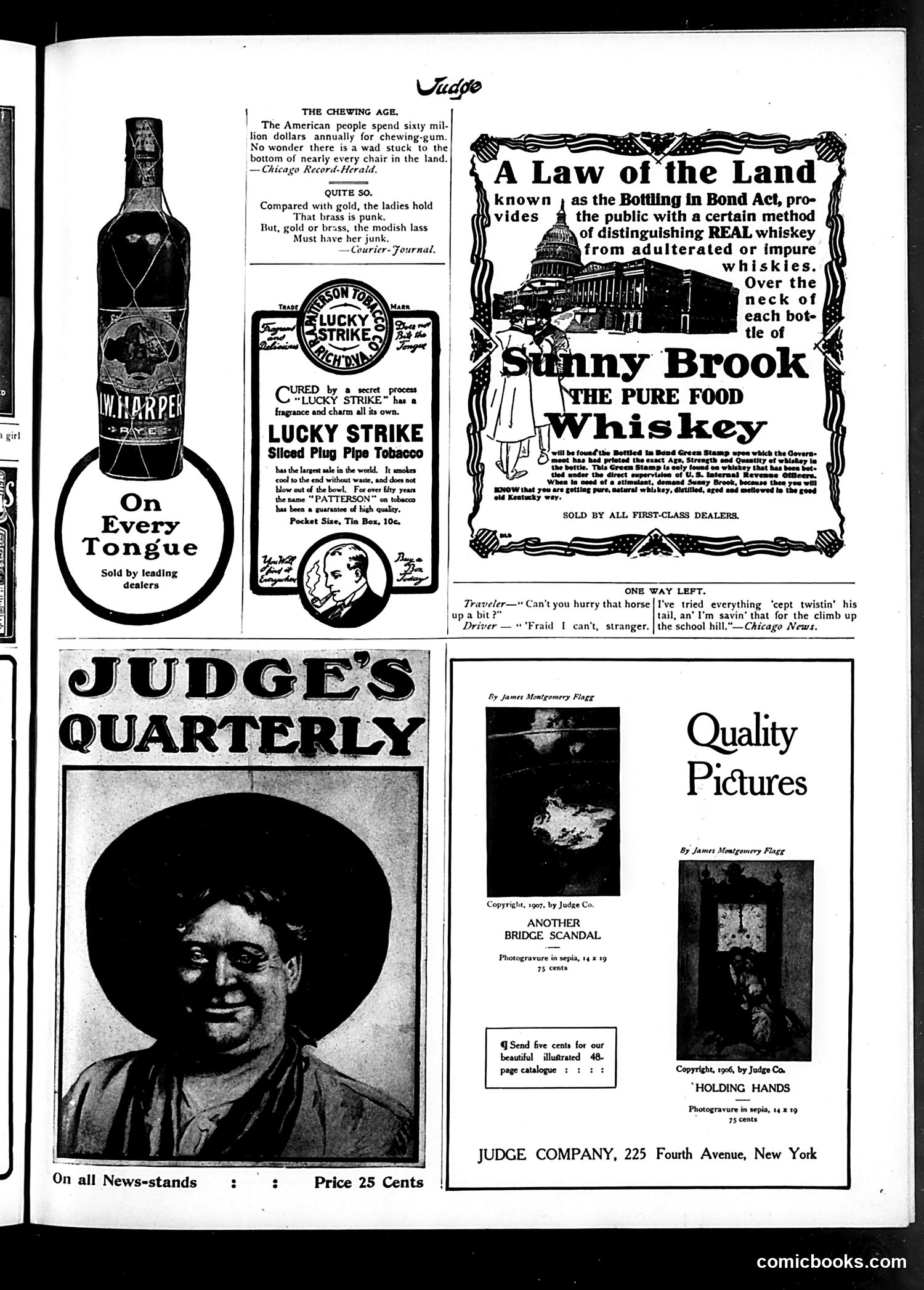
This page is primarily **advertising and product promotion** rather than editorial cartoons. The main content includes: **Advertisements:** - Wharper chewing tobacco and Lucky Strike pipe tobacco - Sunny Brook whiskey, emphasizing the "Bottling in Bond Act"—federal legislation guaranteeing authentic, unadulterated spirits (a consumer protection against widespread whiskey fraud of that era) **Editorial Content:** Brief satirical verses mock American consumer culture: one quip notes Americans spend $60 million annually on chewing gum, leaving "wads stuck to the bottom of nearly every chair"; another jokes that women prefer brass "junk" jewelry to gold. **Judge's Quarterly Cover:** A portrait of a man in a wide-brimmed hat (identity unclear from image alone) sold on newsstands for 25 cents. **Quality Pictures Section:** Promotional material for James Montgomery Flagg illustrations available as photogravures. The page reflects early 1900s consumer advertising alongside light social satire about materialism and commercialism.
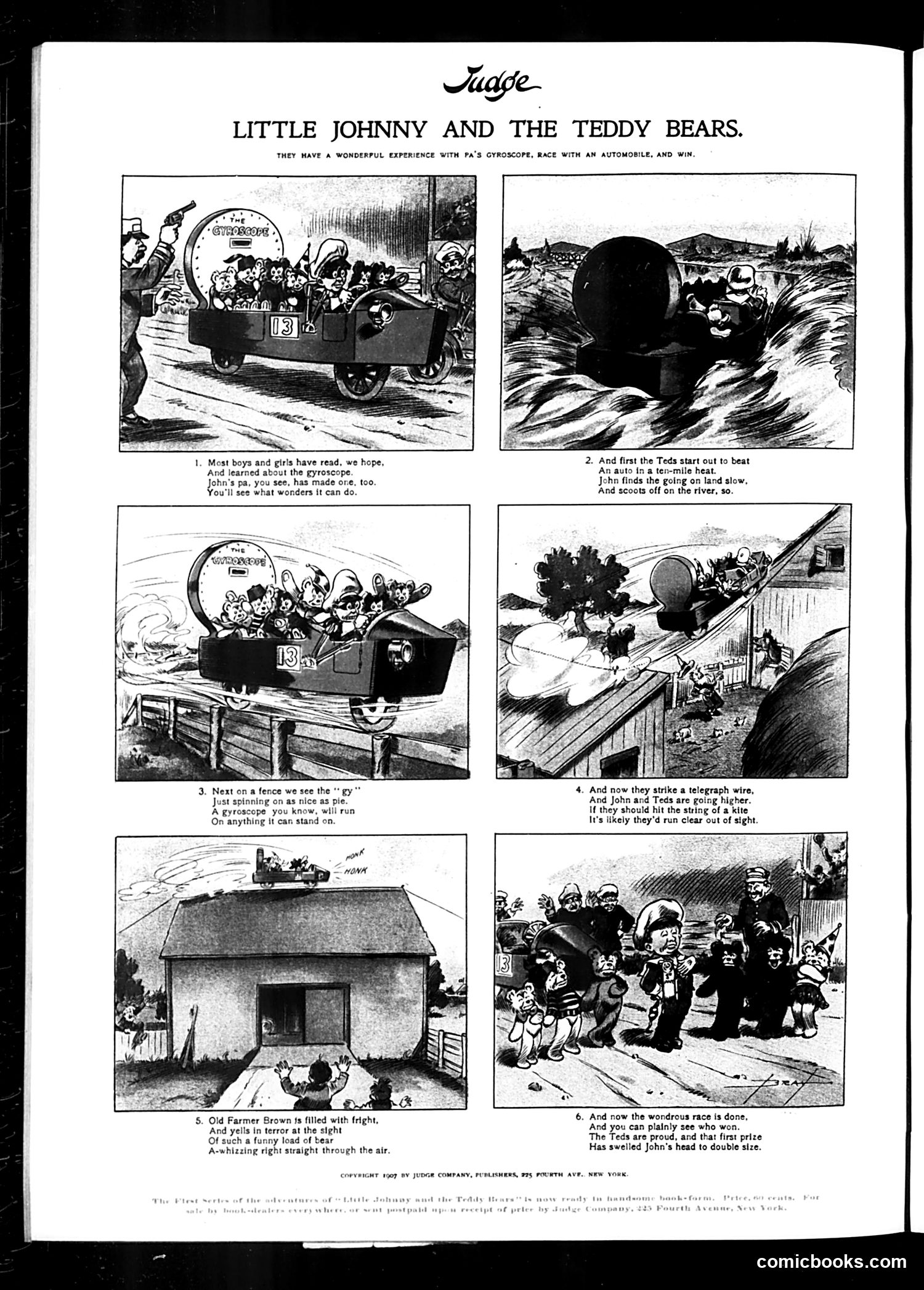
This is a whimsical children's story comic, not political satire. It celebrates the "Teddy Bear" craze of the early 1900s—toys named after President Theodore Roosevelt—by depicting them as adventurous characters. The narrative follows Little Johnny and his teddy bears using his father's gyroscope (a spinning scientific instrument) to power a vehicle that races an automobile across land and water. The humor derives from the gyroscope's unexpected ability to defy gravity, launching them upward into collisions with telegraph wires and kites, terrifying Farmer Brown. The satire, if any exists, is gentle—mocking the era's fascination with new technology (automobiles, gyroscopes) and the commercial phenomenon of teddy bears. The bears winning the race against modern machinery suggests playful superiority of traditional childhood wonder over industrial progress. The final panel's joke about Johnny's "head swelled to double size" with pride is simple visual wordplay.