
Judge, 1907-10-12 · page 7 of 16
Judge — October 12, 1907 — page 7: what you’re looking at
What you’re looking at
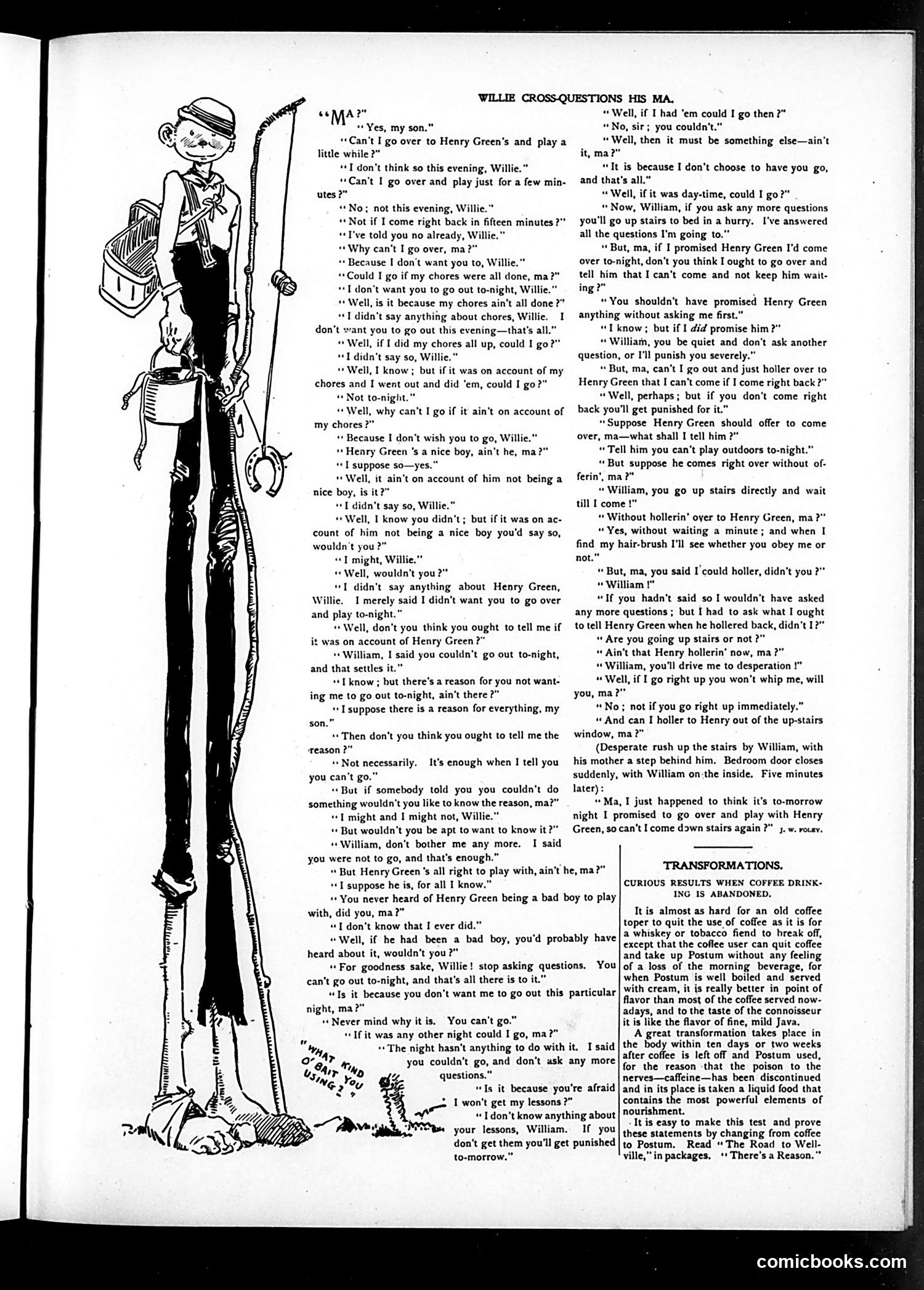
This page contains a humorous domestic dialogue rather than a political cartoon. It depicts a child (Willie) persistently questioning his mother about why he cannot visit his friend Henry Green one evening. The satire targets **parental authority and childhood logic**: Willie uses increasingly sophisticated reasoning to challenge his mother's "no," asking if he could go if chores were done, if it were daytime, if he came right back, or if Henry came to him instead. His mother repeatedly refuses to provide a rational justification, insisting on obedience without explanation. The joke lies in the **universal frustration** of children facing arbitrary parental rules and the parent's exasperation with endless questioning. This reflects period anxieties about childhood discipline and parental authority. The accompanying article about coffee discusses removing caffeine from coffee—a contemporary health concern of the era (likely early 1900s). The cartoon is satirizing not politics but family dynamics and the clash between childish persistence and adult authority.
📄 Transcribed text from this page (OCR, searchable)
Machine-transcribed from the original scan — historical spelling and the odd misread are preserved.
WILLIE CROSS-QUESTIONS HIS MA, eeMfA?” “Yes, my son.” “Can‘t I go over to Henry Green's and play a little while 2” «IT don't think so this evening, Willie.” “Can't I go over and play just for a few min- utes 2” No; not this evening, Willie.” Not if I come right back in fifteen minutes?” ve told you no already, Willie.” “Why can't I go over, ma ** Because I don’t want you to, Willie.” “Could I go if my chores were all done, ma?” “T don’t want you to go out to-night, Willie.” «* Well, is it because my chores ain't all done ?” I didn’t say anything about chores, Willie. I nt you to go out this evening—that's all.” «Well, if I did my chores all up, could I go?” «I didn’t say so, Willie.” «Well, I know ; but if it was on account of my chores and I went out and did ‘em, could I go?” ++ Not to-night.” “Well, why can’t I go if it ain't on account of my chores?" «Because I don't wish you to go, Willie.” «Henry Green ‘sa nice boy, ain't he, ma?” ++I suppose so—yes.”" «Well, it ain't on account of him not being a don't «Well, if I had ‘em could I go then 2?” “No, sir; you couldn't.” “Well, then it must be something else—ain’t it, ma?” “It is because I don’t choose to have you go, and that’s al “Well, if it was day-time, could I go?" « Now, William, if you ask any more questions you'll go up stairs to bed in a hurry. I've answered all the questions I'm going to.” “But, ma, if I promised Henry Green I'd come over to-night, don’t you think I ought to go over and tell him that I can't come and not keep him wait- ing?” . “You shouldn't have promised Henry Green anything without asking me first.” “Tknow; but if I did promise him?" “ William, you be quiet and don’t ask another question, or I'll punish you severely.” «But, ma, can’t I go out and just holler over to Henry Green that I can't come if I come right back?" “Well, perhaps ; but if you don’t come right back you'll get punished for it.” “Suppose Henry Green should offer to come over, ma—what shall I tell him 2?” “Tell him you can't play outdoors to-night.” “But suppose he comes right over without of- ferin’, ma?” “William, you go up stairs directly and wait nice boy, is it?” “«T didn’t say so, Willi «Well, I know you didn’t ; but if it was on ac- count of him not being a nice boy you'd say so, till I come !” “ Without hollerin’ oyer to Henry Green, ma?” “Yes, without waiting a minute; and when I ny Wy wouldn't you 2” «I might, Willie.” “Well, wouldn't you 2?” “I didn't say anything about Henry Green, Willie. I merely said I didn’t want you to go over and play to-night.” + Well, don't you think you ought to tell me if it was on account of Henry Green?” “William, I said you couldn't go out to-night, and that settles it.” ««T know ; but there's a reason for you not want- ing me to go out to-night, ain't there ?” « Tsuppose there is a reason for everything, my son.” «Then don’t you think you ought to tell me the ‘reason ?” + Not necessarily. you can’t go.” «But if somebody told you you couldn't do something wouldn't you like to know the reason, ma?” «I might and I might not, Willie.” ++ But wouldn’t you be apt to want to know it?” “William, don’t bother me any more. I said you were not to go, and that’s enough.” It's enough when I tell you “ But Henry Green's all right to play with, ain't he, ma?” ++ suppose he is, for all I know.” “You never heard of Henry Green being a bad boy to play with, did you, ma?” I don’t know that I ever did.” “Well, if he had been a bad boy, you'd probably have heard about it, wouldn't you ?” «For goodness sake, Willie! stop asking questions. You can't go out to-night, and that’s all there is to it.” “Is it because you don’t want me to go out this particular night, ma 2” «Never mind why it is. You can't go.” i “If it was any other night could I go, ma?” ‘ny, 74 OG, ty usr Ho ty questions.” ‘ng "uy care CQ to-morrow.” “<The night hasn't anything to do with it. I said you couldn't go, and don't ask any more «Is it because you're afraid = I won't get my lessons ?” « T don’t know anything about lessons, William. don't get them you'll get punished find my hair-brush I'll see whether you obey me or not.” «But, ma, you said I'could holler, didn’t you 2” “ William !" “If you hadn't said so I wouldn't have asked any more questions ; but I had to ask what I ought to tell Henry Green when he hollered back, didn't 1?” “ Are you going up stairs or not 2” “ Ain't that Henry hollerin’ now, ma?” William, you'll drive me to desperation !" « Well, if I go right up you won't whip me, will you, ma?” “No; not if you go right up immediately.” “ And can I holler to Henry out of the up-stairs window, ma ?” (Desperate rush up the stairs by William, with his mother a step behind him. Bedroom door closes suddenly, with William on:the inside. Five minutes later): «Ma, I just happened to think it’s to-morrow night I promised to go over and play with Henry Green, so can’t I come dawn stairs again 2”, w. roury. ‘TRANSFORMATIONS. CURIOUS RESULTS WHEN COFFEE DRINK- ING IS ABANDONED. It is almost as hard for an old coffee toper to quit the use of coffee as it is for a whiskey or tobacco fiend to break off, except that the coffee user can quit coffee and take up Postum without any feeling of a loss of the morning beverage, for when Postum is well boiled and served with cream, it is really better in point of flavor than most of the coffee served now- adays, and to the taste of the connoisseur it is like the flavor of fine, mild Java. A great transformation takes place in the body within ten days or two weeks after coffee is left off and Postum used, for the reason that the poison to the nerves—caffeine—has been discontinued and in its place is taken a liquid food that contains the most powerful elements of nourishment. It is easy to make this test and prove these statements by changing from coffee um. Read “The Road to Well- packages, ‘ There's a Reason.” If you comicbooks.com