
A complete issue · 16 pages · 1906
Judge — September 29, 1906
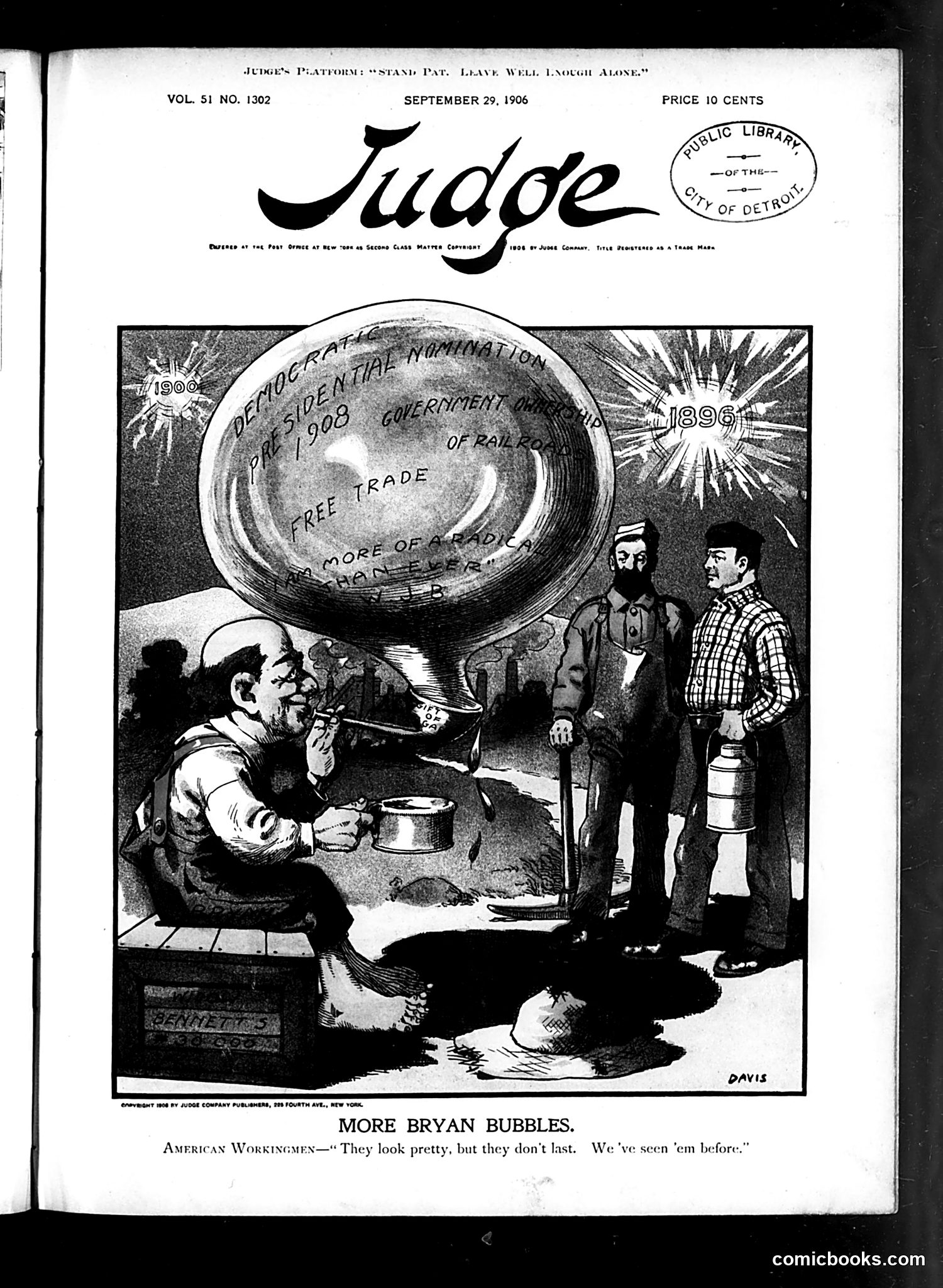
This political cartoon satirizes William Jennings Bryan, the three-time presidential candidate and prominent Democrat. The large soap bubble he's blowing contains text referencing his policy positions: "Democratic Nomination for 1908," "Government Ownership of Railroads," and "Free Trade." The caption quotes American workingmen dismissing Bryan's promises as ephemeral: "They look pretty, but they don't last. We've seen 'em before." The satire suggests Bryan's political proposals are insubstantial and repetitive—empty rhetoric that repeatedly fails to materialize. The bubble imagery emphasizes their fragility and illusory nature. This reflects conservative skepticism toward Bryan's populist agenda and his repeated failed campaigns.
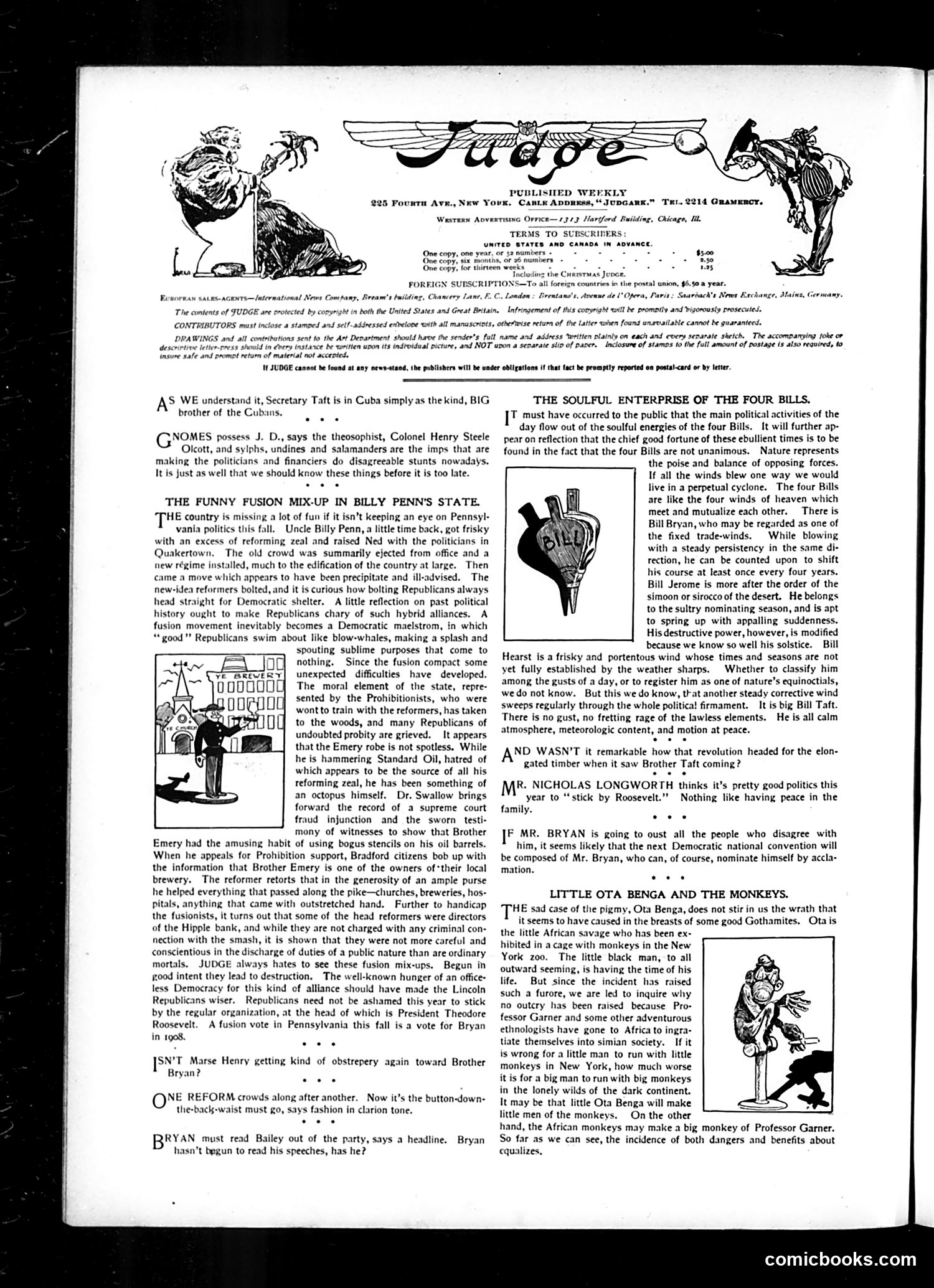
This page contains several political commentaries from the early 1900s. The main articles mock: 1. **Secretary Taft in Cuba** - References William Howard Taft's role as Secretary of War overseeing Cuba, describing reform efforts and political maneuvering. 2. **"The Funny Fusion Mess in Billy Penn's State"** - Criticizes Pennsylvania Republican fusion politics and reformers, with an accompanying cartoon showing what appears to be a political figure operating like a machine. 3. **"The Soulful Enterprise of the Four Bills"** - A metaphorical piece about four political figures (Bills/Bills) representing opposing forces that cyclically dominate politics. 4. **Various political jabs** at Nicholas Longworth, William Jennings Bryan, and references to Roosevelt-era politics. The cartoons use caricature and visual metaphor to satirize contemporary political infighting, reform movements, and factional disputes within the Republican and Democratic parties during the early-20th-century Progressive era.
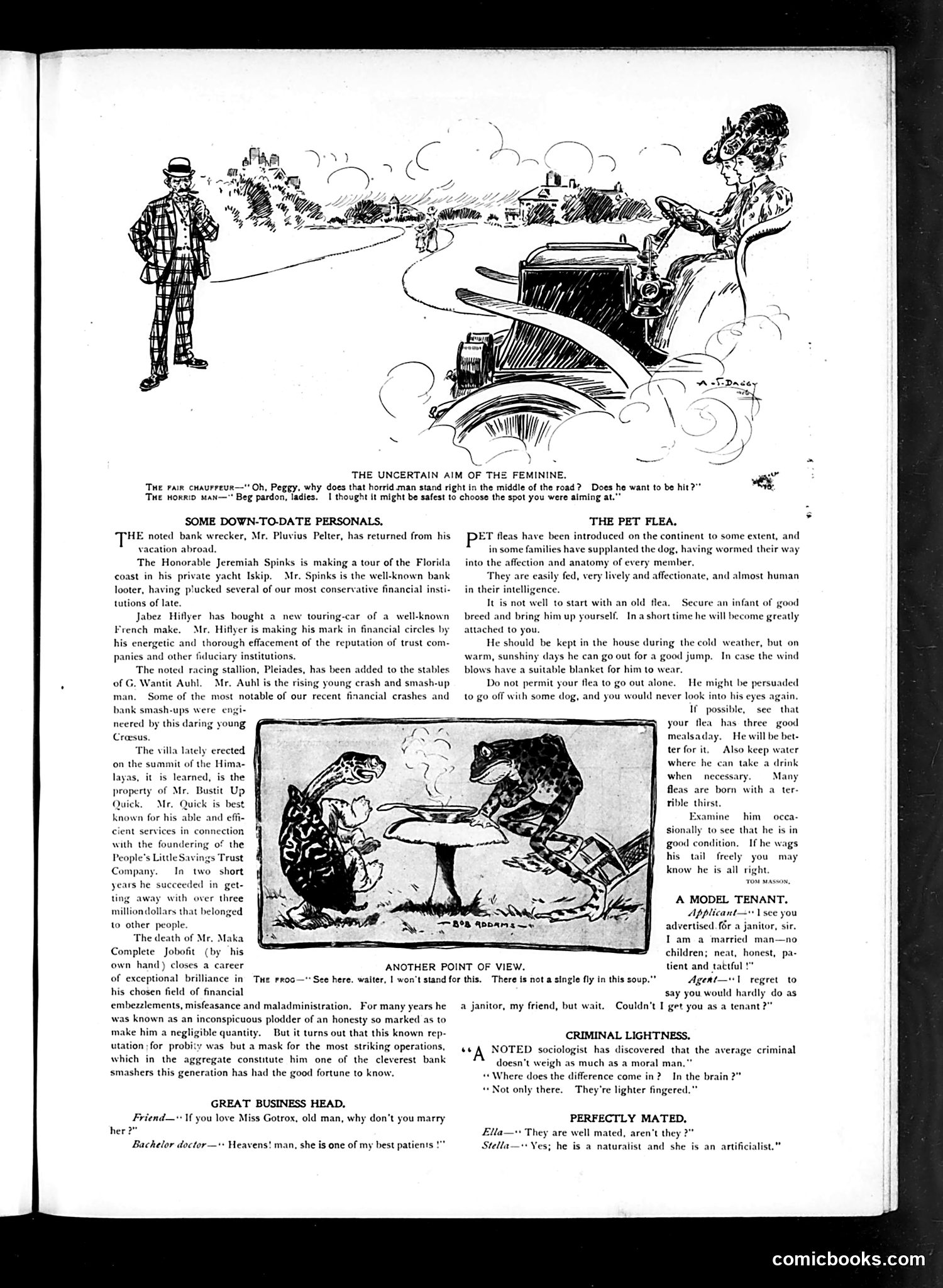
**Top Cartoon ("The Uncertain Feminine"):** A man in a checkered suit confronts a woman in a car, asking why she's positioned her vehicle in the road's center. The joke plays on early automotive etiquette confusion—the woman apparently doesn't know proper driving conventions. This satirizes the novelty of women drivers in the early automobile era, when such things were still noteworthy enough for mockery. **"The Pet Flea":** An instructional piece (not satirical) advising readers on flea care, treating it as a fashionable European pet trend. This reflects genuine early-1900s faddish pet ownership among wealthy classes. **Lower Content:** The page contains miscellaneous humor columns and brief jokes about business, janitors, and criminal psychology—typical Judge magazine filler material satirizing various social types.
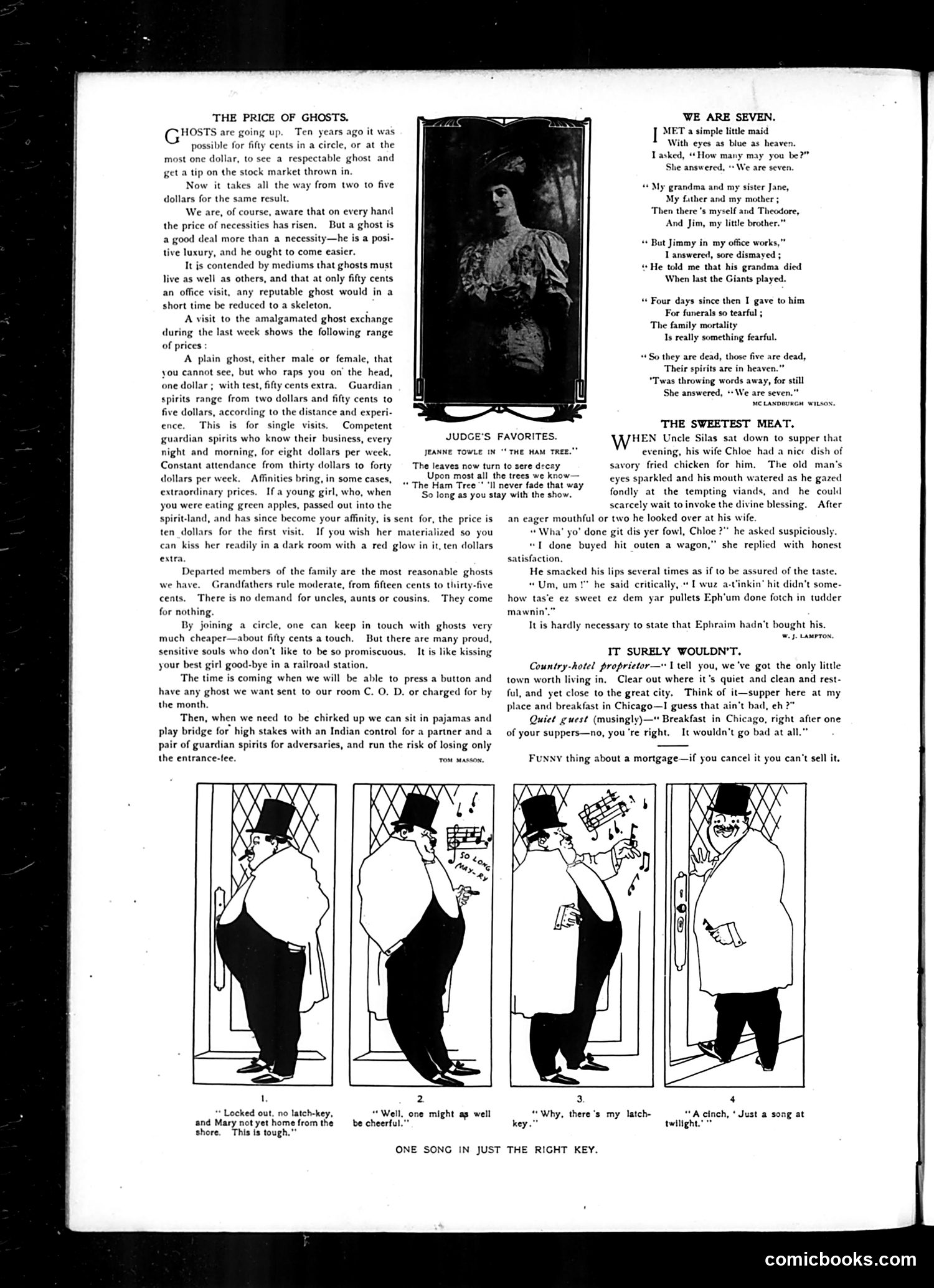
This page contains several unrelated humor pieces typical of Judge magazine's format: **"The Price of Ghosts"** discusses spiritualism as a commodity—mediums charging fees to contact the deceased. The satire critiques how spiritualism had become commercialized, with "ghost prices" ranging from $2.50 to $5, treating contact with spirits like a financial transaction. **"We Are Seven"** and **"The Sweetest Meat"** are narrative humor pieces with no clear political content—domestic humor stories. **"One Song in Just the Right Key"** is a four-panel comic about a locked-out man without his latchkey, showing his increasing desperation to get inside his home. The humor derives from his escalating attempts. The page reflects early-20th-century middle-class concerns: spiritualism fraud, domestic mishaps, and urban living situations.
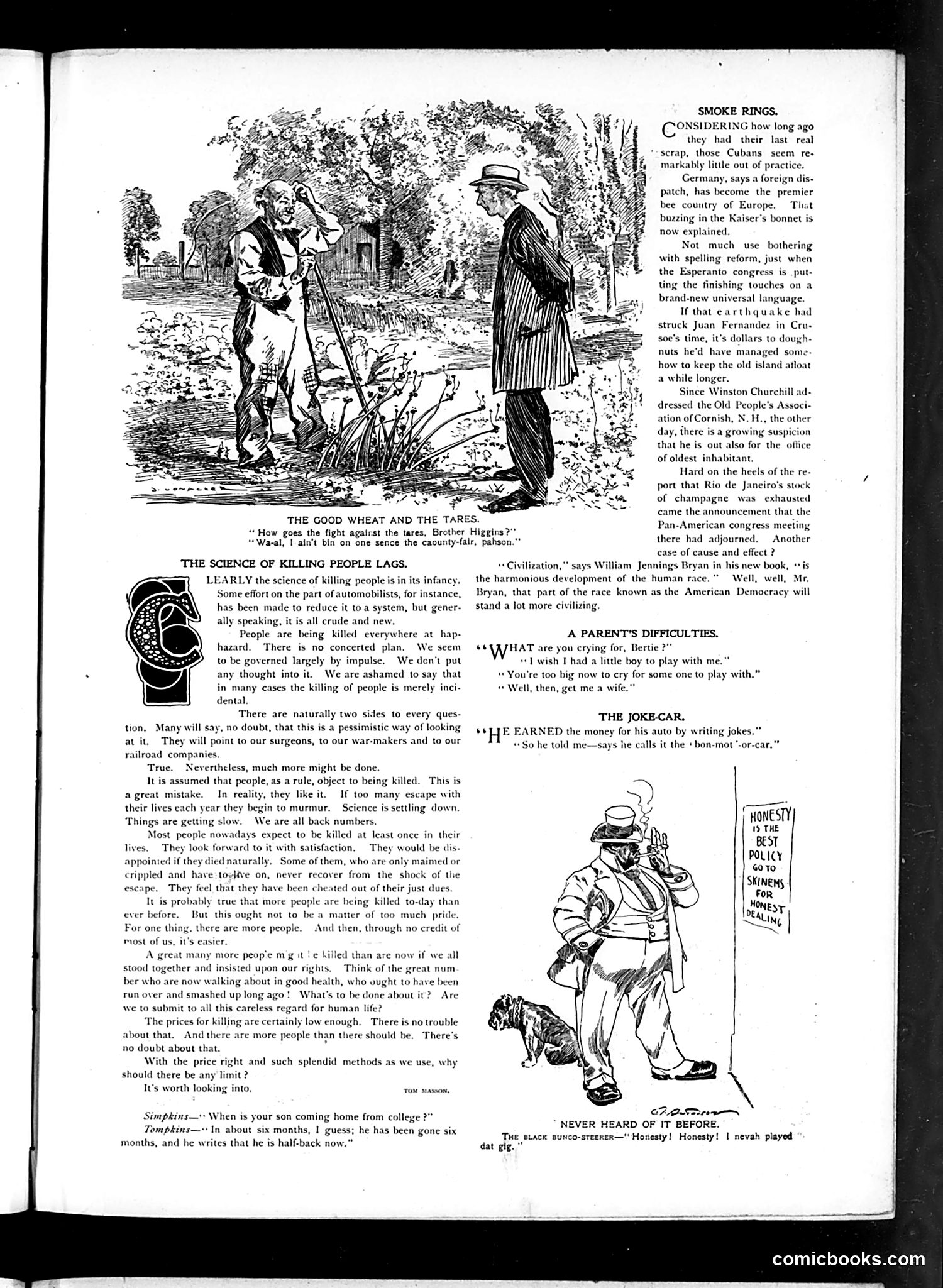
**Top Cartoon ("The Good Wheat and the Tares")**: Shows two men examining a plant. The caption references "Brother Higgins" and discusses fighting "tares"—likely a metaphorical commentary on social problems or undesirable elements in society, possibly labor unrest or political corruption. The imagery suggests agricultural/rural concerns. **"The Science of Killing People Lags"**: This article critiques automobile safety, arguing that society has made no organized effort to prevent traffic deaths. It's presented as dark satire—noting that "most people nowadays expect to be killed at least once in their lives" and sarcastically suggesting this reflects American progress. **"The Joke Car"**: A cartoon about a man earning money writing jokes, depicting him as disheveled—commentary on the precarious economics of humor writing.
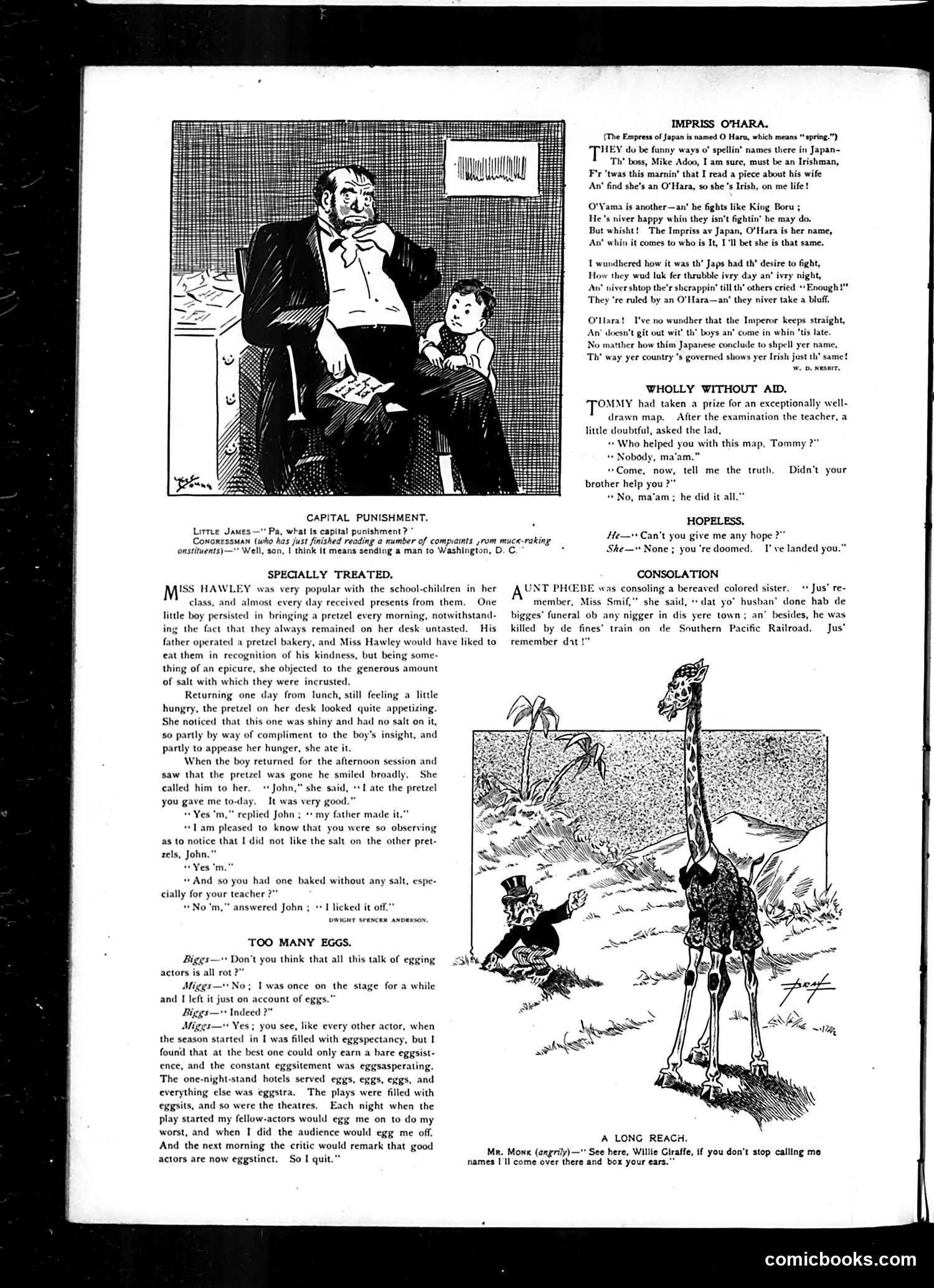
**"Impress O'Hara"** (top): This satirizes Japan's militarism by playing on Irish naming conventions. The Empress of Japan is named "O Haru"; the cartoonist jokes that Japan must be Irish-run since "O'Hara" sounds Irish, and Irish people are stereotyped as combative ("ruled by an O'Hara"). It's ethnic humor mocking both the Japanese and Irish simultaneously, suggesting Japan's constant warfare reflects Irish-American fighting culture. **Remaining content**: The page contains light humor pieces: a teacher interrogating a student about homework help ("Wholly Without Aid"), a joke about "capital punishment" meaning sending someone to Washington D.C., and puns about actors and eggs. The "Consolation" panel uses a racist dialect caricature of a Black woman discussing a funeral on the Southern Pacific Railroad—period offensive humor typical of Judge's era. These represent the magazine's mix of political satire, ethnic stereotyping, and wordplay common in early 20th-century American humor publications.
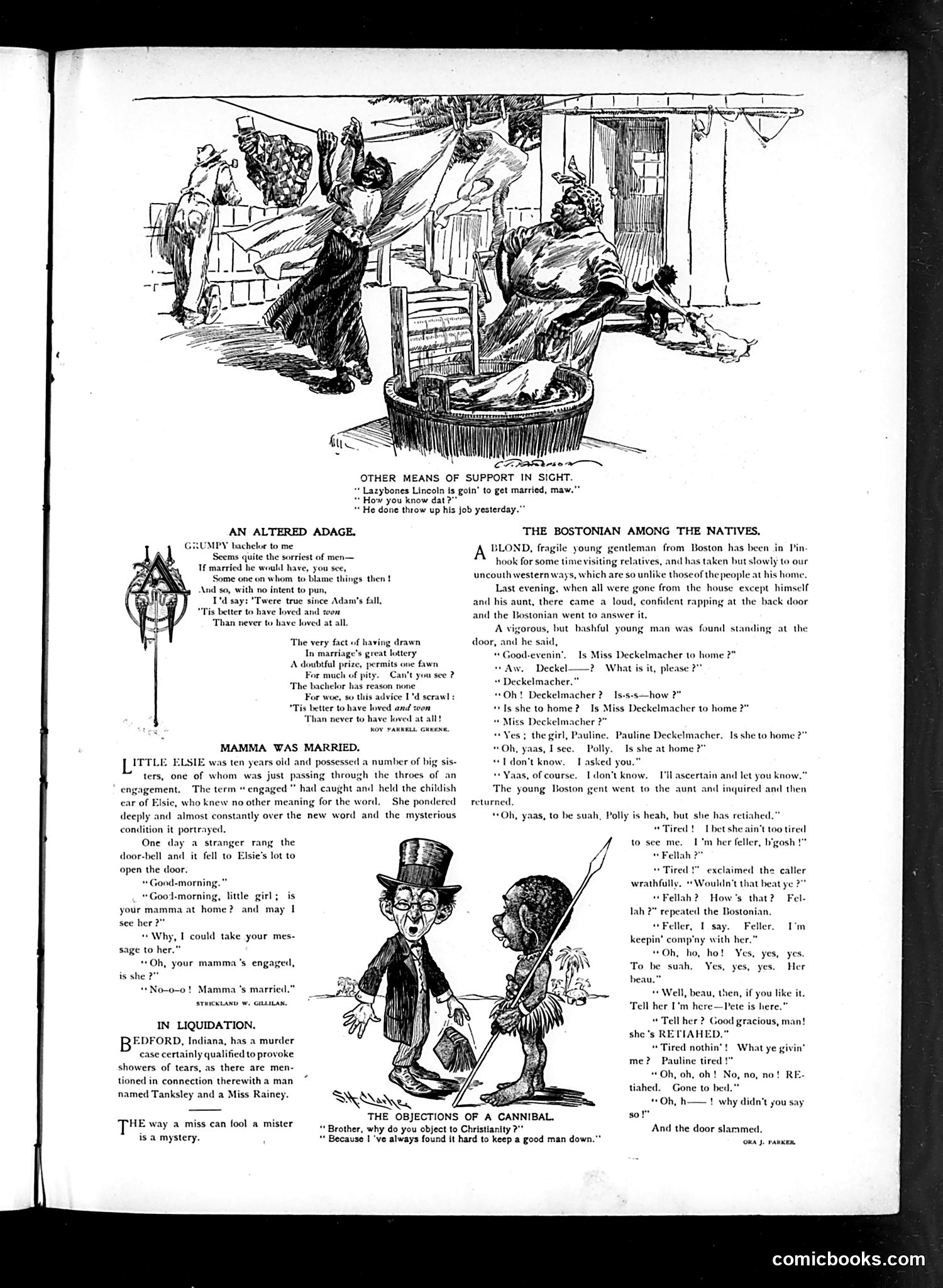
This Judge magazine page contains three satirical pieces: **"Other Means of Support in Sight"**: A brief racist joke playing on the stereotype of lazy Black laborers. "Lazybones Lincoln" (referencing Abraham Lincoln) quits his job upon getting married, implying he'll rely on his wife's support—a dig at both idleness and dependence. **"An Altered Adage"**: Wordplay inverting the proverb "better to have loved and lost." The bachelor argues marriage lets him blame his wife for life's problems, so he revises it as "better to have loved and won." **"The Bostonian Among the Natives"**: Regional humor mocking both a pretentious Bostonian and rural Midwesterners. A Western suitor calls on a girl named Pauline Deckelmacher; the Boston relative's affected speech ("yaas," "suah") contrasts with the caller's colloquial dialect. The humor comes from their mutual incomprehension—he says "retiahed" (retired), the caller hears "tired." **"The Objections of a Cannibal"**: A brief ethnic joke about Christian hypocrisy regarding civilization and morality. The page reflects Gilded Age attitudes toward class, region, and race.
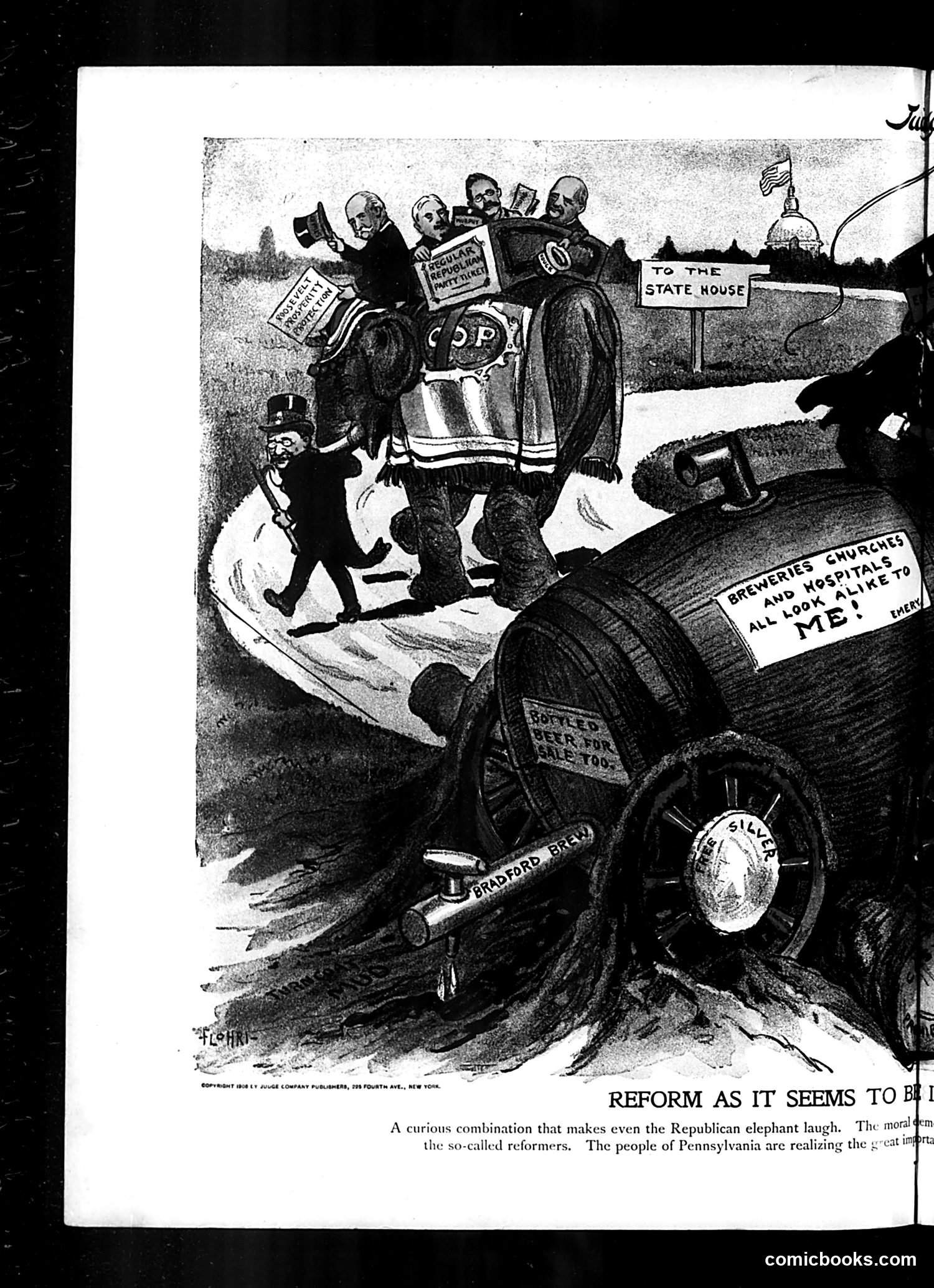
This Judge magazine cartoon satirizes Pennsylvania reformers through a grotesque caricature. An elephant (representing the Republican Party) is depicted as a beast of burden, loaded with barrels labeled with various reform initiatives and carrying figures holding protest signs "TO THE STATE HOUSE." The cartoon critiques what it calls "the so-called reformers," suggesting their reform agenda is chaotic, burdensome, and ridiculous—even making "the Republican elephant laugh." The caption explicitly states Pennsylvanians are "realizing the great importance" of these reforms, though the visual treatment is mocking. This appears to be attacking progressive reformers' proposals as impractical or absurd, using exaggerated imagery to delegitimize their political movement.
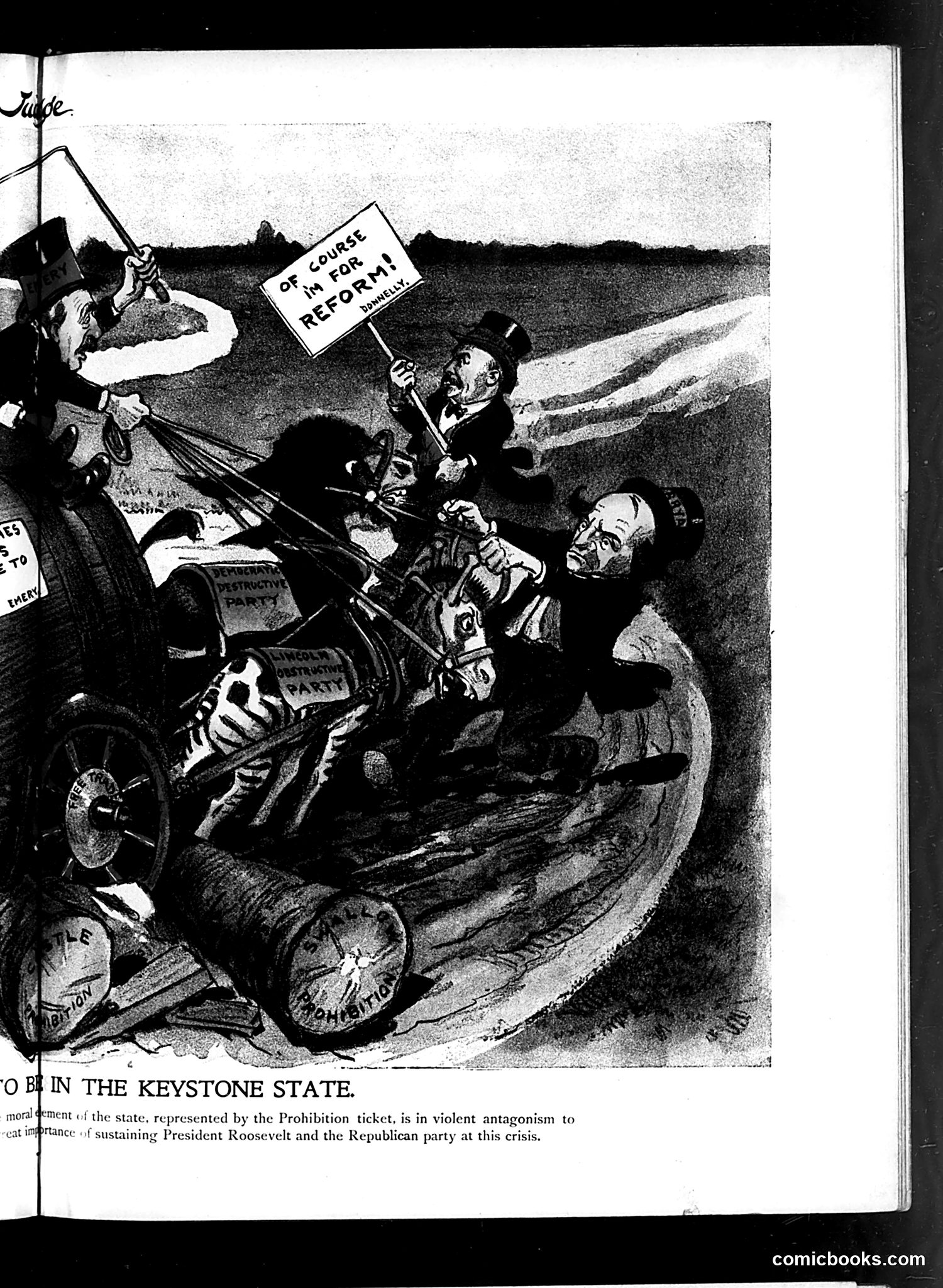
This Judge magazine cartoon satirizes Pennsylvania politics during what appears to be the Progressive Era. A judge figure presides over a chaotic scene where figures representing the Prohibition party and other political factions are literally sinking in a boat labeled with various political positions. The caption indicates the Prohibition ticket's moral stance creates "violent antagonism" to President Roosevelt and the Republican party during a political crisis. The "Keystone State" (Pennsylvania) serves as the setting for this commentary on internal party conflict. The cartoon mocks the Prohibition movement as impractical political ideology that threatens established political coalitions, using the sinking boat metaphor to suggest such positions are untenable during emergencies requiring unity.
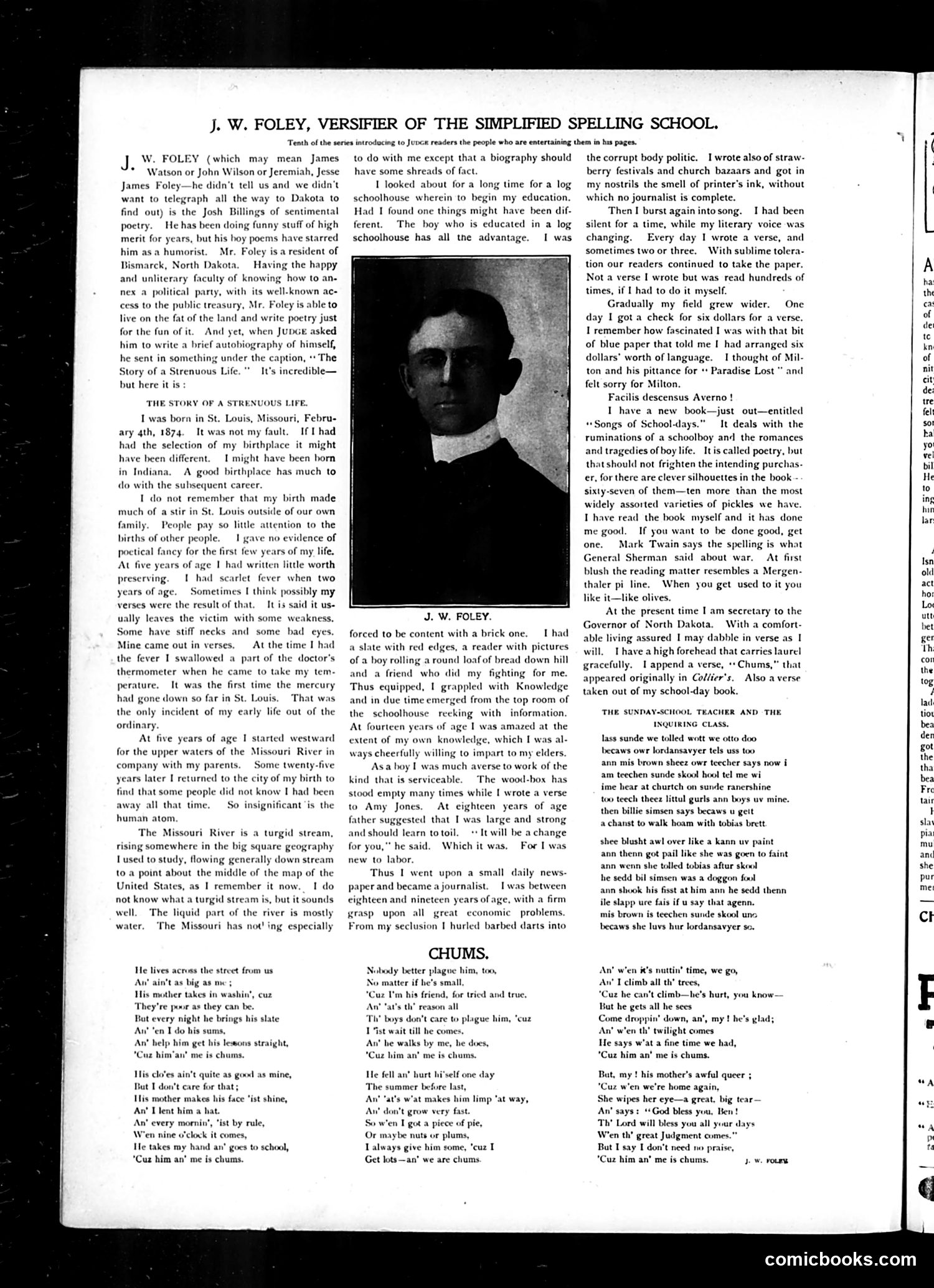
This is a biographical profile of J. W. Foley, a poet and humorist who apparently contributed to Judge magazine. The page satirizes Foley himself and, implicitly, the magazine's own publishing practices. **The Satire:** The introduction mocks Foley's vague identity—the editor doesn't even know his real name ("which may mean James Watson or John Wilson or Jeremiah..."). This opening joke suggests Foley is either genuinely obscure or intentionally mysterious. **Key Points:** - Foley is described as a "Josh Billings of sentimental poetry" (comparing him to a 19th-century humorist) - He lives in North Dakota and uses "political party" connections to access "public treasury" funds—a jab at political patronage - His autobiography, titled "The Story of a Strenuous Life," is self-inflating given his mundane account - The page includes his sentimental poems about poor children and working-class life **The Joke:** Judge is playfully roasting Foley for his mediocrity, political connections, and pretentious self-presentation—typical satirical fare for a magazine that trafficked in lampooning public figures and social types.
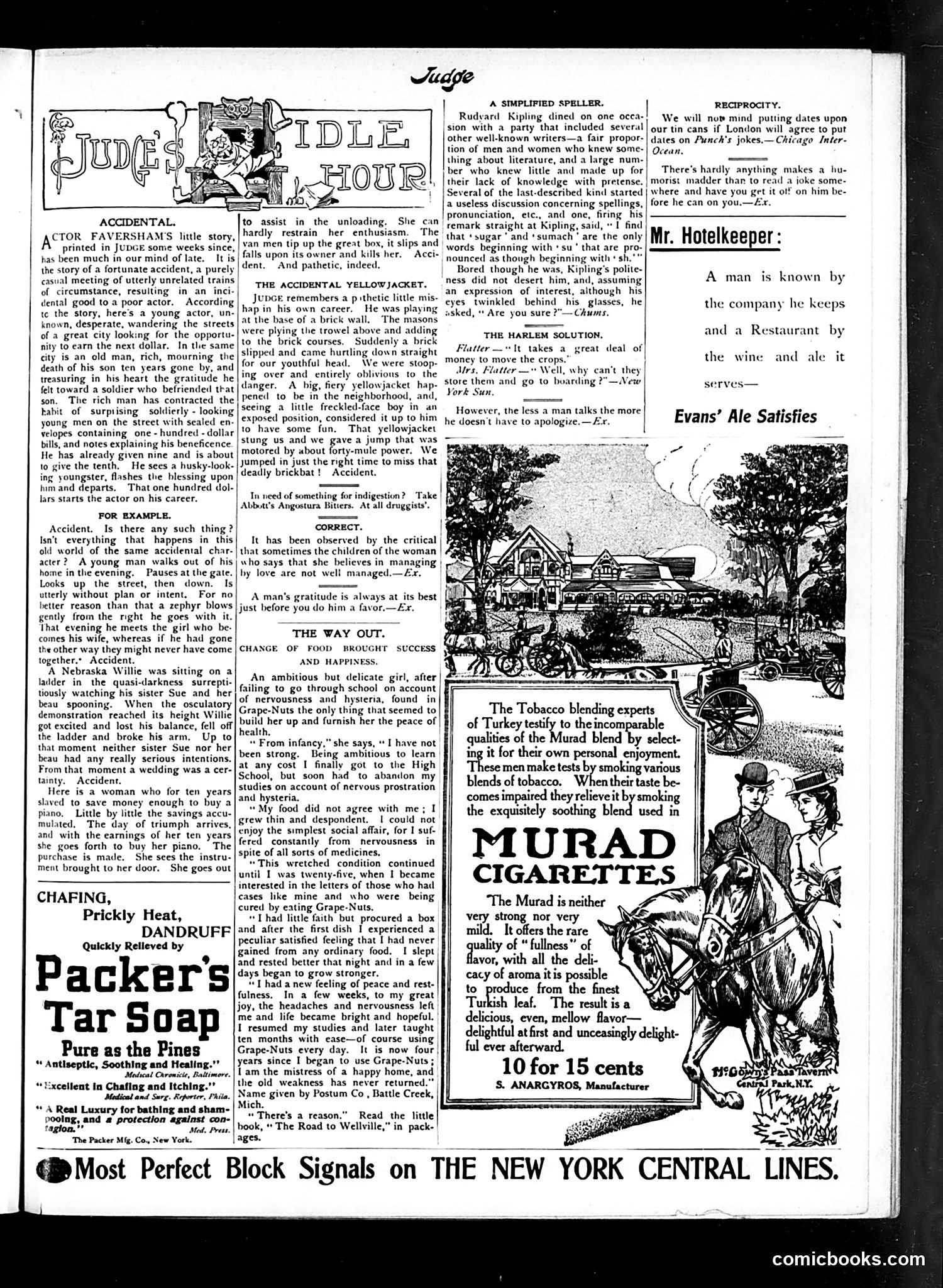
This page from the satirical magazine Judge contains primarily **philosophical essays and advertisements** rather than political cartoons requiring historical context. The main content is "The Accidental Hour," a meditative piece arguing that seemingly random events—a poor actor receiving unexpected charity, a young man meeting his future wife by chance, a woman's piano purchase ending in her death—are actually the fundamental nature of existence. Every event appears accidental but interconnects to shape lives. A secondary anecdote describes how a yellowjacket's sting caused the narrator to jump, inadvertently dodging a falling brick—chance saving his life. The satire is **philosophical rather than political**: Judge uses everyday scenarios to humorously argue that life consists entirely of interconnected accidents and coincidences, challenging readers' assumptions about fate and causality. The remaining space contains **period advertisements** for Packer's Tar Soap, Murad cigarettes, and other products typical of early 20th-century publications.
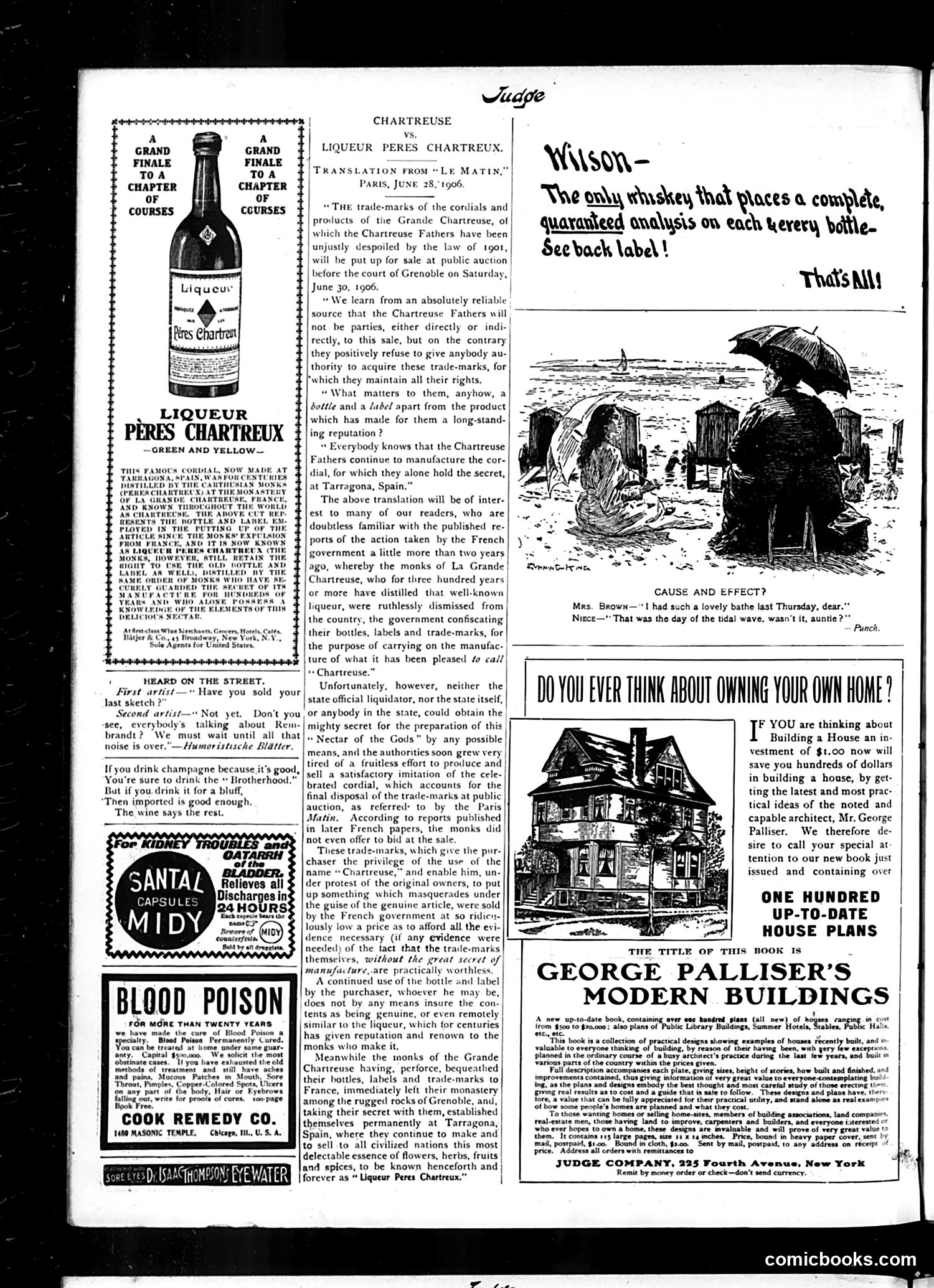
This page primarily contains **advertising and a news commentary**, not traditional political satire. The main article discusses a **real 1906 French legal dispute**: the French government expelled Carthusian monks from La Grande Chartreuse monastery and confiscated their famous liqueur brand and trademarks. The government attempted to manufacture "Chartreuse" themselves but failed to replicate the secret recipe. They eventually auctioned the trademarks. The commentary's point: **the government's action was futile and embarrassing**. Despite owning the brand name, they couldn't produce the product without the monks' secret formula. The monks, still making the genuine liqueur in Spain (Tarragona), refused even to bid at the auction—a deliberate insult demonstrating their indifference to losing mere labels. The satire targets **French anticlerical policy**: expelling religious orders and seizing their property proved pointless when the actual value lay in knowledge the monks retained. The monks' dignified non-participation mocks government overreach. The page also contains period advertisements for patent medicines and real estate, typical of Judge magazine's revenue model.
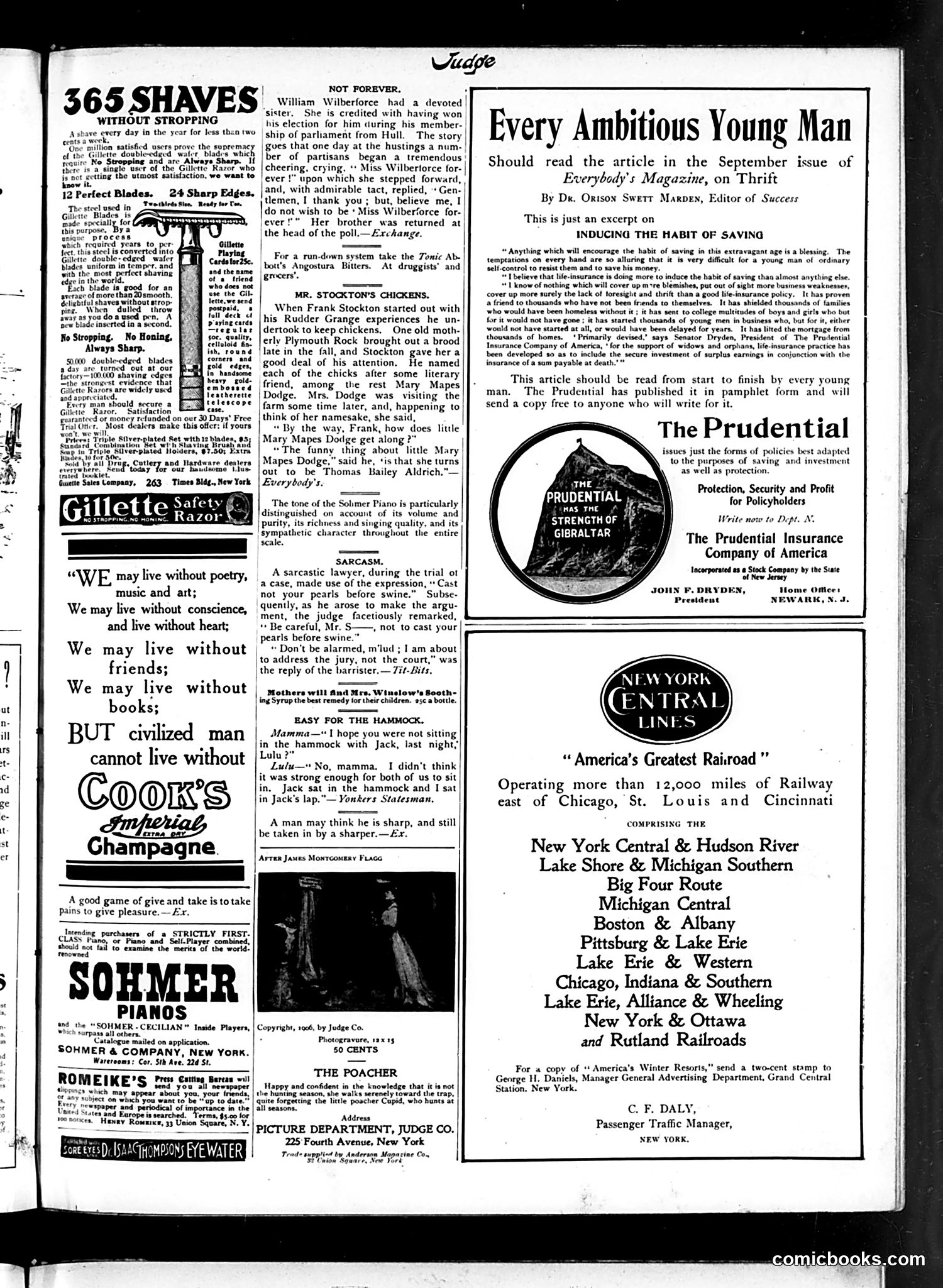
This page is primarily **advertising with satirical vignettes**, typical of Judge magazine's format. The main advertisements include Gillette Safety Razors (emphasizing convenience—365 shaves without stropping), Cook's Champagne (with a humorous poem suggesting civilized life requires it), and Sohmer Pianos. The satirical content consists of brief anecdotes: - **"Not Forever"**: A story about William Wilberforce's sister, whose campaign support led crowds to cheer "Miss Wilberforce forever!"—she humorously deflects the endless praise. - **"Mr. Stockton's Chickens"**: Frank Stockton names his chickens after literary figures; one he names "Mary Mapes Dodge" turns out to be male, leading to the punchline that it's actually "Thomas Bailey Aldrich." - **"Sarcasm"**: A lawyer uses the biblical phrase "cast not your pearls before swine" about addressing jurors, prompting the judge's witty rejoinder. - **"Easy for the Hammock"**: A girl avoids sitting with her boyfriend in a hammock, joking it couldn't support both their weight. These are light social humor pieces targeting courtship propriety and literary culture.
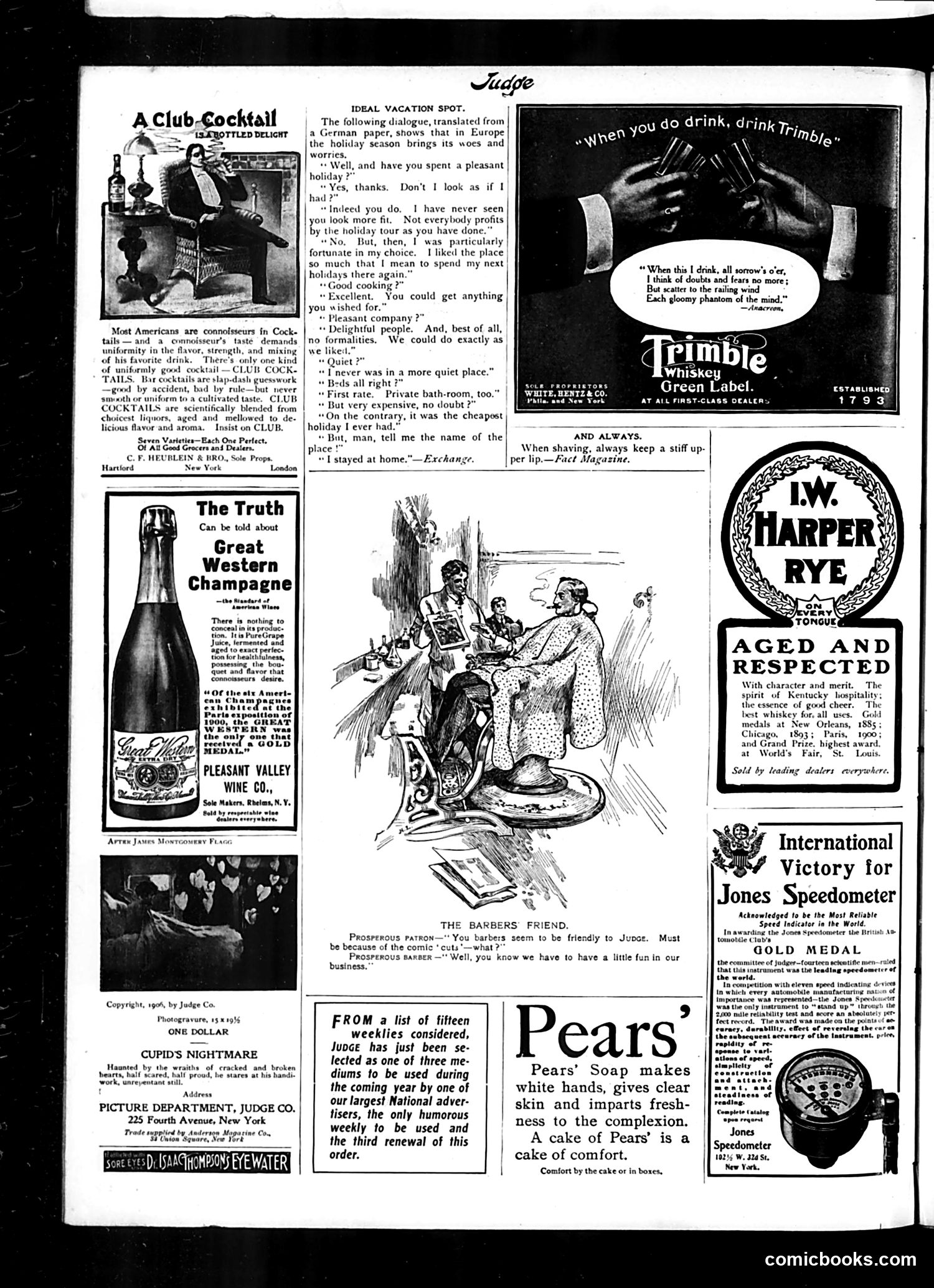
This is primarily an **advertising page** from Judge magazine (circa 1904), with one small cartoon. The main cartoon, "The Barbers' Friend," depicts a prosperous patron asking a barber why barbers seem friendly to judges. The barber responds: "Well, you know we have to have a little fun in our business." This is a mild joke about barbers gossiping and making casual judgments about their customers—a play on the word "Judge" and the barber's role as a social observer who hears everyone's secrets. The page is dominated by **liquor and consumer product advertisements**: Club Cocktails, Great Western Champagne, I.W. Harper Rye Whiskey, Pears' Soap, and others. There's also an advertisement noting that Judge was selected as one of only three humorous weeklies for a major national advertiser's campaign. A small section titled "Ideal Vacation Spot" contains a translated dialogue from a German newspaper about holiday travel, but it's more filler content than satire. The page reflects Judge's dual nature: satirical humor magazine and advertising vehicle for affluent consumers.
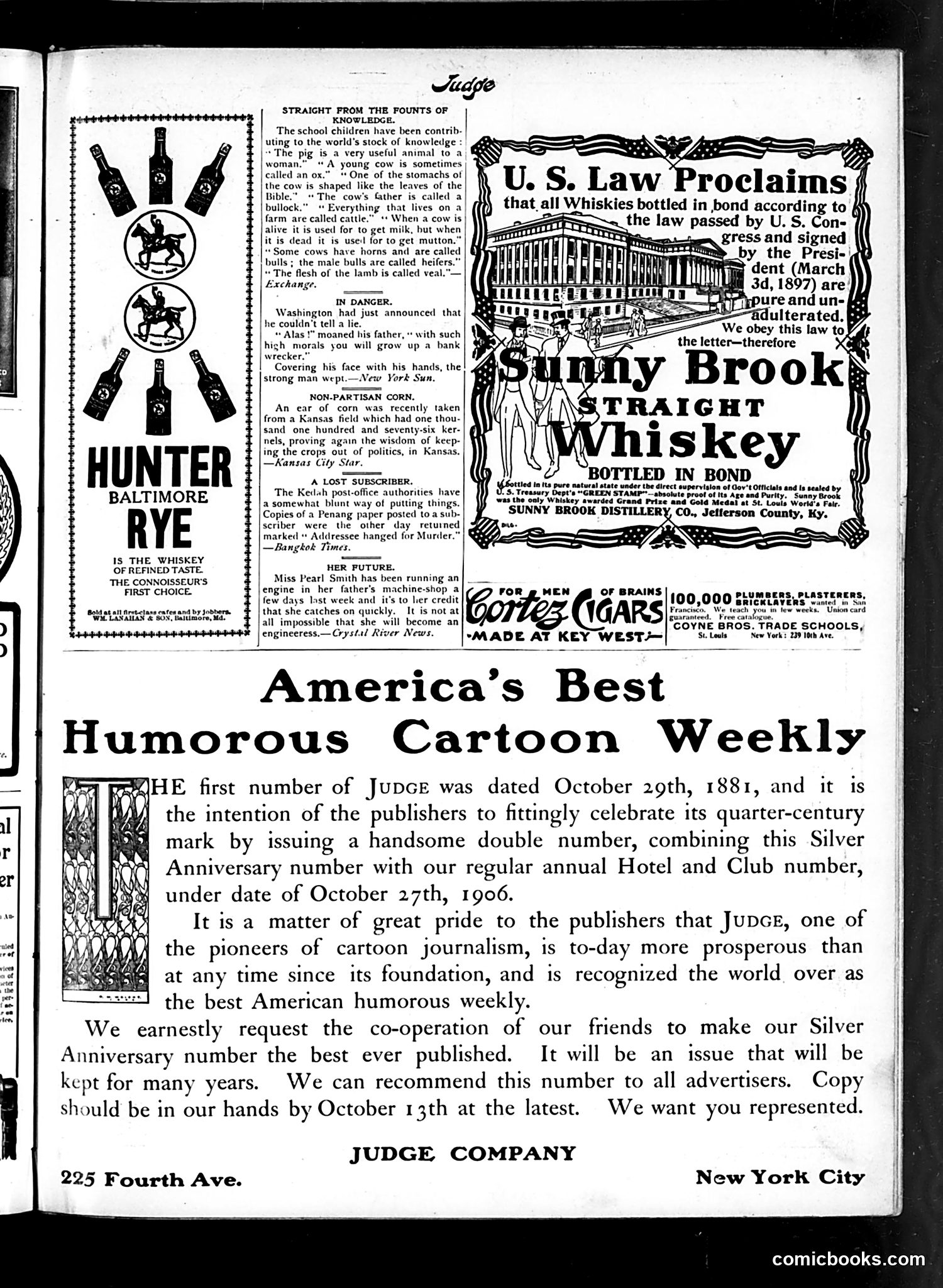
This page is primarily **advertising and promotional content** rather than political satire, though it includes several humor items. ## The Humor Sections: **"Straight from the Founts of Knowledge"** satirizes children's faulty logic and misunderstandings about farm animals—a common early-1900s trope mocking rural ignorance. Examples include confusing "ox" with "cow" and calling male bulls "heifers." **"Non-Partisan Corn"** is gentle political humor about keeping agricultural issues out of Kansas politics, referencing an unusually large corn ear as proof of wisdom. Other brief items joke about morality ("high morals you will grow up a bank wrecker"), postal bureaucracy, and a woman operating machinery—the last item ("Her Future") gently satirizes gender roles by suggesting a woman *might* become an engineer. ## Main Content: The bulk of the page comprises **advertisements** for Hunter Baltimore Rye whiskey and Sunny Brook Whiskey, plus notices about Judge's 25th-anniversary Silver Edition (October 1906) and trade schools. The page demonstrates Judge's identity as a humor weekly mixing satirical commentary with commercial interests.
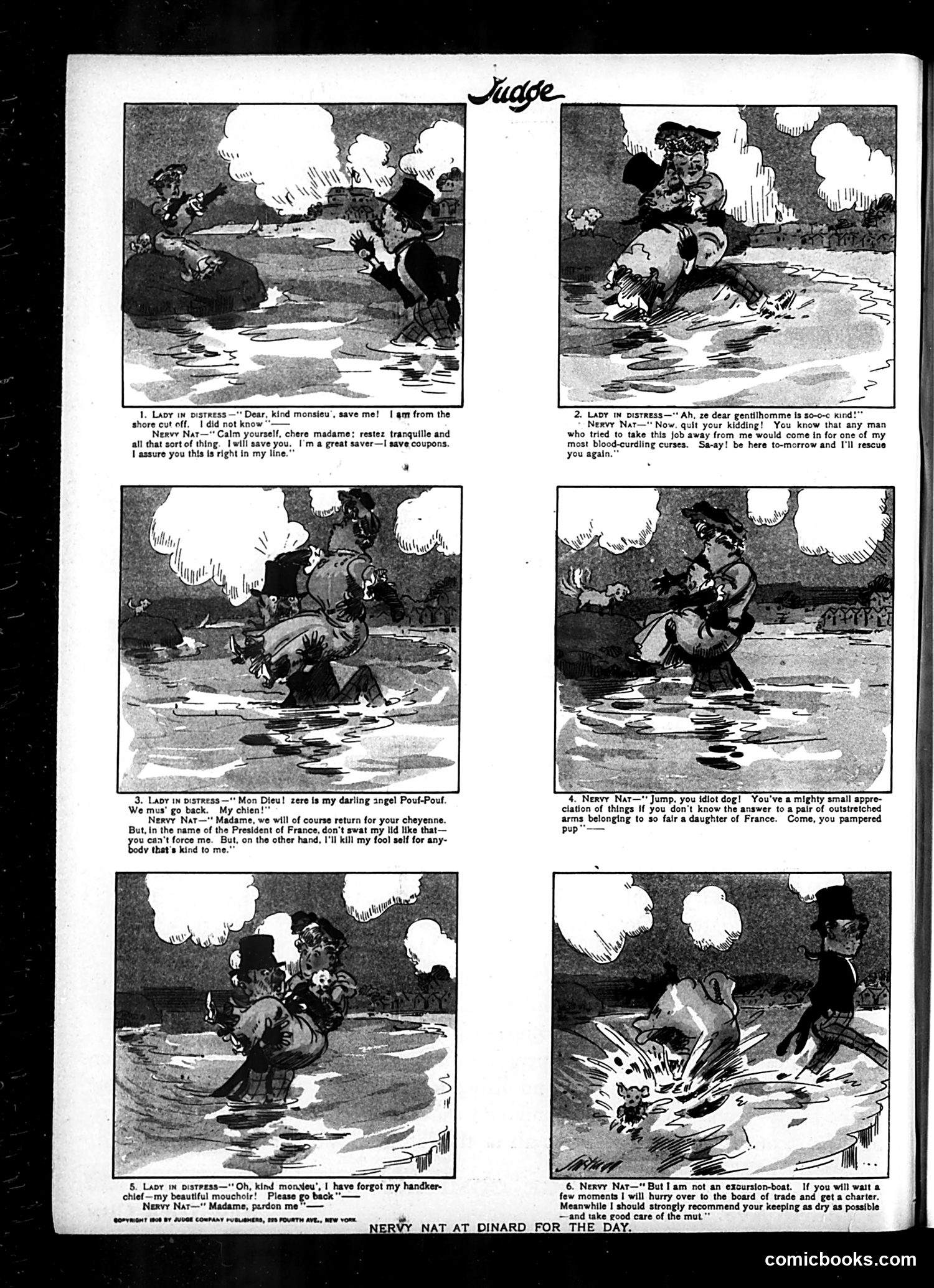
This comic strip satirizes an American con man ("Nervy Nat") who exploits a French noblewoman's distress at a beach resort. The lady, stranded and separated from her small dog, repeatedly calls on Nat to "rescue" her—each time he agrees while making opportunistic demands (her handkerchief, her dog's cooperation, etc.). The satire targets both American audacity abroad and European snobbery. Nat's repeated false heroics—combined with his self-serving conditions and boasts about his importance—mock the American tourist's presumption and hustlerism. The French woman's flowery distress and references to her social status ("daughter of France") parody aristocratic pretension. The joke's appeal lies in Nat getting away with shameless manipulation through sheer confidence and charm, suggesting American brashness could overcome European formality.