
Judge, 1906-09-29 · page 10 of 16
Judge — September 29, 1906 — page 10: what you’re looking at
What you’re looking at
This is a biographical profile of J. W. Foley, a poet and humorist who apparently contributed to Judge magazine. The page satirizes Foley himself and, implicitly, the magazine's own publishing practices. **The Satire:** The introduction mocks Foley's vague identity—the editor doesn't even know his real name ("which may mean James Watson or John Wilson or Jeremiah..."). This opening joke suggests Foley is either genuinely obscure or intentionally mysterious. **Key Points:** - Foley is described as a "Josh Billings of sentimental poetry" (comparing him to a 19th-century humorist) - He lives in North Dakota and uses "political party" connections to access "public treasury" funds—a jab at political patronage - His autobiography, titled "The Story of a Strenuous Life," is self-inflating given his mundane account - The page includes his sentimental poems about poor children and working-class life **The Joke:** Judge is playfully roasting Foley for his mediocrity, political connections, and pretentious self-presentation—typical satirical fare for a magazine that trafficked in lampooning public figures and social types.
📄 Transcribed text from this page (OCR, searchable)
Machine-transcribed from the original scan — historical spelling and the odd misread are preserved.
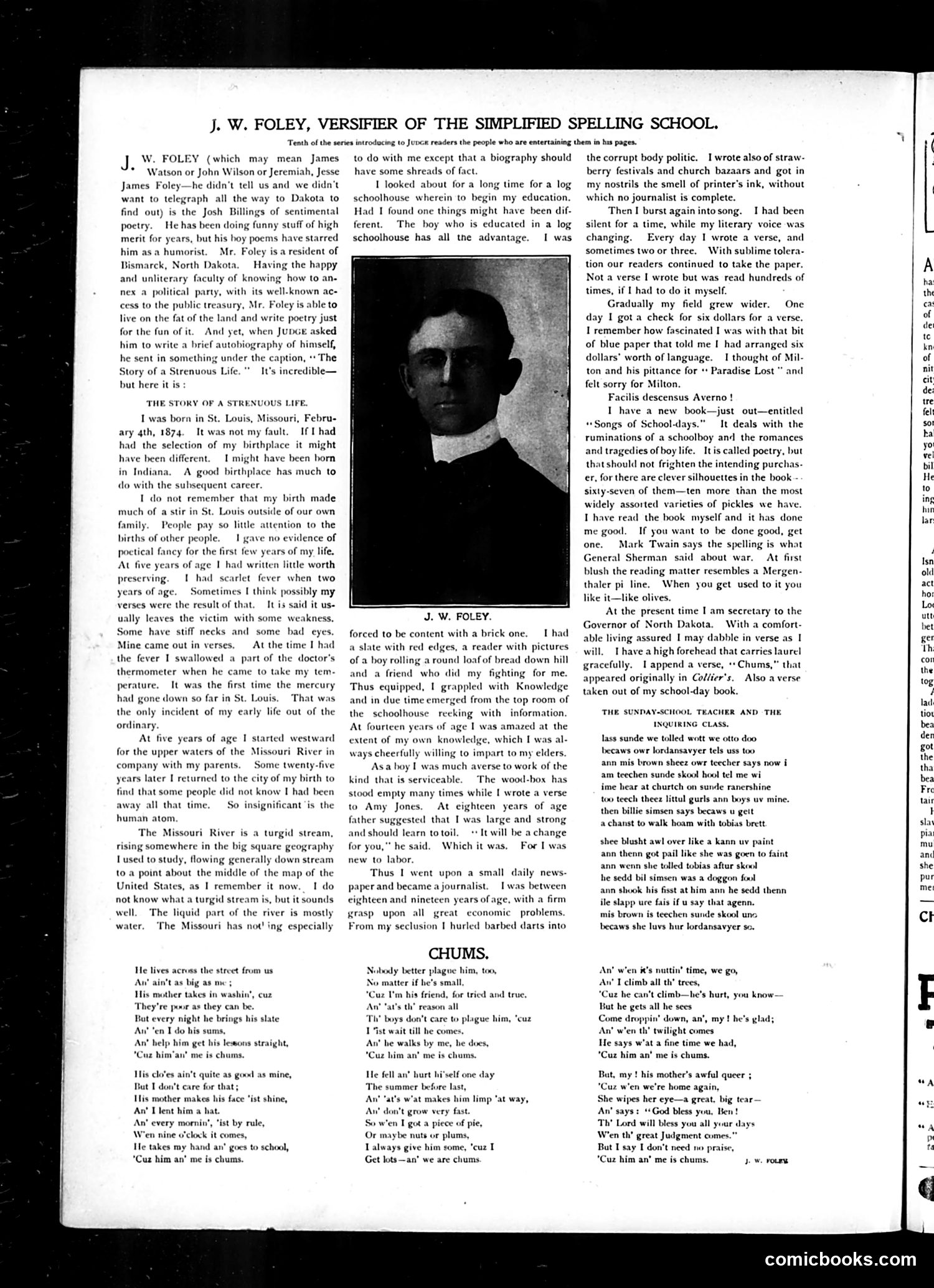
J, W. FOLEY (which may mean James * Watson or John Wilson or Jeremiah, Jesse James Foley—he didn’t tell us and we didn't want to telegraph all the way to Dakota to find out) is the Josh Billings of sentimental poetry. Hehas been doing funny stuff of high merit for years, but his hoy poems have starred resident of him asa humorist. Mr. Foley is Bismarck, North Dakota. Having the happy and unliterary faculty of knowing how to an- nex a political party, with its well-known ac- cess to the public treasury, Mr. Foley is able to live on the fat of the land and write poetry just for the fun of it. And yet, when JupGe asked him to write a brief autobiography of himself, he sent in something under the caption, «* The Story of a Strenuous Life." It’s incredible— but here it is : THE STORY OF A STRENUOUS LIFE. I was born in St. Louis, Missouri, Febru- ary 4th, 1874. It was not my fault, If Thad had the selection of my birthplace it might have been different. I might have been born thplace has much to in Indiana. A good do with the subsequent car I do not remember that my birth made much of a stir in St. Lo family. People pay so little attention to the births of other people. I gave no evidence of poetical fancy for the first few years of my life. At five years of age 1 had written little worth is outside of our own I scarlet fever when two preserving. Th years of age. Sometimes I think possibly my verses were the result of that, It is said it us- ually leaves the victim with some weakness, Some have stiff necks and some bad eyes. Mine came out in verses. At the time I had the fever I swallowed a part of the doctor's thermometer when he came to take my tem- perature, It was the first time the mercury had gone down so far in St. Louis, ‘That was the only incident of my early life out of the ordinary. At five y for the upper waters of the Missouri River in company with my parents. Some twenty-five ears of age I started westward years later I returned to the ity of my birth to find that some people did not know I had been away all that time, So insignificant ‘is the human atom The Missouri River is a turgid stre the big square geography Lused to study, flowing generally down stream toa point about the middle of the map of the United States, as I remember it now. 1 do not know what a turgid stream is, but it sounds well. ‘The liquid part of the river is mostly water. The Missouri has not! ing especially m. rising somewhere He lives acruss the street from us Av’ ain't as big as His mother takes in washin’, cuz ‘They're poor as they can be. But every night he brings his slate An’ ‘en T do his sums, Ant help him get his lewons stra 2 him’al s chums. His clo'es ain't qui But T don’t care for that; face ‘ist shine, as gool as mine, His mother makes h An’ [lent him a hat. An’ every mornin’, “ist by rule, Wren nine o'clock it comes, He takes my hand an* goes to school, *Cuz him an’ me is chums. J. W. FOLEY, VERSIFIER OF THE SIMPLIFIED SPELLING SCHOOL. Tenth of the series introducing to Junce readers the people who are entertaining them in his pages. to do with me except that a biography should have some shreads of fact. I looked about for a long time for a log schoolhouse wherein to begin my education. Had I found one things might have been dif- ferent. The boy who is educated in a log schoolhouse has all the advantage. I was J. W. FOLEY. forced to be content with a brick one. — I had er with pictures around loaf of bread down hill a slate with red edges, ar of a boy rolling anda friend who did my fighting for me. Thus equipped, 1 grappled with Knowledge and in due time emerged from the top room of the schoolhouse reeking with information. At fourteen years of age | was amazed at the extent of my own knowledge, which I was al- ways cheerfully willing to impart to my elders. Asa boy I was much averse to work of the The wood-box has kind that is serviceable stood empty many times while [ wrote a verse to Amy Jones. At cighteen years of age father suggested that I was large and strong and should learn to toil, It will be a change for you,” he said. Which it was, For I was new to labor. Thus I went upon a small daily news- paper and became a journalist. Twas between e, with a firm cighteen and nineteen years ofa grasp upon From my seclusion | hurled barbed darts into CHUMS,. Nobody better plague him, too, No matter if he’s small. "Cuz I'm his friend, for tried a An’ ‘at's th Th’ buys don't care to pl Il great economic problems. 4 true, reason ue him, "cuz I “ist wait till he come An’ he walks by me, he does, "Cuz him an’ me is chums. He fell an’ hurt hi’self on The summer before last, An’ ‘at's w'at makes him limp ‘at way, An! don’t grow very fast. So wen I got a piece of pie, Or maybe nuts or plum Lalways give him some, ‘cuz I day Get lots—an’ we are chums. the corrupt body politic. I wrote also of straw- berry festivals and church bazaars and got in my nostrils the smell of printer's ink, without which no journalist is complete. Then I burst again intosong. I had been silent for a time, while my literary voice was changing. Every day I wrote a verse, and sometimes two or three. With sublime tolera- tion our readers continued to take the paper. Not a verse I wrote but was read hundreds of times, if I had to do it myself. Gradually my field grew wider. One day I gota check for six dollars for a verse. I remember how fascinated I was with that bit of blue paper that told me I had arranged six worth of language. I thought of Mil- Paradise Lost ” and dollars ton and his pittance for felt sorry for Milton. Facilis descensus Averno ! I have a new book—just out—entitled “Songs of School-days.” It deals with the ruminations of a schoolboy and the romances and tragedies of boy life. It is called poetry, but that should not frighten the intending purchas- er, for there are clever silhouettes in the book - sixty-seven of them—ten more than the most widely assorted varieties of pickles we have. I have read the book myself and it has done me good. If you want to be done good, get one. Mark Twain says the spelling is what General Sherman said about war. At first blush the reading matter resembles a Mergen- thaler pi line. When you get used to it you like it—like olives. At the present time I am secretary to the Governor of North Dakota. With a comfort- able living assured I may dabble in verse as 1 will, Thave a high forchead that carries laurel gracefully. [append a verse, Chums,” that appeared originally in Collier's. Also a verse taken out of my school-day book. SCHOOL TREACHER AND THE INQUIRING CLASS. THE SUNDA’ lass sunde we tolled wott we otto doo becaws owr lordansavyer tels uss too ann mis brown sheez owr teecher says now i am teechen sunde skool hool tel me wi ime hear at churtch on sunde ranershine too tech theez littul gurls ann boys uv mine. then billie simsen says becaws u geit achanst to walk hoam with tobias brett shee blusht awl over like a kann uv paint ann thenn got pail like she was goen to faint ann wenn she tolled tobias aftur skool he sedd bil simsen was a doggon fool ann shook his fisst at him ann he sedd thenn ile slapp ure fais if u say that agen. mis brown is teechen sunde skool uno becaws she luvs hur lordansavyer sc An’ wen it’s nuttin’ time, we go, An’ I climb all th’ trees, "Cuz he can't climb—h But he gets all he sees Come droppin’ down, an’, my ! he’s glad; An’ w'en th’ twilight comes He says w'at a fine time we had, "Cuz him an’ me is chums. 's hurt, you know— Bat, my ! his mother’s awful queer ; "Cuz w'en we're home again, She wipes her eye—a great, bi An’ says: “God bless ‘Th’ Lord will bless you all your days Wren th’ great Judgment comes. Bat I say I don’t need no praise, "Cuz him an’ me is chums. comicbooks.com she pur met CI