
Judge, 1906-09-29 · page 6 of 16
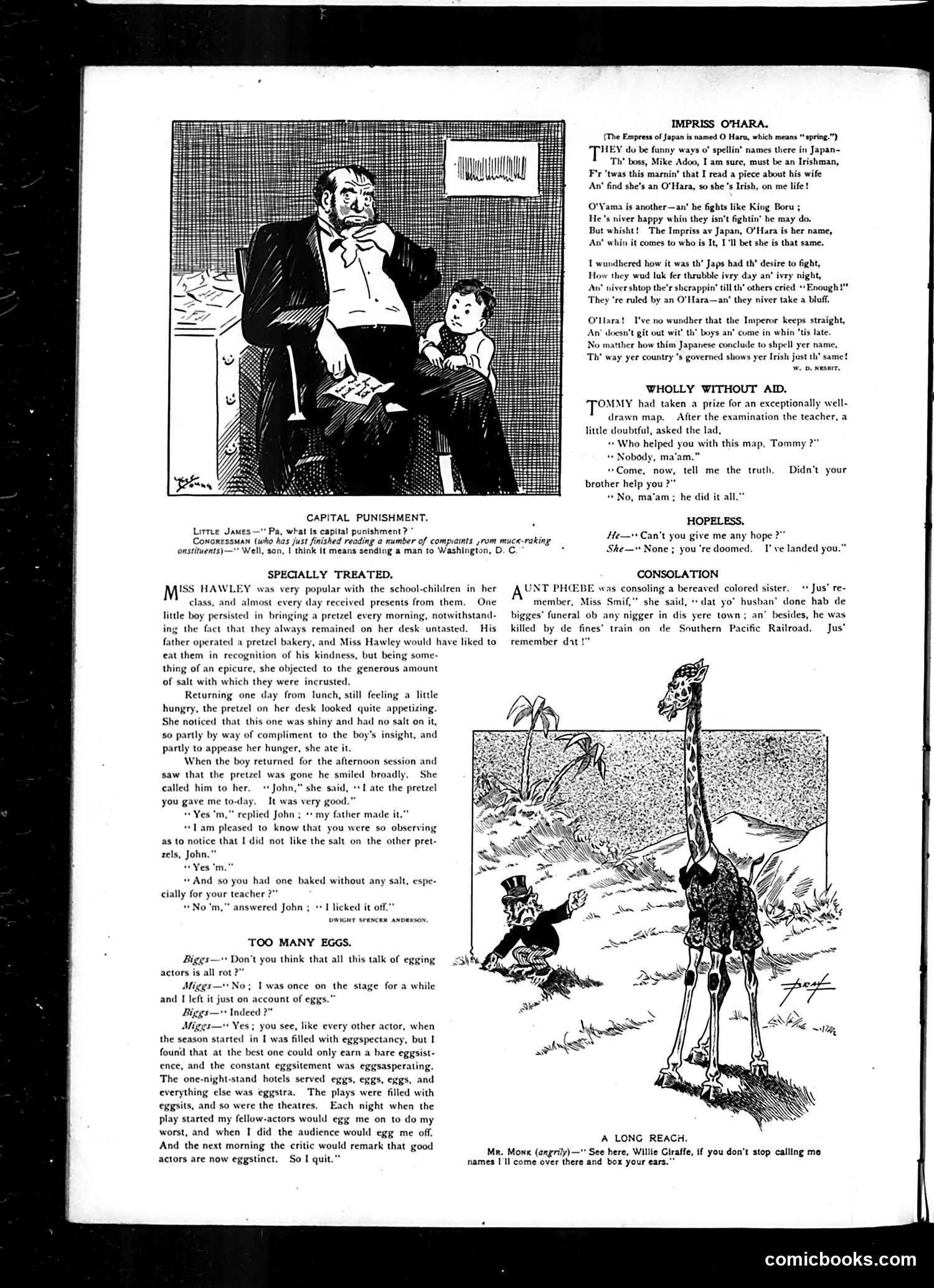
Judge — September 29, 1906 — page 6: what you’re looking at
What you’re looking at
**"Impress O'Hara"** (top): This satirizes Japan's militarism by playing on Irish naming conventions. The Empress of Japan is named "O Haru"; the cartoonist jokes that Japan must be Irish-run since "O'Hara" sounds Irish, and Irish people are stereotyped as combative ("ruled by an O'Hara"). It's ethnic humor mocking both the Japanese and Irish simultaneously, suggesting Japan's constant warfare reflects Irish-American fighting culture. **Remaining content**: The page contains light humor pieces: a teacher interrogating a student about homework help ("Wholly Without Aid"), a joke about "capital punishment" meaning sending someone to Washington D.C., and puns about actors and eggs. The "Consolation" panel uses a racist dialect caricature of a Black woman discussing a funeral on the Southern Pacific Railroad—period offensive humor typical of Judge's era. These represent the magazine's mix of political satire, ethnic stereotyping, and wordplay common in early 20th-century American humor publications.
📄 Transcribed text from this page (OCR, searchable)
Machine-transcribed from the original scan — historical spelling and the odd misread are preserved.
IMPRISS O’HARA. (The Empress of Japan is named O Haru, which means “ spring.”) THEY do be funny ways ospellin’ names there in Japan Th* boss, Mike Adoo, Iam sure, must be an Irishman, F'r ‘twas this marnin’ that I read a piece about his wife An’ find she’s an O'Hara, so she’s Irish, on me life! O’Yama is another—an’ he fights like King Boru ; He's niver happy whin they isn’t fightin’ he may do. But whisht! ‘The Impriss av Japan, O'Hara is her name, An’ whin it comes to who is It, I'll bet she is that same, T wundhered how it was th’ Japs had th’ desire to fight, How they wud luk fer thrubble ivry day an’ ivry night, An’ niver shtop the’r shcrappin’ till th’ others cri¢d “Enough!” ‘They ‘re ruled by an O'Hara—an’ they niver take a bluff. O'llara! I've no wundher that the Imperor keeps straight, An’ doesn’t git out wit’ th’ boys an’ come in whin ‘tis late No matther how thim Japanese conclude to shpell yer nam Th’ way yer country 's governed shows yer Irish just th’ sam WHOLLY WITHOUT AID. OMMY had taken a prize for an exceptionally well- drawn map. After the examination the teacher, a little doubtful, asked the lad, + Who helped you with this map, Tomm; obody, ma'am.” “Come, now, tell me the truth, Didn't your brother help you ?” «No, ma‘am ; he did it all.” CAPITAL PUNISHMENT. HOPELESS, Lirue James —" Pa, what {s capital punishment? ean cae Cononessatan (who has just finished reading a number of compiaints rom muce-raking He—-"Can't you give meiany hope? . onstitwents)—"* Well, son, | think it means sending a man to Washington, D. C. . She—« None ; you're doomed. I’ ve landed you. SPECIALLY TREATED. CONSOLATION LEY was very popular with the school-children in her UNT PHCEBE was consoling a bereaved colored sister. ** Jus’ re- member, Miss Smif," she said, «dat yo" husban’ done hab de class, and almost every day received presents from them, One les, he was little boy persisted in bringing a pretzel every morning, notwithstand- _ bigges’ funeral ob any nigger in dis yere town; an’ b ing the fact that they always remained on her desk untasted. His killed by de fines’ train on de Southern Pacific Railroad. Jus father operated a pretzel bakery, and Miss Hawley would have liked to remember dat!" eat them in recognition of his kindness, but being some- thing of an epicure, she objected to the generous amount of salt with which they were incrusted. Returning one day from lunch, still feeling a little hungry, the pretzel on her desk looked quite appetizing. She noticed that this one was shiny and had no salt on it, so partly by way of compliment to the boy's insight, and partly to appease her hunger, she ate it. When the boy returned for the afternoon session and saw that the pretzel was gone he smiled broadly. She called him to her. John,” she said, “Tate the pretzel you gave me toxlay. It was very good.” + Yes 'm,” replied John ; + my father made “Lam pleased to know that you were so observing as to notice that I did not like the salt on the other pret- zels, John.” “Yes 'm.” “And so you had one baked without any salt, espe- cially for your teacher 2" No 'm,” answered John ; ++I licked it off." TOO MANY EGGS. Biggs—+ Don't you think that all this talk of egging actors is all rot Miggs— No; Lwas once on the stage for a while and I left it just on account of eggs.” Biggs—«* Indeed 2" Miggs— Yes ; you see, like every other actor, when the season started in I was filled with eggspectancy, but I found that at the best one could only earn a bare eggsist- ence, and the constant eggsitement was eggsasperating. The one-night-stand hotels served eggs, eggs, eggs, and everything else was eggstra. The plays were filled with eggsits, and so were the theatres. Each night when the play started my fellow-actors would egg me on to do my worst, and when I did the audience would egg me off. A TONG BERGE And the next morning the critic would remark that good Mr. Mone (angrily)—"* See here, Willie Giraffe, if you don’t stop calling me actors are now eggstinct, So I quit.”” names I'll come over there and box your ears.” comicbooks.com