
A complete issue · 16 pages · 1906
Judge — September 1, 1906
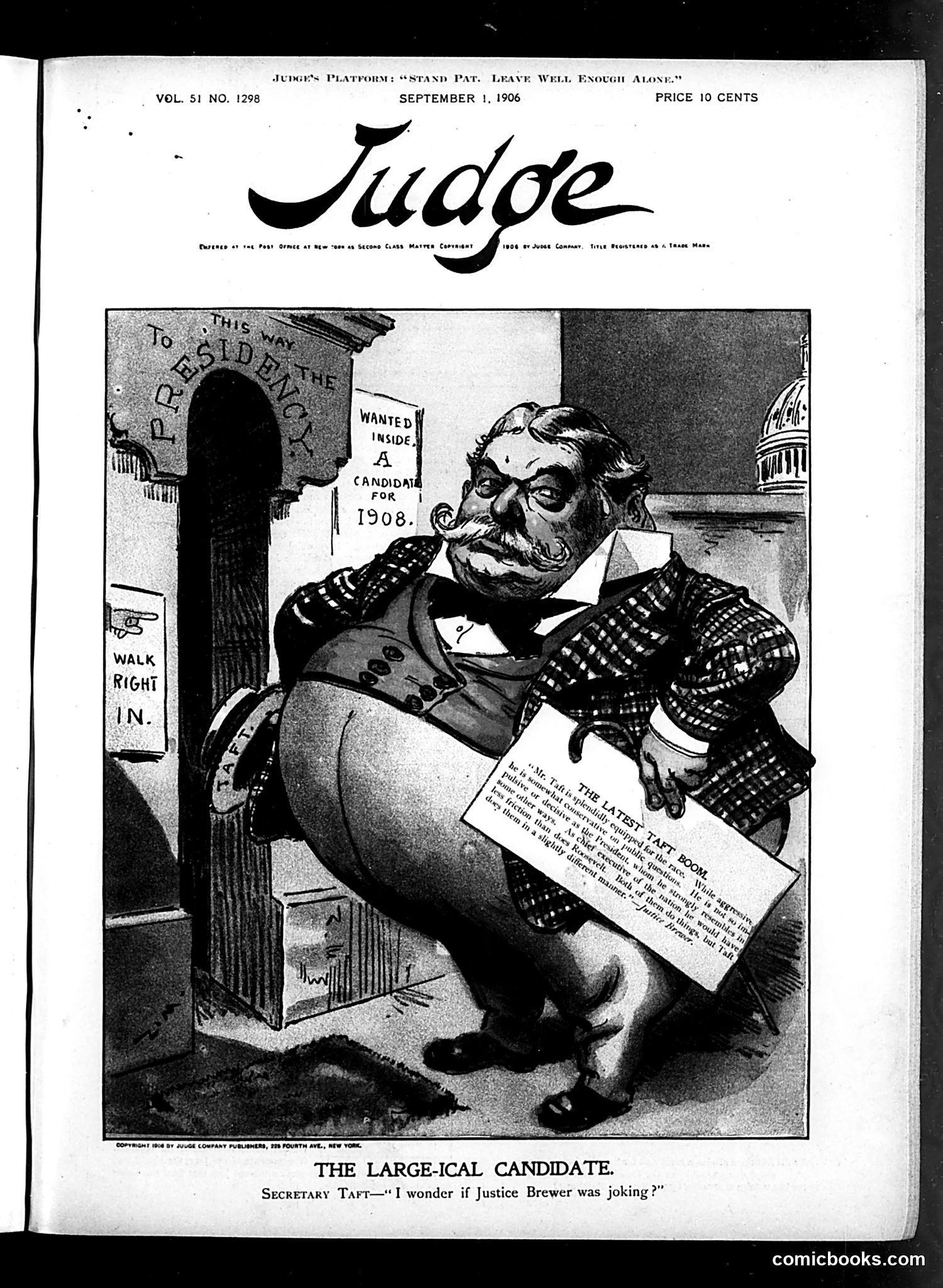
This 1906 Judge magazine cartoon satirizes Secretary of War William Howard Taft as an oversized presidential candidate. The caricature depicts Taft as an extremely large, rotund figure emerging from the "Presidency" building with a sign reading "Wanted Inside: A Candidate for 1908." The humor plays on Taft's notable obesity and his potential candidacy to succeed Theodore Roosevelt. The caption quotes Secretary Taft asking "I wonder if Justice Brewer was joking?" — likely referencing speculation about his candidacy. The "large-ical" pun in the title mocks both Taft's physical size and the term "logical." The cartoon suggests Taft was being considered as Roosevelt's preferred successor, a position he would indeed accept, winning the 1908 election.
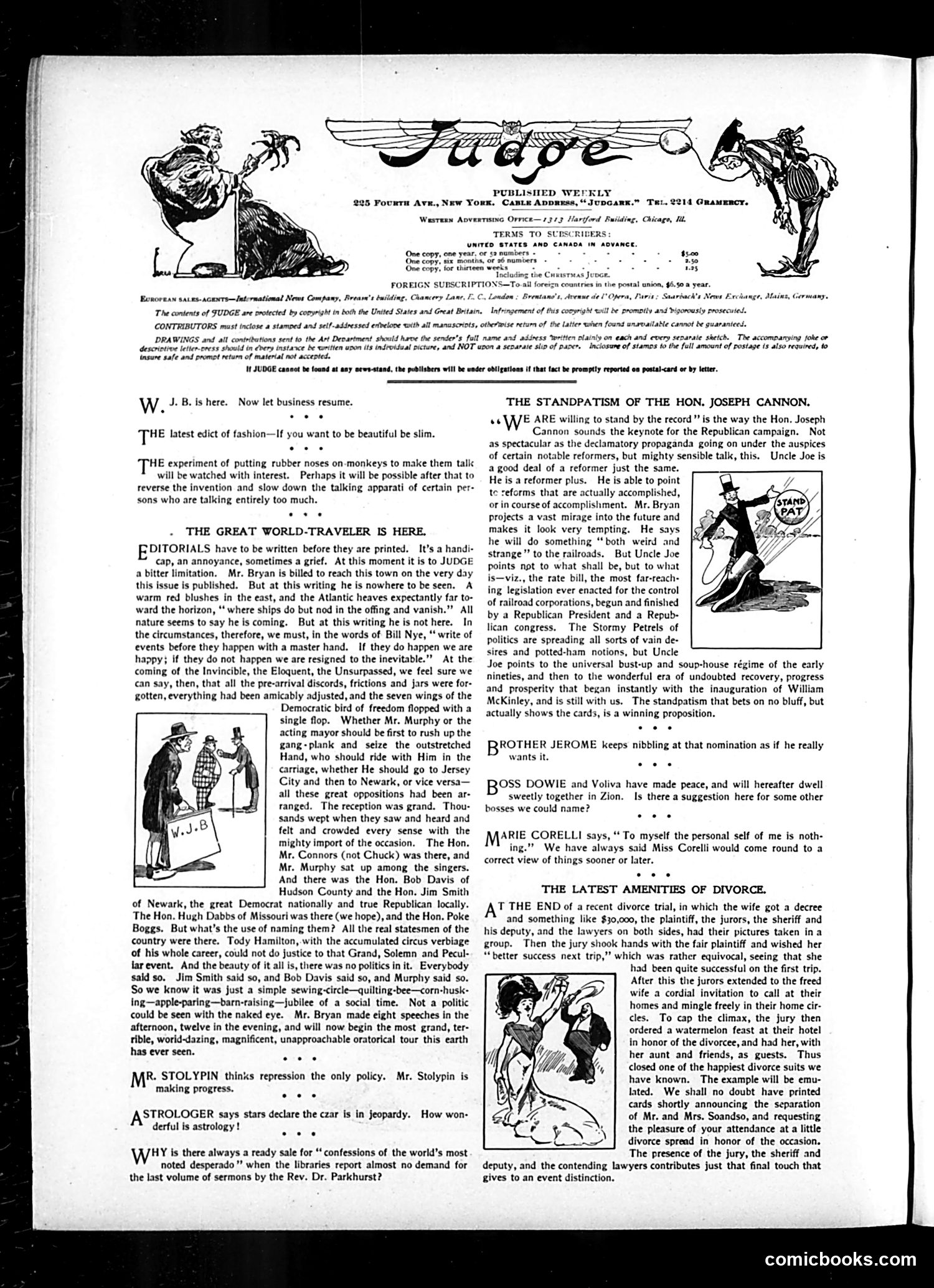
This page contains political commentary and social satire typical of Judge magazine. The left column discusses political figures including references to Bryan, the Hon. Joseph Cannon, and various Democratic and Republican politicians of the era. The main cartoon depicts "The Latest Amenities of Divorce," illustrating a satirical take on divorce proceedings. The image shows a woman at what appears to be a social gathering following her divorce, with commentary suggesting divorce has become fashionable enough to celebrate publicly with formal invitations and guest lists—a mockery of how divorce, once scandalous, has become socially acceptable and almost celebratory among certain circles. The text criticizes this shift in social attitudes while maintaining the magazine's characteristic witty, biting tone toward contemporary American society and politics.
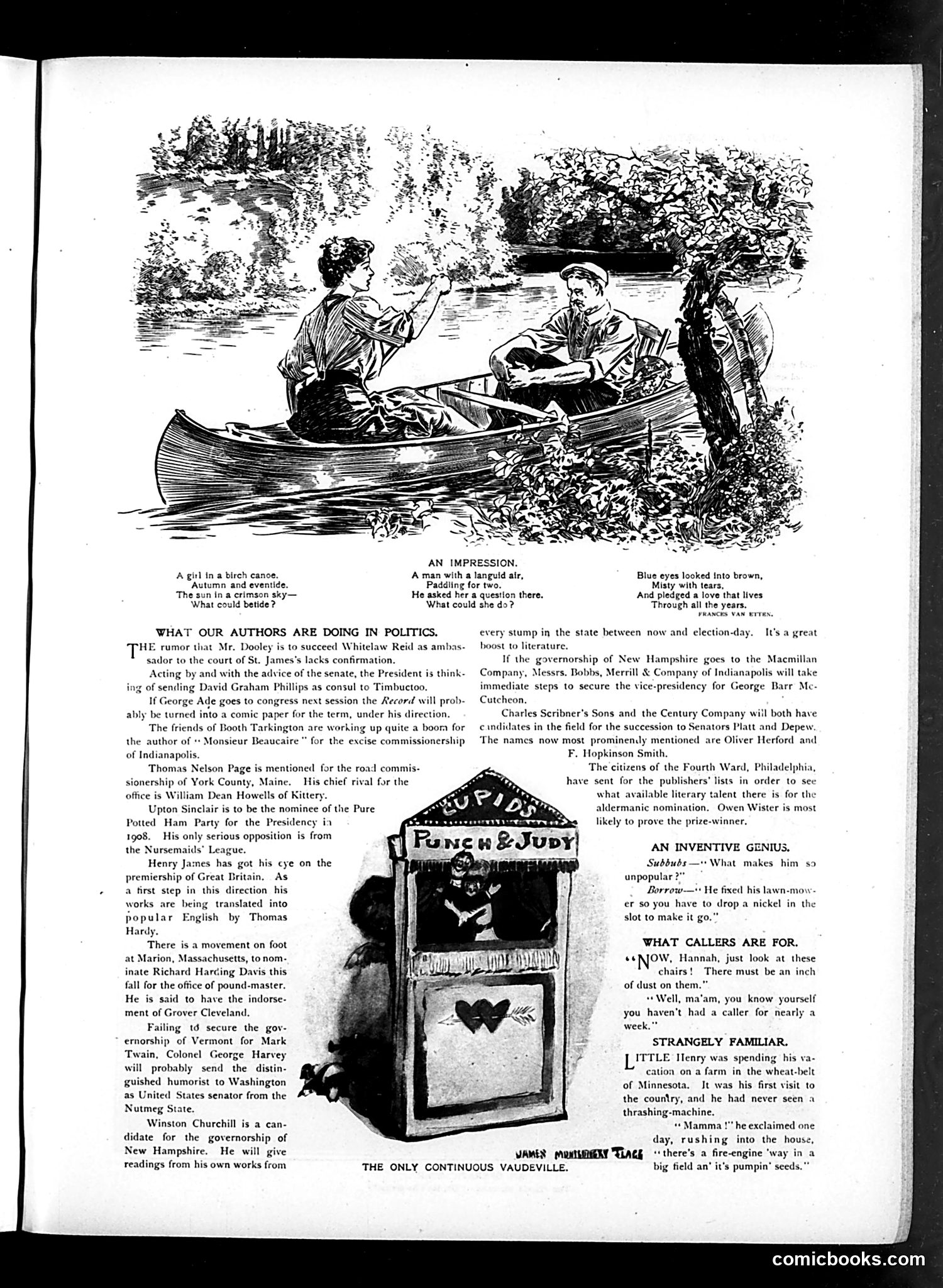
This page contains several distinct items: **Top illustration**: "An Impression" shows a romantic scene of a couple in a boat, accompanying sentimental poetry about love and blue eyes—typical Victorian romantic content. **"What Our Authors Are Doing in Politics"**: A gossip column reporting on various political figures' activities and rumored appointments, including mentions of Mr. Dooley succeeding Whitelaw Reid as ambassador and speculation about congressional positions. **"Punch and Judy" illustration**: A vintage puppet show booth, captioned as "The Only Continuous Vaudeville." **Small humor pieces**: "What Makes Him So Unpopular," "What Callers Are For," and "Strangely Familiar"—brief comedic anecdotes. The page is primarily political gossip and light humor typical of Judge's satirical approach to contemporary American politics and society.
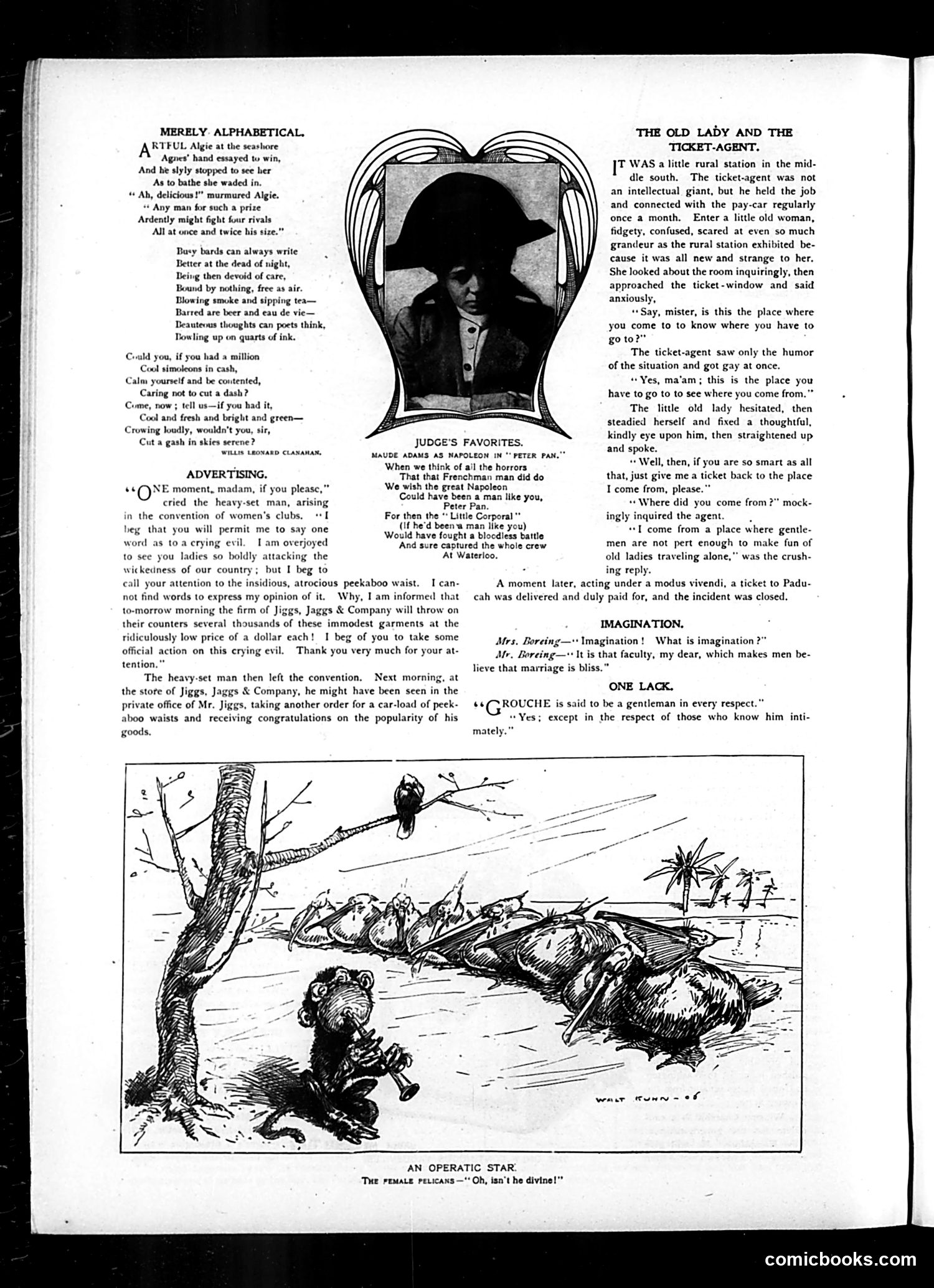
This page contains several short pieces and illustrations rather than a unified political cartoon. **"Judge's Favorites"** features Maude Adams as Napoleon in "Peter Pan"—a theatrical reference praising her performance in what appears to be a stage production. **"The Old Lady and the Ticket-Agent"** is a humorous sketch about a confused elderly woman at a rural train station, mocking her unfamiliarity with modern transportation and bureaucratic procedures. The joke relies on depicting rural Americans as ignorant of urban conveniences. **"An Operatic Star"** shows a monkey near dead pelicans with the caption "Oh, isn't he divine!"—satire about operatic pretension and affected aesthetic appreciation. The page primarily consists of light social humor rather than serious political satire, targeting class stereotypes and cultural pretension common to early 1900s American magazines.
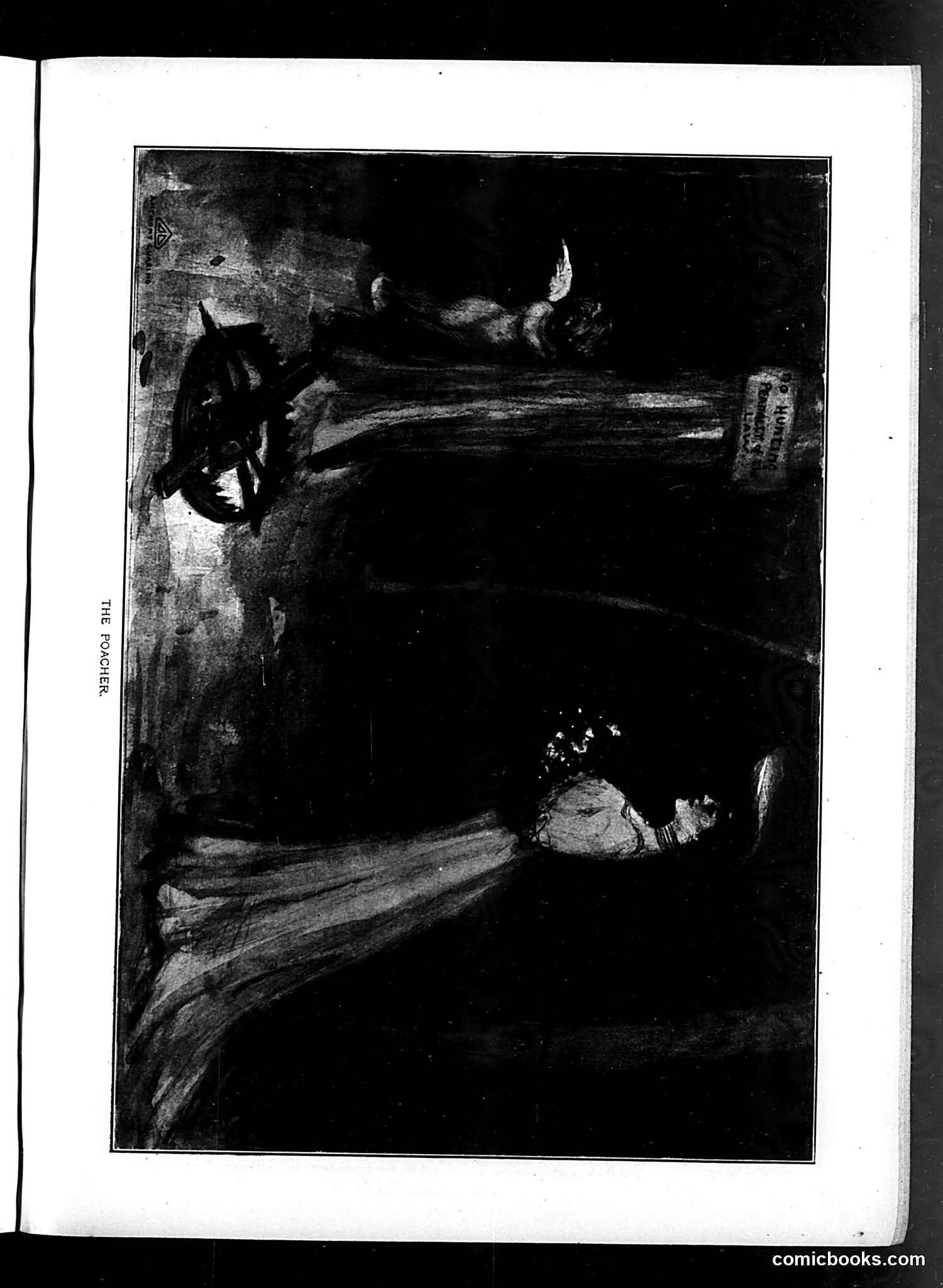
This appears to be a dark satirical cartoon, though the image quality makes precise identification difficult. The OCR text "THE FROGGER" suggests the subject involves someone being compared to or called a "frogger" — a term historically used as slang, potentially derogatory. The scene depicts what appears to be a dramatic nighttime moment with figures and animals (possibly horses or similar creatures) in shadow. Without clearer visibility or additional context from surrounding text, I cannot confidently identify the specific political figures or events being satirized. The theatrical, shadowy treatment suggests this is commentary on a notable public figure or incident from Judge magazine's era, but determining the exact reference requires additional information beyond what the image quality permits me to discern with certainty.
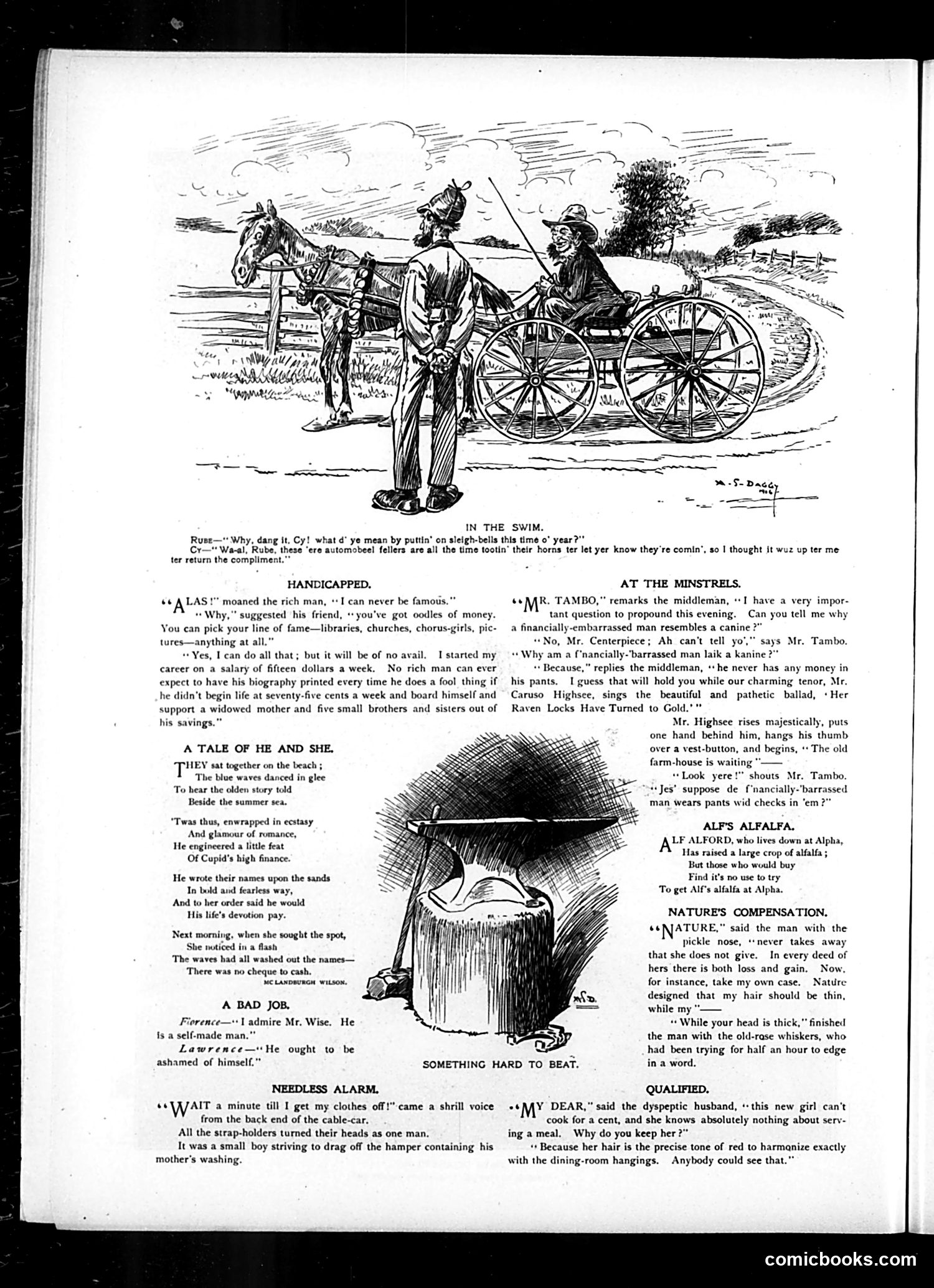
This page from the satirical magazine *Judge* contains multiple short humor pieces satirizing American social attitudes of the era (likely early 1900s): **"Handicapped"** mocks wealthy self-made men's desire for fame—the joke being that only those who rose from poverty (starting at $15/week salaries) can build heroic narratives. Rich men lack the rags-to-riches origin story needed for public adulation. **"A Tale of He and She"** is a romantic parody: a man writes their names in sand as a poetic proposal, but the tide washes them away—the punchline being she expects a financial "check to cash," reducing romance to money. **Other sketches** include workplace comedy ("Needless Alarm" about a boy struggling with a laundry hamper on a cable-car) and a minstrel-show joke (using period racist dialect humor standard for the era). **"Nature's Compensation"** offers a crude joke about a bald man and one with whiskers trading insults about appearance. The overall tone reflects *Judge's* characteristic satirizing of class pretensions, materialism, and romantic folly in American society.
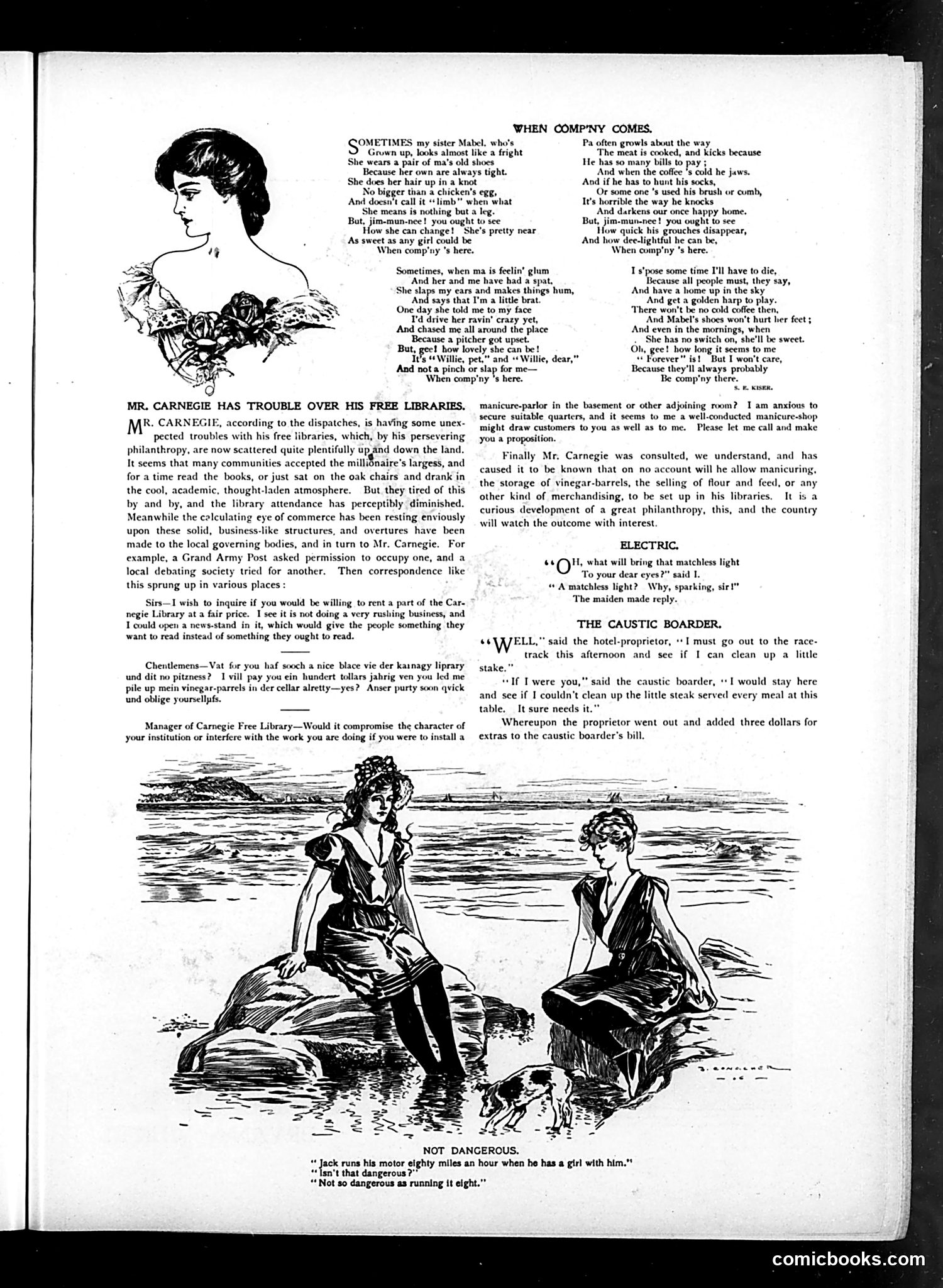
This Judge magazine page satirizes **Andrew Carnegie's free public libraries**—a major philanthropic initiative of the wealthy industrialist. The central article mocks communities that accepted Carnegie's library donations but then lost interest in them. The satire highlights the tension between Carnegie's noble intentions and practical reality: once the novelty wore off, attendance dropped, and local governments grew tempted to rent out the buildings to commercial enterprises (newsstands, debating societies, vinegar storage) to generate revenue. The joke is that Carnegie's altruistic gift became a financial burden communities wanted to exploit for profit—undercutting his philanthropic vision. The page also includes lighter domestic humor unrelated to Carnegie, featuring poems about family behavior ("When Comp'ny Comes") and beach-scene vignettes with period-appropriate jokes about propriety.
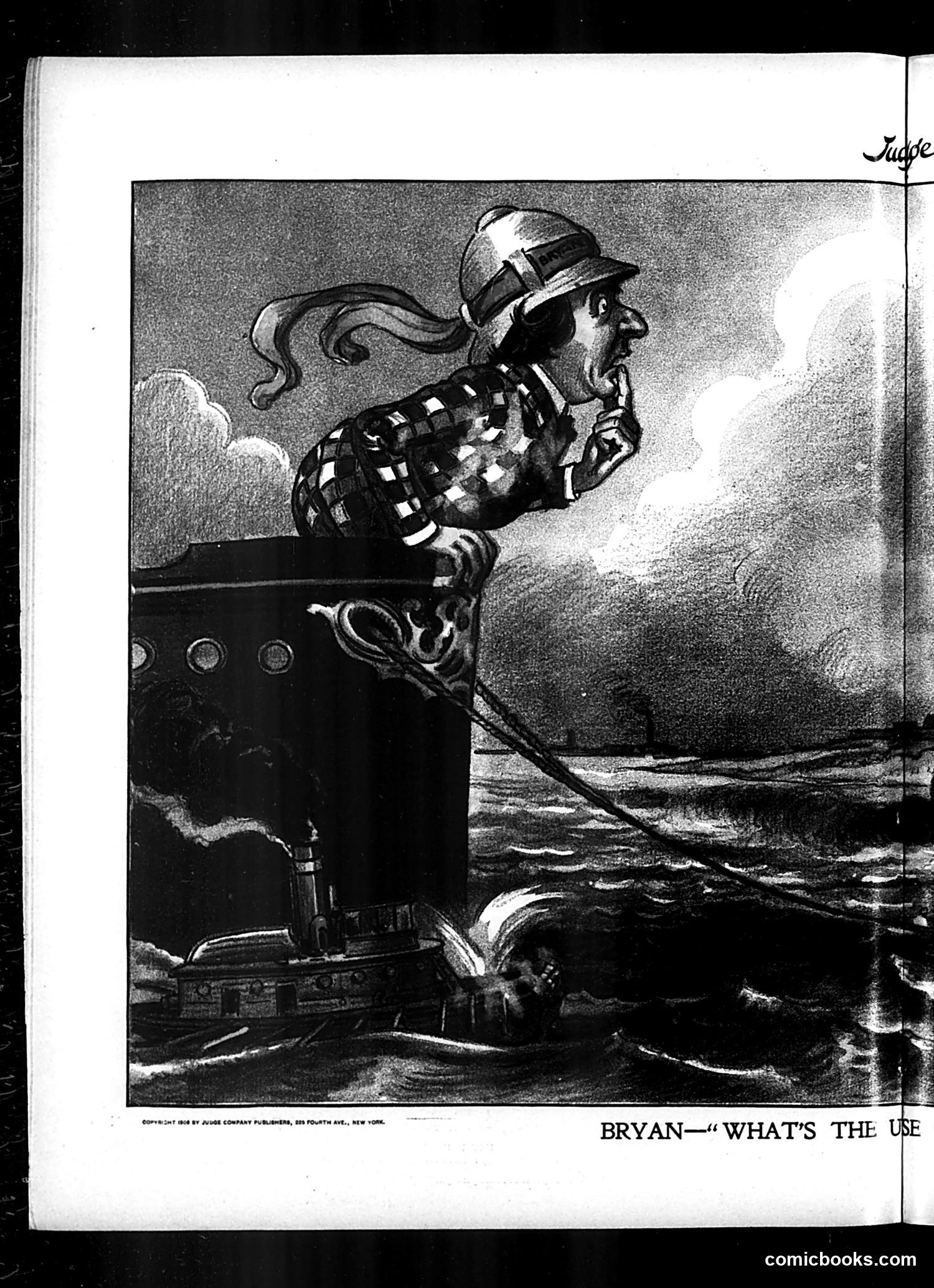
This political cartoon caricatures William Jennings Bryan, the three-time Democratic presidential candidate. The image shows him as a ship's captain or helmsman, standing atop what appears to be a vessel, looking out at stormy seas—likely representing turbulent political conditions. The caption "What's the Use" suggests Bryan's resignation or despair about his political prospects. This appears to be commentary on Bryan's repeated electoral defeats or declining political fortunes. The nautical metaphor—Bryan as a captain unable to navigate his ship—emphasizes his helplessness in the face of political circumstances beyond his control. The cartoon satirizes what Judge viewed as Bryan's futile efforts or outdated political relevance.
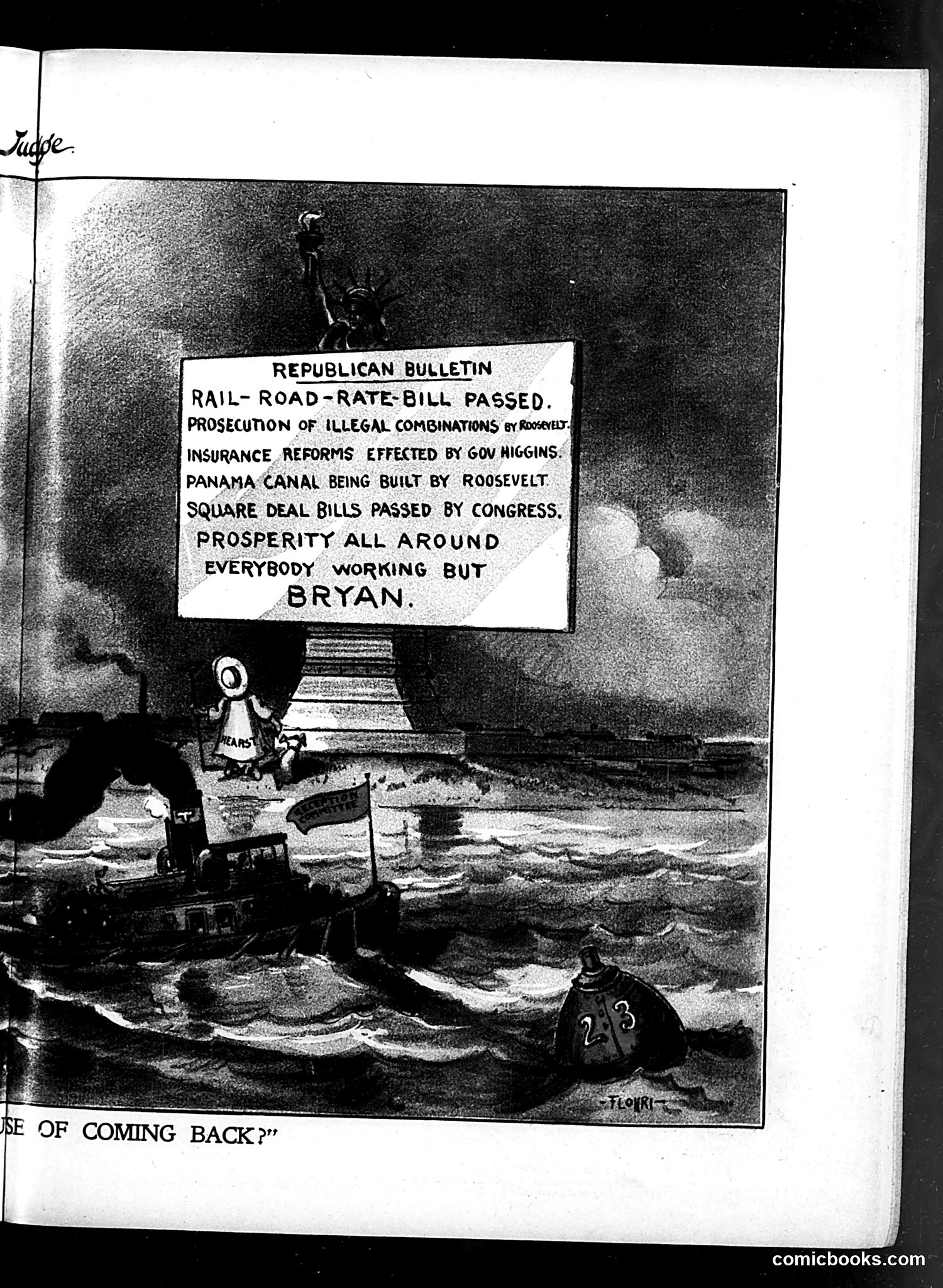
This is a Republican campaign cartoon celebrating Theodore Roosevelt's legislative achievements. The "Republican Bulletin" lists accomplishments: railroad regulation, trust prosecution, insurance reform, and Panama Canal construction. However, the satire's punch line appears at bottom: "EVERYBODY WORKING BUT BRYAN." William Jennings Bryan, the Democratic presidential candidate, is depicted as a figure excluded from Republican prosperity—likely shown as a bomb or explosive device marked "2/3," suggesting he's a political threat or irrelevant to economic progress. The cartoon mocks Democrats by contrasting Republican achievements with Bryan's apparent inability to participate in or benefit from national prosperity, positioning him as out of step with the times.
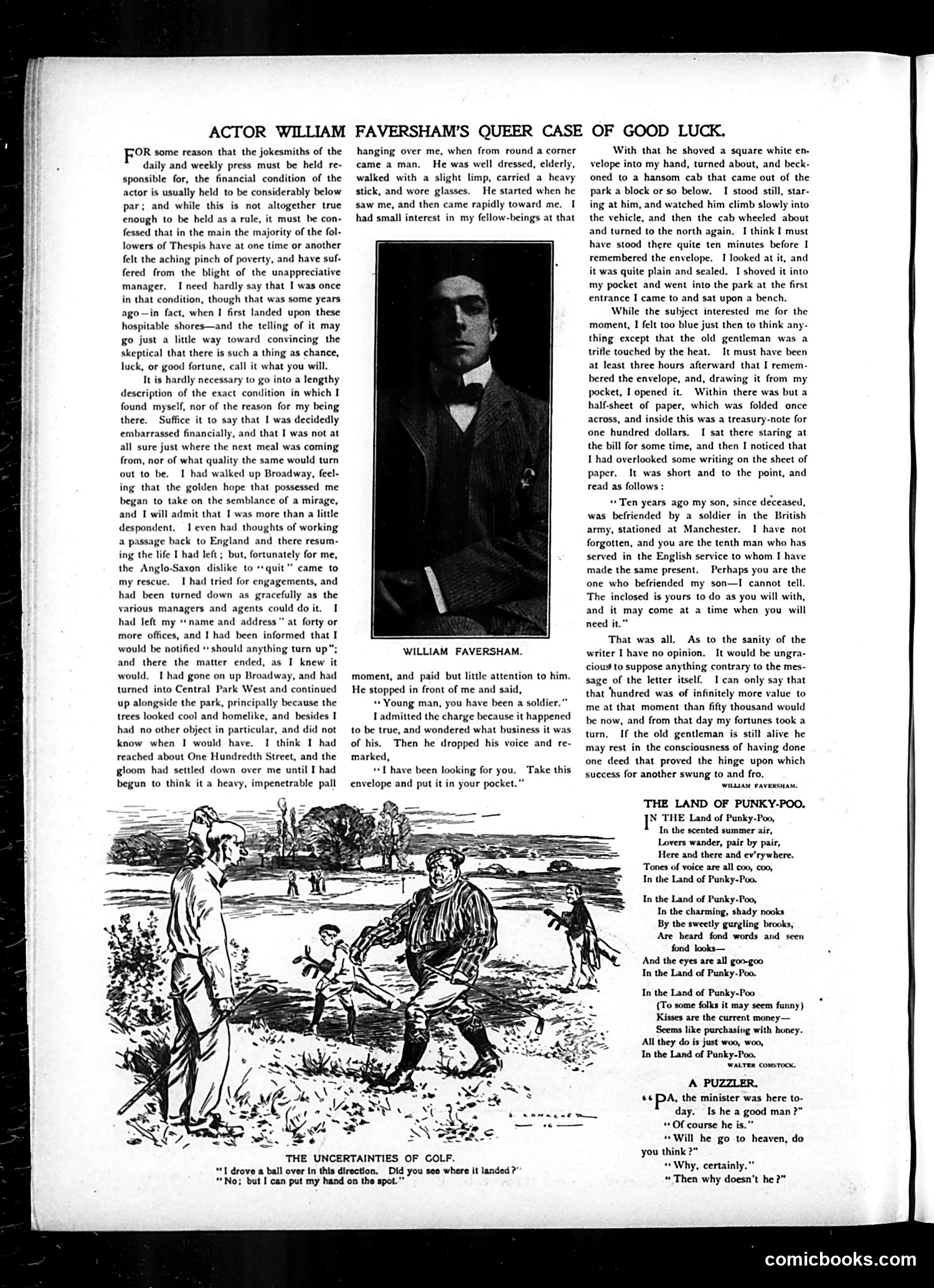
This page features actor William Faversham's memoir account titled "Queer Case of Good Luck," describing a transformative encounter during financial hardship in New York City. **The Story:** A struggling, unemployed Faversham walks dejectedly along Central Park West. An elderly, well-dressed stranger approaches, recognizes him as a former soldier, and mysteriously hands him a sealed envelope with cryptic instructions to "take this envelope and put it in your pocket." The stranger then departs in a hansom cab. **The Point:** This appears to be a serialized human-interest story emphasizing luck and providence—common Judge magazine content. The stranger's ability to discern Faversham's military background and his dramatic intervention suggests fate or serendipitous fortune intervening in the actor's desperate circumstances. The narrative plays into period themes about chance, redemption, and the struggles of theatrical performers. **Additional Content:** The page includes unrelated satirical poetry ("The Land of Punky-Poo") and a golf cartoon ("The Uncertainties of Golf").
This page contains satirical commentary and advertisements typical of early 20th-century Judge magazine. The main cartoon, **"With the Scientists,"** mocks scientific pretension by depicting researchers obsessively measuring trivial physical properties (Earth's hardness, the universe's weight) while ignoring real social problems like poverty and labor conditions. The satire suggests scientists waste effort on arcane calculations that don't improve ordinary people's lives. Supporting this theme, brief humor items mock impractical solutions: a London cabdriver's anxiety over taximeters (new technology), and a rural man turning to selling washing machines after failing at everything else—suggesting desperation driving adoption of dubious inventions. The page is largely advertisements (cigars, hats, shaving soap, ale), reflecting Judge's commercial nature. The overall message critiques both scientific elitism and modern consumer culture's false promises of improvement.
This page is primarily **advertising and humor content** rather than political cartoons. The main satirical elements include: **"Bubbles" Section**: A collection of brief, cynical quips mocking human nature—hypocrisy about marriages and morality, the absurdity of business (Venice street contracts), and economic irony (expensive things valued highly simply because they cost more). The tone is light social commentary typical of turn-of-century American humor magazines. **Notable Jokes**: One anecdote jokes that a jury couldn't believe a boss would be rude to an employee, suggesting workplace mistreatment was so common it seemed implausible in court. Another mocks a man's boss for not granting him a funeral day—gallows humor about labor indifference. **"Jasper's Hints to Money-makers"**: Advertises Leslie's Weekly's financial advice column, positioning it as reliable investment guidance. The page is dominated by advertisements for whiskey, pianos, foot powder, and patent medicines—typical of Judge magazine's revenue model. No specific political figures or events are satirized here.
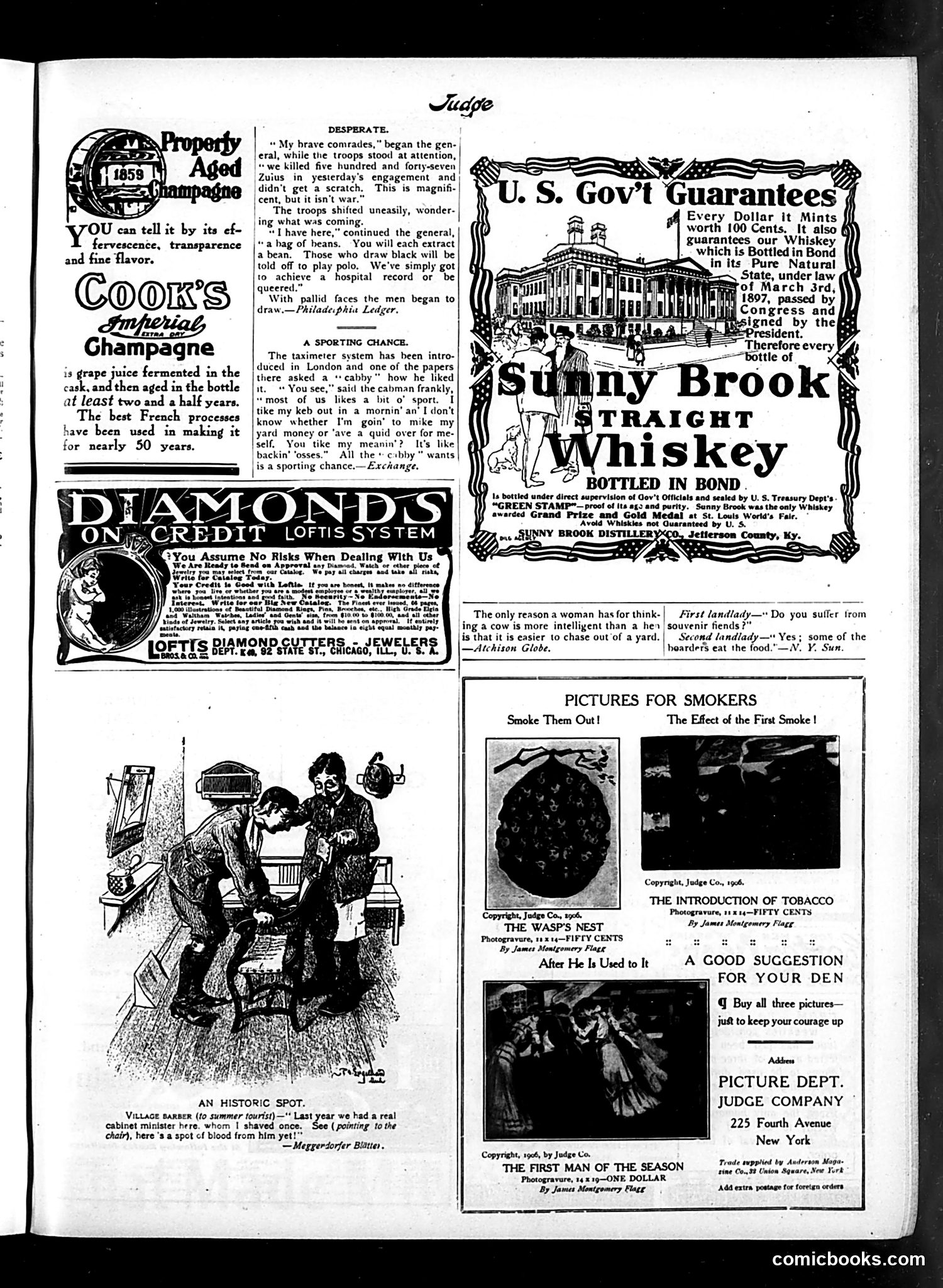
This page from Judge magazine (circa 1906) contains several distinct elements: **"Desperate" Cartoon**: A general tells troops their battlefield victory is insufficient; he orders them to draw beans to determine who plays polo, hoping to achieve a "hospital record." The satire mocks military absurdity and the era's glorification of warfare—suggesting generals prioritize spectacle over actual combat strategy. **"A Sporting Chance" Anecdote**: A London taxi driver compares his new taximeter job to gambling, uncertain whether he'll profit. This reflects early-20th-century anxiety about mechanization disrupting traditional livelihoods. **"An Historic Spot" Cartoon**: A barber boasts to a tourist about serving a cabinet minister, pointing to "blood" on his chair. Dark humor playing on the barber's dubious hygiene and his pride in minor celebrity contact. The page is heavily advertised—Cook's Champagne, Sunny Brook Whiskey (government-guaranteed), Loftis Diamonds, and Judge Company's picture prints dominate the layout. These ads reflect Edwardian consumer culture and the magazine's commercial focus.
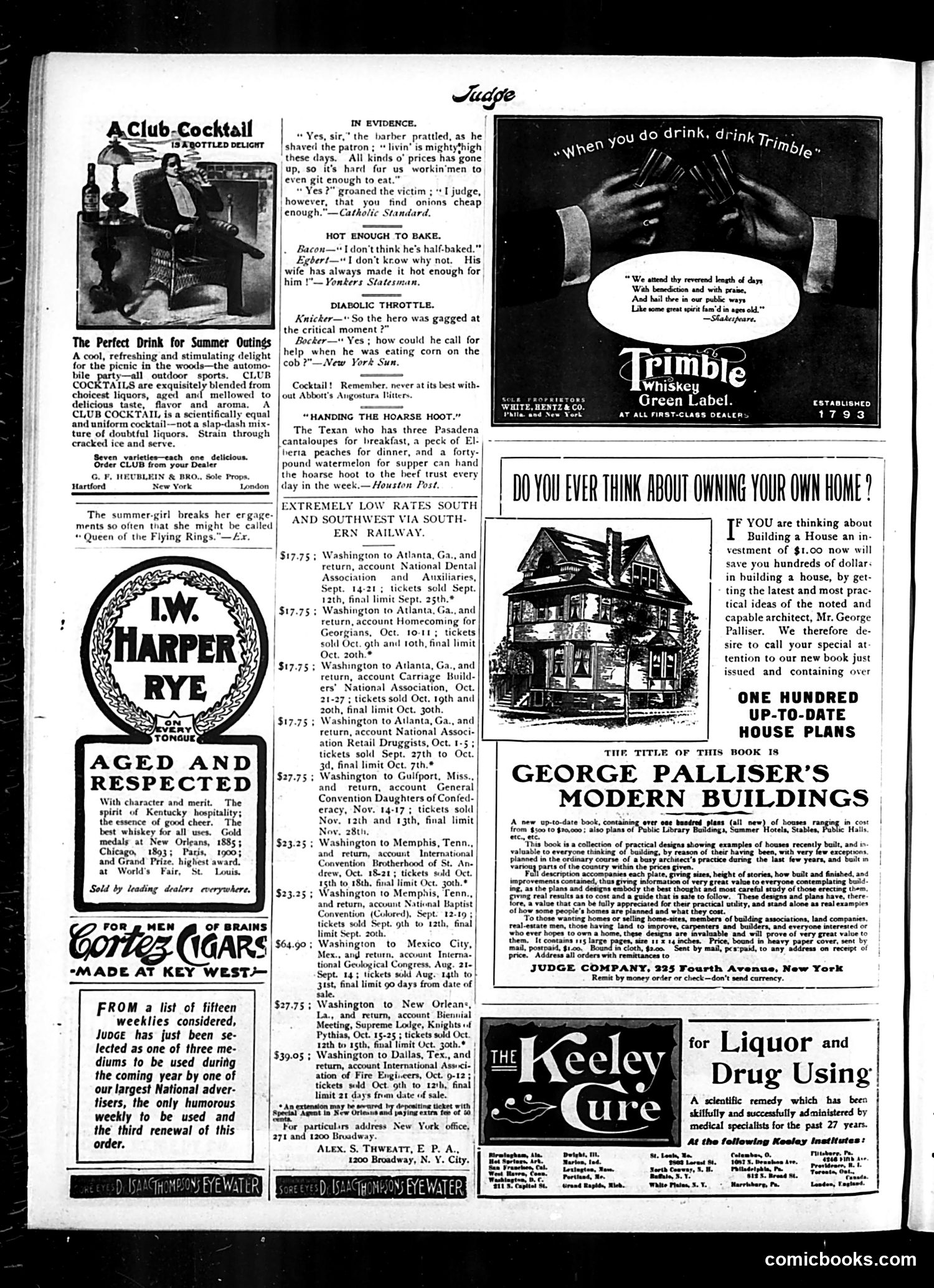
This page is primarily **advertising**, not political satire. It contains several liquor and product advertisements (Club Cocktails, I.W. Harper Rye whiskey, Trimble Whiskey, and the Keeley Cure for alcohol/drug addiction) alongside brief humorous quips and notices. The few jokes present are mild social humor: one mocks a summer girl's broken engagements as making her "Queen of the Flying Rings"; another plays on a barber's complaint about high living costs by suggesting he finds onions cheap (implying onion-eating as poor man's fare); a third makes a pun about eating corn on the cob rendering someone unable to call for help. The page also advertises Judge magazine itself and railway travel deals. There is **no identifiable political cartoon or caricature**—the content reflects early 1900s consumer culture and light domestic humor rather than political commentary. The advertisements targeting leisured audiences (picnics, automobiles, travel) suggest affluent readership.
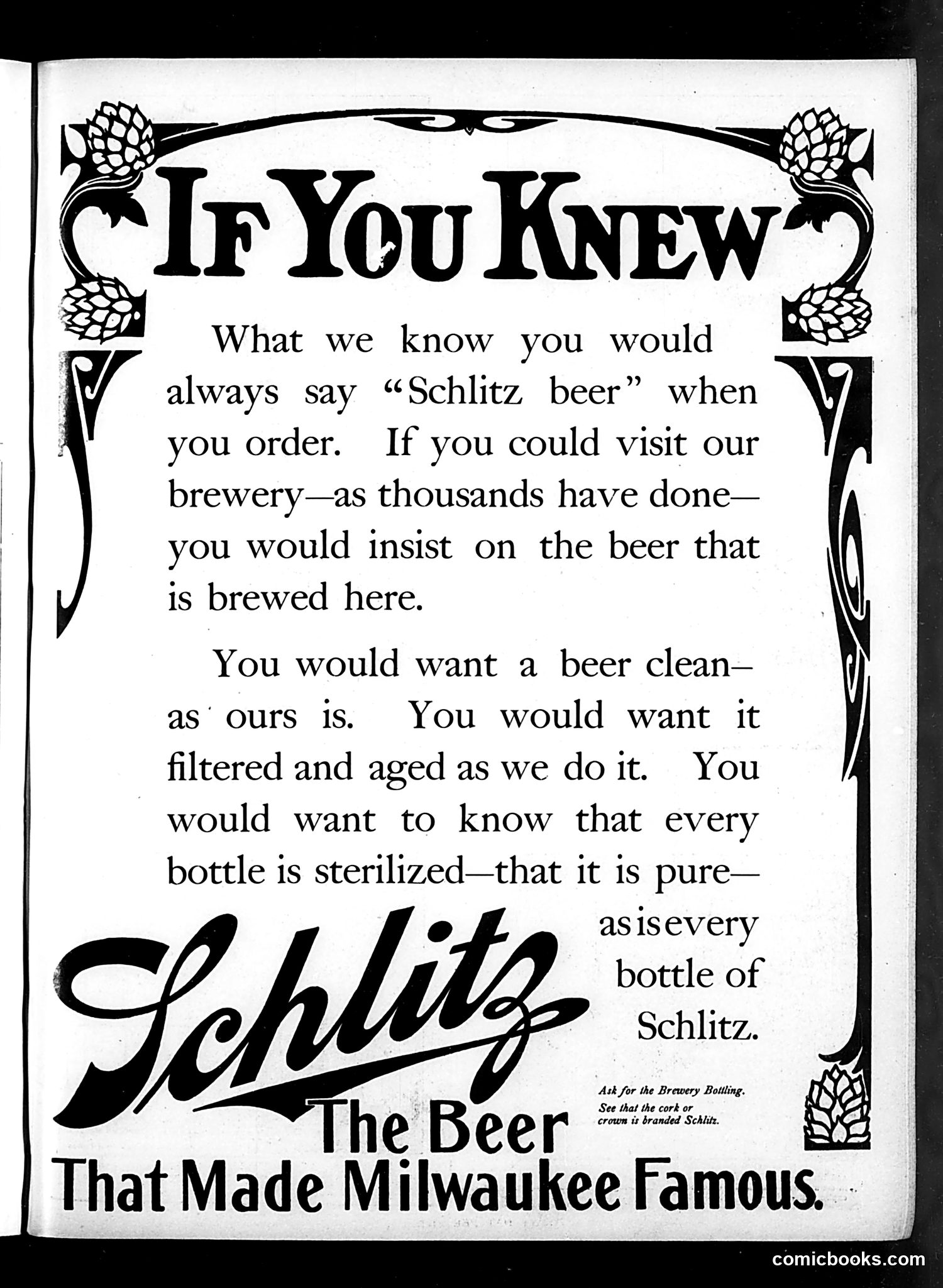
This is a **full-page advertisement**, not a satirical cartoon. It's a vintage Schlitz brewery ad promoting their beer as "The Beer That Made Milwaukee Famous." The ad uses a persuasive "if you knew" pitch: it claims that if readers visited the Schlitz brewery, they would demand Schlitz specifically because of its superior manufacturing practices—emphasizing cleanliness, filtration, aging, and sterilization. This appeals to early-20th-century consumer concerns about product purity and safety (Prohibition era anxieties about contaminated beverages were common). The decorative hop motifs in the corners reinforce the brewing theme. The instructions at bottom—to look for "Brewery Bottling" and branded corks—were authenticity markers meant to prevent counterfeiting or adulteration. The overall message: visiting the brewery would convince you Schlitz is superior to competitors through transparent manufacturing practices.
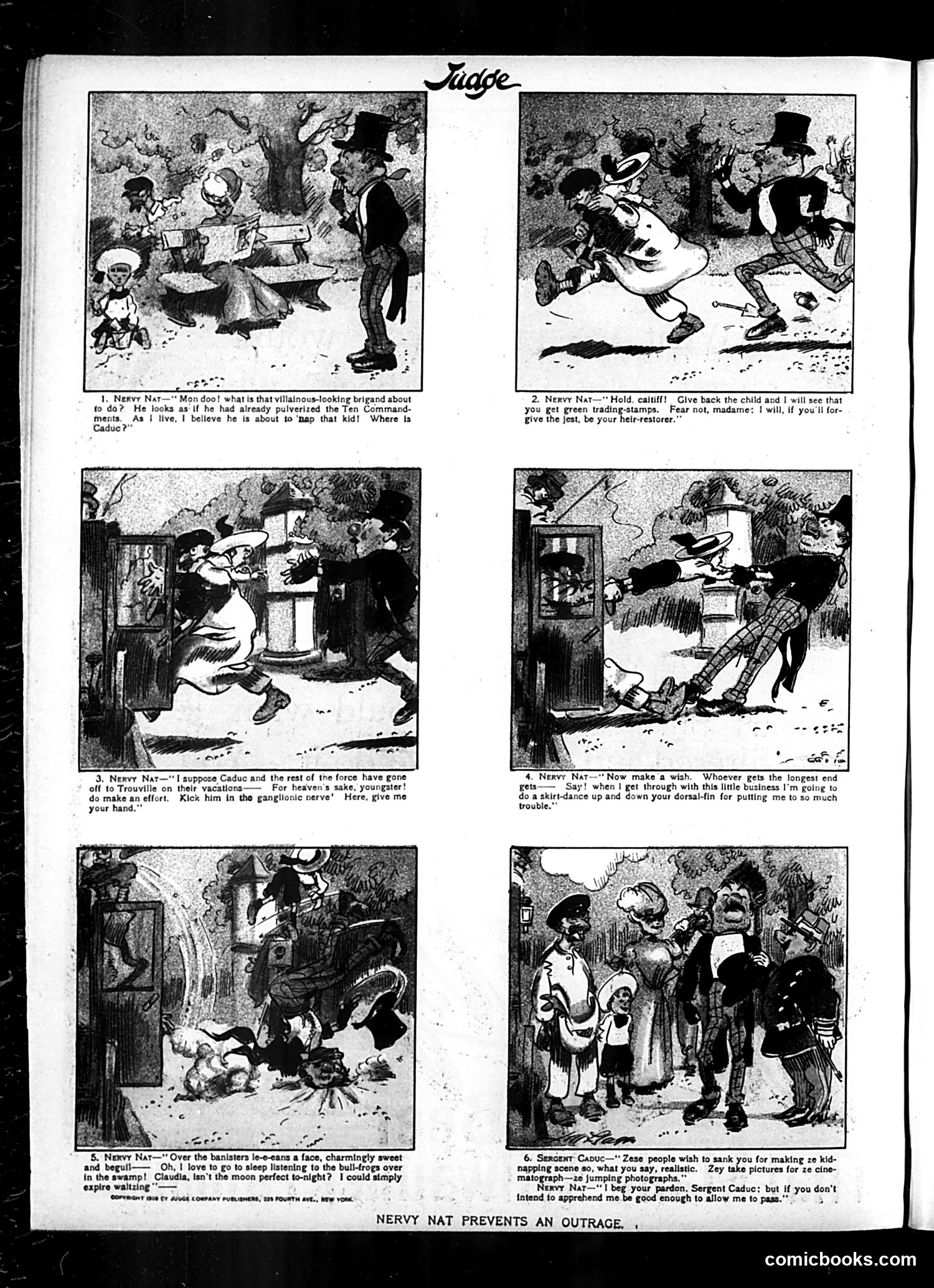
This is a comic strip featuring **Nervy Nat**, an apparent police officer or authority figure in a tall hat who repeatedly intervenes in various situations. The strip satirizes modern commercial culture and police incompetence. In panel 1, Nat accuses a man of kidnapping a child. By panel 2, he's negotiating a ransom using "green trading-stamps" (a popular early-1900s retail loyalty program), transforming a crime into a commercial transaction. Panel 3 mocks police on vacation while crime occurs. Panels 5-6 introduce **Sergeant Caduc**, a French character (indicated by accent spelling), who congratulates them on creating a "realistic" kidnapping scene suitable for cinematograph films—suggesting they've staged the entire outrage for entertainment purposes. The satire targets both the era's obsession with consumer marketing and the novelty of early cinema, while depicting police as either absent or complicit in staged spectacles. The "outrage prevented" is actually revealed as manufactured entertainment.