
Judge, 1906-09-01 · page 10 of 16
Judge — September 1, 1906 — page 10: what you’re looking at
What you’re looking at
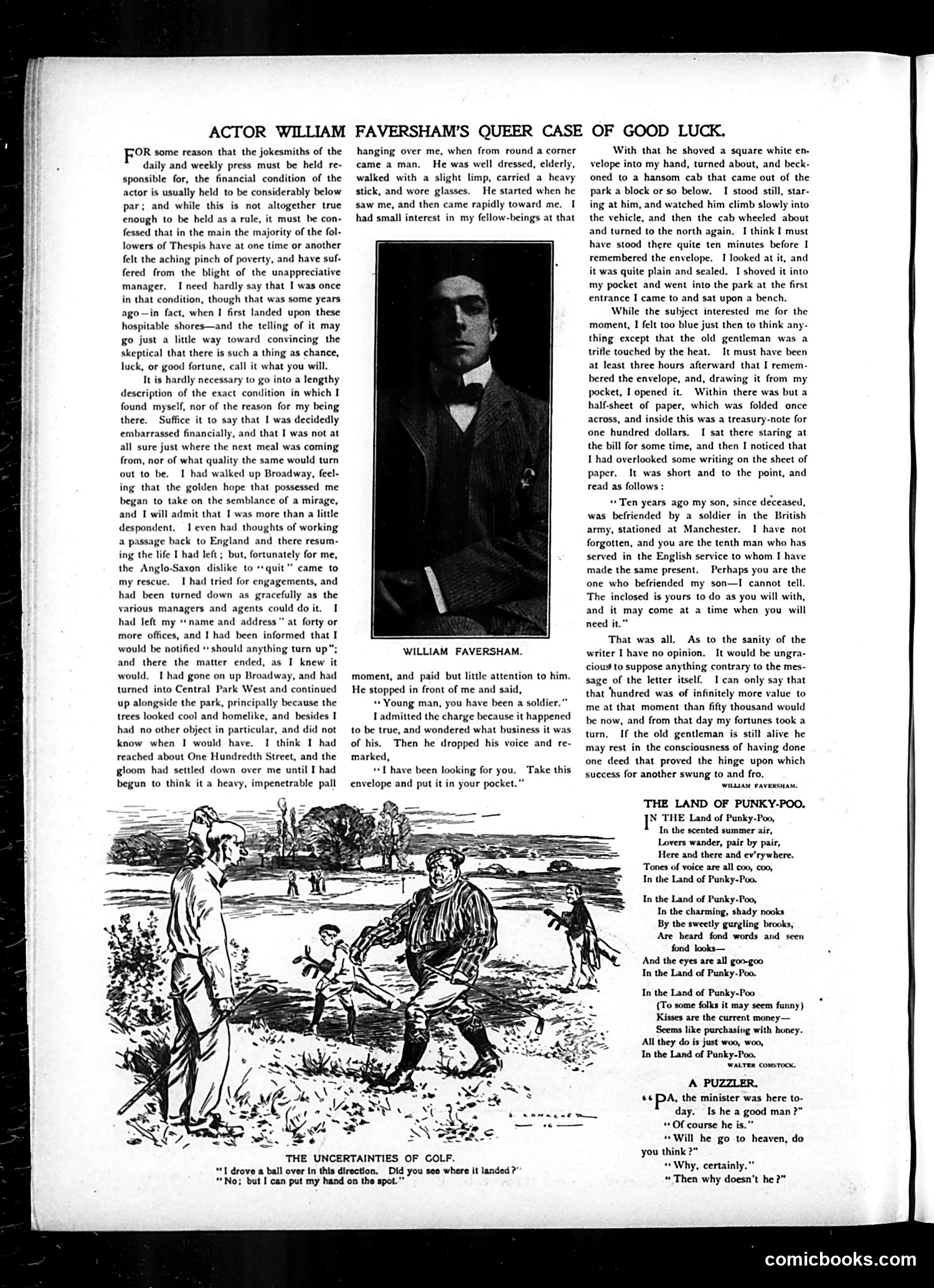
This page features actor William Faversham's memoir account titled "Queer Case of Good Luck," describing a transformative encounter during financial hardship in New York City. **The Story:** A struggling, unemployed Faversham walks dejectedly along Central Park West. An elderly, well-dressed stranger approaches, recognizes him as a former soldier, and mysteriously hands him a sealed envelope with cryptic instructions to "take this envelope and put it in your pocket." The stranger then departs in a hansom cab. **The Point:** This appears to be a serialized human-interest story emphasizing luck and providence—common Judge magazine content. The stranger's ability to discern Faversham's military background and his dramatic intervention suggests fate or serendipitous fortune intervening in the actor's desperate circumstances. The narrative plays into period themes about chance, redemption, and the struggles of theatrical performers. **Additional Content:** The page includes unrelated satirical poetry ("The Land of Punky-Poo") and a golf cartoon ("The Uncertainties of Golf").
📄 Transcribed text from this page (OCR, searchable)
Machine-transcribed from the original scan — historical spelling and the odd misread are preserved.
ACTOR WILLIAM FFOR some reason that the jokesmiths of the daily and weekly press must be held re- sponsible for, the financial condition of the actor is usually held to be considerably below par; and while this is not altogether true enough to be held asa rule, it must be con- fessed that in the main the majority of the fol- lowers of Thespis have at one time or another felt the aching pinch of poverty, and have suf- fered from the blight of the unappreciative manager. I need hardly say that I was once in that condition, though that was some years ago—in fact, when I first landed upon these hospitable shores—and the telling of it may go just a little way toward convincing the skeptical that there is such a thing as chance, luck, or good fortune, call it what you will. It is hardly necessary to go into a lengthy description of the exact condition in which I found myself, nor of the reason for my being there. Suffice it to say that I was decidedly embarrassed financially, and that I was not at all sure just where the next meal was coming from, nor of what quality the same would turn out to be. I had walked up Broadway, feel- ing that the golden hope that possessed me began to take on the semblance of a mirage, and I will admit that I was more than a little despondent. I even had thoughts of working a passage back to England and there resum- ing the life I had left; but, fortunately for me, the Anglo-Saxon dislike to “quit” came to my rescue. I had tried for engagements, and had been turned down as gracefully as the various managers and agents could do it. I had left my “name and address" at forty or more offices, and I had been informed that I would be notified «should anything turn up and there the matter ended, as I knew it would. had gone on up Broadway, and had turned into Central Park West and continued up alongside the park, principally because the trees looked cool and homelike, and besides I had no other object in particular, and did not know when I would have. I think I had reached about One Hundredth Street, and the gloom had settled down over me until I had begun to think it a heavy, impenetrable pall FAVERSHAM’S QUEER CASE OF GOOD LUCK. hanging over me, when from round a corner came a man. He was well dressed, elderly, walked with a slight limp, carried a heavy stick, and wore glasses. He started when he saw me, and then came rapidly toward me. I had small interest in my fellow-beings at that WILLIAM FAVERSHAM. moment, and paid but little attention to him. He stopped in front of me and said, “Young man, you have been a soldier.” I admitted the charge because it happened to be true, and wondered what business it was of his. marked, + Thave been looking for you. envelope and put it in your pocket.” Then he dropped his voice and re- Take this THE UNCERTAINTIES OF COLF. “1 drove a ball over In this direction. Did you see where it landed?” “No; but I can put my hand on the spot.”” With that he shoved a square white en- velope into my hand, turned about, and beck- oned to a hansom cab that came out of the park a block or so below. I stood still, star- ing at him, and watched him climb slowly into the vehicle, and then the cab wheeled about and turned to the north again. I think I must have stood there quite ten minutes before I remembered the envelope. I looked at it, and it was quite plain and sealed, I shoved it into my pocket and went into the park at the first entrance I came to and sat upon a bench, While the subject interested me for the moment, I felt too blue just then to think any- thing except that the old gentleman was a trifle touched by the heat. It must have been at least three hours afterward that I remem- bered the envelope, and, drawing it from my pocket, I opened it. Within there was but a half-sheet of paper, which was folded once across, and inside this was a treasury-note for one hundred dollars. I sat there staring at the bill for some time, and then I noticed that Thad overlooked some writing on the sheet of paper. It was short and to the point, and read as follow: «Ten years ago my son, since deceased, was befriended by a soldier in the British army, stationed at Manchester. I have not forgotten, and you are the tenth man who has served in the English service to whom I have made the same present. Perhaps you are the one who befriended my son—I cannot tell. The inclosed is yours to do as you will with, and it may come at a time when you will need it.” That was all. As to the sanity of the writer I have no opinion. It would be ungra- cious to suppose anything contrary to the mes- sage of the letter itself. I can only say that that ‘hundred was of infinitely more value to me at that moment than fifty thousand would be now, and from that day my fortunes took a turn, If the old gentleman is still alive he may rest in the consciousness of having done one deed that proved the hinge upon which success for another swung to and fro, WHLLLAM FAVERSHAM, THE LAND OF PUNKY-POO. ]8 THE Land of Punky-Poo, In the scented summer air, Lovers wander, pair by pair, Here and there and ev’rywhere. Tones of voice are all coo, coo, In the Land of Punky-Poo. In the Land of Punky-Poo, In the charming, shady nooks By the sweetly gurgling brooks, Are heard fond words and seen fond looks— And the eyes are alll goo-goo In the Land of Punky-Poo. In the Land of Punky-Poo (To some folks it may seem funny) Kisses are the current money— Scems like purchasing with honey. All they do is just woo, woo, In the Land of Punky-Poo, WALTER ComsTOCK. A PUZZLER. s6PA. the minister was here to- day. Is he a good man?” “Of course he is.” “Will he go to heaven, do you think 2 “Why, certainly." “Then why doesn’t he?" comicbooks.com