
A complete issue · 17 pages · 1906
Judge — June 30, 1906
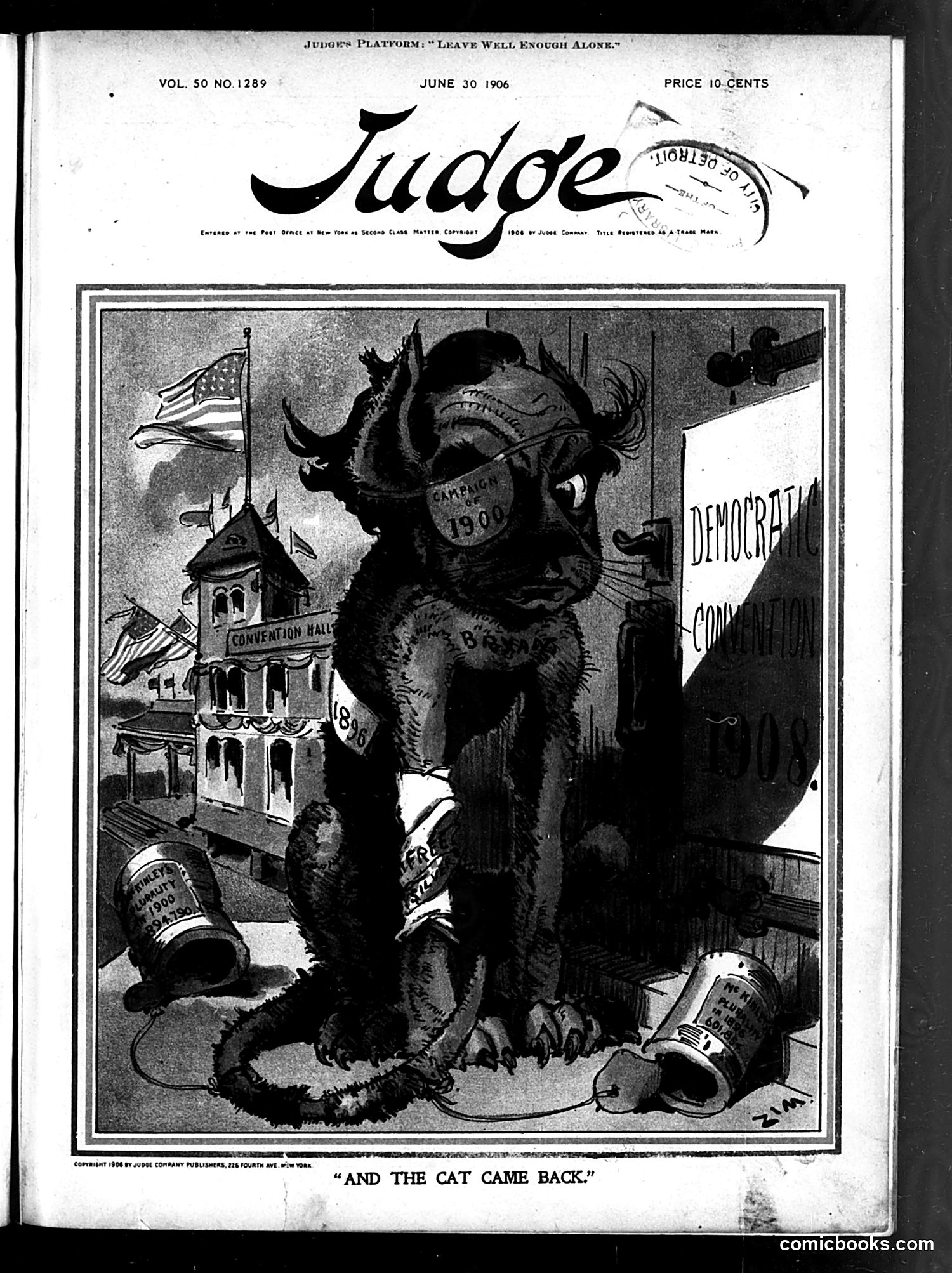
This cartoon depicts a monstrous creature labeled with "1904" emerging from a "Convention Hall," wearing a "Democratic" banner. The beast appears to represent the Democratic Party returning after the 1904 election, which Theodore Roosevelt's Republican ticket won decisively. The overturned barrels labeled "1904" suggest chaos or failure. The American flag and institutions in the background indicate national concerns about Democratic resurgence. The title "And the Cat Came Back" (referencing a popular 1893 song) sarcastically suggests the Democrats are attempting a political comeback despite their defeat. The cartoon mocks Democratic prospects for regaining power, portraying their political return as an unwelcome, monstrous intrusion into American politics.
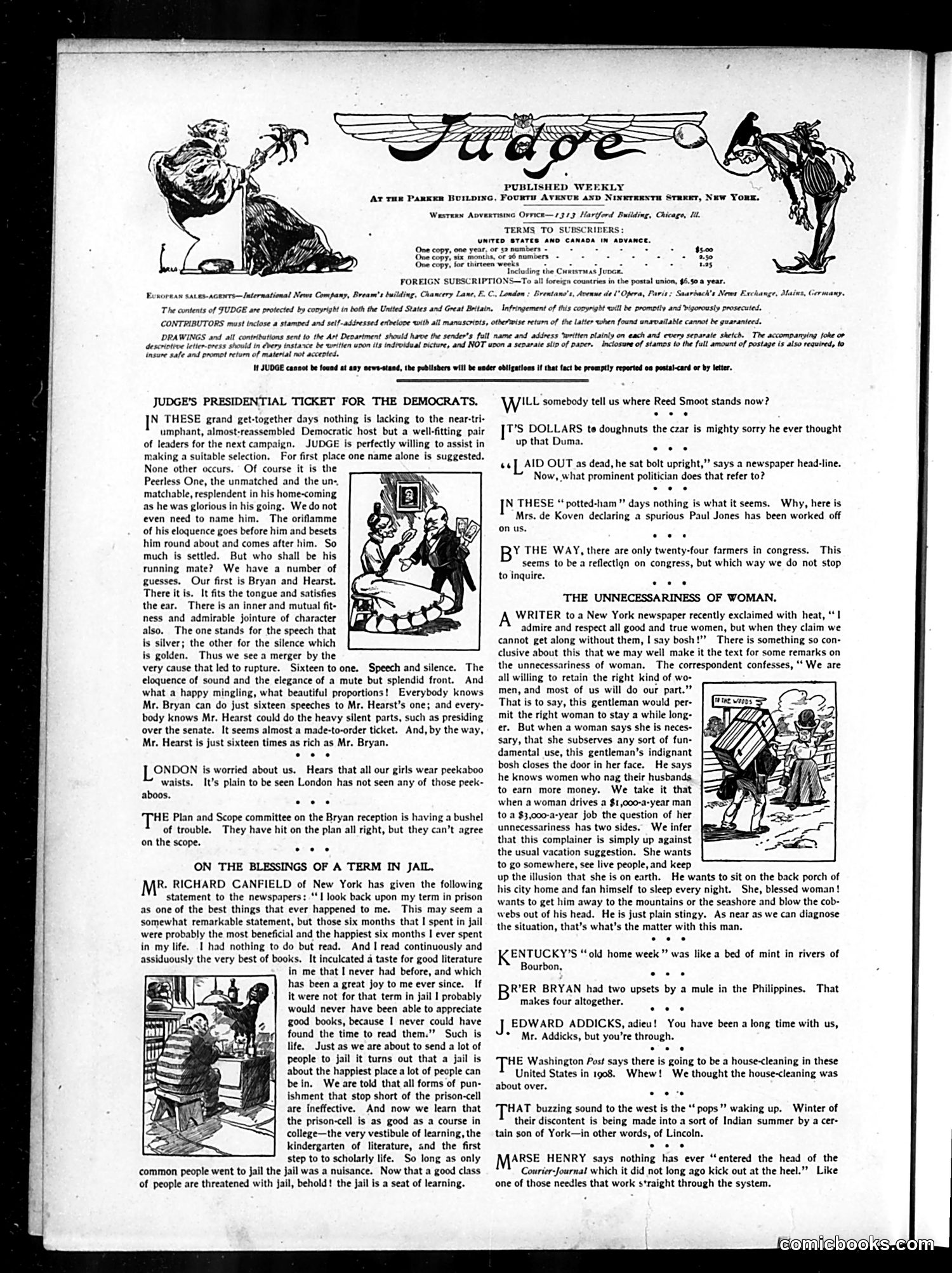
This page contains political commentary and satirical short pieces rather than traditional cartoons. The main sections mock: 1. **Judge's Presidential Ticket for Democrats** - Satirizing the Democratic Party's lack of strong candidates by suggesting "Peerless One" (likely referring to William Jennings Bryan) as nominee, questioning whether he can run the country. 2. **Various political jabs** - Including comments on Reed Smoot (a politician), criticisms of congressional farmers, and mockery of Bryan's previous defeats. 3. **"The Unnecessariness of Woman"** - A satirical piece about women's labor and wages, critiquing arguments that women shouldn't work or deserve equal pay. This reflects early 20th-century debates over women's employment rights. The accompanying illustrations are small vignettes supporting these written commentaries rather than standalone cartoons.
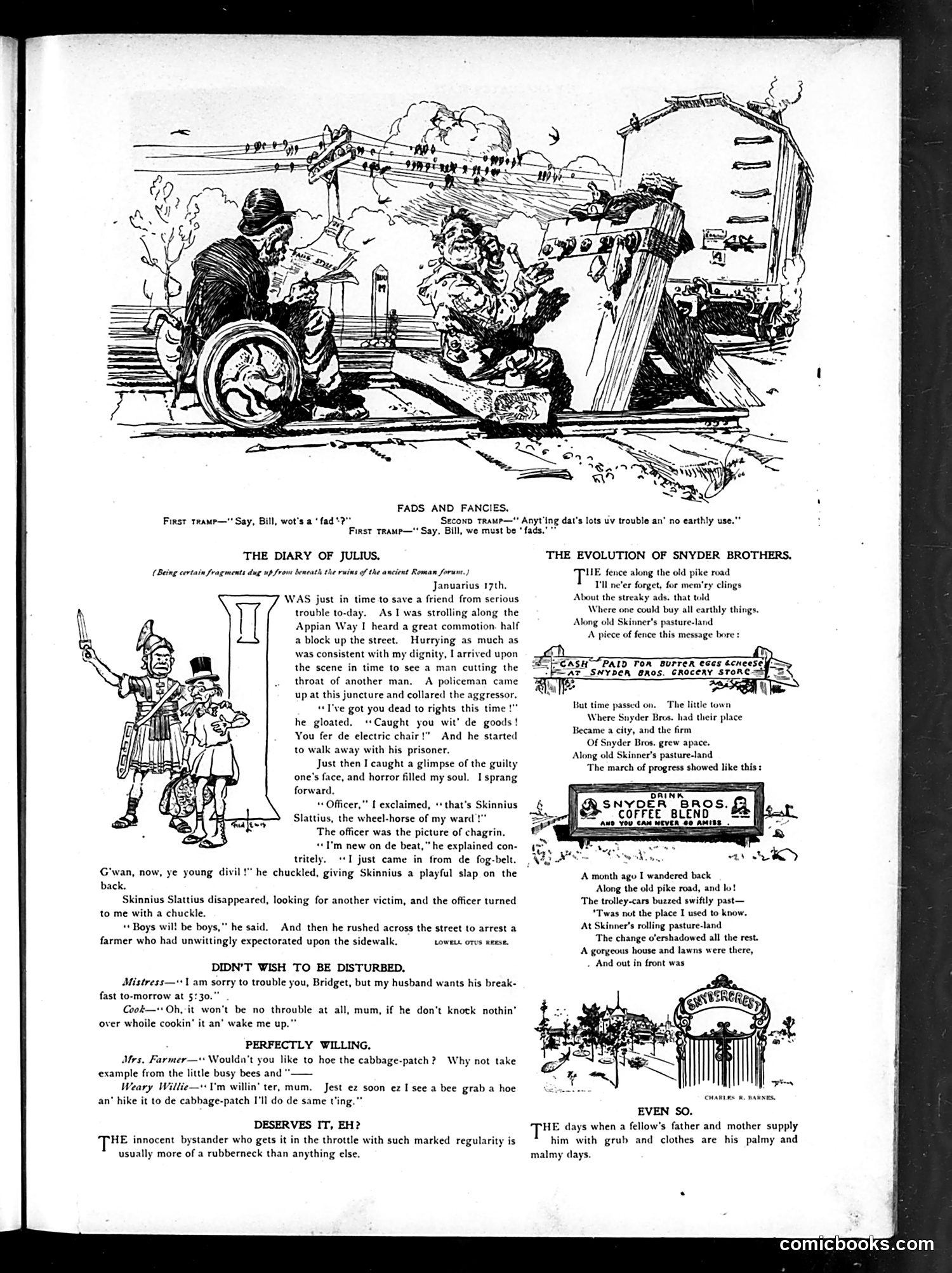
The page contains several unrelated satirical items. At top, "Fads and Fancies" shows two tramps discussing being "fad" — likely mocking contemporary trends. "The Diary of a Roman" presents a first-person account of intervening in a street altercation involving a man named Skinnius Slatius (an invented classical name for comic effect), who appears to be a streetcar conductor. The satire mocks both urban crime and the pomposity of invoking Roman history for mundane modern incidents. The remaining sections—"Didn't Wish to Be Disturbed," "Perfectly Willing," and "Deserves It, Eh?"—are brief dialogue jokes about domestic life and social etiquette, typical of Judge's humor. The advertisements (Snyder Bros. Coffee, White Crest dairy) indicate this is a commercial publication mixing editorial content with paid promotion.
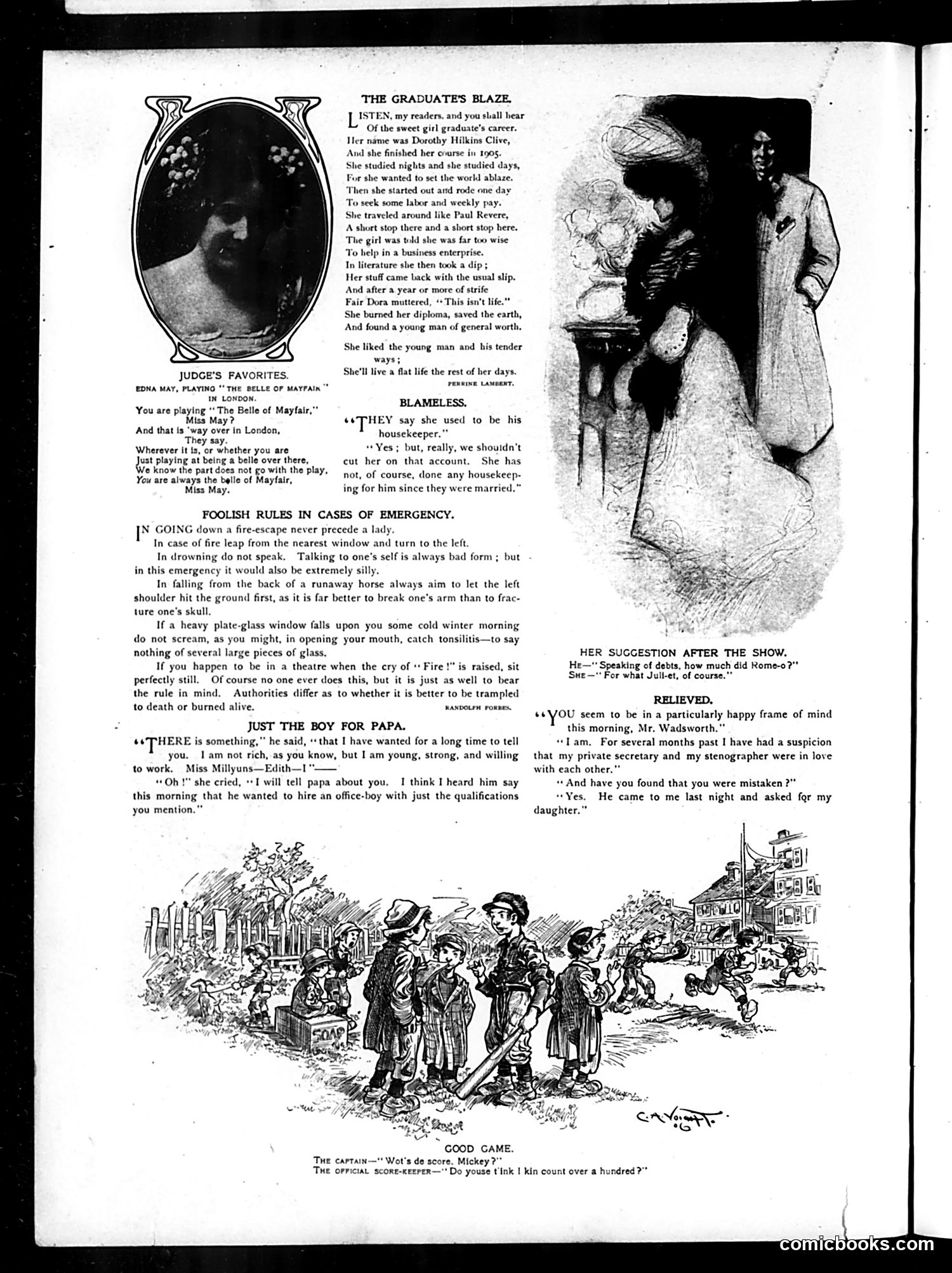
This page contains several satirical pieces and illustrations typical of early 20th-century Judge magazine: **"The Graduate's Blaze"** tells of Dorothy Hikins Clive, who graduates and pursues independence—seeking work, travel, and romance—before settling into domestic life. The satire mocks the "New Woman" of the era who briefly rebels against traditional roles. **"Judge's Favorites"** jokes about actress Edna May always playing "The Belle of Mayfair" in London, suggesting she's typecast regardless of role. **"Foolish Rules in Cases of Emergency"** offers absurdist safety advice (leap left in fires, fall from horses onto your left shoulder), satirizing poorly-thought-out emergency protocols. The bottom illustration shows children playing, captioned "Good Game," with dialogue about keeping score—likely mocking adult competitiveness. The content reflects early 1900s American social satire and gender commentary.
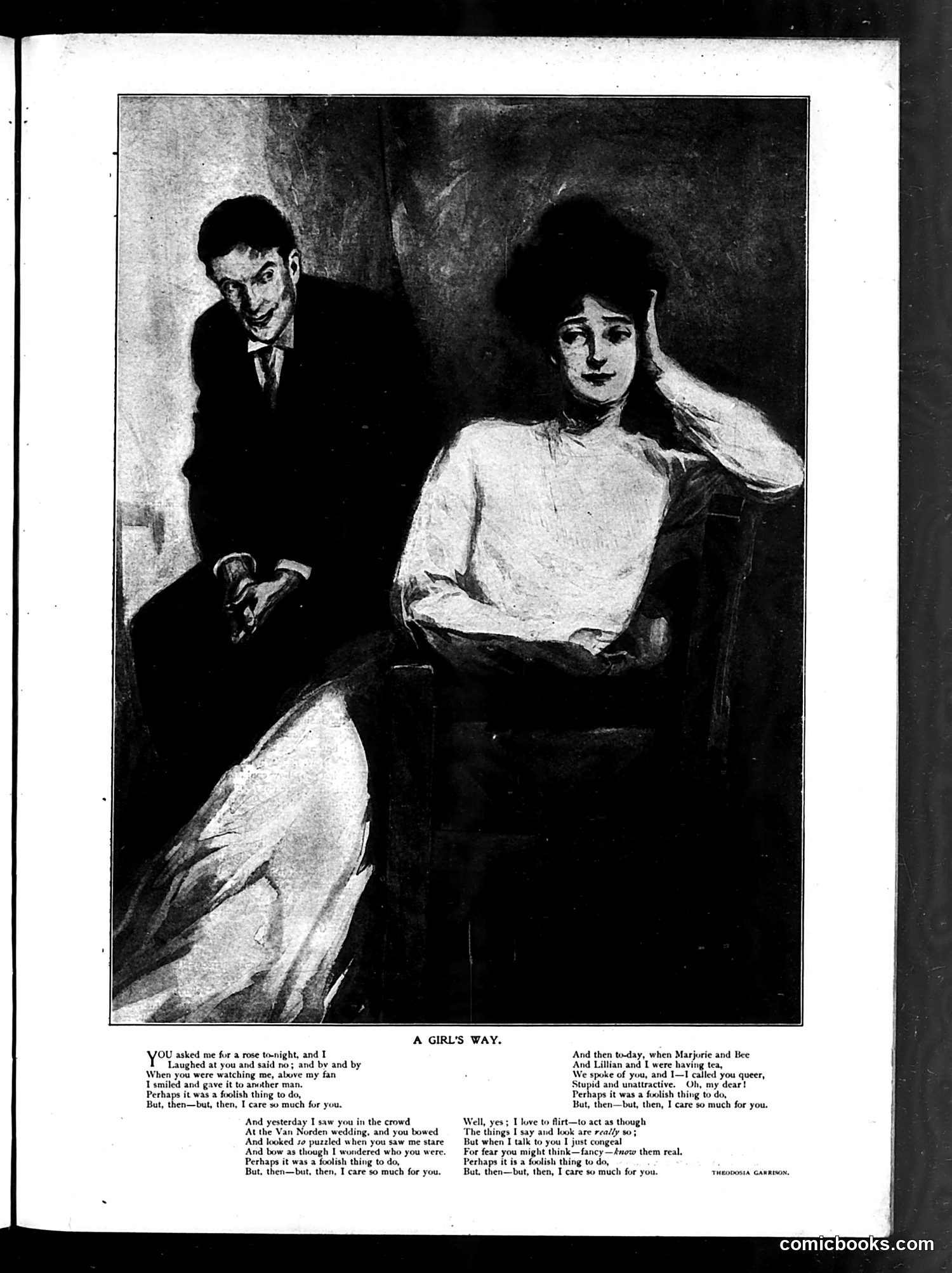
This illustration depicts a domestic scene with a woman seated and a man standing behind her. The accompanying poem, attributed to Theodora Garrison, explores themes of romantic jealousy and reassurance in a relationship. The text references the woman's past romantic encounters—mentioning seeing the man "in the crowd" at a "Van Noorden wedding" and wondering about his identity. The poem suggests she had flirted with or been interested in other men ("I love to flirt"). The man expresses concern about her attention to others, while she reassures him of her commitment, repeatedly insisting "it's a foolish thing to do" regarding her past behavior. The satire appears to comment on courtship anxieties and the social dynamics of romance among the magazine's middle-class readership, capturing the uncertainty and jealousies inherent in romantic relationships of the era.
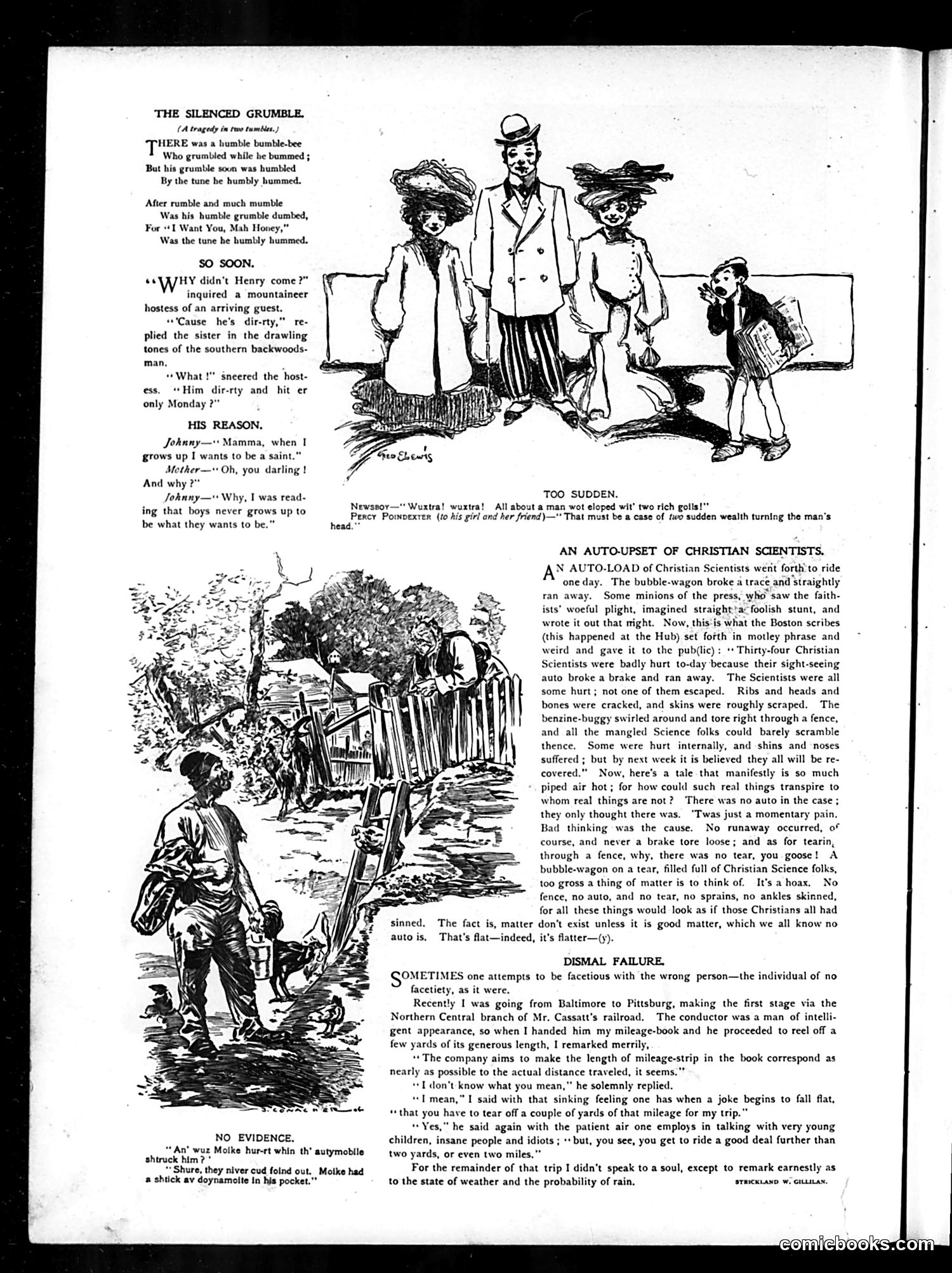
This page contains multiple satirical pieces mocking Christian Scientists and featuring period humor: **"The Silenced Grumble"** is a whimsical poem-cartoon about a bumble-bee whose complaining is stopped by hearing a popular song ("I Want You, Mah Honey")—light, nonsensical humor. **"An Auto-Upset of Christian Scientists"** is the primary satire. It mocks Christian Science beliefs by ridiculing newspaper accounts of a car accident involving Christian Scientists. The joke: if Christian Scientists truly believe matter doesn't exist, how could they actually be injured in a car crash? The piece sarcastically notes that according to their doctrine, the accident couldn't have happened since matter—including cars, fences, and physical injuries—is merely illusion. This attacks the perceived logical inconsistency of Christian Science theology when confronted with material reality. The remaining items are lighter jokes about rural dialect humor and a failed railroad-conductor joke. The satire targets Christian Science's metaphysical claims about the nature of physical reality.
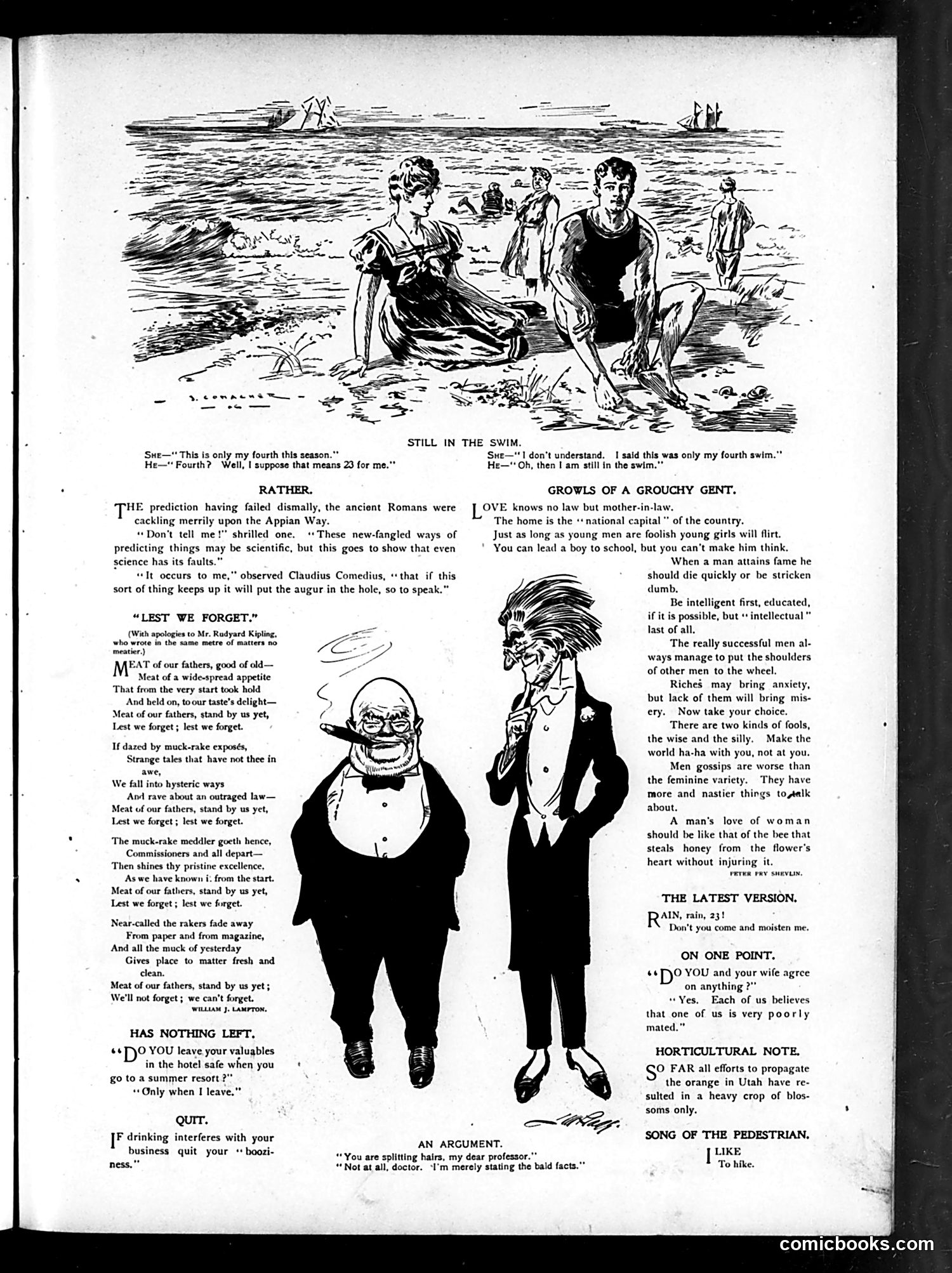
This page contains multiple satirical pieces typical of early 20th-century American humor. The top cartoon mocks courtship rituals—a woman claims this is her "fourth swim" of the season, while a man interprets "fourth" as meaning she's had 23 total swims, suggesting promiscuity or loose behavior. The "Lest We Forget" poem parodies Kipling, ironically praising meat consumption while mocking muckraking journalism. It suggests that scandal-mongering reforms fade away, allowing Americans to return comfortably to old habits—satire of both reformers and public complacency. Other pieces target contemporary social targets: the "Grouchy Gent" section offers misogynistic aphorisms; the Roman prediction joke likely references failed political predictions; and "An Argument" plays on the phrase "splitting hairs" versus "bald facts." Overall, this reflects Judge's conservative stance—skeptical of reform movements and progressive change, favoring traditional social arrangements and gentle mockery of modern anxieties.
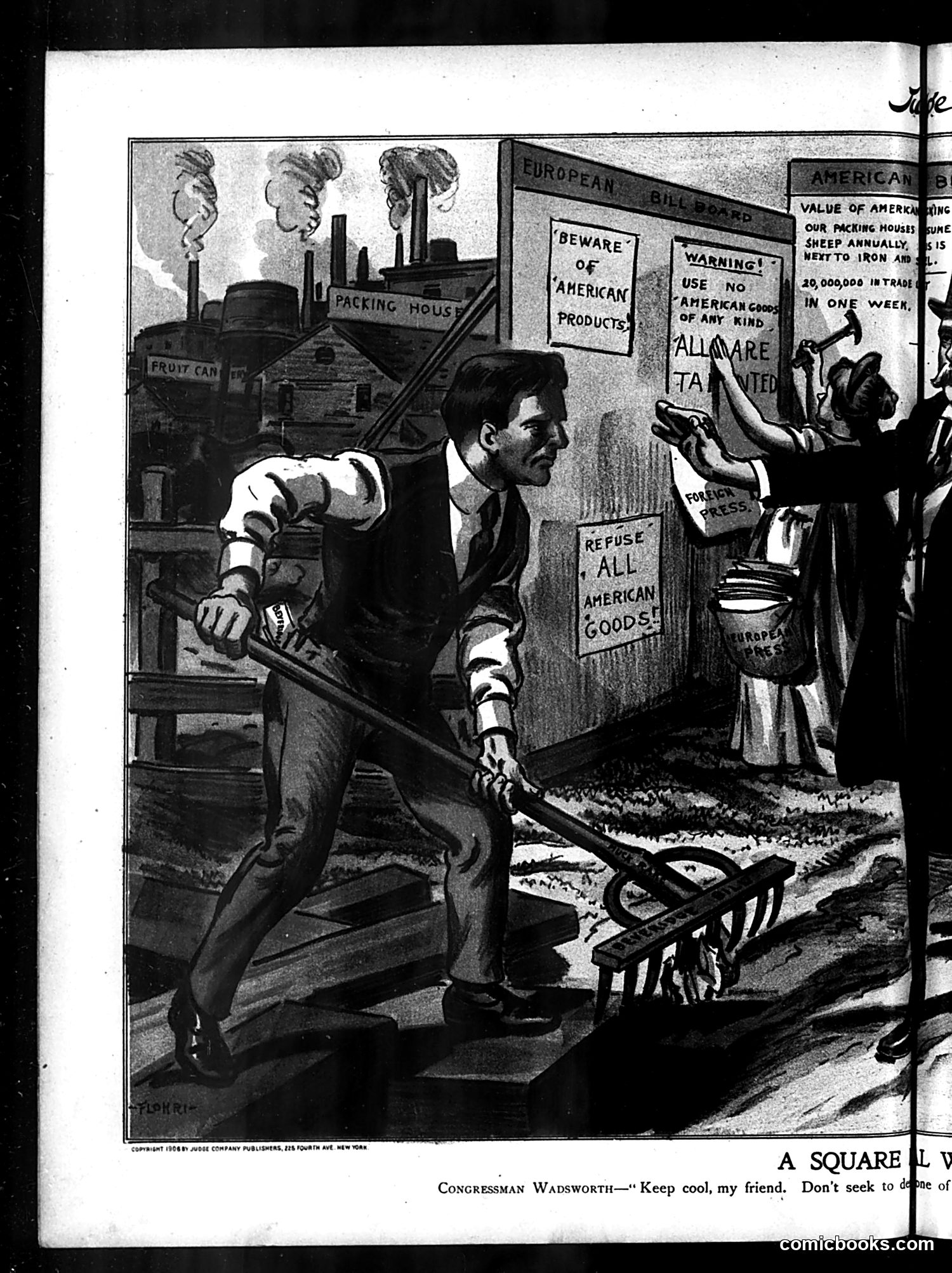
This cartoon satirizes American protectionist sentiment circa 1908. A man labeled "Congressman Wadsworth" wields a rake against European boycotts of American goods. Signs behind him read "BEWARE OF AMERICAN PRODUCTS," "WARNING! USE NO AMERICAN GOODS," and "REFUSE ALL AMERICAN GOODS!"—representing European retaliation. The cartoon depicts a trade war: Europeans are boycotting American meat and agricultural exports (the packing house reference), while Wadsworth attempts to sweep away this opposition. The "European Bill Board" in the background advertises the boycott campaign. The satire suggests that protectionist policies provoke foreign retaliation, creating economic problems the congressman cannot simply "rake away." The cartoon critiques the futility of nationalist trade barriers in generating international economic conflict.
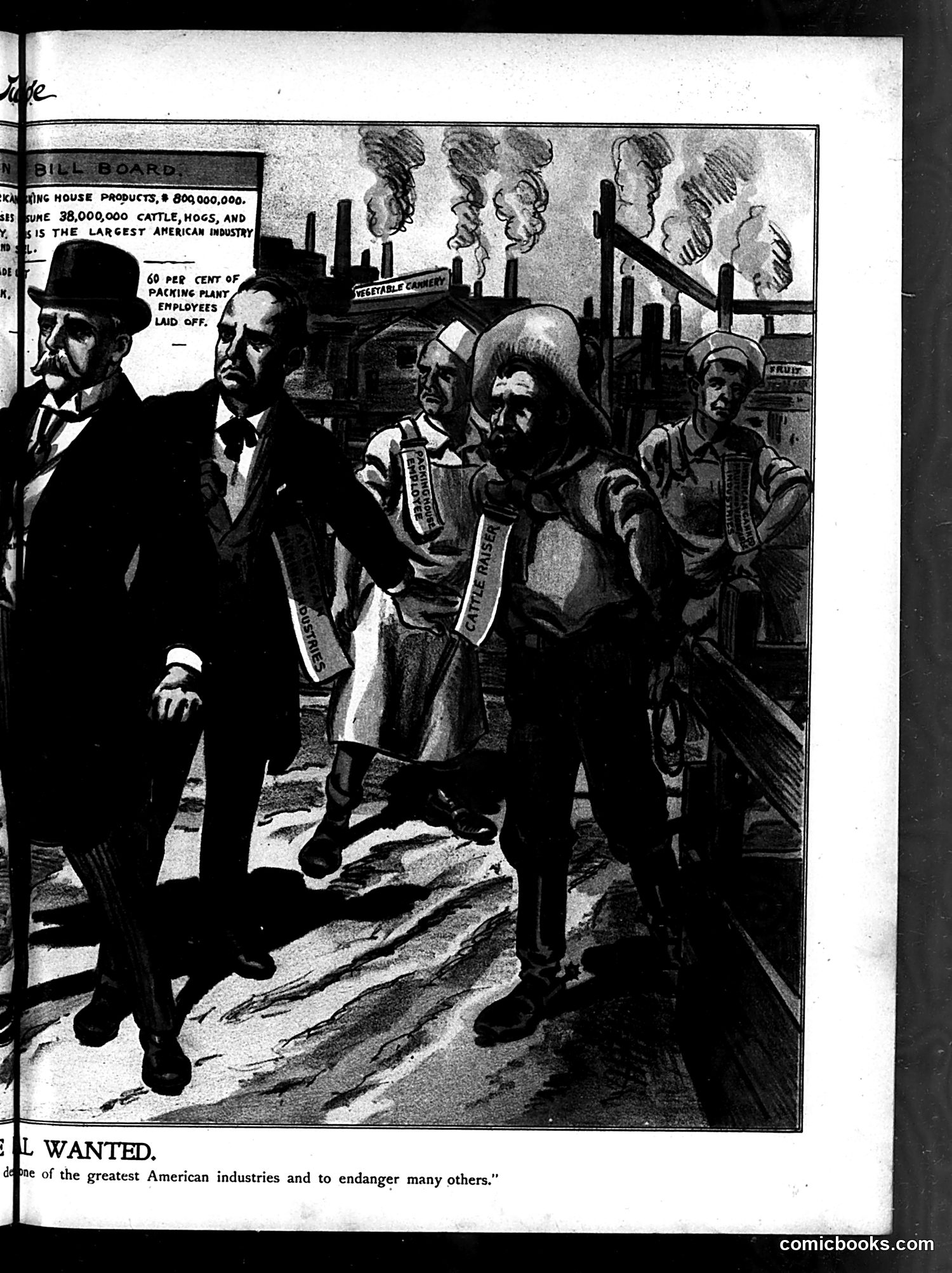
This appears to be a political cartoon from *Judge* magazine critiquing the meatpacking industry. The "Bill Board" at left lists staggering figures—$800 million in products, 38 million cattle and hogs—establishing meatpacking as America's largest industry. The cartoon depicts well-dressed capitalists or industry figures confronting what appear to be workers wearing sashes (possibly union members or strikers). The industrial smokestacks in the background emphasize the scale of the industry. The partial caption warns that some entity or action threatens "one of the greatest American industries and to endanger many others." This likely satirizes either labor unrest in meatpacking or criticism of monopolistic practices by major packers like Armour or Swift. The satire appears to mock industry leadership's alarm at challenges to their dominance, possibly referencing the famous 1906 *Sinclair* exposé or subsequent labor organizing efforts that threatened industry profits and practices.
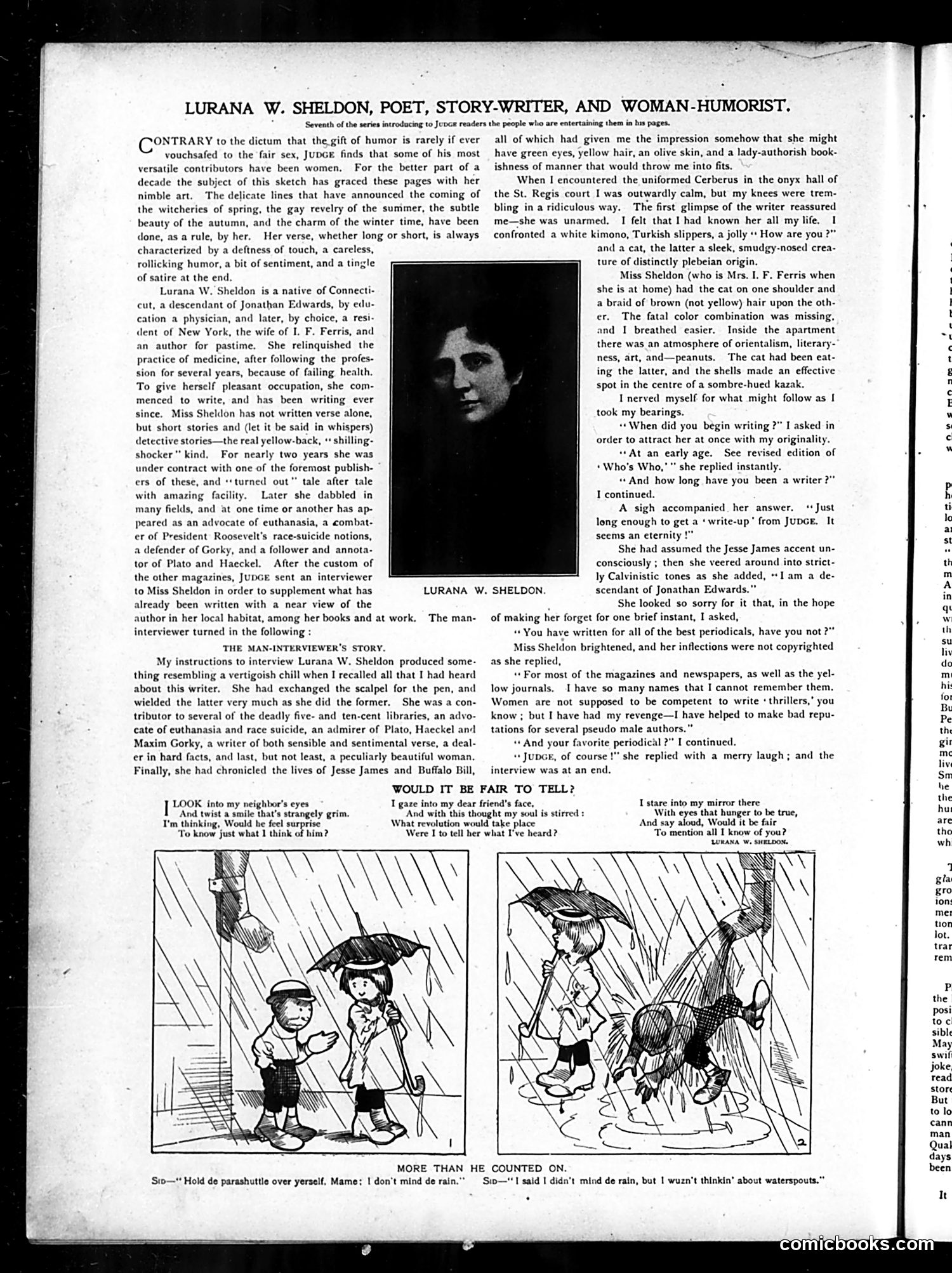
This is a **profile of Lurana W. Sheldon**, a female contributor to *Judge* magazine, presented as the seventh in a series introducing the magazine's writers to readers. The page challenges the stereotype that women lack humor, highlighting Sheldon's versatility as a poet, illustrator, and writer of detective stories and social commentary. She was a Connecticut-born physician who abandoned medicine for writing due to ill health. The satirical angle appears subtle: the "man-interviewer" admits he expected her to be intimidating based on her intellectual interests (Plato, Haeckel, euthanasia advocacy, defending Maxim Gorky), yet found her instead disarmingly approachable—wearing a kimono, holding a cat, cheerfully greeting him. **The two cartoons below** depict children in rain, with captions showing a child asking his mother to hold the parasol, then later claiming he "wasn't thinkin' about waterspouts"—a mild joke about childhood forgetfulness rather than political satire.
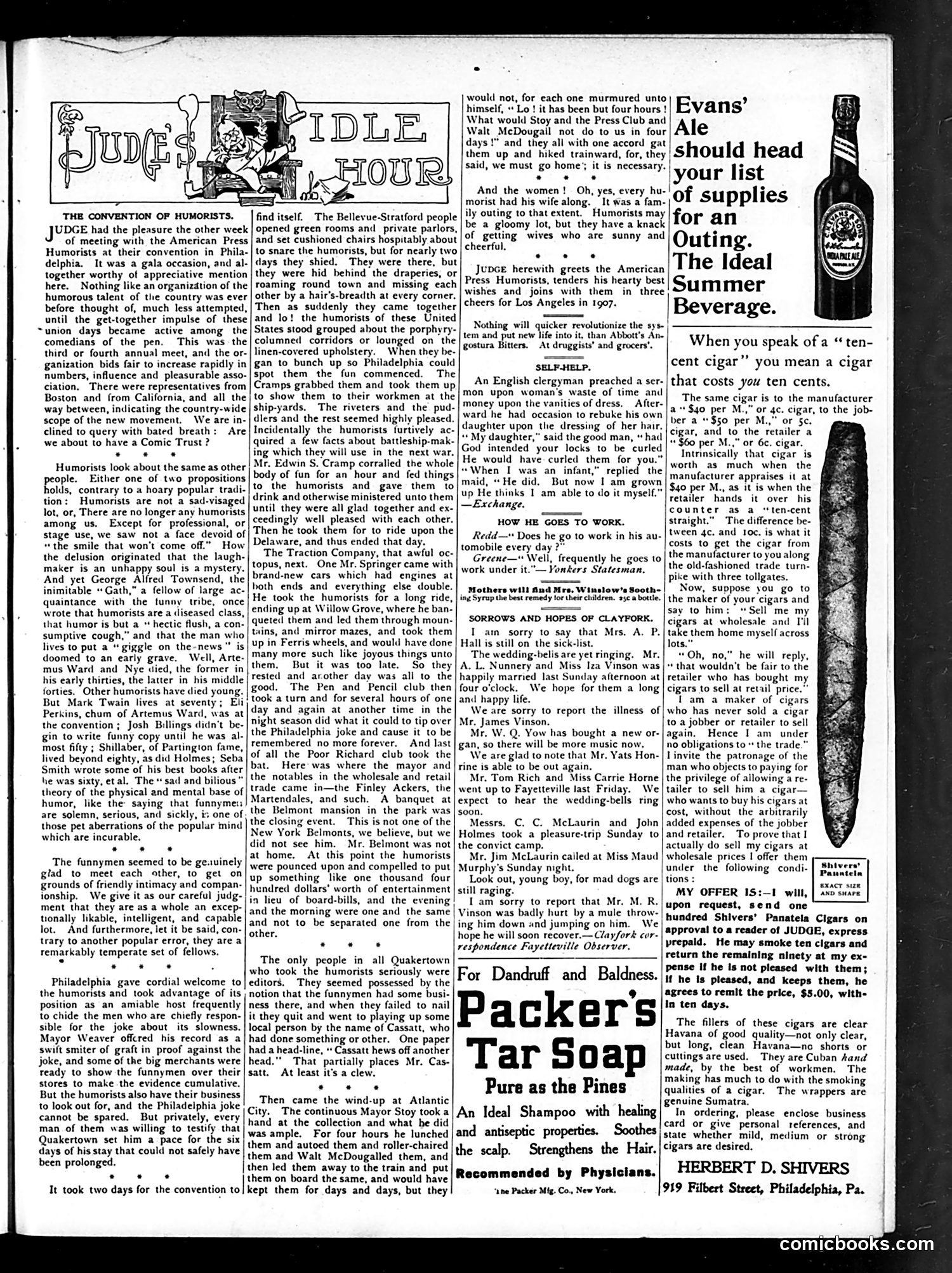
This article celebrates a gathering of American newspaper humorists—professional comedy writers and columnists—at Philadelphia's Bellevue-Stratford hotel. Judge magazine reports on this third or fourth annual convention with genuine enthusiasm, noting the diverse representation from Boston to California. The piece debunks the romantic myth that humorists are melancholic, sickly figures doomed to early death. While citing some early deaths (Artemus Ward, Bill Nye), it counters with living counterexamples: Mark Twain at seventy, Josh Billings who started late, and Oliver Wendell Holmes who lived past eighty. The article humorously describes the initial shyness of attendees despite comfortable accommodations, and includes Philadelphia's defensive responses to its own reputation for slowness—the "Philadelphia joke" being a period cliché about the city's sluggish pace. The overall tone celebrates American humor as a legitimate profession and humorists as intelligent, likable, and notably temperate professionals.
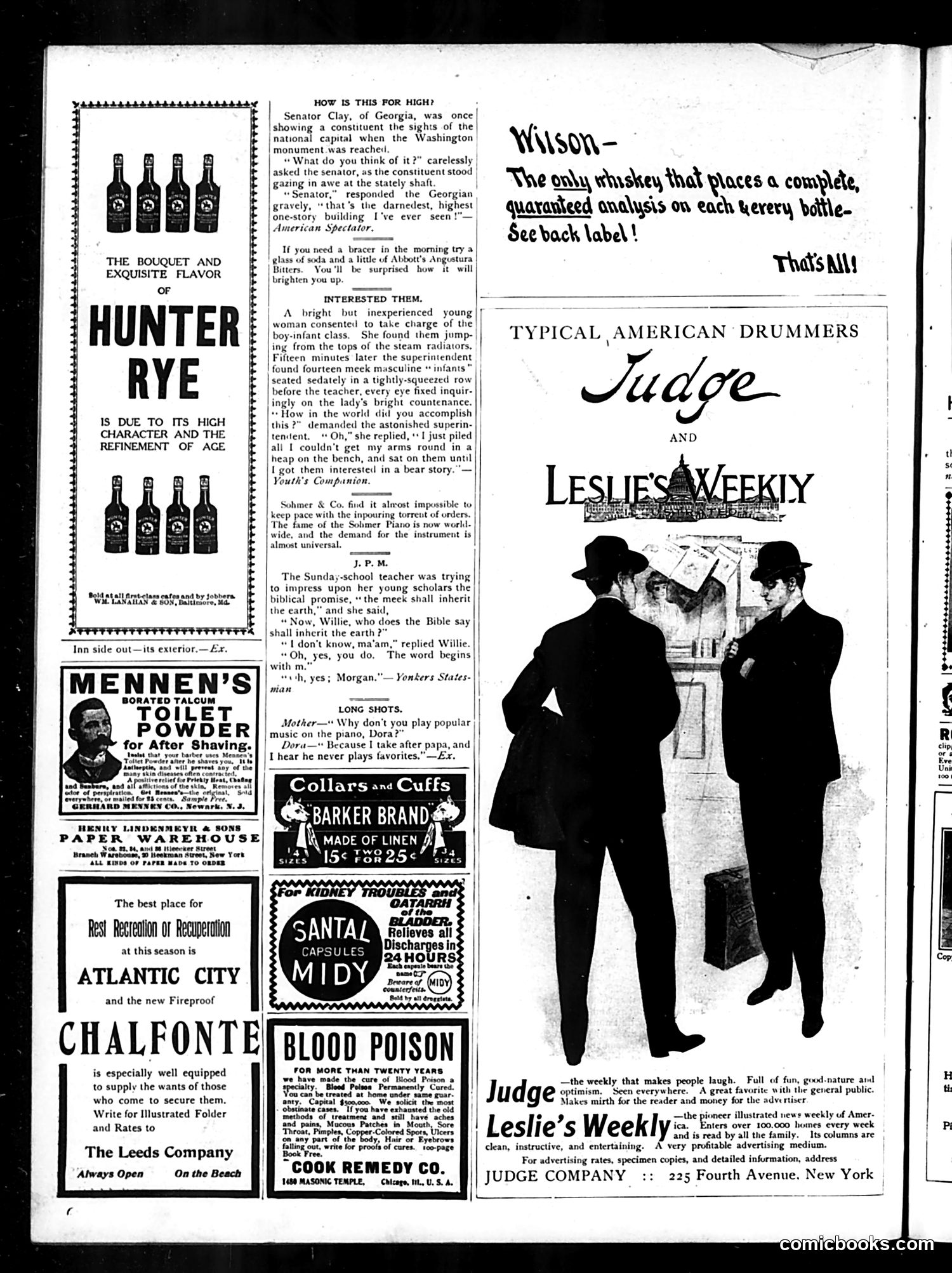
This page is primarily **advertising**, with minimal satirical content. The main cartoon appears in the upper left: a Georgia senator shows a constituent the Washington Monument, calling it "the darnedest, highest one-story building I've ever seen!" **The Satire:** The joke mocks Southern provincialism and ignorance. A senator—supposedly educated and well-traveled—fails to recognize one of America's most famous monuments, instead reducing it to crude architectural terminology ("one-story building"). This plays on period stereotypes about Southern politicians as unsophisticated outsiders unfamiliar with national institutions. The page otherwise contains unrelated short humorous anecdotes (a schoolteacher managing rowdy boys, biblical wordplay about "meek" and "Morgan") and numerous period advertisements for whiskey, talcum powder, pianos, collars, and patent medicines—typical of Judge's revenue model. The central large advertisement promotes Judge and Leslie's Weekly magazines themselves, emphasizing their humor and mass readership.
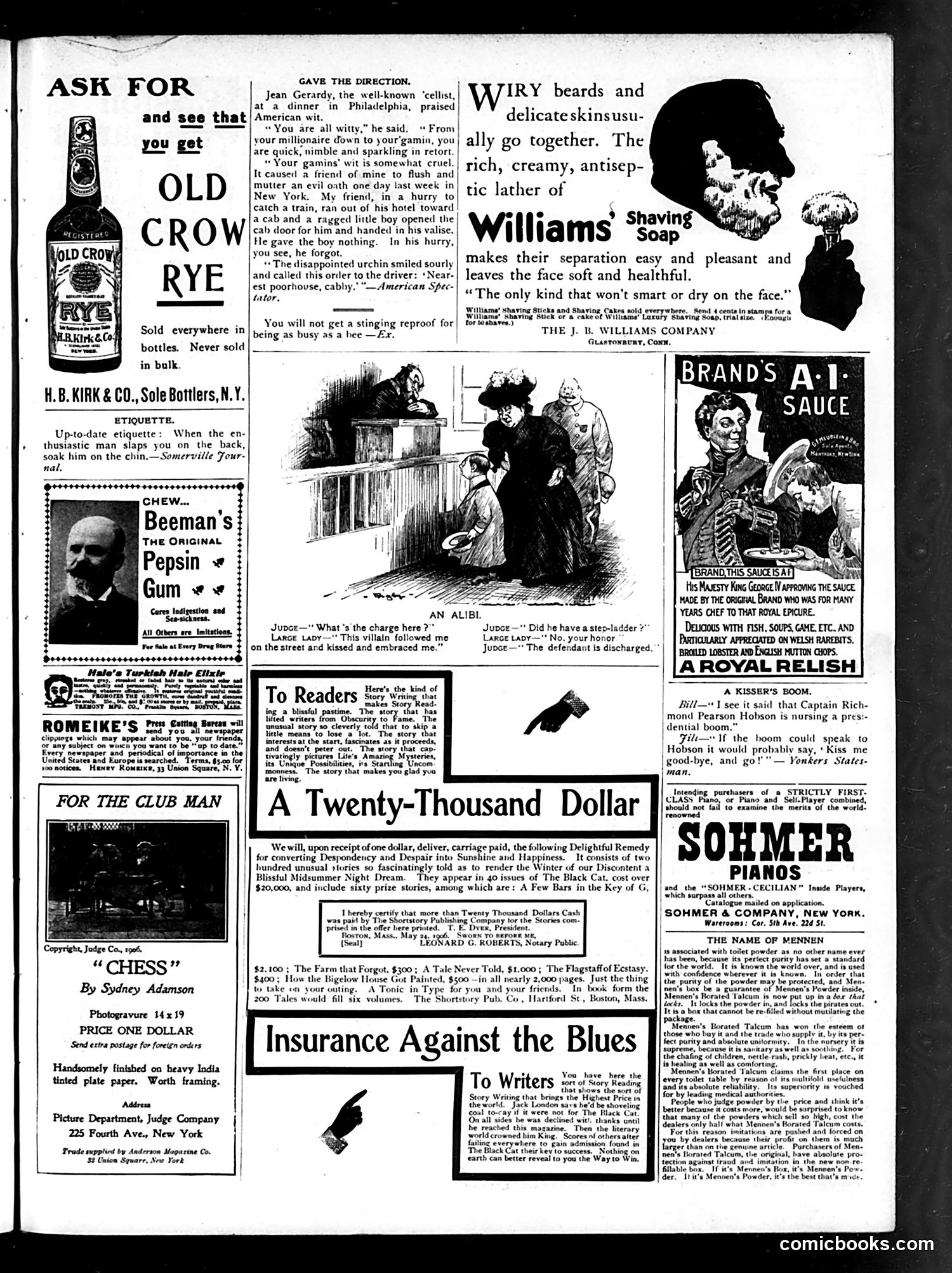
This page from Judge magazine (appears to be early 1900s) is primarily **advertising content** with limited satire. The main items worth noting: **"An Alibi" Courtroom Cartoon**: A brief sketch where a woman accuses a man of street harassment. The punchline pivots on the judge asking if he had a "step-ladder"—implying the defendant's short stature made the accusation absurd. This represents period humor relying on physical characteristics for comic effect. **"A Kisser's Boom"**: A quip about Captain Richmond Pearson Hobson (a real Spanish-American War hero) reportedly seeking presidential election. "Bill" suggests the "boom" (political momentum) should tell Hobson to "kiss...goodbye," mocking his candidacy as unviable. The remainder consists of advertisements for whiskey, shaving soap, pianos, gum, clipping services, and story collections—typical Judge magazine filler. The content reflects early-1900s advertising styles and social attitudes rather than sustained political satire.
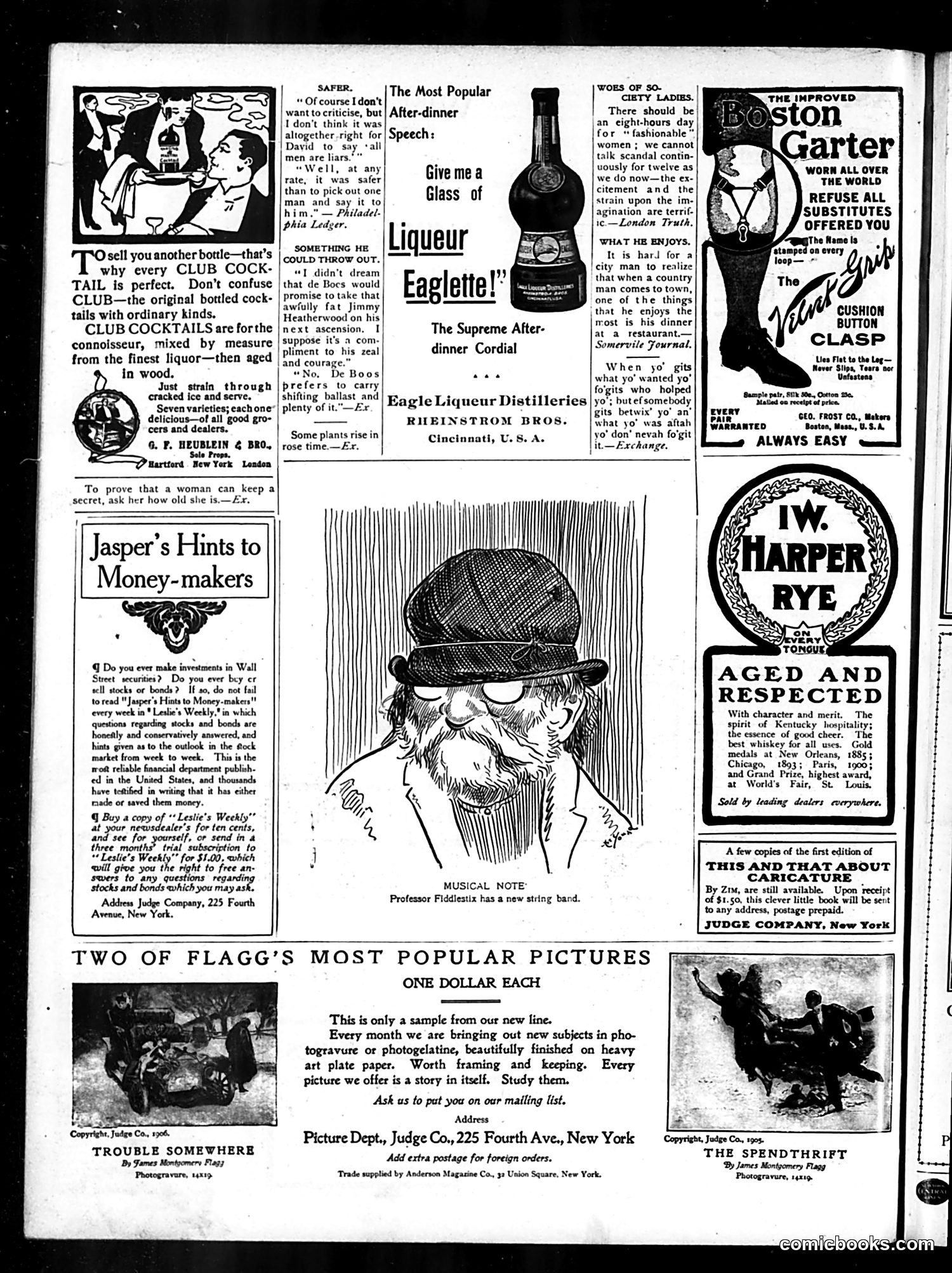
This is primarily an **advertising and humor page** from an early 1900s Judge magazine. The main satirical content includes: **"SAFER"** (top left): A cartoon joke about biblical criticism—the punch line being that blanket statements ("all men are liars") are safer than directed accusations, since they can't be personally refuted. **"WOES OF SOCIETY LADIES"**: A satirical jab at wealthy women, suggesting they gossip so continuously about scandal that an eight-hour workday would exhaust them from the mental strain—mocking both female socialites and their perceived preoccupation with rumor-mongering. **"WHAT HE ENJOYS"**: Rural-urban contrast humor: city dwellers underestimate how much country visitors prize restaurant dining—a jab at both rustic simplicity and urban sophistication. The page is otherwise dominated by **period liquor and product advertisements** (Eagle Liqueur, Boston Garter, Harper Rye), reflecting Judge's commercial model. The Flagg illustrations at bottom advertise art reproductions.
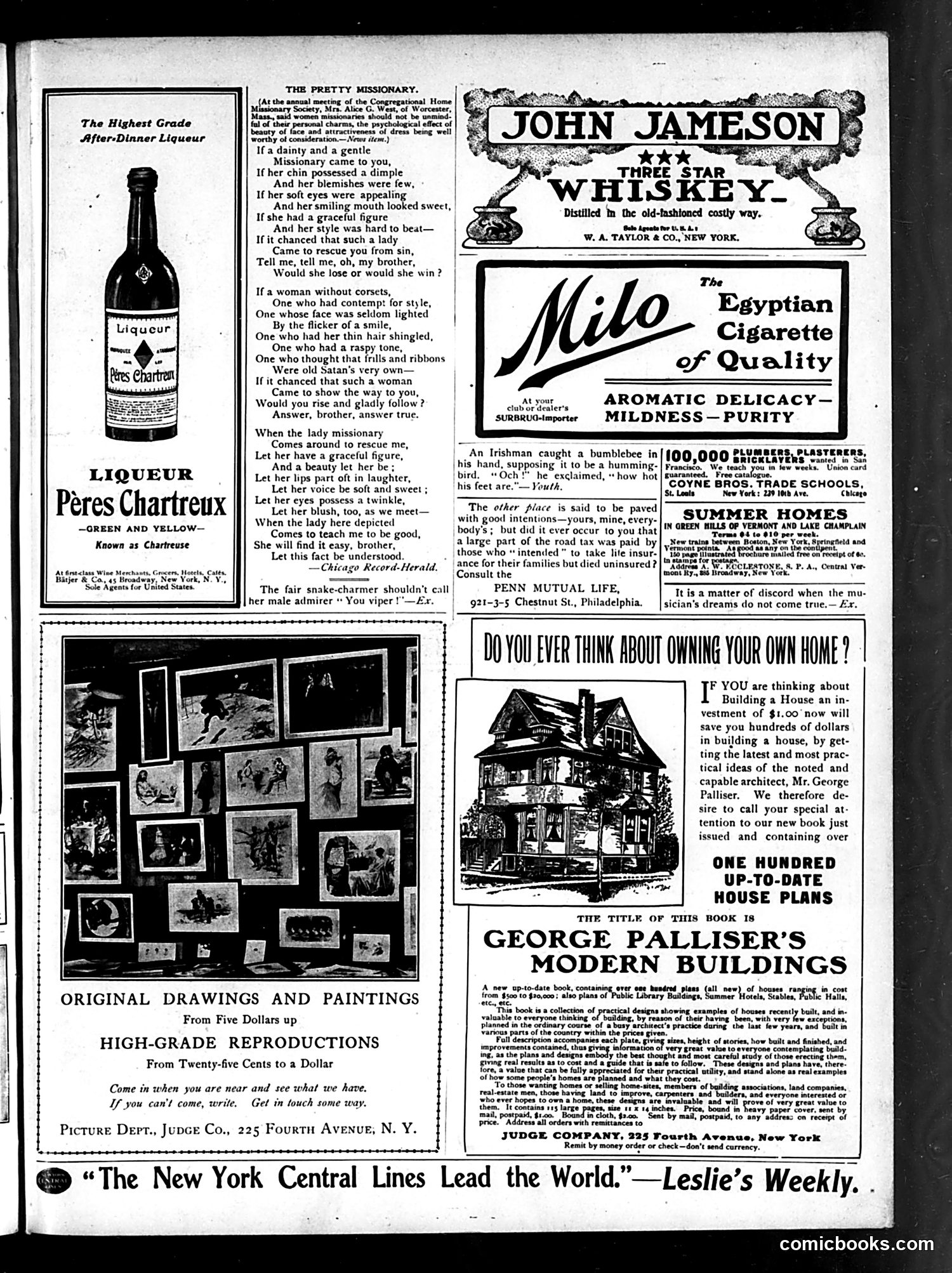
This page's main content is a poem-cartoon from the *Chicago Record-Herald* satirizing male hypocrisy regarding female missionaries. The piece contrasts two scenarios: a beautiful, fashionable woman versus an unattractive one, both seeking to convert the narrator to righteousness. The satire's point is blunt: the poem's speaker admits he'd only accept spiritual salvation from an attractive woman with "graceful figure," "soft" voice, and beauty—not from an plain woman lacking "corsets," "style," or conventional femininity. The joke exposes how men of this era claimed moral seriousness while actually being driven by physical attraction. By having the narrator openly admit this shallow preference, the poet mocks Victorian male pretense about piety and self-improvement. A closing quip about a "snake-charmer" reinforces the seductive manipulation theme. The surrounding ads (liqueur, cigarettes, home-building guides) are typical magazine filler, unrelated to the satire's social commentary on gender and morality.
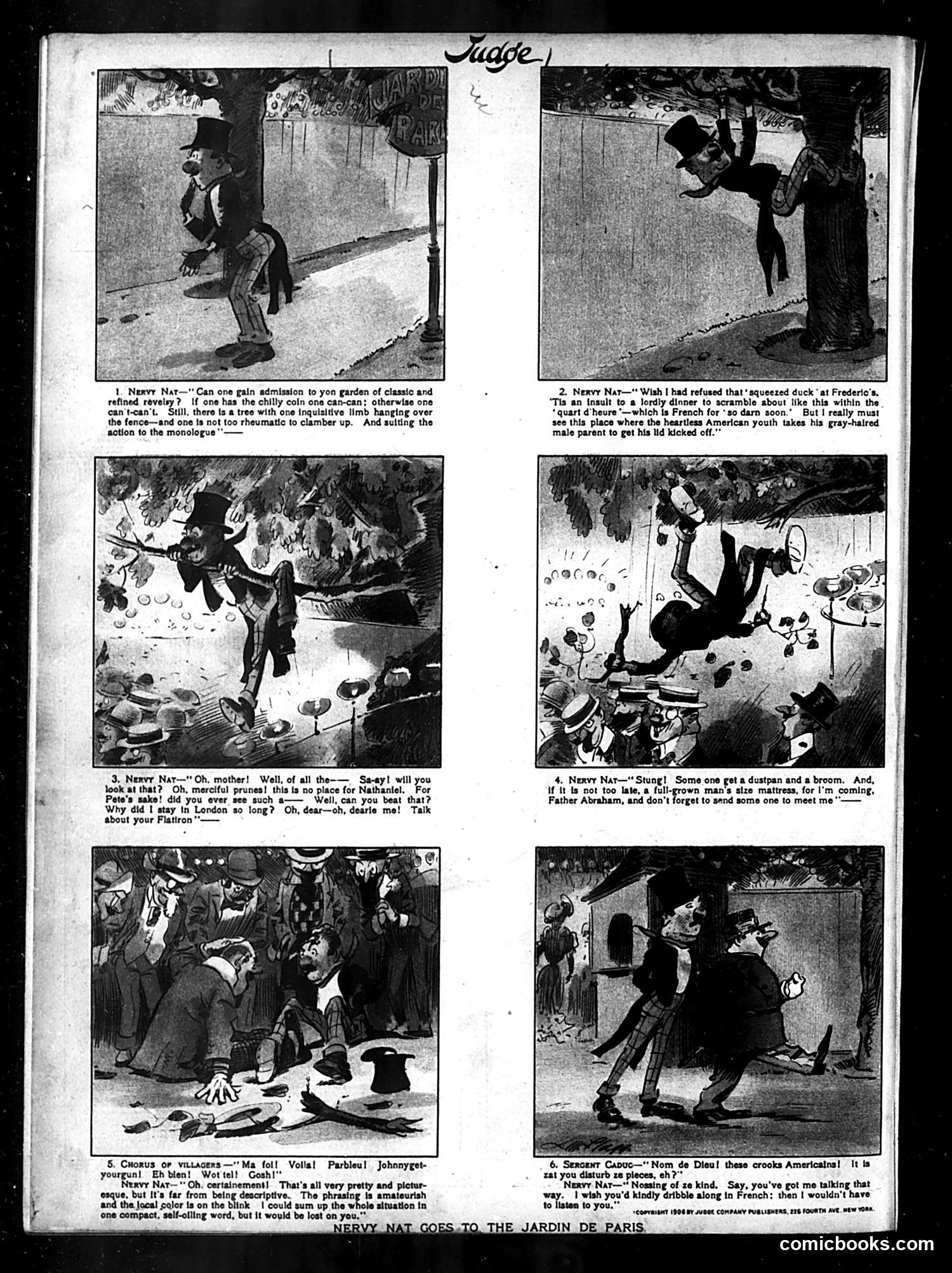
This is a six-panel comic strip following "Nervy Nat," an American character visiting the Jardin de Paris, a famous Parisian nightclub/garden venue. The satire mocks both the pretentious European establishment and the brash American tourist. Nat sneaks into the exclusive garden, gets indigestion from fancy French food ("squeezed duck"), and becomes physically ill while trying to appear cultured. He mangles French phrases, offends waiters and patrons with his loud behavior, and generally causes chaos—culminating in property damage and his eventual expulsion. The humor derives from the contrast between Nat's determination to experience refined European culture and his inability to behave appropriately. Judge magazine frequently satirized American tourists abroad as uncouth and culturally ignorant, while also mocking European snobbery. The character's name itself—"Nervy Nat"—signals his cheek and audacity. This represents early 20th-century American anxieties about social class and international sophistication.

I can see this is a page from Judge magazine, but the image quality is too poor for me to reliably make out specific cartoon content, caricatures, or text beyond the watermark. The page appears very dark and grainy, with some faint decorative or patterned elements visible, but I cannot discern distinct figures, political references, or the satirical point with confidence. To provide accurate historical context as requested, I would need a clearer image where I can actually read the OCR text reliably and see the cartoon illustrations distinctly. I won't speculate about content I cannot clearly see.