
Judge, 1906-06-30 · page 10 of 17
Judge — June 30, 1906 — page 10: what you’re looking at
What you’re looking at
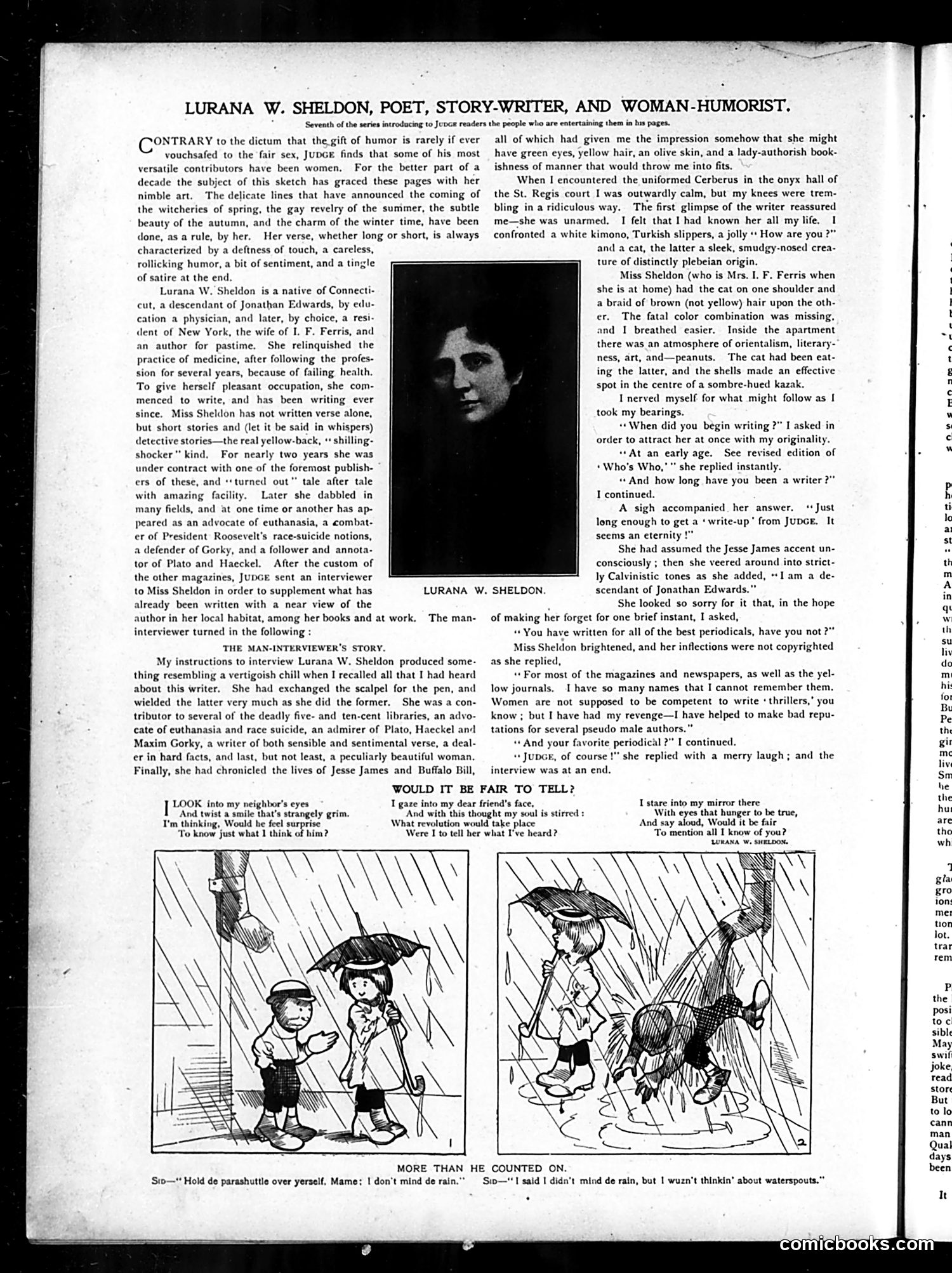
This is a **profile of Lurana W. Sheldon**, a female contributor to *Judge* magazine, presented as the seventh in a series introducing the magazine's writers to readers. The page challenges the stereotype that women lack humor, highlighting Sheldon's versatility as a poet, illustrator, and writer of detective stories and social commentary. She was a Connecticut-born physician who abandoned medicine for writing due to ill health. The satirical angle appears subtle: the "man-interviewer" admits he expected her to be intimidating based on her intellectual interests (Plato, Haeckel, euthanasia advocacy, defending Maxim Gorky), yet found her instead disarmingly approachable—wearing a kimono, holding a cat, cheerfully greeting him. **The two cartoons below** depict children in rain, with captions showing a child asking his mother to hold the parasol, then later claiming he "wasn't thinkin' about waterspouts"—a mild joke about childhood forgetfulness rather than political satire.
📄 Transcribed text from this page (OCR, searchable)
Machine-transcribed from the original scan — historical spelling and the odd misread are preserved.
LURANA W. SHELDON, POET, STORY-WRITER, AND WOMAN-HUMORIST. Seventh of the series introducing to Juvck readers the people who are entertaining them in his pages. CONTRARY to the dictum that the gift of humor is rarely if ever vouchsafed to the fair sex, JUDGE finds that some of his most versatile contributors have been women, For the better part of a decade the subject of this sketch has graced these pages with her nimble art. The delicate lines that have announced the coming of the witcheries of spring, the gay revelry of the sumimer, the subtle beauty of the autumn, and the charm of the winter time, have been done, as a rule, by her. Her verse, whether long or short, is always characterized by a deftness of touch, a careless, rollicking humor, a bit of sentiment, and a tingle of satire at the end. Lurana W. Sheldon is a native of Connecti- cut, a descendant of Jonathan Edwards, by edu- cation a physician, and later, by choice, a resi- dent of New York, the wife of I. F. Ferris, and an author for pastime. She relinquished the practice of medicine, after following the profes- sion for several years, because of failing health. To give herself pleasant occupation, she com- menced to write, and has been writing ever since. Miss Sheldon has not written verse alone, but short stories and (let it be said in whispers) detective stories—the real yellow-back, « shilling- shocker" kind, For nearly two years she was under contract with one of the foremost publish- ers of these, and ‘turned out” tale after tale with amazing facility. Later she dabbled in many fields, and at one time or another has ap- peared as an advocate of euthanasia, a combat- er of President Roosevelt's race-suicide notions, a defender of Gorky, and a follower and annota- tor of Plato and Haeckel. After the custom of the other magazines, JUDGE sent an interviewer to Miss Sheldon in order to supplement what has already been written with a near view of the author in her local habitat, among her books and at work. The man- interviewer turned in the following : THE MAN-INTERVIEWER'S STORY. My instructions to interview Lurana W. Sheldon produced some- thing resembling a vertigoish chill when I recalled all that I had heard about this writer. She had exchanged the scalpel for the pen, and wielded the latter very much as she did the former. She was a con- tributor to several of the deadly five- and ten-cent libraries, an advo- cate of euthanasia and race suicide, an admirer of Plato, Haeckel an‘ Maxim Gorky, a writer of both sensible and sentimental verse, a deal- er in hard facts, and last, but not least, a peculiarly beautiful woman. Finally, she had chronicled the lives of Jesse James and Buffalo Bill, LURANA W. SHELDON. all of which had given me the impression somehow that she might have green eyes, yellow hair, an olive skin, and a lady-authorish book- ishness of manner that would throw me into fits. When I encountered the uniformed Cerberus in the onyx hall of the St. Regis court I was outwardly calm, but my knees were trem- bling in a ridiculous way. The first glimpse of the writer reassured me—she was unarmed. I felt that | had known her all my life. I confronted a white kimono, Turkish slippers, a jolly «« How are you ?” and a cat, the latter a sleek, smudgy-nosed crea- ture of distinctly plebeian origin. Miss Sheldon (who is Mrs. I. F. Ferris when she is at home) had the cat on one shoulder and a braid of brown (not yellow) hair upon the oth- er. The fatal color combination was missing, and I breathed easier. Inside the apartment there was an atmosphere of orientalism, literary- ness, art, and—peanuts. The cat had been eat- ing the latter, and the shells made an effective spot in the centre of a sombre-hued kazak. Inerved myself for what might follow as I took my bearings. “When did you begin writing?” I asked in order to attract her at once with my originali “At an early age. See revised edition of + Who's Who,’ " she replied instantly. “And how long have you been a writer?” I continued. A sigh accompanied. her answer, ‘Just long enough to get a ‘ write-up‘ from JUDGE. It seems an eternity !" She had assumed the Jesse James accent un- consciously ; then she veered around into strict- ly Calvinistic tones as she added, “Iam a de- scendant of Jonathan Edwards.” f She looked so sorry for it that, in the hope of making her forget for one brief instant, I asked, + You have written for all of the best periodicals, have you not ?” Miss Sheldon brightened, and her inflections were not copyrighted as she replied, ++ For most of the magazines and newspapers, as well as the yel- low journals. I have so many names that I cannot remember them. Women are not supposed to be competent to write ‘thrillers,’ you know ; but Ihave had my revenge—I have helped to make bad repu- tations for several pseudo male authors.” “And your favorite periodical 2” I continued. ++ JUDGE, of course!" she replied with a merry laugh; and the interview was at an end. WOULD IT BE FAIR TO TELL? LOOK into my neighbor's eyes And twist a smile that’s strangely grim. I'm thinking, Would he feel surprise ‘To know just what 1 think of him? I gaze into my dear friend's face, And with this thought my soul is stirre What revolution would take place Were I to tell her what I've heard? I stare into my mirror there With eyes that hunger to be true, And say aloud, Would it be fair To mention all I know of you? LURAXA Ws SHELDON. MORE THAN HE COUNTED ON. ‘Sio—‘* Hold de parashuttle over yerself, Mame; | don't mind de rain.” ‘Sio—'*I said | didn't mind de rain, but | wuzn't thinkin’ about waterspouts.”” gro ion: mer tion lot. trar rem P the posi toc sible May swif joke read store But to lo cann man Qual days been It