
A complete issue · 16 pages · 1906
Judge — May 26, 1906
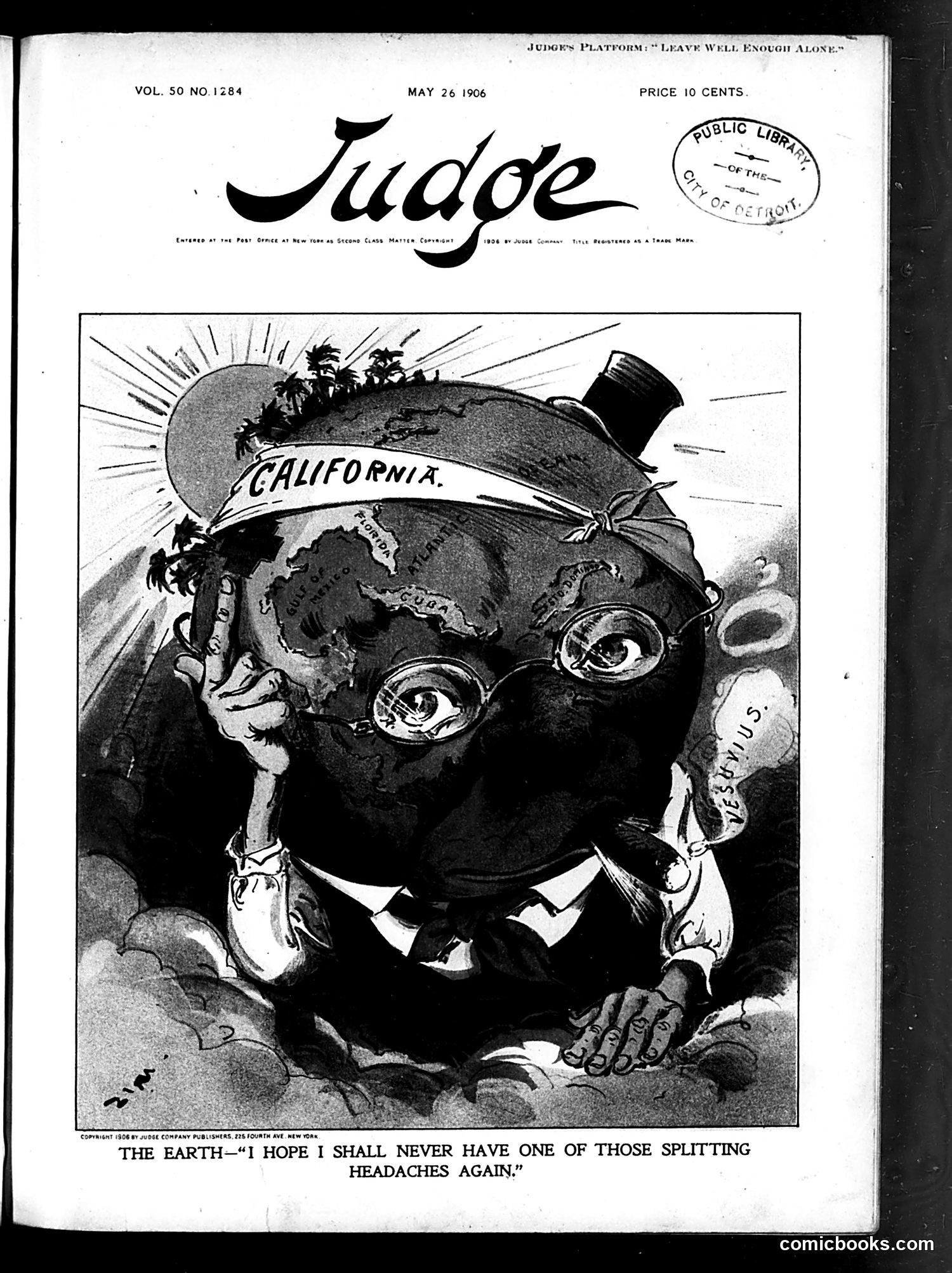
**The Figure:** A personified Earth depicted as a bald man wearing glasses and formal attire (top hat, bow tie), with California labeled on his head/globe. **The Context:** The caption reads: "THE EARTH—'I HOPE I SHALL NEVER HAVE ONE OF THOSE SPLITTING HEADACHES AGAIN.'" **The Meaning:** This cartoonists is referencing the catastrophic San Francisco earthquake of April 18, 1906—just over a month before this magazine's publication. The earthquake, which killed thousands and destroyed the city, is depicted as a literal "splitting headache" afflicting Earth itself. **The Satire:** The joke employs dark humor, treating the disaster as a medical ailment Earth hopes never to repeat. The anthropomorphization—presenting our planet as a suffering person—both trivializes and emphasizes the severity of the natural disaster through comic exaggeration.
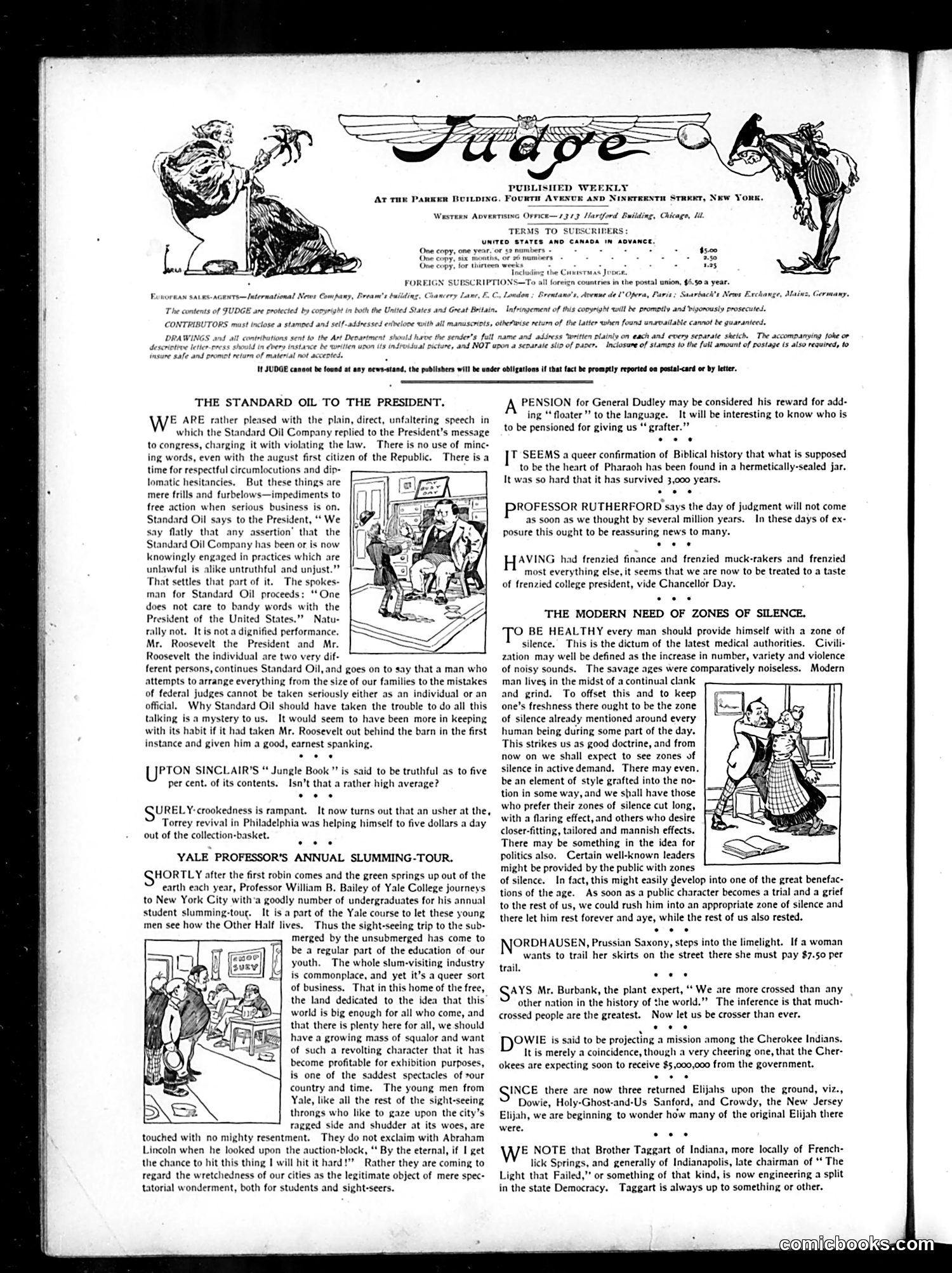
This page contains several brief satirical commentary pieces rather than a unified cartoon. Key sections include: **"The Standard Oil to the President"** critiques President Roosevelt's handling of Standard Oil, suggesting his public speeches against the company contradict his inaction. The accompanying illustration shows what appears to be a corporate figure. **"The Modern Need of Zones of Silence"** satirizes contemporary medical advice about quiet zones for health, humorously suggesting such zones be extended to politics so undesirable public figures could be silenced. Other brief items mock various targets: Yale professors' "slumming tours," Prussian fashion regulations, and political figures like Brother Taggart of Indiana. The overall tone targets Roosevelt's administration, corporate monopolies, and contemporary social pretensions. Without clearer illustrations or specific dates visible, precise identifications of some figures remain uncertain.
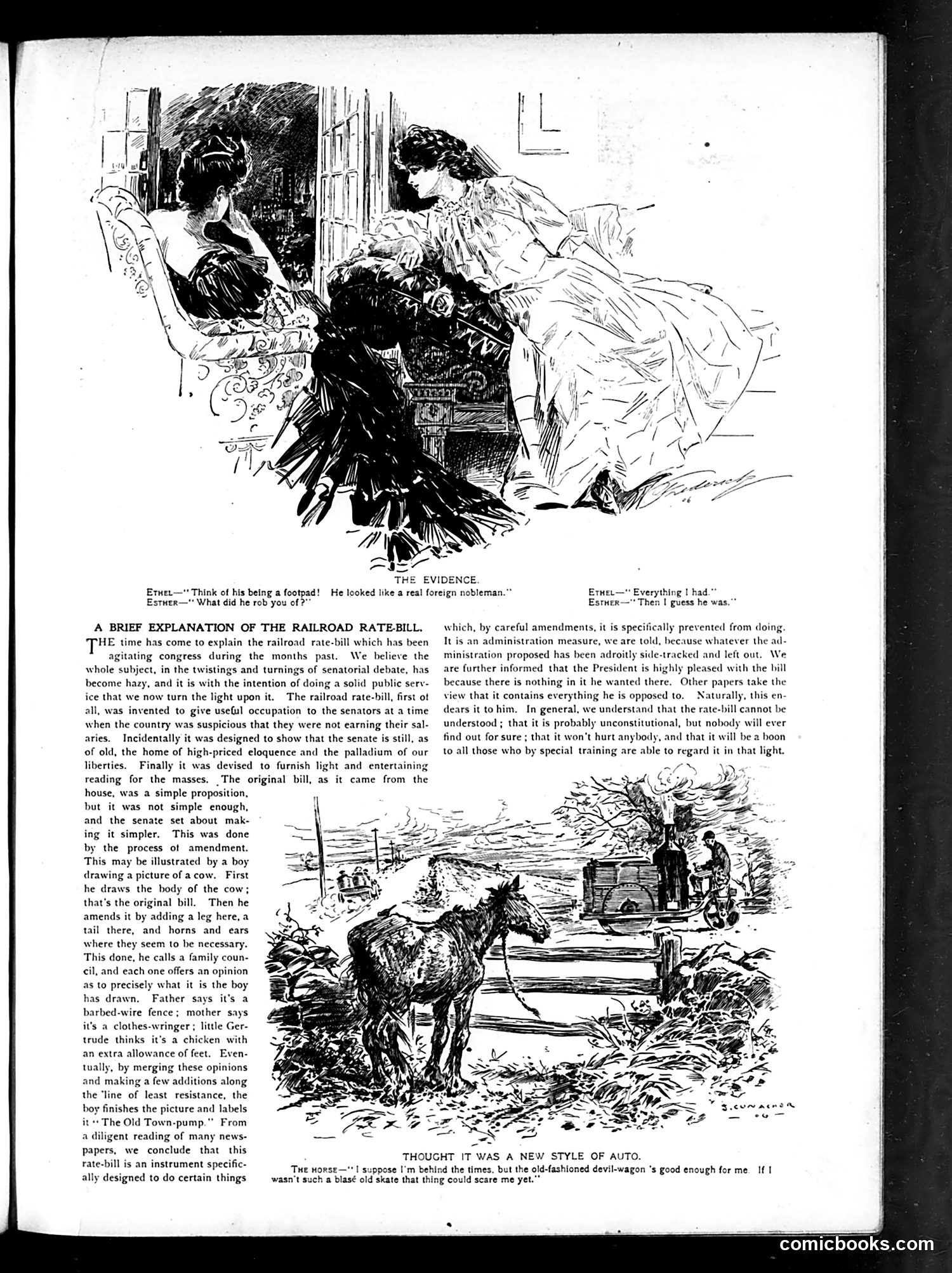
This page satirizes the Railroad Rate Bill through dialogue and illustrations. The top cartoon shows two women discussing a foolish man, with one noting he "looked like a real foreign nobleman" — apparently mocking someone's pretensions. The main text explains the bill's purpose: to regulate railroad rates that Congress had been debating. The article notes the bill was "invented to give useful occupation to the senators" and designed as "light and entertaining reading." The bottom illustration depicts a horse confused by an automobile, with the horse thinking it's "a new style of auto." This appears to mock those who misunderstand modern innovations — likely paralleling confusion about the complex rate-bill legislation itself. The overall satire targets both railroad regulation debates and the Senate's perceived inability to handle substantive legislation clearly.
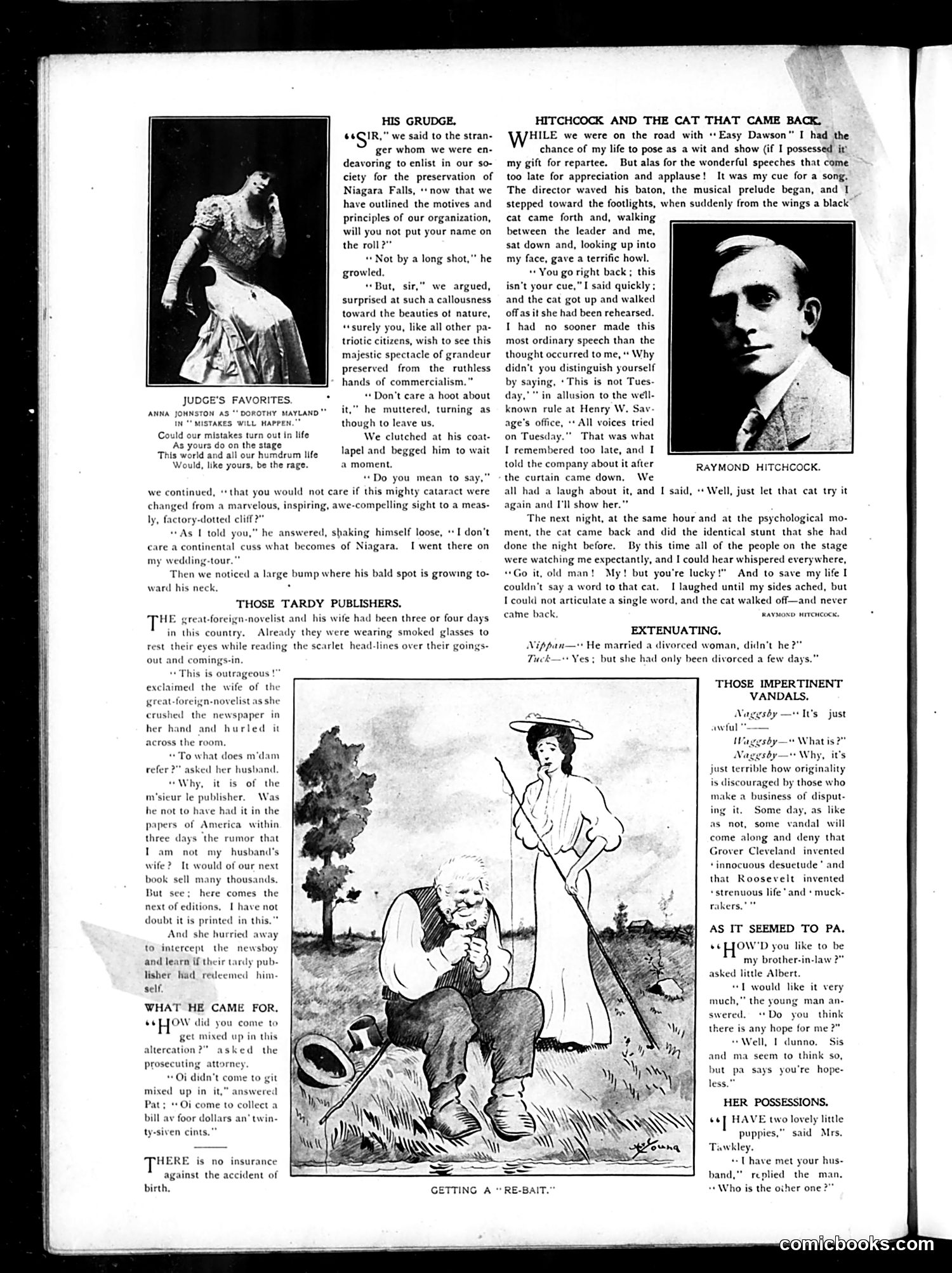
This page contains several distinct sections: a theatrical anecdote about "His Grudge," a story about "Hitchcock and the Cat That Came Back" (likely director Alfred Hitchcock), and a satirical piece titled "Those Tardy Publishers" mocking foreign novelists and their publishers for tardiness and poor work habits. The main cartoon, "Getting a Re-bait," depicts a rural scene with what appears to be social commentary on rural life or labor practices, though the specific satirical target remains unclear from the image alone. The page also includes portrait photographs and brief anecdotes about social behavior ("Those Impertinent Vandals," "Her Possessions," "As It Seemed to Pa"). The overall tone emphasizes Judge's typical approach: mocking contemporary figures, publishing practices, and social pretensions through humor and caricature.
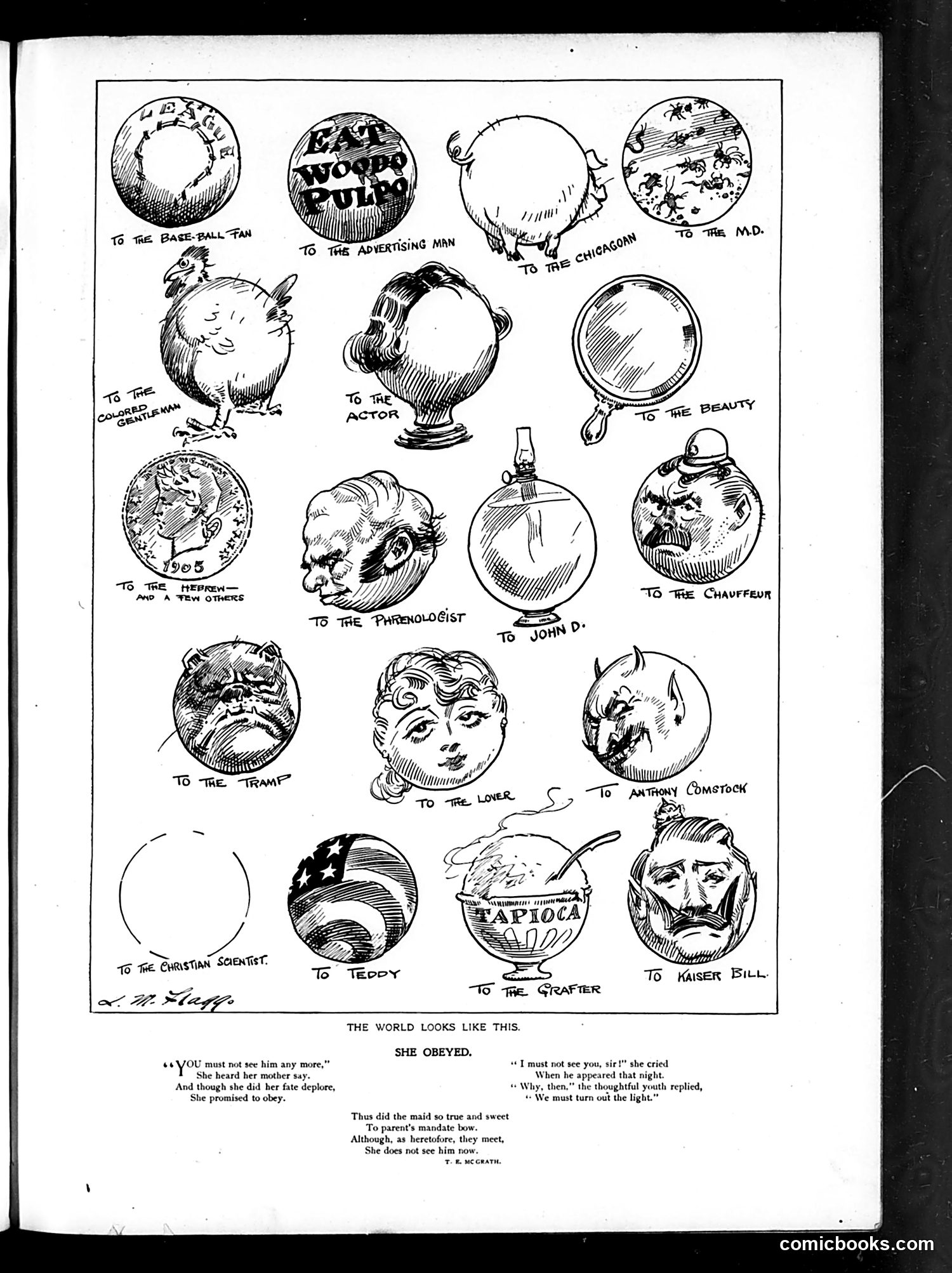
This Judge magazine page presents a satirical collection of spherical objects—each labeled with a recipient—representing how different groups of people view the world through their own perspectives and interests. The caricatures include recognizable figures or types: a baseball fan, advertising man, Chicagoan, congressman, actor, beauty-conscious person, phrenologist, chauffeur, tramp, lover, Anthony Comstock (famous censor), and others. Each sphere reflects that person's preoccupations—the baseball fan's sphere shows a diamond; the actor's is a blank reflection of vanity. The accompanying poem "She Obeyed" appears unrelated to the cartoon proper, suggesting this is a composite page typical of Judge's format. The satire critiques how individual biases and social roles fundamentally shape perception, making everyone live in their own isolated mental world.
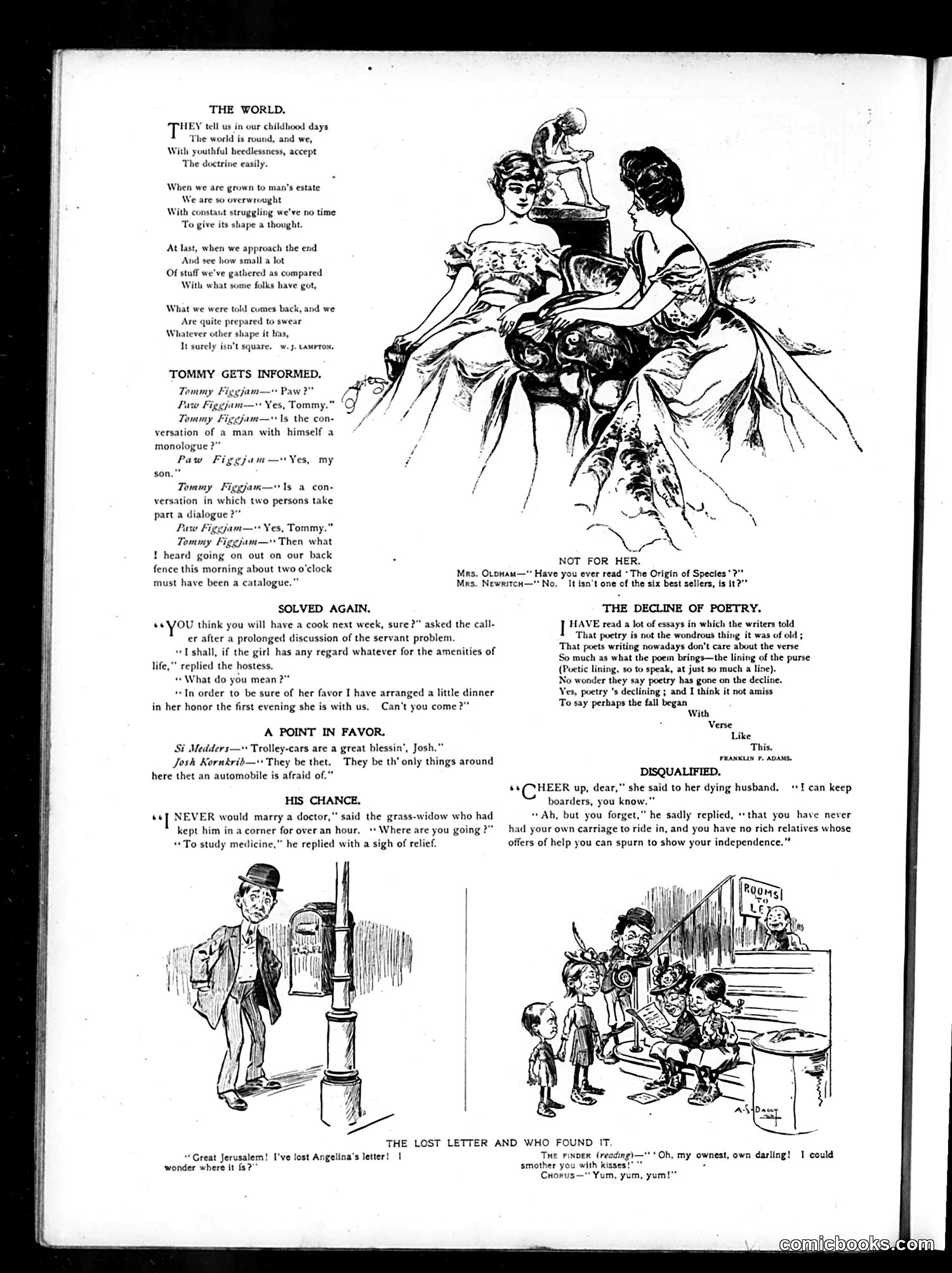
This page contains multiple short humorous pieces typical of early 20th-century American satirical magazines: **"Tommy Gets Informed"** plays on a child's logical confusion: if a conversation between one person is a "monologue" and between two is a "dialogue," then a three-way argument must be a "catalogue"—a simple wordplay joke. **"A Point in Favor"** jokes that trolley-cars are the only things automobiles fear, satirizing early automobile anxiety and their dangers to pedestrians. **"The Decline of Poetry"** laments that modern poets care more about payment than artistry—a genuine cultural complaint about commercialization of literature. **"Disqualified"** contains dark humor: a dying husband tells his wife she cannot become independent by supporting boarders because she's never had her own carriage or rich relatives to spurn—satirizing upper-class pretensions about independence. **"The Lost Letter"** shows a found love letter being read aloud to children, with their delighted "Yum, yum, yum!" response—gentle humor about childhood innocence. The illustrations support these satirical vignettes.
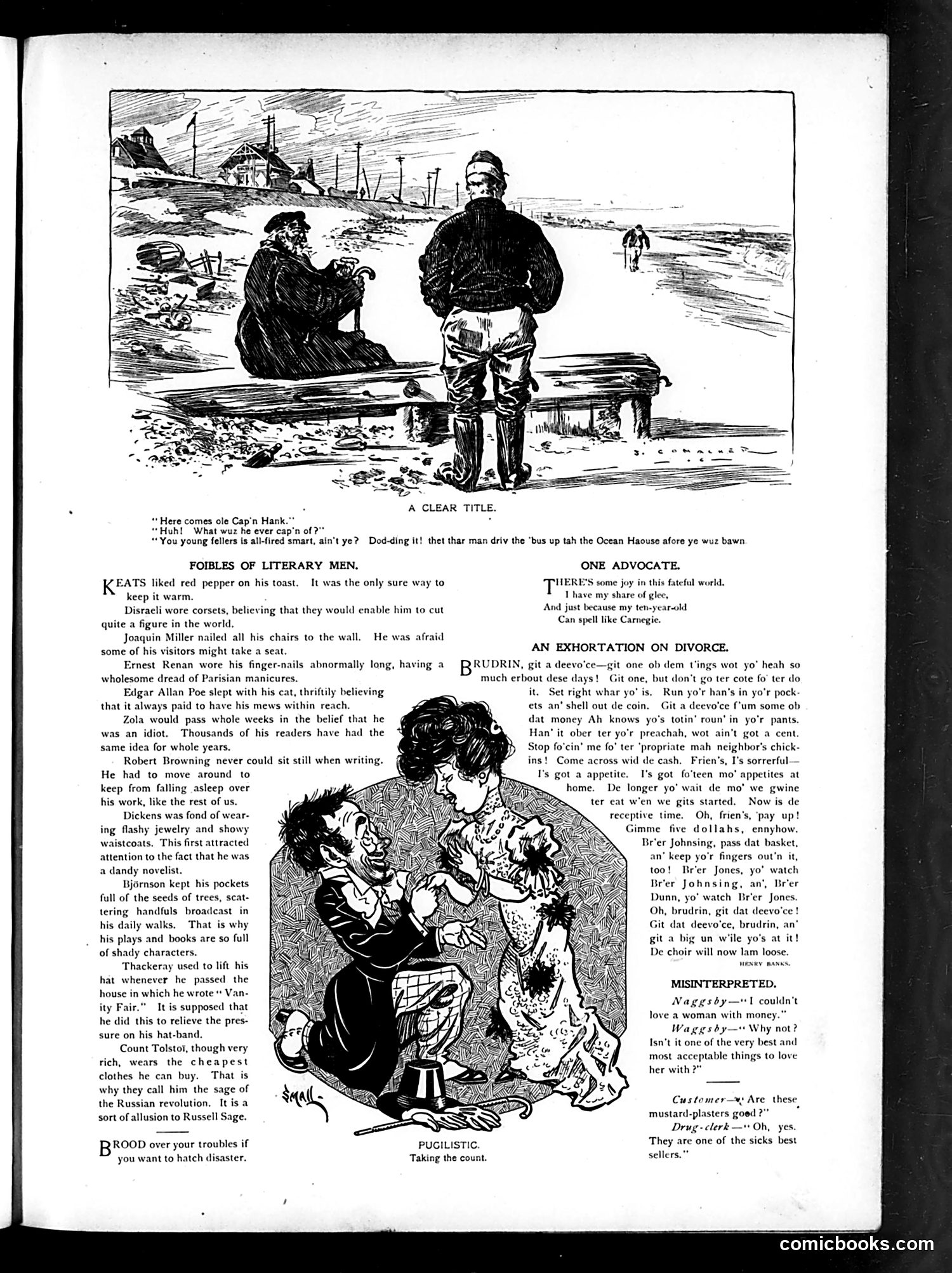
This page contains multiple satirical pieces typical of Judge's humor: **Top cartoon ("A Clear Title")**: A dialect-heavy joke about a man's claim to the title "Captain"—he apparently drove a bus to the Ocean House before the younger men were born, making him the only legitimate "captain" among them. **"Foibles of Literary Men"**: A series of humorous anecdotes about famous writers' eccentricities—Keats using pepper to warm toast, Disraeli wearing corsets, Edgar Allan Poe sleeping with his cat for warmth. The humor mocks both literary pretension and the quirky habits attributed to famous authors. **Dialect pieces** ("An Exhortation on Divorce," "Pugilistic"): Use heavy African American vernacular to present comic monologues—a preacher urging divorce and financial contributions, conversations about taking punches in boxing. Typical of era's minstrel-style humor. **"Misinterpreted"**: Brief wordplay jokes about misunderstandings regarding money and medical products. The overall tone reflects late 19th/early 20th-century satirical magazine conventions, mixing literary mockery with dialect humor now considered offensive.
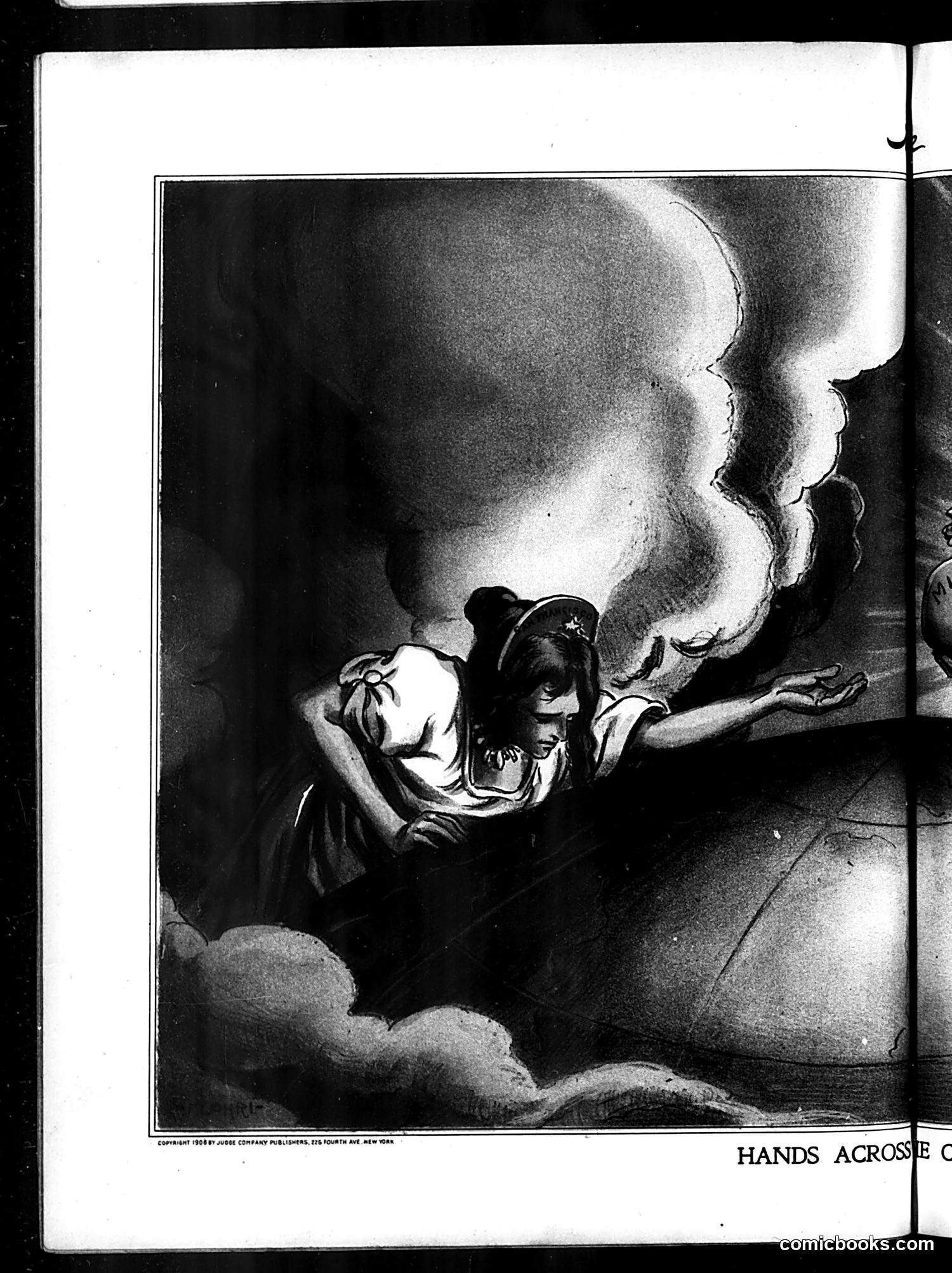
This appears to be a page from *Judge* magazine featuring a dramatic illustration titled "HANDS ACROSS" (visible at bottom right). The image shows a figure in period costume (possibly representing a historical or allegorical character) with arms outstretched amid swirling clouds or smoke, with what appears to be faces or figures emerging from the atmospheric effects above. The OCR text is largely illegible, making specific identification of the cartoon's subject difficult. Without clear text or visible date, I cannot definitively identify which political or social issue this satirizes. The dramatic, ethereal style suggests it may address themes of unity, spiritual matters, or international relations—common *Judge* subjects—but the exact reference and satirical point remain unclear from this reproduction.
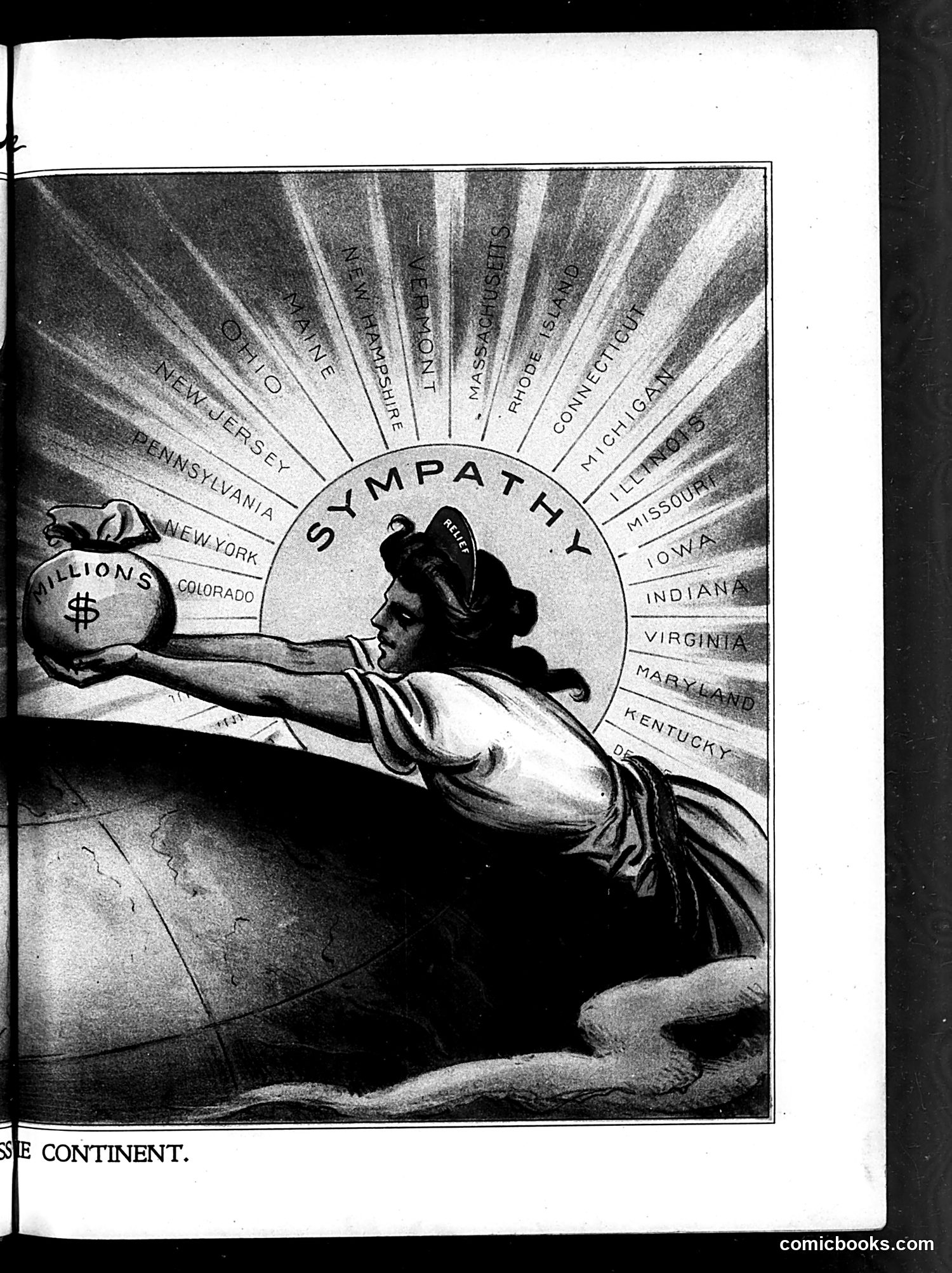
This Judge magazine cartoon depicts **"Sympathy"** as an allegorical female figure reaching toward a bag labeled "MILLIONS $" while states radiate behind her like a halo. The figure appears to be soliciting financial sympathy from various U.S. states (Pennsylvania, New York, Colorado, Virginia, Kentucky, Maryland, Indiana, Iowa, Illinois, and Missouri are visible). The satire critiques what likely represents **charitable appeals or relief efforts** that leverage emotional sympathy to extract money from prosperous states. The cartoon suggests that "sympathy" is being weaponized as a fundraising tool—the figure's gesture toward the money bag reveals the cynical calculation beneath appeals to fellow-feeling. Without the magazine's date, the specific cause remains unclear, though it appears to target perceived exploitation of interstate generosity during an economic crisis or disaster.
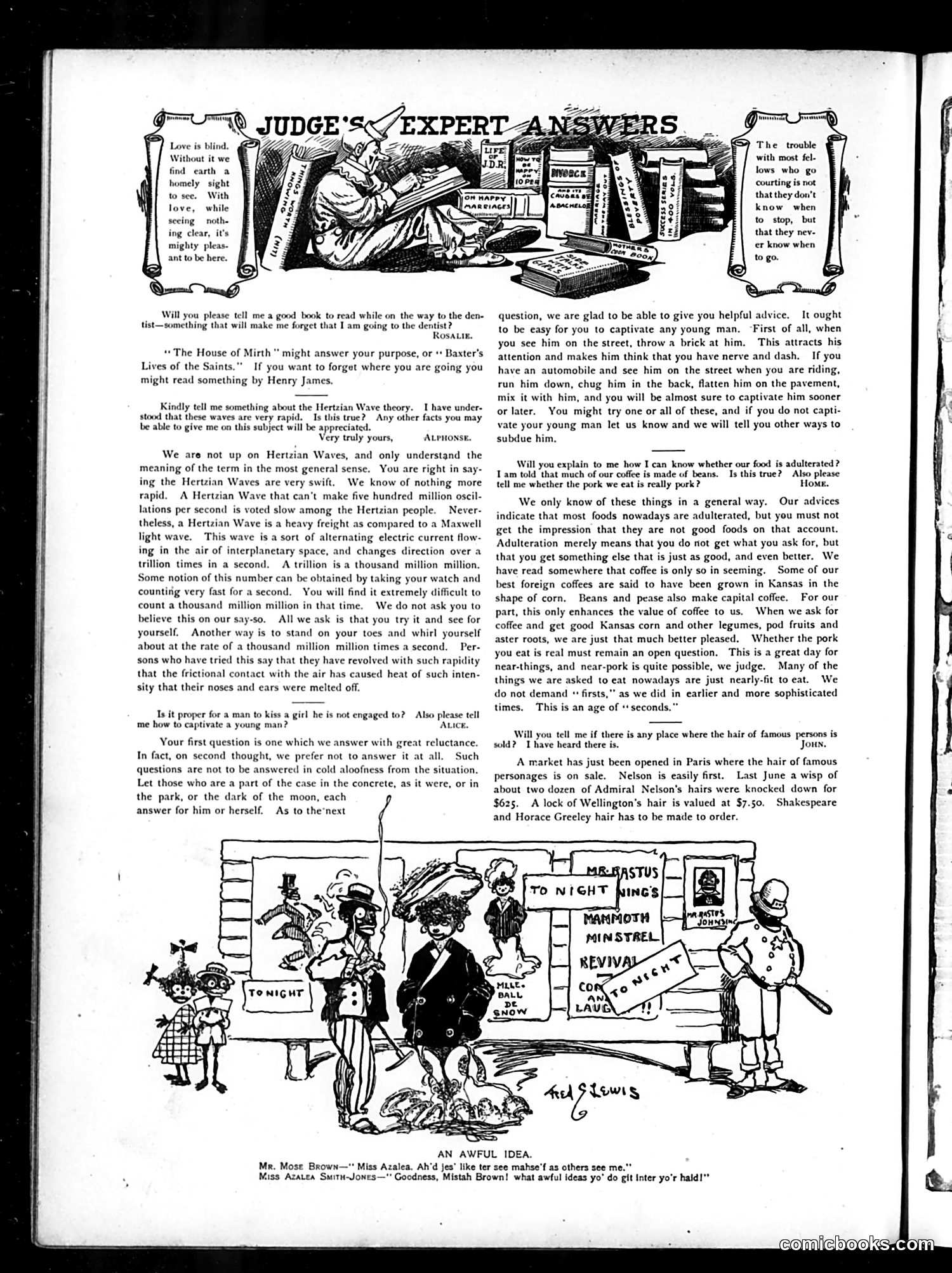
This is an advice column page ("Judge's Expert Answers") from an early 20th-century American satirical magazine. The humor operates through deadpan absurdity in response to earnest reader questions. **Key satirical responses:** - **Hertzian Waves**: The editor provides deliberately overwrought, nonsensical "scientific" explanation of electromagnetic waves, culminating in the ridiculous claim that rotating at wave-frequency speeds causes one's nose and ears to melt off—obviously false but presented as fact. - **Captivating a young man**: The advice to throw bricks at or run down a man with an automobile is clearly tongue-in-cheek mockery of aggressive courtship tactics. - **Food adulteration**: A topical concern (early 1900s food safety scandals), answered with deliberately unhelpful reassurance. **The bottom cartoon** depicts theater marquees advertising "Mammoth Minstrel Revival" and similar shows, with a caption mocking pretentious names. The page's humor relies on readers recognizing the answers are absurd parodies of actual advice-column conventions and contemporary anxieties about science, courtship, and food safety.
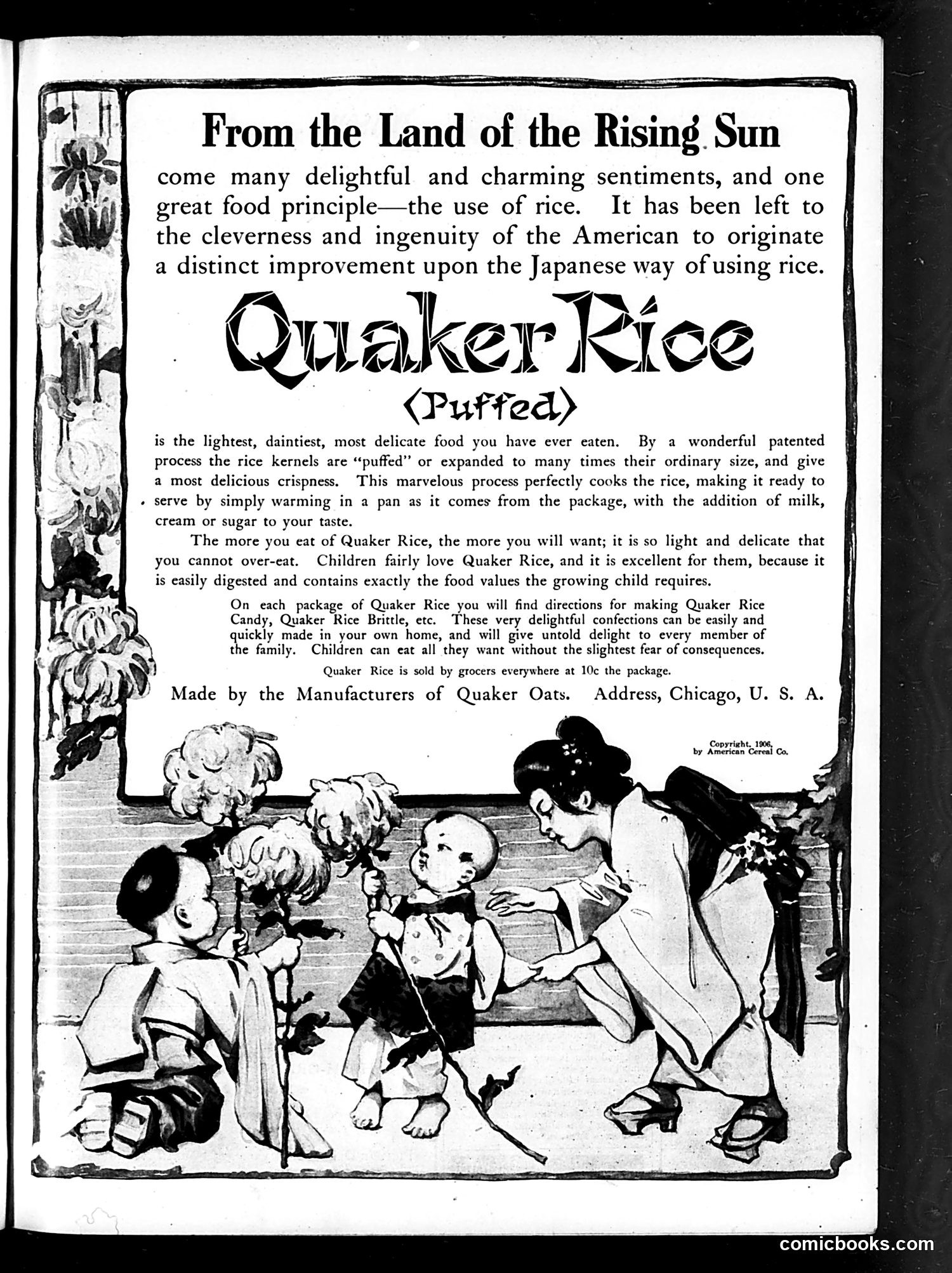
This is primarily a **commercial advertisement**, not political satire. However, it contains period-specific cultural assumptions worth noting: The ad opens with orientalist framing—"Land of the Rising Sun" (Japan)—suggesting exotic appeal while claiming American ingenuity has "improved" Japanese rice preparation through puffing technology. This reflects early-1900s American confidence in technological superiority. The illustration shows what appears to be **East Asian children** (likely intended as Japanese) being introduced to Quaker Rice by a Western woman, reinforcing a "civilizing influence" narrative common in Gilded Age advertising. The product pitch emphasizes digestibility and safety for children, addressing contemporary concerns about food purity and nutrition. The copyright date (1906) and price (10¢) ground this in the early cereal-box era. Rather than satire, this represents straightforward commercial propaganda using racial and cultural stereotypes acceptable to Judge's 1906 audience.
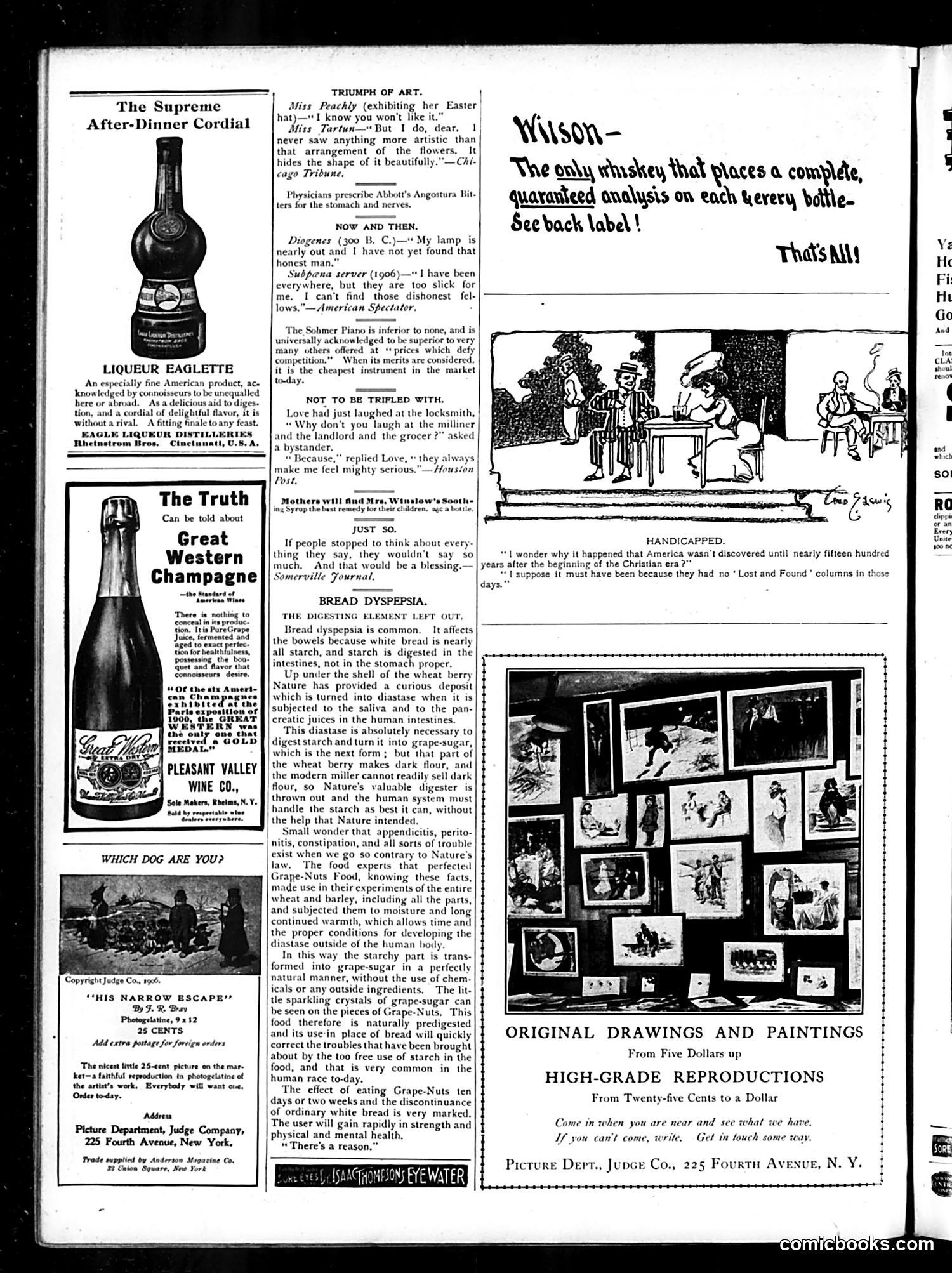
This page is primarily **advertising and humor columns** from Judge magazine, not political satire. The main cartoon ("Handicapped") depicts a social scene where a man has apparently discovered his wife's infidelity ("nearly fifteen hundred years after the beginning of the Christian era"). The joke references the "Lost and Found" newspaper column genre—suggesting marital transgressions were supposedly undiscovered until modern times due to lack of such columns. Other content includes: - **"Triumph of Art"**: A woman's ugly Easter hat is redeemed by claiming the flowers "hide the shape"—satirizing how people use flattery to mask flaws - **"Now and Then"**: Compares Diogenes (ancient philosopher searching for an honest man) to a modern process server unable to find dishonest people—suggesting modern dishonesty has become too sophisticated - Mostly liquor, champagne, and food advertisements typical of the era The page reflects early-1900s concerns: digestive health, gender relations, and consumer products marketed as solutions to everyday problems.
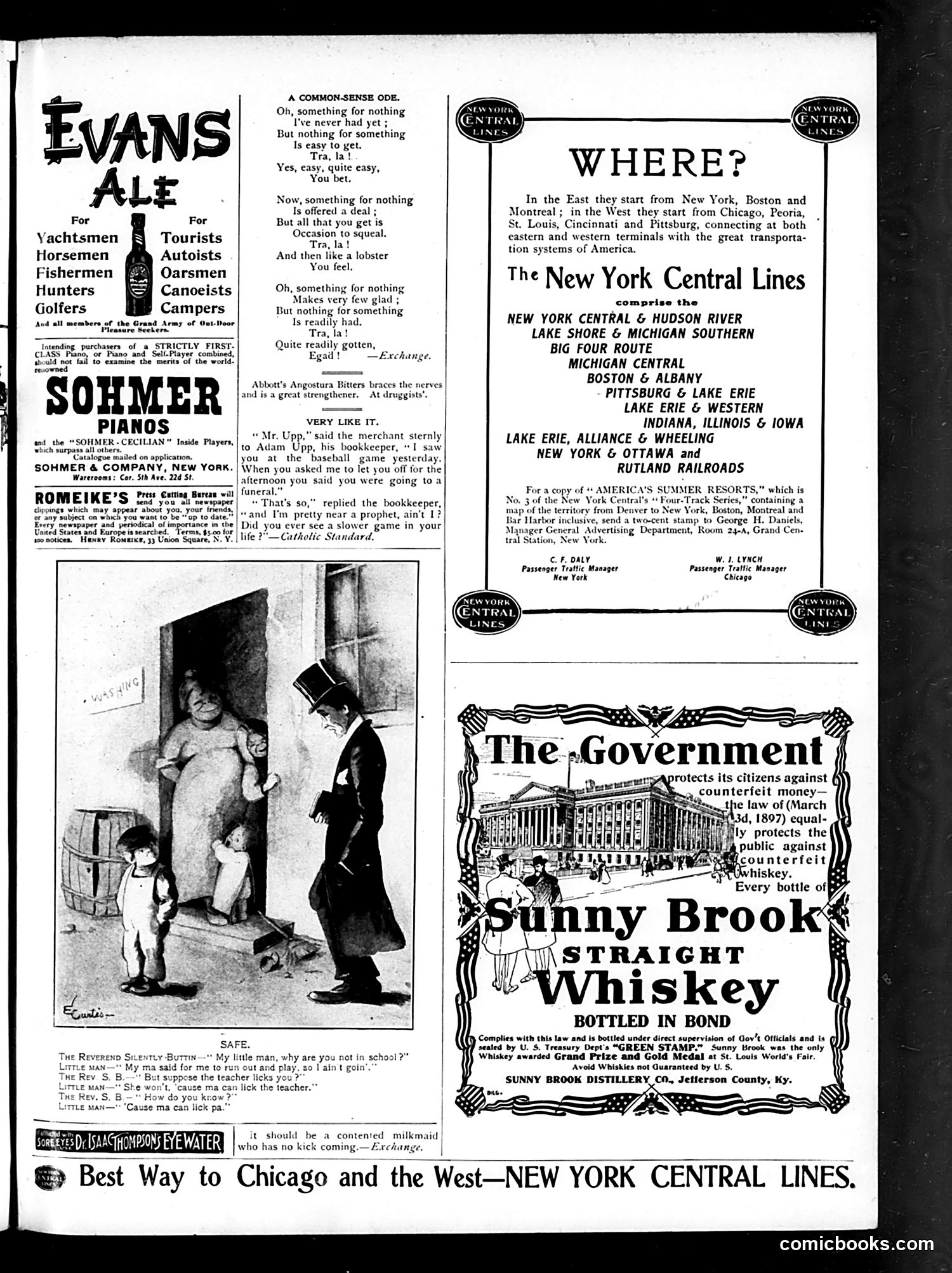
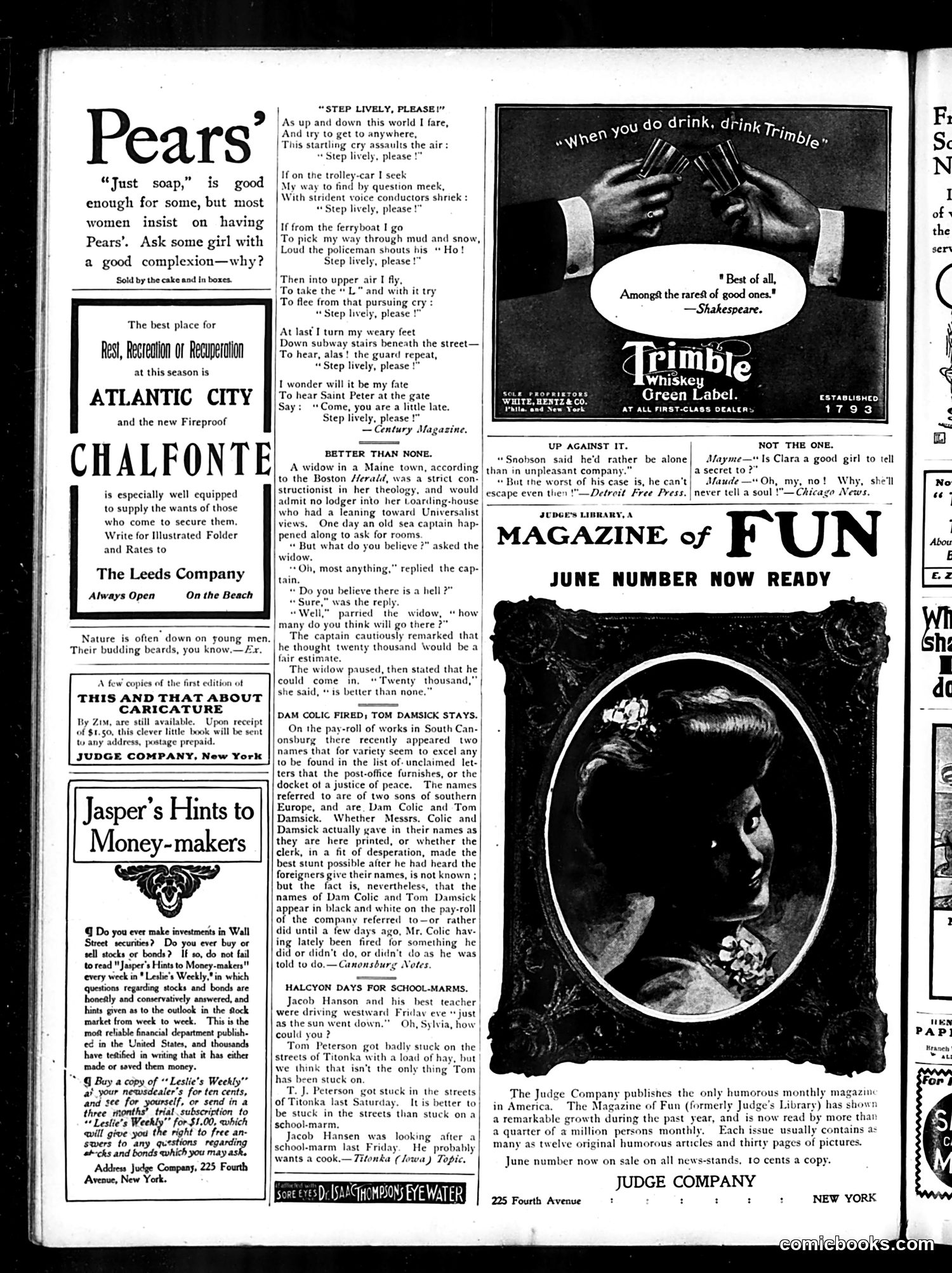
This is primarily an **advertising and humor page** from Judge magazine, with several distinct elements: **Main Content:** The largest feature is a poem titled "STEP LIVELY, PLEASE!" satirizing urban American impatience—conductors, police, and transit workers constantly rushing pedestrians along streets, trolleys, ferries, and subways. The humor culminates in imagining Saint Peter using the same irritated phrase at Heaven's gate. It's social commentary on the frantic pace of early 20th-century city life. **Advertisements:** The page is dominated by ads for Pears' soap, Atlantic City's Chalfonte hotel, and financial advice columns—typical of the era's consumer culture. **Minor humor items** include anecdotes about a Maine widow's pragmatic theology and railroad workers with unusual names (Dam Colic, Tom Damsick). **Right side:** A Trimble Whiskey advertisement featuring hands and a Shakespeare quote about "good ones." The page reflects Judge's typical mix of social satire and commercial content targeting middle-class readers of the era.
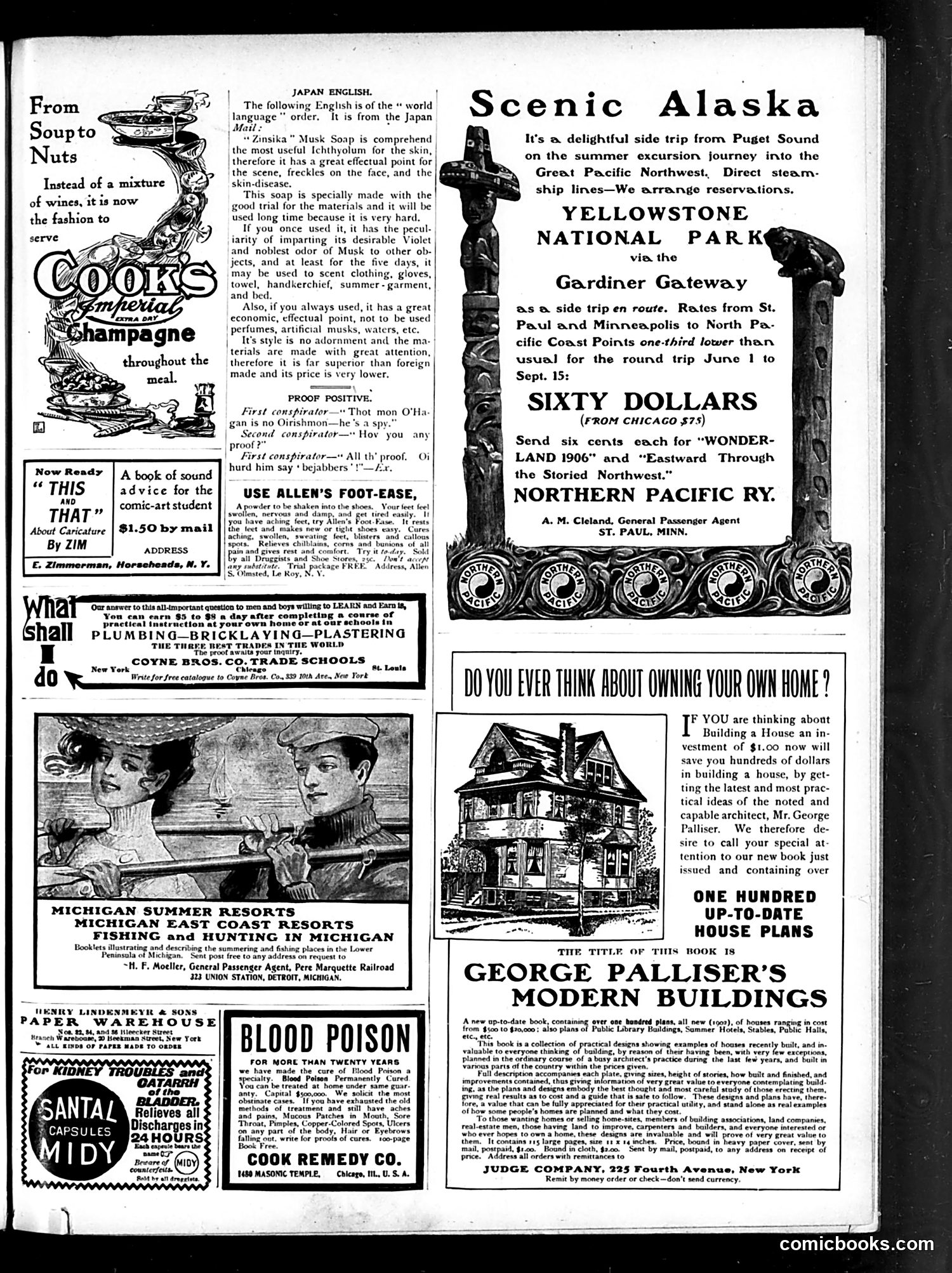
This is primarily an **advertising page** from Judge magazine, not a satirical cartoon page. The layout includes various commercial advertisements for products and services typical of the early 1900s. The only actual **cartoon/joke** is the brief "PROOF POSITIVE" dialogue near the top: two Irish conspirators debate whether a man named O'Hagan is actually Irish or a spy. The "proof" is that they heard him say "bejabbers"—a stereotypical Irish expression—which the first conspirator sarcastically claims proves he's *not* Irish (implying a real Irishman wouldn't use such an obvious cliché). This plays on **period stereotypes of Irish immigrants** and mock-Irish dialect humor common in early 1900s American comedy. The rest of the page advertises travel (Alaska, Yellowstone), trade schools, soap, foot powder, real estate guides, and medical remedies—representative of Judge's revenue model mixing satire with commercial content.
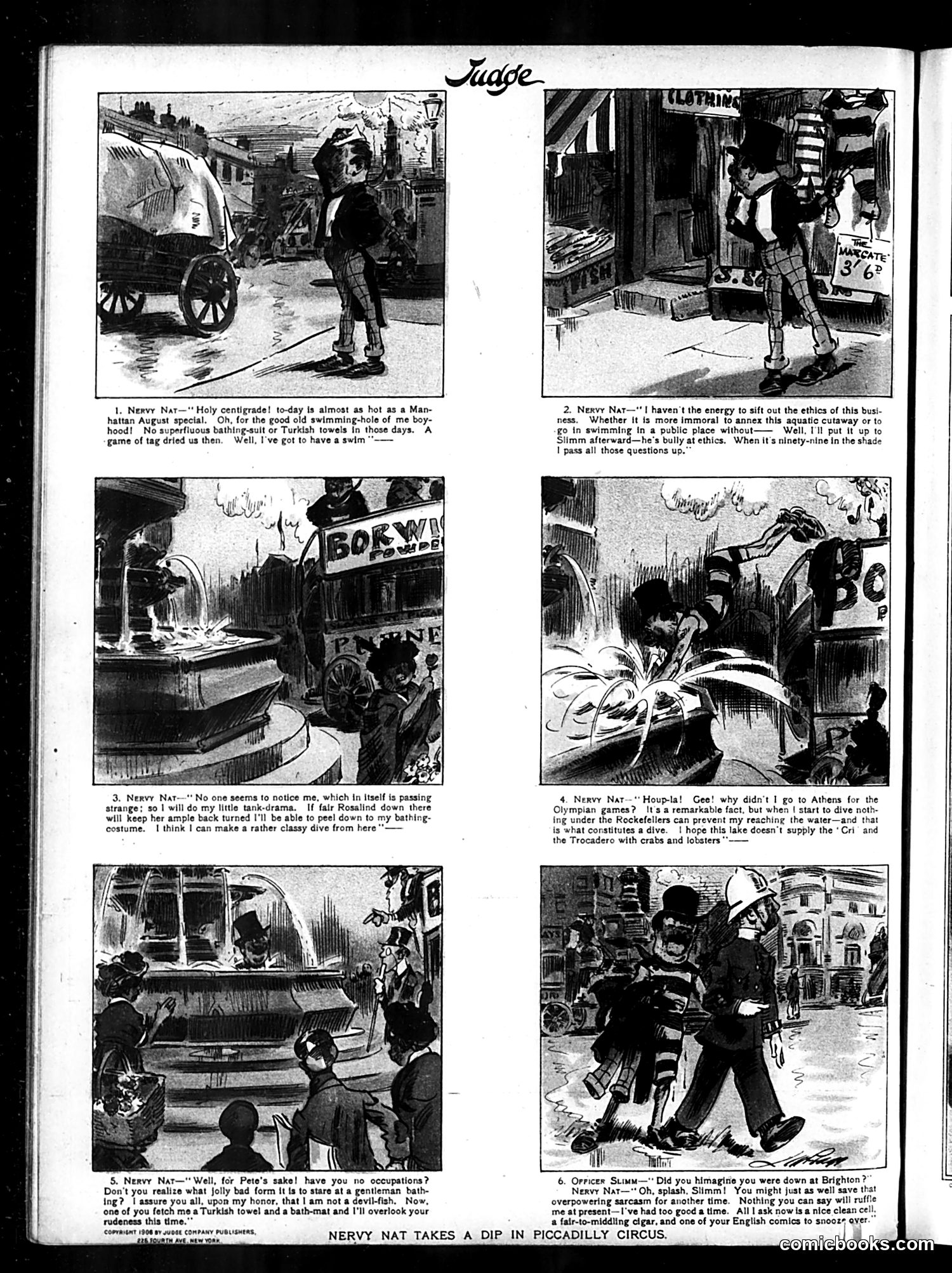
This is a six-panel comic strip satirizing a character named "Nervy Nat," who attempts to swim in what appears to be a public fountain or water feature in London's Piccadilly Circus during hot weather. The humor centers on Nat's audacious indifference to social convention and public decency. He strips down to bathe in a public space, draws crowds of gawking onlookers, and dismisses complaints about his behavior with elaborate, self-serving rationalizations. The strip mocks both his shameless nerve and his pompous pseudo-intellectual excuses (referencing "ethics" and comparing himself to Olympic athletes). The finale shows him arrested by "Officer Stimm," accepting jail as a fitting conclusion to his escapade—treating imprisonment as merely another amusing consequence of his brazen conduct. The satire targets attitudes of reckless entitlement and public nuisance behavior presented as sophisticated amusement.