
Judge, 1906-05-26 · page 6 of 16
Judge — May 26, 1906 — page 6: what you’re looking at
What you’re looking at
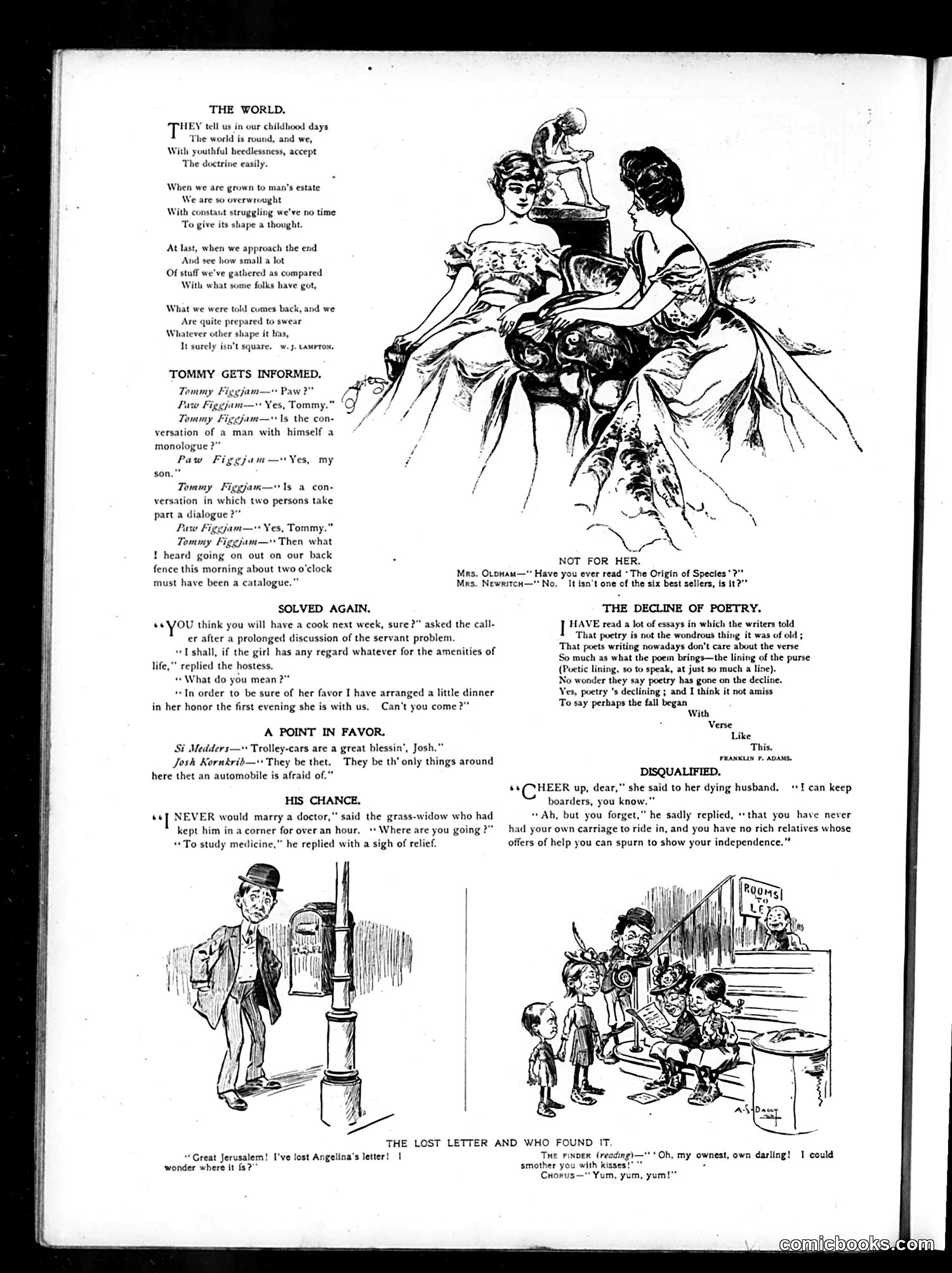
This page contains multiple short humorous pieces typical of early 20th-century American satirical magazines: **"Tommy Gets Informed"** plays on a child's logical confusion: if a conversation between one person is a "monologue" and between two is a "dialogue," then a three-way argument must be a "catalogue"—a simple wordplay joke. **"A Point in Favor"** jokes that trolley-cars are the only things automobiles fear, satirizing early automobile anxiety and their dangers to pedestrians. **"The Decline of Poetry"** laments that modern poets care more about payment than artistry—a genuine cultural complaint about commercialization of literature. **"Disqualified"** contains dark humor: a dying husband tells his wife she cannot become independent by supporting boarders because she's never had her own carriage or rich relatives to spurn—satirizing upper-class pretensions about independence. **"The Lost Letter"** shows a found love letter being read aloud to children, with their delighted "Yum, yum, yum!" response—gentle humor about childhood innocence. The illustrations support these satirical vignettes.
📄 Transcribed text from this page (OCR, searchable)
Machine-transcribed from the original scan — historical spelling and the odd misread are preserved.
THE WORLD. THEY tell us in our childhood days ‘The world is round, and we, With youthful heedlessness, accept The doctrine easily. When we are grown to man's estate We are so overwrought With constant struggling we've no time To give its shape a thought. At last, when we approach the end And see how small a lot Of stuff we've gathered as compared With what some folks have got, What we were told cumes back, and we Are quite prepared to swear Whatever ot! It surely TOMMY GETS INFORMED. Tommy Figgjam—« Paw igs Yes, Tommy.” Tommy jam—" Is the con versation of a man with himself a monologue ?” Paw Figgjam—“Yes, my son,” Tommy Figgjam—\s a con- versation in which two persons take part a dialogue ?” Figgjam—* Yes, Tommy.” Tommy Figgjam—«Then what 1 heard going on out on our back fence this morning about two o'clock must have been a catalogue.” SOLVED AGAIN. +e YOU think you will have a cook next week, sure?” asked the call er after a prolonged discussion of the servant problem. “«Lshall, if the girl has any regard whatever for the amenities of life,” replied the hostess. “What do you mean 2?” ++ In order to be sure of her favor I have arranged a little dinner in her honor the first evening she is with us. Can't you come?” A POINT IN FAVOR. Si Medders— Trolley-cars are a great blessin’, Josh.” Josh Kornkrib— They be thet. They be th’ only things around here thet an automobile is afraid of.” HIS CHANCE. NEVER would marry a doctor,” said the grass-widow who had kept him in a corner for over an hour. + Where are you going 2" “To study medicine,” he replied with a sigh of relief. wae NOT FOR HER. Mrs. OLpnam—" Have you ever read “The Origin of Species?" Mrs. Newritcu—"* No. It isn't one of the six best sellers, is it?” ‘THE DECLINE OF POETRY. HAVE read a lot of essays in which the writers told That poetry is not the wondrous thing it was of old ; That poets writing nowadays don’t care about the verse So much as what the poem brings—the lining of the purse (Poetic lining, so to speak, at just so much a line). No wonder they say poetry has gone on the decline. Yes, poetry 's declining ; and I think it not amiss To say perhaps the fall began With DISQUALIFIED. ++(CHEER up, dear,” she said to her dying husband. “I can keep boarders, you know.” “Ah, but you forget,” he sadly replied, «that you have never had your own carriage to ride in, and you have no rich relatives whose offers of help you can spurn to show your independence. THE LOST LETTER AND WHO FOUND IT. “Great Jerusalem! I've lost Angelina's letter! 1 wonder where it {s?" THe Finder (reading). smother you with kiss Cnorus—" Yum, yum, yum!"