
Judge, 1906-05-26 · page 3 of 16
Judge — May 26, 1906 — page 3: what you’re looking at
What you’re looking at
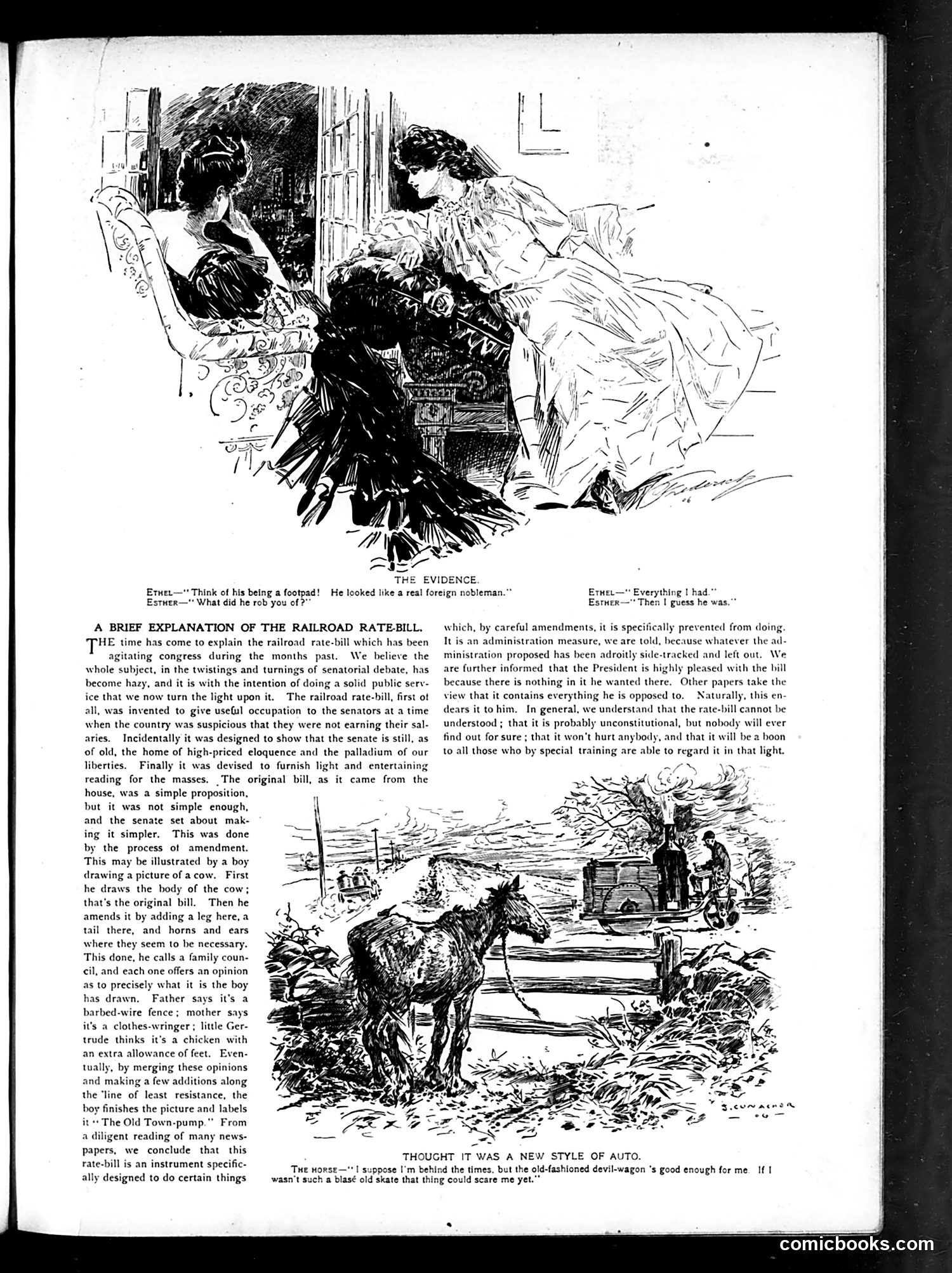
This page satirizes the Railroad Rate Bill through dialogue and illustrations. The top cartoon shows two women discussing a foolish man, with one noting he "looked like a real foreign nobleman" — apparently mocking someone's pretensions. The main text explains the bill's purpose: to regulate railroad rates that Congress had been debating. The article notes the bill was "invented to give useful occupation to the senators" and designed as "light and entertaining reading." The bottom illustration depicts a horse confused by an automobile, with the horse thinking it's "a new style of auto." This appears to mock those who misunderstand modern innovations — likely paralleling confusion about the complex rate-bill legislation itself. The overall satire targets both railroad regulation debates and the Senate's perceived inability to handle substantive legislation clearly.
📄 Transcribed text from this page (OCR, searchable)
Machine-transcribed from the original scan — historical spelling and the odd misread are preserved.
THE EVIDENCE. Ernet—"' Think of his being a footpad! Estwer—" What did he rob you of 7” A BRIEF EXPLANATION OF THE RAILROAD RATEBILL. HE time has come to explain the railroad rate-bill which has been agitating congress during the months past. We believe the whole subject, in the twistings and turnings of senatorial debate, has become hazy, and it is with the intention of doing a solid public serv- ice that we now turn the light upon it. The railroad rate-bill, first of all, was invented to give useful occupation to the senators at a time when the country was suspicious that they were not earning their sal- aries. Incidentally it was designed to show that the senate is still, as of old, the home of high-priced eloquence and the palladium of our liberties. Finally it was devised to furnish light and entertaining reading for the masses. The original bill, as it came from the house, was a simple proposition, but it was not simple enough and the senate set about mak- ing it simpler. This was done by the process of amendment. This may be illustrated by a boy drawing a picture of a cow. First he draws the body of the cow; that’s the original bill. Then he amends it by adding a leg here, a tail there, and horns and ears where they seem to be necessary. This done, he calls a family coun- cil, and each one offers an opinion as to precisely what it is the boy has drawn, Father says it’s a barbed-wire fence; mother says it's a clothes-wringer; little Ger- trude thinks it's a chicken with an extra allowance of feet. Even- by merging these opinions aking a few additions along the ‘line of least resistance, the boy finishes the picture and labels “The Old Town-pump."" From a diligent reading of many news- papers, we conclude that this rate-bill is an instrument specific- ally designed to do certain things Tue Horse—"*I He looked like a real foreign nobleman.” Ernet—"' Everything | had.” Esrmer—" Then I guess he was.”* which, by careful amendments, it is specifically prevented from doing. It is an administration measure, we are told, because whatever the ad- ministration proposed has been adroitly side-tracked and left out, We are further informed that the President is highly pleased with the bill because there is nothing in it he wanted there. Other papers take the view that it contains everything he is opposed to. Naturally, this en- dears it to him. In general, we understand that the rate-bill cannot be understood ; that it is probably unconstitutional, but nobody will ever find out for sure ; that it won't hurt anybody, and that it will be a boon to all those who by special training are able to regard it in that light. Scorn ancna® = ee THOUGHT IT WAS A NEW STYLE OF AUTO. ose I'm behind the times, but the old-fashioned devil-wagon ‘s good enough forme If I wasn't such a blasé old skate that thing could scare me yet.” ~ comicbooks.com