
Judge, 1906-05-26 · page 2 of 16
Judge — May 26, 1906 — page 2: what you’re looking at
What you’re looking at
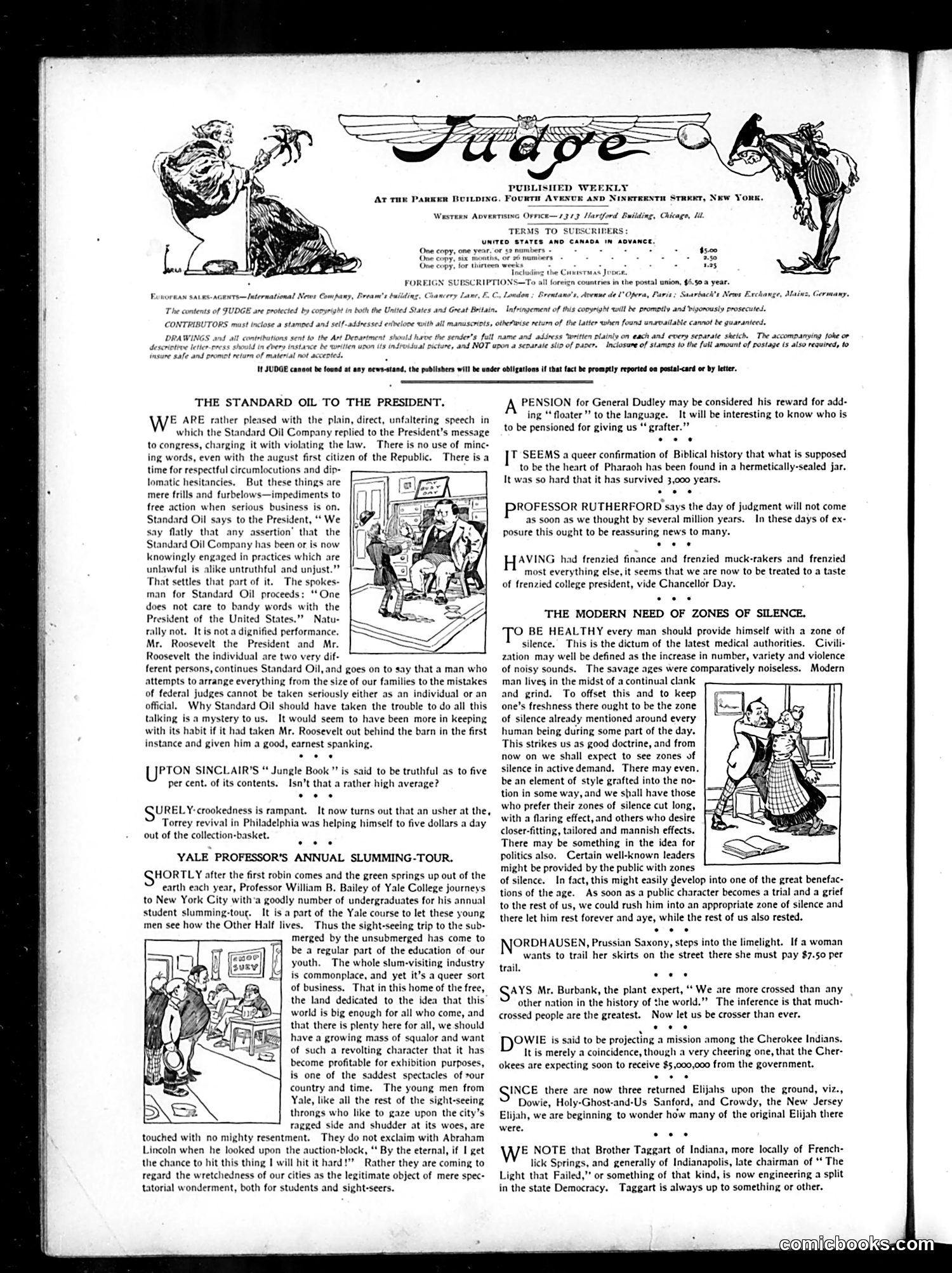
This page contains several brief satirical commentary pieces rather than a unified cartoon. Key sections include: **"The Standard Oil to the President"** critiques President Roosevelt's handling of Standard Oil, suggesting his public speeches against the company contradict his inaction. The accompanying illustration shows what appears to be a corporate figure. **"The Modern Need of Zones of Silence"** satirizes contemporary medical advice about quiet zones for health, humorously suggesting such zones be extended to politics so undesirable public figures could be silenced. Other brief items mock various targets: Yale professors' "slumming tours," Prussian fashion regulations, and political figures like Brother Taggart of Indiana. The overall tone targets Roosevelt's administration, corporate monopolies, and contemporary social pretensions. Without clearer illustrations or specific dates visible, precise identifications of some figures remain uncertain.
📄 Transcribed text from this page (OCR, searchable)
Machine-transcribed from the original scan — historical spelling and the odd misread are preserved.
PUBLISHED WEEKLY AT THe Pangen BUILDING. FouRTI AVENUE AND NINETEENTH StRKET, New Youn. Wastes Apvextisine Ornic unico ‘One copy, ane y' (One copy, six One copy FOREIGN SI Chancery Lame, EC. The contents of FUDGE are protected by PTIONS—To all foreign cou lates and Great Britain. 1313 Hartford Building, Chicags, Ui. TERMS ATES TO SUP the Cinasritas Jooce tres in the postal union, London ; Brentano's, Avenue del Opera, Paris: S Infringement of this copyright will be promptly and rigorously prosecuted. CONTRIBUTORS must inclose a stamped and self-adSressed ertvelone with all manuscriots, othefivise retum of the Latter when found unaailaNe cannot be guaranteed. DRAWIN S and alt contribations . Hler-peess should in évery Instance be % ure safe and promot return of material not accented. Hf JUDGE canoot be found at any news-stand, the publishers will be under obligations if that fact be promptly reported om postal-card or by letter. THE STANDARD OIL TO THE PRESIDENT. E ARE rather pleased with the plain, direct, unfaltering speech in which the Standard Oil Company replied to the President’s message to congress, charging it with violating the law. There is no use of minc- ing words, even with the august first citizen of the Republic. There is a time for respectful circumlocutions and dip- lomatic hesitancies. But these things are mere frills and furbelows—impediments to free action when serious business is on. Standard Oil says to the President, “* We say flatly that any assertion’ that the Standard Oil Company has been or is now knowingly engaged in practices which are unlawful is alike untruthful and unjust.”” That settles that part of it. The spokes- man for Standard Oil proceeds: ‘One does not care to bandy words with the President of the United States.” Natu- rally not. It is not a dignified performance. Mr. Roosevelt the President and Mr. Roosevelt the individual are two very dif- ferent persons, continues Standard Oil, and goes on to say that a man who attempts to arrange everything from the size of our families to the mistakes of federal judges cannot be taken seriously either as an individual or an official, ~Why Standard Oil should have taken the trouble to do all this talking is a mystery to us. It would seem to have been more in keeping with its habit if it had taken Mr. Roosevelt out behind the barn in the first instance and given him a good, earnest spanking. PTON SINCLAIR'S “ Jungle Book "’ is said to be truthful as to five per cent. of its contents. Isn’t that a rather high average? GURELY-crookedness is rampant. It now turns out that an usher at the, Torrey revival in Philadelphia was helping himself to five dollars a day out of the collection-basket. YALE. PROFESSOR’S ANNUAL SLUMMING-TOUR. SHORTLY after the first robin comes and the green springs up out of the earth each year, Professor William B. Bailey of Yale College journeys to New York City with’a goodly number of undergraduates for his annual student slumming-tour. It is a part of the Yale course to let these young men see how the Other Half lives. Thus the sight-seeing trip to the sub- merged by the unsubmerged has come to be a regular part of the education of our youth. The whole slum-visiting industry is commonplace, and yet it’s a queer sort of business. That in this home of the free, the land dedicated to the idea that this world is big enough for all who come, and that there is plenty here for all, we should have a growing mass of squalor and want of such a revolting character that it has become profitable for exhibition purposes, is one of the saddest spectacles of sour country and time. The young men from Yale, like all the rest of the sight-seeing throngs who like to gaze upon the city’s ragged side and shudder at its woes, are touched with no mighty resentment. They do not exclaim with Abraham Lincoln when he looked upon the auction-block, “ By the eternal, if I get the chance to hit this thing I will hit it hard!’ Rather they are coming to regard the wretchedness of our cities as the legitimate object of mere spec- tatorial wonderment, both for students and sight-seers. 110 the Art Department should have the sender's full name and aires ‘written plainly on each and every separate sketch. Hen upon tts indroidual picture, and NOT upon a separate slip of paper. The accompanying foe or Inclosare of stamps 0 the full amount of postage ts also reguited, 10 A PENSION for General Dudley may be considered his reward for add- ing ‘* floater’? to the language. It will be interesting to know who is to be pensioned for giving us “ grafter.”” eee ] T SEEMS a queer confirmation of Biblical history that what is supposed to be the heart of Pharaoh has been found in a hermetically-sealed jar. It was so hard that it has survived 3,000 years. PROFESSOR RUTHERFORD says the day of judgment will not come as soon as we thought by several million years. In these days of ex- posure this ought to be reassuring news to many. eae AVING had frenzied finance and frenzied muck-rakers and frenzied most everything else, it seems that we are now to be treated to a taste of frenzied college president, vide Chancellor Day. ‘THE MODERN NEED OF ZONES OF SILENCE. ‘0 BE HEALTHY every man should provide himself with a zone of silence. This is the dictum of the latest medical authorities. Civili- zation may well be defined as the increase in number, variety and violence of noisy sounds. The savage ages were comparatively noiseless. Modern man lives in the midst of a continual clank and grind. To offset this and to keep one’s freshness there ought to be the zone of silence already mentioned around every human being during some part of the day. This strikes us as good doctrine, and from now on we shall expect to see zones of silence in active demand, There may even. be an element of style grafted into the no- tion in some way, and we shall have those who prefer their zones of silence cut long, with a flaring effect, and others who desire closer-fitting, tailored and manish effects. There may be something in the idea for politics also. Certain well-known leaders might be provided by the public with zones of silence. In fact, this might easily develop into one of the great benefac- tions of the age. As soon as a public character becomes a trial and a grief to the rest of us, we could rush him into an appropriate zone of silence and there let him rest forever and aye, while the rest of us also rested. NORDHAUSEN, Prussian Saxony, steps into the limelight. If a woman wants to trail her skirts on the street there she must pay $7.50 per trail. as les te AYS Mr. Burbank, the plant expert, “* We are more crossed than any other nation in the history of the world.” The inference is that much- crossed people are the greatest. Now let us be crosser than ever. DOWIE is said to be projecting a mission among the Cherokee Indians. It is merely a coincidence, though a very cheering one, that the Cher- okees are expecting soon to receive $5,000,000 from the government. GINCE there are now three returned Elijahs upon the ground, viz. Dowie, Holy-Ghost-and-Us Sanford, and Crowdy, the New Jersey Elijah, we are beginning to wonder how many of the original Elijah there were. fe: 30; 38 WE NOTE that Brother Taggart of Indiana, more locally of French- lick Springs, and generally of Indianapolis, late chairman of *¢ The Light that Failed,” or something of that kind, is now engineering a split in the state Democracy. Taggart is always up to something or other.